
Back to Journals » Journal of Multidisciplinary Healthcare » Volume 19
Factors Associated with Malnutrition in Thai Patients with Heart Failure: A Cross-Sectional Study
Authors Huayhongtong R  , Poungkaew A , Sriyuktasuth A
Received 23 February 2026
Accepted for publication 30 April 2026
Published 15 July 2026 Volume 2026:19 604759
DOI https://doi.org/10.2147/JMDH.S604759
Checked for plagiarism Yes
Review by Single anonymous peer review
Peer reviewer comments 2
Editor who approved publication: Professor Charles V Pollack
Ruetai Huayhongtong,1 Autchariya Poungkaew,2 Aurawamon Sriyuktasuth2
1Master of Nursing Science Program in Adult and Gerontological Nursing, Faculty of Nursing, Mahidol University, Bangkok, Thailand; 2Faculty of Nursing, Mahidol University, Bangkok, Thailand
Correspondence: Autchariya Poungkaew, Faculty of Nursing, Mahidol University, 2 Prannok Road, Bangkok-Noi, Bangkok, 10700, Thailand, Email [email protected]
Background: Malnutrition is a well-established independent predictor of adverse clinical outcomes and reduced quality of life among patients with heart failure (HF). In middle-income countries such as Thailand, nutritional assessment and management in outpatient HF care remain underprioritized.
Objective: To examine the association and predictive contribution of fatigue, constipation, comorbidities, and family support to malnutrition among Thai patients with HF.
Methods: A cross-sectional predictive study was conducted among 138 patients with HF attending a tertiary hospital in Thailand. Nutritional status was assessed using the Mini Nutritional Assessment-Short Form (MNA-SF). Fatigue, constipation, comorbidities, and family support were measured using the Piper Fatigue Scale-12, Rome IV criteria, Charlson Comorbidity Index, and Family APGAR, respectively. Binary logistic regression analysis was performed to identify independent predictors of malnutrition.
Results: Participants had a mean age of 64.77 ± 15.15 years, and 63.0% were male. Overall, 39.9% of participants were malnourished or at risk of malnutrition (28.3% at risk; 11.6% malnourished). All participants reported some degree of fatigue, with 42.7% experiencing moderate-to-severe levels, and 31.2% meeting criteria for constipation. In multivariable analysis, moderate-to-severe fatigue (OR = 5.45, 95% CI 2.33– 12.72, p < 0.001) and constipation (OR = 4.91, 95% CI 1.88– 12.83, p =0.001) were significant independent predictors of malnutrition, collectively explaining 40.5% of the variance (Nagelkerke R2 =0.405).
Conclusion: Fatigue and constipation are significant predictors of malnutrition among Thai patients with HF. These findings highlight the importance of routine symptom assessment and early intervention to prevent nutritional deterioration in outpatient HF care.
Keywords: heart failure, malnutrition, fatigue, constipation, nutritional support, cross-sectional study
Introduction
Heart failure (HF) represents a major global health challenge, affecting an estimated 64.3 million individuals worldwide, with approximately 12% annual growth in incidence.1 Beyond its substantial global economic burden—exceeding $346 billion annually—the impact is disproportionately severe in middle-income countries (MICs) such as Thailand. Thai HF outpatients face a challenging clinical trajectory characterized by high re-hospitalization rates, averaging 1.2 episodes per year, and healthcare expenditures of approximately $3650 per person.2 This economic strain often surpasses annual household incomes, thereby destabilizing both national resources and family unit integrity.
Within this context, malnutrition emerges as a critical yet frequently underrecognized complication. While the pooled prevalence of malnutrition among HF patients reaches 46%, with higher rates observed among inpatients compared to outpatients,3 a significant concern exists in the outpatient setting. Global data indicate that 15.2% to 46% of stable HF patients suffer from nutritional deficits; in Thailand, this prevalence reaches up to 37.7%.4,5 This gap in recognition is particularly concerning in the outpatient setting, where seemingly stable hemodynamic profiles may mask progressive development of cardiac cachexia—a wasting syndrome that increases mortality risk by 1.58-1.606
The pathogenesis of malnutrition in HF is multifactorial, involving complex interactions between hemodynamic, neurohormonal, metabolic, and psychosocial factors. Reduced cardiac output leads to intestinal hypoperfusion and edema, resulting in malabsorption and protein-losing enteropathy.7 Neurohormonal activation, particularly of the renin-angiotensin-aldosterone system (RAAS) and sympathetic nervous system, increases metabolic demands while promoting muscle catabolism.8 Additionally, common HF medications such as digoxin and diuretics can contribute to gastrointestinal symptoms, electrolyte imbalances, and reduced appetite.9
Previous research has identified numerous factors associated with malnutrition in HF patients. Demographic factors, including advanced age, low socioeconomic status, and living alone, consistently predict poor nutritional status.10 Clinical factors such as disease severity (NYHA functional class III–IV), reduced ejection fraction, and frequent hospitalizations are strongly associated with malnutrition.5 Comorbidities, particularly diabetes mellitus, chronic kidney disease, and anemia, compound nutritional challenges through various mechanisms.11 Psychosocial factors, including depression, cognitive impairment, and inadequate social support, further contribute to reduced dietary intake and self-care capacity.12
Despite this extensive body of knowledge, most studies have been conducted in Western populations with different healthcare systems, dietary patterns, and cultural contexts. The relative importance of various predictors may differ substantially in Asian populations, particularly in countries like Thailand, where family-centered care predominates and traditional dietary practices persist. To provide a comprehensive framework for understanding these complex relationships, this study employs the Roy Adaptation Model (RAM) as its theoretical foundation. RAM conceptualizes human responses to health challenges through four adaptive modes: physiological, self-concept, role function, and interdependence.13 Malnutrition in HF can be understood as an ineffective response within the Physiological Adaptive Mode, resulting from the overwhelming of adaptive mechanisms by multiple stimuli.
Guided by the RAM framework and addressing gaps in the Thai context, this study focuses on four key predictors that represent different types of stimuli affecting nutritional adaptation: fatigue (focal stimulus), constipation (contextual stimulus), comorbidities (contextual stimulus), and family support (contextual stimulus). Although fatigue and constipation originate as physiological responses to HF-related hemodynamic and neurohormonal changes, once established as chronic symptoms, they function as stimuli that challenge the patient’s capacity for nutritional adaptation—for example, fatigue limits meal preparation and eating, while constipation reduces appetite and impairs nutrient absorption. These four predictors were selected based on: (1) literature review identifying fatigue and constipation as prevalent yet understudied symptoms in Asian HF populations; (2) theoretical alignment with RAM’s stimulus categories; (3) clinical relevance as modifiable targets for nursing interventions; and (4) the availability of validated Thai-language instruments. This study aimed to: (1) describe the prevalence of malnutrition among Thai HF outpatients, (2) examine the association between fatigue, constipation, comorbidities, family support, and malnutrition, and (3) identify independent predictors of malnutrition. The findings will contribute to the understanding of malnutrition in the unique Thai healthcare context and inform the development of targeted nursing interventions.
Methods
Design and Setting
A cross-sectional predictive correlational design was employed. The study was conducted at the cardiology and heart failure outpatient clinics of a tertiary hospital located in central Thailand, between January 2023 and January 2024. This study is reported in accordance with the STROBE guidelines for cross-sectional studies.
Participants
The target population comprised adult patients with heart failure (HF) attending cardiology and heart failure outpatient clinics. Inclusion criteria were: (1) a confirmed diagnosis of HF for at least 3 months; (2) age ≥ 18 years; (3) clinical stability, defined as no hospital discharge for HF within the preceding month; (4) ability to read and communicate in Thai; and (5) for participants aged ≥ 60 years, adequate cognitive function indicated by a Mini-Cog score of ≥ 3.14 Patients were excluded if they had acute HF decompensation, documented cognitive impairment, or were unable to provide informed consent.
Sample size was calculated using G*Power version 3.1.9.7 (Heinrich-Heine-Universität Düsseldorf, Düsseldorf, Germany) for logistic regression. Based on Cohen’s power analysis, statistical power (1-β) was set at 0.80 and significance level (α) at 0.05. The anticipated odds ratio of 1.48 was derived from a previous study reporting the association between functional constipation and anorexia in community-dwelling older adults.15 The minimum required sample size was calculated as 138 participants.
Instruments
Nutritional Status
The Thai version of the Mini Nutritional Assessment-Short Form (MNA-SF)16 assessed nutritional status through 6 items covering food intake, weight loss, mobility, acute stress, neuropsychological problems, and BMI. Scores range from 0–14, with 12–14 indicating normal nutrition, 8–11 indicating risk of malnutrition, and 0–7 indicating malnutrition. For binary logistic regression analysis, participants were dichotomized into normal nutritional status (12–14) versus malnutrition/at risk of malnutrition (0–11), consistent with prior studies combining these categories due to their similar prognostic significance.17 The Thai version demonstrated excellent test-retest reliability (ICC = 0.96).
Fatigue
The Thai version of the Piper Fatigue Scale-12 (PFS-12)18 assessed fatigue severity through 12 items, each rated 0–10. Total scores were interpreted as: none (0), mild (0.01–3.99), moderate (4.00–6.99), and severe (7.00–10.00). For multivariate analysis, fatigue was dichotomized into Mild versus Moderate-to-Severe. The Thai version demonstrated excellent internal consistency (Cronbach’s α = 0.95).
Constipation
The Rome IV criteria for functional constipation (Thai version)19 identified the presence of constipation through standardized diagnostic criteria. Participants meeting two or more criteria for the past 3 months were classified as having constipation. The Thai version showed excellent test-retest reliability (ICC = 0.97).
Comorbidities
The Charlson Comorbidity Index (CCI)20 assessed the burden of comorbid conditions. We used a modified version excluding HF (the index condition) and dementia (an exclusion criterion). Total scores are categorized as: 0 = no comorbidity, 1–2 = mild, 3–4 = moderate, and ≥5 = severe comorbidity burden.
Family Support
The Family APGAR21 assessed perceived family functioning across five domains. The Thai expanded version22 demonstrated excellent internal consistency (Cronbach’s α = 0.97). Total scores range from 0–20, categorized as 0–6 = low, 7–13 = moderate, and 14–20 = high family support.
Data Collection and Ethical Considerations
Following ethical approval from Mahidol University Faculty of Nursing (IRB-NS2022/698.2106) and the study hospital (043/2022), participants were recruited consecutively during routine clinic visits. After obtaining written informed consent, the primary researcher administered questionnaires while participants waited for appointments. Medical records were reviewed for clinical data verification. Data collection took approximately 30–40 minutes per participant. All procedures performed in this study were in accordance with the ethical standards of the institutional review board and with the 1964 Helsinki Declaration and its later amendments.
Data Analysis
Descriptive statistics were used to summarize participant characteristics. Chi-square (χ2) tests were used for categorical comparisons. Variables demonstrating significant associations in univariate analyses were entered into a multivariable binary logistic regression model to identify independent predictors of malnutrition. Results are presented as odds ratios (ORs) with 95% confidence intervals (CIs). Model performance was evaluated using overall classification accuracy and Nagelkerke R2. All statistical analyses were performed using IBM SPSS Statistics Version 25 (IBM Corp., Armonk, NY, USA).
Results
Participant Characteristics
Figure 1 presents the flow diagram of participant recruitment. Of 165 patients assessed for eligibility, 27 were excluded (15 did not meet inclusion criteria, 9 declined participation, 3 had incomplete data), resulting in 138 participants for analysis.
 |
Figure 1 Flow diagram of participant recruitment and selection according to STROBE (Strengthening the Reporting of Observational Studies in Epidemiology) guidelines. Arrows (↓) indicate the flow of participant selection. Boxes represent stages of enrollment, inclusion, and analysis. The dashed-line box indicates excluded participants with specific reasons for exclusion. Abbreviations: HF, heart failure; MNA-SF, Mini Nutritional Assessment-Short Form. |
Table 1 summarizes the demographic and clinical characteristics of the 138 participants stratified by nutritional status. The mean age was 64.77 ± 15.15 years (range 25–93), with 70.3% aged ≥ 60 years and 63.0% male. Participants with malnutrition were significantly older, with a higher proportion aged ≥ 80 years (27.3% vs 9.6%, p =0.042). No significant differences were observed in sex distribution between groups.
 |
Table 1 Characteristics of Study Participants Stratified by Nutritional Status (N=138) |
Clinically, nutritional status differed significantly by NYHA functional class (p <0.001), with a greater proportion of participants with malnutrition classified as NYHA functional class III (45.5% vs 8.4%). Participants with malnutrition had a shorter median duration of heart failure (12.0 vs 28.0 months, p =0.006) and higher comorbidity severity (38.2% vs 13.3% in the severe category, p =0.008). They were also more likely to have anemia (65.5% vs 34.9%, p <0.001) and showed lower beta-blocker use (76.4% vs 92.8%, p =0.006).
Nutritional Status and Study Variables
Table 2 presents the descriptive statistics of the main study variables. Overall, 39.9% of participants had malnutrition/at risk (28.3% at risk; 11.6% malnourished). All participants had PFS-12 scores above zero, with 42.7% experiencing moderate-to-severe fatigue. Constipation affected 31.2% of participants. Comorbidity burden was predominantly mild to moderate, and family support was high in 95.7% (see Table 2 for details).
 |
Table 2 Descriptive Statistics of Study Variables (N=138) |
Univariate and Multivariable Analysis
Univariate analyses (Table 3) demonstrated significant associations between malnutrition/at risk and fatigue (χ2 = 32.24, p <0.001), constipation (χ2 = 27.08, p <0.001), and comorbidity severity (χ2 = 11.72, p =0.008). Family support was not significantly associated with malnutrition (χ2 = 0.27, p =0.604).
 |
Table 3 Univariate Associations Between Study Variables and Malnutrition (N=138) |
In the multivariable logistic regression analysis (Table 4), the Hosmer-Lemeshow goodness-of-fit test indicated adequate model fit (χ2 = 12.188, df = 6, p =0.058). The model correctly classified 76.8% of cases overall (sensitivity = 61.8%, specificity = 86.7%) and explained 40.5% of the variance in malnutrition (Nagelkerke R2 =0.405). All VIF values were below 2.0, indicating no multicollinearity concerns. Moderate-to-severe fatigue was independently associated with a significantly higher likelihood of malnutrition (OR = 5.45, 95% CI 2.33–12.72, p <0.001). Constipation was also a significant independent predictor (OR = 4.91, 95% CI 1.88–12.83, p =0.001). Comorbidity severity and family support were not independently associated with malnutrition in the adjusted model.
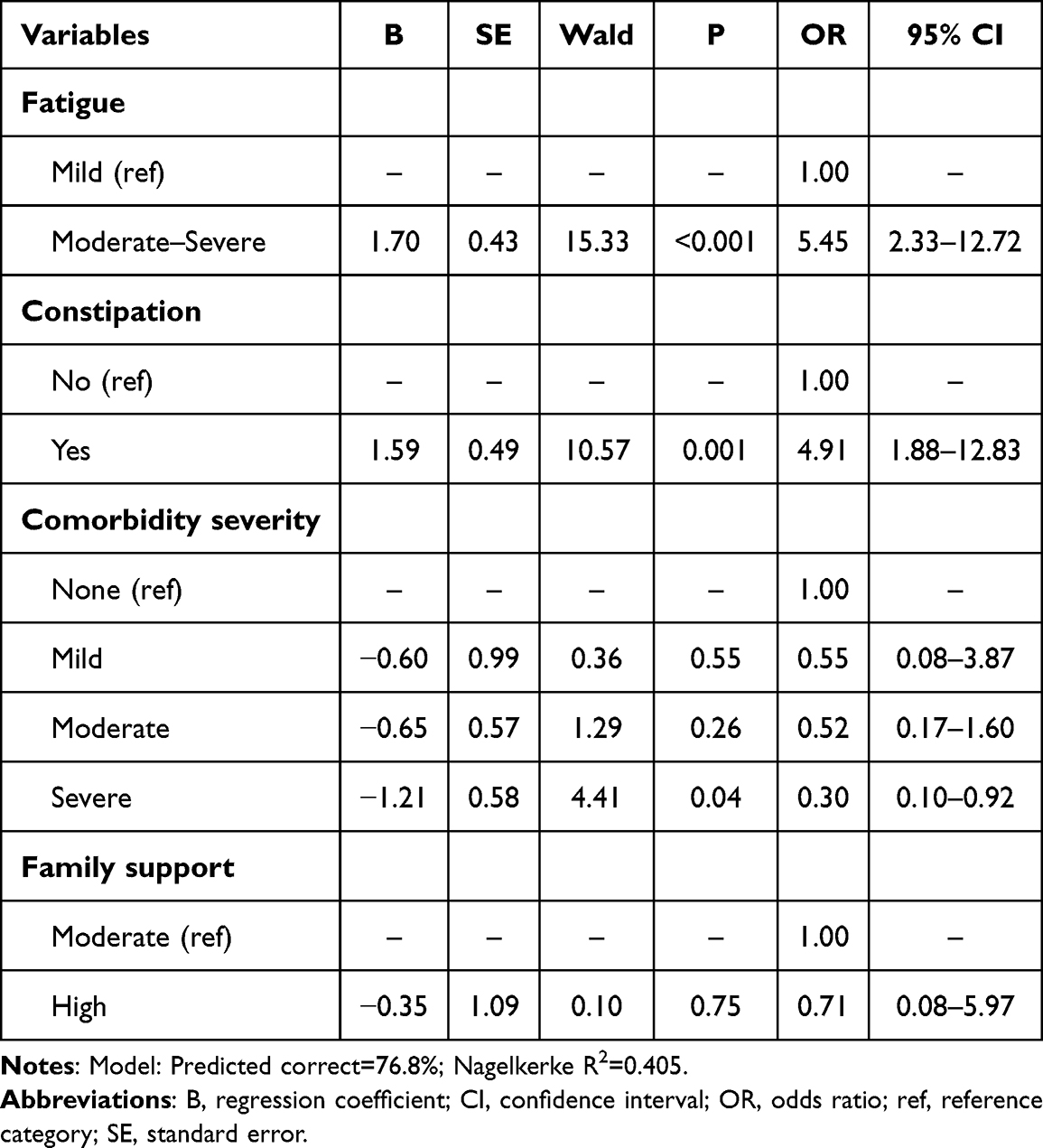 |
Table 4 Multivariable Binary Logistic Regression Analysis of Predictors of Malnutrition (N=138) |
Discussion
This study examined the association between fatigue, constipation, comorbidities, and family support with malnutrition among Thai patients with heart failure. Our findings revealed that 39.9% of participants were malnourished or at nutritional risk, with moderate-to-severe fatigue and constipation emerging as significant independent predictors. Together, these factors explained 40.5% of the variance in malnutrition.
The malnutrition prevalence observed in our Thai cohort occupies an intermediate position within the global spectrum of HF-related malnutrition. While lower than East Asian cohorts in Japan and China (approximately 50.0%), our rates significantly exceed European populations including Spain (18.6–25.1%) and the United Kingdom (11.0–29.0%).17,23–25 This disparity may reflect differences in body composition, dietary patterns, and healthcare access, suggesting the need for region-specific nutritional screening protocols.
Consistent with the Roy Adaptation Model (RAM), fatigue emerged as the dominant focal stimulus affecting nutritional status. Patients experiencing moderate-to-severe fatigue were 5.45 times more likely to have malnutrition/at risk. Notably, all participants in our study had PFS-12 scores above zero, with 42.7% experiencing moderate-to-severe levels—substantially higher than international reports. This high prevalence of fatigue among Thai HF patients warrants particular attention. Previous Thai studies have consistently documented high fatigue prevalence in HF populations,26 aligning with our findings and suggesting that fatigue may be particularly problematic in the Thai context.
Several factors may contribute to this phenomenon. First, Thai patients with HF tend to have low physical activity levels. A recent study by Lobyam et al (2023) found that Thai HF patients had physical activity levels below recommended thresholds (Mean = 588.49 MET, SD = 574.89), with kinesiophobia—fear of movement—identified as a significant negative predictor of physical activity (OR = 2.877, 95% CI 1.32–6.27).27 This fear of movement, often rooted in beliefs that rest protects the heart, can lead to a deconditioning cycle that paradoxically worsens fatigue. The cultural concept of “kreng jai” (reluctance to burden others) may also influence how Thai patients report and manage symptoms, potentially leading to delayed intervention.28
Furthermore, the high prevalence of anemia in our cohort (47.1%) may compound fatigue severity. Anemia impairs oxygen delivery to tissues, exacerbating the energy deficit already present in HF. Importantly, anemia in HF patients often remains undertreated, as clinical attention focuses primarily on cardiac function rather than hematological optimization.29 Notably, anemia prevalence differed substantially by sex in our cohort: 60.8% of female participants (31/51; Hb < 12 g/dL) versus 39.1% of male participants (34/87; Hb < 13 g/dL) were anemic. The combination of reduced physical activity, untreated anemia, and inadequate symptom management creates conditions that perpetuate fatigue and consequently impair nutritional status.
Unlike European settings where structured fatigue management programs are increasingly available, Thai HF care remains predominantly focused on pharmacological therapy. Furthermore, cardiac rehabilitation programs are highly centralized in major Bangkok hospitals, restricting access for provincial patients.30,31
Our findings also identified constipation as a significant independent predictor of malnutrition. The constipation prevalence of 31.2% in our cohort exceeds the 22.0% reported in a Japanese nationwide database study of 556,792 HF patients,32 suggesting a substantial burden in the Thai population. Within the RAM framework, constipation serves as a contextual stimulus arising from the intersection of aging (70.3% aged ≥60 years), loop diuretic use (37%), and limited physical activity engagement.
Lifestyle factors common among Thai elderly, including inadequate fiber intake and fluid restriction counseling for HF management, may further contribute to constipation prevalence.33 Constipation is rarely systematically screened in Thai HF outpatient clinics and is often normalized by elderly patients as an expected consequence of aging. This lack of routine screening means that constipation-related nutritional decline may progress undetected, as constipation may both reduce appetite and perpetuate gut dysfunction that impairs nutrient absorption.34
Despite significant bivariate associations, comorbidity severity did not independently predict malnutrition in our multivariable model. According to RAM’s concept of stimulus hierarchy, when confronting severe focal stimuli such as fatigue, adaptive resources prioritize immediate challenges, diminishing the relative influence of residual stimuli like comorbidities.13 Our predominantly NYHA Class II–III population (79%) may also have contributed to this finding.
Family support, though high in 95.7% of participants, neither correlated with nor predicted malnutrition. This ceiling effect limited statistical power to detect associations. Our observations suggest that family support content was often misaligned with nutritional needs—families prioritized medical appointments (57.2%) and medication adherence (43.5%) over dietary adequacy (39.1%), focusing on sodium restriction rather than ensuring adequate caloric and protein intake. Since all patients with malnutrition were previously undiagnosed, families lacked awareness of the nutritional problems requiring intervention.35
Multidisciplinary Implications
The findings of this study provide actionable insights for multidisciplinary HF care. Cardiovascular nurses play a central role in systematically screening for fatigue and constipation during outpatient visits, enabling early identification of patients at nutritional risk. Dietitians can develop targeted interventions that shift the focus from isolated sodium restriction toward ensuring adequate caloric and protein intake. Gastroenterologists may collaborate to integrate bowel management protocols into HF care pathways. Furthermore, cardiologists benefit from recognizing that fatigue and constipation, beyond traditional hemodynamic parameters, are significant predictors of nutritional decline. Physical therapists can address kinesiophobia by designing culturally tailored exercise programs, such as temple-based (wat) initiatives, to break the fatigue-deconditioning cycle. Finally, family education should be expanded to include the recognition of early nutritional warning signs. This collaborative, team-based approach is essential for comprehensive HF management and improving clinical outcomes.
Strengths and Limitations
This study has several strengths, including its focus on an understudied Thai HF population, the use of validated instruments with established Thai psychometric properties, standardized data collection by a single researcher (RH) to minimize interviewer bias, and the application of a coherent theoretical framework. However, several limitations warrant consideration. The cross-sectional design precludes causal inference regarding temporal relationships between predictors and malnutrition. Convenience sampling from a single tertiary hospital may limit generalizability to community-dwelling HF patients or those in primary care settings, and may not fully represent patients from rural areas, other healthcare levels, or different socioeconomic and cultural contexts, thereby limiting the external validity of the findings. The ceiling effect in family support scores may have masked true associations. Although depression was not assessed using a dedicated screening instrument (eg, PHQ-9), the MNA-SF includes an item evaluating neuropsychological problems (including depression), and patients with physician-documented psychiatric diagnoses were identified during medical record review. Additionally, dietary intake patterns and medication adherence were not directly assessed, which may represent unmeasured confounding factors. Furthermore, other potentially relevant psychosocial and behavioral factors, such as severity of depressive symptoms and lifestyle-related influences, were not comprehensively measured and may have influenced the observed associations. Subgroup analyses by HF subtypes (HFrEF, HFpEF) were not performed due to the limited sample size.
Clinical Implications
These findings have important implications for nursing practice. First, routine screening for fatigue severity using validated instruments should be incorporated into outpatient HF care, with moderate-to-severe fatigue triggering comprehensive nutritional assessment. Interventions addressing kinesiophobia and promoting appropriate physical activity should be developed, potentially utilizing community resources such as temple-based (wat) exercise programs that are culturally acceptable and accessible.27 Second, systematic constipation screening using Rome IV criteria should be integrated into standard HF care protocols. Third, family education should expand beyond traditional disease management to include recognition of nutritional decline and understanding that adequate caloric and protein intake is as important as sodium restriction. Mobile health applications such as LINE, widely used in Thailand, could facilitate symptom monitoring and early intervention.36
Future research should employ longitudinal designs to establish temporal relationships between fatigue, constipation, and malnutrition. Randomized controlled trials evaluating nurse-led interventions targeting the fatigue-constipation-nutrition axis are urgently needed. Qualitative exploration of cultural and dietary factors specific to Thai HF patients would inform culturally appropriate intervention development.
Conclusions
This study reveals that 39.9% of Thai HF outpatients were malnourished or at nutritional risk. Moderate-to-severe fatigue and constipation were significant independent predictors, together explaining 40.5% of the variance. These findings underscore the importance of integrating routine fatigue and constipation screening into outpatient HF care to enable early identification and intervention for nutritional decline in this vulnerable population.
Abbreviations
ACEI, angiotensin-converting enzyme inhibitors; ARB, angiotensin II receptor blockers; ARNI, angiotensin receptor-neprilysin inhibitor; BMI, body mass index; CCI, Charlson Comorbidity Index; CI, confidence interval; HF, heart failure; HFmrEF, heart failure with mildly reduced ejection fraction; HFpEF, heart failure with preserved ejection fraction; HFrEF, heart failure with reduced ejection fraction; ICC, intraclass correlation coefficient; IQR, interquartile range; LVEF, left ventricular ejection fraction; MNA-SF, Mini Nutritional Assessment-Short Form; MRAs, mineralocorticoid receptor antagonists; NYHA, New York Heart Association; OR, odds ratio; PFS-12, Piper Fatigue Scale-12; RAAS, renin-angiotensin-aldosterone system; RAM, Roy Adaptation Model; SD, standard deviation.
Data Sharing Statement
The datasets used and/or analyzed during the current study are available from the corresponding author on reasonable request, subject to ethical approval.
Ethics Approval and Informed Consent
This study was approved by Mahidol University Faculty of Nursing Institutional Review Board (IRB-NS2022/698.2106) and the study hospital ethics committee (043/2022). Written informed consent was obtained from all participants. All procedures performed in this study were in accordance with the ethical standards of the institutional review board and with the 1964 Helsinki Declaration and its later amendments.
Acknowledgments
The authors thank all participants and healthcare staff at the study hospital for their cooperation.
Author Contributions
All authors made a significant contribution to the work reported, whether that is in the conception, study design, execution, acquisition of data, analysis and interpretation, or in all these areas; took part in drafting, revising or critically reviewing the article; gave final approval of the version to be published; have agreed on the journal to which the article has been submitted; and agree to be accountable for all aspects of the work. RH: conceptualization, methodology, data collection, formal analysis, writing—original draft, writing—review and editing. AP: conceptualization, methodology, formal analysis, supervision, writing—original draft, writing—review and editing. AS: conceptualization, methodology, formal analysis, supervision, writing—review and editing.
Funding
This research received no specific grant from any funding agency in the public, commercial, or not-for-profit sectors.
Disclosure
The authors declare that they have no competing interests in this work.
References
1. Groenewegen A, Rutten FH, Mosterd A, Hoes AW. Epidemiology of heart failure. Eur J Heart Fail. 2020;22(8):1342–11. doi:10.1002/ejhf.1858
2. Yingchoncharoen T, Wu TC, Choi DJ, et al. Economic burden of heart failure in Asian countries with different healthcare systems. Korean Circ J. 2021;51(8):681–693. doi:10.4070/kcj.2021.0029
3. Hu X, Sang Y, Yang M, Chen X, Tang W. The prevalence of malnutrition and its effects on the all-cause mortality among patients with heart failure: a systematic review and meta-analysis. PLoS One. 2021;16(10):e0259300. doi:10.1371/journal.pone.0259300
4. Damnong N, Tanatwanit Y . Factors influencing functional status among heart failure patients. J Prapokklao Hosp Clin Med Educ Cent. 2020;37(4):334–342. Thai.
5. Sze S, Pellicori P, Kazmi S, et al. Prevalence and prognostic significance of malnutrition using 3 scoring systems among outpatients with heart failure. JACC Heart Fail. 2018;6(6):476–486. doi:10.1016/j.jchf.2018.02.018
6. Prokopidis K, Irlik K, Hendel M, Piaśnik J, Lip GYH, Nabrdalik K . Prognostic impact and prevalence of cachexia in patients with heart failure: a systematic review and meta-analysis. J Cachexia Sarcopenia Muscle. 2024;15(6):2536–2543. doi:10.1002/jcsm.13596.
7. Sundaram V, Fang JC. Gastrointestinal and liver issues in heart failure. Circulation. 2016;133(17):1696–1703. doi:10.1161/CIRCULATIONAHA.115.020894
8. von Haehling S, Ebner N, Dos Santos MR, Springer J, Anker SD. Muscle wasting and cachexia in heart failure: mechanisms and therapies. Nat Rev Cardiol. 2017;14(6):323–341. doi:10.1038/nrcardio.2017.51
9. Agra Bermejo R, González-Ferreiro R, Varela-Román A, et al. Nutritional status is related to heart failure severity and hospital readmissions in acute heart failure. Int J Cardiol. 2020;308:84–90. doi:10.1016/j.ijcard.2020.01.032
10. Kinugasa Y, Kato M. Malnutrition in heart failure: review and future research. J Cardiol. 2018;72(2):88–93.
11. Anker SD, Comin Colet J, Filippatos G, et al. Ferric carboxymaltose in patients with heart failure and iron deficiency. N Engl J Med. 2009;361(25):2436–2448. doi:10.1056/NEJMoa0908355
12. Kałużna-Oleksy M, Krysztofiak H, Migaj J, et al. Relationship between nutritional status and clinical and biochemical parameters in hospitalized patients with heart failure with reduced ejection fraction, with 1-year follow-up. Nutrients. 2020;12(8):2330. doi:10.3390/nu12082330.
13. Roy C, Andrews HA. The Roy Adaptation Model.
14. Trongsakul S, Lambert R, Clark A, Wongpakaran N, Cross J. Development of the Thai version of Mini-Cog. Geriatr Gerontol Int. 2015;15(5):594–600. doi:10.1111/ggi.12318
15. Jeong E, Kim JA, Kim BS, Lee CK, Kim M, Won CW. Functional constipation and anorexia in community-dwelling older adults: Korean Frailty and Aging Cohort Study (KFACS). Int J Environ Res Public Health. 2021;18(11):5754. doi:10.3390/ijerph18115754
16. Rubenstein LZ, Harker JO, Salva A, Guigoz Y, Vellas B. Screening for undernutrition in geriatric practice: developing the short-form mini-nutritional assessment (MNA-SF). J Gerontol a Biol Sci Med Sci. 2001;56(6):M366–M372. doi:10.1093/gerona/56.6.M366
17. Sze S, Pellicori P, Zhang J, Wong JKY, Clark AL. The impact of malnutrition on short-term morbidity and mortality in ambulatory patients with heart failure. Am J Clin Nutr. 2020;113(3):695–705. doi:10.1093/ajcn/nqaa311
18. Reeve BB, Stover AM, Alfano CM, et al. The Piper Fatigue Scale-12 (PFS-12): psychometric findings and item reduction in a cohort of breast cancer survivors. Breast Cancer Res Treat. 2012;136(3):619–620. doi:10.1007/s10549-012-2212-4
19. Palsson OS, Whitehead WE, van Tilburg MAL, et al. Development and validation of the Rome IV diagnostic questionnaire for adults. Gastroenterology. 2016;150(6):1481–1491. doi:10.1053/j.gastro.2016.02.014
20. Charlson ME, Pompei P, Ales KL, MacKenzie CR. A new method of classifying prognostic comorbidity in longitudinal studies: development and validation. J Chronic Dis. 1987;40(5):373–383. doi:10.1016/0021-9681(87)90171-8
21. Smilkstein G, Ashworth C, Montano D. Validity and reliability of the family APGAR as a test of family function. J Fam Pract. 1982;15(2):303–311.
22. Malathum P. A Model of Factors Contributing to Perceived Abilities for Health-Promoting Self-Care of Community-Dwelling Thai Older Adults [dissertation]. Austin: University of Texas; 2001.
23. Kinugasa Y, Kato M, Sugihara S, et al. Prevalence and prognostic significance of protein-energy malnutrition among hospitalized heart failure patients. Circ Heart Fail. 2022;15(2):e008957.
24. Liang L, Zhao X, Huang L, et al. Prevalence and prognostic importance of malnutrition, as assessed by four different scoring systems, in elder patients with heart failure. Nutr Metab Cardiovasc Dis. 2023;33(5):978–986. doi:10.1016/j.numecd.2023.01.004.
25. Esteban-Fernández A, Ruiz-Ortega J, Pérez-Calvo JI. Malnutrition in Spanish heart failure patients. Rev Esp Cardiol. 2023;76(4):285–293.
26. Kornkasom A, Wattanakitkrilert D, Pongthavornkamol K, Kanoksilp A. Fatigue experience, symptom management strategies and functional status in patients with heart failure. J Nurs Sci. 2014;32(4):35–42.
27. Lobyam C, Poungkaew A, Wattanakitkrileart D, Chirakarnjanakorn S. Factors predicting physical activity in patients with heart failure. Thai J Nurs. 2023;38(1):112–128.
28. Chiaranai C. A phenomenological study of day-to-day experiences of living with heart failure. J Cardiovasc Nurs. 2014;29(4):E1–E8. doi:10.1097/JCN.0000000000000105
29. McDonagh TA, Metra M, Adamo M, et al. 2021 ESC guidelines for the diagnosis and treatment of acute and chronic heart failure. Eur Heart J. 2021;42(36):3599–3726. doi:10.1093/eurheartj/ehab368
30. Heart Association of Thailand. Guidelines for Diagnosis and Treatment of Heart Failure 2019. Bangkok: Heart Association of Thailand; 2019.
31. Poungkaew A, Sindhu S, Pinyopornpanich P, Tresukosol D, Viwatwongkasem C. Evaluation of a health service system for heart failure management in Thailand. Suranaree J Sci Technol. 2018;25(3):295–306.
32. Isogai T, Morita K, Okada A, et al. Association between coexisting constipation and heart failure readmission in patients with heart failure — a nationwide database study. Circ Rep. 2024;6(11):529–535. doi:10.1253/circrep.CR-24-0060
33. Aekplakorn W, Puckcharern H, Satheannoppakao W, editors . Thai National Health Examination Survey, NHES VI (2019–2020). Bangkok: Faculty of Medicine Ramathibodi Hospital, Mahidol University; 2021.
34. Pimentel M, Saad RJ, Long MD, Rao SSC. ACG clinical guideline: small intestinal bacterial overgrowth. Am J Gastroenterol. 2020;115(2):165–178. doi:10.14309/ajg.0000000000000501
35. Kinugasa Y, Kato M, Suzuki N, Greenberg BH, Akashi YJ. Nutritional management of heart failure. J Cardiol. 2022;81(3):283–291. doi:10.1016/j.jjcc.2022.11.001
36. Panyapat J, Tangkittikasem T, Boonyapiphat T, Senthong V, Torpongpun A. Real-world heart failure burden in Thai patients. Cardiol Ther. 2024. doi:10.1007/s40119-024-00355-8
 © 2026 The Author(s). This work is published and licensed by Dove Medical Press Limited. The
full terms of this license are available at https://www.dovepress.com/terms
and incorporate the Creative Commons Attribution
- Non Commercial (unported, 4.0) License.
By accessing the work you hereby accept the Terms. Non-commercial uses of the work are permitted
without any further permission from Dove Medical Press Limited, provided the work is properly
attributed. For permission for commercial use of this work, please see paragraphs 4.2 and 5 of our Terms.
© 2026 The Author(s). This work is published and licensed by Dove Medical Press Limited. The
full terms of this license are available at https://www.dovepress.com/terms
and incorporate the Creative Commons Attribution
- Non Commercial (unported, 4.0) License.
By accessing the work you hereby accept the Terms. Non-commercial uses of the work are permitted
without any further permission from Dove Medical Press Limited, provided the work is properly
attributed. For permission for commercial use of this work, please see paragraphs 4.2 and 5 of our Terms.
Recommended articles

Prognostic Nutritional Index (PNI) as a Predictor in Patients with Metabolic Syndrome and Heart Failure
Zhang X, Zhang J, Liu F, Li W, Zhang T, Fang B, Zhang Z, Xie Q, Yang Y, Li X
Diabetes, Metabolic Syndrome and Obesity 2023, 16:2503-2514
Published Date: 18 August 2023