
Back to Journals » Advances in Medical Education and Practice » Volume 17
Exploring Faculty Development Initiatives at Avalon University School of Medicine: A Case Study
Authors Arja SB  , Kottath Veetil P , Paramban S , Ibikunle I , Abedelbaky MF, Arja SB
Received 21 May 2026
Accepted for publication 8 July 2026
Published 10 July 2026 Volume 2026:17 626534
DOI https://doi.org/10.2147/AMEP.S626534
Checked for plagiarism Yes
Review by Single anonymous peer review
Peer reviewer comments 5
Editor who approved publication: Dr Md Anwarul Azim Majumder
Sateesh B Arja,1 Praveen Kottath Veetil,1,2 Simi Paramban,1 Ibrahim Ibikunle,1 Mohamed Fakhry Abedelbaky,3 Sireesha Bala Arja1,4
1Medical Education Department, Avalon University School of Medicine, Willemstad, Curacao, Netherlands Antilles; 2Human Structure and Function Department, Avalon University School of Medicine, Willemstad, Curacao, Netherlands Antilles; 3Molecular Basis of Medicine Department, Avalon University School of Medicine, Willemstad, Curacao, Netherlands Antilles; 4Diseases, Immunity, and Therapeutics Department, Avalon University School of Medicine, Willemstad, Curacao, Netherlands Antilles
Correspondence: Sateesh B Arja, Medical Education Department, Avalon University School of Medicine, Willemstad, Curacao, Netherlands Antilles, Tel +1 234-367-0431, Email [email protected]
Introduction: As medical education shifts toward competency-based curricula, faculty must navigate evolving expectations for teaching, mentoring, assessment, and scholarship. Despite their central role in training future health professionals, medical educators often face ambiguity regarding career advancement through teaching. Promotion criteria in academic institutions are frequently research-focused, leaving faculty unclear about how to document and demonstrate teaching excellence and educational innovation. This gap can hinder motivation, professional identity, and faculty retention. This study aims to explore the faculty development activities at Avalon University School of Medicine, a Caribbean medical school.
Methods: This is a descriptive case study examining outcomes, including scholarly output, faculty ranking promotions, and fellowships, following the implementation of faculty development activities. Over 10 years, 20 medical educators involved in preclinical teaching were included in this study. They participated in various faculty development activities, including teaching, designing assessments, delivering effective feedback, developing curricula, and applying medical education research methodologies. Faculty members reflected on and practiced these practices in their teaching methods, assessment practices, and research in medical education.
Results: A total of eight faculty members received the Academy of Medical Educators (AoME) Fellowship. Four faculty members completed the IAMSE fellowship. One received the AMEE fellowship, and another received an associate fellowship. One received the AdvanceHE fellowship, and another received a principal fellowship. During these 10 years, 42 publications by faculty members in peer-reviewed journals in educational research were published, 26 abstracts were accepted at International medical education conferences, and 8 faculty members were promoted in faculty rankings.
Conclusion: The findings from this case study indicate that the faculty development initiatives implemented at AUSOM were associated with enhanced faculty engagement in educational scholarship, professional recognition through educator fellowships, and academic career advancement. This experience suggests how a structured, longitudinal faculty development program can support faculty capacity building.
Keywords: faculty development, CPD, scholarship, teaching, learning, medical educator fellowship
Introduction/Background
Across the globe, health professions education is undergoing a paradigm shift toward competency-based curricula, blending technology-enhanced education and training, and outcome-based learning. Within this changing backdrop, faculty members play a crucial role not only as educators but also as facilitators, health professions education researchers, mentors, curriculum designers and planners, assessors, and academic leaders.1,2 However, despite their central importance, many health professions educators face challenges in aligning their teaching contributions with institutional promotion and tenure criteria, which traditionally emphasize biomedical research and scholarly metrics over educational excellence.3
Traditionally, promotion and tenure practices in academic medicine prioritize biomedical research output over contributions to teaching.3 This creates a disconnect between institutional expectations and the daily responsibilities of faculty who are primarily engaged in educating and training learners. As a result, educators often struggle to document their achievements in teaching, curriculum innovation and development, and academic service in ways that are recognized and rewarded. The lack of clarity about how teaching excellence translates into academic promotion can undermine faculty motivation and enthusiasm, professional identity, and retention.3,4 Previous studies have shown that transforming teaching into scholarly work or scholarship can bridge this gap by aligning educational practice with academic expectations.5
The theoretical foundation of this study is grounded in Boyer’s model of scholarship, which expands the traditional definition of scholarship beyond discovery to include teaching, integration, and application.5 This framework positions teaching as a scholarly activity that can be systematically studied, improved, and disseminated.5 In health professions education, this perspective is particularly valuable because teaching requires integrating content expertise, pedagogy, and learner-centred approaches. By adopting Boyer’s framework, faculty development programs can encourage health professions educators to document their teaching practices, conduct educational research, and share their findings through scholarly platforms.
Additionally, adult learning theory aligns the design of faculty development initiatives. Faculty members, as adult learners,6 benefit from experiential learning, reflective practice, and collaborative engagement. These principles underpin effective faculty development programs that promote continuous professional development and professional growth. In health professions education, this perspective is particularly relevant, as teaching involves complex interactions between content expertise, instruction, and learner engagement. By adopting Boyer’s framework, faculty development programs can transform teaching from a routine activity into a scholarly one,5 recognize teaching excellence through a fellowship program, and thereby align it with institutional expectations for academic advancement.
Faculty development initiatives that integrate teaching, research, assessment, and leadership provide health professions educators with a pathway to build professional identity and advance their careers. Within Boyer’s framework,7 educational scholarship extends beyond classroom teaching to include the dissemination of educational innovations, curriculum development, and scholarly inquiry into teaching and learning. Therefore, scholarly publications, presentations at medical education conferences, educator fellowships, and academic promotions were selected as indicators of faculty development because they represent internationally recognized measures of educational scholarship, professional recognition, and career advancement.
Although faculty development has been widely studied in North America, Europe, and Australia, relatively little has been published describing the implementation and outcomes of comprehensive faculty development initiatives within Caribbean medical schools.8 There is limited evidence documenting how structured faculty development programs are associated with scholarly productivity, educator fellowship attainment, and academic promotion in this regional context. Addressing this gap is important because Caribbean medical schools operate within unique institutional environments and may require context-specific approaches to faculty development and academic career advancement. Against this background, this study addresses an important gap by describing the faculty development initiatives implemented at Avalon University School of Medicine, a Caribbean medical school, and exploring the associated outcomes over a ten-year period.
This study explores systematic faculty development activities, exemplified by those implemented at Avalon University School of Medicine (AUSOM). The faculty development initiatives at AUSOM were informed by these complementary theoretical perspectives. Boyer’s model provided the framework for encouraging faculty to transform teaching activities into educational scholarship, whereas adult learning theory informed the design of faculty development activities through experiential learning, reflective practice, collaborative learning, and authentic workplace application. Together, these frameworks guided both the structure of the faculty development initiatives and the outcomes evaluated in this study. This study explores how targeted interventions can promote scholarly engagement and facilitate professional recognition through international fellowships. The faculty perceptions and survey responses were published after the implementation of the faculty development activities at AUSOM.8 However, this current study is not intended to collect faculty members’ perceptions and self-reported experiences regarding faculty development activities, nor to assess improvements in students’ satisfaction rates or course evaluations. The objective of this study is to examine the outcomes, such as scholarly output, educator fellowships, and academic promotions, of faculty members after implementing the faculty development activities.
Methods
This is a descriptive case study; we conducted a retrospective evaluation that examined and used data from faculty records, including faculty curriculum vitae, scholarly activities, promotional records, and faculty development activities. Avalon University School of Medicine systematically implemented faculty development activities. It started with various online courses offered by the International Association of Health Professions Education (AMEE), the International Association of Medical Science Educators (IAMSE) fellowship program, internal workshops and webinars/presentations, and applications to various fellowship programs.
Institutional Setting
AUSOM, based in Curaçao, is a Caribbean medical school offering a Doctor of Medicine (MD) program. The curriculum includes two years of basic science (preclinical) instruction delivered on the island, followed by clinical rotations completed at affiliated teaching hospitals in the United States.
Over 10 years, 20 medical educators involved in preclinical teaching were included in this study, from 2015 to 2025. All faculty involved in teaching biomedical sciences/the preclinical phase were included. It is a small program with 20 faculty members who have taught biomedical sciences over the past 10 years. All faculty were eligible to be enrolled in the faculty development activities. Most of the faculty members were novices in medical education and educational research at the start of these faculty development activities, as indicated by their baseline CVs submitted before their teaching careers at AUSOM, even though they are all formal faculty members of medicine. However, all the faculty were enrolled in faculty development activities to ensure they were abreast of contemporary teaching and assessment methods, as well as needs analysis. Some of these faculty members might have left the university during this period. However, the total number of faculty members involved in this study was twenty. Only faculty development activities completed and achievements achieved during this ten-year period at the AUSOM were counted.
Data Collection
The data were collected from faculty development activities compiled annually by the medical education department and the dean’s office; faculty resumes updated annually; promotional records compiled by the dean’s office and the president’s office; and faculty scholarly activities, including publications and conference presentations. The faculty are required to submit the list of publications and conference presentations annually to the research and ethics committee of AUSOM and the dean’s office.
Please refer to Table 1 for the faculty development activities conducted over the last 10 years.
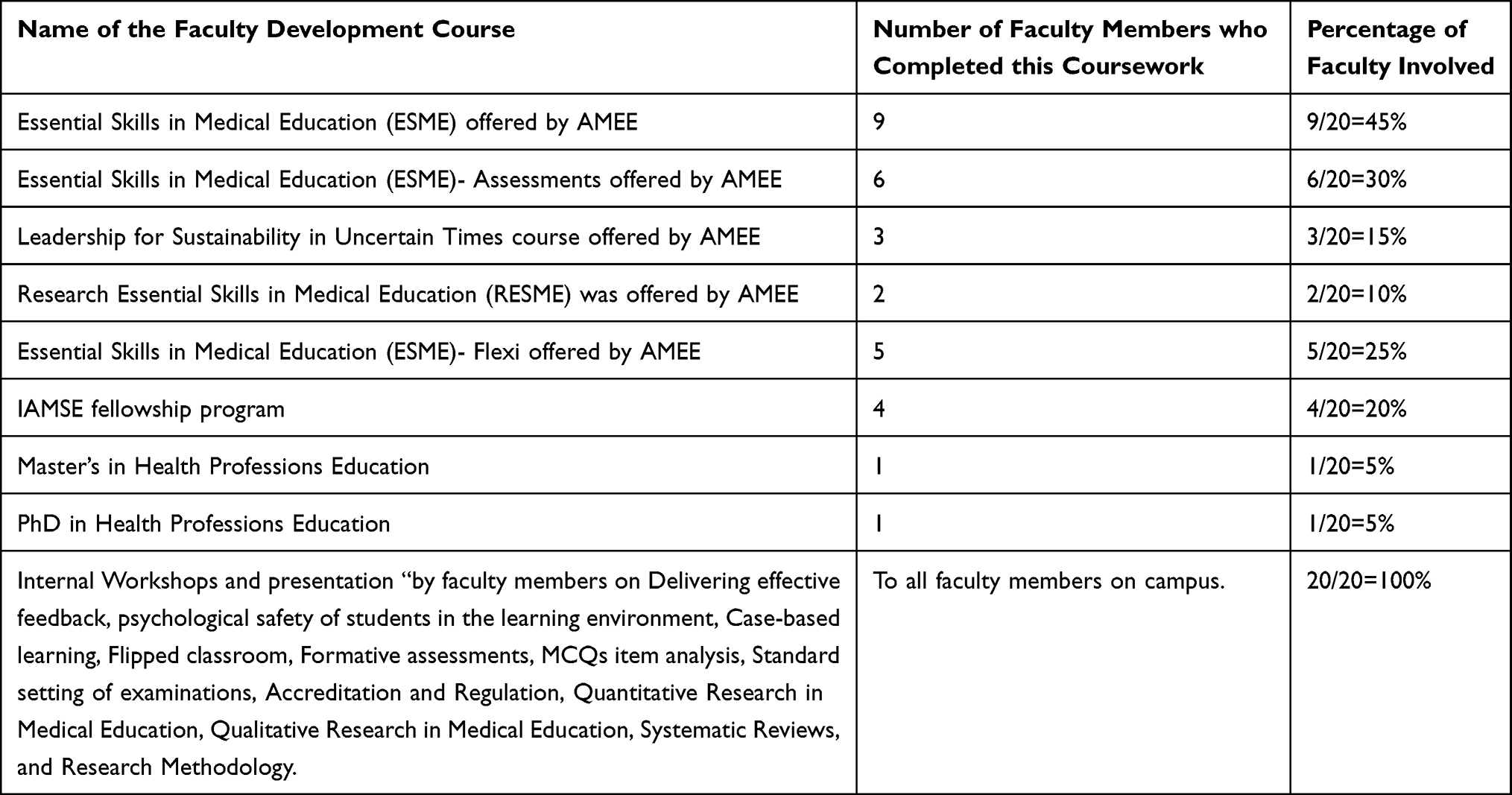 |
Table 1 Faculty Development Courses Done by Different Faculty Members Between 2015 and 2025 |
The Essential Skills in Medical Education (ESME) course covers the role of the trainer/teacher in health care professions; learning outcomes/competencies; curriculum development and implementation; feedback; activities; individualization; and relevance (FAIR) principles; teachers’ Toolkit (large-group teaching versus small-group discussions); and assessments. ESME-Assessment covered the principles of assessment: validity, reliability, and blueprinting; multiple-choice questions (MCQs); objective structured clinical examinations (OSCEs); workplace-based assessments (WPBA); standard setting of examination procedures; and quality assurance of assessment. ESME-Flexi coursework covers the following: Roles of the Teacher; Designing and Planning Learning; Teaching and Facilitating Learning; Supporting Learners; Assessment; and Educational Leadership and Management/Equity, Diversity and Inclusivity.
The Leadership and Management course consists of modules on leading at the edge of uncertainty, working better together, finding the fix that fits, and making the good better. Research Essential Skills in Medical Education (RESME) consists of: From idea to research question, situating your question in the literature: “joining the conversation”. Ontology, epistemology, and worldview; Study design, methods, and analysis; Ethical considerations; and preparing a research protocol. The IAMSE fellowship program consists of completing an AMEE ESME program, completing two day-long faculty development courses, or completing 12 hours of faculty development activities, and completing a project that results in educational scholarship9 and demonstrates the application of content themes at the participant’s home institution.
Results
Since the implementation of faculty development activities, the faculty have implemented contemporary teaching and assessment methods reflectively in their daily practices. These results were reflected in course evaluations. Student satisfaction increased, as reflected in our course evaluations. However, the intention of this study is not to report the improvements in course evaluations. After participating in faculty development activities, the faculty members joined international networks, including the Academy of Medical Educators (AoME), AMEE, AdvanceHE, and IAMSE and attained fellowships and associate fellowships. Please refer to Table 2 for the fellowships obtained by faculty members over the last 10 years following the implementation of the faculty development activities. The five domains of the Academy of Medical Educators, UK, for fellowship include designing and planning learning; teaching and facilitating learning; assessment of learning; educational scholarship and evidence-based practice; and educational management and leadership.10 The professional framework for FHEA includes domains such as learning design and planning teach and/or support learning, assess and give feedback to learners, develop effective learning environments and approaches to student support and guidance, and engage in continuing professional development in subjects/disciplines and their pedagogy, incorporating research, scholarship and the evaluation of professional practices.11 The IAMSE fellowship requires completion of a project that results in educational scholarship and demonstrates the application of content themes at the home institution (AUSOM), along with completion of the ESME course and two-day faculty development courses, or 12 hours of faculty development activities.9
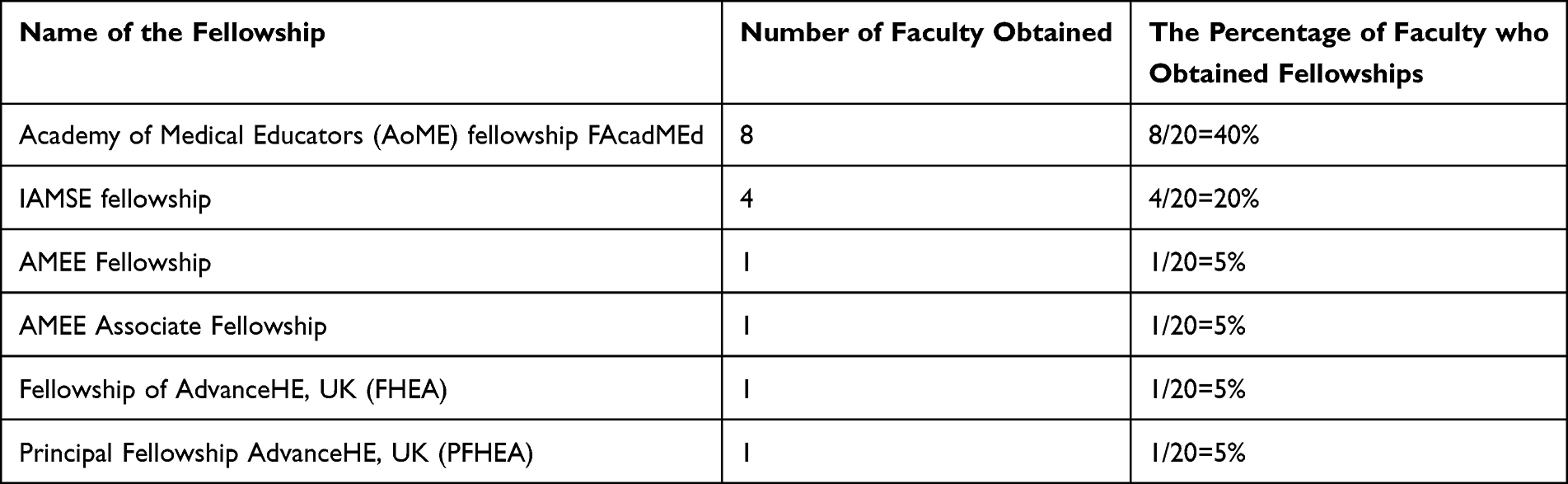 |
Table 2 The List of Fellowships and Associate Fellowships Obtained by Faculty Members (2015–2025) Out of a Total of Twenty Faculty Members |
Please refer to Table 3 for faculty promotions over the last 10 years for these 20 faculty members; 8 received promotions.
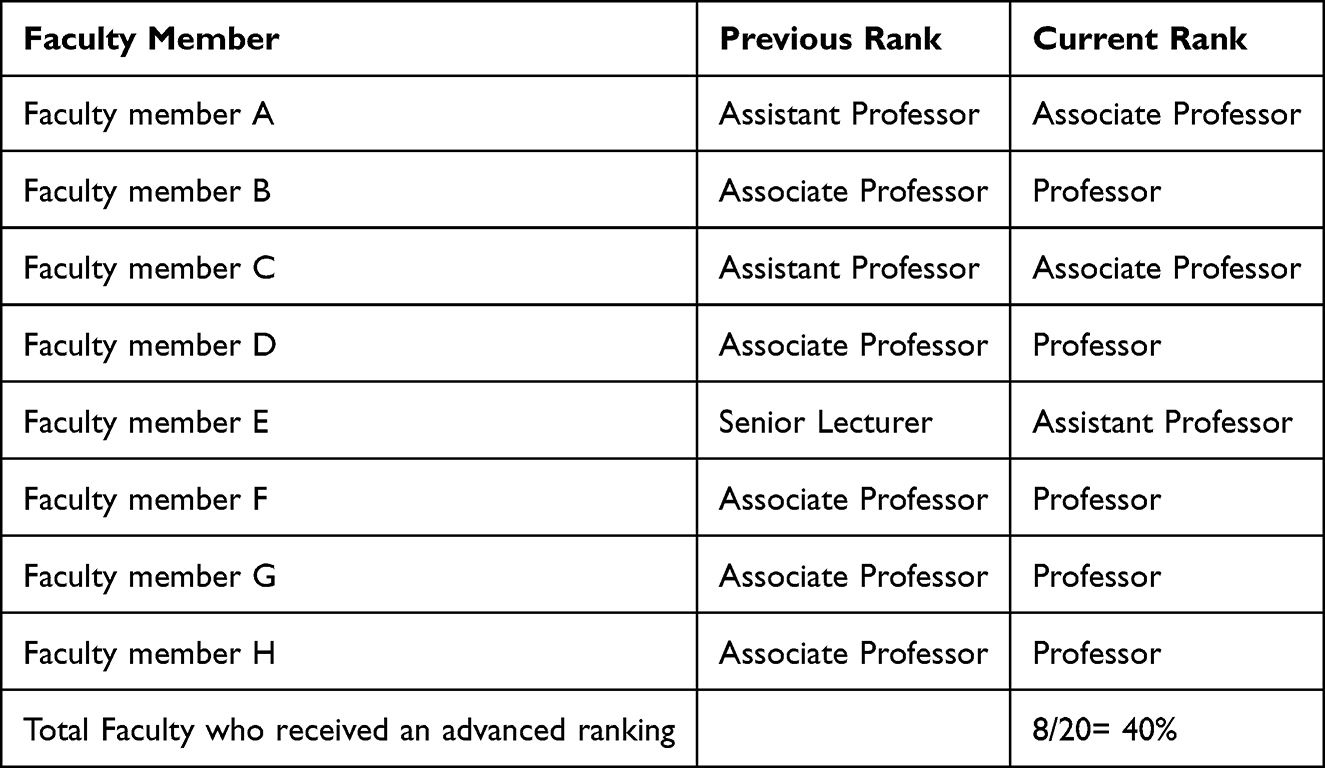 |
Table 3 The Number of Faculty Members Who Got Academic Promotion (2015–2025) from the List of These Twenty Faculty Members |
In addition to the fellowships, the faculty published 42 papers in peer-reviewed journals (please refer to Appendix A) on educational research over the last ten years and gave 26 oral and poster presentations (please refer to Appendix B) at the International Medical Education Conference over the same period. Please refer to Appendices A and B.
Discussion
This study reinforces a longstanding concern in health professions education: the insufficient alignment between teaching contributions and academic promotion practices. Traditional promotion frameworks in academic medicine continue to privilege research productivity and research output over teaching contributions, often leaving teaching-focused faculty without clear pathways for promotion and recognition. The findings from this study suggest that comprehensive, structured, and systematic faculty development initiatives in teaching, assessment, and educational research methods can address this imbalance by enabling educators to document, evaluate, and disseminate their teaching practices as scholarly work. This aligns with broader calls in the literature to reconceptualize teaching as a form of scholarship that is evidence-based, peer-reviewed, and publicly shared.12
A notable outcome of this study is the increased attainment of fellowships and professional recognition from international organizations such as AMEE, IAMSE, AoME, and AdvanceHE. These fellowships provide structured frameworks that define standards for teaching excellence, educational leadership and management, and scholarship. Engagement with such frameworks not only validates individual teaching competence but also promotes educators’ professional identity. Previous research has shown that participation in formal recognition programs enhances faculty identity as educators and strengthens institutional teaching excellence and cultures.13,14 Furthermore, these fellowships encourage reflective practice and portfolio development, which are critical for documenting educational impact. For example, the Principal Fellowship (PFHEA) from AdvanceHE in the UK is associated with active commitment to and championing of all dimensions of the framework through work with students and staff, and institutional developments. It is also associated with successful strategic leadership15 to enhance student learning, with a particular, though not exclusive, focus on improving teaching quality in institutional and/or international/national settings. PFHEA also consolidates personal development and evidence of influencing colleagues’ professional practice in higher education.
The incorporation of teaching, assessment, and scholarship observed in this study highlights the effectiveness of comprehensive faculty development models. Programs such as ESME, RESME, and IAMSE fellowships emphasize experiential learning, scholarly work, collaborative work, mentorship, and project-based outcomes, which are broadly regarded as key components of successful faculty development.13 By engaging in these activities, health profession educators (faculty members at Avalon) adopted evidence-based teaching strategies, conducted medical educational research, and contributed to the broader academic community. This supports the notion that faculty development should extend beyond skill acquisition to include the development of scholarly habits and inquiry-based approaches to teaching.16 This was demonstrated by the scholarly output of faculty members, including 42 peer-reviewed journal publications in medical education research and 26 oral and poster presentations at international and national medical education conferences.
Another important finding is the emphasis on competency-based education and constructive alignment. Faculty training in curriculum design, assessment methods, blueprinting, and examination standard-setting contributed to more coherent and comprehensive assessment. These approaches are consistent with contemporary recommendations in health professions education, which emphasize aligning learning outcomes, instructional methods, and assessment strategies to ensure meaningful constructive alignment.17,18
Leadership development also emerged as a significant benefit of the faculty development initiatives. Faculty members increasingly participated in governance, university standing committees, curriculum committees, and self-study and accreditation processes, indicating a shift toward wider institutional engagement. Effective faculty development programs are known to cultivate leadership skills by fostering problem-solving, collaboration, critical thinking, and strategic planning capabilities13,19,20 Such outcomes are essential for building institutional capacity and sustaining educational innovation in rapidly evolving academic environments.
Despite these positive outcomes, several challenges remain. Time constraints, competing tasks, and variability in faculty engagement were identified as barriers to participation. These findings are consistent with existing literature, which emphasizes that institutional support, including protected time, recognition, and incentives, is critical for the success of faculty development programs.21 Without such support, even well-designed programs may struggle to achieve sustained impact.
Limitations
This study has limitations that should be considered when interpreting the findings. The relatively small sample size and single institution may limit generalizability. Additionally, the retrospective design does not allow for causal inference regarding the relationship between faculty development activities and outcomes such as promotions or fellowship attainment. Future research should explore multi-institutional and longitudinal approaches to better understand the long-term impact of faculty development activities on academic careers and faculty advancement. The other limitation is that although the study is based on objective institutional records, including faculty curriculum vitae, scholarly outputs, fellowship attainment, and academic promotion records, we acknowledge that institutional affiliation may introduce reporting bias.
Future Implications
- Structured, longitudinal faculty development aligned with competency-based medical education enhances educators’ confidence in teaching and assessment skills, and engagement in educational scholarship.
- Institutional investment in protected time and need-based faculty development can support clear pathways for recognition, promotion, and professional advancement in medical education.
- Teaching faculty can adopt Boyer’s framework and engage in educational research.
- Faculty should document teaching excellence and recognition through international fellowship programs for tenure and academic promotion.
Conclusions
This case study explored the faculty development initiatives implemented at Avalon University School of Medicine, a Caribbean medical school, over a 10-year period. The findings associated with AUSOM adopted a structured and comprehensive approach to faculty development through internal workshops, international faculty development programs, educator fellowship pathways, and opportunities for educational scholarship. These initiatives were associated with substantial scholarly productivity, attainment of national and international educator fellowships, and academic promotions among faculty members. The AUSOM experience highlights how a sustained, institutionally supported faculty development strategy can foster educational scholarship, professional recognition, and career advancement within a Caribbean medical school. This case study illustrates how systematic faculty development initiatives can strengthen faculty capacity and advance medical education in similar institutional contexts.
Ethical Approval
The AUSOM Research and Ethics Committee exempted this study from the requirement for ethical approval because it involves no human participants. This study has been conducted in compliance with the Declaration of Helsinki.
Funding
The authors have received no funding.
Disclosure
Dr Sateesh B. Arja is the Associate Editor for the Journal of Advances in Medical Education and Practice. The authors report no other conflicts of interest in this work.
References
1. Schultz KW, Kolomitro K, Koppula S, Bethune CH. Competency-based faculty development: applying transformations from lessons learned in competency-based medical education. Can Med Educ J. 2023;14(5):95–8. doi:10.36834/cmej.75768
2. Frank JR, Snell LS, Cate OT, et al. Competency-based medical education: theory to practice. Med Teach. 2010;32(8):638–645. doi:10.3109/0142159X.2010.501190
3. Sirianni G, Glover Takahashi S, Myers J. Taking stock of what is known about faculty development in competency-based medical education: a scoping review paper. Med Teach. 2020;42(8):909–915. doi:10.1080/0142159X.2020.1763285
4. McCoy L, Diaz SR, Dennis Baker S. The development of a faculty development program framework for medical education. J Med Educ Curric Dev. 2026;13:23821205261439617. doi:10.1177/23821205261439617
5. Colbert-Getz J, Shaffer K, Chow C. Taking the scholarly practice one step further by producing education scholarship. Academic Medicine. 2021;96(4):610. doi:10.1097/ACM.0000000000003536
6. Lippitt GL, Knowles MS, Knowles MS. Andragogy in Action: Applying Modern Principles of Adult Learning. 1984.
7. Boyer EL. Scholarship Reconsidered: Priorities of the Professoriate. Princeton (NJ): Carnegie Foundation for the Advancement of Teaching; 1990.
8. Arja SB, Paramban S, Ponnusamy K, Joseph Nayakanti AR, Fatteh R, Bala Arja S. The systematic approach to faculty development activities for biomedical educators. J Adv Med Educ Professional. 2020;8(3):127–133. doi:10.30476/jamp.2020.84341.1135
9.) International Association of Medical Science Educators. Fellowship program. 2026. Available from: https://www.iamse.org/fellowship-program/.
10. Academy of Medical Educators. AoME professional standards. 4th ed. 2026. Available from: https://medicaleducators.org/write/MediaManager/Documents/Domain_2_AoME_Professional_Standards_4th_edition.pdf.
11. Advance HE. Professional Standards Framework (PSF) 2023. 2026. Available from: https://www.advance-he.ac.uk/teaching-learning/professional-standards-framework.
12. Simpson D, Fincher RM, Hafler JP, et al. Advancing educators and education by defining the components and evidence associated with educational scholarship. Med Educ. 2007;41(10):1002–1009. doi:10.1111/j.1365-2923.2007.02844.x
13. Steinert Y, Mann K, Anderson B, et al. A systematic review of faculty development initiatives designed to enhance teaching effectiveness: a 10-year update: BEME Guide No. 40. Med Teach. 2016;38(8):769–786. doi:10.1080/0142159X.2016.1181851
14. O’Sullivan PS, Irby DM. Reframing research on faculty development. Acad Med. 2011;86(4):421–428. doi:10.1097/ACM.0b013e31820dc058
15. Advance HE. Principal Fellowship. 2026. Available from: https://www.advance-he.ac.uk/fellowship/principal-fellowship.
16. Irby DM, O’Sullivan PS. Developing and rewarding teachers as educators and scholars: remarkable progress and daunting challenges. Med Educ. 2018;52(1):58–67. doi:10.1111/medu.13379
17. Biggs J. Enhancing teaching through constructive alignment. High Educ. 1996;32:347–364. doi:10.1007/BF00138871
18. Harden RM. Developments in outcome-based education. Med Teach. 2002;24(2):117–120. doi:10.1080/01421590220120669
19. Frantz J, Rhoda A, Sandars J, Murdoch-Eaton DB, Marshall M, Burch VC. Understanding faculty development as capacity development: a case study from South Africa. Afr J Health Prof Educ. 2019;11(2):53–56. doi:10.7196/AJHPE.2019.v11i2.1120
20. Frantz JM, Bezuidenhout J, Burch VC, et al. The impact of a faculty development programme for health professions educators in sub-Saharan Africa: an archival study. BMC Med Educ. 2015;15:28. doi:10.1186/s12909-015-0320-7
21. McLean M, Cilliers F, Van Wyk JM. Faculty development: yesterday, today and tomorrow. Med Teach. 2008;30(6):555–584. doi:10.1080/01421590802109834
 © 2026 The Author(s). This work is published and licensed by Dove Medical Press Limited. The
full terms of this license are available at https://www.dovepress.com/terms
and incorporate the Creative Commons Attribution
- Non Commercial (unported, 4.0) License.
By accessing the work you hereby accept the Terms. Non-commercial uses of the work are permitted
without any further permission from Dove Medical Press Limited, provided the work is properly
attributed. For permission for commercial use of this work, please see paragraphs 4.2 and 5 of our Terms.
© 2026 The Author(s). This work is published and licensed by Dove Medical Press Limited. The
full terms of this license are available at https://www.dovepress.com/terms
and incorporate the Creative Commons Attribution
- Non Commercial (unported, 4.0) License.
By accessing the work you hereby accept the Terms. Non-commercial uses of the work are permitted
without any further permission from Dove Medical Press Limited, provided the work is properly
attributed. For permission for commercial use of this work, please see paragraphs 4.2 and 5 of our Terms.
Recommended articles

Comparing Knowledge Acquisition and Retention Between Mobile Learning and Traditional Learning in Teaching Respiratory Therapy Students: A Randomized Control Trial
Alhamad BR, Agha S
Advances in Medical Education and Practice 2023, 14:333-342
Published Date: 6 April 2023
Enhancing Medical Education: The Role of Artificial Intelligence Tools in the Teaching-Learning Process
Kalhori Z, Bajoulvand R, Zahedian M, Malgard S, Aalaa M, Asadzandi S
Advances in Medical Education and Practice 2026, 17:592844
Published Date: 23 May 2026