
Back to Journals » Drug Design, Development and Therapy » Volume 20
Effect of Liposomal Bupivacaine for Intercostal Nerve Block on Chronic Postoperative Pain Following Video-Assisted Thoracoscopic Lung Resection: A Retrospective Cohort Study
Authors Yan J, Zhang Y  , Tang HL, Li XY, Liu HY , Peng K , Liu H , Wang YQ, Ji FH , Shan XS
Received 25 October 2025
Accepted for publication 18 March 2026
Published 25 March 2026 Volume 2026:20 576594
DOI https://doi.org/10.2147/DDDT.S576594
Checked for plagiarism Yes
Review by Single anonymous peer review
Peer reviewer comments 2
Editor who approved publication: Prof. Dr. Tin Wui Wong
Jing Yan,1,2,* Yang Zhang,1,2,* Hui-Li Tang,1,2,* Xin-Yu Li,1,2 Hua-Yue Liu,1,2 Ke Peng,1,2 Hong Liu,3 Yi-Qing Wang,4 Fu-Hai Ji,1,2 Xi-Sheng Shan1,2
1Department of Anaesthesiology, First Affiliated Hospital of Soochow University, Suzhou, Jiangsu, People’s Republic of China; 2Institute of Anaesthesiology, Soochow University, Suzhou, Jiangsu, People’s Republic of China; 3Department of Anaesthesiology and Pain Medicine, University of California Davis Health, Sacramento, CA, USA; 4Department of Neurology, First Affiliated Hospital of Soochow University, Suzhou, Jiangsu, People’s Republic of China
*These authors contributed equally to this manuscript
Correspondence: Xi-Sheng Shan, Department of Anaesthesiology, First Affiliated Hospital of Soochow University, Suzhou, Jiangsu, People’s Republic of China, Tel +86-15895551822, Email [email protected] Fu-Hai Ji, Department of Anaesthesiology, First Affiliated Hospital of Soochow University, Suzhou, Jiangsu, People’s Republic of China, Tel +86-13656207331, Email [email protected]
Purpose: Chronic postsurgical pain (CPSP) is a common complication of video-assisted thoracoscopic surgery (VATS) and substantially impairs postoperative quality of life. We evaluated whether intercostal nerve block (ICNB) with liposomal bupivacaine provides superior chronic pain control compared with ropivacaine.
Patients and Methods: We conducted a retrospective cohort study of 1325 adult patients who underwent elective VATS lung resection with ICNB administered using either liposomal bupivacaine or ropivacaine at the end of the surgery between September 2023 and August 2024. The primary outcome was the incidence of CPSP at 3 months postoperatively, defined as a numerical rating scale (NRS) pain score ≥ 1, a sensitive threshold to capture any postoperative pain. Secondary outcomes included NRS pain scores at rest at 24 and 48 hours postoperatively, cumulative opioid consumption within 48 hours, time to independent postoperative activities, length of hospital stay, and incidence of postoperative neuropathic pain at 3 months. Confounding was addressed using 1:1 propensity score matching with a 0.1 standard deviation caliper.
Results: The median age was 61 years, and 59.9% were female. After propensity score matching, ICNB with liposomal bupivacaine was associated with a significantly lower incidence of CPSP at 3 months compared with ropivacaine (33.5% vs 42.3%; adjusted odds ratio, 0.68; 95% CI, 0.52 to 0.88; P=0.004). Patients receiving liposomal bupivacaine had reduced rest NRS pain scores at both 24 hours (3[2, 4] vs 4[3, 4]; P=0.002) and 48 hours (3[2, 3] vs 3[2, 4]; P=0.038). No significant differences were observed in other secondary outcomes.
Conclusion: ICNB with liposomal bupivacaine was associated with reduced incidence of CPSP following VATS lung resection. These findings highlight the potential long-term analgesic benefit of liposomal bupivacaine and support the need for further randomised controlled trials evaluating long-term CPSP outcomes.
Keywords: chronic postsurgical pain, liposomal bupivacaine, thoracoscopic surgery, intercostal nerve block, ropivacaine
Introduction
Chronic postsurgical pain (CPSP), as defined by the International Association for the Study of Pain, is characterized by persistent nociceptive or neuropathic pain lasting ≥3 months postoperatively, localised to the surgical site or corresponding neural pathways, following exclusion of infection, malignancy, and pre-existing chronic pain conditions unrelated to surgical sequelae.1 Despite the reduced surgical trauma of minimally invasive thoracoscopic techniques compared with open thoracotomy, CPSP remains a common complication of video-assisted thoracoscopic surgery (VATS) lung resection, with reported incidence rates ranging from 22% to 63%.2,3 In addition to intercostal nerve injury, the high prevalence of CPSP in this context is largely attributed to insufficiently controlled acute postoperative pain, which can trigger peripheral and central sensitization, a key mechanism whereby intense noxious input leads to lasting alterations in pain processing pathways and ultimately promotes the transition from acute to chronic pain.4–6
Multimodal analgesic strategies are recommended in thoracic surgery to optimise analgesia, minimise opioid requirements, and mitigate central sensitisation.2,7,8 Within this framework, regional analgesia represents an essential component of postoperative pain management.9 Thoracoscopy-guided intercostal nerve block (ICNB) is a widely utilized regional technique, providing targeted blockade of thoracic dermatomes and demonstrating efficacy in reducing post-thoracotomy pain.10 Ropivacaine, a standard medium-duration local anaesthetic commonly used in thoracic surgery, is constrained by its relatively short duration of action.11 Consequently, long-acting local anaesthetic formulations have been proposed to provide more sustained postoperative analgesia.
Liposomal bupivacaine, a prolonged-release formulation designed to extend analgesic efficacy for up to 72–96 hours, has attracted considerable clinical interest.12,13 Encapsulation of local anaesthetics within lipid-based carriers enables sustained release, thereby prolonging analgesia duration.12,13 Theoretically, these pharmacological properties allow coverage of both the acute phase of tissue injury and the critical phase of postoperative neural sensitisation. Liposomal bupivacaine has since been applied to diverse regional nerve blocks, including intercostal and erector spinae plane blocks, with robust safety profiles across clinical settings.14–16 Several retrospective studies have indicated that the use of liposomal bupivacaine for ICNB alleviates postsurgical pain and decreases major pulmonary complications in thoracic surgery.17–19 Furthermore, a randomised controlled study demonstrated that ICNB with liposomal bupivacaine improved acute preoperative pain and reduced opioid consumption.20 Nevertheless, evidence specifically evaluating its effect on chronic pain following ICNB remains limited.
Accordingly, we conducted a retrospective study of patients undergoing video-assisted thoracoscopic lung resection who received ICNB with either liposomal bupivacaine or ropivacaine. The primary objective was to assess the impact of liposomal bupivacaine on the incidence of CPSP. We hypothesised that ICNB with liposomal bupivacaine would provide superior chronic pain control compared with ICNB using ropivacaine.
Materials and Methods
Study Design
This retrospective cohort study involved 1325 consecutive patients undergoing video-assisted thoracoscopic lung resection at the First Affiliated Hospital of Soochow University, between September 2023 and August 2024. The study was conducted in accordance with the principles of the Declaration of Helsinki and was approved by the Ethics Committee of the First Affiliated Hospital of Soochow University (Approval No.2025545). In line with regulations governing retrospective clinical research, written informed consent was waived by the Ethics Committee. All patient information was de-identified prior to analysis, and confidentiality was maintained throughout the study. This manuscript was prepared in compliance with the Strengthening the Reporting of Observational Studies in Epidemiology (STROBE) guidelines and was prospectively registered with the Chinese Clinical Trial Registry (identifier: ChiCTR2500105292).
Inclusion and Exclusion Criteria
The inclusion criteria comprised patients aged ≥18 years with an American Society of Anesthesiologists (ASA) physical status of 1–3, who underwent elective video-assisted thoracoscopic lung resection and received an intercostal nerve block using either liposomal bupivacaine or ropivacaine at the conclusion of the surgery. Exclusion criteria included (1) pre-existing chronic pain (pain lasting >3 months, irrespective of relation to the surgical site); (2) uncontrolled anxiety or depression; (3) history of prior thoracic surgery; (4) bilateral pulmonary resection or conversion to open surgery; (5) postoperative tumor recurrence or metastasis; (6) advanced hepatic disease (Child-Pugh classification C); (7) renal failure requiring renal replacement therapy; (8) missing primary outcome data.
Intercostal Nerve Blocks
Patients underwent ICNB using a standardised technique, with injections administered sequentially into the T3 to T8 intercostal spaces on the operative side under thoracoscopic visualization at the end of the surgery. Patients receiving liposomal bupivacaine were assigned to the liposomal bupivacaine group, whereas those receiving ropivacaine were assigned to the ropivacaine group. In the liposomal bupivacaine group, a total of 266 mg of liposomal bupivacaine (20 mL) was divided among the injection sites from the third to the eighth ribs, with 3–4 mL administered at each site. In the ropivacaine group, 20 mL of 0.375% ropivacaine was distributed across the same intercostal levels, using an equivalent injection volume per site.
Data Collection
Clinical and perioperative data were obtained from a continuously updated perioperative data warehouse, established in collaboration between the First Affiliated Hospital of Soochow University and Hangzhou Le9 Healthcare Technology Co., Ltd. The warehouse is updated daily with extracts from the hospital’s electronic health record and anaesthesia information management system. Patient characteristics, perioperative variables, and postoperative outcomes were independently reviewed and validated by two researchers. Patient characteristics included age, sex, body mass index (BMI), ASA physical status, hypertension, diabetes mellitus, cerebral disease, coronary artery disease, surgical procedure, number of ports, and nodule size. Perioperative variables comprised intraoperative analgesic use, blood transfusion, fluid infusion, urine output, blood loss, intraoperative vasopressor use, and length of surgery. Postoperative pain intensity was assessed using an 11-point NRS, with 0 indicating “no pain” and 10 indicating “the worst pain imaginable”. Neuropathic pain at 3 months was evaluated using the Douleur Neuropathique 4 (DN4) questionnaire, with DN4 scores ≥4 considered positive.
Study Outcomes
The primary outcome was the incidence of chronic pain at 3 months postoperatively, defined as a numerical rating scale (NRS) score ≥1, a threshold representing high sensitivity and inclusiveness in capturing any persistent postoperative pain.21 Secondary outcomes included NRS pain scores at rest at 24 and 48 hours after surgery; cumulative opioid consumption within the initial 48 hours postoperatively, converted to morphine milligram equivalents (MMEs); time to postoperative independent activities; length of hospital stay; and the neuropathic pain at 3 months postoperatively.
Sample Size Estimation
Based on previous studies, the reported incidence of CPSP in patients undergoing thoracoscopic surgery ranges from 22% to 63%.22 We assumed that an incidence of approximately 35% at our center and considered a 10% absolute difference to be clinically significant. With 80% power and a two-sided α of 0.05, the required minimum sample size was calculated to be 326 patients per group. Accordingly, the sample size was deemed sufficient both before and after matching in this retrospective study. Sample size estimation was conducted using PASS software (version 15, PASS Institute Inc).
Statistical Analysis
Propensity score matching (PSM) was performed to minimise confounding and enhance comparability between the liposomal bupivacaine and ropivacaine groups. Propensity scores were derived from a multivariable logistic regression model incorporating baseline characteristics and perioperative risk factors. Patients were matched in a 1:1 ratio using nearest neighbor matching without replacement, with a caliper width of 0.1 standard deviations of the pooled propensity score, representing a conventional and conservative approach. Covariate balance was evaluated using standardised mean differences (SMDs), with SMD < 0.1 indicating adequate balance.
The normality of continuous variables was examined using the Kolmogorov–Smirnov test. Continuous variables are presented as mean (standard deviation [SD]) or median (interquartile range [IQR]) according to their distribution, while categorical variables are expressed as counts (percentages). The primary and secondary outcomes were analyzed using univariate logistic regression or generalized linear models, with log10 transformation applied to variables exhibiting skewed distributions. The effect sizes were reported as odds ratio (OR) or difference, each with a 95% confidence interval (CI). Multivariable logistic or linear regression models were further used to adjust for intraoperative confounders with an SMD > 0.1. Sensitivity analyses for the primary outcome included univariate logistic regression of the crude cohort and multivariable logistic regression adjusted for covariates with SMD > 0.1, conducted in both the imputed crude datasets and the complete case datasets after PSM. Subgroup analyses for the primary outcome in the matched cohort were performed based on age, sex, BMI, surgical type, number of ports, and length of surgery.
Missing covariate data accounted for less than 5% and were addressed using multiple imputation with the mice package in R (Supplementary Table S1). Data for all primary or secondary outcomes were complete. For the primary and secondary outcomes, the significance level was a 2-sided P < 0.05. All statistical analyses will be conducted using R software (version 4.3.0, R Development Core Team, Vienna, Austria) by independent statisticians.
Results
Patient Enrollment
Among the 2,050 patients screened, 1,325 were finally enrolled in the cohort, comprising 488 patients in the liposomal bupivacaine group and 837 in the ropivacaine group (Figure 1). At baseline, the median (IQR) age was 61 (51, 69) years, 794 patients (59.9%) were female, and the majority (93.5%) were classified as ASA physical status 1–2. Several baseline characteristics (BMI, ASA physical status, history of hypertension, cerebral disease, and coronary artery disease) differed between groups (SMD > 0.1). After PSM, all baseline characteristics were balanced between the two groups (Table 1), which was confirmed by the SMD distribution plot (Figure S1) and the propensity score distribution plot (Figure S2). Some intraoperative variables, such as sufentanil, remifentanil, blood loss, and length of surgery, remained unbalanced between the groups (SMD > 0.1) (Table 2).
 |
Table 1 Patient Baseline Characteristics Before and After Propensity Score Matching |
 |
Table 2 Intraoperative Characteristics of Patients After Propensity Score Matching |
 |
Figure 1 Flow chart of the study. |
Primary and Secondary Outcomes
At 3 months postoperatively, CPSP occurred in 369/974 (37.9%) patients (Table 3). In the unadjusted univariable analysis, ICNB with liposomal bupivacaine was associated with a significantly lower incidence of CPSP compared with ICNB using ropivacaine (33.5% vs 42.3%; OR, 0.69; 95% CI, 0.53 to 0.89; P=0.005).
 |
Table 3 Study Outcomes |
The NRS pain scores at rest were also significantly lower in the liposomal bupivacaine group than in the ropivacaine group at both 24 hours postoperatively (3 [2, 4] vs 4 [3, 4]; P<0.001) and 48 hours (3 [2, 3] vs 3 [2, 3]; P=0.003). Additionally, patients who received ICNB with liposomal bupivacaine had a significantly shorter length of hospital stay than those in the ropivacaine group (5 [4, 8] vs 6 [4, 8] days; P=0.004). However, no significant between-group differences were observed in cumulative 48-h MMEs (40 [31, 50] vs 44.5 [33.5, 51.5] mg; P=0.064), time to independent postoperative activities (22.5 [19.5, 25.8] vs 23.2 [20.0, 26.2] hours; P=0.101), or the incidence of neuropathic pain at 3 months (OR, 0.96; 95% CI, 0.54 to 1.69; P=0.886) (Table 3).
Regression Analyses to Account for Unbalanced Intraoperative Covariates
After multivariable adjustment for intraoperative covariates with SMD > 0.1 using logistic or linear regression models, patients who received ICNB with liposomal bupivacaine at the end of surgery demonstrated a significantly lower incidence of CPSP at 3 months (OR, 0.68; 95% CI, 0.52 to 0.88; P=0.004), as well as significantly lower NRS pain scores at rest at both 24 (P=0.002) and 48 (P=0.038) hours postoperatively. No significant intergroup differences were observed in cumulative 48-h MMEs (P=0.101), time to independent postoperative activities (P=0.100), length of hospital stay (P=0.765), or the incidence of neuropathic pain at 3 months (P=0.757) (Table 3).
Sensitivity and Subgroup Analyses
Sensitivity analyses consistently supported the primary finding, indicating that ICNB with liposomal bupivacaine was associated with a reduced incidence of CPSP compared with ropivacaine, yielding an unadjusted OR of 0.69 (95% CI, 0.54 to 0.87), an adjusted OR of 0.68 (95% CI, 0.54 to 0.87) from multivariable logistic regression in the imputed crude datasets, and an adjusted OR of 0.70 (95% CI, 0.51 to 0.94) in the complete case datasets after PSM (Table 4 and Supplementary Table S2).
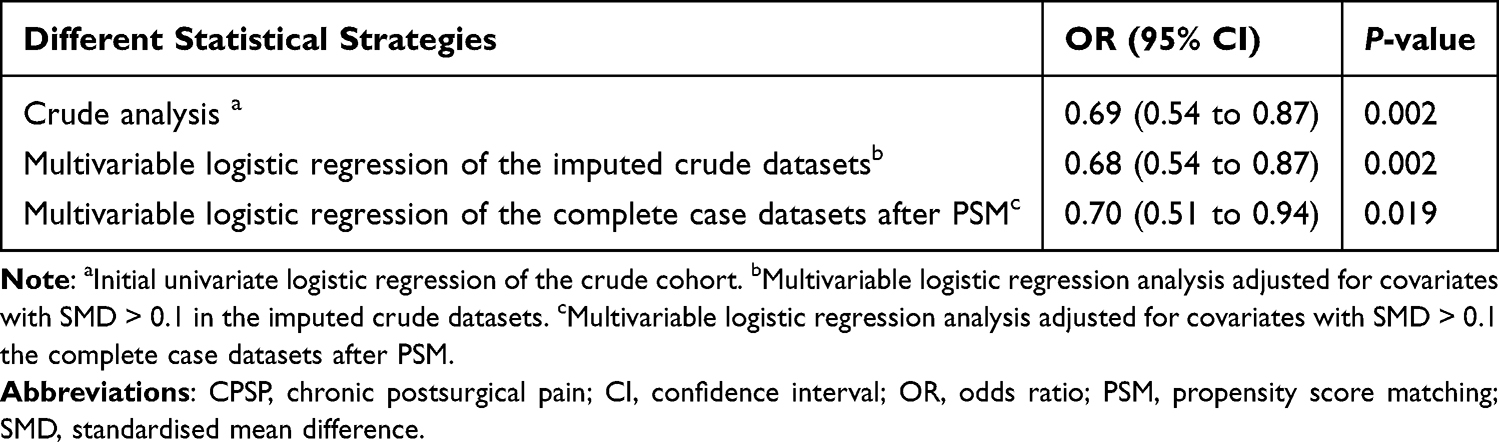 |
Table 4 Sensitivity Analyses for Association Between the Use of Liposomal Bupivacaine and CPSP |
At 3 months, the effect of liposomal bupivacaine versus ropivacaine on CPSP did not differ significantly across subgroups defined by age (<65 vs ≥65), sex (female vs male), BMI (<25 vs ≥25), surgical procedure (wedge vs segmentectomy vs lobectomy), number of ports (single vs two or three), or length of surgery (<120 vs ≥120) (Figure 2).
 |
Figure 2 Subgroup analyses of CPSP at 3 months for patients receiving. Liposomal bupivacaine vs ropivacaine. Red colored dotted lines are the demarcation lines for an odds ratio of 1. Blue squares represent the odds ratios for each subgroup, with the purple diamond indicates the overall odds ratio. Odds ratio < 1 favors liposomal bupivacaine (LB better), odds ratio > 1 favors ropivacaine (Ropivacaine better). Abbreviations: CI, confidence interval; CPSP, chronic postsurgical pain; OR, odds ratio. |
Discussion
This retrospective cohort study of patients undergoing video-assisted thoracoscopic lung resection suggests that liposomal bupivacaine for ICNB is associated with a lower incidence of CPSP at 3 months compared with ICNB using ropivacaine, along with improved pain control at rest during the initial 24–48 hours postoperatively. A notable strength of this study was the application of propensity score matching combined with multivariable logistic and linear regression analyses, which minimized confounding and strengthened the robustness of the findings.
Liposomal bupivacaine, a long-acting local anaesthetic capable of sustained drug release for up to 96 hours, has gained widespread use in thoracic surgery, particularly for ICNB. Emerging evidence supports its efficacy in reducing opioid consumption and improving acute postoperative pain control compared with conventional local anaesthetics.23,24 However, studies specifically investigating its role in preventing chronic pain after ICNB are scarce. Previous reports have described individual cases in which liposomal bupivacaine improved chronic pain outcomes.25–27 To our knowledge, this retrospective cohort study represents the first investigation of the association between liposomal bupivacaine-based ICNB and CPSP incidence after thoracoscopic lung resection. In this work, we observed an 8.8% absolute reduction in CPSP at 3 months among patients who received ICNB with liposomal bupivacaine at the end of surgery compared with those who received ICNB using ropivacaine. This finding aligns with a recent systematic review highlighting liposomal bupivacaine’s potential to attenuate CPSP development in thoracic cohorts, albeit with limited long-term data.28
Despite substantial advances in perioperative care, chronic pain following thoracoscopic surgery remains common and more excruciating than previously recognized. Reported prevalence estimates of CPSP following thoracoscopic surgery vary widely, ranging from 22% to 63%.2,3 This wide variation is likely attributable to heterogeneity in diagnostic definitions, differences in postoperative follow-up duration, and disparities in study sample sizes.29 In the present study, approximately 39% of patients were suffering from CPSP, which is consistent with the prior findings based on ICNB analgesia.30
The selection of the pain intensity threshold for defining CPSP represents a critical methodological consideration that substantially influences the reported incidence. In a previous analysis derived from the PAIN OUT registry,31 the incidence of CPSP was 37.5% when defined using a cutoff of NRS ≥1, whereas applying more stringent thresholds (NRS ≥3 or ≥4) resulted in markedly lower incidence rates of 9.7% and 5.7%, respectively. Although several studies have defined CPSP as an NRS pain score ≥3 persisting for at least 3 months postoperatively and interfering with daily activities,32,33 many investigations continue to adopt a threshold of NRS ≥1, given its greater sensitivity and inclusiveness in capturing any persistent postoperative pain.21,34,35
As an integral component of multimodal analgesic strategies, regional analgesia is recommended in thoracic surgery to optimize pain control, reduce opioid consumption, and facilitate enhanced recovery. Thoracoscopy-guided ICNB is a frequently used technique due to its safety, easy-handling, and accuracy. Studies have reported that ICNB with liposomal bupivacaine is associated with reduced postoperative opioid consumption and shorter hospital stays compared with bupivacaine hydrochloride.19,36,37 In addition, liposomal bupivacaine based ICNB has demonstrated analgesic efficacy comparable to that of epidural analgesia with bupivacaine hydrochloride following video-assisted thoracoscopic surgery.38 In the present study, ICNB with liposomal bupivacaine was associated with superior pain control at rest within the first 24–48 hours postoperatively, suggesting that the observed reduction in CPSP may be largely attributable to the more effective acute pain management. Neuropathic mechanisms are known to contribute substantially to CPSP in thoracic and breast surgeries.39 However, in our cohort, the neuropathic component accounted for only 5.2% of CPSP cases, as determined by the DN4 scale (a validated tool for distinguishing neuropathic from non-neuropathic pain). This finding is consistent with prior observations indicating that video-assisted thoracoscopic surgery is associated with a lower prevalence of neuropathic pain.40,41
The mechanisms underlying the beneficial effects of liposomal bupivacaine are complex and multifaceted. Through DepoFoam® technology, liposomal bupivacaine provided prolonged drug release for up to 72–96 hours, enabling continuous inhibition of nociceptive signal transmission during the intraoperative and early postoperative period, a window pivotal for the formation of pain memory.42 Beyond optimising acute pain control, growing evidence suggests that regional analgesia may attenuate central sensitisation and thereby modulate the development of chronic postsurgical pain.43 The proposed mechanisms include suppression of postoperative nociceptive afferent activity, attenuation of synaptic neuroplasticity changes in the central nervous system, and modulation of signaling properties of non-nociceptive cells, such as microglia.
There are several limitations in our study. First, although propensity score matching and multivariable regression analyses were applied to minimise selection bias, the nature of the retrospective study inherently limits causal inference and remains vulnerable to residual confounding from unmeasured covariates. Second, limitations of the database precluded the assessment of chronic pain outcomes beyond 3 months, thereby restricting our ability to evaluate long-term trajectories. Third, psychological factors such as postoperative depression and anxiety, which are well-recognized contributors to the development of chronic postoperative pain,44 were not captured in the dataset and therefore could not be accounted for in the analysis. Fourth, despite statistical adjustments, the potential for channeling bias cannot be excluded, whereby liposomal bupivacaine might have been selectively used for patients perceived to be at higher risk for severe postoperative pain.
In conclusion, this single-center retrospective study demonstrated that the use of liposomal bupivacaine for ICNB was associated with a reduced incidence of CPSP in patients undergoing VATS lung resection. These findings highlight the potential long-term analgesic benefit of liposomal bupivacaine and support the need for further randomised controlled trials evaluating long-term CPSP outcomes.
Data Sharing Statement
Data are available to researchers on request for the purpose of reproducing the results or replicating the procedure by directly contacting the corresponding author, Xi-Sheng Shan.
Acknowledgments
The authors acknowledge all the patients for their involvement in the study and the First Affiliated Hospital of Soochow University for their support with data acquisition and analysis.
Author Contributions
All authors made a significant contribution to the work reported, whether that is in the conception, study design, execution, acquisition of data, analysis and interpretation, or in all these areas; took part in drafting, revising or critically reviewing the article; gave final approval of the version to be published; have agreed on the journal to which the article has been submitted; and agree to be accountable for all aspects of the work.
Funding
This research was funded by the Jiangsu Provincial Medical Research General Project (H2023019), Innovation and Entrepreneurship Training Program for Students of Soochow University (2024C025), Jiangsu Province Key R&D Program Social Development (BE2023709), Suzhou Medical Innovation Applied Research (SKY2022138), Suzhou Major Disease Multicenter Clinical Research Project (DZXYJ202401), China Primary Health Care Foundation Transition to Clinical Application Research Medical Development Public Welfare Project (202400660071).
Disclosure
The authors declare that the research was conducted in the absence of any commercial or financial relationships that could be construed as a potential conflict of interest.
References
1. Schug SA, Lavand’homme P, Barke A, Korwisi B, Rief W, Treede R-D. The IASP classification of chronic pain for ICD-11: chronic postsurgical or posttraumatic pain. Pain. 2019;160(1):45–11. doi:10.1097/j.pain.0000000000001413
2. Batchelor TJP, Rasburn NJ, Abdelnour-Berchtold E, et al. Guidelines for enhanced recovery after lung surgery: recommendations of the enhanced recovery after surgery (ERAS®) society and the european society of thoracic surgeons (ESTS). Eur J Cardiothorac Surg. 2019;55(1):91–115. doi:10.1093/ejcts/ezy301
3. Gottschalk A, Cohen SP, Yang S, Ochroch EA, Warltier D. Preventing and treating pain after thoracic surgery. Anesthesiology. 2006;104(3):594–600. doi:10.1097/00000542-200603000-00027
4. Haroutiunian S, Nikolajsen L, Finnerup NB, Jensen TS. The neuropathic component in persistent postsurgical pain: a systematic literature review. Pain. 2013;154(1):95–102. doi:10.1016/j.pain.2012.09.010
5. Pogatzki-Zahn EM, Segelcke D, Schug SA. Postoperative pain—from mechanisms to treatment. Pain Rep. 2017;2(2):e588. doi:10.1097/PR9.0000000000000588
6. Glare P, Aubrey KR, Myles PS. Transition from acute to chronic pain after surgery. Lancet. 2019;393(10180):1537–1546. doi:10.1016/S0140-6736(19)30352-6
7. Chen YK, Boden KA, Schreiber KL. The role of regional anaesthesia and multimodal analgesia in the prevention of chronic postoperative pain: a narrative review. Anaesthesia. 2021;76(Suppl S1):8–17. doi:10.1111/anae.15256
8. Nijs J, George SZ, Clauw DJ, et al. Central sensitisation in chronic pain conditions: latest discoveries and their potential for precision medicine. Lancet Rheumatol. 2021;3(5):e383–e392. doi:10.1016/S2665-9913(21)00032-1
9. Hamilton TW, Knight R, Stokes JR, et al. Efficacy of liposomal bupivacaine and bupivacaine hydrochloride vs bupivacaine hydrochloride alone as a periarticular anesthetic for patients undergoing knee replacement: a randomized clinical trial. JAMA Surg. 2022;157(6):481–489. doi:10.1001/jamasurg.2022.0713
10. Isaza E, Santos J, Haro GJ, et al. Intercostal nerve cryoanalgesia versus thoracic epidural analgesia in lung transplantation: a retrospective single-center study. Pain Ther. 2023;12(1):201–211. doi:10.1007/s40122-022-00448-z
11. Coppens S, Hoogma DF, Dewinter G, et al. Erector spinae plane block versus intercostal nerve blocks in uniportal videoscopic-assisted thoracic surgery: a multicenter, double-blind, prospective randomized placebo-controlled trial. Anesthesiology. 2025;143(4):1015–1025. doi:10.1097/ALN.0000000000005625
12. Angst MS, Drover DR. Pharmacology of Drugs Formulated with DepoFoam? Clin Pharmacokinet. 2006;45(12):1153–1176. doi:10.2165/00003088-200645120-00002
13. Hu D, Onel E, Singla N, Kramer WG, Hadzic A. Pharmacokinetic profile of liposome bupivacaine injection following a single administration at the surgical site. Clin Drug Investig. 2013;33(2):109–115. doi:10.1007/s40261-012-0043-z
14. Louis SG, King C, Baral P, Veeramachaneni N. Liposomal bupivacaine enhances the pain-control benefits of uniportal thoracoscopic lobectomy. Ann Thorac Surg. 2019;108(5):1514–1518. doi:10.1016/j.athoracsur.2019.04.095
15. Marino J, Scuderi G, Dowling O, Farquhar R, Freycinet B, Overdyk F. Periarticular knee injection with liposomal bupivacaine and continuous femoral nerve block for postoperative pain management after total knee arthroplasty: a randomized controlled trial. J Arthroplasty. 2019;34(3):495–500. doi:10.1016/j.arth.2018.11.025
16. Berg AA, Flaherty JM, Habeck JM, et al. Evaluation of diaphragmatic function after interscalene block with liposomal bupivacaine: a randomized controlled trial. Anesthesiology. 2022;136(4):531–541. doi:10.1097/ALN.0000000000004118
17. Corsini EM, Mitchell KG, Zhou N, et al. Liposomal bupivacaine intercostal block is important for reduction of pulmonary complications. Ann Thorac Surg. 2021;112(2):423–429. doi:10.1016/j.athoracsur.2020.09.017
18. Patel KM, van Helmond N, Kilzi GM, et al. Liposomal bupivacaine versus bupivacaine for intercostal nerve blocks in thoracic surgery: a retrospective analysis. Pain Physician. 2020;23(3):E251–e258. doi:10.36076/ppj.2020/23/E251
19. Dominguez DA, Ely S, Bach C, Lee T, Velotta JB. Impact of intercostal nerve blocks using liposomal versus standard bupivacaine on length of stay in minimally invasive thoracic surgery patients. J Thorac Dis. 2018;10(12):6873–6879. doi:10.21037/jtd.2018.10.124
20. Dong L, Wang X, Fu L, et al. Efficacy and safety of bupivacaine liposomal in intercostal nerve block for postoperative pain management following uniportal thoracoscopy: a randomized trial. Pain Res Manag. 2025;2025(1):8816879. doi:10.1155/prm/8816879
21. Jiang L, Wang C, Tong J, Han X, Miao C, Liang C. Comparison between thoracic epidural analgesia VS patient controlled analgesia on chronic postoperative pain after video-assisted thoracoscopic surgery: a prospective randomized controlled study. J Clin Anesth. 2025;100:111685. doi:10.1016/j.jclinane.2024.111685
22. Chen WC, Bai YY, Zhang LH, et al. Prevalence and predictors of chronic postsurgical pain after video-assisted thoracoscopic surgery: a systematic review and meta-analysis. Pain Ther. 2023;12(1):117–139. doi:10.1007/s40122-022-00439-0
23. Thuppal S, Sleiman A, Chawla K, et al. Randomized trial of bupivacaine versus liposomal bupivacaine in minimally invasive lobectomy. Ann Thorac Surg. 2022;114(4):1128–1134. doi:10.1016/j.athoracsur.2022.02.058
24. Sheets NW, Davis JW, Dirks RC, et al. Intercostal nerve block with liposomal bupivacaine vs epidural analgesia for the treatment of traumatic rib fracture. J Am Coll Surg. 2020;231(1):150–154. doi:10.1016/j.jamcollsurg.2019.12.044
25. Visoiu M, Verdecchia N. Repeated intercostal nerve blocks with liposomal bupivacaine for chronic chest pain: a case report. A&A Practice. 2019;13(7):260–263. doi:10.1213/XAA.0000000000001047
26. Bertin PM. Liposome bupivacaine for postsurgical pain in an obese woman with chronic pain undergoing laparoscopic gastrectomy: a case report. J Med Case Rep. 2014;8(1):21. doi:10.1186/1752-1947-8-21
27. Lafont ND, Boogaerts JG, Legros FJ. Use of liposome-associated bupivacaine for the management of a chronic pain syndrome. Anesth Analg. 1994;79(4):818. doi:10.1213/00000539-199410000-00058
28. Noviasky J, Pierce DP, Whalen K, Guharoy R, Hildreth K. Bupivacaine liposomal versus bupivacaine: comparative review. Hosp Pharm. 2014;49(6):539–543. doi:10.1310/hpj4906-539
29. Tong Y, Wei P, Wang S, et al. Characteristics of postoperative pain after VATS and pain-related factors: the experience in national cancer center of China. J Pain Res. 2020;13:1861–1867. doi:10.2147/JPR.S249134
30. Zhao X, Xiao W, Zhang T, Xi M, Sun X. The effects of different analgesic methods on chronic pain in patients undergoing video-assisted thoracoscopic surgery. Wideochirurgii Inne Techniki. 2023;18(1):157–165. doi:10.5114/wiitm.2022.120572
31. Hofer DM, Lehmann T, Zaslansky R, et al. Rethinking the definition of chronic postsurgical pain: composites of patient-reported pain-related outcomes vs pain intensities alone. Pain. 2022;163(12):2457–2465. doi:10.1097/j.pain.0000000000002653
32. Yoon S, Hong W-P, Joo H, et al. Long-term incidence of chronic postsurgical pain after thoracic surgery for lung cancer: a 10-year single-center retrospective study. Reg Anesth Pain Med. 2020;45(5):331–336. doi:10.1136/rapm-2020-101292
33. Jin D, Zhang Y, Zheng H, et al. The epidemiology of chronic postsurgical pain after video-assisted thoracic surgery (VATS-CPSP) in China: a multicentre prospective study. J Thorac Dis. 2025;17(5):2802–2812. doi:10.21037/jtd-2024-2220
34. Zhang X-F, Peng C-G, Guo H-J, Zhang Z-M. Development and validation of a prediction model for chronic post-surgical pain risk: a single-center prospective study of video-assisted thoracoscopic lung cancer surgery. J Cardiothorac Surg. 2025;20(1). doi:10.1186/s13019-024-03310-9
35. Zhang Y, Zhou R, Hou B, et al. Incidence and risk factors for chronic postsurgical pain following video-assisted thoracoscopic surgery: a retrospective study. BMC Surg. 2022;22(1):76. doi:10.1186/s12893-022-01522-1
36. Kelley TM Jr, Bailey DW, Sparks P, et al. Intercostal nerve blockade with exparel® results in lower opioid usage during the first 24 hours after video-assisted thorascopic surgery. Am Surg. 2018;84(9):1433–1438. doi:10.1177/000313481808400945
37. Parascandola SA, Ibanez J, Keir G, et al. Liposomal bupivacaine versus bupivacaine/epinephrine after video-assisted thoracoscopic wedge resection†. Interact Cardiovasc Thorac Surg. 2017;24(6):925–930. doi:10.1093/icvts/ivx044
38. Medina M, Foiles SR, Francois M, et al. Comparison of cost and outcomes in patients receiving thoracic epidural versus liposomal bupivacaine for video-assisted thoracoscopic pulmonary resection. Am J Surg. 2019;217(3):520–524. doi:10.1016/j.amjsurg.2018.10.026
39. Prudhomme M, Legras A, Delorme C, et al. Management of neuropathic pain induced by surgery: review of the literature by a group of experts specialized in pain management, anesthesia and surgery. J Visceral Surg. 2020;157(1):43–52. doi:10.1016/j.jviscsurg.2019.09.004
40. Kwon ST, Zhao L, Reddy RM, et al. Evaluation of acute and chronic pain outcomes after robotic, video-assisted thoracoscopic surgery, or open anatomic pulmonary resection. J Thoracic Cardiovasc Surg. 2017;154(2):652–659.e1. doi:10.1016/j.jtcvs.2017.02.008
41. Shanthanna H, Aboutouk D, Poon E, et al. A retrospective study of open thoracotomies versus thoracoscopic surgeries for persistent postthoracotomy pain. J Clin Anesth. 2016;35:215–220. doi:10.1016/j.jclinane.2016.07.029
42. Chenesseau J, Fourdrain A, Pastene B, et al. Effectiveness of surgeon-performed paravertebral block analgesia for minimally invasive thoracic surgery: a randomized clinical trial. JAMA Surg. 2023;158(12):1255–1263. doi:10.1001/jamasurg.2023.5228
43. Bollag L, Richebé P. Effect of regional anesthesia on pain sensitization after surgery: new concepts. Tech Reg Anesthesia Pain Manage. 2012;16(3):127–130. doi:10.1053/j.trap.2013.03.002
44. Weinrib AZ, Azam MA, Birnie KA, Burns LC, Clarke H, Katz J. The psychology of chronic post-surgical pain: new frontiers in risk factor identification, prevention and management. Br J Pain. 2017;11(4):169–177. doi:10.1177/2049463717720636
 © 2026 The Author(s). This work is published and licensed by Dove Medical Press Limited. The
full terms of this license are available at https://www.dovepress.com/terms
and incorporate the Creative Commons Attribution
- Non Commercial (unported, 4.0) License.
By accessing the work you hereby accept the Terms. Non-commercial uses of the work are permitted
without any further permission from Dove Medical Press Limited, provided the work is properly
attributed. For permission for commercial use of this work, please see paragraphs 4.2 and 5 of our Terms.
© 2026 The Author(s). This work is published and licensed by Dove Medical Press Limited. The
full terms of this license are available at https://www.dovepress.com/terms
and incorporate the Creative Commons Attribution
- Non Commercial (unported, 4.0) License.
By accessing the work you hereby accept the Terms. Non-commercial uses of the work are permitted
without any further permission from Dove Medical Press Limited, provided the work is properly
attributed. For permission for commercial use of this work, please see paragraphs 4.2 and 5 of our Terms.
Recommended articles

Ropivacaine with Dexmedetomidine or Dexamethasone in a Thoracic Paravertebral Nerve Block Combined with an Erector Spinae Plane Block for Thoracoscopic Lobectomy Analgesia: A Randomized Controlled Trial
Yang J, Zhao M, Zhang XR, Wang XR, Wang ZH, Feng XY, Lei YJ, Zhang JW
Drug Design, Development and Therapy 2022, 16:1561-1571
Published Date: 26 May 2022
Ultrasound-Guided Continuous Rhomboid Intercostal and Sub-Serratus Plane Block Comparison of Thoracoscopic Intercostal Nerve Block After Thoracoscopic Surgery: A Prospective Randomized Controlled Study
Wang S, Wang H, Chen X, Li M, Xu D
Journal of Pain Research 2024, 17:4471-4481
Published Date: 21 December 2024
Risk Factors for the Occurrence of Rebound Pain After Intercostal Nerves Block in Three-Port Thoracoscopic Surgery: A Case-Control Study
Wan C, Kong M, Shen Q, Lu W, Shen X
Journal of Pain Research 2025, 18:381-390
Published Date: 23 January 2025
Comparing Liposomal Bupivacaine and Ropivacaine in Serratus Anterior Plane Block for Thoracoscopic Lobectomy: A Randomized Controlled Trial
Zhang Y, Li W, Wei A, Chen S, Wang X
Drug Design, Development and Therapy 2025, 19:4717-4726
Published Date: 4 June 2025
Thoracic Paravertebral Block with Liposomal Bupivacaine Versus Plain Bupivacaine in Patients Undergoing Thoracoscopic Lung Resection: A Randomized Controlled Study
Yang Z, Liu M, Wang C, Song Y, Wu J, Wu D, Yao M, Yang Y, Miao C, Liang C
Drug Design, Development and Therapy 2025, 19:6955-6964
Published Date: 12 August 2025