
Back to Journals » Risk Management and Healthcare Policy » Volume 18
Clinico-Epidemiological Prediction of Adverse Outcomes in Acute Pediatric Poisoning: A Risk Prediction Nomogram Approach
Authors Sharif AF  , El-Sarnagawy GN, Aloshari SHA , Helal NE
Received 10 July 2025
Accepted for publication 14 December 2025
Published 23 December 2025 Volume 2025:18 Pages 3977—4001
DOI https://doi.org/10.2147/RMHP.S550232
Checked for plagiarism Yes
Review by Single anonymous peer review
Peer reviewer comments 3
Editor who approved publication: Dr Gulsum Kaya
Asmaa F Sharif,1,2 Ghada N El-Sarnagawy,1 Samar HA Aloshari,3 Nadia Ezzat Helal1
1Department of Forensic Medicine and Clinical Toxicology, Faculty of Medicine, Tanta University, Tanta, Egypt; 2Department of Clinical Medical Sciences, College of Medicine, Dar Al-Uloom University, Riyadh, Saudi Arabia; 3Department of Public Health and Community Medicine, Faculty of Medicine, Taiz University, Taiz, Yemen
Correspondence: Samar HA Aloshari, Department of Public Health and Community Medicine, Faculty of Medicine, Taiz University, P.O. Box 6803, Taiz, Yemen, Tel +9674232429, Email [email protected]
Purpose: Globally, acute pediatric intoxication is a serious health concern with a significant burden. Differentiation between pharmaceutical and non-pharmaceutical poisoning is crucial for promoting early diagnosis and implementing effective preventive strategies.
Patients and Methods: This three-year retrospective cohort study investigated 1328 exposed children, aiming to develop risk prediction nomograms to identify patients in need of pediatric intensive care unit (PICU) admission and those at risk of mortality.
Results: With a mean age of 8.21± 6.64 years, a mortality rate of 1.7% and a PICU admission rate of 1.3%, more than 99% of infants and preschool children were exposed unintentionally, and intentional exposure was observed in about 88% of adolescents (p< 0.001). Aluminum phosphide (AlP) was a leading cause of mortality and PICU admission. Non-pharmaceutical poisoning was associated with more severe clinical presentations and was exclusively linked to mortality. A predictive model for mortality with an overall accuracy of 99% underscores the role of receiving prehospital treatment in increasing the likelihood of mortality. Exposure to AlP contributed to PICU admission with a notably high odds ratio (50.596). Significant predictors of PICU need were rapid admission and leucocytosis. A model predicting PICU admissions, with a Nagelkerke pseudo-R2 of 0.710, encompassed mutual factors contributing to mortality and PICU need, including age, sex, and blood pressure.
Conclusion: The obtained findings highlight critical differences in poisoning characteristics and outcomes across pediatric age groups and exposure types, emphasizing a need to implement preventive strategies through proper family education, increased social awareness, and the provision of psychological support for at-risk individuals.
Keywords: pharmaceutical, non-pharmaceutical, poisoning, pediatric, mortality: pediatric intensive care unit
Introduction
Globally, acute pediatric intoxication is still a serious health concern with a significant burden on emergencies.1 In 2019, the Institute for Health Metrics and Evaluation observed 2.2 million poisoning episodes among pediatric age groups.2 Annually, the World Health Organization (WHO) estimates 45,000 fatalities from acute children and adolescent poisoning.3 Accordingly, acute poisoning is one of the five chief mortality causes in pediatrics.4 While global data highlight the significant burden of pediatric poisoning, epidemiological profiles differ from country to country.5 Precise data about the problem of pediatric poisoning in Egypt are scarce and contradictory. While some studies reported no fatalities6 or very low mortality rate (0.3%),5 others described higher case fatality rates reaching approximately 6%.7 This discrepancy hinders estimating the size of the problem and impedes the development of targeted preventive strategies and evidence-based clinical guidelines.
Various studies have documented that all pediatric age groups are highly vulnerable to poisoning, showing bimodal peak age distribution.8 Substantially, children below five years of age have behavioral tendencies to explore the surrounding environment orally, being more susceptible to accidental ingestion.9 On the other hand, the various psychological stresses and emotional dysregulations in adolescence increase the probability of intentional poisoning.10 A broad spectrum of pharmaceutical and non-pharmaceutical substances is involved in acute pediatric intoxications.11 Regarding pharmaceutical exposures, specific drug classes such as analgesics (paracetamol) and psychotropic medications are frequently implicated in pediatric poisoning, often leading to significant morbidity and mortality.12 Reports from the United States and United Kingdom mentioned that paracetamol poisoning was the leading cause of hepatic failure in pediatrics, accounting for 14% of all cases.13 Poisoning with psychotropics and antidepressants was associated with cardiotoxicity and higher fatalities than other pharmaceuticals.12 On the other hand, non-pharmaceutical substances showed diverse outcomes, ranging from complete cure to severe morbidities. Besides the caustic agents, pesticides and heavy metals were the most common agents associated with a significant need for hospitalization and intensive care in poisoned pediatrics.3
The effect of pediatric poisoning extends beyond acute morbidity and mortality, often leading to significant long-term structural, neurological, developmental, and psychosocial consequences for affected children and their families. Substantially, delayed neurologic sequelae and behavioural changes are recorded as long-term complications following acute pediatric poisoning with organophosphorus and carbon monoxide.14 Toxic types of mushrooms can cause fulminant hepatic failure.15 It was reported that about 5% of children exposed to caustic agents suffered from esophageal damage, other organ damage, and a long-term disability.15,16 Adolescents diagnosed with self-poisoning were at higher risk of future death from accidents.17 Additionally, the impact of pediatric poisoning-related exposure not only has devastating outcomes but also bears an economic burden on healthcare systems.4 These enduring sequelae underscore the critical need for effective prevention and early intervention strategies.
Beyond the causative agent, the epidemiology of pediatric poisoning is profoundly influenced by several factors. Socioeconomic disparities and living in rural areas are some of these factors.18 The parental education, proximity to medical facilities, and varying access to healthcare, as well as cultural practices, can dictate harmful practices, delay in presentation, and ultimately, worsen patient outcomes.19 Additionally, the trends of acute pediatric poisoning vary according to geographical distribution, social concepts, and substance availability.20
Since pediatric poisoning has a global nature variation, the preventive policies should be regionally specific, including drug storage regulations and packaging, as well as education programs targeting caregivers and adolescents.11,21 Furthermore, the impact of effective preventive strategies and educational programming for alleviating pediatric poisoning incidence is still limited.2 Unsafe indoor storage of medications and household substances, which increase the likelihood of unintentional childhood poisoning.22 Alternatively, easy access to highly toxic pesticides and prescriptions accounts for adolescent intentional exposures.23 Although cosmetics, alcohol, and illicit substances are the most prevalent poisoning in developed countries, intoxications with pesticides, hydrocarbons, and traditional medications are usually observed in developing countries.24 Accordingly, updating the epidemiological data in each locality facilitates the design of suitable protocols, optimizes resource utilization and prevention approaches, and raises public awareness.25
Previous studies considered age as one of the factors affecting the poisoning severity, where pediatric patients are more vulnerable to severe outcomes.7 While various risk stratification tools exist in adult toxicology, objective predictive models specifically tailored for pediatric poisoning outcomes remain scarce, with no objective predictive models that assess several pediatric poisoning outcomes. Existing approaches often rely on subjective clinical judgment or simplified scoring systems that may not fully capture the complex interplay of factors influencing outcomes in children.7 A risk prediction nomogram is a statistical regression model integrating significant determinants for potential outcomes.26 Nomograms have been developed in various toxicological settings, either in distinct substances or poisoning categories, tailoring risk estimations upon hospital admissions.27–30 Nomograms, as visual and intuitive predictive models, are particularly well-suited for poisoning settings due to their ability to integrate multiple significant determinants into a user-friendly tool, offering individualized risk estimations that can aid clinicians in rapid decision-making.26 However, embedding this tool in the assessment of pediatric poisoning has not yet been utilized.
Given the unique characteristics of pharmaceutical and non-pharmaceutical classes regarding pattern, course, and implications, differentiation between both categories is crucial for promoting early diagnosis and implementing effective therapeutic strategies.24 However, the emerging course and outcome prediction in the pediatric age are often challenging due to the disclosure inability and delayed admissions, together with immature body systems potentiating unfavorable outcomes, especially with highly toxic substances.2 Timely and accurate identification of pediatric poisoning patients requiring pediatric intensive care unit (PICU) admission is paramount. Early recognition and transfer to specialized care can significantly reduce the risk of severe morbidity and mortality by enabling prompt advanced life support, specific antidotal therapies, and close monitoring.31
Though various public health campaigns and educational initiatives aimed at reducing pediatric poisoning, there is a gap in the literature evaluating the effectiveness of these interventions, particularly in diverse socioeconomic and cultural contexts, particularly in resource-limited settings.32 Therefore, our study aims to perform a comparative analysis between pharmaceutical and non-pharmaceutical pediatric poisoning, focusing on disparities in patterns and outcomes, and to develop a risk prediction nomogram to identify patients in need for PICU admission and those at risk of mortality based on integrating clinical, epidemiological, and laboratory parameters.
Materials and Methods
Study Design and Setting
This contemporary 3-year retrospective cohort study included all pediatric patients admitted to Tanta University Poison Control Centre (TUPCC) with acute poisoning with either pharmaceutical or non-pharmaceutical substances from January 2021 to December 2023. The retrospective nature of this study was designed to ensure a high volume of hospital-based data ready for all analyses. Tanta University Poison Control Centre is a tertiary-care center in the core of Nile delta, Egypt, offering supportive medical care to acutely poisoned patients, serving principally El-Gharbia residents, as well as the nearby governorates.
Sampling and Sample Size Calculation
In this study, we deployed convenience sampling technique where all patients fulfilled the inclusion criteria were included. The sample size was calculated for the derivation cohort using the R Statistical language (version 4.5.0),33 and the “pmsampsize package” (version 1.1.3).34 Based on the results of a previous study, we assumed an incidence of 2.84% for intensive care unit admission and a mortality rate of 2.13%.24 We also assumed a 0.05 acceptable difference in apparent and adjusted R-squared, a 0.05 margin of error in estimation of intercept, a c-statistic of 0.9 at least, and the potential use of eight model parameters. A c-statistic of 0.9 was assumed to represent a strong but hypothetical model performance for sample size estimation purposes. This value was selected arbitrarily due to the absence of prior validated prediction models for pediatric non-pharmaceutical poisoning and does not reflect an expected area under the curve (AUC) of the final model. The minimum sample size required for new model development based on these assumptions for mortality was 1121, with 24 events and an event per predictor parameter (EPP) = 2.99. As for PICU admission, the minimal sample size was 860 (with 25 events, EPP = 3.05). The decision was to adopt the higher sample size (n = 1121) as the minimal number to include.
Inclusion and Exclusion Criteria
This study involved all pediatric patients of either sexes aged 18 years or younger presented with acute pharmaceutical or non-pharmaceutical poisoning admitted to TUPCC over three years (2021–2023). The documented diagnosis in hospital files was principally based on the medical interviews of parents/guardians, documented verified container/substance identification, distinctive clinical findings, and the addressable toxicological and laboratory investigations and other radiological or electrocardiographic (ECG) workup. As Figure 1 demonstrates, pediatric patients were excluded from this study if they had co-ingested substances, combined poisoning with trauma, or chronic pre-existing disorders such as liver, kidney, or heart disease. Additionally, other exclusion criteria involved cases with doubtful unclear diagnosis of toxic exposure, those transferred to another health facility, deaths on arrival, and those with incomplete health records.
 |
Figure 1 Flow chart of included and excluded patients showing recruitment of the pediatric patients poisoned with pharmaceuticals and non-pharmaceuticals during the study period. |
Ethical Consideration
This study was approved by the Research Ethics Committee of the Faculty of Medicine, Tanta University (Approval number: 36264PR975/12/24) according to the Helsinki Declaration principles. To maintain data security and confidentiality, the patients’ data were de-identified by making a password code for each patient. To ensure data security and confidentiality, all patient data were de-identified, where direct personal identifiers were removed and replaced with unique, non-identifiable study codes. The key linking the codes to patient identifiers was stored separately on a secure, encrypted server accessible only to the principal investigator. All electronic data was stored on password-protected computers with restricted access. Physical records were stored in a locked cabinet in a secure location. Since this study was observational and retrospective, involving only the retrieval of de-identified data from archived medical records, the research ethics committee waived obtaining informed consent from the patient’s parents or guardians.
Data Collection Tool
Demographics and Toxicological Data
Two clinical toxicologists involved in data collection were trained to carefully evaluate the reliability of the data and to exclude any records with inconsistencies or uncertainties. Data abstractors were supervised by a senior researcher. Data were abstracted from the archived medical records using a standardized data collection form designed specifically for this study. The forms included clear definitions for each variable and specific instructions for data entry. The used forms included predefined fields for all clinic-epidemiological, sociodemographic, toxicological, clinical, and laboratory variables to ensure consistency and minimize the risk of data extraction bias.
The obtained sociodemographic details included the age, sex, and residence. The pediatric patients were classified into four age groups: infant (less than 1 year), preschool (1 to less than 6 years), school-age (6 to less than 13 years), and adolescents (13 to less than 18 years).8 The obtained toxicological data included any history of addiction, manner of poisoning (unintentional and intentional). Unintentional poisoning included accidental consumption of a substance without adult supervision or by mistake, like giving a substance due to a parent’s or guardian’s mistake. Additionally, intentional ingestion of a substance is suicidal attempt that aimed at ending one’s life. Furthermore, we recorded the exposure route (dermal, inhalation, injection or oral) and poisoning type (pharmaceutical/non-pharmaceutical), including the broad category and distinct agent names. Other toxicological data included the place of exposure (home or outside), the time from exposure until hospital admission in hours, and the received prehospital therapy.1
Initial Clinical Examination and Investigation Data
The initial vital signs of all patients were recorded, including heart rate, systolic blood pressure (SBP) and diastolic blood pressure (DBP), respiratory rate, axillary temperature in Celsius, and Oxygen saturation percentage. The consciousness was assessed using the conventional Glasgow Coma Scale (GCS) (3–15), while the pediatric GCS was used for those aged less than 5 years.35 Also, the Poisoning Severity Score (PSS), according to Persson et al was used to evaluate the severity of poisoning: grade 0 indicates no symptoms or signs; grade 1 (minor) refers to self-limiting symptoms; grade 2 (moderate) involves marked symptoms; and grade 3 (severe) reflects symptoms that may endanger one’s life.36 Additionally, pupil size was assessed if normal, constricted, dilated, or pinpoint.
Results of baseline laboratory investigations were documented, including the White blood cells (WBCs) count, arterial blood gases analysis (pH, PaCO2, and HCO3), serum electrolytes (sodium, potassium), random blood sugar (RBS), liver transaminases [Serum Glutamic Pyruvic Transaminase (SGPT) and Serum Glutamic-Oxaloacetic Transaminase (SGOT)], and kidney function tests, including serum creatinine and urea. Electrocardiographic abnormalities were also recorded (yes or no abnormalities).
Therapeutic Regimens
The treatment of acute pharmaceutical and non-pharmaceutical poisoning in children was performed in conformity with the TUPCC protocol and was supervised by a skilled toxicologist together with pediatric consultations. All acutely poisoned pediatric patients received emergency and supportive treatment. Gastric lavage was allowed for eligible patients presented within 1–2-hour post-ingestion. Furthermore, specifically accessible antidotes were administered. Specific antidotes were administered based on the identified toxin and clinical indications, following established institutional and international guidelines.37
Referral to the PICU was conducted based on the attending physician decision, where the main indications of PICU admission were unstable vital data, respiratory failure, severe hypovolemia, or persistent unconsciousness.38 Any encountered complications were reported, including cardiogenic shock, chest infection, acid-base disturbance, electrolyte disturbance, dehydration, gastrointestinal stricture, delayed neurological sequel (DNS), skin infection/disfigurement, and oral candidiasis. The length of stay (LOS) at hospital for all enrolled patients was also documented in hours.
Grouping and Outcomes
Exposed patients were sub-classified, based on the type of their exposure, into two groups: either pharmaceutical exposed or non-pharmaceutical exposed groups (primary outcome). Pharmaceutical substances were defined according to the United States Food and Drug Administration (FDA) guidelines and the European Medicines Agency. They are agents primarily intended for therapeutic, curative, prophylactic, or diagnostic use in humans.39,40 This category includes both prescription and over-the-counter medications that are manufactured, distributed, and regulated by the Egyptian Ministry of Health (MoH). Non-pharmaceutical substances encompassed all other agents not approved by MoH for therapeutic, prophylactic, or diagnostic use, including household products, industrial chemicals, pesticides, and pure illicit substances (alcohols). Besides, the previously mentioned four pediatric age groups were compared as regards their sociodemographic data, and type of exposure. Secondary outcomes included comparing the patients of different types of exposure regarding some adverse outcomes (mortality, PICU admission, and complications).
Data Analysis
Analyses were conducted using R Statistical language version 4.4.2.41 Categorical variables were presented as counts and percentages. Counts below 5 were reported grouped to prevent re-identification of individual. The association between categorical variables was assessed using appropriate statistical tests. Specifically, Pearson’s Chi-squared test was employed for associations between two nominal variables or when no specific trend was hypothesized. For associations involving an ordinal variable where a monotonic relationship was expected, the Chi-squared test for trend in proportions was utilized. Additionally, Fisher’s exact test was used when expected cell counts were low. The distribution of continuous numerical variables was assessed using the Shapiro–Wilk test for normality and the Q-Q plots. Numerical variables following a normal distribution were presented as the mean and standard deviation (SD), and comparisons between groups were made using the Two-Sample T-Test. Numerical variables that did not follow a normal distribution were summarized as the median and interquartile range (IQR; 25th–75th percentiles), and comparisons were made using the Wilcoxon rank sum test (for two groups) or the Kruskal–Wallis rank sum test (for more than two groups).
Regarding comparisons adjusted for age, the least-squares adjusted mean difference was used. When the number of outcome events was sufficient, we conducted univariate and multivariate logistic regression analyses were conducted to assess the independent variables contributing significantly to the categorical outcomes (mortality and PICU admission) after adjusting for age and sex. The performance of these models was estimated by Nagelkerke pseudo R2 and Hosmer-Lemeshow Goodness-of-Fit Test was used to show model fitness. We have rigorously assessed the model’s performance through internal validation via bootstrapping, to assess the risk of overfitting. Receiver operating characteristic (ROC) curves, calibration curves, and a Kattan-style risk prediction nomogram were created for the models. The nomogram shows three scales: one for each predictor, a total score scale, and a probability scale. To utilize the nomogram, values for each patient were compared to the scales corresponding to each predictor to obtain scores. The total score was then determined by summing the individual scores for all predictors. Finally, the probability of the predicted outcome—such as the need for PICU admission, or mortality was assessed using the probability scale, which was aligned with the total score obtained in the previous step.26 A p-value of 0.05 and a 95% confidence interval (CI) were chosen to interpret the results of the statistical tests.
Results
The current study was conducted with 1328 exposed patients, having a mean age of 8.21±6.64 years, comprising 21 infants, 699 preschool children, 123 school children, and 485 adolescents. Table 1 shows that the non-pharmaceutical exposure exceeded the pharmaceutical (53% versus 47%), with no significant differences among age groups. However, females constituted more than half of the studied cases and outnumbered males significantly, especially in adolescents (p<0.001). More than 99% of infants and preschool children were exposed unintentionally, and intentional suicidal exposure was observed in about 88% of adolescents (p<0.001). Oral ingestion constituted the primary route of exposure in all age groups. The need for PICU admission and mortality were significantly observed in adolescents compared to other age groups (p<0.001). However, prolonged hospitalization was significantly recorded in school children (p<0.001). Although there was comparable complication incidence among age groups, dehydration, gastrointestinal strictures, delayed neurological sequelae, skin infections, and oral candidiasis were significantly higher among pre-school children (p=0.009).
 |
Table 1 Comparison Between Different Age Group Distribution Regarding Sociodemographic, Poisoning Data, and Investigated Outcomes |
The present study shows that exposure to Organophosphorus compounds (OPCs) was the most frequently reported category of poisoning, representing 12% of total admissions, followed by corrosive (9.7%), antipsychotic (8.7%), zinc phosphide (8.3%) and Aluminum phosphide (AlP) (7.8%). Supplementary 1 depicts the distribution of the exposure type according to the age group, showing that in pharmaceutical poisoning, preschool children showed significantly more frequent exposure to non-steroidal anti-inflammatory drugs (NSAIDs), antihistamines, oral anticoagulants, and Iron, in contrast to the infants, where these types of exposure were less encountered (p<0.05). Regarding the non-pharmaceuticals, exposure to phosphides and carbamates was considerably higher in adolescents, while preschool children showed higher presentation with corrosive and pyrethroid poisoning.
Table 2 depicts that pharmaceutical poisoning was significantly higher among females and substantially associated with urban settings and oral route (p=0.041, p=0.042, and p=0.004, respectively). Although non-pharmaceutical poisoned cases significantly received prehospital management, a substantial delay was recorded in pharmaceutical poisoning (p<0.001 in each). Additionally, patients with pharmaceutical poisoning had significantly lower GCS, while non-pharmaceutical poisoning was significantly associated with severe PSS. Accordingly, patients with non-pharmaceutical poisoning had significantly lower O2 saturation and higher respiratory rates than those with pharmaceutical poisoning, with no significant difference in other vital signs.
 |
Table 2 Comparison Between Pharmaceutical and Non-Pharmaceutical Pediatrics Poisoning Regarding Sociodemographic, Poisoning Data, and Initial Clinical Characteristics |
Table 3 conveys that patients exposed to non-pharmaceutical compounds exhibited significantly higher leucocytic count and lower levels of pH and HCO3 than those exposed to pharmaceutical agents. Mortality was an exclusive finding linked to non-pharmaceutical exposure. Furthermore, non-pharmaceutical poisoning was significantly associated with a higher incidence of complications (p=0.014) and the need for PICU utilization (p<0.001). Supplementary 2 demonstrates that AlP was the leading cause of mortality (16%) and PICU admission (15%). Additionally, the highest proportion of non-pharmaceutical complications was observed in corrosives (n = 22, 17%) and AlP (n = 14, 14%).
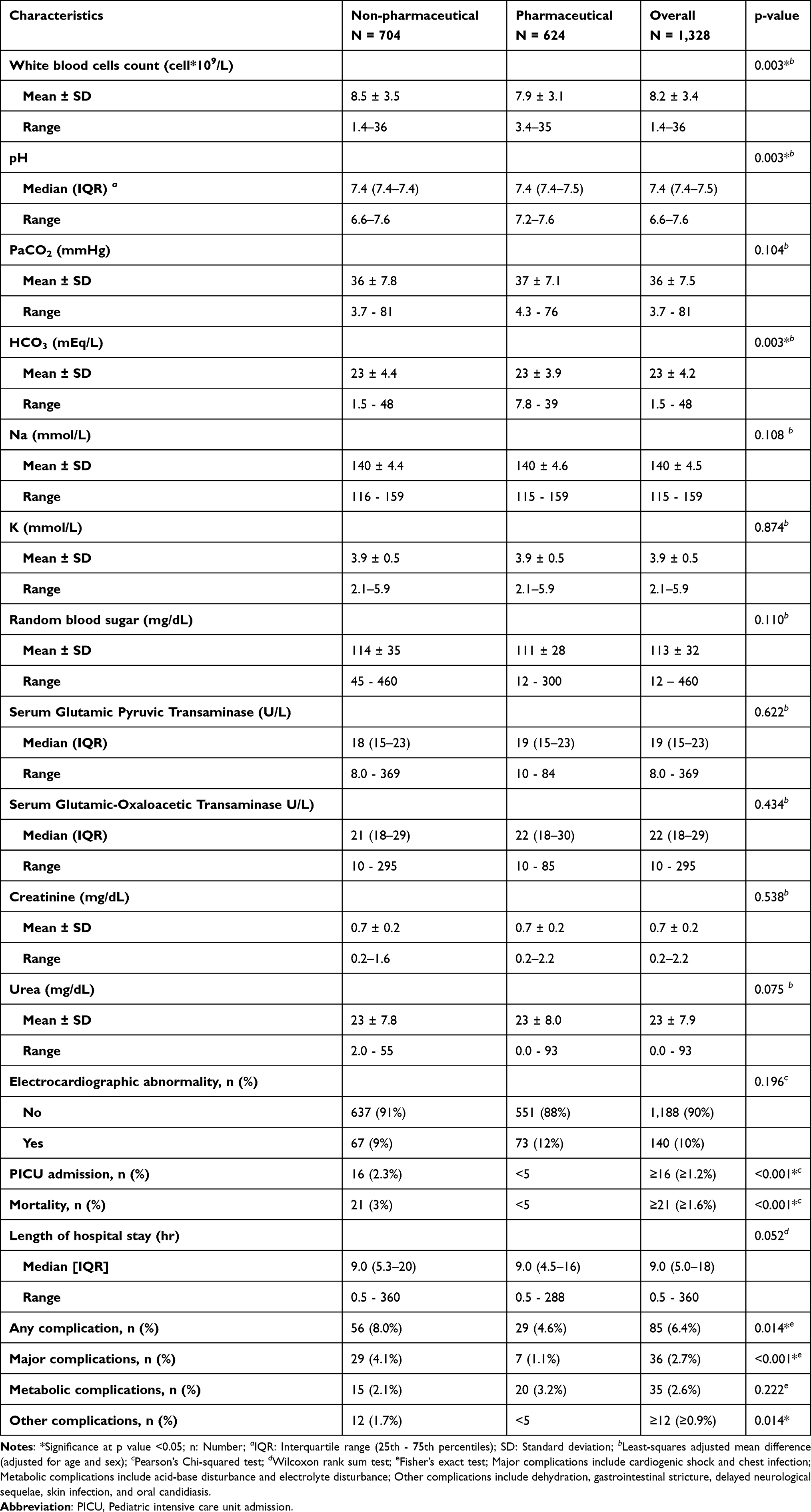 |
Table 3 Comparison Between Pharmaceutical and Non-Pharmaceutical Pediatric Poisoning Regarding Laboratory Workup Characteristics |
Potential individual predictors of mortality in patients exposed to non-pharmaceutical compounds were female sex, older age, suicidal intent, AlP exposure, receiving prehospital treatment, lower GCS and higher PSS on admission, as well as the presence of ECG abnormalities. However, hypotension (low SBP or DBP), tachypnea, hypothermia, a higher leukocytic count, lower pH, HCO3, and PaCO2 were other significant predictors of mortality, in addition to high random blood glucose and creatinine levels (Table 4). Indeed, a proposed model using multivariate forward stepwise regression analysis incorporates seven elements (age, sex, prehospital treatment, SBP, DBP, WBC count, and creatinine level) that could significantly predict mortality; it explains 62.5% of the variance in mortality among patients exposed to non-pharmaceutical compounds. The prehospital treatment was the most significant elements in this model. Visualization of this model was designed in the form of a user-friendly nomogram where the overall points a patient obtained indicate the probability of death. A real patient estimation mortality risk is shown in Figure 2, showing an example of estimating the risk of mortality in an admitted poisoned child. The ROC curve analysis of the proposed model demonstrated excellent performance, as indicated by an AUC (95% CI) of 0.981 (0.96–1), sensitivity of 55%, specificity of 99%, and an overall accuracy of 99% (Figure 3a). The calibration plot (Figure 3b) illustrates the agreement between predicted and observed probabilities of mortality. The apparent calibration curve (dotted line) demonstrates good initial model fit. After 5000 bootstrap repetitions, the bias-corrected line (solid) shows a slight downward deviation at higher predicted probabilities, indicating mild overestimation of mortality risk in that range. The overall agreement between predicted and observed probabilities remains excellent, as reflected by the low mean absolute error (0.005).
 |
Table 4 Univariate Logistic Regression and Multivariate Forward Stepwise Regression Analyses Showing the Potential Predictors of Mortality Among Pediatrics Poisoned with Non-Pharmaceuticals |
 |
Figure 2 Nomogram for predicting the probability of mortality among pediatric patients poisoned with non-pharmaceuticals. An example of calculating the probability of mortality in a patient presented with acute exposure to a non-pharmaceutical compound is shown. In this case, the probability of mortality could be assessed, where the red dotted lines represent the real data of the patient. The child aged 10 years old corresponds to 6 points, being male gives a score of 1, which equals 0 points, systolic blood pressure of 55 mm Hg accounts of 81 points, receiving prehospital treatment accounts for 18 points, creatinine level of 1.1 increases the total points by 12, leucocytic count of 7.5 thousand collects 4 points, and a diastolic blood pressure of 55 mm Hg gave 15 points. The dotted green lines relate the overall points with the probability. Overall points= 6 + 81 + 18 + 12 + 4 + 15 = 136 and probability of death = 70%. The dotted green line indicates a threshold from the logistic regression model for the outcome of interest to take place (0.5). |
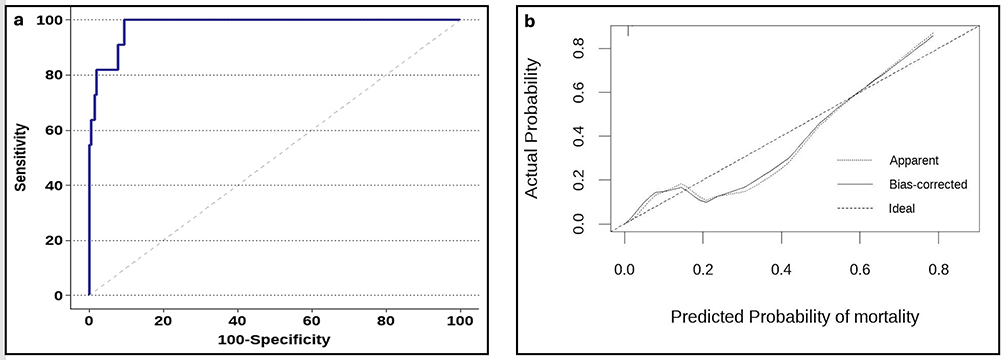 |
Figure 3 (a) Receiver operating characteristic (ROC) curve analysis of the multivariate model predicting the mortality following exposure to non-pharmaceutical agents. This model shows an AUC (95% CI) of 0.981 (0.96–1), sensitivity of 55%, specificity of 99%, and an overall accuracy of 99% (TP=6, TN=679, FP=1, FN=5). The blue line represents the proposed mortality prediction model. (b) Calibration curve for the predicted probability of mortality among pediatric patients exposed to non-pharmaceutical poisoning. |
Regarding the PICU admission in non-pharmaceutical poisoning, Table 5 shows that exposure to AlP was a significant contributor to PICU admission, denoted by the extremely high odds ratio (102.27). Additionally, older children, suicidal exposure, Oxygen desaturation, less delay time, lower GCS, higher PSS, and the presence of ECG abnormalities were other significant predictors of PICU admission (p<0.05). Among the laboratory investigations, respiratory rate, WBC count, random blood glucose level, SGOT, and creatinine were significant positive predictors of PICU admission in pediatric patients exposed to non-pharmaceutical compounds. Nonetheless, SBP, DBP, pH, HCO3, and PaCO2 were significant negative predictors. However, when all factors are considered together, less delay and higher leukocytic counts remain significant predictors of PICU admission. Exposure to AlP and ECG abnormalities are other contributors to the proposed model, as indicated by the borderline p-value, considering the reported higher odds ratios of 50.60 and 4.78, respectively.
 |
Table 5 Univariate Logistic Regression and Multivariate Model Backward Elimination Regression Analyses Showing the Potential Predictors of Pediatric Intensive Care Unit Admission Among Pediatrics Poisoned with Non-Pharmaceuticals |
Figure 4 depicts the visualization of the proposed model, where we plotted a seven-element nomogram to estimate the probability of PICU admission. This nomogram comprises age, sex, AlP exposure, delay time, DBP, WBC count, and ECG abnormalities. This model exhibited high performance (R2 of 71% and good fitness with a Hosmer-Lemeshow Goodness-of-Fit Test p-value of 0.999. Receiver operating characteristic curve analysis of the multivariate model predicting PICU admission following exposure to non-pharmaceutical agents is shown in Figure 5a, showing exceptional AUC (95% CI) of 0.994 (0.99–1), sensitivity of 56%, specificity of 99%, and an overall accuracy of 99% Calibration plot of PICU admission predicting model indicates good fit with a localized but systematic overestimation in the low-risk range (approximately 0.1 to 0.3 predicted probability), where the model’s predictions modestly exceeded the observed ones (Figure 5b). Regarding the internal validation of the proposed models, Supplementary 3 demonstrates that in bootstrapping based on 10000 samples, both models maintain high AUCs above 0.98 with fair bias-corrected Nagelkerke pseudo R2 values.
 |
Figure 4 Nomogram for predicting the probability of pediatric intensive care unit admission among patients poisoned with non-pharmaceuticals. Males and females receive the same value for sex = zero. The dotted green line indicates a threshold from the logistic regression model for the outcome of interest to take place (0.5). |
 |
Figure 5 (a) Receiver operating characteristic (ROC) curve analysis of the multivariate model predicting pediatric intensive care unit (ICU) admission following exposure to non-pharmaceutical agents. This model shows an AUC (95% CI) of 0.994 (0.99–1), sensitivity of 56%, specificity of 99%, and an overall accuracy of 99% (TP=5, TN=652, FP=1, FN=4). The blue line represents the proposed ICU admission predicting model. (b) Calibration curve for predicted probability of pediatric intensive care unit admission among pediatric patients exposed to non-pharmaceutical poisoning. |
Discussion
The present study aimed to explore the clinical and epidemiological patterns of acute poisoning with pharmaceutical and non-pharmaceutical substances in children, assessing their significant characteristic variations. This study provides a comprehensive clinico-epidemiological evaluation of pediatric poisoning, revealing distinct patterns of exposure and outcomes across different age groups. Our findings indicate that non-pharmaceutical exposures were more common than pharmaceutical ones, with accidental poisonings predominantly affecting infants and preschool children, while suicidal intent was a significant concern among adolescents. Notably, adolescents experienced higher rates of PICU admission and mortality, with AlP emerging as a particularly hazardous agent contributing substantially to severe outcomes. Poisoning is a potentially life-threatening and frightening incident for both parents and children.1 Recognizing the predictive factors of mortality and PICU may help decision makers to identify patients at risk.42 We identified some significant predictors of mortality in pediatric poisoning cases including increasing age and prehospital treatment. For PICU admission, key predictors were rapid admission, elevated white blood cell count, AlP exposure, and the presence of cardiac dysrhythmias.
The observed higher poisoning with non-pharmaceuticals agrees with WHO reports, which indicate that that pesticides, fuel and lighting chemicals in developing countries are considered the primary source of poisoning for children in these countries, compared to pharmaceuticals in developed countries.43 The current study reported a mortality rate of 1.7% and an PICU admission rate of 1.3%, which differs from what has been reported in the literature. Marano et al reported higher rates of PICU (8%) than the current study.1 While some studies reported no mortality at all in pediatrics following toxic exposure,1 others reported higher rates. The reported mortality rates ranged between 1% in developed countries and 3–5% in developing countries.44 An earlier study carried out in Taiwan reported a mortality rate of 5.7%.45 However, variations in the study contexts explain discrepancies in the reported rates of PICU, where in some developed countries, only vital signs monitoring is the main indication for the majority of PICU admissions.1 Generally, the outcomes in pediatrics are different from adults, showing much lower fatality rates as the majority of admissions are accidental, and the ingested dose is low mainly to induce severe intoxication.1 Nonetheless, exposure in pediatrics should be treated seriously considering the low body mass, which might result in increased toxicity and contribute to increased risk of morbidity and mortality.43 Concurrently, the risk of mortality was higher after exposure to non-pharmaceuticals.24
Consistent with the obtained findings, more male patients, of relatively older ages were exposed to with non-pharmaceutical, compared to females who tend to take pharmaceuticals.24 Miller et al attributed the higher exposure of females to pharmaceuticals to some cultural considerations that matter about the role of females as caregivers, resulting in increased exposure to pharmaceutical substances through medication management responsibility.46 It is noteworthy to mention that the obtained findings considered that female sex was a significant predictor of mortality in non-pharmaceutical poisoning which is in line with El-Sarnagawy et al.8 Contradicting the current study, male sex was a significant predictor of mortality in a previous study conducted in Iran. The observed discrepancy is attributed to variations in the demographics of the investigated sample, including its geographical location and age range.24
The obtained findings raised a serious problem: suicide intent in children. We observed that 88% of reported exposure in adolescents and 22% of reported exposure in school children were suicidal attempts. However, in non-pharmaceutical exposure, suicidal exposure was a mutual individual predictor of PICU admission and mortality. The present work demonstrated that more than half of adolescents were exposed to non-pharmaceutics, with a higher prevalence of inhalational exposure in this drug category. Usually, pharmaceutical poisoning happens intentionally using over-the-counter (OTC) medications, while non-pharmaceutical exposures occur accidentally using household products or pesticides.47,48 These correlated findings could be explained considering previous studies where non-pharmaceutical poisoning was significantly associated with psychiatric disorders and addiction.24 Indeed, suicide is considered the second leading cause of death in adolescents.49 Marano et al found that intentional exposure due to suicidal attempts or inebriation purposes was associated with older age and significant hospital admission.1 Nevertheless, an earlier study carried out in Turkey reported that more than 30% of suicides among children and adolescents were attributed to pharmaceutical poisoning.50
Contradicting the present study results, where increasing age contributed to mortality and PICU admission, Hamid et al reported that infants below six months had higher mortality rates compared to older children up to 15 years.51 Others noted that about 80% of deaths in pediatrics because of poisoning occurred in children under five.52 These studies investigated only pharmaceutical pediatric poisoning, which might justify the observed discrepancy between them and the current research. There are other social, cultural, and behavioral factors contributing to the observed exposure pattern. Aligned with the obtained findings, non-pharmaceutical self-poisoning was reported to be more common in rural areas among young individuals.53,54
The obtained findings revealed significant age-related variations in the type of toxicity; there is no consensus about the most prevalent type of toxic exposure. An earlier study reported that insecticide poisoning is the most prevalent type of acute exposure in developing countries, which agrees with the current observations.55 In contrast, previous studies reported that toxicities with alcohol and its derivatives were the most common cause of admission.56–58 Central nervous system-related medications were the second reported pharmaceutical poisoning in a recent study conducted in Iran.24 In partial agreement with the current study, where antipsychotics were among the frequently reported toxicities, Hadeiy et al mentioned that narcotics and psychotropic drugs were the second reported drugs after antiepileptic, sedative, and antiparkinsonian medicines.59
Focusing on specific age groups, the current study found that preschool children exhibited significantly higher exposure to non-pharmaceutical substances, particularly corrosives. Moreover, this age group showed a higher percentage of exposure to OTC medications, including NSAIDs, antihistamines, and Iron supplements. Following the industrial, domestic, and cosmetic products, analgesic drugs constituted the commonly reported agents in exposed pediatrics reported to the poison control call center. Nevertheless, corrosive exposure was the leading cause of ED admission. Consistent with the present study, which found that preschool children constituted more than half of the investigated patients, a recent Italian study reported that 74.1% of exposed children belonged to this age category.1 Most admissions involving household products were from preschool children below the age of 5 years.60 The significant involvement of this age group is attributed to the curiosity and exploratory behavior children at this age exhibit, as well as their limited hazard awareness.61 Imitation of adult behaviors is another contributing factor, particularly in pharmaceutical poisonings.61
Several studies attributed the children’s poisoning to the unsafe storage of medications and non-pharmaceuticals at home and the lack of paternal supervision.62–64 Medications of bright colors and sugary coats are another factor precipitating pediatric poisoning, which warrants a need to readjust this formula and educate those tablet recipients.65 Moreover, policymakers should enhance the regulation of OTC medication sales, organize training workshops to assess and monitor community drug prevention programs, update existing rules, and establish an effective oversight system.24
The current study showed that exposure to non-pharmaceuticals was significantly associated with a more severe presentation characterized by lower GCS, higher PSS, and greater deterioration in vital signs (tachypnea and desaturation). Aligned with these findings, Eizadi-Mood et al found that the level of consciousness and abnormal gastrointestinal and respiratory system manifestations characterized patients with non-pharmaceutical poisoning.24 As the respiratory system is the primary route of absorption for some non-pharmaceutical household products, including corrosives and pesticides, these agents tend to induce direct toxic effects on the respiratory system.66,67 Cardiovascular embarrassments were another significant feature of non-pharmaceutical poisoning, which was agreed earlier.24 Abnormal ECG was a mutual contributor to mortality and the need for PICU. While drugs like digoxin and some antihypertension drugs induce cardiovascular toxicity,28 non-pharmaceutical toxicity, particularly with AlP, and other pesticides are known for their associated severe cardiovascular toxicities.68–70 The observed organ affection in non-pharmaceutical poisoning is attributed to the high prevalence of pesticides, including phosphides and OPC, which are known to induce multiple organ affection.26,67,71 Pesticide exposure is associated with high mortality rates.72–76
Aluminum phosphide is a major contributor to poisoning-related fatalities in Egypt owing to its low cost and wide availability for agricultural or even household use. Clinical and epidemiological data retrieved from various Egyptian poison centers report very high case-fatality rates (often 30–100%), resulting in rising total numbers of AlP admissions in recent years. These epidemiological patterns strongly mandate that prevention must go beyond clinical care and require coordinated regulatory, supply-chain, as well as public-health actions.77 The current observations underscore the necessity to find a solution to mitigate the increasing use of pesticides, particularly the AlP, to attempt suicide in adolescents. AlP resulted in 15% and 16% of PICU admissions and deaths, respectively in the investigated patients. Exposure to phosphide induces respiratory tract irritation and gastrointestinal manifestations. Once phosphine gas is absorbed, it causes an inevitable circulatory collapse, arrhythmias, and multiple organ failure, including hepatotoxicity and nephrotoxicity. Death typically happens within 24 hours of exposure.68 Phosphine gas also induces metabolic acidosis and pulmonary edema.78
In the context of pesticide-regulatory frameworks it is advised that AlP should only be purchased and used under strict supervision and licensing from the Ministry of Agriculture as well as traceable sales records to mitigate its widespread availability. Regulations should be settled to ban its open sale, while authorities work together to identify newer and safer alternatives. In addition, community education programs and campaigns, especially farmers, as well as the power of social media, should raise public awareness about proper handling and storage.79,80
In accordance with our study, El-Sarnagawy et al highlighted the highest discriminatory power of leucocytosis in predicting all adverse sequelae in pediatric age groups.8 Likewise, Sharif and colleagues found that leucocytosis was a significant predictor of PICU admission and subsequent mortality in non-pharmaceutical poisoning.81 The latter study was conducted among AlP-intoxicated adults, and the observed leucocytosis was attributed to oxidative stress-inducing inflammatory responses, as proven by the dramatic response to antioxidant therapy described in other studies.82,83 This classical presentation justifies the observed association between hemodynamic instability, metabolic disturbances, a surge in creatinine levels, and worsened outcomes, given that 30.2% of non-pharmaceutical exposure in the present study was due to AlP.
Regarding pesticides, OPC constituted the most common type of exposure in the present study (12%). Easy accessibility made OPC a common tool to attempt suicide in adolescents. There is an urgent need to establish a suicide awareness program in schools where students should be oriented with the risks of toxic exposure. Furthermore, public efforts should be integrated to restrict access to pesticides, particularly phosphides and OPC. School employees should be trained in reporting suicide incidents and implementing crisis response plans and teams in school.24
The significant association between prehospital management and the higher risk of mortality is noteworthy. Some caregivers attempt harmful first-aid interventions at home before accessing emergency services.64 A recent study showed that the time interval from poisoning with non-pharmaceutical to death was shorter, indicating higher severity than in pharmaceutical poisoning.24 In their systematic review, Mottla et al concluded that significant delay after toxic exposure to pharmaceuticals is associated with higher mortality in pediatrics, especially in developing countries.2 One precipitating factor of delay is the inability or fear to disclose exposure in children.43 Another contributing factor to the delay and worsened outcomes (mortality) is the lack of healthcare facilities and geographic barriers to approaching emergency services.84 Inadequate caregiver knowledge about the toxicity and hazards of exposure is another undeniable factor.64
The paradoxical finding that prehospital management was associated with higher mortality may reflect confounding by severity, as more critically ill patients are likely to receive early intervention before hospital arrival. The observed association may indicate inappropriate initial management due to faulty caregiver knowledge or reliance on traditional remedies prior to hospital presentation, especially non-pharmaceutical poisoning.8 Similarly, the higher hospitalization rates among older adolescents may relate to both increased exposure opportunities and a lower clinical threshold for admission in this age group. Families of school-attending children may be more readily identify poisoning signs and more likely to seek hospital care, or children are more likely to be brought to the hospital by school guardians.85–87
The sex differences in exposure patterns could be influenced by gender-specific roles and behaviors, as well as differential healthcare-seeking behavior or supervision. Gender-related differences in household roles, behavioral tendencies, or social expectations influence both exposure risk and care-seeking behavior. Boys and girls are different in play activities, locations of unsupervised time, or home responsibilities that alter exposure risk.88 There may be a substantial cultural difference in seeking medical care differently for boys versus girls as regards timing and level of urgency, which may adversely affect the outcome. Also, gender norms may influence the declaration of intentional versus accidental poisoning.89 These findings highlight the complex interplay between cultural, behavioral, and healthcare system determinants that merit further study.
The present study is privileged to include all predictors of PICU admission and mortality in a bedside nomogram, which could be used early on admission to treat the exposed children according to their risk of developing these adverse outcomes. The proposed nomograms included factors that were incorporated in previously established nomograms in other contexts.26 Age, blood pressure, creatinine level, and leukocytic count were the most reported predictors of adverse outcomes in previous studies.26
While the proposed models are highly effective at correctly identifying survivors and those who will not require PICU admission, the high accuracy and AUC values might result from the low event rate, which inflates accuracy despite limited sensitivity. The small number of PICU admissions and mortality events may have contributed to model overfitting or instability, despite an apparently satisfactory Hosmer–Lemeshow test. Furthermore, these models may miss a notable proportion of patients at risk of death or those in need of PICU admission. So, the proposed models should be interpreted carefully. We must keep in mind that these models represent internal performance only, without external validation; future studies using more balanced samples are needed to confirm their predictive utility. Future research should also focus on refining the proposed models to improve sensitivity without unduly compromising specificity, and external validation is essential to assess their performance in different clinical contexts.
Limitations and Recommendations
The absence of confirmatory measurements identifying the nature of exposure is the primary limiting factor, which is attributed to the resource-constrained nature of the study setting. Though including a large sample, the single-center nature of our study is a significant limitation of this study. The patients’ characteristics, treatment protocols, and data collection practices may vary across institutions. The retrospective design, where the data integrity relies on archived records and caregiver interviews carries potential for recall bias, missing data, and misclassification of poisoning agents. Another limitation of this retrospective design was the potential inter-rater variability in clinical assessments such as the GCS and PSS. Though these scores were performed by the attending physicians on duty, they were not evaluated and could introduce a degree of measurement error.
Additionally, the adopted convenience sampling and low reported rates of some outcomes, including PICU admission and mortality might affect statistical power, introduce potential selection bias and increase the risk of overfitting in predictive models limiting their robustness. We recommend considering oversampling rare outcomes in future model development. Likewise, both developed models exhibited a relatively low sensitivity (~55%), which may fail to identify a substantial proportion of high-risk patients. Therefore, we recommend future studies exploring alternative modelling techniques or additional predictors to improve the sensitivity of the proposed models.
Indeed, some confounding factors such as socioeconomic status, parental education, and mental health history were not included in this study, which might limit the understanding of contextual risk factors, especially for poisoning with suicidal intention. Excluding poly-intoxications, patients with incomplete records and deaths on arrival might not reflect all patterns of pediatric poisonings and underestimate true severity and outcomes. Therefore, we recommend future studies using more comprehensive clinical and contextual data to allow for investigating these patterns of intoxications and multivariable adjustment and assessment of residual confounding factors. Future studies with larger and more heterogeneous populations are warranted to confirm associations of different outcomes with intent of exposure, age, or residence which could further refine the understanding of model performance. Lack of follow-up period after discharge is another limiting factor that needs to be addressed in the upcoming work.
While the predictive models demonstrated high accuracy and AUC values with good calibration, the small number of PICU admissions and mortality events may have contributed to model overfitting or instability, despite an apparently satisfactory Hosmer–Lemeshow test. The model’s event per variable which is below the ideal threshold and the absence of an independent external validation cohort for our risk prediction nomogram are undeniable limitations. While internal validation methods were employed during model development to assess its robustness and predictive performance within our dataset, the generalizability of the nomogram to other populations in different geographic regions or healthcare system settings remains to be fully established. Additionally, we were unable to develop separate predictive models for mortality and PICU admission for patients intoxicated with pharmaceuticals, because the number of these outcome events was extremely limited. This prevented reliable model estimation and validation. Future research should prioritize prospective studies with diverse external validation cohorts to confirm the broader applicability and clinical utility of the proposed nomogram.
This study highlights areas for future research to investigate the underlying causes of observed differences in intoxication patterns in pediatrics. Due to the significant impact of pesticide intoxication, particularly in developing countries, it is recommended that careful and effective preventive strategies be implemented. The observed pattern of poisoning indicates that the occurrence of poisonings can be significantly lowered through proper family education, increased social awareness, and the provision of psychological support for at-risk individuals. Validation of the proposed nomograms in other toxic exposure settings would allow generalizability of the obtained findings.
Conclusion
Our study highlights distinct differences in pediatric poisoning profiles, with unintentional exposures dominating in younger children and intentional self-harm being more prevalent among adolescents. A key finding is the significantly higher morbidity and mortality associated with non-pharmaceutical agents, particularly AlP. Rapid admission and leucocytosis were significant predictors of mortality, and receiving prehospital treatment was a significant indicator of PICU need. The developed nomograms encompassed other mutual factors contributing to mortality and PICU need, such as increasing age, female sex, and low blood pressure. The developed nomograms provide a practical tool for clinicians to rapidly identify patients at high risk for mortality or the need for PICU admission. In clinical practice, these models can guide early management, optimize resource allocation, and inform crucial conversations with families. Nonetheless, these findings should be interpreted considering the acknowledged limitations.
Our results also carry significant public health implications. They underscore the urgent need for targeted preventive strategies, including enhancing public awareness about the dangers of common household agents, improving storage practices for toxic substances, and establishing robust psychological support systems for adolescents at risk of self-harm. By integrating these clinical and public health approaches, we can work towards reducing the burden of pediatric poisoning and improving outcomes for this vulnerable population.
Institutional Review Board Statement
This study was approved by the Research Ethics Committee of the Faculty of Medicine, Tanta University (Approval number: 36264PR975/12/24) according to the Helsinki Declaration principles. To maintain data security and confidentiality, the patients’ data were dealt with anonymously by making a password code for each patient.
Abbreviations
AUC, Area under curve; AlP: Aluminum phosphide; CI, Confidence interval; DBP, Diastolic blood pressure; DNS, Delayed neurological sequel; EEP, Event per predictor parameter; ECG, Electrocardiographic; GCS, Glasgow Coma Scale; LOS, Length of stay; MoH, Ministry of health; NSAIDs, Non-steroidal anti-inflammatory drugs; OPC, Organophosphorus compounds; OTC, Over-the-counter; PICU, Pediatric intensive care unit; PSS, Poisoning Severity Score; RBS, Random blood sugar; ROC, Receiver operating characteristic; SBP, Systolic blood pressure; SD, Standard deviation; SGOT, Serum Glutamic-Oxaloacetic Transaminase; SGPT, Serum Glutamic Pyruvic Transaminase; TUPCC, Tanta University Poison Control Centre; WHO, World Health Organization; WBC, White blood cells.
Data Sharing Statement
The data analyzed in the current study are available upon reasonable request from the corresponding author.
Informed Consent Statement
Since this study was observational and retrospective, involving only the retrieval of anonymized data from archived medical records, the research ethics committee waived obtaining informed consent from the patient’s parents or guardians.
Acknowledgments
The authors extend their appreciation to their colleagues in TUPCC for facilitating data collection.
Author Contributions
All authors made a significant contribution to the work reported, whether that is in the conception, study design, execution, acquisition of data, analysis and interpretation, or in all these areas; took part in drafting, revising or critically reviewing the article; gave final approval of the version to be published; have agreed on the journal to which the article has been submitted; and agree to be accountable for all aspects of the work.
Funding
The authors did not receive any support from funding or nonprofit agencies for this study.
Disclosure
The authors report no competing interests (financial or non-financial) related to this work.
References
1. Marano M, Rossi F, Ravà L, et al. Acute toxic exposures in children: analysis of a three year registry managed by a pediatric poison control center in Italy. Ital J Pediatr. 2021;47(1):125. doi:10.1186/s13052-021-01071-y
2. Mottla ME, Bowler M-E, Asgary R. Epidemiology, risk factors, and strategies to prevent and manage poisonings due to pharmaceuticals in children in low income and low-middle income countries: a systematic review. J Glob Health. 2023;13:04173. doi:10.7189/jogh.13.04173
3. Qu Y, Tang R, Duan Z, et al. Analysis of acute non-pharmaceutical toxic exposures in children: a 5-year retrospective study. Front Public Health. 2025;13:1510205. doi:10.3389/fpubh.2025.1510205
4. Li Z, Xiao L, Yang L, Li S, Tan L. Characterization of acute poisoning in hospitalized children in southwest China. Front Pediatr. 2021;9:727900. doi:10.3389/fped.2021.727900
5. Azab SMS, Hirshon JM, Hayes BD, et al. Epidemiology of acute poisoning in children presenting to the poisoning treatment center at Ain Shams University in Cairo, Egypt, 2009–2013. Clin Toxicol. 2016;54(1):20–26. doi:10.3109/15563650.2015.1112014
6. Alazab RM, Elmougy MT, Fayad RA, Abdelsalam HF, Mohamed AS. Risk factors of acute poisoning among children: a study at a poisoning unit of a university hospital in Egypt. South East Asia J Public Health. 2013;2(2):41–47. doi:10.3329/seajph.v2i2.15943
7. Sayed HY, Elawady R, Elyamany MI, Hemeda MS. Assessment of acute poisoning in children using poisoning severity scores: a cross-sectional study at Damietta general hospital Egypt. Toxicol Rep. 2024;13:101735. doi:10.1016/j.toxrep.2024.101735
8. El-Sarnagawy GN, Ghonem MM, Helal NE. Initial clinical and laboratory parameters triaging non-pharmaceutical acute pediatric poisoned patients for potential adverse outcomes: a three-year retrospective study. Toxicol Res. 2023;12(1):95–106. doi:10.1093/toxres/tfac088
9. Vilke GM, Douglas DJ, Shipp H, et al. Pediatric poisonings in children younger than five years responded to by paramedics. J Emerg Med. 2011;41(3):265–269. doi:10.1016/j.jemermed.2010.10.018
10. Lin CW, Chen WY, Lin YJ, et al. Three decades of pediatric drug intoxication trends in Taiwan (1985-2020). J Chin Med Assoc. 2025;88(4):316–322.
11. Singer CE, Văruț RM, Singer M, et al. Epidemiological and clinical characteristics of pediatric acute drug intoxications: a retrospective analysis. Children. 2024;12(1):44. doi:10.3390/children12010044
12. Lau SH, Elm Y, Dcy A, Yiu WL, Fong NC. Ten years’ experience of paediatrics acute drug poisoning in a tertiary center in Hong Kong. J Emerg Criti Care Med. 2024;8.
13. Van Ganzewinkel C, Derijks L, Anand KJS, et al. Multiple intravenous doses of paracetamol result in a predictable pharmacokinetic profile in very preterm infants. Acta Paediatr. 2014;103(6):612–617. doi:10.1111/apa.12638
14. Yossif H, Hemeda MS, Elawady R, Elyamany MI. Poison severity score of accidental acute pediatric intoxication among cases presenting to the pediatric department in damietta general hospital. Medicine Updates. 2024;19(19):82–99.
15. Corlade-Andrei M, Nedelea PL, Ionescu TD, et al. Pediatric emergency department management in acute poisoning—a 2-year retrospective study. J Pers Med. 2023;13(1):106. doi:10.3390/jpm13010106
16. Sharif AF, Alrakan NA, Alamri TA, et al. Assessing physicians’ perspectives on determinants of endoscopy decisions in children exposed to non-pharmacological corrosive agent: insights from poison control center. Toxicologie Analytique et Clinique. 2025. doi:10.1016/j.toxac.2025.08.006
17. Finkelstein Y, Macdonald EM, Hollands S, et al. Long-term outcomes following self-poisoning in adolescents: a population-based cohort study. Lancet Psychiatry. 2015;2(6):532–539. doi:10.1016/S2215-0366(15)00170-4
18. Koskela LO, Raatiniemi LV, Liisanantti JH. How does socioeconomic status affect the incidence of hospital-treated poisonings? A retrospective study. Eur J Public Health. 2020;30(3):568–572. doi:10.1093/eurpub/ckz179
19. Dayasiri K. Patterns and determinants of potentially harmful first aid practices in children with acute poisoning. BMC Res Notes. 2025;18(1):141. doi:10.1186/s13104-025-07234-y
20. Alinejad S, Chahkandi T, Mehrpour O, Brent J, Riahi SM. Epidemiology of pediatric acute poisoning in Iran: a systematic review and meta-analysis. J Pediatric Perspectives. 2022;10(5):16082–16100.
21. Fakiha B. A cross-sectional study on toxic agents, exposure routes, and healthcare challenges on pediatric poisoning in the Al Jouf Region. Integrative Biomed Res. 2024;8(12):1–9.
22. Santos DF, Silveira MPT, Camargo AL, et al. Unsafe storage of household medicines: results from a cross-sectional study of four-year-olds from the 2004 Pelotas birth cohort (Brazil). BMC Pediatr. 2019;19(1):1–9. doi:10.1186/s12887-019-1597-1
23. Li H, Dodd-Butera T, Beaman ML, Pritty MB, Heitritter TE, Clark RF. Trends in childhood poison exposures and fatalities: a retrospective secondary data analysis of the 2009–2019 U.S. National poison data system annual reports. Pediatr Rep. 2021;13(4):613–623. doi:10.3390/pediatric13040073
24. Eizadi-Mood N, Sanjari H, Feizi A, et al. Clinico-epidemiological evaluation of pharmaceutical/non-pharmaceutical poisoning in a referral poisoning emergency in the Central part of Iran. Sci Rep. 2024;14(1):10493. doi:10.1038/s41598-024-61411-w
25. Ozan E, Öztürk S, Çağlar A. Retrospective analysis of the pediatric intoxication cases. Trends in Pediatrics. 2022;3(1):10–17. doi:10.4274/TP.2022.85057
26. Sharif AF, Kasemy ZA, Alshalawi KS, Sobh ZK. Nomograms applicability in clinical toxicology–enhancing precision in clinical decision-making: a systematic review. Crit Rev Toxicol. 2025;1–19.
27. Elgazzar FM, Afifi AM, Shama MAE, El Askary A, El Sarnagawy GN. Development of a risk prediction nomogram for disposition of acute toxic exposure patients to intensive care unit. Basic Clin Pharmacol Toxicol. 2021;129(3):256–267. doi:10.1111/bcpt.13619
28. El Gameel D, Sharif AF, Shoeib O, Elgebally EI, Fayed MM. Development and validation of a risk prediction nomogram for serious arrhythmias in acute digoxin toxicity among pediatrics: a multicenter study. Toxicon. 2023;233:107241. doi:10.1016/j.toxicon.2023.107241
29. Abdelhamid WG, El-Sarnagawy GN, Sobh ZK. Outcome assessment of acute methanol poisoning: a risk-prediction nomogram approach for in-hospital mortality. Toxicol Rep. 2024;13:101817. doi:10.1016/j.toxrep.2024.101817
30. El-Sarnagawy GN, Elgazzar FM, Ghonem MM. Development of a risk prediction nomogram for delayed neuropsychiatric sequelae in patients with acute carbon monoxide poisoning. Inhal Toxicol. 2024;36(6):406–419. doi:10.1080/08958378.2024.2374394
31. Even KM, Armsby CC, Bateman ST. Poisonings requiring admission to the pediatric intensive care unit: a 5-year review. Clin Toxicol. 2014;52(5):519–524. doi:10.3109/15563650.2014.909601
32. Nixon J, Spinks A, Turner C, McClure R. Community based programs to prevent poisoning in children 0–15 years:Table 1. Inj Prev. 2004;10(1):43–46. doi:10.1136/ip.2003.003822
33. Team RC. R: A language and environment for statistical computing (version 4.5.2). R foundation for statistical computing. Vienna, Austria. 2025. https://www.R-project.org/.
34. Ensor J, Martin EC, Riley RD. Pmsampsize: sample size for development of a prediction model. The Comprehensive R Archive Network. 2023.
35. Kirkham FJ, Newton CRJC, Whitehouse W. Paediatric coma scales. Dev Med Child Neurol. 2008;50(4):267–274. doi:10.1111/j.1469-8749.2008.02042.x
36. Persson HE, Sjöberg GK, Haines JA, de Garbino JP. Poisoning severity score. Grading of acute poisoning. J Toxicol Clin Toxicol. 1998;36(3):205–213. doi:10.3109/15563659809028940
37. Olson K. Poisoning and Drug Overdose. Fourth Edi. Ilene A, Richard C, Neal B, Thomas K, Paul B, John Oeds.. Lange Medical Books/McGraw-Hill; 2012. https://static1.squarespace.com/static/612ee136efc1241e1fcc567e/t/62858ae1903ae2266b272ece/1652919023473/Poisoning_and_Drug_Overdose.pdf.
38. Lee J, Fan N-C, Yao T-C, et al. Clinical spectrum of acute poisoning in children admitted to the pediatric emergency department. Pediatr Neonatol. 2019;60(1):59–67. doi:10.1016/j.pedneo.2018.04.001
39. Europian Medicine Agency. Medicinal product.
40. United States Food And Drug Administration. Code of Federal Regulations, Title 21; 2023.
41. Team RC. R: A language and environment for statistical computing (Version 4.4.2). [Software]. R Foundation for Statistical Computing. Vienna, Austria. 2024. https://www.R-project.org/.
42. ElMehy AE, El-Sarnagawy GN, Adel B. Predictive models assessing the impact of intensive care unit admission on the outcomes of acutely poisoned patients. Toxicol Res. 2025;14(2):tfaf050. doi:10.1093/toxres/tfaf050
43. Organization WH. 2008. World Report on Child Injury Prevention. Geneva: World Health Organization, Preprint posted online 2019.
44. Ozdogan H, Davutoglu M, Bosnak M, Tutanc M, Haspolat K. Pediatric poisonings in southeast of Turkey: epidemiological and clinical aspects. Hum Exp Toxicol. 2008;27(1):45–48. doi:10.1177/0960327108088975
45. Yang CC, Wu JF, Ong HC, et al. Taiwan national poison center: epidemiologic data 1985-1993. J Toxicol. 1996;34(6):651–663. doi:10.3109/15563659609013825
46. Miller MA. Gender-based differences in the toxicity of pharmaceuticals—the food and drug administration’s perspective. Int J Toxicol. 2001;20(3):149–152. doi:10.1080/109158101317097728
47. Al-Jahdali H, Al-Johani A, Al-Hakawi A, et al. Pattern and risk factors for intentional drug overdose in Saudi Arabia. Can J Psychiatry. 2004;49(5):331–334. doi:10.1177/070674370404900509
48. Goel A, Aggarwal P. Pesticide poisoning. National Med J India. 2007;20(4):182.
49. WHO. World Health Organization. Preventing Suicide: A Global Imperative; 2014.
50. Arslan M, Akçan R, Hilal A, Batuk H, Çekin N. Suicide among children and adolescents: data from Çukurova, Turkey. Child Psychiatry Hum Dev. 2007;38(4):271–277. doi:10.1007/s10578-007-0060-y
51. Hamid MH, Butt T, Baloch GR, Maqbool S. Acute poisoning in children. J College Phys Surg Pakistan. 2005;15(12):805.
52. Gholami N, McDonald R, Farnaghi F, Yazdi MH, Zamani N, Hassanian-Moghaddam H. Fatal outcome in acutely poisoned children with hospitalization: a 10-year retrospective study from Tehran, Iran. Pediatr Emerg Care. 2022;38(2):e659–e663. doi:10.1097/PEC.0000000000002429
53. Kasemy ZA, Sharif AF, Amin SA, et al. Trend and epidemiology of suicide attempts by self-poisoning among Egyptians. PLoS One. 2022;17(6):e0270026. doi:10.1371/journal.pone.0270026
54. El-Sarnagawy G, Hafez A, Amer R. Characteristics of suicidal poisoned patients admitted to tertiary care center during COVID-19 pandemic. Egyptian J Neurol Psychiatry Neurosurg. 2022;58(1):138. doi:10.1186/s41983-022-00577-4
55. Abdollahi M, Jalali N, Sabzevari O, Hoseini R, Ghanea T. A restrospective study of poisoning in Tehran. J Toxicol Clin Toxicol. 1997;35(4):387–393. doi:10.3109/15563659709043371
56. Hayatbakhsh MM, Oghabian Z, Conlon E, et al. Lead poisoning among opium users in Iran: an emerging health hazard. Subst Abuse Treat Prev Policy. 2017;12(1):1–8. doi:10.1186/s13011-017-0127-0
57. Shadnia S, Esmaily H, Sasanian G, Pajoumand A, Hassanian-Moghaddam H, Abdollahi M. Pattern of acute poisoning in Tehran-Iran in 2003. Hum Exp Toxicol. 2007;26(9):753–756. doi:10.1177/0960327107083017
58. Sarkar S, Goswami B, Sengupta B, Sengupta S, Bhattacharjee B, Harish J. Epidemiological profile of acute poisoning cases and its outcome in a North Eastern teaching hospital of India. Toxicology. 2022;18:85–91.
59. Hadeiy SK, Parhizgar P, Hassanian-Moghaddam H, et al. Trends of acute drug and chemical toxicities in adults and adolescents in Tehran, Iran between 2012 and 2018: a retrospective chart review. Drug Chem Toxicol. 2022;45(5):2039–2048. doi:10.1080/01480545.2021.1903486
60. Bharath Kumar C, Chowdhury SD, Ghatak SK, et al. Immediate and long-term outcome of corrosive ingestion. Indian J Gastroenterol. 2019;38(4):356–361. doi:10.1007/s12664-019-00978-z
61. Rodgers GB, Franklin RL, Midgett JD. Unintentional paediatric ingestion poisonings and the role of imitative behaviour. Inj Prev. 2012;18(2):103–108. doi:10.1136/injuryprev-2011-040008
62. Ahmed B, Fatmi Z, Siddiqui AR, Bhutta ZA. Population attributable risk of unintentional childhood poisoning in Karachi Pakistan. PLoS One. 2011;6(10):e26881. doi:10.1371/journal.pone.0026881
63. Ahmed B, Fatmi Z, Siddiqui AR, Sheikh AL. Predictors of unintentional poisoning among children under 5 years of age in Karachi: a matched case–control study. Inj Prev. 2011;17(1):27–32. doi:10.1136/ip.2010.027524
64. Dayasiri K, Jayamanne SF, Jayasinghe CY. Accidental and deliberate self-poisoning with medications and medication errors among children in rural Sri Lanka. Emerg Med Inter. 2020;2020(1):9872821. doi:10.1155/2020/9872821
65. Singhi SC, Baranwal AK, M J. Acute iron poisoning: clinical picture, intensive care needs and outcome. Indian Pediatr. 2003;40(12):1177–1182.
66. Sharif AF, El Gameel DEGE, Abdo SAE-F, Elgebally EI, Fayed MM. Evaluation of pediatric early warning system and drooling reluctance oropharynx others leukocytosis scores as prognostic tools for pediatric caustic ingestion: a two-center, cross-sectional study. Environ Sci Pollut Res. 2022;29(4):5378–5395. doi:10.1007/s11356-021-15988-8
67. Sharif AF, Fayed MM. Assessment of the serum glucose/potassium GLU/K ratio as a predictor of intermediate syndrome following acute anticholinesterase exposure. Neurotoxicology. 2022;89:161–173. doi:10.1016/j.neuro.2022.02.001
68. Sobh ZK, Kholief M, Sobh EK, Balah MIF. Exploring research gaps and trends in the management of acute phosphide poisoning: a systematic review. Critic Re Toxicol. 2023;53(3):181–206. doi:10.1080/10408444.2023.2225539
69. Mashali AA, Salama NH, Elsobky HA, Sobh ZK. Prediction of zinc phosphide-induced hepatotoxicity and cardiotoxicity from clinical, laboratory, and radiological indicators. Environ Sci Pollut Res. 2020;27(31):39547–39559. doi:10.1007/s11356-020-10020-x
70. Anand S, Singh S, Nahar Saikia U, Bhalla A, Paul Sharma Y, Singh D. Cardiac abnormalities in acute organophosphate poisoning. Clin Toxicol. 2009;47(3):230–235. doi:10.1080/15563650902724813
71. Sharif AF, AlAmeer MR, AlSubaie DS, et al. Predictors of poor outcomes among patients of acute methanol intoxication with particular reference to sequential organ failure assessment (SOFA) score. Environ Sci Pollut Res. 2021;28(43):60511–60525. doi:10.1007/s11356-021-14998-w
72. Anand R, Binukumar BK, Gill KD. Aluminum phosphide poisoning: an unsolved riddle. J appl toxicol. 2011;31(6):499–505. doi:10.1002/jat.1692
73. Louriz M, Dendane T, Abidi K, Madani N, Abouqal R, Zeggwagh AA. Prognostic factors of acute aluminum phosphide poisoning. Indian J Med Sci. 2009;63(6):227–234.
74. Sulaj Z, Drishti A, Çeko I, Gashi A, Vyshka G. Fatal aluminum phosphide poisonings in Tirana (Albania), 2009 – 2013. DARU J Pharma Sci. 2015;23(1):1–8. doi:10.1186/s40199-015-0090-0
75. Anbalagan LC, Arora N, Pannu AK. Management of acute aluminum phosphide poisoning: has anything changed? Drug Metab Lett. 2021;14(2):106–116. doi:10.2174/1872312814666210813115625
76. Pannu AK, Bhalla A. A simple tool predicts mortality in aluminum phosphide self-poisoning. Indian J Crit Care Med. 2020;24(9):755.
77. El-Sarnagawy GN, Hafez ASAF, Ghonem MM. Role of serum glucose/potassium ratio in assessing poisoning severity and adverse outcomes in patients with acute aluminum phosphide poisoning. Toxicol Rep. 2025;14:101947. doi:10.1016/j.toxrep.2025.101947
78. Bumbrah GS, Krishan K, Kanchan T, Sharma M, Sodhi GS. Phosphide poisoning: a review of literature. Forensic Sci Int. 2012;214(1–3):1–6. doi:10.1016/j.forsciint.2011.06.018
79. ElSafoury H. Legislative status of pesticides in Egypt. Technical report under action A1 of the Egyptian vulture new life project. 2020.
80. Deraz RH, Elrafey DS, Mesallam DIA. Acute aluminium phosphide poisoning in East Delta, Egypt: a growing public health problem over the last five years. Egypt Soc Clin Toxicol J. 2022;10(1):49–61. doi:10.21608/esctj.2022.140273.1009
81. Sharif AF, Mabrouk HA, Abdo SA, Elwy AM, Fayed MM. Neutrophil-to-lymphocyte and platelet-to-lymphocyte ratios as mortality predictors in acute Aluminum phosphide (grain pills) poisoning: clinical insights and risk assessment. Toxicol Res. 2024;13(6):tfae212. doi:10.1093/toxres/tfae212
82. Sobh ZK, Abd-Elhameed A. The therapeutic benefit of antioxidants on the outcome of acute aluminum phosphide poisoning: a systemic review and meta-analysis. Toxicol Res. 2023;12(3):345–354. doi:10.1093/toxres/tfad035
83. Darwish RT, Sobh ZK, Hamouda EH, Saleh EM. The efficacy of coenzyme Q10 and liquid paraffin oil in the management of acute aluminum phosphide poisoning. Toxicol Res. 2020;9(4):444–453. doi:10.1093/toxres/tfaa045
84. Maior MDCLS, Osorio-de-Castro CGS, de Andrade CLTD. Demografia, óbitos e indicadores de agravamento nas internações por intoxicações medicamentosas entre menores de 5 anos no Brasil. Revista brasileira de epidemiologia. 2020;23:e200016. doi:10.1590/1980-549720200016
85. Areprekumor T-E, Joboy-Okei E, Amadin NO, Kalu SU. Patterns and clinical outcomes of childhood poisoning presenting to a children’s emergency department in Yenagoa, Nigeria: a 10-year retrospective study. BMJ Paediatrics Open. 2024;8(1):e002433. doi:10.1136/bmjpo-2023-002433
86. Oba-Daini OO, Ogunlesi TA, Adekanmbi AF, Akodu SO. Childhood poisoning in Sagamu, Southwest, Nigeria. Niger J Paediatr. 2020;47(1):1–5.
87. Zhao J, Hu J, Liu Y. Emergency department visits for pediatric poisoning in china: a 318-case review. Med Sci Monit. 2025;31:e946496. doi:10.12659/MSM.946496
88. Beauchamp GA, Carey JL, Cook MD, et al. Sex differences in pediatric poisonings by age group: a toxicology investigators’ consortium (ToxIC) analysis (2010–2016). J Med Toxicol. 2020;16(4):423–443. doi:10.1007/s13181-020-00781-9
89. Al-Yateem N, Lajam AMA, Othman MMG, et al. The impact of cultural healthcare practices on Children’s health in the United Arab Emirates: a qualitative study of traditional remedies and implications. Front Public Health. 2023;11:1266742. doi:10.3389/fpubh.2023.1266742
 © 2025 The Author(s). This work is published and licensed by Dove Medical Press Limited. The
full terms of this license are available at https://www.dovepress.com/terms
and incorporate the Creative Commons Attribution
- Non Commercial (unported, 4.0) License.
By accessing the work you hereby accept the Terms. Non-commercial uses of the work are permitted
without any further permission from Dove Medical Press Limited, provided the work is properly
attributed. For permission for commercial use of this work, please see paragraphs 4.2 and 5 of our Terms.
© 2025 The Author(s). This work is published and licensed by Dove Medical Press Limited. The
full terms of this license are available at https://www.dovepress.com/terms
and incorporate the Creative Commons Attribution
- Non Commercial (unported, 4.0) License.
By accessing the work you hereby accept the Terms. Non-commercial uses of the work are permitted
without any further permission from Dove Medical Press Limited, provided the work is properly
attributed. For permission for commercial use of this work, please see paragraphs 4.2 and 5 of our Terms.
Recommended articles

Organophosphate Poisoning in a Paediatric Intensive Care Unit: A Retrospective Analysis Based on Ten Years of Experience
Yousef A, Albuali W, AlOmari M, AlMutairi A, Albuali HW, AlQurashi FO, Alshaqaq HM
International Journal of General Medicine 2022, 15:6269-6277
Published Date: 21 July 2022