
Back to Journals » International Journal of General Medicine » Volume 17
Clinical Maternal and Neonatal Features in COVID-19 Infected Pregnancies in Tianjin, China
Received 26 July 2024
Accepted for publication 28 November 2024
Published 11 December 2024 Volume 2024:17 Pages 6075—6087
DOI https://doi.org/10.2147/IJGM.S488808
Checked for plagiarism Yes
Review by Single anonymous peer review
Peer reviewer comments 2
Editor who approved publication: Prof. Dr. Héctor Mora-Montes
Yan Liu,* Shuai Li,* Rong Liu
Department of Obstetrics and Gynecology, Tianjin First Central Hospital, Nankai University, Tianjin, 300192, People’s Republic of China
*These authors contributed equally to this work
Correspondence: Yan Liu, Department of Obstetrics and Gynecology, Tianjin First Central Hospital, Nankai University, No. 24 Fukang Road Nankai District, Tianjin, 300192, People’s Republic of China, Email [email protected]; [email protected]
Purpose: Outbreak of COVID-19 caused by severe acute respiratory syndrome coronavirus 2 (SARS-CoV-2) has become a global pandemic, leading to over 6 million deaths worldwide. Pregnant women suffer from a higher risk facing the pandemic COVID-19, while their related clinical information is limited.
Methods: The clinical information of SARS-CoV-2 positive (n = 30) and negative pregnant women (n = 134) in Tianjin First Central Hospital (from November 30, 2022, to January 20, 2023) were collected. All statistical analyses were conducted in R language, employing t test or Chi-square test methods.
Results: Significantly higher heart rate, temperature, and intrapartum hemorrhage were observed in positive pregnant women, besides fetal placentation grading, umbilical cord around the neck, cardiac B-scan ultrasound, and ultrasonic examination of lower limb vessels were significantly differential between positive and negative individuals. As for coagulation test, significantly higher activated partial thromboplastin time (APTT), Thrombin Time (TT), and D-dimer (DD2) were found in SARS-CoV-2 positive patients. Liver function test results indicated that six indicators were significantly differential between positive and negative individuals.
Conclusion: Compared to negative pregnant women, significantly abnormal liver function and coagulopathy were observed in positive patients. As the unique vulnerable population, SARS-CoV-2 infected pregnant women should be payed more attention in clinical practice.
Keywords: COVID-19, pregnant women, clinical feature, coagulopathy
Background
At the end of 2019, the outbreak of corona virus disease 2019 (COVID-19) caused by severe acute respiratory syndrome coronavirus 2 (SARS-CoV-2) has become a global pandemic and has greatly affected the life around the world.1 SARS-CoV-2 infection has caused more than 6 million deaths and 600 million infected patients globally (data obtained from Center for Systems Science and Engineering [CSSE] at Johns Hopkins University [JHU], Baltimore, USA, 2021).2 More recently, it has been increasingly reported that there are novel variants and immune escape of SARS-CoV, bringing great new challenges.3,4 Of which, Delta variant (B.1.617.2 lineage) and the Omicron variant (B.1.1.529 lineage) have been widely known as novel threats.5 The rapid spread of COVID-19 brings heavy health and economic burdens, especially for the high-risk population like pregnant women.
SARS-CoV-2 belongs to the Coronavirus family, and multiple Coronavirus pathogens could result in viral infections, such as Severe Acute Respiratory Syndrome (SARS).6 The main transmission way of SARS-CoV-2 comprises respiratory droplets and direct contact.1 The clinical manifestations of SARS-CoV-2 infected patients are broadly different. In China, the severity of clinical manifestation is categorized as mild, severe, or critical by Chinese Center for Disease Control and Prevention.7 The subsequent studies have indicated that COVID-19 is not a respiratory disease alone; rather, it affects multi-systems, manifesting with pulmonary and extrapulmonary characteristics,8 hyper-stimulating the immune system,9 etc. Based on which, the mortality of vulnerable populations has remained elevated.10 It has been suggested that compared with non-pregnant individuals, pregnant women with viral/respiratory diseases have exhibited more serious symptoms.11
Pregnant women have been a vulnerable population when facing the pandemic COVID-19, as pregnancy is under a special immunological status, and complicated and precise adaptations occur in the maternal immune system.12 Due to the impacts of COVID-19 on respiratory organs, possible negative maternal outcomes could occur in pregnant individuals, including admitting to the intensive care unit admission, intubation, and even maternal death.13 Although pregnant women with SARS-CoV-2 infection exhibit from no symptoms to severe diseases, it has been demonstrated that they are facing higher risks for mechanical ventilation and preterm birth.14–17 Moreover, Smith et al have documented their findings in pregnant women with COVID-19 that HIV infection, prepregnancy underweight, and anemia are less commonly known risk factors for the adverse birth outcomes.18 The physiologic changes in pregnant women cannot be neglected for instance, decreased lung capacity and elevated metabolic and cardiovascular demands,19,20 which is critical to better understand the potential risk of pregnant women with COVID-19. Meanwhile, despite great development in understanding SARS-CoV-2 infection, there is scarce knowledge of COVID-19 symptoms in some special populations, like pregnant population. Furthermore, deeper insights are undoubtedly the bases of developing better management strategies and specialized cares for pregnant women with COVID-19, especially involving vaccination and medication.
Accordingly, it is still imperative to investigate the clinical maternal and neonatal features between pregnant women with and without SARS-CoV-2 infection. Herein, we have collected the clinical information of pregnant women in Tianjin, China, to further clarify the distinct clinical features. Meanwhile, this present study aims to provide more clinical insights to enhance the management of pregnant women with SARS-CoV-2 infections in a global pandemic context.
Materials and Methods
Patients and Ethic Approval
The clinical information of all subjects were collected from November 30th, 2022, to January 20th, 2023. All participants provided informed consents voluntarily. Our work was approved by the ethic committee of Tianjin First Central Hospital (2024SYDWLL-000465), in accordance with Declaration of Helsinki.
Inclusion and Exclusion Criterion
The following inclusion criterion was adopted: 1) the pregnant women admitted in Tianjin First Central Hospital from November 30, 2022, to January 20, 2023; 2) the subjects volunteered to participate in our study; 3) the Chinese pregnant women; 4) the pregnant women aged 18–44 years.
The following samples were excluded: 1) the pregnant women with severe complications (such as hematological, metabolic, organic, systemic, neurological disorders, and traumatic injuries); 2) the pregnant women with additional medications that might affect the results of this study; 3) the pregnant women with missing data involving any key variables.
Study Design
This study was a retrospective observational study, and the participants were recruited according to the convenience sampling method. From November 30, 2022, to January 20, 2023, a total of 164 Chinese pregnant women hospitalized in Tianjin First Central Hospital were included in our study. Among which, 30 pregnant women were diagnosed with COVID-19 infection (SARS-CoV-2 positive), and the remaining 134 pregnant women had no SARS-CoV-2 infection (SARS-CoV-2 negative). The detailed clinical feature difference between SARS-CoV-2 positive pregnant women and SARS-CoV-2 negative pregnant women was mainly explored in this work. The workflow was displayed in Figure 1.
 |
Figure 1 The flowchart of our work. |
Data Collection
Detailed clinical information of all pregnant women were collected during the hospitalization, comprising the age, delivery mode, fetal position, vaccinum status, gestational age at delivery, volume of intrapartum hemorrhage, temperature, heart rate, blood pressure information of pregnant women, newborn weight, gender, Apgar score, biparietal diameter, head circumference, abdominal circumference, femur length, amniotic fluid, grading of placentation, SD (systolic blood pressure (SBP), diastolic blood pressure (DBP)), umbilical cord around the neck, cardiac B-scan ultrasound, ultrasonic examination of lower limb vessels information of the infants, routine blood test, urinalysis, conventional bacterial culture (Gram-positive aerobic bacteria culture), coagulation test, the liver and kidney function test, and so on. Of which, the Apgar score has been established as a rapid method to assess the neonate’s immediate response to resuscitation. There were 5 elements in this score, including color, heart rate, reflexes, muscle tone, and respiration, which was performed to evaluate the signs of hemodynamic compromise.21 Moreover, there were no more than 2 points in each element, and 8–10 points referred to normal neonate, 4–7 points referred to presenting mild asphyxia, and 0–3 points referred to presenting severe asphyxia. For both SARS-CoV-2 positive and negative groups, all tests were performed uniformly. Moreover, there was no self-reported data in this work.
Diagnosis of COVID-19 Infection
The SARS-CoV-2 positive pregnant women and SARS-CoV-2 negative pregnant women were confirmed with SARS-CoV-2 infection and no SARS-CoV-2 infection, respectively, via nasopharyngeal swab test for SARS-CoV-2 employing quantitative RT-PCR (qRT-PCR). The SARS-CoV-2 positive pregnant women were diagnosed with positive nasopharyngeal swab test with fever symptoms.
Data Analysis and Statistical Analyses
All clinical data of the subjects were enrolled into R language software (version 4.0.3) for our subsequent statistical analyses. There was no missing data in all samples included in our present work. The differences of various clinical features between SARS-CoV-2 positive and SARS-CoV-2 negative pregnant women were compared and analyzed. The categorical variables were analyzed using chi-square test, which were presented in number (percentage). As for the continuous variables, the normal distribution of data was tested using Kolmogorov Smirnov method. The difference between continuous variables in normal distribution was determined by t test, which were presented as mean ± standard deviation (SD). Regarding the non-normal distribution data, log transformation was applied. The principal component analysis (PCA) in multivariate analysis was conducted to confirm potential factors. The p value <0.05 was considered statistically significant.
Results
The Maternal Basic Information Between SARS-CoV-2 Positive and SARS-CoV-2 Negative Pregnant Women
First, we have summarized and analyzed the basic information between SARS-CoV-2 positive and SARS-CoV-2 negative pregnant women. During the clinical information collection period, a total of 164 pregnant women with complete clinical information were finally included in our present study. The basic information of all 164 pregnant women were summarized in Table 1. All subjects’ SARS-CoV-2 infection status were confirmed with nasopharyngeal swab test using qRT-PCR.
 |
Table 1 Basic Information Between SARS-CoV-2 Positive and SARS-CoV-2 Negative Pregnant Individuals |
Between SARS-CoV-2 positive and SARS-CoV-2 negative pregnant women, the age, delivery mode, fetal position, vaccinum, gestational age, and blood pressure showed no significant difference (p > 0.05). Notably, SARS-CoV-2 positive patients had significantly higher heart rate (84.90 bpm) than that of SARS-CoV-2 negative individuals (81.31 bpm). Moreover, significantly higher mean temperature (37.06°C) was also observed in SARS-CoV-2 positive patients, compared to SARS-CoV-2 negative pregnant women (36.34°C). We found that there was significantly more intrapartum hemorrhage (288 mL) in SARS-CoV-2 positive patients, compared to SARS-CoV-2 negative pregnant women (223.56 mL), which was a probable potential risk for both pregnant women and their babies.
The Neonatal Basic Information Between SARS-CoV-2 Positive and SARS-CoV-2 Negative Pregnant Women
Additionally, in order to obtain more fetal information, the basic information of infants born to SARS-CoV-2 positive and SARS-CoV-2 negative pregnant women were also analyzed. The weight, gender, Apgar score, biparietal diameter, head circumference, abdominal circumference, femur length, amniotic fluid, and SD of newborns born to SARS-CoV-2 positive and SARS-CoV-2 negative pregnant women exhibited no significant difference (p > 0.05, Table 2). Whereas, the grading of placentation (p < 0.001), umbilical cord around the neck (p < 0.001), cardiac B-scan ultrasound (p < 0.05), and ultrasonic examination of lower limb vessels (p < 0.01) were significantly different in newborns between SARS-CoV-2 positive and SARS-CoV-2 negative pregnant women (Table 2).
 |
Table 2 The Basic Information of Infants Born to SARS-CoV-2 Positive and SARS-CoV-2 Negative Pregnant Women |
Routine Blood Test and Urinalysis results of SARS-CoV-2 Positive and SARS-CoV-2 Negative Pregnant Women
Subsequently, we have analyzed the blood and urine difference between SARS-CoV-2 positive and SARS-CoV-2 negative pregnant women. Blood and urine routine tests are common tests to effectively obtain the fundamental information of the patients.22 Thus, the results of blood and urine routine tests were also analyzed between SARS-CoV-2 positive and SARS-CoV-2 negative pregnant individuals (Table 3). The results indicated that most of the indicators showed no significant difference between SARS-CoV-2 positive and SARS-CoV-2 negative pregnant individuals. There were significant urine nitrite (p < 0.05) and urobilinogen (p < 0.05) difference between SARS-CoV-2 positive and SARS-CoV-2 negative pregnant individuals (Table 3).
 |
Table 3 Routine Blood and Urine Tests’ Results of SARS-CoV-2 Positive and SARS-CoV-2 Negative Pregnant Women |
Laboratory Findings of SARS-CoV-2 Positive and SARS-CoV-2 Negative Pregnant Women
Next, we found that there were significantly differential laboratory indexes between SARS-CoV-2 positive and SARS-CoV-2 negative pregnant women. Among all laboratory findings in SARS-CoV-2 positive and SARS-CoV-2 negative pregnant women, conventional bacterial culture results indicated that there was no significant difference between two groups (p > 0.05, Table 4). However, differential coagulation test results as well as liver and kidney function indicators were observed between SARS-CoV-2 positive and SARS-CoV-2 negative pregnant individuals. Regarding coagulation test, significantly higher activated partial thromboplastin time (APTT), Thrombin Time (TT), and D-dimer (DD2) were found in SARS-CoV-2 positive patients (p < 0.001, Table 4). Moreover, compared with SARS-CoV-2 negative pregnant women, SARS-CoV-2 positive individuals had significantly higher Alanine Aminotransferase (ALT) (p < 0.05), Aspartate Aminotransferase (AST) (p < 0.001), Alkaline Phosphatase (ALP) (p < 0.05), Gamma-glutamyl Transferase (GGT) (p < 0.01), Total Bilirubin (TBIL) (p < 0.001), and Direct Bilirubin (DBIL) (p < 0.001) levels (Table 4).
 |
Table 4 Laboratory Findings of SARS-CoV-2 Positive and SARS-CoV-2 Negative Pregnant Women |
Finally, we found that a total of 14 continuous variables showed significant difference between SARS-CoV-2 positive and negative pregnant women (Figure 2A). The PCA results indicated that SARS-CoV-2 positive and negative pregnant women could be divided as two separate groups basing on these variables (Figure 2B), implying that these 14 continuous variables were of great potential to distinguish various samples.
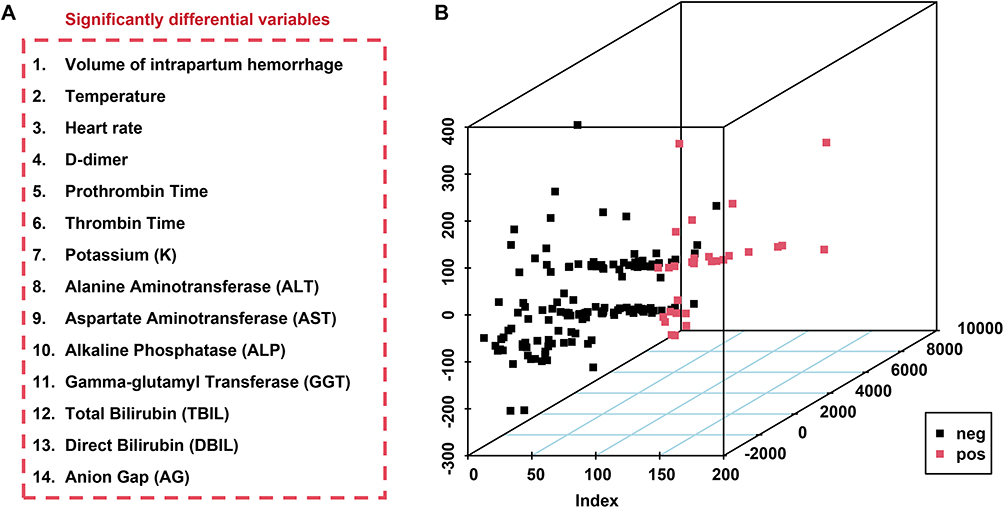 |
Figure 2 The results of principal component analysis (PCA) in multivariate analysis. (A) All 14 variables included. (B) The SARS-CoV-2 positive and SARS-CoV-2 negative pregnant women could be separated. |
Discussion
As a critical question in COVID-19 field, more details have been increasingly revealed in SARS-CoV-2 infected pregnant women, especially involving the maternal and fetal clinical outcomes.23,24 A recent multi-country cohort study has demonstrated that elevated maternal morbidity, mortality as well as neonatal complications were correlated with the COVID-19 diagnosis.25 However, more available clinical characteristics of the SARS-CoV-2 infected pregnant women are still scarce. Therefore, we herein compared the clinical data between SARS-CoV-2 positive and negative pregnant women, collected in Tianjin, China. Our findings indicated that SARS-CoV-2 infected pregnant women tended to exhibit precursors of coagulopathy, which was a dangerous signal for pregnant individuals.
The Distinct Basic Status Between SARS-CoV-2 Positive and Negative Pregnant Women
Firstly, regarding the basic information of pregnant women, most indicators showed no significant difference between positive and negative pregnant women. Whereas, positive women’s temperature and heart rate were significantly higher than that of normal pregnant individuals. It has been widely known that the most typical symptoms of COVID-19 included fever and cough, as the manifestations of viral pneumonia.26 Thus, the symptom in positive pregnant women herein was reasonable. Moreover, despite various manifestations in different patients, Nalbandian et al have documented that shortness of breath, fatigue, and high heart rate occurred in about 10%–15% of COVID-19 patients, as post-COVID-19 conditions.27 On the other hand, fever during pregnancy has been established to make adverse influence on offspring health, such as increasing the risk of neural tube defects, congenital heart defects, and oral clefts.28 Meanwhile, the timing of fever exposure was also an important factor in the unfavorable impacts on neonates.28 Accordingly, this basic aspect of SARS-CoV-2 positive pregnant women deserved to be paid special attention, in order to reduce the negative impacts both on mothers and neonates.
The Implications of SARS-CoV-2 Positive Mothers on Neonates
As for the fetal basic information, only three clinical features, comprising grading of placentation, umbilical cord around the neck, and cardiac B-scan ultrasound, were significantly abnormal. Based on the above data, SARS-CoV-2 positive mothers were probably able to affect the infants. Balkawade et al have suggested that the umbilical cord around the neck would increase the incidence of operative interference, intrapartum complications, fetal heart rate abnormalities, and higher probability of birth asphyxia.29 Whereas, currently, no consensus has been reached in the definition of placental infection of SARS-CoV-2, and extremely a few newborns (1%–3%) were exposed to the vertical maternal-fetal transmission.30
Abnormal Liver Functions in SARS-CoV-2 Positive Pregnant Women
Additionally, in our study, in SARS-CoV-2 positive pregnant women, we found that the ALT, AST, ALP, GGT, TBIL, and DBIL were significantly increased compared to normal pregnant individuals, implying the liver injury in SARS-CoV-2 positive patients. Previously, Xu et al have indicated that in some other highly pathogenic coronavirus infected patients, like Middle East respiratory syndrome coronavirus, liver injury was one of the most common symptoms, correlating with the severity of the disease.31 Hence, liver function-related results in COVID-19 patients raised our concern. In non-pregnant SARS-CoV-2 positive population, the liver injury has also been documented, among which approximately 10%–60% cases exhibited abnormal ALT and AST levels.32 Moreover, different proportions of severe patients and non-severe patients showed increased ALT and AST levels.32 Thus, liver injury was a prevalent manifestation in COVID-19 patients.
A recent study in Selcuk University Medical Faculty Hospital has indicated that among SARS-CoV-2 positive pregnant women, there was worse inflammatory response in pregnant patients with liver damage than those without liver damage, while obstetric and perinatal outcomes were similar in with or without liver dysfunction.33 However, there was still a lack of the related clinical information in SARS-CoV-2 positive pregnant women, which could be partly achieved in our present work. Although some liver function test indicators of positive pregnant women were still in a normal range, the distinction actually indicated a potential tendency of liver functional change. Whether these potential alterations would finally affect the pregnant outcomes should be further investigated in a larger sample size. Although there was no consensus in this field, we recommended more frequent monitors on liver dysfunction in SARS-CoV-2 positive pregnant women, and timely necessary treatments should be adopted based on the dynamic monitoring.
Coagulation Related Abnormality in SARS-CoV-2 Positive Pregnant Women
As pregnancy is actually a type of physiological prothrombotic state, the pregnant women had to suffer from an elevated risk of coagulopathy and/or thromboembolic complications, especially facing COVID-19 threat.34 Among all basic information of pregnant women, significantly more intrapartum hemorrhage in positive patients came to our attention. This feature can be reasonably connected with the coagulation-related indexes. In fact, we indeed found that multiple coagulation-related indexes were significantly different between positive and negative pregnant women, including APTT, TT, and D-dimer. Significantly longer APTT, TT, and higher D-dimer levels were observed in positive individuals, in line with some previous reports.35 Of which, higher D-dimer level has been indicated to associate with postpartum hemorrhage,36 which could further increase the risk of adverse outcomes of both mothers and neonates.
Recently, Januszewski et al have focused on the postpartum blood loss in SARS-CoV-2 infected pregnant women, and they found that positive patients were characterized by a longer APTT, and COVID-19 deliveries were related to an increased postpartum hemorrhage frequency.37 D-dimer measurement has been widely used to exclude the diagnosis of venous thromboembolism.38 It has been indicated that a few severe COVID-19 conditions could trigger the disseminated intravascular coagulation, which was a consumptive coagulopathy manifested with reduced fibrinogen, prolonged clotting times, and increased D-dimers.39 More recently, Choudhary et al have demonstrated that SARS-CoV-2 positive pregnant women complicated by liver dysfunction manifested with higher disease severity, meanwhile suffering a higher risk of complications like postpartum hemorrhage.40 Their findings coincided with our data. Thus, the similar conditions should be paid special attention in SARS-CoV-2 infected pregnant women, to avoid unexpected hemorrhage or death. Based on which, the delivery of SARS-CoV-2 positive pregnant women should be accelerated in a proper way in future clinical practice, to avoid prolonged physical exertion and postpartum hemorrhage. Meanwhile, it is also recommended that neonatologists should prepare for neonatal resuscitation in advance in the delivery room.
Strengths and Limitations of This Work
In summary, our present study has demonstrated the potential difference and association between SARS-CoV-2 positive and negative pregnant women in Tianjin, China, for the first time. Our data were of great significance in the global context of the pandemic, especially involving the vulnerable pregnant population. Nevertheless, we have to acknowledge that there are several limitations in this study. First, our findings would be more powerful when a larger sample size was employed. Meanwhile, our data were obtained from a single-center analysis, which should be validated in multiple-center cohorts in future studies.
Conclusions
In conclusion, we have revealed the specific difference in the SARS-CoV-2 infected pregnant women in Tianjin, China, for the first time. Compared to negative pregnant women, significantly abnormal liver function and coagulopathy were observed in positive patients. Our findings contributed to the deeper understanding of the obviously distinct liver function in SARS-CoV-2 infected pregnant women. In further clinical research and practice, it is important to focus on these indexes in SARS-CoV-2 infected pregnant women. Meanwhile, more frequent detection of liver function and coagulopathy-related markers are beneficial for monitoring the health status of pregnant individuals as well as to prevent potential adverse outcomes.
Abbreviations
APTT, Activated partial thromboplastin time; AST, Aspartate Aminotransferase; COVID-19, Corona virus disease 2019; DBIL, Direct Bilirubin; DD2, D-dimer; GGT, Gamma-glutamyl Transferase; qRT-PCR, quantitative RT-PCR; SARS, Severe Acute Respiratory Syndrome; SARS-CoV-2, Severe acute respiratory syndrome coronavirus 2; TBIL, Total Bilirubin; TT, Thrombin Time.
Data Sharing Statement
The data supporting the conclusion of the study are included in the article.
Ethical Approval and Consent to Participate
Our work was approved by the ethics committee of Tianjin First Central Hospital (2024SYDWLL-000465). All subjects volunteered to participate in our study.
Consent for Publication
Not applicable.
Author Contributions
All authors made a significant contribution to the work reported, whether that is in the conception, study design, execution, acquisition of data, analysis and interpretation, or in all these areas; took part in drafting, revising or critically reviewing the article; gave final approval of the version to be published; have agreed on the journal to which the article has been submitted; and agree to be accountable for all aspects of the work.
Funding
This work was supported by the Key Projects of Tianjin Natural Science Foundation (22JCZDJC00480), and the Innovation Team Talent Foundation of Tianjin First Central Hospital (2022FCH-CXTD).
Disclosure
The authors declare no conflict of interest regarding the publication of this article.
References
1. Ayed A, Embaireeg A, Benawadh A, et al. Maternal and perinatal characteristics and outcomes of pregnancies complicated with COVID-19 in Kuwait. BMC Pregnancy Childbirth. 2020;20(1):754. doi:10.1186/s12884-020-03461-2
2. Chaubey I, Vijay H, Govindaraj S, et al. Impact of COVID-19 vaccination on pregnant women. Pathogens. 2023;12(3):431. doi:10.3390/pathogens12030431
3. Tregoning JS, Flight KE, Higham SL, Wang Z, Pierce BF. Progress of the COVID-19 vaccine effort: viruses, vaccines and variants versus efficacy, effectiveness and escape. Nat Rev Immunol. 2021;21(10):626–636. doi:10.1038/s41577-021-00592-1
4. Boehm E, Kronig I, Neher RA, et al. Novel SARS-CoV-2 variants: the pandemics within the pandemic. Clin Microbiol Infect. 2021;27(8):1109–1117. doi:10.1016/j.cmi.2021.05.022
5. Long B, Carius BM, Chavez S, et al. Clinical update on COVID-19 for the emergency clinician: presentation and evaluation. Am J Emerg Med. 2022;54:46–57. doi:10.1016/j.ajem.2022.01.028
6. Fan C, Lei D, Fang C, et al. Perinatal transmission of 2019 coronavirus disease-associated severe acute respiratory syndrome coronavirus 2: should we worry? Clin Infect Dis. 2021;72(5):862–864. doi:10.1093/cid/ciaa226
7. Wu Z, McGoogan JM. Characteristics of and important lessons from the coronavirus disease 2019 (COVID-19) outbreak in china: summary of a report of 72 314 cases from the Chinese center for disease control and prevention. JAMA. 2020;323(13):1239–1242. doi:10.1001/jama.2020.2648
8. Elrobaa IH, New KJ. COVID-19: pulmonary and extra pulmonary manifestations. Front Public Health. 2021;9:711616. doi:10.3389/fpubh.2021.711616
9. Dotan A, Muller S, Kanduc D, David P, Halpert G, Shoenfeld Y. The SARS-CoV-2 as an instrumental trigger of autoimmunity. Autoimmun Rev. 2021;20(4):102792. doi:10.1016/j.autrev.2021.102792
10. Lamberghini F, Testai FD. COVID-2019 fundamentals. J Am Dent Assoc. 2021;152(5):354–363. doi:10.1016/j.adaj.2021.01.014
11. Narang K, Enninga EAL, Gunaratne M, et al. SARS-CoV-2 Infection and COVID-19 During Pregnancy: a Multidisciplinary Review. Mayo Clin Proc. 2020;95(8):1750–1765. doi:10.1016/j.mayocp.2020.05.011
12. Gomez-Lopez N, Romero R, Tao L, et al. Distinct Cellular Immune Responses to SARS-CoV-2 in Pregnant Women. J Immunol. 2022;208(8):1857–1872. doi:10.4049/jimmunol.2101123
13. Al-Zahrani A, Alanazi L, Thabet H, Alenezi F. Maternal outcomes among pregnant women diagnosed with COVID-19. Cureus. 2023;15(1):e33887. doi:10.7759/cureus.33887
14. Garcia-Flores V, Romero R, Xu Y, et al. Maternal-fetal immune responses in pregnant women infected with SARS-CoV-2. Nat Commun. 2022;13(1):320. doi:10.1038/s41467-021-27745-z
15. Woodworth KR, Olsen EO, Neelam V, et al. Birth and infant outcomes following laboratory-confirmed SARS-CoV-2 infection in pregnancy - set-net, 16 jurisdictions, march 29-October 14, 2020. MMWR Morb Mortal Wkly Rep. 2020;69(44):1635–1640. doi:10.15585/mmwr.mm6944e2
16. Panagiotakopoulos L, Myers TR, Gee J, et al. SARS-CoV-2 infection among hospitalized pregnant women: reasons for admission and pregnancy characteristics - eight U.S. health care centers, march 1-may 30, 2020. MMWR Morb Mortal Wkly Rep. 2020;69(38):1355–1359. doi:10.15585/mmwr.mm6938e2
17. Lokken EM, Walker CL, Delaney S, et al. Clinical characteristics of 46 pregnant women with a severe acute respiratory syndrome coronavirus 2 infection in Washington state. Am J Obstet Gynecol. 2020;223(6):e911–e914. doi:10.1016/j.ajog.2020.05.031
18. Smith ER, Oakley E, Grandner GW, et al. Clinical risk factors of adverse outcomes among women with COVID-19 in the pregnancy and postpartum period: a sequential, prospective meta-analysis. Am J Obstet Gynecol. 2023;228(2):161–177. doi:10.1016/j.ajog.2022.08.038
19. Mertz D, Kim TH, Johnstone J, et al. Populations at risk for severe or complicated influenza illness: systematic review and meta-analysis. BMJ. 2013;347:f5061.
20. Fu W, Sivajohan B, McClymont E, et al. Systematic review of the safety, immunogenicity, and effectiveness of COVID-19 vaccines in pregnant and lactating individuals and their infants. Int J Gynaecol Obstet off Organ Int Fed Gynaecol Obstet. 2022;156(3):406–417. doi:10.1002/ijgo.14008
21. Simon LV, Shah M, Bragg BN. Treasure Island (FL) ineligible companies. disclosure: manan shah declares no relevant financial relationships with ineligible companies. disclosure: bradley Bragg declares no relevant financial relationships with ineligible companies. In: APGAR Score. StatPearls; 2024.
22. Luo J, Zhou L, Feng Y, Li B, Guo S. The selection of indicators from initial blood routine test results to improve the accuracy of early prediction of COVID-19 severity. PLoS One. 2021;16(6):e0253329. doi:10.1371/journal.pone.0253329
23. Smith ER, Oakley E, Grandner GW, et al. Adverse maternal, fetal, and newborn outcomes among pregnant women with SARS-CoV-2 infection: an individual participant data meta-analysis. BMJ Glob Health. 2023;8(1):e009495. doi:10.1136/bmjgh-2022-009495
24. Allotey J, Stallings E, Bonet M, et al. Clinical manifestations, risk factors, and maternal and perinatal outcomes of coronavirus disease 2019 in pregnancy: living systematic review and meta-analysis. BMJ. 2020;370:m3320.
25. Villar J, Ariff S, Gunier RB, et al. Maternal and neonatal morbidity and mortality among pregnant women with and without COVID-19 Infection: the INTERCOVID multinational cohort study. JAMA Pediatr. 2021;175(8):817–826. doi:10.1001/jamapediatrics.2021.1050
26. Zhang S, Cheng ZM, Yu JL, et al. Malic enzyme 2 promotes the progression of hepatocellular carcinoma via increasing triglyceride production. Cancer Med. 2021;10(19):6795–6806. doi:10.1002/cam4.4209
27. Nalbandian A, Desai AD, Wan EY. Post-COVID-19 Condition. Annu Rev Med. 2023;74:55–64. doi:10.1146/annurev-med-043021-030635
28. Dreier JW, Andersen AM, Berg-Beckhoff G. Systematic review and meta-analyses: fever in pregnancy and health impacts in the offspring. Pediatrics. 2014;133(3):e674–688. doi:10.1542/peds.2013-3205
29. Balkawade NU, Shinde MA. Study of length of umbilical cord and fetal outcome: a study of 1000 deliveries. J Obstet Gynaecol India. 2012;62(5):520–525. doi:10.1007/s13224-012-0194-0
30. Roberts DJ, Edlow AG, Romero RJ, et al. A standardized definition of placental infection by SARS-CoV-2, a consensus statement from the national institutes of health/Eunice Kennedy Shriver national institute of child health and human development SARS-CoV-2 placental infection workshop. Am J Obstet Gynecol. 2021;225(6):593e591–593e599. doi:10.1016/j.ajog.2021.07.029
31. Xu L, Liu J, Lu M, Yang D, Zheng X. Liver injury during highly pathogenic human coronavirus infections. Liver Int. 2020;40(5):998–1004. doi:10.1111/liv.14435
32. Lee IC, Huo TI, Huang YH. Gastrointestinal and liver manifestations in patients with COVID-19. J Chin Med Assoc. 2020;83(6):521–523. doi:10.1097/JCMA.0000000000000319
33. Kulhan NG, Orgul G, Avci F, Kulhan M. Comparison of cases with and without acute liver injury in pregnant women with SARS-CoV-2 infection; obstetric and neonatal outcomes. Pak J Med Sci. 2024;40(3Part–II):277–283. doi:10.12669/pjms.40.3.7746
34. Varlas VN, Borș RG, Plotogea M, Iordache M, Mehedințu C, Cîrstoiu MM. Thromboprophylaxis in Pregnant Women with COVID-19: an Unsolved Issue. Int J Environ Res Public Health. 2023;20(3):1949. doi:10.3390/ijerph20031949
35. Djusad S, Irwinda R, Harzif AK, et al. Determining laboratory parameters in pregnant women with severe COVID-19. SAGE Open Med. 2022;10:20503121221132168. doi:10.1177/20503121221132168
36. Shao H, Gao S, Dai D, Zhao X, Hua Y, Yu H. The association of antenatal D-dimer and fibrinogen with postpartum hemorrhage and intrauterine growth restriction in preeclampsia. BMC Pregnancy Childbirth. 2021;21(1):605. doi:10.1186/s12884-021-04082-z
37. Januszewski M, Santor-Zaczynska M, Ziuzia-Januszewska L, et al. Postpartum blood loss in COVID-19 patients-propensity score matched analysis. Biomedicines. 2022;10(10):2517. doi:10.3390/biomedicines10102517
38. Bellesini M, Robert-Ebadi H, Combescure C, Dedionigi C, Le Gal G, Righini M. D-dimer to rule out venous thromboembolism during pregnancy: a systematic review and meta-analysis. J Thromb Haemost. 2021;19(10):2454–2467. doi:10.1111/jth.15432
39. Zhou X, Cheng Z, Luo L, et al. Incidence and impact of disseminated intravascular coagulation in COVID-19 a systematic review and meta-analysis. Thromb Res. 2021;201:23–29. doi:10.1016/j.thromres.2021.02.010
40. Choudhary A, Singh V, Bharadwaj M. Maternal and neonatal outcomes in pregnant women with sars-cov-2 infection complicated by hepatic dysfunction. Cureus. 2022;14(5):e25347. doi:10.7759/cureus.25347
 © 2024 The Author(s). This work is published and licensed by Dove Medical Press Limited. The
full terms of this license are available at https://www.dovepress.com/terms
and incorporate the Creative Commons Attribution
- Non Commercial (unported, 3.0) License.
By accessing the work you hereby accept the Terms. Non-commercial uses of the work are permitted
without any further permission from Dove Medical Press Limited, provided the work is properly
attributed. For permission for commercial use of this work, please see paragraphs 4.2 and 5 of our Terms.
© 2024 The Author(s). This work is published and licensed by Dove Medical Press Limited. The
full terms of this license are available at https://www.dovepress.com/terms
and incorporate the Creative Commons Attribution
- Non Commercial (unported, 3.0) License.
By accessing the work you hereby accept the Terms. Non-commercial uses of the work are permitted
without any further permission from Dove Medical Press Limited, provided the work is properly
attributed. For permission for commercial use of this work, please see paragraphs 4.2 and 5 of our Terms.
Recommended articles

Factors Influencing the Antenatal Care Attendance of Pregnant Women During the First COVID-19 Wave Lockdown in Thailand
Chalermpichai T, Subsomboon K, Kasak R, Pinitlertsakun O, Pangzup S
International Journal of Women's Health 2023, 15:731-740
Published Date: 11 May 2023
The Correlation Between sP-Selectin and Platelet Count in COVID-19 Patients in Referral Hospital, West Java Indonesia
Prihatni D, Budianto FC, Andriyoko B, Trisa S
Journal of Blood Medicine 2023, 14:555-561
Published Date: 27 October 2023
Lesson Learned During a Pandemic: A Phenomenological Study of Pregnant Women’s Experience in Resource-Limited Setting
Cherinet A, Zemedkun A, Wudineh A, Molla W, Sisay D, Negassa B, Mebratu A, Gossaye A, Melaku G, Madoro D
Journal of Multidisciplinary Healthcare 2024, 17:325-337
Published Date: 23 January 2024
Characteristics and Outcomes of Coronavirus Disease- 2019 Among Pregnant Women in Saudi Arabia; a Retrospective Study
Abdelmola A, Albasheer O, Kariri AA, Akkam FM, Hakami RA, Essa SA, Jali FM
International Journal of Women's Health 2024, 16:475-490
Published Date: 14 March 2024