
Back to Journals » Nature and Science of Sleep » Volume 18

Association of Sleep-related Parenting Practices and Sleep Problems in Preschoolers: A National Multiprovince Survey in China
Authors Zhou J, Cheng T, Xu M, Zhang M, Wu Y, Huang M, Liu Y, Tan X, Zhang X, Wang S, Yang L, Peng Y, Zhang T, Guan H
Received 7 October 2025
Accepted for publication 23 December 2025
Published 14 January 2026 Volume 2026:18 570971
DOI https://doi.org/10.2147/NSS.S570971
Checked for plagiarism Yes
Review by Single anonymous peer review
Peer reviewer comments 2
Editor who approved publication: Dr Marco Veneruso
Ji Zhou,1 Tong Cheng,1 Mengjie Xu,1 Mengnan Zhang,1 Yan Wu,2 Minyuan Huang,3 Yunfen Liu,4 Xia Tan,5 Xuejiao Zhang,6 Sumei Wang,7 Lin Yang,8 Yanmei Peng,9 Ting Zhang,10 Hongyan Guan1
1Research and Guidance Center for Infant Care Services, Capital Center for Children’s Health, Capital Medical University, Capital Institute of Pediatrics, Beijing, People’s Republic of China; 2Department of Pediatrics, Yiwu Maternity and Children Hospital, Yiwu, Zhejiang, People’s Republic of China; 3Department of Pediatrics, Jiangmen Maternal and Child Health Hospital, Jiangmen, Guangdong, People’s Republic of China; 4Department of Pediatrics, Yunnan Maternal and Child Health Care Hospital, Kunming, Yunnan, People’s Republic of China; 5Department of Pediatrics, Changsha Hospital for Maternal and Child Health Care, Changsha, Hunan, People’s Republic of China; 6Department of Pediatrics, ShenYang Maternity and Child Health Hospital, Shenyang, Liaoning, People’s Republic of China; 7Department of Pediatrics, Maanshan Maternal and Child Health Hospital, Maanshan, Anhui, People’s Republic of China; 8Department of Pediatrics, The Second Affiliated Hospital of Xi’an, Xi’an, Shaanxi, People’s Republic of China; 9Department of Pediatrics, Huairou District Maternal and Child Health Hospital, Beijing, People’s Republic of China; 10Department of Biochemistry and Immunology, Capital Center for Children’s Health, Capital Medical University, Capital Institute of Pediatrics, Beijing, People’s Republic of China
Correspondence: Hongyan Guan, Research and Guidance Center for Infant Care Services, Capital Center for Children’s Health, Capital Medical University, Capital Institute of Pediatrics, Beijing, People’s Republic of China, Tel +8613501345686, Email [email protected]
Purpose: Sleep is fundamental to the healthy development of preschool children, yet sleep problems are prevalent. Parenting practices are known to be one of the determinants of child sleep, but evidence of large-scale sample in China is limited. We aimed to investigate the association between specific sleep-related parenting practices and sleep problems in Chinese preschoolers.
Patients and Methods: The Chinese cohort of the SUNRISE study was conducted, involving 1316 children aged 3– 4 from 49 kindergartens, covering seven major administrative regions of China. Parents or primary caregivers completed a questionnaire which records children’s sociodemographic information and sleep-related parenting practices. Children’s sleep problems were evaluated using the Children’s Sleep Habits Questionnaire (CSHQ). Linear mixed models were used to calculate the association between parenting practices and specific sleep problems, adjusting for potential covariates.
Results: Thirteen percent demonstrated sleep problems (total CSHQ score > 54). Girls had greater rate of daytime sleepiness, while the 3-year group had a greater rate of overall sleep problems. After adjusting for covariates, parents using electronic devices during the bedtime routine were associated with children’s short sleep duration on weekdays (β=− 0.314, CI − 0.505~– 0.123, P=0.02), bad sleep quality (β=− 0.34, CI – 0.557~0.124, P=0.029). Children sharing a room with others were associated with serious overall sleep problems (β=− 5.929, CI − 9.919~– 1.945, P=0.036). Children who share a bed with others were associated with serious overall sleep problems (β= − 5.914, CI − 9.697~– 2.134, P=0.026).
Conclusion: This study demonstrates that sleep-related parenting practices, including parental screen exposure and co-room/bed sleep arrangements are significantly associated with sleep problems in Chinese preschoolers. These findings help parents to establish a healthy sleeping environment for their children.
Keywords: preschoolers, parenting practices, sleep quality, Chinese cohort
Introduction
Sleep, as a sign of biological behavior, is considered to be closely related to cardiovascular, metabolic, immunologic, mental, behavioral, and cognitive health.1–3 There is evidence that children’s sleep, especially in preschoolers, has been associated with future healthy growth and development.4–6 During the preschool years, the cognitive, emotional and physical fields are rapidly maturing, and adequate quality sleep is essential.7 More importantly, poor sleep in early childhood is considered as a precursor to further adverse health consequences, such as increased risk for obesity,8 hyperactivity,9 and emotional difficulties.10
However, sleep problems, including difficulty initiating or maintaining sleep, are rising and have been identified as a specific global public health problem.11 According to a retrospective study, 15–70% of parents reported their children have sleep problems or disturbances.12 Approximately 20 to 60% of children between the ages of 2 and 5 years old are estimated to experience at least one sleep issue.13 In China, the prevalence of children’s sleep problems is approximately 15.3 to 76.3%.14 A national population-based cohort study has shown that the prevalence of sleep disorders among preschool children in China is 76.78%.15
“Sleep-Related Parenting Practices” on the basis of the SUNRISE Parental Questionnaire, which has been verified reliability in assessing preschooler sleep characteristics and related parenting practices.16 This questionnaire items can fully reflect parenting practice variables of children and the localization was done to fit China’s specific circumstances.
Multiple factors affect children’s sleep, besides intrinsic factors (eg, health and temperament), there are extrinsic factors (eg, parenting behaviors and environment) that affect children’s sleep.17,18 Parental practices and the home environment are powerful determinants of a child’s sleep quality.19 Key practices include establishing consistent bedtime routines, managing screen-time exposure before bed,7 and decisions regarding sleep arrangements, such as co-sleeping versus solitary sleeping.20 Children who shared a bed had significantly shorter overnight sleep, later sleep and wake times, and longer naps than solitary sleepers.21 Previous studies have shown that parents’ screen use time is longer, and children are more likely to overuse the screen,22 excessive screen exposure will adversely affect children’s sleep.23 This indirectly supports the relationship between parents’ bedtime screen use and children’s sleep. While the impact of these parenting practices on child sleep has been studied, there is a comparative lack of multi-regional research within China. Evaluating specific modifiable parental behaviors and their association with different areas of sleep. Existing studies in China have often focused on specific cities or regions24,25 or specific parenting parameters.26
Given China’s vast geographic and cultural diversity, a broader investigation is needed to understand the common associations between different regions. However, to the authors’ knowledge, there is currently no large, multiregional study assessing specific modifiable parental behaviors and their links to different domains of sleep. To fill evidence gaps, in a large-scale and representative sample of 1295 preschoolers across seven administrative divisions in China, we aimed to examine the associations between a comprehensive set of sleep-related parenting practices and a range of sleep problems. In the large, multiprovince study, we considered different types of sleep problems and various covariates, including child age, gender, residence, regional,27 season,28 caregivers’ education29 and caregivers’ age.30 Our overall hypotheses were that specific sleep-related parenting practices would be associated with sleep problems in Chinese preschoolers.
Patients and Methods
Participants
This is a Chinese cohort using cross-sectional data from the SUNRISE study. According to the research protocol,31 49 kindergartens in eight provinces complied with the research standards and signed the informed consent form. Multistage stratified cluster sampling methods were used to recruit children aged 3–4 years from April 2023 to July 2023 and January 2024 according to the seven administrative regions in China (East China: Yiwu and Maanshan; Central China: Changsha; North China: Beijing; Northeast China: Shenyang; Northwest China: Xi‘an; Southwest China: Kunming; South China: Jiangmen). In each province, urban and rural kindergartens were selected so that the ratio of urban children to rural children was 1:1. Ethical approval was obtained from the Ethics Committee of the Capital Institute of Pediatrics (No. SHERLL2022065). The research follows the principles set forth in the Declaration of Helsinki. Informed consent was obtained from parents or guardians of study participants.
Participants had to meet the following criteria: (1) children aged 3–4; (2) no physical discomfort such as cold or fever during the investigation; (3) no congenital diseases, physical development, behavioral and intellectual disorders. Overall, 1316 preschoolers were enrolled. Participants without valid questionnaire data were excluded, leaving data from 1295 preschoolers included in the analysis. Data flowchart were described in Figure S1.
Measurements
Sleep-related Parenting Practices
In the SUNRISE parent questionnaire, parents reported the presence of electronic devices in the child’s bedroom, child electronic device use within 2 h of bedtime, the timing of child pre-bedtime electronic device use, whether children take a nap, bedtime variability (within or >30 min), wake-up time variability (within or >30 min), the frequency of parental smartphone use during bedtime routine, the frequency of bedtime routine and sleep arrangement, specifically room-sharing and bed-sharing. The validity and reliability of the measure was verified in a community sample (ICC= 0.81–0.94; Kappa= 0.73–0.86).16
Sleep Problems
The Children’s Sleep Habits Questionnaire (CSHQ) is a widely used instrument originally designed to screen for sleep disturbances among children aged 4–10 years,32 and the Chinese version has been validated and extended for use in preschool children as young as 3 years.33–35 The CSHQ consists of 33 items that cover eight subscales, and the cutoff scores were defined as described in previous studies: 10.84 for bedtime resistance, 2.31 for sleep onset delay, 5.27 for sleep duration, 7.79 for sleep anxiety, 5.29 for night wakings, 10.61 for parasomnias, 4.50 for sleep disordered breathing, and 15.24 for daytime sleepiness.32,34 Parents were asked to rate the frequency for each item on a 3-point Likert scale: “usually”, “sometimes”, and “rarely” for 5–7 times per week, 2–4 times per week and 0–1 time per week, respectively. A higher CSHQ score indicates higher sleep disturbances. The total score of CSHQ >54 is taken as the critical value to identify the overall sleep disorder. In this study, the standards that are more suitable for children in China are adopted,36 with sensitivity of 0.80 and specificity of 0.72.32
Sleep duration in weekdays and weekend were reported by parents, average sleep duration is calculated by (Sleep duration in weekdays*5+Sleep duration in weekends*2)/7. Sleep duration <10 h were defined as short sleep duration.
Sleep quality was also based on the SUNRISE parent questionnaire. Parents were asked to rate the quality of their child’s sleep on a scale of 1–7, with the higher number indicating higher quality. A score of 1 would indicate that the child was very difficult to settle, wakes many times during the night for prolonged periods, and is very restless while a score of 7 would indicate that the child settles and drifts off to sleep within a few minutes, sleeps right through the night, and has a very sound, deep sleep.16 Sleep quality score less than the median is considered bad sleep quality.
Covariates
Covariates for the analysis included child age, gender, residence (rural/urban), regional in China (east/middle/west/northeast), season (spring/summer or winter). In analyzing the data, in order to study and distinguish the economic development of different regions, each sampling point is reclassified according to its scope. The economic development in the east is the best, followed by the northeast and central regions, and the economic development in the west is the worst, caregivers’ highest education (high school/vocational education and below, tertiary education, postgraduate) and caregivers’ age (<30, 30-39, ≥40).
Statistical Analysis
Descriptive statistics including means, standard deviations, and proportion were used to summarize the demographic characteristics of the participants and the prevalence of parenting practices or sleep problems.
Analysis of variance (ANOVA) was employed to examine differences of sleep problems parameters between different groups in child age, gender, residence, regional in China, season, caregivers’ highest education, caregivers’ age, electronic device in the bedroom, napping, bedtime variability, wake-up time variability, bedtime routine, parental smartphone use during bedtime routine, the presence of electronic devices in the child’s bedroom, child electronic device use within 2 h of bedtime, the timing of child pre-bedtime electronic device use, co-room/bed sleep arrangement categories.
Pairwise comparisons were performed by Bonferroni test when inter-group differences were found. Linear mixed model was used to evaluate the association of sleep-related parenting practices with sleep problems by using the regression coefficient (β) along with 95% confidence intervals (95%CI). False discovery rate (FDR) (Benjamini–Hochberg method) was used for correction. All regression models were adjusted for the aforementioned covariates: child age, gender, residence, regional in China, season, caregivers’ highest education and caregivers’ age. All statistical analyses were performed using R software 4.4.1. A two-tailed P-value of <0.05 was considered statistically significant.
Results
According to the admission criteria, a total of 1316 children were included in the study, 12 children dropped out due to personal reasons, as missing data were less than 5%, and thus handled with listwise deletion. As presented in Table 1, 1295 children were included for the final analyses. There are 649 boys (50.1%) and 646 girls (49.9%), 593 children in the 3-year-old group (45.8%) and 702 children in the 4-year-old group (54.2%). There are 677 residing in urban areas (52.3%) and 618 reside in rural areas (47.7%). Table 1 also presents the distribution of sleep-related parenting practices. 46.9% of parents will use their smartphone during the bedtime routine, 14.4% of children sleep alone in one bed and 82.2% of children share a bed with others.
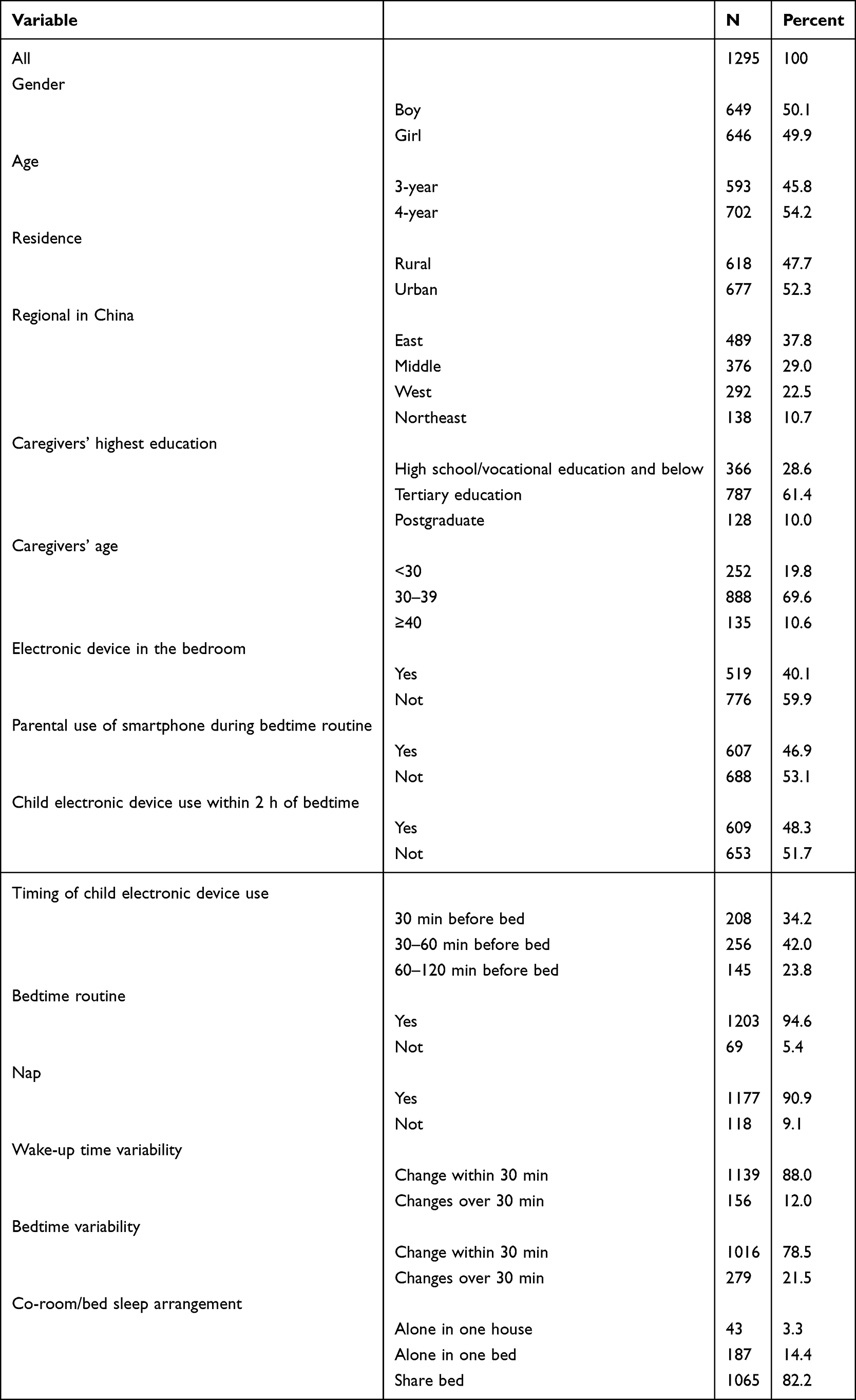 |
Table 1 Characteristics of the Study Participants and Sleep-related Parenting Practices (N=1295) |
The description of prevalence data was summarized in Table 2 and S1.
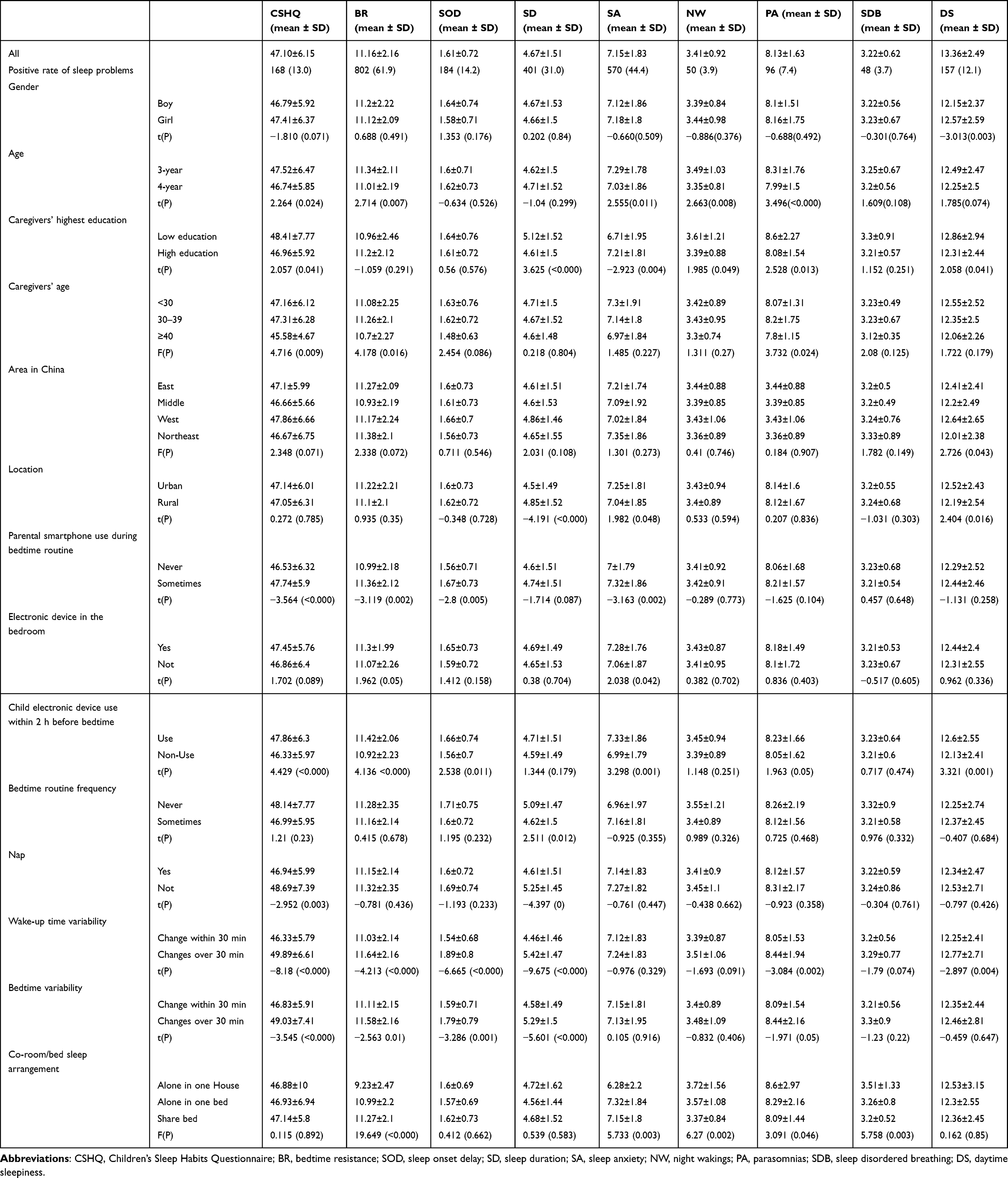 |
Table 2 Sociodemographic Information and Sleep-related Parenting Practices Influence Sleep Problem |
Sleep Duration: of the children, 34.9% were reported as having short sleep duration on weekdays, 24.8% were reported as having short sleep duration on weekends, 35.5% were reported as having average short sleep duration.
Sleep Problem: The prevalence of sleep problem was 13.0% (total CSHQ score=47.10±6.15), sleep quality score=5.54±1.4. The prevalence of each type of sleep disturbance varied, for example, the highest prevalence of bedtime resistance, reaching 61.9% (bedtime resistance score=11.16±2.16); the lowest prevalence is sleep disordered breathing, only 3.7% (sleep disordered breathing score=3.22±0.62).
The data in Tables 2 and S1 suggest that children at 3-year group are at significantly higher risk of short sleep duration on weekends, average short sleep duration, bedtime resistance, sleep anxiety, night wakings and parasomnias than 4-year children (P<0.05). Girls are at significantly higher risk of daytime sleepiness than boys (P<0.05).
Tables S2 and S3. Figure 1 displays the associations between parenting practices and overall sleep problems. Figures S2–S13 display the associations between parenting practices and other sleep problems.
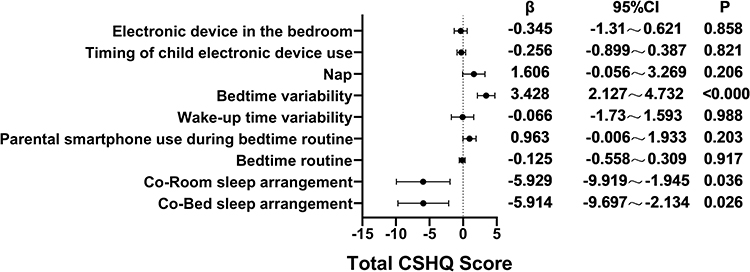 |
Figure 1 Relationship of Parenting Practices with Total CSHQ Score. Abbreviations: CSHQ, Children’s Sleep Habits Questionnaire; CI, confidence interval. |
Napping: After adjusting for covariates, the score for sleep onset delay of children who did not take regular daytime naps is about 0.615 points higher than that of children who napped (β = 0.615, 95%CI: 0.227–1.003, P=0.023).
Bedtime Variability: Having an inconsistent bedtime was associated with multiple sleep problems. Compared to children bedtime change within 30 min, those bedtime change over 30 min had higher total CSHQ score (β=3.428, 95%CI: 2.127–4.732, P<0.000), higher SOD score (β=0.334, 95%CI: 0.177–0.491, P<0.000), higher SD score (β=0.942, 95%CI: 0.638–1.245, P=0.001), higher DS score (β=0.809, 95%CI: 0.267–1.352, P=0.029).
Parental Smartphone Use During Bedtime Routine: The use of electronic devices during the bedtime routine was linked to higher odds of sleep problem. Compared to parents who never used smartphone during bedtime routine, those who sometimes used them had lower sleep duration on weekdays (β= −0.314, 95%CI: −0.505 to –0.123, P=0.020), bad sleep quality (β= −0.34, 95%CI: −0.557 to –0.124, P=0.029).
Co-Room/Bed Sleep Arrangements: Children share room with others was associated with multiple dimensions of sleep problems. Using “Alone in One House” as the reference group, Compared to children who share room with others, sleep alone in one house had lower total CSHQ score (β=−5.929, 95%CI: −9.919 to –1.945, P=0.036), lower NW score (β=−1.343, 95%CI: −1.959 to –0.728, P<0.000), lower SDB score (β=−0.603, 95%CI: −1.025 to –0.182, P=0.042). Compared to children who share bed with others, sleep alone in one house had lower total CSHQ score (β=−5.914, 95%CI: −9.697 to –2.134, P=0.026), lower NW score (β=−1.54, 95%CI: −2.124 to –0.956, P=0.001), lower PA score (β=−1.636, 95%CI: −2.663 to –0.609, P=0.021), lower SDB score (β=−0.689, 95%CI: −1.089 to –0.289, P=0.017), lower DS score (β=−2.195, 95%CI: −3.772 to –0.617, P=0.047).
Discussion
In view of the importance of sleep for children’s development, improving parents’ parenting behavior of sleep during childhood is vital. To our knowledge, this is the first large, multiprovince study that provides compelling evidence that specific, modifiable parenting practices are significantly associated with a wide spectrum of sleep problems in Chinese preschoolers. Our findings also examined a comprehensive set of parenting practices, and emphasize their key role in creating a suitable sleeping environment. This highlights that parents used electronic devices during the bedtime routine and certain co-room/bed sleeping arrangements are linked to poorer sleep outcomes while controlling for key demographic confounders. These results have important implications for pediatric health care and public health messaging in China.
We found that 34.9% reported short sleep duration on weekdays and 24.8% for short sleep duration on weekends. Thirteen percent reported overall sleep problems (CSHQ >54) and prevalence of different tapes from 3.7% (sleep disordered breathing) to 61.9% (bedtime resistance). Caregivers (42.2%) thought their child had bad sleep quality (sleep quality score >6). Similar findings have been reported in other studies. In China, the reported prevalence of sleep problems among preschool children is 43.7%,37 and more seriously, 89.4% of rural preschool children show sleep-related difficulties.38 Indeed, the increasing number of children’s sleep problems has become a serious problem and has brought a heavy burden to children’s development.39 However, different screening methods and criteria may be essential reasons for the difference in the prevalence of sleep problems. In this study, the evaluation criteria more suitable for children in China may underestimate the detection rate of children’s sleep problems.
Our study revealed that sleep-related parenting practices are a cornerstone of healthy sleep. Maintaining a consistent nap and bedtime schedule. An inconsistent bedtime has a strong relationship with the overall sleep problem, especially sleep onset delay and irregular sleep duration. This law is helpful to regulate children’s endogenous circadian rhythm.40 When the bedtime is unpredictable, this internal clock is disrupted, leading to difficulties in initiating sleep or insomnia41 and even causing circadian rhythm disorder in children. This reinforces the importance of consistent routines, a message often promoted in behavioral sleep interventions.42 The absence of a regular daytime nap was associated with irregular sleep duration. This may be because skipping naps leads to over-tiredness at bedtime, but children will be more active, which paradoxically can make it harder for a child to fall and stay asleep.43 Taking a nap can improve children’s sleep, but it may lead to less sleep at night. Therefore, the individual needs of children’s sleep should be considered, and the nap time should not affect the night sleep.
Even more striking was the finding that the relationship between parental screen use during the bedtime routine and sleep problems in children updates our previous cognition.5 Previous studies have confirmed that children’s screen use will affect the quality of sleep and lead to sleep problems.44 We find that parental screen use was linked to a short sleep duration on weekdays and bad sleep quality. As it may suggest that parental media exposure can lead to a decrease in parents-children interaction, which affects children’s sleep quality.45 This phenomenon is particularly noteworthy. It is worth further studying whether there is a reverse causal relationship, that is, parents might turn to screen devices when their children have trouble falling asleep peacefully.46
Perhaps the most culturally nuanced finding relates to co-room/bed sleeping arrangements. Bed/room-sharing is a widespread phenomenon, especially in China. A research from China shows the incidence of bed-sharing is 84.2%, and that of room-sharing is 10.1%, only 5.7% of children sleep separately.34 This may be due to the fact that children in China go to school earlier, their families are mostly crowded houses, and they generally have the habit of sharing beds.47 At present, the advantages and disadvantages of co-sleeping have not been clearly concluded. Some studies believe that sleeping together has a negative impact on children.48,49 In our sample, both bed-sharing and room-sharing were associated with overall sleep problems, night waking and sleep disordered breathing compared to solitary sleeping. It is possible that, in the context of modern Chinese families, asking families to provide each child with a separate room to sleep in is challenging.50 The practical suggestion is to make the sleeping environment as quiet as possible to lessen disturbances to children’s sleep.51 Alternatively, this association could reflect reverse causality; that is, parents may be more likely to co-sleep or room-share in response to a child who is already anxious or has preexisting sleep difficulties.52
However, the study is not without limitations. First, the conclusion about causality cannot be obtained from cross-sectional studies. Longitudinal studies are needed to untangle the temporal relationships between parenting practices and the development of sleep problems. Second, our reliance on parent-reported data both for family practices and problems introduces the potential for common-method and recall bias. Future research would benefit from incorporating objective sleep measures, such as actigraphy, to validate parental reports.53 Finally, we did not assess other potentially influential factors, such as parental mental health, marital satisfaction, or overall family stress, which can impact both parenting practices and child outcomes.54
Conclusion
In conclusion, this large-scale cross-sectional study demonstrates that in China, parenting practices play a crucial role in shaping the sleep health of preschool children. Modifiable practices, including maintaining a consistent nap and bedtime schedule, the choice of co-room/bed sleeping arrangement, are significantly associated with the prevalence of a wide range of sleep problems. These findings provide population-based evidence of associations base for public health policy and clinical practice guidelines. Longitudinal or intervention studies are called to further determine the causal effects of parenting practices on children’s sleep problems.
Abbreviation
CSHQ, Children’s Sleep Habits Questionnaire; BR, bedtime resistance; SOD, sleep onset delay; SD, sleep duration; SA, sleep anxiety; NW, night wakings; PA, parasomnias; SDB, sleep disordered breathing; DS, daytime sleepiness.
Data Sharing Statement
The raw data supporting the findings of this study can be obtained from the corresponding author on reasonable request.
Ethics Statement
This study was reviewed and approved by the Ethical Committee of Capital Institute of Pediatrics (No. SHERLL2022065).
Acknowledgments
The authors express their sincere gratitude to all the participants and their families for their valuable time and contribution to this study. We also thank the staff and teachers from participating kindergartens for their support and assistance during data collection.
Author Contributions
JZ: conceptualization, methodology, formal analysis, writing-original draft, writing-review and editing. TC: project administration, formal analysis, validation, writing-review and editing. MNZ: investigation, writing-review and editing. MJX: investigation, methodology, data curation, writing-review and editing. YW: investigation, writing-review and editing. MYH: investigation, writing-review and editing. YFL: investigation, writing-review and editing. XT: investigation, writing-review and editing. XJZ: investigation, writing-review and editing. SMW: investigation, writing-review and editing. LY: investigation, writing-review and editing. YMP: investigation, writing-review and editing. TZ: supervision, resources, writing-review and editing. HYG: conceptualization, methodology, funding acquisition, writing-review and editing.
All authors made a significant contribution to the work reported, whether that is in the conception, study design, execution, acquisition of data, analysis, and interpretation, or in all these areas; took part in drafting, revising, or critically reviewing the article; gave final approval of the version to be published; agreed on the journal to which the article has been submitted; and agreed to be accountable for all aspects of the work.
Funding
This work was supported by public service development and reform pilot project of Beijing Medical Research Institute (BMR2021-3) Beijing Municipal Health Commission; and the High-level Public Health Technical Personnel Construction Project (Academic Leader-01-17).
Disclosure
The authors report no conflicts of interest in this work.
References
1. Grandner MA, Fernandez FX. The translational neuroscience of sleep: a contextual framework. Science. 2021;374(6567):568–12. doi:10.1126/science.abj8188
2. You Y, Li J, Zhang Y, Li X, Li X, Ma X. Exploring the potential relationship between short sleep risks and cognitive function from the perspective of inflammatory biomarkers and cellular pathways: insights from population-based and mice studies. CNS Neurosci Ther. 2024;30(5):e14783. doi:10.1111/cns.14783
3. You Y, Liu J, Li X, Wang P, Liu R, Ma X. Relationship between accelerometer-measured sleep duration and Stroop performance: a functional near-infrared spectroscopy study among young adults. PeerJ. 2024;12:e17057. doi:10.7717/peerj.17057
4. Tso W, Rao N, Jiang F, et al. Sleep duration and school readiness of Chinese preschool children. J Pediatr. 2016;169:266–271. doi:10.1016/j.jpeds.2015.10.064
5. Bezerra TA, Clark CCT, Souza Filho AND, et al. 24-hour movement behaviour and executive function in preschoolers: a compositional and isotemporal reallocation analysis. Eur J Sport Sci. 2021;21(7):1064–1072. doi:10.1080/17461391.2020.1795274
6. Reyna-Vargas ME, Parmar A, Lefebvre DL, et al. Longitudinal associations between sleep habits, screen time and overweight, obesity in preschool children. Nat Sci Sleep. 2022;14:1237–1247. doi:10.2147/NSS.S363211
7. Bekar P, Efe E. The relationship between problematic media use and sleep problems in preschool children: a descriptive cross-sectional study. Arch Psychiatr Nurs. 2025;55:151854. doi:10.1016/j.apnu.2025.151854
8. Liu J, Ji X, Pitt S, et al. Childhood sleep: physical, cognitive, and behavioral consequences and implications. World J Pediatr WJP. 2024;20(2):122–132. doi:10.1007/s12519-022-00647-w
9. Touchette E, Côté SM, Petit D, et al. Short nighttime sleep-duration and hyperactivity trajectories in early childhood. Pediatrics. 2009;124(5):e985–993. doi:10.1542/peds.2008-2005
10. Qiu SY, Yin XN, Yang Y, et al. Relationship between bedtime, nighttime sleep duration, and anxiety symptoms in preschoolers in China. Front Psychol. 2024;15:1290310. doi:10.3389/fpsyg.2024.1290310
11. Quach J, Gold L, Hiscock H, et al. Primary healthcare costs associated with sleep problems up to age 7 years: australian population-based study. BMJ Open. 2013;3(5):e002419. doi:10.1136/bmjopen-2012-002419
12. Leung TNH, Wong KL, Chan AKC, Li AM. Common childhood sleep problems and disorders. Curr Pediatr Rev. 2024;20(1):27–42. doi:10.2174/1573396318666220827102018
13. Smith JP, Hardy ST, Hale LE, Gazmararian JA. Racial disparities and sleep among preschool aged children: a systematic review. Sleep Health. 2019;5(1):49–57. doi:10.1016/j.sleh.2018.09.010
14. Chen X, Ke ZL, Chen Y, Lin X. The prevalence of sleep problems among children in mainland China: a meta-analysis and systemic-analysis. Sleep Med. 2021;83:248–255. doi:10.1016/j.sleep.2021.04.014
15. Hua J, Lyu J, Du W. Prevalence of sleep disorder in Chinese preschoolers: a national population-based study. Nat Sci Sleep. 2022;14:2091–2095. doi:10.2147/NSS.S383209
16. Zhang Z, Abdeta C, Chelly MS, et al. Measurement properties of the SUNRISE study parent questionnaire for assessing sleep and sleep-related family practices. Sleep Health. 2025:S2352–7218(25)00082–8. doi:10.1016/j.sleh.2025.04.006
17. Covington LB, Patterson F, Hale LE, et al. The contributory role of the family context in early childhood sleep health: a systematic review. Sleep Health. 2021;7(2):254–265. doi:10.1016/j.sleh.2020.11.010
18. Knappe S, Pfarr AL, Petzoldt J, Härtling S, Martini J. Parental cognitions about sleep problems in infants: a systematic review. Front Psychiatry. 2020;11:554221. doi:10.3389/fpsyt.2020.554221
19. Torun NY, Sayınta S, Koçak HN, Kılıç KM. The associations between sleep problems, parental attitudes, and behavioral problems in preschool children. Türk Uyku Tibbi Derg. 2025;12(2):94–102. doi:10.4274/jtsm.galenos.2025.99266
20. Page SD, Clark L, Souders MC, Pinto-Martin JA, Deatrick JA. Family management of common sleep disturbances among children with autism: implications for pediatric nursing research and practice. J Pediatr Nurs. 2025;82:160–169. doi:10.1016/j.pedn.2025.03.006
21. Mason GM, Holmes JF, Andre C, Spencer RMC. Bedsharing in early childhood: frequency, partner characteristics, and relations to sleep. J Genet Psychol. 2021;182(4):269–288. doi:10.1080/00221325.2021.1916732
22. Poulain T, Ludwig J, Hiemisch A, Hilbert A, Kiess W. Media use of mothers, media use of children, and parent-child interaction are related to behavioral difficulties and strengths of children. Int J Environ Res Public Health. 2019;16(23):4651. doi:10.3390/ijerph16234651
23. Janssen X, Martin A, Hughes AR, Hill CM, Kotronoulas G, Hesketh KR. Associations of screen time, sedentary time and physical activity with sleep in under 5s: a systematic review and meta-analysis. Sleep Med Rev. 2020;49:101226. doi:10.1016/j.smrv.2019.101226
24. Deng Y, Zhang Z, Gui Y, et al. Sleep disturbances and emotional and behavioral difficulties among preschool-aged children. JAMA Network Open. 2023;6(12):e2347623. doi:10.1001/jamanetworkopen.2023.47623
25. Li W, Wang G, Yu Z, et al. Grandparental care and sleep disturbances in preschool children: a population-based prospective cohort study. Sleep Med. 2021;82:165–171. doi:10.1016/j.sleep.2021.03.033
26. Wang Z, Li W, Cui N, et al. The association between child maltreatment and sleep disturbances among preschoolers. Child Abuse Negl. 2022;127:105525. doi:10.1016/j.chiabu.2022.105525
27. Wu R, Wang GH, Zhu H, Jiang F, Jiang CL. Sleep patterns in chinese preschool children: a population-based study. J Clin Sleep Med JCSM off Publ Am Acad Sleep Med. 2018;14(4):533–540. doi:10.5664/jcsm.7038
28. Radhakrishnan L, Carey K, Pell D, et al. Seasonal trends in emergency department visits for mental and behavioral health conditions among children and adolescents aged 5-17 years - United States, January 2018-June 2023. MMWR Morb Mortal Wkly Rep. 2023;72(38):1032–1040. doi:10.15585/mmwr.mm7238a3
29. Duraccio KM, Xu Y, Beebe DW, et al. High levels of sleep disturbance across early childhood increases cardiometabolic disease risk index in early adolescence: longitudinal sleep analysis using the health outcomes and measures of the environment study. Sleep. 2024;47(3):zsad318. doi:10.1093/sleep/zsad318
30. Liu Z, Tang H, Jin Q, et al. Sleep of preschoolers during the coronavirus disease 2019 (COVID-19) outbreak. J Sleep Res. 2021;30(1):e13142. doi:10.1111/jsr.13142
31. Okely T, Reilly JJ, Tremblay MS, et al. Cross-sectional examination of 24-hour movement behaviours among 3- and 4-year-old children in urban and rural settings in low-income, middle-income and high-income countries: the SUNRISE study protocol. BMJ Open. 2021;11(10):e049267. doi:10.1136/bmjopen-2021-049267
32. Owens JA, Spirito A, McGuinn M. The Children’s Sleep Habits Questionnaire (CSHQ): psychometric properties of a survey instrument for school-aged children. Sleep. 2000;23(8):1043–1051. doi:10.1093/sleep/23.8.1d
33. Li S, Jin X, Shen X, et al. Development and psychometric properties of the Chinese version of children’s sleep habits questionnaire. Zhonghua Er Ke Za Zhi Chin J Pediatr. 2007;45(3):176–180.
34. Liu Z, Wang G, Geng L, Luo J, Li N, Owens J. Sleep patterns, sleep disturbances, and associated factors among Chinese Urban Kindergarten children. Behav Sleep Med. 2016;14(1):100–117. doi:10.1080/15402002.2014.963581
35. Wang G, Xu G, Liu Z, Lu N, Ma R, Zhang E. Sleep patterns and sleep disturbances among Chinese school-aged children: prevalence and associated factors. Sleep Med. 2013;14(1):45–52. doi:10.1016/j.sleep.2012.09.022
36. National Health Commission of the PRC. Guideline for sleep hygiene among children aged 0-5 years; 2017. Available from: https://www.nhc.gov.cn/wjw/c100311/201710/3f9da54855444a6b8f49051993a78933.shtml.
37. Mindell JA, Sadeh A, Kwon R, Goh DYT. Cross-cultural differences in the sleep of preschool children. Sleep Med. 2013;14(12):1283–1289. doi:10.1016/j.sleep.2013.09.002
38. Zhao T, Xuan K, Liu H, et al. The association between family function and sleep disturbances of preschool children in rural areas of China: a cross-sectional study. Psychol Health Med. 2023;28(4):895–907. doi:10.1080/13548506.2022.2032772
39. Ji M, Tang A, Zhang Y, et al. The relationship between obesity, sleep and physical activity in chinese preschool children. Int J Environ Res Public Health. 2018;15(3):527. doi:10.3390/ijerph15030527
40. Witt RM, Byars KC, Decker K, et al. Current considerations in the diagnosis and treatment of circadian rhythm sleep-wake disorders in children. Semin Pediatr Neurol. 2023;48:101091. doi:10.1016/j.spen.2023.101091
41. Mookiah S, Vilva V. Sleep-wake cycles: revealing the hormonal symphony of melatonin and circadian rhythm disorders - a comprehensive review. Int J Pharm Sci Drug Res. 2025;92–97. doi:10.25004/IJPSDR.2025.170113
42. Mindell JA, Telofski LS, Wiegand B, Kurtz ES. A nightly bedtime routine: impact on sleep in young children and maternal mood. Sleep. 2009;32(5):599–606. doi:10.1093/sleep/32.5.599
43. Meltzer LJ. Clinical management of behavioral insomnia of childhood: treatment of bedtime problems and night wakings in young children. Behav Sleep Med. 2010;8(3):172–189. doi:10.1080/15402002.2010.487464
44. Ricci C, Ordnung M, Rothenbacher D, Genuneit J. Substituting book reading for screen time benefits preschoolers’ sleep health: results from the Ulm SPATZ health study. Nat Sci Sleep. 2024;16:315–324. doi:10.2147/NSS.S448736
45. Johnson N, McMahon C. Preschoolers’ sleep behaviour: associations with parental hardiness, sleep-related cognitions and bedtime interactions. J Child Psychol Psychiatr. 2008;49(7):765–773. doi:10.1111/j.1469-7610.2007.01871.x
46. Aytuglu A, Graham-Engeland JE, Feinberg ME, Jones DE, Schreier HMC. Child sleep problems mediate prospective associations between fathers’ parenting stress and child blood glucose levels. J Fam Psychol JFP J Div Fam Psychol Am Psychol Assoc Div 43. 2025;39(2):277–283. doi:10.1037/fam0001306
47. Liu X, Liu L, Owens JA, Kaplan DL. Sleep patterns and sleep problems among schoolchildren in the United States and China. Pediatrics. 2005;115(1 Suppl):241–249. doi:10.1542/peds.2004-0815F
48. Li S, Jin X, Yan C, Wu S, Jiang F, Shen X. Bed- and room-sharing in Chinese school-aged children: prevalence and association with sleep behaviors. Sleep Med. 2008;9(5):555–563. doi:10.1016/j.sleep.2007.07.008
49. Cortesi F, Giannotti F, Sebastiani T, Vagnoni C, Marioni P. Cosleeping versus solitary sleeping in children with bedtime problems: child emotional problems and parental distress. Behav Sleep Med. 2008;6(2):89–105. doi:10.1080/15402000801952922
50. Maddren CI, Dhamrait G, Ghogho M, et al. Parental perceptions of environmental factors on preschoolers’ sleep duration among 23 low-, middle-, and high-income countries. Behav Sleep Med. 2025:1–13. doi:10.1080/15402002.2025.2576917
51. Burger P, Steur LMH, Polderman JAW, Twisk JWR, Lindeboom R, Gemke RJBJ. Sleep disturbances in hospitalized children: a wake-up call. Eur J Pediatr. 2024;183(9):4063–4072. doi:10.1007/s00431-024-05660-x
52. Germo GR, Chang ES, Keller MA, Goldberg WA. Child sleep arrangements and family life: perspectives from mothers and fathers. Infant Child Dev. 2007;16(4):433–456. doi:10.1002/icd.521
53. Smith C, Galland B, Taylor R, Meredith-Jones K. ActiGraph GT3X+ and actical wrist and hip worn accelerometers for sleep and wake indices in young children using an automated algorithm: validation with polysomnography. Front Psychiatry. 2019;10:958. doi:10.3389/fpsyt.2019.00958
54. Chen S, Wu H, Sun M, Wei Q, Zhang Q. Effects of shift work schedules, compensatory sleep, and work-family conflict on fatigue of shift-working nurses in Chinese intensive care units. Nurs Crit Care. 2023;28(6):948–956. doi:10.1111/nicc.12909
 © 2026 The Author(s). This work is published and licensed by Dove Medical Press Limited. The
full terms of this license are available at https://www.dovepress.com/terms
and incorporate the Creative Commons Attribution
- Non Commercial (unported, 4.0) License.
By accessing the work you hereby accept the Terms. Non-commercial uses of the work are permitted
without any further permission from Dove Medical Press Limited, provided the work is properly
attributed. For permission for commercial use of this work, please see paragraphs 4.2 and 5 of our Terms.
© 2026 The Author(s). This work is published and licensed by Dove Medical Press Limited. The
full terms of this license are available at https://www.dovepress.com/terms
and incorporate the Creative Commons Attribution
- Non Commercial (unported, 4.0) License.
By accessing the work you hereby accept the Terms. Non-commercial uses of the work are permitted
without any further permission from Dove Medical Press Limited, provided the work is properly
attributed. For permission for commercial use of this work, please see paragraphs 4.2 and 5 of our Terms.