
Back to Journals » Advances in Medical Education and Practice » Volume 17
AI Scribe Use in Residency Training: A Call for Specialty Society Guidance in Graduate Medical Education
Authors Giordano JA  , Jones E
Received 3 November 2025
Accepted for publication 25 January 2026
Published 10 February 2026 Volume 2026:17 578656
DOI https://doi.org/10.2147/AMEP.S578656
Checked for plagiarism Yes
Review by Single anonymous peer review
Peer reviewer comments 2
Editor who approved publication: Prof. Dr. Balakrishnan Nair
Julia A Giordano,1 Elizabeth Jones2
1Perelman School of Medicine at the University of Pennsylvania, Philadelphia, PA, USA; 2Department of Dermatology & Cutaneous Biology, Sidney Kimmel Medical College, Philadelphia, PA, USA
Correspondence: Elizabeth Jones, Department of Dermatology & Cutaneous Biology, Sidney Kimmel Medical College, 33 South 9th Street, Philadelphia, PA, 19107, USA, Tel +1570-573-1745, Email [email protected]
Abstract: Artificial intelligence (AI) is increasingly used for documentation purposes in clinical practice, yet guidance for resident use is limited. Given the substantial documentation burden on medical trainees, AI-powered scribing tools may offer benefits, but their integration into residency training raises educational, supervisory, and patient safety considerations. This study aimed to assess the availability of resident-specific guidance on AI scribe use from major medical and specialty organizations and to summarize current evidence on AI scribes in residency. We reviewed five major medical and specialty society websites (AAD, AMA, ACGME, AAMC, ABMS) via website searches and direct emails and conducted a PubMed search for residency-focused studies. No organization provided resident-specific guidelines; the AMA noted the need for safe, accurate, and non-discriminatory AI use, and the AAMC issued general principles for the use of AI in medical education, none of which specifically address resident documentation. Literature review identified two studies evaluating AI-assisted documentation in the residency context. The studies suggest reduced documentation burden and cognitive load, with documentation quality comparable to resident physicians. These findings highlight the need for residency-specific AI scribe consensus guidelines that address resident review, note sign-off, accountability, patient consent, and scope of use to ensure safe and effective integration into training.
Keywords: artificial intelligence, medical documentation, ambient scribing, graduate medical education, residency training, documentation burden, patient safety
Introduction
With the recent rise and expansion of artificial intelligence (AI), AI-powered documentation tools, commonly referred to as AI scribes, have gained increasing traction in clinical practice. These systems, which use ambient listening or speech-recognition technology to generate clinical documentation from patient-clinician interactions, are promoted to reduce documentation burden, improve workflow efficiency, and mitigate physician burnout.1 Given the substantial documentation burden on medical residents,1 the use of AI for scribing is appealing to many clinical practices and training centers. While AI-assisted documentation is gaining attention, published data describing its implementation in residency programs are limited. This lack of information is compounded by the absence of resident-specific guidance: major medical and specialty organizations provide general AI principles or focus on attending-level use, but do not address the unique educational, supervisory, and patient safety considerations relevant to graduate medical education. The reasons for this gap likely include rapid technological development, variability in program resources, and uncertainty regarding the educational and clinical implications of AI-assisted documentation for trainees. In this letter, we aim to summarize the current state of resident-specific guidance on AI scribe use and advocate for the development of residency-specific guidelines to provide frameworks for safe and effective implementation of AI documentation tools.
Between July and August of 2025, we conducted a search of major medical and specialty society websites, including American Academy of Dermatology (AAD), American Medical Association (AMA), Accreditation Council for Graduate Medical Education (ACGME), Association of American Medical Colleges (AAMC), and American Board of Medical Specialties (ABMS), which revealed no resident-specific guidance on AI documentation use. Organizational websites were searched using internal search functions and manual review of education and policy sections with keywords including “artificial intelligence”, “documentation”, “scribe”, and “residency.” To confirm findings, each organization was contacted directly via publicly listed email addresses to inquire about resident-specific policies addressing AI-assisted documentation. Responses from organizations and websites were categorized based on whether they provided resident-specific guidance on AI-assisted documentation and any supporting details provided. Key points from responses were extracted and summarized narratively, with direct quotes included where relevant. None provided resident-specific guidelines on AI documentation. Of responses received, the AAD, ACGME, AAMC, and ABMS confirmed that no such policies yet exist.
The AMA referenced a digital publication noting that while generative AI use in clinical applications is currently limited, its expected growth will require assurances that it is providing safe, accurate, non-discriminatory answers whether through regulation or generally accepted standards for design, development, and deployment.2 The AAMC has issued principles for the use of AI in medical education on their website, though these do not specifically address resident usage. Their guidelines emphasize that AI should be used ethically and transparently, with equitable access for learners, proper education and training, incorporation into curricula, protection of data privacy, and ongoing monitoring and evaluation.3 These recommendations highlight the importance of intentional and supervised AI use in trainee documentation.
In addition, a search of peer-reviewed literature on PubMed using search string: ((“Artificial intelligence”[Mesh] OR “Artificial intelligence” OR “natural language processing” OR “augmented intelligence” OR “speech recognition”[Mesh] OR “speech recognition”) AND (“Medical Scribes”[Mesh] OR “scribe” OR “medical documentation” OR “ambient scribing”) AND (“Internship and Residency”[Mesh] OR “residency” OR “resident physician” OR “resident” OR “graduate medical education”) identified four studies. Two were excluded because they did not evaluate AI-assisted documentation in the context of residency training. The remaining two studies, which met inclusion criteria, are summarized in Tables 1 and 2. Studies were included if they evaluated AI-assisted documentation in the context of residency training. Studies focused exclusively on attending physicians or non-training clinical settings were excluded. Due to the descriptive nature of this review, no statistical analyses were performed.
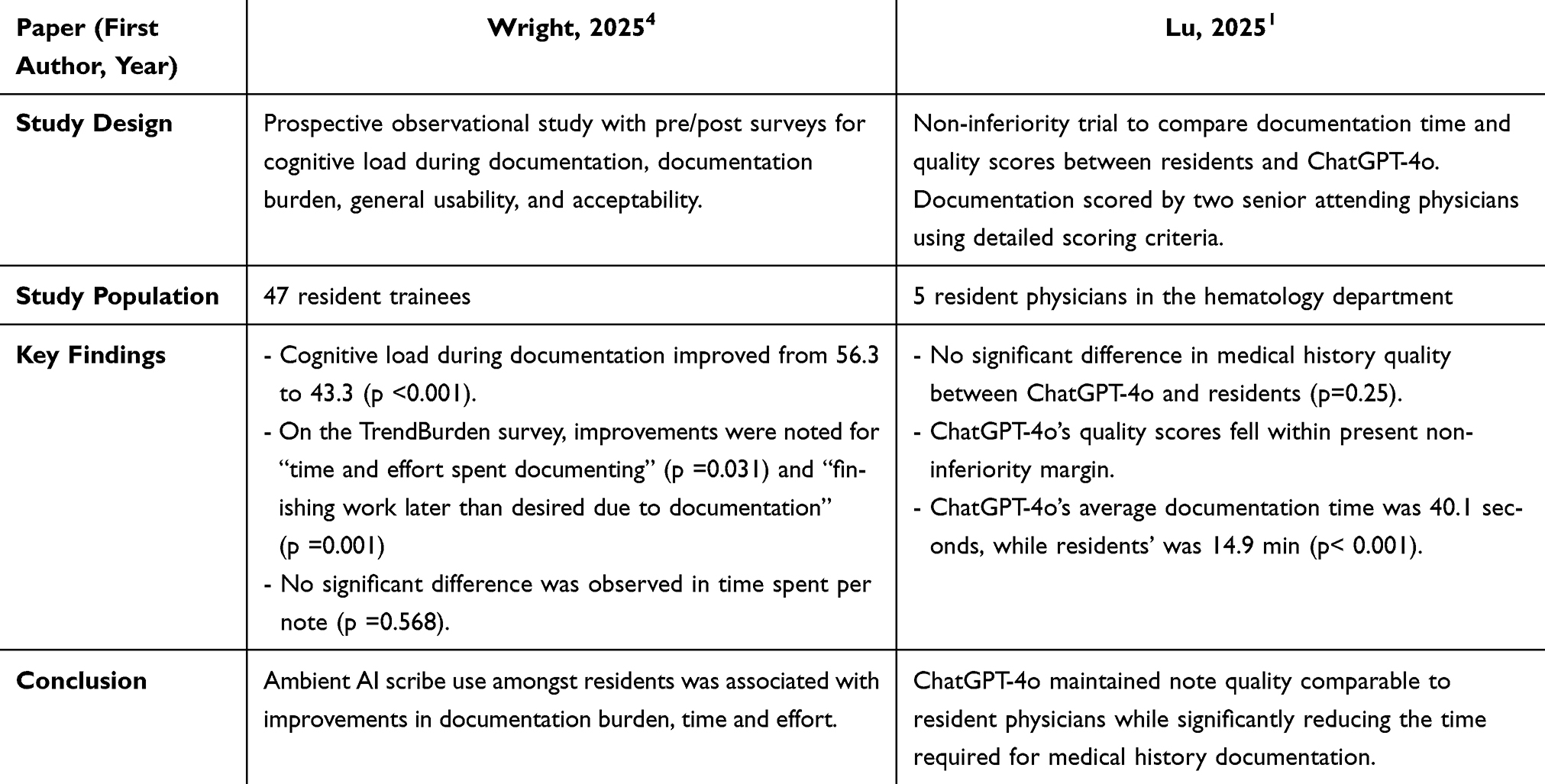 |
Table 1 Summary of Literature on Resident AI Scribe Use |
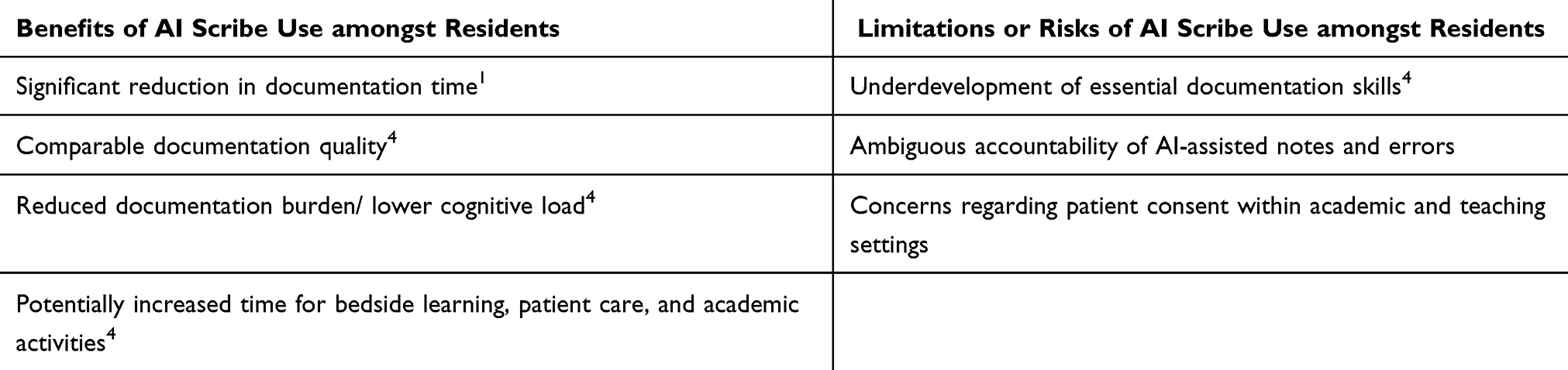 |
Table 2 Summary of Benefits and Limitations of AI Scribe Use Amongst Residents |
Our search revealed no official peer-reviewed recommendations or guidelines currently addressing this topic. Other existing resources primarily focus on attending physicians or general clinical workflows. Studies suggest that AI scribes may reduce physician burnout and enhance patient-physician connection by decreasing time spent on the computer.5 For example, the Kaiser Permanente Medical Group adopted an ambient AI scribing program, with the majority of physicians reporting positive experiences, patients reporting positive to neutral impacts on visit quality, and an aggregate reduction in physician workload equivalent to over 15,700 hours saved in documentation time over one year.6 Despite this, evidence from Wright et al shows no significant reduction in time per note for residents, highlighting potential differences in workflow impact between trainees and practicing clinicians. We acknowledge that the included studies are small and limited in scope, and our findings are intended to highlight an emerging, understudied area rather than provide definitive conclusions about AI scribe use in residency training.
Given these findings, we highlight the need for appropriate AI scribe implementation guidelines in the residency setting. Such policies should incorporate mandatory resident review and note sign-off of AI-generated notes, clear accountability protocols, patient consent standards, and limitations on use depending on the note section such as formulation of assessment and plan. Proactive guidance will maximize the educational benefits of AI scribing, note composition, AI literacy, responsible use to optimize patient safety and documentation accuracy.
In summary, AI scribes may represent a potential tool to alleviate resident documentation burden, yet the absence of resident-specific guidance remains a critical gap in graduate medical education guidelines. The prompt development of clear, resident-focused guidelines is essential to ensuring AI scribes are integrated into residency training safely and effectively.
Funding
There is no funding to report.
Disclosure
The authors report no conflicts of interest in this work.
References
1. Lu X, Gao X, Wang X, et al. Comparison of medical history documentation efficiency and quality based on GPT-4o: a study on the comparison between residents and artificial intelligence. Front Med. 2025;12:1545730. doi:10.3389/fmed.2025.1545730
2. American Medical Association. Augmented intelligence in medicine. AMA. 2025. Available from: https://www.ama-assn.org/practice-management/digital-health/augmented-intelligence-medicine.
3. Association of American Medical Colleges. Principles for the use of AI in medical education. AAMC. 2025. Available from: https://www.aamc.org/about-us/mission-areas/medical-education/principles-ai-use.
4. Wright DS, Kanaparthy N, Melnick ER, et al. The effect of ambient artificial intelligence scribes on trainee documentation burden. Appl Clin Inform. 2025;16(1):1–4. doi:10.1055/a-2647-1142
5. Hoberman B. AI scribes for clinicians: how ambient listening in medicine works and future AI use cases. American Medical Association. 2025. Available from: https://www.ama-assn.org/practice-management/digital-health/ai-scribes-clinicians-how-ambient-listening-medicine-works-and.
6. Tierney AA, Gayre G, Hoberman B, et al. Ambient artificial intelligence scribes to alleviate the burden of clinical documentation. NEJM Catalyst. 2025;6(1). doi:10.1056/CAT.25.0040
 © 2026 The Author(s). This work is published and licensed by Dove Medical Press Limited. The
full terms of this license are available at https://www.dovepress.com/terms
and incorporate the Creative Commons Attribution
- Non Commercial (unported, 4.0) License.
By accessing the work you hereby accept the Terms. Non-commercial uses of the work are permitted
without any further permission from Dove Medical Press Limited, provided the work is properly
attributed. For permission for commercial use of this work, please see paragraphs 4.2 and 5 of our Terms.
© 2026 The Author(s). This work is published and licensed by Dove Medical Press Limited. The
full terms of this license are available at https://www.dovepress.com/terms
and incorporate the Creative Commons Attribution
- Non Commercial (unported, 4.0) License.
By accessing the work you hereby accept the Terms. Non-commercial uses of the work are permitted
without any further permission from Dove Medical Press Limited, provided the work is properly
attributed. For permission for commercial use of this work, please see paragraphs 4.2 and 5 of our Terms.
Recommended articles

Diagnostic Challenges and Patient Safety: The Critical Role of Accuracy – A Systematic Review
Alharbi TAF, Rababa M, Alsuwayl H, Alsubail A, Alenizi WS
Journal of Multidisciplinary Healthcare 2025, 18:3051-3064
Published Date: 30 May 2025
“Service” versus “Education” in Anesthesiology: Domain Classification of Activities Based on Perceptions from Learners and Teachers
Li J, Lin HM, Yanez ND, He Z, Treggiari MM, Kurup V
Advances in Medical Education and Practice 2025, 16:1359-1369
Published Date: 7 August 2025
The Role of Artificial Intelligence in Managing Central Line-Associated Bloodstream Infection (CLABSI) for Patient Safety and Quality of Care
Saad AA, Hassan A, Alali A, Alkhatib F, Tolba MF, Simsekler MCE
Risk Management and Healthcare Policy 2025, 18:2887-2898
Published Date: 3 September 2025
AI-Driven Decision Support Framework for Preventing Medical Equipment Failure and Enhancing Patient Safety: A New Perspective
Alkhatib SA, Katmah R, Kosaji D, Afzal SUB, Tariq MH, Simsekler MCE, Ellahham S
Journal of Multidisciplinary Healthcare 2025, 18:6299-6313
Published Date: 2 October 2025
The Role of Artificial Intelligence in Reducing Dispensing Errors for Patient Safety and Quality: A Systems Approach
Ouda E, Chaabi I, Abualola H, Ramadan MA, Patro PK, Kaya GK, Simsekler MCE
Risk Management and Healthcare Policy 2026, 19:573762
Published Date: 24 February 2026