
Back to Journals » Psychology Research and Behavior Management » Volume 19
A Psychometric Network Analysis of Fear of Progression, Coping Styles, and Self-Management Among Patients Undergoing Continuous Ambulatory Peritoneal Dialysis
Authors Fu S  , Cao X, Liu X, Zhang L, Yang Y
Received 29 April 2026
Accepted for publication 25 June 2026
Published 21 July 2026 Volume 2026:19 620815
DOI https://doi.org/10.2147/PRBM.S620815
Checked for plagiarism Yes
Review by Single anonymous peer review
Peer reviewer comments 2
Editor who approved publication: Professor Mei-Chun Cheung
Songying Fu,1 Xuehua Cao,2 Xichen Liu,1 Lu Zhang,1 Yanmei Yang1
1College of Nursing, Chengdu University of Traditional Chinese Medicine, Chengdu, People’s Republic of China; 2Department of Gynecology Nursing, Sichuan Provincial People’s Hospital, University of Electronic Science and Technology of China, Chengdu, Sichuan, People’s Republic of China
Correspondence: Xuehua Cao, Department of Gynecology Nursing, Sichuan Provincial People’s Hospital, University of Electronic Science and Technology of China, Chengdu, Sichuan, People’s Republic of China, Email [email protected]
Background: Continuous ambulatory peritoneal dialysis (CAPD) requires patients to perform complex self-management tasks at home. Fear of progression and coping styles may influence self-management, but their dimension-level relationships remain poorly understood.
Objective: To investigate the network structure linking fear of progression, coping styles, and self-management among CAPD patients and identify central and bridging dimensions that may be relevant for nursing assessment and intervention planning.
Methods: A cross-sectional study was conducted among 328 CAPD patients in a tertiary hospital in Sichuan, China. Fear of progression, coping styles, and CAPD self-management were assessed using validated questionnaires. A psychometric network was estimated at the dimension level, and centrality, bridge centrality, and network stability were evaluated.
Results: The strongest edge was observed between physical health-related and social/family-related fear of progression (edge weight = 0.663). Confrontation coping exhibited the highest strength and expected influence and showed the strongest cross-community connectivity, with bridge strength and bridge expected influence z-scores of 2.57 and 2.60, respectively. The strongest cross-community edge was identified between confrontation coping and diet management (edge weight = 0.264). Centrality and bridge centrality analyses demonstrated acceptable-to-good stability.
Conclusion: Confrontation coping emerged as a central and bridging dimension linking psychological responses and self-management behaviours in CAPD patients. These findings reflect statistical connectivity rather than causal relationships and may help identify priorities for nursing assessment and future intervention research.
Keywords: peritoneal dialysis, fear of progression, coping style, self-management, network analysis
Introduction
Continuous ambulatory peritoneal dialysis (CAPD) is an important home-based renal replacement therapy for patients with end-stage kidney disease. Compared with facility-based haemodialysis, CAPD allows greater treatment flexibility and autonomy, but it also requires patients to perform complex daily procedures outside the hospital.1 Patients must maintain aseptic technique, monitor fluid balance and symptoms, manage diet and medication, and respond appropriately to abnormal situations.2,3 These demands make self-management a central component of CAPD care and an important focus of nursing practice.
Despite the clinical importance of self-management, many CAPD patients experience difficulties in maintaining long-term treatment behaviours.3,4 Self-management is not merely a technical task; it is shaped by patients’ psychological responses to illness and by the coping strategies they use when facing disease-related uncertainty.5,6 Fear of progression is common among patients with chronic illness and reflects concerns about worsening disease, physical decline, treatment burden, and possible consequences for family and social roles. For patients receiving CAPD, such concerns may be particularly salient because treatment is continuous, complications such as peritonitis remain possible, and disease management is embedded in daily life.7
From a nursing perspective, CAPD self-management is closely linked to patient education, behavioural support, symptom monitoring, and follow-up care.7,8 Nurses are often responsible for teaching exchange techniques, reinforcing infection-prevention behaviours, identifying early signs of complications, and supporting patients’ adaptation to long-term home dialysis.9 Beyond technical instruction, nurses also serve as facilitators of psychological adaptation, helping patients interpret treatment-related stress, develop more active coping responses, and maintain confidence in managing CAPD in daily life.8,9 Therefore, understanding how psychological responses and coping styles relate to specific self-management domains may help nurses move beyond general education and identify more targeted priorities for assessment and support.4
A dimension-level perspective is particularly valuable for nursing assessment and intervention planning because nursing care is commonly directed toward specific behavioural and psychological domains rather than global scale scores. For example, interventions targeting diet management, symptom monitoring, emotional adjustment, or coping skills are typically designed and implemented separately. Understanding which dimensions are most strongly connected within the network may therefore help nurses identify priority areas for assessment, allocate educational resources more efficiently, and develop more targeted intervention strategies tailored to individual patient needs.
The relationships among fear of progression, coping styles, and self-management can be understood through stress-coping theory and self-regulation perspectives. According to Lazarus and Folkman’s stress-coping theory, individuals first appraise disease-related threats and then adopt coping strategies to manage the psychological and practical demands arising from those threats.10 Fear of progression may therefore function as a stress-related cognitive-emotional response, whereas coping styles represent behavioural and cognitive efforts used to manage illness-related challenges. Active coping strategies may facilitate engagement in self-management behaviours, whereas avoidance or resignation may hinder effective disease management.
Similarly, self-regulation models propose that patients continuously monitor health-related information, evaluate discrepancies between current and desired health states, and adjust behaviours accordingly.11 In the context of CAPD, effective self-management requires ongoing symptom monitoring, treatment adherence, dietary regulation, and adaptive responses to disease-related concerns. From this perspective, fear of progression may influence self-management both directly and indirectly through coping responses. These theoretical frameworks suggest that fear of progression, coping styles, and self-management are likely to form an interconnected psychological-behavioural system rather than independent constructs.
Coping style may play an important role in CAPD self-management. Active coping strategies may facilitate information seeking, problem solving, communication with healthcare professionals, and engagement in daily management behaviours, whereas avoidance or resignation may hinder effective disease management and delay responses to abnormal symptoms.12 Although fear of progression, coping styles, and self-management have each been studied in chronic disease populations, their dimension-level interrelationships among CAPD patients remain insufficiently understood.13
Most existing studies have examined these constructs using total scores, bivariate correlations, or regression-based models.3,4 These approaches are useful for identifying overall associations but provide limited insight into how specific dimensions are conditionally related to each other when multiple psychological and behavioural domains are considered simultaneously.14,15
A psychometric network approach offers a useful framework for addressing these questions. In a network model, psychological and behavioural dimensions are represented as nodes, and the edges between nodes indicate conditional associations after controlling for all other variables in the network.14,16 This approach shifts attention from global scale-level relationships to the pattern of connections among specific dimensions.14 Centrality indices can identify dimensions that are highly connected within the network, whereas bridge centrality can identify dimensions that connect different communities, such as fear of progression, coping styles, and self-management.16,17
Despite growing evidence linking fear of progression, coping styles, and self-management in chronic disease populations, several important knowledge gaps remain. First, previous studies have predominantly relied on total scores, correlation analyses, or regression models, which provide limited information regarding the conditional relationships among specific dimensions of these constructs. Second, little is known about which dimensions may serve as central or bridging components connecting psychological responses and self-management behaviours in CAPD patients. Third, few studies have examined these relationships from a network perspective, particularly at the dimension level.
Addressing these gaps is important for nursing research and practice because identifying central and bridge dimensions may help clarify potential targets for assessment, education, and intervention. A dimension-level network approach may therefore provide more clinically actionable information than traditional total-score analyses.
Therefore, this study aimed to estimate a psychometric network of fear of progression, coping styles, and self-management among CAPD patients. Specifically, we aimed to: (1) identify the strongest conditional associations among these dimensions; (2) determine the most central nodes in the network; (3) identify bridge nodes connecting fear of progression, coping styles, and self-management; and (4) evaluate the accuracy, stability, and robustness of the estimated network.
Methods
Study Design and Reporting Standard
This cross-sectional correlational study was conducted to examine the network structure of fear of progression, coping styles, and self-management among patients undergoing continuous ambulatory peritoneal dialysis (CAPD). The study was reported in accordance with the STROBE (Strengthening the Reporting of Observational Studies in Epidemiology) checklist for cross-sectional studies.
Setting and Participants
The study was conducted at the Nephrology Department of Sichuan Provincial People’s Hospital, University of Electronic Science and Technology of China, Sichuan, China. Data were collected between January 2025 and December 2025 using structured self-report questionnaires. Participants were recruited using a consecutive sampling method throughout the study period.
Questionnaire data were collected using self-administered paper-based questionnaires during routine outpatient follow-up visits or scheduled CAPD-related inpatient appointments. For participants who had difficulty reading or writing, trained researchers provided interviewer-assisted questionnaire administration while maintaining standardized wording and procedures. All questionnaires were completed at the time of recruitment. Eligible participants were patients who: (a) had been diagnosed with end-stage kidney disease and were receiving CAPD; (b) were aged 18 years or older; (c) were able to understand and complete the questionnaire independently or with minimal assistance; and (d) provided informed consent. Patients were excluded if they had severe cognitive impairment, acute medical instability, or incomplete questionnaire data that prevented calculation of the main study variables.
Sample Size Consideration
No formal sample size calculation was performed because this study was exploratory in nature and followed methodological recommendations for psychometric network analysis. In network analysis, sample size adequacy is commonly evaluated using network accuracy and stability metrics rather than traditional power calculations.
The primary network consisted of 10 dimension-level nodes. Previous methodological studies have suggested that psychological networks with low-to-moderate complexity can generally be estimated with acceptable stability when sample sizes are approximately 250–500 participants, depending on network structure and edge strength.14,16
A total of 328 participants were included in the final analysis, exceeding the commonly recommended threshold for stable network estimation. Furthermore, network stability was empirically evaluated using bootstrap-based accuracy and stability analyses, which demonstrated acceptable-to-good stability of the estimated network.
Measures
Fear of Progression Questionnaire-Short Form
Fear of disease progression was assessed using the Fear of Progression Questionnaire-Short Form (FoP-Q-SF), originally developed by Herschbach et al18 for patients with chronic diseases and later translated and culturally adapted into Chinese by Wu et al19 The scale contains 12 items rated on a 5-point Likert scale ranging from 1 = never to 5 = always, with higher scores indicating greater fear of disease progression. In the present study, the FoP-Q-SF was analysed at the dimension level and included two domains: fear of progression related to physical health (FoP-PH) and fear of progression related to social/family concerns (FoP-SF). Dimension scores were calculated as item means. Cronbach’s α was 0.879 for the total scale, 0.791 for FoP-PH, and 0.768 for FoP-SF.
Medical Coping Modes Questionnaire
Coping styles were measured using the Medical Coping Modes Questionnaire (MCMQ).20 The MCMQ consists of 20 items and assesses three illness-related coping styles: confrontation, avoidance, and resignation. Items are rated on a 4-point response scale, with higher scores indicating greater use of the corresponding coping style. Reverse-scored items were recoded before dimension scores were calculated. The three MCMQ dimensions were analysed separately and labelled as coping style related to confrontation (COP-Face), coping style related to avoidance (COP-Avoid), and coping style related to resignation (COP-Yield). Dimension scores were calculated as item means. Cronbach’s α values were 0.872 for confrontation, 0.814 for avoidance, and 0.773 for resignation.
CAPD Self-Management Scale
Self-management was assessed using the Continuous Ambulatory Peritoneal Dialysis Self-Management Scale (CAPD-SM).21 The scale contains 28 items covering five domains: technique management, abnormal situation handling, diet management, complication monitoring, and emotion management/social reintegration. Items are rated on a 4-point scale ranging from 0 = never to 3 = always, with higher scores indicating better self-management. The five domains were analysed as separate network nodes and labelled as self-management related to technique management (SM-Tech), self-management related to abnormal situation handling (SM-Abnormal), self-management related to diet management (SM-Diet), self-management related to complication monitoring (SM-Monitor), and self-management related to emotion management/social reintegration (SM-Emotion). Dimension scores were calculated as item means. Cronbach’s α was 0.914 for the total scale; α values were 0.904 for technique management, 0.827 for abnormal situation handling, 0.881 for diet management, 0.913 for complication monitoring, and 0.861 for emotion management/social reintegration.
Bias Control
To minimise potential sources of bias, several strategies were implemented. Standardised and validated instruments were used to reduce measurement bias, and structured questionnaires were employed to ensure consistency in data collection. Selection bias may have been introduced due to the single-centre design and non-random sampling approach. In addition, only 23 of the 351 assessed patients were excluded, including 10 who did not meet the eligibility criteria, 8 who declined participation, and 5 who provided incomplete questionnaires. Given the relatively low exclusion rate and the nature of the exclusions, substantial systematic selection bias among excluded participants is unlikely. However, because detailed data were not available for excluded individuals, the possibility of some degree of selection bias cannot be completely ruled out. In addition, self-report measures may be subject to recall bias and social desirability bias. Furthermore, statistical adjustment and regularisation techniques were applied during network estimation to reduce spurious associations. Conditional dependence modelling was used to estimate associations while controlling for all other variables in the network.
Missing Data
Missing data were minimal (<1%) and were handled using pairwise complete observations in the network estimation.
Statistical Analysis
Preliminary Analyses
All analyses were conducted in R [version 4.5.2]. Descriptive statistics were calculated for demographic and clinical characteristics. Continuous variables were summarized as means and standard deviations, whereas categorical variables were summarized as frequencies and percentages. The distribution and missingness of all network nodes were inspected before network estimation. Reliability was examined using Cronbach’s α for each scale and dimension where appropriate.
For the primary network analysis, dimension-level mean scores were used rather than raw item scores or total scale scores. This approach reduced model complexity, improved interpretability, and ensured that dimensions with different numbers of items were placed on comparable scoring ranges. An item-level network was not used because many items within the same scale dimension are conceptually and statistically overlapping, which may introduce local dependence and inflate associations between closely related items. A dimension-level approach therefore provided a more parsimonious and clinically interpretable representation of fear of progression, coping styles, and CAPD self-management domains.
Network Estimation
A psychometric network model was estimated using the bootnet and qgraph packages in R. The network was modelled as a Gaussian Graphical Model consisting of ten nodes: two fear of progression nodes, three coping style nodes, and five self-management nodes. Edges represented regularized partial correlations between two nodes after conditioning on all other nodes in the network.
The network was estimated using the EBICglasso procedure. The graphical least absolute shrinkage and selection operator was applied to shrink trivial associations to zero and obtain a sparse and interpretable network. Model selection was based on the Extended Bayesian Information Criterion, with the tuning parameter set to 0.5 to balance sensitivity and specificity. In the network visualisation, green edges indicated positive associations and red edges indicated negative associations. Thicker edges represented stronger regularized partial correlations.
The ten nodes were grouped into three predefined communities: fear of progression, coping styles, and self-management. The node labels were as follows: FoP-PH, fear of progression related to physical health; FoP-SF, fear of progression related to social/family concerns; COP-Face, confrontation coping; COP-Avoid, avoidance coping; COP-Yield, resignation coping; SM-Tech, technique management; SM-Abnormal, abnormal situation handling; SM-Diet, diet management; SM-Monitor, complication monitoring; and SM-Emotion, emotion management.
Centrality Indices and Bridge Centrality
To evaluate the relative importance of each node in the network, strength and expected influence were calculated. Strength was defined as the sum of the absolute edge weights connected to a node. Expected influence was calculated as the sum of all edge weights connected to a node while retaining the sign of each edge, making it suitable for networks containing both positive and negative edges. Centrality values were standardized as z-scores for visual comparison across nodes.
Bridge centrality was calculated to identify nodes that connected the three predefined communities. Bridge strength and one-step bridge expected influence were estimated using the networktools package. Bridge strength quantified the absolute magnitude of a node’s connections with nodes from other communities, whereas bridge expected influence retained the sign of cross-community edges. Bridge centrality values were standardized as z-scores for interpretation and visualisation.
Network Accuracy and Stability
The accuracy of edge weights was assessed using nonparametric bootstrap procedures with 1000 bootstrap samples. Bootstrapped 95% confidence intervals were generated for edge weights. Bootstrapped difference tests were also performed to examine whether edge weights and centrality indices differed from one another.
The stability of centrality indices was evaluated using a case-dropping bootstrap procedure with 1,000 bootstrap samples. Stability was quantified using the correlation stability coefficient. A CS-coefficient above 0.25 was considered acceptable for interpretation, and a value above 0.50 was considered to indicate good stability. In the present analysis, stability was assessed for strength and expected influence. Because bridge centrality was central to the research question, case-dropping bootstrap procedures were also conducted for bridge strength and bridge expected influence.
Sensitivity Analysis
To examine whether the network structure was robust to the choice of correlation method, a sensitivity analysis was conducted using Spearman correlations while retaining the same EBICglasso estimation procedure and tuning parameter. The Spearman-based network was visually and numerically compared with the primary network in terms of edge weights, centrality indices, and bridge centrality indices. This analysis was conducted because the network nodes were derived from Likert-type questionnaire items and may not fully satisfy normality assumptions.
Ethical Considerations
Ethical approval was obtained from the Ethics Committee for Basic and Clinical Research of Sichuan Academy of Medical Sciences and Sichuan Provincial People’s Hospital (approval No. 2025–217). All participants provided informed consent prior to participation. All procedures performed in this study involving human participants were conducted in accordance with the ethical standards of the institutional research committee and with the Declaration of Helsinki and its later amendments or comparable ethical standards.
Results
Participant Characteristics
A total of 351 patients were assessed for eligibility. Of these, 23 patients were excluded, including 10 who did not meet the inclusion criteria, 8 who declined to participate, and 5 who provided incomplete questionnaires. Finally, 328 patients were included in the analysis. A flow diagram illustrating participant selection is presented in Figure 1.
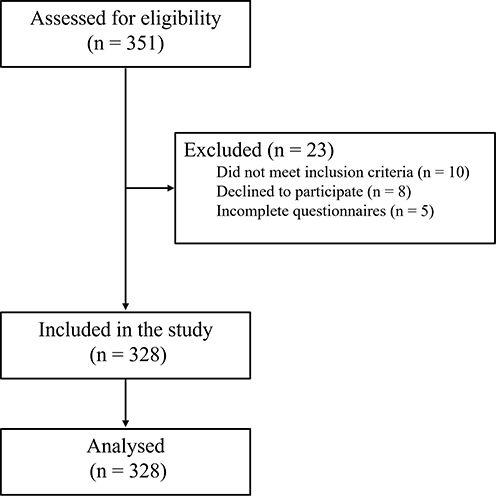 |
Figure 1 Flow diagram of participant selection. |
The mean age was 53.89 years (SD = 16.57), and 56.7% were male. Chronic glomerulonephritis was the most common primary disease (45.4%), followed by diabetes mellitus (28.4%) and hypertension (15.5%). The mean dialysis duration was 30.63 months (SD = 19.70), 27.4% had a history of peritonitis, and 60.1% performed CAPD independently. Detailed sociodemographic and clinical characteristics are shown in Table 1.
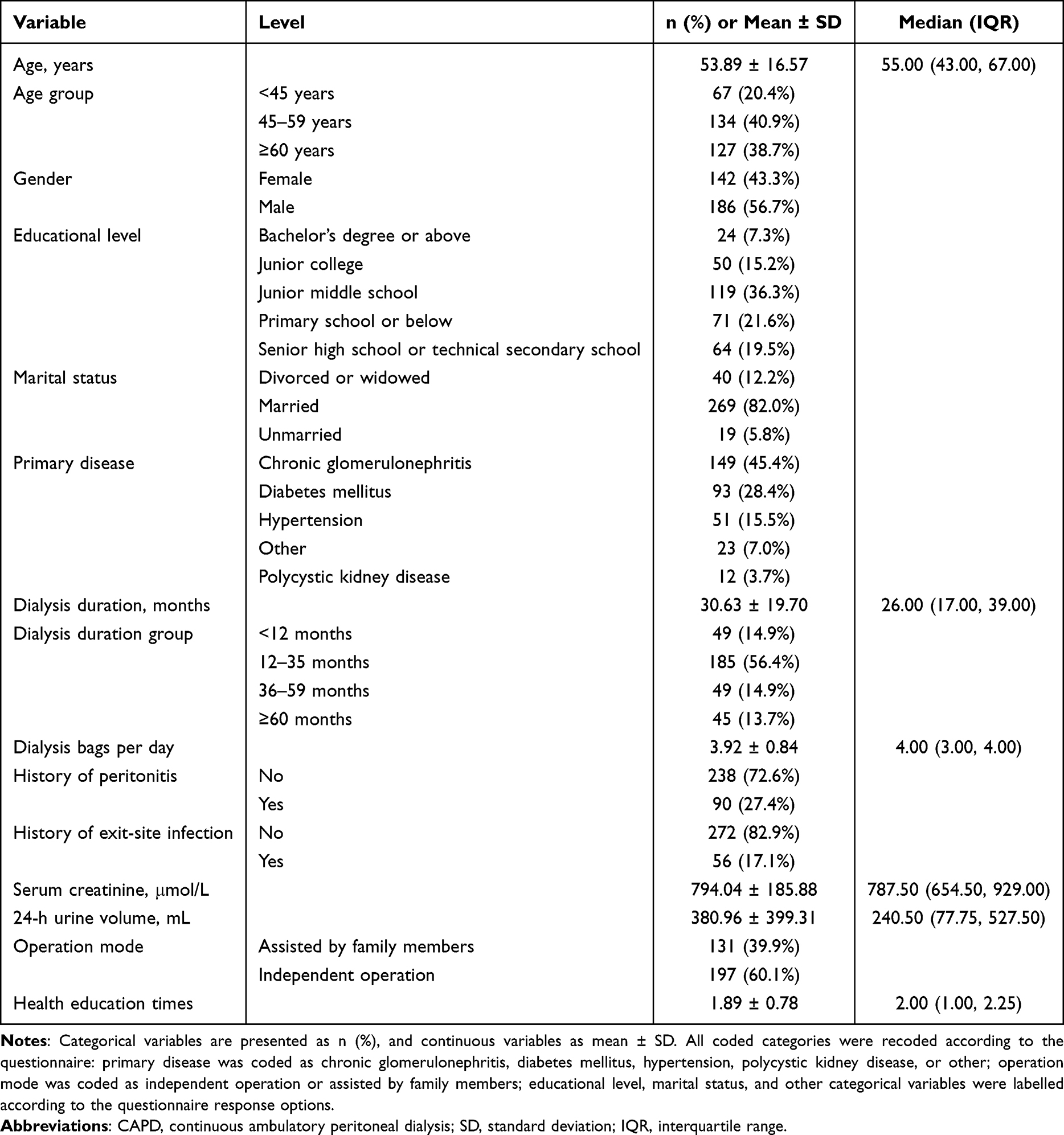 |
Table 1 Sociodemographic and Clinical Characteristics of CAPD Patients (N = 328) |
Descriptive statistics for the network nodes are presented in Table 2. The mean item scores were 3.06 (SD = 0.76) for FoP-PH and 3.09 (SD = 0.72) for FoP-SF. Among coping styles, COP-Avoid had the highest mean item score (2.49, SD = 0.41), followed by COP-Face (2.40, SD = 0.47) and COP-Yield (2.12, SD = 0.58). Among the self-management domains, SM-Tech had the highest mean item score (2.18, SD = 0.42), whereas SM-Emotion had the lowest mean item score (1.75, SD = 0.52). These ten dimension-level mean scores were used as nodes in the subsequent network analysis.
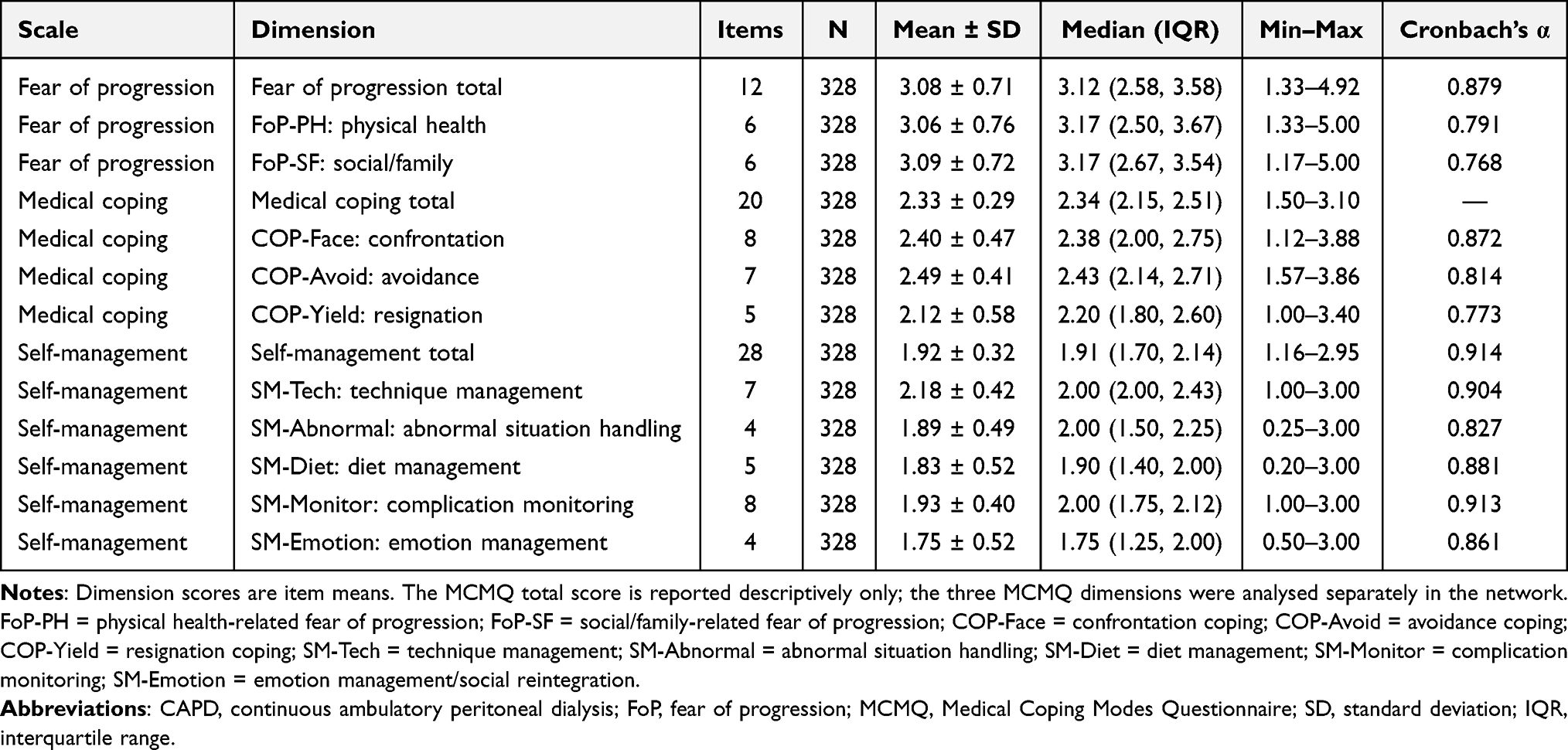 |
Table 2 Descriptive Statistics and Reliability of Study Variables |
Network Structure
The estimated network structure of fear of progression, coping styles, and self-management is presented in Figure 2. The network consisted of 10 dimension-level nodes and 38 non-zero regularized partial correlations. The strongest within-community edge was observed between physical health-related fear of progression (FoP-PH) and social/family-related fear of progression (FoP-SF; edge weight = 0.663), indicating a strong positive conditional association between these two fear-related dimensions. The strongest cross-community edge was observed between confrontation coping (COP-Face) and diet management (SM-Diet; edge weight = 0.264), highlighting a close conditional association between active coping and self-management behaviours.
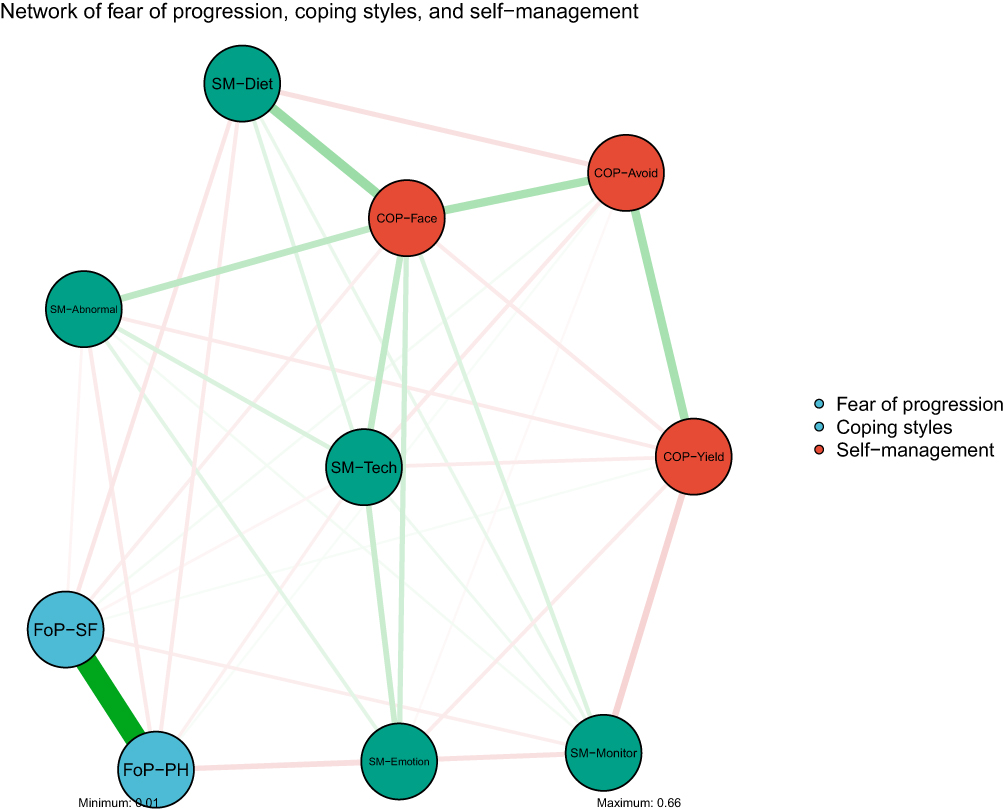 |
Figure 2 Network structure of fear of progression, coping styles, and self-management among CAPD patients. Nodes represent dimension-level scores. Green edges indicate positive regularized partial correlations, and red edges indicate negative regularized partial correlations; thicker edges represent stronger associations. Node colours indicate predefined communities: fear of progression, coping styles, and self-management. Abbreviations: FoP-PH, physical health-related fear of progression; FoP-SF, social/family-related fear of progression; COP-Face, confrontation coping; COP-Avoid, avoidance coping; COP-Yield, resignation coping; SM-Tech, technique management; SM-Abnormal, abnormal situation handling; SM-Diet, diet management; SM-Monitor, complication monitoring; SM-Emotion, emotion management/social reintegration. |
Within the coping community, positive conditional associations were observed between COP-Avoid and COP-Yield (edge weight = 0.233) and between COP-Face and COP-Avoid (edge weight = 0.226), whereas COP-Face and COP-Yield showed a negative conditional association (edge weight = −0.086).
Several additional cross-community conditional associations were observed between coping styles and self-management domains. Positive associations were identified between COP-Face and abnormal situation handling (SM-Abnormal; edge weight = 0.176), technique management (SM-Tech; edge weight = 0.166), emotion management/social reintegration (SM-Emotion; edge weight = 0.132), and complication monitoring (SM-Monitor; edge weight = 0.099). Negative conditional associations were observed between resignation coping (COP-Yield) and SM-Monitor (edge weight = −0.165), avoidance coping (COP-Avoid) and SM-Diet (edge weight = −0.122), COP-Yield and SM-Abnormal (edge weight = −0.085), and COP-Yield and SM-Tech (edge weight = −0.084).
Fear of progression nodes also showed several negative conditional associations with self-management domains. Specifically, FoP-PH was negatively associated with SM-Emotion (edge weight = −0.130), SM-Monitor (edge weight = −0.123), SM-Abnormal (edge weight = −0.086), and SM-Diet (edge weight = −0.086). Detailed edge weights are provided in Supplementary Table S1.
Centrality Analysis
Centrality indices of the estimated network are presented in Figure 3, and numerical values are provided in Supplementary Table S2. Detailed non-zero edge weights from the Spearman sensitivity network are reported in Supplementary Table S3. Confrontation coping (COP-Face) exhibited the highest strength (z = 1.64) and expected influence (z = 2.28) among all nodes, indicating the greatest level of connectivity within the network. In contrast, resignation coping (COP-Yield) showed the lowest expected influence (z = −1.54). Other nodes showed moderate levels of connectivity, reflecting their relative positions within the estimated network. These findings indicate that nodes differ in their overall connectedness within the network; however, centrality reflects statistical connectivity and should not be interpreted as causal importance or definitive clinical priority.
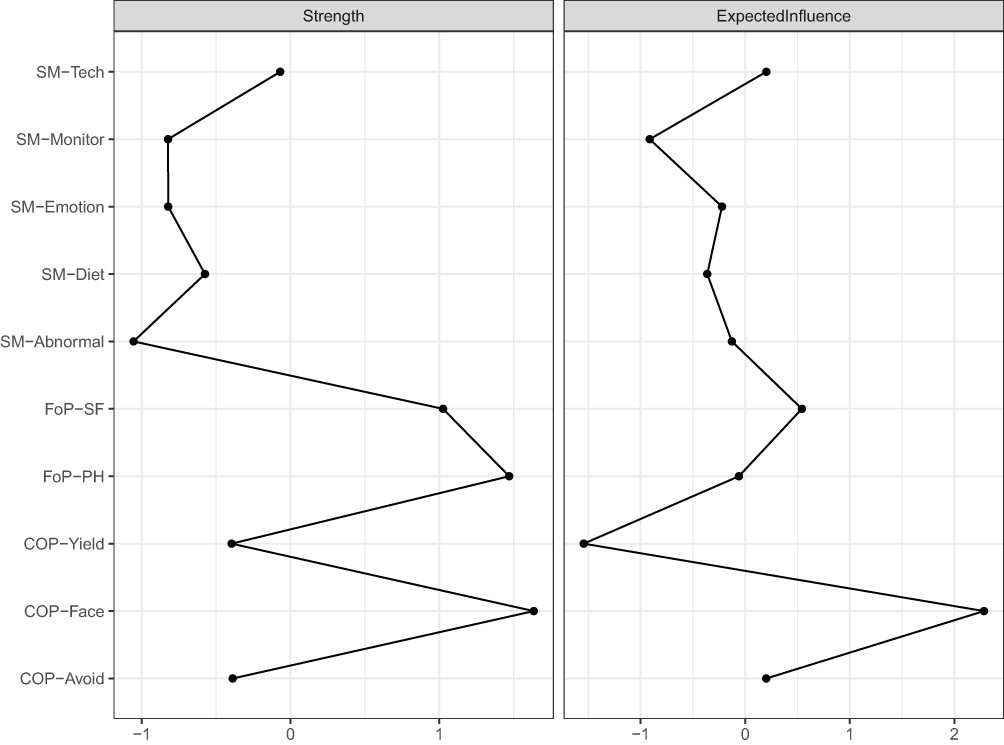 |
Figure 3 Centrality indices of the estimated network. Standardized strength and expected influence are shown for each node. Strength represents the sum of absolute edge weights connected to a node, whereas expected influence represents the sum of signed edge weights connected to a node. Higher values indicate greater relative connectivity within the estimated network. |
Bridge Centrality
Bridge centrality indices are presented in Figure 4. Confrontation coping (COP-Face) exhibited the highest bridge strength (z = 2.57) and bridge expected influence (z = 2.60), indicating the strongest cross-community connectivity between coping styles and self-management domains.
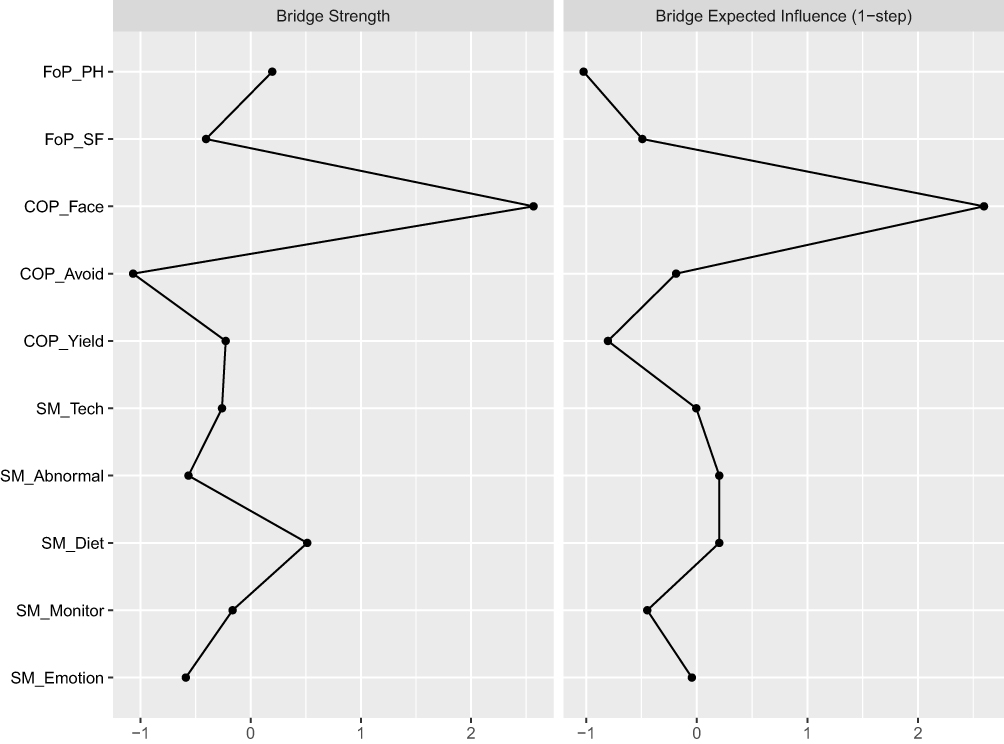 |
Figure 4 Bridge centrality indices of the estimated network. Standardized bridge strength and one-step bridge expected influence are shown for each node across the predefined communities of fear of progression, coping styles, and self-management. Bridge strength represents the absolute magnitude of a node’s cross-community connections, whereas bridge expected influence preserves the sign of these cross-community connections. Higher values indicate greater cross-community connectivity. Abbreviations: FoP-PH, physical health-related fear of progression; FoP-SF, social/family-related fear of progression; COP-Face, confrontation coping; COP-Avoid, avoidance coping; COP-Yield, resignation coping; SM-Tech, technique management; SM-Abnormal, abnormal situation handling; SM-Diet, diet management; SM-Monitor, complication monitoring; SM-Emotion, emotion management/social reintegration. |
This bridge pattern was mainly reflected in its positive conditional associations with diet management (SM-Diet; edge weight = 0.264), abnormal situation handling (SM-Abnormal; edge weight = 0.176), technique management (SM-Tech; edge weight = 0.166), emotion management/social reintegration (SM-Emotion; edge weight = 0.132), and complication monitoring (SM-Monitor; edge weight = 0.099).
SM-Diet had the second highest bridge strength (z = 0.51), followed by FoP-PH (z = 0.20), although their bridge expected influence values were substantially lower. In contrast, FoP-PH (z = −1.02), COP-Yield (z = −0.80), FoP-SF (z = −0.49), and SM-Monitor (z = −0.45) showed negative bridge expected influence values, indicating negative signed cross-community connectivity within the network.
Network Accuracy and Stability
The accuracy and stability of the network were examined using bootstrap procedures. Confidence intervals for edge weights are presented in Supplementary Figure S1. Nonparametric bootstrap analysis showed that the bootstrapped mean edge weights were generally close to the sample estimates, although confidence intervals were wider for weaker edges. Bootstrapped edge-weight difference tests are shown in Supplementary Figure S2. The strongest edge, FoP-PH—FoP-SF, was clearly distinguishable from most other edges.
Case-dropping bootstrap analysis indicated acceptable-to-good stability for the centrality indices. The CS coefficients were 0.515 for strength and 0.515 for expected influence, exceeding the recommended threshold of 0.50 for good stability (Supplementary Figure S3). Bootstrapped difference tests for strength and expected influence are shown in Supplementary Figures S4 and S5. Bridge centrality indices also showed acceptable stability, with CS coefficients of 0.55 for bridge strength and 0.60 for bridge expected influence (Supplementary Figure S6).
Sensitivity Analysis
A sensitivity analysis was conducted using Spearman correlations while retaining the same EBICglasso estimation procedure and tuning parameter. The Spearman-based network showed a broadly similar structure to the primary network (Supplementary Figure S7). The strongest edge remained the connection between FoP-PH and FoP-SF. COP-Face remained strongly connected with several self-management domains, including SM-Diet, SM-Abnormal, and SM-Tech. The main negative connections involving FoP-PH, COP-Yield, and self-management domains were also largely retained. These findings support the robustness of the main network structure to the choice of correlation method.
Discussion
Principal Findings and Contribution
This study provides a dimension-level network perspective on the associations among fear of progression, coping styles, and self-management in CAPD patients. By modelling these constructs as an interconnected system, the findings extend beyond total-score approaches and clarify which specific domains are conditionally related within the network. Three main findings emerged. First, the strongest edge was observed between physical health-related and social/family-related fear of progression, suggesting that these two aspects of illness-related fear were closely interconnected. Second, confrontation coping exhibited the highest strength and expected influence among all nodes, indicating the strongest connectivity within the network. Third, confrontation coping also showed the highest bridge strength and bridge expected influence, suggesting prominent cross-community connections between coping styles and self-management domains.
These findings extend previous peritoneal dialysis research in several ways. Earlier studies have shown that psychological factors, including illness perception and coping style, are associated with self-management among peritoneal dialysis patients.4 For example, a recent cross-sectional study specifically examined illness perception, coping style, and self-management in peritoneal dialysis patients, confirming that psychological and coping-related factors are relevant to self-management behaviours.4 However, such studies usually rely on total scores, correlation analysis, or regression models. They can identify whether a factor is associated with self-management but cannot show which specific dimensions are most strongly connected or which dimensions bridge psychological and behavioural domains. By modelling fear of progression, coping styles, and self-management as an interconnected system, the present study provides a more fine-grained account of how these domains are conditionally related.
Network Structure and Strongest Edges
The strongest edge was observed between FoP-PH and FoP-SF, linking physical health-related and social/family-related fear of progression. This pattern is clinically plausible in CAPD, where treatment is home-based and disease progression may simultaneously evoke concerns about bodily decline, complications, dependence on family members, disruption of social roles, and long-term treatment uncertainty.22,23 However, the strong FoP-PH–FoP-SF connection does not imply that these dimensions should be collapsed. Although they may share a common emotional core, they represent distinct nursing concerns: FoP-PH is more closely related to symptom deterioration, complications, and treatment burden, whereas FoP-SF reflects family roles, social participation, dependence, and perceived burden on relatives.18,24 Their co-occurrence therefore supports the value of dimension-specific assessment. Fear of progression may influence self-management through several emotional, cognitive, and behavioural pathways. Persistent concerns about disease deterioration, complications, or treatment failure may increase anxiety and cognitive burden, thereby reducing psychological resources available for sustained self-management. Although moderate levels of fear may promote vigilance and help-seeking, excessive fear may undermine self-efficacy, encourage avoidance or resignation, and interfere with routine monitoring, diet regulation, and responses to abnormal situations.
Within the coping community, avoidance and resignation were positively connected, whereas confrontation and resignation showed a negative association, consistent with the distinction between active and passive coping.4 In the CAPD context, avoidance and resignation may reflect withdrawal from treatment-related stress or reduced confidence in managing complications, while confrontation coping may indicate greater problem-solving orientation, information seeking, and communication with healthcare professionals.5 These associations should nevertheless be interpreted as conditional statistical relationships rather than causal pathways.
A key cross-community finding was the positive connection between confrontation coping and multiple self-management domains, especially diet management, abnormal situation handling, technique management, and emotion management. This extends prior total-score findings by showing that coping was not uniformly related to self-management but was most clearly linked to domains requiring active engagement.4,5 The strongest cross-community edge, COP-Face–SM-Diet, linking confrontation coping with diet management, is particularly meaningful because dietary management in CAPD demands sustained self-regulation, including restriction of salt, phosphorus, fluid intake, and other diet-related risks.25,26 Unlike procedural exchange techniques, diet management is embedded in daily preferences, family meals, social interactions, and long-term habits. Thus, patients with a stronger confrontational coping orientation may be more likely to seek dietary information, address practical barriers, and actively adjust eating behaviours. This dimension-level pattern offers more actionable nursing insight than a global self-management score.
Central and Bridge Nodes
Confrontation coping showed the highest strength and expected influence in the estimated network, indicating that it was broadly connected with multiple psychological and behavioural dimensions after adjustment for all other nodes. This finding differs from conventional regression-based evidence, which usually identifies predictors of overall self-management, by showing how a specific coping dimension is embedded within the broader system.4,27 However, centrality should not be interpreted as causal or definitive clinical importance; rather, it reflects the relative connectivity of confrontation coping within this network.
Bridge centrality further highlighted the role of confrontation coping. COP-Face, representing confrontation coping, showed the highest bridge strength and bridge expected influence, with z scores of 2.57 and 2.60, respectively, making it the most distinctive cross-community connector among fear of progression, coping styles, and self-management. Its bridge pattern was mainly driven by positive connections with diet management, abnormal situation handling, technique management, emotion management, and complication monitoring. One possible explanation for this finding is that confrontation coping reflects a more active self-regulatory orientation toward illness-related challenges. Patients who adopt a confrontational coping style may be more likely to seek disease-related information, communicate with healthcare professionals, clarify uncertainties, and actively solve treatment-related problems. In the CAPD context, where patients must independently perform dialysis exchanges, regulate diet and fluid intake, and monitor symptoms at home, these behaviours may facilitate sustained engagement in self-management activities. Clinically, this suggests that an active coping orientation may be closely tied to how CAPD patients engage with daily treatment tasks, including seeking information, communicating with nurses, clarifying uncertainties, and taking responsibility for home-based routines.4,8 Compared with total-score studies, this dimension-level finding identifies more specific self-management domains linked to confrontation coping, although it remains hypothesis-generating and requires confirmation in longitudinal or intervention research.
In contrast, resignation coping showed the lowest expected influence and was negatively connected with complication monitoring. This pattern is relevant to CAPD because patients must independently perform procedures, monitor symptoms, and respond to abnormal situations at home.8,28 A resignation-oriented coping style may therefore coexist with reduced active monitoring or problem-solving engagement.4 This pattern may also reflect reduced perceived control and lower self-efficacy in managing treatment-related challenges. Patients who feel overwhelmed by the long-term burden of CAPD may be less motivated to monitor symptoms, track treatment indicators, or respond proactively to early warning signs. From a nursing perspective, patients with higher resignation coping may require careful assessment for “hidden non-adherence”: they may appear cooperative during education or clinic visits but lack motivation to track symptoms, monitor fluid changes, or respond to early warning signs.29 Nevertheless, negative edges in regularized partial correlation networks may reflect suppression effects, shared variance, or other conditional relationships rather than direct inverse effects. Thus, this finding should not be interpreted as evidence that resignation coping directly reduces complication monitoring.
Implications for Nursing Practice
These findings suggest that confrontation coping may represent a potentially relevant target for nursing assessment and future intervention research. However, causal interpretations cannot be drawn from the present cross-sectional network, and the clinical utility of targeting confrontation coping requires further investigation in longitudinal and intervention studies.
In routine CAPD follow-up, nurses may consider assessing coping responses alongside technical skills, diet management, complication monitoring, and emotional adjustment. For example, patients with higher physical health-related fear may warrant closer assessment of emotional management, because FoP-PH showed negative conditional associations with SM-Emotion and other self-management domains in the network. Similarly, when patients show difficulties in diet management or abnormal situation handling, nurses may consider whether these difficulties coexist with lower confrontation coping or stronger passive coping tendencies, rather than attributing them only to insufficient knowledge.
These practice implications should be regarded as preliminary. The present cross-sectional network cannot determine whether changing coping responses would lead to improvements in self-management. Future longitudinal and intervention studies are needed to examine whether coping-oriented assessment or support is followed by changes in specific CAPD self-management behaviours.
Robustness of Findings
The robustness analyses support the credibility of the main findings. The CS coefficients for strength and expected influence exceeded 0.50, suggesting good stability of the centrality estimates. Bridge centrality indices also showed acceptable stability. In addition, the Spearman-based sensitivity network was broadly similar to the primary network, with the strongest edge remaining between FoP-PH and FoP-SF and confrontation coping retaining close connections with several self-management domains. These results suggest that the network pattern was not highly dependent on the correlation method and was sufficiently stable for interpretation.
Limitations
Several limitations should be acknowledged. First, the cross-sectional design precludes causal and temporal inference. Network edges represent conditional associations and cannot determine whether fear of progression, coping styles, or self-management behaviours influence one another over time. Nevertheless, by estimating associations after adjustment for all other nodes, the network approach reduces reliance on simple bivariate correlations and provides more specific hypotheses for future longitudinal and intervention studies. Second, all variables were assessed using self-report questionnaires, which may introduce recall bias, social desirability bias, and common method variance. Third, the single-centre sample from Sichuan, China, may limit generalizability to CAPD patients in other regions or healthcare systems. Fourth, although network stability was acceptable, replication in larger and more diverse samples is needed. In addition, the present network focused primarily on psychological and behavioral dimensions and did not include sociodemographic or clinical characteristics. Variables such as age, educational attainment, dialysis duration, operation mode, and health education exposure may be relevant to self-management and coping processes among CAPD patients. Future studies could incorporate these variables into network models or use them to define clinically meaningful subgroups, thereby examining whether the psychological–behavioral network differs across patient profiles.
Finally, central and bridge nodes should be regarded as hypothesis-generating rather than confirmed intervention targets, because centrality estimates are influenced by network specification, node selection, and edge-weight distribution. Thus, node rankings should be interpreted as properties of the present estimated network rather than a definitive hierarchy of clinical importance.
Conclusion
This study provides a dimension-level network perspective on the relationships among fear of progression, coping styles, and self-management in CAPD patients. The strongest association was observed between physical health-related and social/family-related fear of progression, while confrontation coping demonstrated the highest centrality and bridge centrality within the estimated network. Compared with traditional total-score and regression-based approaches, this study offers a more fine-grained understanding of how specific psychological and behavioural dimensions are conditionally interconnected.
From a clinical perspective, the findings highlight confrontation coping as a potentially important dimension linking psychological responses and self-management behaviours. Assessing coping responses alongside specific self-management domains may help nurses identify patients who require more targeted psychological, educational, and behavioural support. However, these findings should be interpreted as reflecting statistical connectivity rather than causal relationships.
This study extends the application of psychometric network analysis in CAPD research and provides hypothesis-generating evidence for nursing assessment and intervention planning. Future research could re-estimate the network across clinically relevant subgroups, such as newly initiated versus long-term CAPD patients, independently operating versus family-assisted patients, or patients with versus without previous peritonitis. Such subgroup-specific network analyses may help identify more precise intervention targets for different patient groups. Longitudinal and intervention studies are further warranted to examine the stability of these network structures over time, evaluate potential causal pathways, and clarify how psychological and behavioral dimensions evolve across different stages of CAPD treatment.
Data Sharing Statement
The data that support the findings of this study are available from the corresponding author upon reasonable request.
Acknowledgments
We would like to express our sincere gratitude to all the patients who participated in this study. We also thank the clinical staff at the peritoneal dialysis center for their invaluable assistance with participant recruitment and data collection.
Author Contributions
Songying Fu contributed to the conceptualization, methodology, software, formal analysis, investigation, data curation, writing of the original draft, and visualization. Xuehua Cao contributed to the conceptualization, methodology, validation, investigation, resources, writing review and editing, supervision, and project administration. Xichen Liu, Lu Zhang and Yanmei Yang contributed to the investigation, data curation, and writing review and editing. All authors read and approved the final manuscript. All authors contributed to data analysis, drafting or revising the article, have agreed on the journal to which the article will be submitted, gave final approval of the version to be published, and agree to be accountable for all aspects of the work.
Funding
This research received no external funding.
Disclosure
The authors declare no conflict of interest.
References
1. Brown EA, Blake PG, Boudville N, et al. International society for peritoneal dialysis practice recommendations: prescribing high-quality goal-directed peritoneal dialysis. Perit Dial Int. 2020;40(3):244–16. doi:10.1177/0896860819895364
2. Figueiredo AE, Bernardini J, Bowes E, et al. A syllabus for teaching peritoneal dialysis to patients and caregivers. Perit Dial Int. 2016;36(6):592–605. doi:10.3747/pdi.2015.00277
3. Li L, Xie C, Li Y. Factors associated with self-management of peritoneal dialysis patients in urumqi of xinjiang of China: a Cross-Sectional Survey. Patient Prefer Adherence. 2023;17:1573–1589. doi:10.2147/ppa.S415593
4. Zhang M, Nie S, Hai Z, Du Y, Jiang M, Cai C. Effects of illness perception and coping style on self-management in peritoneal dialysis patients: a Cross-Sectional Study. Psychol Res Behav Manag. 2024;17:3381–3393. doi:10.2147/prbm.S474427
5. Yang X, Shan Y, Gao Y, et al. Inner strength, coping self-efficacy and coping strategy of patients with peritoneal dialysis: a exploratory cross-sectional study. Nurs Open. 2024;11(9):e2127. doi:10.1002/nop2.2127
6. Zhang Y, Xie C, Yan W, Li Y, Liu L, Xu J. Self-perceived health control status and influencing factors in young and middle-aged peritoneal dialysis patients: a cross-sectional survey. Sci Rep. 2025;15(1):20445. doi:10.1038/s41598-025-05124-8
7. Chow JS, Brunier G, Figueiredo AE, et al. Teaching peritoneal dialysis: a position paper for the international society for peritoneal dialysis. Perit Dial Int. 2025;45(6):327–343. doi:10.1177/08968608251375512
8. Alodhialah AM, Alahmedi SH. Nurse-Facilitated Self-Management in peritoneal dialysis: a cross-sectional study from Riyadh, Saudi Arabia. Healthcare. 2025;13(20):2561. doi:10.3390/healthcare13202561
9. Bohassan A. The impact of nurses in shaping the peritoneal dialysis journey. Perit Dial Int. 2025;45(6):309–313. doi:10.1177/08968608251386218
10. Lazarus RS, Folkman S. Stress, Appraisal, and Coping. Springer Publishing Company; 1984.
11. Leventhal H, Brissette I, Leventhal EA. The common-sense model of self-regulation of health and illness. In: Cameron LD, Leventhal H, editors. The Self-Regulation of Health and Illness Behaviour. Routledge; 2003:42–65.
12. Lu T, Shi L, Zhang H, Zhang J, Shen Y. Effect of illness perception on self-regulatory fatigue in older adult patients with hypertension: chain-mediating role of self-efficacy and coping style. Front Public Health. 2025;13:1728453. doi:10.3389/fpubh.2025.1728453
13. Lightfoot CJ, Wilkinson TJ, Graham-Brown MPM, Smith AC. Supporting people with chronic kidney disease to self-manage their condition: understanding the lived experiences, needs and requirements, and barriers and facilitators. J Nephrol. 2025;38(7):1969–1984. doi:10.1007/s40620-025-02349-8
14. Borsboom D, Deserno MK, Rhemtulla M, Epskamp S, Waldorp LJ. Network analysis of multivariate data in psychological science. Nat Rev Meth Primers. 2021;1:58.
15. Hevey D. Network analysis: a brief overview and tutorial. Health Psychol Behav Med. 2018;6(1):301–328. doi:10.1080/21642850.2018.1521283
16. Epskamp S, Borsboom D, Fried EI. Estimating psychological networks and their accuracy: a tutorial paper. Behav Res Methods. 2018;50(1):195–212. doi:10.3758/s13428-017-0862-1
17. Jones PJ, Ma R, McNally RJ. Bridge centrality: a network approach to understanding comorbidity. Multivariate Behav Res. 2021;56(2):353–367. doi:10.1080/00273171.2019.1614898
18. Herschbach P, Berg P, Dankert A, et al. Fear of progression in chronic diseases: psychometric properties of the fear of progression questionnaire. J Psychosom Res. 2005;58(6):505–511. doi:10.1016/j.jpsychores.2005.02.007
19. Wu Q, Ye Z, Li L, Liu P. Translation and reliability and validity testing of the Chinese version of the fear of progression questionnaire-short form among cancer patients. Chin J Nurs. 2015;50(12):1515–1519.
20. Feifel H, Strack S, Nagy VT. Coping strategies and associated features of medically ill patients. Psychosom Med. 1987;49(6):616–625. doi:10.1097/00006842-198711000-00007
21. Wang XH, Pang JH, Lin L, et al. Development and testing of self-management scale for PD patients. Perit Dial Int. 2015;35(3):342–350. doi:10.3747/pdi.2013.00190
22. Kuzu F, Alsancak S, Kahveciolu S. Difficulties experienced by peritoneal dialysis patients in the home environment: a Phenomenological Study. J Educ Res Nurs. 2025;22(4):227–232. doi:10.14744/jern.2025.59837
23. Tong A, Lesmana B, Johnson DW, Wong G, Campbell D, Craig JC. The perspectives of adults living with peritoneal dialysis: thematic synthesis of qualitative studies. Am J Kidney Dis. 2013;61(6):873–888. doi:10.1053/j.ajkd.2012.08.045
24. Baillie J, Lankshear A. Patient and family perspectives on peritoneal dialysis at home: findings from an ethnographic study. J Clin Nurs. 2015;24(1–2):222–234. doi:10.1111/jocn.12663
25. Hunter EG, Shukla A, Andrade JM. Barriers to and strategies for dietary adherence: a qualitative study among hemodialysis/peritoneal dialysis patients and health care providers. J Ren Nutr. 2023;33(5):682–690. doi:10.1053/j.jrn.2023.06.007
26. Morris A, Patel R, Papadopoulos K, et al. Nutritional self-management of chronic kidney disease: a systematic review and co-created qualitative synthesis. J Ren Nutr. 2026;36(2):261–276. doi:10.1053/j.jrn.2025.10.007
27. Dablander F, Hinne M. Node centrality measures are a poor substitute for causal inference. Sci Rep. 2019;9(1):6846. doi:10.1038/s41598-019-43033-9
28. Song Z, Xiao Y, Su Y, Qin G, Yang J. The decision-making experience of self-management behaviors in home peritoneal dialysis for patients with diabetic nephropathy: a qualitative study using the theory of planned behavior. Patient Prefer Adherence. 2025;19:2283–2294. doi:10.2147/ppa.S537890
29. Griva K, Lai AY, Lim HA, Yu Z, Foo MW, Newman SP. Non-adherence in patients on peritoneal dialysis: a systematic review. PLoS One. 2014;9(2):e89001. doi:10.1371/journal.pone.0089001
 © 2026 The Author(s). This work is published and licensed by Dove Medical Press Limited. The
full terms of this license are available at https://www.dovepress.com/terms
and incorporate the Creative Commons Attribution
- Non Commercial (unported, 4.0) License.
By accessing the work you hereby accept the Terms. Non-commercial uses of the work are permitted
without any further permission from Dove Medical Press Limited, provided the work is properly
attributed. For permission for commercial use of this work, please see paragraphs 4.2 and 5 of our Terms.
© 2026 The Author(s). This work is published and licensed by Dove Medical Press Limited. The
full terms of this license are available at https://www.dovepress.com/terms
and incorporate the Creative Commons Attribution
- Non Commercial (unported, 4.0) License.
By accessing the work you hereby accept the Terms. Non-commercial uses of the work are permitted
without any further permission from Dove Medical Press Limited, provided the work is properly
attributed. For permission for commercial use of this work, please see paragraphs 4.2 and 5 of our Terms.
Recommended articles
Family Function and Self-Management in Glaucoma Patients: Chain Mediation of Psychological Capital and Coping Style
Liu Y, Zhang J, Zhang Q, Sa R, Xu H
Patient Preference and Adherence 2026, 20:591763
Published Date: 25 May 2026