
Back to Journals » Biologics: Targets and Therapy » Volume 19
Update on Biologic Therapy in Juvenile Idiopathic Arthritis: A Five-year Narrative Review
Authors Civino A, Diomeda F, Burrone M  , Natoli V , Ravelli A
Received 8 May 2025
Accepted for publication 15 July 2025
Published 23 July 2025 Volume 2025:19 Pages 425—441
DOI https://doi.org/10.2147/BTT.S486359
Checked for plagiarism Yes
Review by Single anonymous peer review
Peer reviewer comments 2
Editor who approved publication: Dr Shein-Chung Chow
Adele Civino,1 Federico Diomeda,1 Marco Burrone,2,3 Valentina Natoli,2,3 Angelo Ravelli3,4
1Division of Pediatric Rheumatology and Immunology, Vito Fazzi Hospital, Lecce, Italy; 2Division of Rheumatology and Autoinflammatory Diseases, IRCCS Istituto Giannina Gaslini, Genoa, Italy; 3Department of Neurosciences, Rehabilitation, Ophthalmology, Genetics and Materno-Infantile Sciences (DINOGMI), University of Genova, Genoa, Italy; 4Scientific Direction, IRCCS Istituto Giannina Gaslini, Genoa, Italy
Correspondence: Angelo Ravelli, Direzione Scientifica, IRCCS Istituto Giannina Gaslini, via G. Gaslini 5, Genoa, 16147, Italy, Tel +39-010-56363910, Email [email protected]
Abstract: The “biologic era” in the management of juvenile idiopathic arthritis (JIA) has begun in the year 2000, with the publication of the randomized controlled trial on etanercept. In the subsequent years, there has been continued progress, marked by the availability of new therapeutic agents and the shift towards early aggressive interventions. In addition, a more rational therapeutic approach has been fostered by the promulgation of therapeutic recommendations and guidelines. In parallel with the growing use of the novel biologic disease-modifying antirheumatic drugs (bDMARDs) in the real world of clinical practice, additional information has been gained about their effectiveness and safety. Furthermore, the role of the various bDMARDs in the management of the different JIA categories and of the main disease complications and comorbidities has been scrutinized. Innovative management strategies, such as the step-down and the treat-to-target, have been proposed to maximize the therapeutic benefits through the optimal combination of the newer and conventional medications. However, despite this progress several unmet needs remain, including the lack of well-established criteria for medication discontinuation after the attainment of sustained disease remission and of effective alternatives for patients who respond inadequately to the contemporary therapeutic modalities. The research agenda also calls for the search for reliable early predictors of therapeutic response that foster personalization of treatment and increase its precision. The aim of this Review is to summarize the evidence obtained in the past 5 years in the field of biologic therapy for JIA and to discuss the remaining gaps and the future perspectives of the use of these medications.
Keywords: biologic disease-modifying antirheumatic drugs, biologics, cytokine blockers, cytokine inhibitors, juvenile idiopathic arthritis, pediatric rheumatology
Introduction
The publication in 2000 of the randomized controlled trial (RCT) that led to the approval of etanercept (ETN)1 marks the beginning of the “biologic era” in the management of juvenile idiopathic arthritis (JIA). Over the subsequent years, the availability of a growing number of novel, potent and overall safe therapeutic agents has revolutionized the therapeutic approach and markedly improved the outlook of children with the disease. Owing to this advance as well as to the shift towards early aggressive interventions, contemporary therapeutic approaches aim for early disease control, coupled with sparing use of glucocorticoids and prevention of disease- and treatment-related morbidity. All therapeutic choices should consider that JIA encompasses a heterogeneous group of diseases that require distinct treatment approaches (Box 1).2 The biologic disease-modifying anti-rheumatic drugs (bDMARDs) currently available for the management of JIA and their targets are reported in Table 1.
 |
Box 1 Disease Categories of Juvenile Idiopathic Arthritis Outlined by the International League of Associations for Rheumatology (ILAR) Classification |
 |
Table 1 Biologic Disease-Modifying Antirheumatic Drugs Currently Available for the Management of Juvenile Idiopathic Arthritis |
Several therapeutic trials and observational studies have explored the effectiveness and safety of biologic medications and have described the experience gained with their use in daily practice. The purpose of this review article is to provide a critical summary of the literature published in this area in the past 5 years. See Box 2 for a summary of the main topics addressed in the review.
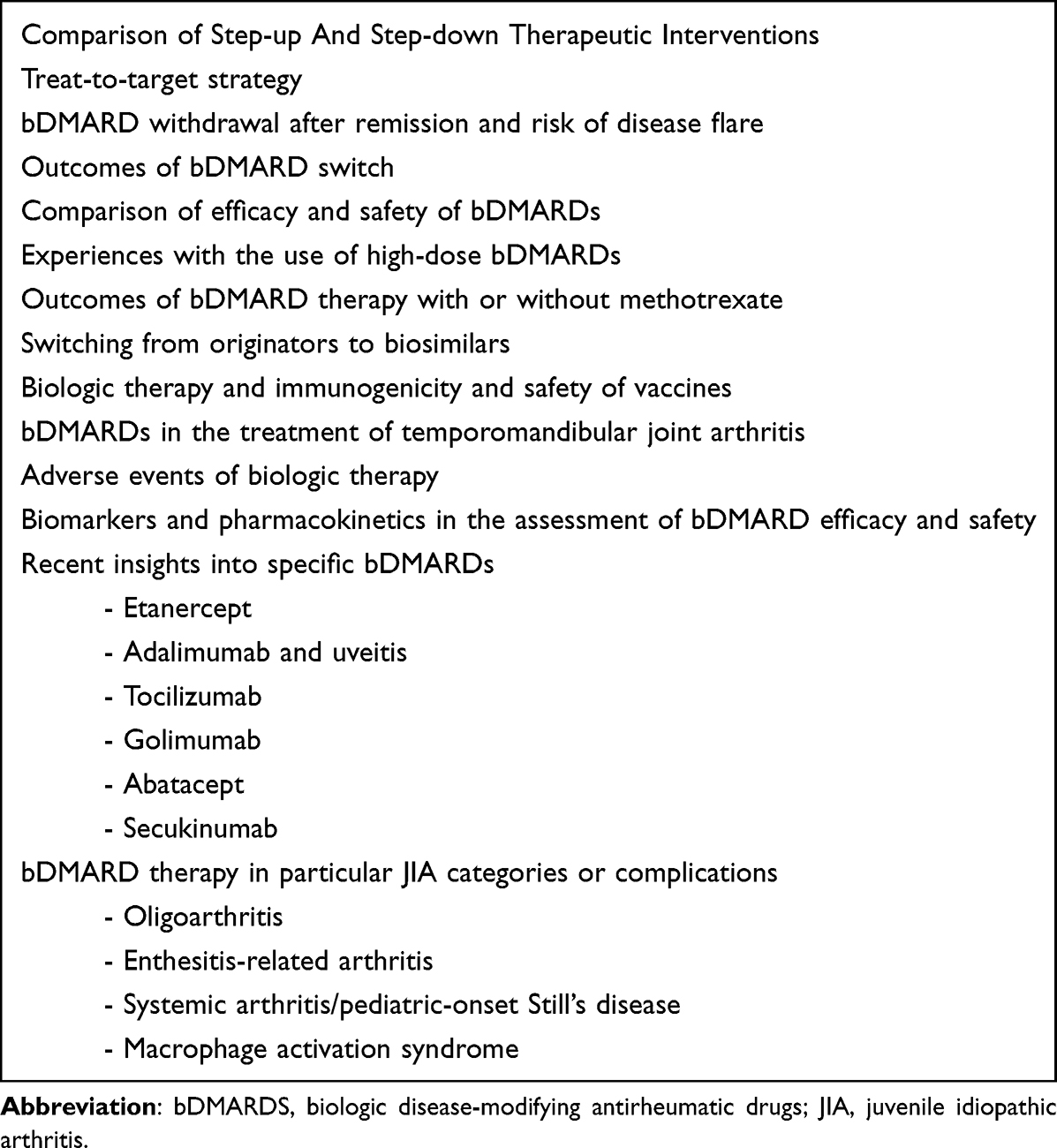 |
Box 2 Summary of the Main Topics Addressed in the Review |
Step-up vs Step-down
One of the most debated issues in the treatment of JIA is whether it is more advantageous, in terms of achievement of complete disease control and treatment tolerability, to pursue a traditional step-up approach, based on the initial prescription of a conventional therapeutic regimen with treatment escalation in case the therapeutic goal is not achieved, or an inverted pyramid approach with step-down therapy as tolerated.3 The STOP-JIA trial by Kimura et al compared three treatment strategies for polyarticular JIA: 1) Step-Up (starting with conventional synthetic disease-modifying antirheumatic drugs, csDMARDs, and adding bDMARDs, if needed); 2) Early Combination (initiating both a csDMARD and a bDMARD simultaneously); and 3) Biologic-First (bDMARD monotherapy from the outset).4 A total of 400 patients were followed for 12 months to assess the proportion achieving clinically inactive disease (CID) without glucocorticoids. While no significant differences were found across strategies, the Early Combination approach showed a higher likelihood of achieving CID per the clinical Juvenile Arthritis Disease Activity Score 10 (cJADAS10) compared to Step-Up.
A secondary analysis by Ong et al used latent class trajectory modeling to explore how early bDMARD initiation influenced disease progression.5 Patients who received bDMARDs within three months had significantly greater odds of achieving rapid improvement, highlighting the importance of early intervention, especially for patients with severe disease.
Similar results were reported by Huang et al, who compared an early aggressive approach (bDMARD + csDMARD in combination) with a conservative stepwise strategy. Patients receiving early aggressive therapy exhibited significantly lower disease activity at 6 months, while those delaying bDMARDs beyond 6 months experienced minimal additional benefit, underscoring the critical role of early bDMARD intervention in improving outcomes.6
The STARS trial is an ongoing RCT aimed to assess whether early aggressive (step-down) therapy leads to better long-term remission than stepwise escalation (step-up) in children with newly diagnosed non-systemic JIA. The results of this trial, which are eagerly awaited, will provide important insights into the relative value of the alternative treatment modalities.3
Treat-to-Target
In 2018, the recommendations for the treat-to-target (T2T) strategy in JIA were published.7 The T2T is based on the paradigm of explicitly defining a treatment target and applying tight control and necessary therapeutic adjustments to reach the target. Klein et al hypothesized that a structured treatment approach with predefined goals would be superior to routine clinical care in achieving remission after 12 months in polyarticular JIA.8 Sixty-three patients with early active disease were enrolled and the treatment milestones were set at 3, 6, 9, and 12 months. All patients received methotrexate (MTX) initially, with treatment escalation being mandated if disease activity targets were not met at the pre-established endpoints. At the end of the study, 48% of patients reached remission and 76% minimal disease activity. Compared to a matched conventionally treated control cohort from the German BIKER registry, significantly more patients under the T2T strategy had achieved remission. However, 50% of patients in the T2T cohort were given bDMARDs compared to only 9% in the control group. This observation indicates that although the T2T approach may improve the outcomes in polyarticular JIA, biologic therapy is often necessary to achieve and maintain tight disease control.
bDMARD Withdrawal After Remission
One of the main unmet needs in the management of JIA regards the availability of well-established protocols or recommendations that guide the withdrawal of the treatment after the achievement of sustained disease remission. Using data from a large UK registry, Kearsley-Fleet et al found that 19% of patients stopped bDMARDs after a median of 2.2 years.9 However, 54% of them had a disease flare and required treatment resumption within 4.7 months. Uveitis and longer disease duration before starting biologics increased the risk of flare, whereas prior use of tocilizumab (TCZ) seemed to reduce it. A 59% frequency of flare after treatment discontinuation following disease remission was found in another retrospective analysis.10 These studies highlight the high relapse rate following bDMARD discontinuation and the urgent need for reliable guidelines.
In patients who are receiving combination therapy with MTX and a bDMARD and reach CID, it is still unclear which medications should be discontinued first. Patients who discontinued MTX alone had a lower relapse rate (29%) and a longer median time to flare (6.3 years) compared to those who discontinued the bDMARD first.10
Castillo-Vilella et al investigated remission and relapse patterns in 206 JIA patients treated with csDMARDs or bDMARDs.11 They found that 70% achieved CID, but only 29% had sustained remission after stopping treatment. Patients receiving csDMARDs, especially females with oligoarthritis, positive antinuclear antibodies (ANA), and negative HLA-B27, were more likely to maintain disease quiescence. Gradual tapering reduced the risk of recurrence compared to abrupt discontinuation. A scoping review of 28 studies analyzing bDMARD withdrawal in non-systemic JIA, including 456 patients, showed a flare rate ranging from 26.3% to 100%, with a mean time to flare of 2 to 8.4 months. ANA positivity, younger onset age, and longer disease duration before bDMARD initiation were associated with a higher risk of flare.12
Among the diverse categories of JIA, children with systemic JIA were found to have the lowest flare rate (11.1%), whereas 46.1% of non-systemic patients relapsed, with a median time to flare time of 7 months. As in the above study, risk factors included ANA positivity and delayed bDMARD initiation.13
There is currently an increasing interest in the role of biomarkers in predicting disease flare after treatment discontinuation in patients who achieve CID. A recent multicenter study investigated the utility of S100A12 and high-sensitivity C-reactive protein (hsCRP) in assessing the risk of relapse after bDMARD withdrawal. Patients with persistently elevated biomarkers had a higher risk of flare, whereas those with lower levels were more likely to have sustained remission. Compared to clinical judgment alone, a biomarker-guided strategy reduced the relapse rate, highlighting its promising role in guiding treatment withdrawal.14
Kip et al found that remission was the most common reason for treatment discontinuation (44.7%), followed by adverse events (28.9%) and inefficacy (22.1%).15 Kaplan-Meier survival analyses confirmed that treatment discontinuation was often due to remission or side effects rather than primary drug failure.
bDMARD Switch
The switch from one bDMARD to another can be motivated by either inadequate efficacy or intolerance. The frequency and modalities of this phenomenon have been investigated recently.
The analysis of 200 JIA patients treated between 2012 and 2021 in Denmark revealed that 37% of them had bDMARDs switched at least once, 17.5% twice and 6% three or more times. The primary reason for switching was inefficacy (57%), followed by injection/infusion reactions (15%) and presence of uveitis (13%).16 Among patients who were switched, 93% were transitioned to a second TNF inhibitor (TNFi), rather than to a bDMARD with a different mechanism of action. Patients who were on ETN were more likely to require a switch than those who were receiving other TNFi.
Twenty-six percent of the 1361 patients included in the Childhood Arthritis and Rheumatology Research Alliance (CARRA) registry by Mannion et al had bDMARD therapy modified over time, most commonly because of inefficacy. The median time to switching decreased from 55.2 months in 2008 to 7.2 months in 2016, reflecting the contemporary tendency toward earlier treatment adjustments.17 These findings are comparable to those obtained in UK centers, were 23% of the patients were switched to a second bDMARD, 5% to a third, and 1% to a fourth. A sub-analysis of patients with polyarticular-course JIA showed that 81% of them were changed to a second TNFi, whereas 19% were given a non-TNFi, without any significant difference in treatment effectiveness.18 This observation suggests that there is no clear advantage of choosing a non-TNFi over a second TNFi when the first TNFi fails.
Comparison of bDMARDs
Thus far, no head-to-head comparisons of bDMARDs in RCTs have been performed. Thus, only indirect evidence of their relative efficacy is available. By examining the first course of bDMARD treatment in a large US pediatric rheumatology center, Yue et al found that TNFi had significantly longer treatment retention than non-TNFi (395 days versus 320 days) (P = 0.010). TNFi-treated patients also experienced a larger reduction in disease activity at 6 months, as measured by the cJADAS, compared to patients on non-TNFi therapy.19
Based on this data, it seems that TNFi may represent the most effective and durable first-line biologic treatment for JIA. However, no significant difference in achievement of CID (cJADAS10 ≤2.5) or minimal disease activity (cJADAS10 ≤5) at 6 months was detected in children with polyarticular-course JIA who were switched to second TNFi or to non-TNFi after failure of the first TNFi was detected.20
In a retrospective comparison of different classes of TNFi within the Pharmachild registry, patients on ETN exhibited a slightly greater improvement in parent-reported outcomes compared to those on adalimumab (ADA). However, the difference was not statistically significant (P = 0.06) and both agents improved the active joint count, with no significant differences in adverse events.21
Similar efficacy figures across different TNFi in non-systemic JIA were registered in a systematic literature review, which disclosed the following response rates, assessed with the American College of Rheumatology Pediatric (ACR Pedi) 30 response criteria: adalimumab (ADA) 71–94%, ETN 73–94%, golimumab (GOL) 89%, and infliximab (IFX) 64%. Serious adverse events (SAEs) were also generally uncommon, with incidence ranging from 0–24.3 per 100 patient-years, depending on the TNFi.22 Administering a TNFi dosage different from the standard schedule may not affect treatment outcomes.23
In contrast to non-systemic JIA, little information has been published for systemic JIA, which is treated with different drugs and regimens. A systematic review and metanalysis showed that canakinumab (CAN) was most effective in achieving a modified ACR Pedi 30 response, and outperformed markedly the placebo (odds ratio 55.0, 95% credible intervals 2.4–67.0). Anakinra (ANK) and ADA ranked second and third, respectively. No significant differences in adverse events, including serious infections, were observed among the biologic agents examined.24 In another metanalysis, CAN proved to be superior to both TCZ and rilonacept (RLN) in leading to a modified ACRpedi30 response, with an odds ratio of 55.04. However, no significant differences in the incidence of SAEs were found between CAN, ANK, TCZ, RLN, and placebo.25
High-Dose bDMARDs
It is still unclear whether the increase of bDMARD dosage above the standard regimens in patients with refractory disease may be advantageous in terms of efficacy without increasing the risk of adverse events. Such analysis was conducted in 5352 JIA patients included in the CARRA Registry, 20% of whom had received a bDMARD dose at least 40% higher than that recommended. Three patient groups were compared: 1) those who had bDMARDs escalated from standard to high dose; 2) those who were switched to a different bDMARD; and 3) those who were left on standard dosage. Dose escalation and bDMARD switch led to similar improvements in disease activity, with reduction in cJADAS10 of −3.53 and −3.95, respectively (p=0.68). SAEs were slightly more frequent in the high-dose and bDMARD switch groups than in the standard-dose group, but the differences were not statistically significant. This study suggests that dose escalation is a reasonable option for patients with inadequate disease control on standard dosing, though further large-scale investigations are necessary to evaluate long-term efficacy and safety of this approach.26
bDMARDs with or without Methotrexate
The impact of combining bDMARDs with MTX in terms of effectiveness and tolerability was evaluated in children with polyarticular JIA by Thiele et al using the data of the BIKER registry. Of the 2148 patients enrolled, 1464 had received MTX and a bDMARD in combination, whereas 684 patients were given bDMARD monotherapy.27 The combination group had a more profound decrease in the level of disease activity than the monotherapy group. In addition, TNFi-treated patients were found to benefit from the addition of MTX more than those receiving TCZ. Treatment duration was longer in the combination than in the monotherapy group (median 3.1 years versus 2.7 years, P = 0.002). Regarding safety, the addition of MTX led to a moderate increase in gastrointestinal and hepatic adverse events, but the rate of SAEs was equal in the two groups. These findings suggest that adding MTX to TNFi therapy enhances effectiveness and prolongs drug survival, without compromising safety. Combination of MTX with TCZ seems not to confer additional benefit.
Switching from Originators to Biosimilars
The introduction of biosimilars has brought a potential improvement in the cost-effectiveness of bDMARD therapy. Based on the information achieved so far, they appear to be overall comparable in terms of efficacy and safety to their reference bDMARDs.
The outcomes of patients on TNFi therapy who had the non-medical switch from originators to biosimilars between 2017 and 2023 were investigated using UK registry data. The most common originators were ADA (64%), ETN (25%), and IFX (11%). Patients who passed to a biosimilar were contrasted with a cohort who continued the originator. No significant worsening of disease activity, measured with the JADAS71, was recorded in the biosimilar group compared to the originator group after 6 months. Drug survival was also comparable in the two samples, with 76% of biosimilar users remaining on therapy after one year and 64% after two years.28
The OBSIDIAN Study extended the follow-up to 1 year. No significant differences in disease activity were detected at 3, 6, and 12 months post-switch. Time to remission, time to relapse, or rate of adverse events were also similar between originators and biosimilars.29
Unmet Needs
Brunner et al found that 52% and 45% of JIA patients in the Cincinnati Children’s Hospital Medical Center (CCHMC) database and CARRA Registry, respectively, had uncontrolled disease despite exposure to at least two bDMARDs.30 In addition, 19% of CCHMC patients and 15% of CARRA Registry patients had been prescribed at least one bDMARD not approved for JIA. Off-label use of biologics was especially common in patients with systemic JIA, enthesitis-related arthritis (ERA), and juvenile psoriatic arthritis (PsA), which highlighted the gap in Food and Drug Administration (FDA)-approved therapeutic options for these conditions.
Biologics and Vaccines
It is well known that patients under immunomodulatory treatment require special consideration when they are candidate to vaccination procedures. The updated EULAR/PRES vaccination recommendations for pediatric patients with autoimmune inflammatory rheumatic diseases mandate the administration of non-live vaccines according to national immunization programs and highlight their safety for immunosuppressed patients.31 Although live-attenuated vaccines should generally be avoided in these instances, the MMR booster and VZV vaccine can be administered under specific conditions. Annual vaccination status reviews are recommended, and seasonal influenza vaccination is strongly encouraged. A preliminary systematic review of 57 studies revealed that non-live vaccines were overall safe and immunogenic, though B-cell depleting therapies reduced humoral responses.
Gertosio et al assessed the efficacy, immunogenicity, and safety of vaccines in children with chronic diseases treated with bDMARDs.32 Although the information on vaccine efficacy is limited, immunogenicity is preserved for most vaccines. However, patients on TNFi showed lower seroconversion rate (P = 0.028) and reduced seroprotection rate for the serotype B influenza vaccine both in JIA (P = 0.004) and inflammatory bowel disease (IBD) (P = 0.013). Vaccine administration was not associated with SAEs, but JIA patients on TNFi had a higher risk of experiencing myalgia or arthralgia post-influenza vaccination (P = 0.014).
Treatment of Temporomandibular Joint Arthritis
Involvement of temporomandibular joints (TMJ) is frequent in children with JIA and is often overlooked. Furthermore, optimal management is still controversial. Stoustrup and associates investigated the effects of bDMARDs in combination with MTX or leflunomide on TMJ arthritis in JIA.33 The primary aim was to assess changes in inflammation and joint deformity using MRI-based scores at baseline, 6 months, and 24 months post-treatment initiation.
Significant improvement in clinical symptoms was detected, with reduction of pain (P = 0.01) and morning stiffness (P = 0.004), and improvement of both mouth opening (P = 0.03) and maximal incisal opening (P = 0.006). MRI disclosed decrease in inflammation scores from a median of 2 (IQR 1–3) at baseline to 1 (IQR 0–2) at 24 months (P = 0.009). Joint deformities either stabilized or improved in 17 of 36 TMJs (47%), and no appreciable progression of structural damage was observed.
This study provides evidence that TNFi therapy in combination with MTX or leflunomide may be efficacious in suppressing TMJ inflammation in JIA.
Treatment Outcomes
Over the past two decades, the use of bDMARDs in children with JIA has increased markedly. Data from national registries in Canada showed that biologic prescription increased from 6% in 2005–2010 to 26% in 2017–2021. This trend was paralleled by substantial improvement in disease control, with an increase in the proportion of patients achieving CID from 64% to 83%. However, changes in parent- and patient-reported outcomes, such as pain and health-related quality of life, were smaller than those of disease activity measures.34
Real-world data obtained from the BiKeR registry showed that over 9 years of continuous ETN use, 68.1% of patients achieved minimal disease activity, 43.1% JADAS-defined remission, and 36.6% met ACR CID criteria. Response rates remained substantial at 82% (ACR Pedi 30), 79% (ACR Pedi 50), 71% (ACR Pedi 70), and 54% (ACR Pedi 90). Although SAEs were infrequent, they occurred more often in ETN-treated patients than in a biologic-naïve control group.35
Response rates at week 104 in a long-term extension study of patients with polyarthritis included in a Phase 3 trial of ADA alone or in combination with MTX were 66% (ACR Pedi 30), 74% (ACR Pedi 50), 83% (ACR Pedi 70), and 96% (ACR Pedi 90), with 37% of patients achieving sustained remission (JADAS27 inactive disease for ≥6 months).36
By analyzing data from four clinical trials on biologic therapies in JIA, Lim et al identified three distinct patterns of treatment response through latent class trajectory analysis: (1) slow response with high baseline active joint count (AJC) (26.5% of patients), (2) rapid early response with low baseline AJC (29.7%), and (3) progressive response with moderate baseline AJC (43.8%).37 Children with greater AJC at baseline had more frequently poor and slower responses to treatment. Concomitant MTX administration was associated with a lower likelihood of falling into the slow-response category. These findings indicate that patients with more extended polyarthritis deserve more aggressive therapeutic interventions since the earlier disease stages.
Adverse Events
Although no major alert signals have emerged in the first 25 years of use of bDMARDs, the level of attention about their side effects remains high. Among 3258 JIA patients enrolled in the BIKER registry, 22.2% experienced at least one infection, and 2.8% had a serious infection. The incidence rate (IR) of infections was higher in patients treated with IL-1 inhibitors (IR 17.3) and IL-6 inhibitors (IR 16.7) than in those receiving TNFi (IR 8.7). Younger age, glucocorticoid use, higher disease activity, and cardiac comorbidities were risk factors for infections in bDMARD-treated JIA patients.38
The lower risk of infections with TNFi compared to other biologic classes was confirmed in the JIR Cohort. Most infectious events affected the upper respiratory tract and only a few cases were classified as severe or very severe. No instances of tuberculosis were reported.
Among 772 infections recorded in 572 bDMARD-treated patients, 119 were opportunistic, with herpes virus infections (68%) and tuberculosis (27.4%) being most common.39
Because biologic agents interfere with cytokine-regulated immunologic mechanisms, they could theoretically disrupt immune balance and potentially increase the risk of developing other immune-mediated diseases in patients with JIA. The likelihood of psoriasis occurrence as paradoxical effect of bDMARD therapy has been recently investigated.
An analysis of the BiKeR registry was conducted to identify JIA patients who had no prior history of psoriasis or PsA before starting biologic therapy. The sample included 4149 patients treated with a TNFi (ETN, ADA, GOL, IFX), 676 treated with a non-TNFi bDMARD (TCZ, abatacept-ABT, ANK, CAN), and 1692 patients only given MTX. Thirty-one patients developed new-onset psoriasis. Compared to MTX alone, TNFi-treated patients had a significantly higher risk of developing psoriasis (RR 10.8, p = 0.019), with the risk being especially high in those receiving monoclonal antibodies (RR 29.8, p = 0.0009). ETN use was not associated with incident psoriasis, and patients on non-TNFi bDMARDs also had an elevated risk (RR 25.0, p = 0.003).40
Another retrospective cohort study (2008–2020) included 5088 pediatric patients, 3794 (75%) with IBD, 1189 (23%) with JIA, and 105 (2%) with chronic nonbacterial osteomyelitis (CNO). Patients treated with ADA had a 2.70-fold higher risk (IRR 2.70, 95% CI 1.53–4.75, P < 0.001) of developing psoriasis compared to those who never received TNFi. The risk was also elevated for IFX (IRR 2.34, 95% CI 1.56–3.51, P < 0.001) and ETN (IRR 2.21, 95% CI 1.17–4.21, P = 0.006). Concomitant administration of a csDMARD reduced the risk.41
Occurrence of IBD is an additional possible complication of biologic therapy. Twenty-eight of 5009 the BiKeR registry patients developed IBD before age 18: 82.1% of them had Crohn’s disease and the overall incidence was 0.56%. Of these patients, 20.3% were HLA-B27 positive, 25% had ERA and 14.3% PsA, suggesting that this ensemble of features define a distinct JIA-IBD phenotype. IBD incidence was lower in patients treated with MTX, and higher in those on ETN, leflunomide, or sulfasalazine. MTX in conjunction with ETN seemed to mitigate the risk.42
A further area of uncertainty is whether bDMARDs may trigger the onset of uveitis. This issue was addressed by extracting data from the British Society for Paediatric and Adolescent Rheumatology Etanercept Cohort Study (BSPAR-ETN) and the Biologics for Children with Rheumatic Diseases (BCRD) study. Of the whole 2294 patients, 943 were on MTX, 304 on ADA/IFX, and 1047 on ETN. During follow-up, 44 cases of uveitis were registered (27 in the MTX group, 16 in the ETN group, and 1 in the ADA group). Overall, no clear risk factors were determined.43
The safety of ANK in systemic JIA was assessed in the Pharmachild registry. Among 306 patients, 201 adverse events were reported (39.5/100 patient-years, PY), with infections being the most common. SAEs (11.0/100 PY) included infections (23.2%) and macrophage activation syndrome (MAS) (19.6%). The incidence of adverse events was highest in the first six months of follow-up and declined thereafter.44
Regarding the safety of CAN, real-world data from a multicenter cohort of 80 patients with systemic JIA showed no serious adverse events. Mild injection site reactions, non-serious infections, and one case of herpes zoster were reported, none of which required treatment discontinuation. One episode of lymphopenia led to discontinuation before 6 months.45
Among 260 systemic JIA patients in the BiKeR registry, biologic exposure included ETN (151 patients), TCZ (109), ANK (71), and CAN (51). SAEs were most frequent with CAN (20/100 PY) and TCZ (21/100 PY), with higher rates of cytopenia and liver complications. Medically significant infections were more common in IL-6 and IL-1 inhibitor-treated patients. MAS occurrence was reported in all treatment groups, with CAN (3.2/100 PY) and TCZ (2.5/100 PY) disclosing the highest rates.46
Patients with systemic JIA who developed MAS while on biologic treatment (n = 45) were compared with those who had MAS without recent biologic exposure (n = 155). Patients receiving anti-IL-1/IL-6 therapies at the time of MAS onset exhibited lower platelet counts (median 128 vs 199 × 10⁹/L), lower ferritin levels (median 1107 vs 2863 ng/mL), lower CRP (15.4 vs 90 mg/L), lower erythrocyte sedimentation rate (ESR) (13 vs 43.5 mm/h), and shorter fever duration (5 vs 10 days) compared to those not receiving biologics. Patients receiving CAN had lower rates of hepatomegaly and splenomegaly. Importantly, 26.6% of patients on bDMARDs did not meet the 2016 MAS classification criteria at presentation, suggesting that these treatments may mask the traditional clinical and laboratory features of MAS.47
Biomarkers and Pharmacokinetics
Biomarkers are a broad range of molecules associated with immune response and inflammation, whose alterations can be used to recognize and monitor a normal or abnormal underlying biological process.48 Currently, their application in clinical practice is limited, but research in the area is expanding.
S100 proteins are extensively investigated in pediatric rheumatology. Their association with treatment response has been evaluated in 219 patients with polyarticular JIA using data from a phase 3 trial of abatacept (NCT01844518). Lower baseline levels of S100A8/9 (≤ 3295 ng/mL) and S100A12 (≤ 176 ng/mL) were linked to higher odds of achieving disease remission and relevant clinical improvement at 4 and 16 months. Persistently lower levels over time correlated with sustained improvement.49
Gerss et al hypothesized that hsCRP and S100A12 could guide bDMARD withdrawal. They conducted a multicenter trial, in which drug discontinuation decisions were based on biomarker levels. The outcomes were compared with those achieved in a control group from the BiKeR registry, whose treatment cessation was based on physician judgment. The frequency of flare after stopping medication was lower among patients enrolled in the trial than in the BiKeR group (45% vs 60%). Trial patients were also able to discontinue therapy earlier than those in the control group.14
Morozova et al examined whether TNF-α levels could serve as a biomarker of disease activity in 98 JIA patients treated with TNFi. TNF-α levels were found to increase after initiation of biologic therapy, but their correlation with disease activity was weak (r = −0.177, p = 0.007).50 These findings suggest that longitudinal TNF-α measurements are of limited clinical value.
Measurement of drug levels is another potential strategy for monitoring TNFi effectiveness. With the aim of generating a pharmacokinetics model that accounts for variability in drug clearance, 78 samples of 50 patients treated with ADA were tested. ADA clearance was found to be influenced by body weight, anti-drug antibodies, MTX use, CRP concentrations, and presence of uveitis. Concomitant MTX was associated with lower drug clearance, whereas patients with uveitis had a faster clearance, suggesting that patients with this comorbidity require higher ADA doses.51
Anti-adalimumab antibodies (AAA) are commonly determined in clinical practice to verify whether their development is responsible for treatment failure. A study of 30 JIA patients revealed that AAA were already detectable 2 months after treatment initiation in 7% of patients, and that the percentage rose to 34% after 3 months and to 37% after 6 months. Patients with AAA at 3 months had lower ADA levels, implying decreased efficacy. By 12 months, 60% of AAA-positive patients required drug switching due to treatment failure, compared to only 15% of AAA-negative patients.52
Genetics
A systematic review looked for genetic variants affecting response to anti-TNF therapies in JIA. Specific genetic markers linked to treatment efficacy were identified, suggesting that genetic profiling may help to personalize therapy. Thus, pharmacogenetics may potentially facilitate optimization of treatment outcomes and reduction of adverse effects.53
Etanercept
ETN is the first bDMARD marketed for the treatment of JIA. The patterns of its use with or without MTX have been evaluated in the CARRA registry by stratifying patients in five groups: 1) combination therapy (ETN and MTX started together); 2) step-up therapy (MTX started first, then ETN added); 3) switchers (MTX stopped before or during ETN administration); 4) MTX add-on (ETN started first, then MTX added later); and 5) ETN monotherapy. A marked variability in MTX use prior to ETN initiation was seen, with step-up therapy being the most common approach. Drug retention rates of ETN were 66.3% at 24 months, 49.4% at 36 months, and 37.3% at 48 months. However, treatment maintenance varied across JIA subtypes and was longer when ETN was started as monotherapy or after discontinuing MTX.54
The effectiveness of re-treatment with ETN after its discontinuation for achievement of CID was scrutinized by Klotsche et al in two large prospective registries, BiKeR and JuMBO. Of a total of 1724 JIA patients, 338 were given a second ETN course and 54 a third course. Discontinuation rate due to inefficacy or adverse events was similar across treatment courses: 19.4%/6.2% for the first, 18.6%/5.9% for the second, and 14.8%/5.6% for the third.55 Seventy-seven percent of the 332 patients who were discontinued after achieving remission experienced a disease flare within an average of 12.1 months, but no risk factors for flare were identified. Importantly, 72.7% of patients who flared were re-treated with ETN, and approximately 70% of them achieved again CID within 12 months. These findings indicate that ETN remains effective when reinitiated after a disease flare following discontinuation due to remission.
Adalimumab and Uveitis
Although the management of JIA-related uveitis continues to pose considerable clinical challenges, the introduction of bDMARDs, especially ADA, has improved considerably its prognosis.56 A recent investigation examined the results of 20 years of JIA-uveitis management at a tertiary care referral center by comparing patients treated before and after the introduction of biologics. The use of systemic glucocorticoids declined over time (p = 0.008), while MTX prescription increased progressively (p = 0.039), with 93.3% of the patients receiving this medication at the time of the study. The administration of bDMARDs (ADA in 72.7% of the patients), resulted in fewer uveitis recurrences and complications.57
The efficacy and safety of ADA in JIA-associated uveitis was confirmed in a pooled analysis, which found that this agent increased treatment success and reduced treatment failure compared to placebo (RR 2.60, 95% CI 1.30–5.20 for success; RR 0.23, 95% CI 0.11–0.50 for failure).58
The role of other promising therapies in refractory cases is currently being scrutinized against ADA as standard of care. A phase 3 trial, is currently evaluating baricitinib versus ADA in patients unresponsive to MTX, assessing response rates at 24 weeks.59 Other alternative agents include TCZ, ABT, GOL, and rituximab (anti-CD20).60 Biologic therapies may improve the success of ocular surgery. The results of the intervention for cataract were better in the subset of patients who were receiving bDMARDs.61
Although bDMARDs have a key role in the treatment of JIA-associated uveitis, there is some evidence that some of them, especially ETN, may contribute to its development. Among 21 new cases of uveitis seen at a single institution between 2014 and 2022, no difference was recorded between patients treated with MTX, ETN or no DMARDs. However, none of the patients receiving ADA had uveitis, suggesting a potential protective role of this drug.62
Tocilizumab
A recent consensus statement has outlined the indications, as well as the efficacy and safety profile, of IL-6 pathway blockers in both adult- and pediatric-onset rheumatic disorders.63,64
A comparative analysis of efficacy and pharmacokinetics of subcutaneous versus intravenous TCZ has shown that the two formulations achieved similar steady-state concentrations and that 53% and 31% of patients with systemic and polyarticular JIA, respectively, reached clinical remission. Safety was also comparable.65 A long-term extension study revealed that subcutaneous TCZ concentrations remained stable, and that clinical benefit was maintained in most patients.66 The demonstration of the equivalence between the two routes of administration is important, as subcutaneous injections are more feasible and can be easily performed at home.
The demonstration of the effectiveness of TCZ in systemic and polyarticular JIA has been strengthened by the observation of its potential ability to halt the progression of radiographic joint in the post hoc evaluation of the radiographs collected in two randomized controlled trials (TENDER and CHERISH).67
The usefulness of intravenous TCZ was examined in 8 patients with refractory JIA-associated uveitis previously treated with MTX (n = 8) and/or TNFi (n = 6). Five of the 8 patients achieved remission of ocular inflammation and all patients with cystoid macular edema had amelioration of visual outcomes.68
Golimumab
The long-term efficacy, pharmacokinetics, immunogenicity, and safety of intravenous (IV) GOL in children with polyarticular JIA have been scrutinized in the long-term extension of the GO-VIVA study. Participants received IV GOL (80 mg/m² every 8 weeks) beyond the initial 52-week trial period, up to week 252. GOL concentrations remained within the expected therapeutic range from week 52 through week 244. The frequency of anti-drug antibodies was 39.2% and 44.8% at week 52 and 244, respectively. Neutralizing antibodies were identified in 28% of participants. The clinical response was sustained over time, with ACR Pedi 30/50/70/90 improvement rates at week 116 of 72.4%, 71.7%, 63.8%, and 50.4%, respectively. The safety profile was consistent with prior findings.69
Abatacept
ABT as monotherapy and in combination with MTX were compared in patients with polyarticular-course JIA over two years. Both regimens showed sustained efficacy, with similar ACR Pedi response rates regardless of prior biologic exposure. Pharmacokinetic analysis confirmed that MTX did not alter ABT clearance. Safety outcomes were comparable between the two groups, with occasional minimal injection site reactions.70
The long-term safety of ABT was assessed using PRINTO/PRCSG registry data, which included 569 patients (1214.6 PY). Both SAEs (IR 5.52/100 PY) and serious infections (IR 1.48/100 PY) were uncommon. Effectiveness was maintained, with 55.9% of patients achieving low disease activity and 35.6% CID.71
Secukinumab
This bDMARD, a fully human monoclonal antibody targeting IL-17A, is primarily proposed for the treatment of ERA and juvenile PsA. It was tested in a randomized, double-blind, placebo-controlled, phase 3 trial based on the withdrawal design, which enrolled 86 patients. Patients who achieved an ACR Pedi 30 response at week 12 were randomly assigned 1:1 to continue secukinumab (SEK) or receive placebo. The primary endpoint—time to disease flare—was significantly longer in the SEK group than in the placebo group. Secondary endpoints, such as rates of ACR Pedi 30/50/70/90/100 responses and CID, and disease activity scores (JADAS27), were attained more frequently in patients treated with SEK. The most common side effects included nasopharyngitis, nausea, upper respiratory infections, and diarrhea. Overall, safety profile was consistent with that seen in adult PsA and axial spondyloarthritis (SpA).72
Oligoarthritis
Although most patients with persistent oligoarthritis pursue a mild disease course and may not require the introduction of a bDMARD, some of them fail to respond adequately to first-line treatments, such as NSAIDs, intra-articular glucocorticoids, and MTX, and require escalation to biologic therapy.
The timing and necessity of starting bDMARDs in patients with this JIA category who were already receiving MTX were investigated by Polat et al. The 86 patients were divided into two groups: 69 were on MTX alone and 17 required the addition of a bDMARD.73 Predictors of bDMARD initiation were sought for. However, at the time of diagnosis, gender, age, disease duration, number or type of affected joints, as well as JADAS10 were similar between the groups.
However, by the third and sixth months of treatment, JADAS10 scores remained higher in the MTX plus bDMARD group (p = 0.001 and p = 0.004, respectively). Multivariate analysis revealed that for each point increase in JADAS10 at 3 months, the likelihood of adding a bDMARD increased by 1.24-fold (p = 0.004, 95% CI: 1.07–1.43). Importantly, the number or type of joints affected at disease onset did not predict bDMARD requirement. The authors concluded that JADAS10 scores at 3 and 6 months, rather than baseline disease activity, forecast the need for bDMARD escalation in persistent oligoarticular JIA.
Enthesitis-Related Arthritis
Children with this JIA category, particularly those with axial involvement, share significant clinical and biological similarities with adults with SpA, including HLA-B27 positivity, sacroiliitis, inflammatory back pain, and enthesitis. However, due to differences in classification criteria, the FDA has historically waived pediatric studies for axial SpA treatments, thus limiting available approved therapies for ERA. As a result, none of the FDA-approved therapies for adult axial or peripheral SpA have been formally studied or labeled for use in pediatric patients with ERA.74
Shipa et al evaluated drug survival of ADA and ETN as first-line biologic therapy in patients with ERA and analyzed the factors that influence treatment persistence over a 10-year period (2009–2019). A total of 188 biologic-naïve patients were included, 108 receiving ETN and 80 ADA. Over the study period, 99 patients discontinued their first-line TNFi, with a median drug survival of 3.9 years.75 ADA combined with MTX provided the longest drug survival compared to ETN-based regimens or ADA monotherapy. Patients with axial involvement, especially those with high CRP levels at baseline, were more likely to experience treatment failure and to require alternative therapeutic strategies.
The BACK-OFF JSpA trial is the first randomized study designed to evaluate bDMARD de-escalation strategies in children with juvenile SpA who have achieved sustained CID on TNFi.76
Systemic JIA/Pediatric-Onset Still’s Disease
A systematic review of treatments for Still’s disease, of either pediatric and adult onset, aimed to inform the EULAR/PReS guidelines for disease management was conducted recently. IL-1 and IL-6 inhibitors were found to display the best efficacy in controlling both systemic and articular inflammation. The meta-analyses of existing randomized controlled trials disclosed an odds ratio for ACR Pedi 50 response of 6.02 (95% CI 2.24–21.36) for IL-1 inhibitors and of 8.08 (95% CI 1.89–34.57) for IL-6 blockers. In contrast, MTX, cyclosporine, and TNFi exhibited marginal efficacy.77
These findings were confirmed by the systematic review and network metanalysis of Kilic et al, which showed that the same bDMARDs increased the likelihood of achieving an ACR Pedi 50 response compared to placebo.78 No differences were found in the occurrence of serious adverse events, suggesting that the available options have an acceptable safety profile. ANK emerged as the most effective and safe agent, followed by CAN, RLN, and TCZ.
Other investigations ranked CAN before ANK in terms of effectiveness. The German autoinflammatory diseases registry collected 111 patients treated with IL-1 inhibitors. Twenty-eight (51%) of the 55 patients on ANK and 17 (85%) of the 20 on CAN achieved CID. Clinical response was maintained in 74% of patients on CAN and 68% on ANK.79
A Turkish retrospective multicenter study highlighted the frequent tendency for patients started with ANK to switch over time to other biologics. More than half (58.8%) of the patients who were initially given ANK were transitioned to another bDMARD, primarily CAN (80%). Nevertheless, the early efficacy of ANK was underscored by its better physician’s global assessment scores at month 3 (p=0.04).80
Some studies tried to verify the previously postulated relationship between the effectiveness of ANK and particular IL1RN risk alleles. This association was not confirmed by Erkens et al, who found high rates of CID at 6 months, 1 year, and 2 years irrespective of the IL1RN status.81 Another group investigated the correlation of genetic variants with treatment response in systemic JIA. Their retrospective analysis included 56 patients treated with ANK, 73.2% of whom had reached CID at 6 months. In contrast with the former study, the homozygosity for at least one high-expression single nucleotide polymorphism (SNP) in the IL1RN gene led to a six-fold higher risk of non-response.82 Despite these disparities, the search for genetic predictors of drug effectiveness should be further intensified in the future as it is crucial to implement personalization of treatment.
The critical importance of early bDMARD initiation in systemic JIA was emphasized by Beukelman et al, who compared first-line therapeutic strategies by applying the CARRA consensus treatment plans (CTP) in the context of the First-line Options for sJIA Treatment (FROST) study.83 Among 73 children with new-onset systemic JIA, 86% received the biologic CTP (ie IL-1 or IL-6 inhibitors) and 14% the non-biologic CTP (ie glucocorticoids alone or MTX). Half of the patients in the non-biologic CTP group were given a bDMARD within 4 months to achieve the same level of response of patients in the biologic CTP. The favorable impact of first-line bDMARD therapy on glucocorticoid sparing was demonstrated in a retrospective observational study that emulated a pragmatic trial by using administrative data.84
A systematic review assessed the efficacy and safety of ABT in systemic JIA. The ACR Pedi 30, 50 and 70 response rates were 64.8%, 50.3% and 27.9% at 3 months, and increased to 85.7%, 71.4% and 42.9% at 6 months, and to 80.0%, 50.0% and 40.0% at 12 months. However, specific data on systemic and joint symptoms, and activities of daily living were not reported, which limit the appraisal of the overall impact of ABT on the disease burden.85
Another systematic review by the same group addressed the role of TNFi in systemic JIA. ETN was found to be more efficacious than IFX, and the latter agent induced frequently severe adverse reactions, including anaphylaxis.86 However, because it is well known that TNFi therapy has little or no effect on systemic symptoms, it would be useful to the clinicians to get specific information on the efficacy of these agents on joint disease, once extra-articular features have subsided.
Interstitial lung disease is an emerging and serious severe complication of systemic JIA, that is often linked to MAS or adverse reactions to biologic therapies. The disease course, treatment strategies, and long-term outcomes of children with this condition have been described in a prospective cohort analysis involving 41 patients. The presence of the HLA-DRB1*15 haplotype was significantly more common in patients with lung involvement, suggesting a genetic predisposition.87 Thus far, there is no clear demonstration that this complication is related to the increased use of IL-1 and IL-6 inhibitors in systemic JIA, as recently hypothesized based on its increased prevalence in parallel with the growing use of these bDMARDs and its association with idiosyncratic reactions to the same drugs.88 No recommendations are currently available for its optimal treatment and the therapeutic approaches have varied widely.
Macrophage Activation Syndrome
The METAPHOR project is aimed at providing a comprehensive systematic review of current treatment approaches for MAS worldwide.89 A total of 57 studies have been examined, which included 1,148 patients with systemic JIA-associated MAS (n = 889), systemic lupus erythematosus (n = 137), Kawasaki disease (n = 69), and other rheumatological conditions (n = 53). Treatments were found to be largely different across different centers and countries. Glucocorticoids were used in 90% of cases, with methylprednisolone being preferred over dexamethasone. Cyclosporin was frequently prescribed, particularly in patients with systemic JIA-associated MAS. In the same group of patients, ANK administration was associated with a favorable outcome in 83% of patients.
The IFNγ inhibitor emapalumab was tested in a Phase II, open-label, single-arm clinical trial, which involved 14 patients with systemic JIA-associated MAS. This trial was conducted in several European and US centers. Emapalumab proved quite effective, as 93% of patients achieved remission. Safety profile was overall satisfactory, although some patients developed new or reactivated CMV infections, all of which were resolved spontaneously or with standard treatment.90
Conclusion
In the past 5 years, a number of studies have provided new information from the real world of clinical practice about the effectiveness and safety of the bDMARDs approved for use in JIA in the previous two decades. Furthermore, novel therapeutic agents have been proposed for the disease categories that lacked specifically approved therapies or for particular complications or comorbidities. Innovative management strategies, such as the step-down and T2T approaches, have been designed to maximize the therapeutic benefits through the optimal combination of the newer and conventional medications. Altogether, these advances hold the promise of further improving the outcomes for children with JIA. Several unmet needs remain, however, such as the absence of evidence-based recommendations for medication withdrawal after the achievement of sustained remission and of suitable protocols for patients who do not respond adequately to the contemporary interventions. Future investigations should also seek reliable early predictors of therapeutic response that enable personalization of treatment and enhance its precision.
Abbreviations
CID, clinically inactive disease; T2T, treat-to-target; MTX, methotrexate; TCZ, tocilizumab; ANA, antinuclear antibodies; CRP, C-reactive protein;. TNFi, TNF inhibitor; ETN, etanercept; CARRA, Childhood Arthritis and Rheumatology Research Alliance; cJADAS, clinical Juvenile Arthritis Disease Activity Score; ADA, adalimumab; SAEs, serious adverse events; CAN, canakinumab; ANK, anakinra; RLN, rilonacept; IFX, infliximab; ERA, enthesitis-related arthritis; PsA, juvenile psoriatic arthritis; FDA, Food and Drug Administration; ABT, abatacept; GOL, golimumab; ACR Pedi, American College of Rheumatology Pediatric; IBD, inflammatory bowel disease; CNO, chronic noninfectious osteomyelitis; MAS, macrophage activation syndrome; ESR, erythrocyte sedimentation rate; SEK, secukinumab; SpA, spondyloarthritis; SNP, single nucleotide polymorphism; CTP, consensus treatment plan; PY, patient-years.
Acknowledgment
We disclose that we have used Chat GPT-4o in the preparation of our manuscript to generate a summary of each of the published articles assessed in the literature review. This tool has been used to facilitate and speed up the retrieval of the information needed to prepare the manuscript. However, all the materials obtained were evaluated critically and adapted, modified or integrated for the writing of the review.
Author Contributions
All authors made a significant contribution to the work reported, whether that is in the conception, study design, execution, acquisition of data, analysis and interpretation, or in all these areas; took part in drafting, revising or critically reviewing the article; gave final approval of the version to be published; have agreed on the journal to which the article has been submitted; and agree to be accountable for all aspects of the work.
Funding
No financial support was available for this work.
Disclosure
AR has received grant support and/or speaking or consultant fees from AbbVie, Alexion, Bristol-Myers Squibb, Galapagos, Johnson & Johnson, Novartis, Pfizer, Roche and SOBI, and personal fees from Reckitt-Benkiser and Alfasigma. AC has received grant support and/or speaking or consultant fees from AbbVie, Novartis, and SOBI. The authors report no other conflicts of interest in this work.
References
1. Lovell DJ, Giannini EH, Reiff A, et al. Etanercept in children with polyarticular juvenile rheumatoid arthritis. pediatric rheumatology collaborative study group. N Engl J Med. 2000;342(11):763–769. doi:10.1056/NEJM200003163421103
2. Petty RE, Southwood TR, Manners P, et al. International league of associations for rheumatology classification of juvenile idiopathic arthritis: second revision, Edmonton, 2001. J Rheumatol. 2004;31(2):390–392.
3. Burrone M, Mazzoni M, Naddei R, et al. Looking for the best strategy to treat children with new onset juvenile idiopathic arthritis: presentation of the “comparison of STep-up and step-down therapeutic strategies in childhood ARthritiS (STARS) trial. Pediatr Rheumatol Online J. 2022;20(1):80. doi:10.1186/s12969-022-00739-x
4. Kimura Y, Ringold S, Riordan ME, et al. Comparing Three Ways to Start Treatment for Patients with Polyarticular Juvenile Idiopathic Arthritis—The Stop-JIA Trial. Washington (DC): Patient-Centered Outcomes Research Institute (PCORI); March 2021.
5. Ong MS, Ringold S, Kimura Y, et al. Improved disease course associated with early initiation of biologics in polyarticular juvenile idiopathic arthritis: trajectory analysis of a childhood arthritis and rheumatology research alliance consensus treatment plans study [published correction appears in arthritis. Rheumatol. 2021;73(10):1910–1920. doi:10.1002/art.41892
6. Huang B, Qiu T, Chen C, et al. Timing matters: real-world effectiveness of early combination of biologic and conventional synthetic disease-modifying antirheumatic drugs for treating newly diagnosed polyarticular course juvenile idiopathic arthritis. RMD Open. 2020;6(1):e001091. doi:10.1136/rmdopen-2019-001091
7. Ravelli A, Consolaro A, Horneff G, et al. Treating juvenile idiopathic arthritis to target: recommendations of an international task force. Ann Rheum Dis. 2018;77(6):819–828. doi:10.1136/annrheumdis-2018-213030
8. Klein A, Minden K, Hospach A, et al. Treat-to-target study for improved outcome in polyarticular juvenile idiopathic arthritis. Ann Rheum Dis. 2020;79(7):969–974. doi:10.1136/annrheumdis-2019-216843
9. Kearsley-Fleet L, Baildam E, Beresford MW, et al. Successful stopping of biologic therapy for remission in children and young people with juvenile idiopathic arthritis. Rheumatology. 2023;62(5):1926–1935. doi:10.1093/rheumatology/keac463
10. Nieto-González JC, Garulo DC, Boteanu A, et al. What to expect when systemic treatment in juvenile idiopathic arthritis is withdrawn? J Rheumatol. 2023;50(10):1326–1332. doi:10.3899/jrheum.2022-1305
11. Castillo-Vilella M, Giménez N, Tandaipan JL, Quintana S, Modesto C. Clinical remission and subsequent relapse in patients with juvenile idiopathic arthritis: predictive factors according to therapeutic approach. Pediatr Rheumatol Online J. 2021;19(1):130. doi:10.1186/s12969-021-00607-0
12. Gieling J, van den Bemt B, Hoppenreijs E, Schatorjé E. Discontinuation of biologic DMARDs in non-systemic JIA patients: a scoping review of relapse rates and associated factors. Pediatr Rheumatol Online J. 2022;20(1):109. doi:10.1186/s12969-022-00769-5
13. Tanatar A, Akgün Ö, Çağlayan Ş, et al. Withdrawal of biologic therapy in juvenile idiopathic arthritis due to remission: predictors of flare and outcomes. Expert Opin Biol Ther. 2023;23(3):305–313. doi:10.1080/14712598.2023.2185132
14. Gerss J, Tedy M, Klein A, et al. Prevention of disease flares by risk-adapted stratification of therapy withdrawal in juvenile idiopathic arthritis: results from the PREVENT-JIA trial. Ann Rheum Dis. 2022;81(7):990–997. doi:10.1136/annrheumdis-2021-222029
15. Kip MMA, de Roock S, Currie G, et al. Pharmacological treatment patterns in patients with juvenile idiopathic arthritis in the Netherlands: a real-world data analysis. Rheumatology. 2023;62(SI2):SI170–SI180. doi:10.1093/rheumatology/keac299
16. Pedersen ML, Neve-Græsbøll A, Herlin T, Glerup M. Biologic switching patterns among children with non-systemic juvenile idiopathic arthritis. Pediatr Rheumatol Online J. 2023;21(1):107. doi:10.1186/s12969-023-00897-6
17. Mannion ML, Xie F, Horton DB, et al. Biologic switching among nonsystemic juvenile idiopathic arthritis patients: a cohort study in the childhood arthritis and rheumatology research alliance registry. J Rheumatol. 2021;48(8):1322–1329. doi:10.3899/jrheum.200437
18. Kearsley-Fleet L, Heaf E, Davies R, et al. Frequency of biologic switching and the outcomes of switching in children and young people with juvenile idiopathic arthritis: a national cohort study. Lancet Rheumatol. 2020;2(4):e217–e226. doi:10.1016/S2665-9913(20)30025-4
19. Yue X, Huang B, Hincapie AL, et al. Comparative effectiveness and persistence of TNFi and non-TNFi in juvenile idiopathic arthritis: a large paediatric rheumatology centre in the USA. Rheumatology. 2021;60(9):4063–4073. doi:10.1093/rheumatology/keaa877
20. Mannion ML, Amin S, Balevic S, et al. Comparative effectiveness of a second tumor necrosis factor inhibitor versus a non-tumor necrosis factor biologic in the treatment of patients with polyarticular-course juvenile idiopathic arthritis. Arthritis Care Res. 2024;76(8):1090–1098. doi:10.1002/acr.25339
21. van Straalen JW, de Roock S, Giancane G, et al. Real-world comparison of the effects of etanercept and Adalimumab on well-being in non-systemic juvenile idiopathic arthritis: a propensity score matched cohort study. Pediatr Rheumatol Online J. 2022;20(1):96. doi:10.1186/s12969-022-00763-x
22. Horneff G, Minden K, Rolland C, Daly ACH, Borlenghi C, Ruperto N. Efficacy and safety of TNF inhibitors in the treatment of juvenile idiopathic arthritis: a systematic literature review. Pediatr Rheumatol Online J. 2023;21(1):20. doi:10.1186/s12969-023-00798-8
23. Verstegen RHJ, Shrader P, Balevic SJ, et al. Dosing variation at initiation of adalimumab and etanercept and clinical outcomes in juvenile idiopathic arthritis: a childhood arthritis and rheumatology research alliance registry study. Arthritis Care Res. 2023;75(2):410–422. doi:10.1002/acr.24859
24. Wang B, Zhang Y, Zhao Z, et al. Comparative efficacy and safety of different drugs in patients with systemic juvenile idiopathic arthritis: a systematic review and network meta-analysis. Medicine. 2024;103(18):e38002. doi:10.1097/MD.0000000000038002
25. Song GG, Lee YH. Comparison of the efficacy and safety of biological agents in patients with systemic juvenile idiopathic arthritis: a Bayesian network meta-analysis of randomized controlled trials. Int J Clin Pharmacol Ther. 2021;59(3):239–246. doi:10.5414/CP203791
26. Correll CK, Shrader P, Dennos A, et al. Effectiveness and safety of high-dose biologics in juvenile idiopathic arthritis in the childhood arthritis and rheumatology research alliance. Arthritis Care Res. 2022;74(11):1770–1779. doi:10.1002/acr.24727
27. Thiele F, Klein A, Klotsche J, et al. Biologics with or without methotrexate in treatment of polyarticular juvenile idiopathic arthritis: effectiveness, safety and drug survival. Rheumatology. 2023;62(6):2230–2238. doi:10.1093/rheumatology/keac587
28. Kearsley-Fleet L, Baildam E, Beresford MW, et al. Outcomes after anti-tumour necrosis factor originator to biosimilar switching in children and young people with juvenile idiopathic arthritis in the UK: a national cohort study. Lancet Rheumatol. 2024;6(7):e438–e446. doi:10.1016/S2665-9913(24)00087-0
29. Maccora I, Lombardi N, Crescioli G, et al. OBSIDIAN - real-world evidence of originator to biosimilar drug switch in juvenile idiopathic arthritis. Rheumatology. 2022;61(4):1518–1528. doi:10.1093/rheumatology/keab572
30. Brunner HI, Schanberg LE, Kimura Y, et al. New medications are needed for children with juvenile idiopathic arthritis. Arthritis Rheumatol. 2020;72(11):1945–1951. doi:10.1002/art.41390
31. Jansen MHA, Rondaan C, Legger GE, et al. EULAR/PRES recommendations for vaccination of paediatric patients with autoimmune inflammatory rheumatic diseases: update 2021. Ann Rheum Dis. 2023;82(1):35–47. doi:10.1136/annrheumdis-2022-222574
32. Gertosio C, Licari A, De SA, Rebuffi C, Chiappini E, Marseglia GL. Efficacy, immunogenicity, and safety of available vaccines in children on biologics: a systematic review and meta-analysis. Vaccine. 2022;40(19):2679–2695. doi:10.1016/j.vaccine.2022.03.041
33. Stoustrup P, Kellenberger CJ, Høst C, et al. Effects of biologics on temporomandibular joint inflammation in juvenile idiopathic arthritis. J Rheumatol. 2025;52(2):173–180. doi:10.3899/jrheum.2024-0538
34. Nguyen K, Barsalou J, Basodan D, et al. A decade of progress in juvenile idiopathic arthritis treatments and outcomes in Canada: results from ReACCh-Out and the CAPRI registry [published correction appears in rheumatology. Rheumatology. 2024;63(SI2):SI269. doi:10.1093/rheumatology/kead686
35. Armaroli G, Klein A, Ganser G, et al. Long-term safety and effectiveness of etanercept in JIA: an 18-year experience from the BiKeR registry. Arthritis Res Ther. 2020;22(1):258. doi:10.1186/s13075-020-02326-5
36. Lovell DJ, Brunner HI, Reiff AO, et al. Long-term outcomes in patients with polyarticular juvenile idiopathic arthritis receiving Adalimumab with or without methotrexate. RMD Open. 2020;6(2):e001208. doi:10.1136/rmdopen-2020-001208
37. Lim LSH, Shobhan S, Lokku A, Ringold S, Pullenayegum E. Latent classes of early response trajectories to biologics initiation in juvenile idiopathic arthritis: an analysis of four trials. Pediatr Rheumatol Online J. 2022;20(1):57. doi:10.1186/s12969-022-00719-1
38. Thiele F, Klein A, Windschall D, et al. Comparative risk of infections among real-world users of biologics for juvenile idiopathic arthritis: data from the German BIKER registry. Rheumatol Int. 2021;41(4):751–762. doi:10.1007/s00296-020-04774-3
39. Giancane G, Swart JF, Castagnola E, et al. Opportunistic infections in immunosuppressed patients with juvenile idiopathic arthritis: analysis by the pharmachild safety adjudication committee. Arthritis Res Ther. 2020;22(1):71. doi:10.1186/s13075-020-02167-2
40. Zimmer A, Klein A, Kuemmerle-Deschner JB, et al. Incident psoriasis under treatment with tumor necrosis factor-α inhibitors in juvenile idiopathic arthritis patients-analysis of the BiKeR registry. Rheumatol Int. 2023;43(9):1675–1684. doi:10.1007/s00296-023-05352-z
41. Baggett K, Brandon TG, Xiao R, Valenzuela Z, Buckley LH, Weiss PF. Incidence rates of psoriasis in children with inflammatory bowel disease and juvenile arthritis treated with tumor necrosis factor inhibitors and disease-modifying antirheumatic drugs. J Rheumatol. 2022;49(8):935–941. doi:10.3899/jrheum.211359
42. Broekaert IJ, Klein A, Windschall D, et al. Development of inflammatory bowel disease in children with juvenile idiopathic arthritis treated with biologics. J Pediatr Gastroenterol Nutr. 2023;76(2):174–182. doi:10.1097/MPG.0000000000003656
43. Davies R, De Cock D, Kearsley-Fleet L, et al. The risk of uveitis in patients with JIA receiving etanercept: the challenges of analysing real-world data. Rheumatology. 2020;59(6):1391–1397. doi:10.1093/rheumatology/kez449
44. Giancane G, Papa R, Vastert S, et al. Anakinra in patients with systemic juvenile idiopathic arthritis: long-term safety from the pharmachild registry. J Rheumatol. 2022;49(4):398–407. doi:10.3899/jrheum.210563
45. De Matteis A, Bracaglia C, Pires Marafon D, et al. Canakinumab in systemic juvenile idiopathic arthritis: real-world data from a retrospective Italian cohort. Rheumatology. 2022;61(4):1621–1629. doi:10.1093/rheumatology/keab619
46. Klein A, Klotsche J, Hügle B, et al. Long-term surveillance of biologic therapies in systemic-onset juvenile idiopathic arthritis: data from the German BIKER registry. Rheumatology. 2020;59(9):2287–2298. doi:10.1093/rheumatology/kez577
47. Ulu K, Aliyev E, Kılıç Könte E, et al. Macrophage activation syndrome in patients with systemic juvenile idiopathic arthritis on anti-interleukin-1 or −6 therapy. Rheumatology. 2024;63(SI2):SI167–SI172. doi:10.1093/rheumatology/keae124
48. Consolaro A, Varnier GC, Martini A, Ravelli A. Advances in biomarkers for paediatric rheumatic diseases. Nat Rev Rheumatol. 2015;11(5):265–275. doi:10.1038/nrrheum.2014.208
49. Brunner HI, Schulert GS, Sproles A, et al. S100 proteins as potential predictive biomarkers of Abatacept response in polyarticular juvenile idiopathic arthritis [published correction appears in Arthritis. Res Ther. 2024;26(1):154. doi:10.1186/s13075-024-03385-8
50. Morozova N, Avramovič MZ, Markelj G, Toplak N, Avčin T. Dynamics of serum levels of TNF-α in a longitudinal follow-up study in 98 patients with juvenile idiopathic arthritis treated with anti-TNF-α biological drugs. Clin Rheumatol. 2024;43(7):2287–2293. doi:10.1007/s10067-024-07012-4
51. A N-SR, Hooijberg F, Bergkamp SC, et al. Population pharmacokinetics of adalimumab in juvenile idiopathic arthritis patients: a retrospective cohort study using clinical care data. Paediatr Drugs. 2024;26(4):441–450. doi:10.1007/s40272-024-00629-7
52. Brunelli JB, Silva CA, Pasoto SG, et al. Anti-Adalimumab antibodies kinetics: an early guide for juvenile idiopathic arthritis (JIA) switching. Clin Rheumatol. 2020;39(2):515–521. doi:10.1007/s10067-019-04798-6
53. Pregnolato F, Chighizola CB, Giani T, Costi S, Marino A, Cimaz R. Genetic variants and therapeutic response to Anti-TNF-α agents in juvenile idiopathic arthritis: an updated systematic review and meta-analysis. J Clin Rheumatol. 2022;28(7):374–378. doi:10.1097/RHU.0000000000001835
54. Beukelman T, Lougee A, Matsouaka RA, et al. Patterns of etanercept use in juvenile idiopathic arthritis in the childhood arthritis and rheumatology research alliance registry. Pediatr Rheumatol Online J. 2021;19(1):131. doi:10.1186/s12969-021-00625-y
55. Klotsche J, Klein A, Niewerth M, et al. Re-treatment with etanercept is as effective as the initial firstline treatment in patients with juvenile idiopathic arthritis. Arthritis Res Ther. 2021;23(1):118. doi:10.1186/s13075-021-02492-0
56. Ramanan AV, Dick AD, Jones AP, et al. Adalimumab plus methotrexate for uveitis in juvenile idiopathic arthritis. N Engl J Med. 2017;376(17):1637–1646. doi:10.1056/NEJMoa1614160
57. Del Giudice E, Simio C, Scala A, et al. Juvenile idiopathic arthritis-associated uveitis in the era of biological therapy: how the disease changed in more than 20 years of observation in a tertiary referral center in Rome (Italy). Int Ophthalmol. 2022;42(3):775–784. doi:10.1007/s10792-021-02043-1
58. Renton WD, Jung J, Palestine AG. Tumor necrosis factor (TNF) inhibitors for juvenile idiopathic arthritis-associated uveitis. Cochrane Database Syst Rev. 2022;10(10):CD013818. doi:10.1002/14651858.CD013818.pub2
59. Ramanan AV, Guly CM, Keller SY, et al. Clinical effectiveness and safety of baricitinib for the treatment of juvenile idiopathic arthritis-associated uveitis or chronic anterior antinuclear antibody-positive uveitis: study protocol for an open-label, Adalimumab active-controlled phase 3 clinical trial (JUVE-BRIGHT). Trial. 2021;22(1):689. doi:10.1186/s13063-021-05651-5
60. Gaggiano C, Rigante D, Tosi GM, et al. Treating juvenile idiopathic arthritis (JIA)-related uveitis beyond TNF-α inhibition: a narrative review. Clin Rheumatol. 2020;39(2):327–337. doi:10.1007/s10067-019-04763-3
61. Bolletta E, Coassin M, Iannetta D, et al. Cataract Surgery with intraocular lens implantation in juvenile idiopathic arthritis-associated uveitis: outcomes in the era of biological therapy. J Clin Med. 2021;10(11):2437. doi:10.3390/jcm10112437
62. Bison HS, Janetos TM, Gao HM, Zhang DL, Song J, Bohnsack BL. Comparison of uveitis incidence by medication in juvenile idiopathic arthritis and implications for screening. Am J Ophthalmol. 2023;247:70–78. doi:10.1016/j.ajo.2022.11.010
63. Aletaha D, Kerschbaumer A, Kastrati K, et al. Consensus statement on blocking interleukin-6 receptor and interleukin-6 in inflammatory conditions: an update. Ann Rheum Dis. 2023;82(6):773–787. doi:10.1136/ard-2022-222784
64. Kastrati K, Aletaha D, Burmester GR, et al. A systematic literature review informing the consensus statement on efficacy and safety of pharmacological treatment with interleukin-6 pathway inhibition with biological DMARDs in immune-mediated inflammatory diseases. RMD Open. 2022;8(2):e002359. doi:10.1136/rmdopen-2022-002359
65. Ruperto N, Brunner HI, Ramanan AV, et al. Subcutaneous dosing regimens of tocilizumab in children with systemic or polyarticular juvenile idiopathic arthritis. Rheumatology. 2021;60(10):4568–4580. doi:10.1093/rheumatology/keab047
66. Brunner HI, Ruperto N, Ramanan AV, et al. Long-term efficacy and safety of subcutaneous tocilizumab in clinical trials of polyarticular or systemic juvenile idiopathic arthritis. Rheumatology. 2024;63(9):2535–2546. doi:10.1093/rheumatology/keae180
67. Malattia C, Ruperto N, Pederzoli S, et al. Tocilizumab may slow radiographic progression in patients with systemic or polyarticular-course juvenile idiopathic arthritis: post hoc radiographic analysis from two randomized controlled trials. Arthritis Res Ther. 2020;22(1):211. doi:10.1186/s13075-020-02303-y
68. Maleki A, Manhapra A, Asgari S, Chang PY, Foster CS, Anesi SD. Tocilizumab employment in the treatment of resistant juvenile idiopathic arthritis associated uveitis. Ocul Immunol Inflamm. 2021;29(1):14–20. doi:10.1080/09273948.2020.1817501
69. Brunner HI, Pacheco-Tena C, Louw I, et al. Intravenous golimumab in children with polyarticular-course juvenile idiopathic arthritis: long-term extension of an open-label phase iii study. J Rheumatol. 2024;51(11):1125–1134. doi:10.3899/jrheum.2024-0298
70. Ruperto N, Lovell DJ, Berman A, et al. Abatacept as monotherapy and in combination with methotrexate in patients with juvenile idiopathic arthritis: analysis of 2 phase iii trials. J Rheumatol. 2023;50(11):1471–1480. doi:10.3899/jrheum.2022-1320
71. Lovell DJ, Tzaribachev N, Henrickson M, et al. Safety and effectiveness of Abatacept in juvenile idiopathic arthritis: results from the PRINTO/PRCSG registry. Rheumatology. 2024;63(SI2):SI195–SI206. doi:10.1093/rheumatology/keae025
72. Brunner HI, Foeldvari I, Alexeeva E, et al. Secukinumab in enthesitis-related arthritis and juvenile psoriatic arthritis: a randomised, double-blind, placebo-controlled, treatment withdrawal, phase 3 trial. Ann Rheum Dis. 2023;82(1):154–160. doi:10.1136/ard-2022-222849
73. Polat MC, Çelikel E, Tekin ZE, et al. When should the use of biological agents be considered in persistent oligoarticular juvenile idiopathic arthritis patients? Eur J Pediatr. 2024;183(6):2725–2731. doi:10.1007/s00431-024-05538-y
74. Weiss PF, Fuhlbrigge RC, von Scheven E, et al. children with enthesitis-related arthritis and possible benefits from treatments for adults with spondyloarthritis. Arthritis Care Res. 2022;74(7):1058–1064. doi:10.1002/acr.24529
75. Shipa MR, Heyer N, Mansoor R, et al. Adalimumab or etanercept as first line biologic therapy in enthesitis related arthritis (ERA) - a drug-survival single centre study spanning 10 years. Semin Arthritis Rheum. 2022;55:152038. doi:10.1016/j.semarthrit.2022.152038
76. Weiss PF, Sears CE, Brandon TG, et al. Biologic abatement and capturing kids’ outcomes and flare frequency in juvenile spondyloarthritis (BACK-OFF JSpA): study protocol for a randomized pragmatic trial. Trials. 2023;24(1):100. doi:10.1186/s13063-022-07038-6
77. Bindoli S, De Matteis A, Mitrovic S, Fautrel B, Carmona L, De Benedetti F. Efficacy and safety of therapies for Still’s disease and macrophage activation syndrome (MAS): a systematic review informing the EULAR/PReS guidelines for the management of Still’s disease. Ann Rheum Dis. 2024;83(12):1731–1747. doi:10.1136/ard-2024-225854
78. Kilic B, Ozturk A, Karup S, Hacioglu E, Ugurlu S. Efficacy and safety of biologic drugs in Still’s disease: a systematic review and network meta-analysis of randomized controlled trials. Rheumatology. 2025;64(1):22–31. doi:10.1093/rheumatology/keae295
79. Lainka E, Baehr M, Raszka B, et al. Experiences with IL-1 blockade in systemic juvenile idiopathic arthritis - data from the German AID-registry. Pediatr Rheumatol Online J. 2021;19(1):38. doi:10.1186/s12969-021-00510-8
80. Sozeri B, Demir F, Barut K, et al. Evaluation of clinical outcomes in systemic juvenile idiopathic arthritis patients treated with biological agents in Turkey: the TURSIS study. Clin Exp Rheumatol. 2024;42(1):194–201. doi:10.55563/clinexprheumatol/j611kr
81. Erkens RGA, Calis JJA, Verwoerd A, et al. Recombinant interleukin-1 receptor antagonist is an effective first-line treatment strategy in new-onset systemic juvenile idiopathic arthritis, irrespective of HLA-DRB1 Background and IL1RN Variants. Arthritis Rheumatol. 2024;76(1):119–129. doi:10.1002/art.42656
82. Pardeo M, Rossi MN, Pires Marafon D, et al. Early Treatment and IL1RN single-nucleotide polymorphisms affect response to anakinra in systemic juvenile idiopathic arthritis. Arthritis Rheumatol. 2021;73(6):1053–1061. doi:10.1002/art.41612
83. Beukelman T, Tomlinson G, Nigrovic PA, et al. First-line options for systemic juvenile idiopathic arthritis treatment: an observational study of childhood arthritis and rheumatology research alliance consensus treatment plans. Pediatr Rheumatol Online J. 2022;20(1):113. doi:10.1186/s12969-022-00768-6
84. Peterson RG, Xiao R, Katcoff H, Fisher BT, Weiss PF. Effect of first-line biologic initiation on glucocorticoid exposure in children hospitalized with new-onset systemic juvenile idiopathic arthritis: emulation of a pragmatic trial using observational data. Pediatr Rheumatol Online J. 2021;19(1):109. doi:10.1186/s12969-021-00597-z
85. Nishimura K, Ishikawa T, Okamoto N, et al. Efficacy and safety of Abatacept for systemic juvenile idiopathic arthritis: a systematic review. Mod Rheumatol. 2024;35(1):167–173. doi:10.1093/mr/roae046
86. Ishikawa T, Nishimura K, Okamoto N, et al. Efficacy and safety of tumor necrosis factor inhibitors for systemic juvenile idiopathic arthritis: a systematic review. Mod Rheumatol. 2024;35(1):174–184. doi:10.1093/mr/roae050
87. Huang Y, Sompii-Montgomery L, Patti J, et al. Disease course, treatments, and outcomes of children with systemic juvenile idiopathic arthritis-associated lung disease. Arthritis Care Res. 2024;76(3):328–339. doi:10.1002/acr.25234
88. Binstadt BA, Nigrovic PA. The conundrum of lung disease and drug hypersensitivity-like reactions in systemic juvenile idiopathic arthritis. Arthritis Rheumatol. 2022;74(7):1122–1131. doi:10.1002/art.42137
89. Baldo F, Erkens RGA, Mizuta M, et al. Current treatment in macrophage activation syndrome worldwide: a systematic literature review to inform the METAPHOR project. Rheumatology. 2025;64(1):32–44. doi:10.1093/rheumatology/keae391
90. De Benedetti F, Grom AA, Brogan PA, et al. Efficacy and safety of emapalumab in macrophage activation syndrome. Ann Rheum Dis. 2023;82(6):857–865. doi:10.1136/ard-2022-223739
 © 2025 The Author(s). This work is published and licensed by Dove Medical Press Limited. The
full terms of this license are available at https://www.dovepress.com/terms
and incorporate the Creative Commons Attribution
- Non Commercial (unported, 4.0) License.
By accessing the work you hereby accept the Terms. Non-commercial uses of the work are permitted
without any further permission from Dove Medical Press Limited, provided the work is properly
attributed. For permission for commercial use of this work, please see paragraphs 4.2 and 5 of our Terms.
© 2025 The Author(s). This work is published and licensed by Dove Medical Press Limited. The
full terms of this license are available at https://www.dovepress.com/terms
and incorporate the Creative Commons Attribution
- Non Commercial (unported, 4.0) License.
By accessing the work you hereby accept the Terms. Non-commercial uses of the work are permitted
without any further permission from Dove Medical Press Limited, provided the work is properly
attributed. For permission for commercial use of this work, please see paragraphs 4.2 and 5 of our Terms.
Recommended articles

Management Strategies of Juvenile Idiopathic Arthritis-Associated Chronic Anterior Uveitis: Current Perspectives
Paroli MP, Del Giudice E, Giovannetti F, Caccavale R, Paroli M
Clinical Ophthalmology 2022, 16:1665-1673
Published Date: 28 May 2022