
Back to Journals » International Journal of Chronic Obstructive Pulmonary Disease » Volume 21

Underrepresentation of Women in COPD Pharmacologic Trials Relative to Disease Burden: A Systematic Review and Meta-Analysis:
Authors Umer M  , Jagra AS , Al Seidi J, Ahmad A, Touza M, Emehinola O, Surani S, Hanif FM
Received 7 December 2025
Accepted for publication 13 February 2026
Published 25 February 2026 Volume 2026:21 585685
DOI https://doi.org/10.2147/COPD.S585685
Checked for plagiarism Yes
Review by Single anonymous peer review
Peer reviewer comments 2
Editor who approved publication: Prof. Dr. Richard Russell
Muhammed Umer,1 Amritpal Singh Jagra,1 Jumana Al Seidi,1 Amaar Ahmad,2 Masara Touza,1 Oluwatosin Emehinola,1 Salim Surani,3 Fizzah Mohammad Hanif4
1Internal Medicine, Saint Michaels Medical Center - New York Medical College, Newark, NJ, USA; 2Pulmonary and Critical Care, HCA Healthone Skyridge, Lone Tree, Co, USA; 3Internal Medicine, University of Houston, Houston, Tx, USA; 4Internal Medicine, Sir Syed Medical College, Karachi, Pakistan
Correspondence: Muhammed Umer, Internal Medicine, Saint Michaels Medical Center, 111 Central Avenue, Newark, NJ, 07102, USA, Email [email protected]
Background: Although chronic obstructive pulmonary disease (COPD) increasingly affects women, they remain under-represented in randomized controlled trials (RCTs). Understanding enrollment patterns is essential to ensure the generalizability of COPD therapeutic evidence.
Methods: We systematically identified RCTs of pharmacologic interventions for COPD published between 2010 and 2024. For each trial, we calculated the Enrollment Disparity Difference (EDD)—defined as the trial’s percentage of women minus the Global Burden of Disease (GBD) sex-specific prevalence. Random-effects meta-analyses were conducted to pool EDD across trials; heterogeneity was explored using subgroup analyses (region, sample size, therapy class, age group, funding source) and meta-regression models. Temporal trends were evaluated, and a weighted annual EDD trajectory with forecasted values through 2026 was generated.
Results: A total of 190 RCTs were included. Women comprised 31.7% of enrolled participants. Pooled EDD was – 0.21 (95% CI, – 0.22 to – 0.19), indicating relative underrepresentation. Heterogeneity was very high (I2 = 100%). Underrepresentation varied significantly across regions, with the greatest gaps observed in Asia and Africa and the smallest in North and South America. Age was a significant moderator (β = – 0.0070 per year, p = 0.0006), with greater disparities in trials enrolling older patients. Industry funding, sample size, and therapy class were not significant predictors. A continuous-year meta-regression demonstrated an improvement in female representation over time (β = 0.0068 per year, p = 0.0269).
Conclusion: Women remain underrepresented in COPD RCTs. Although modest improvements have occurred, significant gaps persist. Ensuring equitable representation is essential for generating evidence that reflects the COPD population.
Plain Language Summary: Chronic obstructive pulmonary disease (COPD) affects both men and women, but women are often underrepresented in medical research. This underrepresentation matters because women often experience COPD differently than men. They may have more shortness of breath, different types of lung disease, different responses to inhalers, and higher rates of anxiety and depression related to their illness.
To understand how well women are included in COPD clinical trials, we reviewed 190 randomized controlled trials that tested medications for COPD. We found that women were consistently underrepresented: on average, trials enrolled about 20% fewer women than expected based on real-world disease patterns.
When trials do not include enough women, the results may not fully reflect how well treatments work for everyone. This can affect how confidently doctors can use evidence from trial to guide treatment decisions for their patients specifically women. We also found that women’s representation in trials has slowly improved over time, especially after 2020, but there is still a substantial gap.
Overall, our findings highlight the need for more inclusive research practices, such as broader eligibility criteria, targeted recruitment of women, and routine reporting of trial results separately for men and women. Ensuring that clinical trials reflect the real-world population with COPD is essential for developing treatments that work for everyone.
Keywords: COPD, gender disparities, clinical trial enrollment
Introduction
Historically perceived as a predominantly male disease, chronic obstructive pulmonary disease (COPD) is now increasingly recognized as a major health concern among women. Since 2008, epidemiological trends have shown convergence in prevalence between the sexes, with female prevalence rising markedly.1 Recent national surveillance data from the United States indicate a higher prevalence of COPD in women (7.8%) compared to men (6.5%), despite women having lower cumulative tobacco exposure.2 This upward trajectory in women’s disease burden is reflected in accelerated increases in both morbidity and mortality rates compared to men, thereby diminishing the historical sex-based disparity in COPD outcomes.3 However, the role of gender in its development, progression, and management remains inadequately addressed. A growing body of evidence indicates that biological sex influences the manifestation of COPD in substantial ways, shaping symptoms, comorbidities, disease trajectory, and response to treatment.
Sex-specific clinical manifestations further highlight the need for tailored approaches to diagnosis and management. Women with COPD are more likely to experience heightened breathlessness and psychological conditions such as anxiety and depression, contributing to a disproportionate decline in overall quality of life when compared to men.4,5 Additionally, women tend to experience more frequent exacerbations and hospital admissions, and some studies suggest they may undergo a faster deterioration in lung function, despite lower mortality rates relative to male patients.4–6
Underlying anatomical and physiological distinctions between sexes contribute to these divergent clinical presentations. For instance, women typically have smaller airway diameters relative to lung volume, greater biological sensitivity to airborne pollutants, and hormone-mediated differences in immune responses that may intensify lung inflammation.5,7 These factors often correspond with an airway-predominant phenotype in female patients, whereas male patients more frequently present with emphysema-dominant disease patterns.5,8,9 Recognizing these variations is critical to ensuring accurate diagnosis and optimizing treatment strategies responsive to sex-specific needs.7,10 Since evidence from clinical trials underpins therapeutic guidelines, the systematic under-representation of women raises questions about the generalizability of trial outcomes, leading to recommendations that do not serve all.
Our analysis aims to provide insight into these matters by assessing gender disparities in clinical trial enrollment, to guide future projects in reducing bias and improving the validity and generalizability of research findings. Preliminary findings from this analysis were presented as an abstract at the CHEST 2025 annual meeting, where we briefly reported female underrepresentation in COPD trials and the lack of first-author leadership.11 This manuscript expands upon that work by describing the methods in detail, discussing the findings, and suggesting techniques to reduce enrollment disparities.
Methods
Search Strategy and Study Selection
This systematic review and meta-analysis followed the guidelines outlined in the Preferred Reporting Items for Systematic Reviews and Meta-Analyses (PRISMA).12 The 27-item PRISMA checklist for adhering to guidelines for reporting systematic review and meta-analyses is included in the supplementary file. We systematically searched ClinicalTrials.gov to identify randomized controlled trials (RCTs) investigating pharmacologic treatments for chronic obstructive pulmonary disease (COPD) between January 1, 2010, and January 31, 2024. The search terms were: (COPD OR chronic obstructive pulmonary disease OR Pulmonary Disease, Chronic Obstructive OR Chronic Bronchitis OR Bronchitis, Chronic [MeSH], Emphysema, pulmonary emphysema [MeSH]) AND (Randomized Controlled trial OR Controlled Clinical Trial OR randomized OR randomized OR randomly or Trial).
Eligible studies met the following criteria: (1) RCTs focused on pharmacologic management of COPD; (2) availability of completed trial data with published outcomes; (3) articles published in English; (4) registered on clinicaltrials.gov; and (5) trials that were Phase III and beyond. We excluded non-randomized studies, studies involving non-pharmacologic interventions, studies lacking key demographic information, studies enrolling fewer than 100 participants, or studies not published in English.
To verify the availability of published outcomes, we used a multi-step confirmation process. First, we reviewed each ClinicalTrials.gov record for linked publications. If none were listed, we conducted manual searches in PubMed using the trial’s NCT number, study acronym, intervention name, and principal investigator. When needed, we cross-checked Embase and Scopus to identify corresponding peer-reviewed manuscripts. Only trials with clearly identifiable, published outcome data were included. Two reviewers independently confirmed publication status, resolving discrepancies through consensus or consultation with a third reviewer.
Non-pharmacologic COPD interventions—such as pulmonary rehabilitation, smoking cessation programs, oxygen therapy, or home ventilatory support—were excluded because their trial designs differ fundamentally from pharmacologic RCTs. These modalities often lack randomization or blinding (the latter being inherently infeasible for behavioral or device-based interventions), use broader eligibility criteria with minimal safety-related exclusions, and frequently do not report sex-disaggregated enrollment. Including these heterogeneous interventions would have impeded comparability across studies and limited the interpretability of Enrollment Disparity Difference estimates. Restricting the analysis to pharmacologic RCTs, therefore, ensured methodological consistency and a coherent assessment of sex disparities within a well-defined trial domain.
Screening and Data Extraction
Two reviewers independently screened titles and abstracts, followed by a full-text review of potentially eligible studies. Any discrepancies were resolved through discussion or consultation with a third reviewer. Data extraction was conducted using a pre-designed electronic form, capturing trial characteristics (publication year, recruitment region, sample size, trial phase), and participant demographics (sex distribution and age).
Assessment of Enrollment Disparity
To evaluate sex-based enrollment representation, we used sex-specific COPD prevalence estimates from the Global Burden of Disease (GBD) 2021 database. Each trial was matched to the GBD estimate corresponding to the country or region where ≥80% of participants were recruited and to the midpoint year of trial enrollment. For multinational trials without a dominant region, we used the GBD “global” estimate. From these data, we extracted the sex-specific number of individuals with COPD and the associated 95% uncertainty intervals.
Quantifying Enrollment Disparity
Enrollment disparities were assessed using a modified version of the Enrollment Disparity Difference (EDD), a metric previously applied to characterize participation disparities in stroke trials.13 For each included study, we calculated the proportion of women among enrolled participants (PPW) and compared it to the proportion of women with COPD in the underlying population (PSW) as per GBD data. The EDD was defined as the difference between these two values (EDD = PPW – PSW), with negative values indicating underrepresentation of women and positive values indicating overrepresentation. Because PSW was derived from sex-specific COPD prevalence estimates from the corresponding country/region and recruitment year of each trial, baseline differences in COPD prevalence between men and women were directly accounted for in the EDD calculation.
Further details on how the standard error for EDD was calculated are provided in the supplementary file.
Meta-Analytic Approach
All analyses were performed using R (version 4.x) with the metafor and meta packages, and figures were generated using RevMan 5.4 for forest plots. We used a random-effects model (restricted maximum likelihood [REML]) to pool Enrollment Disparity Difference (EDD) values, given the anticipated heterogeneity across trials in geography, treatment class, and population characteristics.
Between-study heterogeneity was quantified using I2 (percentage of variability due to heterogeneity rather than chance) and τ2 (between-study variance). We additionally reported Q statistics with corresponding p-values for heterogeneity testing.
Subgroup analyses were conducted by recruitment region, age group, trial size, therapy class, industry involvement, and publication period. Univariable and multivariable meta-regression models were fit using the metafor package to explore the contribution of study-level covariates to variation in EDD.
To evaluate changes in female representation over time, we conducted a year-specific aggregation of enrollment disparity differences (EDD). For each included trial, we extracted the calendar year of participant enrollment or, when unavailable, the publication year as a proxy. Trials were then grouped by year, and a year-level weighted EDD was calculated. Weighting was based on each study’s sample size.
To characterize temporal patterns, we plotted these weighted annual EDD values from 2010 to 2023. We then applied meta-regression using a mixed-effects model to assess the association between study year and EDD. Year was modelled both as a categorical moderator (2010–2014, 2015–2019, 2020–2024) and as a continuous predictor to estimate linear change over time. The fitted regression line from the continuous meta-regression model was used to generate projected EDD estimates for future years (2024–2026) to illustrate the continuation of observed temporal trends.
We did not formally assess small-study effects or publication bias using funnel plots or Egger’s regression because our primary outcome was enrollment disparity (EDD), a baseline demographic difference rather than a treatment effect, and the substantial structural heterogeneity across trials limits the interpretability of such methods. Similarly, we did not apply a full Cochrane risk-of-bias assessment, as female enrollment is a baseline demographic characteristic uniformly reported across all included RCTs and is not subject to performance, detection, or selective reporting bias. All trials provided complete sex-disaggregated enrollment data, allowing direct extraction of female participation proportions.
Results
Study Selection and Characteristics
Of 3,460 total search results, 190 (5.5%) were deemed eligible and included in the meta-analysis (Figure 1) The characteristics of these 190 trials are presented in Table 1.
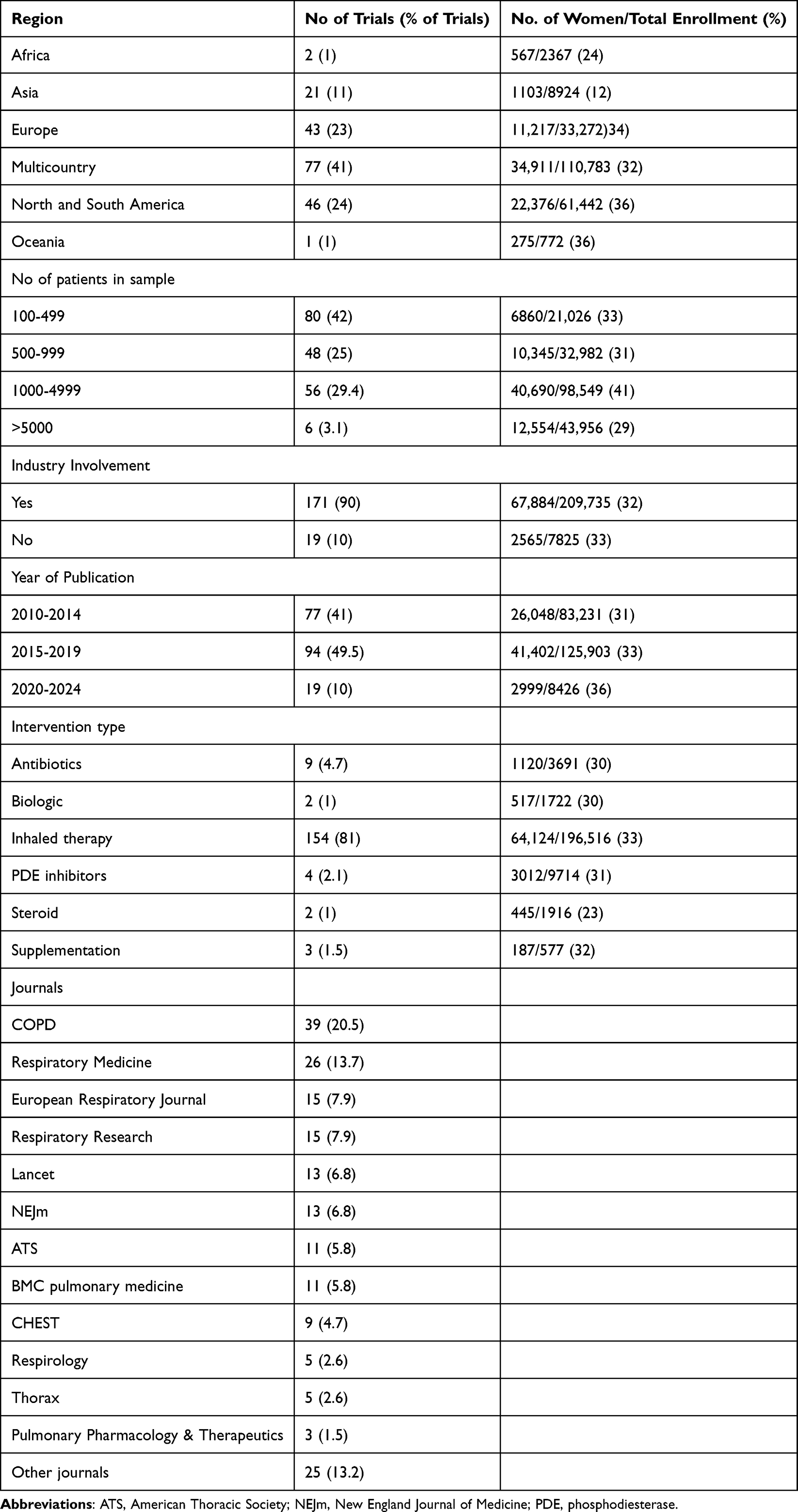 |
Table 1 Number of Randomized Clinical Trials and Enrollment of Women by Various Trial Characteristics (N = 190 Trials) |
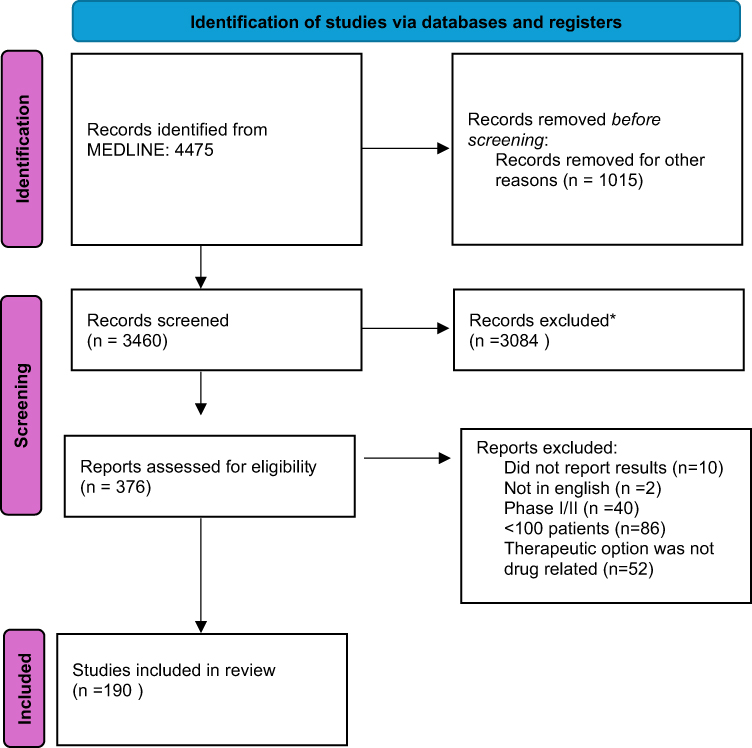 |
Figure 1 PRISMA Flow Diagram Showing the Number of Studies Excluded in Each Step of the Systematic Review Process.* Excluded based on title and abstracts. |
These articles were most frequently published in International Journal of Chronic Obstructive Pulmonary Disease (21%), Respiratory Medicine (14%), European Respiratory Journal (8%), and Respiratory Research (8%). About 41% of trials were conducted in multiple regions across the globe, and around 23% in both Europe and the Americas (North and South America). The most common interventions evaluated in the RCTs were inhaled therapy (including beta agonist, muscarinic antagonists, and inhaled steroids) (81.0%), antibiotics for exacerbation (5%), PDE inhibitors (2%), supplements (2%), biologic agents (1%), and non-inhaled steroids (1%). About 90% of the articles were sponsored by pharmaceutical industry. The majority of RCTs (49.5%) were conducted between 2015 and 2019.
Enrollment Disparity Difference
The random-effects pooled EDD across the 190 trials was −0.21 (95% CI, −0.19 to −0.22), indicating that women were underenrolled by an absolute difference of 21 percentage points relative to their representation in the underlying COPD populations (Figure 2). However, there was substantial variability across trials in women’s participation (I2, 100.0%).
 |
Figure 2 Forest Plot with the Random-Effects Pooled Enrollment Disparity Differences for All Trials and Trial Subgroups Pooled EDDs were calculated using random-effects meta-analysis within each subgroup. Negative values indicate underrepresentation of women relative to disease prevalence. Error bars represent 95% confidence intervals. Between-subgroup differences were assessed using a test for subgroup interaction. Abbreviations: CI, Confidence Interval; SE, Standard error. |
Results of the subgroup analyses are presented in Figure 2. The largest sex disparity was observed among trials conducted in the Asia region, which showed a large negative EDD value (summary EDD, −0.30 [95% CI, −0.36, −0.23]). In subgroup analyses stratified by age, the extent of underrepresentation of women (EDD) varied significantly across age groups (p = 0.0212). Studies enrolling older adults (>65 years) had the largest gender gap (EDD = –0.238 [95% CI −0.25 to −0.23), followed by those with middle-aged populations (51–65 years, EDD = –0.1958 [95% CI −0.20 to −0.19). Trials involving younger participants (≤50 years) demonstrated the smallest gap (EDD = –0.1167 [95% CI −0.15 to −0.08). Subgroup analysis of EDD based on industry involvement had almost the same results (EDD= −0.21). Based on the type of intervention, highest disparity was seen in trials testing supplements (EDD= −0.24 (95% CI −0.28 to −0.20). There were only three RCTs in 190 RCTs on supplements in COPD. Lowest disparity was seen in trials conducted on inhaled therapy and PDE inhibitors of about −0.18.
In univariable meta-regression analysis, region and age were associated with improved female representation. The American regions were associated with greater women’s representation, whereas increasing age was associated with lower women’s representation relative to prevalence. A univariable meta-regression model was used to assess temporal trends in female representation. While the difference across time periods was not statistically significant (p = 0.0725), there was a trend towards improved representation in more recent years (a decrease of 0.007 in the EDD per year [95% CI, 0.00 to 0.01 per year, p=0.02] Figure 3. Specifically, trials conducted between 2020 and 2024 showed a less pronounced gender gap than earlier periods, suggesting a possible shift toward more equitable enrollment, though this did not reach conventional levels of statistical significance. In a multivariable meta-regression analysis, trials from Americas had an adjusted mean EDD 0.19 units higher than those from Africa, controlling for other covariates. An improvement in disparity was also seen per year (0.01 [95% CI 0.004 to 0.016]) in the EDD after controlling for other covariates. With increasing mean age of the sample population, disparity grew deeper with an EDD of −0.006 per year of age [95% CI −0.0105 to −0.0023] after adjusting for region, trial size, therapy type, industry involvement, and year (Table 2).
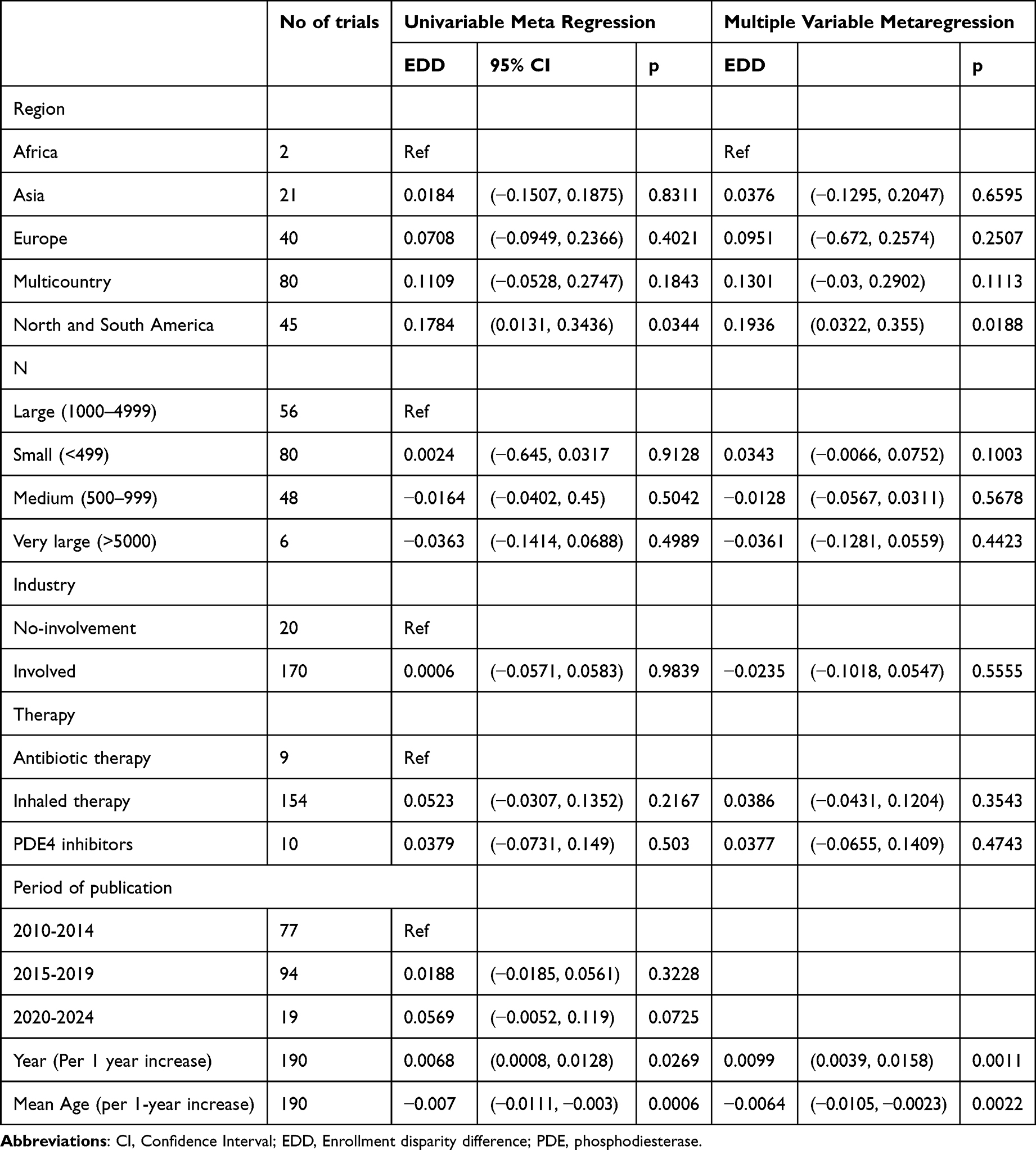 |
Table 2 Results of the Random-Effects Multivariable Metaregression Analysis of the Enrollment Disparity Difference from Trials Enrolling Patients with COPD (n=190) |
 |
Figure 3 Temporal Trend and Projected Female Representation in COPD trials (2010–2026) Blue points represent year-wise weighted enrollment disparity differences (EDD), calculated as the proportion of women enrolled in trials minus the proportion of women with COPD in the corresponding population based on Global Burden of Disease estimates. Negative values indicate underrepresentation of women. Orange points and the fitted line represent values estimated from a continuous-year random-effects meta-regression. Forward projections beyond the observed data are shown for illustrative purposes only and reflect statistical extrapolation rather than prediction of future enrollment patterns. Abbreviations: EDD, enrollment disparity difference. |
Discussion
This meta-analysis highlights significant and persistent gender disparities in COPD research, particularly in clinical trial enrollment and academic authorship. By comparing trial participant demographics with sex-specific prevalence data from the Global Burden of Disease (GBD) project, our findings underscore a notable misalignment between the populations most affected by COPD and those included in clinical research.14
Women remain substantially underrepresented in COPD trials, accounting for just 32.4% of enrolled participants despite evidence of rising COPD burden among women worldwide.15 The pooled enrollment disparity difference (EDD) of –0.21 reflects a 21-percentage-point shortfall in female representation relative to their disease prevalence. Another way of understanding is to say that 200 fewer women are enrolled per 1,000 trial participants. In previous trials of cardiovascular diseases and stroke, participation prevalence ratios ranging from 0.48 to 0.78 have been reported for women, equivalent to EDD of −0.1 to −0.3, and 0.05 for stroke respectively.13,16 In this context, our EDD for women representation is comparable to, or sometimes greater than other chronic diseases, highlighting the need for improved trial participation.
The observed heterogeneity was very high (I2 ≈ 100%), which is expected given the nature of the outcome and the structure of the included evidence base. Unlike treatment effects, enrollment disparity (EDD) reflects underlying demographic, epidemiologic, and structural differences across trials—such as regional variation in COPD prevalence, differences in recruitment practices, sample size, therapy class, and health-system context. Although subgroup and meta-regression analysis did not substantially address heterogeneity, EDD across subgroups like regions, age distributions, type of therapy, and publications years were consistently negative. This supports our hypothesis that female under-representation is indeed prevalent and not an outcome of flaw in our methodology.
The underrepresentation limits the generalizability of trial outcomes and may obscure clinically relevant sex-based differences in disease progression, treatment response, and adverse effects.3,17 Several factors are likely to contribute to this disparity. Historically, COPD has been viewed as a male-predominant condition, largely due to its association with occupational exposures and smoking behaviors more common among men in earlier decades.3,9 Although smoking patterns have shifted and indoor air pollution continues to affect women in many regions disproportionately, these evolving risk profiles have not been adequately reflected in clinical trial recruitment strategies.
Social and cultural dynamics further compound these issues. Regional variation emerged as one of the strongest sources of heterogeneity in female enrollment across trials. These realities were reflected in our subgroup analysis, which showed the largest enrollment disparity in Asian trials (EDD = –0.30), while American studies demonstrated comparatively higher female representation. In many Asian settings, restrictive gender norms, limited autonomy, and disproportionate caregiving responsibilities often hinder women’s ability to participate in research.18 These sociocultural factors likely contribute to the particularly large enrollment disparities observed in Asian trials, beyond what can be explained by trial design alone. Differences in regulatory oversight and policy enforcement, such as initiatives by the US National Institutes of Health to promote equitable research inclusion, may also contribute to these regional patterns.19
Beyond regional variation, our subgroup analyses revealed additional patterns that further clarify the drivers of sex disparities in COPD trial enrollment. Studies enrolling older populations (>65 years) exhibited substantially greater underrepresentation of women compared with trials including younger cohorts, consistent with the demographic reality that older women carry a disproportionate COPD burden. Industry funding did not significantly influence EDD, and temporal meta-regression demonstrated modest improvement in female representation in more recent years. Collectively, these results indicate that sex imbalance in COPD research is shaped by multiple intersecting demographic, regional, and structural factors rather than any single study-level characteristic.
Older women are particularly vulnerable to exclusion from COPD trials, as individuals over 75 frequently face age-related eligibility limits, mobility constraints, and higher comorbidity burdens. These practical and clinical barriers disproportionately affect women, who make up a larger share of the elderly COPD population and may encounter additional caregiving and logistical challenges that impede research participation.20
Most trials in our meta-analysis were industry-funded (89%), as expected, given that pharmacologic COPD trials represent the domain in which industry funding is most common, whereas non-pharmacologic interventions such as pulmonary rehabilitation or oxygen therapy are typically funded through public, academic, or health-system sources. Sponsorship did not reveal a statistically significant association with women’s enrollment (Figure 2). This indicates that the observed disparities are not confined to specific funding models or investigator demographics but are instead widespread across the COPD research landscape.
Across the 15-year study period, we observed a gradual improvement in the representation of women in COPD pharmacotherapy trials. Year-wise weighted EDD values demonstrated a steady upward trend, indicating that underrepresentation has become progressively less pronounced over time. This pattern aligns with the significant positive slope in our continuous meta-regression, which showed that EDD improves by approximately 0.006–0.007 per year. Although the magnitude of improvement is modest, the directionality suggests increased attention to equitable enrollment and possibly the early impact of policies such as NIH’s Sex as a Biological Variable (SABV) guidance19 and the growing emphasis on sex-balanced recruitment in regulatory and scientific communities.
Extending the regression line to forecast future years further illustrates this trajectory: provided no major changes in trial design or recruitment practice occurs, the enrollment gap is expected to narrow incrementally through 2026 and beyond. These projections are merely statistical extrapolation and should not be interpreted as predictive, however they do reinforce the central finding that progress is occurring, though still falling short of full parity. The purpose of this exercise is not to predict the disparity in any given year but to highlight that improvement in representation relies on appropriate changes in recruitment practices and trial design.
The clinical relevance of these disparities is strongly supported by prior literature demonstrating clear sex-related differences in COPD. Women with COPD exhibit distinct symptom profiles, including significantly higher odds of severe dyspnea compared with men, even at similar levels of airflow limitation.5 Exacerbation patterns also show meaningful sex-related differences: women often present with more impaired gas exchange at hospitalization despite higher FEV1 and FVC values, suggesting a disproportionate physiologic burden.20 Several post-hoc analyses of large COPD trials, including EUROSCOP, LHS, TORCH, and FLAME, have demonstrated sex-specific differences in response to inhaled therapies, bronchodilator responsiveness, and exacerbation reduction.21 Emerging evidence also points to sex-related pharmacokinetic and pharmacodynamic differences that may affect inhaled medication handling or response.22 Collectively, these findings underscore the importance of equitable female representation to ensure that trial results are generalizable and clinically relevant.
Another contributor to sex imbalance in COPD evidence is the predominance of emphysema-focused trial designs. Pharmacologic COPD trials frequently rely on FEV1-driven inclusion criteria or recruit populations with greater emphysema burden—features more common in men. In contrast, women more often present with airway-predominant COPD characterized by higher symptom burden and exacerbation frequency but less radiographic emphysema.5 As a result, women with airway-dominant disease may be less likely to meet entry thresholds, and trial outcomes may overestimate treatment effects in emphysema while underrepresenting benefits relevant to airway-driven disease. Incorporating endpoints that capture symptoms, exacerbation patterns, and patient-reported outcomes would help ensure that results are applicable to both phenotypes and improve the relevance of trial findings for women.
Ongoing efforts to improve sex equity in research may be taking hold, but sustained attention and structural reforms remain essential. Policies from major funding and regulatory agencies underscore this need: the US National Institutes of Health requires investigators to consider sex as a biological variable (SABV) in study design and analysis,19 and the US Food and Drug Administration has issued guidance encouraging sex-balanced recruitment to ensure trial populations reflect those affected by disease.23 Evidence-based strategies have shown promise in improving women’s participation, like in the trial done for weight loss by Crane et al.24 Targeted community recruitment has been associated with higher female enrollment across multiple chronic disease trials, and sex-disaggregated reporting has been shown to enhance the generalizability and applicability of findings to both men and women.24 Practical accommodations can also meaningfully improve participation: studies involving caregiver-aged women show that flexible scheduling, transportation assistance, and decentralized or hybrid study visits significantly improve recruitment and retention.25 Given that women with COPD tend to be older and have higher burdens of comorbidities such as anxiety, depression, osteoporosis, and autoimmune disease, expanding eligibility criteria and minimizing exclusions based on common age-related conditions may prevent inadvertent underrepresentation. Promoting women’s leadership in study design and authorship may further ensure that recruitment methods and outcome measures better reflect the needs of the full COPD population.
These findings have important implications for clinical practice and policy. Without adequate female representation in COPD trials, treatment guidelines may be less applicable to women, potentially compromising care quality and outcomes. Sex-specific differences in pharmacokinetics, symptom burden, and disease progression highlight the need for data that reflects real-world patient diversity.3 Addressing gender disparities in research is therefore essential not only for fairness but for ensuring effective and personalized care for all individuals living with COPD.
Limitations
Our study has limitations. Considerable between-study heterogeneity persisted (I2 ≈ 100%) despite extensive subgroup analyses, suggesting the presence of unmeasured structural differences across trials. We relied on published trial-level data, limiting adjustment for key participant-level confounders and restricting our ability to characterize sex-specific screening or exclusion patterns. EDD is calculated from baseline characteristics, and while universally reported, does not capture differential eligibility or referral pathways. COPD prevalence estimates used as comparators may not fully represent populations enrolled in individual trials. Finally, broad intervention categories and incomplete reporting of disease phenotypes or severity may limit the specificity of subgroup interpretations.
Conclusion
Women remain substantially underrepresented in COPD clinical trials despite a rising global disease burden and clear sex-based differences in COPD presentation and outcomes. This persistent enrollment disparity—approximately 21 percentage points below disease prevalence—undermines the generalizability of trial findings and may limit the applicability of current treatment recommendations for women. Achieving equitable representation will require intentional changes in trial design, recruitment strategies, and reporting standards. Ensuring that COPD evidence reflects the full diversity of affected populations is essential for delivering effective, inclusive, and precision-based care.
Author Contributions
All authors made a significant contribution to the work reported, whether that is in the conception, study design, execution, acquisition of data, analysis and interpretation, or in all these areas; took part in drafting, revising or critically reviewing the article; gave final approval of the version to be published; have agreed on the journal to which the article has been submitted; and agree to be accountable for all aspects of the work.
Disclosure
The authors report no conflicts of interest in this work.
References
1. Gut-Gobert C, Cavaillès A, Dixmier A, et al. Women and COPD: do we need more evidence? Eur Respir Rev. 2019;28(151):180055. doi:10.1183/16000617.0055-2018
2. Steinberg AW, Ozga JE, Tang Z, Stanton CA, Sargent JD, Paulin LM. Gender, tobacco and chronic obstructive pulmonary disease: analysis of the 2020 national health interview survey. BMJ Open Respir Res. 2025;12(1):e002462. doi:10.1136/bmjresp-2024-002462
3. Aryal S, Diaz-Guzman E, Mannino DM. Influence of sex on chronic obstructive pulmonary disease risk and treatment outcomes. Int J Chron Obstruct Pulmon Dis. 2014;9:1145–12. doi:10.2147/COPD.S54476
4. Lisspers K, Larsson K, Janson C, et al. Gender differences among Swedish COPD patients: results from the Arctic, a real-world retrospective cohort study. NPJ Prim Care Respir Med. 2019;29(1):45. doi:10.1038/s41533-019-0157-3
5. Milne KM, Mitchell RA, Ferguson ON, Hind AS, Guenette JA. Sex-differences in COPD: from biological mechanisms to therapeutic considerations. Front Med Lausanne. 2024;11:1289259. doi:10.3389/fmed.2024.1289259
6. Bade BC, DeRycke EC, Ramsey C, et al. Sex differences in veterans admitted to the hospital for chronic obstructive pulmonary disease exacerbation. Ann Am Thorac Soc. 2019;16(6):707–714. doi:10.1513/AnnalsATS.201809-615OC
7. Han MK, Postma D, Mannino DM, et al. Gender and chronic obstructive pulmonary disease: why it matters. Am J Respir Crit Care Med. 2007;176(12):1179–1184. doi:10.1164/rccm.200704-553CC
8. Roberts NJ, Patel IS, Partridge MR. The diagnosis of COPD in primary care; gender differences and the role of spirometry. Respir Med. 2016;111:60–63. doi:10.1016/j.rmed.2015.12.008
9. Barnes PJ. Sex differences in chronic obstructive pulmonary disease mechanisms. Am J Respir Crit Care Med. 2016;193(8):813–814. doi:10.1164/rccm.201512-2379ED
10. Sex DDL. Gender, and COPD. Annu Rev Physiol. 2025;87(1):471–490. doi:10.1146/annurev-physiol-042022-014322
11. Umer M, Jagra A, Touza M, et al. Underrepresentation of women in COPD trials: examining participation trends and first-author leadership. Chest. 2025;168(4):A5723–A5724. doi:10.1016/j.chest.2025.07.3204
12. Page MJ, McKenzie JE, Bossuyt PM, et al. The PRISMA 2020 statement: an updated guideline for reporting systematic reviews. BMJ. 2021;372:n71. doi:10.1136/bmj.n71
13. Strong B, Pudar J, Thrift AG, et al. Sex disparities in enrollment in recent randomized clinical trials of acute stroke: a meta-analysis. JAMA neurol. 2021;78(6):666–677. doi:10.1001/jamaneurol.2021.0873
14. Collaborators GBDM. Global, regional, and national age-sex-specific mortality and life expectancy, 1950-2017: a systematic analysis for the global burden of disease study 2017. Lancet. 2018;392(10159):1684–1735.
15. Agusti A, Celli BR, Criner GJ, et al. Global initiative for chronic obstructive lung disease 2023 Report: GOLD executive summary. Am J Respir Crit Care Med. 2023;207(7):819–837. doi:10.1164/rccm.202301-0106PP
16. Jin X, Chandramouli C, Allocco B, Gong E, Lam CSP, Yan LL. Women’s participation in cardiovascular clinical trials from 2010 to 2017. Circulation. 2020;141(7):540–548. doi:10.1161/CIRCULATIONAHA.119.043594
17. Zhang H, Wu F, Yi H, et al. Gender differences in chronic obstructive pulmonary disease symptom clusters. Int J Chron Obstruct Pulmon Dis. 2021;16:1101–1107. doi:10.2147/COPD.S302877
18. Lee GE, Ow M, Lie D, Dent R. Barriers and facilitators for clinical trial participation among diverse Asian patients with breast cancer: a qualitative study. BMC Women’s Health. 2016;16(1):43. doi:10.1186/s12905-016-0319-1
19. National Institutes of Health (NIH). Consideration of sex as a biological variable in NIH-funded research. NOT–OD–15–102. 2015. Available from: https://grants.nih.gov/grants/guide/notice-files/NOT-OD-15-102.html.
20. Forsat ND, Palmowski A, Palmowski Y, Boers M, Buttgereit F. Recruitment and retention of older people in clinical research: a systematic literature review. J Am Geriatr Soc. 2020;68(12):2955–2963. doi:10.1111/jgs.16875
21. Rogliani P, Cavalli F, Ritondo BL, Calzetta L, Matera MG, Cazzola M. Sex differences in adult asthma and COPD therapy: a systematic review. Respir Res. 2022;23:222. doi:10.1186/s12931-022-02140-4
22. Soldin OP, Mattison DR. Sex differences in pharmacokinetics and pharmacodynamics. Clin Pharmacokinet. 2009;48(3):143–157. PMID: 19385708; PMCID: PMC3644551. doi:10.2165/00003088-200948030-00001
23. EFOR-GROUP. FDA’s 2025 regulatory shift: integrating sex-specific data across the medical device lifecycle. EFOR-Group. 2025. Available from: https://efor-group.com/en/fda-2025-regulatory-shift-integrating-sex-specific-data-medical-devices-lifecycle.
24. Crane MM, Seburg EM, Levy RL, Jeffery RW, Sherwood NE. Using targeting to recruit men and women of color into a behavioral weight loss trial. Trials. 2020;21:537. PMID: 32546253; PMCID: PMC7298816. doi:10.1186/s13063-020-04500-1
25. Pringle S, Ko EM, Doherty M, Smith AJB. Addressing transportation barriers in oncology: existing programs and new solutions. Support Care Cancer. 2024;32(5):317. PMID: 38684580; PMCID: PMC11058971. doi:10.1007/s00520-024-08514-2
 © 2026 The Author(s). This work is published and licensed by Dove Medical Press Limited. The
full terms of this license are available at https://www.dovepress.com/terms
and incorporate the Creative Commons Attribution
- Non Commercial (unported, 4.0) License.
By accessing the work you hereby accept the Terms. Non-commercial uses of the work are permitted
without any further permission from Dove Medical Press Limited, provided the work is properly
attributed. For permission for commercial use of this work, please see paragraphs 4.2 and 5 of our Terms.
© 2026 The Author(s). This work is published and licensed by Dove Medical Press Limited. The
full terms of this license are available at https://www.dovepress.com/terms
and incorporate the Creative Commons Attribution
- Non Commercial (unported, 4.0) License.
By accessing the work you hereby accept the Terms. Non-commercial uses of the work are permitted
without any further permission from Dove Medical Press Limited, provided the work is properly
attributed. For permission for commercial use of this work, please see paragraphs 4.2 and 5 of our Terms.