
Back to Journals » Breast Cancer: Targets and Therapy » Volume 17
Triple-Negative Breast Cancer on the Rise: Breakthroughs and Beyond [Response to Letter]
Authors Agelidis A, Ter-Zakarian A, Jaloudi M
Received 9 September 2025
Accepted for publication 12 September 2025
Published 29 September 2025 Volume 2025:17 Pages 877—881
Alex Agelidis,1,2 Anna Ter-Zakarian,1 Mohammed Jaloudi1
1Scripps Cancer Center, Scripps Health, La Jolla, California, USA; 2Scripps Translational Research Institute, Scripps Research, La Jolla, California, USA
Correspondence: Mohammed Jaloudi, Email [email protected]
View the original paper by Dr Agelidis and colleagues
This is in response to the Letter to the Editor
Dear editor
We appreciate the thoughtful commentary provided by Drs. Lonning, Nikolaienko and Knappskog in response to our article published in June 2025.
The correspondents bring forth several interesting points regarding molecular characterization of hormone receptor-positive (HR+) and hormone receptor-negative (HR-) breast cancers. In our view, these statements and the associated references in their letter (refs. 8–19) do not specifically address the question of TNBC epidemiology among younger patients and are beyond the scope of our article. It should be noted that several of the references cited are authored by the correspondents and while these studies aim to better define the molecular pathogenesis of breast cancer subtypes, they are beyond the scope of this work and the disputed claim.
To address and clarify the concern brought forth by Drs. Lonning, Nikolaienko and Knappskog, we independently consulted the most recently available information from the National Cancer Institute (NCI) Surveillance, Epidemiology, and End Results (SEER) database, which is a trusted resource for detailed statistics about various cancers and subgroupings by age, gender, ethnicity and histology.1 These results summarized below show a statistically significant increase in incidence of TNBC during the years 2016–2022 among women in age groups 15–39 and below 50 (Figure 1). Likewise, the increased incidence of TNBC during this time period is apparent among women aged 50–64 and above 65 (Figure 2). Finally, while HR+/HER2- breast cancers account for the majority of the increased incidence in total breast cancer cases among females below age 50, as previously reported, recent data show a significant increase in TNBC incidence in this younger group (Figure 3).
 |
Figure 1 SEER 21 delay-adjusted incidence rates of HR-/HER2- breast cancer among females aged 15–39 and <50. |
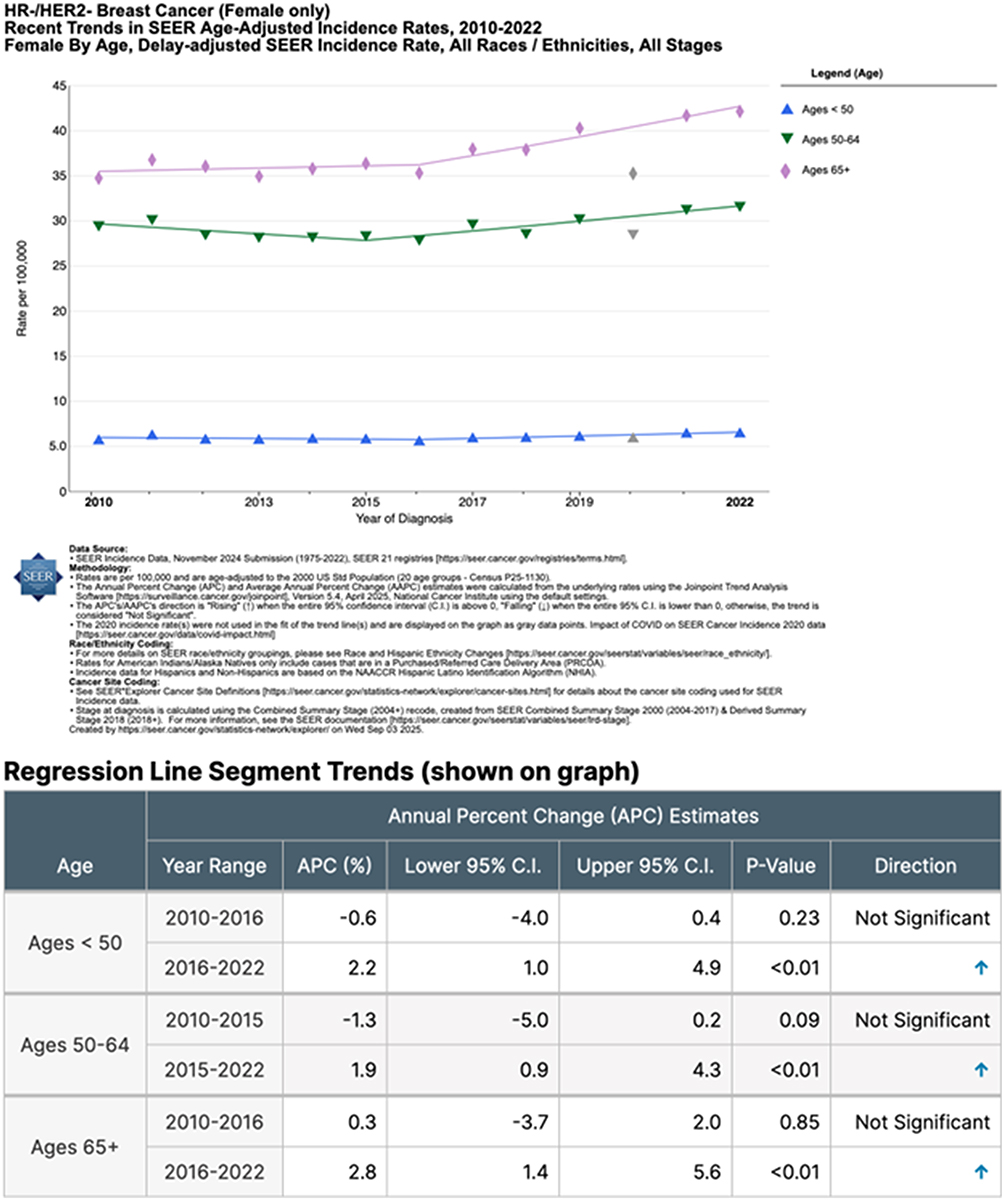 |
Figure 2 SEER 21 delay-adjusted incidence rates of HR-/HER2- breast cancer among females aged <50, 50–64 and 65+. |
 |
Figure 3 SEER 21 observed incidence rate by breast cancer subtype in females below age 50. (Delay-adjusted rate currently unavailable for this grouping on SEER database). |
Disclosure
The authors report no conflicts of interest in this communication.
Reference
1. SEER*Explorer: An interactive website for SEER cancer statistics [Internet]. Surveillance research program, National Cancer Institute; 2025. Data source(s): SEER Incidence Data, November 2024 Submission (1975-2022), SEER 21 registries.[cited September 3, 2025]. Available from: https://seer.cancer.gov/statistics-network/explorer/.
 © 2025 The Author(s). This work is published and licensed by Dove Medical Press Limited. The
full terms of this license are available at https://www.dovepress.com/terms
and incorporate the Creative Commons Attribution
- Non Commercial (unported, 4.0) License.
By accessing the work you hereby accept the Terms. Non-commercial uses of the work are permitted
without any further permission from Dove Medical Press Limited, provided the work is properly
attributed. For permission for commercial use of this work, please see paragraphs 4.2 and 5 of our Terms.
© 2025 The Author(s). This work is published and licensed by Dove Medical Press Limited. The
full terms of this license are available at https://www.dovepress.com/terms
and incorporate the Creative Commons Attribution
- Non Commercial (unported, 4.0) License.
By accessing the work you hereby accept the Terms. Non-commercial uses of the work are permitted
without any further permission from Dove Medical Press Limited, provided the work is properly
attributed. For permission for commercial use of this work, please see paragraphs 4.2 and 5 of our Terms.