
Back to Journals » Clinical Ophthalmology » Volume 20
Translation and Preliminary Psychometric Evaluation of the Arabic 5-Item Dry Eye Questionnaire: A Reliability Study in Healthy Young Adults
Authors Al Farhan H  , Aldawasri SA, Al Salloum AM, Anazi NS, Alarify H, Al-Otaibi WM
Received 27 December 2025
Accepted for publication 4 May 2026
Published 13 May 2026 Volume 2026:20 589060
DOI https://doi.org/10.2147/OPTH.S589060
Checked for plagiarism Yes
Review by Single anonymous peer review
Peer reviewer comments 2
Editor who approved publication: Dr Sotiria Palioura
Haya Al Farhan, Sarah A Aldawasri, Abrar M Al Salloum, Naeema S Anazi, Hani Alarify, Wafa Majed Al-Otaibi
Optometry Department, College of Applied Medical Sciences, King Saud University, Riyadh, Saudi Arabia
Correspondence: Haya Al Farhan, Optometry Department, College of Applied Medical Sciences, King Saud University, Riyadh, Saudi Arabia, Tel +96652103321, Email [email protected]
Purpose: To translate the 5-Item Dry Eye Questionnaire (DEQ-5) into Arabic and conduct a preliminary psychometric evaluation of its reliability and internal consistency for DED symptom screening in Arabic-speaking populations.
Methods: Two native Arabic translators initially translated the DEQ-5 from English into Arabic. An interdisciplinary committee developed a unified consensus version, subsequently back-translated by two native English speakers. The finalized questionnaire was administered to 60 healthy Arabic-speaking volunteers (aged 18– 40 years) by two independent observers at two sessions spaced 2– 5 days apart, enabling assessment of test–retest stability under standardized, blinded administration conditions.
Results: The participants had an average age of 21.6 ± 3.9 years, with 45% male and 55% female. Total DEQ-5 scores averaged 9.0 ± 5.2 (range: 0– 19); 73.3% scored above the > 6 clinical threshold. Test–retest reliability was good-to-excellent at the scale level (ICC = 0.887; 95% CI: 0.819– 0.931; P < 0.001). At the item level, Spearman ρ ranged from 0.679 to 0.861, all P < 0.001, and quadratic weighted κw from 0.650 to 0.853. Internal consistency was good (Cronbach’s α = 0.878). Floor (10%) and ceiling effects (1.7%) were within acceptable psychometric limits.
Conclusion: The Arabic DEQ-5 demonstrates strong preliminary reliability and good internal consistency, supporting its application as a psychometrically evaluated screening instrument for DED symptom identification in Arabic-speaking populations. These findings provide a foundation for standardized symptom screening, cross-cultural epidemiological comparisons, and future validation studies in Arabic-speaking communities. The infographic details the translation and preliminary psychometric evaluation of the Arabic DEQ-5. The process includes seven steps: 1. Source from DEQ-5 (English), 2. Forward translation by two Arabic translators, 3. Expert committee with eight specialists, 4. Back-translation by a native English speaker, 5. Cognitive debrief with ten readers, 6. Field test with two observers over two sessions and 7. Validation for clinical use of the Arabic DEQ-5. The study cohort consists of 60 Arabic-speaking adults aged 18 to 40 years, with two observers conducting two sessions 2 to 5 days apart. The results show an ICC test-retest reliability of 0.887 with a 95 percent confidence interval of 0.819 to 0.931, an internal consistency of 0.878 across the five DEQ-5 items and 73.3 percent symptomatic dry eye with a score greater than 6 as the clinical cut-off.Infographic on Arabic DEQ-5 translation and psychometric evaluation process and results.
Keywords: dry eye disease, DEQ-5, Arabic translation, preliminary psychometric evaluation, questionnaire, psychometric properties
Introduction
Dry eye disease (DED) is a multifactorial, symptomatic disease characterized by loss of homeostasis in the tear film and/or ocular surface; tear film instability and hyperosmolarity, ocular surface inflammation and damage, and neurosensory abnormalities are etiological factors.1 Global DED prevalence is estimated at 34.6% (95% CI: 30.2–39.4%), with significant regional disparities.2 In Saudi Arabia, DED symptom prevalence ranges from 32.1 to 75.9% across single-city studies,3,4 being driven by the arid climate, low ambient humidity, high ambient temperatures, and rapidly escalating digital device use.4,5 This high regional prevalence, compounded by environmental determinants unique to the Arabian Peninsula urgently requires a validated, rapid screening tool enabling systematic DED identification within Arabian routine practice.
Despite its regional burden, DED remains underdiagnosed in Arabic-speaking populations. Validated Arabic versions of the 12-item Ocular Surface Disease Index (OSDI)6,7 are limited in high-throughput clinical environments by its ~5-min completion time8 and multi-item structure. The 5-Item Dry Eye Questionnaire (DEQ-5) addresses this gap by a five-item format, formally recommended by TFOS DEWS II9 for DED symptom screening, with demonstrated suitability for serial symptom monitoring and epidemiological research.9,10 These five items assess symptom frequency and end-of-day intensity across ocular discomfort, dryness, and watery eyes (total score 0–22), with a screening cut-off >6 for DED10 and a score >12 prompting evaluation to exclude Sjögren syndrome.10 Its reduced item burden enables rapid, standardized symptom capture in high-volume clinical settings without sacrificing discriminative capacity across DED severity levels,10 yet no validated Arabic version existed prior to this study — a critical gap across a region of over 400 million Arabic speakers11 where environmental risk factors compound an already high DED burden.4,5 Both TFOS DEWS II9 and the 2025 TFOS DEWS III1 Diagnostic Methodology report1 consider standardized symptom questionnaires essential for DED diagnosis; the latter report replaced the DEWS II9 dual-instrument recommendation by the OSDI-6, while acknowledging that other questionnaires, including the DEQ-5, could help understand environmental risk factors for the disease.1 Validated adaptations into Portuguese12 and Mexican Spanish13 confirm the DEQ-5’s cross-cultural applicability.14,15
Cross-cultural validation is not equivalent to translation: it requires psychometric demonstration that the adapted instrument preserves reliability, internal consistency, and measurement stability in the target population.15–19 The Arabic adaptation presents unique challenges: morphological complexity, diglossia between Modern Standard Arabic and regional spoken varieties, and right-to-left script directionality, all affecting item comprehension and response consistency.16,17
To the best of our knowledge, this is the first preliminary psychometric evaluation of the DEQ-5 for Arabic-speaking populations. This study aimed to produce a culturally appropriate Arabic DEQ-5 and to assess its reliability, internal consistency, and test-retest stability as a standardized DED screening tool across Arabic-speaking clinical and research settings, establishing the evidence base for future criterion validity studies incorporating objective clinical dry eye measures.
Materials and Methods
This observational, cross-sectional study was conducted from August 2023 to May 2024, following established cross-cultural adaptation guidelines.18 The interdisciplinary committee (IC), comprising eight native Arabic-speaking cornea and ocular surface specialists proficient in English, oversaw all stages. Two native Arabic-speaking professional translators independently translated the English DEQ-5 (Supplementary Figure 1) into Arabic. Disagreements were resolved through structured IC discussion in which each member evaluated all four Beaton equivalence domains (semantic, idiomatic, experiential, and conceptual) relative to the original; final wording decisions were reached by expert consensus, with the original English DEQ-5 as reference standard throughout.18 A native English-speaking translator, unacquainted with the original, then performed back-translation. The questionnaire was proofread twice by the IC and once by a native Arabic-speaking translator. The IC confirmed close conceptual alignment with the original, with no major differences. Following IC approval, a cognitive debriefing check was conducted in 10 Arabic-speaking individuals (not involved in the study), consistent with cross-cultural adaptation guidelines recommending 5–10 participants for this step.19 Participants completed the questionnaire and were asked to paraphrase each item and indicate whether the wording was clear and comprehensible; all items were considered clear by all participants; no wording refinements were required,18,19 (Figure 1).
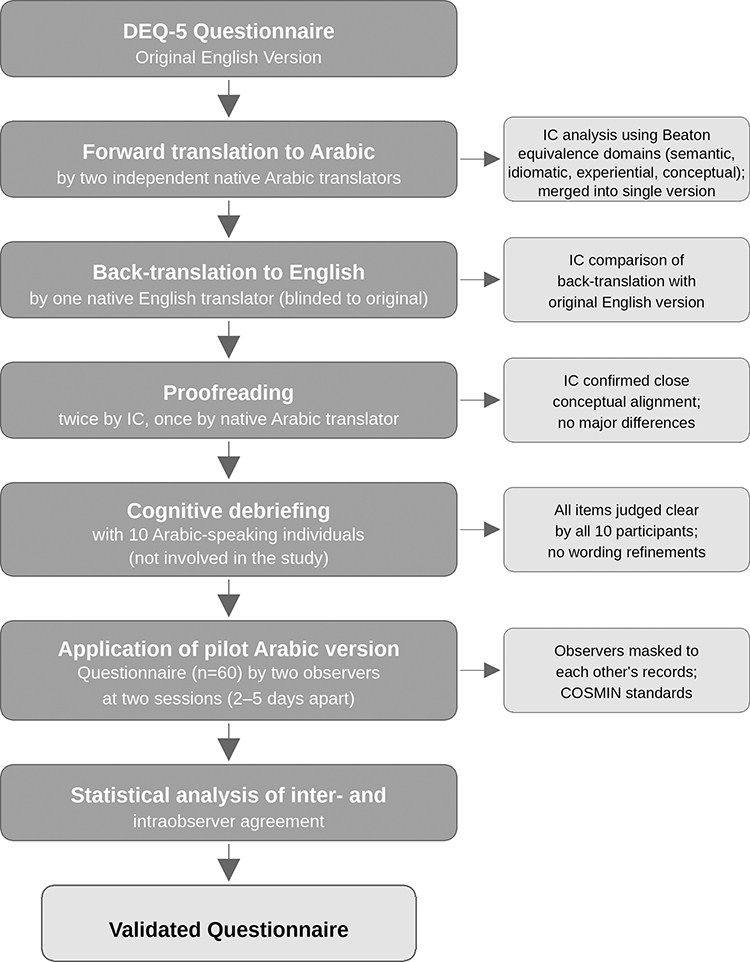 |
Figure 1 Flowchart of the DEQ-5 translation study design showing the forward translation, committee review, back-translation, comprehension check, and final validation phases. |
Before questionnaire administration, an objective refraction test was performed using a Topcon KR-800 autorefractor (Topcon Corporation, Tokyo, Japan). Refractive error was assessed as part of participant characterization and to verify compliance with the ocular exclusion criteria, but not in relation to DEQ-5 scores. The Arabic DEQ-5 was administered by two independent observers at two sessions spaced 2–5 days apart, a test-retest interval selected to minimize recall bias while ensuring that no clinically meaningful symptom change would be expected.18,19 To satisfy the requirement of clinical stability between sessions,20 participants verbally confirmed before the second session that they had experienced no changes in ocular symptoms, medications, or acute illness since the first visit; no exclusions were required on this basis. Participants completed the questionnaire independently. Observers were limited to standardized administration conditions only — providing verbal instructions before starting, maintaining a quiet environment, and independently collecting sealed completed forms — without any involvement in scoring or interpreting responses. Observer 1 administered tests on Session 1 and Observer 2 on Session 2, standardized across participants; observers were fully masked to each other’s records throughout, ensuring independence of administrations as per COSMIN reliability standards.19,21 The study group comprised fellows, staff, and students from the university, all of whom provided written informed consent with the right to withdraw.
The DEQ-5 consists of five questions: two measure ocular discomfort, two evaluate dryness, and one assesses tearing. Questions Q1A (discomfort frequency), Q2A (dryness frequency), and Q3 (watery eyes frequency) ask participants to rate, during a typical day in the past month, how often they experienced each symptom, using five response options scored 0–4: Never (0), Rarely (1), Sometimes (2), Frequently (3), and Constantly (4). Questions Q1B and Q2B assess the end-of-day intensity of discomfort and dryness respectively, asking how intense each symptom was within two hours of going to bed, using a 0–5 scale, where 0 = never have it, 1 = not at all intense, and 5 = very intense. The maximum total DEQ-5 score is 22, with scores categorized as ≤6 (non-dry eye) and >6 (dry eye). The questionnaire was printed on a single page in Arial, size 12, with 1.5 line spacing, replicating the original DEQ-5 presentation format.10
Sixty participants were recruited based on published guidelines recommending 30–40 participants for initial questionnaire field testing.18 This sample satisfies the psychometric 10:1 subject-to-item ratio (5 items × 10 = 50 minimum; achieved ratio 12:1),22 and provides 80% power to detect Spearman ρ ≥ 0.40 at α = 0.05.21 Participants were healthy, native Arabic speakers aged 18–40 years; restriction to a healthy cohort was a deliberate methodological choice to reduce confounding from pre-existing ocular surface conditions, systemic medications, and age-related tear film changes, thereby ensuring that observed psychometric properties reflect the instrument rather than the clinical characteristics of the population.18,19 Exclusion criteria included contact lens use, history of systemic medication or ocular diseases, refractive surgery, and eyelid conditions affecting the ocular surface. The study was approved by the Institutional Review Board Sub-Committee, Health Sciences Colleges Research on Human Subjects, King Saud University (approval number: E-23-7931) and followed the Declaration of Helsinki. All participants provided written informed consent.
Statistical Analysis
Floor and ceiling effects were examined, with values exceeding 15% flagged as indicative of limited discriminative ability.20 Internal consistency was assessed using Cronbach’s alpha (α ≥ 0.70 acceptable; α ≥ 0.80 good; ≥ 0.90 excellent)23 for all five items collectively, with alpha-if-item-deleted statistics computed for each item to confirm individual item contribution to scale coherence.23 Test-retest reliability was evaluated at the scale level using the intraclass correlation coefficient (ICC; two-way mixed-effects model, absolute agreement, single measures)24,25 with the following interpretation benchmarks:25 poor, <0.50; moderate, 0.50–0.75; good, 0.75–0.90; and excellent, >0.90, and at the item level using Spearman ρ and quadratic weighted kappa (κw), the appropriate statistic for ordinal scales,26 with 95% bootstrap confidence intervals for both (κw: almost perfect 0.81–1.00, substantial 0.61–0.80, moderate 0.41–0.60, fair 0.21–0.40, slight ≤ 0.20).27 Clinical utility was assessed using a DEQ-5 threshold of >6.10 Statistical significance was set at P < 0.05; all analyses used SPSS v29.0 (IBM Corporation, Armonk, NY, USA.
Results
Sixty participants aged 18–40 years were included, with a mean age of 21.6 ± 3.9 years. The sample comprised 27 men (45%) and 33 women (55%), reflecting a balanced sex distribution. Refractive error assessments confirmed mild myopia, with mean spherical equivalents of −0.82 ± 1.21 D (OD) and −0.67 ± 1.48 D (OS), consistent with the ocular inclusion criteria. Participant demographics are presented in Table 1.
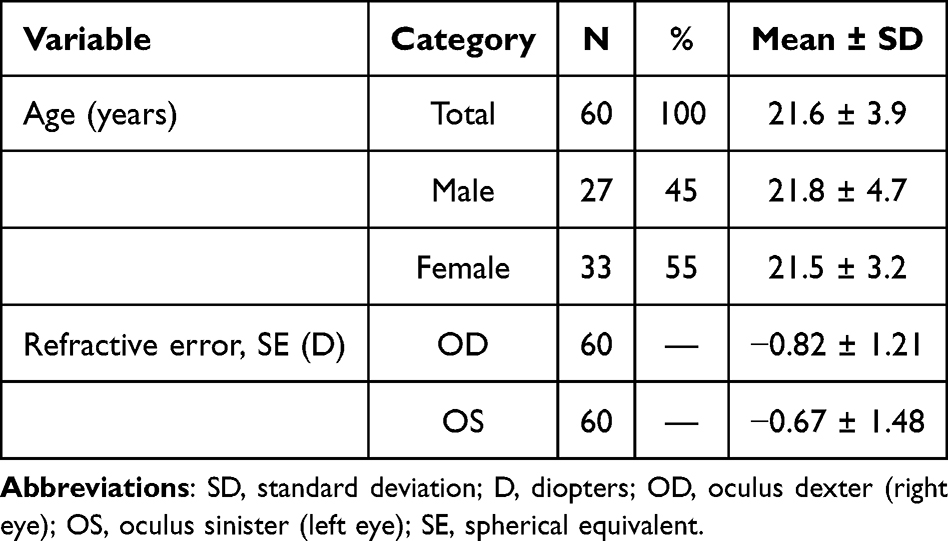 |
Table 1 Participants’ Demographic Data |
The detailed analysis of the Arabic DEQ-5 item scores uncovered clear distribution patterns across different symptom categories. The average scores ranged from 1.47 ± 1.13 for Q3 (Watery Eyes Frequency) to 1.98 ± 1.14 for Q2A (Dryness Frequency), with the overall DEQ-5 scores averaging 9.03 ± 5.22 (range: 0–19). The distribution of individual items showed varying features: discomfort and dryness frequency items (Q1A, Q2A) exhibited nearly symmetric patterns (skewness: −0.08 to −0.04), whereas end-of-day intensity items (Q1B, Q2B) displayed right-skewed distributions (skewness: 0.50 to 0.60); the watery eyes frequency item (Q3) also exhibited a right-skewed distribution, as shown in Figure 2.
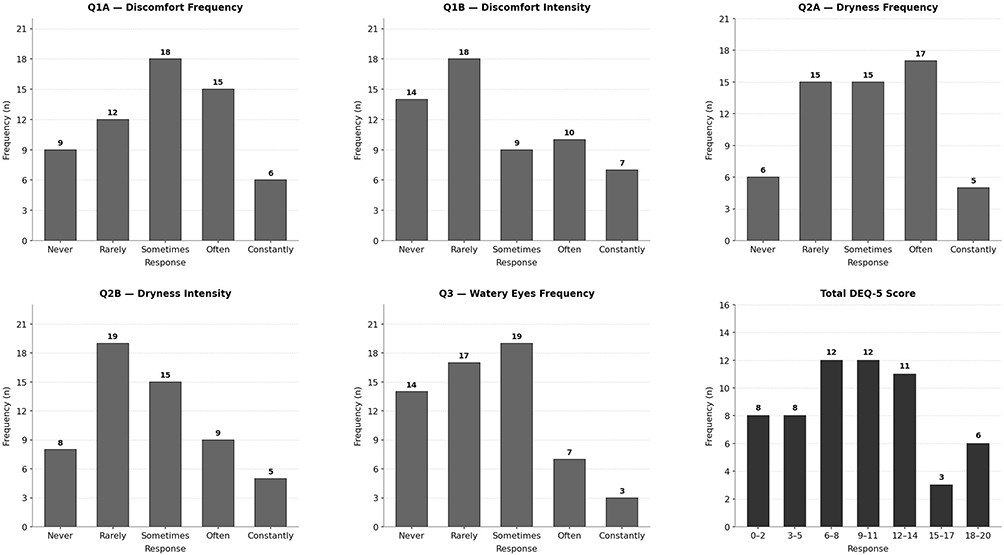 |
Figure 2 Histograms showing the score distributions for each DEQ-5 item in the Arabic version. Q1A (discomfort frequency), Q1B (discomfort intensity), Q2A (dryness frequency), Q2B (dryness intensity), Q3 (watery eyes frequency). Bin width = 1 response unit throughout to enable fair visual comparison across items. |
The analysis revealed generally good psychometric properties, with 10% of participants scoring 0 (floor effect) and 1.7% reaching the maximum score (ceiling effect), both within acceptable psychometric limits. Importantly, 76.7% of subjects scored between 3 and 17, indicating a well-balanced distribution that captures meaningful changes across different dry eye severities. Additionally, 73.3% of participants scored above the DEQ-5 >6 clinical cut-off, consistent with the mean total score of 9.03 ± 5.22 and the item-level score distributions described above, with dryness frequency (Q2A: 1.98 ± 1.14) recording the highest item mean and watery eyes frequency (Q3: 1.47 ± 1.13) the lowest.
As the DEQ-5 is entirely self-administered, the observers’ role was limited to ensuring standardized administration conditions. The ICC indexes temporal stability of participant self-reports under blinded conditions, rather than interobserver scoring agreement.
At the scale level, the ICC was 0.887 (95% CI: 0.819–0.931, P < 0.001), indicating good-to-excellent test-retest reliability. At the item level, Spearman ρ ranged from 0.679 (Q3) to 0.861 (Q2B), all P < 0.001, and quadratic weighted κw ranged from 0.650 (Q3) to 0.853 (Q2B). Across the total DEQ-5 score, the overall Spearman ρ was 0.889 and overall κw was 0.886 (P < 0.001), corroborating the scale-level ICC. Complete item-level statistics with 95% bootstrap confidence intervals are presented in Table 2.
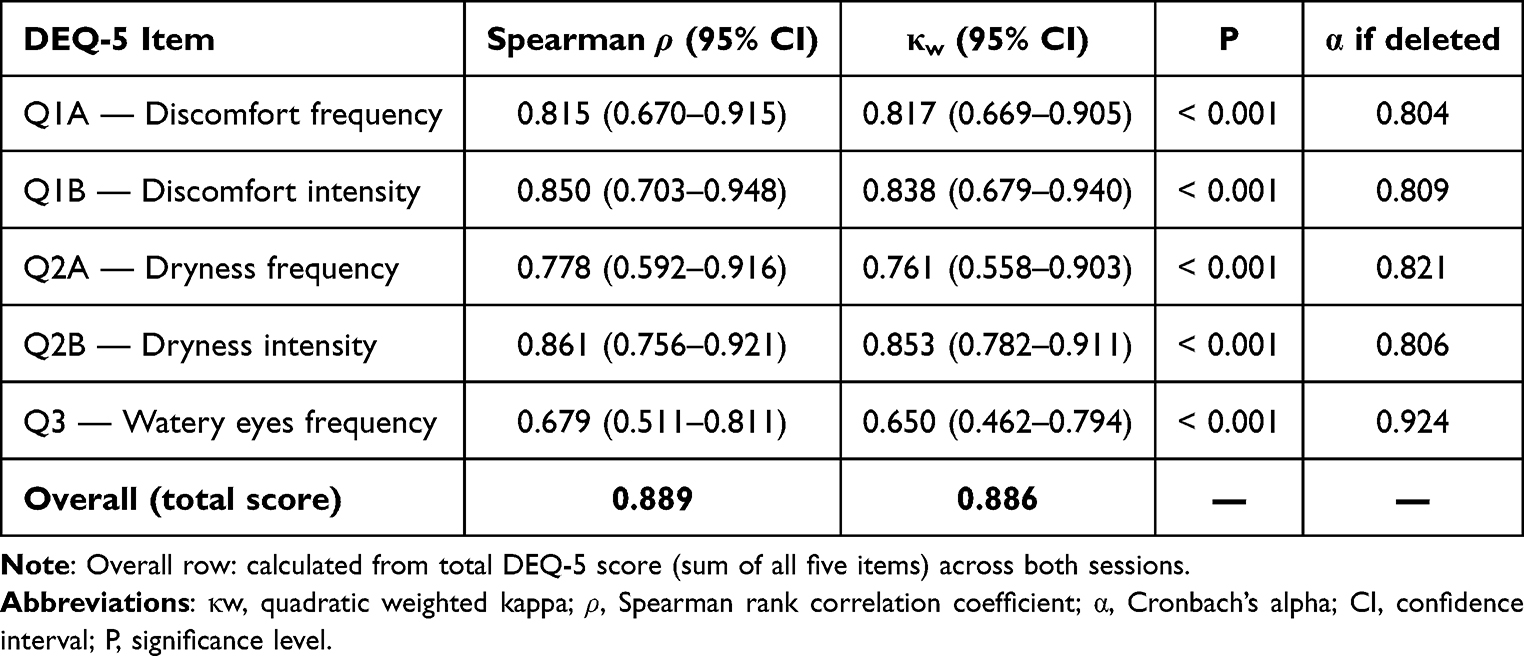 |
Table 2 Item-Level Test-Retest Reliability and Internal Consistency of the Arabic DEQ-5 |
Internal consistency of the Arabic DEQ-5 was assessed using Cronbach’s alpha computed across all five items collectively, yielding α = 0.878 and indicating good internal consistency. Alpha-if-item-deleted analysis confirmed that removing any single discomfort or dryness item reduced scale coherence, with values from 0.821 (Q2A deleted) to 0.809 (Q1B deleted), all below the overall α, confirming that each of these four items contributes meaningfully to scale integrity. The sole exception was Q3 (watery eyes frequency), whose removal increased alpha to 0.924, consistent with its lower item-level reliability across both Spearman ρ and weighted κw analyses. All five items were retained according to the original instrument structure.
Discussion
The successful translation and preliminary psychometric evaluation of the Arabic DEQ-5 addresses the diagnostic gap for DED among Arabic-speaking populations, demonstrating good-to-excellent test–retest reliability, good internal consistency and supporting its application as a rapid, standardized screening tool. The translation process proceeded without major linguistic difficulties, contrasting with the Mexican Spanish validation where the words “constantly” and “frequently” — synonymous in Spanish — required substitution with “always” to preserve meaningful distinction,13 confirming that the Arabic DEQ-5 captures the original instrument’s conceptual content across all five items with no loss of measurement equivalence.
The sample was balanced (45% men, 55% women; mean age 21.6 ± 3.9 years), with 93.3% aged 18–24. This offers insight into early DED symptoms in younger adults but limits generalizability to older populations, where DED is more prevalent and severe. These results primarily apply to young, healthy, university-based adults aged 18–40.
The Arabic DEQ-5 demonstrated acceptable score distribution characteristics. Floor effects (10%) and ceiling effects (1.7%) were within the ≤15% threshold indicative of adequate discriminative ability,20 and 76.7% of participants scored within the mid-range (3–17), confirming the instrument captures meaningful variation across DED symptom severity levels. The 73.3% positive rate (DEQ-5 > 6) is consistent with the upper range of DED symptom prevalence reported in Saudi Arabian cohorts (32.1–75.9%)3,4 and plausibly due to convergence of multiple risk factors: environmental exposure, heightened symptom sensitivity and intensive digital device use documented in young university-based adults,28–30 and the higher propensity for DED symptom reporting in women.3–5 Without objective clinical verification, these scores should be interpreted as a screening signal of elevated symptom burden rather than confirmed DED diagnoses.
At the scale level, test-retest reliability was good-to-excellent (ICC = 0.887; 95% CI: 0.819–0.931),25 consistent with Turkish (ICC = 0.95)31 and Mexican Spanish (ICC = 0.90, different-day)13 DEQ-5 adaptations, though direct comparison warrants caution given differences in sample composition, retest interval, and ICC model specification.25 The Portuguese adaptation12 did not report an ICC, precluding comparison. The two-way mixed-effects model with absolute agreement was selected on two grounds: the two measurement sessions were fixed protocol timepoints rather than randomly sampled occasions, and test-retest reliability requires confirmation of score reproducibility —not only preservation of relative rankings— a requirement that the consistency definition fails to satisfy.25,26 The resulting 95% CI (0.819–0.931) confirms adequate precision for a sample with n = 60.
At the item level, Spearman ρ ranged from 0.679 to 0.861 and quadratic weighted κw from 0.650 to 0.853,26 with three items achieving almost perfect agreement (Q1A: κw = 0.817; Q1B: κw = 0.838; Q2B: κw = 0.853) and one demonstrating substantial agreement (Q2A: κw = 0.761) as per Landis and Koch (1977).27 The sole exception was Q3 (watery eyes frequency; ρ = 0.679; κw = 0.650), which recorded the lowest values on both indices. For contextual reference, the Portuguese adaptation12 reported unweighted Cohen’s κ = 0.688 and Pearson r = 0.755 for Q3, and the Mexican Spanish adaptation13 unweighted κ = 0.649 for Q3, both indicating substantial agreement in their respective studies; a direct numerical comparison with the present quadratic weighted κw values is not appropriate given the different statistical frameworks; these figures are presented solely to contextualize the Arabic Q3 results within existing DEQ-5 adaptations.
The Arabic DEQ-5 Cronbach’s α (0.878) is comparable to values reported for the Portuguese (α = 0.887)11 and Turkish (α = 0.90)31 DEQ-5 adaptations, supporting the cross-cultural stability of the instrument’s internal consistency. The original English DEQ-5 did not report Cronbach’s alpha, as it was designed to assess discriminative validity rather than internal consistency.10 The Q3 alpha-if-deleted value of 0.924 — the only item whose removal increases the overall α — further corroborates the dimensional distinctiveness of the watery eyes item. The lower reliability of Q3 is mechanistically consistent with the episodic, stimulus-driven nature of reflex tearing. Unlike ocular discomfort and dryness — chronic, relatively stable manifestations of tear film deficiency resulting in strong test-retest agreement (κw: 0.761–0.853 across Q1A, Q1B, Q2A, and Q2B) — watery eyes frequency is an acute reflex response to environmental stimuli that varies between test occasions, directly attenuating between-session reproducibility; a low base-rate in a healthy young cohort further amplifies apparent instability, as small absolute score changes represent disproportionately large shifts on the response scale. This dimensional distinctiveness is independently supported by findings that watery eyes showed the weakest association with the DEQ-5 total score (r = 0.320) compared with r > 0.740 for all remaining items, with a maximum inter-item correlation of r = 0.108 (P > 0.05),32 mirroring the original observation10 that watery eyes showed the highest Spearman correlation with self-assessed dry eye severity among all DEQ-5 items (r = 0.48) and was reported primarily by non-SS KCS patients, in whom reflex tearing remains physiologically intact. Despite these reliability features, all five items were kept to preserve the original instrument’s structure. The watery eyes item offers unique diagnostic information that would be lost if it were removed.
The psychometrically evaluated Arabic DEQ-5 addresses a meaningful gap in DED assessment infrastructure for Arabic-speaking populations. Its five-item structure and substantially lower respondent burden compared with the full OSDI8 support integration into high-volume outpatient ophthalmology and optometry settings as a rapid, standardized triage instrument. Its proven reproducibility across administrations ensures consistent symptom documentation for longitudinal monitoring and treatment response assessment, while its discriminative capacity across DED severity levels10 supports its potential as an endpoint measure in clinical and epidemiological research involving Arabic-speaking populations. In a region where DED a prevalence of 32.1–75.9%3,4 and limited validated Arabic screening tools, the instrument’s capacity to identify elevated symptom burden efficiently facilitates timely clinical evaluation and potentially earlier intervention, with benefits to patient outcomes and quality of life.1,9
Limitations
Several limitations should be acknowledged. The study population was restricted to healthy individuals aged 18–40 years — a deliberate choice to control for confounding ocular surface conditions, systemic medications, and age-related tear film changes — which, while strengthening internal validity, limits applicability to older adults and clinical DED populations. No objective clinical dry eye measures, such as tear film breakup time, Schirmer testing, or ocular surface staining, were performed; thus, the study demonstrates reliability and internal consistency but does not establish criterion validity or diagnostic accuracy. Single-site university recruitment limits generalizability across the geographic and sociodemographic diversity of Arabic-speaking populations. The study focused on initial psychometric assessment of a homogeneous group, not subgroup analyses by age, sex, or clinical subtype; these will be addressed in future research. Such limitations are typical for preliminary validation and outline the steps needed to fully validate the Arabic DEQ-5 in clinical settings.
Future Research Directions
Future studies should extend validation to older adult populations and patients with clinically confirmed DED diagnoses, incorporating objective clinical measures — including tear film breakup time, osmolarity, and ocular surface staining — to establish criterion validity, diagnostic accuracy, and optimal cut-off thresholds. Larger, multicenter samples spanning diverse geographic regions and sociodemographic contexts would enable population-specific normative data and strengthen generalizability. Confirmatory factor analysis and Bland–Altman reproducibility analysis represent additional methodological priorities for future work.
Conclusion
This preliminary study indicates that the Arabic DEQ-5 exhibits good-to-excellent test–retest reliability and good internal consistency, supporting its application as a psychometrically evaluated screening instrument for DED symptom identification in Arabic-speaking populations. Criterion validity, construct validity, and diagnostic accuracy against objective clinical measures were not assessed and remain priorities for future research; validation in older adults and more diverse Arabic-speaking populations is similarly required before broader clinical application can be recommended. By addressing a meaningful gap in DED assessment infrastructure, this study lays the foundation for standardized DED symptom screening, cross-cultural epidemiological comparisons, and multicenter research involving Arabic-speaking populations.
Abbreviations
DED, dry eye disease; DEQ-5, 5-Item Dry Eye Questionnaire; IC, interdisciplinary committee; ICC, intraclass correlation coefficient; OSDI, Ocular Surface Disease Index; TFOS DEWS II, Tear Film and Ocular Surface Society Dry Eye Workshop II; TFOS DEWS III, Tear Film and Ocular Surface Society Dry Eye Workshop III; OD, right eye; OS, left eye; κw, quadratic weighted kappa; ρ, Spearman rank correlation; CI, confidence interval.
Data Sharing Statement
The datasets used and analyzed during the current study are available from the corresponding author on reasonable request, subject to appropriate ethical approval and data protection regulations. The study was approved by the Institutional Review Board Sub-Committee, Health Sciences Colleges Research on Human Subjects, King Saud University (approval number: E-23-7931).
Acknowledgments
The authors would like to express sincere gratitude to the eight cornea and ocular surface specialists who served on the interdisciplinary committee for their valuable expertise in reviewing the Arabic translation. Special thanks to the professional translators who conducted the forward and back-translation processes with meticulous attention to cultural and linguistic nuances. The authors acknowledge the 60 study participants for their time and cooperation in completing the validation testing.
Author Contributions
All authors made a significant contribution to the work reported, whether that is in the conception, study design, execution, acquisition of data, analysis and interpretation, or in all these areas; took part in drafting, revising or critically reviewing the article; gave final approval of the version to be published; have agreed on the journal to which the article has been submitted; and agree to be accountable for all aspects of the work.
Funding
This research received no specific grant from any funding agency in the public, commercial, or not-for-profit sectors.
Disclosure
The authors declare no conflicts of interest in relation to this study.
References
1. Wolffsohn JS, Benítez-Del-Castillo JM, Loya-Garcia D, et al. TFOS DEWS III: diagnostic methodology. Am J Ophthalmol. 2025;279:387–10. doi:10.1016/j.ajo.2025.05.033
2. Xiao K, Li L, Zhang X, et al. Global prevalence of dry eye: a systematic review and meta-analysis. Cont Lens Anterior Eye. 2025;49(2):102627. doi:10.1016/j.clae.2026.102627
3. Helayel HB, Al Abdulhadi HA, Aloqab A, et al. Prevalence and risk factors of dry eye disease among adults in Saudi Arabia. Saudi J Med Med Sci. 2023;11(3):242–249. doi:10.4103/sjmms.sjmms_251_22
4. Alshamrani AA, Almousa AS, Almulhim AA, et al. Prevalence and risk factors of dry eye symptoms in a Saudi Arabian population. Middle East Afr J Ophthalmol. 2017;24(2):67–73. doi:10.4103/meajo.MEAJO_281_16
5. Alves M, Asbell P, Dogru M, et al. TFOS Lifestyle Report: impact of environmental conditions on the ocular surface. Ocul Surf. 2023;29:1–52. doi:10.1016/j.jtos.2023.04.007
6. Bakkar MM, El-Sharif AK, Al Qadire M. Validation of the Arabic version of the ocular surface disease index questionnaire. Int J Ophthalmol. 2021;14(10):1595–1601. doi:10.18240/ijo.2021.10.18
7. Aljarousha M, Badarudin NE, Che Azemin MZ, et al. The validity and reliability of the Arabic version of the OSDI questionnaire in a sample of the Gazan population. Int Ophthalmol. 2023;43(4):1303–1316. doi:10.1007/s10792-022-02528-7
8. Amparo F, Schaumberg DA, Dana R. Comparison of two questionnaires for dry eye symptom assessment: the ocular surface disease index and the symptom assessment iN dry eye. Ophthalmology. 2015;122(7):1498–1503. doi:10.1016/j.ophtha.2015.02.037
9. Wolffsohn JS, Arita R, Chalmers R, et al. TFOS DEWS II diagnostic methodology report. Ocul Surf. 2017;15(3):539–574. doi:10.1016/j.jtos.2017.05.001
10. Chalmers RL, Begley CG, Caffery B. Validation of the 5-item Dry Eye Questionnaire (DEQ-5): discrimination across self-assessed severity and aqueous tear deficient dry eye diagnoses. Cont Lens Anterior Eye. 2010;33(2):55–60. doi:10.1016/j.clae.2009.12.010
11. United Nations. World Arabic Language Day [Internet]. Available from: https://www.un.org/en/observances/arabiclanguageday.
12. Gross LG, Pozzebon ME, Favarato AP, Ayub G, Alves M. Translation and validation of the 5-Item dry eye questionnaire into Portuguese. Arq Bras Oftalmol. 2022;87(3):e2022–0197. doi:10.5935/0004-2749.2022-0197
13. Martinez JD, Galor A, Amescua G, et al. Transcultural validation of the 5-item dry eye questionnaire for the Mexican population. Int Ophthalmol. 2019;39(10):2313–2324. doi:10.1007/s10792-018-01068-3
14. Tsang S, Royse CF, Terkawi AS. Guidelines for developing, translating, and validating a questionnaire in perioperative and pain medicine. Saudi J Anaesth. 2017;11(Suppl 1):S80–S89. doi:10.4103/sja.SJA_203_17
15. Gjersing L, Caplehorn JRM, Clausen T. Cross-cultural adaptation of research instruments: language, setting, time and statistical considerations. BMC Med Res Methodol. 2010;10:13. doi:10.1186/1471-2288-10-13
16. Al-Ebrahim SQ, Harrison J, Chen TF, Mohammed MA. Cross-cultural adaptation and psychometric properties of patient-reported outcome measures in Arabic speaking countries: a scoping review. Res Social Adm Pharm. 2023;19(7):989–1006. doi:10.1016/j.sapharm.2023.03.007
17. Al Sayah F, Ishaque S, Lau D, Johnson JA. Health related quality of life measures in Arabic speaking populations: a systematic review. Qual Life Res. 2013;22(1):213–229. doi:10.1007/s11136-012-0129-3
18. Beaton DE, Bombardier C, Guillemin F, Ferraz MB. Guidelines for the process of cross-cultural adaptation of self-report measures. Spine. 2000;25(24):3186–3191. doi:10.1097/00007632-200012150-00014
19. Sousa VD, Rojjanasrirat W. Translation, adaptation and validation of instruments or scales for use in cross-cultural health care research. J Eval Clin Pract. 2011;17(2):268–274. doi:10.1111/j.1365-2753.2010.01434.x
20. Terwee CB, Bot SDM, de Boer MR, et al. Quality criteria were proposed for measurement properties of health status questionnaires. J Clin Epidemiol. 2007;60(1):34–42. doi:10.1016/j.jclinepi.2006.03.012
21. Mokkink LB, Terwee CB, Patrick DL, et al. The COSMIN checklist for assessing the methodological quality of studies on measurement properties of health status measurement instruments: an international Delphi study. Qual Life Res. 2010;19(4):539–549. doi:10.1007/s11136-010-9606-8
22. Osborne JW, Costello AB. Sample size and subject to item ratio in principal components analysis. Pract Assess Res Eval. 2004;9(1):11. doi:10.7275/ktzq-jq66
23. Nunnally JC, Bernstein IH. Psychometric Theory.
24. Shrout PE, Fleiss JL. Intraclass correlations: uses in assessing rater reliability. Psychol Bull. 1979;86(2):420–428. doi:10.1037/0033-2909.86.2.420
25. Koo TK, Li MY. A guideline of selecting and reporting intraclass correlation coefficients for reliability research. J Chiropr Med. 2016;15(2):155–163. doi:10.1016/j.jcm.2016.02.012
26. Fleiss JL, Cohen J. The equivalence of weighted kappa and the intraclass correlation coefficient as measures of reliability. Educ Psychol Meas. 1973;33(3):613–619. doi:10.1177/001316447303300309
27. Landis JR, Koch GG. The measurement of observer agreement for categorical data. Biometrics. 1977;33(1):159–174. doi:10.2307/2529310
28. Deo N, Nagrale P. Dry eye disease: an overview of its risk factors, diagnosis, and prevalence by age, sex, and race. Cureus. 2024;16(2):e54028. doi:10.7759/cureus.54028
29. Zarban NA, Alammari OB, Abu Sabah S, et al. Prevalence and risk factors of dry eye disease in association with the increased use of electronic devices among university students in Western Saudi Arabia. Cureus. 2024;16(1):e51554. doi:10.7759/cureus.51554
30. Alissa M, Alqahtani MM, Almutairi MN, et al. The severity of dry eye symptoms and risk factors among university students in Saudi Arabia: a cross-sectional study. Sci Rep. 2024. doi:10.1038/s41598-024-65297-6
31. Turhan SA, Bagatur Vurgun E, Yalçındağ E, et al. The Turkish version of the 5-item Dry Eye Questionnaire (T-DEQ-5): translation, validity, and reliability. Cont Lens Anterior Eye. 2024;47(6):102309. doi:10.1016/j.clae.2024.102309
32. Wolffsohn JS, Travé-Huarte S, Craig JP, Muntz A, Stapleton FJ. Appropriateness of questionnaires for the diagnosis and monitoring treatment of dry eye disease. J Clin Med. 2024;13(11):3146. doi:10.3390/jcm13113146
 © 2026 The Author(s). This work is published and licensed by Dove Medical Press Limited. The
full terms of this license are available at https://www.dovepress.com/terms
and incorporate the Creative Commons Attribution
- Non Commercial (unported, 4.0) License.
By accessing the work you hereby accept the Terms. Non-commercial uses of the work are permitted
without any further permission from Dove Medical Press Limited, provided the work is properly
attributed. For permission for commercial use of this work, please see paragraphs 4.2 and 5 of our Terms.
© 2026 The Author(s). This work is published and licensed by Dove Medical Press Limited. The
full terms of this license are available at https://www.dovepress.com/terms
and incorporate the Creative Commons Attribution
- Non Commercial (unported, 4.0) License.
By accessing the work you hereby accept the Terms. Non-commercial uses of the work are permitted
without any further permission from Dove Medical Press Limited, provided the work is properly
attributed. For permission for commercial use of this work, please see paragraphs 4.2 and 5 of our Terms.