
Back to Journals » Drug Design, Development and Therapy » Volume 20
Toward Model-Informed Precision Dosing of Imipenem: Multicenter External Validation of Population Pharmacokinetic Models in Adult Critically Ill Patients
Authors Zhang P, Pang X, Chen H  , Zhu J , Liang G, Yang Y, Zhang X, Yu Z
Received 17 April 2026
Accepted for publication 3 July 2026
Published 21 July 2026 Volume 2026:20 617895
DOI https://doi.org/10.2147/DDDT.S617895
Checked for plagiarism Yes
Review by Single anonymous peer review
Peer reviewer comments 3
Editor who approved publication: Prof. Dr. Tin Wui Wong
Ping Zhang,1,2,* Xiaoping Pang,3,* Huadong Chen,4,* Jianping Zhu,1 Gang Liang,1 Yi Yang,1 Xuan Zhang,5 Zhenwei Yu1,2
1Department of Pharmacy, Sir Run Run Shaw Hospital, School of Medicine, Zhejiang University, Hangzhou, People’s Republic of China; 2Research Center for Clinical Pharmacy, College of Pharmaceutical Science, Zhejiang University, Hangzhou, People’s Republic of China; 3Department of Pharmacy, Taizhou Hospital of Zhejiang Province Affiliated to Wenzhou Medical University, Taizhou, People’s Republic of China; 4Department of Pharmacy, Affiliated Dongyang Hospital of Wenzhou Medical University, Dongyang, People’s Republic of China; 5Department of Pharmacy, Northern Jiangsu People’s Hospital, Yangzhou, People’s Republic of China
*These authors contributed equally to this work
Correspondence: Xuan Zhang, Email [email protected] Zhenwei Yu, Email [email protected]
Background: Model-informed individualized dosing of imipenem is required for critically ill patients due to high infection mortality and large pharmacokinetic (PK) variability. This study aims to externally evaluate the predictive performance of available imipenem pharmacokinetic (popPK) models to facilitate clinical application.
Methods: A multicenter dataset of 152 ICU patients (201 concentrations) was used for the external validation of 9 popPK models. Model performance was investigated for prediction- and simulation-based diagnostics and Bayesian forecasting. The median relative prediction error (rPEmedian), median absolute relative prediction error (rAPEmedian), and NPDE were calculated to quantify accuracy and precision.
Results: Model predictive performance exhibited heterogeneity. Priori prediction showed wide rPEmedian ranges, and only 3 models were within ± 15%. Moreover, the priori predictions of all models failed to demonstrate satisfactory performance in terms of both F20 and F50. Notably, Bayesian forecasting incorporating TDM data significantly improved accuracy, with four models demonstrating superior performance in terms of rPEmedian and F50. Predictive performance was poorer in patients with renal function impairments. Simulation diagnostics revealed systematic bias across all models. In general, the Truong et al (2025) model performed better than the other models.
Conclusion: Available imipenem popPK models for adult critically ill patients were unsatisfactory in predictive performance, and the Truong et al (2025) model performed best among all models. The integration of Bayesian forecasting with therapeutic drug monitoring (TDM) data significantly improved predictive accuracy, suggesting that the synergistic use of the popPK model and TDM may optimize clinical dosing decisions and potentially improve clinical outcomes.
Keywords: population pharmacokinetics, imipenem, external validation, Bayesian forecasting, therapeutic drug monitoring
Introduction
Severe infections in critically ill patients pose a formidable clinical challenge in the intensive care unit (ICU).1,2 According to an epidemiological survey, 54% of ICU patients had suspected or confirmed infection, of whom 22% had ICU-acquired infections; moreover, approximately 70% received at least one antibiotic.3 It was associated with high mortality, and the dosing of antibiotics would be challenging due to the highly heterogeneous pharmacokinetics (PK) and pathophysiologically unstable nature of the patient population themselves.4 Nevertheless, antibiotic therapy in clinical practice remains largely empirical and standard dosing, and this approach may be inadequate for the management of complex cases. Therefore, precision dosing strategies guided by pharmacokinetic/pharmacodynamic (PK/PD) principles and integrated with therapeutic drug monitoring (TDM) have emerged as a cornerstone for optimizing antibiotic efficacy while mitigating toxicity.5
Imipenem, the first marketed carbapenem antibiotic, is utilized clinically for the treatment of severe infections caused by a broad spectrum of pathogens, including aerobic and anaerobic bacteria, as well as for early empirical therapy when the causative pathogen is unidentified.6 The PK/PD target of imipenem is primarily characterized by fT>MIC (the time fraction of the free drug concentration exceeding the bacterial minimum inhibitory concentration during the dosing interval). The conventional efficacy threshold is generally defined as at least 40% fT>MIC, whereas a more intensive target of 100% fT>1-4×MIC is required in critically ill patients.7 Marked interindividual variability in the drug’s PK, specifically in its distribution volume and total clearance, is driven by the dynamic pathophysiological changes commonly seen in this population, such as aggressive fluid resuscitation and rapidly fluctuating renal function.8,9 Consequently, empirical dosing regimens risk either subtherapeutic or supratherapeutic exposures. Subtherapeutic exposure is directly linked to therapeutic failure and poor outcomes, while excessive exposure increases the risk of adverse effects, such as central nervous system toxicity.10,11
Although progress has been made in population pharmacokinetic (popPK) studies of imipenem, with several models developed to guide individualized dosing, significant limitations persist in the existing models. Many are derived from single-center studies with small sample sizes, where parameter estimates may be influenced by specific population characteristics, limiting their generalizability.12–14 Moreover, the vast majority of these models have only undergone internal validation for performance evaluation, lacking rigorous external validation using independent cohorts.15 The absence of external validation casts doubts on the models’ predictive performance and robustness when applied to patients from different medical centers or with distinct pathophysiological features, thereby hindering their translation into clinical decision-support tools.
To ensure reliable generalizability and enable the selection of the popPK model for precision dosing in clinical practice, this study conducts a multicenter systematic external validation of published imipenem popPK models using multicenter data. We will quantitatively assess the predictive accuracy of each model in an independent multicenter cohort of critically ill patients to determine its applicability in a new population, laying a solid foundation for ultimately developing precise dosing strategies applicable to a broader ICU patient population.
Methods
Evaluation Dataset
Patients were retrospectively included from across four tertiary hospitals if they met the following eligibility criteria: (a) patients admitted to the ICU; (b) received imipenem treatment due to confirmed or suspected infections; and (c) patients had at least one TDM data point of imipenem. The exclusion criteria were as follows: (a) aged under 18 years; (b) urinary tract infections; (c) treated with continuous renal replacement therapy (CRRT); and (d) essential clinical data were incomplete.
The following variables were extracted from hospital information systems: age, sex, body weight (BW), body mass index (BMI), albumin (ALB), serum creatinine (SCR), creatinine clearance estimated by the Cockcroft-Gault equation (CLcrCG), estimated glomerular filtration rate (eGFR), extracorporeal membrane oxygenation (ECMO) support, daily imipenem dosage, plasma drug concentrations, and precise timing of drug administration and blood sampling. Sampling points comprised peak, trough, and opportunistic plasma concentrations. Plasma concentrations were determined by the laboratories of each hospital using liquid chromatography-tandem mass spectrometry (LC-MS), with a lower limit of quantification of 0.5 μg/mL. The study protocol was approved by the ethics committee of Sir Run Run Shaw Hospital, School of Medicine, Zhejiang University (reference number 2025–1193). Informed consent was waived as part of the approval.
Evaluation of Population Pharmacokinetic Models for Imipenem
We have previously completed a systematic review of imipenem popPK models.15 During the model screening process for external validation, several published models were excluded based on predefined criteria. The primary reasons for exclusion were as follows: (1) enrollment of pediatric or adolescent populations (younger than 18 years); (2) the covariates incorporated in the model did not align with our dataset; and (3) the structural model equations were either inapplicable or the key modeling information was missing.
External validation was performed using the NONMEM software (version 7.4), and the results were analyzed using R software (version 4.4.0). For each model, the structural model, parameterization, inter-individual variability model, residual error model, and covariate equations were extracted from the original publication and implemented accordingly (Table S1). No additional inter-occasion variability or dosing variability was incorporated during the external validation, and no data splitting was performed. Each popPK model was assessed under three methods of external validation:
(1) Priori prediction: all imipenem concentrations were predicted using solely dosing records and baseline patient covariates;
(2) Bayesian prediction: Bayesian prediction was performed by incorporating the first TDM concentration from each subject as prior individual information. Bayesian forecasting was implemented in NONMEM with MAXEVAL = 0, such that the published population parameters and variability structure were fixed and not re-estimated.
For both a priori and Bayesian prediction, a numerical comparison between predicted and observed imipenem plasma concentrations (Cpred and Cobs) was conducted to quantify the model-specific relative prediction error (rPE) across the overall evaluation dataset and within each study. The rPEmedian within ± 15% represents the good predictive accuracy of the model. The median relative prediction error (rPEmedian) and median absolute relative prediction error (rAPEmedian) were calculated to assess accuracy and precision using the following equations.



F20 and F50 represent the percentage of all individual rPE values in the range of ± 20% and ± 50%, respectively. Predefined criteria for good predictive performance were as follows: rPEmedian within ± 15%, F20 > 35%, and F50 > 50%.16
(3) Simulation-based diagnostics using normalized prediction distribution errors (NPDE) were performed, which involved Monte Carlo simulations (n = 1000) for each model. Under the null hypothesis, NPDE should follow a standard normal distribution, N (0,1). Model adequacy was assessed using the Wilcoxon signed-rank test for mean deviation, Fisher’s variance test for variance deviation, Shapiro–Wilk test for normality, and a global test with Bonferroni correction. Graphical evaluation included the histogram, quantile-quantile plot, NPDE versus time after dose, and NPDE versus PRED.
Results
Patient Baseline Characteristics and popPK Models
A total of 152 ICU patients with 201 imipenem plasma concentration-time measurements were finally included and the demographic details are shown in Table 1. The cohort had a median age of 68.0 years, a median body weight (BW) of 63.3 kg, and a median CLcrCG of 77.2 mL/min. Notably, two individuals in the study underwent extracorporeal membrane oxygenation (ECMO) therapy. Imipenem was administered at loading daily doses ranging from 0.5 g to 3 g, with a median observed plasma concentration of 1.8 μg/mL.
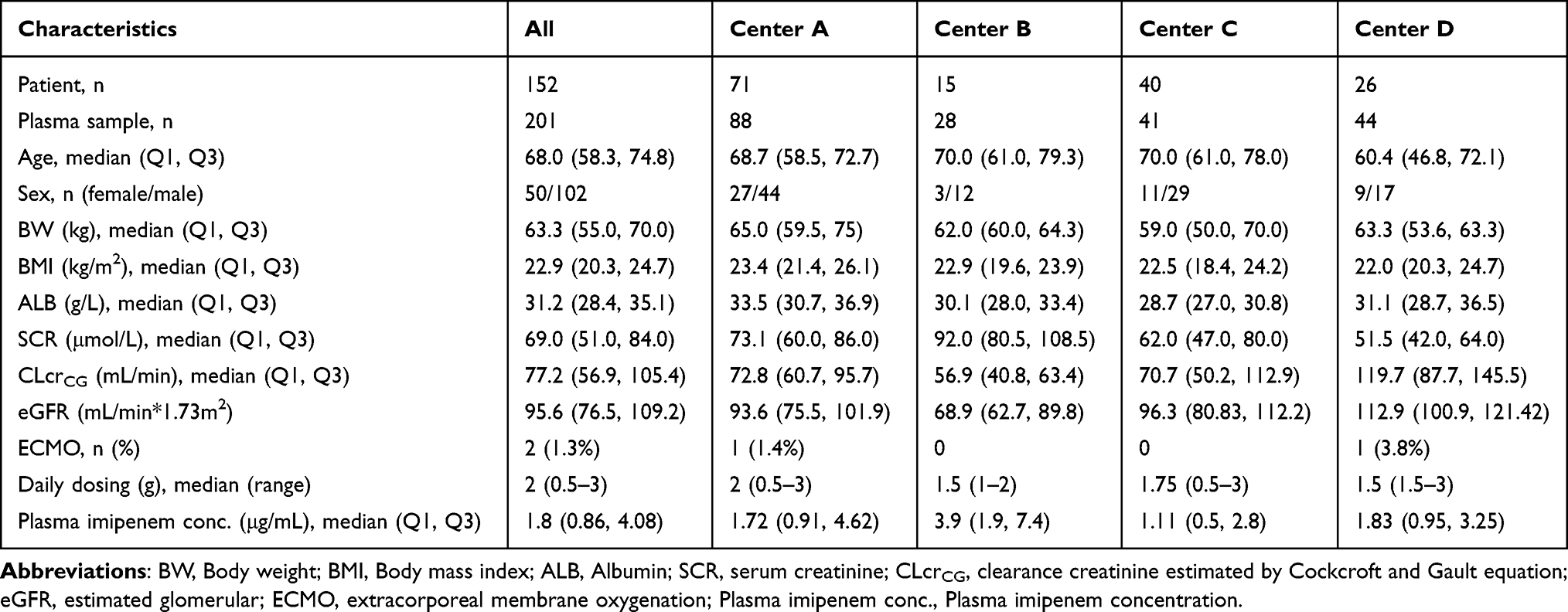 |
Table 1 Summary of the Baseline Population Characteristics in the External Evaluation Dataset |
Nine popPK models were identified for external validation, comprising one one-compartment model and eight two-compartment models (Tables S1 and S2).13,17–24 The typical population estimates for clearance (CL) ranged from 4.79 to 15.31 L/h, while the central volume of distribution (V1) varied between 11.1 and 41.23 L. Among these models, only a single study incorporated estimated glomerular filtration rate calculated by the CKD-EPI equation (eGFRCKD-EPI) as a covariate in the final model; the remaining models utilized CLcr in their final covariate selection.
External Validation
Priori prediction and Bayesian prediction were performed to assess the model performance, and a schematic diagram of the process is shown in Figure 1. The detailed results are shown in Figure 2, and a summary is shown in Table 2 and Figure S1. Priori predictions exhibited substantial bias (rPEmedian: −157.57% to 45.08%), and only the Nguyen et al (2021),19 Wang et al (2024),23 and Truong et al (2025)24 models had rPEmedian values within ± 15%. The Truong et al (2025)24 model had the largest F50, but no a priori predictions achieved F20 > 35% or F50 > 50%. Bayesian forecasting markedly improved predictive performance compared to priori approaches. It achieved ± 15% rPEmedian in the Jaruratanasirikul et al (2021),20 Dinh et al (2022),21 Bai et al (2024),22 and Truong et al (2025)24 models, with Bai et al (2024)22 model showing the smallest absolute error (−2.88%). Jaruratanasirikul et al (2021),20 Dinh et al (2022),21 Bai et al (2024),22 and Truong et al (2025)24 models all achieved F50 > 50% (51.11%, 53.33%, 53.33%, and 53.33%, respectively), although F20 values remained below 35% across all models (range: 15.56–28.89%). Overall, priori predictive performance was suboptimal but improved substantially with Bayesian prediction, with the Truong et al (2025)24 model having both a priori and Bayesian predictive performance.
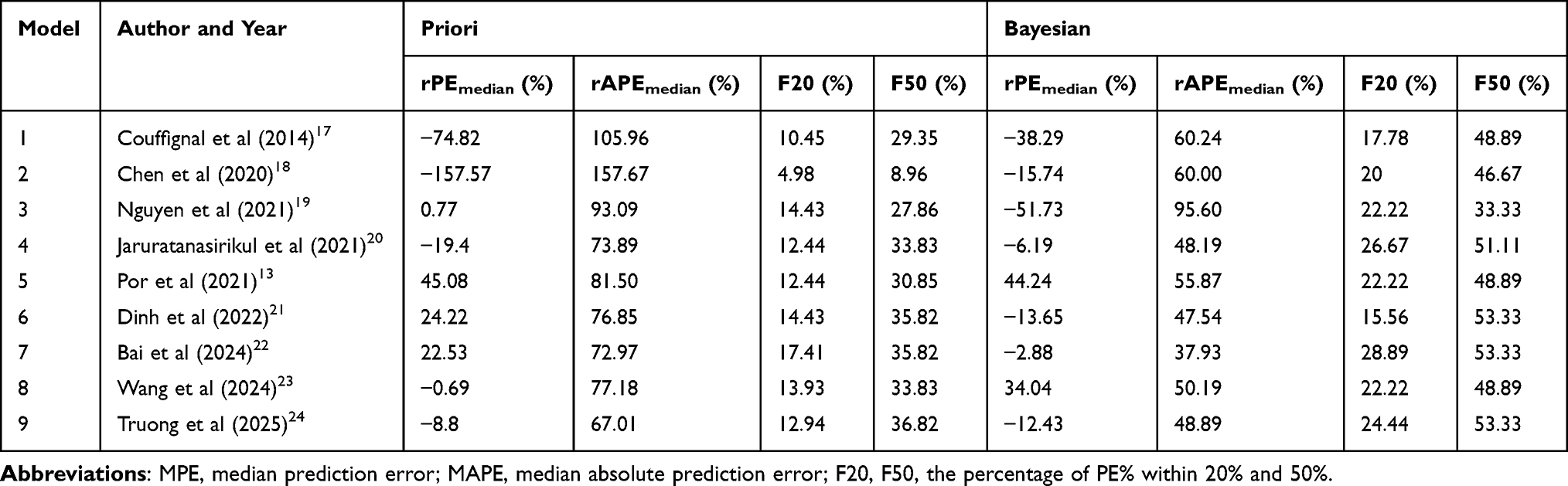 |
Table 2 Summary of the Predictive Performance of Different Models |
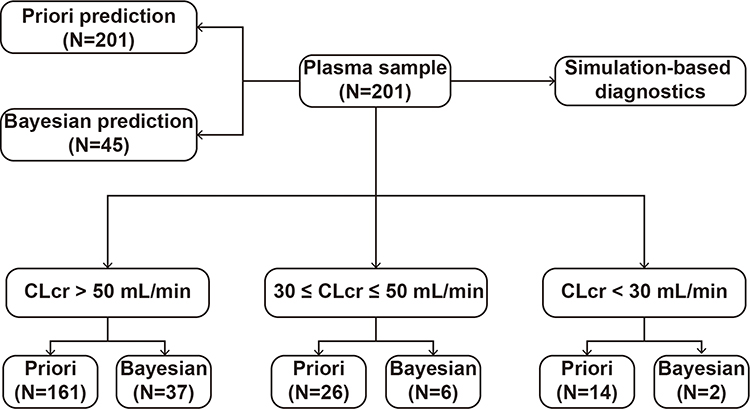 |
Figure 1 Schematic diagram of the external validation. |
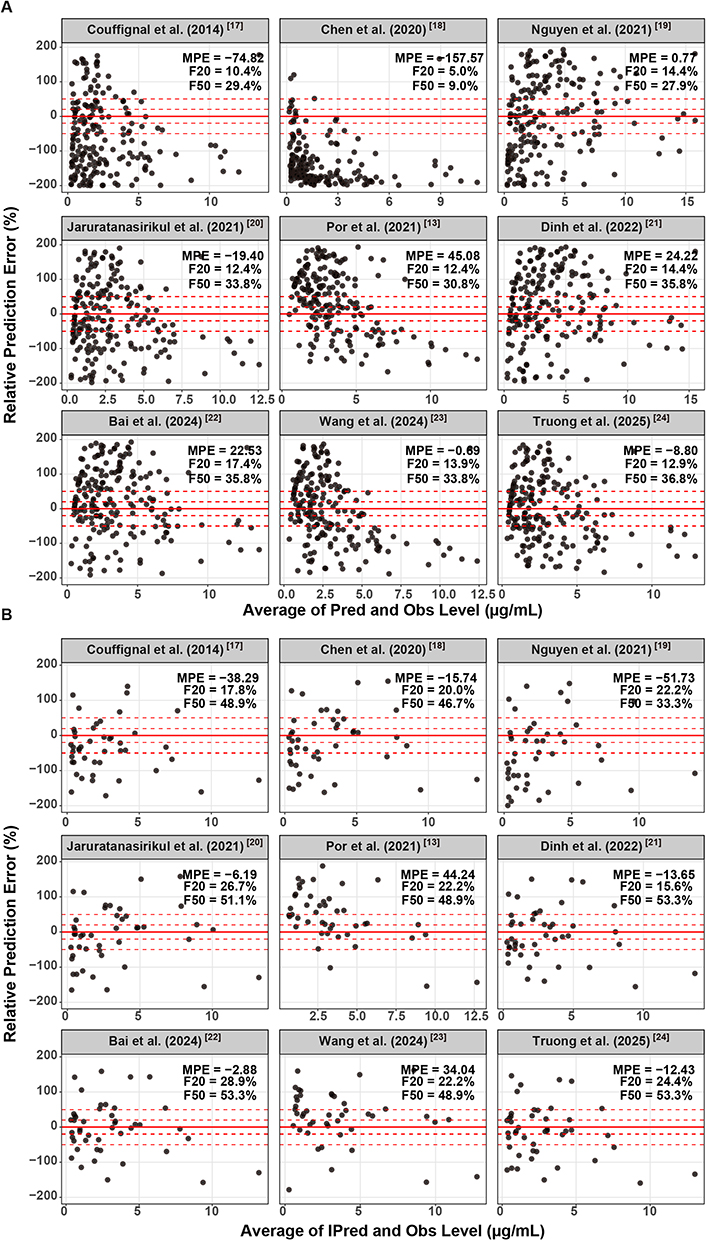 |
Figure 2 Bland-Altman plot of the external validation of the popPK model. (A) stands for Priori prediction and (B) for Bayesian forecasting. Red dashed lines are the F20 and F50. The rPE in the figure is the median value. Abbreviations: Pred, predicted; Obs, observed. |
Renal function (usually expressed as creatinine clearance) was a covariate of all models, and the model predictive performances stratified by renal function are shown in Tables 3, S3 and 4. For those with CLcr > 50 mL/min, the performance of a priori prediction was not improved compared to the whole population. Bayesian forecasting also led to improved predictive accuracy compared with a priori prediction, with the model by Truong et al (2025)24 demonstrating the highest F50 of 59.46%. For patients with impaired renal function (50 mL/min > CLcr > 30 mL/min or CLcr < 30 mL/min), all models had poor predictive performance, and most models had a large rPEmedian in these patients. In terms of Bayesian prediction performance, there were insufficient data to draw a conclusion.
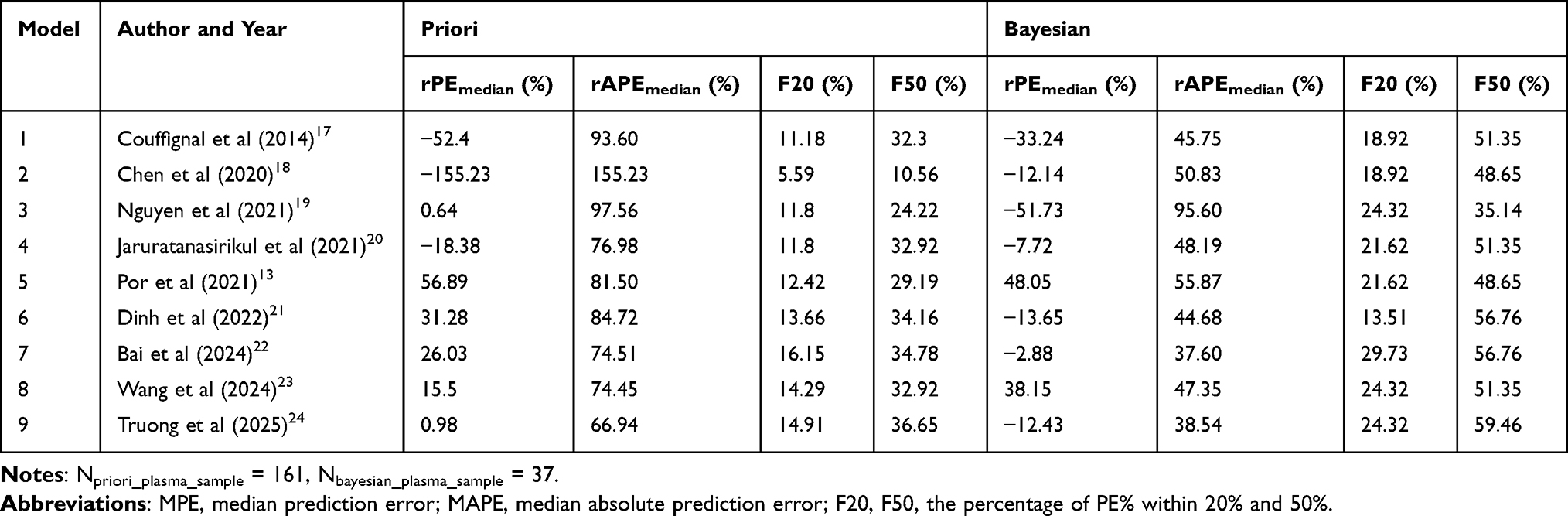 |
Table 3 Prediction Performance of Published popPK Models for Patients with CLcr > 50 mL/min |
We performed simulation-based validation for these models, and the detailed NPDE results are shown in Table S5, Figures 3 and S2. Mean NPDE values were close to zero and lacked significant bias in Nguyen et al (2021),19 Jaruratanasirikul et al (2021),20 Truong et al (2025),24 and Wang et al (2024)23 studies. None of the models achieved variance equal to one, and all failed the global goodness-of-fit assessment (P < 0.01). Q-Q plot analysis revealed that only the Jaruratanasirikul et al (2021),20 Bai et al (2024),22 and Truong et al (2025)24 models closely matched the expected theoretical distribution, while the others exhibited pronounced deviations and systematic patterns (Figures 3 and S2). In summary, although no model met the criteria for satisfactory simulation-based diagnostic performance, the models from Truong et al (2025)24 demonstrated relatively superior distributional alignment.
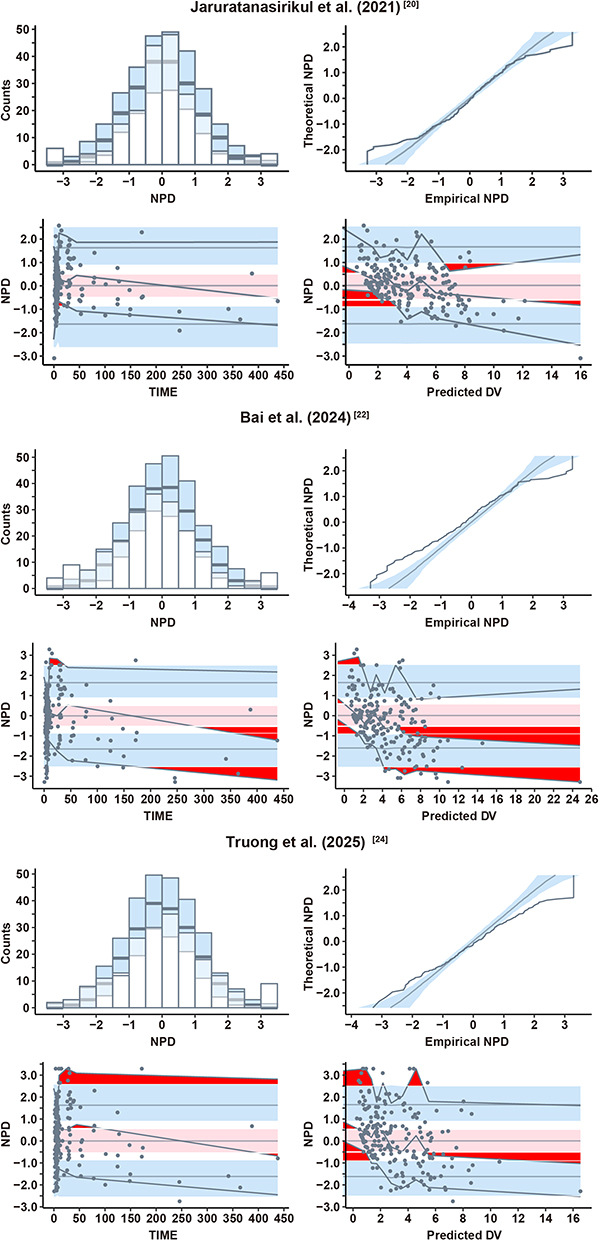 |
Figure 3 NPDE graphics of the three popPK models. Distribution of NPDE values (histogram and quantile-quantile plot) and model diagnostic scatter plots of NPDE vs time and NPDE vs predicted concentration (predicted DV). Prediction intervals are shown as colored areas: blue bands represent the 5th and 95th prediction intervals, and the pink band indicates the median prediction. Abbreviation: NPDE, normalized prediction distribution errors. |
Discussion
To our knowledge, this represents the first comprehensive external evaluation of previously published popPK models for imipenem in critically ill patients which employs prediction- and simulation-based diagnostics to assess the accuracy and precision of the selected models.15 Unfortunately, all validated models had unsatisfactory predictive performance, although Bayesian prediction could elevate the prediction accuracy. The Truong et al (2025)24 model performed best among all models. It should be emphasized that this work is not intended to challenge previously published popPK models, but rather to validate their external generalizability and practical applicability. Taken together, our findings support the need for an imipenem popPK model combined with TDM to enable precision dosing in critically ill patients.
In this study, data were collected from four tertiary hospitals located in different regions of China, representing a diverse ICU patient population. The multicenter design enhances the generalizability of our findings and helps mitigate potential center-specific biases.25,26 By comparing priori prediction and Bayesian forecasting, the model by Truong et al (2025)24 was identified as the most robust. This model was developed using data from 151 patients and 322 blood samples, including both critically ill and non-critically ill individuals. Such a design allows the model to account for PK differences between these populations, thereby improving its predictive accuracy in critically ill patients. The favorable external validation performance of Truong et al (2025)24 may be partly attributable to the similarity between the external validation cohort of critically ill patients and the model-building dataset. The ample sample size further supports robust modeling of dynamic PK changes in this group. Importantly, the model was externally validated in two independent datasets, a critical step to assess generalizability and clinical utility, minimize overfitting, and ensure reliable performance across different centers and patient populations.27,28
Notably, most models included only CLcr as the primary covariate, with a few additionally incorporating body weight and ALB, but failed to systematically account for other variables reflecting the complex pathophysiology of critically ill patients, such as inflammation, organ function, disease severity, and large-volume fluid resuscitation. This limited covariate structure restricts the model’s ability to explain PK variability, particularly in the highly heterogeneous critically ill population. Regarding structural model selection, Nguyen et al (2021)19 employed a one-compartment model. However, for critically ill patients with complex drug distribution and elimination processes, a one-compartment model may inadequately characterize in vivo dynamics, thereby compromising model fit and predictive performance. Furthermore, most models lacked external validation, which weakens generalizability to new patient populations or clinical settings.
Since imipenem is primarily eliminated via the kidneys, this study further evaluated the predictive performance of various models across different renal function strata. The results indicated no significant improvement in predictive performance for any model in the population with CLcr > 50 mL/min. This suggests that in patients with normal renal function, other important covariates may not have been adequately considered, thereby limiting the improvement in predictive accuracy within this subgroup. In patients with impaired renal function, the predictive accuracy of all models declined markedly. Under conditions of renal insufficiency, compensatory changes in non-renal clearance pathways may occur, and key parameters such as protein binding and volume of distribution can be altered by hypoalbuminemia or the accumulation of endogenous solutes.29,30 This uncertainty is compounded by the frequent presence of multiple organ dysfunction and concomitant medications in these patients.31 Furthermore, renal function in critically ill patients is often dynamic in clinical practice, and CLcr estimated from serum creatinine may not accurately reflect the true glomerular filtration rate, posing additional challenges for the clinical application of these models.32 Therefore, future model development should consider incorporating more comprehensive covariates reflecting the overall patient condition and strengthening data collection and model validation in special populations to enhance the generalizability and clinical utility of popPK models.
The NPDE results revealed significant bias in all models during simulation-based diagnostics. This finding aligns with previous external evaluations of popPK models for antibiotics in critically ill populations, which have consistently shown that published models exhibit considerable variability in predictive performance and often fail to generalize to broader patient cohorts.16,33 Of note, Bayesian forecasting can leverage available drug concentrations to adjust subsequent dosing regimens, thereby improving individual-level predictive performance to a certain extent.34 This finding suggests that incorporating individual concentration feedback may facilitate the optimization of individualized dosing strategies in clinical practice. Moreover, it underscores the need for future model development to prioritize external validation, thereby enhancing model applicability in real-world clinical settings.
This study has several limitations. First, due to the unavailability of certain clinical characteristics or key covariate data for some models, these models were not included in the present analysis. Therefore, it cannot be ruled out that some of these excluded models may demonstrate superior performance. Second, the currently available TDM data for Bayesian forecasting are relatively limited. Given prior evidence that two TDM samples outperform a single sample under continuous infusion, the use of only one sample may have limited evaluation of individualized predictive performance.35 Future popPK studies should optimize TDM sampling strategies and fully integrate TDM data to enhance the practical value of models in precision dosing.
Conclusion
In conclusion, this study conducted an external evaluation of nine published imipenem popPK models using multicenter data. These models exhibited considerable variability in predictive performance among critically ill patients, and the Truong et al (2025) model performed best among all models. Meanwhile, integration of TDM data may further improve the robustness and individualized predictive performance of models, thereby better supporting precision dosing and the balance between efficacy and safety in critically ill patients. Future studies should focus on developing more robust popPK models with richer covariate characterization to provide a more reliable basis for precision dosing in clinical practice.
Data Sharing Statement
All the data are within the manuscript and Supplementary Materials.
Ethical Approval and Informed Consent
This study was approved by the ethics committee of Sir Run Run Shaw Hospital, School of Medicine, Zhejiang University (reference number 2025-1193), and this study was conducted in accordance with the Declaration of Helsinki. Informed consent was waived as part of the approval, as this study is based on retrospective data analysis. Moreover, all patient data have been de-identified to ensure patient confidentiality.
Funding
This work was supported by Public welfare technology application research projects of Jinhua, Zhejiang (2023-4-223) and Zhejiang Pharmaceutical Association (2017ZYY036).
Disclosure
The authors declare that they have no potential conflicts of interest in this work.
References
1. Dardón-Fierro FE, Ferrer R, Plata-Menchaca EP. Editorial: current evidence on epidemiology and management of infections in critically ill patients. Front Public Health. 2025;13:1584879. doi:10.3389/fpubh.2025.1584879
2. Rello J. Latest updates and challenges in infections in intensive care medicine. J Intensive Med. 2023;4(1):1–10. doi:10.1016/j.jointm.2023.11.001
3. Vincent J-L, Sakr Y, Singer M, et al. Prevalence and outcomes of infection among patients in intensive care units in 2017. JAMA. 2020;323(15):1478–1487. doi:10.1001/jama.2020.2717
4. Al-Ouqaili MTS, Hussein RA, Kanaan BA, et al. Investigation of carbapenemase-encoding genes in Burkholderia cepacia and Aeromonas sobria isolates from nosocomial infections in Iraqi patients. PLoS One. 2025;20(8):e0315490. doi:10.1371/journal.pone.0315490
5. Onita T, Ishihara N, Yano T. PK/PD-guided strategies for appropriate antibiotic use in the era of antimicrobial resistance. Antibiotics. 2025;14(1):1584879.
6. Woerther P-L, Lepeule R, Burdet C, et al. Carbapenems and alternative β-lactams for the treatment of infections due to extended-spectrum β-lactamase-producing Enterobacteriaceae: what impact on intestinal colonisation resistance? Int J Antimicrob Agents. 2018;52(6):762–770. doi:10.1016/j.ijantimicag.2018.08.026
7. Song J, Pang X, Chen H, et al. Prevalence of on time administration of carbapenem and its impact on PK/PD target attainment in hospitalized patients: a multicenter retrospective study. Front Cell Infect Microbiol. 2025;15:1690269. doi:10.3389/fcimb.2025.1690269
8. Gatti M, Pea F. Pharmacokinetic/pharmacodynamic target attainment in critically ill renal patients on antimicrobial usage: focus on novel beta-lactams and beta lactams/beta-lactamase inhibitors. Expert Rev Clin Pharmacol. 2021;14(5):583–599. doi:10.1080/17512433.2021.1901574
9. Veiga RP, Paiva J-A. Pharmacokinetics-pharmacodynamics issues relevant for the clinical use of beta-lactam antibiotics in critically ill patients. Critical Care. 2018;22(1):233. doi:10.1186/s13054-018-2155-1
10. de Lima KA, de Souza AG, Chaves Filho AJM, et al. Integrative behavior analysis, oxidative stress markers determination and molecular docking to investigate proconvulsant action of betalactamic carbapenems. Neurotoxicology. 2025;110:155–167. doi:10.1016/j.neuro.2025.08.003
11. Reza N, Dubey V, Sharland M, et al. Antimicrobial use and resistance. BMJ. 2025;391:e082681. doi:10.1136/bmj-2024-082681
12. Lafaurie M, Burdet C, Hammas K, et al. Population pharmacokinetics and pharmacodynamics of imipenem in neutropenic adult patients. Infect Dis Now. 2023;53(1):104625. doi:10.1016/j.idnow.2022.09.020
13. Por ED, Akers KS, Chung KK, et al. Population pharmacokinetic modeling and simulations of imipenem in burn patients with and without continuous venovenous hemofiltration in the military health system. J Clin Pharmacol. 2021;61(9):1182–1194. doi:10.1002/jcph.1865
14. Li S, Xie F. Population pharmacokinetics and simulations of imipenem in critically ill patients undergoing continuous renal replacement therapy. Int J Antimicrob Agents. 2019;53(1):98–105. doi:10.1016/j.ijantimicag.2018.10.006
15. Zhang P, Zhao Y, Zhu J, et al. Population pharmacokinetics of imipenem in different populations for individualized dosing: a systematic review. Front Pharmacol. 2026;16:1738055. doi:10.3389/fphar.2025.1738055
16. Zhou Y, Long E, Shi T, et al. External validation of vancomycin population pharmacokinetic models in ten cohorts of infected Chinese patients. J Global Antimicrob Resist. 2022;30:163–172. doi:10.1016/j.jgar.2022.05.016
17. Couffignal C, Pajot O, Laouénan C, et al. Population pharmacokinetics of imipenem in critically ill patients with suspected ventilator-associated pneumonia and evaluation of dosage regimens. Br J Clin Pharmacol. 2014;78(5):1022–1034. doi:10.1111/bcp.12435
18. Chen W, Zhang D, Lian W, et al. Imipenem population pharmacokinetics: therapeutic drug monitoring data collected in critically ill patients with or without extracorporeal membrane oxygenation. Antimicrob Agents Chemother. 2020;64(6):e00385–00320. doi:10.1128/AAC.00385-20
19. Nguyen T-M, Ngo T-H, Truong A-Q, et al. Population pharmacokinetics and dose optimization of ceftazidime and imipenem in patients with acute exacerbations of chronic obstructive pulmonary disease. Pharmaceutics. 2021;13(4):456. doi:10.3390/pharmaceutics13040456
20. Jaruratanasirikul S, Boonpeng A, Nawakitrangsan M, et al. NONMEM population pharmacokinetics and Monte Carlo dosing simulations of imipenem in critically ill patients with life-threatening severe infections during support with or without extracorporeal membrane oxygenation in an intensive care unit. Pharmacotherapy. 2021;41(7):572–597. doi:10.1002/phar.2597
21. Dinh TD, Nguyen HN, Le BH, et al. Population-based pharmacokinetics and dose optimization of imipenem in Vietnamese critically-ill patients. Infect Drug Resist. 2022;15:4575–4583. doi:10.2147/IDR.S373348
22. Bai J, Wen A, Li Z, et al. Population pharmacokinetics and dosing optimisation of imipenem in critically ill patients. European J Hospital Pharm. 2024;31(5):434–439. doi:10.1136/ejhpharm-2022-003403
23. Wang J, Fang Q, Luo X, et al. Population pharmacokinetics and dosing optimization of imipenem in Chinese elderly patients. Front Pharmacol. 2024;15:1524272. doi:10.3389/fphar.2024.1524272
24. Truong AQ, Smeets TJL, Terrier J, et al. Inadequate imipenem dosing in patients with decreased kidney function: a global clinical pharmacokinetic study. Clin Microbiol Infect. 2025;31(9):1518–1525. doi:10.1016/j.cmi.2025.05.005
25. Das MK. Multicenter studies: relevance, design and implementation. Indian Pediatrics. 2022;59(7):571–579. doi:10.1007/s13312-022-2561-y
26. Impellizzeri FM. Together we are stronger: multicenter studies. Int J Sports Physiol Performance. 2017;12(2):141. doi:10.1123/IJSPP.2016-0818
27. Bastida C, Escolà-Rodríguez A, Fernández S, et al. External validation of population pharmacokinetic models for meropenem in critically ill adult patients. J Global Antimicrob Resist. 2025;43:358–364. doi:10.1016/j.jgar.2025.05.015
28. Schouwenburg S, Preijers T, Abdulla A, et al. Leveraging clinical data to enhance the performance evaluation of ceftriaxone population pharmacokinetic models in children. Clin Pharmacokinet. 2025;64(4):585–598. doi:10.1007/s40262-025-01486-4
29. Vilay AM, Churchwell MD, Mueller BA. Clinical review: drug metabolism and nonrenal clearance in acute kidney injury. Critical Care. 2008;12(6):235. doi:10.1186/cc7093
30. Boriani G, Savelieva I, Dan G-A, et al. Chronic kidney disease in patients with cardiac rhythm disturbances or implantable electrical devices: clinical significance and implications for decision making-a position paper of the European heart rhythm association endorsed by the heart rhythm society and the Asia pacific heart rhythm society. Europace. 2015;17(8):1169–1196. doi:10.1093/europace/euv202
31. Brakenridge S, Kornblith L, Cuschieri J. Multiple organ failure: what you need to know. J Trauma Acute Care Surg. 2024;97(6):831–838. doi:10.1097/TA.0000000000004419
32. Miano TA, Barreto EF, McNett M, et al. Toward equitable kidney function estimation in critical care practice: guidance from the society of critical care medicine’s diversity, equity, and inclusion in renal clinical practice task force. Crit Care Med. 2024;52(6):951–962. doi:10.1097/CCM.0000000000006237
33. Cheng Y, Wang C-Y, Li Z-R, et al. Can population pharmacokinetics of antibiotics be extrapolated? Implications External Eval Clin Pharmacokinetics. 2021;60(1):53–68.
34. Chai MG, Roberts JA, Kelly CF, et al. Efficiency of dosing software using Bayesian forecasting in achieving target antibiotic exposures in critically ill patients, a prospective cohort study. Anaesth Crit Care Pain Med. 2023;42(6):101296. doi:10.1016/j.accpm.2023.101296
35. Greppmair S, Brinkmann A, Roehr A, et al. Towards model-informed precision dosing of piperacillin: multicenter systematic external evaluation of pharmacokinetic models in critically ill adults with a focus on Bayesian forecasting. Intensive Care Med. 2023;49(8):966–976. doi:10.1007/s00134-023-07154-0
 © 2026 The Author(s). This work is published and licensed by Dove Medical Press Limited. The
full terms of this license are available at https://www.dovepress.com/terms
and incorporate the Creative Commons Attribution
- Non Commercial (unported, 4.0) License.
By accessing the work you hereby accept the Terms. Non-commercial uses of the work are permitted
without any further permission from Dove Medical Press Limited, provided the work is properly
attributed. For permission for commercial use of this work, please see paragraphs 4.2 and 5 of our Terms.
© 2026 The Author(s). This work is published and licensed by Dove Medical Press Limited. The
full terms of this license are available at https://www.dovepress.com/terms
and incorporate the Creative Commons Attribution
- Non Commercial (unported, 4.0) License.
By accessing the work you hereby accept the Terms. Non-commercial uses of the work are permitted
without any further permission from Dove Medical Press Limited, provided the work is properly
attributed. For permission for commercial use of this work, please see paragraphs 4.2 and 5 of our Terms.
Recommended articles

A Step Toward Precision Dosing of Escitalopram in Chinese Patients: An External Evaluation of Published Population Pharmacokinetic Models
Yan K, Xie X, Shao Q, Wang N, Yang M
Drug Design, Development and Therapy 2025, 19:10937-10951
Published Date: 11 December 2025
Pharmacokinetic Model Based on Stochastic Simulation and Estimation for Therapeutic Drug Monitoring of Teicoplanin in Korean Neutropenic Hematopoietic Stem Cell Transplant Recipients
Chae H, Cha HJ, Kang M, Han S, Lee DG
Drug Design, Development and Therapy 2026, 20:550736
Published Date: 29 January 2026
Population Pharmacokinetics of Tiapride in Children and Adolescents with Tic Disorders: Leveraging Plasma and Saliva Concentration to Guide Individualized Dosing
Huang W, Shen J, Luo X, Wu Y, Zheng Y, Zhou J, Xu B, Yin X, Wu X
Drug Design, Development and Therapy 2026, 20:587387
Published Date: 21 April 2026