
Back to Journals » Psychology Research and Behavior Management » Volume 19
The Relationships Between Affect, Psychache, and Suicidal Ideation: A Network Analysis in 3879 Young Adults
Authors He Y, Xu T, Tan G, Zhang T, Lu J, Chen J, Guo Q
Received 26 July 2025
Accepted for publication 11 December 2025
Published 8 January 2026 Volume 2026:19 556389
DOI https://doi.org/10.2147/PRBM.S556389
Checked for plagiarism Yes
Review by Single anonymous peer review
Peer reviewer comments 3
Editor who approved publication: Professor Mei-Chun Cheung
Yang He,1 Tao Xu,2 Guodong Tan,3 Ting Zhang,4 Jiayi Lu,2 Jin Chen,5 Qingjun Guo2
1School of Psychology, Shanghai Normal University, Shanghai, 200234, People`s Republic of China; 2Psychology Section, Secondary Sanatorium of Air Force Healthcare Center for Special Services, Hangzhou, 310007, People`s Republic of China; 3Air Force Medical Center, Fourth Military Medical University, Beijing, 100142, People`s Republic of China; 4Department of Nuclear Medicine, Eighth Medical Center, People’s Liberation Army General Hospital, Beijing, 100091, People`s Republic of China; 5Department of Endocrinology and Metabolism, Changhai Hospital, Second Military Medical University/Naval Medical University, Shanghai, 200433, People`s Republic of China
Correspondence: Qingjun Guo, Psychology Section, Secondary Sanatorium of Air Force Healthcare Center for Special Services, Hangzhou, 310007, People`s Republic of China, Email [email protected] Jin Chen, Department of Endocrinology and Metabolism, Changhai Hospital, Second Military Medical University/Naval Medical University, Shanghai, 200433, People`s Republic of China, Email [email protected]
Background: Suicide remains a critical public health challenge for young adults. Although affect and psychache are known correlates of suicidal ideation, research relying on sum scores of corresponding scales has limited fine-grained insights into their specific relationships. To address this gap, this study employed a novel joint network framework to move beyond traditional approaches and perform a dimension-level analysis of these constructs, aiming to elucidate their complex interrelationships and identify potential intervention targets.
Methods: A sample of 3879 young adults (mean age = 20.02 ± 1.05 years) completed self-report measures of positive and negative affect, psychache, and suicidal ideation (assessing pessimism, sleep, and despair). We estimated a regularized partial correlation network to examine the associations between dimensions and calculated expected influence (EI) and bridge expected influence (BEI) indices.
Results: The prevalence of suicidal ideation in young adults was 8.37%. The network revealed complex relationships between positive and negative affect, psychache, and the dimensions of suicidal ideation. Psychache, sleep, and positive affect were identified as the most central nodes, while psychache and positive affect were the key bridge nodes.
Limitations: The cross-sectional design precludes causal inference, and the reliance on self-report measures may be subject to bias.
Conclusion: This network analysis provides a fine-grained understanding of the interrelationships between affect, psychache, and suicidal ideation in young adults. The identified central and bridge nodes represent precise and promising targets for clinical intervention. In practice, alleviating psychache, fostering positive emotional experiences, and improving sleep quality are likely to effectively prevent and reduce suicidal ideation among young adults.
Keywords: network analysis, psychache, positive affect, negative affect, suicidal ideation, prevention, young adults
Introduction
Suicide constitutes a major global public health issue and is a leading cause of death worldwide.1–3 Annually, more than 720,000 individuals die by suicide, and it was the third leading cause of death globally among individuals aged 15–29 in 2021. In China, this burden disproportionately affects young people.4 National data indicate that suicide is a leading cause of death among Chinese young people aged 15–29, and its incidence within the 10–24 age group exhibited a clear upward trend between 2017 and 2021.5 The high prevalence of suicidal behaviors among adolescents is a global concern. In the United States, for instance, a large national epidemiological survey revealed that 12.1% of adolescents experience suicidal ideation, 4.0% make a suicide plan, and 4.1% attempt suicide, with the vast majority of these youth having pre-existing mental disorders.6 Furthermore, a meta-analysis of 54 studies involving over 308,000 participants revealed that during the COVID-19 pandemic, the prevalence of suicidal ideation, suicide attempts, and self-harm increased relative to pre-pandemic levels, with younger individuals demonstrating heightened susceptibility to suicidal thoughts.7
Suicidal ideation has long been a central focus in suicide research due to its strong connection to suicidal behavior.8 It encompasses a spectrum of thoughts, ranging from fleeting considerations of suicide to detailed plans to end one’s life.9 Research consistently shows that suicidal ideation constitutes a critical stage in the suicide process, as it is strongly linked to subsequent suicide attempts and completed suicide.10–12 This relationship is further substantiated by specific empirical evidence. For instance, an 18-month follow-up study demonstrated a strong connection between persistent suicidal ideation and later suicide attempts and completions.13 Furthermore, a meta-analysis of 365 studies spanning 50 years found that adolescents with recent suicidal ideation were 2.22 times more likely to die by suicide than those without such thoughts.14 Given its established role as a significant risk factor for suicide mortality,15–17 an in-depth exploration of the underlying mechanisms of suicidal ideation is essential to develop effective prevention strategies, particularly for this vulnerable age group (ie, adolescents and young adults).18
Psychache, defined by Shneidman as an intense and unbearable psychological pain distinct from physical pain, has been established as a pivotal precursor to suicidal ideation.19 Substantial evidence indicates that psychache is not only closely associated with suicidal thoughts but also serves as a prominent predictor of their development.20–22 Notably, this predictive power is uniquely robust, as demonstrated in a two-year prospective study of high-risk undergraduates, which identified psychache as the sole factor predicting changes in suicidal ideation over time, surpassing the contributions of depression and hopelessness.23 This relationship is particularly pronounced among adolescents. For example, research has consistently reported that those with elevated psychache exhibit increased suicidal ideation,24,25 with key sources of such pain including family dysfunction and academic pressure.26 Furthermore, another longitudinal study of adolescents revealed that persistent psychache mediates the relationship between emotional abuse and suicidal ideation by profoundly diminishing self-worth and amplifying despair.27 Overall, psychache represents a core psychological mechanism in the onset and maintenance of suicidal ideation among young people, underscoring the need for further research to inform targeted interventions.
Affect, which comprises both positive (eg, happiness, confidence) and negative (eg, sadness, despair, anxiety) emotional dimensions,28 also plays a critical role in suicidal ideation.18 A well-documented pattern shows that high negative affect is associated with increased suicidal thoughts, whereas high positive affect correlates with reduced ideation.29–31 For instance, one cross-sectional study found that suicidal ideation mediates the relationship between affect and suicide attempts in adolescents,32 while a prospective study demonstrated that emotional intelligence can mitigate suicidal ideation by enhancing positive affect and reducing negative affect in university students.33 Additionally, affect interacts dynamically with psychache: positive affect may buffer its intensity, while negative affect can exacerbate it.34,35 This bidirectional relationship highlights the importance of considering affective processes when examining the pathways through which psychache influences suicidal risk in young people.
Although the associations between affect, psychache, and suicidal ideation in young people are well-established, prevailing research relies predominantly on traditional latent variable models that analyze aggregate scale scores.18,23,29,32–35 This approach, however, obscures the fine-grained and dynamic interactions among the specific components of these constructs, which are crucial for a mechanistic understanding of suicide risk.36–38 To address this critical gap, the present study employs network analysis. This methodology conceptualizes psychopathology as a complex system of directly interacting symptoms.39–41 Within this network, key variables such as psychache, suicidal ideation, and positive and negative affect are represented as nodes.40 The analysis estimates the unique conditional relationships, known as edges, between each pair of nodes after controlling for all other variables in the system.39,42 In addition, a key advantage of this method is its capacity to identify not only central nodes that maintain the global stability of the network, but also bridge nodes that connect the distinct constructs of affect, psychache, and suicidal ideation.43,44 It is noteworthy that the identification of these nodes can illuminate pathways for risk propagation and indicate precise targets for clinical intervention.39
Network analysis has been successfully applied to explore relationships between suicidal ideation and various psychological symptoms.38,44,45 For example, Guo et al used network analysis to investigate affect, meaning in life, and suicidal ideation,46 while Li et al examined the network structure of psychache, meaning in life, and suicidal ideation in a separate framework.47 However, these prior studies have either focused on affect while overlooking the central role of psychache, or concentrated on psychache without situating it within the dynamic context of affect.46,47 Therefore, a significant research gap persists, as no investigation has adopted an integrated network framework to concurrently model psychache, positive and negative affect, and the structure of suicidal ideation. This limitation obstructs a mechanistic understanding of how these core risk factors interact as a synergistic system. The present study addresses this gap by focusing on Chinese young adults aged 18 to 24. This group is exposed to distinct sociocultural stressors that may configure risk in culturally specific ways. In particular, the psychological construct of “Neijuan” (involution)—characterized by perceived resource scarcity, coercive social norms, significant psychological pressure, and pervasive competition—creates a unique context for the development of psychache and dysregulated affect.48 These acute pressures, set against a backdrop of rapid societal transformation associated with rising mental health burdens,49 likely shape unique patterns of risk interaction. Emerging ecological models further support the complex, system-like configuration of suicide risk in this population.50 Consequently, this research moves beyond a mere methodological application by constructing the first joint network model of psychache, the affective system, and suicidal ideation. This approach aims to elucidate the architecture of a culturally specific psychopathology and identify precise intervention targets within this high-risk group.
In summary, this study is the first to employ network analysis within a joint framework that integrates psychache, suicidal ideation, and affect to examine their fine-grained relationships. We propose the following specific hypotheses: first, psychache will demonstrate the strongest direct connection with suicidal ideation; second, negative affect will act as a critical bridge node, positively connecting psychache with suicidal ideation, whereas positive affect will exhibit a protective bridging effect that weakens network connections. Accordingly, this study has three main aims: (1) to visualize and quantify the network structure; (2) to identify the most influential central nodes; and (3) to determine the key bridge nodes that connect the constructs of affect, psychache, and suicidal ideation. Ultimately, this network approach transcends traditional latent variable models by revealing how these core risk factors operate as an interactive system in Chinese young adults, thereby providing a scientific basis for precise interventions. Although the data are drawn from a Chinese context, the investigation focuses on fundamental psychological processes. Thus, the findings are expected to offer insights into the cross-cultural mechanisms of suicidal ideation.
Materials and Methods
Participants and Ethical Approval
Young adults in this study were defined as individuals aged 18–24 years. This age range was selected based on research indicating that the 10–24 age group better reflects the developmental characteristics of contemporary youth, with this population exhibiting a notably higher frequency of suicidal behavior compared to adults.51–53
Data collection was conducted via convenience sampling through the Wenjuanxing platform (www.wjx.cn) between January 15 and May 15, 2024, with 5,000 participants aged 18 years and older initially recruited. Participants accessed the electronic questionnaire by scanning a QR code, reviewed and provided consent via an electronic informed consent form, and completed the survey based on their personal experiences. To ensure data quality, responses were excluded if participants were aged 25 years or older, completed the questionnaire in less than 150 seconds, or exhibited abnormal scores (≥ 4) on the masking dimension of the suicidal ideation measure. After these exclusions, 3,879 valid datasets from young adults were included in the final analysis. It is important to note that this cross-sectional study design precludes causal inferences regarding the relationships between variables. Furthermore, the use of convenience sampling may limit the generalizability of our findings to the broader young adult population and could be subject to biases such as social desirability or under-reporting, despite our stringent data cleaning procedures. Finally, our study was reviewed and approved by the Ethics Committee of the Air Force Hangzhou Special Recreation Centre and strictly adhered to the principles of the Declaration of Helsinki.
Measures
Positive and Negative Affect Scale (PANAS)
The PANAS was developed by Watson et al to assess individuals’ affect.54 The present study utilized a revised version of the PANAS that includes 20 items.55 Each item was rated on a 5-point Likert scale ranging from “almost none” (1) to “extremely much” (5). Higher scores indicate more severe affect experiences. In this study, the Cronbach’s α coefficients for positive affect and negative affect were 0.92 and 0.91, respectively, indicating that the scale has good internal consistency.
Psychache Scale (PAS)
The Chinese version of PAS is a unidimensional questionnaire consisting of 13 items, specifically designed to evaluate psychological states.56,57 Each item is rated on a 5-point Likert scale, ranging from 1 = “never” to 5 = “always”, or alternatively from 1 = “strongly disagree” to 5 = “strongly agree”. This scale assesses introspective experiences of negative affect such as guilt, despair, loss, and fear. Higher total scores on this scale indicate more severe perceived psychache. The Cronbach’s α coefficient for this scale is 0.96, indicating its strong reliability.
Self-Rating Scale for Suicidal Ideation (SIOSS)
The SIOSS was used to assess suicidal ideation.58 It consists of 26 items divided into four dimensions despair, pessimism, sleep, and masking with all items answered using a binary format (0 or 1). If the masking dimension score is ≥4 the measurement is considered unreliable. A total score of ≥12 across the despair, pessimism, and sleep dimensions indicates the presence of suicidal ideation with higher scores reflecting more severe suicidal ideation.58 In this study the scale demonstrated good internal consistency reliability with a Cronbach’s α coefficient of 0.80.
Statistical Analysis
In this study, SPSS 25.0 was used to calculate the mean and standard deviation of the data. Additionally, a network model was constructed, and the expected influence (EI) and bridge expected influence (EI) were calculated using R software (version 4.1.1).
First, the qgraph package (version 1.9.8) in R was used to construct and visualize a network of affect, psychache, and suicidal ideation.59 The network was estimated using a Gaussian Graphical Model (GGM), which is an undirected network model.60 In this model, each dimension from the scales (the PANAS, PAS, and SIOSS) was treated as a separate node. The unique association between two nodes, after statistically controlling for the influence of all other nodes in the network, was defined as an edge.60 The estimation of the GGM was based on a nonparametric Spearman correlation analysis as the input.61,62
Furthermore, during the network construction process, the Least Absolute Shrinkage and Selection Operator (LASSO) regularization technique and the Extended Bayesian Information Criterion (EBIC) were jointly used to regularize the Gaussian Graphical Model, which helps to produce a more accurate and interpretable network structure.61,63 Specifically, the hyperparameter gamma (γ) for the EBIC was set to 0.5, which is the default setting in the qgraph package.61 This value balances the fit of the model to the data with the desire for a simpler, more interpretable network.63 In this process, by shrinking all edge weights and setting those with very small correlations to exactly zero, potentially spurious connections are removed, resulting in a more stable, sparse, and interpretable network.64
Second, the EI of each node was calculated using the qgraph package (version 1.9.8) to identify the most central nodes in the network.65 The EI of a node is defined as the sum of the weights of all edges connecting that node to every other node in the network. A higher EI value indicates that the node has a greater overall impact on the network.65 Similarly, the BEI of each node was calculated using the networktools package (version 1.4.0) to identify the key bridge nodes.66 The BEI of a node is defined as the sum of the weights of all edges connecting that node to nodes belonging to a different theoretical community.66 A higher BEI value indicates a greater capacity for that node to act as a pathway for risk propagation across different communities.66 Before analysis, the nodes were pre-defined into three communities: the affect community, the psychache community, and the suicidal ideation community.
Finally, the accuracy and stability of the estimated edge weights and the centrality indices (EI and BEI) were assessed using the R bootnet package (version 1.5.3).41,66 First, the accuracy of the edge weights was evaluated by calculating 95% confidence intervals (CI) through a nonparametric bootstrap method with 1,000 bootstrap samples. Narrower CI indicate more precise estimation of the edge weights.67 Next, the stability of the EI and BEI indices was assessed using the correlation stability (CS) coefficient, which was calculated via a case-dropping bootstrap method (1,000 bootstrap samples). A CS coefficient above 0.5 is considered ideal, while a value above 0.25 is acceptable.41 Additionally, bootstrap methods were used to test for significant differences between edge weights and between EI and BEI indices (α = 0.05, 1000 bootstrap samples). Furthermore, we tested for significant gender differences in the overall network structure using the NetworkComparisonTest package.68
Results
Descriptive Statistics
For the 3879 participants, the average age was 20.02 ± 1.05 years (M ± SD, range: 18 to 24 years). A total of 1790 (46.15%) respondents were male, and 2089 (53.85%) were female. Additionally, 322 (8.37%) respondents met the screening criteria for suicidal ideation. The mean scores, standard deviations, EI (raw values), and BEI (raw values) for each variable are shown in Table 1.
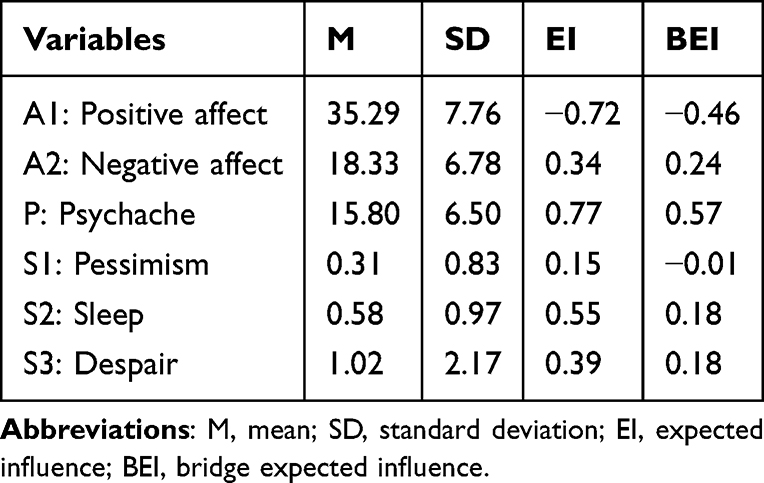 |
Table 1 The Means, SDs, EIs, and BEIs of Each Dimension |
Network Structure
The final network of affect, psychache, and suicidal ideation is shown in Figure 1A. The network contained 14 non-zero edges (93.33% of possible edges) with weights ranging from −0.19 to 0.28. The strongest connections identified were cross-community edges: psychache (P) was positively linked to negative affect (A2; edge weight = 0.28), sleep (S2; edge weight = 0.24), and despair (S3; edge weight = 0.21). Conversely, positive affect (A1) was negatively associated with a negative outlook (S1; edge weight = −0.19) and despair (S3; edge weight = −0.17). Within communities, the strongest edges were between sleep and despair (S2-S3; edge weight = 0.21) in the suicidal ideation community, and between positive and negative affect (A1-A2; edge weight = −0.18). All edge weights are detailed in Table 2. The bootstrapped 95% CI was narrow, suggesting accurate estimation of edge weights (see Supplementary Figure S1). The bootstrapped difference test for edge weights is shown in Supplementary Figure S2.
 |
Table 2 The Edge Weights in the Network Model of Affect, Psychache and Suicidal Ideation |
 |
Figure 1 Network structure of affect, psychache, and suicidal ideation and the EI and BEI of the nodes in the network. (A) Network structure of affect, psychache, and suicidal ideation. The blue edges represent positive relationships, whereas the red edges represent negative relationships. The thickness of an edge indicates the strength of the relationship. The weights of the edges are provided in Table 2. (B) The EI indices of the nodes in the network (raw values). (C)The BEI indices of the nodes in the network (raw values). Note: A1: positive affect; A2: negative affect; P: psychache; S1: pessimism; S2: sleep; S3: despair. |
Central Symptoms
The EI for each node is shown in Figure 1B. The nodes with the highest positive EI values were “psychache” (EI = 0.77) and “sleep” (EI = 0.55), identifying them as the most influential risk nodes in the network. In contrast, “positive affect” had the highest negative EI value (EI = −0.72), indicating its role as a central protective node. The CS coefficient for EI was 0.75, exceeding the recommended threshold of 0.50, which signifies that the estimation of EI was ideally stable (see Supplementary Figure S3). The results of the bootstrapped difference test for node EI are provided in Supplementary Figure S4.
Bridge Symptoms
The BEI for each node is shown in Figure 1C. The node with the highest positive BEI value was “psychache” (BEI = 0.57), identifying it as the most critical risk bridge node that may actively spread activation to the suicidal ideation community. Within the affect community, “positive affect” had the highest negative BEI value (BEI = −0.46), suggesting it serves as a primary protective bridge node that may inhibit the activation of symptoms in other communities. The CS coefficient for BEI was 0.75, exceeding the preferable threshold of 0.5, indicating ideal stability for the BEI estimation (see Supplementary Figure S5). Supplementary Figure S6 shows the result of the bootstrapped difference test for node BEI.
Gender Differences in Networks
There was no significant difference between males and females in terms of network invariance (network invariance M = 0.37, p = 0.67). There was also no significant difference between males and females in terms of overall strength invariance (overall strength invariance S = 0.08, p = 0.89). In terms of edge strength, we also found no significant difference between genders for most node pairs.
Discussion
While substantial research has examined affect, psychache, and suicidal ideation in isolation, this study is the first to investigate their fine-grained relationships in a joint framework using network analysis. Our findings deepen the theoretical understanding of the specific psychopathological pathways underlying these constructs and identify central and bridge symptoms that point to precise targets for prevention and intervention strategies. The reliability of our measurements was robust, with Cronbach’s α coefficients of 0.92 for positive affect and 0.91 for negative affect on the PANAS, 0.96 for the PAS, and 0.80 for the SIOSS. These high reliability estimates are strongly supported by both international and Chinese-specific studies. Internationally, our result for the PAS aligns exactly with the Spanish adaptation in young adults which reported an identical Cronbach’s α of 0.96,69 and our PANAS reliabilities are consistent with its excellent internal consistency recently demonstrated in university student populations.70 Within the Chinese context, the SIOSS has been established as a psychometrically sound tool for college students,71 and psychache has been consistently identified as a central construct in suicide research,72 thereby collectively reinforcing the transcultural stability and psychometric soundness of our assessment tools within our sample.
Building on this foundation of reliable measurement, our network model provided a fine-grained analysis of the relationships between these constructs. Within network theory, the edges bridging different communities are of particular interest, as they are thought to represent the psychopathological pathways that underlie comorbidity.73–75 Guided by this perspective, we identified and examined the key bridging connections in our network. Our results indicated that positive affect was significantly and negatively correlated with dimensions of suicidal ideation such as pessimism, sleep, and despair, whereas negative affect exhibited a significant positive correlation with these same dimensions. These findings align with a previous network analysis by Guo et al,46 yet they reveal a more complex picture than what is often found in studies using latent variable models based on total scores.23,27,32,33 For instance, longitudinal studies have shown that negative affect can predict future suicidal ideation with a time lag,76 while low positive affect independently predicts suicidal events.77,78 Our network findings thus consolidate and extend previous work by illustrating the specific, contemporaneous connections between these affective states and distinct components of suicidal ideation.
In addition, our results demonstrated that psychache was positively related to both the sleep and despair dimensions of suicidal ideation. This finding is consistent with a recent web-based network analysis, which also identified psychache as being positively linked to despair and sleep problems.47 The link between psychache and despair is conceptually coherent, as intolerable psychological pain often stems from a profound sense of hopelessness about one’s situation or future.79 This pathway is further corroborated by latent variable studies, which have similarly shown that deepening despair—often involving a loss of meaning in existence—significantly increases the risk of suicidal ideation.80–82 Furthermore, the association between psychache and sleep disturbances can be understood through established evidence suggesting that sleep disorders are significantly associated with suicidal ideation and that psychache may mediate this relationship.83 This implies a potential vicious cycle in which psychological pain disrupts sleep, which in turn may exacerbate the sense of despair and pain.
Interestingly, beyond these direct connections, our network suggested an indirect pathway. The positive correlation between psychache and negative affect indicates that psychache may also influence suicidal ideation by amplifying negative emotional states. This proposed pathway is consistent with prior experimental research demonstrating that intense psychological pain is associated with a heightened motivation to avoid such pain, a state inherently characterized by negative affect.84 This finding underscores the multifaceted role of psychache as a pivotal risk factor, an association robustly observed across different populations including adolescents and adults.85–88 Furthermore, within the interpersonal theory of suicide, feelings of being a burden and thwarted belongingness are established as key precursors to suicidal ideation.89 It is plausible that intense psychache contributes directly to the perception of being a burden, while also fueling the negative affect that characterizes a state of psychological pain, thereby creating a synergistic risk effect. This synergistic relationship is strongly supported by empirical models demonstrating a close, sequential pathway between perceived burdensomeness and psychache in the development of suicide risk.90
Regarding the most influential symptoms in the network, the EI indices identified psychache and sleep as the two most central risk nodes and positive affect as the central protective node. This indicates that these three symptoms had the greatest overall potential to activate or dampen the entire network of suicidal ideation. The centrality of sleep and positive affect is partially consistent with prior network studies on suicidal ideation.46,91 However, discrepancies exist, as other studies have identified despair and loneliness as central.44,47 We hypothesize that these differences likely stem from variations in study populations, measurement tools, other model-included variables, and potentially, cultural context. Indeed, the prominence of psychache and sleep problems may be particularly salient in our unique sample of Chinese youth grappling with the relentless pressures of “Neijuan”,48 where chronic stress directly manifests as profound psychological pain and sleep disruption.71,92 It is critical to interpret these identified nodes with caution; they represent promising but exploratory intervention targets, as the cross-sectional design of our study precludes causal inference and necessitates validation through future longitudinal or experimental research. The BEI analysis further clarified how risk and protection might spread. Psychache emerged as the most critical bridge node, positively connecting its own community to suicidal ideation, whereas positive affect served as the primary protective bridge node, with negative connections weakening the pathway to suicidal ideation. This pattern suggests a dynamic where psychache acts as a potent conduit for risk propagation into suicidal thoughts, whereas positive affect functions as a crucial buffer, helping to insulate an individual from this escalation.
The current study carries significant theoretical and clinical implications. Theoretically, these findings offer foundational insights into potential pathological pathways linking psychache, affect, and suicidal ideation, thereby advancing understanding of the mechanisms underlying their relationships. They clarify the specific roles of affect dimensions (positive and negative) and the overarching construct of psychache in the development and maintenance of suicidal ideation. Specifically, this study identifies positive associations between psychache and the sleep disturbance and despair dimensions of suicidal ideation, which may elucidate how psychache contributes to suicidal ideation. It also suggests a potential pathway wherein positive affect mitigates suicidal ideation through its negative association with the despair or pessimism dimensions of suicidal ideation. Furthermore, the negative correlation between positive affect and psychache provides another indirect explanation for positive affect’s protective role in reducing suicidal ideation.
Clinically, and consistent with the exploratory nature of our network model, these findings offer a valuable, hypothesis-generating foundation for developing targeted interventions. Central nodes are theorized to be promising intervention targets due to their potential for broad influence on the entire network.39,93–95 In our study, this implies that interventions focusing on the central risk nodes of sleep disturbance and psychache could yield widespread benefits by reducing the overall network activity of suicidal ideation. Similarly, bridge nodes are critical for interrupting cross-construct interactions between different symptom clusters.66,96,97 Our results indicate that mitigating psychache and enhancing positive affect, both of which serve dual roles as central and bridge nodes, could be particularly effective strategies for preventing the escalation of general psychological distress into active suicidal ideation.
To operationalize these targets, interventions can be precisely designed. For instance, to target the central node of sleep disturbance, digital Cognitive Behavioral Therapy for Insomnia (CBT-I) could be employed, which has direct evidence in not only improving sleep but also preventing and alleviating suicidal ideation.98 This approach is highly feasible for young adults, as even email-delivered CBT-I has proven effective in university student populations.99 For the central and bridge node of psychache, therapies focused on meaning-making, such as Acceptance and Commitment Therapy (ACT) or specific interventions grounded in psychache theory, could be deployed to alleviate mental pain, as demonstrated in suicidal patients with depression.100 Similarly, to bolster the protective central and bridge node of positive affect, well-established positive psychology interventions (PPIs) could be integrated into treatment plans. These include techniques such as behavioral activation, mindfulness-based practices, which have been shown to systematically enhance momentary positive emotions,101,102 and strength-based exercises, which aim to cultivate positive feelings like hope and optimism that are linked to reduced suicidal risk.103 This multifaceted approach provides a robust framework for systematically enhancing positive affective experiences.
Beyond these individual-level clinical interventions, our findings also support the development of broader public health and policy initiatives. For example, school-based and university-based mental health programs that incorporate universal screening for sleep problems and psychache could facilitate early identification of at-risk youth.104 Furthermore, the central role of sleep suggests that public health campaigns promoting sleep hygiene and later school start times could have a population-level impact on youth well-being.105 Finally, the scalability of digital interventions (eg, app-based CBT-I) makes them particularly suitable for reaching the large and tech-savvy young adult population. This approach is strongly supported by evidence that digital cognitive behavioral therapy for insomnia not only improves sleep but also directly prevents and alleviates suicidal ideation,98 thereby offering a potent and accessible strategy to address the critical issue of mental health service accessibility.
Despite its contributions, this study has inherent limitations. First, the cross-sectional design precludes any causal inference regarding the dynamic interactions among psychache, affect, and suicidal ideation in young adults. The observed network structure represents statistical associations at a single time point, and the directionality of influence between nodes remains hypothetical. Future studies must adopt longitudinal or experience-sampling designs to track the temporal precedence and causal relationships among these variables. Second, reliance on self-report measures introduces potential social desirability bias, particularly in young adult populations, necessitating cautious interpretation of associations. Third, the use of convenience sampling, while practical, may restrict the generalizability of our findings to the broader population of young adults. The sample may over-represent certain demographics or individuals with specific characteristics, potentially limiting the external validity of the identified network structure. While the psychological processes investigated here represent fundamental mechanisms, the specific configuration and strength of network connections may vary across populations. Future research should employ rigorous, randomized sampling strategies and directly compare network structures across diverse cultural and demographic groups to disentangle universal mechanisms from culturally specific expressions of psychopathological risk. Finally, while central and bridge nodes were identified as promising intervention targets, the translational efficacy of therapies targeting these nodes requires empirical validation in young adult cohorts through randomized controlled trials.
Conclusions
This study presents the first network analysis investigating the relationships between suicidal ideation, psychache, and affect in a joint framework. Our findings elucidate the specific interaction pathways among these constructs and identify psychache, sleep, and positive affect as pivotal central and bridge nodes. These exploratory insights highlight positive affect as a key protective factor, with negative affect and psychache emerging as significant risk factors within the network. While these findings pinpoint promising targets for clinical intervention, they are derived from a cross-sectional study with a convenience sampling strategy, and their causal efficacy and generalizability require validation through future longitudinal and experimental research. Clinically, this suggests that precisely tailored interventions, such as cognitive-behavioral therapy for insomnia to address sleep disturbances, psychache-focused therapies to alleviate psychological pain, and behavioral activation or mindfulness-based techniques to enhance positive affect, hold potential for effectively reducing suicidal ideation. Ultimately, this research elucidates the fine-grained structure and potential psychopathological pathways contributing to suicidal ideation in young adults, thereby providing a foundational model for future research and precision interventions.
Data Sharing Statement
The datasets presented in this article are not readily available because they contain sensitive information on suicidal ideation. Requests to access the datasets should be directed to the corresponding author, Qingjun Guo. The R code supporting the network analysis is available from the corresponding author upon reasonable request.
Ethical Approval Statement
The study strictly adhered to the Declaration of Helsinki and received approval from the Ethics Committee of the Air Force Hangzhou Special Recreation Centre (TLZX20241129-01). All participants have given their informed consent, and all methods were carried out in accordance with relevant guidelines and regulations.
Acknowledgments
We thank the participants for their thoughtful responses. In addition, we are deeply grateful to AJE Edit (https://www.aje.cn/) for their invaluable editorial assistance in the preparation of this manuscript.
Author Contributions
All authors made substantial contributions to conception and design, acquisition of data, or analysis and interpretation of data; took part in drafting the article or revising it critically for important intellectual content; agreed to submit to the current journal; gave final approval of the version to be published; and agree to be accountable for all aspects of the work.
Disclosure
The authors declare that the research was conducted in the absence of any commercial or financial relationships that could be construed as a potential conflict of interest.
References
1. World Health Organization. Suicide; 2025. Available from: https://www.who.int/news-room/fact-sheets/detail/suicide.
2. The Lancet Public Health. A public health approach to suicide prevention. Lancet Public Health. 2024;9(10):e709. doi:10.1016/S2468-2667(24)00220-2
3. GBD. Suicide collaborators. Global, regional, and national burden of suicide, 1990-2021: a systematic analysis for the global burden of disease study 2021. Lancet Public Health. 2025;10(3)e189–13. doi:10.1016/S2468-2667(25)00006-4
4. Zhao S, Zhang J. Suicide risks among adolescents and young adults in rural China. Int J Environ Res Public Health. 2014;12(1):131–145. doi:10.3390/ijerph120100131
5. Luo X, Li X, Liu L, Li C, Chang Y. Analysis on epidemiological characteristics and disease burden of suicide in different populations in China, 2010–2021. Dis Surveill. 2023;38:1391–1397. doi:10.3784/jbjc.202306290304
6. Nock MK, Green JG, Hwang I, et al. Prevalence, correlates, and treatment of lifetime suicidal behavior among adolescents: results from the national comorbidity survey replication adolescent supplement. JAMA Psychiatry. 2013;70(3):300–310. doi:10.1001/2013.jamapsychiatry.55
7. Dubé JP, Smith MM, Sherry SB, Hewitt PL, Stewart SH. Suicide behaviors during the COVID-19 pandemic: a meta-analysis of 54 studies. Psychiatry Res. 2021;301:113998. doi:10.1016/j.psychres.2021.113998
8. Klonsky ED, Dixon-Luinenburg T, May AM. The critical distinction between suicidal ideation and suicide attempts. World Psychiatry. 2021;20(3):439–441. doi:10.1002/wps.20909
9. Harmer B, Lee S, Rizvi A, Saadabadi A. Suicidal ideation. StatPearls [Internet]. Treasure Island (FL):StatPearls Publishing;2025. https://www.ncbi.nlm.nih.gov/books/NBK565877/.
10. Park SM, Cho SI, Moon SS. Factors associated with suicidal ideation: role of emotional and instrumental support. J Psychosom Res. 2010;69(4):389–397. doi:10.1016/j.jpsychores.2010.03.002
11. Coentre R, Góis C. Suicidal ideation in medical students: recent insights. Adv Med Educ Pract. 2018;9:873–880. doi:10.2147/AMEP.S162626
12. Wei S, Li H, Hou J, et al. Comparing characteristics of suicide attempters with suicidal ideation and those without suicidal ideation treated in the emergency departments of general hospitals in China. Psychiatry Res. 2018;262:78–83. doi:10.1016/j.psychres.2018.02.007
13. Musci RJ, Hart SR, Ballard ED, et al. Trajectories of suicidal ideation from sixth through tenth grades in predicting suicide attempts in young adulthood in an Urban African American Cohort. Suicide Life Threat Behav. 2016;46(3):255–265. doi:10.1111/sltb.12191
14. Buddeberg C, Buddeberg-Fischer B, Gnam G, Schmid J, Christen S. Suicidal behavior in Swiss students: an 18-month follow-up survey. Crisis. 1996;17(2):78–86. doi:10.1027/0227-5910.17.2.78
15. Franklin JC, Ribeiro JD, Fox KR, et al. Risk factors for suicidal thoughts and behaviors: a meta-analysis of 50 years of research. Psychol Bull. 2017;143(2):187–232. doi:10.1037/bul0000084
16. Zhu X, Tian L, Huebner ES. Trajectories of suicidal ideation from middle childhood to early adolescence: risk and protective factors. J Youth Adolesc. 2019;48(9):1818–1834. doi:10.1007/s10964-019-01087-y
17. McHugh CM, Corderoy A, Ryan CJ, Hickie IB, Large MM. Association between suicidal ideation and suicide: meta-analyses of odds ratios, sensitivity, specificity and positive predictive value. BJ Psych Open. 2019;5(2):e18. doi:10.1192/bjo.2018.88
18. Cha CB, Franz PJ, Guzmán M, Glenn E, Kleiman CR, Nock MK. Annual research review: suicide among youth - epidemiology, (potential) etiology, and treatment. J Child Psychol Psychiatr. 2018;59(4):460–482. doi:10.1111/jcpp.12831
19. Shneidman ES. Suicide as psychache. J Nerv Ment Dis. 1993;181(3):145–147. doi:10.1097/00005053-199303000-00001
20. Campos RC, Holden RR, Gomes M. Assessing psychache as a suicide risk variable: data with the Portuguese version of the psychache scale. Death Stud. 2019;43(8):527–533. doi:10.1080/07481187.2018.1493002
21. Hall BB, Webb JR, Hirsch JK. Spirituality and suicidal behavior: the mediating role of self-forgiveness and psychache. Psychol Relig Spirit. 2020;12:36–44. doi:10.1037/rel0000182
22. Pereira AM, Campos RC. Exposure to suicide in the family and suicidal ideation in Portugal during the Covid-19 pandemic: the mediating role of unbearable psychache. Br J Clin Psychol. 2022;61(3):598–612. doi:10.1111/bjc.12325
23. Troister T, Holden RR. A two-year prospective study of psychache and its relationship to suicidality among high-risk undergraduates. J Clin Psychol. 2012;68(9):1019–1027. doi:10.1002/jclp.21869
24. Hawton K, Saunders KE, O’Connor RC. Self-harm and suicide in adolescents. Lancet. 2012;379(9834):2373–2382. doi:10.1016/S0140-6736(12)60322-5
25. Johnson JG, Cohen P, Kasen S, Brook JS. Psychiatric disorders associated with suicidal ideation and attempts among children and adolescents. J Am Acad Child Adolesc Psychiatry. 2018;57:749–757.
26. Deng Y, Cherian J, Khan NUN, et al. Family and academic stress and their impact on students’ depression level and academic performance. Front Psychiatry. 2022;13:869337. doi:10.3389/fpsyt.2022.869337
27. Li X, You J, Ren Y, et al. A longitudinal study testing the role of psychache in the association between emotional abuse and suicidal ideation. J Clin Psychol. 2019;75(12):2284–2292. doi:10.1002/jclp.22847
28. Watson D, Stanton K. Emotion blends and mixed emotions in the hierarchical structure of affect. Emot Rev. 2017;9(2):99–104. doi:10.1177/1754073916639659
29. Teismann T, Brailovskaia J, Margraf J. Positive mental health, positive affect and suicide ideation. Int J Clin Health Psychol. 2019;19(2):165–169. doi:10.1016/j.ijchp.2019.02.003
30. Lucht L, Spangenberg L, Forkmann T, et al. Association of real-time assessed mood, affect and suicidal ideation in psychiatric inpatients with unipolar depression. Clin Psychol Psychother. 2022;29(5):1580–1586. doi:10.1002/cpp.2741
31. Schatten HT, Brick LA, Holman CS, Czyz E. Differential time varying associations among affective states and suicidal ideation among adolescents following hospital discharge. Psychiatry Res. 2021;305:114174. doi:10.1016/j.psychres.2021.114174
32. Rubio A, Oyanedel JC, Bilbao M, Mendiburo-Seguel A, López V, Páez D. Suicidal ideation mediates the relationship between affect and suicide attempt in adolescents. Front Psychol. 2020;11:524848. doi:10.3389/fpsyg.2020.524848
33. Extremera N, Rey L, Quintana-Orts C, Mérida-López S, Neto F. A 4-month prospective study of the relationship between emotional intelligence and suicide ideation in Spanish adolescents: the mediating role of positive and negative affect. Death Stud. 2023;47(4):509–513. doi:10.1080/07481187.2022.2072019
34. Layrón Folgado JE, Conchado Peiró A, Marco JH, Barrigón ML, Baca-García E, Pérez Rodríguez S. Trajectory analysis of suicidal ideation in spanish college students using ecological momentary assessment. Front Psychiatry. 2022;13:853464. doi:10.3389/fpsyt.2022.853464
35. Husky M, Swendsen J, Ionita A, et al. Predictors of daily life suicidal ideation in adults recently discharged after a serious suicide attempt: a pilot study. Psychiatry Res. 2017;256:79–84. doi:10.1016/j.psychres.2017.06.035
36. Fried EI, Nesse RM. Depression sum-scores don’t add up: why analyzing specific depression symptoms is essential. BMC Med. 2015;13(1):72. doi:10.1186/s12916-015-0325-4
37. Schmittmann VD, Cramer AOJ, Waldorp LJ, Epskamp S, Kievit RA, Borsboom D. Deconstructing the construct: a network perspective on psychological phenomena. New Ideas Psychol. 2013;31(1):43–53. doi:10.1016/j.newideapsych.2011.02.007
38. De Beurs D, Fried EI, Wetherall K, et al. Exploring the psychology of suicidal ideation: a theory driven network analysis. Behav Res Ther. 2019;120:103419. doi:10.1016/j.brat.2019.103419
39. Borsboom D. A network theory of mental disorders. World Psychiatry. 2017;16(1):5–13. doi:10.1002/wps.20375
40. McNally RJ. Can network analysis transform psychopathology? Behav Res Ther. 2016;86:95–104. doi:10.1016/j.brat.2016.06.006
41. Epskamp S, Borsboom D, Fried EI. Estimating psychological networks and their accuracy: a tutorial paper. Behav Res Methods. 2018;50(1):195–212. doi:10.3758/s13428-017-0862-1
42. Cai H, Bai W, Sha S, et al. Identification of central symptoms in Internet addictions and depression among adolescents in Macau: a network analysis. J Affect Disord. 2022;302:415–423. doi:10.1016/j.jad.2022.01.068
43. Fong TCT, Junus A, Wen M, Yip PSF. Comorbidity among symptoms of internet gaming disorder, social withdrawal, and depression in 3430 young people in Hong Kong: a network analysis. J Affect Disord. 2024;359:319–326. doi:10.1016/j.jad.2024.05.091
44. Zhong S, Cheng D, Su J, et al. A network analysis of depressive symptoms, psychosocial factors, and suicidal ideation in 8686 adolescents aged 12-20 years. Psychiatry Res. 2023;329:115517. doi:10.1016/j.psychres.2023.115517
45. de Beurs D, Bockting C, Kerkhof A, et al. A network perspective on suicidal behavior: understanding suicidality as a complex system. Suicide Life Threat Behav. 2021;51(1):115–126. doi:10.1111/sltb.12676
46. Guo Z, Yang T, He Y, et al. The relationships between suicidal ideation, meaning in life, and affect: a network analysis. Int J Ment Health Addict. 2023:1–20. doi:10.1007/s11469-023-01019-9
47. Li Y, Guo Z, Tian W, et al. An investigation of the relationships between suicidal ideation, psychache, and meaning in life using network analysis. BMC Psychiatry. 2023;23(1):257. doi:10.1186/s12888-023-04700-4
48. Zhang W, Pan C, Yao S, et al. “Neijuan” in China: the psychological concept and its characteristic dimensions. Acta Psychol Sin. 2024;56(1):107–123. doi:10.3724/SP.J.1041.2024.00107
49. Tingshuai G, Van leeuwen FJ, Jiang Q, Leopold L. Mental health in China: social change in life course trajectories. Popul Dev Rev. 2026;50(2):759–796. doi:10.1111/padr.12684
50. Li H, Han Y, Xiao Y, Liu X, Li A, Zhu T. Suicidal ideation risk and socio-cultural factors in China: a longitudinal study on social media from 2010 to 2018. Int J Environ Res Public Health. 2021;18(3):1098. doi:10.3390/ijerph18031098
51. Sawyer SM, Azzopardi PS, Wickremarathne D, Patton GC. The age of adolescence. Lancet Child Adolesc Health. 2018;2(3):223–228. doi:10.1016/s2352-4642(18)30022-1
52. Hawton K, Hill NTM, Gould M, John A, Lascelles K, Robinson J. Clustering of suicides in children and adolescents. Lancet Child Adolesc Health. 2020;4(1):58–67. doi:10.1016/s2352-4642(19)30335-9
53. Come AX, Polanco-Roman L, Dos Santos PF, et al. Social and psychiatric factors of suicidal thoughts and behaviors in mozambican adolescents. J Am Acad Child Psy. 2022;61(7):841–844.e1. doi:10.1016/j.jaac.2022.03.032
54. Watson D, Clark LA, Tellegen A. Development and validation of brief measures of positive and negative affect: the PANAS scales. J Pers Soc Psychol. 1988;54(6):1063–1070. doi:10.1037//0022-3514.54.6.1063
55. Huang L, Yang T, Li Z. Applicability of the positive and negative affect scale in Chinese. Chin Ment Health J. 2003;17:54–56.
56. Holden RR, Mehta K, Cunningham EJ, McLeod LD. Development and preliminary validation of a scale of psychache. Can J Behav Sci. 2001;33:224–232. doi:10.1037/h0087144
57. Yang L, Chen W. Reliability and validity of the psychache scale in Chinese undergraduates. Chin J Clin Psychol. 2017;25:475–478. doi:10.16128/j.cnki.1005-3611.2017.03.017
58. Xia CY, Wang DB, He XD, Ye SH. Study of self-rating idea of undergraduates in the mountain area of Southern Zhejiang. Chin J Sch Health. 2012;33:144–146. doi:10.3969/j.issn.1005-3220.2002.02.030
59. Epskamp S, Cramer AOJ, Waldorp LJ, Schmittmann VD, Borsboom D. QGraph: network visualizations of relationships in psychometric data. J Stat Softw. 2012;48(4):1–18. doi:10.18637/jss.v048.i04
60. Epskamp S, Waldorp LJ, Mõttus R, Borsboom D. The Gaussian graphical model in cross-sectional and time-series data. Multivariate Behav Res. 2018;53(4):453–480. doi:10.1080/00273171.2018.1454823
61. Epskamp S, Fried EI. A tutorial on regularized partial correlation networks. Psychol Methods. 2018;23(4):617–634. doi:10.1037/met0000167
62. Friedman J, Hastie T, Tibshirani R. Sparse inverse covariance estimation with the graphical lasso. Biostatistics. 2008;9(3):432–441. doi:10.1093/biostatistics/kxm045
63. Chen J, Chen Z. Extended Bayesian information criteria for model selection with large model spaces. Biometrika. 2008;95(3):759–771. doi:10.1093/biomet/asn034
64. Foygel R, Drton M. Extended Bayesian information criteria for Gaussian graphical models. Adv Neural Inf Process Syst. 2010;23:2020–2028. doi:10.48550/arXiv.1011.6640
65. Robinaugh DJ, Millner AJ, McNally RJ. Identifying highly influential nodes in the complicated grief network. J Abnorm Psychol. 2016;125(6):747–757. doi:10.1037/abn0000181
66. Jones PJ, Ma R, McNally RJ. Bridge centrality: a network approach to understanding comorbidity. Multivariate Behav Res. 2021;56(2):353–367. doi:10.1080/00273171.2019.1614898
67. Mullarkey MC, Marchetti I, Beevers CG. Using network analysis to identify central symptoms of adolescent depression. J Clin Child Adolesc Psychol. 2019;48(4):656–668. doi:10.1080/15374416.2018.1437735
68. van Borkulo CD, van Bork R, Boschloo L, et al. Comparing network structures on three aspects: a permutation test. Psychol Methods. 2023;28(6):1273–1285. doi:10.1037/met0000476
69. Ordóñez-Carrasco JL, Cuadrado Guirado I, Rojas Tejada A. Scale of psychological pain: spanish adaptation of the psychache scale in young adults. Rev Psiquiatr Salud Ment Engl Ed. 2022;15(3):196–204. doi:10.1016/j.rpsmen.2022.09.006
70. Di Fabio A, Svicher A. Positive and negative affect in studies scale (PANASS): psychometric properties in university students. Couns Giorn Ital Ric Appl. 2024;17(3):90–100.
71. Xu H, Yang X, Lai X, et al. Longitudinal relationships among perceived stress, suicidal ideation and sleep quality in Chinese undergraduates: a cross-lagged model. J Affect Disord. 2022;299:45–51. doi:10.1016/j.jad.2021.11.033
72. Cheng Y, Zhao WW, Chen SY, Zhang YH. Research on psychache in suicidal population: a bibliometric and visual analysis of papers published during 1994-2020. Front Psychiatry. 2021;12:727663. doi:10.3389/fpsyt.2021.727663
73. Nelson JD, Cuellar AE, Cheskin LJ, Fischer S. Eating disorders and posttraumatic stress disorder: a network analysis of the comorbidity. Behav Ther. 2022;53(2):310–322. doi:10.1016/j.beth.2021.09.006
74. Knefel M, Karatzias T, Spinazzola J, Shevlin M, Ford JD. The relationship of posttraumatic stress disorder and developmental trauma disorder with childhood psychopathology: a network analysis. J Anxiety Disord. 2023;99:102766. doi:10.1016/j.janxdis.2023.102766
75. An Y, Shi J, Chuan-Peng H, Wu X. The symptom structure of posttraumatic stress disorder and co-morbid depression among college students with childhood abuse experience: a network analysis. J Anxiety Disord. 2021;293:466–475. doi:10.1016/j.jad.2021.06.065
76. Selby EA, Yen S, Spirito A. Time varying prediction of thoughts of death and suicidal ideation in adolescents: weekly ratings over 6-month follow-up. J Clin Child Adolesc Psychol. 2013;42(4):481–495. doi:10.1080/15374416.2012.736356
77. Rojas SM, Leen-Feldner EW, Blumenthal H, Lewis SF, Feldner MT. Risk for suicide among treatment seeking adolescents: the role of positive and negative affect intensity. Cogn Ther Res. 2014;39(2):100–109. doi:10.1007/s10608-014-9650-8
78. Yen S, Weinstock LM, Andover MS, Sheets ES, Selby EA, Spirito A. Prospective predictors of adolescent suicidality: 6-month post-hospitalization follow-up. Psychol Med. 2013;43(5):983–993. doi:10.1017/S0033291712001912
79. Orbach I, Mikulincer M, Sirota P, Gilboa-Schechtman E. Mental pain: a multidimensional operationalization and definition. Suicide Life Threat Behav. 2003;33(3):219–230. doi:10.1521/suli.33.3.219.23219
80. Siau CS, Klonsky ED, Kõlves K, et al. Psychache, hopelessness, and suicidal ideation and behaviors: a cross-sectional study from China. Int J Environ Res Public Health. 2024;21(7):885. doi:10.3390/ijerph21070885
81. Cho JK, Yang H, Park J, et al. Association between allergic rhinitis and despair, suicidal ideation, and suicide attempts in Korean adolescents: a nationally representative study of one million adolescents. Eur Rev Med Pharmacol Sci. 2023;27(19):9248–9256. doi:10.26355/eurrev_202310_33952
82. Bradford DRR, Biello SM, Russell K. Insomnia symptoms mediate the association between eveningness and suicidal ideation, defeat, entrapment, and psychological distress in students. Chronobiol Int. 2021;38(10):1397–1408. doi:10.1080/07420528.2021.1931274
83. Becker G, Orbach I, Mikulincer M, Iohan M, Gilboa-Schechtman E, Grossman-Giron A. Reexamining the mental pain-suicidality link in adolescence: the role of tolerance for mental pain. Suicide Life Threat Behav. 2019;49(4):1072–1084. doi:10.1111/sltb.12506
84. Meerwijk EL, Weiss SJ. Tolerance for psychological pain and capability for suicide: contributions to suicidal ideation and behavior. Psychiatry Res. 2018;262:203–208. doi:10.1016/j.psychres.2018.02.005
85. Xie W, Li H, Luo X, et al. Anhedonia and pain avoidance in the suicidal mind: behavioral evidence for motivational manifestations of suicidal ideation in patients with major depressive disorder. J Clin Psychol. 2014;70(7):681–692. doi:10.1002/jclp.22055
86. Ducasse D, Holden RR, Boyer L, et al. Psychological pain in suicidality: a meta-analysis. J Clin Psychiatry. 2018;79(3):16r10732. doi:10.4088/JCP.16r10732
87. Ribeiro JD, Huang X, Fox KR, Franklin JC. Depression and hopelessness as risk factors for suicide ideation, attempts and death: meta-analysis of longitudinal studies. Br J Psychiatry. 2018;212(5):279–286. doi:10.1192/bjp.2018.27
88. Mento C, Silvestri MC, Muscatello MRA, et al. Psychological pain and risk of suicide in adolescence. Int J Adolesc Med Health. 2020;34(3). doi:10.1515/ijamh-2019-0270
89. Barzilay S, Feldman D, Snir A, et al. The interpersonal theory of suicide and adolescent suicidal behavior. J Affect Disord. 2015;183:68–74. doi:10.1016/j.jad.2015.04.047
90. Brooks BD, Dangel TJ, Kaniuka AR, et al. Thwarted belongingness and suicide risk in primary care: perceived burdensomeness and psychache as mediators. J Clin Psychol Med Settings. 2024;31(1):122–129. doi:10.1007/s10880-023-09960-6
91. Ma S, Yang J, Xu J, et al. Using network analysis to identify central symptoms of college students’ mental health. J Affect Disord. 2022;311:47–54. doi:10.1016/j.jad.2022.05.065
92. Wang Y, Jing X, Han W, Jing Y, Xu L. Positive and negative affect of university and college students during COVID-19 outbreak: a network-based survey. Int J Public Health. 2020;65(8):1437–1443. doi:10.1007/s00038-020-01483-3
93. Borsboom D, Cramer AO. Network analysis: an integrative approach to the structure of psychopathology. Annu Rev Clin Psychol. 2013;9:91–121. doi:10.1146/annurev-clinpsy-050212-185608
94. Wang Z, Huang R, Yang D, Peng Y, Zhou B, Chen Z. Identifying influential nodes based on the disassortativity and community structure of complex network. Sci Rep. 2024;14(1):8453. doi:10.1038/s41598-024-59071-x
95. Shang Q, Zhang B, Li H, Deng Y. Identifying influential nodes: a new method based on network efficiency of edge weight updating. Chaos. 2021;31(3):033120. doi:10.1063/5.0033197
96. Byrne ME, Tanofsky-Kraff M, Lavender JM, et al. Bridging executive function and disinhibited eating among youth: a network analysis. Int J Eat Disord. 2021;54(5):721–732. doi:10.1002/eat.23476
97. Wang LL, Tam MHW, KKY H, et al. Bridge centrality network structure of negative symptoms in people with schizophrenia. Eur Arch Psychiatry Clin Neurosci. 2023;273(3):589–600. doi:10.1007/s00406-022-01474-w
98. Kalmbach DA, Cheng P, Ahmedani BK, et al. Cognitive-behavioral therapy for insomnia prevents and alleviates suicidal ideation: insomnia remission is a suicidolytic mechanism. Sleep. 2022;45(12):zsac251. doi:10.1093/sleep/zsac251
99. Chang YP, Pereira T, Salinas A, Or HY, Morales M, Le ML. Effects of an Email delivered cognitive behavioral therapy for insomnia in college students. Perspect Psychiatr Care. 2021;57(4):1685–1692. doi:10.1111/ppc.12736
100. Zou Y, Li H, Shi C, Lin Y, Zhou H, Zhang J. Efficacy of psychological pain theory-based cognitive therapy in suicidal patients with major depressive disorder: a pilot study. Psychiatry Res. 2017;249:23–29. doi:10.1016/j.psychres.2016.12.046
101. Geschwind N, Peeters F, Drukker M, van Os J, Wichers M. Mindfulness training increases momentary positive emotions and reward experience in adults vulnerable to depression: a randomized controlled trial. J Consult Clin Psychol. 2011;79(5):618–628. doi:10.1037/a0024595
102. Forkmann T, Brakemeier EL, Teismann T, Schramm E, Michalak J. The effects of mindfulness-based cognitive therapy and cognitive behavioral analysis system of psychotherapy added to treatment as usual on suicidal ideation in chronic depression: results of a randomized-clinical trial. J Affect Disord. 2016;200:51–57. doi:10.1016/j.jad.2016.01.047
103. Arora S, Sharma V. Positive suicidology: promoting well-being and addressing suicide. In: Kumar U, editor. Handbook of Suicide Prevention. Singapore: Springer; 2025; pp. 517–530. doi:10.1007/978-981-96-1403-5_28
104. Connors EH, Moffa K, Carter T, et al. Advancing mental health screening in schools: innovative, field-tested practices and observed trends during a 15-month learning collaborative. Psychol Sch. 2022;59(6):1135–1157. doi:10.1002/pits.22670
105. Marx R, Tanner-Smith EE, Davison CM, et al. Later school start times for supporting the education, health, and well-being of high school students: a systematic review. Campbell Syst Rev. 2017;13(1):1–99. doi:10.4073/csr.2017.15
 © 2026 The Author(s). This work is published and licensed by Dove Medical Press Limited. The
full terms of this license are available at https://www.dovepress.com/terms
and incorporate the Creative Commons Attribution
- Non Commercial (unported, 4.0) License.
By accessing the work you hereby accept the Terms. Non-commercial uses of the work are permitted
without any further permission from Dove Medical Press Limited, provided the work is properly
attributed. For permission for commercial use of this work, please see paragraphs 4.2 and 5 of our Terms.
© 2026 The Author(s). This work is published and licensed by Dove Medical Press Limited. The
full terms of this license are available at https://www.dovepress.com/terms
and incorporate the Creative Commons Attribution
- Non Commercial (unported, 4.0) License.
By accessing the work you hereby accept the Terms. Non-commercial uses of the work are permitted
without any further permission from Dove Medical Press Limited, provided the work is properly
attributed. For permission for commercial use of this work, please see paragraphs 4.2 and 5 of our Terms.
Recommended articles
Innovative Analysis of the Interconnected Network Structure Between Anxiety and Sleep Quality Among College Students
He Y, Yang T, Guo Q, Wu S, Liu W, Xu T
Psychology Research and Behavior Management 2025, 18:607-618
Published Date: 13 March 2025
Seeking Satisfaction Among Israeli Young Adults: The Roles of Gratification, Compensation, Reward Deficiency Syndrome, and Compulsivity in Relation to Addictive Behaviors
Efrati Y, Demetrovics Z, Horváth Z, Griffiths MD, Potenza MN, Blum K, Czakó A, Kotyuk E
Substance Abuse and Rehabilitation 2025, 16:177-191
Published Date: 2 July 2025
Chronic Disease Prevalence and Modifiable Risk Factors Among Undergraduate Students at Ha’il University: A Population-Level Cross-Sectional Study
Asweto CO, Hassan SUN, Alzain MA, Alsaif B, Saeed ME, Kassar A, Mohammed Ali KE, Ghorbel M, Zrieq R, Hamed M, Wang W
Risk Management and Healthcare Policy 2026, 19:604127
Published Date: 20 May 2026