
Back to Journals » Psychology Research and Behavior Management » Volume 17
The Relationship Between Childhood Emotional Abuse and Nonsuicidal Self-Injury Among Chinese College Students: The Mediating Role of Depression and the Moderating Effect of Reciprocal Filial Piety

Received 11 October 2024
Accepted for publication 10 December 2024
Published 21 December 2024 Volume 2024:17 Pages 4345—4354
DOI https://doi.org/10.2147/PRBM.S498812
Checked for plagiarism Yes
Review by Single anonymous peer review
Peer reviewer comments 2
Editor who approved publication: Dr Gabriela Topa
Ling Yang,1,2 Yang Li,3 Wenchao Wang3
1Center for Southeast Asian Economic and Culture Studies, Chengdu Normal University, Chengdu, 611130, People’s Republic of China; 2School of History, Geography and Tourism, Chengdu Normal University, Chengdu, 611130, People’s Republic of China; 3Beijing Key Laboratory of Applied Experimental Psychology, National Demonstration Center for Experimental Psychology Education (Beijing Normal University), Faculty of Psychology, Beijing Normal University, Beijing, 100875, People’s Republic of China
Correspondence: Wenchao Wang, Faculty of Psychology, Beijing Normal University, No. 19 Xinjiekouwai Street, Beijing, 100875, People’s Republic of China, Tel/Fax +008601058801884, Email [email protected]
Purpose: Nonsuicidal self-injury (NSSI) is a serious issue among college students, which might affect the development of their mental health. Based on Nock’s integrated model of NSSI and the biosocial development model, the present study constructed a moderated mediation model to explore the psychological mechanism between childhood emotional abuse and NSSI.
Patients and Methods: Self-reporting data on emotional abuse, depression, NSSI, and filial piety were collected from 3720 (57.5% female) college students in China using a two-wave design survey. Structural equation modeling was used to test the effect of mediation and moderation.
Results: Emotional abuse, depression, and NSSI were significantly and positively correlated with each other. RFP was negatively correlated with emotional abuse, depression, and NSSI, whereas AFP demonstrated a positive correlation with depression, and NSSI. A significant positive indirect relation of emotional abuse to NSSI through depression was found (β = 0.06, SE = 0.01, 95% CI = [0.05, 0.08]). Moreover, the mediating effect was moderated by reciprocal filial piety (RFP) but not authoritarian filial piety (AFP). Specifically, a higher level of RFP buffered the relationship between emotional abuse and depression (β = 0.43, p < 0.001) and the relationship between depression and NSSI (β = 0.07, p = 0.007).
Conclusion: This study reveals the mechanism of the relationship between childhood emotional abuse and NSSI in Chinese college students, and emphasizes the role of depression and RFP. What’s more, AFP did not exert a significant effect. It also suggests that interventions focusing on depression and cultivation of RFP may reduce the effect of childhood emotional abuse on NSSI.
Keywords: childhood emotional abuse, depression, NSSI, filial piety, college students
A Letter to the Editor has been published for this article.
Introduction
Nonsuicidal self-injury (NSSI), defined as the deliberate damage of one’s body tissue without suicidal intent,1 is prevalent among college students. Studies have indicated that the prevalence of NSSI among college students is close to 20%.2,3 NSSI can lead to significant physical harm, and it may also result in severe psychopathology or an increased risk of suicide.4,5 Therefore, it is essential to investigate the mechanisms associated with NSSI among college students to develop more effective interventions and prevention strategies.
Emotional Abuse Affects NSSI
According to Nock’s integrated model of NSSI,6 childhood maltreatment is a significant distal risk factor for NSSI. Childhood maltreatment encompasses various forms of abuse and neglect,7 with emotional abuse being the most influential factor for NSSI.8,9 Emotional abuse refers to verbal abuse, rejection, terrorization, abandonment, and psychological unavailability.10 Yates’ developmental psychopathology theory posits that childhood maltreatment disrupts the development of critical early emotional regulation abilities, leading to impaired adaptive functioning.11 As a result, individuals are more likely to adopt maladaptive strategies, such as NSSI, to cope with stressors and negative emotions.12 Numerous studies have demonstrated a positive correlation between emotional abuse and NSSI in college students.13–15 Furthermore, compared to other forms of abuse, emotional abuse makes the largest contribution to NSSI.16 This underscores the necessity of focusing on the specific mechanisms by which emotional abuse influences NSSI.
The Mediating Role of Depression
The functional model of self-injury posits that self-harm can alleviate or terminate the reinforcement of negative emotions, such as depression.17 When individuals lack effective emotional regulation strategies, they may resort to inflicting physical pain as a means of alleviating psychological distress, as it can serve as a rapid and effective strategy for regulating depressive emotions.12 Depression is the key emotional factor influencing self-injury. A meta-analysis of the factors influencing NSSI identified depression as the most significant emotional variable.18 Several longitudinal studies have also confirmed the positive predictive effect of depression on NSSI.19–21
Several studies have found that childhood emotional abuse plays a crucial role in the development and persistence of depression among college students.22–24 According to Yates, childhood emotional abuse significantly disrupts a child’s ability to regulate emotions, and children may imitate the abuser’s poor emotional management strategies, making them more prone to negative emotions (eg depression).11 Studies have confirmed that a major contributing factor to increased depression risk is insufficient emotional regulation capacity.25 A meta-analysis of 184 studies also found that childhood emotional abuse is most strongly associated with the severity of depression in adulthood.26 Thus, based on the above evidence, the mediating role of depression between emotional abuse and NSSI is hypothesized. However, whether other variables exert a protective effect in this relationship remains underexplored. Therefore, further exploration of potential variables that may influence the strength and direction of these relationships is needed to enhance understanding of the framework surrounding NSSI.
Filial Piety as a Potential Moderator
Linehan’s biosocial development model pointed out that psychosocial risk factors, including cultural and familial environments, are significant contributors to NSSI.27 Filial piety is considered a core component of Confucian cultural values and, therefore, a central aspect of Chinese culture.28 An old Chinese proverb states, “Bǎi Shàn Xiào Wéi Xiān”, meaning that filial piety is regarded as the foremost virtue of kindness. Thus, it is important to focus on the role of filial piety among Chinese students. Filial piety refers to an individual’s adherence to a set of norms, values, and practices regarding how children should interact with their parents.29 Yeh’s dual filial piety model divides filial piety into reciprocal filial piety (RFP) and authoritarian filial piety (AFP).30 RFP refers to children’s positive and voluntary care for their parents, motivated by gratitude and love, whereas AFP emphasizes children’s unilateral and unconditional obedience to their parents, based on the hierarchical structure of the family.29
Previous empirical research has suggested that RFP may promote positive psychological development and alleviate negative psychological symptoms.31,32 Conversely, AFP has been shown to harm mental health.31,32 A meta-analysis summarizing 40 studies on filial piety found that RFP is frequently negatively correlated with psychopathologies such as depression, anxiety, and suicide, whereas AFP is significantly positively correlated with disorders such as eating disorders but negatively correlated with suicide risk.33 Additionally, a study on Chinese sexual minority men found that RFP buffered the impact of sexual minority stigma on NSSI and suicide risk, whereas AFP had no significant effect.34 These two forms of filial piety may also play distinct roles in the model used in the present study. As RFP emphasizes emotional communication and mutual respect between children and parents, individuals practicing RFP may receive more family support, thereby reducing depressive symptoms stemming from childhood abuse.35 Out of a sense of responsibility and care for their parents, they may also avoid self-harm as it would be seen as an act of filial disobedience. In contrast, AFP emphasizes unconditional obedience to parental authority,36 which may undermine self-esteem and increase the risk of depression. However, strict adherence to parental authority may also deter individuals from engaging in self-harm. Therefore, RFP is hypothesized to act as a protective moderating factor in the model linking childhood abuse to NSSI. However, due to the limited and mixed findings regarding AFP, specific hypotheses about its moderating effect are not proposed.
The Present Study
In summary, previous research has established preliminary associations between childhood emotional abuse, depression, and NSSI. However, research on protective factors remains limited, and few studies have incorporated psychosocial variables. Investigating protective factors can offer strategies for NSSI intervention and prevention while incorporating psychosocial variables broadens theoretical and empirical perspectives on NSSI. Therefore, drawing upon Nock’s integrated model of NSSI and the biosocial development model, this study constructed a moderated mediation model (see Figure 1). It is hypothesized that emotional abuse is associated with NSSI in college students through the mediating effect of depression (Hypothesis 1). Furthermore, based on the dual filial piety model, higher levels of RFP are hypothesized to attenuate the effect of emotional abuse on depression and the effect of depression on NSSI (Hypothesis 2). The moderating effect of AFP is explored without predefined hypotheses (Hypothesis 3).
 |
Figure 1 Moderated Mediation model among emotional abuse, depression, filial piety, and NSSI. Abbreviations: NSSI, Nonsuicidal self-injury; T1, Time 1; T2, Time 2. |
Methods
Participants
After gaining approval from the local education authorities, we conducted two surveys with a 6-month interval at a college in China’s central province. 6287 students completed the first survey at Time 1 and 3720 students (59.2%) completed the second survey at Time 2. Despite a relatively high attrition rate, we selected participants who attended both two waves, ensuring that it did not impact our final results and conclusions. The loss to follow-up of participants was mainly attributed to graduation, and there was no significant difference between the loss-to-follow-up participants and the full participants in baseline emotional abuse (t[6285] = -1.93, p =.053), depression (t[6285] = -1.89, p =.058), and filial piety (t[6285] = -0.743, p =.457). Of the 3720 participants, 1580 (42.5%) were male, and 2140 (57.5%) were female. Participants had a mean age of 18.89 years (SD = 1.24) with a range of 18–22 years at Time 1.
Procedures
Professional psychology-trained teaching staff at each college were contacted before the survey, and those who expressed interest in the study assisted with data collection. Based on their teaching schedules, they selected classes from each major in the school for the survey, conducted during the spare time of these classes. Preceding each survey, students received an oral briefing highlighting their voluntary participation. Any student not wishing to participate could freely leave the classroom. All remaining students were then invited to complete an online questionnaire anonymously. Under the guidance of professionally trained psychology graduate students, participants were prompted to answer questions in an online survey using the application software on their mobile phones, which lasted no longer than 30 minutes. In this study, we acquired informed consent from each participant. This study was approved by the ethics committee of the Faculty of Psychology, Beijing Normal University (protocol number: No.12220085) and complied with the Declaration of Helsinki. At Time 1, data on emotional abuse, depression, filial piety, and demographic variables were collected from the participants. At Time 2, data regarding NSSI was collected from the participants. Additionally, participants were informed that school psychologists or teachers could provide psychological or counseling services if needed.
Measures
Emotional Abuse
The emotional abuse subscale of the Childhood Trauma Questionnaire-Short Form, developed by Bernstein et al,37 was utilized to measure the frequency of childhood emotional abuse experiences among participants before the age of 16. The Chinese version of this questionnaire has been demonstrated to be a reliable and valid measurement.38 The scale contains 5 items (eg, “I felt like my parents wished they had never given birth to me”) which are rated on a 5-point Likert scale ranging from 1 (never) to 5 (very often). Higher total scores indicate more frequent exposure to emotional abuse. Cronbach’s α for the emotional abuse was 0.698.
Depression
The Center for Epidemiological-Studies Depression Scale (CES-D-20) was used to assess the degree of depression among participants.39 The Chinese version of the CES-D-20 had previously been refined by Chen et al and demonstrated good reliability and construct validity in Chinese populations.40 The scale contains 20 items (eg, “I feel sad”) which are rated on a 4-point Likert scale from 0 (never) to 3 (always). Higher total scores indicate higher levels of depression. Cronbach’s α for the depression was 0.890.
Filial Piety
The Filial Piety Scale was used to assess the participants’ filial piety,30 which has been shown to be reliable and valid in previous studies with Chinese samples.41 The scale contains 10 items which are divided into two dimensions: reciprocal filial piety (RFP, 5 items; eg, “When parents are unhappy, children should talk to their parents and understand and comfort them”) and authoritarian filial piety (AFP, 5 items; eg, “No matter what parents do, children should do it immediately”). The items are rated on a 5-point Likert scale ranging from 1 (totally disagree) to 5 (totally agree). Cronbach’s α was 0.970 for RFP and 0.871 for AFP.
NSSI
The first part of the Inventory of Statements About Self-injury (ISAS) was used to assess NSSI within the past six years.42 The ISAS has demonstrated good reliability and construct validity when used among Chinese populations.43 The scale contains 12 items that evaluate the frequency of 12 common NSSI behaviors. The items are rated on a 6-point Likert scale ranging from 0 (never) to 5 (five times or more). Higher total scores indicate a higher frequency of NSSI. Cronbach’s α for NSSI was 0.936.
Data Analyses
In this study, the data obtained were analyzed using SPSS 26.0. The online survey software automatically excluded responses from participants who provided incomplete or invalid answers, ensuring the quality of the data. As a result, there were no missing values in the final sample. Inclusion criteria for participants were completing the questionnaire attentively and providing valid responses without missing data. First, descriptive statistics and correlational analysis of the obtained data were conducted to examine the relationship between variables. Then, we used SPSS process macro (Model 4) to test the mediating role of depression between emotional abuse and NSSI and used process macro (Model 58) to test the moderating role of filial piety. In addition, as Hayes and Preacher suggested,44 we used a 5000-sample bias-corrected bootstrap analysis program to test for effects.
Results
Descriptive Statistics and Correlational Analysis
The means, standard deviation, and intercorrelation among variables are presented in Table 1. The results showed that emotional abuse, depression, and NSSI were significantly and positively correlated with each other. RFP was negatively correlated with emotional abuse, depression, and NSSI, whereas AFP demonstrated a positive correlation with these variables. Meanwhile, gender, age, and family monthly income at Time 1 also correlated with some study variables to a different extent, indicating the need to use them as covariates in the following research.
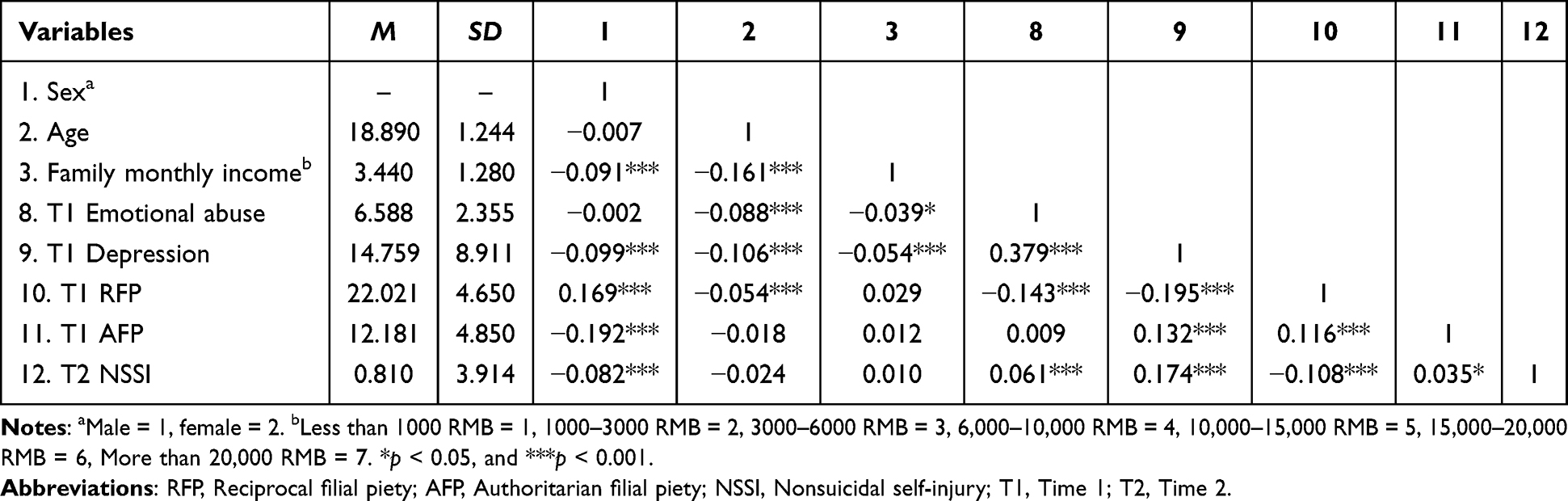 |
Table 1 The Means, Standard Deviations, and Intercorrelations Among All Study Variables |
Testing for Mediation Analyses
With sex, age, and family monthly income as covariates, we examined the mediating role of depression between emotional abuse and NSSI. The results (see Figure 2) showed that emotional abuse was positively associated with depression, and depression was also positively associated with NSSI. The test results of the Bias-Corrected Bootstrap program showed that the mediating effect of depression was significant (β = 0.06, SE = 0.01, 95% CI = [0.05, 0.08]). Depression acted as a complete mediator between childhood emotional abuse and NSSI.
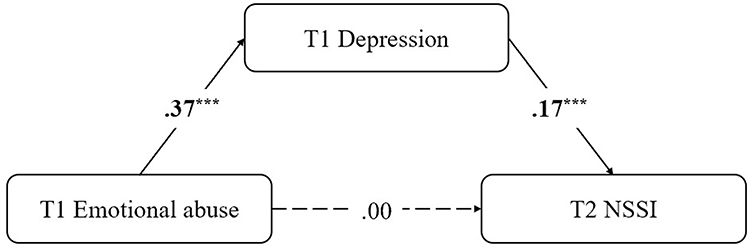 |
Figure 2 Standardized path coefficients for the mediation model of emotional abuse, depression, and NSSI. Abbreviations: NSSI, Nonsuicidal self-injury; T1, Time 1; T2, Time 2. Note: ***p < 0.001. |
Testing for Moderated Mediation
Next, we examined the moderated mediating model. RFP and AFP were tested separately. The results are shown in Table 2. The emotional abuse × RFP interaction was significant in relation to depression, and the depression × RFP interaction was significant in relation to NSSI (see Figure 3). Meanwhile, no interaction involving AFP was significant (see Table 3).
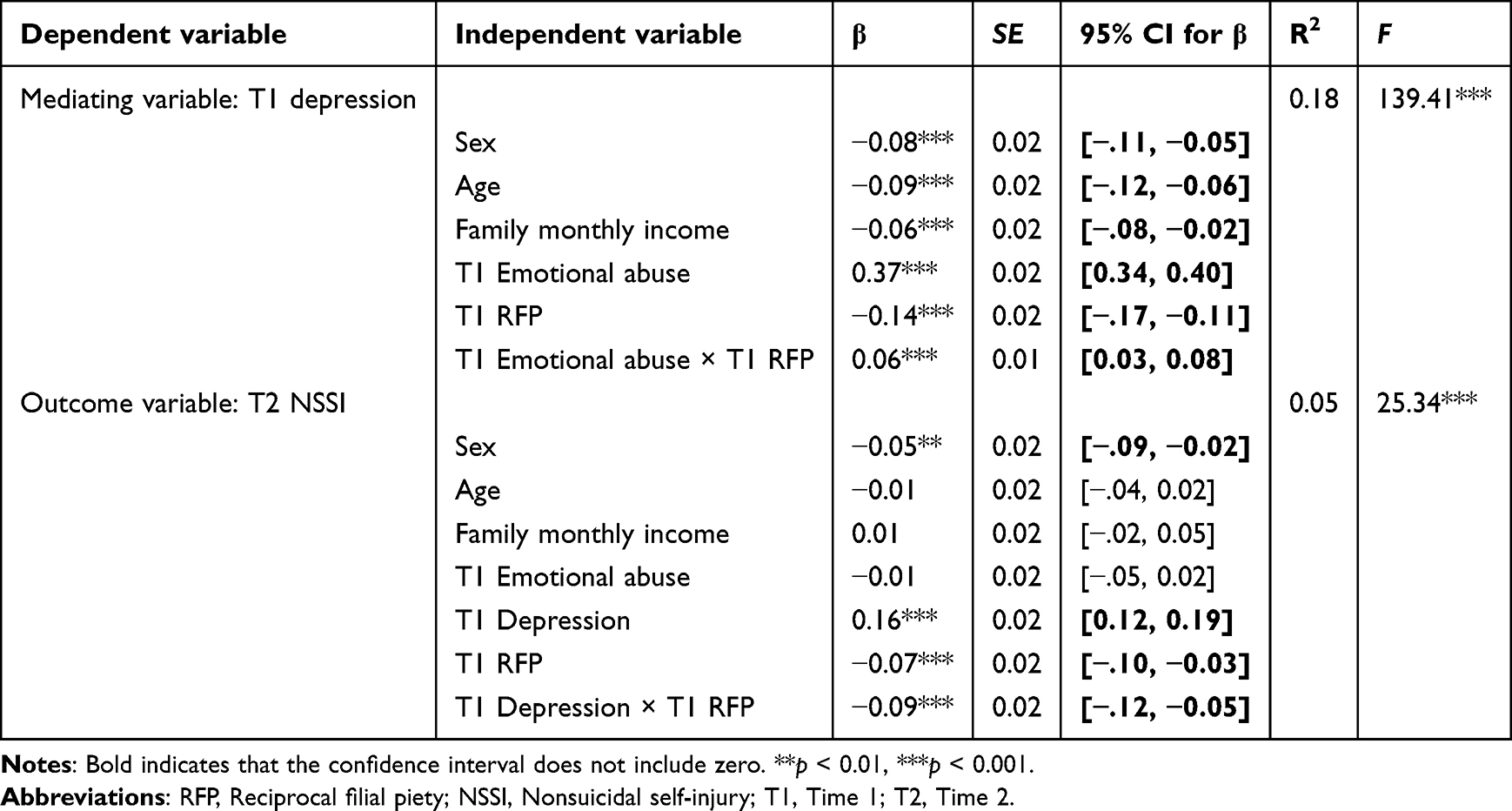 |
Table 2 The Moderated Mediation Model Test (RFP as a Moderator) |
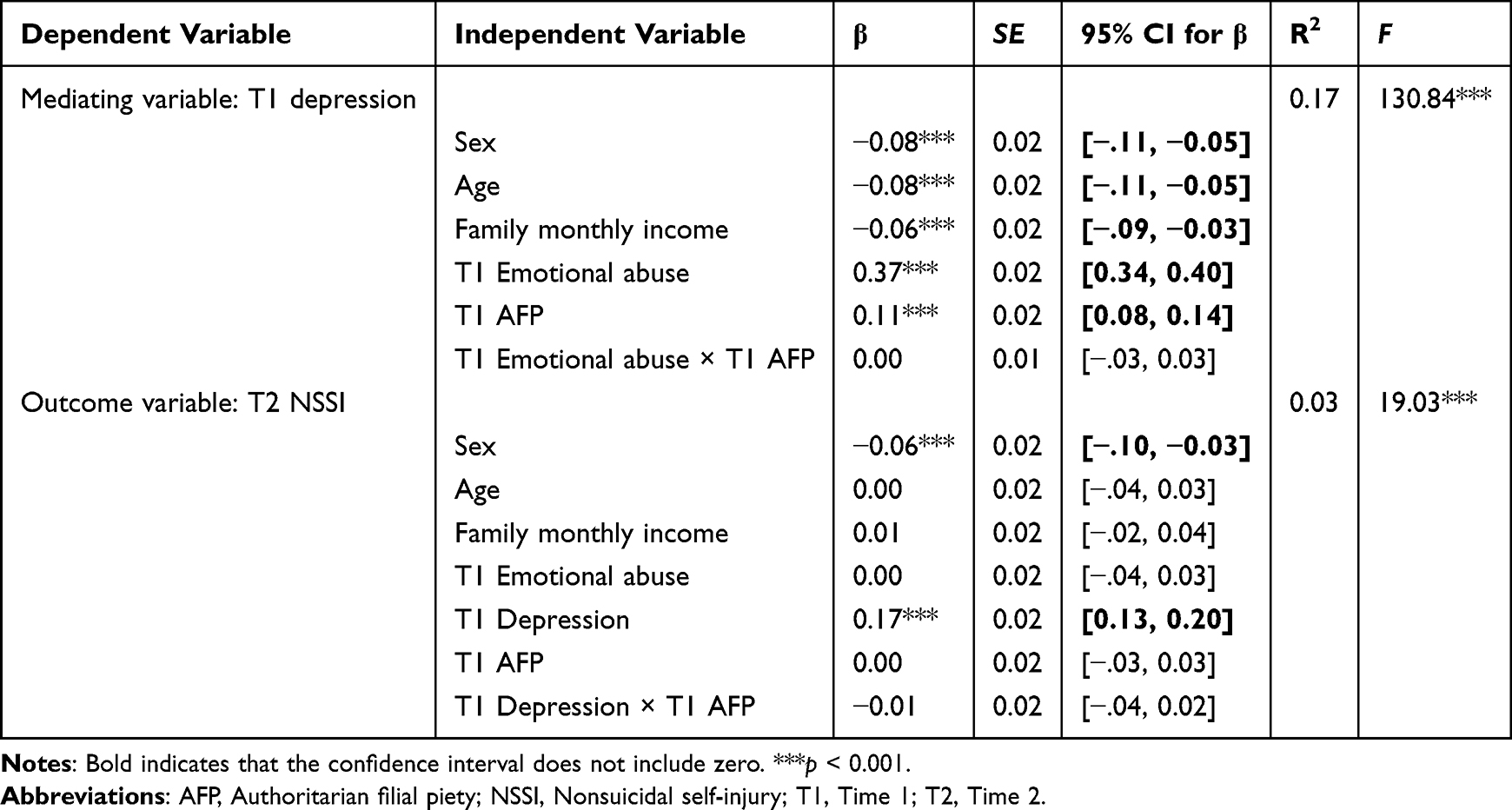 |
Table 3 The Moderated Mediation Model Test (AFP as a Moderator) |
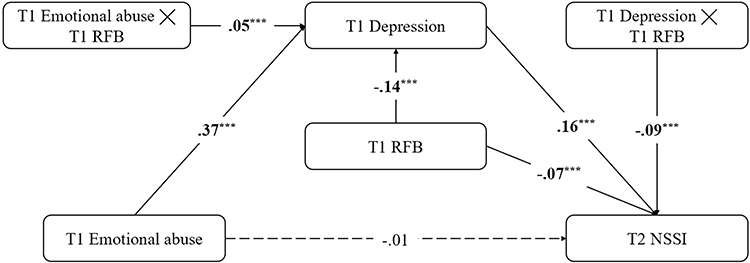 |
Figure 3 Standardized path coefficients for the moderated mediation model of emotional abuse, depression, NSSI, and RFP. Abbreviations: RFP, Reciprocal filial piety; NSSI, Nonsuicidal self-injury; T1, Time 1; T2, Time 2. Note: ***p < 0.001. |
Further simple slope test (see Figure 4) showed that emotional abuse had a stronger positive association with depression when RFP was high than when RFP was low. Depression had a weaker positive association with NSSI when RFP was high than when RFP was low.
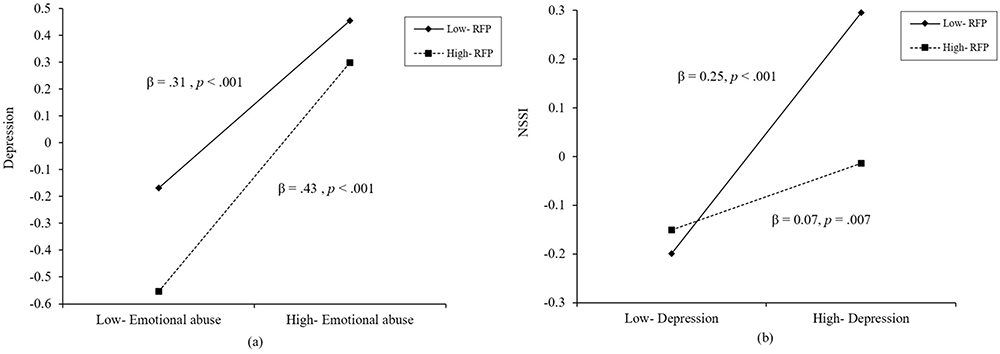 |
Figure 4 Moderation effects in the model. Abbreviations: RFP, Reciprocal filial piety; NSSI, Nonsuicidal self-injury. Notes: (a) Emotional abuse × RFP interactive effects in relation to depression. (b) Depression × RFP interactive effects in relation to NSSI. Functions are graphed for two levels of RFP: 1 standard deviation above the mean and 1 standard deviation below the mean. |
Discussion
Drawing upon Nock’s integrated model of NSSI and the biosocial development model, this study explored the emotional mechanisms underlying the impact of childhood emotional abuse on NSSI among college students, as well as the moderating role of dual filial piety. Specifically, we found that depression mediated the relationship between emotional abuse and NSSI. RFP moderated this relationship, while AFP did not exert a significant moderating effect.
Consistent with Hypothesis 1, this study found that depression mediates the relationship between emotional abuse and NSSI in college students. This finding also supports Nock’s integrated model.6,12 In other words, childhood emotional abuse, as a distal factor, impairs emotional regulation abilities, making individuals more susceptible to depressive symptoms. This effect is profound, persisting into adulthood.45,46 Consequently, college students are likely to adopt self-injurious behaviors to cope with proximal negative emotions related to depression. Additionally, they may be reluctant to seek alternative strategies from social networks due to concerns about disclosing their past experiences.47 As a result, many college students, unable to bear the pressure and distress, may resort to this maladaptive strategy due to its convenience and secrecy.
Additionally, the results of this study supported Hypothesis 2, showing that RFP moderated both the impact of emotional abuse on depression and the influence of depression on NSSI. This is consistent with previous research.34 Specifically, in the first half of the mediation process, RFP buffered the effect of emotional abuse on depression, but this effect was conditional. Among students with low RFP, depressive symptoms remained high regardless of the level of emotional abuse. In contrast, high RFP reduced depression, but only when emotional abuse was at lower levels. RFP which emphasizes the importance of mutual connection and care between children and their elders,48 fosters emotional communication and bonding between parents and children.49 Therefore, college students with high RFP are more likely to benefit from a caring family environment, reducing their risk of depression. However, when childhood emotional abuse is severe, RFP does not offer significant protection. The lingering effects of trauma may overshadow any positive influence of RFP,50 as abusers may fail to reciprocate care and respect, leading to inner conflict and intensified depression.
In the latter half of the mediation process, we found that higher levels of RFP attenuated the effect of depression on NSSI. College students with high levels of RFP care for their parents and avoid causing their parents distress.51 There is an old Chinese proverb saying “Shēn Tı̌ Fā Fū, Shòu Zhı̄ Fù Mŭ, Bù Gǎn Huı̌ Shāng, Xiào Zhı̄ Shı̌ Yě”. This proverb implies that one’s body, given by their parents, should not be harmed. Therefore, filial college students are less likely to engage in self-harm, as protecting and cherishing oneself is seen as a way of honoring their parents.52 In contrast, college students with low levels of RFP are more likely to struggle with establishing strong relationships with their parents and receive less familial support. They are also more vulnerable to depressive emotions and, consequently, more prone to maladaptive self-injurious behaviors.
Based on the exploratory Hypothesis 3, we found that AFP did not have a significant moderating effect in the model, which is consistent with previous research. Individuals who have experienced emotional abuse in childhood often lack emotional comfort and support, making them more susceptible to depressive symptoms. AFP promotes unconditional obedience and does not encourage children to express their emotional needs to their parents.48 As a result, it causes to less emotional relief or support. Additionally, authoritarian filial piety typically inhibits the individual’s freedom to express their true emotions.36 This cultural and familial norm may restrict individuals from seeking external help, leading them to internalize emotional problems. Consequently, AFP does not help mitigate the risk of depression and NSSI caused by emotional abuse in Chinese college students.
Limitations and Contributions
This study has certain limitations. First, it relied on self-report measures, which may lead to subjectivity in assessment. Future research could adopt more diverse measurement methods, such as multi-informant assessments. Second, the study was conducted with Chinese college students, limiting the generalizability of the findings to this population. Additionally, filial piety is a psychosocial variable characteristic of Eastern cultures,53 so future research should collect data from more diverse populations to assess the generalizability of the conclusions or perform cross-cultural comparisons. Third, although emotional abuse may be the most influential form of abuse affecting NSSI, it is possible that NSSI may also be influenced by other forms of abuse. Future research should measure and control for other types of abuse and neglect in the analysis.
Despite these limitations, this study provides important insights. From the perspective of Confucian culture in China, we extended Nock’s integrative model of NSSI and identified the mediating role of depression in the relationship between emotional abuse and NSSI. We also explored the different roles of reciprocal and authoritarian filial piety within this framework. Therefore, in educational guidance and clinical counseling and intervention, educators and counselors should focus on depression among college students with early emotional trauma and conduct targeted interventions to more effectively reduce the occurrence of maladaptive self-injurious behaviors. Furthermore, students could be encouraged to cultivate reciprocal filial piety to mitigate the risks of depression and NSSI, while also being made aware of the ineffectiveness of authoritarian filial piety.
Conclusion
Guided by the integrated model of NSSI and the biosocial development model, this study investigated the mediating role of depression in the relationship between childhood emotional abuse and NSSI among Chinese college students. Additionally, the moderating effects of filial piety were examined. The findings indicated that childhood emotional abuse positively predicted NSSI by increasing depression. Moreover, RFP was protective in depression and NSSI, while AFP did not exert the same effect.
Ethics Approval
This study was approved by the ethics committee of the Faculty of Psychology, Beijing Normal University (protocol number: No.12220085). This study complies with the Declaration of Helsinki.
Informed Consent
All participants gave informed consent before their inclusion in the study.
Funding
This work was supported by the “Key Research Base of Region and Country of Sichuan Province, Center for Southeast Asia Economic and Culture Studies (grant number: DNY2308)“.
Disclosure
The authors report no conflicts of interest in this work.
References
1. Nock MK. Self-Injury. Annu Rev Clin Psychol. 2010;6:339–363. doi:10.1146/annurev.clinpsy.121208.131258
2. Swannell SV, Martin GE, Page A, Hasking P, St John NJ. Prevalence of nonsuicidal self-injury in nonclinical samples: systematic review, meta-analysis and meta-regression. Suicide Life Threat Behav. 2014;44(3):273–303. doi:10.1111/sltb.12070
3. Kiekens G, Hasking P, Bruffaerts R, et al. Non-suicidal self-injury among first-year college students and its association with mental disorders: results from the World Mental Health International College Student (WMH-ICS) initiative. Psychol Med. 2023;53(3):875–886. doi:10.1017/S0033291721002245
4. Nitkowski D, Petermann F. Non-suicidal self-injury and comorbid mental disorders: a review. Fortschritte Neurol Psychiatr. 2011;79(1):9–20. doi:10.1055/s-0029-1245772
5. Victor S, Klonsky E. Correlates of suicide attempts among self-injurers: a meta-analysis. Clin Psychol Rev. 2014;34(4):282–297. doi:10.1016/j.cpr.2014.03.005
6. Nock MK. Why do people hurt themselves?: New insights into the nature and functions of self-injury. Curr Dir Psychol Sci. 2009;18(2):78–83. doi:10.1111/j.1467-8721.2009.01613.x
7. Stoltenborgh M, Bakermans-Kranenburg MJ, Alink LRA, van IJzendoorn MH. The prevalence of child maltreatment across the globe: review of a series of meta-analyses. Child Abuse Rev. 2015;24(1):37–50. doi:10.1002/car.2353
8. Lei H, Yang Y, Zhu T, Zhang X, Dang J. Network analysis of the relationship between non-suicidal self-injury, depression, and childhood trauma in adolescents. BMC Psychol. 2024;12(1). doi:10.1186/s40359-024-01729-2
9. Zhang M, Liu X, Xia W, et al. Network analysis of childhood maltreatment, anxiety, and addictive non-suicidal self-injury in adolescents. Int J Ment Health Addict. 2024. doi:10.1007/s11469-024-01344-7
10. Glaser D. Emotional abuse and neglect (psychological maltreatment): a conceptual framework. Child Abuse Negl. 2002;26(6–7):697–714. doi:10.1016/S0145-2134(02)00342-3
11. Yates TM, Carlson EA, Egeland B. A prospective study of child maltreatment and self-injurious behavior in a community sample. Dev Psychopathol. 2008;20(2):651–671. doi:10.1017/S0954579408000321
12. Nock M, Prinstein M, Sterba S. Revealing the form and function of self-injurious thoughts and behaviors: a real-time ecological assessment study among adolescents and young adults. J Abnorm Psychol. 2009;118(4):816–827. doi:10.1037/a0016948
13. Gu H, Ma P, Xia T. Childhood emotional abuse and adolescent nonsuicidal self-injury: the mediating role of identity confusion and moderating role of rumination. Child Abuse Negl. 2020;106:104474. doi:10.1016/j.chiabu.2020.104474
14. Wang H, Xu S, Wang S, Wang Y, Chen R. Using decision tree to predict non-suicidal self-injury among young adults: the role of depression, childhood maltreatment and recent bullying victimization. Eur J Psychotraumatology. 2024;15(1). doi:10.1080/20008066.2024.2322390
15. Liu J, Yao Y, Deng X, Xu X, He W. How does emotional abuse affect adolescents’ non-suicidal self-injury urges? A moderated chain mediation model. CHILD ABUSE Negl. 2024;147. doi:10.1016/j.chiabu.2023.106535
16. Kang N, Jiang Y, Ren Y, et al. Distress intolerance mediates the relationship between child maltreatment and nonsuicidal self-injury among Chinese adolescents: a three-wave longitudinal study. J Youth Adolesc. 2018;47(10):2220–2230. doi:10.1007/s10964-018-0877-7
17. Nock M, Prinstein M. A functional approach to the assessment of self-mutilative behavior. J Consult Clin Psychol. 2004;72(5):885–890. doi:10.1037/0022-006X.72.5.885
18. Valencia-Agudo F, Burcher GC, Ezpeleta L, Kramer T. Nonsuicidal self-injury in community adolescents: a systematic review of prospective predictors, mediators and moderators. J Adolesc. 2018;65(1):25–38. doi:10.1016/j.adolescence.2018.02.012
19. Shek D, Zhu X. The predictive effect of depression on self-injury: positive youth development as a moderator. Appl Res Qual LIFE. 2023;18(6):2877–2894. doi:10.1007/s11482-023-10211-x
20. Faura-Garcia J, Calvete E, Orue I. Longitudinal associations between nonsuicidal self-injury, depressive symptoms, hopelessness, and emotional dysregulation in adolescents. Arch Suicide Res. 2024;28(3):800–814. doi:10.1080/13811118.2023.2237075
21. Chen Y, Hu R, Xu X, et al. The effect of mental health status and family function on nonsuicidal self-injury: a longitudinal of Chinese children and adolescents. Psychol Res Behav Manag. 2023;16:4491–4500. doi:10.2147/PRBM.S429748
22. Tao J, He K, Xu J. The mediating effect of self-compassion on the relationship between childhood maltreatment and depression. J Affect Disord. 2021;291:288–293. doi:10.1016/j.jad.2021.05.019
23. Wang W, Wang X, Duan G. Non-suicidal self-injury and suicidal ideation among Chinese college students of childhood emotional abuse: associations with rumination, experiential avoidance, and depression. Front PSYCHIATRY. 2023;14. doi:10.3389/fpsyt.2023.1232884
24. Zhang Q, Zhang Q, Ran G, Liang Y. Childhood abuse and depression in emerging adults: the mediating role of regulatory emotional self-efficacy and the moderating role of subjective social status. J ADULT Dev. 2024;31(3):206–216. doi:10.1007/s10804-023-09463-6
25. Wolff J, Thompson E, Thomas S, et al. Emotion dysregulation and non-suicidal self-injury: a systematic review and meta-analysis. Eur Psychiatry. 2019;59:25–36. doi:10.1016/j.eurpsy.2019.03.004
26. Nelson J, Klumparendt A, Doebler P, Ehring T. Childhood maltreatment and characteristics of adult depression: meta-analysis. Br J Psychiatry. 2017;210(2):96–104. doi:10.1192/bjp.bp.115.180752
27. Linehan MM. Cognitive-Behavioral Treatment of Borderline Personality Disorder. Guilford Press; 1993:558.
28. Eklund L. Filial daughter? Filial son? How China’s young urban elite negotiate intergenerational obligations. NORA - Nord J Fem Gend Res. 2018;26(4):295–312. doi:10.1080/08038740.2018.1534887
29. Yeh KH, Bedford O. Filial belief and parent-child conflict. Int J Psychol. 2004;39(2):132–144. doi:10.1080/00207590344000312
30. Yeh KH, Bedford O. A test of the dual filial piety model. Asian J Soc Psychol. 2003;6(3):215–228. doi:10.1046/j.1467-839X.2003.00122.x
31. Liu F, Chui H, Chung MC. Reciprocal/authoritarian filial piety and mental well-being in the Chinese LGB Population: the roles of LGB-specific and general interpersonal factors. Arch Sex Behav. 2022;51(7):3513–3527. doi:10.1007/s10508-021-02130-5
32. Jen CH, Chen WW, Wu CW. Flexible mindset in the family: filial piety, cognitive flexibility, and general mental health. J Soc Pers Relat. 2019;36(6):1715–1730. doi:10.1177/0265407518770912
33. Han X, Cheung MC. The relationship between dual filial piety and mental disorders and symptoms among adolescents: a systematic review of quantitative and qualitative studies. Adolesc Res Rev. 2024. doi:10.1007/s40894-024-00234-2
34. Ying J, Liu S, Chen D, Shen Y, Zhang J, You J. Good or bad? The influence of filial piety belief on nonsuicidal self-injury and suicide risk among young gay men in China. Psychol Sex Orientat Gend Divers. 2023. doi:10.1037/sgd0000665
35. Bedford O, Yeh KH. The history and the future of the psychology of filial piety: Chinese norms to contextualized personality construct. Front Psychol. 2019;10. doi:10.3389/fpsyg.2019.00100
36. Bedford O, Yeh KH. Evolution of the conceptualization of filial piety in the global context: from skin to skeleton. Front Psychol. 2021;12. doi:10.3389/fpsyg.2021.570547
37. Bernstein DP, Stein JA, Newcomb MD, et al. Development and validation of a brief screening version of the childhood trauma questionnaire. Child Abuse Negl. 2003;27(2):169–190. doi:10.1016/S0145-2134(02)00541-0
38. Wang X, Yang L, Gao L, Yang J, Lei L, Wang C. Childhood maltreatment and Chinese adolescents’ bullying and defending: the mediating role of moral disengagement. Child Abuse Negl. 2017;69:134–144. doi:10.1016/j.chiabu.2017.04.016
39. Radloff LS. The CES-D Scale: a self-report depression scale for research in the general population. Appl Psychol Meas. 1977;1(3):385–401. doi:10.1177/014662167700100306
40. Chen Z, Yang X, Li X. Psychometric features of CSE-D in Chinese adolescents. Chin J Clin Psychol. 2009;17:443–445.
41. Chen WW. The relationship between perceived parenting style, filial piety, and life satisfaction in hong kong. J Fam Psychol. 2014;28(3):308–314. doi:10.1037/a0036819
42. Klonsky ED, Glenn CR. Assessing the functions of non-suicidal self-injury: psychometric properties of the inventory of statements about self-injury (ISAS). J Psychopathol Behav Assess. 2009;31(3):215–219. doi:10.1007/s10862-008-9107-z
43. You J, Lin MP. Predicting suicide attempts by time-varying frequency of nonsuicidal self-injury among Chinese community adolescents. J Consult Clin Psychol. 2015;83(3):524–533. doi:10.1037/a0039055
44. Hayes AF, Preacher KJ. Quantifying and testing indirect effects in simple mediation models when the constituent paths are nonlinear. Multivar Behav Res. 2010;45(4):627–660. doi:10.1080/00273171.2010.498290
45. Wang S, Walsh K, Li J. A prospective longitudinal study of multidomain resilience among youths with and without maltreatment histories. Dev Psychopathol. 2024;36(2):750–764. doi:10.1017/S0954579423000032
46. Latham R, Newbury J, Fisher H. A systematic review of resilience factors for psychosocial outcomes during the transition to adulthood following childhood victimisation. Trauma Violence Abuse. 2023;24(2):946–965. doi:10.1177/15248380211048452
47. Song X, Wang S, Wang R, et al. Mediating effects of specific types of coping styles on the relationship between childhood maltreatment and depressive symptoms among Chinese undergraduates: the role of sex. Int J Environ Res Public Health. 2020;17(9). doi:10.3390/ijerph17093120
48. Yeh KH. The beneficial and harmful effects of filial piety: an integrative analysis. In: Progress in Asian Social Psychology: Conceptual and Empirical Contributions. Contributions in Psychology. Vol. 42. Praeger Publishers/Greenwood Publishing Group; 2003:67–82.
49. Ko K, Su-Russell C, Proulx C. Filial support behaviours: associations with filial piety, reciprocity and parent-child contact in China. Fam Relatsh Soc. 2023;12(3):411–430. doi:10.1332/204674321X16605783687158
50. Higgins DJ, McCabe MP. Relationships between different types of maltreatment during childhood and adjustment in adulthood. Child Maltreat. 2000;5(3):261–272. doi:10.1177/1077559500005003006
51. Yang L, Yang N, Chen C, Luo Q, Wang P. Investigation and reflection of college students’ concept on filial piety: taking chengdu normal university as an example. J Chengdu Norm Univ. 2015;31(8):113–116. doi:10.13900/j.cnki.jbc.2016.03.010
52. Zhou L. The Influence of Filial Beliefs on Self-Injurious Behaviour. Xinyang Normal College; 2020.
53. Yang L. Analysis of the content and filial piety in piety-scripture. J Bengbu Univ. 2016;5(3):36–40. doi:10.13900/j.cnki.jbc.2016.03.010
 © 2024 The Author(s). This work is published and licensed by Dove Medical Press Limited. The
full terms of this license are available at https://www.dovepress.com/terms
and incorporate the Creative Commons Attribution
- Non Commercial (unported, 3.0) License.
By accessing the work you hereby accept the Terms. Non-commercial uses of the work are permitted
without any further permission from Dove Medical Press Limited, provided the work is properly
attributed. For permission for commercial use of this work, please see paragraphs 4.2 and 5 of our Terms.
© 2024 The Author(s). This work is published and licensed by Dove Medical Press Limited. The
full terms of this license are available at https://www.dovepress.com/terms
and incorporate the Creative Commons Attribution
- Non Commercial (unported, 3.0) License.
By accessing the work you hereby accept the Terms. Non-commercial uses of the work are permitted
without any further permission from Dove Medical Press Limited, provided the work is properly
attributed. For permission for commercial use of this work, please see paragraphs 4.2 and 5 of our Terms.
Recommended articles

Association Between Non-Suicidal Self-Injury and Gut Microbial Characteristics in Chinese Adolescent

Cai L, Wang S, Hou C, Li Z, Liao Y, Jia FJ
Neuropsychiatric Disease and Treatment 2022, 18:1315-1328
Published Date: 1 July 2022
The Relationship Between Bullying Victimization and Cyber Aggression Among College Students: The Mediating Effects of Relative Deprivation and Depression
Zhang J, Gu J, Wang W
Psychology Research and Behavior Management 2022, 15:3003-3012
Published Date: 17 October 2022
Anxiety and Depression Among College Students During the COVID-19 Lockdown: A Cross-Sectional Survey in Jiangsu, China
Qin B, Hu Z, Liu W, Sun Y, Wang Y, Zhang H, Yang F, He Y
Risk Management and Healthcare Policy 2023, 16:711-723
Published Date: 12 April 2023
The Influence of Negative Emotions on Mobile Phone Addiction Among Chinese College Students: The Mediating Role of Negative Coping Styles and the Moderating Role of Gender
Pan J, Guo J, Wu Y, Zhao X
Psychology Research and Behavior Management 2025, 18:3-13
Published Date: 6 January 2025