
Back to Journals » Journal of Pain Research » Volume 18
The Optimal Patient Profile and Appropriate Role of Spinal Cord Stimulation (SCS) for Patients with Persistent Spinal Pain Syndrome-Type 1 (PSPS-T1) Not Suitable for Spine Surgery: A European Modified Delphi Consensus
Authors Schulte TL, Fernández-Marín MR, Gazzeri R  , Hamel O, Kallewaard JW , Poply K, Smet I, Vesper J, Van de Kelft E
Received 8 May 2025
Accepted for publication 10 September 2025
Published 25 September 2025 Volume 2025:18 Pages 4959—4973
DOI https://doi.org/10.2147/JPR.S533951
Checked for plagiarism Yes
Review by Single anonymous peer review
Peer reviewer comments 3
Editor who approved publication: Professor Michael Überall
Tobias L Schulte,1 María Reyes Fernández-Marín,2 Roberto Gazzeri,3 Oliver Hamel,4 Jan Willem Kallewaard,5,6 Kavita Poply,7,8 Iris Smet,9 Jan Vesper,10 Erik Van de Kelft11,12
1Department of Orthopedics and Trauma Surgery, Katholisches Klinikum Bochum - St. Josef Hospital, Ruhr University Bochum, Bochum, Germany; 2Orthopedic Surgery and Traumatology Department, Hospital Universitario Virgen Del Rocío, Sevilla, Spain; 3Interventional and Surgical Pain Management Unit, San Giovanni-Addolorata Hospital, Rome, Italy; 4Neurosurgical Department, Cèdres Private Hospital, Toulouse, France; 5Department of Anesthesiology and Pain Medicine, Amsterdam University Medical Centre, Amsterdam, The Netherlands; 6Rijnstate Hospital, Arnhem, The Netherlands; 7Pain & Anaesthesia Research Centre, Department of Anaesthesia & Pain Medicine, St Bartholomew’s and the Royal London Hospital, Barts Health NHS Trust, London, UK; 8Queen Mary University of London, London, UK; 9Multidisciplinary Pain Center, VITAZ Hospital, Sint-Niklaas, Belgium; 10Department of Functional and Stereotactic Neurosurgery, Center for Neuromodulation, Medical Faculty and University Hospital Düsseldorf, Heinrich Heine University Düsseldorf, Düsseldorf, Germany; 11Department of Neurosurgery, VITAZ Hospital, Sint-Niklaas, Belgium; 12Faculty of Medicine and Health Sciences, University of Antwerp, Antwerp, Belgium
Correspondence: Tobias L Schulte, Department of Orthopedics and Trauma Surgery, Katholisches Klinikum Bochum - St. Josef Hospital, Ruhr University Bochum, Gudrunstr. 56, Bochum, D-44791, Germany, Email [email protected]
Purpose: Chronic lower back pain (CLBP) is a debilitating condition, and a leading cause of disability associated with significant negative impacts on patients’ quality of life (QoL) and mental health. In both Persistent Spinal Pain Syndrome Types 1 and 2 (PSPS-T1/2) patients, spinal cord stimulation (SCS) therapy has shown favorable outcomes including improved QoL and patient satisfaction, reductions in opioid use, and an acceptable safety profile. This consensus aimed to define the PSPS-T1 patient profile for SCS to maximize its benefits in clinical settings and allow budget holders to quantify the patient population and allocate budget accordingly.
Methods: This study used a modified Delphi methodology. A literature review was conducted, followed by multidisciplinary steering group discussions that resulted in the development of 32 statements under five key domains. These statements, along with a four-point Likert scale, were incorporated into a survey distributed across seven European countries to 144 healthcare professionals experienced in pain management. The respondents included orthopedic surgeons (n=50), pain specialists (n=48), and neurosurgeons (n=46). The consensus agreement threshold was set at 75%.
Results: Consensus was achieved for 30 of the 32 statements, with 11 statements (34%) reaching ≥ 90% agreement. Two statements did not achieve consensus. Based on the consensus achieved in the study, an algorithm is proposed to assist in patient selection for SCS.
Conclusion: This consensus provides recommendations on optimal patient profiles, referral processes, diagnostic procedures, and a decision-making algorithm for PSPS-T1 patients who are ineligible for spine surgery in Europe.
Keywords: Delphi consensus, chronic back pain, spinal cord stimulation, SCS, Europe
Introduction
Chronic lower back pain (CLBP) is a debilitating condition, and the leading global cause of years lived with disability.1 Globally, the age-standardized prevalence rate of lower back pain in 2020 was 7,460 per 100,000.1 In addition, central Europe has the highest age-standardized prevalence rate of 12,800 per 100,000 individuals for low back pain globally, while Western Europe has a lower rate of 9,510 per 100,000 individuals.1 Patients with CLBP often receive delayed treatment owing to difficulties with diagnosis and referrals, leading to a loss of trust in healthcare professionals (HCPs) and pain management practices.2 This delay also contributes to a decreased quality of life (QoL),3 and psychological stress, including depression and anxiety.4
In case of mechanical low back pain with or without radicular pain, surgery can be considered when conservative treatment fails. Typical pathologies that generate mechanical low back pain are degenerative scoliosis, segmental instability, such as in (degenerative) spondylolisthesis and general instability of the spine.5 In case of radicular symptoms without CLBP, such as in lumbar disc herniation or spinal canal stenosis and neuroforaminal narrowing, decompression surgery is a good treatment option when conservative treatment has failed. In all other cases, ie, no mechanical LBP and/or no radicular pain, surgery should be offered very cautiously, as there is no or very limited evidence for success. In addition, spine surgery for low back pain does not always result in adequate pain relief, and meta-analysis has shown 5–28% of individuals experience persistent pain following “successful” spine surgery, with a pooled prevalence of 15%.5 Patients for whom spine surgery is not a strict indication, may experience reduced benefit from CMM - and so their pain persists.6
Therefore, where surgery is deemed inappropriate, or where surgery has not provided sufficient improvement, alternative treatment modalities should be considered, including spinal cord stimulation (SCS).
Spinal cord stimulation is a minimally invasive pain treatment involving delivery of mild electrical impulses to the dorsal spinal cord.7 It was first developed based on the gate-control theory of pain proposed by Melzack and Wall in 1965.8 The current system involves an implantable neurostimulator connected to one or several leads placed in the epidural space near the spinal cord. Electrical impulses travel through the leads to generate a small electrical field, aiming to modulate the transmission of pain signals to the brain, and reduce pain in the process.9,10
A multidisciplinary team from the American Society of Pain and Neuroscience (ASPN) conducted a literature review and moderately recommended SCS for non-surgical lower back pain and lumbar spinal stenosis, while strongly recommending SCS for patients with chronic pain following lumbar spine surgery.11 The European Federation of Neurological Societies (EFNS) evaluated the evidence on electrical neurostimulation and recommended SCS as an efficacious intervention in failed back surgery syndrome (FBSS) and complex regional pain syndrome (CRPS) type I.12
With a recent shift in perspective, the term Persistent Spinal Pain Syndrome Type 1 and Type 2 (PSPS-T1/2, Type 1: chronic pain without previous spine surgery; Type 2: chronic pain, persisting after spine surgery) was introduced as part of the new International Classification of Diseases (ICD-11) 2022 to replace FBSS, in order to avoid inadequate and misleading causation of the CLBP disorder.13
Studies have shown that SCS is effective for patients with PSPS-T1 (most frequently lumbosacral radiculopathy, degenerative disc disease/discogenic back pain, and foraminal stenosis), reporting over 50% reduction in pain,6,14,15 decreased disability score, and reduced opioid use.6,14
Selecting appropriate cohorts of patients is crucial to maximizing the benefits of interventional pain treatments, such as SCS.16 In the PSPS-T1 patient population, it is critical to identify the optimal patient profile, including previous unsuccessful pain management approaches. This consensus study seeks to define the optimal patient profile, referral practices, and diagnostic procedures of PSPS-T1 patient candidates for SCS in Europe when earlier CMM or pain management interventions have failed.
Material and Methods
This study employed a modified Delphi consensus methodology (Figure 1). A targeted literature review on the appropriate role of SCS for patients with PSPS-T1 in Europe was conducted using PubMed and Google Scholar in March 2024 (see Figure S1). A general web search using free text terms was also performed to identify any information not indexed to the selected databases.
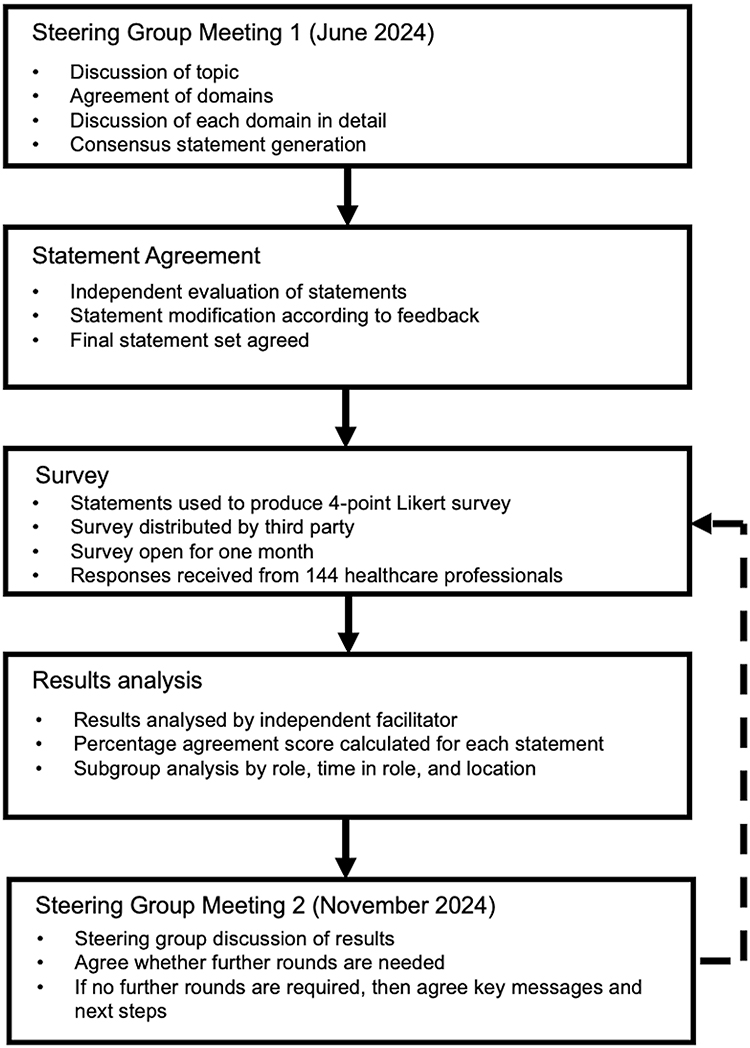 |
Figure 1 Modified Delphi study design. |
Following the literature review and guided by an independent facilitator (Triducive Partners Ltd), a European multidisciplinary steering group convened in June 2024 to discuss the optimal patient profile and appropriate role of SCS for patients with PSPS-T1 not suitable for spine surgery in Europe. The group included anesthesiologists (n=2), a physician specialized in pain medicine and neuromodulation (n=1), orthopedic surgeons (n=2), and neurosurgeons (n=4) who specialize in the management and treatment of patients with CLBP. Potential steering group members were identified by the facilitator (using publicly available data sources and the facilitator’s database of healthcare practitioners) based on their expertise, clinical experience, previous publications, and geographical location within Europe, and selected for invitation to the steering group by email.
The information gathered from the literature review was used to inform the meeting discussions, during which the group agreed on five main domains of focus:
- Identification of interventions after CMM and prior to SCS
- Describing PSPS-T1 patients suitable for SCS
- Optimal referral process and practices
- Role of imaging
- Existing and future research in the area.
In the first round (Round 1) of the Delphi consensus, the steering group discussed each domain and proposed statements. Each steering group member independently reviewed these statements and recommended either “accept”, “remove”, or “reword with suggested changes.” Recommendations were accepted based on a simple majority. The accepted recommendations constituted the initial round of consensus.
The finalized statements were then distributed to a wider panel for evaluation in the second round (Round 2) as a four-point Likert scale survey (ie, “strongly disagree”, “tend to disagree”, “tend to agree”, and “strongly agree”). The survey took an average of 20 minutes to complete. With prior written consent, the survey was distributed by M3 Global, a specialist market research organization with the world’s largest database of physicians and caregivers, according to the following criteria:
- Residing and practicing in either Belgium, France, Germany, the United Kingdom, Italy, Spain, or the Netherlands
- Experienced in managing and treating patients with CLBP
- Current role of orthopedic surgeon, pain specialist, or neurosurgeon
- Participants were not required to be SCS users or implanters.
In addition, there was no requirement for members of this panel to have any current or prior relationship with the study sponsor. The identities of individual respondents were not disclosed to the steering group or the independent facilitator, ensuring the anonymity of the survey. Each survey respondent received nominal and universal compensation for their participation.
The predefined stopping criteria were established a priori as a minimum of 100 responses and a consensus threshold set at 75%, a commonly used threshold for consensus.17–19 Although a group of more than 20 HCPs is generally considered sufficient for a Delphi consensus, a sample size of over 80 participants provides high levels of replicability for the results (≥80%).19 Since the stopping criteria were met, no additional rounds of Delphi consensus were needed. Results were analyzed early November 2024, after which the steering group convened to review and discuss the findings.
Registration of the study and ethical approval were not required since it did not involve interventions or assessments related to participants’ health outcomes, and anonymity was ensured. All completed surveys were analyzed to identify an overall agreement score for each statement. The current study is reported in accordance with ACCORD (ACcurate Consensus Reporting Document) guidelines.20
Results
Following review of the initial 41 statements, 12 statements were modified, and 9 statements were removed, resulting in a final set of 32 statements for testing in Round 2 with the wider panel (Table 1).
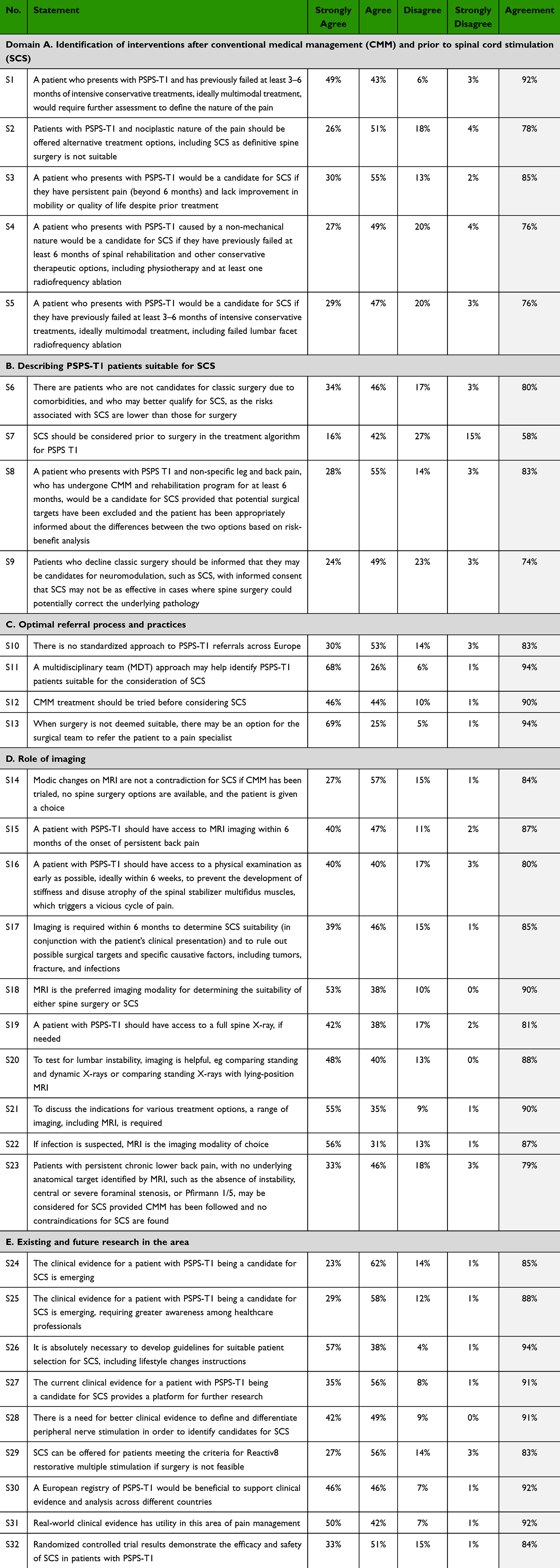 |
Table 1 Defined Consensus Statements and Corresponding Levels of Agreement (All Numbers Rounded to the Nearest Whole Number) |
The Round 2 survey was conducted over one month in October 2024 and 144 responses were received. The respondent numbers for each targeted country were Belgium (n=19), France (n=21), Germany (n=21), Spain (n=21), Italy (n=21), the Netherlands (n=20) and the United Kingdom (n=21) (Figure S2). Respondent roles included orthopedic surgeons (n=50), pain specialists (n=48, including from non-surgical specialties), and neurosurgeons (n=46). Demographic information, including role and time in the role, is shown in Figures S3 and S4, respectively.
All responses were included for analysis to identify emerging trends and areas of consensus (Table 1). The overall agreement score for each statement was calculated based on the aggregate number of “agree” responses as a percentage of the total number of responses.
Consensus (75%) was achieved in 30 of the 32 statements, 11 of which achieved agreement levels of ≥90%. Two statements failed to achieve consensus, although both did achieve above 50% agreement. The distribution of responses by agreement level for each statement is shown in Figure S5. The distribution of consensus agreement levels for each statement is shown in Figure 2.
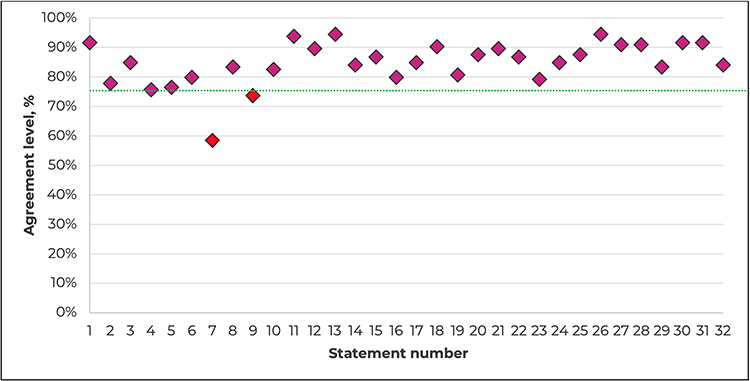 |
Figure 2 Scatter plot of consensus agreement levels by statement. The threshold for consensus is depicted by the green line (75%). |
Domain A: Identification of Interventions After CMM and Prior to SCS
Respondents agreed (S1, 92%) that patients with PSPS-T1 who have failed at least 6 months of conservative treatments21 require further assessment to define the nature of the pain. Additionally, agreement was achieved regarding the need for alternative treatment options (including SCS) after CMM (S2-S5). Specifically, these include patients presenting with PSPS-T1 who:
- have a nociplastic pain, and, therefore, are not evident candidates for spine surgery (S2, 78%), or
- have persistent pain (beyond 6 months) and lack improvement in mobility or QoL despite prior treatment (S3, 85%), or
- have pain that is not mechanical in nature (ie, is not related to specific positions or movements of the lumbar and sacral regions of the spine) and have previously failed at least 6 months of spinal rehabilitation and other conservative therapeutic options (S4, 76%), or
- have previously failed at least 6 months of intensive conservative treatments, including different interventional therapies in the pain clinic (S5, 76%).
Domain B: Describing PSPS-T1 Patients Suitable for SCS
Responses to statements describing the PSPS-T1 patients suitable for SCS highlighted a mixed level of consensus. However, respondents agreed that patients who are not candidates for spine surgery owing to comorbidities may be suitable for SCS (S6, 80%).22
Regarding statement 8 (83%), we would like to clarify this statement which considers non-specific back- and leg pain in the non-operated patient. In the literature, “specific back pain” is defined as back pain due to a well-known pain generator such as tumor, trauma, infection, inflammation and mechanical back pain due to instability of the spine (segmental or global).22–24 It is clear that in these pathologies, SCS should not be considered.
Specific leg pain is leg pain due to a well-known pain generator such as nerve root compression, vascular problems, hip problems and polyneuropathy.25 It is clear that in these pathologies (except for polyneuropathy) SCS should not be considered. Therefore, in case of PSPS T1, when no exact pain generator can be identified (which is often the case), SCS can be considered, after failure of other conservative treatments. However, in cases of multilevel nerve root compression, spine surgery may not be considered appropriate due to the risk-benefit profile. In such “specific leg pain” scenarios, SCS may be a viable alternative following a thorough discussion with the patient.
Consensus was not achieved regarding SCS consideration prior to spine surgery in the PSPS-T1 population (S7, 58%) and use of SCS in those who have declined spine surgery (S9, 74%). Although the threshold for consensus was not reached, the lack of consensus does not indicate clear disagreement and therefore SCS may be an option based on individual patient factors. While patient preferences should be considered, they should not dictate the treatment choice, particularly where there is a clear indication for a treatment. If patients decline surgery, they can be referred to a pain clinic for management, and SCS might be considered suitable in selected cases after comprehensive assessment and trial of conventional therapy.
Domain C. Optimal Referral Process and Practices
Consensus was established on the optimal referral process and practices for SCS. Based on these results, a decision-making algorithm (Figure 3) has been proposed to support identification candidates with CLBP suitable for SCS. Respondents recognized that there is no standard approach to the PSPS-T1 referral process across Europe (S10, 83%) and agreed that a multidisciplinary spine team approach may help identify candidates for SCS (S11, 94%), who have received a trial of CMM (S12, 90%) and an option for referral to a pain specialist if spine surgery is deemed not suitable (S13, 94%).
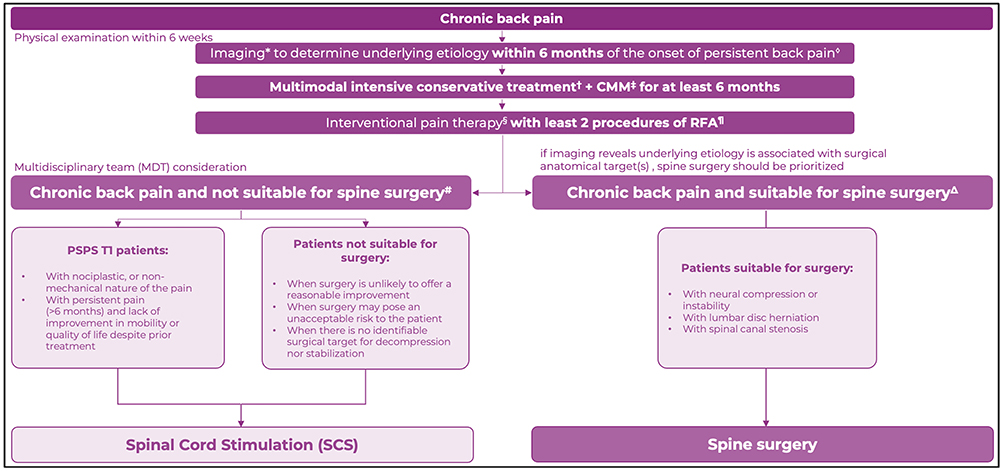 |
Figure 3 Proposal for a decision-making algorithm to help identify patients suitable for SCS. Notes: *Imaging modalities should include a combination of MRI lumbar spine and X-ray (standing and dynamic), where lumbar instability and Pars defects are suspected. Full spine X-ray may be required in some cases. CT (computed tomography) scans may still be appropriate in certain cases. †Multimodal intensive conservative treatment should be guided by assessment with an appropriate tool (eg, PainDETECT questionnaire) and may include physiotherapy, psychotherapy, behavioral therapy, and BMI (body mass index) reduction. ◊Modic changes on MRI are not a contraindication for SCS if CMM has been trialed, and no spine surgery options are available. ‡Conventional medical management (CMM) may include pain relievers, anti-inflammatory drugs, muscle relaxants, nerve pain medications, antidepressants, and opioids (high doses of opioids should be avoided). §Interventional pain therapy may include epidural steroid injections, radiofrequency ablation, facet joint injections, nerve blocks. Sacro-iliac joint injections, facet and/or sacro-iliac joint denervation, dorsal root ganglion neuromodulation with pulsed radiofrequency, epidurolysis. #Exclusion criteria for SCS are patients suitable for spine surgery, those with infections, tumors, trauma, psychological comorbidities, and patients effectively managed with CMM. ΔIf a patient suitable for spine surgery declines the procedure, they can be referred to a pain clinic for further management. SCS might be suitable in selected cases. |
Domain D. Role of Imaging
The panel reached consensus on the role of medical imaging for patients presenting with PSPS-T1. Specifically, patients should have access to magnetic resonance imaging (MRI) within 6 months of the onset of persistent back pain (S15, 87%). In addition, a physical examination conducted as early as possible, ideally within six weeks, to prevent the development of stiffness and disuse atrophy of the spinal stabilizer multifidus muscles, which triggers a vicious cycle of pain (S16, 80%). MRI is the imaging modality of choice if infection is suspected (S22, 87%). Patients presenting with PSPS-T1 should have access to a full spine X-ray in cases of obvious mechanical LBP (S19, 81%). Lumbar instability can also be assessed via imaging, eg, comparing standing and dynamic X-rays or comparing standing X-rays with lying-position MRI (S20, 88%).
A range of imaging is required to discuss the indications for treatment options (S21, 90%). MRI is the preferred imaging modality to assess the suitability of either spine surgery or SCS (S18, 90%). To determine SCS suitability (in conjunction with clinical presentation), and to rule out possible surgical targets and specific causative factors (such as tumors, fractures, infections), imaging is required within six months prior to SCS (S17, 85%). The panel agreed that those patients with persistent CLBP with no structural pain generator identified after thorough diagnostic workup, may be candidates for SCS provided CMM has been followed (S23, 79%). Respondents also agreed that Modic changes on MRI are not a contraindication for SCS if six months of CMM has been trialed (S14, 84%). It is important that all patients with SCS have MRI diagnostic access preserved.
Domain E. Existing and Future Research in the Area
The clinical evidence for SCS in the PSPS-T1 setting is emerging (S24, 85%), and greater awareness of this is needed among all HCPs (S25, 88%). Very strong agreement was exhibited for statements related to existing and future research on the role of SCS for patients with PSPS-T1 who are unsuitable for spine surgery. Also, the need for suitable guidelines on patient selection for SCS, including instructions on lifestyle changes (S26, 94%), and better clinical evidence to define and differentiate the appropriate uses of peripheral nerve stimulation and SCS, respectively (S28, 91%).
The panel agreed that the current clinical evidence in this area would provide a platform for further research (S27, 91%), and real-world clinical evidence would have utility in pain management (S31, 92%). To support the clinical evidence and analysis across Europe, establishing a European registry of PSPS-T1 would be beneficial (S30, 92%). The panel also agreed that current evidence supports the efficacy and safety of SCS in patients with PSPS-T1 (S32,84%).
Based on the level of consensus achieved across the 32 statements, authors suggest the following recommendations:
- Patients with PSPS-T1 should undergo a wide range of medical imaging and physical assessments in a timely manner to guide treatment decisions. Medical imaging options include a combination of MRI and full spine X-ray as needed, which can be used to determine the suitability of treatment (eg, spine surgery or SCS).
- The proposed decision-making algorithm may help identify PSPS-T1 patients who could be considered for SCS (Figure 3). A complementary HCP checklist has been provided in the Supplementary Information. These two items are intended to help standardize treatment approach across Europe.
- Spine surgery should be performed if clear indications associated with anatomical targets are presented, and the risk/benefit of surgery is considered favorable; otherwise, SCS can be a treatment of choice for patients who are ineligible for spine surgery (Figure 3).
- Eligibility of patients for SCS should be assessed by HCPs. Patient preference should be considered following the principles of patient autonomy but should not dictate the treatment choice.
Discussion
Each recommendation is discussed separately below.
- Patients with PSPS-T1 should undergo a wide range of imaging and physical assessments in a timely manner to guide treatment decisions. Imaging options include a combination of MRI and full spine X-ray, which can be used to determine the suitability of treatment (eg, spine surgery or SCS) (Figure 3).
A thorough history of the disease and a physical examination should be performed to assess symptoms and signs of underlying serious and dangerous conditions.23 Additionally, patients should undergo a comprehensive behavioral assessment and be evaluated for the presence of psychological risk factors.23,26 This evaluation can guide future treatment decisions, as psychiatric disorders are considered absolute contraindications for SCS.26
Imaging is a crucial aspect of the diagnostic process, as it may help identify the cause of pain and guide treatment decisions and approaches. Several imaging modalities are available to support the diagnosis of CLBP.27
X-rays evaluate the local or global spinal alignment, osteophytes, and surgical hardware placement, with parameters like pelvic incidence and lumbar lordosis playing a critical role in identifying alignment issues (S19, 81%). MRI provides visualization of soft tissues, such as discs and nerve roots, and helps identify causes like stenosis.27 Recently, a high-resolution 3D quantitative synthetic CT (sCT) method has become commercially available (BoneMRI v1.8, MRIguidance BV, NL) after FDA and CE approval, converting MRI into sCT images mimicking CT images.
Although a number of additional diagnostic modalities, such as CT-scan (when BoneMRI is not available), including SPECT-CT and CT myelography, Positron Emission Tomography (PET), and epidurography,27 are commonly used in clinical practice, our results indicate agreement that combining imaging modalities, such as (full-spine) X-ray and MRI, can further enhance diagnostic precision.
For patients being considered for SCS, medical imaging is important prior to implantation to identify potential pain generators and exclude indications for spine surgery. Some conditions, such as stenosis from large disk herniation, hypertrophic ligamentum flavum or epidural fibrosis, can reduce the epidural space and make the implantation of SCS challenging, and imaging needs to confirm there is adequate epidural space for the traversing SCS leads.28
One of the challenges in managing patients with CLBP is that CMM often fails to achieve satisfactory improvement. As a result, multimodal pain treatment, including pharmacological, physical and psychological evaluations, has been proposed as an answer to the complex and debilitating nature of the pain, although currently there is limited evidence supporting this strategy.29 This consensus emphasized the involvement of multimodal pain management prior to consideration of any invasive procedures (Figure 3). Published evidence, including a study of the effectiveness of multimodal treatment on 155 patients with CLBP, reported improvements in pain intensity depression, anxiety, and well-being, recommending the initiation of a multimodal therapy in early stages.30
One significant obstacle associated with multimodal pain management is the difficulty of implementation, stemming from limited data on the complex intercorrelation of biological, psychological, and cognitive factors involved in pain development at an individual level.31 Although there is a lack of direct comparison, a systematic review and network meta-analysis of 13 randomized clinical trials involving 1,561 patients indicated that both conventional and novel SCS therapies were associated with superior efficacy to CMM, which included analgesics, physical therapy, and cognitive behavioral therapy.32
Minimally invasive pain intervention, such as radiofrequency ablation, has shown good outcomes for relieving CLBP in some patients that have reacted well on a test block, with a minimal effect lasting 3–4 months. The procedure does not require general anesthesia, it can be repeated if necessary, and reported adverse events are minimal and rare.33 Therefore, radiofrequency ablation should be considered for eligible patients (eg, those with clinical signs of spondyloarthropathy or facet joint disease), prior to spine surgery or SCS. Contraindications include unstable joints, implanted defibrillators, and pregnancy.33
In summary, the treatment approach should include multimodal intensive conservative treatment, conventional medical management, and interventional pain therapy, where eligible, prior to considerations of further treatment (Figure 3).
Across Europe, there is a need to identify patients with refractory pain who may benefit from SCS. Guidance from the National Institute for Health and Care Excellence (NICE) in the UK recommends SCS for patients who continue to experience chronic pain (measuring at least 50 mm on a 0 to 100 mm visual analogue scale) for at least six months despite appropriate CMM.34 European consensus recommendations published in 2020 indicate that the inclusion criteria for SCS should include age ≥18 years; chronic low back/leg pain with a duration of at least six months and at least moderate severity impact on QoL; presence of complex regional, neuropathic, or ischemic pain syndromes; failure of previous CMM and/or minimally invasive treatments; and where there are no clear benefits from spine surgery.35
The diverse composition of SCS patient cohorts has made patient subtype characterization more complicated. For example, some HCPs proposed radiofrequency ablation following CMM. However, the respondents in this study displayed mixed opinions, reflecting the heterogeneity of patient subgroups. Most studies on radiofrequency ablation focused on lumbar facet joints and sacroiliac joints.36 There is therefore a need to use both real-world and clinical evidence, including a European PSPS-T1 registry, to better identify patient subgroups suitable for SCS and refine pain management protocols.
For individuals for whom CMM has failed to provide sufficient pain relief, surgical options should be considered where a clear surgical target has been identified (ie, through medical imaging) and the risk/benefit ratio is considered favorable. However, there are situations where surgery may not be appropriate, and in these situations SCS may be considered:
- When there is no clear evidence of neural compression or mechanical spine instability after careful evaluation of images along with clinical presentation.
- When patient factors (eg, frailty, significant comorbidity) make the individual a poor candidate for more invasive spine surgery.37
In patients with a clear symptomatic spinal canal stenosis, foraminal stenosis or disc herniation and for whom CMM has failed, conventional decompression surgery should be discussed to improve their radiculopathy or spinal claudication. In patients with clear symptomatic segmental instability, osteochondrosis and spondylarthritis, and for whom CMM has failed, stabilizing instrumentations should be discussed as conventional surgical options. It is not always easy to correlate low back pain to concrete imaging findings, such as osteochondrosis, spondylarthritis or spondylolisthesis. Details from the patient’s history such as deterioration of pain during mechanical stress and improvement while mechanical relief are crucial. Test infiltrations eg of the zygapophyseal joints may help to define the origin of pain but need to be interpreted with modesty knowing about the limitations of these test infiltrations.
Patients who - due to imaging, clinical exam, and history - could theoretically be candidates for conventional surgery, may present with relevant comorbidities, that increase the risks of surgery significantly. In addition, conventional surgery may involve long instrumented multi-segmental surgeries, that patients could reject for personal reasons. The weighing of pros and cons of any conventional surgery, even if theoretically indicated, may lead to rejection by either the patient or HCP.
SCS implantation is a minimally invasive procedure that does not involve major structural alterations to the spine, making it a potential option for individuals who cannot undergo surgery. Some evidence suggests that CMM often has limited benefits, while SCS is associated with significant improvements in functional disability and QoL in PSPS-T1 patients ineligible for spine surgery.6,38
There is a need for a patient-centered treatment approach for patients with PSPS-T1 that considers individual patient characteristics. This should be achieved through an MDT of HCPs who collaboratively make treatment decisions not only on suitability for SCS, but also regarding any indication for spine surgery.27 Additionally, this approach can improve the prompt identification of patients suitable for SCS and as a consequence, patients’ access to specialized evaluation and advanced treatments.28 Patient preferences, which may vary depending on factors, such as age, economic, and social status,39 should be considered as part of the shared decision-making process, but should not dictate the treatment choice. If a patient is identified as likely to benefit from SCS, treatment goals and expectations should be discussed with the MDT, and patients should be educated about the treatment procedure, preparations, and post-implantation period.
It is recommended that the MDT includes primary care providers, anesthesiologists, psychologists, nurses, and physical and occupational therapists, with additional involvement from surgeons, neurologists, internists, physiatrists, psychiatrists, social workers, dietitians, and pharmacists.40 Although the MDT approach may incur additional costs, several studies demonstrated its effectiveness, including improvements in patients’ QoL.28,40
Strengths and Limitations
This study gathered key opinion leaders in Europe with the experience in management and treatment of CLBP. This informed the development of a proposed decision-making algorithm to support the appropriate selection of patients with CLBP and enhance the selection process for SCS. This work is intended to address gaps in existing guidelines and aim to standardize the treatment approach for patients with CLBP in Europe. It is among the first to seek and achieve consensus on this topic with a large number of respondents across Europe, contributing to the establishment of current best practices. However, while the study aimed to define patient profiles at the European level, it only included seven countries. Future studies should incorporate a broader range of countries to account for diverse factors such as population demographics, economic conditions, healthcare systems, and reimbursement policies. The wording of some statements could have been improved for clarity, for example, Statement 29 was intended to test if the multifidus stimulation criteria were also relevant to SCS, as there is some overlap of indications, and not to establish any preference. This may have led to misunderstanding of the intention of the statement by the respondents. In addition, the statements (particularly in Domain A) exhibited significant repetition, which may be due to a desire on the part of the steering group to reflect the many nuances of decision making in this area. However, on reflection, this has limited the clarity of the results, and future work should consider this.
The study was initiated and funded by Medtronic Europe. All authors except for RG received honoraria from Medtronic Europe while undertaking this study. Medtronic Europe commissioned Triducive Partners Limited to facilitate the project, analyze the responses to the consensus statements in line with the Delphi methodology and write the draft manuscript. After engaging Triducive Partners Limited, Medtronic Europe reviewed the consensus statements and draft manuscript for technical accuracy only. Medtronic Europe took no part in the writing, revision or editing of the manuscript.
Conclusion
Based on the consensus achieved, this study considered the optimal patient profiles and defined the appropriate role of SCS for PSPS-T1 patients who are not eligible for spine surgeries in Europe. This population includes PSPS T1 patients with pain that is not mechanical in nature, or who have comorbidities that increase the risks of surgery significantly, and who experience persistent pain (>6 months) and lack of improvement in mobility or quality of life despite prior treatment. In addition, there was clear agreement that SCS should not be used ahead of surgery where a clear indication exists.
Four recommendations on patient identification, the referral process, the role of imaging, and standardization of approach were established. In addition, this study also outlined the decision-making algorithm for the management of patients with CLBP, enabling better identification of appropriate patients for SCS in clinical settings.
Data Sharing Statement
Data is available from Triducive Partners Ltd on reasonable request.
Ethics Approval and Informed Consent
Ethical approval was not required for this study, as it involved a non-interventional Delphi process with healthcare professionals only, and did not involve patients, vulnerable populations, or the collection of sensitive or personally identifiable data. In accordance with the Governance Arrangements for Research Ethics Committees (GAfREC), paragraph 2.3.3, research involving staff recruited by virtue of their professional role does not require NHS Research Ethics Committee review unless it involves access to confidential information or raises issues of professional performance. All participants were provided with information about the study and gave informed consent to participate.
Consent for Publication
All materials were developed by the authors for the purposes of this consensus, no consent from third parties is required.
Acknowledgments
The authors wish to thank Triducive Partners Limited for their support in collating the data, analyzing the results, and medical writing support during the manuscript development.
Author Contributions
All authors made a significant contribution to the work reported, whether that is in the conception, study design, execution, acquisition of data, analysis and interpretation, or in all these areas; took part in drafting, revising or critically reviewing the article; gave final approval of the version to be published; have agreed on the journal to which the article has been submitted; and agree to be accountable for all aspects of the work.
Funding
The study was initiated and funded by Medtronic Europe. All authors received honoraria from Medtronic Europe while undertaking this study. Medtronic Europe commissioned Triducive Partners Limited to facilitate the project, analyze the responses to the consensus statements in line with the Delphi methodology and write the draft manuscript. After engaging Triducive Partners Limited, Medtronic Europe reviewed the consensus statements and draft manuscript for technical accuracy only. Medtronic Europe took no part in the writing, revision or editing of the manuscript except to check that the manuscript contained no promotion of specific medicines and that all recommendations were appropriate to drug label.
Disclosure
All authors received honoraria from Medtronic Europe while undertaking this study. Medtronic Europe commissioned Triducive Partners Limited to facilitate the project and analyze the responses to the consensus statements in line with the Delphi methodology. IS declares honoraria for attendance at advisory boards for Medtronic, Abbott, and Nevro. JWK declares honoraria for attendance at advisory boards for Medtronic, Saluda, Boston Scientific. KP declares honoraria for attendance at advisory boards for Medtronic, Mainstay, and Curonix.
TLS declares honoraria for attendance at advisory boards for Medtronic, Johnson & Johnson, Amgen, Kaia Health Software and for lectures from Implantcast, Medtronic, Johnson & Johnson, DePuy-Synthes, Ulrich medical, UCB Pharma, Kaia Health Software, SpineArt, Mainstay. The authors report no other conflicts of interest in this work.
References
1. Ferreira ML, De Luca K, Haile LM, et al. Global, regional, and national burden of low back pain, 1990-2020, its attributable risk factors, and projections to 2050: a systematic analysis of the Global Burden of Disease Study 2021. Lancet Rheumatol. 2023;5(6):e316–e329. doi:10.1016/S2665-9913(23)00098-X
2. Buchman DZ, Ho A, Goldberg DS. Investigating Trust, Expertise, and Epistemic Injustice in Chronic Pain. J Bioeth Inq. 2017;14(1):31–42. doi:10.1007/s11673-016-9761-x
3. Husky MM, Ferdous Farin F, Compagnone P, Fermanian C, Kovess-Masfety V. Chronic back pain and its association with quality of life in a large French population survey. Health Qual Life Outcomes. 2018;16(1):195. doi:10.1186/s12955-018-1018-4
4. Nicola M, Correia H, Ditchburn G, Drummond P. Invalidation of chronic pain: a thematic analysis of pain narratives. Disabil Rehabil. 2021;43(6):861–869. doi:10.1080/09638288.2019.1636888
5. Giraldo JP, Williams GP, Lee JJ, et al. An evidence-based review of the current surgical treatments for chronic low-back pain: rationale, indications, and novel therapies. J Neurosurg Spine. 2025;42(4):413–424. doi:10.3171/2024.9.SPINE24580. PMID: 39919297.
6. Kallewaard JW, Billet B, Van Paesschen R, et al. European randomized controlled trial evaluating differential target multiplexed spinal cord stimulation and conventional medical management in subjects with persistent back pain ineligible for spine surgery: 24-month results. Eur J Pain. 2024;28(10):1745–1761. doi:10.1002/ejp.2306
7. Atkinson L, Sundaraj SR, Brooker C, et al. Recommendations for patient selection in spinal cord stimulation. J Clin Neurosci. 2011;18(10):1295–1302. doi:10.1016/j.jocn.2011.02.025
8. Caylor J, Reddy R, Yin S, et al. Spinal cord stimulation in chronic pain: evidence and theory for mechanisms of action. Bioelectron Med. 2019;5(1):12. doi:10.1186/s42234-019-0023-1
9. Lam CM, Latif U, Sack A, et al. Advances in Spinal Cord Stimulation. Bioengineering. 2023;10(2):185. doi:10.3390/bioengineering10020185
10. North RB, Lempka SF, Guan Y, et al. Glossary of Neurostimulation Terminology: a Collaborative Neuromodulation Foundation, Institute of Neuromodulation, and International Neuromodulation Society Project. Neuromodulation. 2022;25(7):1050–1058. doi:10.1016/j.neurom.2021.10.010
11. Sayed D, Grider J, Strand N, et al. The American Society of Pain and Neuroscience (ASPN) Evidence-Based Clinical Guideline of Interventional Treatments for Low Back Pain. J Pain Res. 2022;15:3729–3832. doi:10.2147/JPR.S386879
12. Cruccu G, Aziz TZ, Garcia-Larrea L, et al. EFNS guidelines on neurostimulation therapy for neuropathic pain. Eur J Neurol. 2007;14(9):952–970. doi:10.1111/j.1468-1331.2007.01916.x
13. Christelis N, Simpson B, Russo M, et al. Persistent Spinal Pain Syndrome: a Proposal for Failed Back Surgery Syndrome and ICD-11. Pain Med. 2021;22(4):807–818. doi:10.1093/pm/pnab015
14. Kapural L, Calodney A. Retrospective Efficacy and Cost-Containment Assessment of 10 kHz Spinal Cord Stimulation (SCS) in Non-Surgical Refractory Back Pain Patients. J Pain Res. 2022;15:3589–3595. doi:10.2147/JPR.S373873
15. Vallejo R, Manuel Zevallos L, Lowe J, Benyamin R. Is Spinal Cord Stimulation an Effective Treatment Option for Discogenic Pain? Pain Pract. 2012;12(3):194–201. doi:10.1111/j.1533-2500.2011.00489.x
16. Shanthanna H, Eldabe S, Provenzano DA, et al. Evidence-based consensus guidelines on patient selection and trial stimulation for spinal cord stimulation therapy for chronic non-cancer pain. Reg Anesth Pain Med. 2023;48(6):273–287. doi:10.1136/rapm-2022-104097
17. Diamond IR, Grant RC, Feldman BM, et al. Defining consensus: a systematic review recommends methodologic criteria for reporting of Delphi studies. J Clin Epidemiol. 2014;67(4):401–409. doi:10.1016/j.jclinepi.2013.12.002
18. Vogel C, Zwolinsky S, Griffiths C, Hobbs M, Henderson E, Wilkins E. A Delphi study to build consensus on the definition and use of big data in obesity research. Int J Obes. 2019;43(12):2573–2586. doi:10.1038/s41366-018-0313-9
19. Manyara AM, Purvis A, Ciani O, Collins GS, Taylor RS. Sample size in multistakeholder Delphi surveys: at what minimum sample size do replicability of results stabilize? J Clin Epidemiol. 2024;174. doi:10.1016/j.jclinepi.2024.111485
20. Gattrell WT, Logullo P, van Zuuren EJ, et al. ACCORD (ACcurate COnsensus Reporting Document): a reporting guideline for consensus methods in biomedicine developed via a modified Delphi. PLoS Med. 2024;21(1). doi:10.1371/journal.pmed.1004326
21. Lee SW, Nguyen D, Aguila E, Thomas M, Doddy K. Conservative Management of Low Back Pain. HCA Healthc J Med. 2021;2(5). doi:10.36518/2689-0216.1261
22. Russo M, Deckers K, Eldabe S, et al. Muscle Control and Non-specific Chronic Low Back Pain. Neuromodulation. 2018;21(1):1–9. doi:10.1111/ner.12738. Epub 2017 Dec 12. PMID: 29230905; PMCID: PMC5814909.
23. Nicol V, Verdaguer C, Daste C, et al. Chronic Low Back Pain: a Narrative Review of Recent International Guidelines for Diagnosis and Conservative Treatment. J Clin Med. 2023;12(4). doi:10.3390/jcm12041685
24. Koes BW, Van Tulder MW, Thomas S. Clinical review Diagnosis and treatment of low back pain. BMJ. 2006;332(7555):1430–1434. doi:10.1136/bmj.332.7555.1430. PMID: 16777886; PMCID: PMC1479671.
25. Konstantinou K, Dunn KM, Ogollah R, Lewis M, van der Windt D, Hay EM. Prognosis of sciatica and back-related leg pain in primary care: the ATLAS cohort. Spine J. 2018;18:1030–1040. doi:10.1016/j.spinee.2017.10.071
26. Thomson S, Helsen N, Prangnell S, et al. Patient selection for spinal cord stimulation: the importance of an integrated assessment of clinical and psychosocial factors. Eur J Pain. 2022;26(9):1873–1881. doi:10.1002/ejp.2009
27. Miękisiak G. Failed Back Surgery Syndrome: no Longer a Surgeon’s Defeat-A Narrative Review. Medicina. 2023;59(7). doi:10.3390/medicina59071255
28. Hagedorn JM, Misercola B, Comer A, et al. The Team Approach to Spinal Cord and Dorsal Root Ganglion Stimulation: a Guide for the Advanced Practice Provider. Mayo Clin Proc Innov Qual Outcomes. 2021;5(3):663–669. doi:10.1016/j.mayocpiqo.2021.05.002
29. Yoon JP, Son HS, Lee J, Byeon GJ. Multimodal management strategies for chronic pain after spinal surgery: a comprehensive review. Anesth Pain Med. 2024;19(1):12–23. doi:10.17085/apm.23122
30. Borys C, Lutz J, Strauss B, Altmann U. Effectiveness of a multimodal therapy for patients with chronic low back pain regarding pre-admission healthcare utilization. PLoS One. 2015;10(11). doi:10.1371/journal.pone.0143139
31. Eucker SA, Knisely MR, Simon C. Nonopioid Treatments for Chronic Pain-Integrating Multimodal Biopsychosocial Approaches to Pain Management. JAMA Netw Open. 2022;5(6):e2216482. doi:10.1001/jamanetworkopen.2022.16482
32. Huygen FJPM, Soulanis K, Rtveladze K, Kamra S, Schlueter M. Spinal Cord Stimulation vs Medical Management for Chronic Back and Leg Pain. JAMA Netw Open. 2024;7(11):e2444608. doi:10.1001/jamanetworkopen.2024.44608
33. Rodriguez-Merchan EC, Delgado-Martinez AD, De Andres-Ares J. Radiofrequency Ablation for the Management of Pain of Spinal Origin in Orthopedics. Arch Bone Joint Surg. 2023;11(11):666–671. doi:10.22038/ABJS.2023.71327.3333
34. National Institute for Health and Care Excellence. Spinal Cord Stimulation for Chronic Pain of Neuropathic or Ischaemic Origin. 2008. Available from: www.nice.org.uk/guidance/ta159.
35. Thomson S, Huygen F, Prangnell S, et al. Appropriate referral and selection of patients with chronic pain for spinal cord stimulation: european consensus recommendations and e-health tool. Eur J Pain. 2020;24(6):1169–1181. doi:10.1002/ejp.1562
36. Leggett LE, Soril LJ, Lorenzetti DL, et al. Radiofrequency Ablation for Chronic Low Back Pain: a Systematic Review of Randomized Controlled Trials. Pain Res Manag. 2014;19(5). doi:10.1155/2014/834369
37. Schoenfeld AJ, Carey PA, Cleveland III AW, Bader JO, Bono CM. Patient factors, comorbidities, and surgical characteristics that increase mortality and complication risk after spinal arthrodesis: a prognostic study based on 5,887 patients. Spine J. 2013;13(10):1171–1179. doi:10.1016/j.spinee.2013.02.071
38. Eckermann JM, Pilitsis JG, Vannaboutathong C, Wagner BJ, Province-Azalde R, Bendel MA. Systematic Literature Review of Spinal Cord Stimulation in Patients With Chronic Back Pain Without Prior Spine Surgery. Neuromodulation. 2022;25(5):648–656. doi:10.1111/ner.13519
39. Campbell G, Settumba S, Hopkins R, et al. A discrete choice experiment: understanding patient preferences for managing chronic non-cancer pain. Eur J Pain. 2024. doi:10.1002/ejp.4760
40. Staudt MD. The Multidisciplinary Team in Pain Management. Neurosurg Clin N Am. 2022;33(3):241–249. doi:10.1016/j.nec.2022.02.002
 © 2025 The Author(s). This work is published and licensed by Dove Medical Press Limited. The
full terms of this license are available at https://www.dovepress.com/terms
and incorporate the Creative Commons Attribution
- Non Commercial (unported, 4.0) License.
By accessing the work you hereby accept the Terms. Non-commercial uses of the work are permitted
without any further permission from Dove Medical Press Limited, provided the work is properly
attributed. For permission for commercial use of this work, please see paragraphs 4.2 and 5 of our Terms.
© 2025 The Author(s). This work is published and licensed by Dove Medical Press Limited. The
full terms of this license are available at https://www.dovepress.com/terms
and incorporate the Creative Commons Attribution
- Non Commercial (unported, 4.0) License.
By accessing the work you hereby accept the Terms. Non-commercial uses of the work are permitted
without any further permission from Dove Medical Press Limited, provided the work is properly
attributed. For permission for commercial use of this work, please see paragraphs 4.2 and 5 of our Terms.