
Back to Journals » Psychology Research and Behavior Management » Volume 19
Reciprocal Associations Between Growth Mindset and Adolescent School Life Satisfaction: The Longitudinal Mediation Effect of Meaning in Life
Authors Zhao X  , Xin T, Sang Q
Received 19 March 2026
Accepted for publication 19 May 2026
Published 25 May 2026 Volume 2026:19 609893
DOI https://doi.org/10.2147/PRBM.S609893
Checked for plagiarism Yes
Review by Single anonymous peer review
Peer reviewer comments 2
Editor who approved publication: Professor Mei-Chun Cheung
Xintong Zhao,1 Tao Xin,1,2 Qingsong Sang1
1School of Educational Science, Anhui Normal University, Wuhu, Anhui, People’s Republic of China; 2Collaborative Innovation Center of Assessment for Basic Education Quality, Beijing Normal University, Beijing, People’s Republic of China
Correspondence: Tao Xin, Email [email protected]
Purpose: Prior research indicates that growth mindset and meaning in life promote school life satisfaction, yet the relationship between these three factors and their underlying mechanisms remain unclear.
Patients and Methods: This study used Random Intercept Cross-Lagged Panel Model (RI-CLPM) to examine the bidirectional longitudinal relationships between adolescents’ growth mindset and school life satisfaction, as well as examined the mediating role of meaning in life in this dynamic interplay. Using a cluster sampling approach, a two-year longitudinal study was conducted among 811 Chinese secondary school students using the Growth Mindset Scale, the Meaning in Life Questionnaire, and the School Life Satisfaction Rating Questionnaire for Adolescents.
Results: The RI-CLPM results indicated that: (1) A bidirectional relationship exists between growth mindset and school life satisfaction. (2) At the within-person level, T2 meaning in life exhibited longitudinal mediating effects on the relationship between T1 growth mindset and T3 school life satisfaction.
Conclusion: This study enhances our understanding of growth mindset, meaning in life and school life satisfaction. Specifically, the findings suggest that interventions targeting adolescents’ growth mindset may enhance their school life satisfaction, partly by strengthening their meaning in life. These insights offer considerable practical significance from a positive psychology perspective.
Keywords: growth mindset, meaning in life, school life satisfaction, adolescents
Introduction
School constitutes a central environment for secondary school students’ growth and daily experiences, making it a critical context for their social development. Secondary school students frequently encounter substantial academic pressures, which makes them susceptible to psychological issues and emotional fluctuations.1 In light of this, research into secondary school students’ satisfaction with school life holds significant importance for assisting them in better integrating into school life and alleviating academic distress. School life satisfaction reflects students’ overall evaluation of the quality of their school experience, grounded in their own subjective standards.2 It serves not only as an important measure of the quality of students’ educational experiences,3 but also as one of the most stable and central components of overall life satisfaction.4 However, school life satisfaction among adolescents is currently a cause for concern. School life satisfaction explains 18.4% of the variance in students’ overall well-being.5 Research consistently shows that students report the lowest satisfaction in this domain compared to other aspects of life.6 In addition, adolescents tend to report significantly lower levels of school life satisfaction as they progress through higher grades.7 Moreover, compared with their Western peers, Chinese adolescents typically report lower levels of school life satisfaction.7 Low school life satisfaction is linked to quantifiable negative indicators. For instance, it explains 26.9% of the variance in adolescents’ dropout intention, with lower satisfaction being significantly associated with higher dropout intention.8 Furthermore, compared with their school‑satisfied peers, adolescents with low school satisfaction have a 157% higher risk of hopelessness, a 151% higher risk of frequent health complaints, a 92% higher risk of fighting, and a 134% higher risk of truancy.9 These concrete indicators demonstrate that low school life satisfaction is not merely a subjective feeling but a measurable problem with tangible educational and psychological consequences. Given the particular significance of school life for students, research into school life satisfaction is warranted.
Existing literature has identified some factors associated with adolescent school life satisfaction. External factors such as teacher-student relationships, school climate, and academic stress affect school life satisfaction.10–12 Internal factors such as character strengths (eg., hope, perseverance, and perspective) and academic self-efficacy also matter.13,14 Among these internal factors related to school life satisfaction, growth mindset and meaning in life are pivotal assets for adolescent development, significantly influencing the formation and maintenance of school life satisfaction.15,16 However, previous research on school life satisfaction has several limitations. First, previous studies have typically examined the relationship of either growth mindset or meaning in life with school life satisfaction in isolation,17,18 without testing the combined effects of both on school life satisfaction or exploring the potential bidirectional relationships between the variables. Second, research on school life satisfaction has largely been conducted in samples of American or Western Europe students, with relatively few studies focusing on Chinese adolescents.19 Chinese adolescents face unique learning contexts and collectivist cultural values.20 Compared with their Western peers, their levels of school life satisfaction tend to be lower.7 Therefore, whether findings from Western samples can be generalized to Chinese adolescents remains unclear. Third, previous studies have predominantly used cross-sectional designs,15,21 which cannot determine temporal precedence or capture dynamic changes over time. To address these limitations, the present study employs a two-year longitudinal design to investigate the bidirectional relationships among growth mindset, meaning in life, and school life satisfaction in a large sample of Chinese secondary school students.
Growth Mindset as a Predictor of School Life Satisfaction
School life satisfaction, a key indicator of adolescent well-being and academic adjustment, is susceptible to various challenges. Factors such as intense academic pressure, peer conflicts, and strained teacher-student relationships have been shown to negatively impact students’ school life satisfaction.12,22 However, effective interventions should address not only external stressors but also the intrinsic psychological resources that help buffer against them. In this context, growth mindset emerges as a crucial, malleable cognitive resource whose protective value is particularly evident.
Growth mindset may enhance adolescents’ school life satisfaction. Specifically, it refers to the conviction that individuals’ abilities are modifiable and can be constantly improved by learning.23 People with growth mindsets firmly believe that their intelligence level can be improved through continuous efforts,24 on the contrary, individuals who hold a fixed mindset perceive abilities as innate and largely unchangeable despite effort.23 According to the integrative mechanisms model of psychological health, believing in the malleability of abilities helps individuals cope more effectively with environmental stressors, people with this mindset tend to experience more positive emotions, adopt adaptive behaviors, and maintain better physiological regulation, all of which contribute to higher life satisfaction.25 Adolescents with higher levels of growth mindset exhibit greater school life satisfaction. Several studies have identified a significant positive correlation between growth mindset and school life satisfaction. A longitudinal study using the Chinese family panel study further found that growth mindsets promote the development of positive cognitive frameworks, allowing individuals to face difficulties with optimism and enhancing subjective well-being.26 In school setting, students with a growth mindset are more likely to view effort as the key to success, this perspective not only improves academic performance but also contributes to greater school life satisfaction.15 In summary, growth mindset may appear to play a significant role in fostering school life satisfaction.
Growth mindset not only positively predicts school life satisfaction, but school life satisfaction may also positively predict growth mindset. Positive psychological resources play an indispensable core role in individual adaptation and growth, as per conservation of resources theory (COR).27 Optimism, hope, and self-efficacy constitute positive psychological resources that students with greater satisfaction towards their academic life can cultivate within the campus environment. These resources form the foundation for developing a growth mindset.28 Although empirical research on school life satisfaction and growth mindset remains scarce, the broaden-and-build theory of positive emotion suggests that positive emotions can broaden cognitive scope and strengthen the development of enduring psychological resources.29 Students with high school life satisfaction experience more frequent positive emotions in the school context.3 These positive emotions foster cognitive flexibility and openness, thereby enhancing receptivity to the concept of malleable ability.29 Conversely, lower satisfaction is associated with academic difficulties and negative affect,30 which hinders the cultivation of a growth mindset. As a result, school life satisfaction may be a critical factor in the development of growth mindset, with the potential for bidirectional interactions between the two.
Meaning in Life and Its Longitudinal Mediating Role
Previous studies have examined the relationship between growth mindset and school life satisfaction, yet evidence regarding the underlying mechanisms and processes linking the two remains scarce. Based on existing research, meaning in life may potentially serve as a mediating variable in this relationship. Steger et al31 define meaning in life as an individual’s deep awareness and experience of their own existential value, life purpose, and life coherence. In adolescence, the development of individual’s meaning in life presents a significant critical turning point,32 and this sense of meaning is important in educational contexts.33 As a fundamental intrinsic human motivation, meaning in life helps individuals recognize their self-worth, facilitates self-actualization, and enhances their understanding of life and social relationships.34–36
Growth mindset may enhance individuals’ perception of life’s meaning. This cognitive framework emphasizes self-development through proactive learning and embracing challenges,37 constituting a core component of meaning in life.38 According to self-determination theory, individuals exhibit autonomy and goal-directedness, persistently applying strategies in pursuit of their personal values.39 As such, adolescents with a growth mindset demonstrate a stronger inclination to proactively pursue self-improvement.40 This enables them to both pursue personal goals more effectively and deepen their understanding of meaning in life.41 As a positive cognitive orientation focused on self-development and personal progress,23 a growth mindset encourages attention to growth opportunities in daily life rather than defensive responses to setbacks, thereby fostering a stronger perception of life’s meaning and value.42 Previous research has found that growth mindset significantly predicts meaning in life among Chinese middle school students.21 Some young people nowadays suffer from “empty heart disease,” which is defined by a loss of meaning, low mood, and blurred values. The main problem is a lack of meaningful experiences in life, thus altering cognitive and thinking processes is the key to resolution.43 In summary, growth mindset may be a predictor of meaning in life.
The central role of meaning in life within campus settings is supported by Second Wave Positive Psychology (PP 2.0). Second Wave Positive Psychology (PP 2.0) emphasizes the need for students to actively explore purpose in life and cultivate positive attitudes toward life in order to reach greater levels of school life satisfaction.44 As mentioned earlier, adolescence serves as a pivotal stage in the development of individuals’ sense of meaning in life. This sense of meaning plays a particularly prominent role in educational settings, underscoring the necessity of exploring it within the school context. Meaning-making theory holds that individuals give life significance, order, and direction through a continual, dynamic process of generating meaning.45 On the one hand, students who have a stronger sense of life meaning are more likely to recognize the deeper worth of learning, which promotes self-actualization.46 On the other hand, they are more adept at proactively constructing meaning, displaying greater interpersonal appeal,47 and participating more actively in classroom activities and peer relationship building,48 such positive behaviors further improve their perception of school life. A meta-analysis by Li et al49 revealed a moderately strong significant positive correlation between the presence of meaning and life satisfaction. Specifically, increased life meaning not only lowers suicide risk and decreases anxiety and depression,50 but it also boosts students’ vitality and increases life satisfaction.51,52 Conversely, a lack of life meaning diminishes individuals’ sense of control and purpose, weakening their positive evaluation of school life.53 Taken together, meaning in life may mediate the relationship between growth mindset and school life satisfaction.
According to meaning-making theory, meaning in life is an outcome actively constructed by individuals through interpreting life experiences.45 For adolescents, school serves as their primary living environment. Higher school life satisfaction indicates that individuals have accumulated more positive experiences within this setting.30 These positive experiences provide crucial material for individuals’ meaning-making,27 thereby fostering their meaning in life. As a vital psychological resource, this sense of meaning in life equips individuals with the inner energy and psychological resilience to cope with setbacks,28 ultimately driving the development of growth mindset. Therefore, the sense of life meaning may serve as a mediating factor in the mechanism through school life satisfaction influences growth mindset.
According to the theory of individual-environment interaction, the development of individuals occurs within a continuous, dynamic process of interaction with their environment.54 High school life satisfaction reflects individuals’ placement in more supportive, resource-rich school environments, enabling them to more readily value and interpret meaning in surrounding positive resources, thereby proactively constructing a stronger sense of meaning in life. Empirical research supports this association: Ma55 confirmed that life satisfaction positively predicts meaning in life, while Zhao et al56 also found that higher life satisfaction significantly enhances individuals’ meaning in life. Focusing on campus contexts, Jiang et al10 found that high levels of school life satisfaction are closely associated with greater positive emotional experiences among students, and these positive emotional experiences are crucial factors in the formation of meaning.
Simultaneously, meaning in life is also associated with growth mindset. According to organismic valuing theory, expanding the meaning of one’s existence is an innate human tendency.57 As a positive indicator,31 meaning in life enables individuals to maintain confidence when facing challenges and makes them more inclined to adopt proactive coping strategies. As noted by Snyder et al,58 positive emotional experiences can stimulate individuals’ motivation to achieve goals and foster more effective problem-solving approaches Therefore, individuals with higher meaning in life are more likely to develop and maintain a growth mindset—the belief that abilities can be developed through effort. Based on the above theoretical and empirical foundations, the bidirectional relationship between growth mindset and school life satisfaction may be mediated by meaning in life. However, no studies have yet examined this potential mediating role using longitudinal data.
It is noteworthy that the association between growth mindset and school life satisfaction may exhibit gender differences. Litlabø et al59 found that boys demonstrated significantly higher levels of growth mindset than girls. Dweck23 also noted that boys are more likely than girls to develop a growth mindset. This phenomenon can be explained by gender role theory: sociocultural norms significantly differentiate emotional expression and regulation between boys and girls,60 and this differentiation further amplifies gender differences in the growth mindset effect. Traditional gender roles promote “rational restraint” in boys, encouraging efficient emotional regulation and problem-focused coping, while assigning girls an “emotional sensitivity” role linked to weaker regulatory ability and greater rumination,61 hindering adaptive reinterpretation of setbacks.62 This divergence suggests boys can more fully embrace a growth mindset: they are more likely to use it to view academic challenges as opportunities, and their regulatory efficiency helps translate this perspective into greater meaning and school satisfaction. For girls, however, this translation may be subject to certain limitations. Specifically, given that boys may possess higher levels of growth mindset than girls,59 gender may moderate the relationship between growth mindset and meaning in life, as well as the relationship between growth mindset and school satisfaction. Moreover, as boys are socialized to develop rational and calm coping strategies,61,62 they are more likely than girls to translate a growth mindset into adaptive emotions, thereby achieving higher levels of school satisfaction. From this perspective, gender may moderate the association between growth mindset and school life satisfaction.
Objectives of the Present Study
Growth mindset and meaning in life, as central constructs in research on school life satisfaction, play a critical role in understanding and enhancing adolescents’ well-being.25,52 Although previous research has investigated the relationship between these three dimensions to some extent, some limitations remain.
Most prior studies have examined the relationship of either growth mindset or meaning in life with school life satisfaction in isolation,17,18 without integrating both variables within a unified framework to investigate their joint mechanisms. By integrating these two core variables for analysis, this study not only clearly reveals the internal pathways through which a growth mindset influences school life satisfaction but also overcomes the limitations of single-variable testing that previously resulted in “single-targeted” interventions. By constructing an integrated mechanism model, this study offers more targeted and systematic guidance for practical interventions, thereby enhancing their applicability and effectiveness. Second, previous research on growth mindsets has predominantly focused on Western countries,63 with limited studies conducted within the Chinese context. Compared to individualistic Western societies, the manifestation of growth mindsets may differ in China, a culture emphasizing collectivism.20 Simultaneously, the sources of meaning in life vary across Eastern and Western cultural paradigms, with individuals exhibiting cultural and linguistic sensitivity when deriving life meaning.64 Given this context, this study’s empirical analysis grounded in Chinese cultural settings enriches cross-cultural evidence on the relationship between growth mindset and meaning in life. It not only provides cross-cultural validation for existing theories but also uncovers localized practical insights, thereby enhancing cultural diversity in this field of research. Furthermore, previous studies predominantly employed cross-sectional design,15,21 lacking longitudinal data to effectively infer causal relationships and dynamic patterns among variables.65 Additionally, traditional cross-lagged models (CLPM) face methodological limitations, unable to distinguish whether observed longitudinal associations between variables stem from genuine dynamic effects inherent to the variables themselves or from individual differences among participants.66 Given these challenges, numerous researchers have emphasized that the Random Intercept Cross-Lagged Panel Model (RI-CLPM) should be the preferred analytical framework for estimating cross-lagged effects between variables, particularly when stable trait components are present.67 This model incorporates a latent random intercept variable representing stable traits into the cross-lagged framework, fixing its influence on each time-point measurement at 1,68 enabling precise decomposition of longitudinal relationships into between-person effects (reflecting stable trait components) and within-person effects (capturing dynamic state-level fluctuations over time).68 Compared to the CLPM, the RI-CLPM not only reveals the dynamic mechanisms of interaction between variables more precisely but also more clearly depicts the psychological change process of individuals over time.68,69 Given the limitations of previous research methodologies, this study marks the first application of the RI-CLPM in a Chinese adolescent population to systematically investigate the longitudinal interplay among growth mindset, meaning in life, and school life satisfaction. This approach not only enhances the precision and reliability of causal inferences among variables but also fills a research gap in China by employing the RI-CLPM to analyze the relationship between growth mindset and school life satisfaction among adolescents.
Therefore, this study applies RI-CLPM to analyze the relationship among growth mindset, meaning in life, and school life satisfaction by distinguishing between-person and within-person effects. It also investigates the longitudinal mediating role of meaning in life and gender differences. Based on this rationale, the study proposes the following hypotheses: (1) At the within-person level, growth mindset and school life satisfaction exhibit bidirectional relationships; (2a) Meaning in life mediates the relationship between growth mindset and school life satisfaction; (2b) Meaning in life mediates the relationship between school life satisfaction and growth mindset. Based on this, the present study employed a multi-group comparison approach to examine gender differences in the bidirectional relationships among growth mindset, meaning in life, and school life satisfaction.
Material and Methods
Participants and Procedure
Cluster sampling was used in this study to recruit secondary school students from four secondary schools in Anhui Province, China. In our study, participants met the following inclusion criteria: (a) participants were able to read and understand Chinese independently, as all questionnaires were administered in Chinese; (b) both they and their legal guardians provided written informed consent; (c) they had no diagnosed intellectual disabilities or reading difficulties that would prevent them from understanding the questionnaire; and (d) participants explicitly agreed to complete all three waves of the survey and were informed that they could withdraw at any time without penalty. Three follow-up questionnaire surveys were conducted over a two-year period: the initial survey was conducted in May 2023 (T1), with subsequent surveys at 12-month intervals in May 2024 (T2) and May 2025 (T3). The initial survey received 856 questionnaires. Ultimately, 34 participants were unable to complete all three follow-up surveys due to objective circumstances such as student absences. Across the three waves of data collection, participant attrition amounted to 16 individuals at T2 and 18 at T3, resulting in an overall attrition rate of 3.97%. Independent-samples t-tests were conducted to evaluate baseline differences between participants who dropped out at T2 or T3 and those who remained in the study. Across all three variables, no significant differences emerged: growth mindset (T2: t=0.513, p>0.05; T3: t=0.527, p>0.05), meaning in life (T2: t=0.632, p>0.05; T3: t=0.561, p>0.05), and school life satisfaction (T2: t=0.619, p>0.05; T3: t=0.671, p>0.05). This pattern supports the assumption that data were missing completely at random. The screening criteria for valid questionnaires included no missing data, no patterned or repetitive responses, complete personal information, and completion within the specified time frame. Following these criteria, 11 non-valid questionnaires were excluded, leading to a final sample of 811 participants included in the analysis. The written informed consent form was signed by all participants, who voluntarily took part in this anonymous study. Prior to the start of data collection, they had been explicitly informed of the study’s purpose, adhered to fundamental confidentiality principles, and understood that no answers were considered right or wrong during the process. This research has obtained the ethical review and authorization permission from the researchers’ institutional review board. There were 391 male participants (48.2%) and 420 female participants (51.8%) among the valid participants. In the initial survey, participants were aged from 14 to 16 years, with an average age of 15.42 years.
Measures
Growth Mindset
The original version of the Growth Mindset Scale developed by Dweck23 was used to assess students’ growth mindset. Following previous studies, the Chinese version employed in this study was a direct translation of the original English items following a translation-back-translation procedure, with no modifications to the item content.70,71 This scale comprises six items, comprising three positive-scored items (eg., No matter who you are, you can always change your intelligence to a large extent) and three reverse-scored items (eg., Intelligence is difficult to change). Higher scores indicate a greater level of growth mindset. This original version (translated into Chinese) has been used several times with groups of Chinese adolescents, demonstrating good reliability and validity.70,71 Based on the data collected from the participants in the present study, the scale demonstrated good internal consistency reliability across the three measurement waves. Specifically, Cronbach’s alpha coefficients were 0.968, 0.966, and 0.974, and McDonald’s omega coefficients were 0.964, 0.962, and 0.965, respectively.
Meaning in Life
The Meaning in Life Questionnaire (MLQ), which consists of ten items, was used in this study. It was originally developed by Steger et al31 and later revised by the Chinese scholar Wang.72 The scale utilizes a 7-point Likert scale, with a rating range from 1 (indicating “strongly disagree”) to 7 (indicating “strongly agree”). Items such as “I am searching for meaning in my life” and “My life has a clear direction”. Higher scores indicate a greater perception of meaning in life. The revised version was suitable for secondary school students with good reliability and validity.72 Based on the data collected from the participants in the present study, the scale demonstrated good internal consistency reliability across the three measurement waves. Specifically, Cronbach’s alpha coefficients were 0.905, 0.908, and 0.908, and McDonald’s omega coefficients were 0.834, 0.818, and 0.852, respectively.
School Life Satisfaction
The School Life Satisfaction Rating Questionnaire for Adolescents developed by Tao et al73 was used to assess participants’ school life satisfaction. The questionnaire comprising 12 items. A five-point Likert scale was used, ranging from “not at all satisfied” to “very satisfied”. Items such as “If possible, would you prefer to attend another class?” and “How would you rate the support you receive from your teachers?” With higher scores, individuals exhibit greater levels of school life satisfaction. According to the study by Tao et al,73 this scale had a good level of reliability and validity Based on the data collected from the participants in the present study, the scale demonstrated good internal consistency reliability across the three measurement waves. Specifically, Cronbach’s alpha coefficients were 0.934, 0.945, and 0.951, and McDonald’s omega coefficients were 0.917, 0.906, and 0.909, respectively.
Analysis
First, description statistical analysis, correlation analysis, and the Intra-Class Correlation Coefficients (ICCs) were performed by using SPSS 26.0. In our study, the 1-ICC for growth mindset, meaning in life and school life satisfaction were 0.65, 0.76, 0.51, respectively. When 1-ICC proportions all exceed 10%, indicating the necessity of employing RI-CLPM to separate between-person variance.68 To examine the reliability of the key scales, internal consistency was assessed using both Cronbach’s alpha and McDonald’s omega. Cronbach’s alpha was computed in SPSS 26.0. Given that SPSS does not natively provide omega, McDonald’s omega coefficients were calculated using R (version 4.5.1) with the omega() function from the psych package.74 Subsequently, longitudinal measurement invariance test and RI-CLPM were conducted using Mplus 8.3. The RI-CLPM distinguishes between between-person level and within-person level, further examining the dynamic interaction between growth mindset and school life satisfaction. This model incorporates a random intercept term into the traditional cross-lagged model to account for time-invariant, individual-like stability components that remain constant over time,68 it fixes the loading of this latent variable onto the observed indicators to 1.75 In contrast to CLPM, RI-CLPM provides a more precisely estimate of how variables change over time within individuals.76 This analysis typically focuses on the within-person level to examine whether two or more variables demonstrate reciprocal predictive relationships.77 The mediating role of meaning in life was examined by establishing a structural equation model and employing the Bootstrap method. Finally, in order to examine gender differences, multiple-group comparative structural equation models were established to test whether the relationships among growth mindset, meaning in life, and school life satisfaction differed across groups. Following the analytical framework proposed by Mulder and Hamaker,75 two types of structural equation models were specified: a baseline model (M1) with freely estimated path coefficients and a constrained model (M2) with path coefficients restricted to be equal across groups. By comparing the model fit between the two, if M1’s overall fit indices are significantly superior to M2’s, this indicates that the path relationships between variables exhibit group-level heterogeneity. Conversely, if there are no significant differences in the level of model fit between the two, this suggests that the path coefficients are identical across different groups. It should be noted that the present model did not control for several potential confounders (eg., SES, academic achievement). Consequently, the reported associations may be subject to residual confounding, and this should be taken into account when interpreting the findings.
Results
Common Method Bias Test
To minimize common methodological biases arising from participant self-reporting, the Harman single-factor method was employed. Results indicated that for each of the three measurements, four factors (T1), four factors (T2), and three factors (T3) were extracted, with eigenvalues exceeding 1. The variance explained by the first factor was 31.686%, 31.575%, and 32.807% respectively, all below the 40% critical threshold, which indicates that there is no significant common method bias in this study.78
Descriptive Statistics and Correlations
Results of descriptive statistics and correlation analysis results are presented in Table 1. Findings indicate that across all three measurements, growth mindset, meaning in life, and school life satisfaction exhibited significant positive correlations with each other (correlation coefficients ranging from 0.291 to 0.677, p < 0.001). The correlation between gender and growth mindset, meaning in life, and school life satisfaction was not significant.
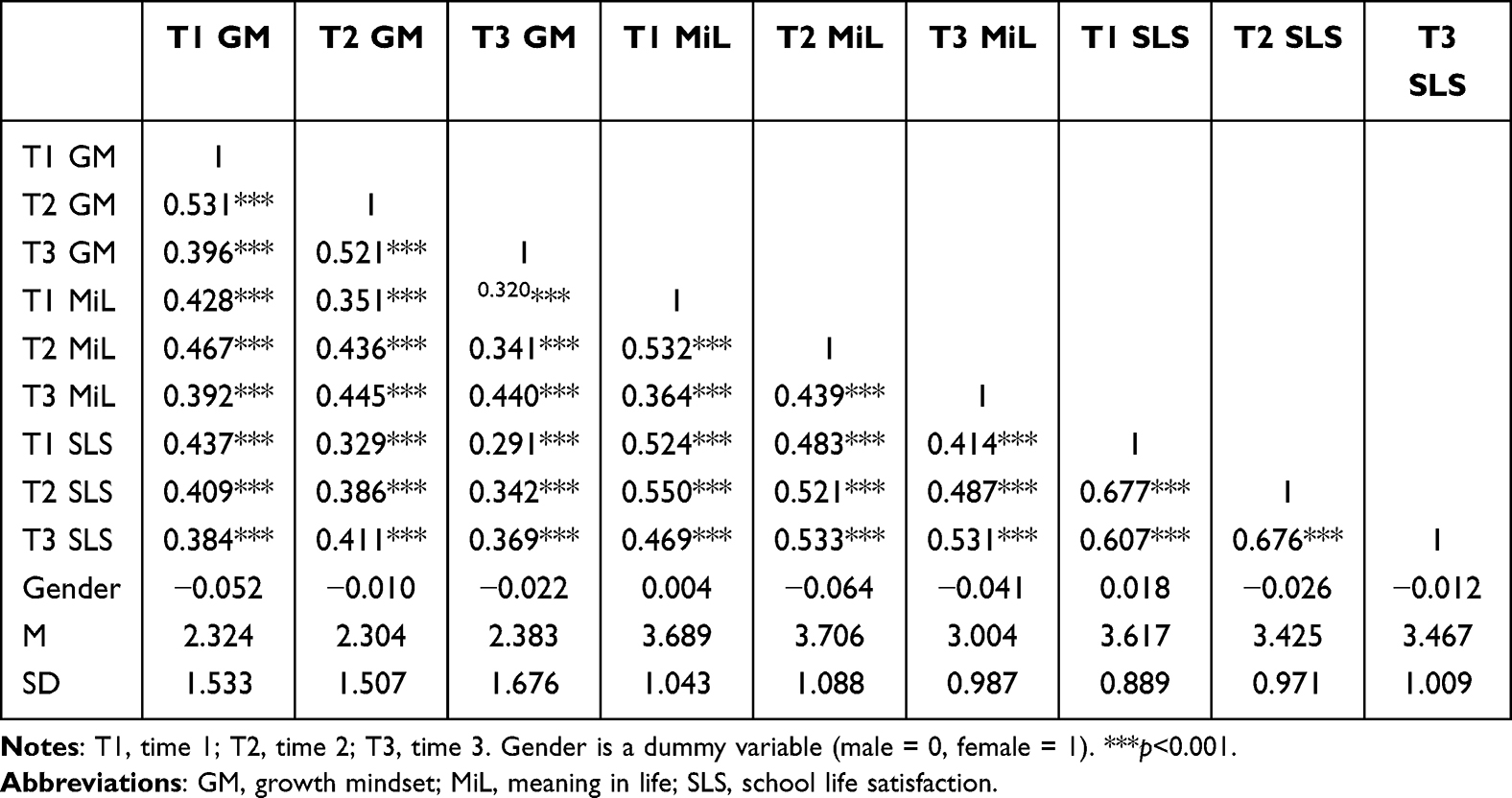 |
Table 1 Descriptive Statistics and Correlations (N = 811) |
Longitudinal Measurement Invariance Test
Since this study conducted three longitudinal waves of measurement, tests for longitudinal invariance were required. Three models were primarily constructed to examine different levels of invariance: configural invariance, metric invariance, and scalar invariance. According to Chen’s79 criteria, if the change in fit indices between adjacent models satisfies ΔCFI < 0.01 and ΔRMSEA < 0.015, the measurements are deemed to possess corresponding equivalence at different time points. As shown in Table 2, all variables satisfied the scalar invariance test.
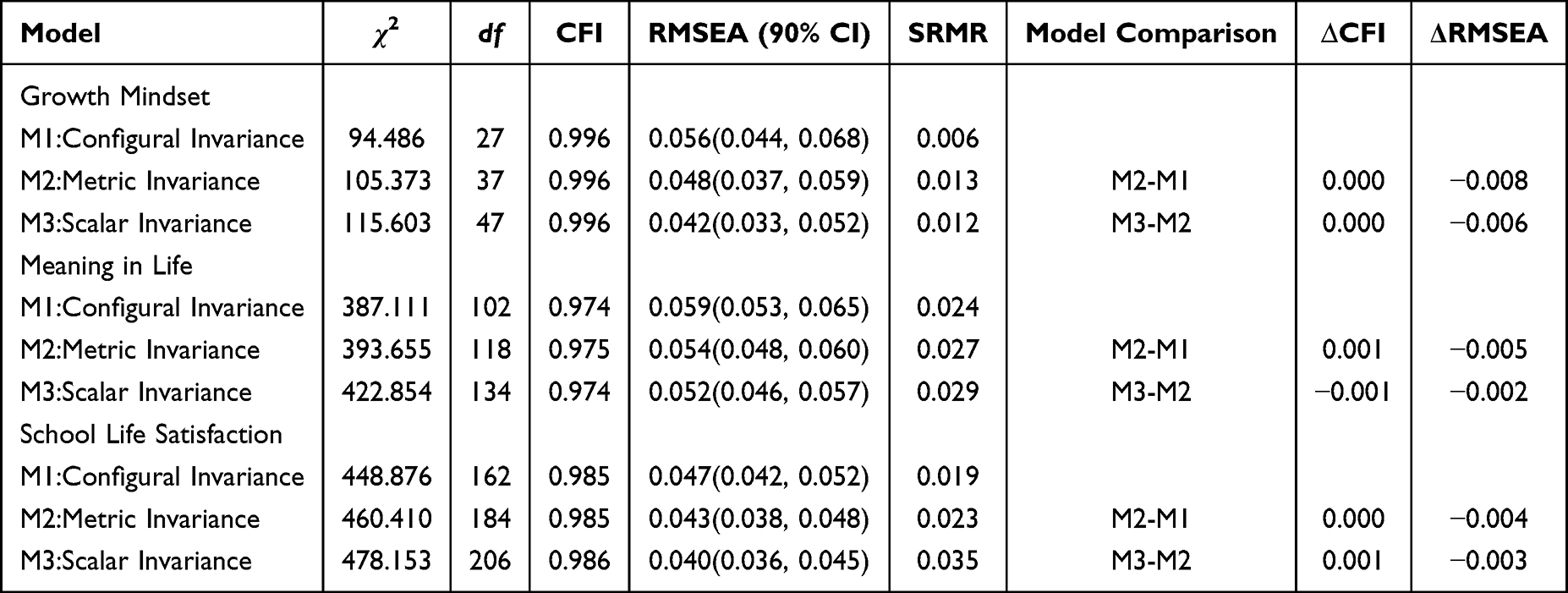 |
Table 2 Model Fit Indices for Longitudinal Measurement Invariance Analysis |
Bidirectional Relationship Between Growth Mindset and School Life Satisfaction
Figure 1 presents the RI-CLPM results for growth mindset and school life satisfaction. The model provided an acceptable fit to the data, χ2/df =4.023, RMSEA=0.051, CFI=0.998, TLI=0.974, SRMR=0.013. At the between-person level, growth mindset and school life satisfaction exhibited significant positive correlation (r = 0.690, p < 0.001). At the within-person level, T1 growth mindset significantly and positively predicted T2 growth mindset (r = 0.226, p = 0.005), and T2 growth mindset significantly and positively predicted T3 growth mindset (r = 0.229, p < 0.001). T1 school life satisfaction significantly and positively predicted T2 school life satisfaction (r = 0.182, p = 0.040), T2 school life satisfaction significantly and positively predicted T3 school life satisfaction (r = 0.276, p < 0.001). Regarding cross-lagged effects, T1 growth mindset significantly and positively predicted T2 school life satisfaction (r = 0.124, p = 0.042), T2 school life satisfaction significantly and positively predicted T3 growth mindset (r = 0.097, p = 0.045), T2 growth mindset significantly and positively predicted T3 school life satisfaction (r = 0.143, p = 0.011).
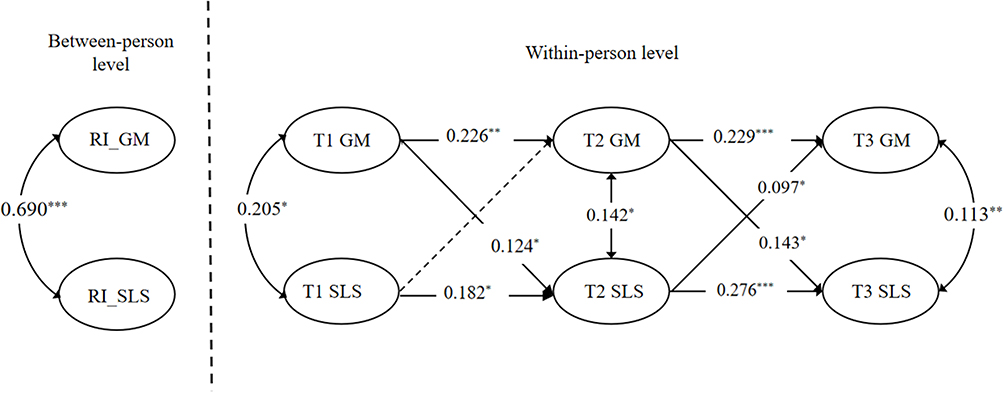 |
Figure 1 RI-CLPM results for growth mindset and school life satisfaction. Abbreviations: GM, growth mindset; SLS, school life satisfaction. Notes: Significant paths are depicted with solid lines, whereas non-significant paths are shown with dashed. Paths that were not statistically significant have been excluded from the model. ***p<0.001, **p<0.01, *p<0.05. |
Longitudinal Mediating Effect of Meaning in Life
Figure 2 presents the RI-CLPM results for growth mindset, meaning in life and school life satisfaction. The model provided an acceptable fit to the data, χ2/df =1.185, RMSEA=0.015, CFI=0.1.000, TLI=0.998, SRMR=0.009. At the between-person level, growth mindset significantly and positively correlated with school life satisfaction (r = 0.651, p < 0.001), growth mindset significantly and positively correlated with meaning in life (r = 0.953, p < 0.001), and meaning in life significantly and positively correlated with school life satisfaction (r = 0.940, p<0.001). At the within-person level, T1 growth mindset significantly and positively predicted T2 growth mindset (r = 0.236, p = 0.004), T2 growth mindset significantly and positively predicted T3 growth mindset (r = 0.220, p = 0.002). T1 meaning in life significantly and positively predicted T2 meaning in life (r = 0.317, p < 0.001), and T2 meaning in life significantly and positively predicted T3 meaning in life (r = 0.175, p = 0.006). T1 school life satisfaction significantly and positively predicted T2 school life satisfaction (r = 0.173, p = 0.043), and T2 school life satisfaction significantly and positively predicted T3 school life satisfaction (r = 0.240, p<0.001). T1 growth mindset significantly and positively predicted T2 meaning in life (r = 0.171, p<0.001) and T2 school life satisfaction (r = 0.125, p = 0.015). T1 meaning in life significantly and positively predicted T2 school life satisfaction (r = 0.270, p<0.001). T2 growth mindset significantly and positively predicted T3 meaning in life (r = 0.131, p = 0.025) and T3 school life satisfaction (r = 0.132, p = 0.009). T2 meaning in life significantly and positively predicted T3 school life satisfaction (r = 0.253, p<0.001). T2 school life satisfaction significantly and positively predicted T3 meaning in life (r = 0.166, p = 0.003) and T3 growth mindset (r = 0.105, p = 0.024). The results of nonparametric percentile Bootstrap analysis showed that T2 meaning in life significantly mediates the relationship between T1 growth mindset and T3 school life satisfaction, with an indirect effect of 0.043, 95% CI = [0.022, 0.072]. The mediating effect of T2 meaning in life between T1 school life satisfaction and T3 growth mindset was not significant, with an indirect effect of 0.005, 95% CI = [−0.003, 0.022].
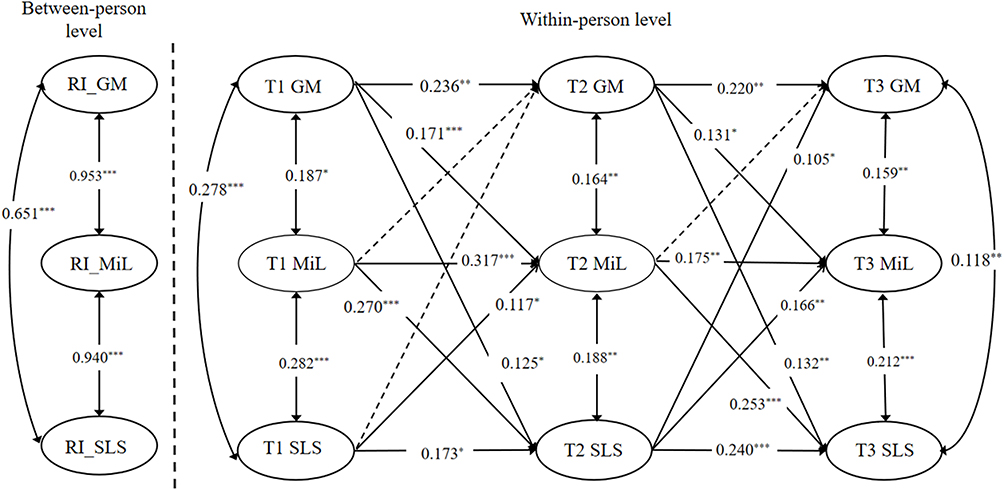 |
Figure 2 RI-CLPM results for growth mindset, meaning in life and school life satisfaction. Abbreviations: GM, growth mindset; MiL, meaning in life; SLS, school life satisfaction. Notes: Significant paths are depicted with solid lines.whereas non-significant paths are shown with dashed. Paths that were not statistically significant have been excluded from the model. ***p<0.001, **p<0.01, *p<0.05. |
Gender Differences in Longitudinal Mediation Models
A multi-group comparative structural equation model was employed to examine gender differences in the relationships among adolescents’ growth mindset, meaning in life, and school life satisfaction. The results revealed that model M2, which constrained path coefficients to be equal (χ2/df = 0.096, RMSEA = 0.000, CFI = 1.000, TLI = 1.000) yielded superior fit indices compared to model M1 with freely estimated path coefficients (χ2/df = 3.256, RMSEA=0.053, CFI=0.995, TLI=0.973). Consequently, no significant gender differences were observed in the relationship between growth mindset, meaning in life, and school life satisfaction.
Discussion
This study used RI-CLPM to investigate the dynamic relationship between growth mindset and school life satisfaction through three longitudinal waves. Through the comprehensive analysis of three longitudinal survey data, the dynamic characteristics of the relationship between them are revealed. The results revealed that at the within-person level, adolescents’ growth mindset and school life satisfaction exhibited reciprocal predictive relationships. Meaning in life mediated longitudinally between growth mindset and school life satisfaction. These findings revealed the dynamic relationship between growth mindset and school life satisfaction, giving valuable insights into effectively improving school life satisfaction among this cohort.
The Relationship Between Growth Mindset and School Life Satisfaction
This study reveals a dynamic, bidirectional interaction between growth mindset and school life satisfaction. This finding not only validates their conceptual association, but more importantly, through a longitudinal design, it uncovers the underlying mechanisms that previous cross-sectional studies failed to reveal. Previous research has predominantly analyzed the relationship between growth mindset and life satisfaction, with limited studies examining its connection to school life satisfaction.17,21 This study addresses the limitations of prior research by exploring the relationship between growth mindset and school life satisfaction within the school context.
Research findings indicate that adolescents’ growth mindset positively predicts their school life satisfaction. This result aligns with Zhao and Chang,15 suggesting that individuals with growth mindset tend to exhibit higher school life satisfaction. Unlike previous studies, this research employs a longitudinal design to further reveal that growth mindset exerts a delayed predictive effect on school life satisfaction, thereby providing a crucial supplement to prior conclusions based on cross-sectional data. According to the integrated mechanism model of psychological well-being,25 growth mindset facilitates individuals’ experience of more positive emotions in daily life, thereby enhancing their life satisfaction. Furthermore, as a positive cognitive framework, growth mindset enables individuals to assess their capabilities more rationally, leading to higher life satisfaction.24,25 Burnette et al80 meta-analysis further indicates that growth mindset enhances life satisfaction by strengthening individuals’ belief in the value of effort and promoting self-regulatory behaviors. In summary, growth mindset plays a positive role in helping adolescents improve their school life satisfaction.
School life satisfaction also promotes the development of growth mindset among adolescents. The findings demonstrate for the first time that school life satisfaction significantly predicts growth mindset, providing empirical evidence for their relationship. Within the context of China’s large population and heavy academic pressures, adolescents in critical academic stages who exhibit high school life satisfaction accumulate positive psychological resources that further enhance their growth mindset levels. According to the broaden-and-build theory of positive emotion,29 the positive emotions generated by school life satisfaction can broaden individuals’ thought sequences, making students more willing to attempt new learning challenges and tasks, thereby contributing to the formation of growth mindset. Within the school context, the positive emotions derived from high school life satisfaction create conditions conducive to expanding adolescents’ thinking.3 Furthermore, research indicates that T1 school life satisfaction did not significantly predict T2 growth mindset. This may be because at the T1 time point, middle school students had recently entered campus and their perception of the school atmosphere was still incomplete. The role of school life satisfaction had not yet fully manifested, and its impact on growth mindset requires a period of accumulation to become apparent. This further underscores that continuously fostering a positive campus environment is crucial for promoting individual cognitive development.
Longitudinal Mediating Role of Meaning in Life
This study found that at the within-person level, adolescents’ growth mindset, meaning in life, and school life satisfaction demonstrated relative stability among the three time points. T2 meaning in life mediated the relationship between T1 growth mindset and T3 school life satisfaction. This provides empirical evidence for PP2.0. PP 2.0 emphasizes a balanced, dialectical pursuit of well-being in specific domains, focusing not only on positive traits but also valuing the role of meaning-making and coping with life challenges.44 Unlike earlier positive psychology approaches that placed excessive emphasis on positive affect, PP 2.0 places meaning at its core and highlights the integrative function of meaning, which helps individuals construct their understanding of the world and engage in self-regulation.37 Thus, rather than merely cultivating positive emotions, PP 2.0 emphasizes the need for students to actively explore purpose in life and make sense of both positive and negative school experiences, thereby achieving greater school life satisfaction. Specifically, growth mindset significantly and positively predicted meaning in life. This aligns with the findings of Zhao et al,21 indicating that short-term induced growth mindsets can enhance adolescents’ perception of meaning in life Concurrently, the results support self-determination theory, suggesting individuals exhibit behavioral autonomy and goal-directedness.39 Adolescents with a growth mindset are more inclined to proactively seek self-improvement and can more effectively deepen their understanding of meaning in life.40,41 This finding further supports the perspective of treating growth mindset as a core variable in positive development.81,82 As a significant indicator reflecting individuals’ beliefs about personal development, growth mindset enhances positive experiences and meaning perception by strengthening the conviction that abilities can be developed.42,83 It emphasizes self-development through actively engaging with challenges and constitutes an important dimension of meaning in life.37,38
Enhanced life meaning leads to increased school life satisfaction. This finding supports meaning-making theory, whereby individuals continuously construct meaning to give value to their lives.45 Students with higher life meaning are better at proactively constructing value in their studies and daily lives, which further elevates their school life satisfaction. People with high levels of meaning in life typically demonstrate a positive correlation between meaning-seeking behaviors and life satisfaction.31 Conversely, lower life meaning is often associated with unclear goals and diminished motivation, which may reduce positive emotional experiences and consequently impact life satisfaction.18 The lack of meaning in life can weaken individuals’ feelings of control and self-value, decreasing life satisfaction further.53 Within the school context, a deeper understanding and active pursuit of meaning enable students adapt more effectively to the campus environment while facilitating self-actualization,46 which in turn promotes school life satisfaction. Adolescents are typically in a developmental stage marked by a strong self-actualization motivation, where successful individual growth contributes substantially to enhanced meaning experience and mental well-being.35 Conversely, when this developmental process is disrupted, it may frequently result in psychological distress and reduced life satisfaction.84
A notable null finding emerged in this study. Contrary to the hypothesis, this study found that T2 meaning in life was unable to mediate the relationship between T1 school life satisfaction and T3 growth mindset. This non-significant reverse mediation, although unexpected, offers important insights into the directional flow between these constructs. This may be because school life satisfaction is a relatively volatile evaluative feeling. Over a longer follow-up period, it may struggle to consistently influence growth mindset through meaning in life. As a stable belief about the malleability of one’s abilities, growth mindset formation is shaped by long-term socialization processes and early experiences.63 Compared to evaluative feelings about specific environments (eg., school life satisfaction), growth mindset represents an individual’s relatively stable belief in intellectual plasticity,85 making it more likely to play a driving role during adolescent development. Thus, the absence of reverse mediation further supports the interpretation that meaning in life functions primarily as a mechanism translating growth mindset into enhanced school satisfaction, rather than the reverse. Future research could further elucidate the boundary conditions and mechanisms underlying these dynamic relationships by extending time intervals or employing more intensive tracking designs (eg., quarterly follow-ups).
This study found that gender differences were not significant in the longitudinal mediating model among growth mindset, meaning in life, and school life satisfaction. This indicated that positive developmental pathways apply equally to students of both genders. The reason may be that all three constructs represent core psychological resources necessary for coping with academic pressures and developmental challenges during adolescence.86,87 Given that male and female students encounter broadly comparable school-related challenges during this period, the psychological mechanisms that support their development are likely to function in similar ways.
Research Significance and Limitations
This study holds both theoretical and practical significance. Theoretically, it reveals the bidirectional relationship between growth mindset and school life satisfaction, along with its underlying mechanisms. The results indicate that growth mindset and meaning in life jointly predict school life satisfaction, a finding that supports and enriches meaning-making theory and self-determination theory. These theories highlight how an individual’s mindset and sense of meaning inform their appraisal of life’s value.39,45 Extending this view, implicit theory suggests that a growth mindset helps individuals cope with stress, supports physiological regulation, and enhances meaning and life satisfaction23—a perspective further corroborated by our finding that school life satisfaction reciprocally strengthens growth mindset over time. Using the RI-CLPM, which separates within- from between-person variance, our study underscores the importance of modeling both levels to accurately capture the dynamic interplay between these constructs. Furthermore, this study identified a one-way mediation model where meaning in life mediates the relationship between growth mindset and school life satisfaction, with this pattern consistent across genders. This pattern suggests that, within the Chinese cultural context, all three variables represent core psychological resources in adolescence, offering preliminary grounds for future cross-cultural comparison.
From a practical perspective, the research findings offer insights for enhancing school mental health education and optimizing the overall educational environment. On the one hand, at the level of positive construction, the study identifies psychological resources that schools can proactively cultivate. School psychological services may design and implement group interventions or school-based curricula centred on themes of “meaning-seeking” and “goal-setting”, assisting pupils in clarifying their academic or life objectives. Concurrently, assessments of growth mindset and meaning in life should be integrated into routine mental health screenings or individual counselling, identifying potential groups with low satisfaction in school life as entry points for intervention. Moreover, the overall school environment should strive to foster a culture that supports independent exploration, encouraging students to establish goals aligned with their personal interests. This approach creates synergistic effects at both the cognitive level (growth mindset) and the existential level (meaning in life), thereby continuously enhancing students’ sense of belonging and satisfaction with school life.
Secondly, more crucially, this study calls upon educators to adopt a systematic perspective of reflection and improvement. The practical significance lies not only in “what to do”, but equally in “what to avoid”. On the dimension of counter-risk avoidance, attention must be focused on identifying and mitigating school practices and environmental risk factors that erode students’ growth mindset and sense of life’s meaning. Proactive efforts should be made to recognize and refine those elements within the school environment that may suppress or undermine these positive resources. Schools must reduce the emphasis on performance-based ranking systems, prioritize the process of student effort, and strengthen students’ growth mindset. Furthermore, curriculum content should transcend mere mechanical knowledge transmission, placing greater importance on the intrinsic meaning of learning activities themselves. Schools should foster a relaxed management atmosphere, grant students autonomy in choice, value their intrinsic motivation and exploration of interests, and actively cultivate these two critical endogenous resources: growth mindset and a sense of life’s meaning. Cultivating these positive resources helps bridge the gap created by negative educational practices and environmental risk factors. This approach drives the transformation of school mental health education, safeguarding students’ satisfaction with school life and promoting their holistic physical and mental development. Simultaneously, it provides education stakeholders with more comprehensive and actionable theoretical guidance and practical strategies for implementing effective interventions.
This study has certain limitations. Firstly, the construct of meaning in life was not examined from a multidimensional perspective. Research indicated that secondary school students scored significantly higher in “seeking meaning” than in “presence of meaning”.72 Steger et al31 observed that individuals tend to seek meaning more in the early stages of life, while later life stages are characterized by a greater perception of meaning. Therefore, future studies should further explore the underlying mechanisms distinguishing these two dimensions of meaning in life. Secondly, due to resource constraints, this study was conducted only in a limited number of secondary schools within Anhui Province. Future studies may expand both the geographical scope of sampling and the temporal duration to improve the representativeness and generalizability of the findings. In addition, this study did not incorporate information on socioeconomic Status (SES). However, existing research indicates that SES is a significant variable influencing adolescents’ growth mindset.88 Consequently, future studies may consider including SES in their analyses to further investigate its underlying mechanisms in relation to adolescents’ growth mindset and associated variables. Thirdly, as this research relied on self-report questionnaires, participants’ reported school life satisfaction may differ from actual circumstances. Future studies could incorporate experimental methods and other approaches to increase the diversity of data sources and strengthen the reliability of research results. A further limitation concerns missing data. We relied on listwise deletion based on valid questionnaire criteria, an approach that assumes data are missing completely at random (MCAR).89 Although the very low attrition rate and large final sample make it unlikely that this introduced significant bias, subsequent longitudinal studies could strengthen the robustness of the findings by adopting full-information maximum likelihood (FIML).90
Conclusion
This three-wave longitudinal study offers insights for understanding the relationships among growth mindset, meaning in life and school life satisfaction. Our finding indicated that: (1) After controlling for between-person effects, at the within-person level, T1 growth mindset significantly and positively predicted T2 school life satisfaction. T2 school life satisfaction significantly and positively predicted T3 growth mindset. T2 growth mindset significantly and positively predicted T3 school life satisfaction. These findings support Hypothesis 1, confirming a bidirectional relationship between adolescents’ growth mindset and school life satisfaction. (2) After controlling for between-person effects, at the within-person level, T2 meaning in life exhibited longitudinal mediating effects on the relationship between T1 growth mindset and T3 school life satisfaction. These findings support Hypothesis 2a, demonstrating that meaning in life serves as a longitudinal mediator in the dynamic interplay between growth mindset and school life satisfaction. These findings do not support Hypothesis 2b, as the reverse mediation pathway (from school life satisfaction to growth mindset via meaning in life) was not significant. Multi-group comparison analyses revealed no significant gender differences in the mediation model. Thus, interventions that combine growth mindset with meaning in life are likely to enhance school satisfaction more effectively than targeting either factor alone.
Data Sharing Statement
The datasets generated during and/or analyzed during the current study are available from the corresponding author on reasonable request.
Ethical Statement
This project was approved by the Research Ethics Committee of Anhui Normal University (approval NO.AHNU-ET20220804). All subjects provided informed consent and were rewarded for the completion of the survey. The procedures in this study adhered to the rules of the Declaration of Helsinki.
Informed Consent Statement
Informed consent was obtained from the legal guardians of all student subjects involved in the study, and assent was also obtained from the students.
Funding
The present study was funded by the National Key R&D Program of China under grant number 2021YFC3340801.
Disclosure
All authors declared that they have no conflicts of interest in this work.
References
1. Kulakow S, Raufelder D, Hoferichter F. School-related pressure and parental support as predictors of change in student stress levels from early to middle adolescence. J Adolesc. 2021;87(1):38–16. doi:10.1016/j.adolescence.2020.12.008
2. Qu K, Zou H, Li X. Migrant children’ school satisfaction and its relation with teacher-student relationship and learning behavior. Chin J Spec Educ. 2008;07:50–55.
3. Jiang X, Huebner ES, Siddall J. A short-term longitudinal study of differential sources of school-related social support and adolescents’ school satisfaction. Soc Indic Res. 2013;114(3):1073–1086. doi:10.1007/s11205-012-0190-x
4. Lounsbury JW, Saudargas RA, Gibson LW, Leong FT. An investigation of broad and narrow personality traits in relation to general and domain-specific life satisfaction of college students. Res High Educ. 2005;46(6):707–729. doi:10.1007/s11162-004-4140-6
5. Furnham A, Cheng H. Perceived parental behavior, self-esteem and happiness. Soc Psychiatry Psychiatr Epidemiol. 2000;35(10):463–470. doi:10.1007/s001270050265
6. Antaramian SP, Huebner ES, Valois RF. Adolescent life satisfaction. Appl Psychol. 2008;57:112–126. doi:10.1111/j.1464-0597.2008.00357.x
7. Li M, Bian Q, Fan W, Chen X. The development of school satisfaction in Chinese early adolescents: the contributions of peer liking and academic performance. J Youth Adolesc. 2023;52(2):359–369. doi:10.1007/s10964-022-01701-6
8. Pedditzi ML. School satisfaction and self-efficacy in adolescents and intention to drop out of school. Int J Environ Res Public Health. 2024;21:111. doi:10.3390/ijerph21010111
9. Horanicova S, Husarova D, Gecková AM, De Winter AF, Reijneveld SA. School satisfaction and its associations with health and behavioural outcomes among 15-years old adolescents. Int J Environ Res Public Health. 2022;19:11514. doi:10.3390/ijerph191811514
10. Jiang X, Shi D, Fang L, Ferraz RC. Teacher–student relationships and adolescents’ school satisfaction: behavioural engagement as a mechanism of change. Br J Educ Psychol. 2022;92(4):1444–1457. doi:10.1111/bjep.12509
11. Aldridge JM, McChesney K, Ernest A. Associations between school climate and student life satisfaction: resilience and bullying as mediating factors. Learn Environ Res. 2020;23(1):129–150. doi:10.1007/s10984-019-09296-9
12. Xia Q, Pang C, Zeng W, Li Q, Wu S, Xiao X. Burnout among VET pathway university students: the role of academic stress and school-life satisfaction. BMC Public Health. 2025;25(1):1467. doi:10.1186/s12889-025-22769-2
13. Weber M, Harzer C. Relations between character strengths, school satisfaction, enjoyment of learning, academic self-efficacy, and school achievement: an examination of various aspects of positive schooling. Front Psychol. 2022;13:826960. doi:10.3389/fpsyg.2022.826960
14. Simonsen IE, Rundmo T. The role of school identification and self-efficacy in school satisfaction among Norwegian high-school students. Soc Psychol Educ. 2020;23(6):1565–1586. doi:10.1007/s11218-020-09595-7
15. Zhao Y, Chang B. Relationship between growth mindset and learning engagement in adolescents: the chain mediating effect of grit and life satisfaction. Psychol Tech Appl. 2024;12(02):85–96. doi:10.16842/j.cnki.issn2095-5588.2024.02.003
16. Jin Y, He M, Li J. The relationship between meaning in life and subjective well-being in China: a Meta-analysis. Adv Psychol Sci. 2016;24(12):1854–1863. doi:10.3724/SP.J.1042.2016.01854
17. Hao Y, Zhou Y. Perceived academic control, growth mindset, self-regulation, and life satisfaction in Chinese students: a mixed methods study featuring interpretative phenomenological analysis. Acta Psychol. 2026;262:105943. doi:10.1016/j.actpsy.2025.105943
18. Wendt GW, Costa AB, Poletto M, Cassepp-Borges V, Dellaglio DD, Koller SH. Stressful events, life satisfaction, and positive and negative affect in youth at risk. Child Youth Serv Rev. 2019;102:34–41. doi:10.1016/j.childyouth.2019.04.028
19. Moral-Garcia JE, Jiménez A, Cabaco AS, Jiménez-Eguizabal A. The Role of Physical Activity and School Physical Education in Enhancing School Satisfaction and Life Satisfaction. Int J Environ Res Public Health. 2021;18(4):1689. doi:10.3390/ijerph18041689
20. Rege M, Hanselman P, Solli IF, et al. How can we inspire nations of learners? An investigation of growth mindset and challenge-seeking in two countries. Am Psychol. 2021;76(5):755. doi:10.1037/amp0000647
21. Zhao H, Zhang M, Li Y, Wang Z. The Effect of Growth Mindset on Adolescents’ Meaning in Life: the Roles of Self-Efficacy and Gratitude. Psychol Res Behav Manag. 2023;16:4647–4664. doi:10.2147/PRBM.S428397
22. Moksnes UK, Løhre A, Lillefjell M, Byrne DG, Haugan G. The association between school stress, life satisfaction and depressive symptoms in adolescents: life satisfaction as a potential mediator. Soc Indic Res. 2016;125(1):339–357. doi:10.1007/s11205-014-0842-0
23. Dweck CS. Mindset: The New Psychology of Success. Random House; 2006.
24. Blackwell LS, Trzesniewski KH, Dweck CS. Implicit theories of intelligence predict achievement across an adolescent transition: a longitudinal study and an intervention. Child Dev. 2007;78(1):246–263. doi:10.1111/j.1467-8624.2007.00995.x
25. Yu Z, Lian R. The influence of implicit theory on mental health and its mechanism. J Shandong Norm Univ Humanit Soc Sci. 2019;64(2):105–112. doi:10.16456/j.cnki.1001-5973.2019.02.009
26. Zhao S, Du H, Li Q, Wu Q, Chi P. Growth mindset of socioeconomic status boosts subjective well-being: a longitudinal study. Pers Individ Dif. 2021;168:110301. doi:10.1016/j.paid.2020.110301
27. Hobfoll SE. Conservation of resources: a new attempt at conceptualizing stress. Am Psychol. 1989;44(3):513.
28. Katja R, Päivi ÅK, Marja-Terttu T, Pekka L. Relationships Among adolescent subjective well-being, health behavior, and school satisfaction. J Sch Health. 2002;72(6):243–249. doi:10.1111/j.1746-1561.2002.tb07337.x
29. Fredrickson BL. The role of positive emotions in positive psychology: the broaden-and-build theory of positive emotions. Am Psychol. 2001;56(3):218. doi:10.1037/0003-066x.56.3.218
30. Hagenauer G, Gläser-Zikuda M, Moschner B. University students’ emotions, life-satisfaction and study commitment: a self-determination theoretical perspective. J Furth High Educ. 2018;42(6):808–826. doi:10.1080/0309877X.2017.1323189
31. Steger MF, Frazier P, Oishi S, Kaler M. The meaning in life questionnaire: assessing the presence of and search for meaning in life. J Couns Psychol. 2006;53(1):80. doi:10.1037/0022-0167.53.1.80
32. Pfeifer JH, Berkman ET. The development of self and identity in adolescence: neural evidence and implications for a value-based choice perspective on motivated behavior. Child Dev Perspect. 2018;12(3):158–164. doi:10.1111/cdep.12279
33. Ahmed U, Majid AHA, Zin MLM. Meaningful work and work engagement: a relationship demanding urgent attention. Int J Acad Res Bus Soc Sci. 2016;6(8):116–122. doi:10.6007/IJARBSS/v6-i8/2264
34. Ding F, Tian X, Chen L, Wang X. The relationship between physical health and fear of death in rural residents: the mediation effect of meaning in life and mental health. Death Stud. 2020;46(1):148–156. doi:10.1080/07481187.2020.1723741
35. Martela F, Steger MF. The three meanings of meaning in life: distinguishing coherence, purpose, and significance. J Posit Psychol. 2016;11(5):531–545. doi:10.1080/17439760.2015.1137623
36. Sørensen T, la Cour P, Danbolt LJ, et al. The sources of meaning and meaning in life questionnaire in the Norwegian context: relations to mental health, quality of life, and self-efficacy. Int J Psychol Relig. 2019;29(1):32–45. doi:10.1080/10508619.2018.1547614
37. Lee CS, Jang HY. The roles of growth mindset and grit in relation to hope and self-directed learning. J Korea Converg Soc. 2018;9(1):95–102. doi:10.15207/JKCS.2018.9.1.095
38. Feldman DB, Snyder CR. Hope and the meaningful life: theoretical and empirical associations between goal-directed thinking and life meaning. J Soc Clin Psychol. 2005;24(3):401–421. doi:10.1521/jscp.24.3.401.65616
39. Deci EL, Ryan RM. The “what” and “why” of goal pursuits: human needs and the self-determination of behavior. Psychol Inq. 2000;11(4):227–268. doi:10.1207/s15327965pli1104_01
40. Zhao H, Zhang J, Heng S, Qi C. Team growth mindset and team scientific creativity of college students: the role of team achievement goal orientation and leader behavioral feedback. Think Skills Creat. 2021;42:100957. doi:10.1016/j.tsc.2021.100957
41. Feng F, Zhu C, Hou Y. The meaning of life and the perceived control of senior citizens: the effect of self-identity and policy support. Psychol Sci. 2020;43(5):1087–1094. doi:10.16719/j.cnki.1671-6981.20200509
42. Wong PT. Existential positive psychology and integrative meaning therapy. Int Rev Psychiatry. 2020;32(7–8):565–578. doi:10.1080/09540261.2020.1814703
43. Guan J. The improvement of contemporary youth’s thinking mode and cognition. People’s Trib. 2022;8:32–35.
44. Wong PTP. Positive psychology 2.0: towards a balanced interactive model of the good life. Can Psychol. 2011;52(2):69. doi:10.1037/a0022511
45. Frankl VE. Man’s Search for Meaning. Simon and Schuster; 1985.
46. Zhang R, Li D. How to experience a meaningful life: based on the integration of theoretical models on meaning in life. Adv Psychol Sci. 2018;26(04):744–760. doi:10.3724/SP.J.1042.2018.00744
47. Folker AP, Lauridsen SM, Hegelund ER, Wimmelmann CL, Flensborg-Madsen T. Does meaning protect against loneliness? Exploring empirical studies and theory. Health Promot Int. 2021;36(2):471–480. doi:10.1093/heapro/daaa081
48. Stavrova O, Luhmann M. Social connectedness as a source and consequence of meaning in life. J Posit Psychol. 2016;11(5):470–479. doi:10.1080/17439760.2015.1117127
49. Li J, Dou K, Liang Y. The relationship between presence of meaning, search for meaning, and subjective well-being: a three-level meta-analysis based on the Meaning in Life Questionnaire. J Happiness Stud. 2021;22(1). doi:10.1007/s10902-020-00230-y
50. Waytz A, Hershfield HE, Tamir DI. Mental simulation and meaning in life. J Pers Soc Psychol. 2015;108(2):336. doi:10.1037/a0038322
51. Krause N. Meaning in life and mortality. J Gerontol B Psychol Sci Soc Sci. 2009;64(4):517–527. doi:10.1093/geronb/gbp047
52. Kress VE, Newgent RA, Whitlock J, Mease L. Spirituality/religiosity, life satisfaction, and life meaning as protective factors for nonsuicidal self-injury in college students. J Coll Couns. 2015;18(2):160–174. doi:10.1002/jocc.12012
53. Bayer ND, Taylor A, Fallon A, et al. Pediatric residents’ sense of meaning in their work: is this value related to higher specialty satisfaction and reduced burnout? Acad Pediatr. 2021;21(3):557–563. doi:10.1016/j.acap.2020.10.012
54. Wachs TD, Plomin RE. Conceptualization and Measurement of Organism-Environment Interaction. American Psychological Association; 1991.
55. Ma Y. Effect of interpersonal relationship on depression: the chain mediating effect of life satisfaction and life meaning. China J Health Psychol. 2022;30(10):1459–1463. doi:10.13342/j.cnki.cjhp.2022.10.004
56. Zhao D, Wang Y, Li J, Wang L. Coping style as mediator on the relationship between meaning in life and life satisfaction in graduate students. China J Health Psychol. 2014;22(11):1733–1735. doi:10.13342/j.cnki.cjhp.2014.11.053
57. Rogers CR. On Becoming a Person: A Therapist’s View of Psychotherapy. Houghton Mifflin Harcourt; 1995.
58. Snyder CR, Lehman KA, Kluck B, Monsson Y. Hope for rehabilitation and vice versa. Rehabil Psychol. 2006;51(2):89. doi:10.1037/0090-5550.51.2.89
59. Litlabø VR, Haga M, Richter I, Sigmundsson H. Exploring gender differences in Norwegian eighth-grade students: the role of passion, grit, growth mindset, self-efficacy, compassion, courage, and wellbeing. Front Educ. 2025;10:1703583. doi:10.1037/0033-295X.84.2.191
60. Nolen-Hoeksema S. Emotion regulation and psychopathology: the role of gender. Annu Rev Clin Psychol. 2012;8(1):161–187. doi:10.1146/annurev-clinpsy-032511-143109
61. Alkhazaleh ZM, Mahasneh AM. Fear of failure among a sample of Jordanian undergraduate students. Psychol Res Behav Manag. 2016;9:53–60. doi:10.2147/prbm.s96384
62. Gandhi A, Luyckx K, Maitra S, Claes L. Non-suicidal self-injury and identity distress in Flemish adolescents: exploring gender differences and mediational pathways. Pers Individ Dif. 2015;82:215–220. doi:10.1016/j.paid.2015.03.031
63. Dweck CS, Yeager DS. Mindsets: a view from two eras. Perspect Psychol Sci. 2019;14(3):481–496. doi:10.1177/1745691618804166
64. Prager E. Sources of personal meaning for older and younger Australian and Israeli women: profiles and comparisons. Ageing Soc. 1997;17(2):167–189. doi:10.1017/S0144686X96006307
65. Preacher KJ. Advances in mediation analysis: a survey and synthesis of new developments. Annu Rev Psychol. 2015;66:825–852. doi:10.1146/annurev-psych-010814-015258
66. Verschueren M, Claes L, Gandhi A, Luyckx K. Identity and psychopathology: bridging developmental and clinical research. Emerg Adulthood. 2020;8(5):319–332. doi:10.1177/2167696819870021
67. Curran PJ, Hancock GR. The challenge of modeling co-developmental processes over time. Child Dev Perspect. 2021;15(2):67–75. doi:10.1111/cdep.12401
68. Hamaker EL, Kuiper RM, Grasman RP. A critique of the cross-lagged panel model. Psychol Methods. 2015;20(1):102. doi:10.1037/a0038889
69. Marsh HW, Pekrun R, Lüdtke O. Directional ordering of self-concept, school grades, and standardized tests over five years: new tripartite models juxtaposing within-and between-person perspectives. Educ Psychol Rev. 2022;34(4):2697–2744. doi:10.1007/s10648-022-09662-9
70. Cai J, Yang Y, Yu H, Xu C. Father educational involvement and Chinese elementary school children’s math anxiety: the chain mediating role of growth mindset and math self-concept. Curr Psychol. 2024;43(33):27102–27116. doi:10.1007/s12144-024-06292-y
71. Jiang X, Shen R, Zhang K. Impact of cumulative family risk on depressive symptoms: mediated by perceived stress and moderated by growth mindset among Chinese adolescents. Curr Psychol. 2024;43(47):36259–36273. doi:10.1007/s12144-024-07084-0
72. Wang X. Psychometric evaluation of the meaning in life questionnaire in Chinese middle school students. Chin J Clin Psychol. 2013;21(05):764–767+763. doi:10.16128/j.cnki.1005-3611.2013.05.008
73. Tao F, Sun Y, Feng E, Su P, Zhu P. Development of school life satisfaction rating questionnaire for adolescents and its reliability and validity. Chin J Sch Health. 2005;26(12):987–989.
74. Revelle W. Psych: Procedures for Psychological, Psychometric, and Personality Research. R Package Version 2.5. 2020.
75. Mulder JD, Hamaker EL. Three extensions of the random intercept cross-lagged panel model. Struct Equation Model. 2021;28(4):638–648. doi:10.1080/10705511.2020.1784738
76. Fang J, Wen Z, Huang G. Exploring the longitudinal relations: based on longitudinal models with cross-lagged structure. Psychol Sci. 2023;46(3):733–740. doi:10.16719/j.cnki.1671-6981.20230328
77. Gu H, Yu W, Cheng Y. Reciprocal associations between identity confusion and adolescent NSSI: the longitudinal mediation effect of alienation. Acta Psychol Sin. 2025;57(02):247–259. doi:10.3724/SP.J.1041.2025.0247
78. Zhou H, Long L. Statistical remedies for common method biases. Adv Psychol Sci. 2004;12(6):942–950.
79. Chen F. Sensitivity of goodness of fit indexes to lack of measurement invariance. Struct Equation Model. 2007;14(3):464–504. doi:10.1080/10705510701301834
80. Burnette JL, O’boyle EH, VanEpps EM, Pollack JM, Finkel EJ. Mindsets matter: a meta-analytic review of implicit theories and self-regulation. Psychol Bull. 2013;139(3):655–701. doi:10.1037/a0029531
81. Verberg F, Helmond P, Otten R, Overbeek G. Mindset and perseverance of adolescents with intellectual disabilities: associations with empowerment, mental health problems, and self-esteem. Res Dev Disabil. 2019;91:103426. doi:10.1016/j.ridd.2019.103426
82. Yu T, Pan X, Li J, et al. Impacts of growth mindset on health: effects, mechanisms and interventions. Chin J Clin Psychol. 2022;30:871–875. doi:10.16128/j.cnki.1005-3611.2022.04.023
83. Lam KKL, Zhou M. A serial mediation model testing growth mindset, life satisfaction, and perceived distress as predictors of perseverance of effort. Pers Individ Dif. 2020;167:110262. doi:10.1016/j.paid.2020.110262
84. George LS, Park CL. Meaning in life as comprehension, purpose, and mattering: toward integration and new research questions. Psychol Rev. 2016;20(3):205–220. doi:10.1037/gpr0000077
85. Mendoza NB, Yan Z. From beliefs to behaviors: conceptualizing and assessing students’ practices that reflect a growth mindset. Soc Psychol Educ. 2025;28(1):1–35. doi:10.1007/s11218-025-10032-w
86. Krok D. When is meaning in life most beneficial to young people? Styles of meaning in life and well-being among late adolescents. J Adult Dev. 2018;25(2):96–106. doi:10.1007/s10804-017-9280-y
87. Schroder HS, Yalch MM, Dawood S, Callahan CP, Donnellan MB, Moser JS. Growth mindset of anxiety buffers the link between stressful life events and psychological distress and coping strategies. Pers Individ Dif. 2017;110:23–26. doi:10.1016/j.paid.2017.01.016
88. Zhao S, Chen L, King RB, Nie Y, Du H, Chi P. When adolescents believe that SES can be changed, they achieve more: the role of growth mindset of SES. Pers Individ Dif. 2021;183:111104. doi:10.1016/j.paid.2021.111104
89. Little RJA, Rubin DB. Statistical Analysis with Missing Data.
90. Enders CK, Bandalos DL. The relative performance of full information maximum likelihood estimation for missing data in structural equation models. Struct Equation Model. 2001;8(3):430–457. doi:10.1207/S15328007SEM0803_5
 © 2026 The Author(s). This work is published and licensed by Dove Medical Press Limited. The
full terms of this license are available at https://www.dovepress.com/terms
and incorporate the Creative Commons Attribution
- Non Commercial (unported, 4.0) License.
By accessing the work you hereby accept the Terms. Non-commercial uses of the work are permitted
without any further permission from Dove Medical Press Limited, provided the work is properly
attributed. For permission for commercial use of this work, please see paragraphs 4.2 and 5 of our Terms.
© 2026 The Author(s). This work is published and licensed by Dove Medical Press Limited. The
full terms of this license are available at https://www.dovepress.com/terms
and incorporate the Creative Commons Attribution
- Non Commercial (unported, 4.0) License.
By accessing the work you hereby accept the Terms. Non-commercial uses of the work are permitted
without any further permission from Dove Medical Press Limited, provided the work is properly
attributed. For permission for commercial use of this work, please see paragraphs 4.2 and 5 of our Terms.
Recommended articles

The Effect of Growth Mindset on Adolescents’ Meaning in Life: The Roles of Self-Efficacy and Gratitude
Zhao H, Zhang M, Li Y, Wang Z
Psychology Research and Behavior Management 2023, 16:4647-4664
Published Date: 13 November 2023