
Back to Journals » ClinicoEconomics and Outcomes Research » Volume 18
Real-World Clinical and Economic Outcomes Among Patients with Localized Prostate Cancer Undergoing Radical Prostatectomy Across Different Risk Stratifications in the United States
Authors Shore N, Lowentritt B, Patel C, Burbage S, Kinkead F, Rossi C, Lee F, Pilon D, Karsh L, Brown G
Received 7 January 2026
Accepted for publication 4 May 2026
Published 27 May 2026 Volume 2026:18 590934
DOI https://doi.org/10.2147/CEOR.S590934
Checked for plagiarism Yes
Review by Single anonymous peer review
Peer reviewer comments 2
Editor who approved publication: Professor Giorgio Colombo
Neal Shore,1 Benjamin Lowentritt,2 Charmi Patel,3 Sabree Burbage,3 Frederic Kinkead,4 Carmine Rossi,4 Francesca Lee,4 Dominic Pilon,4 Lawrence Karsh,5 Gordon Brown6
1START Carolinas/Carolina Urologic Research Center, Myrtle Beach, SC, USA; 2Chesapeake Urology, Towson, MD, USA; 3Real World Value & Evidence, Johnson & Johnson, Horsham, PA, USA; 4Analysis Group, Inc, Montréal, QC, Canada; 5Advent Health Urology, Denver, CO, USA; 6New Jersey Urology, Cherry Hill, NJ, USA
Correspondence: Carmine Rossi
Analysis Group, Inc, Montréal, QC, Canada
, Tel +1 514 871 4233
, Email [email protected]
Background: Radical prostatectomy is a potentially curative treatment for localized prostate cancer (LPC), but there is limited literature comprehensively describing clinical and economic outcomes stratified by risk group. This study compared survival and healthcare costs following radical prostatectomy between patients with high-risk and low/intermediate-risk LPC in routine urology practice in the US.
Methods: Linked electronic medical records and administrative claims were used to identify men with LPC undergoing radical prostatectomy (index date). Patients were classified into high-risk or low/intermediate-risk cohorts based on staging, prostate-specific antigen test results, and Gleason score, in alignment with the National Comprehensive Cancer Network®. Cohorts were balanced using inverse probability of treatment weighting. Metastasis-free survival and event-free survival post index were compared between cohorts using a weighted Cox proportional hazards model. All-cause/prostate cancer (PC)-related healthcare costs were compared post index using weighted ordinary least squares regression in a subgroup of patients with 12 months of continuous insurance eligibility prior to/including index.
Results: Patients in the high-risk cohort (N=7542) had significantly higher rates of metastasis (36 months: hazard ratio [95% confidence interval (CI)]: 3.80 [3.31, 4.38], p< 0.001; 60 months: 3.59 [3.19, 4.04], p< 0.001) and disease progression (36 months: 3.49 [3.28, 3.71], p< 0.001; 60 months: 3.37 [3.18, 3.57], p< 0.001) compared to patients in the low/intermediate-risk cohort (N=11,429). In the cost subgroup, the high-risk cohort (N=1488) incurred significantly higher mean total all-cause healthcare costs (cost difference [95% CI]: $9134 [5999, 12,400] per-patient-per-year, p< 0.001) and mean total PC-related healthcare costs ($7502 [4718, 10,279] per-patient-per-year, p< 0.001) compared to the low/intermediate-risk cohort (N=2572) post index.
Conclusion: In this real-world analysis of patients with LPC who underwent radical prostatectomy, high-risk disease was significantly associated with poorer survival and higher healthcare costs post-procedure compared to low/intermediate-risk LPC. These findings demonstrate the heightened clinical and economic burden observed with high-risk LPC.
Keywords: healthcare costs, localized prostate cancer, radical prostatectomy, risk stratification, survival
Introduction
As the second most common cancer among men in the United States (US), prostate cancer (PC) affected more than 3.5 million men in the country in 2022 and represents a leading cause of morbidity and mortality worldwide.1,2 Although nearly 70% of patients are diagnosed with localized PC (LPC),1 those who progress to metastatic disease have a particularly poor prognosis, with a PC-specific survival rate of 24% at 5 years post metastasis.3
Risk stratification of LPC can inform therapeutic decision-making by providing important information regarding the risk of disease progression, metastasis, and death.2,4 The National Comprehensive Cancer Network® (NCCN) categorizes patients into low, intermediate, high, and very high-risk groups based on tumor node metastasis (TNM) staging, prostate-specific antigen (PSA) levels, and Gleason score.5 Treatment recommendations vary according to risk category and are tailored to each individual’s life expectancy, values, concerns, and preferred balance between risks and benefits.2,4 For patients with low-risk LPC, active surveillance is typically recommended, though immediate treatment may be offered to those who have a high probability of risk reclassification or those who develop disease progression on active surveillance.2,4 Definitive local treatment with radical prostatectomy (open or laparoscopic) or radiation therapy (with or without brachytherapy or androgen-deprivation therapy [ADT]) are recommended for patients with intermediate- or high-risk LPC with longer life expectancy,2,4,6 while enzalutamide may be considered for patients who experience biochemical recurrence (BCR) with high risk for metastasis.7 Given the lack of a consensus between radical prostatectomy and radiation therapy,4 treatment selection in these cases is typically based on toxicities and patient comorbidities and tolerability.2 For instance, patients with high-risk LPC who are eligible for surgery may elect to undergo radical prostatectomy to reduce lower urinary tract symptoms and to avoid the need for concurrent ADT (and its related side effects).2 Of note, while radical prostatectomy is associated with surgical risks like blood loss and infection, most side effects are immediate and improve over time.2,6
Radical prostatectomy has been shown to provide durable long-term efficacy,8 however there is scarce literature comprehensively describing clinical and economic outcomes stratified by risk group. Prior studies have separately described poorer survival9–11 and elevated costs12,13 with increasing risk stratification using a variety of different patient populations, endpoints, and methodologies. As such, the current study was conducted to contribute to this growing body of evidence by comprehensively comparing clinical and economic outcomes following radical prostatectomy between patients with high-risk and low/intermediate-risk LPC in routine urology practice in the US.
Methods
Data Source
This study used linked patient-level data from January 1, 2016 to August 31, 2024 from Precision Point Specialty Analytics (PPS), a clinical electronic medical record (EMR) database, and Komodo Research Database (KRD+), an administrative insurance claims database. Demographic and clinical data collected as part of routine urology practice in the US are available from PPS, with data on PSA testing, treatment dispensation (including PC-specific medications), and PC procedures. KRD+ contains insurance claims covering over 320 million patients in the US, across commercial, Medicaid, and Medicare insurers. The transaction-level healthcare data include information on insurance eligibility, diagnoses and procedures received in inpatient and outpatient settings, and prescription fills from both open claims (ie, all available claims) and closed claims (ie, claims from a period of continuous insurance enrollment to allow for full adjudication). Cost data are allowed amounts that are imputed based on payer type and care setting.14 Importantly, mortality data from KRD+ are not dependent on information provided by healthcare providers; instead, they are independently sourced from third-party aggregated information from national and state governments, public listings, private claims, and obituaries.15 Mortality data are updated every month and represent >90% of all yearly oncology-specific deaths reported by the US Centers for Disease Control and Prevention.15
To link the patient-level data from PPS and KRD+, Datavant’s patent-pending, machine learning–validated, de-identification technology was used to create encrypted, patient-specific tokens that securely replaced private patient information. As such, this study was considered exempt research under 45 CFR § 46.104(d)(4) because it involved only the secondary use of data that were de-identified in compliance with the Health Insurance Portability and Accountability Act, specifically, 45 CFR § 164.514.
Study Design and Patient Population
A retrospective, longitudinal study was used to evaluate clinical and cost outcomes among patients with LPC who received a radical prostatectomy (Figure 1).
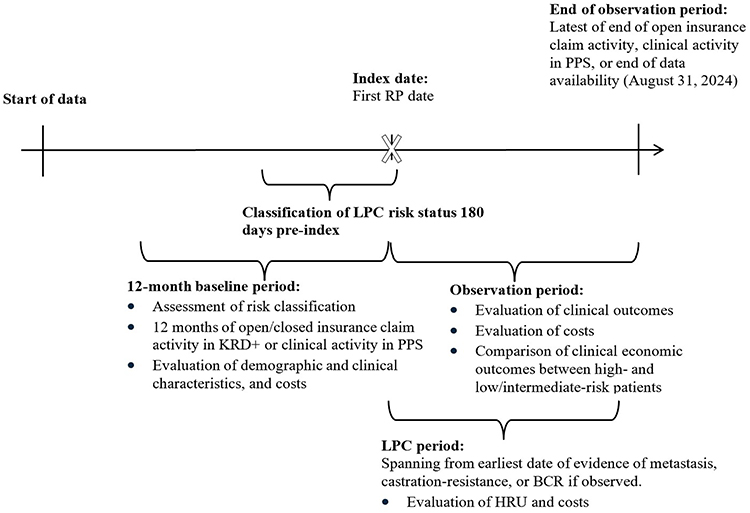 |
Figure 1 Study design scheme. Abbreviations: BCR, biochemical recurrence; KRD+, Komodo Research Database; LPC, localized prostate cancer; PPS, Precision Point Specialty; RP, radical prostatectomy. |
Male patients were included in the study if they had a radical prostatectomy on or after July 1, 2016, with the date of the first recorded procedure defined as the index date. Included patients were aged ≥18 years as of the index date and had no evidence of metastasis (defined based on bone, nodal, or visceral metastasis identified through derived variables from the PPS database or diagnosis codes for metastasis identified in the PPS and KRD+ databases; see Supplementary Table 1 for codes to identify metastasis), diagnosis of non-PC, use of other localized therapy for LPC (ie, cryotherapy, interstitial prostate brachytherapy, high-intensity focused ultrasound) or therapy for advanced PC (ie, androgen receptor pathway inhibitors [ARPIs], chemotherapy, immunotherapy, estrogens, radiopharmaceuticals, poly [ADP-ribose] polymerase inhibitors; see Supplementary Table 2 for codes to identify advanced PC treatment), or evidence of castration resistance prior to or on the index date (see Supplementary Table 3 for assessment of castration resistance). For the analysis of clinical outcomes, patients were required to have ≥12 months of claim activity (from KRD+) or clinical activity (from PPS) prior to the index date. Cost outcomes were assessed among the subset of patients with ≥12 months of continuous insurance eligibility (from KRD+) prior to and including the index date.
The baseline period comprised the 12 months before the index date. The observation period was defined as the time from the index date until either (1) the latest of end of claims activity in KRD+ or end of clinical activity in PPS (both no later than August 31, 2024) for the analysis of clinical outcomes, or (2) the earliest of end of continuous insurance eligibility or August 31, 2024 for the analysis of cost outcomes (Figure 1). The LPC period spanned from the index date until the earliest evidence of disease progression, which was indicated by the occurrence of metastasis, castration resistance, or BCR. BCR was evaluated during the period from the index date until the first evidence of metastasis or castration resistance, initiation of therapy for advanced PC (as described above), or end of PPS clinical activity, whichever occurred first (Supplementary Figure 1). During this BCR evaluation period, BCR was identified as having consecutive PSA tests of ≥0.2 ng/mL and >0.2 ng/mL (the date of the latter of the 2 tests was considered the BCR date) or initiation of salvage therapy (ie, external beam radiation therapy or brachytherapy; see Supplementary Table 4 for codes to identify salvage therapy).16 The earliest observed date for either of these 2 criteria was used to define the BCR date.
Study Cohorts
Within both the clinical and cost outcomes populations, patients were classified into two mutually exclusive cohorts (high-risk or low/intermediate-risk) based on TNM staging, PSA test results, and Gleason score from PPS data during the 180 days before the index date, in alignment with the NCCN Clinical Practice Guidelines in Oncology (NCCN Guidelines®; Supplementary Table 5).5 As some patients did not have information on all 3 clinical variables, classification was based on the minimum information available; for instance, a patient with a PSA level of >20 ng/mL was categorized as high risk regardless of whether other tests were available. The proportion of patients with 1, 2, or all 3 clinical variables to assess LPC risk is reported in Supplementary Table 6.
Study Measures and Outcomes
Study measures evaluated prior to or on the index date included demographics (ie, age, race, geographic region, payer type) and clinical characteristics (ie, index year, time between PC diagnosis and index date, prior use of ADT, prior first-generation ARPI use, Quan-Charlson comorbidity index score).
Clinical outcomes evaluated in the clinical outcome population included metastasis-free survival (MFS; defined as the time from the index date to the earliest date of metastasis or death from any cause) and event-free survival (EFS; defined as the time from the index date to the earliest date of metastasis, BCR, or death from any cause). A sensitivity analysis of EFS was conducted where salvage therapy was not considered in the definition of BCR (Supplementary Figure 2).
Total all-cause and PC-related healthcare costs were evaluated in the cost outcomes population, with PC-related costs identified as claims with International Classification of Diseases, 10th Revision, Clinical Modification code C61 or procedure codes for luteinizing hormone-releasing hormone or other NCCN guideline-recommended therapies for metastatic castration-sensitive PC (Supplementary Table 2).5 These costs were reported separately during the baseline period, the observation period, the LPC period, and on the index date. Costs on the index date included index procedure-specific costs (ie, claims with a procedure code for radical prostatectomy) and index procedure-related costs (ie, claims with a procedure code for medical acts directly related to radical prostatectomy). Total healthcare costs included pharmacy and medical (ie, inpatient, emergency room, outpatient, other services) cost components and were reported as imputed allowed amounts comprising total payer and patient costs. All costs were reported in 2024 US dollars (USD; adjusted for inflation using the medical care component of the US Consumer Price Index) per-patient-per-year (PPPY), except for index date costs, which were reported per-patient-per-day (PPPD). Costs were truncated at the 99th percentile to account for extreme outliers.
Statistical Analysis
Inverse probability of treatment weighting (IPTW) was used to balance baseline variables between the high-risk and low/intermediate-risk cohorts, with propensity scores generated from a logistic regression model using the following predictors: age, race, geographic region, payer type, year of index date, time between PC diagnosis and index date, prior use of ADT, use of first-generation ARPIs, and Quan-Charlson comorbidity index score. Patients in the high-risk cohort were assigned a weight of 1/(propensity score) while patients in the low/intermediate-risk cohort were assigned a weight of 1/(1-propensity score). Normalized inverse probability of treatment weights were truncated at the 95th percentile.17 Weights were generated separately for the clinical outcomes and cost outcomes populations. A standardized difference of <10% indicated that the weighted cohorts were well-balanced.18
MFS and EFS were estimated separately in the high-risk and low/intermediate-risk cohorts using weighted Kaplan–Meier (KM) analyses. Patients without an event were censored at the latest of the end of claims activity in KRD+ or clinical activity in PPS, or end of data availability. MFS and EFS were compared between the two cohorts using a weighted Cox proportional hazards model, with hazard ratios (HRs) and 95% confidence intervals (CIs) reported at 36 and 60 months post index. The proportional hazards assumption was assessed using Schoenfeld residual-based diagnostics, and no meaningful deviations from proportional hazards were observed.
Healthcare costs incurred during the observation period were compared between the high-risk and low/intermediate-risk cohorts using mean cost differences, which were estimated based on weighted ordinary least squares regression. To account for skewness in the distribution of cost outcomes, non-parametric bootstrapping procedures with 500 replications were used to calculate 95% CIs and p-values for all cost variables.
All statistical analyses were conducted using SAS Enterprise Guide software Version 7.15 (SAS Institute, Cary, NC).
Results
Patient Characteristics
Clinical Outcomes Population
This study included 18,971 patients with LPC treated with radical prostatectomy, of which 7542 were included in the high-risk cohort and 11,429 in the low/intermediate-risk cohort for the analysis of clinical outcomes (Figure 2). After weighting, the two cohorts were generally well-balanced (standardized difference of <10%; Table 1, Supplementary Table 7, and Supplementary Figure 3). The mean age was 63.9 years in the high-risk cohort and 63.6 years in the low/intermediate-risk cohort. Approximately 52.6% of the high-risk cohort and 52.5% of the low/intermediate-risk cohort were white, with 14.0% Black or African American in both cohorts. Most patients either had Medicare coverage (high-risk: 46.8%; low/intermediate-risk: 45.7%) or commercial insurance (high-risk: 45.5%; low/intermediate-risk: 46.7%) during the baseline period. The mean (median) time between PC diagnosis and the index date was 6.9 (2.5) months in the high-risk cohort and 7.2 (2.8) months in the low/intermediate-risk cohort. Patients had a mean Quan-Charlson comorbidity index of 2.7 in both cohorts.
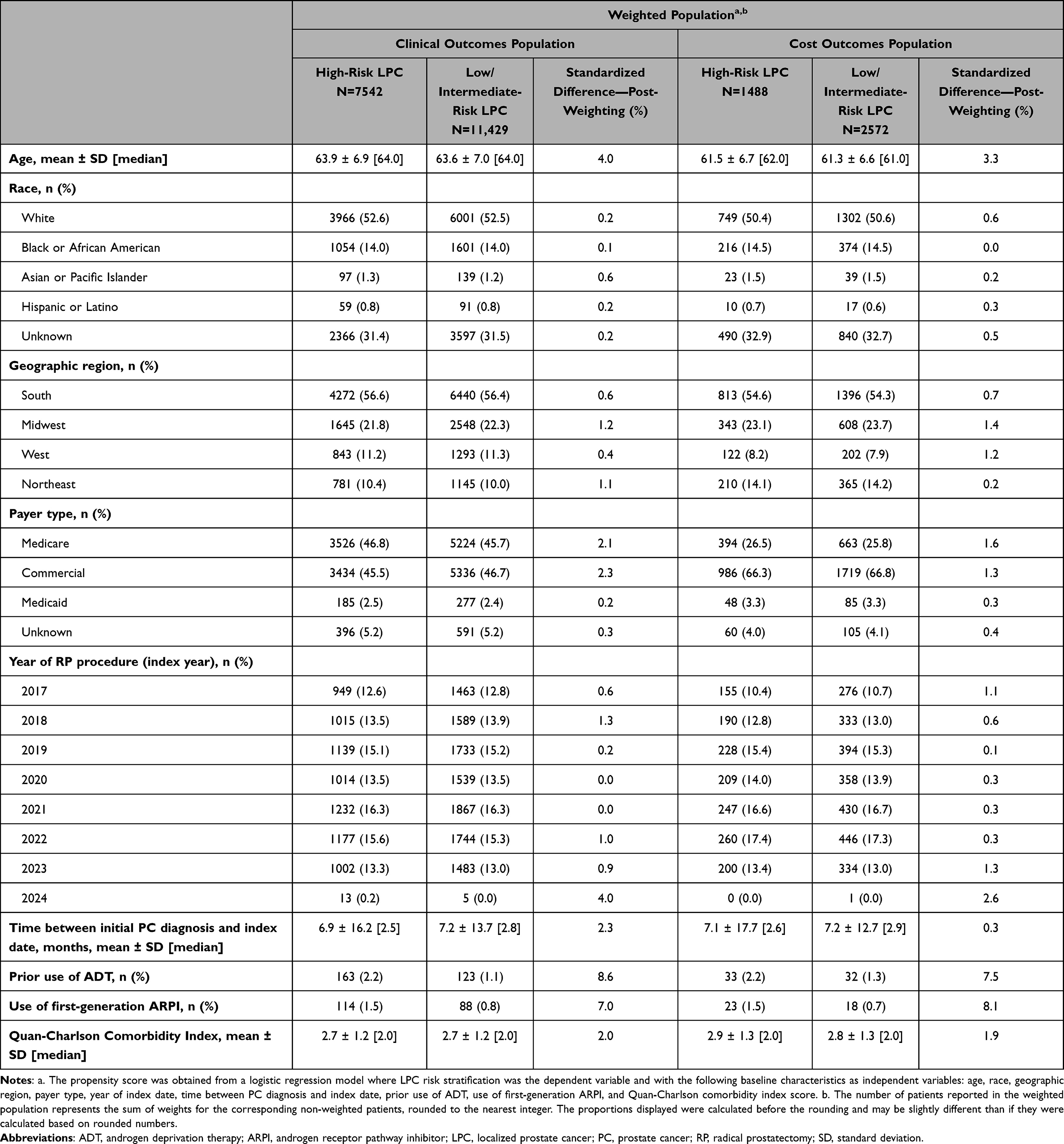 |
Table 1 Baseline characteristics of patients with LPC treated with RP |
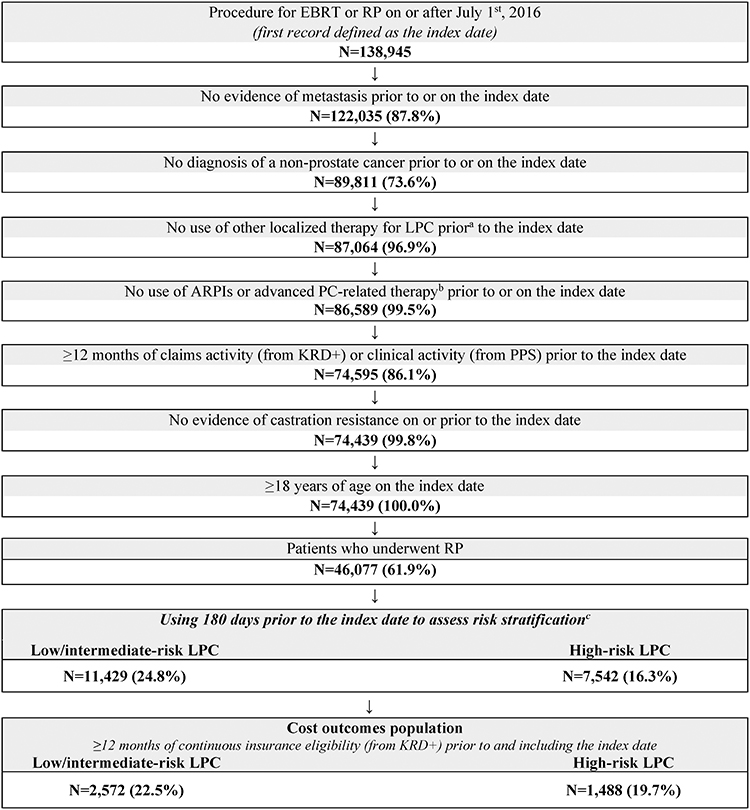 |
Figure 2 Patient selection flowchart. Abbreviations: ARPI, androgen receptor pathway inhibitor; EBRT, external beam radiation therapy; KRD+, Komodo Research Database; LPC, localized prostate cancer; PARP, poly (ADP-ribose) polymerase; PC, prostate cancer; PPS, Precision Point Specialty; RP, radical prostatectomy. Notes: a. Other therapies for LPC included cryotherapy, interstitial prostate brachytherapy, and high-intensity focused ultrasound. b. Advanced PC-related therapies included ARPIs, chemotherapy, immunotherapy, estrogens, radiopharmaceuticals, and PARP inhibitors. c. Patients with insufficient information to classify in either the low/intermediate-risk or the high-risk cohort were excluded from the study. |
Cost Outcomes Population
For the analysis of cost outcomes, 1488 patients were included in the high-risk cohort and 2572 in the low/intermediate-risk cohort. After weighting, the two cohorts were generally well-balanced (standardized difference of <10%; Table 1). The mean age was 61.5 years in the high-risk cohort and 61.3 years in the low/intermediate-risk cohort. Approximately 50.4% of the high-risk cohort and 50.6% of the low/intermediate-risk cohort were white, with 14.5% Black or African American in both cohorts. Most patients had commercial insurance (high-risk: 66.3%; low/intermediate-risk: 66.8%) during the baseline period. The mean (median) time between PC diagnosis and the index date was 7.1 (2.6) months in the high-risk cohort and 7.2 (2.9) months in the low/intermediate-risk cohort. Patients had a mean Quan-Charlson comorbidity index of 2.9 in the high-risk cohort and 2.8 in the low/intermediate-risk cohort.
Patients in the high-risk and low/intermediate-risk cohorts incurred $10,701 and $9494 PPPY, respectively, in baseline mean total all-cause healthcare costs, including $514 and $492 PPPY in mean all-cause pharmacy costs and $10,065 and $8909 PPPY in baseline mean all-cause medical costs (Table 2).
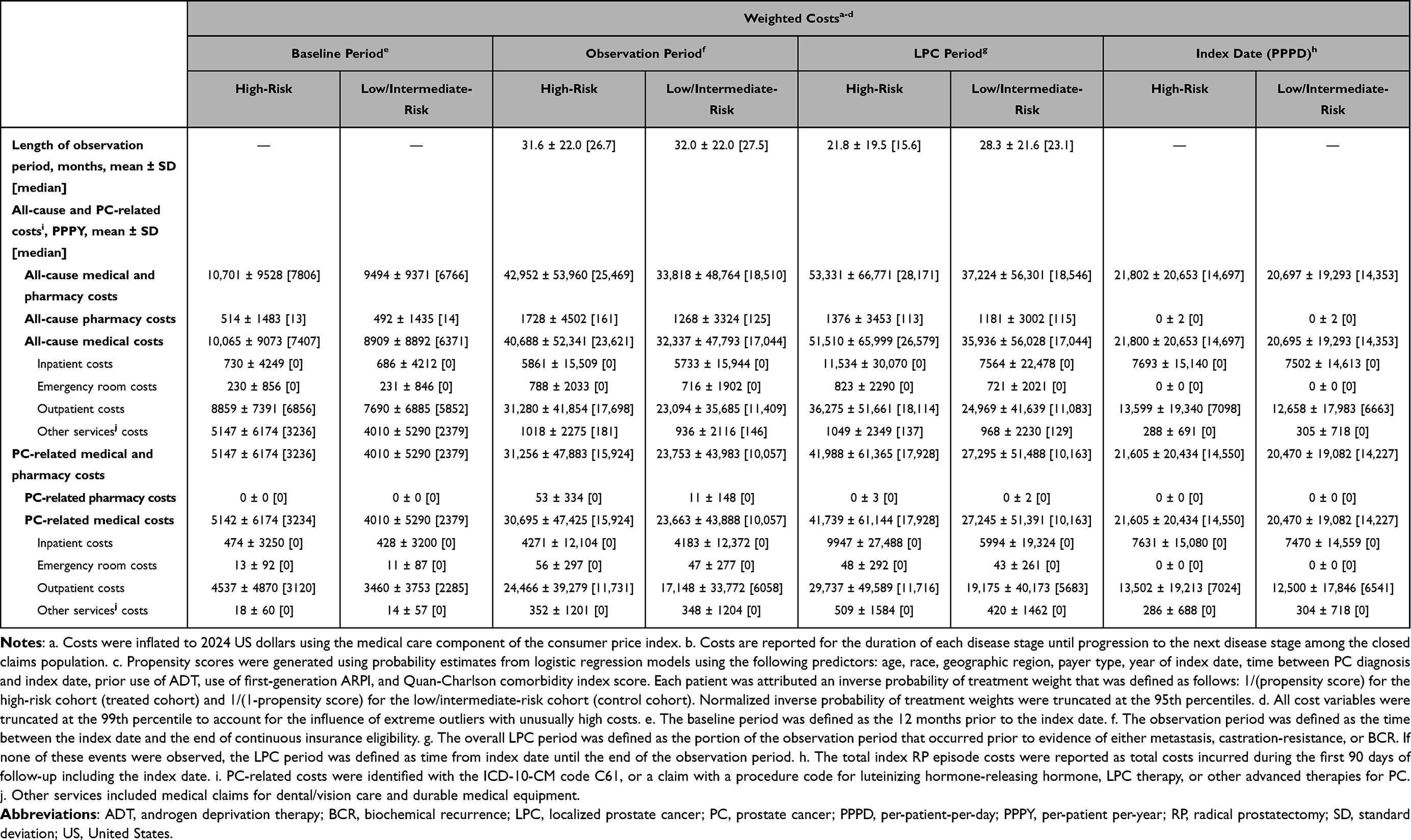 |
Table 2 Descriptive healthcare costs in baseline and observation periods in patients with LPC treated with RPa |
Clinical Outcomes
The mean weighted duration of the observation period was 47.1 months for patients in the high-risk cohort and 47.7 months for patients in the low/intermediate-risk cohort. The weighted proportion of patients with ≥1 follow-up PSA was 95.8% in the high-risk cohort and 96.5% in the low/intermediate-risk cohort, and the mean (median) number of tests per year was 3.0 (2.5) and 2.5 (2.1) in the high-risk and low/intermediate-risk cohorts, respectively (Supplementary Table 8). Patients’ post-index treatment patterns are reported in Supplementary Table 9.
By 36 months post index, the KM rates for MFS were 90.2% in the high-risk cohort and 97.3% in the low/intermediate-risk cohort. The proportion of patients who had progressed to metastasis or had died was significantly higher among patients in the high-risk versus the low/intermediate-risk cohort (HR [95% CI]: 3.80 [3.31, 4.38]; p<0.001; Figure 3). By 60 months, the KM rates for MFS were 84.3% in the high-risk cohort and 95.1% in the low/intermediate-risk cohort. Higher rates of metastasis progression or death were maintained by this time point for high-risk patients (HR [95% CI]: 3.59 [3.19, 4.04]; p<0.001).
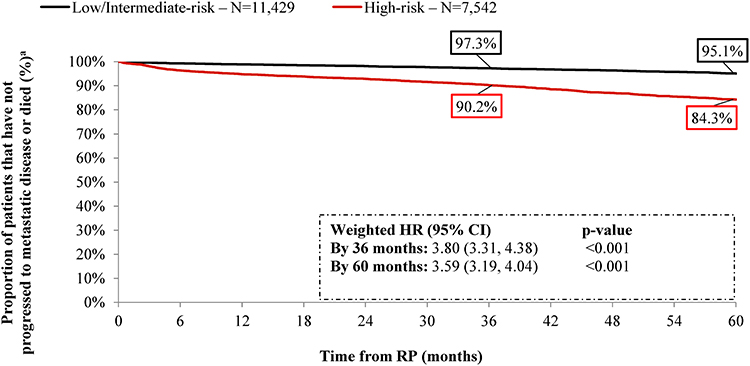 |
Figure 3 Metastasis-free survival following treatment with RP in patients with LPC. Abbreviations: CI, confidence interval; HR, hazard ratio; KRD+, Komodo Research Database; LPC, localized prostate cancer; MFS, metastasis-free survival; PPS, Precision Point Specialty; RP, radical prostatectomy. Notes: a. MFS was assessed from the index date to the first date of metastasis or death. For patients still at risk, MFS was censored at the latest of end of claims activity in KRD+ or clinical activity in PPS, or end of data availability (i.e., August 31, 2024). |
By 36 months post index, the KM rates for EFS were 57.8% in the high-risk cohort and 85.0% in the low/intermediate-risk cohort. The proportion of patients who had progressed to BCR, metastasis or had died was also significantly higher among patients in the high-risk versus low/intermediate-risk cohort (HR [95% CI]: 3.49 [3.28, 3.71]; p<0.001; Figure 4). By 60 months, the KM rates for EFS were 50.8% in the high-risk cohort and 80.7% in the low/intermediate-risk cohort. Higher rates of progression or death were also maintained by this time point for high-risk patients (HR [95% CI]: 3.37 [3.18, 3.57]; p<0.001). Among patients with ≥2 available risk classification components, results from the MFS and EFS analyses remained robust (Supplementary Figure 4).
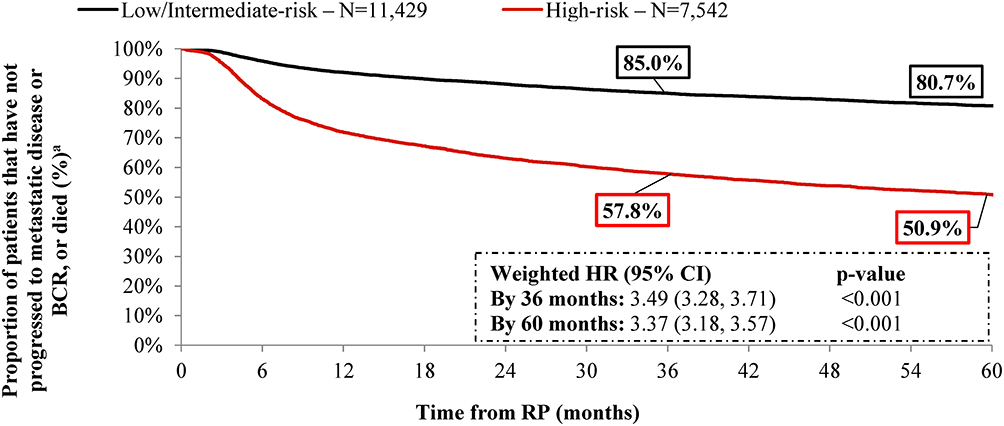 |
Figure 4 Event-free survival following treatment with RP in patients with LPC. Abbreviations: BCR, biochemical recurrence; CI, confidence interval; EFS, event-free survival; HR, hazard ratio; KRD+, Komodo Research Database; LPC, localized prostate cancer; PPS, Precision Point Specialty; RP, radical prostatectomy. Notes: a. EFS was assessed from the index date to the earliest date of BCR, metastasis, or death. For patients still at risk, EFS was censored at the latest of end of claims activity in KRD+ or clinical activity in PPS, or end of data availability (i.e., August 31, 2024). |
Cost Outcomes
Observation Period
The mean duration of the observation period was 31.6 months for patients in the high-risk cohort and 32.0 months for patients in the low/intermediate-risk cohort.
During the observation period, patients in the high-risk cohort incurred significantly higher mean total all-cause healthcare costs ($42,952 PPPY) than patients in the low/intermediate-risk cohort ($33,818 PPPY), resulting in a cost difference (95% CI) of $9134 (5999, 12,400) PPPY (p<0.001; Table 2 and Figure 5). The cost difference remained significantly higher in the high-risk versus low/intermediate-risk cohort when specifically comparing mean all-cause pharmacy costs ($1728 vs $1268 PPPY; cost difference [95% CI]: $461 [195, 740] PPPY; p<0.001) and mean all-cause medical costs ($40,688 vs $32,337 PPPY; cost difference [95% CI]: $8351 [5122, 11,723] PPPY; p<0.001). Outpatient costs were the main driver of the observed difference in total all-cause healthcare costs between the high-risk and low/intermediate-risk cohorts ($31,280 vs $23,094 PPPY; cost difference [95% CI]: $8186 [5766, 10,738] PPPY; p<0.001).
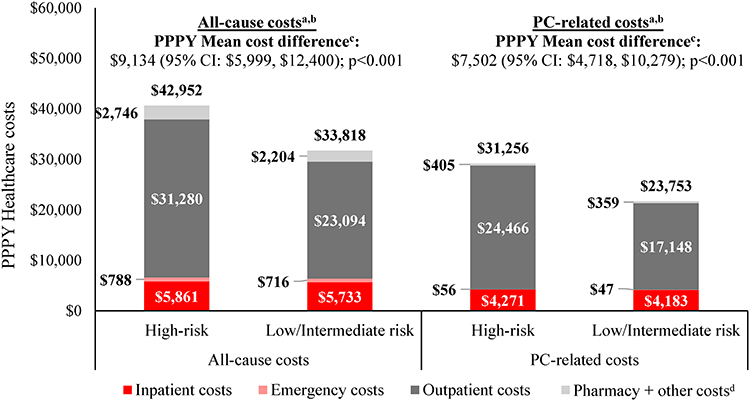 |
Figure 5 PPPY costs comparison during complete observation period in patients with LPC treated with RP. Abbreviations: CI, confidence interval; LPC, localized prostate cancer; PC, prostate cancer; PPPY, per-patient-per-year; RP, radical prostatectomy; US, United States. Notes: a. Costs were inflated to 2024 US dollars. b. All costs were truncated at the 99th percentile to account for the influence of outliers. As a result, the sum of the individual mean costs may not align exactly with the total costs. c. 95% CIs and p-values for mean cost differences were estimated using non-parametric bootstrapping procedures with 500 replications. d. Pharmacy costs and the costs of other services were reported together. Other services included medical claims for dental/vision care and durable medical equipment. |
Mean total PC-related healthcare costs were also significantly higher in the high-risk versus low/intermediate-risk cohort ($31,256 vs $23,753 PPPY; cost difference [95% CI]: $7502 [4718, 10,279] PPPY; p<0.001), including mean PC-related pharmacy ($53 vs $11 PPPY; cost difference [95% CI]: $42 [23, 60] PPPY; p<0.001) and medical costs ($30,695 vs $23,663 PPPY; cost difference [95% CI]: $7032 [4206, 9903] PPPY; p<0.001; Table 2 and Figure 5).
LPC Period
The mean duration of the LPC period was 21.8 months for patients in the high-risk cohort and 28.3 months for patients in the low/intermediate-risk cohort.
During the LPC period, patients in the high-risk and low/intermediate-risk cohorts incurred $53,331and $37,224 PPPY, respectively, in mean total all-cause healthcare costs, including $1376 and $1181 PPPY in mean all-cause pharmacy costs and $51,510 and $35,936 PPPY in mean all-cause medical costs (Table 2). Mean total PC-related healthcare costs during the LPC period were $41,988 PPPY in the high-risk cohort and $27,295 PPPY in the low/intermediate-risk cohort, including $41,738 and $27,245 PPPY, respectively, in mean PC-related medical costs (Figure 6). Of note, medical costs comprised >99% of total PC-related healthcare costs during the LPC period.
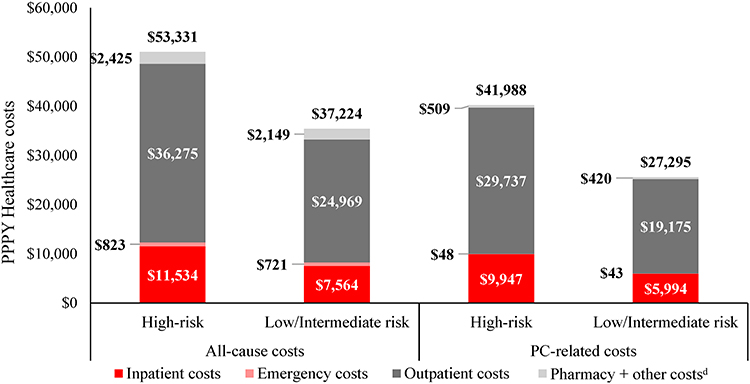 |
Figure 6 PPPY descriptive costs during LPC period in patients with LPC treated with RP.a-c Abbreviations: BCR, biochemical recurrence; LPC, localized prostate cancer; PC, prostate cancer; PPPY, per-patient-per-year; RP, radical prostatectomy; US, United States. Notes: a. Costs were inflated to 2024 US dollars. b. All costs were truncated at the 99th percentile to account for the influence of outliers. c. The overall LPC period was defined as the portion of the observation period that occurred prior to evidence of either metastasis, castration resistance, or BCR. If none of these events were observed, the LPC period was defined as time from index date until the end of the observation period. d. Pharmacy costs and the costs of other services were reported together. Other services included medical claims for dental/vision care and durable medical equipment. |
Index Date
On the index date, patients in the high-risk and low/intermediate-risk cohorts incurred $21,802 and $20,697 PPPD, respectively, in mean total all-cause healthcare costs, with medical costs comprising >99% of total costs related to the index radical prostatectomy (Table 2). Mean total PC-related healthcare costs on the index date were $21,605 PPPD in the high-risk cohort and $20,470 PPPD in the low/intermediate-risk cohort. RP-related costs were $9009 PPPD ($6753 were RP-specific) in the high-risk cohort and were $8976 PPPD ($6880 were RP-specific) in the low/intermediate-risk cohort.
Discussion
In this large, contemporary, real-world analysis, patients with high-risk LPC had a significantly elevated risk of metastasis, disease progression, BCR, or death compared with those with low/intermediate-risk LPC at 36 and 60 months following radical prostatectomy. In addition, patients with high-risk LPC incurred significantly higher all-cause and PC-related healthcare costs than those with low/intermediate-risk LPC following radical prostatectomy, with outpatient costs driving the cost difference.
A small number of prior studies have described contemporary survival outcomes with radical prostatectomy stratified by LPC risk group in real-world clinical practice.9–11 In one retrospective analysis of patients with LPC in Europe and the US, PC-specific and overall survival progressively decreased with increasing risk (from low to intermediate to high based on European Association of Urology and Cancer of the Prostate Risk Assessment risk groups) at 15 years following robot-assisted radical prostatectomy.9 A separate real-world study conducted in Germany reported a similar trend of worsening 20-year clinical outcomes with increasing NCCN-defined risk, with 20-year MFS rates following radical prostatectomy of 96.8% for the low-risk group, 85.9% for the intermediate-risk group, and 64.8% for the high-risk group (log-rank p<0.0001).11 Despite the use of different patient populations, endpoints, and methodologies, these prior studies corroborate the current finding of poorer clinical outcomes with high-risk LPC relative to low or intermediate-risk LPC.
Similar to clinical outcomes, the economic burden incurred following radical prostatectomy stratified by LPC risk group is not well-characterized in the literature.12,13 In a recent analysis of Medicare beneficiaries with LPC or locally advanced PC treated with radical prostatectomy, all-cause healthcare costs were significantly higher among patients with NCCN high-risk disease ($21,703 PPPY; 2021 USD) compared to those with low/intermediate-risk disease ($15,487 PPPY; p<0.0001).13 These findings are consistent with those of the present analysis, though the absolute costs are not directly comparable given the current study included a majority of commercially insured patients (with only one-quarter of patients with Medicare coverage). Of note, despite this difference, both studies found that outpatient costs were the main driver of the cost difference between the two cohorts. This may be explained by the need for more PSA monitoring for patients with high-risk LPC,5,19 though reasons for the increased costs were not specifically evaluated. In a separate, model-based study by Gustavsen, cumulative medical costs from a US commercial payer perspective trended highest with high-risk LPC, relative to low- and intermediate-risk, at 5 and 10 years post radical prostatectomy (based on American Urological Association risk groups).12 Taken together, these prior studies support the current findings in demonstrating the considerably larger economic burden associated with high-risk LPC relative to low or intermediate-risk disease following radical prostatectomy.
The present study contributes additional insight by characterizing the high healthcare costs related to radical prostatectomy incurred by patients on the day of the procedure. The existing literature has similarly demonstrated a large cost associated with radical prostatectomy over various time frames (eg, $49,406-$54,529 in 2018 USD during the perioperative/postoperative periods among commercially insured patients, and $23,632 in 2015 USD during the year after diagnosis among Medicare beneficiaries), though costs have not been stratified by LPC risk group in prior studies.20,21 High costs associated with LPC treatments, including radical prostatectomy, have been found to be a source of financial toxicity, with one survey-based study of patients with LPC in the US reporting that both financial burden and treatment with surgery were significantly associated with treatment regret.22 Despite these high upfront costs related to receiving radical prostatectomy, high-risk patients remain likely to experience disease progression.
Although not evaluated in this study, progression of high-risk LPC to metastatic PC has important clinical and economic consequences, as 5-year survival declines to 37.9% with a median overall survival of 22–29 months following progression.1,23,24 In terms of economic implications, progression from nonmetastatic to metastatic castration-sensitive PC has previously been found to be associated with 3 to 4-times higher all-cause healthcare costs, driven by increased hospitalization costs.25 As such, given the substantial clinical and cost impact of metastasis, there is thus an unmet need for approaches to delay or prevent disease progression, whether through early monitoring of low-risk LPC or more effective treatment for high-risk LPC.
Currently, several novel and existing agents are under investigation for the treatment of low-, intermediate-, and high-risk LPC.26–29 As the treatment landscape expands over the next few years, future research will be warranted to evaluate how the introduction of these treatment options impacts the clinical and economic burden of LPC.
Limitations
The study findings should be considered in the context of some limitations. The identification of patients with LPC relied on the variables provided in the EMR; any inaccuracies or omissions in the data (eg, dates of diagnosis or treatment) may have led to misclassification. Additionally, detection of metastasis following workup for the RP procedure was not considered; however, this limitation affected both cohorts equally given all patients underwent RP. Although IPTW was used to balance the high-risk and low/intermediate-risk cohorts, any potential confounders that were not measured or available in the data (eg, margin status, tumor volume, imaging findings, socioeconomic variables) could have resulted in residual confounding after balancing. Given administrative claims and EMR data were derived from open-source databases, patients’ complete medical histories, including diagnoses, procedures, or medication records, may be incomplete as specific periods of continuous enrollment or insurance eligibility were not included. However, given most of LPC-related care is received in the urology practice setting, the key procedures, treatments, and outcomes would be captured. Finally, cost outcomes were assessed among patients with continuous closed claims eligibility, which may have resulted in a selected population with more stable insurance coverage. Additionally, because follow-up for cost outcomes was limited to periods of continuous eligibility, patients were effectively censored at the end of eligibility. As loss of eligibility may be related to patient characteristics or clinical status, this may introduce informative censoring and potential bias in cost estimates.
Conclusion
In this real-world analysis of patients with LPC who underwent radical prostatectomy, high-risk disease was associated with significantly poorer MFS and EFS compared to low/intermediate-risk LPC, with an increased risk of disease progression, recurrence, or death. Although patients with high-risk and low/intermediate-risk LPC had similar baseline costs, costs increased for patients with high-risk disease following radical prostatectomy, overall, and prior to recurrence or progression. These findings demonstrate the heightened clinical and economic burden observed among patients with high-risk LPC.
Previous Presentations
Part of the material in this manuscript was presented at the Academy of Managed Care Pharmacy Nexus held October 27–30, 2025 in National Harbor, MD, USA as a poster presentation.
Data Sharing Statement
The data that support the findings of this study are available from Precision Point Specialty Analytics and Komodo Health. Restrictions apply to the availability of these data, which were used under license for this study. Data are available from https://portal.ppsanalytics.com/ and https://www.komodohealth.com/ with the permission of Precision Point Specialty Analytics and Komodo Health.
Ethics Statement
The study was considered exempt research under 45 CFR § 46.104(d)(4) as it involved only the secondary use of data that were de-identified in compliance with the Health Insurance Portability and Accountability Act (HIPAA), specifically, 45 CFR § 164.514.
Acknowledgments
Medical writing assistance was provided by professional medical writer, Christine Tam, MWC, an employee of Analysis Group, Inc., a consulting company that has provided paid consulting services to Johnson & Johnson, which funded the development and conduct of this study and manuscript.
Author Contributions
All authors made a significant contribution to the work reported, whether that is in the conception, study design, execution, acquisition of data, analysis and interpretation, or in all these areas; took part in drafting, revising or critically reviewing the article; gave final approval of the version to be published; have agreed on the journal to which the article has been submitted; and agree to be accountable for all aspects of the work.
Funding
This study was funded by Johnson & Johnson.
Disclosure
Neal Shore is an employee of the START Carolinas/Carolina Urologic Research Center and has received research funding/consulting fees from Johnson & Johnson, Bayer, Dendreon, Ferring, Astellas, Alessa, Amgen, Pfizer, AstraZeneca, AbbVie, Merck, Bristol Myers Squibb, MDxHealth, Myriad, CG Oncology, Urogen pharma, Clarity, Curium, Lilly, Photocure, Telix Pharmaceuticals, Minomic, Novartis, Promaxo, Protara Therapeutics, Fize Medical, Accord, Aura Biosciences, Bioprotect, and Sumitomo, and Tutelix.
Benjamin Lowentritt is an employee of Chesapeake Urology and has received consulting fees from Johnson & Johnson, Dendreon, Astellas Pharma, Bayer, AstraZeneca/MedImmune, Merck, Tolmar, AbbVie, Pfizer, and Myovant Sciences.
Lawrence Karsh has received consultant and speaker fees from Johnson & Johnson, Ferring, Astellas, Bayer, AstraZeneca and Pfizer and has participated in clinical trials with Johnson & Johnson, Bayer, Astellas, Ferring, Pfizer, Protara, ImmunisAI.
Gordon Brown is an employee of New Jersey Urology and has received consulting fees from Johnson & Johnson.
Charmi Patel and Sabree Burbage are employees and stockholders of Johnson & Johnson.
Frederic Kinkead, Carmine Rossi, Francesca Lee, and Dominic Pilon are employees of Analysis Group, Inc., a consulting company that has provided paid consulting services to Johnson & Johnson, which funded the development and conduct of this study and manuscript.
The authors report no other conflicts of interest in this work.
References
1. National Cancer Institute, Surveillance, Epidemiology, and End Results Program. Cancer Stat Facts: prostate Cancer. 2025; Available from: https://seer.cancer.gov/statfacts/html/prost.html.
2. Raychaudhuri R, Lin DW, Montgomery RB. Prostate cancer: a review. JAMA. 2025;333(16):1433–15. doi:10.1001/jama.2025.0228
3. Pinsky PF, Black A, Daugherty SE, et al. Metastatic prostate cancer at diagnosis and through progression in the prostate, lung, colorectal, and ovarian cancer screening trial. Cancer. 2019;125(17):2965–2974. doi:10.1002/cncr.32176
4. Eastham JA, Auffenberg GB, Barocas DA, et al. Clinically localized prostate cancer: AUA/ASTRO guideline, part i: introduction, risk assessment, staging, and risk-based management. J Urol. 2022;208(1):10–18. doi:10.1097/JU.0000000000002757
5. National Comprehensive Cancer Network®. NCCN Clinical Practice Guidelines in Oncology (NCCN Guidelines®) Prostate Cancer. 2025; Available from: https://www.nccn.org/professionals/physician_gls/pdf/prostate.pdf.
6. Achard V, Panje CM, Engeler D, Zilli T, Putora PM. Localized and locally advanced prostate cancer: treatment options. Oncology. 2021;99(7):413–421. doi:10.1159/000513258
7. Freedland SJ, de Almeida Luz M, De Giorgi U, et al. Improved outcomes with enzalutamide in biochemically recurrent prostate cancer. N Engl J Med. 2023;389(16):1453–1465. doi:10.1056/NEJMoa2303974
8. Hamdy FC, Donovan JL, Lane JA, et al. Fifteen-year outcomes after monitoring, surgery, or radiotherapy for prostate cancer. N Engl J Med. 2023;388(17):1547–1558. doi:10.1056/NEJMoa2214122
9. Falagario UG, Knipper S, Pellegrino F, et al. Prostate cancer-specific and all-cause mortality after robot-assisted radical prostatectomy: 20 years’ report from the European Association of Urology Robotic Urology Section Scientific Working Group. Eur Urol Oncol. 2024;7(4):705–712. doi:10.1016/j.euo.2023.08.005
10. Han JH, Herlemann A, Washington SL, et al. Observation, radiotherapy, or radical prostatectomy for localized prostate cancer: survival analysis in the United States. World J Mens Health. 2023;41(4):940–950. doi:10.5534/wjmh.220151
11. Wurnschimmel C, Wenzel M, Wang N, et al. Radical prostatectomy for localized prostate cancer: 20-year oncological outcomes from a German high-volume center. Urol Oncol. 2021;39(12):830e817–830e826. doi:10.1016/j.urolonc.2021.04.031
12. Gustavsen G, Gullet L, Cole D, Lewine N, Bishoff JT. Economic burden of illness associated with localized prostate cancer in the United States. Future Oncol. 2020;16(1):4265–4277. doi:10.2217/fon-2019-0639
13. Karsh L, Du S, He J, Shore N. Differences in healthcare costs by risk classification for patients with localized prostate cancer treated with radical prostatectomy in SEER-medicare.
14. Komodo Health, Inc. Imputing allowed amounts - Development and validation of an encounter-level allowed amount imputation model.
15. Komodo Health, Inc. Komodo Mortality Data Version 23.8 User Guide.
16. Shore ND, Moul JW, Pienta KJ, Czernin J, King MT, Freedland SJ. Biochemical recurrence in patients with prostate cancer after primary definitive therapy: treatment based on risk stratification. Prostate Cancer and Prostatic Diseases. 2024;27(2):192–201. doi:10.1038/s41391-023-00712-z
17. Dorfman A, Valliant R. The Hajek Estimator Revisited. American Statistical Association on Survey Research Methods. 1997.
18. Austin P. Using the standardized difference to compare the prevalence of a binary variable between two groups in observational research. Commun Stat Simul Comput. 2009;38(6):1228–1234. doi:10.1080/03610910902859574
19. Paulino Pereira LJ, van den Bergh RCN, Sedelaar M, et al. Risk-based prostate-specific antigen monitoring reduces follow-up burden after radical prostatectomy. Eur Urol Oncol. 2025;8(5):1278–1285. doi:10.1016/j.euo.2025.02.013
20. Nabi J, Friedlander DF, Chen X, et al. Assessment of out-of-pocket costs for robotic cancer surgery in US adults. JAMA Netw Open. 2020;3(1):e1919185. doi:10.1001/jamanetworkopen.2019.19185
21. Tang C, Lei X, Smith GL, et al. Costs and complications after a diagnosis of prostate cancer treated with time-efficient modalities: an analysis of national medicare data. Pract Radiat Oncol. 2020;10(4):282–292. doi:10.1016/j.prro.2020.02.014
22. Joyce DD, Wallis CJD, Huang LC, et al. The association between financial toxicity and treatment regret in men with localized prostate cancer. JNCI Cancer Spectr. 2022;6(6). doi:10.1093/jncics/pkac071.
23. Tappero S, Piccinelli ML, Incesu RB, et al. Overall survival of metastatic prostate cancer patients according to location of visceral metastatic sites. Clin Genitourin Cancer. 2024;22(2):47–55e42. doi:10.1016/j.clgc.2023.08.004
24. Elmehrath AO, Afifi AM, Al-Husseini MJ, et al. Causes of death among patients with metastatic prostate cancer in the US from 2000 to 2016. JAMA Netw Open. 2021;4(8):e2119568. doi:10.1001/jamanetworkopen.2021.19568
25. Trinh QD, Chaves LP, Feng Q, Zhu J, Sandin R, Abbott T. The cost impact of disease progression to metastatic castration-sensitive prostate cancer. J Manag Care Spec Pharm. 2022;28(5):544–554. doi:10.18553/jmcp.2022.28.5.544
26. DeWeese T, Wheeler T, Sylvester J, et al. Phase 3, randomized, placebo-controlled clinical trial of CAN-2409+prodrug in combination with standard of care external beam radiation (EBRT) for newly diagnosed localized prostate cancer. J Clin Oncol. 2025;43(16_suppl). doi:10.1200/JCO.2025.43.16_suppl.5000.
27. Myint Z, St. Claire W, Strup S, et al. Phase II study of pembrolizumab in combination with radiation with or without olaparib in localized high-risk prostate cancer. J Clin Oncol. 2024;42(4_suppl):TPS351–TPS351. doi:10.1200/JCO.2024.42.4_suppl.TPS351
28. Schweizer MT, True L, Gulati R, et al. Pathological effects of apalutamide in lower-risk prostate cancer: results from a Phase II clinical trial. J Urol. 2023;209(2):354–363. doi:10.1097/JU.0000000000003038
29. Shore N, Hafron J, Saltzstein D, et al. Apalutamide for high-risk localized prostate cancer following radical prostatectomy (Apa-RP). J Urol. 2024;212(5):682–691. doi:10.1097/JU.0000000000004163
 © 2026 The Author(s). This work is published and licensed by Dove Medical Press Limited. The
full terms of this license are available at https://www.dovepress.com/terms
and incorporate the Creative Commons Attribution
- Non Commercial (unported, 4.0) License.
By accessing the work you hereby accept the Terms. Non-commercial uses of the work are permitted
without any further permission from Dove Medical Press Limited, provided the work is properly
attributed. For permission for commercial use of this work, please see paragraphs 4.2 and 5 of our Terms.
© 2026 The Author(s). This work is published and licensed by Dove Medical Press Limited. The
full terms of this license are available at https://www.dovepress.com/terms
and incorporate the Creative Commons Attribution
- Non Commercial (unported, 4.0) License.
By accessing the work you hereby accept the Terms. Non-commercial uses of the work are permitted
without any further permission from Dove Medical Press Limited, provided the work is properly
attributed. For permission for commercial use of this work, please see paragraphs 4.2 and 5 of our Terms.