
Back to Journals » Advances in Medical Education and Practice » Volume 17
Predictors of Considering a Vascular Surgery Career Among Medical Students at Jazan University, Saudi Arabia: A Cross-Sectional Study
Authors Shaabi HI 
Received 14 May 2026
Accepted for publication 3 July 2026
Published 16 July 2026 Volume 2026:17 624647
DOI https://doi.org/10.2147/AMEP.S624647
Checked for plagiarism Yes
Review by Single anonymous peer review
Peer reviewer comments 2
Editor who approved publication: Dr Sateesh Arja
Hossam Ibraheem Shaabi
Department of Surgery, College of Medicine, Jazan University, Jazan, Saudi Arabia
Correspondence: Hossam Ibraheem Shaabi, Department of Surgery, College of Medicine, Jazan University, Al Marefah Road, Jazan, 45142, Saudi Arabia, Email [email protected]
Background: Vascular surgery faces a sustained workforce shortage worldwide, with persistent gender disparities in the international pipeline. This study characterized medical students’ knowledge and perceptions of vascular surgery at Jazan University and identified factors independently associated with having considered a vascular surgery career.
Methods: A cross-sectional study used a 34-item questionnaire among fourth- to sixth-year medical students. Bivariate analyses used Mann–Whitney U and Kruskal–Wallis tests, and the primary outcome was modeled with multivariable binary logistic regression on pre-specified predictors.
Results: Of 213 respondents (54.9% male; mean age 22.9 ± 1.4 years), 43 (20.2%) had considered a vascular surgery career. In the adjusted model, male gender was the strongest independent predictor of the outcome (aOR 4.55; 95% CI 1.84– 11.24; p = 0.001), and greater importance attached to training length was associated with lower odds (aOR 0.63; 95% CI 0.42– 0.96; p = 0.030). Female students scored lower than male students on the Perceptions of Vascular Surgeons composite (3.06 ± 0.54 vs. 3.25 ± 0.42; p < 0.001). Lifestyle as an attending was the highest-rated specialty-selection factor (4.27 ± 1.07), yet only 11.3% agreed that vascular surgeons have a good work–life balance and only 21.6% agreed the career offers adequate family time. Self-rated knowledge was low (2.86 ± 0.88) but rose with educational stage (p < 0.001).
Conclusion: Male gender was the strongest independent predictor of having considered a vascular surgery career, with over four-and-a-half times the odds of female students. Self-rated knowledge was low despite structured teaching, and perceptions of work–life balance were negative, mirroring international findings. Strengthening the depth and clinical immersion of existing vascular surgery teaching, establishing a vascular surgery interest group, and providing female-oriented mentorship are evidence-based next steps for the Saudi vascular surgery community.
Keywords: vascular surgery, medical students, career choice, specialty preference, Saudi Arabia
Introduction
Vascular surgery faces a sustained workforce shortage worldwide. A recent US workforce model projects the supply of vascular surgeons declining from 73.7% of projected demand in 2024 to 64.3% by 2037—the lowest of any surgical specialty1—extending earlier projections of a deficit persisting through 2030 and beyond.2,3 Despite the introduction of the Integrated Vascular Surgery Residency (0+5) pathway in 2007, applicant volume continues to outpace available training positions.4 Attracting medical students into the specialty is widely regarded as a prerequisite for closing the workforce gap, although the link between attitudes during medical school and eventual specialty choice remains poorly characterized.
A consistent factor pattern recurs across two decades of survey research. Mentorship, early exposure, endovascular technology, and intellectual challenge are reported as the strongest positive drivers of vascular surgery interest.5–7 The dominant deterrent is perceived poor work–life balance—in a multi-school US survey of fourth-year medical students, only 7% believed vascular surgeons have a good work–life balance, with female students additionally citing gender-related concerns and limited family planning during residency.8 These perceptions are reinforced by trainee-level evidence: 80-hour-week violations among vascular surgery trainees were associated with higher burnout.9 Targeted educational interventions raise medical-student interest in vascular surgery, including simulation-based courses, structured curricula, one-day exposure conferences, and dedicated vascular surgery interest groups, although gains tend to fade without reinforcement.10–12
Gender disparities are a persistent feature of the vascular surgery pipeline. Women constitute approximately 15% of the US vascular surgery workforce,13 and recurring gender-specific barriers—discrimination, family-planning concerns during training, and the absence of female role models—have been documented across the surgical literature.14,15 These patterns are amplified in low- and lower-middle-income settings, where female medical students are 40% less likely than their male counterparts to consider surgical careers.16 In Saudi Arabia, women’s entry into surgical subspecialties has historically lagged, and societal and familial expectations regarding demanding call schedules, lifestyle, and work–life balance for female physicians have been described as barriers to surgical careers.17 Whether comparable gender disparities arise at the medical-student stage in Saudi Arabia, and whether they are modifiable through curricular intervention, remain uncharacterized.
A parallel workforce concern is emerging in Saudi Arabia, where the rising burden of cardiovascular disease has been recognized as a national health priority within the Vision 2030 reform agenda,18 set against a documented health-workforce shortage in which Saudi nationals constitute fewer than one-third of practicing physicians.19 Across the Saudi specialty-choice literature, lifestyle, income, and personal interest dominate decision-making,20,21 and surgical clerkship exposure has shown smaller-than-expected effects on attitudes.22 The only prior Saudi survey of medical students’ perceptions of vascular surgery reported that 7.1% of 408 nationwide respondents selected vascular surgery as their first specialty preference, with cardiovascular interest and endovascular capability cited as the main motivators and the absence of an integrated vascular surgery residency program in Saudi Arabia identified as a pipeline barrier.23 That study, however, was dominated by central-region respondents (61.8% central, 8.6% southern), was descriptive only, did not analyze gender as a predictor of vascular surgery interest, and used a self-constructed rather than a validated instrument. The factors that independently predict consideration of a vascular surgery career in Saudi Arabia—particularly outside the central region—therefore remain uncharacterized. Whereas prior regional work has been largely descriptive and focused on attitudinal motivators, the present study examines both demographic and attitudinal variables within a structured framework to identify independent predictors of vascular surgery career consideration.
Within Saudi Arabia, this national workforce concern is unevenly distributed across regions, with southern provinces—including Jazan—consistently among the most under-resourced for specialist care.24,25 Prior work at Jazan University has examined attitudes toward surgical careers among local medical students but did not assess vascular surgery specifically.26 No prior study has assessed medical-student perceptions of vascular surgery in southern Saudi Arabia. At Jazan University, vascular surgery is delivered as a dedicated service within the Department of Surgery and is taught by board-certified vascular surgeons through structured lectures, bedside teaching, and skills-laboratory sessions distributed across the clinical years. This structured exposure provides the local context for the present study. This study aimed to (i) characterize medical students’ self-rated knowledge of, and perceptions of, vascular surgery at Jazan University; and (ii) identify demographic and attitudinal factors independently associated with having considered a vascular surgery career, using multivariable logistic regression. These findings are intended to provide actionable evidence for curriculum planners, medical educators, and healthcare workforce strategists in the region.
Methods
Study Design
This was a cross-sectional observational study assessing the knowledge, attitudes, and perceptions of medical students at Jazan University regarding a career in vascular surgery. The study was reported in accordance with the Strengthening the Reporting of Observational Studies in Epidemiology (STROBE) guidelines for cross-sectional studies.
Study Setting and Population
The study was conducted at the College of Medicine, Jazan University, in the Jazan region of southwestern Saudi Arabia. The undergraduate program is a seven-year curriculum leading to the degree of Bachelor of Medicine and Bachelor of Surgery (MBBS): one foundation year of basic sciences, five years of medical education (years two to six), and a one-year mandatory internship in the seventh year, comprising 12 academic semesters across the first six years. Clinical training is delivered across Jazan University Teaching Hospital and two affiliated governmental tertiary hospitals in the Jazan region under formal academic affiliation agreements. Vascular surgery is provided as a dedicated service within the Department of Surgery rather than as a standalone department, and is taught and supervised by three board-certified vascular surgeons, including a Professor of Vascular Surgery on the Faculty of Medicine and two consultant vascular surgeons based at the affiliated hospitals. Undergraduate exposure to vascular surgery is structured and distributed across years: dedicated vascular surgery lectures are delivered within the nine-week Surgery I module (fourth year) and the nine-week Surgery II module (sixth year), bedside teaching and skills-laboratory sessions in vascular surgery are provided in the fourth and fifth years, and two elective modules with dedicated vascular surgery content (Wound Care, fifth year; Non-Invasive Surgery, sixth year) are available. Across these modules, dedicated vascular surgery teaching comprises approximately 14 lectures together with multiple bedside-teaching, skills-laboratory, simulation, and group-discussion sessions, rather than a brief two- to three-day component. The target population comprised all medical students enrolled in the fourth, fifth, and sixth years of the MBBS program during the study period. These years constitute the clinical phase of medical training, during which students progressively develop views of different specialties through coursework and clinical rotations.
Inclusion and Exclusion Criteria
Eligible participants were medical students enrolled in the fourth, fifth, or sixth year at the College of Medicine, Jazan University, who provided informed consent. Pre-clinical (first- to third-year) students were excluded, as were participants who provided incomplete or duplicate responses or declined consent.
Sample Size and Sampling Method
The minimum required sample size was calculated using the standard formula for cross-sectional studies estimating a single proportion, n0 = Z2 × p × (1 − p) / d2, where Z = 1.96 corresponds to a 95% confidence level and d = 0.05 is the margin of error. In the absence of a directly comparable local estimate, the most conservative assumption of p = 0.5 was adopted, maximizing the required sample size. This yielded an unadjusted estimate of n0 = 384. Because the eligible population was finite (N = 240 medical students across the three clinical years at Jazan University), the finite population correction was applied, n = n0 / [1 + (n0 − 1)/N], giving an adjusted minimum sample of 148 participants. Accounting for an anticipated 10% non-response rate, the target sample was 165. Participants were recruited by convenience sampling through official WhatsApp college groups from March to May 2026. Of 240 eligible students contacted, 213 returned completed questionnaires, a response rate of 88.75%.
Study Instrument
Data were collected using a self-administered, structured questionnaire adapted from a previously validated instrument.8 The questionnaire was administered in English, the language of medical instruction at Jazan University, and consisted of 34 items across five parts. Part 1 collected demographic information (gender, age, marital status, current educational stage, planned specialty application) and prior consideration of a vascular surgery career. Part 2 assessed the importance of 11 factors influencing specialty selection on a 5-point Likert scale (1 = least important, 5 = most important), including mentorship, projected income, lifestyle during training and as an attending, training competitiveness, length of residency, clinical rotation experiences, patient population, prestige, interest in pathology, and variety of treatment modalities. Parts 3, 4, and 5 used a 5-point agreement scale (1 = strongly disagree, 5 = strongly agree) to assess, respectively, self-rated knowledge of vascular surgery (4 items), perceptions of vascular surgeons (7 items, including 2 reverse-scored quality-of-life items), and perceptions of a vascular surgery career (6 items). Three composite domain scores were derived as the unweighted mean of contributing items among participants with complete responses to that domain. The Knowledge of Vascular Surgery score was the mean of the four Part 3 items, the Perceptions of Vascular Surgeons score was the mean of the seven Part 4 items with the two quality-of-life items reverse-scored before averaging, and the Perceptions of a Vascular Surgery Career score was the mean of the six Part 5 items. The complete 34-item questionnaire is provided as Supplementary File 1.
Pilot Testing and Instrument Validity
The questionnaire was pilot tested on a convenience sample of 15 medical students not subsequently included in the main analysis, to verify clarity, comprehensibility, and completion time. Feedback was used to refine item wording where necessary. Content validity was confirmed by independent review from two vascular surgery faculty members. Following expert content review and pilot testing, internal consistency (reliability) of each composite scale was quantified using Cronbach’s alpha coefficient, with values ≥ 0.70 considered acceptable The resulting alpha coefficients were 0.81 for knowledge of vascular surgery, 0.71 for perceptions of vascular surgeons (after reverse-scoring of the two quality-of-life items), and 0.82 for perceptions of a vascular surgery career.
Data Collection Procedure
The questionnaire was hosted on Google Forms and distributed electronically through Jazan University WhatsApp groups. Each invitation included a brief explanation of the study’s purpose, an informed-consent statement, and a unique survey link. Estimated completion time was 10–15 minutes. The form was configured to accept only one response per Google account to minimize duplicate submissions. No personal identifiers were collected. These official WhatsApp groups serve as the primary channel for academic and administrative communication within each clinical-year cohort and encompass essentially all enrolled fourth-, fifth-, and sixth-year students; the possibility that students less active in these groups were under-represented is addressed in the study limitations.
Ethical Considerations
The study was approved by the Standing Committee for Scientific Research / Institutional Review Board of Jazan University (approval number REC-47/11/1946). Participation was voluntary and anonymous. The first page of the online questionnaire described the study purpose, the absence of compensation or penalty for non-participation, the anonymous nature of responses, and the right to withdraw at any time without consequence. Submission of the completed questionnaire was taken as documentation of informed consent. All data were stored in password-protected files accessible only to the research team.
Statistical Analysis
Data were analyzed using IBM SPSS Statistics, version 26 (IBM Corp., Armonk, NY, USA). Continuous variables were summarized as mean ± SD and categorical variables as frequencies and percentages; for selected agreement-scale items, responses of 4 (Agree) and 5 (Strongly Agree) were combined into an “Agree” category. Individual agreement-scale items were treated as ordinal and summarized as counts and percentages. The three multi-item composite domain scores were treated as approximately interval-level quantities, consistent with established practice for multi-item summated scales, and were summarized as mean ± SD; all between-group comparisons used non-parametric tests. The primary inferential analysis identified factors independently associated with having considered a vascular surgery career, with the outcome dichotomized as Yes versus No/Unsure, using binary logistic regression. The 11 specialty-selection factors and three composite domain scores (Knowledge of Vascular Surgery, Perceptions of Vascular Surgeons, Perceptions of a Vascular Surgery Career) were entered jointly in Model A; Model B added gender, planned specialty preference (Surgical versus Non-surgical/Undecided), and academic year (fifth- and sixth-year versus fourth-year), the last entered because educational stage was associated with perceptions in bivariate analysis. Results are reported as adjusted odds ratios (aOR) with 95% confidence intervals. As a secondary analysis, participants planning surgical (SS) and non-surgical (NSS) specialties were compared on demographic, factor, knowledge, and perception variables. Because Shapiro–Wilk testing showed significant deviation from normality, non-parametric tests were used throughout: the Mann–Whitney U-test for two-group comparisons and the Kruskal–Wallis test for three or more groups. A two-tailed p < 0.05 was considered statistically significant.
Results
Participant Characteristics
The 213 respondents had a mean age of 22.9 ± 1.4 years; 117 (54.9%) were male and 202 (94.8%) were single. Fifth-year students were the largest group (79, 37.1%), followed by fourth-year (73, 34.3%) and sixth-year (61, 28.6%). Eighty-four (39.4%) were undecided about their future career, 78 (36.6%) planned a surgical specialty, and 51 (23.9%) planned a non-surgical specialty. Forty-three respondents (20.2%) had considered a career in vascular surgery, 119 (55.9%) had not, and 51 (23.9%) were unsure. Demographic characteristics and the distribution of the primary outcome are summarized in Table 1. Statistically significant differences emerged for two composite scales. Self-rated knowledge of vascular surgery rose with educational stage, from 2.44 in fourth-year students to 2.73 in fifth-year students and 3.52 in sixth-year students (p < 0.001). The perceptions of vascular surgeons composite varied by educational stage (p = 0.012), and male students scored higher than female students on this composite (3.25 ± 0.42 vs. 3.06 ± 0.54; p < 0.001). Across the full sample, the composite means were 2.86 ± 0.88 for knowledge of vascular surgery, 3.16 ± 0.49 for perceptions of vascular surgeons, and 3.55 ± 0.68 for perceptions of a vascular surgery career.
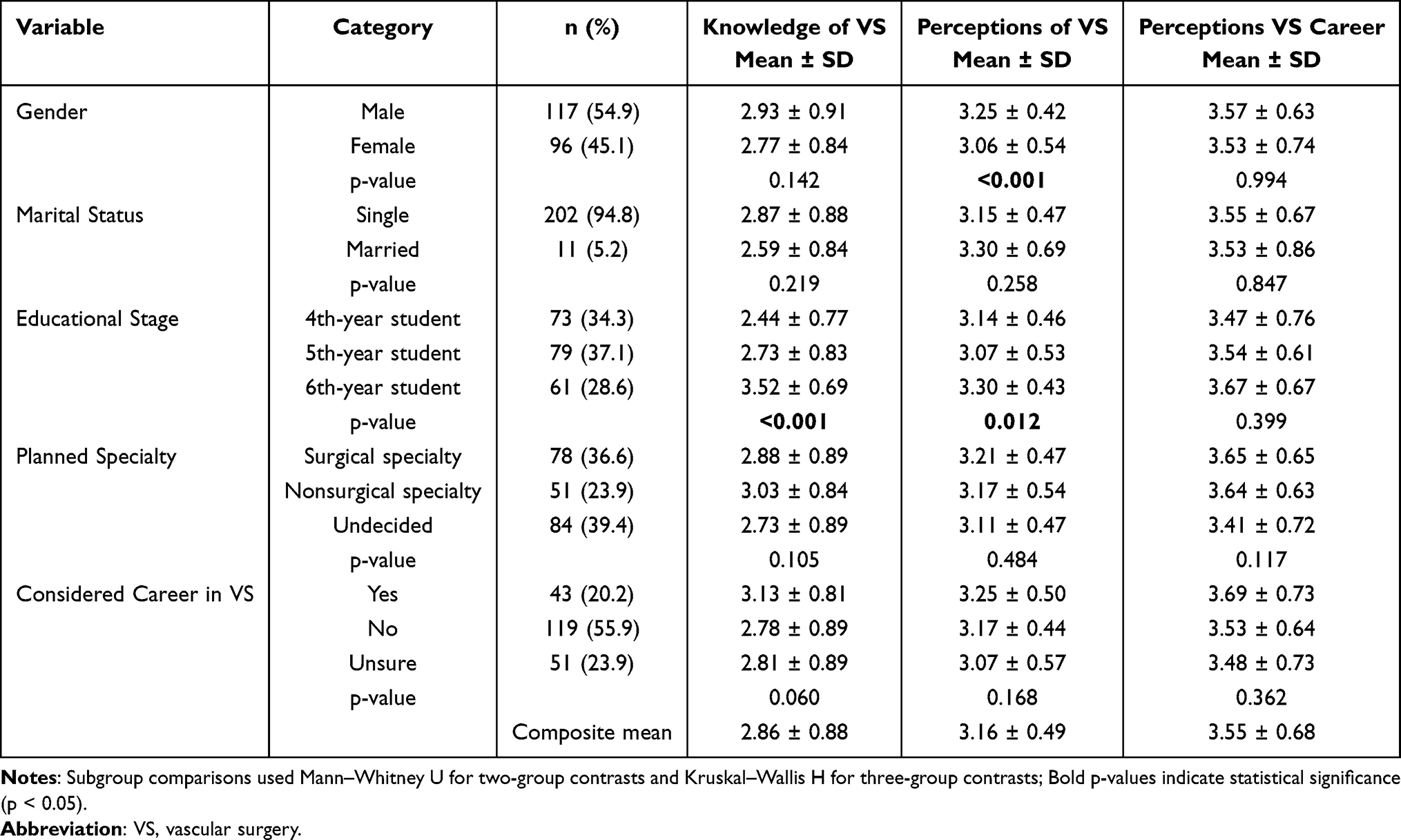 |
Table 1 Demographic Characteristics and Questionnaire Scores by Subgroup (N = 213) |
Factors Influencing Specialty Selection
The highest-rated factors influencing specialty selection were lifestyle/work–life balance as an attending (4.27 ± 1.07), lifestyle during training (3.99 ± 1.19), and projected income (3.84 ± 1.17), while length of residency/fellowship training was rated lowest (3.23 ± 1.30) and prestige of the field second-lowest (3.30 ± 1.33) (Table 2). Specialty-preference groups differed on three factors. NSS-bound students placed greater weight on lifestyle during training than SS-bound students (4.29 vs. 3.62; p = 0.003), whereas SS-bound students rated variety of treatment modalities (4.15 vs. 3.55; p = 0.006) and prestige of the field (3.56 vs. 2.98; p = 0.018) more highly. Female students rated patient population treated more highly than male students (3.72 vs. 3.41; p = 0.029).
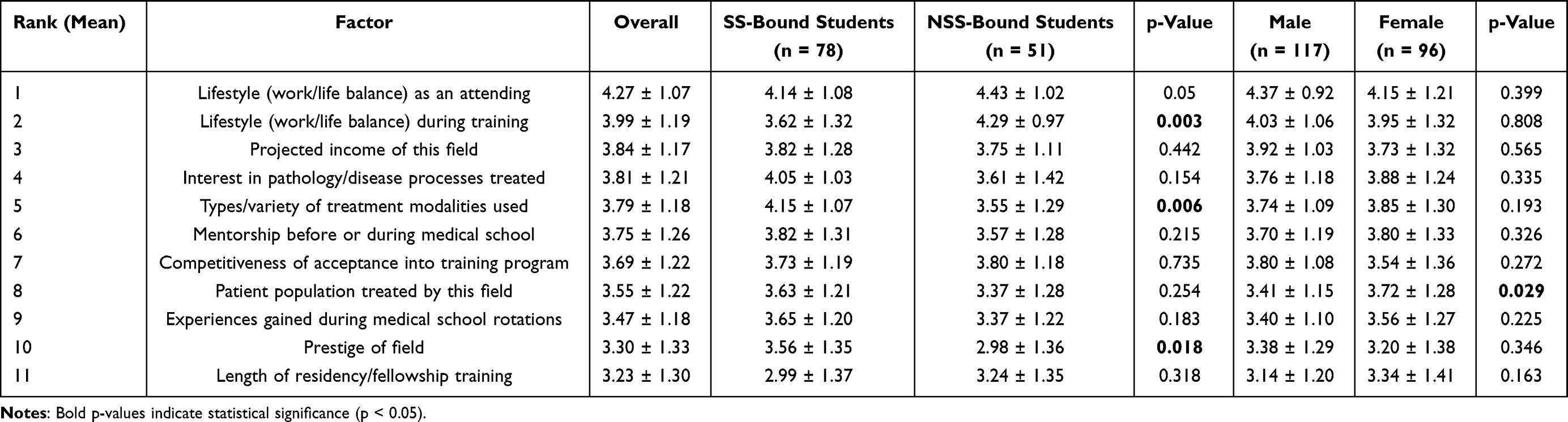 |
Table 2 Ranked Importance of Factors Influencing Specialty Selection, with Comparisons by Planned Specialty and Gender (Mean ± SD; N = 213) |
Knowledge and Perceptions of Vascular Surgeons and Vascular Surgery as a Career
Self-rated knowledge of vascular surgery was generally low (overall agreement 33.6%). The most familiar item was knowledge of the diseases treated by vascular surgeons, with 110 respondents (51.6%) in agreement. The least familiar was knowledge of the lifestyle of vascular surgeons, with only 34 respondents (16.0%) in agreement (Table 3).
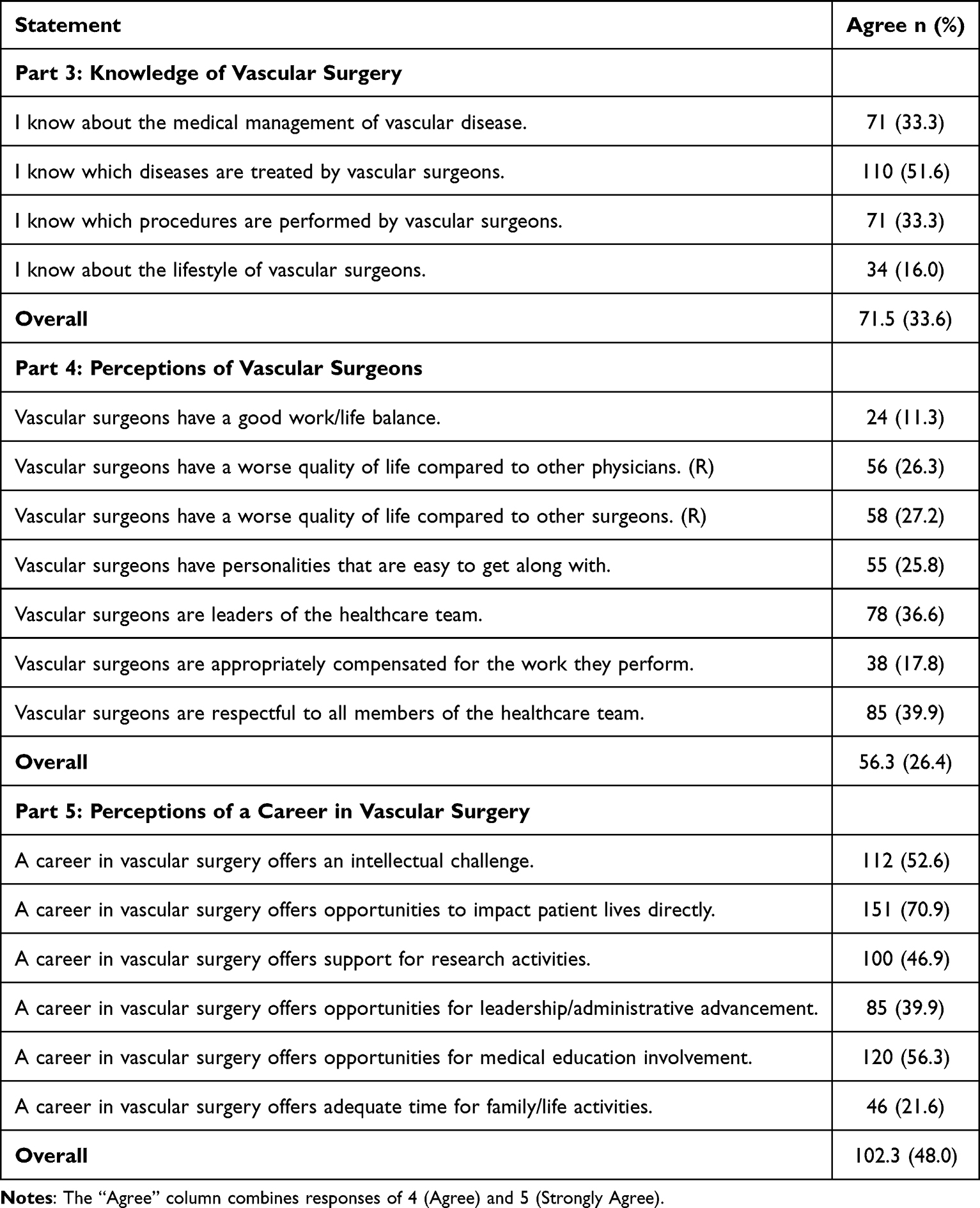 |
Table 3 Knowledge of Vascular Surgery, Perceptions of Vascular Surgeons, and Perceptions of a Career in Vascular Surgery, by Planned Specialty and Gender (N = 213) |
Perceptions of vascular surgeons clustered around neutral (overall agreement 26.4%). The highest agreement was for vascular surgeons being respectful to all members of the healthcare team (85, 39.9%). The lowest agreement was for vascular surgeons having a good work–life balance (24, 11.3%).
Perceptions of a vascular surgery career were more favorable overall (agreement 48.0%). The most endorsed item was that a career in vascular surgery offers opportunities to impact patient lives directly, with 151 respondents (70.9%) in agreement. The least endorsed item was that a career in vascular surgery offers adequate time for family and life activities, with only 46 respondents (21.6%) in agreement.
Predictors of Having Considered a Vascular Surgery Career
Binary logistic regression of having considered a vascular surgery career (Yes vs. No/Unsure; 43 events of 213) is presented in Table 4. Model A entered the 11 specialty-selection factors and the three composites; Model B added gender, planned specialty, and academic year. In Model A, greater importance attached to length of residency/fellowship training was inversely associated with the outcome (aOR 0.59; 95% CI 0.41–0.86; p = 0.007), and greater importance attached to prestige of the field was positively associated (aOR 1.43; 95% CI 1.02–2.05; p = 0.040); this association did not persist in Model B (aOR 1.23; 95% CI 0.84–1.81; p = 0.292). In Model B, male gender was the strongest independent predictor of having considered a vascular surgery career (aOR 4.55; 95% CI 1.84–11.24; p = 0.001), and length of training remained inversely associated (aOR 0.63; 95% CI 0.42–0.96; p = 0.030).
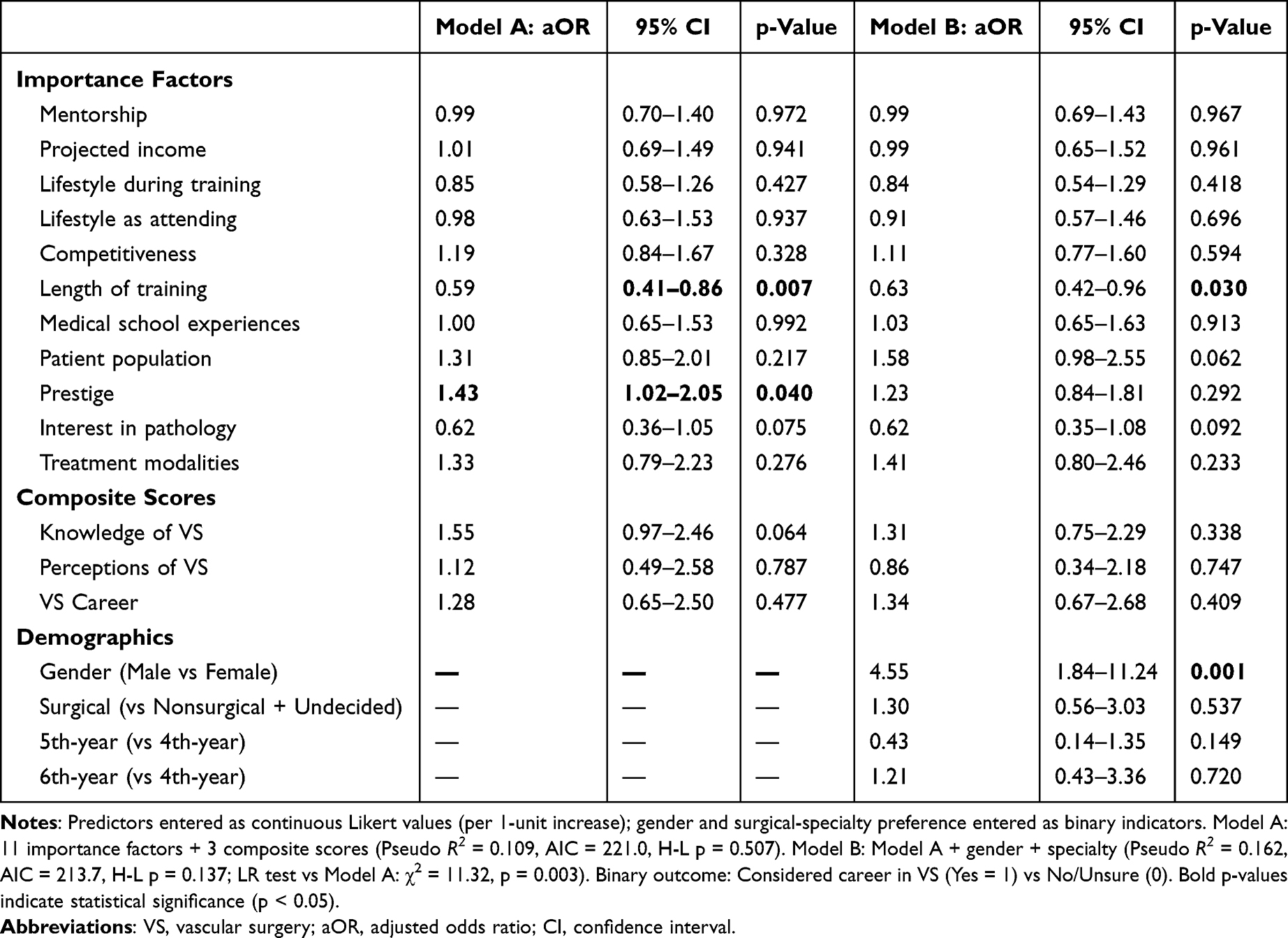 |
Table 4 Binary Logistic Regression: Predictors of Having Considered a Career in Vascular Surgery (Yes vs. No/Unsure, N = 213) |
Discussion
Among medical students at Jazan University, 20.2% had considered a career in vascular surgery, comparable to 22% reported in the multi-school US sample.8 Identifying what predicts whether students consider vascular surgery is essential for workforce planning: international projections forecast deepening shortages of vascular surgeons over the coming two decades,1–3 and addressing this shortfall depends in part on characterizing the modifiable determinants of specialty choice at the medical-student stage.
The modest 20.2% rate is principally explained by a mismatch between what students value when selecting a specialty and what they perceive vascular surgery to offer. Lifestyle as an attending was the highest-rated factor influencing specialty selection, and lifestyle during training the second; length of training received the lowest rating of any specialty-selection factor. These rankings line up with students’ perceptions of vascular surgery itself. Across all three Likert domains, the lowest-rated item concerned a lifestyle attribute: knowledge of vascular surgeons’ lifestyle (Part 3), their work–life balance (Part 4), and the family time the career affords (Part 5). Students value lifestyle most yet perceive vascular surgery as offering the least of it—a self-reinforcing pattern that depresses overall consideration. The NSS–SS contrast sharpens this picture. NSS-bound students rated lifestyle during training more highly than their SS-bound peers (4.29 ± 0.97 vs. 3.62 ± 1.32; p = 0.003), which helps explain why students who are NSS-bound or undecided—the majority of the sample—tend not to consider vascular surgery.
This pattern is not new. Lifestyle has been documented as the dominant deterrent of vascular surgery interest in career-choice surveys for over two decades,8,27 and only 7% of fourth-year students in a US multi-school sample believed vascular surgeons have a good work–life balance,8 consistent with the similarly low 11.3% observed here. Trainee-level evidence supports the perception. Eighty-hour-week violations among vascular surgery trainees have been associated with higher burnout,9 and unhealthy work–life balance has been identified as a leading driver of job dissatisfaction among practicing vascular surgeons.28 Longitudinal evidence further indicates that interest in surgical careers declines progressively through medical school principally because of perceptions of lifestyle and training length.29 The regression reinforces this: students who rated training length as a more important consideration in specialty choice were independently less likely to have considered vascular surgery (aOR 0.63). Length of training was the lowest-rated specialty-selection factor overall, yet vascular surgery entails one of the longer surgical pathways: an integrated residency requires approximately five years, whereas the traditional route through general surgery requires about seven.30 Burnout during this training is common, affecting 44.6% of vascular trainees in one report.31 A prolonged, demanding pathway may therefore weigh disproportionately against vascular surgery for students who prioritize lifestyle. The absence of an integrated (0+5) vascular surgery residency in Saudi Arabia, previously identified as a pipeline barrier,23,32 is relevant here: a shorter, integrated route to independent practice could mitigate the training-length deterrent that emerged as an independent predictor in this study.
Prestige presents a divergent pattern. Prestige of the field was rated second-lowest overall, suggesting it is not a population-level draw at Jazan—yet SS-bound students rated prestige significantly higher than NSS-bound peers (3.56 ± 1.35 vs. 2.98 ± 1.36; p = 0.018), and prestige was positively associated with the outcome in Model A (aOR 1.43; 95% CI 1.02–2.05; p = 0.040), though this association did not persist after adjustment in Model B (aOR 1.23; p = 0.292). SS-bound students also placed greater weight on the variety of treatment modalities (4.15 ± 1.07 vs. 3.55 ± 1.29; p = 0.006), a factor on which vascular surgery scores well given its hybrid open–endovascular technical scope. Read together, these contrasts identify a coherent subgroup signal. Surgically inclined students value prestige and procedural variety—the combination that makes vascular surgery technically attractive.8,27 Prestige is therefore not a universal driver of vascular surgery interest at Jazan but a subgroup-specific positive signal among the small population already oriented toward surgery. Projected income ranked among the more important specialty-selection factors in this sample, consistent with Saudi evidence in which income determines specialty choice for a majority of students.20,26 How vascular surgery compensation is perceived relative to other specialties was not assessed here and remains uncharacterized.
A gap persists between what students know about vascular surgery and how they perceive it. Self-rated knowledge was uniformly low, and the lowest-rated knowledge item—knowledge of vascular surgeons’ lifestyle—links to the lifestyle perceptions that drive the broader disinterest. Self-rated knowledge rose with educational stage, from 2.44 ± 0.77 in fourth-year students to 3.52 ± 0.69 in sixth-year students (p < 0.001), indicating that knowledge accumulates gradually and concentrates in the senior years. This late, gradual accrual suggests that vascular surgery content delivered earlier in training may not be retained or consolidated, even though dedicated teaching is provided. The absence of a standardized international vascular surgery curriculum5 suggests that enhanced and earlier curricular intervention is a plausible mechanism for raising student knowledge, and focused preclinical surgical exposure produces lasting perception changes.33 The closest comparator field, interventional radiology, demonstrates how large the gains can be. Introducing a structured undergraduate curriculum in interventional radiology increased the proportion of students considering it as a career from 60% to 73%.34 The relationship between training stage and views of vascular surgery was not uniform across measures. Self-rated knowledge rose steadily with educational stage, yet the more favorable perceptions of vascular surgeons seen among fourth-year students were not maintained in senior years (Table 1). Two non-exclusive mechanisms may contribute. Accumulating clinical experience increases factual familiarity while exposing students to the demands of surgical training, so early enthusiasm may be tempered by a growing emphasis on lifestyle and work–life balance as graduation approaches. This divergence, knowledge increasing while attitudes cool, suggests that the window for shaping favorable perceptions occurs early in the clinical phase. A similar decline in surgical interest across training stages has been reported among Saudi medical students, with interest falling from 61.8% in junior years to 24.8% by the final year.35 These stage differences were significant in bivariate analysis but attenuated after adjustment (Table 4) and are therefore interpreted as hypothesis-generating. These findings relate directly to the local curriculum. At Jazan University, vascular surgery is taught through structured, multi-year teaching that includes dedicated lectures within the Surgery I and Surgery II modules, bedside teaching, and skills-laboratory sessions, supervised by board-certified vascular surgeons. Self-rated knowledge nonetheless remained low, which suggests that the presence of structured didactic exposure does not, by itself, translate into retained knowledge or sustained career interest. This pattern points away from a simple deficit of teaching and toward the depth, timing, and clinical immersion of that teaching: didactic and short-format sessions may be insufficient to build durable familiarity, and earlier or more sustained clinical contact, mentorship, and a vascular surgery interest group may be needed to convert existing exposure into knowledge and career interest.
Alongside these population-level patterns, gender operated as a distinct individual-level predictor. After adjustment for 14 attitudinal and importance-related covariates, male students had over four-and-a-half times the odds of female students of having considered a vascular surgery career, the strongest independent association in the model (aOR 4.55; 95% CI 1.84–11.24; p = 0.001). Female students also scored lower than male students on the overall Perceptions of Vascular Surgeons composite (3.06 ± 0.54 vs. 3.25 ± 0.42; p < 0.001). Several explanations are plausible and not mutually exclusive. Female students may experience clinical encounters with vascular-surgery teams differently, may be more sensitive to gendered behaviors that male students do not perceive or report, may have had less direct exposure to vascular surgery during clerkships, or may bring different normative expectations of professional conduct to the survey. Distinguishing among these possibilities will require qualitative or longitudinal follow-up. Internationally, women constitute approximately 15% of the US vascular surgery workforce13 and remain under-represented across the training pipeline.14 The recurring barriers identified in systematic reviews, including gender discrimination, lifestyle considerations, and the absence of female role models,8,15 are amplified in low- and lower-middle-income settings, where female medical students are 40% less likely than their male counterparts to consider surgical careers.16 Regardless of which mechanism predominates, the gendered perception of vascular surgery is modifiable. A single-day undergraduate exposure intervention produced an 18% reduction in the perception that vascular surgery is female-unfriendly (p = 0.03), alongside gains in interest and understanding.11 Comparable under-representation of women in surgical career interest has been documented among Saudi medical students, for whom mentorship and visible female role models have been proposed to support entry into surgical fields.17
Several limitations apply. The cross-sectional design cannot establish causal direction. Although a response rate of 88.75% (213/240) was achieved, convenience sampling through institutional WhatsApp groups raises the possibility of non-response and self-selection bias, with vascular-surgery-interested students potentially over-represented among respondents. All data are self-reported, introducing social-desirability bias, and behavioral outcomes such as actual residency-application choices were not measured. The single-institution scope limits generalizability to other Saudi medical schools, particularly in regions with different specialty mixes. Multi-institutional, longitudinal replication using a standardized instrument is warranted.
Conclusions
Among medical students at Jazan University, 20.2% had considered a vascular surgery career. Male gender was the strongest independent predictor of having done so, corresponding to over four-and-a-half times the odds of female students (aOR 4.55), and the importance attached to training length was the only other independent predictor, inversely associated with the outcome. The central recruitment challenge is structural: lifestyle was the highest-rated factor influencing specialty selection, yet only 11.3% of students agreed that vascular surgeons have a good work–life balance. Because favorable perceptions were highest among fourth-year students and declined in senior years, recruitment efforts should be concentrated early in the clinical phase. Although vascular surgery is already taught through structured, multi-year teaching at Jazan, self-rated knowledge remained low; strengthening the depth and clinical immersion of this teaching, establishing a vascular surgery interest group, and providing deliberately female-oriented mentorship therefore represent evidence-based next steps for converting existing exposure into knowledge and career interest. At the training-pathway level, the prolonged route to independent practice that deterred students in this study could be addressed by establishing an integrated vascular surgery residency in Saudi Arabia, which would shorten time to independent practice and remove a structural barrier previously identified in the Kingdom.23,32
Abbreviations
aOR, adjusted odds ratio; CI, confidence interval; MBBS, Bachelor of Medicine, Bachelor of Surgery; SS, surgical specialty; NSS, non-surgical specialty; SD, standard deviation; STROBE, Strengthening the Reporting of Observational Studies in Epidemiology; VS, vascular surgery.
Data Sharing Statement
The datasets generated and analyzed during the current study are available from the corresponding author on reasonable request.
Ethics Approval and Consent to Participate
The study was approved by the Standing Committee for Scientific Research / Institutional Review Board of Jazan University (approval number REC-47/11/1946). Participation was voluntary and anonymous. Informed consent was obtained from all participants prior to participation; submission of the completed online questionnaire was taken as documentation of informed consent. The study was conducted in accordance with the principles of the Declaration of Helsinki.
Disclosure
The author declares no competing interests in this work.
References
1. Silvestre J, Wooster MD, Seeger S, Rowe VL, Reitman CA. Trends in supply, demand, and workforce adequacy in vascular surgery: forecasting a national shortage. J Vasc Surg. 2025;82(3):1066–12. doi:10.1016/j.jvs.2025.04.071
2. Williams K, Schneider B, Lajos P, Marin M, Faries P. Supply and demand: will we have enough vascular surgeons by 2030? Vascular. 2016;24(4):414–420. doi:10.1177/1708538115596652
3. Go MR, Oslock WM, Way DP, et al. An updated physician workforce model predicts a shortage of vascular surgeons for the next 20 Years. Ann Vasc Surg. 2020;66:282–288. doi:10.1016/j.avsg.2020.01.097
4. Jayroe H, Weaver L, Velazquez G, et al. Vascular surgery training positions and applicant 10-year trends with consideration for further expansion. Ann Vasc Surg. 2023;95:291–296. doi:10.1016/j.avsg.2023.05.003
5. Lee KS, Ng JJ, Choong A. A scoping review of vascular surgery education in the medical school curriculum. J Vasc Surg. 2021;74(4):1362–1374e3. doi:10.1016/j.jvs.2021.04.024
6. DeAngelo M, Hakim A, Darelli-Anderson AM, Harding JP, Smith BK. Medical student perspectives on choosing a career in vascular surgery. Ann Vasc Surg. 2022;83:152–157. doi:10.1016/j.avsg.2021.11.015
7. Fereydooni A, Ramirez JL, Morrow KL, Chandra V, Coleman DM, Lee JT. Factors influencing medical student choices in the integrated vascular surgery match: implications for future post-pandemic residency matches. J Vasc Surg. 2021;74(4):1354–1361e4. doi:10.1016/j.jvs.2021.05.014
8. Arismendi T, Schaper N, Falkenhain A, et al. Fourth-Year Medical Students’ perceptions of vascular surgery: can we improve the pipeline? Ann Vasc Surg. 2023;97:147–156. doi:10.1016/j.avsg.2023.07.099
9. Janko MR, Smeds MR. Burnout, depression, perceived stress, and self-efficacy in vascular surgery trainees. J Vasc Surg. 2019;69(4):1233–1242. doi:10.1016/j.jvs.2018.07.034
10. Treffalls RN, Yan Q, Treffalls JA, Clothier WT, Davies MG. Systematic review of vascular surgery recruitment strategies for medical students and general surgery residents. J Vasc Surg. 2022;76(3):837–843e4. doi:10.1016/j.jvs.2022.03.875
11. Turki MAA, Zargaran A, Murtaza A, et al. Vascular surgery: what increases the flow of students to the speciality? Vascular. 2019;27(3):338–344. doi:10.1177/1708538118809854
12. Pitcher GS, Dittman JM, Lavingia KS, Amendola MF. Vascular surgery interest groups provide a targeted approach to mentorship and recruitment. JVS-Vascular Insights. 2023;1:26. doi:10.1016/j.jvsvi.2023.100026
13. Arya S, Franco-Mesa C, Erben Y. An analysis of gender disparities amongst United States medical students, general surgery residents, vascular surgery trainees, and the vascular surgery workforce. J Vasc Surg. 2022;75(1):5–9. doi:10.1016/j.jvs.2021.09.029
14. Dorsey C, Ross E, Appah-Sampong A, Vela M, Saunders M. Update on workforce diversity in vascular surgery. J Vasc Surg. 2021;74(1):5–11e1. doi:10.1016/j.jvs.2020.12.063
15. Trinh LN, O’Rorke E, Mulcahey MK. Factors influencing female medical students’ decision to pursue surgical specialties: a systematic review. J Surg Educ. 2021;78(3):836–849. doi:10.1016/j.jsurg.2020.08.050
16. Marks IH, Diaz A, Keem M, et al. Barriers to women entering surgical careers: a global study into medical student perceptions. World J Surg. 2020;44(1):37–44. doi:10.1007/s00268-019-05199-1
17. Harun RAT, Almustafa R, AlKhalifah Z, et al. Role models as a factor influencing career choice among female surgical residents in Saudi Arabia: a cross-sectional study. BMC Medical Educ. 2022;22(1):109. doi:10.1186/s12909-022-03181-5
18. Tash AA, Al-Bawardy RF. cardiovascular disease in Saudi Arabia: facts and the way forward. J Saudi Heart Assoc. 2023;35(2):148–162. doi:10.37616/2212-5043.1336
19. Albejaidi F, Nair KS. Building the health workforce: Saudi Arabia’s challenges in achieving Vision 2030. Int J Health Plann Manag. 2019;34(4):e1405–e1416. doi:10.1002/hpm.2861
20. Asiri WMA, Shati AA, Alrowaibah NA, Althumairi RK, Alqahtani GM, Mahmood SE. The influencing factors of choosing future medical specialties among students in Saudi Arabia: a nationwide multicenter survey. Medicine. 2023;102(14):e33483. doi:10.1097/MD.0000000000033483
21. Salawati E, Ghamri R, Amir A, et al. The magnitude of influence of personal and professional factors on the career choices of medical students. J Med Life. 2024;17(4):449–456. doi:10.25122/jml-2023-0453
22. Mashbari H, Madkhali AY, Hamithi D, et al. Effect of surgery before and after clerkship on the attitude of medical students toward surgery as a future career in Saudi Arabia. J Med Educ. 2023;22(22):e144803.
23. Alsheikh S, AlGhofili H, Altoijry A, et al. An integrated vascular surgery residency program would increase interest among Saudi medical students in a career in vascular surgery. BMC Med Educ. 2024;24(1):903. doi:10.1186/s12909-024-05928-8
24. Jamjoom AB, Gahtani AY, Sharab BM. Regional variation in the neurosurgical workforce in Saudi Arabia. Cureus. 2022;14(8):e28236. doi:10.7759/cureus.28236
25. Aldebasi T, Alhejji AM, Bukhari BH, et al. Ophthalmology workforce over a decade in the Kingdom of Saudi Arabia: demographics, distribution, and future challenges. Hum Resour Health. 2024;22(1):19. doi:10.1186/s12960-024-00902-3
26. Hakami N, Madkhali A, Hakami F, et al. Obstacles deterring medical students from pursuing a career in the field of surgery in Jazan University, Saudi Arabia. Cureus. 2023;15(8):e43233. doi:10.7759/cureus.43233
27. Calligaro KD, Dougherty MJ, Sidawy AN, Cronenwett JL. Choice of vascular surgery as a specialty: survey of vascular surgery residents, general surgery chief residents, and medical students at hospitals with vascular surgery training programs. J Vasc Surg. 2004;40(5):978–984. doi:10.1016/j.jvs.2004.08.036
28. Jackson TN, Wheeler TP, Truitt MS, Nelson P, Kempe K. Recruitment & retainment of vascular surgeons: prophylactic measures to improve the current workforce crisis. Ann Vasc Surg. 2022;85:219–227. doi:10.1016/j.avsg.2022.02.011
29. Are C, Stoddard HA, Nelson KL, Huggett K, Carpenter L, Thompson JS. The influence of medical school on career choice: a longitudinal study of students’ attitudes toward a career in general surgery. Am J Surg. 2018;216(6):1215–1222. doi:10.1016/j.amjsurg.2018.10.036
30. Smith BK, Davies MG, Harris IB. The current state of the 0+5 integrated vascular surgery residency training paradigm: a scoping review of the literature. J Surg Educ. 2019;76(4):990–1004. doi:10.1016/j.jsurg.2019.01.007
31. Chia MC, Hu -Y-Y, Li RD, et al. Prevalence and risk factors for burnout in U.S. vascular surgery trainees. J Vascular Surg. 2022;75(1):308–315.e4. doi:10.1016/j.jvs.2021.06.476
32. Zayed MA, Dalman RL, Lee JT. A comparison of 0 + 5 versus 5 + 2 applicants to vascular surgery training programs. J Vascular Surg. 2012;56(5):1448–1452. doi:10.1016/j.jvs.2012.05.083
33. Zambare WV, Dechert TA, Sanchez SE, Brahmbhatt TS. Changes in medical student perceptions of surgery are sustainable through focused preclinical surgical exposure. J Surg Educ. 2021;78(5):1583–1592. doi:10.1016/j.jsurg.2021.02.008
34. Shaikh M, Shaygi B, Asadi H, et al. The introduction of an undergraduate interventional radiology (IR) curriculum: impact on medical student knowledge and interest in IR. Cardiovasc Intervent Radiol. 2016;39(4):514–521. doi:10.1007/s00270-015-1215-z
35. Alharbi AM, Alsultan AA, Tirkistani JM, et al. Factors influencing medical students’ choice of anesthesiology as a future specialty in Saudi Arabia. Cureus. 2024;16(8):e68028. doi:10.7759/cureus.68028
 © 2026 The Author(s). This work is published and licensed by Dove Medical Press Limited. The
full terms of this license are available at https://www.dovepress.com/terms
and incorporate the Creative Commons Attribution
- Non Commercial (unported, 4.0) License.
By accessing the work you hereby accept the Terms. Non-commercial uses of the work are permitted
without any further permission from Dove Medical Press Limited, provided the work is properly
attributed. For permission for commercial use of this work, please see paragraphs 4.2 and 5 of our Terms.
© 2026 The Author(s). This work is published and licensed by Dove Medical Press Limited. The
full terms of this license are available at https://www.dovepress.com/terms
and incorporate the Creative Commons Attribution
- Non Commercial (unported, 4.0) License.
By accessing the work you hereby accept the Terms. Non-commercial uses of the work are permitted
without any further permission from Dove Medical Press Limited, provided the work is properly
attributed. For permission for commercial use of this work, please see paragraphs 4.2 and 5 of our Terms.
Recommended articles

Future Dreams of Junior and Senior Medical Students at a Public Saudi Medical School
Bin Abdulrahman KA, Alobaida BA, Alzabadin RA, Alosaimi AK, Almutairi NS, Alayed FA, Alsahabi BK, Alqumaizi AK
Advances in Medical Education and Practice 2022, 13:1187-1195
Published Date: 28 September 2022
Social Media Usage and Academic Performance Among Medical Students in Medina, Saudi Arabia
Alshanqiti A, Alharbi OA, Ismaeel DM, Abuanq L
Advances in Medical Education and Practice 2023, 14:1401-1412
Published Date: 14 December 2023
What Matters Most: Determinants Associated with the Selection of Medical Residencies in Qatar
Kane T, Ford J, Al Saady RM, Vranic S, Musa OAH, Suliman S
Advances in Medical Education and Practice 2024, 15:141-151
Published Date: 28 February 2024
Attitude and Understanding of Artificial Intelligence Among Saudi Medical Students: An Online Cross-Sectional Study
Alwadani FAS, Lone A, Hakami MT, Moria AH, Alamer W, Alghirash RA, Alnawah AK, Hadadi AS
Journal of Multidisciplinary Healthcare 2024, 17:1887-1899
Published Date: 29 April 2024
Effect of Social Anxiety Disorder on Specialty Choice Among Residents and Interns in Saudi Arabia: A Multi-Center Cross-Sectional Study
Abudasser AM, Alshehri ISM, Alasiri RYS, Wakidah RY, Alqahtani RY
Advances in Medical Education and Practice 2025, 16:1187-1196
Published Date: 5 July 2025