
Back to Journals » Infection and Drug Resistance » Volume 19
Prediction for the Therapeutic Efficacy of Topical Nocardia Rubra Cell Wall Skeleton Human Papillomavirus Infection: A Retrospective Study
Received 22 January 2026
Accepted for publication 15 May 2026
Published 22 May 2026 Volume 2026:19 598145
DOI https://doi.org/10.2147/IDR.S598145
Checked for plagiarism Yes
Review by Single anonymous peer review
Peer reviewer comments 2
Editor who approved publication: Professor Chi H. Lee
Hongyan Liu,1,2 Ying Liu1
1Department of Central Laboratory, The Third Affiliated Hospital of Jinzhou Medical University, Jinzhou, 121000, People’s Republic of China; 2Department of Gynecology, Jing Dong Zhong Mei Hospital, Langfang, 065201, People’s Republic of China
Correspondence: Ying Liu, Department of Central Laboratory, The Third Affiliated Hospital of Jinzhou Medical University, No. 2, Section 5, Heping Road, Linghe District, Jinzhou, Liaoning, 121000, People’s Republic of China, Email [email protected]
Objective: To develop and validate an individualized clinical prediction model for estimating the therapeutic efficacy of topical Nocardia rubra Cell Wall Skeleton (Nr-CWS) in patients with persistent high-risk Human Papillomavirus (HPV) infection.
Methods: This single-center retrospective cohort study included 180 patients who received topical Nr-CWS treatment. According to human papillomavirus deoxyribonucleic acid (HPV-DNA) clearance status at 12 months after treatment, patients were classified into an effective group and an ineffective group. Kaplan–Meier analysis was used to evaluate treatment efficacy. Univariate and multivariate Cox proportional hazards regression analyses were performed to identify independent predictors associated with treatment outcomes. A nomogram prediction model was constructed based on the identified independent predictors.
Results: The cumulative effectiveness rate of Nr-CWS treatment at 12 months was 82.22%. Age, HPV subtype, and treatment adherence were independent predictors of therapeutic efficacy. The nomogram model constructed based on these predictors showed good discrimination, with an AUC of 0.803 (95% CI: 0.716– 0.890) and a C-index of 0.860, and was well-calibrated (mean absolute error = 0.026). Decision curve analysis demonstrated a positive net clinical benefit across a wide range of threshold probabilities.
Conclusion: This study successfully identified key clinical predictors influencing the efficacy of Nr-CWS therapy and developed a well-calibrated clinical prediction model. The model demonstrates good discrimination, calibration, and clinical applicability for individualized prediction of treatment response in patients with high-risk HPV infection. These findings offer a practical and visualized tool to support clinical decision-making. However, further validation in larger, multicenter cohorts is required.
Keywords: nocardia rubra cell wall skeleton, human papillomavirus, nomogram model, risk factors, therapeutic efficacy
Introduction
Persistent infection with human papillomavirus (HPV) (Detailed abbreviations are listed in Supplementary Table S1) is a major etiological factor in the development and progression of cervical cancer and constitutes a significant global public health burden among women.1,2 Although prophylactic HPV vaccination is gradually altering the epidemiological landscape, the therapeutic management of already infected adult women remains a central clinical challenge.3 Currently, multiple strategies exist for managing persistent high-risk HPV infection. However, highly specific antiviral agents are lacking. In this context, local immunomodulatory therapies have attracted considerable attention due to their potential to enhance viral clearance.
Topical Nocardia rubra cell wall skeleton (Nr-CWS), a non-specific immunomodulator,4 has been shown in several studies to promote clearance of high-risk HPV and regression of low-grade cervical lesions in some patients by activating innate and cellular immune responses at the local mucosal level.5,6 Beyond direct immune activation, emerging evidence in biomaterial science indicates that modulating the local tissue microenvironment—specifically through effects on inflammation, immune activation, and repair processes—can critically influence therapeutic outcomes.7 Although still exploratory, this immuno-regenerative perspective conceptually aligns with the use of topical Nr-CWS in high-risk HPV infection, where restoring immune surveillance within the cervical mucosal microenvironment is a key mechanism. This approach offers a valuable non-surgical therapeutic option in clinical practice.
However, both clinical observations and meta-analyses of topical Nr-CWS efficacy indicate significant interindividual heterogeneity in treatment response.8 For example, reported efficacy rates vary across studies: a recent randomized multicenter trial reported an overall 12-month efficacy rate of 91.0%,8 whereas other studies have reported rates ranging from approximately 60% to 85%.9 Although the overall effectiveness is considerable, a substantial proportion of patients fail to achieve viral clearance after completing the recommended course, resulting in treatment failure and potential risk of disease progression. The drivers behind these differences in efficacy remain unclear, making it difficult for clinicians to predict in advance which patients are more likely to benefit and which may be non-responders. This uncertainty limits the implementation of individualized treatment strategies and tailored follow-up intensity. Therefore, systematically identifying and quantifying the key predictors of Nr-CWS efficacy is of urgent clinical importance for achieving precision medicine, optimizing resource allocation, and improving the cost-effectiveness of treatment.
Previous studies have attempted to explore factors associated with Nr-CWS efficacy, such as HPV type and baseline viral load, but the findings remain inconsistent—some identifying HPV genotype and baseline viral load as potential predictors, while others report no significant association after adjusting for confounders.9,10 Moreover, the few studies employing multivariable analysis were primarily designed to compare Nr-CWS with alternative treatments, rather than to systematically identify and validate independent predictors of therapeutic response.8 More importantly, existing studies generally face methodological limitations: some use cross-sectional designs that cannot fully capture the dynamic process of therapeutic response over longitudinal follow-up, while others have limited sample sizes. In particular, when overall treatment efficacy is high, the number of patients experiencing treatment failure is small, making the development and validation of predictive models for these critical outcomes statistically underpowered. In the broader field of HPV management, nomogram-based prediction models have been successfully developed to forecast outcomes such as natural HPV clearance11 and post-LEEP viral persistence.12 Yet, no comparable model currently exists to predict therapeutic response to topical Nr-CWS. This represents a notable gap given the clinical variability described above.
A nomogram prediction model is particularly well-suited to address this gap: by integrating multiple risk factors into a single scoring system, it provides clinicians with an intuitive tool to estimate individual patient outcomes before treatment initiation, thereby facilitating risk-stratified management and informed clinical decision-making.13 There remains a lack of a prediction model that integrates key clinical and behavioral variables, such as treatment adherence, with rigorous internal validation.
In light of these gaps, this study aims to conduct a retrospective cohort investigation with the primary objective of identifying and validating independent clinical predictors of therapeutic efficacy for topical Nr-CWS in high-risk HPV infection. Based on these findings, we further seek to construct an initial prediction model for risk assessment. The results of this study are expected to provide clinicians with a preliminary decision-support tool, enabling pre-treatment risk stratification, intensified management for high-risk patients, or early consideration of combination interventions, ultimately promoting individualized and precision-based treatment strategies for high-risk HPV infection.
Materials and Methods
Study Population
We retrospectively collected clinical data of patients with persistent HPV infection who visited the gynecology outpatient clinic of our hospital and received topical Nr-CWS treatment between January 2021 and January 2025. Persistent HPV infection was defined as detection of the same high-risk HPV subtype on two consecutive cervical HPV DNA tests performed at least 12 months apart. A total of 180 patients meeting the inclusion criteria were enrolled. The study protocol was approved by the Ethics Committee of Jing Dong Zhong Mei Hospital (approval number: JDZM202601) and conducted in accordance with the Declaration of Helsinki.14 Individual informed consent was waived due to the retrospective design, but all researchers were required to strictly protect patient privacy and data security.
Inclusion criteria were: (1) age ≥18 years; (2) confirmed persistent HPV infection by polymerase chain reaction (PCR) or HPV genotyping (two consecutive HR-HPV tests with a 6‑month interval are both positive, and the HR-HPV positivity persists for ≥12 months); (3) received at least one full course of topical Nr-CWS therapy; (4) no prior treatment for cervical lesions within 6 months before enrollment; and (5) complete clinical records, including clinical characteristics, laboratory results, and follow-up data.
Exclusion criteria were: (1) co-infection with other sexually transmitted infections; (2) prior antiviral or local destructive therapy, including interferon, laser, loop electrosurgical excision procedure (LEEP), or photodynamic therapy; (3) pregnancy, lactation, or attempting conception; (4) severe cardiac, hepatic, or renal dysfunction, or autoimmune diseases; (5) high-grade cervical intraepithelial neoplasia or cervical cancer; or (6) incomplete follow-up data or loss to follow-up.
Data Collection
Data extraction and entry were independently performed by two trained researchers using a standardized data collection form. Discrepancies were resolved by reviewing the original medical records or by arbitration of a third researcher. Definitions and categorizations of all predictive variables were predefined before analysis and mainly based on objective records (eg, laboratory reports, medical charts) to minimize recall and misclassification bias inherent to retrospective data collection.
Collected variables included:
(1) Demographic and baseline characteristics: age, gravidity, parity, and body mass index (BMI).
(2) HPV-related indicators: HPV DNA was detected and genotyped using the Linear Array HPV Genotyping Test (Roche Diagnostics, Mannheim, Germany), which identifies HPV types, including high-risk variants associated with cervical cancer. HPV viral load was measured by real-time PCR and quantified in relative light units per cut-off (RLU/CO), with results interpreted according to the laboratory’s standard threshold values. All tests were conducted by the hospital’s central laboratory, adhering to established protocols and quality control measures to ensure accuracy. Additionally, Thin-layer liquid-based cytology test (TCT) was used to evaluate cervical cytology and further assess the presence of any abnormal cells associated with HPV infection.
(3) Comorbidities: presence of bacterial vaginosis, vulvovaginal candidiasis, or other vaginal microbiota disorders.
(4) Clinical indicators: pre-treatment peripheral blood levels of interleukin-6 (IL-6), tumor necrosis factor-alpha (TNF-α), interferon-gamma (IFN-γ), CD4⁺ T cells, CD8⁺ T cells, and CD4⁺/CD8⁺ ratio.
(5) Treatment adherence: Adherence was calculated as (number of doses documented as taken) / (prescribed doses) × 100%. To ensure accurate assessment, data were collected from three sources with a hierarchical prioritization: pharmacy dispensing records, patient self-reported medication logs, and follow-up interview recall. When discrepancies between sources were identified, the most conservative estimate—the lower documented dose count—was adopted to avoid overestimation of adherence. All adherence assessments were independently reviewed by two researchers, with disagreements resolved through consensus adjudication. Patients completing ≥80% of the prescribed doses were classified as “good adherence”, otherwise as “poor adherence”.
(6) Nr-CWS Administration Protocol: According to the standardized procedure, Nr-CWS (Tian’an Biopharmaceutical Co., Ltd., lot number S20030009, 60 μg/vial) is applied topically to the cervix starting 2–3 days after menstrual bleeding has ceased; for each application, two vials are used, one vial dissolved in 1 mL of normal saline and slowly injected into the cervical canal using a needleless syringe, and the other vial diluted with 2.0 mL of normal saline to saturate a cotton ball with a retrieval string, which is then placed against the lesion and removed after 24 hours, with the treatment repeated once every two days for ten applications to complete one course. This schedule was maintained for all patients in the rehabilitation group, and the application was done under the supervision of the attending gynecologist to ensure proper administration. Patients were instructed not to use any other topical treatments during the study period. Treatment adherence was monitored through pharmacy records, patient logs, and follow-up interviews to ensure consistency in protocol administration.
Primary Outcomes
The primary outcome was time to first HPV-DNA clearance after initiation of Nr-CWS therapy. The event was defined as the first documented conversion of all baseline positive high-risk HPV DNA results to negative during follow-up. Patients who did not achieve HPV-DNA clearance by the end of the 12-month follow-up were treated as censored observations, with persistent positivity defined as a viral load ≥1.0 relative light unit/cut-off (RLU/CO) or clinically interpreted as positive.15 Time to first HPV-DNA clearance was defined as conversion of all baseline positive high-risk HPV DNA results to negative. Due to the retrospective design, outcome assessors were not blinded to patient treatment status. To minimize assessment bias, objective laboratory criteria (HPV-DNA testing) were used to define “treatment success” versus “treatment failure”. All tests were independently conducted by the hospital’s laboratory department following standard operating procedures, without subjective interpretation.
Sample Size Consideration
As a retrospective observational study, the sample size was determined by the total number of patients who met the eligibility criteria during the study period. To ensure adequate statistical robustness for the development of the clinical prediction model, sample size adequacy was assessed according to established methodological recommendations for time-to-event predictive modeling. According to widely accepted guidance in prediction modeling research, reliable estimation of regression coefficients and minimization of overfitting generally require at least 10–20 outcome events per variable (events per variable, EPV) included in the multivariable model.16 In the present study, the primary event of interest was HPV clearance, which occurred in 148 patients during follow-up. The final multivariable Cox proportional hazards model retained three independent predictors (age, HPV subtype, and treatment adherence). Accordingly, the EPV was approximately 49.3, which substantially exceeded the recommended minimum threshold, indicating that the sample size was sufficient for stable model development and reliable estimation of effect sizes, and also suggesting adequate statistical power for detecting meaningful associations in the multivariable analysis.
Statistical Analysis
All statistical analyses were performed using R software (version 4.5.1) and SPSS software. Continuous variables were first tested for normality using the Shapiro–Wilk test. Normally distributed data are presented as mean ± standard deviation and compared between groups using independent-samples t-test. Non-normally distributed data are presented as median (interquartile range) and compared using the Mann–Whitney U-test. Categorical variables are presented as counts (percentages) and compared using the chi-square (χ2) test. Kaplan-Meier survival curves were generated to visualize treatment response. Variables with P < 0.05 in univariate Cox proportional hazards regression analysis were included in the multivariate Cox proportional hazards regression model. Independent predictors were identified using a stepwise backward selection method. A nomogram prediction model was constructed based on the multivariate Cox results. Model performance was evaluated by receiver operating characteristic (ROC) curves and area under the curve (AUC) to assess discrimination. Calibration was assessed using bootstrap resampling (1000 iterations) to generate calibration curves and compute the concordance index (C-index). Decision curve analysis (DCA) was used to evaluate clinical utility. Prior to analysis, missing data were assessed, and variables with missing values were handled using multiple imputation with chained equations to minimize potential bias and preserve statistical efficiency. All hypothesis tests were two-sided, with p < 0.05 considered statistically significant.
Results
Comparison of Clinical Characteristics
A total of 180 patients with persistent HPV infection meeting the eligibility criteria were included. After 12 months of Nr-CWS therapy, 148 patients (82.22%) had time to first HPV-DNA clearance. Analysis of demographic, pathological, and laboratory parameters showed that patients in the treatment failure group were significantly older and had longer disease duration compared with the treatment success group (P < 0.05). Significant differences were also observed between the two groups in HPV subtype, TCT result category, and comorbidities, including bacterial vaginosis (BV) and vulvovaginal candidiasis (VVC) (P < 0.05). Regarding laboratory indicators, the treatment failure group had significantly lower CD4⁺ counts and CD4⁺/CD8⁺ ratios than the success group (P < 0.05). No significant differences were observed in BMI, gravidity, or parity (all P > 0.05), indicating comparability of baseline clinical characteristics between groups (Table 1).
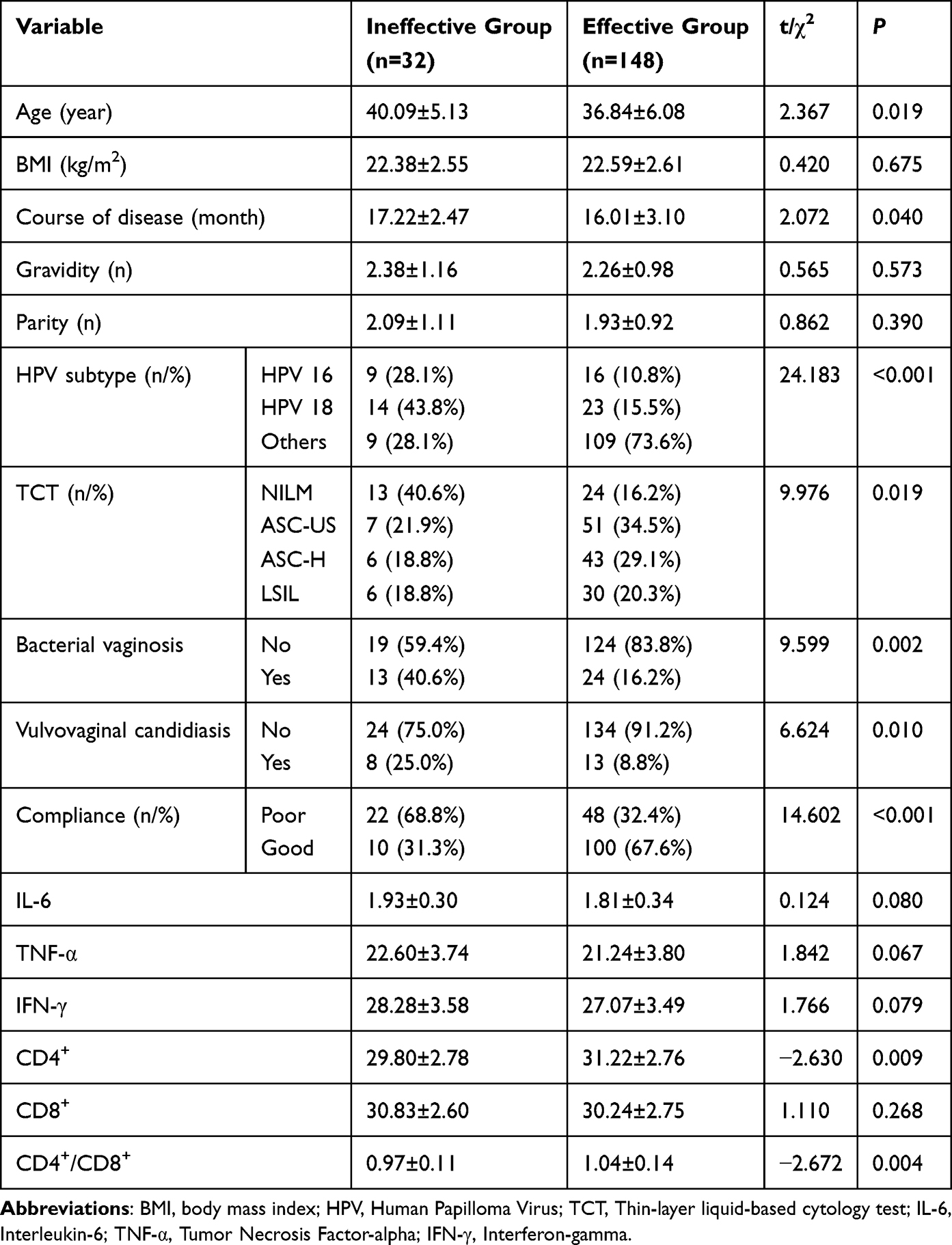 |
Table 1 Comparison of Clinical Characteristics Stratified by Time to First HPV-DNA Clearance |
Treatment Efficacy and Kaplan–Meier Analysis
During the 12-month follow-up of Nr-CWS therapy, 32 patients did not achieve HPV-DNA clearance. As shown in the Kaplan–Meier curve (Figure 1), the rate of HPV-DNA negativity increased over time, indicating a time-dependent improvement in treatment efficacy. The time to first HPV-DNA clearance rate was 50.56% at 3 months (95% CI: 42.68%–57.35%), 71.67% at 6 months (95% CI: 64.26%–77.54%), and reached a cumulative 82.22% at 12 months (95% CI: 75.66%–87.02%). The 12-month failure rate of Nr-CWS therapy was 17.78% (95% CI: 12.98%–24.34%). These results suggest that Nr-CWS clearance of persistent HPV infection gradually improves with treatment duration, with relatively rapid early HPV-DNA conversion followed by a plateau phase.
 |
Figure 1 Kaplan–Meier curve for time to first HPV-DNA clearance. |
Univariate Cox Proportional Hazards Regression Analysis
Time to first HPV-DNA clearance was set as the dependent variable, and age, disease duration, BMI, HPV subtype, comorbidities, and CD4⁺/CD8⁺ ratio were included as independent variables in univariate Cox regression. The analysis (Table 2) identified HPV subtype, treatment adherence, CD4⁺/CD8⁺ ratio, and TCT category as risk factors for time to first HPV-DNA clearance (all HR > 1, P < 0.05). Age, disease duration, and comorbid VVC or BV were protective factors (all HR < 1, P < 0.05). BMI, gravidity, and parity were not significantly associated with time to first HPV-DNA clearance (P > 0.05).
 |
Table 2 Univariate Cox Proportional Hazards Regression Analysis |
Multivariate Cox Proportional Hazards Regression Analysis
Multivariate Cox regression (Table 3) identified three independent predictors significantly associated with treatment efficacy. Age (HR = 0.963, 95% CI: 0.930–0.997, P = 0.034) was a protective factor, indicating that increasing age was associated with reduced likelihood of time to first HPV-DNA clearance. HPV subtype (HR = 1.334, 95% CI: 1.002–1.774, P = 0.048) and treatment adherence (HR = 1.583, 95% CI: 1.089–2.300, P = 0.016) were risk factors, suggesting that certain HPV subtypes or poor adherence increased the risk of treatment failure. Variables significant in univariate analysis, such as VVC, BV, TCT results, and CD4⁺/CD8⁺ ratio, did not retain independent significance in multivariate analysis (P > 0.05).
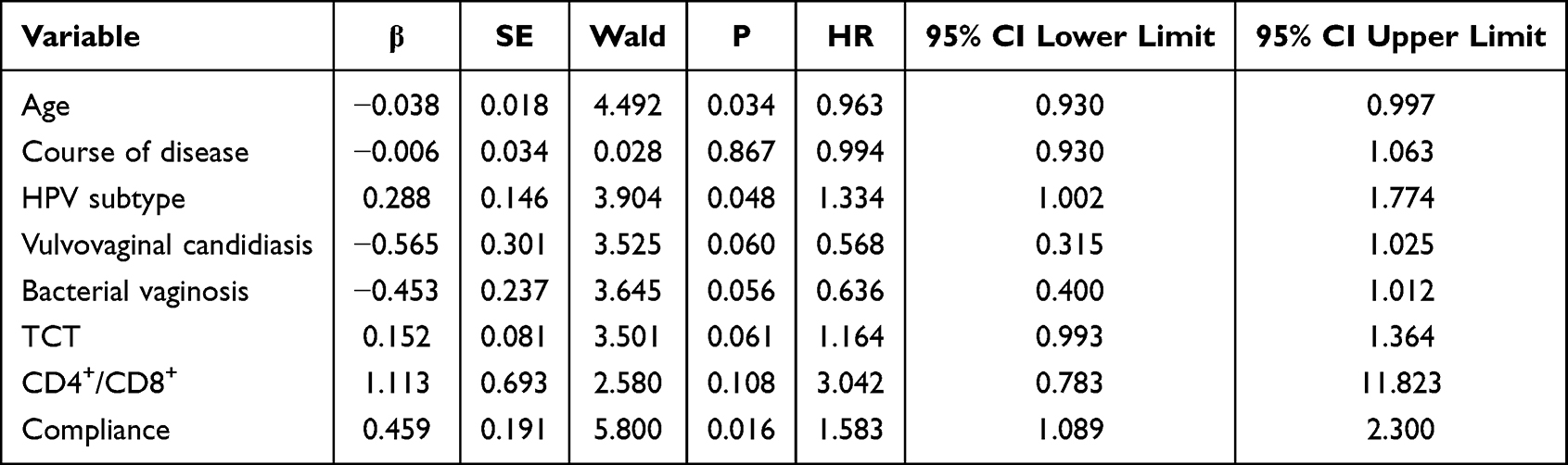 |
Table 3 Multivariate Cox Proportional Hazards Regression Analysis |
Nomogram Model Construction and Validation
Based on the three independent predictors (age, HPV subtype, and treatment adherence) identified in multivariate Cox regression, a nomogram was constructed to predict the probability of the first HPV-DNA clearance with Nr-CWS in patients with HPV infection (Figure 2). The nomogram integrates these clinical variables by assigning specific scores to each factor, with the total score corresponding to the predicted probability of success at 3, 6, and 12 months. Model validation demonstrated good performance: ROC analysis showed excellent discrimination with an AUC of 0.803 (95% CI: 0.716–0.890) (Figure 3A); calibration curves for 12-month outcomes indicated high predictive accuracy, with a C-index of 0.860 and mean absolute error of 0.026, demonstrating strong agreement between predicted and observed probabilities (Figure 3B). DCA further indicated that the model provided higher net clinical benefit across a wide range of threshold probabilities, supporting its clinical utility (Figure 3C). These results suggest that the constructed nomogram is a reliable and practical individualized tool, integrating key clinical factors to predict Nr-CWS treatment efficacy in HPV infection.
 |
Figure 2 A nomogram model constructed based on the results of multivariate Cox analysis for predicting the therapeutic efficacy of Nr-CWS in patients with persistent HPV infection. |
 |
Figure 3 Validation of the prediction model for Nr-CWS treatment efficacy in patients with persistent HPV infection. (A) Time-dependent ROC curve for 12-month treatment failure, showing excellent discriminatory ability (AUC = 0.803). (B) Calibration curve; bootstrap-corrected curve demonstrates good agreement between predicted and observed outcomes. (C) DCA demonstrating clinical utility of the model. |
Discussion
This study retrospectively analyzed and constructed and validated a nomogram integrating age, HPV subtype, and treatment adherence to predict the efficacy of topical Nr-CWS in patients with persistent HPV infection. Internal validation demonstrated good predictive performance and clinical applicability, providing a quantitative tool to identify patients likely to benefit from treatment and to implement individualized management in clinical practice.
Firstly, age was identified as an independent predictor for Nr-CWS treatment efficacy, indicating that, after adjusting for other variables, increased age was associated with a lower probability of first HPV-DNA clearance. This finding aligns with previous studies on HPV clearance, which often suggest that younger age favors HPV-DNA clearance.17,18 However, for established persistent infection and specific immunomodulatory therapies, the underlying mechanisms may be more complex. One possible explanation is that age-related immunosenescence not only affects systemic immunity but also alters the local cervical mucosal immune microenvironment, potentially impairing initial T-cell activation and proliferation in response to antigen stimulation, as well as the generation and function of tissue-resident memory T cells.19 In addition, evidence from a comprehensive review across the reproductive lifespan suggests that reproductive aging and associated physiological changes may influence HPV persistence through complex interactions involving mucosal immunity, fertility status, and hormonal environment.20 Nr-CWS, as an immunomodulator, relies on effective activation of local cellular immune responses, which is consistent with previous evidence indicating that HPV clearance is largely dependent on host cell-mediated immunity.21 Therefore, the age-related decline in local immune responsiveness may reduce the effectiveness of HPV-DNA clearance. Clinically, this suggests that older patients with persistent HPV infection may require more aggressive or combination treatment strategies.
Secondly, HPV subtype was another independent risk factor, indicating that patients infected with certain high-risk HPV types (eg, HPV18) had a relatively lower probability of treatment success. Previous studies have shown that infections with HPV16 and HPV18 persist significantly longer than other high-risk types and are associated with higher risks of high-grade lesions.22 The virological characteristics of different HPV types vary considerably, including differences in E6/E7 protein interactions with host cells, immune evasion capacity, and ability to induce cellular transformation.23,24 These inherent biological differences may result in distinct immunosuppressive microenvironments, affecting the response to immunotherapy.21 Our findings emphasize that HPV genotyping is important not only for risk assessment but also for predicting treatment response in high-risk HPV infections, such as HPV16 and HPV18. This observation is consistent with previous studies showing that persistent infection with high-risk HPV subtypes is associated with delayed viral clearance and increased risk of progression, highlighting the importance of both viral characteristics and host factors in determining treatment outcomes.25,26
Treatment adherence was confirmed as one of the strongest independent predictors. Good adherence significantly increased the likelihood of first HPV-DNA clearance. This is consistent with principles of chronic disease management and previous studies, highlighting adherence as one of the most important modifiable factors influencing treatment outcomes.27,28 For Nr-CWS, which requires long-term, regular application to maintain local immune stimulation, any interruption or non-standard use may fail to achieve the threshold for effective immune activation, resulting in treatment failure. This finding elevates adherence from a management issue to a quantifiable core prognostic indicator. Clinically, adherence should be maximized through patient education, regular follow-up, and medication reminders.
The model performed well across multiple dimensions. The ROC AUC was 0.803, demonstrating good discrimination between patients likely to achieve treatment success versus failure. The calibration curve indicated strong agreement between predicted and observed 12-month treatment success probabilities (C-index = 0.860), confirming predictive accuracy and reliability. Importantly, DCA showed that across a wide range of threshold probabilities, using this model to guide clinical decisions yielded higher net benefit than uniform strategies of “treat all” or “treat none”. Thus, the constructed nomogram serves not only as a statistical prediction tool but also as a practical, visual aid to support clinician-patient communication and individualized treatment planning.
From a clinical perspective, emerging evidence from early-stage cervical lesions such as CIN1 has shown that local multi-component vaginal formulations may contribute to HPV clearance, supporting the potential role of topical therapeutic strategies in HPV-related disease management.29 The constructed nomogram may serve as a practical tool for individualized risk stratification in patients undergoing Nr-CWS therapy. Similar predictive tools have been shown to support clinical decision-making and optimize follow-up strategies in patients with HPV infection.30 In this context, patients identified as having a lower probability of HPV clearance may benefit from intensified monitoring, adherence-enhancing interventions, or alternative therapeutic approaches, whereas those with a higher predicted probability may avoid unnecessary interventions.
Several limitations should be noted. First, as a single-center retrospective study, selection bias, information bias, and residual confounding cannot be completely excluded, despite the use of predefined criteria and standardized data collection procedures. Second, the limited sample size may affect the precision of some variable estimates in multivariate analysis and the stability of the model, and although internal validation was performed, the potential risk of overfitting cannot be completely excluded. Third, potential overfitting cannot be fully excluded despite bootstrapped internal validation, and external validation is needed to confirm generalizability. Fourth, treatment adherence was assessed during follow-up and may be subject to time-related bias, as adherence status could change over time and may not be entirely independent of the occurrence of HPV-DNA clearance. Finally, the model underwent only internal validation, and the lack of external validation may limit its generalizability, which requires further verification in independent, multicenter, prospective cohorts.
Future research should focus on: 1) multicenter, prospective studies for rigorous external validation and calibration of the predictive model; 2) expanding sample size to further explore and validate other potential predictors, such as dynamic changes in viral load during treatment, host genetic factors, and more detailed local immunohistochemical markers; and 3) interventional studies based on risk stratification to evaluate whether individualized treatment strategies guided by model predictions (eg, combination therapy for high-risk patients predicted to have poor response) can improve clinical outcomes.
Conclusion
This study constructs and preliminarily validates a nomogram incorporating age, HPV subtype, and treatment adherence to predict the efficacy of topical Nr-CWS in persistent HPV infection. Increased age and specific high-risk HPV subtypes are associated with a lower probability of first HPV-DNA clearance, whereas good treatment adherence is associated with improved treatment outcomes. The model demonstrates good predictive performance and clinical utility, providing a valuable quantitative tool for clinicians to identify patients most likely to benefit, support early interventions for high-risk individuals, and guide individualized management strategies. However, it should be emphasized that the present model provides preliminary predictive evidence, and its clinical applicability remains to be confirmed in future external, multicenter validation studies. Despite the limitations of a retrospective design, this study provides a foundation for advancing precision immunotherapy for HPV infection, optimizing healthcare resource allocation, and improving patient outcomes.
Data Sharing Statement
All data generated or analyzed during this study are included in this published article.
Ethics Approval and Consent to Participate
The study protocol was approved by the Ethics Committee of Jing Dong Zhong Mei Hospital (approval number: JDZM202601) and conducted in accordance with the Declaration of Helsinki. Individual informed consent was waived due to the retrospective design, but all researchers were required to strictly protect patient privacy and data security.
Funding
This study was supported by 2025 Teaching Research and Reform Project of Jinzhou Medical University (No. YD2025013).
Disclosure
The authors declare no competing interests.
References
1. Sung H, Ferlay J, Siegel RL, et al. Global cancer statistics 2020: GLOBOCAN estimates of incidence and mortality worldwide for 36 cancers in 185 countries. CA Cancer J Clin. 2021;71(3):209–11. doi:10.3322/caac.21660
2. Mabika-Obanda AKF, Ambounda Ledaga N, Ngou Milama K, et al. Vaccine-preventable HPV burden and cervical abnormalities in women during 2022-2024 Octobre Rose campaigns in Libreville. Nat Commun. 2025;17(1). doi:10.1038/s41467-025-67777-3
3. Manisha M, Singh P, Yadav G, et al. Genotype-specific human papillomavirus patterns and their implications across the cervical cancer spectrum: a cross-sectional study from Western India. Int J Gynaecol Obstet. 2025;173(3):1391–1399. doi:10.1002/ijgo.70730
4. Liu G, Chen Y, Dai S, et al. Targeting the NLRP3 in macrophages contributes to senescence cell clearance in radiation-induced skin injury. J Transl Med. 2025;23(1):196. doi:10.1186/s12967-025-06204-z
5. Jiang S, Nan X, Pan X, Zhang J, Tang L, Gong H. The effect of aminolevulinic acid hydrochloride topical powder photodynamic therapy versus nocardia rubra cell wall skeleton and observers group in the treatment of cervical low-grade squamous intraepithelial lesions with human papillomavirus infection: a non-randomized study, controlled pilot study. Medicine. 2023;102(27):e34302. doi:10.1097/MD.0000000000034302
6. Chen W, Zhang Y, Zhao C, et al. Nocardia rubra cell wall skeleton up-regulates T cell subsets and inhibits PD-1/PD-L1 pathway to promote local immune status of patients with high-risk human papillomavirus infection and cervical intraepithelial neoplasia. Front Immunol. 2020;11:612547. doi:10.3389/fimmu.2020.612547
7. Ten Brink T, Damanik F, Rotmans JI, Moroni L. Unraveling and harnessing the immune response at the cell-biomaterial interface for tissue engineering purposes. Adv Healthc Mater. 2024;13(17):e2301939. doi:10.1002/adhm.202301939
8. Chen F, Di W, Hu YJ, et al. Evaluation of the efficacy and safety of Nocardia rubra cell wall skeleton immunotherapy for cervical high-risk HPV persistent infection. Zhonghua Fu Chan Ke Za Zhi. 2023;58(7):536–545. doi:10.3760/cma.j.cn112141-20230331-00154
9. Jiang S, Huang J, Nan X, Huang M, Gong H. Score-matched analysis of human papillomavirus photodynamic therapy with Nocardia rubra and aminolevulinic powder. Medicine. 2025;104(49):e46369. doi:10.1097/MD.0000000000046369
10. Zhao J, Feng H, Wang T, Pang X, Zhou Y, Cui Y. The safety and efficacy of a novel method for treatment of HSIL. Arch Gynecol Obstet. 2021;304(5):1291–1298. doi:10.1007/s00404-021-06047-1
11. He S, Zhu G, Zhou Y, et al. Predictive models for personalized precision medical intervention in spontaneous regression stages of cervical precancerous lesions. J Transl Med. 2024;22(1):686. doi:10.1186/s12967-024-05417-y
12. Zhang Q, Tai X, Jia L. Development of a nomogram for predicting 6-month HPV persistence after cold knife conization in Chinese women with high-grade squamous intraepithelial lesions. Int J Womens Health. 2026;18:551082. doi:10.2147/IJWH.S551082
13. Liu Y, Shi Y, Zhang Y, Hua K, Ding J. A novel bivariate nomogram for predicting sequela vaginal lesions after surgery in patients with HPV-associated cervical cancer. Front Oncol. 2025;15:1587520. doi:10.3389/fonc.2025.1587520
14. World Medical A. World medical association declaration of helsinki: ethical principles for medical research involving human subjects. JAMA. 2013;310(20):2191–2194. doi:10.1001/jama.2013.281053
15. Hu SY, Zhao XL, Zhang Y, Qiao YL, Zhao FH. Interpretation of “WHO guideline for screening and treatment of cervical pre-cancer lesions for cervical cancer prevention, second edition”. Zhonghua Yi Xue Za Zhi. 2021;101(34):2653–2657. doi:10.3760/cma.j.cn112137-20210719-01609
16. Vittinghoff E, McCulloch CE. Relaxing the rule of ten events per variable in logistic and Cox regression. Am J Epidemiol. 2007;165(6):710–718. doi:10.1093/aje/kwk052
17. Rodriguez AC, Schiffman M, Herrero R, et al. Longitudinal study of human papillomavirus persistence and cervical intraepithelial neoplasia grade 2/3: critical role of duration of infection. J Natl Cancer Inst. 2010;102(5):315–324. doi:10.1093/jnci/djq001
18. Yin J, Zhang S, Wang S, et al. Age-specific clinical performance of HPV-based vs. cytology-based cervical cancer screening in China. Nat Commun. 2025;17(1). doi:10.1038/s41467-025-67215-4
19. Nikolich-Zugich J. The twilight of immunity: emerging concepts in aging of the immune system. Nat Immunol. 2018;19(1):10–19. doi:10.1038/s41590-017-0006-x
20. Terrinoni M, Golia D’Auge T, Mascellino G, et al. Human papillomavirus across the reproductive lifespan: an integrative review of fertility, pregnancy outcomes, and fertility-sparing management. Medicina. 2025;61(8). doi:10.3390/medicina61081499
21. Kiamba EW, Goodier MR, Clarke E. Immune responses to human papillomavirus infection and vaccination. Front Immunol. 2025;16:1591297. doi:10.3389/fimmu.2025.1591297
22. Khan MJ, Castle PE, Lorincz AT, et al. The elevated 10-year risk of cervical precancer and cancer in women with human papillomavirus (HPV) type 16 or 18 and the possible utility of type-specific HPV testing in clinical practice. J Natl Cancer Inst. 2005;97(14):1072–1079. doi:10.1093/jnci/dji187
23. Doorbar J, Quint W, Banks L, et al. The biology and life-cycle of human papillomaviruses. Vaccine. 2012;30 Suppl 5:F55–70. doi:10.1016/j.vaccine.2012.06.083
24. Zur Hausen H. Papillomaviruses in the causation of human cancers - a brief historical account. Virology. 2009;384(2):260–265. doi:10.1016/j.virol.2008.11.046
25. Rodriguez AC, Schiffman M, Herrero R, et al. Rapid clearance of human papillomavirus and implications for clinical focus on persistent infections. J Natl Cancer Inst. 2008;100(7):513–517. doi:10.1093/jnci/djn044
26. Koshiol J, Lindsay L, Pimenta JM, Poole C, Jenkins D, Smith JS. Persistent human papillomavirus infection and cervical neoplasia: a systematic review and meta-analysis. Am J Epidemiol. 2008;168(2):123–137. doi:10.1093/aje/kwn036
27. DiMatteo MR. Variations in patients’ adherence to medical recommendations: a quantitative review of 50 years of research. Med Care. 2004;42(3):200–209. doi:10.1097/01.mlr.0000114908.90348.f9
28. Erkuner O, van Eck M, Xhaet O, et al. Contemporary management of patients with atrial fibrillation in the Netherlands and Belgium: a report from the EORP-AF long-term general registry. Neth Heart J. 2021;29(11):584–594. doi:10.1007/s12471-021-01634-y
29. Terrinoni M, Baldoni A, Alfonsi L, Sandi F, Carbone IF, Gerli S. Efficacy of treatment of HPV-related CIN1 with a vaginal spray composed of Carboxymethyl glucan-Curcumin-Resveratrol-Epicatechin gallate (CCREg): a preliminary study. Italian J Gynaecol Obstetrics. 2025;37(3):298–305. doi:10.36129/jog.2025.206
30. Bogani G, Lalli L, Sopracordevole F, et al. Development of a nomogram predicting the risk of persistence/recurrence of cervical dysplasia. Vaccines. 2022;10(4):579. doi:10.3390/vaccines10040579
 © 2026 The Author(s). This work is published and licensed by Dove Medical Press Limited. The
full terms of this license are available at https://www.dovepress.com/terms
and incorporate the Creative Commons Attribution
- Non Commercial (unported, 4.0) License.
By accessing the work you hereby accept the Terms. Non-commercial uses of the work are permitted
without any further permission from Dove Medical Press Limited, provided the work is properly
attributed. For permission for commercial use of this work, please see paragraphs 4.2 and 5 of our Terms.
© 2026 The Author(s). This work is published and licensed by Dove Medical Press Limited. The
full terms of this license are available at https://www.dovepress.com/terms
and incorporate the Creative Commons Attribution
- Non Commercial (unported, 4.0) License.
By accessing the work you hereby accept the Terms. Non-commercial uses of the work are permitted
without any further permission from Dove Medical Press Limited, provided the work is properly
attributed. For permission for commercial use of this work, please see paragraphs 4.2 and 5 of our Terms.
Recommended articles
Development of a Nomogram That Predicts the Risk of Atrial Fibrillation in Patients with Coronary Heart Disease
Cao X, Sun Y, Chen Y, Tang C, Yu H, Li X, Gu Z
Risk Management and Healthcare Policy 2024, 17:1815-1826
Published Date: 9 July 2024
Risk Factors for 30-Day Prognosis of Hemorrhagic Fever with Renal Syndrome in the Dali Region, China
Huang L, Yan Q, Gao XM, Gu W
Infection and Drug Resistance 2025, 18:6007-6017
Published Date: 18 November 2025