
Back to Journals » Cancer Management and Research » Volume 17

Postoperative Anxiety in Childbearing-Age Women with PTMC: Comparison Between Traditional Surgery and Thermal Ablation
Authors Yu B, Luo Y, Tan S, Cui L, Liu X, Zhou Q
Received 8 May 2025
Accepted for publication 12 September 2025
Published 20 September 2025 Volume 2025:17 Pages 2143—2152
DOI https://doi.org/10.2147/CMAR.S538777
Checked for plagiarism Yes
Review by Single anonymous peer review
Peer reviewer comments 3
Editor who approved publication: Dr Sanjeev K. Srivastava
Bo Yu,1 Yukun Luo,2 Shi Tan,1 Ligang Cui,1 Xiaoxiao Liu,1 Qidi Zhou3
1Department of Ultrasound, Peking University Third Hospital, Beijing, People’s Republic of China; 2Department of Ultrasound, The First Medical Center, General Hospital of Chinese PLA, Beijing, People’s Republic of China; 3Medical Examination Center, Peking University Third Hospital, Beijing, People’s Republic of China
Correspondence: Shi Tan, Department of Ultrasound, Peking University Third Hospital, No. 49 Huayuan North Road, Haidian District, Beijing, People’s Republic of China, Email [email protected] Yukun Luo, Department of Ultrasound, The First Medical Center, General Hospital of Chinese PLA, No. 28 Fuxing Road, Haidian District, Beijing, People’s Republic of China, Email [email protected]
Objective: To compare postoperative anxiety in childbearing-age women with PTMC undergoing traditional surgery and thermal ablation, and identify influencing factors.
Methods: This retrospective cohort study included 118 women of childbearing age who underwent surgery for papillary thyroid microcarcinoma (PTMC) between January and December 2023. Postoperative anxiety symptoms and their influencing factors were prospectively assessed during follow-up visits using standardized questionnaires: the Fear of Progression Questionnaire-Short Form (FoP-Q-SF), the Self-Rating Anxiety Scale (SAS), the Thyroid Cancer-Specific Health-Related Quality of Life Questionnaire (THYCA-QoL), and the Reproductive Health Literacy Scale. Demographic characteristics and clinical data were analyzed using univariate analysis and multiple linear regression models to identify risk factors.
Results: Postoperative anxiety was significantly associated with long-term levothyroxine use (β=0.405, p=0.011) and surgical approach. Traditional surgery patients demonstrate higher physical health (2.50 vs 1.50, p< 0.001) and social/family scores (2.17 vs 1.50, p< 0.001) than the ablation group parallels greater levothyroxine dependency (89.4% vs 15.2%, p< 0.001). Symptom-anxiety correlations differed between groups: traditional surgery was associated with multidimensional drivers (voice changes r=0.572, weight gain r=0.488), whereas thermal ablation primarily correlated with transient voice changes (r=0.507).
Conclusion: The multidimensional anxiety after traditional surgery originates from thyroid dysfunction and complications, whereas thermal ablation is associated with a lower psychological burden with manageable short-term symptoms. Treatment selection should be individualized prioritizing reproductive timelines and individualized risk-benefit profiles.
Keywords: papillary thyroid microcarcinoma, thermal ablation, thyroidectomy, women of childbearing age, postoperative anxiety, psychological health
Introduction
Papillary thyroid microcarcinoma (PTMC) now represents over 60% of thyroid malignancies diagnosed in reproductive-age women across East Asia, with incidence peaking at ages 30–39 years.1 This epidemiological shift, driven by widespread high-resolution ultrasound screening, has created new therapeutic dilemmas.2 While fine-needle aspiration cytology delivers >90% diagnostic accuracy for nodules ≥5 mm,3 management consensus remains elusive for low-risk PTMC (unifocal, ≤1 cm, no extrathyroidal extension). The 2015 American Thyroid Association guidelines endorse active surveillance for very low-risk tumors,4 yet contemporary data show 68–92% of Asian patients elect immediate intervention due to malignancy-associated psychological distress.5 This preference is particularly pronounced in childbearing-age women, where treatment decisions critically intersect with reproductive timelines.6
Two fundamentally divergent approaches dominate clinical practice: Traditional surgery (lobectomy/total thyroidectomy) provides definitive oncologic control but necessitates ≥12-month pregnancy delay and lifelong levothyroxine supplementation, carrying 15–30% risk of permanent complications including hypoparathyroidism and recurrent laryngeal nerve injury.7 In recent years, ultrasound-guided thermal ablation techniques have emerged as alternative treatments for low-risk PTMC because of their minimally invasive nature and ability to preserve thyroid function8,9 and permits conception within 3 months,10 yet level-I evidence beyond 10-year follow-up remains limited. Crucially, the psychological trade-offs between these modalities are poorly characterized. Surgery’s physical morbidity may amplify fertility-related anxiety via body image alterations and medication dependency,11 whereas ablation’s minimal invasiveness could mitigate such distress—though no studies have directly compared their multidimensional psychological impacts in this population.12
Motivated by this clinical uncertainty, our study was designed to directly compare the psychological ramifications of traditional surgery versus thermal ablation in childbearing-age women with PTMC. We sought to determine whether the minimally invasive nature of ablation translates into superior mental wellbeing by assessing anxiety across physical and social domains, while concurrently identifying treatment-specific distress triggers—such as medication dependency in surgical patients or transient nerve symptoms in ablation recipients. Crucially, by integrating these psychological profiles with oncologic outcomes, we aimed to develop individualized decision pathways that optimize both cancer control and reproductive timelines for women prioritizing pregnancy.
Materials and Methods
General Information
Female patients who underwent surgery for papillary thyroid carcinoma during the preconception period between January 2023 and December 2023 were selected as study subjects. The inclusion criteria were as follows: (1) Women of childbearing age (18–45 years) with postoperative pathological confirmation of papillary thyroid microcarcinoma (PTMC, diameter ≤1 cm); (2) no history of other malignancies or major surgeries, and currently in the preconception period (defined in this study as planning to conceive within 6 months); and (3) treated with either ultrasound-guided thermal ablation or traditional thyroidectomy (lobectomy/total thyroidectomy). The exclusion criteria were as follows: (1) postoperative pathology indicating non-PTMC (eg, tall cell variant, solid variant, diffuse sclerosing variant, etc); (2) presence of cervical lymph node or distant metastasis (cN1/M1); and (3) history of psychiatric disorders or communication difficulties (eg, language comprehension issues, cognitive deficits); (4) uncontrolled hypertension or poorly managed diabetes before surgery; (5) other underlying diseases that may significantly affect the study results, such as severe cardiovascular diseases, chronic kidney disease, or autoimmune diseases.
Methods
Sample Size Calculation
Sample size was calculated based on the FoP-Q-SF physical health score difference observed in pilot data (median difference=1.0, pooled SD=1.25, d=0.8). Using G*Power 3.113 for independent t-test with α=0.05 and power=0.9, 52 patients per group were required. With an anticipated 20% attrition, we planned to recruit 130 patients but ultimately enrolled 118 due to lower-than-expected dropout (9.2%).
Research Tools and Data Collection
Using a cross-sectional survey design, data were collected through an electronic questionnaire platform (Questionnaire Star). The research tools included the following standardized scales:12 Self-Rating Anxiety Scale (SAS) assessing generalized anxiety levels (eg, tension, insomnia), rating 20 items on a 1–4 scale with a total score ≥50 indicating anxiety symptoms (SAS Scoring Methods; Supplementary Table S1); Thyroid Cancer-Specific Health-Related Quality of Life Questionnaire (THYCA-QoL) including 24 items quantifying the impact of postoperative symptoms (eg, hoarseness, weight changes) on quality of life, with higher scores indicating greater symptom burden (Supplementary Table S2); Fear of Progression Questionnaire-Short Form (FoP-Q-SF), covering two dimensions (12 items) —physical health and social/family life, with higher scores indicating greater fear of disease recurrence (Supplementary Table S3); and the Reproductive Health Literacy Scale, including 25 items assessing fertility-related knowledge, medical resource utilization ability, and awareness of pregnancy timing14 (Supplementary Table S4).
Quality Control Measures
Questionnaire distribution and collection: All questionnaires were distributed by the researchers during outpatient follow-up visits, with standardized instructions provided to avoid interpretation bias due to third-party involvement. The questionnaire completion process was supervised to ensure that patients completed it independently without external interference.
The scales used in this study were as follows: the Fear of Progression Questionnaire-Short Form (FoP-Q-SF), the Thyroid Cancer-specific Quality of Life Questionnaire (THYCA-QoL), and the Self-Rating Anxiety Scale (SAS). These are standardized scales that have been published and are widely used both domestically and internationally. Additionally, to assess reproductive health literacy among women in the preconception period, we self-developed the Reproductive Literacy Scale (Preconception Women’s Reproductive Health Literacy Questionnaire) and conducted reliability and validity verification. Internal consistency was assessed using Cronbach’s α coefficient, with all scales reaching acceptable levels of >0.70 (SAS (α=0.933), THYCA-QoL (α=0.892), FoP-Q-SF (α=0.933), and the Reproductive Health Literacy Scale (α=0.746)); structural validity was verified via principal component analysis (PCA), with all scales’ KMO values >0.80 (SAS=0.858, THYCA-QoL=0.863, FoP-Q-SF=0.889, Reproductive Health Literacy Scale=0.834); Bartlett’s sphericity test P<0.001; and cumulative variance contribution rate >65%, indicating suitability for factor analysis.
Statistical Methods
SPSS 26.0 was used for data analysis via the following process. First, the Shapiro‒Wilk test was used to assess the normality of continuous variables. Variables with a normal distribution are expressed as the mean ± standard deviation, whereas nonnormally distributed variables are expressed as the median (interquartile range) [M (Q1, Q3)]. Intergroup comparisons were selected based on data type and group number: the Mann‒Whitney U-test for two groups and the Kruskal‒Wallis H-test for multiple groups, with Bonferroni correction for multiple comparisons if significant differences were found. To screen for factors influencing postoperative anxiety (physical health and social/family dimensions), a two-stage analysis strategy was adopted: (1) Univariate preliminary screening: potential related variables were included with a lenient threshold (P<0.1), including demographic characteristics (age, body mass index [BMI], education level, employment status, comorbidities, payment method, residence, family history of thyroid nodules, menstrual status, parity) and clinical indicators (surgical method, duration of levothyroxine use). (2) multivariate modelling: stepwise multiple linear regression (stepwise method) was used to construct the final model, with variable entry criteria of P<0.05 and removal criteria of P>0.1, including the THYCA-QoL symptom domains: sympathetic symptoms, voice changes, weight gain, and oral cavity/throat problems. Standardized regression coefficients (β), 95% confidence intervals (95% CI), and variance inflation factors (VIFs) were calculated to assess multicollinearity (VIF>5 indicating significant collinearity). Correlation analysis was performed using Spearman’s rank correlation coefficient (r), with a two-tailed P<0.01 indicating significance (to reduce Type I error risk). All tests were two-tailed, with P<0.05 considered statistically significant.
Definition of Key Variables
Long-term levothyroxine use: Defined as daily supplementation for ≥6 months postoperatively (binary: yes/no), based on electronic medical records. Levothyroxine use was analyzed as a binary exposure (long-term use yes/no), consistent with its clinical relevance to anxiety in this cohort.
Complications: Assessed via patient-reported outcomes (THYCA-QoL) and clinical documentation; mortality was not evaluated given negligible risk in low-risk PTMC.4
Results
This study included a total of 118 patients: 66 in the conventional surgery group and 52 in the thermal ablation group. There were no statistically significant differences between the two groups in demographic characteristics (all P > 0.05), indicating comparable baseline profiles (Table 1). To address our primary objective of comparing postoperative anxiety between surgical approaches and identifying influencing factors, we performed the following analyses: First, univariate and multivariate analyses were conducted to identify factors associated with anxiety scores; Second, we examined procedure-specific symptom-anxiety correlations.
 |
Table 1 Baseline Characteristics of Patients |
Different Effects of Surgical Methods on Anxiety Symptoms
Building on the baseline comparability, we next analyzed the determinants of postoperative anxiety. Univariate analysis identified long-term levothyroxine use and surgical method as significant factors associated with anxiety symptoms in women of childbearing age with PTMC. Compared with the traditional surgery group, the thermal ablation group had significantly lower physical health scores (2.50 vs 1.50, P<0.001), with a similar trend in social/family scores (2.17 vs 1.50, P<0.001); patients with long-term levothyroxine use had significantly higher anxiety scores in both physical health (2.33 vs 1.67, P<0.001) and social/family dimensions (2.17 vs 1.50, P<0.001) (Table 2). Multivariate regression models further confirmed that traditional surgery (β=−0.916, 95% CI: −1.22~-0.61, P<0.001) and levothyroxine dependency (β=0.405, 95% CI: 0.10~0.71, P=0.011) were independent predictors of physical health scores, but neither had a significant effect on social/family scores (P>0.05) (Table 3).
 |
Table 2 Univariate Analysis of Anxiety Scores in Women Planning for Pregnancy After PTMC Surgery: Demographic Characteristics and Clinical Variables |
 |
Table 3 Multivariate Linear Regression Analysis of Physical Health and Social-Family Scores |
Operation-Specific Anxiety Symptoms
To further understand the drivers of anxiety specific to each procedure, we examined the correlations between postoperative symptoms and anxiety scores. Notably, the correlation patterns between postoperative symptoms and anxiety differed by surgical method. In the traditional surgery group, voice changes (r=0.572, P<0.001), weight gain (r=0.488, P<0.001), and sympathetic nerve symptoms (r=0.389, P=0.001) were the main drivers of anxiety. In the thermal ablation group, sympathetic nerve symptoms (r=0.401, P=0.003) and voice changes (r=0.507, P<0.001) remained correlated with anxiety, but weight gain was not significantly associated (r=0.202, P=0.150) (Table 4). Possible explanations for these differences include the following: traditional surgery, due to its larger thyroid resection range and long-term medication dependency (89.4% vs 15.2% in the thermal ablation group, P<0.001), was associated with a greater burden of physical symptoms; social/family scores may be influenced by fertility urgency (r=0.665, P<0.001) and insufficient medical resource utilization, weakening the direct impact of clinical variables.
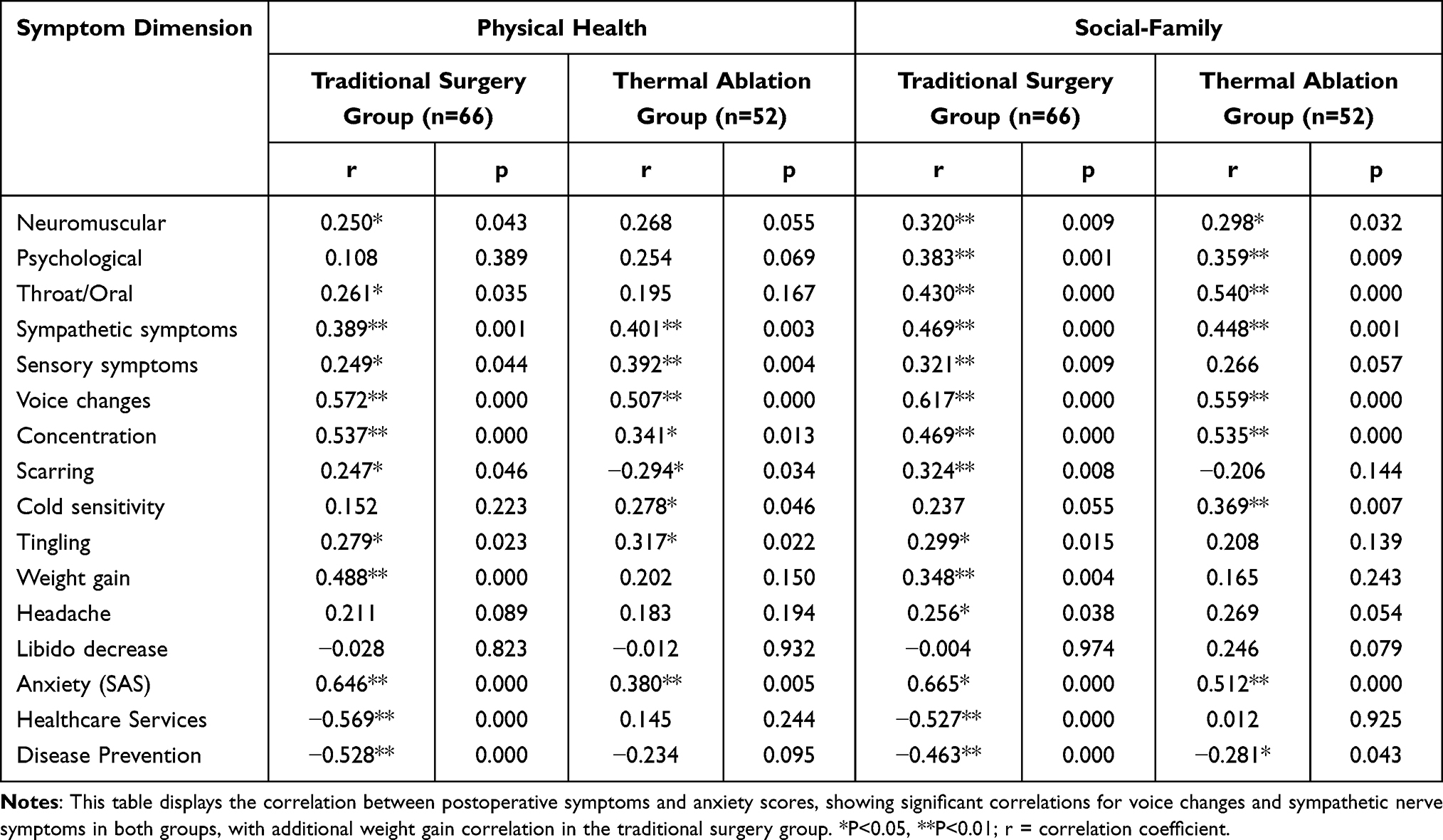 |
Table 4 Correlation Analysis of Postoperative Symptoms and Anxiety Scores in Women Planning for Pregnancy After PTMC Surgery: Comparison Between Traditional Surgery and Thermal Ablation |
Stratified Analysis by Parity
Further stratification by parity status revealed distinct anxiety patterns (Table 5). Nulliparous women undergoing traditional surgery reported the highest median scores across both physical health (2.67, IQR: 2.00–3.33) and social/family dimensions (2.33, IQR: 2.00–3.08), significantly exceeding nulliparous ablation patients (Physical Health: 1.58, p<0.001; Social-Family: 1.67, p<0.001). A significant interaction effect between treatment modality and parity was observed for physical health (p=0.032), indicating that the psychological burden associated with surgery was exacerbated in nulliparous women. In contrast, parous women exhibited lower anxiety scores regardless of treatment, though surgery remained associated with higher burden (eg, Physical Health: Surgery 2.33 vs Ablation 1.42).
 |
Table 5 Anxiety Scores Stratified by Parity and Treatment Group |
Discussion
Differential Impact of Surgical Method on Anxiety Symptoms
Our study demonstrates significant differences in the impact of traditional surgery versus thermal ablation on postoperative anxiety in women of childbearing age. Compared with the thermal ablation group, the traditional surgery group had a 0.916-point greater physical health score (β=−0.916, P<0.001), which was closely related to the risk of recurrent laryngeal nerve injury (9.1% in the traditional surgery group vs 5.8% in the thermal ablation group) and the incidence of postoperative hypothyroidism (89.4% in the traditional surgery group vs 15.2% in the thermal ablation group). Although extended ablation may cause temporary vocal cord paralysis (5.8%), nerve function usually recovers within 1 month, and the sensation of a foreign body in the throat caused by changes in ablation volume can be significantly alleviated through preoperative communication.15 These findings are consistent with those of previous studies,16 suggesting that minimally invasive techniques can reduce the psychological burden related to long-term complications.
Our findings of higher anxiety in traditional surgery patients align with prior studies on thyroid procedure-related psychological outcomes. Zhang et al17 reported demonstrated significantly worse mental health in surgery patients (SF-36 Mental Component Summary: 45.3±6.1 vs 58.9±7.3, p<0.001), with multivariate analysis confirming surgical approach as independent predictor (β=−0.41, p<0.001), attributing this to three key factors: Visible scarring: Cervical scars in open surgery patients correlate with body image distress, which amplifies social anxiety.18 Prolonged recovery: Surgery requires ≥12-month pregnancy delay versus 3 months for ablation, directly impacting fertility timelines.19 Chronic medication dependency: Lifelong levothyroxine use in 89.4% of our surgery cohort induced ‘pill burden anxiety”.20
And then our stratified analysis (Table 5) suggests that nulliparous women face dual psychological stressors: surgical complications and fertility timeline disruption. This interaction underscores the need for preconception counseling in surgical decision-making, particularly for women prioritizing pregnancy.
Dual Challenges of Hypothyroidism and Fertility Anxiety
This study revealed that long-term levothyroxine use was identified as an independent factor associated with higher physical health scores (β = 0.405, p = 0.011), indicating greater anxiety in this domain among users. A total of 75.4% of patients were concerned about the safety of medication during pregnancy, and 42.4% believed that hypothyroidism could increase the risk of miscarriage. This cognitive bias is closely related to patients’ misunderstanding of thyroid hormone replacement therapy (THRT).21 Although guidelines emphasize that THRT can effectively maintain thyroid function during pregnancy, 49.2% of traditional surgery patients in this study still required at least 1 year of postoperative recovery, significantly delaying fertility plans. This phenomenon highlights the urgent need for standardized patient education systems in clinical practice, such as the use of “hormone metabolism animation demonstrations” to correct patients’ fears of levothyroxine.
Furthermore, we did not include thyroglobulin (Tg) monitoring as part of this study. This decision was based on current guidelines,4,22 which do not recommend routine Tg testing for low-risk PTMC patients without signs of recurrence. Since our study focused on treatment-related anxiety rather than disease progression, and given the low-risk nature of our cohort, Tg was not considered a relevant factor for the psychological outcomes assessed.
Surgical Method-Specific Anxiety Symptoms and Intervention Strategies
Symptom correlation analysis revealed that anxiety symptoms in the traditional surgery group were multidimensional (voice changes, weight gain, and sympathetic nerve symptoms), whereas those in the thermal ablation group were primarily local symptoms (voice changes and sympathetic nerve symptoms) (Table 4). Notably, the strong correlation between weight gain and anxiety in the traditional surgery group (r=0.488, P<0.001) may reflect the synergistic effect of hypothyroidism-induced metabolic disorders and body image anxiety,23 whereas this association was significantly weaker in the thermal ablation group because of better preservation of thyroid function (r=0.202, P=0.150). To address these differences, the following recommendations are proposed: 1) Traditional surgery patients should be included in multidisciplinary management (endocrinology, psychology) within 3 months postoperatively, with a focus on monitoring thyroid-stimulating hormone (TSH) levels and body composition changes; 2) thermal ablation patients should undergo enhanced vocal cord function assessment and psychological intervention for throat discomfort within 1 month postoperatively.
Clinical Implications
Our study highlights the distinct psychological impacts of traditional surgery and thermal ablation on women of childbearing age diagnosed with papillary thyroid microcarcinoma (PTMC). Traditional surgery, characterized by extensive thyroid resection and subsequent long-term medication dependency, imposes a heavier burden of physical symptoms and elicits higher anxiety scores. In contrast, thermal ablation mitigates physical symptoms but requires vigilant management of short-term nerve-related symptoms. These findings align with prior research demonstrating the psychological benefits of minimally invasive techniques in reducing long-term complications and enhancing quality of life. However, our study uniquely focuses on the preconception period and the specific psychological challenges confronting women actively planning for pregnancy. This underscores the imperative for tailored psychological support and educational interventions for this specific patient cohort.
The study’s findings carry significant weight for clinical practice. Surgeons and healthcare providers must consider the psychological ramifications of different surgical approaches when counseling patients on treatment options. For women with pressing fertility concerns, thermal ablation emerges as a preferable alternative due to its reduced psychological impact. Nevertheless, for those with more substantial tumor risks, traditional surgery remains the gold standard, provided that comprehensive informed consent is obtained. Establishing robust postoperative psychological support systems is crucial to addressing anxiety-related issues and optimizing reproductive health outcomes.
Study Limitations and Future Directions
This study is not without its limitations.
Selection Bias
Thermal ablation patients were strictly selected per consensus guidelines.22 This cohort inherently preferred minimally invasive options (78% cited “avoiding scars/medication” as primary motivation in pre-procedure surveys), potentially confounding anxiety comparisons.
Unquantified Moderating Effects
The study did not quantify the moderating effects of social support (eg, partner involvement, continuity of medical care) on anxiety. Given the established role of social support in psychological outcomes, its omission may curtail the comprehensiveness of our analysis.
Cross-Sectional Design
The cross-sectional nature of our study precludes the establishment of causality. Future longitudinal studies are imperative to elucidate the temporal relationships between surgical methods and anxiety symptoms.
Sample Size
Though power analysis confirmed adequacy for primary endpoints (FoP-Q-SF physical score), our cohort (n=118) limited subgroup analyses (eg, parity-stratified effects). Recruitment challenges for preconception-age women resulted in 9.2% attrition, marginally below the 20% anticipated threshold.
Future research endeavors should focus on the following.
Matched Patient Characteristics
As a limitation inherent to retrospective designs, preoperative psychological status was not systematically assessed. Although current analyses adjusted for demographic/clinical confounders, unmeasured baseline anxiety differences could influence outcomes. Future prospective studies should incorporate pre-intervention assessments (eg, STAI) to establish causality.
Quantified Social Support
Incorporating measures of social support to assess its moderating effect on anxiety is essential. This could involve gathering data on partner involvement, family support, and the continuity of medical care.
Longitudinal Follow-Up
Conducting longitudinal follow-up studies to track changes in anxiety levels and quality of life over time would provide valuable insights into the long-term psychological impact of different surgical methods.
Intervention Studies
Exploring intervention pathways for improving reproductive health literacy is crucial. This could encompass educational programs, psychological support, and patient counseling to address concerns about fertility and disease recurrence.
Multicenter Collaboration
Engaging in multicenter collaboration to increase sample size and diversity would enhance the robustness and generalizability of the findings.
Conclusion
Postoperative anxiety in women of childbearing age with PTMC is significantly influenced by surgical approach and thyroid function management. Traditional surgery, associated with higher physical health scores and long-term levothyroxine dependency, induces multidimensional anxiety driven by voice changes, weight gain, and sympathetic symptoms. In contrast, thermal ablation minimizes physical burden but requires vigilance for transient nerve-related symptoms, primarily voice changes. Clinical decision-making should prioritize individualized risk-benefit assessment: Thermal ablation is recommended for women with urgent pregnancy timelines (permitting conception within 3 months), while traditional surgery remains appropriate for higher-risk tumors after thorough counseling. Postoperative psychological support systems addressing procedure-specific drivers (eg, weight management for surgery, vocal rehabilitation for ablation) are essential to optimize reproductive health outcomes.
Data Sharing Statement
The datasets used and/or analyzed during the current study are available from the corresponding author on reasonable request. Data requests should be addressed to Dr. Shi Tan (Email: [email protected]).
Ethic Approval and Inform Consent
This study was approved by the ethics committee of The General Hospital of Chinese PLA (No. S2021-504-01). All procedures performed in studies involving human participants were in accordance with the ethical standards of the institutional and/or national research committee and with the 1964 Helsinki declaration and its later amendments or comparable ethical standards. Written informed consent was obtained from all participants.
Author Contributions
All authors made a significant contribution to the work reported, whether that is in the conception, study design, execution, acquisition of data, analysis and interpretation, or in all these areas; took part in drafting, revising or critically reviewing the article; gave final approval of the version to be published; have agreed on the journal to which the article has been submitted; and agree to be accountable for all aspects of the work.
Funding
The study was funded by the “Demonstration study on the clinical application evaluation of domestic high-end medical imaging equipment in the diagnosis and treatment of common diseases in major countries along the ‘Belt and Road’” [grant number: 2023YFC2414200](to Shi Tan).
Disclosure
The authors declare no conflicts of interest in this work.
References
1. Sung H, Ferlay J, Siegel RL. et al. Global cancer statistics 2020: GLOBOCAN estimates of incidence and mortality worldwide for 36 cancers in 185 countries. CA Cancer J Clin. 2021;71(3):209–249. doi:10.3322/caac.21660
2. Kaliszewski K, Diakowska D, Wojtczak B, Rudnicki J. Cancer screening activity results in overdiagnosis and overtreatment of papillary thyroid cancer: a 10-year experience at a single institution. PLoS One. 2020;15(7):e0236257. doi:10.1371/journal.pone.0236257
3. Cibas ES, Ali SZ. The 2017 Bethesda system for reporting thyroid cytopathology. Thyroid. 2017;27(11):1341–1346. doi:10.1089/thy.2017.0500
4. Haugen BR, Alexander EK, Bible KC, et al. 2015 American thyroid association management guidelines for adult patients with thyroid nodules and differentiated thyroid cancer: the American thyroid association guidelines task force on thyroid nodules and differentiated thyroid cancer. Thyroid. 2016;26(1):1–133. doi:10.1089/thy.2015.0020
5. Sugitani I, Ito Y, Takeuchi D, et al. Indications and strategy for active surveillance of adult low-risk papillary thyroid microcarcinoma: consensus statements from the Japan association of endocrine surgery task force on management for papillary thyroid microcarcinoma. Thyroid. 2021;31(2):183–192. doi:10.1089/thy.2020.0330
6. Dong AC, Stephenson MD, Stagnaro-Green AS. The need for dynamic clinical guidelines: a systematic review of new research published after release of the 2017 ATA guidelines on thyroid disease during pregnancy and the postpartum. Front Endocrinol. 2020;11:193. doi:10.3389/fendo.2020.00193
7. Mitov F, Dimov R, Outchikov P, Manchev I, Mourdjev K, Todorov A. A comparative analysis of the postoperative complications of thyroid cancer surgery related to surgical approach. Folia Med. 1999;41(3):34–39.
8. Tuttle RM, Li D, Ridouani F. Percutaneous ablation of low-risk papillary thyroid cancer. Endocr Relat Cancer. 2023;30(3). doi:10.1530/ERC-22-0244
9. Zhang M, Tufano RP, Russell JO, et al. Ultrasound-guided radiofrequency ablation versus surgery for low-risk papillary thyroid microcarcinoma: results of over 5 years’ follow-up. Thyroid. 2020;30(3):408–417. doi:10.1089/thy.2019.0147
10. Papaleontiou M, Haymart MR. Thyroid nodules and cancer during pregnancy, post-partum and preconception planning: addressing the uncertainties and challenges. Best Pract Res Clin Endocrinol Metab. 2020;34(4):101363. doi:10.1016/j.beem.2019.101363
11. Jung MS, Visovatti M. Post-treatment cognitive dysfunction in women treated with thyroidectomy for papillary thyroid carcinoma. Support Care Cancer. 2017;25(3):915–923. doi:10.1007/s00520-016-3481-y
12. Lan Y, Jin Z, Zhang MB, et al. Analysis of factors influencing quality of life in patients with papillary thyroid microcarcinoma after radiofrequency ablation. J Chin Acad Med Sci. 2020;42:632–639.
13. Faul F, Erdfelder E, Lang AG, Buchner A. G*Power 3: a flexible statistical power analysis program for the social, behavioral, and biomedical sciences. Behav Res Methods. 2007;39(2):175–191. doi:10.3758/BF03193146
14. Liu WW, Huang QJ, Jiang H, Qian X. Reliability and validity of the reproductive health literacy questionnaire for pregnant women. Chin J Womens Child Health Res. 2018;29:27–31.
15. Lim JY, Kuo JH. Thyroid nodule radiofrequency ablation: complications and clinical follow up. Tech Vasc Interv Radiol. 2022;25(2):100824. doi:10.1016/j.tvir.2022.100824
16. Lan Y, Zhang MB, Zhang Y, et al. Comparison of quality of life in patients with papillary thyroid microcarcinoma under different treatment methods. J Chin Acad Med Sci. 2021;43:328–337.
17. Yan L, Zhang M, Song Q, Luo Y. Ultrasound-guided radiofrequency ablation versus thyroid lobectomy for low-risk papillary thyroid microcarcinoma: a propensity-matched cohort study of 884 patients. Thyroid. 2021;31(11):1662–1672. doi:10.1089/thy.2021.0100
18. Zhao X, Bie F, Luo C, Zhang JE. Distress, illness perception and coping style among thyroid cancer patients after thyroidectomy: a cross-sectional study. Eur J Oncol Nurs. 2024;69:102517. doi:10.1016/j.ejon.2024.102517
19. van Velsen E, Leung AM, Korevaar T. Diagnostic and treatment considerations for thyroid cancer in women of reproductive age and the perinatal period. Endocrinol Metab Clin North Am. 2022;51(2):403–416. doi:10.1016/j.ecl.2021.11.021
20. Becks GP, Burrow GN. Thyroid disease and pregnancy. Med Clin North Am. 1991;75(1):121–150. doi:10.1016/S0025-7125(16)30475-8
21. Zhao JJ. Issues and prospects in the diagnosis and treatment of hypothyroidism in special populations. Chin Med J. 2023;103:305–310. doi:10.3760/cma.j.cn112137-20220701-01461
22. Papini E, Guglielmi R, Novizio R, Pontecorvi A, Durante C. Management of low-risk papillary thyroid cancer. Minimally-invasive treatments dictate a further paradigm shift. Endocrine. 2024;85(2):584–592. doi:10.1007/s12020-024-03864-7
23. Wang ZX, Yang SJ, Guan HX, Wang W. The relationship between thyroid hormone sensitivity and obesity phenotypes in euthyroid population Chinese. J Endocrinol Metab. 2023;39:426–429.
 © 2025 The Author(s). This work is published and licensed by Dove Medical Press Limited. The
full terms of this license are available at https://www.dovepress.com/terms
and incorporate the Creative Commons Attribution
- Non Commercial (unported, 4.0) License.
By accessing the work you hereby accept the Terms. Non-commercial uses of the work are permitted
without any further permission from Dove Medical Press Limited, provided the work is properly
attributed. For permission for commercial use of this work, please see paragraphs 4.2 and 5 of our Terms.
© 2025 The Author(s). This work is published and licensed by Dove Medical Press Limited. The
full terms of this license are available at https://www.dovepress.com/terms
and incorporate the Creative Commons Attribution
- Non Commercial (unported, 4.0) License.
By accessing the work you hereby accept the Terms. Non-commercial uses of the work are permitted
without any further permission from Dove Medical Press Limited, provided the work is properly
attributed. For permission for commercial use of this work, please see paragraphs 4.2 and 5 of our Terms.