
Back to Journals » Journal of Multidisciplinary Healthcare » Volume 19
Perceptions of Integrated Medical Service Among Stroke Patients in South Korea: Self-Reported Web-Based Survey Study
Authors Lee HG  , Jung WS , Woo HG , Kwon S , Heo SH
Received 22 September 2025
Accepted for publication 8 January 2026
Published 29 January 2026 Volume 2026:19 569481
DOI https://doi.org/10.2147/JMDH.S569481
Checked for plagiarism Yes
Review by Single anonymous peer review
Peer reviewer comments 2
Editor who approved publication: Dr David C. Mohr
Han-Gyul Lee,1 Woo-Sang Jung,1 Ho Geol Woo,2 Seungwon Kwon,1 Sung Hyuk Heo2
1Department of Cardiology and Neurology, Kyung Hee University College of Korean Medicine, Kyung Hee University Medical Center, Seoul, Republic of Korea; 2Department of Neurology, Kyung Hee University College of Medicine, Kyung Hee University Medical Center, Seoul, Republic of Korea
Correspondence: Seungwon Kwon, Email [email protected] Sung Hyuk Heo, Email [email protected]
Background: Integrated medical service (IMS) refers to the collaborative treatment of conventional medicine and Korean medicine in Korea. IMS for stroke is recognized for its efficacy, however, there are many barriers to obtaining therapeutic effects in clinical settings. This study was aimed to investigate the current perceptions of IMS among Korean stroke patients to provide a basis for exploring ways to universalize IMS in real-world stroke clinical practice.
Methods: We conducted a self-reported web-based survey in December 2021. We recruited 100 Korean patients who had been diagnosed with stroke. The questionnaire developed by the research team was composed of 5 sections: demographic information, stroke history, perceptions of IMS for acute stroke and stroke sequelae, and other perceptions of IMS for stroke treatment.
Results: For both acute stroke and stroke sequelae, half of the patients agreed (45% and 52%) and about 15% of the patients disagreed to receive IMS (18% and 12%), had positive expectations of IMS effects (49% and 53%), and feel the economic burdensome of IMS (50% and 52%); National Health Insurance (NHI) covered treatments such as acupuncture and electroacupuncture (69.5% and 69.3%) were the most common types of KM treatment desired; private insurance subscribers had higher preference for NHI uncovered treatments such as NHI uncovered herbal medicines; the most common reason for reluctance to receive IMS was economic burden (38.9% and 58.3%) and treatment not being recommended by a conventional medicine doctor in acute stroke (38.9%) even though most patients had positive expectations of IMS effects (49% and 53%).
Conclusion: Stroke patients were favorable to IMS and had high expectations for its effectiveness. Cost and lack of cooperation from conventional medicine doctors were barriers to patients’ access to IMS. Policy reform and active cooperation between conventional and traditional doctors may improve IMS access and satisfaction.
Keywords: integrated medical service, conventional medicine, Korean medicine, stroke patients, web-based survey
Introduction
Integrative medicine is patient-centered, healing-oriented, and cooperates with conventional medicine (CM) and complementary and alternative medicine (CAM).1 There is growing evidence that integrative medicine can successfully address and, to some extent, alleviate many of the problems of the current medical crisis by providing effective, safe, and cost-effective treatments, and preventing future disease and promoting overall health.2 In addition, as integrative medicine reduces the burden of chronic diseases on individuals, their families, and the medical system, its demand is increasing in modern society, where chronic diseases are more prevalent.1,3
Korea has a dualized medical system that separates CM and Korean medicine (KM), a category of CAM. KM is an East Asian traditional medicine that has been developed over thousands of years, along with traditional Chinese medicine.4 With the enactment of the Medical Law in 1951, Korea adopted a dualized system in which CM and KM coexist and have mutually exclusive education, medical treatment, and insurance systems with different licenses.5 In Korea, integrative medicine refers to integrated medical service (IMS), in which CM and KM cooperate to determine the most appropriate treatment method based on their respective medical theories and technology.6 Since 1971, IMS has achieved quantitative growth7 and as the international demand for integrative medicine increases, the role of IMS in Korea also increases.8 Therefore, the Korean government launched the first demonstration project of the KM and CM collaboration in 2016 to confirm the basis for IMS’s safety, effectiveness, and cost-effectiveness to promote qualitative growth for IMS’s institutional settlement,9 and started the 4th demonstration project in April 2022.10
Considering the increasing importance of IMS within chronic and complex diseases, stroke represents one of the major conditions where integrated care can play a critical role. Stroke ranks second among the causes of death11 and third among the causes of disability-adjusted life years worldwide.12 In Korea, stroke is the third leading cause of death and its incidence is gradually increasing with the aging population.13,14 Mortality from stroke is on the decline as risk factors are controlled and acute stroke treatment advances, however, conversely, disability due to sequelae is increasing.15 Stroke causes serious impairments in performing essential daily activities, such as motor or cognitive functions, which greatly affect not only the patient but also their family and society.16 In addition, because stroke has a risk of recurrence for up to 10 years after primary onset, long-term secondary preventive management is important.17 Therefore, active prevention of stroke recurrence and treatment of sequelae through effective use of medical resources from immediately after stroke diagnosis to the chronic stage are required.13
In Korea, more than two-thirds of the population has undergone KM treatment, and trust in KM is high.18,19 In particular, stroke is a complex disease and can take significant time to recover; therefore, experts in each field should participate in treatment to restore the patient’s function and prevent recurrence.20 CM has well-established efficacy in the acute management of stroke, including thrombolytic therapy, antithrombotic treatment, and early rehabilitation strategies.21 However, because stroke recovery often requires long-term multidisciplinary care, complementary approaches such as KM may provide additional benefits within Korea’s dual medical system. Therefore, the IMS has the advantage of providing high-quality medical services to stroke patients.22 Previous studies have shown that IMS for stroke increases survival rate after the acute phase,23 has a better rehabilitation effect during the subacute period,24 and is more effective in the rehabilitation of sequelae.25 Thus, evidence-based practice guidelines for integrative medicine for stroke were published in 2019.26 However, despite the positive medical effects, there are barriers between IMS and patients in domestic clinical practice owing to the noncooperation of CM doctors,27 lack of publicity and standard care guidelines,28 and prohibitive costs.23
This study investigated patient perceptions of IMS in the acute stage immediately after stroke diagnosis and in the chronic stage of sequelae. Based on this, we intended to provide a basis for improving the IMS process by exploring the current status and complementary aspects of IMS in actual clinical practice.
Materials and Methods
Participants Recruitment
This self-report web-based survey study protocol and methods were based on a previous study.29 This study was conducted on patients aged 18 years or older who had been diagnosed with stroke. Participants who understood the study purpose and voluntarily agreed to participate were included. Those who had communication difficulties were excluded. The survey was conducted on the self-owned survey panel of Medi Research, a survey agency, in a web-based format. The self-owned panel was designed to collect opinions corresponding to the average age, sex, and region of Korea; patients who had been diagnosed with stroke were recruited from among the panels. The study protocol was approved by the Institutional Review Board of Kyung Hee University (KHSIRB 21–513, approved on 2021–12-13) and performed in accordance with the guidelines of the Declaration of Helsinki.
In this study, 100 participants were recruited for convenience, considering the scale and feasibility of the study. Fees were provided for participation in the survey. The survey was conducted between December 14 and 21, 2021.
Survey
A questionnaire developed by the research team was used for the survey and included items such as: (1) demographic information; (2) stroke history; (3) perceptions of IMS for acute stroke (immediately after stroke diagnosis); (4) perceptions of IMS for stroke sequelae; (5) other perceptions of IMS for stroke treatment. Demographic information was sex, age, highest education completed, type of residence, average income per month, total number of household members contributing to household income, type of National Health Insurance (NHI), private health insurance (PHI) subscriber and average number of visits to medical institutions per year. Stroke history included the most recent stroke diagnosis point, types of stroke treatment during the stroke diagnosis and treatment, stroke sequelae experience, other medical conditions, smoking and stroke recurrence. Perceptions of IMS for both acute stroke and stroke sequelae investigated willingness to receive IMS, positive expectations of IMS effects and economic burdensome of IMS with 5-point Likert scale from Strongly disagree to Strongly agree Those who responded Neither agree nor disagree to Strongly agree to willingness to receive IMS asked to response type of KM treatment would like to receive with multiple responses. Those who responded Strongly disagree or Disagree to willingness to receive IMS asked to response the reasons for reluctance to receive IMS with multiple responses. In addition, expected advantages of receiving IMS for both phases were also investigated respectively. Furthermore, appropriate monthly cost of IMS and source of IMS information were also collected (Supplementary material).
Survey Data Collection and Recording
The web-based questionnaire was administered to the panel by sending a link via e-mail. The survey agency emailed the survey directly to participants to prevent multiple participation. When the panel agreed to study participation, consent was obtained from the survey link and the participants responded directly to the web-based questionnaire. Upon completion, the data were sent to Medi Research and delivered to the research team as raw data, excluding personally identifiable information.
Data Analysis
The results were analyzed using descriptive statistics. Analyses were conducted using Microsoft Excel, version 15.26. All data, except for the self-perception of health condition, were expressed as numbers (%).
Results
Demographic Information
A total of 100 patients participated in this study; 57 patients were male, and their ages ranged evenly from 20 to 70 or older. In the insurance system, 87 had NHI, 13 were medical beneficiaries (Type I, II) and 61 had PHI. The average number of visits to medical institutions per year was categorized as 10 or less (59), and more than 10 (41). The categories of average monthly income were: 3 million won or less (42), 3–6 million won (35), and 6 million won or more (23). Participant demographics are shown in Table 1.
 |
Table 1 Demographic Information |
Stroke History of Participants
Table 2 shows participant stroke history. The most recent stroke diagnosis point was evenly distributed from the last six months to more than five years. Surgical procedures or surgery was the most common type of stroke treatment (71%), followed by medication (59%). Acupuncture and herbal medicine use was relatively low at 26 and 12, respectively. Most patients (89%) experienced stroke sequelae, and 57% still had sequelae. Stroke sequelae symptoms were the most common, with decreased physical activity, followed by cognitive and emotional decline (62%, 55.4%, and 32.6%, respectively). Stroke recurrence was observed in 26%.
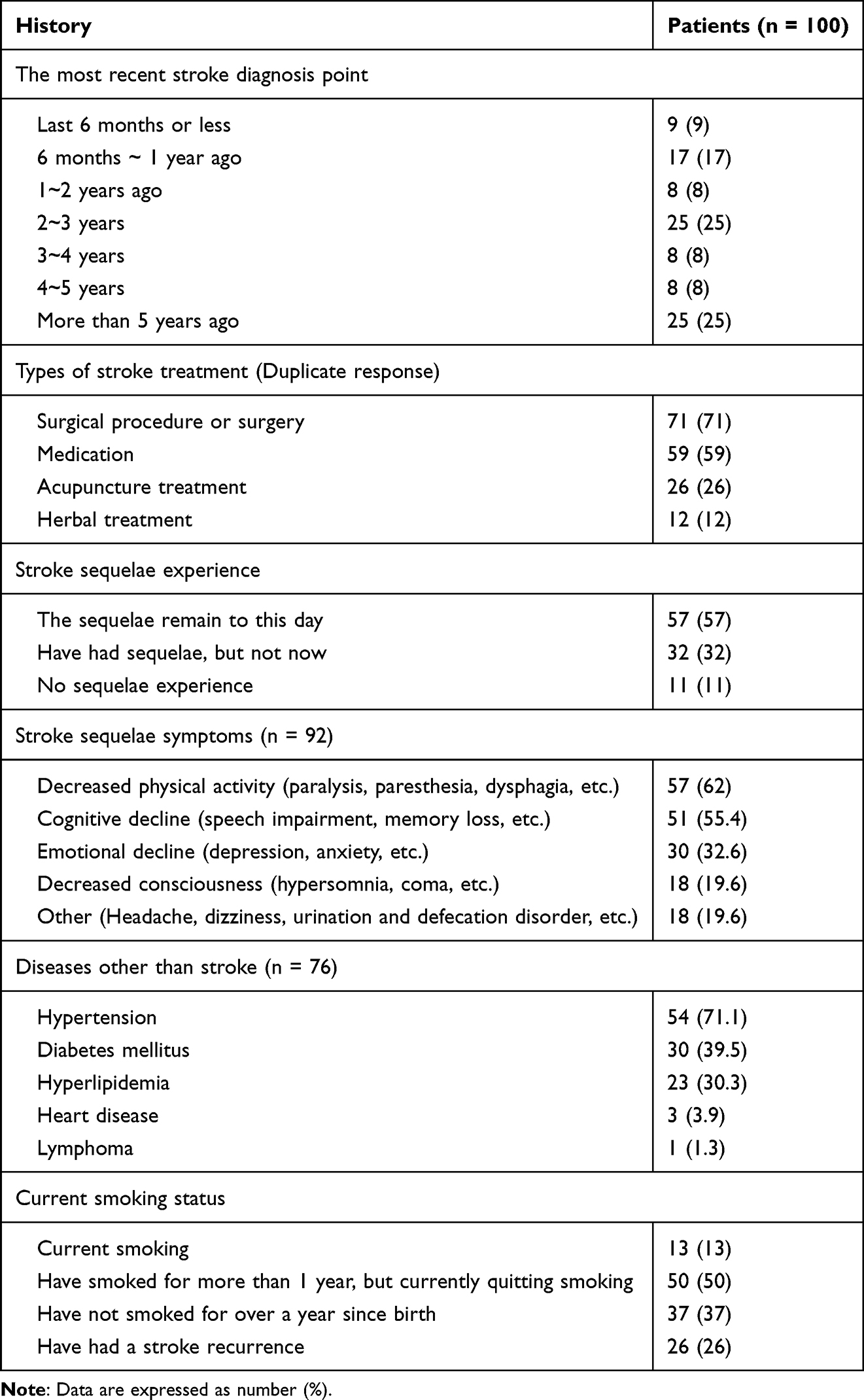 |
Table 2 Stroke History of Participants |
Perceptions of IMS for Acute Stroke (Immediately After Stroke Diagnosis)
Table 3 shows the perceptions of IMS regarding acute stroke. There were 45 participants willing to receive IMS immediately after diagnosis (Strongly agree 18 + Agree 27) (Figure 1A). In particular, when the average number of visits to medical institutions per year was more than 10, the willingness to receive treatment was higher than those who visited 10 times or less (58.5% vs 35.6%). A total of 49 participants had expectations about the effect of IMS on stroke treatment immediately after the stroke diagnosis (Strongly agree 9 + Agree 40) (Figure 1B). Among them, those who had PHI and visited medical institutions more than 10 times per year were more positive than those who did not (52.5% vs 43.6% and 61% vs 40.7%, respectively). A total of 50 participants responded that IMS immediately after stroke diagnosis was economically burdensome (Strongly agree 12 + Agree 38) (Figure 1C). In particular, non-subscribers of PHI felt more burdened (59% vs 44.3%, respectively). The types of KM treatments that they wanted to receive for acute stroke were especially high for NHI covered treatments such as acupuncture and electroacupuncture (69.5%) and NHI covered herbal medicines (51.2%) (Figure 2), and the higher the income, the higher the preference rate for most KM treatment. In addition, PHI subscribers had a relatively higher preference for NHI uncovered treatments than non-subscribers, such as NHI uncovered herbal medicines (29.4% vs 19.4%) and pharmaco-acupuncture/bee venom injections (35.3% vs 9.7%). A common reason for reluctance to receive IMS immediately after stroke diagnosis was economic burden and non-recommendation by CM doctors (38.9%) (Figure 3). The expected advantages of receiving IMS immediately after stroke diagnosis were the most common in the treatment of sequelae (helping return to daily life quickly) in 72 patients, followed by the treatment of symptoms immediately after stroke (reducing sequelae) in 47 patients (Figure 4A).
 |
Table 3 Perceptions of IMS for Acute Stroke (Immediately After Stroke Diagnosis) |
 |
Figure 1 Perceptions of IMS for acute stroke and stroke sequelae. (A) Willing to receive IMS for acute stroke (immediately after stroke diagnosis) and stroke sequelae (B) Positive expectations of IMS effects on treatment of acute stroke (immediately after stroke diagnosis) and stroke sequelae (C) Economic burdensome of IMS for acute stroke and stroke sequelae. IMS, Integrated medical service. |
 |
Figure 2 Type of Korean medicine treatment willing to receive in acute stroke and stroke sequelae. Abbreviation: NHI, National Health Insurance. |
 |
Figure 3 Reason for reluctance to receive IMS in acute stroke and stroke sequelae. Abbreviations: CM, Conventional medicine; KM, Korean medicine. |
 |
Figure 4 Expected advantages of receiving IMS. (A) Acute stroke (B) Stroke sequelae. Abbreviation: IMS, Integrated medical service. |
Perceptions of IMS for Stroke Sequelae
Table 4 shows the perceptions of IMS for stroke sequelae. There were 52 participants willing to undergo IMS in case of stroke sequelae (Strongly agree 16 + Agree 36) (Figure 1A). Particularly, those who had PHI and visited medical institutions more than 10 times per year had a higher percentage of positive responses than those who did not (55.7% vs 46.2% and 65.9% vs 42.4%, respectively). A total of 53 participants had expectations regarding the effect of IMS on the treatment of stroke sequelae (Strongly agree 12 + Agree 41) (Figure 1B). Among them, expectations were higher as the average monthly income increased to 3–6 million won (54.3%) and 6 million won or more (60.9%) than those with 3 million won or less (47.6%). Those who visited medical institutions more than 10 times per year were more positive (63.4% vs 45.8%). A total of 52 participants responded that IMS for stroke sequelae was economically burdensome (Strongly agree 18 + Agree 34) (Figure 1C). Non-subscribers of PHI felt more burdened than subscribers (56.4% vs 49.2%). The types of KM treatments that they wanted to receive for stroke sequelae were acupuncture (69.3%) and NHI covered herbal (47.7%) (Figure 2). PHI subscribers had a relatively higher preference for NHI uncovered treatments than non-subscribers, such as NHI uncovered herbal medicines (41.8% vs 18.2%) and pharmaco-acupuncture/bee venom injections (34.5% vs 24.2%). The most common reason for reluctance to receive IMS when stroke sequelae occurred was economic burden (58.3%) (Figure 3). In the case of stroke sequelae, patients expected improving decreased physical activity (55) and cognitive decline (52) using IMS (Figure 4B).
 |
Table 4 Perceptions of IMS for Stroke Sequelae |
Other Perceptions of IMS for Stroke Treatment
Table 5 shows the other perceptions of the IMS regarding stroke treatment. The most common cost considered appropriate for IMS was between 50,000 and 200,000 won per month (55%). The costs for high-income earners and private health insurance subscribers tended to be high. The most common IMS information sources were medical staff (52%), patients with stroke experience (48%), and the internet (37%).
 |
Table 5 Other Perceptions of IMS for Stroke Treatment |
Discussion
To the best of our knowledge, this study is the first to examine the general perceptions of IMS in stroke patients. In addition to the perceptions of each treatment for acute stroke and sequelae, the overall perception of IMS was investigated by classifying participants by economic factors, insurance systems, and frequency of use of medical institutions.
In both periods, patients were more willing to receive IMS. In the case of stroke recurrence, the positive intention to receive IMS immediately after diagnosis was more than twice the negative intention. In the case of stroke sequelae, there were more than four positive responses. Acute stroke is thought to be less likely than sequelae due to a short period of less than two weeks after onset,21 a high cost because of the need for hospitalization,23 and the development of acute stage treatments for CM, such as tissue-plasminogen activator.30 In the case of sequelae treatment, it is believed that the intention was higher due to the fact that the treatment is lengthy while disability is serious,15 the sequelae treatment through IMS is more effective than CM alone,24,25,31 and IMS is preferred for stroke rehabilitation treatment.32 The fact that the treatment of sequelae showed the highest response rate as an advantage of receiving IMS immediately after stroke diagnosis in the current survey supports this. The most common sequelae that were expected to be relieved with IMS were decreased physical activity and cognitive decline. Considering the effect of IMS in improving physical and cognitive functions in stroke,24,25,33 it is possible to increase treatment satisfaction by meeting these patients’ expectations. In addition, the IMS intention was high when the number of visits to medical institutions was high in both periods. The presumed reason is because patients with an active will for treatment frequently visit medical institutions and, therefore, have a desire to try various treatments, such as IMS.
For patients who responded positively or neither positively or negatively to their willingness to receive IMS, acupuncture, electroacupuncture, and insured herbal extracts were the most desired KM treatment methods both immediately after stroke diagnosis and sequelae. Since the effects of acupuncture and electroacupuncture on stroke treatment and rehabilitation have been well established,34–36 they are thought to influence patient preference. In addition, acupuncture and electroacupuncture are treatments applied with the NHI in Korea, and patients tend to prefer treatments with NHI due to high costs, and the survey results showed that even the same herbal medicine has a higher preference in the insured herbal extracts than uninsured herbal decoctions. In particular, immediately after stroke diagnosis, treatments not covered by NHI such as pharmaco-acupuncture/bee venom injection and herbal decoctions were less preferred as income was lower, and relatively low preference without private insurance, also based on this. Despite the positive effects of herbal medicines37,38 and pharmaco-acupuncture/bee venom injections39–41 on stroke treatment, it is possible that patients have limited opportunities to choose treatment because of insurance system limitations.
These results support the need for economic medical supplementation of IMS for stroke treatment. Patients who responded negatively to their intention to undergo IMS cited economic burden as the most common reason in both periods. Even when asked about their perception of economic burden, half of the respondents answered that it would be burdensome in both periods, and only approximately 10% responded that it was not burdensome.
Non-private insurance subscribers had a higher burden than insured subscribers. According to the Korean Medicine Utilization and Herbal Medicine Consumption Survey in 2020, the general public had a high rate of satisfaction with treatment results for KM, while the rate of satisfaction with treatment cost was relatively low, especially the cost burden of uninsured herbal medicines. Accordingly, the demand for “expanding NHI benefits” was the highest as a need for improvement.42 In addition, considering that the average cost of uninsured herbal medicine is 160,000–380,000 won for 10 days,43 while more than half of the respondents answered that the appropriate cost of IMS is 50,000–200,000 won per month, it may be difficult to expect universalization of IMS without expanding insurance coverage. Therefore, to expand the application of NHI for KM, the Korean government has started the “Pilot project of herbal decoctions coverage in the National Health Insurance” for three disease groups, including sequelae of cerebrovascular disease, in November 2020.44
Meanwhile, in the case immediately after stroke diagnosis, “Not recommended by CM doctor” also accounted for the most responses as a reason for their reluctance to receive IMS. The rate was relatively low for sequelae. Among the current clinical practice guidelines for stroke, KM treatment is the only one that includes acupuncture in the rehabilitation section.45 The Cochrane review of acupuncture for stroke found that clear evidence of benefit was insufficient due to the small amount of evidence in the acute stage,46 and acupuncture could be effective in treating various sequelae symptoms during rehabilitation.36 Cochrane reviews of herbal medicines only reviewed single herbal medicines, such as Radix notoginseng47 or some sequelae, such as post-stroke fatigue.48 Considering that the most common response to the question of how to acquire IMS information was from medical staff, it can be inferred that CM doctors also recommend IMS to patients if there is sufficient evidence and need. Therefore, for CM doctors to recommend IMS for acute stroke, it is necessary to improve the recommendation level through the accumulation of large-scale evidence and support policies.
Experience, mutual understanding, and respect between CM and KM doctors should precede doctors’ intention to use IMS, and academic exchange, sharing of curriculum, and support for IMS research and policy could be helpful.27,49 Considering that CM doctors working at IMS hospitals had a more positive perception of KM or IMS,50 the development of IMS medical institutions could activate stroke IMS by creating a cooperative environment. Furthermore, judging from the high ranking of “patients with stroke experience” as an IMS information source, it can be inferred that they have favorable intentions if they have IMS experience. Therefore, if doctors actively recommend that patients receive IMS, satisfaction and patient perception of IMS could be further improved.
This study provides theoretical significance by presenting empirical data on stroke patients’ perceptions of Integrated Medical Service (IMS), an area that has been insufficiently described in the existing literature. Practically, the findings identify key barriers—such as economic burden and limited CM–KM cooperation—that may guide policy development and improve IMS implementation in real-world clinical settings. These implications highlight the value of this exploratory survey and underscore the importance of understanding patient perspectives in advancing integrated stroke care.
This study has several limitations: 1) all surveys were conducted using a non-face-to-face web-based surveys which have two methodological limitations: they cannot account for a distributed population, and respondents with biases may select themselves as samples;51 2) 100 participants is a small group considering that this was a survey study. However, this exploratory study targeted patients with stroke rather than the general population, and many participants was not required. Additionally, based on the even distribution of the participants’ characteristics, it was assumed that the sample represented the stroke patient group relatively well; and 3) some patients with stroke may find it difficult to participate in web-based surveys because of old age, physical dysfunction, or cognitive impairment. Therefore, it is possible that this study primarily included patients who were familiar online or had mild symptoms. For these patients, collecting caregivers’ opinions may be a solution.29 Future studies that directly investigate a larger number of patients with stroke and their caregivers are required.
Conclusion
Stroke patients were more likely to receive IMS both immediately after stroke diagnosis and at the sequelae stage and had a higher positive intention in the sequelae period. The desired KM treatments were high with NHI treatments, such as acupuncture and insured herbal extracts, and relatively low for non-insured treatments, such as herbal decoctions. Economic burden was cited as the most common reason to avoid IMS in both periods. Patients without private insurance had a higher economic burden than those with insurance. The CM doctor’s non-recommendation was the most cited reason immediately after stroke diagnosis to not receive IMS treatment. Institutional supplementation and active participation of doctors are needed to provide better stroke treatment to patients by improving the complementary points of stroke IMS revealed in this study.
Data Sharing Statement
The datasets generated during and/or analyzed during the current study are available from the corresponding author Seungwon Kwon on reasonable request.
Ethics Approval and Consent to Participate
This study was conducted in accordance with the declaration of Helsinki. The study protocol was approved by the Institutional Review Board of Kyung Hee University (KHSIRB 21-513, approved on 13 December 2021). Online-based informed consent was obtained from all participants.
Consent for Publication
The manuscript is not submitted for publication or consideration elsewhere.
Author Contributions
All authors made a significant contribution to the work reported, whether that is in the conception, study design, execution, acquisition of data, analysis and interpretation, or in all these areas; took part in drafting, revising or critically reviewing the article; gave final approval of the version to be published; have agreed on the journal to which the article has been submitted; and agree to be accountable for all aspects of the work.
Funding
This work was supported by Korea Health Technology R&D Project through the Korea Health Industry Development Institute (KHIDI), funded by the Ministry of Health and Welfare, Republic of Korea, No. HI20C1405 and RS-2020-KH088006.
Disclosure
The authors report no conflicts of interest in this work.
References
1. Maizes V, Rakel D, Niemiec C. Integrative medicine and patient-centered care. Explore. 2009;5(5):277–17. doi:10.1016/j.explore.2009.06.008
2. Horrigan B, Lewis S, Abrams DI, Pechura C. Integrative medicine in America—-how integrative medicine is being practiced in clinical centers across the United States. Global Adv Health Med. 2012;1(3):18–52. doi:10.7453/gahmj.2012.1.3.006
3. Guarneri EM, Horrigan BJ, Pechura CM. The efficacy and cost effectiveness of integrative medicine: a review of the medical and corporate literature. Explore. 2010;6(5):308–312. doi:10.1016/j.explore.2010.06.012
4. Lee B, Kim S-N, Park H-J, Lee H. Research advances in treatment of neurological and psychological diseases by acupuncture at the acupuncture meridian science research center. Integrat Med Res. 2014;3(2):41–48. doi:10.1016/j.imr.2014.03.003
5. Jun E-H, Lee H-J, Cho M-K, Kim N-K, Lee I. Trend analysis of Korean-Western medicine collaboration studies by disease group. J Internal Korean Med. 2020;41(4):658–667. doi:10.22246/jikm.2020.41.4.658
6. Lim SM. An actual utilization and development plan study of interdisciplinary medical care at the national rehabilitation center. J Soc Korean Med Diagnostics. 2014;18(1):25–31.
7. Han G, Gu H, Yun Y. Attitudes of western medicine doctors and Korean medicine doctors toward Korean medicine education for cooperative practices. J Korean Med. 2013;34(1):160–169.
8. Yea S-J, Jang H-C, Kim C, Kim J-H, Kim S-K, Song M-Y. Plan of information system for combined treatment of the oriental and the western medicine. J Soc Preventive Korean Med. 2009;13(3):19–28.
9. Korean medicine and west medicine collaboration 1st demonstration project guide (Ministry of health and welfare) 1-36. 2016.
10. Korean medicine and west medicine collaboration 4th demonstration project guide (Ministry of health and welfare) 1-44. 2022.
11. Feigin VL, Abate MD, Abate YH, et al. Global, regional, and national burden of stroke and its risk factors, 1990-2021: a systematic analysis for the global burden of disease study 2021. Lancet Neurol. 2024;23(10):973–1003. doi:10.1016/s1474-4422(24)00369-7
12. Ferrari AJ, Santomauro DF, Aali A, et al. Global incidence, prevalence, years lived with disability (YLDs), disability-adjusted life-years (DALYs), and healthy life expectancy (HALE) for 371 diseases and injuries in 204 countries and territories and 811 subnational locations, 1990-2021: a systematic analysis for the global burden of disease study 2021. Lancet. 2024;403(10440):2133–2161. doi:10.1016/s0140-6736(24)00757-8
13. Kim JY, Kang K, Kang J, et al. Executive summary of stroke statistics in Korea 2018: a report from the epidemiology research council of the Korean stroke society. J Stroke. 2019;21(1):42. doi:10.5853/jos.2018.03125
14. Moon J, Seo Y, Lee HH, et al. Incidence and case fatality of stroke in Korea, 2011-2020. Epidemiol Health. 2024;46:e2024003. doi:10.4178/epih.e2024003
15. Crichton SL, Bray BD, McKevitt C, Rudd AG, Wolfe CD. Patient outcomes up to 15 years after stroke: survival, disability, quality of life, cognition and mental health. J Neurol Neurosurg. 2016;87(10):1091–1098. doi:10.1136/jnnp-2016-313361
16. De Wit L, Putman K, Schuback B, et al. Motor and functional recovery after stroke: a comparison of 4 European rehabilitation centers. Stroke. 2007;38(7):2101–2107. doi:10.1161/STROKEAHA.107.482869
17. Mohan KM, Wolfe CD, Rudd AG, Heuschmann PU, Kolominsky-Rabas PL, Grieve AP. Risk and cumulative risk of stroke recurrence: a systematic review and meta-analysis. Stroke. 2011;42(5):1489–1494. doi:10.1161/STROKEAHA.110.602615
18. Woo Y-J, Chung S-Y, Park B-J. Current status of spontaneous adverse reactions reporting system on herbal medicine in China, Japan, Korea and WHO. J Internal Korean Med. 2014;35(2):111–118.
19. Goo J-G, No H-I, Hong S-M, Kang I-S, Lee Y-H, Han D-W. Workers’ attitudes about a system of collaborative hospital practice between western and traditional Korean medicine. J Soc Preventive Korean Med. 2009;13(2):129–146.
20. Clarke DJ, Forster A. Improving post-stroke recovery: the role of the multidisciplinary health care team. J Multidiscip Healthc. 2015;8:433. doi:10.2147/JMDH.S68764
21. Powers WJ, Rabinstein AA, Ackerson T, et al. Guidelines for the early management of patients with acute ischemic stroke: 2019 update to the 2018 guidelines for the early management of acute ischemic stroke: a guideline for healthcare professionals from the American heart association/American stroke association. Stroke. 2019;50(12):e344–e418. doi:10.1161/str.0000000000000211
22. Gwak DS, Lee JS, Schellingerhout D, et al. Effects of combining traditional east asian and conventional western medicine on acute stroke outcomes. J Am Heart Assoc. 2025;14(21):e043784. doi:10.1161/jaha.125.043784
23. Park M, Hunter J, Kwon S. Evaluating integrative medicine acute stroke inpatient care in South Korea. Health Policy. 2018;122(4):373–379. doi:10.1016/j.healthpol.2018.02.004
24. Fang J, Chen L, Ma R, et al. Comprehensive rehabilitation with integrative medicine for subacute stroke: a multicenter randomized controlled trial. Sci Rep. 2016;6(1):25850. doi:10.1038/srep25850
25. Zhong LL, Zheng Y, Lau AY, et al. Would integrated Western and traditional Chinese medicine have more benefits for stroke rehabilitation? A systematic review and meta-analysis. Stroke Vasc Neurol. 2022;7(1):77–85. doi:10.1136/svn-2020-000781
26. Ni X, Lin H, Li H, et al. Evidence-based practice guideline on integrative medicine for stroke 2019. J Evid Based Med. 2020;13(2):137–152. doi:10.1111/jebm.12386
27. Leem J, Kim KI, Seo JH, Cheong MJ, Youn I. Perception, attitude, and demand for Korean medicine and western medicine collaborative treatment of medical occupational groups in Korea: a scoping review. Integr Med Res. 2021;10(1):100430. doi:10.1016/j.imr.2020.100430
28. Jeong Y-M, Cho S-W. Survey on perception level of the east-west collaborative medical practices among the general public. J Korean Med Rehab. 2019;29(1):41–61. doi:10.18325/jkmr.2019.29.1.41
29. Lee H-G, Kwon S, Jang B-H, et al. A study on the perceptions of Korean older adult patients and caregivers about polypharmacy and deprescribing. Int J Environ Res Public Health. 2022;19(18):11446. doi:10.3390/ijerph191811446
30. Saver JL, Fonarow GC, Smith EE, et al. Time to treatment with intravenous tissue plasminogen activator and outcome from acute ischemic stroke. JAMA. 2013;309(23):2480–2488. doi:10.1001/jama.2013.6959
31. Kim M-S, Yun J-M. Comparison of the functional recovery of stroke patients treated with eastern-western integrative medical care and western single rehabilitation therapy. J Internal Korean Med. 2016;37(4):645–652. doi:10.22246/jikm.2016.37.4.645
32. Lim S-M, Song S-E. The survey about the recognition and demand on cooperative system between western and oriental medicine of stroke patients in national rehabilitation center. J Soc Preventive Korean Med. 2011;15(1):131–143.
33. Moon S, Keum D. Effect of east-west integrative rehabilitation on activities of daily living and cognitive functional recovery in stroke patients: a retrospective study. J Korean Med Rehab. 2020;30(2):105–123. doi:10.18325/jkmr.2020.30.2.105
34. Liu H, Shen X, Tang H, Li J, Xiang T, Yu W. Using microPET imaging in quantitative verification of the acupuncture effect in ischemia stroke treatment. Sci Rep. 2013;3(1):1–7.
35. Yu B-H, Xing Y, Zhang F. The therapeutic effect of electroacupuncture therapy for ischemic stroke. Evid Based Complement Alternat Med. 2020;2020(1). doi:10.1155/2020/6415083
36. Yang A, Wu HM, Tang JL, Xu L, Yang M, Liu GJ. Acupuncture for stroke rehabilitation. Cochrane Database Syst Rev. 2016;2016(8):Cd004131. doi:10.1002/14651858.CD004131.pub3
37. Gaire BP. Herbal medicine in ischemic stroke: challenges and prospective. Chin J Integr Med. 2018;24(4):243–246. doi:10.1007/s11655-018-2828-2
38. Zhang X, Zhang XF, Wang L, et al. Analysis of clinical efficacy of traditional chinese medicine in recovery stage of stroke: a systematic review and meta-analysis. Cardiovasc Ther. 2020;2020:7172052. doi:10.1155/2020/7172052
39. Seo Y-R, Jung W-S, Park S-U, Moon S-K, Park J-M, Park J-Y. The effect of ouhyul herbal acupuncture point injections on shoulder pain after stroke. Evid Based Complement Alternat Med. 2013;2013:504686.
40. Cho S-Y, Park J-Y, Jung W-S, et al. Bee venom acupuncture point injection for central post stroke pain: a preliminary single-blind randomized controlled trial. Complementary Ther Med. 2013;21(3):155–157. doi:10.1016/j.ctim.2013.02.001
41. Lim SM, Lee S-H. Effectiveness of bee venom acupuncture in alleviating post-stroke shoulder pain: a systematic review and meta-analysis. J Integr Med. 2015;13(4):241–247. doi:10.1016/S2095-4964(15)60178-9
42. Korean medicine utilization and herbal medicine consumption survey 2020 (Ministry of health and welfare). 2021.
43. Korean medicine utilization and herbal medicine consumption survey 2017 (Nikom). 2018.
44. Pilot project of herbal decoctions coverage in the national health insurance (Ministry of health and welfare). 2020.
45. Winstein CJ, Stein J, Arena R, et al. Guidelines for adult stroke rehabilitation and recovery: a guideline for healthcare professionals from the American heart association/American stroke association. Stroke. 2016;47(6):e98–e169. doi:10.1161/STR.0000000000000098
46. Xu M, Li D, Zhang S. Acupuncture for acute stroke. Cochrane Database Syst Rev. 2018;3(3):Cd003317. doi:10.1002/14651858.CD003317.pub3
47. Chen X, Zhou M, Li Q, et al. Sanchi for acute ischaemic stroke. Cochrane Database Syst Rev. 2008. doi:10.1002/14651858.CD006305.pub2
48. Wu S, Kutlubaev MA, Chun HYY, et al. Interventions for post‐stroke fatigue. Cochrane Database Syst Rev. 2015;2015(7). doi:10.1002/14651858.CD007030.pub3
49. Lee E-J, Park H-S, Lee S-Y, Bae D-J, Lee T-G, Shin H-K. Recognition of medical doctors employed to university hospital on the cooperative medical system between Korean traditional and western medicines. J Internal Korean Med. 2012;33(3):298–305.
50. Ryu J-S, Lim B-M, Cho B-M, Lee W-C, Yoon T-H. Consciousness on co-operative practices between doctors who working in cooperative practicing hospitals and general hospital. J Soc Preventive Korean Med. 2009;13(3):29–41.
51. Andrade C. The limitations of online surveys. Indian J Psychol Med. 2020;42(6):575–576. doi:10.1177/0253717620957496
 © 2026 The Author(s). This work is published and licensed by Dove Medical Press Limited. The
full terms of this license are available at https://www.dovepress.com/terms
and incorporate the Creative Commons Attribution
- Non Commercial (unported, 4.0) License.
By accessing the work you hereby accept the Terms. Non-commercial uses of the work are permitted
without any further permission from Dove Medical Press Limited, provided the work is properly
attributed. For permission for commercial use of this work, please see paragraphs 4.2 and 5 of our Terms.
© 2026 The Author(s). This work is published and licensed by Dove Medical Press Limited. The
full terms of this license are available at https://www.dovepress.com/terms
and incorporate the Creative Commons Attribution
- Non Commercial (unported, 4.0) License.
By accessing the work you hereby accept the Terms. Non-commercial uses of the work are permitted
without any further permission from Dove Medical Press Limited, provided the work is properly
attributed. For permission for commercial use of this work, please see paragraphs 4.2 and 5 of our Terms.