
Back to Journals » Psychology Research and Behavior Management » Volume 19
Perceived Stress and Depression Among College Students in Shanghai: Psychological Resilience as a Potential Protective Factor Across Physical Activity Levels in a Cross-Sectional Study
Authors Liu B, Jia Y, Zeng L, Qiu H, Meng X, Qi J, Xiao Q, Li J
Received 21 September 2025
Accepted for publication 27 January 2026
Published 8 February 2026 Volume 2026:19 569244
DOI https://doi.org/10.2147/PRBM.S569244
Checked for plagiarism Yes
Review by Single anonymous peer review
Peer reviewer comments 3
Editor who approved publication: Prof. Dr. Bao-Liang Zhong
Bing Liu,1,2 Yueyi Jia,1,2 Li Zeng,3 Hui Qiu,4 Xiangdong Meng,5 Jiatian Qi,1,6 Qiaoli Xiao,1,2 Jingjing Li1,2
1Physical Education College, Shanghai University, Shanghai, People’s Republic of China; 2Sports Science Research Center, Shanghai University, Shanghai, People’s Republic of China; 3School of Sports Science and Engineering, East China University of Science and Technology, Shanghai, People’s Republic of China; 4School of Physical Education, Shanghai University of Traditional Chinese Medicine, Shanghai, People’s Republic of China; 5Student Affair Office, Shanghai University, Shanghai, People’s Republic of China; 6School of Economics Shanghai University, Shanghai University, Shanghai, People’s Republic of China
Correspondence: Bing Liu, Physical Education College, Shanghai University; Sports Science Research Center, Shanghai University, No. 99, Shangda Road, Baoshan District, Shanghai, People’s Republic of China, Email [email protected] Jingjing Li, Physical Education College, Shanghai University; Sports Science Research Center, Shanghai University, No. 99, Shangda Road, Baoshan District, Shanghai, People’s Republic of China, Email [email protected]
Introduction: Depression has emerged as one of the most prevalent mental health disorders among Chinese college students, significantly impacting the development of higher education in China. The intervention and prevention of depression have become key priorities for the Chinese government.
Participants and Methods: This study utilized the International Physical Activity Questionnaire (IPAQ), the Perceived Stress Scale (PSS), the Psychological Resilience Scale (PRS), and the Center for Epidemiological Studies-Depression Scale (CES-DS). It focused on college students from two universities in Shanghai, China, which have been identified by the Center for Epidemiological Studies as having high incidence of depression. The research investigated the mechanisms through which enhanced psychological resilience mitigates perceived stress and depressive symptoms across different levels of physical activity.
Results: The results reveal that psychological resilience mediates the relationship between perceived stress and depression in college students, irrespective of whether their physical activity levels are low, moderate, or high. However, significant differences were observed in the mediating effect of psychological resilience on the relationship between perceived stress and depression across different levels of physical activity. Psychological resilience demonstrates a notably strong mediating effect among college students engaged in high levels of physical activity. While the mediating effect remains significant under moderate levels of physical activity, its strength is considerably lower. In college students with low levels of physical activity, the mediating effect is comparatively weakest.
Conclusion: These findings indicate that the mediating role of psychological resilience in the relationship between perceived stress and depression varies across college students with different levels of physical activity. This underscores the importance for educational authorities to implement measures that encourage college students to maintain higher levels of physical activity, thereby enhancing their psychological resilience and effectively mitigating perceived stress and depression among this population.
Keywords: physical activity levels, college students in Shanghai, perceived stress, psychological resilience, depression
Introduction
Depression is a significant global public health issue. Data from the World Health Organization (WHO) indicates that depression has emerged as the most prevalent disease of the 21st century, severely impacting the physical and mental health of individuals worldwide.1 Among the individuals suffering from depression, college students represent a notably high proportion. Given the distinctive dual relationship between family and society in China, the college years represent a transitional period in which most students move from the family context into broader social life. Dependence on the family and uncertainty about social competition may increase vulnerability to depression.2 Consequently, depression has become a prominent mental health issue among contemporary Chinese college students. According to data from the National Depression Blue Book, a relatively high proportion of college students experience at least mild depression. Depression can lead to interpersonal communication disorders among college students, manifesting as heightened or diminished nervous activity, fatigue, difficulties in concentration, and a reduced enthusiasm for both academic and personal life. In severe cases, affected students may experience anorexia, insomnia, and suicidal ideation.3–5 Epidemiological evidence suggests that in Shanghai—a city at the forefront of China’s economic development—depression has become the primary health concern among university students. This may be attributable both to the spillover of intensified competition driven by rapid economic growth and to the tension and uncertainty associated with social crowding that extends into university campuses.6 The pattern of depression among Chinese university students, exemplified by those in Shanghai, has drawn substantial attention from Chinese scholars. Existing studies have generally highlighted prevention and regulation strategies such as early educational initiatives, timely interventions targeting social cognition, coordinated efforts among universities, families, and broader society, and the provision of greater mental health staffing and psychological intervention resources.7–9 However, depression, as a complex social phenomenon influenced by the unique characteristics of Chinese social culture, remains inadequately understood, which complicates our ability to fully comprehend the underlying nature of depression among college students. Research on this issue, whether focusing on early intervention or addressing the actual depressive states of college students, has generally been passive, with approaches and methodologies that are relatively limited and simplistic.
Literature Review
Previous studies on depression among Chinese college students have primarily focused on the causes of depression through the lenses of stressful life events, stressors, and coping styles.10–12 These external factors have significantly contributed to the understanding of depression in this demographic. However, due to the considerable individual differences in how college students perceive stressful life events, their experiences of stress vary significantly. As a result, the impact of stressful events on individuals differs depending on their subjective perceptions.13 Students who are more sensitive to stress or perceive higher levels of stress are more likely to experience negative emotions when confronted with stressful situations.14 If students believe that a particular stressful event persists over time, it can lead to the unconscious emergence of depression.15,16 Empirical studies indicate that perceived stress, an internal psychological experience, positively predicts depression among college students.17,18 Therefore, investigating the influence of perceived stress on depression is essential for reducing and preventing depression among college students.
Although existing studies have demonstrated that perceived stress can influence depression among college students, the mechanisms through which perceived stress affects depression remain unclear. Therefore, it is imperative to further investigate the mediating mechanisms by which perceived stress impacts depression in this demographic. This exploration aims to elucidate how perceived stress contributes to depression among college students.19 Perceived stress refers to the psychological response an individual generates upon recognizing threatening stimuli in their environment and subsequently undergoing cognitive processing and evaluation.20–22 The psychological systems model posits that when individuals perceive external threats, their responses to stressful events are influenced by internal factors, such as cognitive levels and willpower.23,24 According to this model, an individual’s coping capacity is often contingent upon the strength of their psychological resilience.25 Psychological resilience, also referred to as psychological flexibility, is an individual’s ability or trait to effectively manage stress, setbacks, and trauma.26 Psychological resilience, as a positive personality trait and psychological ability, not only aids individuals in maintaining a healthy mental state amidst pressure and setbacks but also enhances the willpower, determination, and self-control of college students. This resilience promotes personal growth and holistic development.27 The integrative psychological resilience model posits that individual processes, such as selective perception and cognitive reorganization, significantly impact resilience. Moreover, perceived stress can effectively enhance the psychological resilience of college students through positive external influences.28 Empirical studies demonstrate a significant negative correlation between perceived stress and psychological resilience among college students; specifically, higher levels of perceived stress correspond to lower levels of resilience.29 Additionally, research indicates that psychological resilience negatively predicts depression in college students, meaning that greater resilience is associated with a lower likelihood of experiencing depression.30–32 Individuals with high psychological resilience not only cope effectively with setbacks but also actively seek opportunities for self-growth. They tend to maintain focus on their goals, exhibit confidence in their abilities, act decisively in interpersonal relationships, possess a strong sense of control over their lives, and actively regulate their emotional states, thereby mitigating perceived stress33 and further reducing the incidence of depression. Thus, perceived stress may elevate the levels of depression among college students by diminishing their psychological resilience. Consequently, this study proposes Hypothesis 1: Psychological resilience serves as a mediating factor between perceived stress and depression in college students.
The interactive model of psychological resilience proposes that the presence of protective psychological factors mitigates the impact of dangerous or stressful events, compared to circumstances in which such factors are absent or minimal. These protective factors serve as a form of psychological immunity, shielding individuals from the adverse effects of stress and adversity. According to Masten (2001),34 a range of protective factors emerges across different stages of psychological development, each varying in the degree of immunity it provides. These factors continuously promote resilience, thereby supporting psychological development and alleviating depressive symptoms. A pertinent question arises: how can protective factors be enhanced to improve the psychological resilience of college students? Extensive research has been conducted on this issue. Some scholars argue that prosocial behaviors significantly enhance the psychological resilience of college students.35 Others suggest that a positive perception of social support among college students contributes to their psychological resilience.36 Furthermore, many Chinese scholars advocate that active participation in various school and social practice activities is essential for improving the psychological resilience of Chinese college students.37 However, these perspectives often overlook a fundamental truth: the influence of external factors can only be realized through the regular internal reflections and feelings of college students, which lead to an understanding and assessment of their psychological resilience. Transactional Model of Stress and Coping conceptualizes stress as a dynamic person–environment transaction: whether an event becomes stressful depends less on the event itself than on how individuals appraise it and the coping strategies they subsequently deploy.38 In this framework, physical activity may foster a more challenge-oriented appraisal style, attenuate stress reactivity, and facilitate more adaptive coping responses, including problem-focused coping, emotion regulation, and recovery-promoting strategies.39 Research findings across various disciplines also indicate that the level of physical activity among college students is a significant indicator of their psychological resilience on campus. Furthermore, during their college years, students have ample time and access to facilities for engaging in physical activities, which positions them to cultivate psychological resilience.40 Studies demonstrate a significant positive correlation between physical activity levels and the psychological resilience of college students. Notably, students participating in high and moderate levels of physical activity exhibit significantly higher psychological resilience compared to those engaged in low levels of physical activity. Moderate-intensity physical activity has been shown to effectively enhance the mental health and resilience of college students.41 Additionally, physical activity positively influences the brain’s structure and function in college students, facilitating improved top-down self-regulation. Particularly for students who cultivate a habit of regular physical activity, there is a marked reduction in psychological issues.42
Drawing on the theoretical framework outlined above, the following hypotheses are proposed. Hypothesis 2 posits that the moderating role of psychological resilience in the relationship between perceived stress and depression varies at different levels of physical activity. Specifically, H2-1 proposes that at high levels of physical activity, psychological resilience significantly and positively predicts reductions in depression by buffering perceived stress. H2-2 suggests that at moderate levels of physical activity, psychological resilience maintains a positive but comparatively weaker predictive effect. H2-3 posits that at low levels of physical activity, psychological resilience does not exert a predictive effect in mitigating depression through the reduction of perceived stress. Based on the interrelations among these variables, this study proposes a hypothetical model, illustrated in Figure 1.
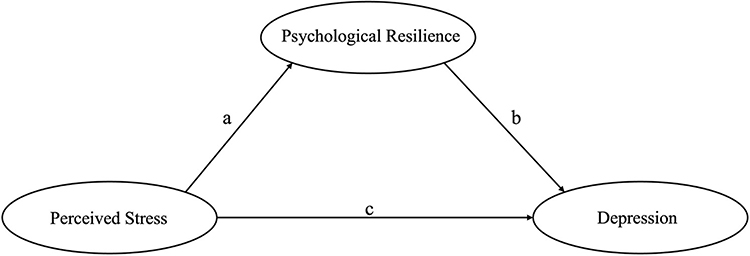 |
Figure 1 Hypothetical Model of Perceived Stress and Psychological Resilience Influencing Depression in College Students. Note: Letters, such as a, b, c, denote the coefficients for each path. |
Methods
Subjects and Procedures
Following the ethical approval from the Ethics Committee of Shanghai University (No. ECSHU 2025–019) in accordance with the Declaration of Helsinki, this research was conducted using a convenience sampling method. Initially, the theoretical framework of this study was collaboratively developed based on the International Physical Activity Guidelines, Stress Adaptation Theory, and Psychological Resilience Theory. A model was established that centers on psychological resilience as a mediating factor across different levels of physical activity, leading to the formulation of two research hypotheses. Second, the questionnaire was distributed to students from two well-known universities in Shanghai identified by the epidemiological survey center as having relatively high prevalence of depression. The center noted that, although the prevalence of depression among university students in Shanghai has shown a year-by-year upward trend, students in science- and engineering-oriented institutions may face the fastest growth in depression rates. This is likely because these universities typically involve higher academic pressure, students generally spend less time in physical activity than those in other types of institutions, and overall levels of prosocial behavior and self-compassion tend to be lower in this group.43 Accordingly, this study selected two prestigious, science- and engineering-oriented universities in Shanghai as the target institutions and conducted the survey via Wenjuanxing, an online questionnaire platform. Approval was obtained from college administrators, faculty members, and participating students at both universities. The survey emphasized that participation was voluntary and that responses would be kept confidential and collected anonymously. Before the questionnaire is officially distributed, participants should be informed of the research purpose and precautions using a standardized guiding language. Additionally, subjects are required to sign the informed consent form online. Following the online distribution, a total of 2019 questionnaires were collected. After excluding questionnaires completed in less than 100 seconds and those with identical answers for five consecutive questions, 1846 valid questionnaires were retained, resulting in an effective recovery rate of 91.43%. Among the valid responses, 827 were from male students, accounting for 44.8%, while 1019 were from female students, representing 55.2%. The majority of participants were aged between 18 and 21 years. Subsequently, SPSS 26.0 was employed to conduct common method bias test on the data, as well as descriptive statistics and correlation analysis for each variable. Based on these analyses, Amos 26.0 was utilized to construct a structural equation model to test the mediating role of psychological resilience in the relationship between perceived stress and depression among college students, which forms the conclusion of this study.
Measurement Tools
International Physical Activity Questionnaire (IPAQ)
The physical activity levels of college students were assessed using the International Physical Activity Questionnaire-Short Form (IPAQ-SF).44 This scale has been widely used among Chinese college students to assess physical activity levels and has received broad scholarly recognition over the past two decades of research in this population. Accordingly, we consider this scale appropriate for the present study. The rationale for employing a short questionnaire is to facilitate the investigation of a large sample size, as college students possess the cognitive ability to respond to concise questions and can easily self-assess their physical activity levels. The IPAQ-SF comprises seven items designed to evaluate the frequency (days per week) and duration (minutes per day) of various intensities of physical activities performed for at least 10 minutes over the past seven days. The scale covers three categories of physical activity—High-, moderate-, and low-intensity—corresponding to metabolic equivalent (MET) values of 8.0, 4.0, and 3.3, respectively. Based on the frequency (days) and duration (minutes) of each activity recorded in the questionnaire, weekly total physical activity for each participant was calculated by combining these values with the corresponding MET scores using the following formula (MET-min/week): Total physical activity = (low-intensity minutes × days × 3.3) + (moderate-intensity minutes × days × 4.0) + (High-intensity minutes × days × 8.0). According to the classification criteria for physical activity levels, the sample was divided into high, moderate, and low physical activity groups. The specific grouping procedures are presented in Table 1.45
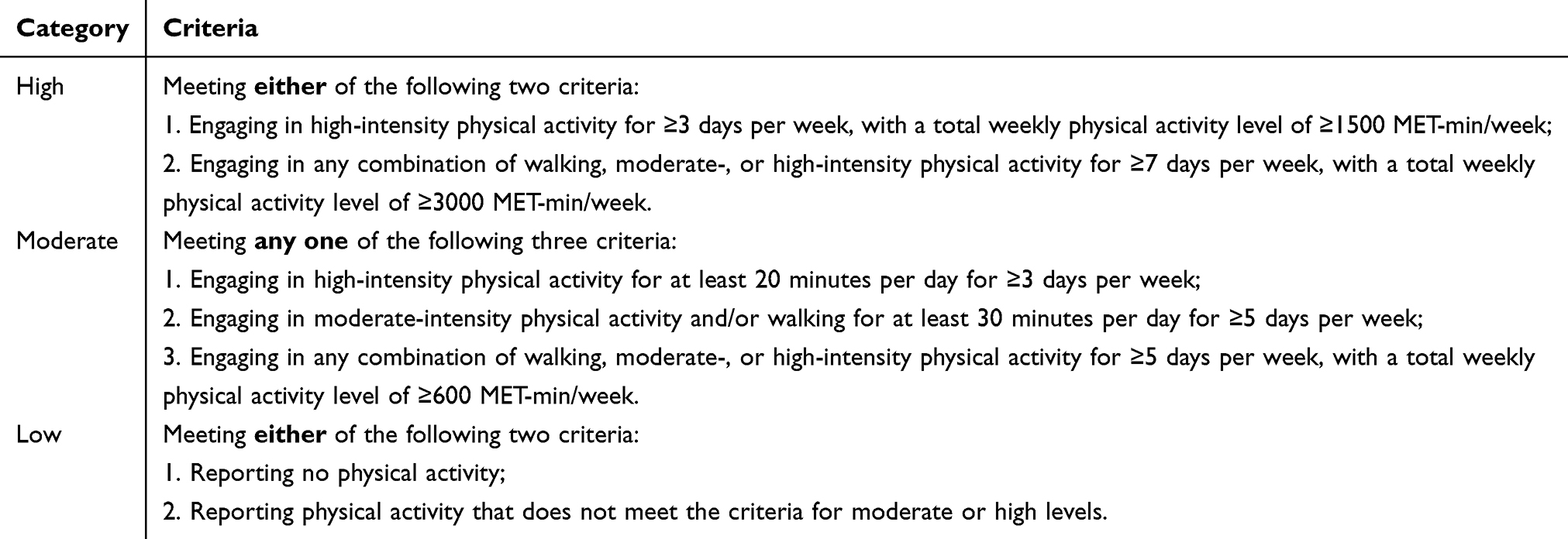 |
Table 1 Classification Criteria for Physical Activity Levels |
Perceived Stress Scale (PSS)
The Perceived stress Scale, developed by Cohen et al 46 and subsequently revised by Chinese scholars for college students within the Chinese context,22 was utilized in this study. This scale primarily assesses the perceived stress of college students over the past month. It comprises eight items that include both positive and negative indicators, such as “Recently, I have frequently felt that unexpected events have occurred, which has caused me distress”, “Recently, I have found myself feeling very unhappy and unable to control my emotions”, and “I often feel that I can effectively manage my time”. During the reliability and validity analyses, items with corrected item–total correlation (CITC) values below 0.40 were removed, such as “I often feel that difficulties are piling up and I cannot overcome them”. A five-point Likert scale was employed, with scores ranging from 1 to 5, corresponding to “completely non-compliant” to “completely compliant”. After transforming the negative indicators, a higher total score indicates a greater perceived stress and a heightened sense of loss of control. The results of the confirmatory factor analysis indicated a good model fit: χ2/df = 2.992, root mean square error of approximation (RMSEA) = 0.033, comparative fit index (CFI) = 0.998, goodness of fit index (GFI) = 0.996. The Cronbach’s α coefficient for the scale was 0.948.
Psychological Resilience Scale (PRS)
The Chinese version of the Psychological Resilience Scale, developed by Connor and Davidson47 and revised by Yu,48 was utilized in this study. This scale comprises a total of 25 items specifically designed to align with the characteristics of the Chinese population. Sample items include: “When changes occur, I can adapt” and “Having endured trials, I have become stronger”. The scale employs a 5-point Likert scoring system, with scores ranging from 1 to 5, corresponding to “completely inconsistent” and “completely consistent”, respectively. A higher score reflects a greater level of psychological resilience among subjects. Results from confirmatory factor analysis indicated a good model fit: χ2/df = 3.105, RMSEA = 0.034, CFI = 0.995, GFI = 0.991. The Cronbach’s α coefficient for the scale was 0.925.
Center for Epidemiological Studies-Depression Scale (CES-DS)
This scale, developed by Radloff49 and revised by Zhang et al,50 is primarily utilized to evaluate the depressive emotions or moods of subjects over the past week. It consists of 20 items that include both positive and negative indicators, such as “Some things that usually don’t bother me now also bother me”, “Recently, I have been particularly reluctant to eat”, and “Recently, I always feel that people are very friendly to me”. The scale employs a 5-point Likert scoring method, where responses range from “completely inconsistent” to “completely consistent”, scored from 1 to 5, respectively. Following score conversion, a higher score indicates a greater likelihood of the individual experiencing depressive symptoms. Results from confirmatory factor analysis indicated a good model fit: χ2/df = 3.941, RMSEA = 0.040, CFI = 0.998, GFI = 0.992. The Cronbach’s α coefficient for the scale was 0.948.
Data Analysis
First, descriptive statistics and correlation analyses were conducted using SPSS 26.0. Path analysis was then performed in AMOS 26.0. Model fit was evaluated using the chi-square test and commonly adopted fit indices, with acceptable thresholds defined as χ2/df < 5, RMSEA ≤ 0.050, CFI ≥ 0.900, and GFI ≥ 0.900.51 Based on the AMOS path analysis, direct and indirect effects (calculated as the product of path coefficients) were examined,52 to assess whether psychological resilience mediates the association between perceived stress and depression among college students across different levels of physical activity.
Results
Common Method Deviation Analysis
In this study, data were collected through questionnaires utilizing a self-reporting method. Common method biases may be present; therefore, an analysis for common method bias was conducted using the Harman single-factor test. The results indicated that the variance explained by the first factor was 36.349% (29.671% after rotation), which does not exceed the critical threshold of 40%. This finding suggests that there is no serious common method bias in this study.
Descriptive Statistics
Using SPSS 26.0 for statistical analysis, we examined the demographic indicators of the samples based on the different levels of physical activity reflected in the data (Table 2). There is a significant positive correlation between perceived stress and depression among college students at different levels of physical activity. Conversely, perceived stress exhibits a significant negative correlation with psychological resilience, while psychological resilience is also significantly negatively correlated with depression among college students (Table 3).
 |
Table 2 Demographic Characteristics (N=1846) |
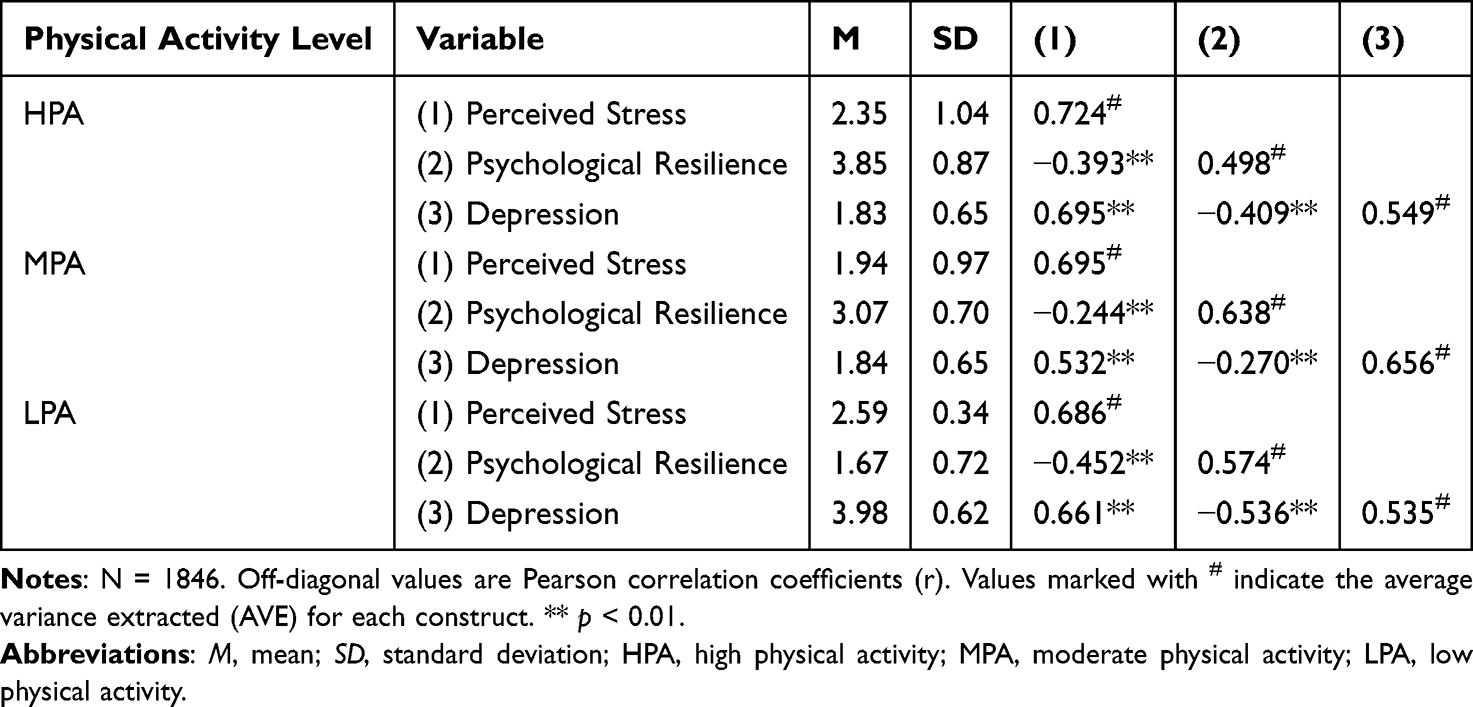 |
Table 3 Descriptive Statistics, Correlation Analysis, and Average Variance Extracted (AVE) Results Across Different Physical Activity Levels (N = 1846) |
Analysis of Variance for Perceived Stress, Psychological Resilience, and Depression Among College Students at Different Levels of Physical Activity
After controlling for covariates such as age, sex, and grade, we examined the normality of the data and the homogeneity of variances. The Shapiro–Wilk test indicated p values of 0.817, 0.891, and 0.882, all exceeding 0.05, suggesting that the data met the assumption of normality. The test for homogeneity of variances also yielded p values greater than 0.05, indicating that the assumption of equal variances was satisfied. A multivariate analysis of variance was conducted to statistically examine differences in psychological scale scores at different levels of physical activity. The results indicate significant differences in perceived stress, psychological resilience, and depression among college students participating in different levels of physical activity (Table 4).
 |
Table 4 Means of Perceived Stress, Psychological Resilience, and Depression by Physical Activity Level: One-Way ANOVA Results |
Path Analysis
The structural equation model examining the effects of perceived stress and psychological resilience on depression among college students demonstrated a good fit, with the following indices: χ2/df = 3.350, p > 0.05, RMSEA = 0.036, CFI = 0.982, and TLI = 0.976. Based on the structural model constructed according to the research hypotheses, the results indicated that, irrespective of physical activity levels, perceived stress significantly and negatively affected the psychological resilience (r = −0.283, t = −18.467, p < 0.001). Furthermore, psychological resilience significantly and negatively affected depression (r = −0.502, t = −19.850, p < 0.001). These findings suggest that psychological resilience mediates the relationship between perceived stress and depression among college students (Figure 2). The indirect effect was calculated as a × b = (−0.27) × (−0.25) = 0.06, where a and b represent the path coefficients from perceived stress to psychological resilience and from psychological resilience to depression, respectively. That is, across different levels of physical activity, psychological resilience accounted for an approximately 6% mediating effect in the relationship between perceived stress and depression. Therefore, H1 was supported.
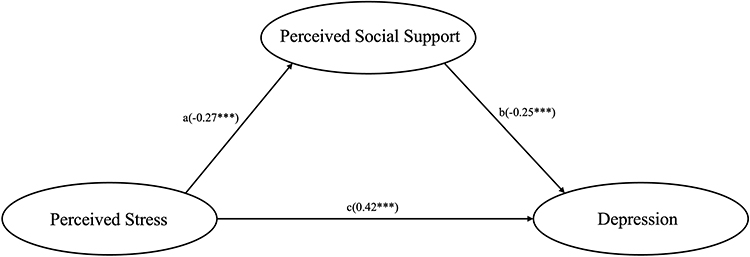 |
Figure 2 Path coefficients of Perceived Stress and Psychological Resilience Influencing Depression in College Students. Notes: Path model of perceived stress and perceived social support influencing depression in college students. The values in parentheses on each arrow indicate the path coefficient and its significance level (paths a, b, and c). *** p < 0.001. |
Path coefficients differed across college students with different physical activity levels, indicating that the mediating effect of psychological resilience in the relationship between perceived stress and depression is not uniform across activity groups. Among students with high levels of physical activity, perceived stress significantly and negatively affected psychological resilience (r = −0.320, t = −9.806, p < 0.001), and psychological resilience significantly and negatively affected depression (r = −0.366, t = −7.343, p < 0.001) (Figure 3). The indirect effect was a × b = (−0.78) × (−0.66) = 0.52, suggesting that under high levels of physical activity, psychological resilience accounted for a 52% mediating effect in the association between perceived stress and depression. For students with moderate levels of physical activity, perceived stress also significantly and negatively affected psychological resilience (r = −0.272, t = −15.445, p < 0.001), and psychological resilience significantly and negatively affected depression (r = −0.194, t = −7.572, p < 0.001) (Figure 4), but the indirect effect was smaller: a × b = (−0.56) × (−0.43) = 0.24, indicating a 24% mediating effect. Among students with low levels of physical activity, perceived stress significantly and negatively affected psychological resilience (r = −0.195, t = −3.200, p < 0.002), and psychological resilience significantly and negatively affected depression (r = −0.182, t = −2.201, p < 0.029) (Figure 5). The indirect effect was a × b = (−0.21) × (−0.20) = 0.04, suggesting only a 4% mediating effect. Overall, these patterns indicate substantial differences in the mediating role of psychological resilience across physical activity levels (Table 5). Accordingly, H2-1 and H2-2 were supported, whereas H2-3 was not supported.
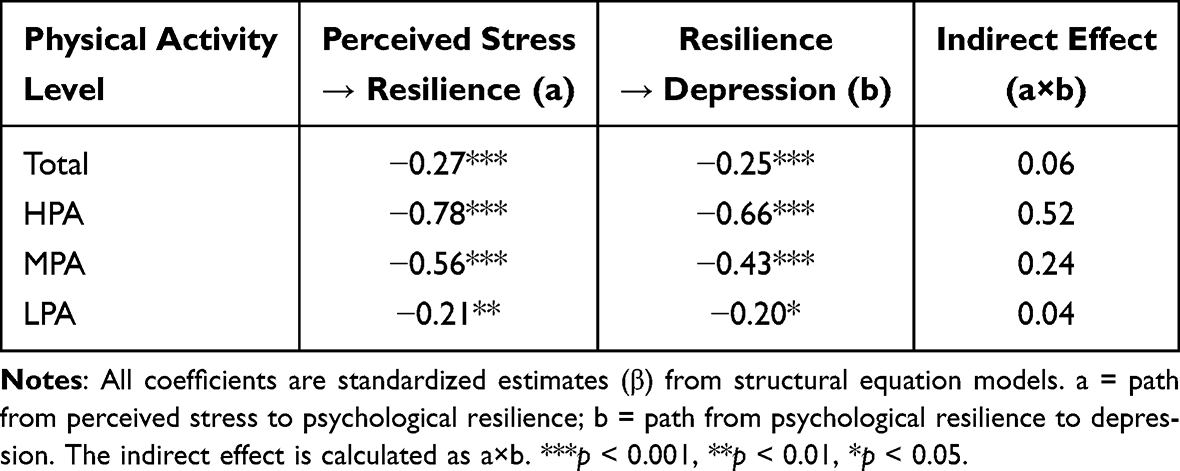 |
Table 5 Standardized Path Coefficients and Indirect Effects for the Perceived Stress–Depression Pathway via Psychological Resilience Across Physical Activity Levels |
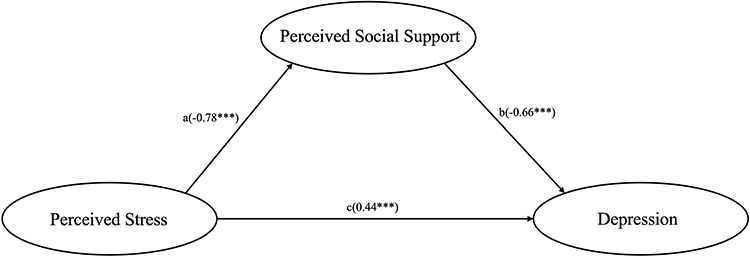 |
Figure 3 Path coefficients of perceived stress and psychological resilience on depression at high levels of physical activity. Notes: Path model of perceived stress and perceived social support influencing depression in college students at high levels of physical activity. The values in parentheses on each arrow indicate the path coefficient and its significance level (paths a, b, and c). *** p < 0.001. |
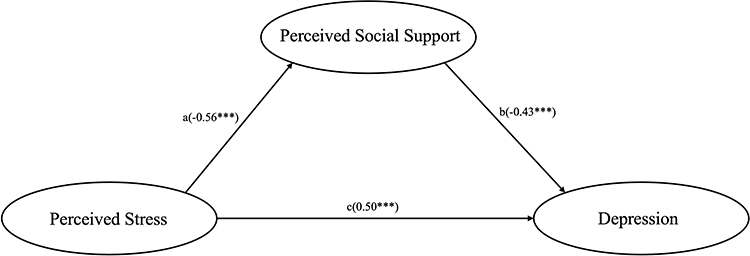 |
Figure 4 Path coefficients of perceived stress and psychological resilience on depression at moderate levels of physical activity. Notes: Path model of perceived stress and perceived social support influencing depression in college students at moderate levels of physical activity. The values in parentheses on each arrow indicate the path coefficient and its significance level (paths a, b, and c). *** p < 0.001. |
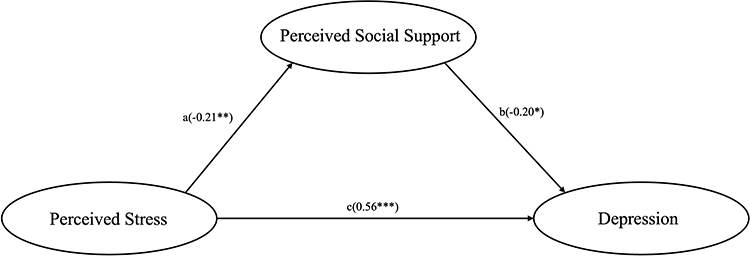 |
Figure 5 Path coefficients of perceived stress and psychological resilience on depression at low levels of physical activity. Notes: Path model of perceived stress and perceived social support influencing depression in college students at low levels of physical activity. The values in parentheses on each arrow indicate the path coefficient and its significance level (paths a, b, and c). ***p<0.001, **p<0.01, *p<0.05. |
Discussion
The Mediating Role of Psychological Resilience at Different Levels of Physical Activity
Depression is a prevalent psychological issue among college students globally, with the situation being particularly severe among Chinese college students.53 Recent studies have explored depression within the framework of the Diathesis-Stress Theory, proposing that exposure to stressors can elicit depressive symptoms, particularly among individuals with preexisting vulnerabilities.54 Although Chinese college students are exposed to diverse stressors, these are predominantly reflected in academic competition, employment pressure, pursuit of awards and honors, and interpersonal relationships. Importantly, such stressors rarely occur in isolation but tend to manifest as a composite of multiple pressures.55 The impact of these stress factors, however, is contingent upon an individual’s perception of stress. Prior research has demonstrated significant individual differences in perceived stress, indicating that people vary considerably in their sensitivity and responses to stressors.13 Consequently, this study investigates the internal mechanisms influencing depression from the perspective of perceived stress among college students in Shanghai. Findings reveal that higher levels of perceived stress correlate with increased levels of depression among college students, aligning with previous research.56–58
Based on the established relationship between perceived stress and depression, this study further explores the mediating role of psychological resilience in the relationship between perceived stress and depression among college students. The results demonstrate that the higher the level of psychological resilience among college students, the less likely they are—at least in terms of the overall trend—to exhibit depressive symptoms. This finding is in line with prior studies.29 Furthermore, this research supports Richardson’s59 Theory of Psychological Resilience, suggesting that all college students possess a certain degree of perceived stress, which is generally linked to their psychological resilience. Additionally, students with higher levels of psychological resilience are less likely to exhibit depressive symptoms. This observation is consistent with earlier research.30–32
According to the Theory of Psychological Resilience, resilience functions as a positive psychological protective factor. High levels of psychological resilience can effectively buffer against the emergence of negative emotions and reduce individuals’ sensitivity to perceived stress, thereby serving as a protective psychological mechanism against depression. The present findings support a widely accepted view that, when conceptualized as a personality trait, psychological resilience can shield individuals from the adverse psychological effects of stress or challenging circumstances, and thus acts as a key promotive factor for mental health.60,61 The results of this study align closely with previous research, indicating that individuals with high psychological resilience exhibit less negative emotion and possess enhanced recovery abilities under stress.62,63 This observation supports the conditional model of psychological resilience, which posits that certain individual traits can mitigate the adverse effects of risk factors.64 Traits such as tenacity, self-reliance, and optimism empower individuals to actively seek solutions, navigate challenges, and embrace difficulties, thereby reducing the detrimental impact of risk factors on their well-being and fostering greater adaptability and development. The findings suggest that psychological resilience is not only a beneficial personal trait but also a crucial psychological protective factor that shields individuals from the adverse effects of perceived stress, making them less susceptible to depression and promoting effective adaptation. This underscores the notion that psychological resilience, as a positive health attribute for college students, can be cultivated through specific strategies in their daily academic and personal lives. Particularly in challenging situations, the development of persistent willpower can significantly enhance the mental health of college students and contribute to lowering their risk of depression. This assertion is supported by numerous intervention studies focused on enhancing the psychological resilience of college students.65–67
Education authorities and higher education institutions should not only strive to provide employment resources for college students but also cultivate their abilities through multiple channels and reduce their perceived stress. Additionally, they must strengthen the development of college students’ psychological resilience through targeted interventions. Enhancing the psychological resilience of college students should be prioritized as a key objective for promoting mental health. Particular attention should be given to increasing the physical activity levels of contemporary Chinese college students.68 Prior research suggests that the university period is a crucial stage for developing regular exercise habits.69 Although Chinese educational discourse has long emphasized the holistic ideal of “moral, intellectual, physical, aesthetic, and labor education”, in practice, an exam-oriented evaluation system and intensifying academic competition have substantially compressed opportunities for physical activity during childhood and adolescence.70,71 Beyond the formally scheduled school physical education classes, students’ after-school time is increasingly occupied by academic study and subject-based tutoring, such that physical activity in early socialization is frequently diluted, instrumentalized, and even marginalized.72 As a result, many students arrive at university with a developmental experience characterized by a low baseline of established physical-activity habits. Even though university life typically affords greater time autonomy and freedom of activity choice, the absence of long-term habit formation may lead students to remain physically inactive in this more permissive environment. This, in turn, reduces opportunities for physical activity to function as a pathway for psychological resource building and stress regulation, thereby weakening a practically important route to enhancing psychological resilience.73 Notably, as early as the beginning of the twentieth century, Cai Yuanpei argued that “a complete personality begins with physical education”, presciently underscoring the foundational value of physical activity in cultivating well-rounded personal development.74 Unfortunately, amid China’s rapid socioeconomic transformation and escalating educational competition, academic achievement has been disproportionately privileged, and the educational role of physical activity has, to varying degrees, been consciously or unconsciously overlooked.75
Although existing evidence generally indicates that physical activity among university students is not only a key means of strengthening psychological resilience but also an effective approach to reducing depressive symptoms, substantial heterogeneity in physical activity levels persists due to differences in prior participation histories and habit formation.76 Such heterogeneity may further shape both the strength and the pathways through which psychological resilience operates within the perceived stress–depression association, suggesting the need to incorporate a moderating perspective of physical-activity habits/levels into mechanistic models to more precisely explain between-group differences in psychological adaptation.
The Mediating Effect of Psychological Resilience on Perceived Stress Affecting Depression in College Students at Different Levels of Physical Activity
Previous studies have demonstrated that physical activity exerts a negative prediction on depression among college students.77,78 Research in sports psychology indicates that college students can enhance their physical and mental health through moderate participation in physical exercise, which is widely recognized as an effective intervention for depression.79 However, the psychological mechanisms underlying the impact of physical activity on depression among college students remain inadequately explored. Specifically, this study aims to investigate whether variations in psychological resilience exist among individuals engaged in different levels of physical activity, and how these variations may influence sensitivity to perceived stress, ultimately affecting depression. This study centers on whether the mediating role of psychological resilience differs across varying levels of physical activity. Most prior research has primarily focused on the straightforward pathway of psychological resilience as a mediator between perceived stress and depression in college students.80,81
Such studies indicate that psychological resilience, as a key mediating variable, should be taken seriously by educators; however, they do not elucidate how to effectively enhance the psychological resilience of college students. Some scholars have proposed various strategies for cultivating psychological resilience among college students from different perspectives. Nevertheless, in the absence of standardized operational requirements, certain practices aimed at improving psychological resilience are not sustainable.82 For instance, in some Chinese universities, educators encourage students to actively engage in various volunteer activities. While these initiatives aim to alleviate students’ perceived stress and enhance their psychological resilience through volunteer experiences, they often fail to facilitate the transformation of these experiences into improved internal resilience due to external organizational constraints. This limitation may be partly attributable to the fact that volunteer activities have not yet been incorporated into compulsory curricular requirements in most Chinese universities, and their planning and implementation often lack sufficient structure and continuity, thereby constraining their effectiveness in strengthening college students’ psychological resilience.83,84 Additionally, some universities attempt to bolster students’ capacity to withstand setbacks and reduce their perceived stress through team-based scientific and technological activities.85,86 However, the rising incidence of depression among college students suggests that these approaches have yet to achieve substantial improvements in students’ psychological well-being. Physical activity is widely acknowledged as an effective intervention for alleviating depression among college students in Chinese universities. Although physical activity is widely recognized in Chinese universities as an effective approach to alleviating depression among college students, the strong covert nature of depression means that affected students are often dispersed across different disciplines and majors. As a result, it is difficult for universities to deliver targeted, centralized interventions for this population. In practice, institutions can only make a broad, less precise judgment that moderate levels of physical activity may help reduce depressive symptoms among college students.41 Consequently, it is imperative to conduct a large-scale study to analyze the mediating effect of psychological resilience on the relationship between perceived stress and depression at different levels of physical activity. This research aims to enhance our understanding of how varying levels of physical activity influence the alleviation of depressive symptoms among college students.
This study shows that under different levels of physical activity, psychological resilience plays a certain mediating role in the influence of perceived stress on depression among college students. These findings align with previous research that indicates physical activity influences depression in college students.87–90 However, the effects of psychological resilience differ across various levels of physical activity, revealing significant variations. Notably, differences in physical activity levels impact college students’ sensitivity to perceived stress.91,92 Furthermore, these findings highlight the varying degrees of psychological resilience’s intervention on depression, which is crucial for understanding how Chinese college students can mitigate depression levels through active and effective physical engagement amidst increasingly complex competitive pressures.
Theory of Objectified Body Consciousness posits that contemporary college students, in the face of competitive pressures, actively engage with their objectified body consciousness. This engagement leads to the formation of specific body representations in their academic and personal lives. Due to variations in these body representations, individuals cultivate differing levels of body self-esteem.93 The body self-esteem model suggests that an individual’s social evaluation of their body is intricately linked to their self-esteem needs. In the context of intense academic and employment competition, the body shape and weight of Chinese college students have become sources of individual stress. Consequently, a strong sense of body self-esteem compels some college students to enhance their perceived stress and bolster psychological resilience through participation in physical activities, thereby reducing levels of depression.94
Therefore, based on the survey conducted in Shanghai, this study found that among college students with high levels of physical activity, psychological resilience exerted a particularly strong effect within the pathway through which perceived stress influences depression. In other words, students who engaged in physical activity with greater intensity, longer duration, and higher frequency reported significantly lower perceived stress and markedly higher psychological resilience. In comparisons with students at moderate and low physical activity levels, variance analyses further indicated that the high physical activity group demonstrated the strongest negative association with depressive symptoms. These findings are partly consistent with existing evidence.95 Some scholars have suggested that interventions for adolescent depression are most effective at high levels of physical activity. Although this conclusion is supported by experimental findings demonstrating a direct intervention effect of high physical activity levels on adolescent depression, the underlying mechanisms have not been clearly articulated.96 Conversations with Chinese college students who engage in high levels of physical activity revealed that their primary motivation is to manage the various stressors arising from the ongoing development of higher education institutions. Initially, these students exhibit low levels of physical activity (such as walking), which gradually evolve into a pursuit of physical self-esteem. This progression leads to a continuous enhancement of their physical activity capabilities, ultimately establishing a habit of high-level physical activity.
The transtheoretical model posits that individuals progress through various stages of motor behavior development, serving as an authoritative framework for understanding the differing levels of physical activity among individuals. This model is primarily influenced by four key elements: the stage of behavioral change, the process of change, self-efficacy, and decisional balance.97 From the perspective of educational psychology, the cross-theoretical motor behavior model aims to guide learners in comprehensively understanding the phased characteristics of motor behavior, thereby enhancing their intrinsic motivation for physical self-esteem. This understanding helps alleviate the stress associated with social congestion and bolsters psychological resilience.98 This study also found that among college students in the surveyed universities in Shanghai, psychological resilience under moderate physical activity levels showed a positive and significant effect in the pathway through which perceived stress influenced depression. However, compared with students at high physical activity levels, this effect differed significantly. In other words, although moderate physical activity appears to promote resilience and thereby buffer the impact of perceived stress on depression, the magnitude of this protective effect is relatively smaller. Thus, while affirming the beneficial role of moderate levels of physical activity, our findings suggest that students in this group may still need more effective training approaches, strategies, and supportive measures to further progress toward higher levels of physical activity. For students with low levels of physical activity, psychological resilience also exerted some influence in the perceived stress–depression link, but the overall effect was weak. This pattern shows certain differences from existing research.99 An additional nuance in our findings is that students in the high physical activity group reported slightly higher levels of perceived stress than those in the moderate physical activity group, although this difference did not reach statistical significance in post-hoc tests. This pattern should therefore be interpreted cautiously. One possible explanation is that some highly active students face additional time-management demands when trying to reconcile intensive training or frequent exercise with a heavy academic workload, which may offset part of the stress-buffering benefits of high activity. In competitive or performance-oriented contexts, achievement pressure, concerns about selection, or fear of underperformance may also contribute to elevated stress among highly active students.100 In addition, insufficient recovery or unstructured high-intensity participation could, for a subset of students, be experienced as another source of strain rather than purely as a resource.101 Finally, self-reported estimates of physical activity may be subject to perception and recall biases, which could contribute to small mean differences between the high physical activity and moderate physical activity groups.44 Taken together, these considerations suggest that more physical activity does not automatically translate into lower perceived stress for all students and that the quality and context of high activity are likely to be important.102 The improvement in depression among college students at moderate levels of physical activity is consistent with the conclusions of this study.103 However, a key distinction is that existing studies primarily emphasize the direct effects of moderate physical activity on depression, rather than its indirect influence through perceived stress responses.41
Under conditions of low physical activity, psychological resilience still played a certain role in the relationship between perceived stress and depression among college students, resulting in the hypothesis proposed in this study not being fully supported. This may be attributed to the composition of the low physical activity group, which included both students with low levels of physical activity and those who were completely sedentary (ie, not participating in any exercise). Notably, students with low levels of activity accounted for 77.03% of this group. The relatively large proportion of these students may have contributed to a slight enhancement in psychological resilience, suggesting that as long as individuals are not entirely sedentary, even low levels of physical activity may exert a modest moderating effect of psychological resilience in the relationship between perceived stress and depression.104,105 Therefore, the present study concludes that under conditions of low levels of physical activity (non-sedentary), psychological resilience plays a significant mediating role in the impact of perceived stress on depression among college students, although the magnitude of this effect is considerably weaker compared to that observed at moderate and high levels of physical activity. Research further indicates that differences in the effectiveness of psychological resilience interventions across varying levels of physical activity are largely attributable to environmental influences on college students.106
The Ecosystem Theory posits that an individual’s psychological development is inherently situated within a dynamic interplay of internal and external environments. Internal psychological growth is influenced not only by the external objective environment but also by the individual’s internal processes of acceptance, evaluation, and regulation. This psychological state is characterized by continuous adjustment, adaptation, and balance, ultimately culminating in higher developmental stages.107 Consequently, at various stages of physical activity development, the differential impact of psychological resilience necessitates that educators devise tailored advanced plans for college students, addressing their specific physical activity levels to enhance psychological resilience. By incorporating heterogeneity in physical activity levels into the proposed mechanism, this study innovatively formulates and empirically tests whether the perceived stress–psychological resilience–depression pathway operates differentially across varying levels of physical activity, thereby elucidating a context-sensitive mechanism through which perceived stress influences depressive symptoms among college students via psychological resilience. This framework moves beyond the largely generalized treatment of physical activity in prior research and clarifies the boundary conditions and theoretical significance of physical activity as a salient contextual factor shaping the translation of psychological resources into mental health outcomes. Historically, the values associated with physical education have not garnered significant social attention within China’s basic education system.108 This neglect is evident in the high prevalence of obesity and myopia among primary school children.109 Aside from the physical education classes mandated by schools, these children typically do not engage in extracurricular physical activities. Moreover, internet addiction has emerged as a pressing educational challenge for children in contemporary China.110 The lack of physical activity often persists throughout childhood and adolescence and continues into college, where, under the accumulation of multiple stressors, depression has become a widespread phenomenon among university students.111 Some scholars argue that improving the physical activity levels of college students requires not only the implementation of organized and regular physical activities from a practical standpoint but also the active promotion of the belief that “The cultivation of a complete personality begins with physical education”.74 Furthermore, it is essential to strategically implement revitalization plans for the physical activities of children and adolescents, fostering a shared responsibility among schools, society, and families.112 Additionally, the government should increase financial investment to establish a foundation for the participation and support of children and adolescents in physical activities.113 This comprehensive approach aims to enhance the physical activity levels of children and adolescents in China and to cultivate qualified Chinese talents for global development.
Conclusion
In this cross-sectional study of college students from two universities in Shanghai, we examined how perceived stress, psychological resilience, and depressive symptoms are related across different physical activity levels. Overall, perceived stress was positively associated with depressive symptoms, whereas psychological resilience was negatively associated with depression, suggesting that stress appraisal and internal psychological resources are closely linked to emotional well-being in this population. These patterns indicate that perceived stress remains a salient correlate of depressive symptoms among Chinese college students and may be an important target for campus-based mental health efforts.
The association between perceived stress and psychological resilience, as well as the resilience–depression link, appeared to vary across physical activity levels. In general, students with moderate to high levels of physical activity showed a more favorable profile—lower perceived stress, higher psychological resilience, and lower depressive symptoms—than those with low activity. Within this pattern, higher perceived stress tended to be related to lower resilience, and higher resilience tended to be related to lower depression, particularly among students with greater physical activity engagement. By contrast, in the low-activity group these associations were weaker, suggesting that limited physical activity may constrain the extent to which resilience can buffer the impact of stress on depressive symptoms. These findings tentatively suggest that psychological resilience may function as a protective correlate in the perceived stress–depression association, and that the strength of this resilience-mediated pathway may be sensitive to differences in physical activity level.
Conceptually, the present findings support viewing physical activity as an important behavioral context for the accumulation of psychological resources, positioning psychological resilience as a core resource-based construct, and treating perceived stress as a proximal cognitive appraisal mechanism linking resources to emotional outcomes. Rather than examining these factors in isolation, our results provide preliminary evidence for a resilience-mediated relationship structure that differs across low, moderate, and high physical activity groups within a high-pressure urban university setting.
Research Limitations
(1) This study primarily employed questionnaire surveys. Although college students generally have a fundamental understanding of the questions and scales used, variations in their perceptions of physical activity can result in ambiguity when assessing the intensity, frequency, and duration of these activities. Such ambiguity presents practical challenges for the survey.
(2) This study focused on college students from two universities identified by the Center for Epidemiologic Studies as having a high prevalence of depression. While these institutions locate in economically developed cities in China and comprise academically high-achieving students who face considerable academic and employment pressures—rendering them relatively representative—the generalizability of the findings remains limited. The study did not include universities from other regions of China, thereby underscoring the necessity of expanding the research scope in future investigations to ensure broader applicability of the results.
(3) This study employed a cross-sectional design. Although it revealed associative patterns among the variables, it is difficult to determine their temporal order and causal direction, and the design cannot capture dynamic changes over time. Future research could adopt longitudinal tracking or device-based measures/ecologically based repeated-measures designs to assess key variables—such as physical activity, psychological resilience, perceived stress, and depression—across multiple time points in the future work. By controlling for baseline levels and examining trajectories of change, such studies would be better positioned to test potential sequential pathways, bidirectional influences, and the dynamic mechanism of “resource accumulation—stress appraisal—emotional outcomes”.
(4) Because we estimated separate mediation models for each physical activity group, differences in indirect effects across groups should be interpreted as descriptive rather than the result of formal multi-group moderation tests. Future research with larger and more balanced samples should adopt multi-group SEM or moderated mediation frameworks to formally compare structural paths across activity levels.
Abbreviations
WHO, World Health Organization; IPAQ, International Physical Activity Questionnaire; PSS, Perceived Stress Scale; PRS, Psychological Resilience Scale; CES-DS, Center for Epidemiological Studies-Depression Scale; CITC, Corrected Item–Total Correlation; RMSEA, Root Mean Square Error of Approximation; CFI, Comparative Fit Index; GFI, Goodness of Fit Index.
Data Sharing Statement
The data that support the findings of this study are available from the corresponding author(s) upon reasonable request.
Acknowledgments
We would like to thank all survey participants for their cooperation in this study.
Author Contributions
All authors made substantial contributions to the work reported, including the conception and design of the study, execution, data acquisition, and/or data analysis and interpretation; participated in drafting, revising, or critically reviewing the manuscript; approved the final version to be published; agreed on the journal to which the article has been submitted; and accept responsibility for all aspects of the work.
Funding
This work was funded by the National Social Science Fund of China, grant number 21BTY103.
Disclosure
The author(s) report no conflicts of interest in this work.
References
1. Zhang Y, Jia X, Yang Y, Sun N, Shi S, Wang W. Change in the global burden of depression from 1990-2019 and its prediction for 2030. J Psychiatr Res. 2024;178:16–18. doi:10.1016/j.jpsychires.2024.07.054
2. Li C, Gao Y. Social mentality of college students under the pressure of education and employment competition——an analysis based on panel survey study of Chinese university students(PSCUS) in 2023. Youth Exploration. 2024;5:17–24. doi:10.13583/j.cnki.issn1004-3780.2024.05.002
3. Wiebenga J, Dickhoff J, Merelle S, Penninx BW. Prevalence, course, and determinants of suicide ideation and attempts in patients with a depressive and/or anxiety disorder: a review of NESDA findings. J Affect Disord. 2021;283:267–277. doi:10.1016/j.jad.2021.01.053
4. Liu J, Bullock A, Coplan RJ, Chen X, Li D, Zhou Y. Developmental cascade models linking peer victimization, depression, and academic achievement in Chinese children. British J Develop Psychol. 2018;36(1):47–63. doi:10.1111/bjdp.12212
5. Naicker K, Galambos NL, Zeng Y, Senthilselvan A, Colman I. Social, demographic, and health outcomes in the 10 years following adolescent depression. J Adolesc Health. 2013;52(5):533–538. doi:10.1016/j.jadohealth.2012.12.016
6. Association CNND. 2023 China mental health. 2023.
7. Li X, Zhang C, Yu R, et al. The joint role of childhood emotional abuse and bullying victimization in the development of depressive symptoms in adolescents: serial mediation or enhanced regulation. Acta Psychologica Sinica. 2025:1–14. doi:10.3724/SP.J.1041.2025.1056
8. Tan Y, He T, Ding W, Cao Z, Lin X. The joint role of childhood emotional abuse and bullying victimization in the development of depressive symptoms in adolescents: serial mediation or enhanced regulation. Chin J Clin Psychol. 2023;31(01):136–141. doi:10.16128/j.cnki.1005-3611.2023.01.025
9. Zhou S, Guo H, Yang P, Wang M, Liu X, Ding X. The effect of family environment on college students’ depression: the chain mediating role of cognitive emotion regulation and dormitory interpersonal relationship. Chin J Special Educ. 2021;(12):75–81.
10. Yang X, Zhang Y. The relationship between stressful life events and college students’ depression: the chain mediating effect of basic psychological needs and sense of life meaning. J Taiyuan Urban Vocational College. 2023;(05):137–140. doi:10.16227/j.cnki.tycs.2023.0303
11. Chang B, Liu W, Zhang S, Li Z. Analysis on the effect of public risk perception for public health emergencies on depression in college students based on the stress process model. Health Res. 2024;44(01):11–14+24. doi:10.19890/j.cnki.issn1674-6449.2024.01.003
12. Yuan S, Chen Y, Huang X. Effects of stressful life events, life attitude and coping strategy on depression of college students. Commun Psychol Res. 2023;15(01):255–268.
13. Igor K, Nada K. Personality traits, stressful life events, and coping styles in early adolescence. Pers Individ Dif. 2001;30(3):503–515. doi:10.1016/S0191-8869(00)00041-6
14. Agata S, Jakub T, Tomasz Z. The affective bases of risk perception: negative feelings and stress mediate the relationship between mental imagery and risk perception. Front Psychol. 2016;7:932. doi:10.3389/fpsyg.2016.00932
15. Ravindran AV, Matheson K, Griffiths J, Merali Z, Anisman H. Stress, coping, uplifts, and quality of life in subtypes of depression: a conceptual frame and emerging data. J Affect Disord. 2002;71(1–3):121–130. doi:10.1016/s0165-0327(01)00389-5
16. Rooij SRD, Schene AH, Phillips DI, Roseboom TJ. Depression and anxiety: associations with biological and perceived stress reactivity to a psychological stress protocol in a middle-aged population. Psychoneuroendocrinology. 2010;35(6):866–877. doi:10.1016/j.psyneuen.2009.11.011
17. Skipworth K, Woodruff L, Moses K. Relationship between perceived stress and depression in college students. Arizona State University; 2011.
18. Cristóbal-Narváez P, Jmha B, Akab C. Perceived stress and depression in 45 low- and middle-income countries. J Affect Disord. 2020;274:799–805. doi:10.1016/j.jad.2020.04.020
19. Wen Z, Ye B. Different methods for testing moderated mediation models: competitors or backups? Acta Psychologica Sinica. 2014;46(5):714–726. doi:10.3724/SP.J.1041.2014.00714
20. Seiffge-Krenke I, Nurmi AJE, Nurmi J-E. Changes in stress perception and coping during adolescence: the role of situational and personal factors. Child Development. 2010;80(1):259–279. doi:10.1111/j.1467-8624.2008.01258.x
21. Staempfli MB. Adolescent playfulness, stress perception, coping and well being. J Leisure Res. 2007;39(3):393–412. doi:10.1080/00222216.2007.11950114
22. Yang Y, Huang H. An epidemiological study on stress among urban residents in social transition period. Chin J Epidemiol. 2003;24(09):760–764. doi:10.3760/j.issn:0254-6450.2003.09.004
23. Lazarus RS, Folkman S. Transactional theory and research on emotions and coping. European J Personality. 1987;1(3):141–169. doi:10.1002/per.2410010304
24. Kumpfer KL. Factors and processes contributing to resilience. Springer US; 2002.
25. Werner EE. Children of the Garden Island. Sci Am. 1989;260(4):106–111. doi:10.1038/scientificamerican0489-106
26. Masten AS, Cicchetti D. Resilience in development: progress and transformation. In: Developmental Psychopathology: Risk, Resilience, and Intervention. Vol. 4.
27. Block J, Kremen AM. IQ and ego-resiliency: conceptual and empirical connections and separateness. J Pers Soc Psychol. 1996;70(2):349–361. doi:10.1037//0022-3514.70.2.349
28. Kumpfer KL. Factors and processes contributing to resilience: the resilience framework. In: Resilience and Development: Positive Life Adaptations. Kluwer Academic Publishers; 1999:179–224. Longitudinal research in the social and behavioral sciences.
29. Pan Y. Relationship study among resilience, perceived stress, positive affect and mental health of higher vocational college students. 2012.
30. Han L, Li M. Relationship among the rural college student’s depression, social support and resilience. Chin J Sch Health. 2014;35(03):385–387+390. doi:10.16835/j.cnki.1000-9817.2014.03.027
31. Li H. The relationship between the psychological resilience of bullied children and depression and anxiety. 2006.
32. Sun J, Li W. Mediating effect of psychological resilience between depression in the elderly in communities and social support. Chin General Pract. 2015;18(07):827–830.
33. Turkington GD, Tinlin-Dixon R, St Clair-Thompson H. A mixed-method exploration of mental toughness, perceived stress and quality of life in mental health workers. J Psychiatr Ment Health Nurs. 2023;30(6):1152–1169. doi:10.1111/jpm.12948
34. Masten AS. Ordinary magic. Resilience processes in development. Am Psychol. 2001;56(3):227–238. doi:10.1037//0003-066x.56.3.227
35. Wang H, Wu S, Wang W, Wei C. Emotional intelligence and prosocial behavior in college students: a moderated mediation analysis. Front Psychol. 2021;12:713227. doi:10.3389/fpsyg.2021.713227
36. Xin Z. Perceived social support and college student engagement: moderating effects of a grateful disposition on the satisfaction of basic psychological needs as a mediator. BMC Psychol. 2022;10(1):298. doi:10.1186/s40359-022-01015-z
37. Chen L. China’s popular educational activity: does social practice really help enhance college student learning outcomes? Int J Chin Educ. 2018;7(1):129–149. doi:10.1163/22125868-12340093
38. Folkman S. Stress, appraisal, and coping. Springer New York; 1984. doi:10.1007/978-1-4419-1005-9_215
39. Zhang C, Zhang J, Lin W. The mediating role of coping styles between physical activity and sense of meaning in life among Chinese college students. Sci Rep. 2025;15(1):34269. doi:10.1038/s41598-025-16472-w
40. Qiu W, Wang X, Cui H, et al. The impact of physical exercise on college students’ physical self-efficacy: the mediating role of psychological resilience. Behav Sci. 2025;15(4):541. doi:10.3390/bs15040541
41. Li B, Jiang W, S-s H, et al. Influence of moderate-to-high intensity physical activity on depression levels: a study based on a health survey of Chinese university students. BMC Public Health. 2024;24(1):1023. doi:10.1186/s12889-024-18433-w
42. Zhong T. Physical activity motivations and psychological well-being among university students: a canonical correlation analysis. Brief Res Report Front Public Health. 2024;12:1442632. doi:10.3389/fpubh.2024.1442632
43. Xu Y, Wang B. Mental health assessment and its influencing factors analysis of arts and science students in double first-class universities. Open Access Lib J. 2022;9(12):1–13. doi:10.4236/oalib.1109665
44. Lee P, Macfarlane D, Lam T, Stewart S. Validity of the international physical activity questionnaire short form (IPAQ-SF): a systematic review. Int J Behav Nutrition Phys Activity. 2011;8(1). doi:10.1186/1479-5868-8-115
45. Fan M, Lv J, He P. Chinese guidelines for data processing and analysis concerning the international physical activity questionnaire. Chin J Epidemiol. 2014;35(8):4. doi:10.3760/cma.j.issn.0254-6450.2014.08.019
46. Cohen S, Wills TA. Stress, social support, and the buffering hypothesis. Psychol Bull. 1985;98(2):310–357. doi:10.1037/0033-2909.98.2.310
47. Connor KM, Davidson JR. Development of a new resilience scale: the Connor-Davidson resilience scale (CD-RISC). Depress Anxiety. 2003;18(2):76–82. doi:10.1002/da.10113
48. Yu X, Zhang J. A comparison between the Chinese version of ego-resiliency scale and connor-davidson resilience scale. 心理科学. 2007;(05):1169–1171. doi:10.16719/j.cnki.1671-6981.2007.05.035
49. Radloff LS. The CES-D scale a self-report depression scale for research in the general population. Applied Psychol Measurement. 1977;1(3):385–401. doi:10.1177/014662167700100306
50. Zhang J, Wu Z, Fang G, Li J, Han B, Chen Z. Development of the Chinese age norms of CES-D in urban area. Chin Mental Health J. 2010;024(002):139–143.
51. Preacher KJ, Hayes AF. SPSS and SAS procedures for estimating indirect effects in simple mediation models. Behav Res Methods Instrum Comput. 2004;36(4):717–731. doi:10.3758/BF03206553
52. Jenatabadi HS. An overview of path analysis: mediation analysis concept in structural equation modeling. arXiv. 2015.
53. Liu A, Wang R. Latent profile analysis on the characteristics of college students’ depression. Chin J Clin Psychol. 2022;30(05):1208–1212. doi:10.16128/j.cnki.1005-3611.2022.05.040
54. MöRelius E, Örtenstrand A, Theodorsson E, Frostell A. A randomised trial of continuous skin-to-skin contact after preterm birth and the effects on salivary cortisol, parental stress, depression, and breastfeeding. Early Human Dev. 2015;91(1):63–70. doi:10.1016/j.earlhumdev.2014.12.005
55. Jiang H, Liu H, Miao M, Gan Y. Daily hassles and psychological adjustment among freshmen: the moderating effect of meaning in life. J Psychol Sci. 2015;38(01):123–130. doi:10.16719/j.cnki.1671-6981.2015.01.014
56. Pruessner M, Hellhammer DH, Pruessner JC, Lupien SJ. Self-reported depressive symptoms and stress levels in healthy young men: associations with the cortisol response to awakening. Psychosomatic Med. 2003;65(1):92–99. doi:10.1097/01.psy.0000040950.22044.10
57. Nummer G, Seiffge-Krenke I. Can differences in stress perception and coping explain sex differences in depressive symptoms in adolescents? Z Kinder Jugendpsychiatr Psychother. 2001;29(2):89–97. doi:10.1024//1422-4917.29.2.89
58. Qin Q, Jiang Y, Mei X, et al. The effect of childhood trauma on depression in college students: a moderated mediation model. J Affect Disord. 2024;352:8. doi:10.1016/j.jad.2024.02.067
59. Richardson GE. The metatheory of resilience and resiliency. J Clin Psychol. 2002;58(3):307–321. doi:10.1002/jclp.10020
60. Collishaw S, Goodman R, Pickles A, Maughan B. Modelling the contribution of changes in family life to time trends in adolescent conduct problems. Soc Sci Med. 2007;65(12):2576–2587. doi:10.1016/j.socscimed.2007.06.010
61. Zhu Q, Fan F, Zheng Y, Sun S, Zhang L, Tian W. Moderating and mediating effects of resilience between negative life events and depression symptoms among adolescents following the 2008 Wenchuan earthquake in China. Chin J Clin Psychol. 2012;20(04):514–517. doi:10.16128/j.cnki.1005-3611.2012.04.031
62. Fredrickson BL, Tugade MM, Waugh CE, Larkin GR. What good are positive emotions in crises? A prospective study of resilience and emotions following the terrorist attacks on the United States on September 11th, 2001. J Pers Soc Psychol. 2003;84(2):365–376. doi:10.1037//0022-3514.84.2.365
63. Tugade MM, Fredrickson BL. Resilient individuals use positive emotions to bounce back from negative emotional experiences. J Personality Soc Psychol. 2004;86(2):320–333. doi:10.1037/0022-3514.86.2.320
64. Garmezy N, Masten AS, Tellegen A. The study of stress and competence in children: a building block for developmental psychopathology. Child Dev. 1984;55(1):97–111. doi:10.2307/1129837
65. Hodder RK, Daly J, Freund M, Bowman J, Hazell T, Wiggers J. A school-based resilience intervention to decrease tobacco, alcohol and marijuana use in high school students. BMC Public Health. 2011;11(1):722. doi:10.1186/1471-2458-11-722
66. Sood A, Prasad K, Schroeder D, Varkey P. Stress management and resilience training among Department of Medicine faculty: a pilot randomized clinical trial. J Gen Intern Med. 2011;26(8):858–861. doi:10.1007/s11606-011-1640-x
67. Steinhardt M, Dolbier C. Evaluation of a resilience intervention to enhance coping strategies and protective factors and decrease symptomatology. J Am Coll Health. 2008;56(4):445–453. doi:10.3200/jach.56.44.445-454
68. Katie C, Thomas B, Julie A. The impact of physical activity on maternal mental wellbeing. Br J Midwifery. 2025;33(4):220–226. doi:10.12968/bjom.2024.0086
69. Liao F. A survey of college students physical exercise habits and needs——take Jimei University as an example. Sports Sci Res. 2022;26(04):76–80+86. doi:10.19715/j.tiyukexueyanjiu.2022.04.011
70. Zhao K, Zhao Y, Xu W. Relationship between middle school students’ academic stress and physical exercise behavior from the perspective of Self-Determination Theory: the chained mediation of motivation and intention. PLoS One. 2025;20(1):e0316599. doi:10.1371/journal.pone.0316599
71. Lu C, Stolk RP, Sauer PJJ, et al. Factors of physical activity among Chinese children and adolescents: a systematic review. Int J Behav Nutr Phys Act. 2017;14(1):36. doi:10.1186/s12966-017-0486-y
72. Guo MM, Koh KT, Wang XZ. Trends of physical activity and recreational screen time among Chinese children and adolescents: a national study from 2017 to 2019. BMC Public Health. 2024;24(1):1305. doi:10.1186/s12889-024-18822-1
73. Pan M, Ying B, Lai Y, Kuan G. Status and influencing factors of physical exercise among college students in China: a systematic review. Int J Environ Res Public Health. 2022;19(20):13465. doi:10.3390/ijerph192013465
74. Qu M. “Complete personality, first in sport” - the way physical education promotes the formation of a healthy personality. People’s Educ. 2019;(17):59–61. doi:10.12677/ae.2025.151078
75. Y E, Yang J, Shen Y, Quan X. Physical activity, screen time, and academic burden: a cross-sectional analysis of health among Chinese adolescents. Int J Environ Res Public Health. 2023;20(6):4917. doi:10.3390/ijerph20064917
76. Keating XD, Guan J, Piñero JC, Bridges DM. A meta-analysis of college students’ physical activity behaviors. J Am College Health. 2005;54(2):116–126. doi:10.3200/JACH.54.2.116-126
77. Zhang J, Zheng S, Hu Z. The Effect of physical exercise on depression in college students: the chain mediating role of self-concept and social support. Front Psychol. 2022;13:841160. doi:10.3389/fpsyg.2022.841160
78. Wei X, Lai Z, Tan Z, et al. The effect of physical activity on depression in university students: the mediating role of self-esteem and positive psychological capital. Front Psychol. 2024;15:1485641. doi:10.3389/fpsyg.2024.1485641
79. Jetzke M, Mutz M. Sport for pleasure, fitness, medals or slenderness? Differential effects of sports activities on well-being. Appl Res Qual Life. 2020;15(5):1519–1534. doi:10.1007/s11482-019-09753-w
80. Slimmen S, Timmermans O, Mikolajczak-Degrauwe K, Oenema A. How stress-related factors affect mental wellbeing of university students A cross-sectional study to explore the associations between stressors, perceived stress, and mental wellbeing. PLoS One. 2022;17(11):e0275925. doi:10.1371/journal.pone.0275925
81. Liu Y, Yu H, Shi Y, Ma C. The effect of perceived stress on depression in college students: the role of emotion regulation and positive psychological capital. Front Psychol. 2023;14:1110798. doi:10.3389/fpsyg.2023.1110798
82. Stamp E, Crust L, Swann C, Perry J, Clough P, Marchant D. Relationships between mental toughness and psychological wellbeing in undergraduate students. Pers Individ Dif. 2015;75:170–174. doi:10.1016/j.paid.2014.11.038
83. Xu L, Han Y. A grounded theory study on the influences of young volunteers’ psychological capital on volunteering. Contemporary Youth Res. 2020;03:26–32.
84. Li Y, Xie J, Li T. Effect of social support, psychological capital, and loneliness on stress in volunteer activities. Chin Med Herald. 2024;21(32):105–109. doi:10.20047/j.issn1673-7210.2024.32.20
85. Feng X, Han P, Long T. Teams’ stressors and flow experience: an energy-based perspective and the role of team mindfulness. J Business Res. 2024;183:114860. doi:10.1016/j.jbusres.2024.114860
86. Li X. Reflections on carrying out scientific research activities of undergraduates to enhance professionalism and competence--Taking biological sciences majors as an example. New Curriculum Res. 2017;(03):20–21.
87. Craft LL. Exercise and clinical depression: examining two psychological mechanisms. Psychol Sport Exercise. 2005;6(2):151–171. doi:10.1016/j.psychsport.2003.11.003
88. Oddie S, Fredeen D, Williamson B, Declerck D, Moslenko K, Moslenko K. Can physical activity improve depression, coping & motivation to exercise in children and youth experiencing challenges to mental wellness? Psychology. 2014;5(19):2147–2158. doi:10.4236/psych.2014.519217
89. Campbell P. Does exercise reduce depressive symptoms? Commentary review on efficacy, mechanisms and implementation. Anxiety Depression J. 2020;3(1):121. doi:10.13140/RG.2.2.32028.64641
90. Salmon P. Effects of physical exercise on anxiety, depression, and sensitivity to stress: a unifying theory. Clin Psychol Rev. 2001;21(1):33–61. doi:10.1016/s0272-7358(99)00032-x
91. Guo SQ, Guo K, Fu HY. Exercise adherence and meaning in life: the chain mediating effect of perceived social support and optimism. Soc Behav Personality. 2023;51(11):10. doi:10.2224/sbp.12679
92. Norseth CH. Stress, Depression, Social Support, and Help-Seeking in College Student-Athletes. Loma Linda University; 2017.
93. Gattino S, Czepczor-Bernat K, Fedi A, et al. Self-objectification and its biological, psychological and social predictors: a cross-cultural study in four European countries and Iran. Eur J Psychol. 2023;19(1):27–47. doi:10.5964/ejop.6075
94. Sonstroem RJ. Physical self-concept: assessment and external validity. Exerc Sport Sci Rev. 1998;26:133–164. doi:10.1249/00003677-199800260-00008
95. Harvey SB, Hotopf M, Overland S, Mykletun A. Physical activity and common mental disorders. Br J Psychiatry. 2010;197(5):357–364. doi:10.1192/bjp.bp.109.075176
96. Oberste M, Medele M, Javelle F, et al. Physical activity for the treatment of adolescent depression: a systematic review and meta-analysis. Front Physiol. 2020;11:185. doi:10.3389/fphys.2020.00185
97. Prochaska JO, DiClemente CC. Stages and processes of self-change of smoking: toward an integrative model of change. J Consulting Clin Psychol. 1983;51(3):390–395. doi:10.1037/0022-006X.51.3.390
98. Lu YW, Shi P, Sun JY, Zhang ZY. Changes in physical activity behavior in children and adolescents: a systematic review and meta-analysis based on a trans-theoretical model. Eur Rev Med Pharmacol Sci. 2022;26(23):8860–8872. doi:10.26355/eurrev_202212_30558
99. Wanjau MN, Möller H, Haigh F, et al. Physical activity and depression and anxiety disorders: a systematic review of reviews and assessment of causality. AJPM Focus. 2023;2(2):100074. doi:10.1016/j.focus.2023.100074
100. Amaranto JC. Examining stressors affecting academic and athletic performance in collegiate student-athletes. Int J Multidis Res. 2025;7(6). doi:10.36948/ijfmr.2025.v07i06.60795
101. Brenner JS, Watson A, Brooks MA; Council On Sports M, Fitness. Overuse injuries, overtraining, and burnout in young athletes. Pediatrics. 2024;153(2). doi:10.1542/peds.2023-065129
102. Yang J, Wang Y, Zheng X, Wang H, Song G. The relationship between physical activity and depression among middle-aged and elderly Chinese: a longitudinal study. Scand J Med Sci Sports. 2025;35(5):e70073. doi:10.1111/sms.70073
103. Pearce M, Garcia L, Abbas A, et al. Association between physical activity and risk of depression: a systematic review and meta-analysis. JAMA Psychiatry. 2022;79(6):550–559. doi:10.1001/jamapsychiatry.2022.0609
104. Tajik E, Abd Latiff L, Adznam SN, Awang H, Yit Siew C, Abu Bakar AS. A study on level of physical activity, depression, anxiety and stress symptoms among adolescents. J Sports Med Phys Fitness. 2017;57(10):1382–1387. doi:10.23736/s0022-4707.16.06658-5
105. Yang K, Yin Y, Zhang X. The effects of physical activity and sedentary behavior on perceived stress in college students. 2023.
106. Veselka L, Schermer JA, Martin RA, Vernon PA. Laughter and resiliency: a behavioral genetic study of humor styles and mental toughness. Twin Res Hum Genet. 2010;13(5):442–449. doi:10.1375/twin.13.5.442
107. Bronfenbrenner U. Toward an experimental ecology of human development. Am Psychologist. 1977;32(7):513–531. doi:10.1037/0003-066X.32.7.513
108. Zhu Y, Du R. Chinese and Western sports philosophy and their differences. Trans/Form/Ação. 2024;47(5). doi:10.1590/0101-3173.2024.v47.n5.e02400188
109. Hong Y, Ullah R, Wang J-B, Fu J-F. Trends of obesity and overweight among children and adolescents in China. World J Pediatr. 2023;19(12):1115–1126. doi:10.1007/s12519-023-00709-7
110. Li J, Sun W, Luo Z, et al. Dose-response associations of internet use time and internet addiction with depressive symptoms among Chinese children and adolescents: cross-sectional study. JMIR Public Health Surveill. 2024;10:e53101. doi:10.2196/53101
111. Brown CEB, Richardson K, Halil-Pizzirani B, Atkins L, Yücel M, Segrave RA. Key influences on university students’ physical activity: a systematic review using the Theoretical Domains Framework and the COM-B model of human behaviour. BMC Public Health. 2024;24(1):418. doi:10.1186/s12889-023-17621-4
112. Chen P, Wang D, Shen H, et al. Physical activity and health in Chinese children and adolescents: expert consensus statement (2020). Br J Sports Med. 2020;54(22):1321–1331. doi:10.1136/bjsports-2020-102261
113. Wang Z, Wang J. Exercise promoting health: starting with children and adolescents——review on the ACSM 63rd annual meeting. J Beijing Sport Univ. 2016;8:5.
 © 2026 The Author(s). This work is published and licensed by Dove Medical Press Limited. The
full terms of this license are available at https://www.dovepress.com/terms
and incorporate the Creative Commons Attribution
- Non Commercial (unported, 4.0) License.
By accessing the work you hereby accept the Terms. Non-commercial uses of the work are permitted
without any further permission from Dove Medical Press Limited, provided the work is properly
attributed. For permission for commercial use of this work, please see paragraphs 4.2 and 5 of our Terms.
© 2026 The Author(s). This work is published and licensed by Dove Medical Press Limited. The
full terms of this license are available at https://www.dovepress.com/terms
and incorporate the Creative Commons Attribution
- Non Commercial (unported, 4.0) License.
By accessing the work you hereby accept the Terms. Non-commercial uses of the work are permitted
without any further permission from Dove Medical Press Limited, provided the work is properly
attributed. For permission for commercial use of this work, please see paragraphs 4.2 and 5 of our Terms.
Recommended articles

Psychological Resilience and Stress Coping Styles in Migraine Patients
Kurtses Gürsoy B, Köseoğlu Toksoy C
Neuropsychiatric Disease and Treatment 2023, 19:63-72
Published Date: 5 January 2023
Anxiety, Depression, Perceived Stress, and Burnout Among Chinese Researchers: A Cross-Sectional Nationwide Study
Gao L, Wang LL, Yang R, Yang XJ, Zhou SJ
Psychology Research and Behavior Management 2023, 16:4209-4220
Published Date: 17 October 2023
Evaluation of the Effect of Psychological Resilience on Anxiety in Patients with Diabetic Retinopathy Through the Mediating Effect of Perceived Stress: A Moderated Mediation Model
Cui Y, Mao Y, Tang M, Zhu J, Yao H
Psychology Research and Behavior Management 2025, 18:1169-1180
Published Date: 22 May 2025