
Back to Journals » Journal of Multidisciplinary Healthcare » Volume 19
Nursing Intervention to Support Psychological Recovery Among Intensive Care Patients and Their Families: A Systematic Review with Narrative Synthesis
Authors Sutini T  , Emaliyawati E , Sugiharto F , Abdullah KL
Received 27 March 2026
Accepted for publication 10 July 2026
Published 18 July 2026 Volume 2026:19 612598
DOI https://doi.org/10.2147/JMDH.S612598
Checked for plagiarism Yes
Review by Single anonymous peer review
Peer reviewer comments 2
Editor who approved publication: Professor Charles V Pollack
Titin Sutini,1 Etika Emaliyawati,2 Firman Sugiharto,3 Khatijah Lim Abdullah4
1Department of Mental Health Nursing, Faculty of Nursing, Universitas Padjadjaran, Sumedang, West Java, Indonesia; 2Department of Emergency and Critical Care Nursing, Faculty of Nursing, Universitas Padjadjaran, Sumedang, West Java, Indonesia; 3Faculty of Nursing, Universitas Padjadjaran, Sumedang, West Java, Indonesia; 4School of Nursing, Faculty of Medical and Life Sciences, Sunway University, Bandar Sunway, Malaysia
Correspondence: Titin Sutini, Department of Mental Health Nursing, Faculty of Nursing, Universitas Padjadjaran, Sumedang, West Java, Indonesia, Fax +6222-7795596, Email [email protected]
Background: Psychological distress is highly prevalent among intensive care unit (ICU) patients and their families, often persisting long after discharge and contributing to post-intensive care syndrome (PICS). Although nursing interventions play a critical role in addressing these challenges, existing evidence remains fragmented across different intervention approaches.
Objective: This systematic review aimed to identify, categorize, and evaluate the effectiveness of nursing interventions in supporting psychological recovery among ICU patients and their families.
Methods: A systematic review was conducted following PRISMA guidelines. Five electronic databases, including PubMed, Scopus, EBSCOhost, SpringerLink, and Taylor & Francis, were searched on 5 March 2026. Only randomized controlled trials (RCTs) were eligible for inclusion, as this design provides the highest level of evidence for evaluating intervention effectiveness and minimizes confounding bias. Eligible studies involved adult ICU patients and/or their family members receiving nursing-led or nursing-involved interventions targeting psychological outcomes. Data were synthesized narratively due to substantial clinical and methodological heterogeneity across interventions, populations, and outcome measures.
Results: A total of 18 RCTs were included. Interventions were categorized into four domains: psychosocial, rehabilitation and follow-up, technology-based, and family-based interventions. Psychosocial interventions demonstrated effectiveness in reducing anxiety, although results for depression and PTSD were inconsistent. Rehabilitation and follow-up interventions improved physical and functional outcomes but showed limited effects on psychological recovery. Technology-based interventions, particularly virtual reality, showed promising but variable results depending on their integration with therapeutic support. Family-based interventions appeared promising in improving psychological outcomes across patients and caregivers, though this finding is based on a limited number of studies and warrants further investigation. A significant gap was identified in the pre-ICU phase, with very limited evidence on preventive interventions.
Conclusion: Nursing interventions have the potential to support psychological recovery in ICU populations, particularly when delivered as multicomponent, family-centered, and continuous care. However, current evidence remains limited by methodological heterogeneity, risk of bias, inconsistent outcomes, and the predominance of studies from high-income settings, which limits generalizability.
Keywords: good health and well-being, ICU, nursing intervention, psychological recovery, SDGs
Introduction
Psychological problems are often a problem that arises in patients in the intensive care unit (ICU) and their families.1 ICU care is strongly associated with high rates of psychological problems, including anxiety, depression, post-traumatic stress disorder (PTSD), and stress in both patients and their families, with family members often experiencing greater and longer-lasting distress.2–5 The prevalence of anxiety levels affects up to 80%, depression up to 70%, and PTSD up to 62% of family members, with symptoms often persisting for months or even years after discharge from the ICU.1,2,5–10 At the same time, patients’ families often harbor high levels of anxiety and stress from the intensive care period, which is often not systematically identified.11 The psychological burden experienced by patients during treatment up to post-treatment in the ICU needs to be seen as a direct consequence of intensive care.
The impact of these psychological issues among ICU patients can be both short-term and long-term. In the acute phase, patients may experience delirium, nightmares, difficulty distinguishing between reality, and an intense fear of death and machine dependency. Families face anxiety, information confusion, and conflict over clinical decisions.12,13 In the long term, the combination of anxiety, depression, and PTSD is associated with reduced quality of life, impaired social functioning, reduced work capacity, and increased utilization of health services.14,15 Families experiencing post-intensive care syndrome (PICS) not only bear emotional burdens, but also physical and economic ones, because they have to act as the primary caregiver in the midst of a disturbed mental condition.11,16 This series of impacts shows that the psychological recovery of ICU patients and their families is a key component of successful long-term outcomes.
Psychological recovery in the ICU context is a multidimensional construct that includes the alleviation of negative affective states such as anxiety, depression, and post-traumatic stress disorder (PTSD), as well as the restoration of adaptive coping mechanisms, psychological resilience, health-related quality of life (HRQoL), and functional well-being throughout the continuum of critical illness care.17–19 Although these outcome dimensions are conceptually distinct, they are theoretically interrelated within a stress-adaptation framework. Anxiety and depression constitute acute affective responses to critical illness. At the same time, PTSD indicates a failure of cognitive and emotional processing of traumatic ICU experiences. This pattern is well-documented among ICU survivors and is directly associated with impaired HRQoL.20,21 In contrast, HRQoL and family well-being represent higher-order outcomes that emerge from the cumulative trajectory of post-ICU adaptation and may persist for years following discharge.22 This hierarchical conceptualization highlights that interventions targeting acute affective symptoms may not necessarily yield equivalent improvements in longer-term outcomes, emphasizing the need to evaluate nursing interventions across the entire spectrum of psychological recovery.
This comprehensive conceptualization holds clinical significance, as ICU survivors and their families rarely experience isolated psychological symptoms. Rather, they frequently exhibit overlapping and interacting psychological sequelae that change dynamically from the acute phase through post-discharge recovery.19,23 Given this complexity, interventions targeting psychological recovery should be evaluated not only for their effects on individual outcomes such as anxiety or PTSD, but also for their ability to address the full spectrum of psychological burden experienced by both patients and families.
In this context, nursing interventions hold a uniquely strategic role in the ICU care landscape. Unlike multidisciplinary psychological interventions, which are typically delivered episodically by specialists such as psychiatrists, psychologists, or social workers, nursing interventions are characterized by their continuity, immediacy, and relational depth.11,24 Nurses maintain a constant presence at the bedside across all shifts, enabling them to provide sustained emotional support, real-time therapeutic communication, patient and family education, and coordinated care that encompasses the entire ICU stay and extends into post-discharge follow-up.25–27 This ongoing presence positions nurses not merely as adjuncts to psychological care, but as primary agents capable of delivering structured, evidence-based psychological interventions in a manner that is both contextually embedded and longitudinally consistent. Moreover, in healthcare settings with limited access to specialist psychological services, particularly in low- and middle-income countries, nursing interventions may represent the most feasible and scalable approach for addressing psychological recovery in critically ill populations.23,28–31
Several systematic reviews have investigated psychological support in the ICU, yet the existing literature demonstrates significant limitations that this review aims to address. Previous reviews primarily examined family support interventions and caregiver outcomes, without systematically characterizing nursing involvement or categorizing intervention types across the entire care continuum.32,33 Another review focused on rehabilitation and follow-up programs but was limited to post-discharge interventions and excluded psychosocial or technology-mediated approaches delivered during ICU admission.34 Notably, none of these prior reviews adopted a comprehensive, nursing-specific analytical perspective that integrates psychosocial, rehabilitation, technology-based, and family-centered interventions within a unified framework. Additionally, existing reviews have not systematically evaluated the distribution of interventions across the ICU care trajectory (pre-ICU, during ICU, and post-discharge), thereby leaving phase-specific evidence gaps unaddressed. The present systematic review addresses these limitations by: (1) focusing explicitly on nursing-led and nursing-involved interventions across all care phases; (2) evaluating effectiveness across the multidimensional construct of psychological recovery; and (3) incorporating a critical appraisal of methodological quality as a moderating factor in interpreting the evidence. Therefore, a systematic review is needed that not only identifies different types of interventions but also groups them and evaluates their characteristics and effectiveness based on evidence from RCTs.
Materials and Methods
Study Design
This study was conducted as a systematic review with narrative synthesis. The design, conduct, and reporting followed the recommendations of the Cochrane Handbook for Systematic Reviews of Interventions and the Preferred Reporting Items for Systematic Reviews and Meta-Analyses (PRISMA).35,36 The review focused on RCTs evaluating nursing interventions to support psychological recovery among ICU patients and their families. This review has been registered in PROSPERO under ID CRD420261343274.
Eligibility Criteria
The eligibility criteria were defined using the PICOT framework (Population, Intervention, Comparison, Outcome, Type of study).
- Population (P): Adult ICU patients (current or former ICU patients) and/or their family members or informal caregivers who experienced intensive care.
- Intervention (I): Nursing interventions aimed at supporting psychological recovery, including, but not limited to, psychoeducation, emotional support, communication-based interventions, family-centered care, ICU diaries, rehabilitation programs, or multicomponent nursing interventions delivered during the ICU stay or post-discharge.
- Comparison (C): Usual care, standard care, or other non-nursing or alternative interventions.
- Outcome (O): Changes in validated psychological outcomes, including anxiety, depression, post-traumatic stress disorder (PTSD), psychological distress, and mental health–related quality of life.
- Type of study (T): Randomized controlled trials (RCTs).
In this review, nursing interventions are defined as structured, purposeful actions delivered by registered nurses, either independently or as primary coordinators within a multidisciplinary team, aimed at preventing, alleviating, or managing psychological distress among ICU patients and their families. This definition includes three categories: (1) nurse-led interventions, where nurses act as the sole or principal provider; (2) nurse-coordinated interventions, where nurses direct and integrate contributions from allied health professionals; and (3) nurse-involved multidisciplinary interventions, where nurses have a clearly documented and central role in intervention delivery or follow-up.
Inclusion criteria for this review included original RCTs published in peer-reviewed journals, available in full text, and written in English. Studies were eligible if they involved ICU patients and/or their family members and evaluated nursing interventions with at least one quantitative psychological outcome measured using validated instruments. No restriction was applied on the year of publication to allow comprehensive identification of nursing interventions over time. Exclusion criteria were (1) studies not involving ICU populations; (2) interventions not involving nursing roles or not led/coordinated by nurses; (3) lack of psychological outcomes; (4) secondary research (systematic/scoping reviews, meta-analyses, protocols, editorials, commentaries); (5) conference abstracts without full text; and (6) articles not published in English or without accessible full text.
Data Collection and Analysis
Search Strategy
A systematic search was conducted across the following electronic databases on 5 March 2026: PubMed, Scopus, EBSCOhost, Springer Nature, and Taylor & Francis Online. In addition, hand searching of reference lists from included studies and relevant reviews was performed to identify additional eligible studies. These databases were selected to capture a broad range of clinical, nursing, and interdisciplinary literature. The search strategy combined controlled vocabulary (eg, MeSH terms) and free-text terms covering four main concepts: ICU/critical care, nursing intervention, psychological outcomes, and family involvement. The core of the search string used the following structure:
(“intensive care unit” OR ICU OR “critical care” OR “critically ill patients”) AND (“nursing intervention*” OR “nursing care” OR “nursing support” OR “physical therapy” OR physiotherapy OR rehabilitation OR “digital health” OR eHealth OR telehealth OR telemedicine OR telerehabilitation OR “mobile health” OR mHealth OR “mobile application*” OR “virtual reality” OR “remote monitoring”) AND (“psychological recovery” OR “psychological support” OR “mental health” OR anxiety OR depression OR PTSD) AND (family OR caregiver* OR relatives).
Boolean operators “AND” and “OR” were used to combine and expand terms, and truncation symbols were applied where appropriate. Search strings were adapted for each database. In addition, the reference lists of included studies and relevant reviews were manually screened to identify any additional eligible RCTs. The search strategy intentionally incorporated broad and heterogeneous terms, including rehabilitation, telehealth, digital health, and virtual reality. This methodological breadth was justified to capture the full spectrum of nursing interventions across various modalities, as nursing involvement is often not explicitly labeled in titles or abstracts. To address this, strict eligibility criteria were applied during the screening process, requiring explicit nursing involvement, an ICU population, and at least one validated psychological outcome measure.
Study Selection
All references identified from the database searches were imported into Mendeley reference manager, where duplicate records were automatically and manually removed. The de-duplicated library was then uploaded into Rayyan (Rayyan Systems Inc.) to facilitate independent screening. Two reviewers (T.S and F.S) independently screened titles and abstracts in Rayyan against the PICOT-based eligibility criteria. Full-text articles were retrieved and independently assessed for eligibility by the same two reviewers using Rayyan. Reasons for exclusion at the full-text stage (eg, incorrect population, incorrect intervention, not an RCT, no psychological outcome) were documented. Disagreements at any stage of screening were resolved through discussion, and, if needed, by consulting a third reviewer until consensus was reached. The complete study selection process, including the numbers of records identified, duplicates removed, screened records, excluded reports, and included studies, is presented in the PRISMA flow diagram (Figure 1).
 |
Figure 1 PRISMA Flowchart. |
Data Extraction and Analysis
Data extraction was performed by the two reviewers (TS and FS) using a standardized data extraction form developed for this review and piloted on a small subset of studies. Another reviewer (EE and KLA) independently checked the extracted data for completeness and accuracy. The extraction form captured the following information:
- Table 1 presents the general characteristics of the included studies, including the authors and countries, study design, sample and setting, outcome measures (instruments), intervention and control conditions, and the main psychological outcomes. This table provides an overview of the methodological and clinical profiles of the included randomized controlled trials, enabling comparisons across study designs, populations, and outcome measures.
- Table 2 summarizes the detailed characteristics of the nursing interventions. It includes information on the type of intervention, its components, the role of nurses or healthcare providers in delivering the intervention, duration and frequency, and the targeted outcomes. This table enables a deeper understanding of how nursing interventions were structured, implemented, and operationalized across different studies.
Given the anticipated heterogeneity in technology-assisted nursing interventions, psychological outcomes, and follow-up periods, the authors planned a primarily narrative synthesis Studies were grouped by target population (patients only, family members only, or patient–family dyads) and by type of digital health intervention. Within these groups, the authors compared direction and magnitude of effects on psychological outcomes, as well as contextual factors such as setting, timing relative to ICU stay, and integration with usual care. To ensure a comprehensive and structured interpretation of the evidence, patterns across the studies were also explored.
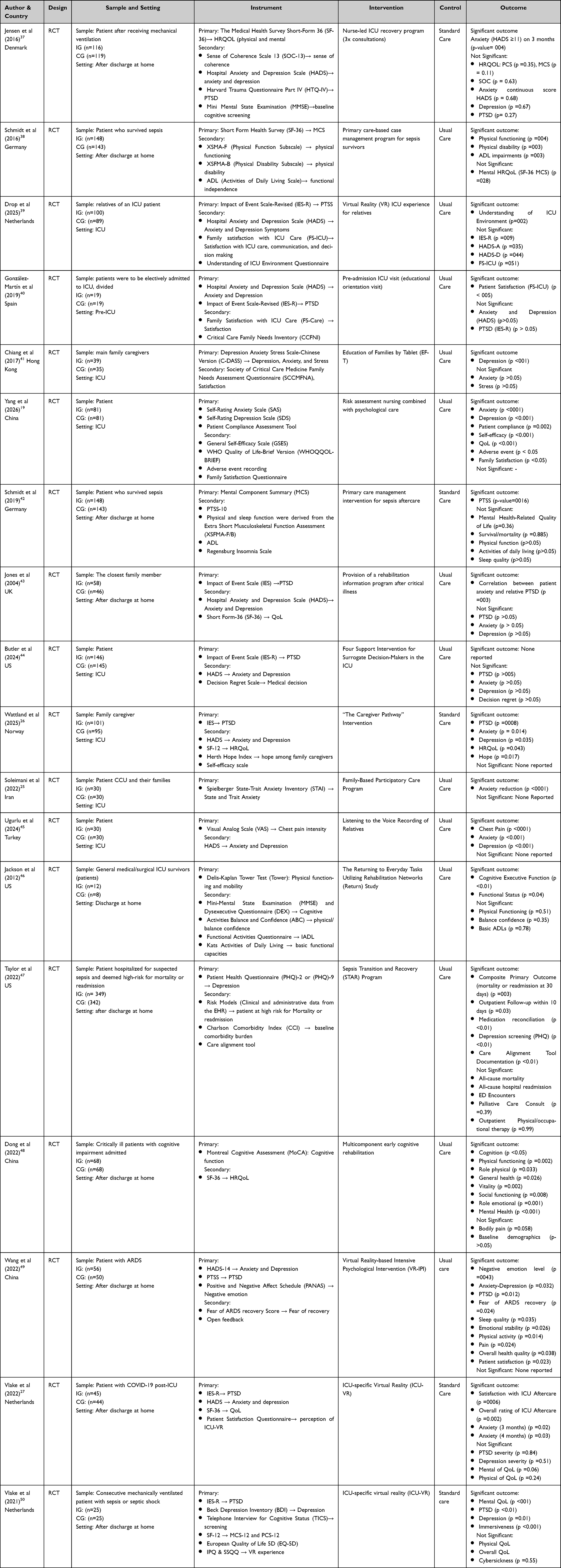 |
Table 1 Characteristics of Studies |
 |
Table 2 Characteristics of Intervention |
Interventions identified in the included studies were categorized into four domains: psychosocial, rehabilitation and follow-up, technology-based, and family-based interventions. Categorization was determined primarily by the predominant therapeutic mechanism and the intervention’s intended primary target, rather than by delivery format. Interventions were classified as psychosocial if their core components focused on emotional support, therapeutic communication, psychological education, or sensemaking processes. Rehabilitation and follow-up interventions were defined by a primary emphasis on restoring physical, cognitive, or functional capacity and facilitating continuity of care following ICU discharge. Technology-based interventions were those in which a digital modality, such as virtual reality, tablet-based education, or multimedia platforms, served as the central therapeutic vehicle. Family-based interventions were classified as those primarily targeting the family unit or caregiver dyad, with structured family involvement as the core design principle. In cases where interventions contained overlapping elements, such as family-based programs with psychoeducational components or technology-mediated tools within a broader rehabilitative program, classification was assigned based on the dominant intervention mechanism as described by study authors. These boundary cases were documented and discussed among reviewers to ensure consistency and transparency in classification.
Assessment of Risk of Bias and Certainty of the Evidence
Risk of bias in the included RCTs was assessed using the Cochrane Risk of Bias tool for randomized trials (RoB 2).51 RoB 2 evaluates five domains of potential bias: (1) bias arising from the randomization process, (2) bias due to deviations from the intended interventions, (3) bias due to missing outcome data, (4) bias in measurement of the outcome, and (5) bias in selection of the reported result. For each domain, risk of bias was judged as “low risk”, “some concerns”, or “high risk”, and an overall risk of bias judgment was derived for each trial. Two reviewers independently performed the RoB 2 assessments; disagreements were discussed and resolved by consensus. The resulting risk-of-bias judgments were taken into account when interpreting the strength and assurance of the evidence.
The certainty of evidence for each major outcome was assessed using the Grading of Recommendations Assessment, Development and Evaluation (GRADE) framework. Because all included studies were RCTs, the certainty of evidence initially started at a high level and was downgraded according to five domains: risk of bias, inconsistency, indirectness, imprecision, and publication bias. Certainty assessments were conducted separately for the four major psychological outcomes (anxiety, depression, post-traumatic stress disorder [PTSD], and health-related quality of life [HRQoL]). Owing to substantial clinical and methodological heterogeneity across intervention types, populations, outcome measures, and follow-up periods, certainty judgments were based on narrative synthesis rather than pooled meta-analytic estimates. The detailed GRADE assessment is presented in Table S1.
Results
Study Selection
Database searches identified 19,830 records, comprising PubMed (n = 870), Springer Nature (n = 11,243), Scopus (n = 516), EBSCOhost (n = 641), and Taylor & Francis (n = 6560). After removing 1206 duplicate records, 18,624 records remained for title and abstract screening, of which 18,588 were excluded. The full texts of the remaining 66 reports were assessed for eligibility. Fifty-three reports were excluded for the following reasons: pediatric population (n = 26), non-randomized controlled trial design (n = 9), absence of psychological outcomes (n = 17), and pre-hospital setting (n = 1).
In addition, 15 records were identified through manual searching of the reference lists of eligible studies and relevant reviews. Following full-text assessment, 5 studies met the eligibility criteria, while 10 records were excluded. Overall, 18 randomized controlled trials were included in the final review, consisting of 13 studies identified through database searching and 5 studies identified through hand searching (Figure 1).
Risk of Bias Assessment Results
The risk of bias assessment across the included studies showed variability in methodological quality, with several studies classified as low or high risk of bias (Figure 2). Studies categorized as having an overall low risk of bias included Yang et al (2026),19 Jones et al (2004),43 Butler et al (2024),44 Soleimani et al (2022),25 and Jackson et al (2012).46 These studies consistently showed low risk across most domains, including randomization, intervention adherence, outcome measurement, and selective reporting, indicating strong methodological rigor and reliability of findings. In contrast, several studies were identified as having an overall high risk of bias, including Schmidt et al (2016),38 Drop et al (2025),39 González-Martín et al (2019),40 Schmidt et al (2019),42 Wattland et al (2024),26 Taylor et al (2022),47 Wang et al (2022),49 and Vlake et al (2022; 2021).27,50 The high risk in these studies was primarily associated with issues in the randomization process, deviations from intended interventions, and measurement of outcomes, which may affect the internal validity of the results. Overall, while many studies demonstrated strong methodological quality, the presence of several high-risk studies underscores the need for cautious interpretation of the evidence, particularly when synthesizing findings across studies with varying levels of bias.
 |
Figure 2 Risk of Bias Assessments Results. |
Certainty of the Evidence
The certainty of evidence for the four major outcomes was evaluated using the GRADE framework (Table S1). Overall, the certainty of evidence ranged from low to very low. Anxiety, depression, and HRQoL were rated as low-certainty evidence, whereas evidence for PTSD was judged as very low certainty. Downgrading was primarily attributable to serious concerns regarding risk of bias and inconsistency. Several included RCTs were judged as having a high risk of bias according to the RoB 2 assessment, particularly in the domains of the randomization process, deviations from intended interventions, and outcome measurement. Furthermore, intervention effects varied substantially across studies, with both significant and non-significant findings reported for all psychological outcomes, resulting in serious inconsistency.
No serious concerns were identified regarding indirectness, as the included studies were generally consistent with the predefined review question in terms of participants, interventions, comparators, and outcomes. Likewise, publication bias was not detected. However, evidence for PTSD was further downgraded because of serious imprecision, reflecting the relatively limited number of contributing studies and uncertainty surrounding the consistency of treatment effects.
Characteristics of Studies
A total of 18 studies included in this review demonstrated consistent methodological rigor, with all employing the RCT design (Table 1). Geographically, the studies were predominantly conducted in high-income countries, particularly in Europe and North America. European countries such as Denmark, Germany, the Netherlands, Spain, Norway, and the United Kingdom contributed a substantial number of studies.26,37–40,42,43 Additionally, several studies were conducted in the United States.44,46,47 In Asia, research was mainly carried out in China, Hong Kong, Iran, and Turkey.18,19,25,41,45,48,49
Regarding study settings, most interventions were conducted either during ICU admission or after hospital discharge. A large proportion of studies were implemented in ICU settings, targeting patients, family members, or caregivers during critical care.18,19,25,26,39,41,44,45 Meanwhile, several studies focused on the post-ICU phase, particularly after discharge at home, aiming to improve long-term recovery outcomes such as quality of life, psychological status, and functional ability.27,37,38,42,46–49 Only one study addressed the pre-ICU phase by providing educational orientation prior to ICU admission.40 Overall, the included studies emphasize the acute (ICU) and post-acute (post-discharge) phases of care, with limited attention to preventive or pre-ICU interventions. Additionally, the dominance of studies conducted in high-income countries may limit the generalizability of findings to low-resource settings.
Characteristics of Participants
The included studies involved diverse participants, including critically ill patients, ICU survivors, and family members or caregivers. Most studies primarily focused on patients, particularly those who had experienced critical illness, such as individuals receiving mechanical ventilation, sepsis survivors, patients with acute respiratory distress syndrome (ARDS), and critically ill patients with cognitive impairment.19,37,38,42,47–49 The sample sizes varied considerably across studies, ranging from small pilot trials with fewer than 20 participants to large-scale randomized trials involving more than 300 participants.36,38
Several studies specifically targeted ICU survivors during the post-discharge phase, reflecting an increasing focus on long-term recovery following critical illness.27,37,38,42,43,46–48,50 In contrast, some studies recruited patients during ICU admission, particularly those who were critically ill or undergoing intensive treatments.18,19,25,26,39,41,44,45 One study conducted pre-ICU and evaluated after discharge.40 In addition to patient populations, many studies included family members or caregivers, either as primary participants or alongside patients. These included relatives of ICU patients, main family caregivers, and surrogate decision-makers, highlighting the importance of family-centered care in critical care settings.18,26,39,41,43,44 Some studies focused exclusively on family members, such as relatives of ICU patients or caregivers involved in decision-making.26,39,41 Meanwhile, other studies included both patients and their families, reflecting a more holistic approach to care.25
Characteristics of Intervention
Based on their dominant components, the interventions were grouped into four categories: (I) psychosocial interventions, (II) rehabilitation and follow-up interventions, (III) technology-based interventions, and (IV) family-based interventions (Table 2 and Figure 3). Overall, these interventions demonstrated that ICU-related care extended beyond symptom management to include emotional recovery, long-term rehabilitation, technological support, and family involvement.
 |
Figure 3 Summary of Results. |
Category I: Psychosocial Interventions
A total of four studies were categorized as psychosocial interventions. These interventions primarily focused on emotional support, structured communication, coping strategies, psychological care, and educational support to help participants understand and process the ICU experience. For example, Jensen et al (2016)37 implemented a nurse-led ICU recovery program that integrated person-centered communication, psychological support, and reflection on ICU experiences. Similarly, González-Martín et al (2019)40 provided a pre-admission ICU orientation visit to prepare patients prior to ICU admission. Yang et al (2026)19 combined risk assessment nursing with psychological care during ICU stay. In addition, Butler et al (2024)44 delivered a structured support intervention focusing on emotional support, communication, and decision-making assistance for surrogate decision-makers in the ICU.
Across these studies, several key components were consistently identified. Emotional support was a central element in the interventions by Jensen et al (2016), Yang et al (2026), and Butler et al (2024),19,37,44 while communication and informational support were emphasized in González-Martín et al (2019). In particular, Huang et al (2022) highlighted the role of sensemaking through structured informational and emotional support, and Butler et al (2024)44 emphasized communication and decision support for families in critical care settings. Although educational elements were present in multiple interventions, their primary purpose was to reduce uncertainty and enhance psychological adaptation rather than to provide technical rehabilitation.
The role of nurses was particularly prominent in this category. Jensen et al (2016)37 described interventions delivered by trained nurses, while González-Martín et al (2019)40 involved a trained nurse in providing pre-admission education. Yang et al (2026)19 reported a nurse-led intervention delivered throughout the ICU stay, indicating a continuous role in psychological care. Similarly, Butler et al (2024) described trained nurses as the primary providers of emotional and communication support for surrogate decision-makers.
Category II: Rehabilitation and Follow-Up Interventions
A total of six studies were classified as rehabilitation and follow-up interventions.38,42,43,46–48 These interventions primarily focused on promoting recovery after critical illness through structured rehabilitation, case management, post-discharge follow-up, and continuity of care. Specifically, Schmidt et al (2016) and Schmidt et al (2019) implemented primary care-based sepsis aftercare programs,38,42 Jackson et al (2012) evaluated a rehabilitation network program for ICU survivors,46 Taylor et al (2022)47 tested the Sepsis Transition and Recovery (STAR) program, Dong et al (2022)48 applied a multicomponent early cognitive rehabilitation program. Jones et al (2004)43 delivered a rehabilitation information program following critical illness.
Across these studies, several key components were identified. Case management and structured monitoring were central in the interventions by Schmidt et al (2016) and Schmidt et al (2019),38,42 while care coordination and transition support were emphasized in Taylor et al (2022).47 Rehabilitation-focused components, including physical and cognitive recovery, were prominent in Jackson et al (2012) and Dong et al (2022).46,48 In addition, Jones et al (2004)43 highlighted the importance of providing structured recovery information to support the transition from ICU to home. Compared with psychosocial interventions, this category placed greater emphasis on functional recovery, long-term monitoring, and restoration of physical and cognitive health following ICU discharge.
Nurses played a central role in implementing these interventions, particularly in follow-up care and coordination. In the studies by Schmidt et al (2016) and Schmidt et al (2019),38,42 ICU-trained nurses acted as case managers, working alongside consulting physicians to monitor patients and provide ongoing support. Taylor et al (2022) similarly described the use of a sepsis nurse navigator to coordinate post-discharge care and facilitate continuity of services.47 In contrast, interventions such as those by Jackson et al (2012) and Dong et al (2022) involved broader multidisciplinary teams, including rehabilitation specialists and mental health professionals, where nurses contributed as part of a collaborative care model.36,49
Category III: Technology-Based Interventions
A total of six studies were categorized as technology-based interventions. These studies used digital or multimedia approaches as the central mode of intervention delivery. Drop et al (2025)39 used virtual reality for relatives of ICU patients, Chiang et al (2017)41 used tablet-based education for family caregivers, Ugurlu et al (2024) used voice recordings from relatives, Wang et al (2022)49 implemented virtual reality-based intensive psychological intervention, and both Vlake et al (2021) and Vlake et al (2022) evaluated ICU-specific virtual reality.27,50
The technological media differed across studies, but the underlying purpose was similar: to enhance understanding, provide emotional reassurance, or improve psychological adaptation. Virtual reality was central in several studies,27,39,49,50 tablet-based information delivery was used in Chiang et al (2017);41 and audio-based emotional support was used in Ugurlu et al (2024).45 This category, therefore, reflects the use of technology not only as an information tool but also as a therapeutic medium to support ICU-related recovery and coping.
The role of nurses in this category appeared to be present but more variable compared to other intervention types. In some studies, nurses served as the primary providers of the intervention, such as trained ICU nurses delivering it and nurses in CICU settings.41,45 In other cases, nurses contributed as part of a multidisciplinary team, for example, in interventions in which virtual reality content was introduced by both physicians and nurses27 or delivered within an interdisciplinary team that included ICU nurses.39 However, not all technology-based interventions were nurse-led. In one study, the intervention was primarily delivered by a trained psychologist, suggesting that the intervention’s leadership could shift depending on the program’s design and focus.49
Category IV: Family-Based Interventions
A total of two studies were grouped as family-based interventions.25,26 These interventions primarily emphasized the involvement, support, or empowerment of family members and caregivers during the ICU experience. Soleimani et al (2022)25 implemented a family-based participatory care program, and Wattland et al (2025)26 evaluated “The Caregiver Pathway” intervention.
This category featured several recurring components. Participatory care and family involvement in patient care, decision-making support, caregiver support, and follow-up were the dominant themes. In contrast, informational and emotional support for family sensemaking were less prominent.18,25,26 Unlike the psychosocial category, which mainly addressed individual psychological adjustment, family-based interventions explicitly positioned relatives or caregivers as active participants in care or recovery.
The role of nurses was particularly prominent and consistent across all studies in this category. In Soleimani et al (2022),25 nurses in the CCU facilitated family participation in patient care, while Wattland et al (2025)26 described interventions delivered by trained ICU nurses that provided ongoing support and follow-up. Overall, nurses in family-based interventions played a central role not only as care providers but also as educators, communicators, and facilitators of family engagement.
Characteristics of Outcome
The outcomes reported in the included studies were categorized into primary and secondary outcomes. Primary outcomes mainly focused on psychological status and quality of life, while secondary outcomes included physical, functional, and healthcare-related measures.
Primary Outcomes: Psychological Outcomes and Quality of Life
Psychological outcomes were the most frequently assessed primary outcomes across the included studies. These primarily included anxiety, depression, and post-traumatic stress disorder (PTSD), measured using validated instruments such as the Hospital Anxiety and Depression Scale (HADS), Impact of Event Scale (IES/IES-R), Self-Rating Anxiety Scale (SAS), and Self-Rating Depression Scale (SDS).18,19,27,37,41,45,49,50 In addition, QoL was consistently reported as a primary outcome, reflecting both physical and mental health dimensions following ICU experience. QoL was commonly measured using instruments such as the Short Form Health Survey (SF-36, SF-12) and WHOQOL-BREF.27,37,38,42,48,50
Anxiety was one of the most frequently reported outcomes and was significantly reduced in several studies.19,25–27,37,45,49 Similarly, depression showed significant improvement across multiple studies.19,26,41,45,49,50 PTSD was also commonly assessed and demonstrated a significant reduction following interventions in several studies.18,26,42,49,50 In addition, QoL was reported as a primary outcome and showed significant improvement in several studies.19,26,48,50
Secondary Outcomes: Physical, Functional, and Healthcare-Related Outcomes
Secondary outcomes included physical, functional, and healthcare-related outcomes. Physical and functional outcomes, such as physical functioning, disability, and activities of daily living, were reported to improve significantly in several studies.38,46,48 Cognitive outcomes also improved in selected studies.46,48 In addition, healthcare-related outcomes, including patient compliance, outpatient follow-up, and care processes, showed significant improvements.47 Family-related outcomes, including satisfaction, understanding of the ICU environment, and hope, were also reported to be significantly improved following the interventions.26,39,40
Not Significant Outcomes
Despite the overall positive findings, several studies reported non-significant results across both primary and secondary outcomes. Psychological outcomes such as anxiety and depression were not consistently improved in all studies.18,37,44 Similarly, PTSD outcomes were inconsistent, with some studies reporting no significant effect.27,37,39,44 QoL outcomes also showed mixed results, with some studies reporting no significant improvement.27,37,38 In addition, certain physical and functional outcomes, such as physical functioning and activities of daily living, were not significantly improved in some studies.38,46 Healthcare-related outcomes, including mortality, readmission, and decision regret, were also reported as non-significant in several studies.44,47
Discussion
Principal Findings
This systematic review demonstrates that nursing interventions to support the psychological recovery of ICU patients and their families are complex and heterogeneous, with significant variation in design, intensity, timing of implementation, and components involved. Although most studies report improvements in psychological outcomes, inconsistent findings across studies suggest that the effectiveness of interventions is determined not only by the type of approach but also by the underlying mechanisms, continuity, and implementation context. The interventions in this review are categorized into four domains: psychosocial, rehabilitation and follow-up, technology-based, and family-based, according to their predominant therapeutic mechanisms and primary intervention targets. This framework offers a significant conceptual contribution by facilitating a systematic understanding of mechanisms of action and patterns of effectiveness. However, several interventions included overlapping elements across categories. Classification decisions were made transparently and were guided by the dominant design intent of each intervention, as detailed in the Methods section. This categorization provides an important conceptual contribution by enabling a more systematic understanding of the mechanisms of action, effectiveness, and existing gaps within each type of intervention.
Psychosocial Interventions: The Foundation of Psychological Recovery in the ICU
Psychosocial interventions in this review consistently focused on emotional support, therapeutic communication, education, and sensemaking. Interventions such as communication-based recovery programs and psychological support have demonstrated effectiveness in reducing anxiety and improving psychological adaptation among both patients and their families.19,37 Within this category, most studies reported a positive trend in reducing anxiety. However, findings related to depression and PTSD remained inconsistent.
For example, continuous and multicomponent interventions, such as those implemented by Yang et al (2026),19 showed significant improvements in both anxiety and depression. In contrast, more limited or episodic interventions, such as those reported by Jensen et al (2016),37 demonstrated only partial effects, while Butler et al (2024)44 reported no significant improvements across psychological outcomes. These differences suggest that their intensity and duration strongly influence the effectiveness of psychosocial interventions.
Conceptually, these findings are consistent with the stress and coping theory, which posits that adaptation to chronic stress requires sustained support rather than short-term interventions.52 Furthermore, differences in target populations also contribute to variations in outcomes. Interventions focusing directly on patients tend to produce stronger effects compared to those targeting family members alone, who often experience more complex psychological distress due to clinical uncertainty and the burden of decision-making.32,53,54
The intensity and duration of interventions appear to influence outcomes in this category significantly. Studies utilizing continuous, multicomponent delivery throughout the ICU stay, such as Yang et al (2026),19 demonstrated more sustained improvements across multiple psychological domains than episodic or single-session interventions.37,44 This observed intensity-response relationship indicates that brief psychosocial interventions may not be sufficient to achieve lasting psychological change in the context of critical illness, where psychological distress is both severe and multidimensional. Furthermore, the prevalence of high or unclear risk of bias across several studies, particularly regarding allocation concealment and blinding of outcome assessors, warrants caution when interpreting reported effect sizes.
Rehabilitation and Follow-Up Interventions: The Gap Between Physical and Psychological Recovery
In contrast to psychosocial interventions, rehabilitation and follow-up interventions demonstrate a more consistent pattern of improvement in physical and functional outcomes but are less effective in addressing psychological outcomes. These interventions emphasize long-term recovery through case management, physical and cognitive rehabilitation, and continuity of care after ICU discharge. Previous studies indicate that these approaches are effective in improving physical functioning, cognitive outcomes, and healthcare processes.38,42,46,47 However, their impact on psychological outcomes, such as mental health–related quality of life, anxiety, and depression, remains inconsistent.38,43
Previous studies further indicate that despite improvements in physical functioning or daily activities, there are no significant changes in mental quality of life, anxiety, or PTSD.38,43 This suggests a mismatch between the focus of the interventions and the targeted outcomes, as most rehabilitation approaches remain predominantly biomedical and do not explicitly address psychological mechanisms such as trauma or emotional distress. This phenomenon can be explained by the concept of post-intensive care syndrome (PICS), which highlights that physical and psychological impairments develop through different pathways and do not necessarily influence each other directly.55 In this context, the role of nurses as case managers represents a key strength, as it facilitates continuity of care. However, the lack of intervention components specifically targeting psychological trauma remains a major limitation of this category.
Variability in follow-up periods across rehabilitation studies complicates the interpretation of outcomes. Studies with extended follow-up windows, such as Schmidt et al (2019)42 at 24 months, offer insights into the durability of intervention effects. In contrast, studies with shorter follow-up periods may capture only transient gains that do not persist beyond the immediate post-discharge phase. Additionally, several studies in this category were rated as having some concerns or a high risk of bias, particularly regarding deviations from intended interventions and missing outcome data. These factors may have inflated estimates of effectiveness for physical outcomes while obscuring genuine null effects on psychological endpoints.
Technology-Based Interventions: Innovations with Variable Effectiveness
Technology-based interventions demonstrate considerable innovative potential but also exhibit the greatest variability in effectiveness among categories. Studies such as Wang et al (2022)49 and Vlake et al (2021)50 report that the use of VR can significantly reduce anxiety, depression, and PTSD, particularly when technology is applied as an immersive and structured therapeutic tool. In contrast, other studies, including Drop et al (2025)39 and Vlake et al (2022),27 found no significant effects on key psychological outcomes.
One of the main strengths of these interventions lies in their ability to provide immersive experiences and visualizations that help patients and families reconstruct ICU experiences that were previously confusing or traumatic. This aligns with exposure-based therapy approaches, where individuals are gradually re-exposed to traumatic experiences in a safe environment. However, inconsistent findings across studies suggest that technology alone is not always effective, particularly when it is not integrated with a humanistic or therapeutic approach.27,39 Interventions that rely solely on technology without therapeutic interaction may lack psychological depth and meaning. Therefore, technology should be positioned as a complementary tool rather than a replacement for human-centered nursing care.
Variability in outcomes among technology-based interventions can be attributed in part to differences in intervention intensity and the degree of therapeutic integration. Wang et al (2022)49 implemented a VR-based intervention twice daily for one month, with each session lasting 30 minutes and accompanied by structured psychological counseling, and reported more consistent improvements than Vlake et al (2022),27 whose single 14-minute exposure without ongoing therapeutic support produced limited psychological benefits. The overall evidence for virtual reality remains mixed and does not permit definitive conclusions regarding its effectiveness as a nursing intervention for psychological recovery in ICU populations. The effectiveness of VR appears highly dependent on intervention intensity, degree of therapeutic integration, and contextual factors.
Family-Based Interventions: A Promising but Preliminary Evidence Base
Family-based interventions have shown a promising pattern of effectiveness in improving psychological outcomes for both patients and caregivers, including reductions in anxiety, depression, and PTSD symptoms, as well as enhancements in quality of life. However, this category includes only two RCTs, and the consistency of positive findings across these studies, while noteworthy, is insufficient to draw definitive conclusions regarding the comparative superiority of this approach over other intervention modalities. The observed effectiveness of family-based interventions may be attributable to their holistic design, which addresses both the patient and the broader social context in which recovery occurs. Nonetheless, recommendations favoring family-based approaches over alternative interventions should be considered preliminary and hypothesis-generating until validated by larger, methodologically rigorous, and independently replicated trials. The risk-of-bias profiles of the two included studies should also be considered when interpreting the strength of these findings.
Family-based interventions showed a promising pattern of effectiveness in improving psychological outcomes, including anxiety, depression, PTSD, and quality of life.25,26 Interventions in this category typically include education, emotional support, participation in care, and post-ICU follow-up. Both included studies reported reductions in psychological distress and improvements in overall well-being. However, given that this category comprises only two studies, these findings should be interpreted with caution and are insufficient to establish definitive conclusions regarding the superiority of this approach over other intervention modalities.25,26 These studies consistently report reductions in psychological distress and improvements in overall well-being.
Conceptually, the potential strength of this approach lies in its holistic nature, as it simultaneously addresses the patient and the broader social system in which recovery occurs. Nonetheless, the limited number of studies in this category precludes firm conclusions about its comparative effectiveness, and larger, well-powered trials are needed before family-based interventions can be recommended as the preferred modality in clinical practice.25,26 Nurses play a dominant role as facilitators of communication, educators, and coordinators of care.
Key Gap: Limited Interventions in the Pre-ICU Phase
An important observation from this review is the marked paucity of evidence regarding the pre-ICU phase. Only one study assessed an intervention at this stage, specifically an educational orientation visit prior to ICU admission, which did not demonstrate significant effects on psychological outcomes.40 As the review’s conclusions regarding the pre-ICU phase are based solely on this single study, which involved a single educational session without structured follow-up, no generalizable conclusions can be drawn about the effectiveness or ineffectiveness of pre-ICU nursing interventions.32,53,54 The lack of evidence in this phase should be regarded as a significant research gap rather than as evidence of no effect. Further research specifically designed to evaluate preventive psychological interventions in the pre-ICU context, with sufficient intensity, follow-up, and outcome measurement, is necessary before clinical recommendations can be formulated.
Overall, comparisons across intervention categories indicate that the level of integration, continuity, and interpersonal engagement strongly influences the effectiveness of nursing interventions. Multicomponent, continuous, and family-involved interventions yield more consistent outcomes than fragmented or single-component approaches. Furthermore, although technology offers promising innovations, its effectiveness remains dependent on integration with humanistic care. These findings highlight that psychological recovery in the ICU context requires a multidimensional approach that simultaneously integrates biological, psychological, and social components.
Implications for Practice
The findings of this review have significant implications for clinical nursing practice, especially within critical care environments. The available evidence well supports several implications, while others remain promising yet preliminary.
The most consistent implication for practice is the integration of psychological support into routine intensive care unit (ICU) nursing care. Most psychosocial interventions reviewed demonstrated positive effects on anxiety, though effects on depression and post-traumatic stress disorder were less consistent. Consequently, ICU nursing practice should transition from fragmented or short-term interventions to a continuous approach that supports patients throughout the ICU trajectory, including admission, stay, and post-discharge periods. Interventions that combine psychosocial support, education, follow-up care, and coordination are more consistently beneficial than single-component interventions. Psychological care should therefore be established as a core element of ICU nursing practice rather than as an ancillary or optional activity.
The findings also support expanding nurses’ roles in providing psychological support and ensuring continuity of care for ICU survivors. Nurse-led case management, follow-up care, education, and structured communication demonstrated potential benefits, particularly when interventions were continuous and coordinated across care transitions. These results indicate that nurses contribute not only to bedside care but also serve as care coordinators, educators, and providers of psychological support. Implementing these roles requires enhanced competencies in communication, psychological assessment, trauma-informed care, and post-ICU follow-up.
In contrast, certain implications remain promising but preliminary. Family-centered interventions demonstrated positive outcomes in the reviewed studies; however, the evidence base is limited due to the small number of randomized controlled trials in this area. As such, structured family involvement may be included as part of comprehensive ICU psychological care, but this recommendation should be applied cautiously and requires validation through larger, methodologically rigorous studies. Nurses can facilitate this approach by promoting communication among patients, families, and healthcare teams, and by supporting family members at risk for post-intensive care syndrome-family.
Technology-based interventions, including virtual reality, mobile applications, and digital follow-up tools, present promising opportunities to support psychological recovery following critical illness. However, current evidence does not support their use as standalone interventions. Their effectiveness depends on integration into human-centered, nurse-led care. Digital health tools should therefore be regarded as complementary strategies that may enhance, rather than substitute for, direct nursing support, communication, and continuity of care. In summary, the findings indicate that ICU nursing practice should prioritize integrated psychosocial support and continuity of care, as evidenced by the recommendations. Family-centered and technology-based approaches should be considered emerging strategies with potential value, though their effectiveness requires further validation through high-quality randomized controlled trials.
The GRADE assessment further strengthens the interpretation of the present findings by demonstrating that the overall certainty of evidence ranged from low to very low across the major psychological outcomes. Although many nursing interventions showed favorable effects on anxiety, depression, PTSD, and HRQoL, confidence in these estimates remains limited because of methodological limitations, substantial heterogeneity in intervention characteristics and outcome measurements, and inconsistent findings across studies. The evidence for PTSD was judged to be of very low certainty because of additional concerns regarding imprecision, whereas anxiety, depression, and HRQoL were supported by low-certainty evidence. Therefore, the observed benefits of nursing interventions should be interpreted with caution, and future multicenter RCT using standardized intervention protocols and outcome measures are needed to provide more robust and definitive evidence.
Strengths and Limitations
This systematic review has several strengths. First, it focuses exclusively on RCTs, which represent the highest level of evidence for evaluating intervention effectiveness, thereby enhancing the reliability of the findings. Second, this review provides a comprehensive and integrative categorization of nursing interventions into psychosocial, rehabilitation and follow-up, technology-based, and family-based approaches. This categorization contributes to a clearer conceptual framework for understanding how different intervention types operate and interact to support psychological recovery. Third, the review adopts a comparative and analytical synthesis, allowing identification of patterns, inconsistencies, and underlying mechanisms across studies, rather than merely summarizing findings.
However, several limitations should be acknowledged. First, there was substantial heterogeneity across the included studies in terms of intervention design, duration, outcome measures, and follow-up periods, which limited the ability to conduct a meta-analysis and required reliance on narrative synthesis. Second, variations in methodological quality, including the presence of studies with a high risk of bias, may affect the internal validity and interpretation of the findings. Third, most studies were conducted in high-income countries, which may limit the generalizability of the results to low- and middle-income settings with different healthcare systems and resource availability. Additionally, the review was restricted to studies published in English, which may introduce language and publication bias. Finally, the extremely limited number of studies in specific intervention categories, particularly family-based interventions (n = 2) and the pre-ICU phase (n = 1), represents a significant constraint on the interpretability of findings within these domains. Consequently, conclusions regarding these categories should be considered preliminary and hypothesis-generating rather than confirmatory until replicated in future well-designed trials.
Conclusion
This systematic review synthesizes evidence from 18 RCTs examining nursing interventions to support psychological recovery in ICU patients and their families. The findings, categorized into four intervention domains: psychosocial, rehabilitation and follow-up, technology-based, and family-based, suggest that nursing-led or nursing-involved interventions can improve psychological outcomes in ICU populations, particularly when implemented as multicomponent, continuous, and family-integrated strategies. These domains, however, encompass a wide range of approaches, including educational interventions, psychological support, virtual reality, telemedicine, and nursing follow-up programs, which vary significantly in modality, delivery mechanism, intensity, and theoretical foundation. This diversity limits the direct comparability of findings both across and within categories. Furthermore, these conclusions should be interpreted cautiously due to significant methodological limitations in the included studies.
Most included RCTs were limited by small sample sizes, high or unclear risk of bias, single-center designs, and considerable heterogeneity in both intervention components and outcome measurement tools. These factors collectively prevent definitive conclusions regarding the superiority of any specific intervention approach. While family-based interventions showed promise as a potentially effective approach, this finding is based on a limited number of studies. It does not constitute definitive evidence of greater effectiveness compared to other intervention categories. Replication in larger, methodologically rigorous trials is necessary before drawing firm conclusions.
A critical gap remains in the pre-ICU phase, where preventive interventions are largely underexplored. Overall, the findings suggest that psychological recovery in ICU settings requires a comprehensive, multilevel, and continuous approach that integrates biological, psychological, and social dimensions of care. Future research should prioritize the development of integrated, nurse-led, multicomponent interventions and expand investigations into early-phase and context-specific applications, particularly in low- and middle-income settings.
Acknowledgments
All authors thank Universitas Padjadjaran, Bandung, West Java, Indonesia, for facilitating the database for us in this study. This publication charge is funded by Unpad through the Indonesian Endowment Fund for Education (LPDP) on behalf of the Indonesian Ministry of Higher Education, Science and Technology, and managed under the EQUITY Program (Contract No. 4303/B3/DT.03.08/2025 and 3927/UN6. RKT/HK.07.00/2025).
Disclosure
The authors had no conflicts of interest in this research.
References
1. Saeid Y, Salaree M, Ebadi A, Moradian S. Family intensive care unit syndrome: an integrative review. Iran J Nurs Midwifery Res. 2020;25(5):361–29. doi:10.4103/ijnmr.IJNMR_243_19
2. Białek K, Sadowski M. Stress, anxiety, depression and basic hope in family members of patients hospitalised in intensive care units – preliminary report. Anaesthesiol Intensive Ther. 2021;53(2):134–140. doi:10.5114/ait.2021.105728
3. Abdallah HMM, Amin SM, Hammouda EY, Atta M, El-Monshed A, Hamad N. Family intensive care unit syndrome: investigating the mediating role of healthcare communication in psychological well-being among family members. Nurs Crit Care. 2025;30(4). doi:10.1111/nicc.70119
4. Geense W, Zegers M, Peters M, et al. New physical, mental, and cognitive problems 1-year Post-ICU: a prospective multicenter study. Am J Respir Crit Care Med. 2021;203(12):1512–1521. doi:10.1164/rccm.202009-3381OC
5. Johnson C, Suchyta M, Darowski E, et al. Psychological sequelae in family caregivers of critically-ill intensive care unit patients: a systematic review. Ann Am Thorac Soc. 2019;16(7):894–909. doi:10.1513/AnnalsATS.201808-540SR
6. Halain AA, Tang L, Chong M, Ibrahim N, Abdullah KL. Psychological distress among the family members of Intensive Care Unit (ICU) patients: a scoping review. J Clin Nurs. 2021;31(5–6):497–507.
7. Schembari G, Santonocito C, Messina S, et al. Post-intensive care syndrome as a burden for patients and their caregivers: a narrative review. J Clin Med. 2024;13(19):5881. doi:10.3390/jcm13195881
8. Jezierska N. Psychological reactions in family members of patients hospitalised in intensive care units. Anaesthesiol Intensive Ther. 2014;46(1):42–45. doi:10.5603/AIT.2014.0009
9. Putowski Z, Rachfalska N, Majewska K, Megger K, Krzych Ł. Identification of risk factors for post-intensive care syndrome in family members (PICS-F) among adult patients: a systematic review. Anaesthesiol Intensive Ther. 2023;55(3):168–178. doi:10.5114/ait.2023.130831
10. Smith A, Ferguson H, Russell R, Savsani P, Wang S. Post-Intensive Care Syndrome Family. Crit Care Clin. 2024;41(1):73–88. doi:10.1016/j.ccc.2024.08.008
11. Shirasaki K, Hifumi T, Nakanishi N, et al. Postintensive care syndrome family: a comprehensive review. Acute Med Surg. 2024;11(1). doi:10.1002/ams2.939
12. Jackson JC, Jutte JE, Hunter CH, Ciccolella N, Warrington H, Sevin C. Post-traumatic stress disorder (PTSD) after critical illness: a conceptual review of distinct clinical issues and their implications. Rehabil Psychol. 2016;61(2):132–140. doi:10.1037/rep0000085
13. Zante B, Erne K, Grossenbacher J, Camenisch SA, Schefold JC, Jeitziner MM. Symptoms of post-traumatic stress disorder (PTSD) in next of kin during suspension of ICU visits during the COVID-19 pandemic: a prospective observational study. BMC Psychiatry. 2021;21(477):1–9. doi:10.1186/s12888-021-03468-9
14. Unoki T, Sakuramoto H, Uemura S, et al. Prevalence of and risk factors for post- intensive care syndrome: multicenter study of patients living at home after treatment in 12 Japanese intensive care units, SMAP-HoPe study. PLoS One. 2021;5(16):e0252167. doi:10.1371/journal.pone.0252167
15. Righy C, Rosa RG, Teixeira R, et al. Prevalence of post-traumatic stress disorder symptoms in adult critical care survivors: a systematic review and meta-analysis. Crit care. 2019;23(213):1–13. doi:10.1186/s13054-019-2489-3
16. Kang J. Being devastated by critical illness journey in the family: a grounded theory approach of post-intensive care syndrome-family. Intensive Crit Care Nurs. 2023;78:103448. doi:10.1016/j.iccn.2023.103448
17. Hatch R, McKechnie S, Griffiths J. Psychological intervention to prevent ICU-related PTSD: who, when and for how long? Crit Care. 2011;15(2):141. doi:10.1186/cc10054
18. Huang HQ, Dong HY, Guan XY, Zhang L, Zhou Q. The facilitated sensemaking model as a framework for nursing intervention on family members of mechanically ventilated patients in the intensive care unit. Worldviews Evidence-Based Nurs. 2022;19(6):467–476. doi:10.1111/wvn.12606
19. Yang F, Wang L, Liu J, He W, Fang P. Impact of risk assessment nursing combined with psychological care on SAS scores, SDS scores, and patient compliance in patients in the surgical intensive care unit: a single-center, randomized controlled trial. Langenbeck’s Arch Surg. 2026;1–9.
20. Davydow DS, Gifford JM, Desai SV, Needham DM, Bienvenu OJ. Post-traumatic stress disorder in general intensive care unit survivors: a systematic review. Gen Hosp Psychiatry. 2008;30(5):421–434. doi:10.1016/j.genhosppsych.2008.05.006
21. Schelling G, Stoll C, Haller M, et al. Health-related quality of life and post-traumatic stress disorder in survivors of the acute respiratory distress syndrome. Crit Care Med. 1998;26(4):651–659. doi:10.1097/00003246-199804000-00011
22. Gamberini L, Mazzoli CA, Prediletto I, et al. Health-related quality of life profiles, trajectories, persistent symptoms and pulmonary function one year after ICU discharge in invasively ventilated COVID-19 patients, a prospective follow-up study. Respir Med. 2021;189:106665. doi:10.1016/j.rmed.2021.106665
23. Ramalingam MB, Huang Y, Lim PAC. Rehabilitation of a post-intensive care unit patient after severe COVID-19 pneumonia. Am J Phys Med Rehabil. 2020;99(12):1092–1095. doi:10.1097/PHM.0000000000001606
24. Berger E, Schol C, Meertens-Gunput S, et al. Digital health interventions supporting recovery for intensive care patients and their family members: a scoping review. MAYO Clin Proc Digit Heal. 2025;3(1):100185. doi:10.1016/j.mcpdig.2024.11.006
25. Soleimani M, Tansaz Z, Kheirollahi N, Babamohamadi H. The effect of a family-based participatory care program on anxiety in patients with acute coronary syndrome in coronary care units: a randomised controlled clinical trial. Aust Crit Care. 2023;36(4):565–572. doi:10.1016/j.aucc.2022.04.002
26. Watland S, Solberg Nes L, Ekeberg Ø, et al. The caregiver pathway intervention can contribute to reduced post-intensive care syndrome among family caregivers of ICU survivors: a randomized controlled trial. Crit Care Med. 2025;53(3):e555–66. doi:10.1097/CCM.0000000000006546
27. Vlake JH, van Bommel J, Wils EJ, et al. Intensive care unit–specific virtual reality for critically ill patients with COVID-19: multicenter randomized controlled trial. J Med Internet Res. 2022;24(1):1–16. doi:10.2196/32368
28. Cox CE, Hough CL, Jones DM, et al. Effects of mindfulness training programmes delivered by a self-directed mobile app and by telephone compared with an education programme for survivors of critical illness: a pilot randomised clinical trial. Thorax. 2019;74(1):33–42. doi:10.1136/thoraxjnl-2017-211264
29. Kovaleva MA, Jones AC, Kimpel CC, et al. Patient and caregiver experiences with a telemedicine intensive care unit recovery clinic. Hear Lung. 2023;58:47–53. doi:10.1016/j.hrtlng.2022.11.002
30. Hunter A, Leckie T, Coe O, et al. Using smartwatches to observe changes in activity during recovery from critical illness following COVID-19 critical care admission: 1-year, multicenter observational study. JMIR Rehabil Assist Technol. 2022;9(2):1–11. doi:10.2196/25494
31. Meraner V, Sperner-Unterweger B. Patients, physicians and nursing personnel in intensive care units: psychological and psychotherapeutic interventions. Nervenarzt. 2016;87(3):264–268. doi:10.1007/s00115-016-0098-9
32. Checa-Checa A, Medina-Maldonado V, Ramírez A, Rodríguez Diez J. Family support strategies during intensive care unit: a systematic review. Inq. 2025;62:00469580251368654.
33. Gunnlaugsdóttir T, Jónasdóttir RJ, Björnsdóttir K, Klinke ME. How can family members of patients in the intensive care unit be supported? A systematic review of qualitative reviews, meta-synthesis, and novel recommendations for nursing care. Int J Nurs Stud Adv. 2024;7(September). doi:10.1016/j.ijnsa.2024.100251
34. Lebel V, Charette S. Nursing interventions to reduce stress in families of critical care patients: an integrative review. Crit Care Nurse. 2021;41(1):32–44. doi:10.4037/ccn2021188
35. Page MJ, McKenzie JE, Bossuyt PM, et al. The PRISMA 2020 statement: an updated guideline for reporting systematic reviews. BMJ. 2021;372.
36. Riley RD, Moons KGM, Snell KIE, et al. A guide to systematic review and meta-analysis of prognostic factor studies. BMJ. 2019;364. doi:10.1136/bmj.k4597
37. Jensen JF, Egerod I, Bestle MH, et al. A recovery program to improve quality of life, sense of coherence and psychological health in ICU survivors: a multicenter randomized controlled trial, the RAPIT study. Intensive Care Med. 2016;42(11):1733–1743. doi:10.1007/s00134-016-4522-1
38. Schmidt K, Worrack S, Von Korff M, et al. Effect of a primary care management intervention on mental- health-related quality of life among survivors of sepsis: a randomized clinical trial. JAMA. 2016;24(315):139–148.
39. Drop D, Vlake J, Wils E, et al. Effect of an intensive care unit virtual reality intervention on relatives´ mental health distress: a multicenter, randomized controlled trial. Crit Care. 2025;29(62). doi:10.1186/s13054-025-05281-2
40. González-Martín S, Becerro-de-Bengoa-Vallejo R, Angulo-Carrere MT, et al. Effects of a visit prior to hospital admission on anxiety, depression and satisfaction of patients in an intensive care unit. Intensive Crit Care Nurs. 2019;54:46–53. doi:10.1016/j.iccn.2019.07.001
41. Chiang VCL, Lee RLP, Ho FM, et al. Fulfilling the psychological and information need of the family members of critically ill patients using interactive mobile technology: a randomised controlled trial. Intensive Crit Care Nurs. 2017;41:77–83. doi:10.1016/j.iccn.2017.03.006
42. Schmidt KF, Schwarzkopf D, Baldwin LM, et al. Long-term courses of sepsis survivors: effects of a primary care management intervention. Am J Med. 2019;133(3):381–385.e5. doi:10.1016/j.amjmed.2019.08.033
43. Jones C, Skirrow P, Griffiths RD, et al. Post-traumatic stress disorder-related symptoms in relatives of patients following intensive care. Intensive Care Med. 2004;30(3):456–460. doi:10.1007/s00134-003-2149-5
44. Butler RA, Seaman JB, Felman K, et al. Randomized clinical trial of the four supports intervention for surrogate decision-makers in intensive care units. Am J Respir Crit Care Med. 2025;211(3):370–380. doi:10.1164/rccm.202405-0931OC
45. Uğurlu YK, Alemdar DK. The effect of listening to the voice recording of relatives on chest pain, anxiety and depression in patients hospitalized in the coronary intensive care unit: a randomized controlled trial. Nurs Crit Care. 2024;30(3):1–10.
46. Jackson J, Anderson V, Siebert CS, et al. Cognitive and Physical Rehabilitation of ICU Survivors: results of the RETURN randomized, controlled pilot investigation. Crit Care Med. 2012;23(1):1–7. doi:10.1097/01.ccm.0000425344.33147.f1
47. Taylor SP, Murphy S, Rios A, et al. Effect of a multicomponent sepsis transition and recovery program on mortality and readmissions after sepsis: the improving morbidity during post-acute care transitions for sepsis randomized clinical trial*. Crit Care Med. 2022;50(3):469–479. doi:10.1097/CCM.0000000000005300
48. Dong Q, Yang Y, Tang Q, et al. Effects of early cognitive rehabilitation training on cognitive function and quality of life in critically ill patients with cognitive impairment: a randomised controlled trial. Aust Crit Care. 2023;36(5):708–715. doi:10.1016/j.aucc.2022.10.015
49. Wang C, Hu S, Lu R, Wan W, Zhou J, Fan X. Effects of intensive psychological intervention on negative emotions and satisfaction in patients with acute respiratory distress syndrome. Rev Psiquiatr Clin. 2022;49(5):101–109.
50. Vlake JH, Van Bommel J, Wils EJ, et al. Virtual reality to improve sequelae of the postintensive care syndrome: a multicenter, randomized controlled feasibility study. Crit Care Explor. 2021;3(9):E0538. doi:10.1097/CCE.0000000000000538
51. Strene JAC, Page JSMRGE, Blencowe NS, et al. RoB 2: a revised tool for assessing risk of bias in randomised trials. BMJ. 2019;366:1–8.
52. Lazarus RS, Folkman S. Stress, Appraisal, and Coping. New York, NY: Springer Publishing Company, Inc.; 1984.
53. Vitorino ML, Henriques A, Melo G, Henriques HR. The effectiveness of family participation interventions for the prevention of delirium in intensive care units: a systematic review. Intensive Crit Care Nurs. 2025;89:103976. doi:10.1016/j.iccn.2025.103976
54. Mackintosh NJ, Davis RE, Easter A, et al. Interventions to increase patient and family involvement in escalation of care for acute life-threatening illness in community health and hospital settings. Cochrane Database Syst Rev. 2020;12(12):CD012829. doi:10.1002/14651858.CD012829.pub2
55. Needham DM, Davidson J, Cohen H, et al. Improving long-term outcomes after discharge from intensive care unit: report from a stakeholders’ conference. Crit Care Med. 2012;40(2):502–509. doi:10.1097/CCM.0b013e318232da75
 © 2026 The Author(s). This work is published and licensed by Dove Medical Press Limited. The
full terms of this license are available at https://www.dovepress.com/terms
and incorporate the Creative Commons Attribution
- Non Commercial (unported, 4.0) License.
By accessing the work you hereby accept the Terms. Non-commercial uses of the work are permitted
without any further permission from Dove Medical Press Limited, provided the work is properly
attributed. For permission for commercial use of this work, please see paragraphs 4.2 and 5 of our Terms.
© 2026 The Author(s). This work is published and licensed by Dove Medical Press Limited. The
full terms of this license are available at https://www.dovepress.com/terms
and incorporate the Creative Commons Attribution
- Non Commercial (unported, 4.0) License.
By accessing the work you hereby accept the Terms. Non-commercial uses of the work are permitted
without any further permission from Dove Medical Press Limited, provided the work is properly
attributed. For permission for commercial use of this work, please see paragraphs 4.2 and 5 of our Terms.