
Back to Journals » International Journal of Nanomedicine » Volume 21
Nanobiotic-Enhanced Probiotics for Targeted Gut Delivery: Mechanisms, Therapeutic Applications, and Translational Challenges
Authors Muhammad N 
Received 6 March 2026
Accepted for publication 6 May 2026
Published 14 May 2026 Volume 2026:21 607382
DOI https://doi.org/10.2147/IJN.S607382
Checked for plagiarism Yes
Review by Single anonymous peer review
Peer reviewer comments 4
Editor who approved publication: Professor Dong Wang
Noor Muhammad
Department of Zoology, Government College University, Lahore, Pakistan
Correspondence: Noor Muhammad, Department of Zoology, Government College University, Lahore, Pakistan, Email [email protected]
Abstract: The gut microbiota plays a pivotal role in maintaining human health by influencing physiological processes such as digestion, immune regulation, and metabolism. However, disruptions in gut microbial balance, or dysbiosis, are associated with numerous disorders. Probiotics have emerged as potential therapeutic agents, but their efficacy is limited by challenges such as low survival during gastrointestinal transit, poor colonization, and lack of targeted delivery. Nanotechnology has recently provided promising solutions to these limitations by enhancing the stability, viability, and functionality of probiotics. To provide an updated perspective, this article presents a structured narrative review informed by a PRISMA-guided literature search and screening process. Relevant studies published between 2021 and 2025 were identified from PubMed, Scopus, IEEE Xplore, and Google Scholar and were narratively synthesized to examine nanoencapsulation strategies, hybrid nanobiotic systems, smart delivery platforms, therapeutic applications, and translational barriers. Nanoencapsulation techniques, hybrid nanobiotic systems, and smart delivery platforms are at the forefront of probiotic enhancement. These systems improve protection of probiotics against harsh gastric conditions and enable targeted release within specific regions of the gastrointestinal tract, thereby enhancing colonization efficiency and therapeutic potential. Moreover, nanobiotics show promise in modulating gut microbiota composition, strengthening immune responses, and opening new therapeutic avenues for the management of gastrointestinal disorders, metabolic diseases, and immune-related conditions. Despite these advances, challenges related to safety, scalability, and regulatory approval remain significant barriers to clinical translation. This review synthesizes recent progress in nanobiotic-enhanced probiotics, evaluates their therapeutic applications, and discusses key challenges and future directions for precision microbiome therapeutics. The illustration compares conventional probiotics and nanobiotics in the digestive system. On the left, conventional probiotics are shown with low survival in gastric acid and bile. On the right, nanobiotics are depicted with enhanced probiotic release and adhesion in the intestines. Benefits of nanobiotics include helping in metabolic diseases, promoting gut health, stabilizing immune response and restoring healthy microbiota. A close-up shows mucosal adhesion in the intestines, indicating improved effectiveness of nanobiotics over conventional probiotics.Conventional vs. nanobiotics: gut health and immune benefits.
Keywords: nanobiotics, probiotics, nano-encapsulation, gut health, therapeutic applications, immune modulation
Introduction
The microbial community of the gastrointestinal tract (GIT) plays a fundamental role in immune modulation, nutrient metabolism, epithelial barrier integrity, and neuroendocrine signaling through the gut–brain axis.1 Dysbiosis, or disruption of this microbial equilibrium, has been associated with a broad range of disorders, including inflammatory bowel disease (IBD), obesity, metabolic syndrome, type 2 diabetes mellitus (T2DM), allergies, and neuropsychiatric conditions.2 Landmark initiatives such as MetaHIT and the Human Microbiome Project have significantly advanced understanding of host–microbiome interactions and established gut health as a central focus of modern biomedical research.3
 |
Figure 1 PRISMA-informed flow diagram of literature identification, screening, eligibility assessment, and study inclusion for the present narrative review. |
Given the central role of dysbiosis in these disorders, there is a clear need for microbiome-directed interventions that can help restore microbial balance, reinforce barrier function, and modulate aberrant immune and metabolic signaling.4 Probiotics have therefore attracted increasing interest as candidate therapeutic agents because selected strains can suppress pathobionts, support mucosal homeostasis, and contribute beneficial metabolic functions. Against this background, it is important to consider both the therapeutic rationale for probiotic use and the limitations that have constrained their clinical performance.5,6
Probiotics, defined by the World Health Organization (WHO) and the Food and Agriculture Organization (FAO) as “live microorganisms which, when administered in adequate amounts, confer a health benefit on the host”, have emerged as promising therapeutic agents.7 Common probiotic genera such as Lactobacillus, Bifidobacterium, and Bacillus have been widely investigated for their ability to restore microbial balance, enhance mucosal immunity, inhibit pathogenic colonization, and produce beneficial metabolites. However, the clinical performance of conventional probiotic formulations remains limited by poor stability during storage and insufficient delivery efficiency following oral administration.8
Nanotechnology has emerged as a promising strategy to overcome these limitations. By enabling control over particle size, surface properties, encapsulation efficiency, and release behavior, nanoscale delivery systems can improve probiotic stability, retention, and site-specific activity within the intestine.9 This convergence of microbiology and nanoscience has led to the development of nanobiotic-enhanced probiotics, an emerging class of precision microbiome therapeutics with potential applications in gastrointestinal, metabolic, and immune-related disorders.10,11
For example, Lactobacillus rhamnosus delivered through chitosan nanoparticle carriers has shown improved mucosal adherence and reduced disease activity compared with free cells in experimental colitis models, illustrating how nanoencapsulation can enhance probiotic stability, localization, and therapeutic function at diseased intestinal sites.12
Previous reviews in this area have summarized probiotic encapsulation strategies, nanotechnology-assisted delivery systems, or the broader relationship between probiotics and gut health; however, many have focused mainly on conventional carrier platforms, provided limited comparison among nanocarrier classes, or placed less emphasis on recently emerging systems and translational barriers.13–15 In contrast, the present review provides an updated synthesis of literature from 2021–2025 with specific emphasis on nanobiotic-enhanced probiotics for targeted gut delivery. Beyond summarizing nanoencapsulation approaches, this review integrates mechanistic discussion, comparative evaluation of major nanocarrier platforms, emerging systems such as exosome-/extracellular-vesicle- and MOF-based carriers, and translational issues including safety, pharmacokinetics, scalability, and regulatory considerations. In this way, the manuscript aims to provide a more focused and current perspective on how nanotechnology is reshaping probiotic delivery for gastrointestinal, metabolic, immune, and gut–brain-axis applications.
Research Methodology
Review Design
This article was conducted as a structured narrative review informed by PRISMA 2020 principles for transparent literature identification, screening, and reporting. The aim of the review was to synthesize recent evidence on nanobiotic-enhanced probiotics for targeted gut delivery, with emphasis on delivery mechanisms, therapeutic applications, and translational challenges. Because the included literature was heterogeneous in study design, model systems, probiotic strains, nanocarrier platforms, and reported outcomes, the evidence was synthesized narratively rather than through formal meta-analysis.
Information Sources and Search Strategy
A literature search was conducted across four major databases: PubMed, Scopus, IEEE Xplore, and Google Scholar. The search covered studies published between January 2021 and December 2025. Search terms combined probiotic-related, nanotechnology-related, and gut-health-related concepts. The search strategy was adapted for each database according to indexing structure and syntax. The exact database-specific search strings are provided in Supplementary Table 1.
Inclusion Criteria
Studies were included if they were published in English between 2021 and 2025 and appeared as peer-reviewed original articles or highly relevant review articles. Eligible studies focused on probiotics, probiotic-derived systems, or probiotic delivery platforms enhanced by nanotechnology, nanoencapsulation, or nanocarrier-based approaches. To be considered relevant for inclusion, studies also had to report findings related to at least one of the following domains: gastrointestinal survival, targeted release, mucoadhesion, colonization-related performance, microbiota modulation, immune regulation, gut barrier protection, or disease-related therapeutic applications.
Exclusion Criteria
Studies were excluded if they focused solely on conventional probiotics without any nanotechnology-enabled delivery component or if they addressed only food formulation, storage stability, or industrial preservation without clear relevance to gastrointestinal delivery or therapeutic application. Editorials, letters, conference abstracts, dissertations, patents, book chapters, and other non-peer-reviewed sources were also excluded. In addition, non-English publications and studies lacking sufficient methodological or outcome detail relevant to the objectives of the present review were not considered for inclusion.
Study Selection and Exclusion Process
A total of 1524 records were initially identified across all databases, including 728 from Google Scholar, 297 from PubMed, 188 from IEEE Xplore, and 311 from Scopus. After duplicate removal (n = 218), 1306 records remained for title and abstract screening. Of these, 742 records were excluded because they did not meet the relevance criteria. The remaining 564 full-text articles were assessed for eligibility. At the full-text stage, 342 articles were excluded because of irrelevant outcomes (n = 132), out-of-scope content (n = 109), or irrelevant study design (n = 101). A final total of 222 studies were included in the narrative synthesis. The study selection workflow is shown in Figure 1.
Screening Procedure and Software
All retrieved references were exported to EndNote for organization and duplicate removal. Duplicate records were first identified electronically and then verified manually. Screening was conducted in two stages: (1) title and abstract screening, and (2) full-text review. Reasons for exclusion at the full-text stage were recorded and categorized to ensure transparency.
Data Extraction
Data extraction was performed using a structured extraction sheet prepared in Microsoft Excel. The following variables were extracted where available: author and year, study type, biological model, probiotic strain(s), nanocarrier type, encapsulation or coating material, delivery mechanism, disease/application area, survival and release outcomes, colonization or retention-related findings, microbiota-related findings, immune or barrier effects, safety observations, and key translational implications.
Quality Assessment and Risk-of-Bias Appraisal
To improve methodological transparency, formal quality appraisal was conducted for original research articles only, using tools appropriate to study design. Randomized clinical studies were assessed using RoB 2, non-randomized human studies using ROBINS-I, and animal studies using the SYRCLE risk-of-bias tool. In vitro studies were appraised descriptively using predefined methodological domains, including clarity of strain identification, nanocarrier characterization, use of controls, outcome reproducibility, and statistical reporting. Review articles, systematic reviews, meta-analyses, editorials, book chapters, and other non-research sources were not subjected to formal study-level risk-of-bias assessment and were included for contextual synthesis only. Quality appraisal findings were used to guide interpretation of the evidence and are summarized in Supplementary Table 2.
Data Synthesis
Because the included evidence was highly heterogeneous in design and outcome reporting, findings were synthesized narratively rather than through formal meta-analysis. The synthesis was organized by major thematic domains, including probiotic background, nanocarrier systems, delivery mechanisms, microbiota and immune interactions, therapeutic applications, and translational challenges related to safety, scalability, and regulation.
Background: Probiotics and Gut Health
Probiotic Concepts and Mechanisms
The probiotics play a pivotal role in maintaining the balance of the gut microbiota, a community of trillions of microorganisms residing in the human GIT.16 The gut microbiome influences numerous physiological processes, including digestion, immune system modulation, metabolism, and even neuroendocrine signaling through the gut-brain axis. Maintaining this microbial balance is essential for health, as disruptions in the microbiota, known as dysbiosis, have been implicated in a wide range of health conditions.17 These include IBD, metabolic syndrome, obesity, T2DM, allergies, and even neuropsychiatric disorders such as depression and anxiety. Given these crucial roles, restoring or maintaining a healthy microbiome has become a central therapeutic strategy, with probiotics emerging as a key tool in promoting gut health (Figure 2).18,19
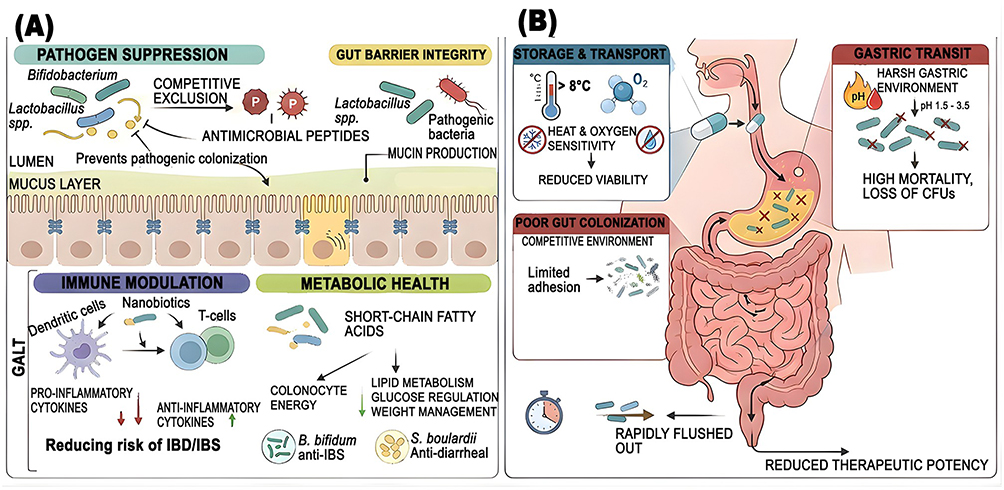 |
Figure 2 Mechanisms of probiotic action and limitations of conventional oral probiotic delivery. (A) Major mechanisms by which probiotics exert beneficial effects in the gastrointestinal tract (GIT), including pathogen suppression through competitive exclusion and antimicrobial peptide production, enhancement of gut barrier integrity through mucin production, immune modulation within gut-associated lymphoid tissue (GALT), and metabolic regulation through the production of short-chain fatty acids (SCFAs). (B) Major limitations of conventional oral probiotic delivery, including reduced viability during storage and transport due to heat and oxygen sensitivity, high microbial mortality during gastric transit under acidic conditions (pH 1.5–3.5), poor gut colonization caused by competition with native microbiota, and rapid clearance from the gastrointestinal tract, ultimately resulting in reduced therapeutic potency. Black arrows indicate direction of movement, interaction, or biological effect; downward arrows indicate reduction or loss; red cross marks indicate microbial damage, inhibition, or death; and green downward arrows indicate beneficial reduction in adverse outcomes or metabolic burden. |
The mechanisms by which probiotics exert their effects on gut health are diverse and multifaceted. One of the primary functions of probiotics is to modulate the gut immune system. The GIT houses a large portion of the body’s immune cells, and the gut-associated lymphoid tissue (GALT) plays a central role in immune regulation.6,20 Probiotics help to enhance local immunity, which is essential for defending against pathogens and maintaining intestinal homeostasis. They achieve this by stimulating the production of anti-inflammatory cytokines, such as interleukin-10 (IL-10). At the same time, they reduce the levels of pro-inflammatory cytokines such as tumor necrosis factor-alpha (TNF-α) and interleukin-6 (IL-6).20,21 This immune modulation helps maintain a balance between immune tolerance and defense, reducing the risk of excessive inflammatory responses that could lead to diseases like IBD and irritable bowel syndrome (IBS).22
In addition to immune modulation, probiotics play a critical role in pathogen suppression through several mechanisms. One of the most significant ways they achieve this is through competitive exclusion. In this process, probiotics outcompete harmful pathogens for essential nutrients and colonization sites on the intestinal epithelium.6,23 This competition prevents pathogens such as Clostridium difficile, Escherichia coli, and Salmonella from establishing themselves in the gut. Moreover, many probiotics produce antimicrobial peptides which inhibit the growth of harmful microorganisms.24 For instance, strains of Lactobacillus produce lactic acid and hydrogen peroxide, which lower the pH of the gut environment, creating an inhospitable environment for pathogens.25,26 Probiotics also contribute to gut barrier integrity by enhancing the production of mucins, which form a protective mucus layer over the intestinal epithelium. This further shields the host from pathogen invasion and helps maintain the integrity of the intestinal lining.27,28
Beyond immune modulation and pathogen suppression, probiotics contribute to metabolic health, an emerging area of interest in probiotic research. The gut microbiota is known to significantly influence nutrient metabolism, including fat storage, glucose regulation, and cholesterol metabolism.8,29,30 Probiotics have been shown to enhance glucose metabolism and insulin sensitivity. This is especially beneficial in the management of T2DM. They achieve this by altering the gut microbiome to promote beneficial bacteria that produce short chain fatty acids (SCFAs).31,32 Among these, butyrate is a primary energy source for colonocytes and has anti-inflammatory effects. Additionally, SCFAs play a role in regulating lipid metabolism and can modulate adiposity, contributing to weight management and the prevention of obesity.33
Limitations of Conventional Probiotic Delivery
Although probiotics offer substantial health benefits, their practical application in therapeutic settings faces several significant challenges, particularly in delivery and stability.6,34 The effectiveness of probiotics depends largely on their ability to survive the harsh gastrointestinal (GI) environment and successfully colonize the gut. However, conventional probiotic formulations often struggle to meet these challenges, resulting in reduced viability and clinical efficacy (Figure 2).16,35
The stomach presents one of the most formidable obstacles to probiotic survival. It is characterized by extreme acidity, with pH levels ranging from 1.5 to 3.5, especially after food intake. This acidic environment is designed to break down food and neutralize harmful pathogens, but it also harms the viability of live microorganisms.36,37 Most probiotic strains, particularly those used in conventional oral formulations, are not acid-resistant, making it difficult for them to survive the journey through the stomach. While some probiotic species, such as Lactobacillus acidophilus, have inherent acid tolerance, others are more sensitive to low pH conditions.35,38 Studies have demonstrated that probiotics can experience significant reductions in colony-forming units (CFUs) upon exposure to gastric acid, resulting in a loss of therapeutic potency. Research on various strains of Bifidobacterium and Lactobacillus has shown that only a small percentage survives stomach transit when taken orally in their unprotected form. This severely limits their potential for gut colonization and therapeutic impact.6,39
Even if probiotics survive against these stressors, their colonization efficiency remains a major challenge. The gut is a highly competitive environment, with an established microbiota that limits the colonization of new bacterial strains.16,35,40 Probiotics, once reaching the intestines, must adhere to the intestinal mucosa and compete with indigenous bacteria for nutrients and adhesion sites. Many probiotic strains fail to establish a stable population in the gut, especially when not tailored to the host’s specific microbiome.6,25,40 The transient nature of most conventional probiotics means that their effects are often short-lived. The Lactobacillus strains commonly used in probiotic formulations often persist in the human gut for only a few days before being flushed out with feces.7,41 This transient nature reduces their long-term efficacy in terms of sustaining beneficial changes in the gut microbiome, limiting their potential therapeutic effects, particularly for chronic conditions like IBD or IBS.42,43
Ultimately, the survival challenges and low colonization efficiency of conventional probiotics affect their clinical efficacy. Inconsistent colonization and viability lead to variable results in clinical trials, making it difficult to determine the true therapeutic potential of probiotics.44,45 In studies evaluating the efficacy of probiotics for IBS, results have often been inconclusive, with some patients benefiting from probiotic treatment while others show no improvement. This inconsistency has hindered the widespread adoption of probiotics as a mainstream therapeutic intervention.46,47 Clinical efficacy also depends on the dosage and delivery mechanism of probiotics. Without controlled release or targeted delivery, the therapeutic potential of probiotics is diminished.6 Some studies have shown that when probiotics are delivered in combination with prebiotics or through advanced delivery systems such as nano-encapsulation, their efficacy is significantly improved. However, these advanced methods are not typically used in conventional probiotic formulations, which often rely on simple oral ingestion of capsules, powders, or yogurt.13,48–50
Nanobiotics and Probiotic Enhancement
What are Nanobiotics?
The term nanobiotics refers to an emerging interdisciplinary approach that integrates nanotechnology with biological agents to improve their stability, delivery, and therapeutic performance. In the context of probiotics, nanotechnology is used to engineer nanoscale carrier systems that can encapsulate, protect, and transport beneficial microorganisms in a more controlled manner than conventional formulations.51,52 Unlike traditional encapsulation platforms, which often operate at the micro- to millimeter scale, nanobiotic systems employ carriers with highly tunable physicochemical properties, including particle size, surface charge, permeability, and release behavior. These features allow more precise control over probiotic delivery and functional interaction within the gastrointestinal environment.53,54
Nanobiotic platforms may be constructed from polymers, lipids, proteins, or inorganic materials, depending on the intended application. Polymeric nanoparticles based on materials such as alginate, chitosan, and poly(lactic-co-glycolic acid) (PLGA) are widely studied because of their biodegradability, structural versatility, and mucoadhesive potential. Lipid-based systems, including liposomes and nanoemulsions, provide membrane-like environments that can support probiotic encapsulation and facilitate sustained release.55,56 More broadly, nanobiotic design enables tailoring of carrier architecture to improve retention, site-specific activity, and interaction with mucosal tissues. By combining nanoscale engineering with probiotic functionality, nanobiotics represent a promising extension of probiotic science and a foundation for more precise microbiome-directed therapeutics.53,57,58
Rationale for Nanotech in Probiotics
Nanotechnology provides a rational platform for improving probiotic delivery because materials at the nanoscale possess distinctive physicochemical properties, including high surface-area-to-volume ratio, tunable surface chemistry, and controllable interaction with biological environments.53,54 These features allow probiotic carriers to be engineered with greater precision in terms of encapsulation behavior, surface functionality, and release characteristics than conventional formulations.6,59 As a result, nanocarrier systems offer a versatile strategy for improving probiotic stability and functional performance within the GIT.60
A major advantage of nanocarrier-based systems is the ability to regulate when and where probiotic cells are released. In contrast to conventional formulations, which often provide limited control over delivery, nanomaterials can be designed to respond to physiological triggers such as pH gradients, enzymatic activity, or local intestinal conditions.58,60 This enables more site-specific probiotic release and can improve retention and activity at the intended intestinal location. In addition, selected nanocarriers may be tailored to exhibit mucoadhesive properties, thereby prolonging residence time at the mucosal surface and enhancing interaction with epithelial tissues.44
Nanotechnology also broadens the functional scope of probiotic delivery by enabling co-formulation with complementary agents such as prebiotics, bioactive compounds, or antimicrobial molecules.53,61 Such integrated delivery strategies may promote synergistic effects after release and enhance the overall therapeutic value of probiotic formulations. Collectively, these features explain why nanotechnology has become an increasingly attractive platform for the development of next-generation probiotic systems.54,62
Nanobiotic Delivery Systems
Nanoencapsulation Methods
Nanotechnology has revolutionized the delivery of probiotics, enabling the engineering of nanoencapsulation techniques that enhance stability, viability, and controlled release (Figure 3). These nanoencapsulation methods involve enclosing probiotics within nanosized carriers, which provide physical protection from the harsh environment of the GIT while optimizing their therapeutic potential.49,63,64 There are several approaches to nanoencapsulation. Each utilizes different materials and mechanisms to ensure probiotics can survive the digestive journey. These approaches help probiotics exert their beneficial effects once they reach their target sites.49
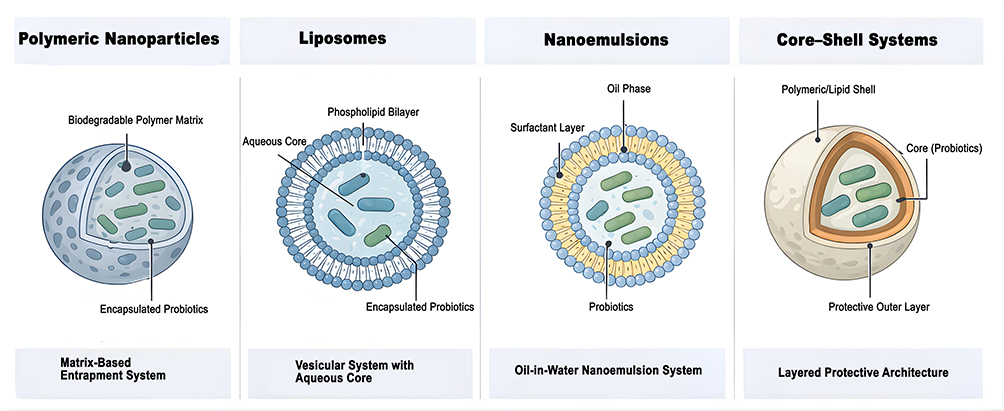 |
Figure 3 Nanoencapsulation methods used in nanobiotic delivery systems. Polymeric nanoparticles entrap probiotics within biodegradable polymer matrices. Liposomes are phospholipid bilayer vesicles with an aqueous core containing encapsulated probiotics. Nanoemulsions are oil-in-water systems stabilized by a surfactant layer and used to protect probiotic cargo. Core–shell systems consist of a probiotic-containing core surrounded by polymeric or lipid shell layers that provide additional structural protection. |
Polymeric Nanoparticles
This involves polymeric nanoparticles made from biodegradable, biocompatible polymers (Figure 3). Materials such as chitosan, alginate, pectin, and PLGA are commonly used to form the nanoparticles. These polymers offer several advantages, including their controlled-release capabilities and the ability to protect the encapsulated probiotics from digestive enzymes, stomach acid, and bile salts in the small intestine.65,66 Chitosan, for example, is a biocompatible polysaccharide that can form stable nanoparticles and exhibit mucoadhesive properties, helping prolong the retention time of probiotics at the intestinal mucosa. Similarly, alginate, a naturally derived polysaccharide, is often used for encapsulating probiotics. It provides an additional benefit of pH-responsive release. This ensures the probiotics are released in the colon’s alkaline environment.67
Liposomes and Nanoemulsions
Another approach are the use of liposomes and nanoemulsions (Figure 3). Liposomes are phospholipid bilayer vesicles that encapsulate probiotics within an aqueous core, providing a protective barrier against environmental stresses. They are particularly effective at protecting probiotics from stomach acid and improving their bioavailability. Liposomes are also beneficial because they can carry both hydrophilic and lipophilic substances, enabling the co-delivery of probiotics with other beneficial prebiotics or bioactive compounds. Nanoemulsions, which are oil-in-water dispersions, offer similar protective benefits and are especially effective for protecting probiotics from oxidative stress while maintaining their activity. These systems also help improve intestinal adhesion by enhancing interaction with gut epithelial cells, thereby increasing colonization efficiency.49,63,68
Core-Shell Coatings
A more advanced nanoencapsulation technique is the core-shell coating method, where probiotics are encapsulated within a central core surrounded by an outer shell of polymeric materials or lipid layers (Figure 3). This design provides an additional layer of protection, ensuring that the probiotics are released in a controlled manner at the desired location. The outer shell can be engineered to respond to specific stimuli, such as changes in pH, enzymatic activity, or temperature, enabling targeted release in regions of the gut that are most beneficial for therapeutic outcomes. The shell can be designed to dissolve or break down in the colon’s alkaline environment, releasing the encapsulated probiotics where they are most needed.49,69
Emerging Carrier Platforms
Beyond established polymeric and lipid-based systems, recent studies have identified exosome-based and metal-organic framework (MOF)-based platforms as promising next-generation carriers for probiotic delivery. Exosome-based systems, particularly milk-derived exosomes and other extracellular-vesicle-inspired biomimetic coatings, offer high biocompatibility, membrane flexibility, and favorable interaction with the intestinal surface.70,71 In a recent study, Hao et al72 developed a milk exosome-based coating system (mExo@DSPE-PEG-PBA) for Akkermansia muciniphila, Bifidobacterium animalis subsp. lactis BB-12, and Lactiplantibacillus plantarum Q7, achieving encapsulation efficiencies of 70.93–90.37% and simulated gastrointestinal survival rates of 80.99–94.53%, while also improving probiotic self-aggregation and adhesion-related behavior. Likewise, extracellular vesicles derived from probiotic microorganisms have shown carrier potential; for example, Mierzejewska et al73 demonstrated that vesicles from probiotic Saccharomyces boulardii could be internalized by human intestinal cell lines and transfer loaded bioactive cargo, supporting their use as biologically active delivery vehicles. MOFs represent another emerging carrier class with highly tunable porosity, large surface area, and potential for protective yet stimulus-responsive encapsulation. FitzGerald et al74 reported that L. plantarum 299v encapsulated within a biocompatible iron(III) fumarate matrix showed improved stability in saline, lysozyme, and pepsin compared with uncoated cells, highlighting the promise of MOFs as protective probiotic carriers. Although these systems remain at an early preclinical stage and require further toxicological and translational validation, they broaden the nanobiotic toolbox beyond conventional nanopolymers and liposomes and better reflect the cutting edge of probiotic carrier design.53,75
These nanoencapsulation methods are fundamental in improving the stability, survivability, and targeted release of probiotics, ensuring that therapeutic doses reach the lower GIT, where they can exert their beneficial effects. Advances in nanotechnology continue to enhance the efficiency and precision of these delivery systems, which is critical for improving the clinical efficacy of probiotics.76
Mechanisms by Delivery Type
Nanocarrier systems provide significant advantages over conventional probiotic delivery, primarily by enhancing the viability, stability, and bioavailability of probiotics in the GIT. The mechanisms by which nanocarriers protect probiotics are multifaceted and depend on the type of nanocarrier used, but some common features apply across various delivery systems.
pH-Responsive Release
The key mechanisms by which nanocarriers protect probiotics is through pH-responsive release. This is particularly important for ensuring that probiotics are protected from the acidic conditions of the stomach. They must be released at the target site in the colon, where the pH is higher and more favorable for microbial activity.49 Polymers like chitosan and alginate being used to form nanoparticles that are stable in acidic environments. These polymers break down or become more permeable at neutral or alkaline pH levels. This allows the probiotics to be released gradually and at the right site. This site-specific release maximizes the therapeutic effects of probiotics. It ensures they reach the colon in a viable form, where they can restore gut flora and provide therapeutic benefits such as immune modulation and pathogen suppression.67,77
Mucoadhesive Properties
Another critical feature of nanocarriers is their mucoadhesion, which enhances interaction with the gut mucosa. Materials like chitosan and pectin have been shown to adhere to the mucus layer of the intestinal lining. This not only extends the retention time of probiotics at the target site but also facilitates better colonization. This is especially important for prolonged therapeutic effects.78 It increases the local concentration of probiotics and ensures that the beneficial microbes can interact with the intestinal microbiota more effectively. This contact plays a key role in immune regulation by communicating with the GALT.20,34,79
Single-Cell Nanoencapsulation
Single-cell nanoencapsulation, also known as cell-in-shell technology, represents a more advanced form of nanoencapsulation. In this method, individual probiotic cells are encapsulated in ultrathin nanocarriers that act as protective shells. This method offers several advantages, including the protection of probiotics from harsh GIT conditions. The single-cell approach also ensures that each probiotic cell is individually protected. It allows for precision delivery to its target site in the intestine. Furthermore, this technology enables enhanced targeted release. The shell can be designed to disintegrate or release its payload in response to specific triggers, such as pH changes, enzymatic activity, or inflammation markers in the colon. This not only improves the survival and functionality of probiotics but also enhances the therapeutic specificity of probiotic treatments.69,80
Beyond simple physical protection, complex nanocarrier systems can modulate probiotic behavior through interfacial and stimulus-responsive mechanisms at the intestinal mucosal surface. Mucoadhesive materials such as chitosan and pectin promote electrostatic and polymer–mucin interactions, thereby increasing residence time within the mucus layer and enhancing contact between viable probiotic cells and the epithelium.81,82 In parallel, nanoscale dimensions and surface functionalization can improve localization at inflamed or damaged intestinal sites, increasing opportunities for epithelial adhesion and immune crosstalk. Stimuli-responsive systems provide an additional level of control: pH-sensitive or enzyme-responsive matrices remain relatively stable during upper gastrointestinal transit but swell, erode, or dissociate under distal intestinal or colonic conditions, enabling site-specific release of viable cells.83 Together, these mechanisms help explain why nanobiotic systems may strengthen barrier-associated responses, modulate inflammatory signaling pathways, and enhance probiotic bioactivity beyond the passive survival advantage provided by conventional formulations.84
Bioavailability and Targeted Release
One of the primary challenges of conventional probiotic therapies is ensuring that a sufficient number of viable cells reach the lower GIT, where they can provide therapeutic benefits. Nanoencapsulation and targeted delivery systems significantly improve bioavailability. They protect probiotics during their passage through the upper GIT and also facilitate their targeted release.49,58 Nanocarrier systems improve the fraction of live probiotics that survive this harsh environment by providing physical protection through encapsulation, enabling a larger proportion of viable cells to reach the colon. Additionally, stimuli-responsive nanocarriers release probiotics in response to specific triggers, such as changes in gut pH or enzymatic degradation. This further enhances the effectiveness of the probiotics by ensuring targeted release at the right time and location.35
Compared with free probiotics, nanobiotic formulations provide functional advantages at each stage of gastrointestinal transit. In the stomach, unencapsulated probiotic cells are rapidly inactivated by low gastric pH and associated digestive stress, whereas nanoencapsulation provides a protective barrier that preserves cell viability during gastric exposure.53,57 In the small intestine, free probiotics are further compromised by bile salts and digestive enzymes, which reduce survival and limit subsequent colonization. By contrast, nanocarriers maintain structural integrity during intestinal transit and, in some formulations, enhance mucoadhesion, thereby prolonging residence time at the mucosal surface and improving epithelial interaction and colonization potential.35 Upon reaching the colon, free probiotics often arrive in reduced numbers and exhibit limited site-specific activity, whereas nanobiotics can undergo pH-triggered or enzyme-triggered release, enabling controlled delivery of viable cells at the target site. This stage-wise protection, retention, and stimulus-responsive release collectively explain why nanobiotics generally achieve greater colonization efficiency, improved restoration of microbial balance, and stronger therapeutic effects than free probiotic formulations (Figure 4).85
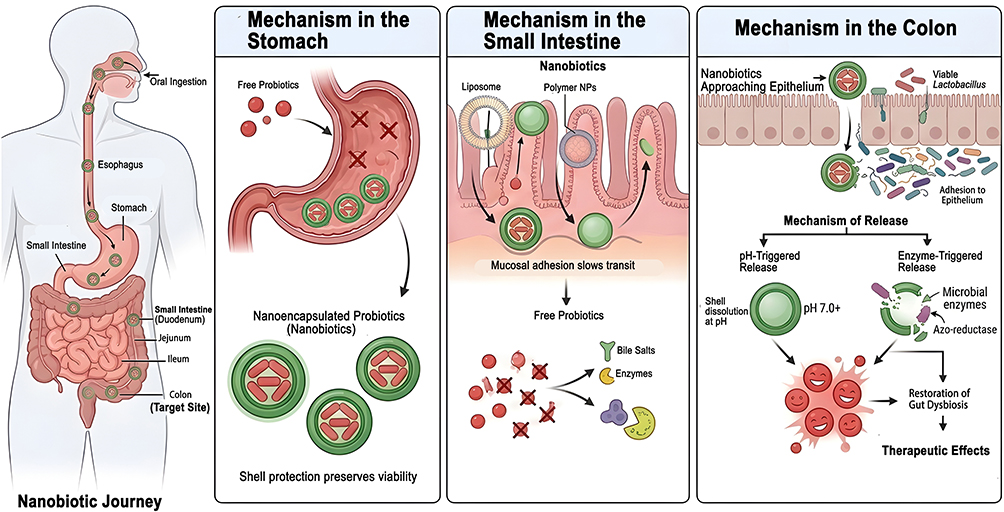 |
Figure 4 Gastrointestinal transit and targeted colonic release of nanoencapsulated probiotics (nanobiotics). The schematic illustrates the oral journey of nanobiotics through the gastrointestinal tract, from ingestion to colon-targeted release. In the stomach, free probiotics are highly susceptible to degradation under acidic conditions, whereas nanoencapsulated probiotics remain protected by their shell, which preserves viability. In the small intestine, nanobiotics such as liposomes and polymeric nanoparticles can interact with the mucosal surface, thereby slowing transit and enhancing retention, while free probiotics are further compromised by bile salts and digestive enzymes. In the colon, nanobiotics approach and adhere to the epithelium, followed by pH-triggered or enzyme-triggered shell degradation, resulting in localized release of viable probiotics. This targeted colonic delivery supports restoration of gut dysbiosis and contributes to therapeutic effects. Black arrows indicate direction of movement, transit, or biological action; red cross marks indicate microbial damage, loss of viability, or degradation. |
Functional Interactions with the Gut
Modulation of Microbiota
Nanobiotic-enhanced probiotics have demonstrated a promising capacity to reshape the composition and diversity of the gut microbiome. They do this more effectively than conventional probiotics. This is largely because improved delivery systems increase the number of viable microbes that actually reach the intestine. The gut microbiota is a complex microbial ecosystem that plays a central role in metabolic, immune, and neurological functions.7,53 When this microbial balance is disturbed, a condition known as dysbiosis, it has been linked to a range of diseases. These include inflammatory disorders, metabolic syndrome, and even neurodegenerative processes. Traditional probiotic therapies often fail to induce significant or lasting changes in microbial communities. This is because a large proportion of probiotic cells are inactivated before reaching the colon.18 However, nanoencapsulation and nanocarrier technologies protect probiotics during gastrointestinal transit. They also promote sustained release in the lower gut. This enhances the probiotics’ interactions with the resident microbiota. Research indicates that nano-protected probiotics can increase the abundance of beneficial taxa such as Bifidobacterium, Lactobacillus, and Eubacterium. At the same time, they reduce the relative abundance of pathogenic genera such as Enterococcus, Fusobacterium, and Pseudomonas, outcomes that correlate with improved microbial diversity and balance.54,86 Enhanced microbial diversity is associated with healthier metabolic profiles and greater stability of the gut ecosystem, a factor considered beneficial for long-term host health. These modulatory effects are likely mediated through improved adhesion, colonization, and activity of probiotic strains. These strains would otherwise be lost due to gastric acidity or enzymatic degradation during transit. This highlights the role of nanocarrier technologies in achieving more profound and sustained shifts in microbiome composition.87
Immune Modulation
Nanobiotic carriers not only enhance the delivery of probiotics but also modulate their capacity to interact with the host immune system, potentially leading to stronger and more balanced immune responses. The gut mucosa is a major interface between the host immune system and the external environment, densely populated with immune cells that constantly survey microbial signals. Probiotic microorganisms are known to engage with GALT and influence immune signaling pathways. However, their immunomodulatory impact is often limited by suboptimal delivery. By enabling probiotics to survive longer in the intestinal environment and adhere more effectively to the epithelial surface, nanotechnology can amplify their immune interactions. Studies have shown that nanobiotic formulations can reduce excessive inflammatory signaling, such as through the TLR4/nuclear factor kappa-light-chain-enhancer of activated B cells (NFκB) pathway, which is implicated in many chronic inflammatory diseases.53,80,88 They do this by encouraging the production of anti-inflammatory cytokines and mitigating pro-inflammatory mediators. This shift toward a regulatory immune profile fosters tolerance to commensal microbes while suppressing harmful pathogens, creating an environment that supports immune homeostasis. Furthermore, stimuli-responsive nanocarriers that release probiotics in response to local inflammatory cues may directly engage immune cells in inflamed tissues. This enhances local immunoregulation in conditions such as IBD. By improving the persistence of probiotics at immunologically active sites, nanobiotic strategies enable controlled release in specific intestinal regions. This strengthens the probiotics’ ability to modulate innate and adaptive immunity.89,90
Gut Barrier Protection
The structural and functional integrity of the intestinal barrier, composed of epithelial cells, mucus layers, and tight junction proteins, is fundamental. It helps prevent the translocation of pathogens and regulates immune responses. Disruption of this barrier, often referred to as “leaky gut”, is associated with chronic inflammation and a variety of systemic diseases. Conventional probiotics can support barrier function in some individuals, but their effects are constrained by limited survival through the GIT. Nanobiotic formulations, through enhanced protection and targeted release, increase the number of viable cells that reach the intestine. These cells interact with the mucosal surface, enabling a more robust impact on barrier repair mechanisms.
At the epithelial level, nanoencapsulation may enhance the ability of probiotic cells to remain in close contact with the mucus layer and intestinal surface, thereby increasing the likelihood of adhesion-mediated signaling. Rather than acting solely through improved survival, these systems can prolong mucosal residence, promote interaction with epithelial receptors, and facilitate localized modulation of barrier-associated pathways.91 Such interactions may stimulate mucin production by goblet cells, reinforce tight junction assembly, and reduce epithelial permeability, while also limiting the translocation of luminal antigens and inflammatory microbial products into the submucosa. In this way, nanobiotic formulations may strengthen barrier integrity not only by improving probiotic delivery, but also by amplifying functional communication between probiotic cells and the intestinal epithelium.92
For example, Wang et al93 encapsulated Lactobacillus plantarum P-8 in gelatin/gum Arabic microcapsules, first confirmed improved survival under simulated gastric and intestinal conditions, and then administered the formulation to DSS-induced colitis mice for 21 days. Compared with free probiotic cells, the microcapsules more effectively reduced disease activity and histopathologic injury while increasing colonic MUC-2, ZO-1, and occludin expression, indicating stronger restoration of both the mucus layer and tight-junction barrier.94 Similarly, Alkushi et al94 evaluated orally delivered multi-strain-probiotic-loaded nanoparticles in a DSS-induced colitis model and found that nanoparticle delivery suppressed inflammatory and oxidative injury more effectively than free probiotics, while also producing more prominent upregulation of barrier-associated genes, including MUC-2, MUC-5, ZO-1, occludin, and claudin-1. In another preclinical study, Zhang et al95 developed sulfhydryl-modified double-layered multinucleated microcapsules containing Bifidobacterium adolescentis FS2-3 and Bacillus subtilis SN15-2; in vitro digestion and adhesion assays showed improved probiotic survival and mucus interaction, and in an Escherichia coli O157:H7 murine enteritis model the formulation increased intestinal probiotic retention, alleviated inflammation, and repaired microbiota disruption. Collectively, these studies suggest that nano-protected probiotic systems can enhance barrier repair not only by improving survival during gastrointestinal transit, but also by increasing mucosal retention, reinforcing mucus-associated defenses, and restoring tight-junction integrity.
Collectively, these effects contribute to reduced intestinal permeability. These effects not only reduce inflammation by limiting the passage of microbial products into the submucosa but also support the regeneration of epithelial cells and the maintenance of gut homeostasis. Certain advanced nanoencapsulation techniques have been linked with improved barrier enhancement outcomes in models of gut injury. In necrotizing enterocolitis models, formulations that protect probiotic cells until they reach the damaged intestinal region have been associated with intensified barrier repair. These formulations also help downregulate inflammatory signals. This illustrates the therapeutic potential of nanobiotic systems in clinical settings. In these settings, barrier disruption is central to disease progression.96,97
Therapeutic Applications
This section shows where nanobiotic-enhanced probiotics have a real-world impact and clinical potential. Each subsection includes specific applications, mechanisms, and evidence from recent studies (Table 1). To maintain focus on nanobiotic-enhanced probiotics for targeted gut delivery, each subsection briefly distinguishes established evidence on conventional probiotics from findings specific to nanoencapsulation or nanobiotic delivery platforms, and then identifies areas that remain preliminary or translational.
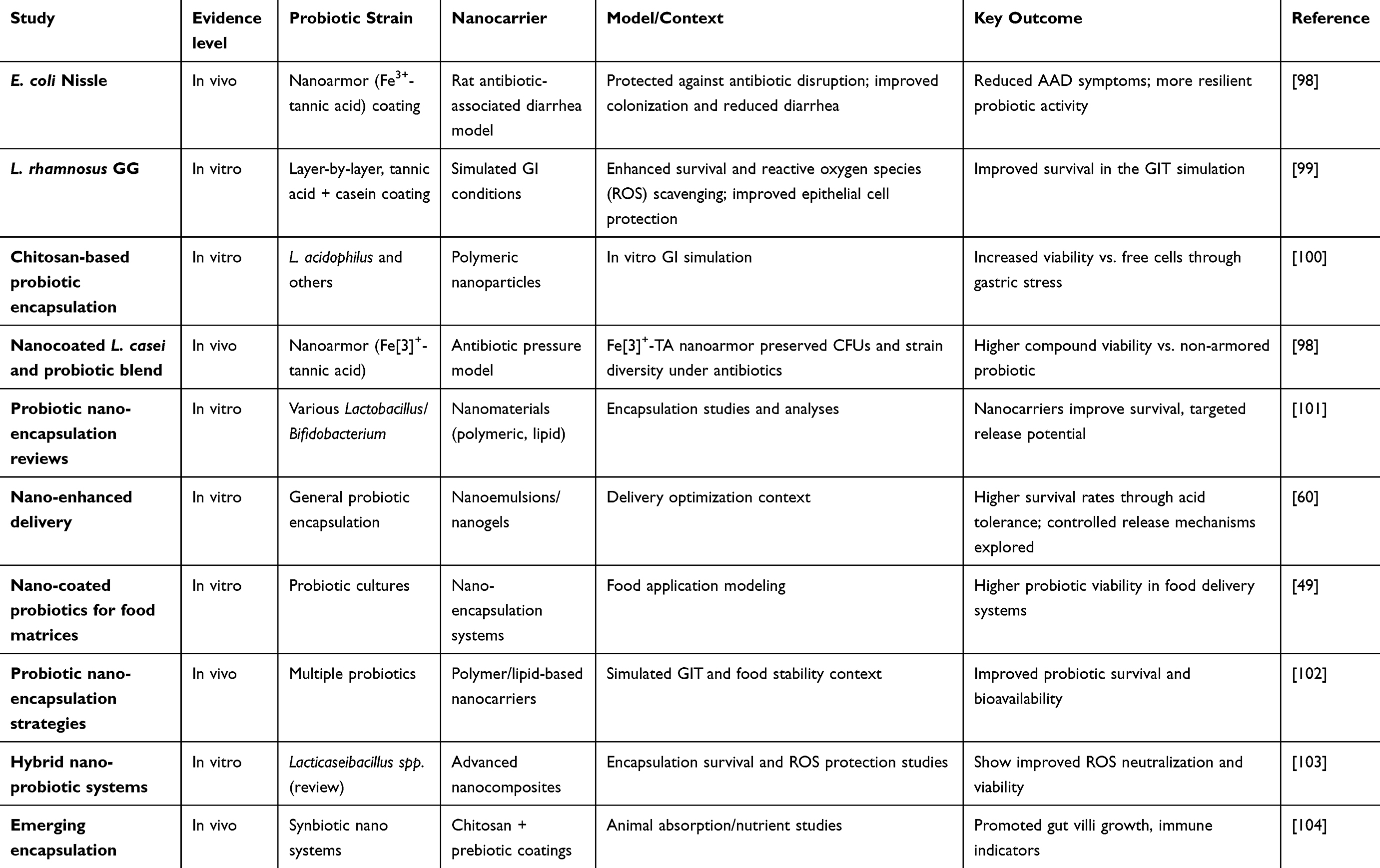 |
Table 1 Summary of Recent Studies with Outcomes |
Inflammatory Bowel Diseases and IBS
Nanobiotic-enhanced probiotics are increasingly being investigated as adjuncts or alternatives to conventional therapies for ulcerative colitis (UC), Crohn’s disease (CD), and IBS. These disorders are linked, to varying degrees, with immune dysregulation, epithelial barrier dysfunction, and microbiome imbalance, while current pharmacological therapies often remain limited by suboptimal targeting and systemic adverse effects. Nanotechnology-based delivery systems may improve the therapeutic performance of probiotics by enabling colon-directed delivery, prolonged mucosal retention, and stronger local immunomodulatory effects at sites of intestinal injury or inflammation.53,105 Recent studies indicate that nanocarrier-based probiotic formulations can enhance mucosal interaction, regulate inflammatory signaling, and reduce disease severity more effectively than free probiotics in preclinical intestinal disease models.13,49,54
Among intestinal disorders, UC has been one of the most intensively studied targets for nanobiotic probiotic delivery because its localized colonic pathology is well suited to colon-directed release and mucosal-retention strategies. In experimental UC models, nano-coated probiotics have been shown to reduce key inflammatory mediators such as IL-6 and TNF-α more effectively than non-encapsulated formulations.106 Encapsulation within biocompatible materials such as chitosan or alginate has also been associated with improved mucosal adherence and prolonged retention at inflamed colonic sites, thereby enhancing modulation of the local immune microenvironment. For example, Lactobacillus rhamnosus delivered through chitosan nanoparticle carriers improved disease activity scores in chemically induced colitis models compared with free cells, supporting the therapeutic potential of nanocarrier-assisted probiotic delivery in UC.13,69,107
Although CD has been studied less extensively than UC in the context of nanobiotic probiotics, emerging preclinical evidence suggests beneficial effects of nano-delivery strategies in experimental models. Nanoencapsulated probiotics have been reported to modulate immune pathways involved in tissue injury and inflammation while also supporting gut barrier integrity, which is frequently compromised in CD.108 In particular, nano-protected probiotic cells have been associated with increased tight junction protein expression and reduced epithelial permeability, both of which are important for limiting the translocation of luminal antigens and sustaining mucosal homeostasis.109,110 While human clinical evidence remains limited, these findings suggest that nanobiotic delivery may enhance the functional effects of probiotics in CD.
IBS, although distinct from classical IBD, is increasingly linked to low-grade inflammation, visceral hypersensitivity, altered motility, and microbiota disruption. Nanocarrier-based probiotic systems may improve therapeutic effects in IBS by enabling more localized delivery and sustained probiotic activity within the intestine.111 Small cohort studies using nano-protected probiotic formulations have reported improved symptom control and better quality-of-life outcomes compared with standard probiotic preparations.54,60 Although large-scale clinical evidence is still lacking, these early findings support the potential of nanobiotics as a more effective probiotic strategy in IBS management.
Collectively, current evidence suggests that nanobiotic probiotic systems may offer therapeutic advantages across UC, CD, and IBS by improving mucosal retention, reinforcing barrier integrity, and enhancing local immunoregulatory effects.88 However, most supporting data remain preclinical, and further well-designed clinical studies are needed to confirm their translational value.
Gastrointestinal Infections
Gastrointestinal infections caused by bacterial, parasitic, and viral agents remain a major global health challenge and contribute substantially to morbidity and mortality (Figure 5). Conventional antimicrobial therapies are increasingly limited by antimicrobial resistance, treatment-associated side effects, and disruption of the native gut microbiota. In this context, nanobiotic-enhanced probiotics are emerging as promising adjunctive strategies for infection control because they can improve localized probiotic activity, strengthen pathogen suppression, and support restoration of microbial balance at infected mucosal sites.112,113
 |
Figure 5 Therapeutic applications and multi-mechanistic efficacy of nanobiotic-enhanced probiotics in gastrointestinal infections. (A) Comparison of free probiotic cells and nanobiotic-enhanced probiotics during gastrointestinal transit. Nanoencapsulation protects probiotic cells against acidic gastric conditions and bile salts, thereby reducing viability loss and enabling targeted release at sites of infection or inflammation, with a greater proportion of viable cells reaching target sites in the lower gastrointestinal tract. (Bi–Bii) Applications in bacterial, viral, and fungal gastrointestinal infections. In bacterial gastroenteritis, nano-coated probiotics improve viability, enhance bacteriocin-associated activity, and increase the proportion of viable cells reaching the colon, thereby suppressing pathogen growth. In viral and fungal gut infections, nanobiotic formulations interfere with viral replication, reduce pathogen attachment, disrupt pathogen biofilms, and promote immunomodulatory responses, including enhanced antiviral cytokine production and stronger mucosal immunity. (C) Application in Helicobacter pylori infections. Nanocarrier protection improves probiotic persistence under acidic gastric conditions, facilitating competitive inhibition of colonization, mitigation of mucosal damage, and overall nanobiotic protection. (D) Summary of the major shared therapeutic mechanisms, including pathogen exclusion, enhanced production of antimicrobial substances, and immune modulation. Black arrows indicate direction of transit, release, or biological action; red cross marks indicate reduced viability or microbial damage; green check marks indicate improved probiotic performance or protection. |
Bacterial gastroenteritis caused by pathogens such as E. coli, Salmonella enterica, and C. difficile is characterized by intestinal inflammation, diarrhea, abdominal pain, and, in severe cases, systemic complications. Multiple studies have shown that nano-coated probiotics exhibit stronger antibacterial activity than their free-cell counterparts. In addition to improving probiotic persistence at the intestinal mucosa, nanobiotic systems can enhance competitive exclusion of pathogens and increase the production or functional activity of antimicrobial substances such as bacteriocins.114 In one recent study, probiotics encapsulated in nano-chitosan matrices showed substantially greater antibacterial activity against gastrointestinal pathogens than non-encapsulated formulations, indicating that nanoencapsulation can amplify probiotic antimicrobial performance.115,116 These effects may contribute not only to direct pathogen inhibition but also to restoration of a healthier microbial ecosystem, thereby reducing the likelihood of recurrent infection.
Helicobacter pylori infection is a major cause of peptic ulcer disease and is strongly associated with chronic gastritis and gastric cancer (Figure 5). Although standard multidrug regimens remain the mainstay of treatment, they may induce side effects and further promote antimicrobial resistance. Conventional probiotic adjuncts have been explored to reduce antibiotic-associated disturbances and improve gastric microbial balance, but their effects on eradication outcomes remain inconsistent. In the context of this review, the more relevant question is whether nanobiotic delivery systems can improve probiotic persistence and local activity at the gastric mucosal surface. As illustrated in Figure 5, nano-protected formulations, including liposomal probiotic systems, may enhance survival under acidic gastric conditions, strengthen competitive interactions with H. pylori, and help mitigate mucosal damage more effectively than unprotected probiotics.117,118 However, direct evidence for nanoprobiotic strategies against H. pylori remains limited, and most current claims should still be regarded as translational rather than clinically established, particularly with respect to eradication efficacy and long-term outcomes.119
Evidence for nanobiotic-enhanced probiotics in viral and fungal gut infections remains limited and largely preclinical. At present, the main mechanistic rationale is that nanocarrier-assisted delivery may enhance probiotic viability, local mucosal persistence, and interference with pathogen attachment or biofilm formation.23,25,120 Some studies also suggest that nanoencapsulation may strengthen probiotic-mediated immunomodulatory effects, including antiviral cytokine responses and mucosal immune support. However, these observations remain preliminary, and controlled human data are still insufficient to define the therapeutic role of nanobiotic probiotics in viral or fungal gastrointestinal infections.86
Metabolic Health
Metabolic disorders are increasingly linked to gut dysbiosis and systemic inflammation, underscoring the central role of the gut microbiome in host metabolic regulation. Evidence from conventional probiotics suggests some benefit in modulating metabolic risk factors through effects on microbial composition and low-grade inflammation, but these outcomes have generally been modest and inconsistent, partly because of poor gastrointestinal survival and limited site-specific delivery.121,122 Within the scope of this review, however, the more relevant question is whether nanobiotic-enhanced probiotics can improve these effects by increasing probiotic viability, protecting cells during gastrointestinal transit, and enabling more targeted delivery to distal intestinal sites where host–microbiome metabolic interactions are most relevant. By improving survival and localization, nanocarrier systems may enhance downstream effects on systemic inflammation, short-chain fatty acid production, and bile acid and lipid metabolism.53,54,60
Lifestyle-related factors also shape the metabolic efficacy of probiotic and nanobiotic interventions by influencing both gut microbial ecology and colonization potential. Diet is a major determinant of microbiome composition: short-term dietary changes can rapidly alter community structure, whereas fiber-rich, plant-diverse diets generally support greater microbial diversity and short-chain-fatty-acid-producing taxa, while Western-style high-fat, high-sugar, low-fiber diets are associated with dysbiosis, enrichment of bile-tolerant organisms, barrier dysfunction, and low-grade inflammation.123 Likewise, antibiotic exposure can markedly reduce microbial richness and diversity, disrupt colonization resistance, and alter the ecological niche into which administered probiotics are introduced. Exercise habits are also relevant, as regular physical activity is generally associated with greater microbial diversity and enrichment of metabolically favorable taxa, whereas sedentary lifestyles are linked to less favorable microbiome profiles.124 These variables are directly relevant to probiotic persistence, because probiotic engraftment is highly individualized and depends in part on baseline host and microbiome features. Accordingly, although nanobiotic formulations may improve survival and site-specific delivery, their colonization efficiency and metabolic impact are still likely to be conditioned by diet quality, antibiotic exposure, exercise habits, and the pre-existing gut microbiome.53 In this context, healthy dietary and lifestyle patterns may provide a more permissive ecological environment for sustained probiotic activity, whereas unhealthy diets, recurrent antibiotic exposure, and adverse lifestyle habits may blunt the benefits even when delivery is improved by nanoencapsulation.
Obesity is often characterized by alterations in gut microbial communities that influence energy harvest, fat storage, and hormonal regulation. In experimental models, nanotechnology-based probiotic delivery has shown promise in modulating these metabolic processes more effectively than conventional probiotic formulations. Nanoencapsulation improves the stability and gut delivery of probiotics, enabling a higher proportion of viable cells to reach the colon, where they interact with resident microbiota and host tissues. Studies using nanocarrier-encapsulated probiotic strains have reported reduced weight gain and adiposity in treated animals. This is likely linked to shifts in bile acid metabolism. It may also involve changes in microbial communities that regulate energy balance.125,126 These findings align with broader evidence that modifying gut microbiota composition can support improvements in metabolic health. This includes increasing beneficial bacteria such as A. muciniphila, which is known to influence diet-induced obesity and metabolic endotoxemia.127
T2DM is characterized by chronic low-grade inflammation, insulin resistance, and metabolic dysregulation, processes in which the gut microbiota contributes. Probiotics have been shown in clinical and preclinical studies to improve insulin sensitivity and modulate glucose metabolism, though the magnitude of these effects varies widely.31 Nanobiotic delivery systems further enhance probiotic efficacy by ensuring that higher concentrations of live microbial cells reach the distal gut. There, they can interact with enteroendocrine cells and modulate the release of metabolic hormones. These hormones regulate glucose homeostasis and appetite. Improved probiotic colonization via nanocarriers has been associated with more robust metabolic signaling in experimental settings. By enhancing the delivery and persistence of probiotics in the colon, nanobiotic systems have the potential to lower fasting glucose levels. They can also improve insulin responsiveness and reduce inflammatory mediators associated with metabolic disease.53,128
NAFLD represents a hepatic manifestation of systemic metabolic dysfunction and is strongly associated with obesity, insulin resistance, and dysregulated microbiota. Standard probiotic interventions have demonstrated favorable effects on liver enzymes and other metabolic markers in both human and animal studies. This suggests that altering gut microbial composition can have positive effects on liver health.129 In preclinical models, nanobiotic formulations designed for improved probiotic stability and targeted colon delivery have been shown to modulate the gut–liver axis. These formulations reduce hepatic fat accumulation and improve liver histology more effectively than conventional probiotics. By enhancing probiotic colonization and activity, nanocarriers support reductions in hepatic inflammatory signals. They also enhance barrier function, preventing the translocation of endotoxins that drive liver inflammation. Nanocarriers may improve serum liver enzyme profiles, such as alanine aminotransferase (ALT) and aspartate aminotransferase (AST). Although clinical data on nanobiotic probiotics in NAFLD remain limited, these early preclinical findings suggest that targeted probiotic delivery could become an important adjunctive strategy in treating or managing NAFLD and its progression.130,131
Gut–Brain Axis and Neurobehavioral Health
The gut–brain axis is a complex communication network linking the GIT and its microbiota with the central nervous system through neural, endocrine, and immune pathways (Figure 6). Through these interconnected pathways, gut microbes can influence brain function and behavior by modulating neurotransmitters, immune signaling, the hypothalamic–pituitary–adrenal (HPA) axis, and related metabolic processes.19 In conventional probiotic research, neurobehavioral benefits have been reported, but these effects have often remained limited and inconsistent, partly because poor gastrointestinal survival and insufficient site-specific delivery reduce functional activity in vivo. In the context of this review, the more relevant question is whether nanobiotic-enhanced probiotics can overcome these limitations through improved viability, protected gastrointestinal transit, and stronger interaction with host neural and immune signaling pathways. Current evidence suggests that nanoencapsulation and targeted delivery systems may enhance probiotic persistence and thereby strengthen gut–brain-axis-related effects more effectively than unprotected formulations.132,133
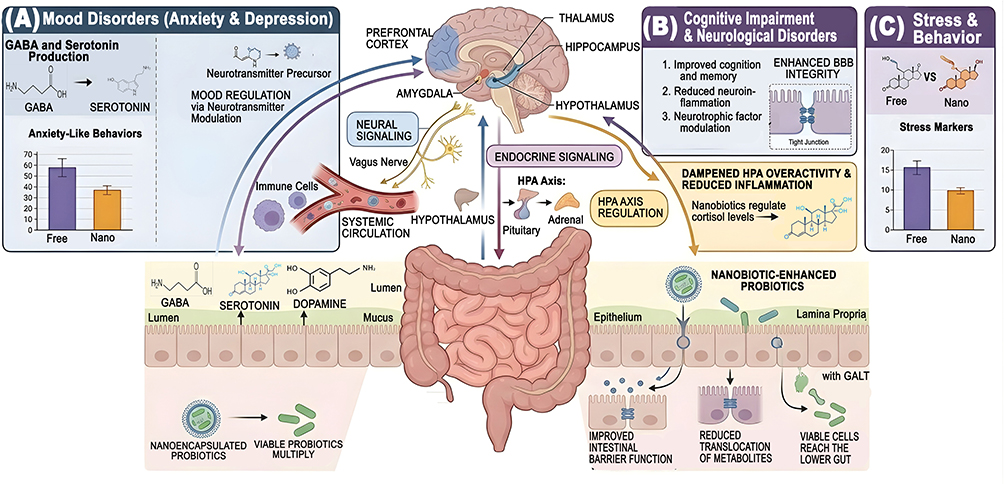 |
Figure 6 Modulation of the gut–brain axis and neurobehavioral health via nanobiotic-enhanced probiotics. This schematic illustrates bidirectional communication between the gastrointestinal tract (GIT) and the central nervous system mediated by nanobiotic-enhanced probiotics. (A) Nanocarrier delivery improves probiotic viability and enhances microbial production of neuroactive metabolites, including γ-aminobutyric acid (GABA), serotonin, and dopamine, which contribute to modulation of mood-related behaviors such as anxiety and depression. (B and C) Nanobiotic formulations improve cognitive function and stress resilience by reducing neuroinflammation, strengthening blood–brain barrier (BBB) integrity, and regulating hypothalamic–pituitary–adrenal (HPA) axis activity, resulting in decreased circulating stress markers such as cortisol. Central and lower sections show improved intestinal colonization and barrier integrity enable enhanced signaling through neural (vagus nerve), endocrine, immune, and metabolic pathways, collectively supporting gut–brain axis regulation and neurobehavioral health. |
Mood disorders like anxiety have strong associations with gut microbiota composition and gut–brain communication. Certain gut microbes can produce or influence the metabolism of neuroactive compounds. These include gamma-aminobutyric acid (GABA), serotonin, and dopamine, which are critical mediators of mood regulation. Bacterial species such as Bifidobacterium and Lactobacillus can modulate GABA and other neurotransmitters. These neurotransmitters influence the activity of inhibitory and excitatory neural circuits. These effects have been observed in both rodent and preliminary human studies. Nanobiotic approaches can enhance the survival and targeted release of probiotic strains capable of these functions. This increases the likelihood that sufficient numbers of viable microbes reach the lower gut. There, they produce neurotransmitter precursors and metabolites that interact with the gut–brain axis. In animal models, probiotics delivered with protective nanocarriers have demonstrated greater reductions in anxiety-like behaviors. They also show more pronounced modulation of stress markers compared with non-nano formulations. This may be due to improved microbial persistence, enhanced metabolic activity, and stronger interactions with neural and immune signaling pathways.134,135
Emerging evidence suggests that probiotic interventions can influence cognitive function and neuroinflammation, processes intimately linked to gut–brain axis signaling. Studies have shown that probiotics such as Bifidobacterium longum and other beneficial microbes may improve memory and learning outcomes in animal models. They do so by reducing systemic and neural inflammation, enhancing blood–brain barrier integrity, and modulating neurotrophic factor production. Nanobiotic delivery systems can improve the effectiveness of these interventions.136,137 They achieve this by increasing probiotic survival through the GIT and promoting sustained interaction with the enteroendocrine and neural pathways that influence cognition. By enhancing probiotic viability and colonization, nanocarrier approaches amplify the probiotic’s ability to influence gut-derived signals transmitted through the vagus nerve and systemic circulation. This may potentially lead to improved outcomes in models of cognitive impairment. Although clinical evidence remains limited and largely exploratory, these findings support the potential role of nanobiotic probiotics in managing neurological complications. These complications stem from gut–brain axis dysfunction.6,138
The link between gut microbiota and stress responses is partially mediated by interactions with the HPA axis, which governs the body’s central stress response. Dysbiosis can lead to heightened HPA activation. This leads to increased release of stress hormones, such as cortisol, and to subsequent behavioral effects.
Direct preclinical evidence for stress reduction by nanocarrier-assisted probiotics is still emerging, but several studies support this concept. In a recent nanomaterial-assisted study, Eldeeb et al139 engineered E. coli Nissle 1917 with Fe3_33O4_44 nanoparticles and a protective poly-norepinephrine coating to improve oral viability and enable alternating-magnetic-field-triggered GABA release. In a restraint-stress mouse model, oral administration of this engineered probiotic significantly reduced anxiety-like behavior, and the effect was associated with reduced neuronal activation in the nucleus of the solitary tract and locus coeruleus as well as modulation of gut microbial homeostasis, supporting a vagus nerve-dependent gut–brain mechanism. Conventional preclinical psychobiotic studies also provide mechanistic support for this broader concept.140 For example, Gao et al141 administered Lactobacillus helveticus WHH1889 to chronic unpredictable mild stress (CUMS) mice for five weeks and found improvement in depressive- and anxiety-like behaviors together with reduced serum corticosterone, restoration of hippocampal 5-HT/5-HTP levels, and partial normalization of gut microbiota composition. Similarly, Tian et al142 showed that Bifidobacterium breve CCFM1025 reversed chronic stress-induced depressive and anxiety-like behaviors in mice, attenuated HPA-axis hyperactivity and inflammation, increased brain-derived neurotrophic factor expression, and restored stress-related gut microbial and metabolite abnormalities. Collectively, these findings suggest that nanocarrier-assisted probiotic strategies may reduce chronic stress-related behavioral and biochemical abnormalities, but they also highlight that direct evidence for nanoencapsulated psychobiotics remains more limited than for conventional probiotic stress models and requires further validation.143
By dampening HPA axis overactivity and decreasing inflammatory mediators, nanobiotic probiotics may contribute to more resilient stress responses. They may also help stabilize behavioral outcomes in experimental models.144,145
Immune Disorders & Autoimmunity
Modulating the immune system through probiotic interactions has important implications that extend beyond gastrointestinal disease. This includes allergic disorders, autoimmune conditions, and even the potential to act as vaccine adjuvants. Conventional probiotics influence systemic immunity by interacting with the GALT. They modulate cytokine profiles and balance T helper cell responses. However, their clinical effects in immune disorders have been variable, often due to limited survival and delivery challenges. Nanotechnology-based delivery systems can overcome these constraints. They protect probiotic cells throughout gastrointestinal transit and enhance their functional interactions with host immune cells. This may lead to better immune regulation, reduced inflammation, and improved therapeutic outcomes in immune-related conditions.20,101
In allergic conditions, the immune response is typically skewed toward a T-helper 2 (Th2)- dominant phenotype, with increased production of IgE and pro-inflammatory cytokines that drive hypersensitivity reactions. Conventional probiotics have been shown to help modulate immune responses by influencing T-helper 1 (Th1)/Th2 balance and enhancing mucosal tolerance. However, their effectiveness is often limited by poor survival in the gastrointestinal environment. Nanobiotic-enhanced delivery have shifted the immune balance toward a more regulatory phenotype.146,147 This increases anti-inflammatory cytokine production while attenuating Th2-driven responses and IgE-mediated inflammation in allergic disorders. Although direct clinical evidence on nano-formulated probiotics in allergy is still emerging, mechanistic research suggests that enhancing probiotic viability and targeted release in the gut can strengthen mucosal immune regulation. It may also decrease allergic inflammation more effectively than unprotected probiotics. This points to potential benefits in conditions like allergic rhinitis, food allergies and atopic dermatitis.148,149
In autoimmune conditions, in which the immune system aberrantly attacks host tissues, modulating immune tolerance is a key therapeutic target. Studies on probiotics have shown that microbial modification of the gut microbiota can influence immune cell function. It can also increase regulatory T cell responses and reduce systemic inflammation in animal models of autoimmune disease. These include conditions like arthritis and lupus. This suggests a protective or modulatory role of probiotics in autoimmune pathology.150 Nanobiotic formulations may amplify these immunomodulatory effects by ensuring that more live probiotic cells survive to interact with immune tissues. They also enhance the delivery of probiotics to immune regulatory sites. Preclinical evidence suggests that more consistent probiotic survival and colonization can support improvements in autoimmune markers and immune regulation. This has been observed in models of diseases such as rheumatoid arthritis and systemic lupus erythematosus. However, controlled clinical data remain limited.10,60
Beyond direct modulation of allergic and autoimmune responses, nanobiotic-enhanced probiotics are also being explored as oral vaccine adjuvants that can improve mucosal immune responses. The rationale is that probiotics, when co-administered with vaccine antigens and delivered via nanocarriers, may help stimulate both innate and adaptive immune pathways at mucosal sites. This could lead to stronger and more durable immune protection. While this area of research is still in its infancy, emerging studies indicate that co-delivery of probiotics with antigens using nanotechnology-based systems can enhance mucosal IgA production and T cell responses. This offers potential advantages for vaccines targeting respiratory, enteric, or systemic pathogens.151,152
Cancer Prevention & Supportive Care
Probiotics have been increasingly studied not only for general gut health but also for their potential anti-tumor properties and supportive roles in cancer prevention and care. Research on traditional probiotics suggests that their ability to modulate the enhance immune responses, gut microbiota, and produce metabolites with anticancer effects could help reduce cancer risk. It may also improve outcomes, particularly for cancers of the GIT such as colorectal cancer (CRC). Nanobiotic-enhanced probiotics, by improving survival through the digestive system, may enable targeted release in the colon. This could further amplify anticancer and supportive benefits compared with conventional probiotic formulations.153
CRC is the most studied cancer types in relation to probiotics, largely due to its strong links with gut dysbiosis, inflammation, and microbial metabolites. Traditional probiotics have been shown in in vitro and animal models to exert pro-apoptotic effects and antiproliferative on colon cancer cells. These effects are often mediated by mechanisms that modulate gene expression and induce programmed cell death. Probiotic metabolites, such as SCFAs, especially butyrate, have been shown to act as histone deacetylase (HDAC) inhibitors. This leads to increased apoptosis and inhibition of tumor cell proliferation, a phenomenon known as the “butyrate paradox” in colon cancer biology.154,155 Nanoformulations designed to enhance probiotic retention and viability in the colon have the potential to increase the local concentration of these beneficial microbes and their metabolites at sites of tumorigenesis, enhancing anti-inflammatory effects and reducing tumor development in preclinical CRC models. Strategies such as nanoencapsulation and mucoadhesive coatings are being explored to maximize the delivery of therapeutic probiotics to the colonic epithelium, a key site for early colorectal tumor formation. While direct clinical evidence for nanobiotic probiotics in human cancer prevention is limited, the mechanistic rationale and preclinical data support continued investigation into how enhanced probiotic delivery might reduce CRC risk through microbiota modulation, immune stimulation, and direct effects on epithelial cell signaling.156,157
Beyond cancer prevention, nanobiotic probiotics, have demonstrated potential in supporting patients undergoing chemotherapy by minimizing its side effects. Chemotherapy can cause intestinal mucositis, a painful inflammation of the gut mucosa that impairs nutrient absorption, leads to diarrhea, and often necessitates dose reductions or treatment interruptions. Traditional probiotic supplementation has been shown in animal studies to attenuate chemotherapy-induced intestinal mucositis.158,159 This is likely due to inhibiting excessive apoptosis of intestinal epithelial cells, promoting cell proliferation, and preserving the gut barrier. Nanobiotic probiotics, thanks to improved delivery and survival enabled by nanoencapsulation, enhance these protective effects. Enhanced probiotics delivered via nanocarriers could reduce inflammation, support gut mucosal repair, and stabilize the microbiota during chemotherapy. This lower the severity of mucositis and improve treatment adherence and outcomes. Although human clinical trials specifically using nanobiotic formulations in this context are not yet available, the existing evidence supporting probiotic therapy for chemotherapy-induced mucosal injury provides a strong foundation. This foundation supports future research into nanotechnology-enhanced approaches in supportive cancer care.53,128
Pediatric and Geriatric Applications
Age-related differences in gut microbiota composition and host physiology make targeted probiotic interventions particularly relevant in both pediatric and elderly populations. In infants and children, the gut microbiome is still developing and is highly sensitive to disruption by infection, antibiotic exposure, and feeding practices, with potential short- and long-term consequences for immune and metabolic health. In contrast, older adults often exhibit reduced microbial diversity, diminished production of beneficial metabolites, and increased susceptibility to inflammation and infection.160,161 These age-associated alterations highlight the need for delivery systems that can improve probiotic stability, retention, and functional activity in vulnerable populations. Nanobiotic platforms may help address these challenges more effectively than conventional formulations.160,162
In pediatric settings, probiotics have been investigated for prevention and management of infantile colic, diarrhea, and antibiotic-associated dysbiosis. Meta-analyses and clinical guidelines indicate that selected strains can reduce the incidence or severity of some of these conditions, although efficacy remains strain- and condition-dependent. For example, Limosilactobacillus reuteri has been reported to reduce crying time in infants with colic compared with placebo, supporting its relevance in early-life gut modulation.163,164 Nanobiotic formulations may further improve pediatric probiotic performance by promoting more consistent delivery and intestinal activity, which could be particularly useful in immature or unstable microbial ecosystems. Although direct clinical evidence for nanobiotic probiotics in children remains limited, early preclinical findings suggest potential benefits in reducing dysbiosis-related gut symptoms more effectively than conventional formulations.53,80
Older adults represent another population in which microbiota-targeted interventions may be beneficial. Aging is associated with chronic low-grade inflammation, reduced immune responsiveness, and increased susceptibility to gastrointestinal disturbances such as diarrhea, constipation, and infection. Probiotic supplementation in older individuals has been associated with shifts toward more beneficial microbial profiles, reduced inflammation, and support of gut barrier function, although outcomes remain variable across strains and dosing strategies.165 Nanobiotic-enhanced delivery may strengthen these effects by improving probiotic persistence and functional interaction with the aged intestinal environment.166,167 This may help support nutrient utilization, reduce dysbiosis-related symptoms, and improve resilience against age-related gastrointestinal dysfunction. However, direct clinical studies evaluating nanobiotic probiotics specifically in elderly populations remain scarce, and further translational work is needed to define their clinical utility (Table 2).53
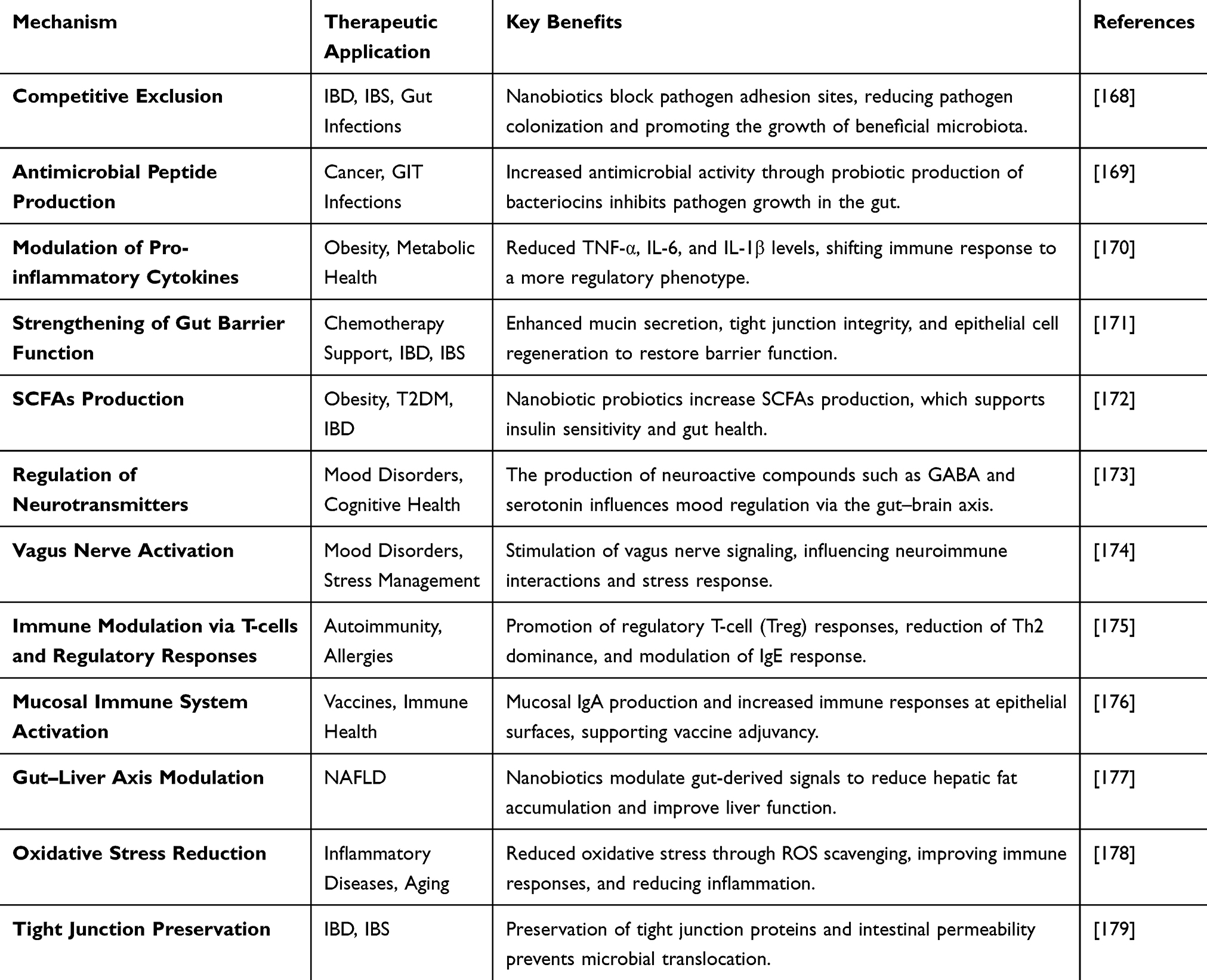 |
Table 2 Mechanisms of Action in Nanobiotic Probiotic Therapy |
Safety, Translational, and Regulatory Challenges
Although nanobiotic-enhanced probiotics hold considerable promise, the transition from concept to clinical application and commercialization is fraught with complex challenges. These stem from safety concerns related to nanomaterials, regulatory ambiguity, manufacturing and scalability limitations, and consumer perceptions. Addressing these issues is critical if nanobiotic technologies are to fulfill their potential as effective, safe, and socially acceptable therapeutics for gut health and systemic diseases.
The introduction of nanomaterials into food and therapeutic products raises valid safety concerns. These concerns must be rigorously evaluated, especially when live microorganisms are involved. Unlike traditional probiotic supplements, nanobiotic systems employ engineered nanoparticles to protect and deliver microbial cells. These materials can interact with biological tissues and the gut environment in unpredictable ways.180 There is ongoing scientific debate about the potential toxicity of nanomaterials, including risks of oxidative stress, inflammation, and unintended immune activation. Some studies have shown that certain inorganic nanoparticles can penetrate epithelial barriers. They can accumulate in tissues or interfere with cellular signaling pathways. This raises concerns about long-term exposure within the gut or beyond. Many nanocarrier materials used in probiotic delivery, such as chitosan, alginate, or lipids, are considered biocompatible and generally recognized as safe (GRAS).181 However, the impact of chronic exposure, potential effects on host microbiota ecology, and interactions with gut immunity warrant extensive in vivo and clinical evaluation. Long-term studies are largely lacking. The gut microbiome itself plays a central role in metabolic and immune homeostasis. Any perturbations caused by nanostructured materials must be understood before widespread clinical use. The complexity of the ecosystem and interindividual variability further complicate safety assessments, as responses to nanobiotic formulations may differ across age groups, genetics, and health statuses.1,124
Pharmacokinetics, Biodistribution, and Clearance of Nanobiotic Systems
An important translational consideration for nanobiotic systems is their pharmacokinetic behavior after oral administration, including intestinal uptake, systemic distribution, clearance, and excretion. For most gut-targeted nanobiotic formulations, therapeutic activity is intended to remain primarily local within the GIT, and systemic absorption may therefore be limited.182 Nevertheless, a fraction of orally administered nanocarriers may cross the intestinal barrier and enter systemic circulation, where their biodistribution becomes relevant for both efficacy and safety. In such cases, hepatic uptake and renal handling are key determinants of nanocarrier fate, while fecal excretion remains an important route of elimination for non-absorbed material or carriers cleared through the hepatobiliary pathway.183
The in vivo fate of nanobiotic systems is strongly influenced by physicochemical characteristics such as particle size, surface charge, composition, degradability, and coating properties. Smaller or more degradable carriers may be cleared more readily through renal filtration, whereas larger or less degradable systems are more likely to undergo hepatic sequestration, prolonged tissue retention, or biliary excretion.184 Circulation time may also vary depending on the extent of intestinal absorption and interactions with biological barriers or phagocytic clearance systems. However, direct pharmacokinetic data for probiotic-specific nanobiotic formulations remain limited, and most current understanding is extrapolated from broader oral nanoparticle studies rather than dedicated nanoprobiotic ADME investigations. This remains an important translational gap, because biodistribution, renal and hepatic clearance, and excretion profiles will ultimately influence biosafety evaluation, dose optimization, and clinical applicability.53,128
Nanobiotic probiotics challenge existing translational and regulatory pathways because they combine two layers of development complexity within a single platform: the biological complexity of live microorganisms and the physicochemical complexity of nanoscale carriers.53 Recent peer-reviewed literature on microbiome therapeutics indicates that the field has begun to move beyond proof-of-concept, as illustrated by the approval of Rebyota in 2022 and VOWST in 2023 for recurrent C. difficile infection.185 These real-world examples demonstrate that microbiota-based therapeutics can reach clinical practice when product composition, manufacturing controls, safety evaluation, and efficacy are sufficiently standardized. At the same time, published reviews emphasize that such products require substantially greater control than conventional probiotics, including compositional standardization, current good manufacturing practice, and structured clinical safety assessment.8 For nanobiotic probiotics, the translational burden is likely to be even greater, because developers must demonstrate not only strain identity, potency, viability, and microbial consistency, but also reproducible nanocarrier properties such as particle size distribution, surface chemistry, encapsulation efficiency, coating stability, and batch-to-batch uniformity. Recent analyses further highlight that the lack of harmonized analytical methods for live biotherapeutic products, together with unresolved standards for potency testing and complex microbial characterization, remains a major obstacle to regulatory maturation.53,58
Recently published studies further shows that the regulatory framework remains fragmented and strongly dependent on intended use. If a microbiome-based product is marketed for general digestive or nutritional support, it may fall under food or supplement regulation, whereas products intended to prevent, treat, or mitigate disease are more likely to enter biologic or medicinal-product pathways.186,187 European reviews specifically note that microbiome-based therapies may fall under multiple legislative categories, creating uncertainty in how safety, efficacy, and quality should be evaluated across products with overlapping microbiological and therapeutic functions. Parallel reviews of nanotechnology-enabled health products indicate that nano-enabled formulations face additional regulatory ambiguity because nanotechnology-specific requirements are still distributed across broader pharmaceutical, food, and device frameworks rather than governed by a single dedicated pathway.146 In practical terms, this means that future nanobiotic probiotics will likely require early regulatory agreement on product classification, validated methods for both microbial and nanomaterial characterization, GMP-compatible scale-up strategies, and long-term surveillance for unintended microbiome perturbation, host immune effects, and chronic exposure to carrier materials. These issues indicate that translational success in this field depends not only on therapeutic efficacy, but also on whether nanobiotic systems can be manufactured reproducibly and evaluated within a regulatory pathway capable of addressing both live biological agents and engineered nanoscale materials.53,188
Even if safety and regulatory challenges are addressed, consumer acceptance of nanobiotic-enhanced probiotics may pose a barrier to adoption. The use of nano-engineered materials in products intended for ingestion, particularly those containing live microorganisms, may raise public concerns. These concerns are influenced by perceptions of “unnatural” technology and uncertainty about long-term safety. Surveys of consumer attitudes toward nanotechnology in food and medicine reveal mixed responses, with acceptance often hinging on perceived benefits versus risks, trust in regulatory oversight, and understanding of the underlying science.53,189 Clear communication is therefore essential, including transparent labeling, education on the mechanisms and benefits, and informed consent in clinical contexts where nanobiotic probiotics are used therapeutically. Misinformation or lack of public understanding could undermine confidence and slow the translation of nanobiotic innovations into widespread clinical and consumer use.190
Comparative Analysis of Recent Findings
As research into nanobiotic-enhanced probiotics expands, an emerging body of literature has begun to quantitatively and qualitatively compare traditional probiotic systems with nano-enhanced delivery platforms. This comparative analysis highlights clear trends in improved efficacy and survivability in preclinical and in vitro models. It summarizes what meta-analyses suggest about overall effects. The analysis also identifies key gaps and contradictions that must be addressed before widespread clinical translation can occur.
Trends in Efficacy
Recent comparative studies establish a definitive efficacy paradigm shift. These studies demonstrate that nano-enhanced probiotic systems substantially outperform traditional free-cell formulations. This is observed across three critical metrics: targeted delivery, gastrointestinal survivability, and downstream in vivo health effects.191
Superior Survivability Under Physiological Stress
The primary limitation of conventional probiotic administration is the rapid loss of bacterial viability when exposed to the hostile conditions of the upper gastrointestinal GIT. Recent in vitro simulated digestion models have quantified this discrepancy. A study evaluating the electrospun nanoencapsulation of Lactobacillus and Bifidobacterium strains within biopolymer matrices demonstrated that free probiotic cells suffered a severe 10-log (CFU/mL) reduction within 120 minutes of exposure to simulated gastric and intestinal fluids. In stark contrast, the nano-encapsulated counterparts exhibited only a 3-log reduction, preserving 81–100% of the initial bacterial population.57 Similarly, encapsulation utilizing solid lipid nanoparticles (SLNs) has been shown to maintain viability above the therapeutic threshold of 8.0 log CFU/g. This is achieved under severe acidic stress (pH 2.0) and bile salt exposure. In contrast, free cells routinely plummet below 3.5 log CFU/mL.192 Furthermore, nanoencapsulation provides significant thermal stability, shielding probiotics from heat stress generated during industrial processing and extended shelf-storage, a feat unattainable by free cells.13
Enhanced Delivery and Colonization
Beyond passive protection, nanobiotics exhibit superior delivery and colonization capabilities. The physicochemical properties of nanomaterials, specifically their size, high surface-area-to-volume ratio, and tunable zeta potential, enable deep penetration into the intestinal mucosal layer. These properties enhance their ability to interact with and deliver therapeutic agents effectively.86 Chitosan-based and water chestnut starch-based nanocapsules possess inherent mucoadhesive properties that significantly slow intestinal transit times.13 This prolonged retention facilitates a controlled, sustained release of viable bacteria directly at the colonic epithelium. It dramatically increases the successful colonization rates compared to free probiotics. Free probiotics are rapidly flushed through the GIT.53
Augmented in vivo Health Effects
The physical superiority of nanobiotic delivery directly translates into enhanced therapeutic outcomes in vivo. Comparative animal models indicate that nano-enhanced probiotics exert more profound immunomodulatory and metabolic effects than equal doses of free bacteria.41 Nano-encapsulated multi-strain probiotics have been linked to significantly accelerated restoration of intestinal villi morphology and enhanced nutrient absorption in dysbiotic models. Furthermore, nanobiotics drive a more robust local immune response. They upregulate the expression of critical cytokines. Nanobiotics also enhance epithelial barrier integrity by increasing tight junction protein expression. This is more effective than unencapsulated controls.193 Consequently, nanobiotics are currently demonstrating elevated clinical potential for modulating complex conditions. These conditions include IBD, CRC, and systemic metabolic syndromes like obesity and diabetes. Nanobiotics achieve this by successfully shifting the host microbiome toward an eubiotic state.41
Comparative Performance of Major Nanocarrier Classes
Although nanocarrier-mediated delivery consistently improves probiotic performance relative to free cells, the magnitude and mechanism of benefit differ across carrier classes. A recent meta-analysis confirmed an overall survival advantage for nanoparticle-encapsulated probiotics under simulated gastrointestinal conditions, with odds ratios of 2.79 at 0 min and 2.41 at 120 min relative to free cells.194 Polymeric systems, particularly chitosan–alginate-based carriers, currently show the most consistent evidence for acid and bile protection; for example, chitosan–alginate nanoparticles limited simulated gastric losses of Bacillus coagulans and Enterococcus faecium to 0.86 and 0.27 log CFU, respectively, with similarly low losses in simulated intestinal fluid.195 Core–shell platforms appear especially advantageous when colon-targeted retention is prioritized. In vivo, polysaccharide-based core–shell formulations prolonged intestinal persistence and yielded higher cecal counts than free probiotics, indicating improved colonization-related performance. By contrast, liposomes offer excellent biocompatibility and high encapsulation efficiency, but their physicochemical instability remains a relevant limitation for long-term storage and translational robustness.196 Emerging platforms such as milk-exosome-based coatings and MOF-based shells are promising but remain less validated: exosome-based systems have shown simulated gastrointestinal survival rates of 80.99–94.53% together with improved adhesion-related behavior, whereas MOF-based carriers have mainly demonstrated enhanced protection against saline, lysozyme, and pepsin stress, with limited colonization data to date.72 Taken together, current evidence suggests that polymeric and core–shell systems are presently the most mature platforms for combining gastrointestinal protection with colon-directed retention, whereas exosome- and MOF-based systems remain promising but early-stage alternatives.
To facilitate a clearer cross-platform comparison, Table 3 summarizes the major nanocarrier classes currently used for probiotic delivery with emphasis on gastrointestinal survival, colonization- or retention-related performance, principal advantages, and current limitations. This structured comparison helps distinguish carrier systems supported by relatively mature evidence from those that remain promising but are still in an early preclinical stage.
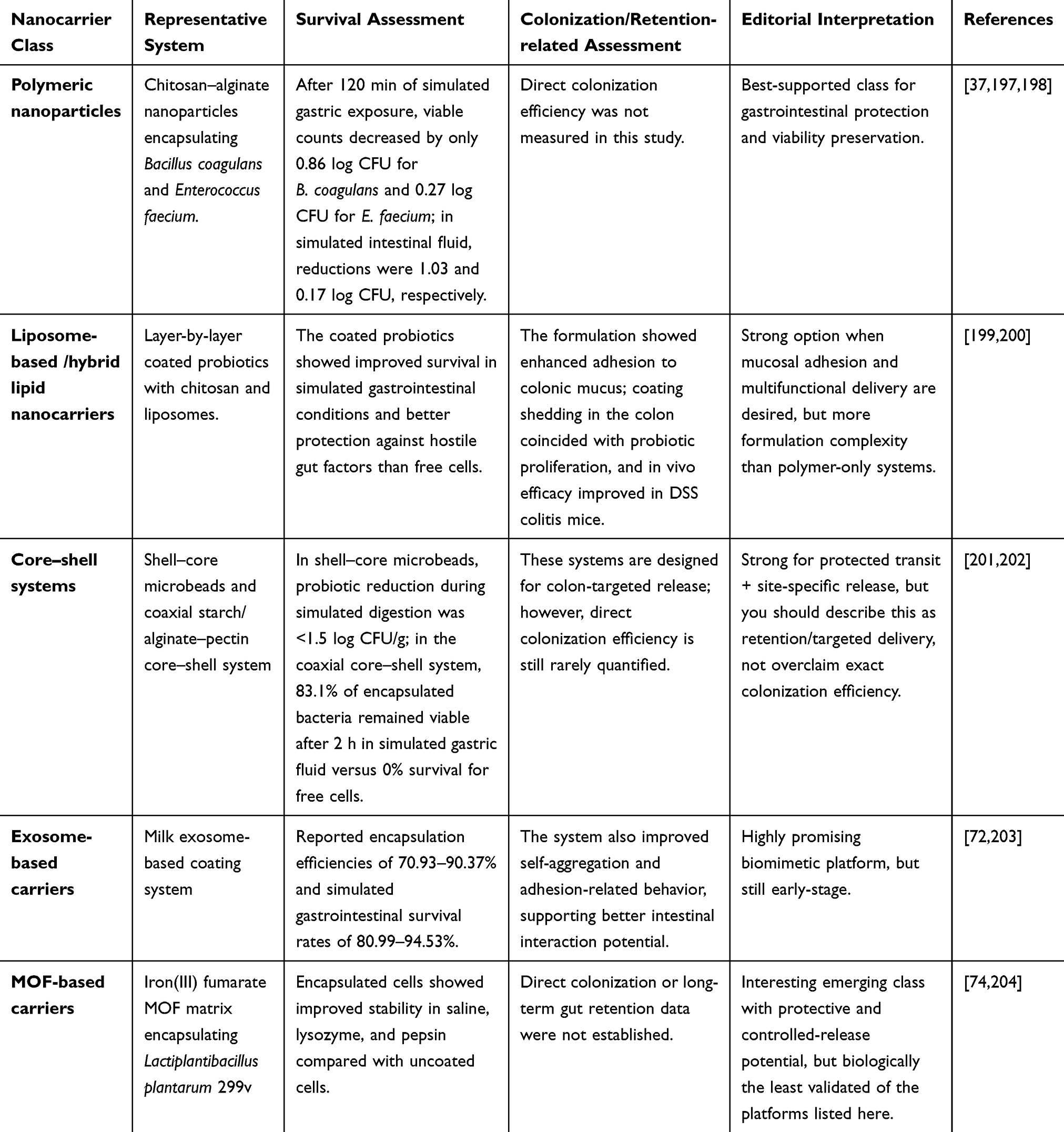 |
Table 3 Comparative Evaluation of Representative Nanocarrier Classes for Probiotic Delivery |
Meta-Analysis and Effect Size
Quantitative evaluations through recent systematic reviews and meta-analyses provide robust statistical validation for the improved performance of probiotics when delivered via nanocarriers.194 A landmark meta-analysis assessing the biological effects of nanocarrier-mediated probiotic delivery utilized random-effects models to aggregate survival data across various simulated gastrointestinal conditions. The study reported a highly favorable, statistically significant effect size for encapsulation. Specifically, upon initial exposure to simulated gastric stress (0 min), nano-encapsulated probiotics demonstrated an Odds Ratio (OR) of 2.79 (95% CI: 2.79–2.80) for survival compared to free-state counterparts. This protective advantage remained significant throughout the digestion timeline, maintaining an OR of 2.41 at 120 minutes of exposure to harsh simulated intestinal fluids.194
Similarly, comprehensive meta-analytical reviews focus on specific microbial strains, such as Lactobacillus species and yeast-based probiotics. These reviews confirm that micro- and nano-encapsulation techniques consistently yield a 1–2 log CFU/g increase in survival rate. This is compared to unencapsulated controls post-gastrointestinal transit.205 These statistical models provide definitive proof that the physical shielding of nanocarriers directly translates to higher viable cell delivery to the colon.
Limitations and the Lack of Standardized Outcomes
Despite these promising statistical confirmations, meta-analyses simultaneously expose a critical vulnerability in current research: the severe limitation of standardized outcomes.206 High degrees of statistical heterogeneity (I2 > 75%) are frequently observed across aggregated studies. The extreme diversity in experimental designs primarily drives this variance.41 Researchers utilize vastly different encapsulating materials. These include solid lipid nanoparticles versus ternary biopolymer hydrogels like alginate-chitosan. They also use distinct encapsulation methods, such as electrospraying vs. emulsion. Additionally, researchers work with variable baseline probiotic strains that have inherent differences in acid/bile tolerance.207,208
Furthermore, the lack of universally adopted in vitro digestion protocols means that primary studies often evaluate varying concentrations of bile salts, enzymes, and pH levels.41 This methodological inconsistency makes it exceedingly difficult to perform direct comparisons of effect sizes across different nano-formulations. Consequently, while meta-analyses unequivocally confirm that nanocarriers improve probiotic efficacy, the field requires urgent methodological standardization. This is necessary to translate these heterogeneous effect sizes into universally accepted clinical dosing guidelines.206
Gaps and Contradictions
Despite the profound efficacy demonstrated in controlled laboratory environments, the progression of nanobiotic formulations from bench to bedside is currently hindered by significant translational gaps. There are also contradictory findings within the recent literature.54
The Preclinical vs. Clinical Translational Discrepancy
The most glaring contradiction exists between the overwhelming success of nanobiotics in preclinical animal models and the stark lack of predictive consistency in human clinical trials.53 In murine and poultry models, orally administered nano-encapsulated probiotics consistently demonstrate near-perfect colonic targeting. They also show massive reductions in pathogen shedding and precise modulation of inflammatory markers.209,210 However, extrapolating these localized effects to human subjects is fraught with physiological hurdles.
The human GIT presents a vastly different anatomical landscape compared to laboratory animals. Crucial differences in gastric emptying rates and localized pH fluctuations create variability. Human fasting stomach pH can drop to 1.5, whereas murine stomachs often maintain a less severe pH of 3.0–4.0. Additionally, the basal composition of the indigenous gut microbiome contributes to this variability. These factors create immense variability in the degradation kinetics of nanocarriers.211 Consequently, the sustained-release profiles meticulously optimized in silico or in murine models often result in premature probiotic release. Alternatively, they may cause incomplete matrix degradation when introduced to the human GIT.53 As highlighted in recent critical reviews, this discrepancy leads to unpredictable colonization rates and suboptimal therapeutic outcomes in human subjects, directly contradicting the uniform 8 to 9 log CFU/g survival rates observed in preclinical data.53,54
Contradictions in Nanomaterial Biocompatibility and Toxicity
A secondary, heavily debated contradiction concerns the long-term safety profile of the nanomaterials used for encapsulation.212 Current in vitro assays predominantly promote biopolymers (eg, low-molecular-weight chitosan, sodium alginate) and advanced synthetic hydrogels as highly biocompatible.191 However, longitudinal in vivo data present a more complicated and sometimes contradictory narrative.
While short-term studies report no acute toxicity, emerging pharmacokinetic research indicates that chronic administration of certain nanoscale vehicles may lead to unintended bioaccumulation within the intestinal crypts or the reticuloendothelial system (RES).213 Furthermore, an inherent therapeutic paradox exists. While the primary goal of the nanocarrier is to deliver probiotics to restore eubiosis, some studies suggest that prolonged accumulation of specific degradation products may inadvertently cause problems. This is particularly true for synthetic polymers. These degradation products might alter the mucus layer’s viscosity, disrupt native commensal populations, or induce low-grade localized inflammatory responses.86 This contradiction, where the delivery vehicle potentially antagonizes the immunomodulatory aim of the probiotic, remains largely unresolved. It is primarily due to a severe lack of standardized, multi-year human toxicological evaluations.212
Manufacturing Scalability and Process-Induced Viability Gaps
Finally, there is a pronounced operational gap between laboratory-scale encapsulation efficiency and industrial scalability. Literature frequently reports exceptional encapsulation efficiencies exceeding 95% utilizing precise, low-stress methodologies such as layer-by-layer single-cell nanocoating, electrospinning, or microfluidics.57,191 However, transitioning these delicate procedures to commercial production exposes the fragile bacterial payload to severe mechanical shear stress. It also subjects the payload to extreme pressures and unfavorable thermal conditions during processes like high-shear extrusion or industrial lyophilization.206
The literature reveals a harsh operational contradiction. Nano-formulations that achieve near-perfect viability in benchtop simulated digestion protocols often suffer massive, multi-log viability losses. These losses occur during actual industrial processing and during extended shelf storage.191,206 Additionally, critical gaps exist regarding multi-strain encapsulations. Industrial matrices often inadvertently favor the survival and release kinetics of one specific strain over another. For example, Lactobacillus survives industrial heat better than Bifidobacterium. This fundamentally alters the intended symbiotic ratio before the product even reaches the consumer’s colon.206 Overcoming these process-induced damages without compromising the structural integrity of the “nano-armor” represents a critical, yet unmet, milestone for the clinical viability of nanobiotic therapeutics (Table 4).54,206
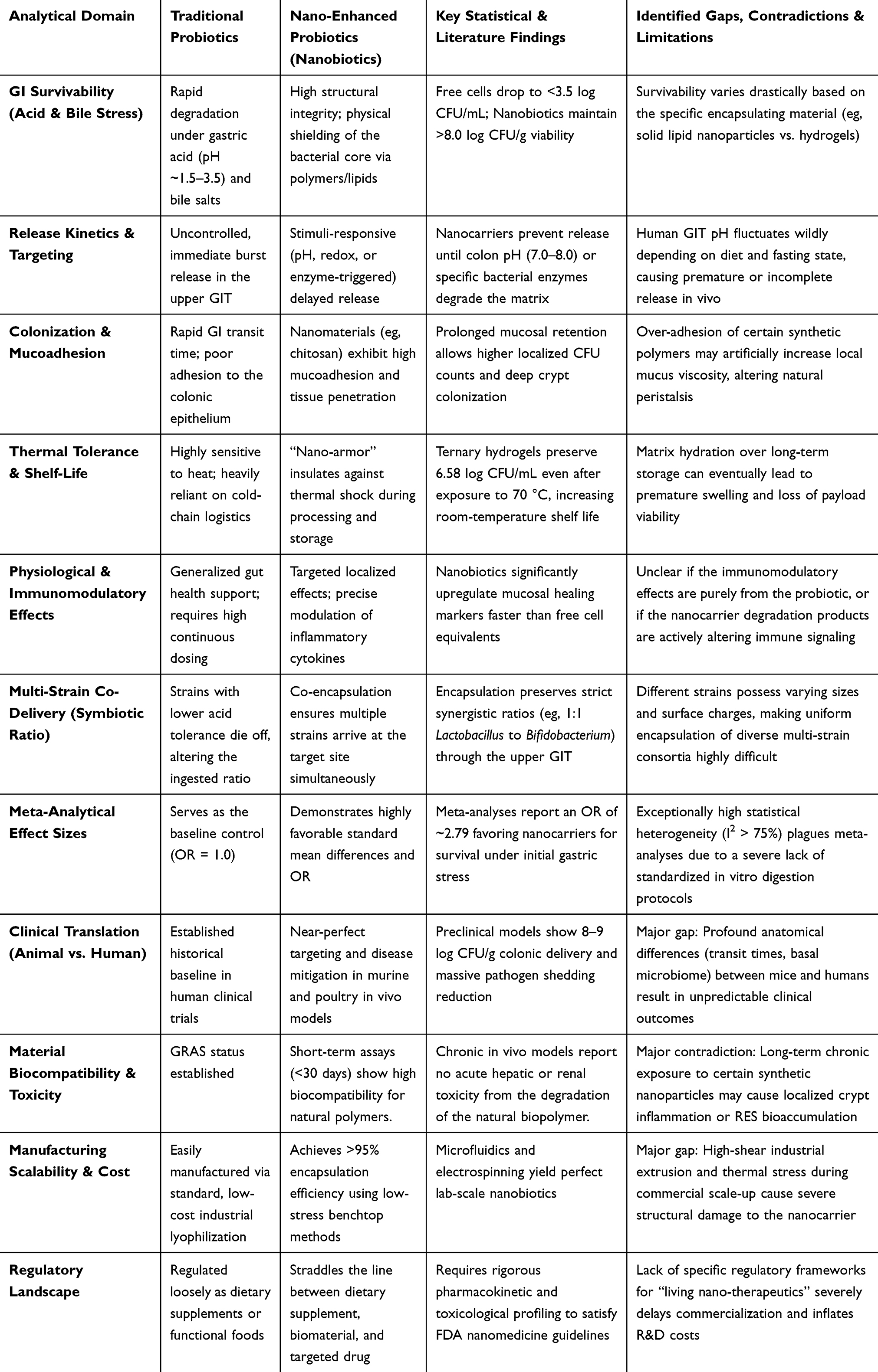 |
Table 4 Comparative Analysis of Traditional vs. Nano-Enhanced Probiotic Systems |
Future Directions and Research Needs
As nanobiotic probiotics transition from concept to clinical relevance, research is rapidly evolving toward smarter, more personalized, and clinically translatable systems. While early results demonstrate enhanced viability and targeted delivery, the next decade of innovation must focus on advanced nanocarrier designs, integration with individualized microbiome insights, and robust human clinical validation.10 Addressing these areas will be key to unlocking the full therapeutic potential of nanobiotic probiotics in medicine.
Emerging Nanocarrier Technologies
Next-generation nanocarrier platforms are advancing beyond basic protective encapsulation toward “smart” and stimuli-responsive systems that can dynamically interact with specific physiological cues in the GIT. These smart carriers are engineered to respond to changes in pH, enzymatic activity, redox conditions, or inflammatory markers, enabling on-demand release of probiotic cells when and where they are most needed.214,215 The platforms are being developed that release their cargo only upon encountering the alkaline environment of the distal intestine or specific enzymatic triggers. These platforms aim to maximize probiotic efficacy at target sites while reducing unnecessary activation upstream. Other sophisticated triggers, explored in drug delivery research, could theoretically be adapted for probiotic release. These include ultrasound-responsive hydrogels or electro-responsive polymer systems. This approach could achieve spatial and temporal precision in complex disease settings.216
Hybrid platforms that integrate functional nanocarriers with bioactive scaffolds or sensing elements offer additional opportunities to condition probiotic release based on real-time gut conditions. These multifunctional designs could detect inflammatory biomarkers and precisely secrete probiotics in response, thereby improving relevance for chronic inflammatory diseases such as IBD.217 Continued research into precision targeting strategies is important. This includes nanocarriers that can sense and react to local microenvironments. Such research represents a frontier in nanobiotic delivery. It should be prioritized in the coming years.54,194
Personalized Probiotic Therapy
One of the most promising directions for nanobiotic probiotics is personalized therapy, in which formulations are tailored to an individual’s unique gut microbiome profile, genetics, and disease context. The gut microbiota differs significantly across individuals, influenced by diet, genetics, age, environment, and health status, and emerging research in precision microbiome interventions highlights the need to move beyond “one-size-fits-all” approaches.8,218 Integrating microbiome profiling technologies (such as metagenomic sequencing and metabolomic analyses) with nanobiotic design could enable formulations that are optimized for specific microbial compositions or functional deficiencies in a given patient. Like, if a person’s microbiome shows depletion of specific beneficial taxa, nanobiotic probiotics could be engineered to release strains or prebiotic co-factors. These strains or cofactors would most likely restore the ability to produce key metabolites, such as SCFAs.219 Realizing truly personalized probiotic therapy also requires development of diagnostics and biomarkers that reliably predict response to specific probiotic interventions and can be tracked longitudinally. Coupling these diagnostics with customizable nanocarrier platforms could allow clinicians to deliver strain-specific, dose-optimized probiotic treatments. These treatments would adapt to changes in an individual’s gut ecosystem. This approach moves nanobiotic probiotics closer to the goals of precision medicine.220
Clinical Translation
Despite compelling preclinical results, there remains a critical need for well-designed human clinical trials to validate the safety, efficacy, and long-term benefits of nanobiotic probiotics. Much of the current evidence comes from in vitro studies and animal models, which, although informative, cannot fully capture the complexity of human physiology.41 They also fail to account for microbiome variability and disease progression. Meta-analyses of nanoparticle-encapsulated probiotics demonstrate improved viability under controlled conditions, but standardized clinical outcomes for human health benefits remain limited.60,194 Future clinical research should prioritize randomized, controlled trials across diverse patient populations and disease states. These trials should assess not only surrogate outcomes, such as probiotic survival and colonization, but also patient-relevant endpoints.221 These endpoints include symptom improvement, quality of life, inflammatory biomarkers, and disease progression. Trials should also evaluate long-term safety, including effects of repeated or chronic exposure to nanocarriers, interactions with the host microbiota, and potential off-target effects.222
Conclusion
Nanobiotic approaches represent a transformative strategy for enhancing the therapeutic efficacy of probiotics. By leveraging nanotechnology, these systems address longstanding limitations of traditional probiotics, such as poor survival rates, limited colonization, and inconsistent therapeutic outcomes. Nanoencapsulation protects probiotic cells from harsh gastrointestinal conditions, improving their viability and ensuring targeted delivery to specific gut regions, particularly those with the highest levels of inflammation or infection. This enhanced delivery allows probiotics to exert more powerful effects, not only on gut health but also on systemic conditions related to the gut–brain axis, immune modulation, and metabolic health. Nanobiotic probiotics show significant promise in treating gastrointestinal disorders such as IBD, IBS, and CRC, as well as supporting patients undergoing chemotherapy.
Furthermore, immune disorders and metabolic diseases, including obesity, diabetes, and NAFLD, stand to benefit from the advanced delivery capabilities and precision targeting offered by these technologies. By enhancing microbial survival and functional performance, nanobiotics may reshape the therapeutic landscape for these complex diseases, offering more effective, sustainable interventions compared to conventional probiotics. Despite these advancements, continued research is essential to optimize nanocarrier designs, improve scalability, and assess long-term safety. Clinical trials are particularly important to translate the promising preclinical results into real-world therapies, ensuring that these innovative delivery systems are both safe and effective across diverse populations. Regulatory frameworks need to evolve alongside these advancements to provide clear guidelines for clinical application, enabling nanobiotics to fulfill their potential in personalized medicine. In conclusion, nanobiotics offer an exciting future for probiotic therapy, but achieving their full potential requires collaboration between researchers, clinicians, and regulators, along with a commitment to rigorous clinical testing to ensure these therapies can be safely and effectively integrated into mainstream healthcare.
Data Sharing Statement
All data related to the manuscript is available in the manuscript.
Bioethics Approval and Consent
This is a review article so, no approval and consent required.
Acknowledgment
The author acknowledges the drawing software Biorender, Canva and Adobe Illustrator for creating figures and the use of English editing software, such as Grammarly for refining the English grammar in this manuscript.
Disclosure
The author declares no conflict of interest.
References
1. Cao C, Yue S, Lu A, Liang C. Host-gut microbiota metabolic interactions and their role in precision diagnosis and treatment of gastrointestinal cancers. Pharmacol Res. 2024;207:107321. doi:10.1016/j.phrs.2024.107321
2. Cortés M, Olate P, Rodriguez R, et al. Human microbiome as an immunoregulatory axis: mechanisms, dysbiosis, and therapeutic modulation. Microorganisms. 2025;13(9):2147. doi:10.3390/microorganisms13092147
3. Godoy-Vitorino F. Strengthening integrative microbiome research through regional leadership. Int J Environ Res Public Health. 2025;22(9):1322. doi:10.3390/ijerph22091322
4. Fetarayani D, Vidyani A, Sutanto H. Gut microbiome-centric nutritional strategies in inflammatory bowel disease: modulating dysbiosis for therapeutic benefit. Medicina de Familia SEMERGEN. 2025;51(8):102575. doi:10.1016/j.semerg.2025.102575
5. Tonacci A, Gorini F. Sensory characteristics of probiotic-containing foods: a multidisciplinary perspective on enhancing acceptability and consumer adherence. Nutrients. 2025;18(1):32. doi:10.3390/nu18010032
6. Latif A, Shehzad A, Niazi S, et al. Probiotics: mechanism of action, health benefits and their application in food industries. Front Microbiol. 2023;14:1216674. doi:10.3389/fmicb.2023.1216674
7. Maftei N-M, Raileanu CR, Balta AA, et al. The potential impact of probiotics on human health: an update on their health-promoting properties. Microorganisms. 2024;12(2):234. doi:10.3390/microorganisms12020234
8. Abdul Manan M. The role of probiotics in personalized therapeutics: advances in gut microbe-driven interventions. Microbe. 2025;8:100497. doi:10.1016/j.microb.2025.100497
9. Parvin N, Aslam M, Alam MN, Mandal TK. Nanotechnology driven innovations in modern pharmaceutics: therapeutics, imaging, and regeneration. Nanomaterials. 2025;15(22):1733. doi:10.3390/nano15221733
10. Abouelela ME, Helmy YA. Next-generation probiotics as novel therapeutics for improving human health: current trends and future perspectives. Microorganisms. 2024;12(3):430. doi:10.3390/microorganisms12030430
11. Yaqub MO, Jain A, Joseph CE, Edison LK. Microbiome-driven therapeutics: from gut health to precision medicine. Gastrointest Disord. 2025;7(1):7. doi:10.3390/gidisord7010007
12. Zhang Z, Liu J, Li M, et al. Lactobacillus rhamnosus encapsulated in alginate/chitosan microgels manipulates the gut microbiome to ameliorate salt-induced hepatorenal injury. Front Nutr. 2022;9:872808. doi:10.3389/fnut.2022.872808
13. Agriopoulou S, Tarapoulouzi M, Varzakas T, Jafari SM. Application of encapsulation strategies for probiotics: from individual loading to co-encapsulation. Microorganisms. 2023;11(12):2896. doi:10.3390/microorganisms11122896
14. Cheng J, Li X, Ke T, Gong J, Jiang T, Chen L. Advances in polysaccharide-based probiotic delivery systems: a review. Carbohydr Polym Technol Appl. 2025;10:100804. doi:10.1016/j.carpta.2025.100804
15. Agriopoulou S, Smaoui S, Chaari M, Varzakas T, Can Karaca A, Jafari SM. Encapsulation of probiotics within double/multiple layer beads/carriers: a concise review. Molecules. 2024;29(11):2431. doi:10.3390/molecules29112431
16. Lau LYJ, Quek SY. Probiotics: health benefits, food application, and colonization in the human gastrointestinal tract. Food Bioeng. 2024;3(1):41–37. doi:10.1002/fbe2.12078
17. Jyoti DP. Mechanisms and implications of the gut microbial modulation of intestinal metabolic processes. Npj Metab Health Dis. 2025;3(1):24. doi:10.1038/s44324-025-00066-1
18. Shen Y, Fan N, S-x M, Cheng X, Yang X, Wang G. Gut microbiota dysbiosis: pathogenesis, diseases, prevention, and therapy. MedComm. 2025;6(5):e70168. doi:10.1002/mco2.70168
19. O’Riordan KJ, Moloney GM, Keane L, Clarke G, Cryan JF. The gut microbiota-immune-brain axis: therapeutic implications. Cell Rep Med. 2025;6(3):101982. doi:10.1016/j.xcrm.2025.101982
20. Mazziotta C, Tognon M, Martini F, Torreggiani E, Rotondo JC. Probiotics mechanism of action on immune cells and beneficial effects on human health. Cells. 2023;12(1):184. doi:10.3390/cells12010184
21. Reddy MS. A comprehensive perspective of probiotics and their significant role in successfully preventing or treating diseases in both preventive and clinical medicine. Med Res Arch. 2025;13(9):6915. doi:10.18103/mra.v13i9.6915
22. Almansour N, Al-Rashed F, Choudhry K, et al. Gut microbiota: a promising new target in immune tolerance. Front Immunol. 2025;16:1607388. doi:10.3389/fimmu.2025.1607388
23. Petrariu OA, Barbu IC, Niculescu AG, et al. Role of probiotics in managing various human diseases, from oral pathology to cancer and gastrointestinal diseases. Front Microbiol. 2023;14:1296447. doi:10.3389/fmicb.2023.1296447
24. Yang S, Qiao J, Zhang M, et al. Prevention and treatment of antibiotics-associated adverse effects through the use of probiotics: a review. J Adv Res. 2025;71:209–226. doi:10.1016/j.jare.2024.06.006
25. Iqbal Z, Ahmed S, Tabassum N, Bhattacharya R, Bose D. Role of probiotics in prevention and treatment of enteric infections: a comprehensive review. 3 Biotech. 2021;11(5):242. doi:10.1007/s13205-021-02796-7
26. Vinayamohan P, Joseph D, Viju LS, Baskaran SA, Venkitanarayanan K. Efficacy of probiotics in reducing pathogenic potential of infectious agents. Fermentation. 2024;10(12):599. doi:10.3390/fermentation10120599
27. Halder N, Sunder J, De AK, Bhattacharya D, Joardar SN. Probiotics in poultry: a comprehensive review. J Basic Appl Zool. 2024;85(1):23. doi:10.1186/s41936-024-00379-5
28. Gou HZ, Zhang YL, Ren LF, Li ZJ, Zhang L. How do intestinal probiotics restore the intestinal barrier? Front Microbiol. 2022;13:929346. doi:10.3389/fmicb.2022.929346
29. Mohammad I, Ansari MR, Khan MS, Bari MN, Kamal MA, Poyil MM. Beyond digestion: the gut microbiota as an immune–metabolic interface in disease modulation. Gastrointest Disord. 2025;7(4):77. doi:10.3390/gidisord7040077
30. Yu M, Yu B, Chen D. The effects of gut microbiota on appetite regulation and the underlying mechanisms. Gut Microbes. 2024;16(1):2414796. doi:10.1080/19490976.2024.2414796
31. Ağagündüz D, Çelik E, Cemali Ö, et al. Mechanism of actions of probiotics on type 2 diabetes: development and complications. Biomed Pharmacother. 2025;191:118421. doi:10.1016/j.biopha.2025.118421
32. Ayesha IE, Monson NR, Klair N, et al. Probiotics and their role in the management of Type 2 diabetes mellitus (short-term versus long-term effect): a systematic review and meta-analysis. Cureus. 2023;15(10):e46741. doi:10.7759/cureus.46741
33. Saban Güler M, Arslan S, Ağagündüz D, et al. Butyrate: a potential mediator of obesity and microbiome via different mechanisms of actions. Food Res Int. 2025;199:115420. doi:10.1016/j.foodres.2024.115420
34. Amin MR, Biswas AP, Tasnim M, Islam MN, Azam MS. Probiotics and their applications in functional foods: a health perspective. Appl Food Res. 2025;5(2):101193. doi:10.1016/j.afres.2025.101193
35. Han S, Lu Y, Xie J, et al. Probiotic gastrointestinal transit and colonization after oral administration: a long journey. Front Cell Infect Microbiol. 2021;11:609722. doi:10.3389/fcimb.2021.609722
36. Koga Y. Microbiota in the stomach and application of probiotics to gastroduodenal diseases. World J Gastroenterol. 2022;28(47):6702–6715. doi:10.3748/wjg.v28.i47.6702
37. Liaqat I, Fatima A, Andleeb S, et al. Synthesis of biodegradable nanocomposite–based chitosan/Ag NPs for food packaging. BioNanoScience. 2025;15(3):359. doi:10.1007/s12668-025-01947-x
38. Mendonça AA, WdP P-N, da Paixão GA, DdS S, De Morais MA, De Souza RB. Journey of the probiotic bacteria: survival of the fittest. Microorganisms. 2023;11(1):95. doi:10.3390/microorganisms11010095
39. Das TK, Pradhan S, Chakrabarti S, Mondal KC, Ghosh K. Current status of probiotic and related health benefits. Appl Food Res. 2022;2(2):100185. doi:10.1016/j.afres.2022.100185
40. Chandrasekaran P, Weiskirchen S, Weiskirchen R. Effects of probiotics on gut microbiota: an overview. Int J Mol Sci. 2024;25(11):6022. doi:10.3390/ijms25116022
41. Sarita B, Samadhan D, Hassan MZ, Kovaleva EG. A comprehensive review of probiotics and human health-current prospective and applications. Front Microbiol. 2024;15:1487641. doi:10.3389/fmicb.2024.1487641
42. Shaikh SD, Sun N, Canakis A, Park WY, Weber HC. Irritable bowel syndrome and the gut microbiome: a comprehensive review. J Clin Med. 2023;12(7):2558. doi:10.3390/jcm12072558
43. Zhao Y, Zhu S, Dong Y, et al. The role of gut microbiome in irritable bowel syndrome: implications for clinical therapeutics. Biomolecules. 2024;14(12):1643. doi:10.3390/biom14121643
44. Peng L, Wang X, Wang Y, Guo J, Yang J. Surface modification of probiotics at single-cell resolution: strategies, applications, and future directions in inflammatory bowel disease. Mater Today Bio. 2025;35:102485. doi:10.1016/j.mtbio.2025.102485
45. Carolak E, Czajkowska J, Stypułkowska A, Waszczuk W, Dutkiewicz A, Grzymajlo K. Being a better version of yourself: genetically engineered probiotic bacteria as host defense enhancers in the control of intestinal pathogens. Gut Microbes. 2025;17(1):2519696. doi:10.1080/19490976.2025.2519696
46. Ceccherini C, Daniotti S, Bearzi C, Re I. Evaluating the efficacy of probiotics in IBS treatment using a systematic review of clinical trials and multi-criteria decision analysis. Nutrients. 2022;14(13):2689. doi:10.3390/nu14132689
47. Satish Kumar L, Pugalenthi LS, Ahmad M, Reddy S, Barkhane Z, Elmadi J. Probiotics in irritable bowel syndrome: a review of their therapeutic role. Cureus. 2022;14(4):e24240. doi:10.7759/cureus.24240
48. Jagtiani E, Microencapulsation AS. Probiotics, prebiotics, and nutraceuticals. J Nanotechnol Nanomater. 2022;3(1):34–60. doi:10.33696/Nanotechnol.3.030
49. Arratia-Quijada J, Nuño K, Ruíz-Santoyo V, Andrade-Espinoza BA. Nano-encapsulation of probiotics: need and critical considerations to design new non-dairy probiotic products. J Funct Foods. 2024;116:106192. doi:10.1016/j.jff.2024.106192
50. Shanuke DS, Ranasinghage NBDP, Illippangama AU, Kulathunga J, Bandara MD. Co-encapsulation of probiotics and prebiotics: techniques and applications in food fortification. Food Sci Nutr. 2025;13(6):e70426. doi:10.1002/fsn3.70426
51. Karnwal A, Sharma V, Kumar G, Jassim AY, Dohroo A, Sivanesan I. Transforming medicine with nanobiotechnology: nanocarriers and their biomedical applications. Pharmaceutics. 2024;16(9):1114. doi:10.3390/pharmaceutics16091114
52. Desai N, Rana D, Patel M, Bajwa N, Prasad R, Vora LK. Nanoparticle therapeutics in clinical perspective: classification, marketed products, and regulatory landscape. Small. 2025;21(29):2502315. doi:10.1002/smll.202502315
53. Kadam O, Dalai S, Chauhan B, et al. Nanobiotechnology unveils the power of probiotics: a comprehensive review on the synergistic role of probiotics and advanced nanotechnology in enhancing geriatric health. Cureus. 2025;17(3):e80478. doi:10.7759/cureus.80478
54. Chen A, Gong Y, Wu S, et al. Navigating a challenging path: precision disease treatment with tailored oral nano-armor-probiotics. J Nanobiotechnol. 2025;23(1):72. doi:10.1186/s12951-025-03141-3
55. Puricelli C, Gigliotti CL, Stoppa I, et al. Use of poly lactic-co-glycolic acid nano and micro particles in the delivery of drugs modulating different phases of inflammation. Pharmaceutics. 2023;15(6):1772. doi:10.3390/pharmaceutics15061772
56. Srinivasan MK, Prasad M. Recent advances in tumor targeted polymeric nanoparticles for HNC treatment: enhancing therapeutic efficacy via engineered and biocompatible drug delivery systems. J Oral Biol Craniofac Res. 2025;15(6):1316–1330. doi:10.1016/j.jobcr.2025.08.012
57. PBVd S, Rosales TKO, Fabi JP. Nanoencapsulation of biotics: feasibility to enhance stability and delivery for improved gut health. Pharmaceutics. 2025;17(9):1180. doi:10.3390/pharmaceutics17091180
58. Razavi S, Janfaza S, Tasnim N, Gibson DL, Hoorfar M. Nanomaterial-based encapsulation for controlled gastrointestinal delivery of viable probiotic bacteria. Nanoscale Adv. 2021;3(10):2699–2709. doi:10.1039/d0na00952k
59. Ahmadi M, Khajeh F, Shahbahrami R, et al. Advanced synbiotic delivery platforms: integrating prebiotic alginate co-encapsulants for probiotic protection in functional foods. Carbohydr Polym Technol Appl. 2025;12:101022. doi:10.1016/j.carpta.2025.101022
60. Rahmati F. Advancing probiotic delivery in cancer therapy: nanocarrier innovations for enhanced viability, targeted action, and clinical translation. Nat Nanotechnol. 2025;1(1):15. doi:10.1186/s44301-025-00018-0
61. Zhang Y, Wang Y, Lu Y, et al. Advanced oral drug delivery systems for gastrointestinal targeted delivery: the design principles and foundations. J Nanobiotechnol. 2025;23(1):400. doi:10.1186/s12951-025-03479-8
62. Martelli A, Mohamed YOA, Gallego-Ferrer G, Gentile P, Girón-Hernández J. Revolutionizing gut health: advances in encapsulation strategies for probiotics and bioactive molecules. Biotechnol Adv. 2025;83:108630. doi:10.1016/j.biotechadv.2025.108630
63. Hao M, Tan X, Liu K, Xin N. Nanoencapsulation of nutraceuticals: enhancing stability and bioavailability in functional foods. Front Nutr. 2025;12:1746176. doi:10.3389/fnut.2025.1746176
64. Jan T, Negi R, Hilal A, et al. Microencapsulation techniques for probiotic formulations: current scenario and future perspective. J Food Qual. 2025;2025(1):6738124. doi:10.1155/jfq/6738124
65. Sidhu AK, Verma N, Kaushal P, Agrawal SB, Bhatia S. Green synthesis of polymeric nanoparticles: agricultural applications and toxicological implications. Discov Appl Sci. 2025;7(6):505. doi:10.1007/s42452-025-06877-7
66. Shamloo E, Sadeghi E, Soltani M, et al. Encapsulation of natural/bio-based materials as nano bio-adsorbents for removal of toxic pollutants from food products: a review. Carbohydr Polym Technol Appl. 2025;10:100870. doi:10.1016/j.carpta.2025.100870
67. Gonciarz W, Balcerczak E, Brzeziński M, et al. Chitosan-based formulations for therapeutic applications. A recent overview. J Biomed Sci. 2025;32(1):62. doi:10.1186/s12929-025-01161-7
68. Rahim MA, Zahran HA, Jaffar HM, et al. Liposomal encapsulation in food systems: a review of formulation, processing, and applications. Food Sci Nutr. 2025;13(8):e70587. doi:10.1002/fsn3.70587
69. Sun Q, Yin S, He Y, Cao Y, Jiang C. Biomaterials and encapsulation techniques for probiotics: current status and future prospects in biomedical applications. Nanomaterials. 2023;13(15):2185. doi:10.3390/nano13152185
70. Serrano DR, Juste F, Anaya BJ, et al. Exosome-based drug delivery: a next-generation platform for cancer, Infection, neurological and immunological diseases, gene therapy and regenerative medicine. Pharmaceutics. 2025;17(10):1336. doi:10.3390/pharmaceutics17101336
71. Palakurthi SS, Shah B, Kapre S, et al. A comprehensive review of challenges and advances in exosome-based drug delivery systems. Nanoscale Adv. 2024;6(23):5803–5826. doi:10.1039/d4na00501e
72. Hao L, Liu Y, Szeto IM-Y, et al. Milk exosome-based delivery system for probiotic encapsulation that enhances the gastrointestinal resistance and adhesion of probiotics. Nutrients. 2025;17(5):923. doi:10.3390/nu17050923
73. Mierzejewska J, Kowalska P, Marlicka K, et al. Exploring extracellular vesicles of probiotic yeast as carriers of biologically active molecules transferred to human intestinal cells. Int J Mol Sci. 2023;24(14):11340. doi:10.3390/ijms241411340
74. FitzGerald LI, Sutton AL, Doherty CM. Encapsulation of a probiotic bacterial strain in a biocompatible iron(III) fumarate matrix. ACS Appl Bio Mater. 2025;8(4):2765–2770. doi:10.1021/acsabm.4c01398
75. Rafik ST, Vaidya JS, MacRobert AJ, Yaghini E. Organic nanodelivery systems as a new platform in the management of breast cancer: a comprehensive review from preclinical to clinical studies. J Clin Med. 2023;12(7):2648. doi:10.3390/jcm12072648
76. Fekete EE, Figeys D, Zhang X. Microbiota-directed biotherapeutics: considerations for quality and functional assessment. Gut Microbes. 2023;15(1):2186671. doi:10.1080/19490976.2023.2186671
77. El-Saadony MT, Saad AM, Sitohy M, et al. Chitosan nanoparticles: green synthesis, biological activities, and sustainable frontiers in targeted drug delivery and cancer nanomedicine – a comprehensive review. Mater Today Bio. 2025;35:102358. doi:10.1016/j.mtbio.2025.102358
78. Subramanian DA, Langer R, Traverso G. Mucus interaction to improve gastrointestinal retention and pharmacokinetics of orally administered nano-drug delivery systems. J Nanobiotechnol. 2022;20(1):362. doi:10.1186/s12951-022-01539-x
79. Wang X, Zhang P, Zhang X. Probiotics regulate gut microbiota: an effective method to improve immunity. Molecules. 2021;26(19):6076. doi:10.3390/molecules26196076
80. Wang X, Yu M, Ye J, et al. Research advances on encapsulation of probiotics with nanomaterials and their repair mechanisms on intestinal barriers. Food Sci Hum Wellness. 2024;13(6):3095–3109. doi:10.26599/FSHW.2022.9250246
81. Sato H, Yamada K, Miyake M, Onoue S. Recent advancements in the development of nanocarriers for mucosal drug delivery systems to control oral absorption. Pharmaceutics. 2023;15(12):2708. doi:10.3390/pharmaceutics15122708
82. Hazt B, Read DJ, Harlen OG, Poon WCK, O’Connell A, Sarkar A. Mucoadhesion across scales: towards the design of protein-based adhesives. Adv Colloid Interface Sci. 2024;334:103322. doi:10.1016/j.cis.2024.103322
83. Shah RM, Kaur IP, Jadhav SR. The surface-first paradigm: engineering nanocarriers for infection-responsive drug delivery. Adv Colloid Interface Sci. 2025;349:103761. doi:10.1016/j.cis.2025.103761
84. Zheng B, Liu D, Qin X, Zhang D, Zhang P. Mucoadhesive-to-mucopenetrating nanoparticles for mucosal drug delivery: a mini review. Int J Nanomed. 2025;20:2241–2252. doi:10.2147/ijn.S505427
85. Sun C, Zhang Z, Sun Y, et al. Enteric delivery of probiotics: challenges, techniques, and activity assays. Foods. 2025;14(13):2318. doi:10.3390/foods14132318
86. Pandey RP, Dhiman R, Chang CM. The potential of nanoencapsulated probiotics in the modulation of the gut microbiome. Nanomedicine. 2025;20(4):335–338. doi:10.1080/17435889.2025.2452152
87. Jan T, Negi R, Sharma B, et al. Next generation probiotics for human health: an emerging perspective. Heliyon. 2024;10(16):e35980. doi:10.1016/j.heliyon.2024.e35980
88. Jung W, Son YM. Nanoparticle-driven modulation of mucosal immunity and interplay with the microbiome. World J Microbiol Biotechnol. 2025;35:e2404033. doi:10.4014/jmb.2504.04033
89. Cristofori F, Dargenio VN, Dargenio C, Miniello VL, Barone M, Francavilla R. Anti-inflammatory and immunomodulatory effects of probiotics in gut inflammation: a door to the body. Front Immunol. 2021;12:578386. doi:10.3389/fimmu.2021.578386
90. Almusallam D, Alhabardi S. A systematic review on the dynamic interplay between the immune system and gut microbiome in inflammatory bowel disease patients. Future J Pharm Sci. 2025;11(1):129. doi:10.1186/s43094-025-00891-7
91. Chen C, Zhu Z. Recent advances in the nanoshells approach for encapsulation of single probiotics. Drug Des Dev Ther. 2023;17:2763–2774. doi:10.2147/dddt.S419897
92. Wang Y, Mo Y, Sun Y, et al. Intestinal nanoparticle delivery and cellular response: a review of the bidirectional nanoparticle-cell interplay in mucosa based on physiochemical properties. J Nanobiotechnol. 2024;22(1):669. doi:10.1186/s12951-024-02930-6
93. Wang H, Sun Y, Ma X, Yang T, Wang F. The Lactobacillus plantarum P-8 probiotic microcapsule prevents DSS-induced Colitis through improving intestinal integrity and reducing colonic inflammation in mice. Nutrients. 2024;16(7):1055. doi:10.3390/nu16071055
94. Alkushi AG, Elazab ST, Abdelfattah-Hassan A, et al. Multi-strain-probiotic-loaded nanoparticles reduced colon inflammation and orchestrated the expressions of tight junction, NLRP3 inflammasome and caspase-1 genes in DSS-induced colitis model. Pharmaceutics. 2022;14(6):1183. doi:10.3390/pharmaceutics14061183
95. Zhang H, Liu Z, Fang H, et al. Construction of probiotic double-layered multinucleated microcapsules based on sulfhydryl-modified carboxymethyl cellulose sodium for increased intestinal adhesion of probiotics and therapy for intestinal inflammation induced by Escherichia coli O157:H7. ACS Appl Mater Interfaces. 2023;15(15):18569–18589. doi:10.1021/acsami.2c20437
96. Di Vincenzo F, Del Gaudio A, Petito V, Lopetuso LR, Scaldaferri F. Gut microbiota, intestinal permeability, and systemic inflammation: a narrative review. Intern Emerg Med. 2024;19(2):275–293. doi:10.1007/s11739-023-03374-w
97. Dmytriv TR, Storey KB, Lushchak VI. Intestinal barrier permeability: the influence of gut microbiota, nutrition, and exercise. Front Physiol. 2024;15:1380713. doi:10.3389/fphys.2024.1380713
98. Pan J, Gong G, Wang Q, et al. A single-cell nanocoating of probiotics for enhanced amelioration of antibiotic-associated diarrhea. Nat Commun. 2022;13(1):2117. doi:10.1038/s41467-022-29672-z
99. Zhai Z, Wang X, Qian Z, et al. Lactobacillus rhamnosus GG coating with nanocomposite ameliorates intestinal inflammation. Biomed Pharmacother. 2024;178:117197. doi:10.1016/j.biopha.2024.117197
100. Centurion F, Basit AW, Liu J, Gaisford S, Rahim MA, Kalantar-Zadeh K. Nanoencapsulation for probiotic delivery. ACS Nano. 2021;15(12):18653–18660. doi:10.1021/acsnano.1c09951
101. Abavisani M, Ebadpour N, Khoshrou A, Sahebkar A. Boosting vaccine effectiveness: the groundbreaking role of probiotics. J Agric Food Res. 2024;16:101189. doi:10.1016/j.jafr.2024.101189
102. Gutiérrez-álzate K, Beltrán-Cotta LA, Dos Santos Rekowsky BS, Cavalheiro CP, Pereira da Costa M. Micro- and nanoencapsulation of probiotics: exploring their impact on animal-origin foods. ACS Food Sci Technol. 2024;4(12):2799–2812. doi:10.1021/acsfoodscitech.4c00776
103. Rezagholizade-shirvan A, Soltani M, Shokri S, Radfar R, Arab M, Shamloo E. Bioactive compound encapsulation: characteristics, applications in food systems, and implications for human health. Food Chem X. 2024;24:101953. doi:10.1016/j.fochx.2024.101953
104. Febrian MB, Saptiama I, Marlina M, et al. Encapsulation of multi-strain probiotics using nanochitosan as a potential immunomodulator in broiler chicken. J Saudi Soc Agric Sci. 2025;24(3):15. doi:10.1007/s44447-025-00021-y
105. Zhang J, Zhang X, Cheng X, et al. Probiotics in inflammatory bowel diseases: emphasis on mechanisms and clinical application. Front Med. 2025;12:1620079. doi:10.3389/fmed.2025.1620079
106. Bu F, Chen K, Chen S, Jiang Y. Gut microbiota and intestinal immunity interaction in ulcerative colitis and its application in treatment. Front Cell Infect Microbiol. 2025;15:1565082. doi:10.3389/fcimb.2025.1565082
107. Zhu Y, Wang Z, Bai L, Deng J, Zhou Q. Biomaterial-based encapsulated probiotics for biomedical applications: current status and future perspectives. Mater Des. 2021;210:110018. doi:10.1016/j.matdes.2021.110018
108. Vakadaris G, Stefanis C, Giorgi E, et al. The role of probiotics in inducing and maintaining remission in Crohn’s disease and ulcerative colitis: a systematic review of the literature. Biomedicines. 2023;11(2):494. doi:10.3390/biomedicines11020494
109. Neurath MF, Artis D, Becker C. The intestinal barrier: a pivotal role in health, inflammation, and cancer. Lancet Gastroenterol Hepatol. 2025;10(6):573–592. doi:10.1016/S2468-1253(24)00390-X
110. Rose EC, Odle J, Blikslager AT, Ziegler AL. Probiotics, prebiotics and epithelial tight junctions: a promising approach to modulate intestinal barrier function. Int J Mol Sci. 2021;22(13):6729. doi:10.3390/ijms22136729
111. Cheng X, Ren C, Mei X, Jiang Y, Zhou Y. Gut microbiota and irritable bowel syndrome: status and prospect. Front Med. 2024;11:1429133. doi:10.3389/fmed.2024.1429133
112. Borrego-Ruiz A, Borrego JJ. The gut microbiome in enteric viral infections: underlying mechanisms and therapeutic approaches. Microorganisms. 2025;13(10):2247. doi:10.3390/microorganisms13102247
113. Kamel M, Aleya S, Alsubih M, Aleya L. Microbiome dynamics: a paradigm shift in combatting infectious diseases. J Pers Med. 2024;14(2):217. doi:10.3390/jpm14020217
114. Mitra AK, Asala AF, Malone S, Mridha MK. Effects of probiotics in adults with gastroenteritis: a systematic review and meta-analysis of clinical trials. Diseases. 2023;11(4):138. doi:10.3390/diseases11040138
115. Shafique B, Ranjha MMAN, Murtaza MA, et al. Recent trends and applications of nanoencapsulated bacteriocins against microbes infood quality and safety. Microorganisms. 2023;11(1):85. doi:10.3390/microorganisms11010085
116. Bisht V, Das B, Hussain A, Kumar V, Navani NK. Understanding of probiotic origin antimicrobial peptides: a sustainable approach ensuring food safety. NPJ Sci Food. 2024;8(1):67. doi:10.1038/s41538-024-00304-8
117. Akinpelu OO, Samuel HS, Undie DA, Ibekwe FA, Onotu OP, Etim EE. Current concepts of Helicobacter pylori infection. Eur J Med Res. 2025;31(1):169. doi:10.1186/s40001-025-03725-7
118. Zaman T, Haq A, Ahmad R, et al. The role of probiotics in the eradication of Helicobacter pylori and overall impact on management of peptic ulcer: a study involving patients undergoing triple therapy in Bangladesh. Cureus. 2024;16(3):e56283. doi:10.7759/cureus.56283
119. Mestre A, Sathiya Narayanan R, Rivas D, et al. Role of probiotics in the management of Helicobacter pylori. Cureus. 2022;14(6):e26463. doi:10.7759/cureus.26463
120. Reyes-Castillo PA, González-Vázquez R, Torres-Maravilla E, Tello M, Bermúdez-Humarán LG, Mayorga-Reyes L. Probiotics against viral infections: current clinical trials and future perspectives. Immuno. 2021;1(4):468–498. doi:10.3390/immuno1040034
121. Shafik AN, Fahim VF, Iskander FA, Elsayegh HA, Serag H, Sallam HS. The role of the gut microbiome dysbiosis in metabolic dysfunction: a mini review. Healthcare. 2025;13(23):3029. doi:10.3390/healthcare13233029
122. Sultan S, El-Mowafy M, Elgaml A, Ahmed TAE, Hassan H, Mottawea W. Metabolic influences of gut microbiota dysbiosis on inflammatory bowel disease. Front Physiol. 2021;12:715506. doi:10.3389/fphys.2021.715506
123. Nova E, Gómez-Martinez S, González-Soltero R. The influence of dietary factors on the gut microbiota. Microorganisms. 2022;10(7):1368. doi:10.3390/microorganisms10071368
124. Patangia DV, Anthony Ryan C, Dempsey E, Paul Ross R, Stanton C. Impact of antibiotics on the human microbiome and consequences for host health. Microbiologyopen. 2022;11(1):e1260. doi:10.1002/mbo3.1260
125. Ma T, Shen X, Shi X, et al. Targeting gut microbiota and metabolism as the major probiotic mechanism - An evidence-based review. Trends Food Sci Technol. 2023;138:178–198. doi:10.1016/j.tifs.2023.06.013
126. Oudat Q, Okour A. The role of probiotics in modulating gut microbiota and metabolic health for weight management: a mini review. Acta Microbiol Hell. 2025;70(1):5. doi:10.3390/amh70010005
127. Shaheen N, Khursheed W, Gurung B, Wang S. Akkermansia muciniphila: a key player in gut microbiota-based disease modulation. Microbiol Res. 2025;301:128317. doi:10.1016/j.micres.2025.128317
128. Lopes SA, Roque-Borda CA, Duarte JL, et al. Delivery strategies of probiotics from nano- and microparticles: trends in the treatment of inflammatory bowel disease—an overview. Pharmaceutics. 2023;15(11):2600. doi:10.3390/pharmaceutics15112600
129. Zhang X, Lau -HC-H, Yu J. Pharmacological treatment for metabolic dysfunction–associated steatotic liver disease and related disorders: current and emerging therapeutic options. Pharmacol Rev. 2025;77(2):100018. doi:10.1016/j.pharmr.2024.100018
130. Cao C, Shi M, Wang X, Yao Y, Zeng R. Effects of probiotics on non-alcoholic fatty liver disease: a review of human clinical trials. Front Nutr. 2023;10:1155306. doi:10.3389/fnut.2023.1155306
131. Kaufmann B, Seyfried N, Hartmann D, Hartmann P. Probiotics, prebiotics, and synbiotics in nonalcoholic fatty liver disease and alcohol-associated liver disease. Am J Physiol. 2023;325(1):G42–g61. doi:10.1152/ajpgi.00017.2023
132. Park JC, Chang L, Kwon H-K, Im S-H. Beyond the gut: decoding the gut–immune–brain axis in health and disease. Cell Mol Immunol. 2025;22(11):1287–1312. doi:10.1038/s41423-025-01333-3
133. Mohammadi T, Mohebalizadeh M. Gut-brain axis. In: Rezaei N, editor. Cancerous Cells: Immunobiology of Tumors and Metastasis. Springer Nature Switzerland; 2025:219–246.
134. Liu P, Ouyang Y, Gao Z, et al. Decoding the gut-brain axis in depression: mechanistic insights and functional microbiota-based interventions. J Funct Foods. 2025;133:107029. doi:10.1016/j.jff.2025.107029
135. Kumar A, Pramanik J, Goyal N, et al. Gut microbiota in anxiety and depression: unveiling the relationships and management options. Pharmaceuticals. 2023;16(4):565. doi:10.3390/ph16040565
136. Kumar A, Sivamaruthi BS, Dey S, et al. Probiotics as modulators of gut-brain axis for cognitive development. Front Pharmacol. 2024;15:1348297. doi:10.3389/fphar.2024.1348297
137. S S, D LS, Rajendran P, H N, A SS. Exploring the potential of probiotics in Alzheimer’s disease and gut dysbiosis. IBRO Neurosci Rep. 2024;17:441–455. doi:10.1016/j.ibneur.2024.11.004
138. Ansari F, Neshat M, Pourjafar H, Jafari SM, Samakkhah SA, Mirzakhani E. The role of probiotics and prebiotics in modulating of the gut-brain axis. Front Nutr. 2023;10:1173660. doi:10.3389/fnut.2023.1173660
139. Eldeeb BA, El-Raheem WMA, Elbeltagi S. Green synthesis of biocompatible Fe(3)O(4) magnetic nanoparticles using Citrus Sinensis peels extract for their biological activities and magnetic-hyperthermia applications. Sci Rep. 2023;13(1):19000. doi:10.1038/s41598-023-46287-6
140. Wang X, Zhang Y, Chang Y, et al. Alternating magnetic field-responsive engineered probiotics for anxiety therapy via gut-brain axis modulation. J Nanobiotechnol. 2025;23(1):463. doi:10.1186/s12951-025-03551-3
141. Gao K, Chen CL, Ke XQ, et al. Ingestion of Lactobacillus helveticus WHH1889 improves depressive and anxiety symptoms induced by chronic unpredictable mild stress in mice. Benef Microbes. 2022;13(6):473–488. doi:10.3920/bm2022.0052
142. Tian P, O’Riordan KJ, Lee YK, et al. Towards a psychobiotic therapy for depression: bifidobacterium breve CCFM1025 reverses chronic stress-induced depressive symptoms and gut microbial abnormalities in mice. Neurobiol Stress. 2020;12:100216. doi:10.1016/j.ynstr.2020.100216
143. Ross K. Psychobiotics: are they the future intervention for managing depression and anxiety? A literature review. Explore. 2023;19(5):669–680. doi:10.1016/j.explore.2023.02.007
144. Rusch JA, Layden BT, Dugas LR. Signalling cognition: the gut microbiota and hypothalamic-pituitary-adrenal axis. Front Endocrinol. 2023;14:1130689. doi:10.3389/fendo.2023.1130689
145. Banfi D, Moro E, Bosi A, et al. Impact of microbial metabolites on microbiota–gut–brain axis in inflammatory bowel disease. Int J Mol Sci. 2021;22(4):1623. doi:10.3390/ijms22041623
146. Karisola P, Alenius H. Environmental determinants of immune tolerance in asthma and allergy. Immunol Lett. 2025;277:107102. doi:10.1016/j.imlet.2025.107102
147. Tarrant I, Finlay BB. The potential of live biotherapeutic products in allergic disease: current findings and future directions. Front Microbiomes. 2024;3:1418633. doi:10.3389/frmbi.2024.1418633
148. Kang S-H, Park Y-J, Seong H, Hwang C-Y, Kim C-S. Probiotic consumption alleviates atopic dermatitis-related immune responses in association with gut microbial changes: in vitro and mouse model studies. J Funct Foods. 2024;121:106428. doi:10.1016/j.jff.2024.106428
149. Andreou E, Papaneophytou C. Boosting immunity through nutrition and gut health: a narrative review on managing allergies and multimorbidity. Nutrients. 2025;17(10):1685. doi:10.3390/nu17101685
150. Bhutta NK, Xu X, Jian C, et al. Gut microbiota mediated T cells regulation and autoimmune diseases. Front Microbiol. 2024;15:1477187. doi:10.3389/fmicb.2024.1477187
151. Wang S, Jiang T, Jiang M, Miao Y-B. Leveraging polysaccharide-derived nanocarriers to open new horizons in oral vaccine activation. Mater Today Bio. 2025;35:102300. doi:10.1016/j.mtbio.2025.102300
152. Zhang F-Y, Yang C-Y, Huang C-H, Wang I-J. Exploring the influence of probiotic administration routes on immune responses in atopic march. Front Immunol. 2025;16:1601596. doi:10.3389/fimmu.2025.1601596
153. Naeem H, Hassan HU, Shahbaz M, et al. Role of probiotics against human cancers, inflammatory diseases, and other complex malignancies. J Food Biochem. 2024;2024(1):6632209. doi:10.1155/2024/6632209
154. Ha S, Zhang X, Yu J. Probiotics intervention in colorectal cancer: from traditional approaches to novel strategies. Chin Med J. 2024;137(1):8–20. doi:10.1097/cm9.0000000000002955
155. Gan AW, Kang X, Goh SS, Wong SH, Loo SCJ. Recent advances in the encapsulation of probiotics as functional foods for colorectal cancer prevention. J Funct Foods. 2025;128:106804. doi:10.1016/j.jff.2025.106804
156. Sabeel Z, Yang Z. Microbiome-targeted nanoplatforms and engineering approaches in breast cancer therapy. Mol Cancer. 2025;24(1):276. doi:10.1186/s12943-025-02456-x
157. Sun A, Liu H, Sun M, et al. Emerging nanotherapeutic strategies targeting gut-X axis against diseases. Biomed Pharmacother. 2023;167:115577. doi:10.1016/j.biopha.2023.115577
158. López-Gómez L, Alcorta A, Abalo R. Probiotics and probiotic-like agents against chemotherapy-induced intestinal mucositis: a narrative review. J Pers Med. 2023;13(10):1487. doi:10.3390/jpm13101487
159. Yang B, Li W, Shi J. Preventive effect of probiotics on oral mucositis induced by anticancer therapy: a systematic review and meta-analysis of randomized controlled trials. BMC Oral Health. 2024;24(1):1159. doi:10.1186/s12903-024-04955-7
160. Schoultz I, Claesson MJ, Dominguez-Bello MG, et al. Gut microbiota development across the lifespan: disease links and health-promoting interventions. J Intern Med. 2025;297(6):560–583. doi:10.1111/joim.20089
161. Brown JA, Bashir H, Zeng MY. Lifelong partners: gut microbiota-immune cell interactions from infancy to old age. Mucosal Immunol. 2025;18(3):509–523. doi:10.1016/j.mucimm.2025.01.006
162. Ren J, Li H, Zeng G, Pang B, Wang Q, Wei J. Gut microbiome-mediated mechanisms in aging-related diseases: are probiotics ready for prime time? Front Pharmacol. 2023;14:1178596. doi:10.3389/fphar.2023.1178596
163. Liang S, Huang L, Ma K, et al. Pediatric diarrhea management with probiotics supplementation: results from a randomized controlled trial. iScience. 2025;28(12):113981. doi:10.1016/j.isci.2025.113981
164. García-Santos JA, Nieto-Ruiz A, García-Ricobaraza M, Cerdó T, Campoy C. Impact of probiotics on the prevention and treatment of gastrointestinal diseases in the pediatric population. Int J Mol Sci. 2023;24(11):9427. doi:10.3390/ijms24119427
165. K NV, S M. Aging through the lens of the gut microbiome: challenges and therapeutic opportunities. Arch Gerontol Geriatr Plus. 2025;2(2):100142. doi:10.1016/j.aggp.2025.100142
166. Deng X, Shang X, Zhou L, et al. Efficacy and safety of probiotics in geriatric patients with constipation: systematic review and meta-analysis. J Nutr Health Aging. 2023;27(11):1140–1146. doi:10.1007/s12603-023-2028-4
167. Zhang L, Zeng X, Guo D, Zou Y, Gan H, Huang X. Early use of probiotics might prevent antibiotic-associated diarrhea in elderly (>65 years): a systematic review and meta-analysis. BMC Geriatr. 2022;22(1):562. doi:10.1186/s12877-022-03257-3
168. Xie H, Yu S, Tang M, Xun Y, Shen Q, Wu G. Gut microbiota dysbiosis in inflammatory bowel disease: interaction with intestinal barriers and microbiota-targeted treatment options. Front Cell Infect Microbiol. 2025;15:1608025. doi:10.3389/fcimb.2025.1608025
169. Anjana TSK. Bacteriocin-producing probiotic lactic acid bacteria in controlling dysbiosis of the gut microbiota. Front Cell Infect Microbiol. 2022;12:851140. doi:10.3389/fcimb.2022.851140
170. Barros J, Abraão A, Gouvinhas I, Granato D, Barros AN. Advances in leaf plant bioactive compounds: modulation of chronic inflammation related to obesity. Int J Mol Sci. 2025;26(7):3358. doi:10.3390/ijms26073358
171. Kong C, Yang M, Yue N, et al. Restore intestinal barrier integrity: an approach for inflammatory bowel disease therapy. J Inflamm Res. 2024;17:5389–5413. doi:10.2147/jir.S470520
172. Sankarganesh P, Bhunia A, Ganesh Kumar A, Babu AS, Gopukumar ST, Lokesh E. Short-chain fatty acids (SCFAs) in gut health: implications for drug metabolism and therapeutics. Med Microecol. 2025;25:100139. doi:10.1016/j.medmic.2025.100139
173. Ataei P, Kalantari H, Bodnar TS, Turner RJ. The gut–brain connection: microbes’ influence on mental health and psychological disorders. Front Microbiomes. 2025;4:1701608. doi:10.3389/frmbi.2025.1701608
174. Chen Z, Liu K. Mechanism and applications of vagus nerve stimulation. Curr Issues Mol Biol. 2025;47(2):122. doi:10.3390/cimb47020122
175. Conrad ML, Barrientos G, Cai X, et al. Regulatory T cells and their role in allergic disease. Allergy. 2025;80(1):77–93. doi:10.1111/all.16326
176. Zhou X, Wu Y, Zhu Z, et al. Mucosal immune response in biology, disease prevention and treatment. Signal Transduct Target Ther. 2025;10(1):7. doi:10.1038/s41392-024-02043-4
177. Joon A, Sharma A, Jalandra R, Bayal N, Dhar R, Karmakar S. Nonalcoholic fatty liver disease and gut-liver axis: role of intestinal microbiota and therapeutic mechanisms. J Transl Gastroenterol. 2024;2(1):38–51. doi:10.14218/JTG.2023.00018
178. Chen X, Yan L, Yang J, Xu C, Yang L. The impact of probiotics on oxidative stress and inflammatory markers in patients with diabetes: a meta-research of meta-analysis studies. Front Nutr. 2025;12:1552358. doi:10.3389/fnut.2025.1552358
179. Ferris MM, Subitoni Antonio L, Al-Sadi R. Probiotics and the intestinal tight junction barrier function. Front Cell Dev Biol. 2025;13:1671152. doi:10.3389/fcell.2025.1671152
180. Onyeaka H, Passaretti P, Miri T, Al-Sharify ZT. The safety of nanomaterials in food production and packaging. Curr Res Food Sci. 2022;5:763–774. doi:10.1016/j.crfs.2022.04.005
181. Xuan L, Ju Z, Skonieczna M, Zhou PK, Huang R. Nanoparticles-induced potential toxicity on human health: applications, toxicity mechanisms, and evaluation models. MedComm. 2023;4(4):e327. doi:10.1002/mco2.327
182. Kim KS, Na K, Bae YH. Nanoparticle oral absorption and its clinical translational potential. J Control Release. 2023;360:149–162. doi:10.1016/j.jconrel.2023.06.024
183. Liu Y, An D, Meng X, Deng S, Liu G. Zein-based nanocarriers: advances in oral drug delivery. Pharmaceutics. 2025;17(7):944. doi:10.3390/pharmaceutics17070944
184. Mok ZH. The effect of particle size on drug bioavailability in various parts of the body. Pharm Sci Adv. 2024;2:100031. doi:10.1016/j.pscia.2023.100031
185. Stallhofer J, Steube A, Katzer K, Stallmach A. Microbiota-based therapeutics as new standard-of-care treatment for recurrent Clostridioides difficile infection. Visc Med. 2024;40(2):82–91. doi:10.1159/000535851
186. Rodriguez J, Cordaillat-Simmons M, Pot B, Druart C. The regulatory framework for microbiome-based therapies: insights into European regulatory developments. NPJ Biofilms Microbiomes. 2025;11(1):53. doi:10.1038/s41522-025-00683-0
187. Guglielmetti S, Boyte M-E, Smith CL, Ouwehand AC, Paraskevakos G, Younes JA. Commercial and regulatory frameworks for postbiotics: an industry-oriented scientific perspective for non-viable microbial ingredients conferring beneficial physiological effects. Trends Food Sci Technol. 2025;163:105130. doi:10.1016/j.tifs.2025.105130
188. Ma Y, Zhang J, Yu N, et al. Effect of nanomaterials on gut microbiota. Toxics. 2023;11(4):384. doi:10.3390/toxics11040384
189. Merenstein D, Pot B, Leyer G, et al. Emerging issues in probiotic safety: 2023 perspectives. Gut Microbes. 2023;15(1):2185034. doi:10.1080/19490976.2023.2185034
190. Swanson KS, Gibson GR, Hutkins R, et al. The international scientific association for probiotics and prebiotics (ISAPP) consensus statement on the definition and scope of synbiotics. Nat Rev Gastroenterol Hepatol. 2020;17(11):687–701. doi:10.1038/s41575-020-0344-2
191. Atraki R, Azizkhani M. Survival of probiotic bacteria nanoencapsulated within biopolymers in a simulated gastrointestinal model. Innov Food Sci Emerg Technol. 2021;72:102750. doi:10.1016/j.ifset.2021.102750
192. Kumar N, Tyagi N, Mehan S, Singh A, Verma B, Kumar S. Preparation of probiotic-loaded solid lipid nanoparticles and in vitro survival in gastrointestinal conditions. BIO Web Conf. 2024;86:01051. doi:10.1051/bioconf/20248601051
193. Sahoo D, Rodriguez E, Nguyen K, Chintapula U. Probiotic bacteria as therapeutics and biohybrid drug carriers: advances, design strategies, and future outlook. ACS Appl Bio Mater. 2025;8(9):7513–7534. doi:10.1021/acsabm.5c00959
194. Pandey RP, Gunjan H, Mukherjee R, Chang C-M. Nanocarrier-mediated probiotic delivery: a systematic meta-analysis assessing the biological effects. Sci Rep. 2024;14(1):631. doi:10.1038/s41598-023-50972-x
195. Wathoni N, Herdiana Y, Suhandi C, Mohammed AFA, El-Rayyes A, Narsa AC. Chitosan/alginate-based nanoparticles for antibacterial agents delivery. Int J Nanomed. 2024;19:5021–5044. doi:10.2147/ijn.S469572
196. Zhang C, Chen Z, He Y, et al. Oral colon-targeting core-shell microparticles loading curcumin for enhanced ulcerative colitis alleviating efficacy. Chin Med. 2021;16(1):92. doi:10.1186/s13020-021-00449-8
197. Oberoi K, Tolun A, Altintas Z, Sharma S. Effect of alginate-microencapsulated hydrogels on the survival of Lactobacillus rhamnosus under simulated gastrointestinal conditions. Foods. 2021;10(9):1999. doi:10.3390/foods10091999
198. Golnari M, Behbahani M, Mohabatkar H. Comparative survival study of Bacillus coagulans and Enterococcus faecium microencapsulated in chitosan-alginate nanoparticles in simulated gastrointestinal condition. LWT. 2024;197:115930. doi:10.1016/j.lwt.2024.115930
199. Han M, Yang S, Song J, Gao Z. Layer-by-layer coated probiotics with chitosan and liposomes demonstrate improved stability and antioxidant properties in vitro. Int J Biol Macromol. 2023;128826. doi:10.1016/j.ijbiomac.2023.128826
200. Jiang X, Pan D, Tao M, et al. New nanocarrier system for liposomes coated with Lactobacillus acidophilus S-layer protein to improve leu–gln–pro–glu absorption through the intestinal epithelium. J Agric Food Chem. 2021;69(27):7593–7602. doi:10.1021/acs.jafc.1c01498
201. Xie Y, Zhang K, Zhu J, Ma L, Zou L, Liu W. Shell–core microbeads loaded with probiotics: influence of lipid melting point on probiotic activity. Foods. 2024;13(14):2259. doi:10.3390/foods13142259
202. Wang K, Chen E, Lin X, et al. Core-shell nanofibers based on microalgae proteins/alginate complexes for enhancing survivability of probiotics. Int J Biol Macromol. 2024;271(Pt 2):132461. doi:10.1016/j.ijbiomac.2024.132461
203. Wu L, Wang L, Liu X, et al. Milk-derived exosomes exhibit versatile effects for improved oral drug delivery. Acta Pharm Sin B. 2022;12(4):2029–2042. doi:10.1016/j.apsb.2021.12.015
204. Guo H, Zhou Y, Xie Q, et al. Microencapsulation of Lactobacillus plantarum with improved survivability using pufferfish skin gelatin-based wall materials. Mar Drugs. 2024;22(3):124. doi:10.3390/md22030124
205. WdC O, LPd B, EAGd S, et al. The yeast-based probiotic encapsulation scenario: a systematic review and meta-analysis. Appl Sci. 2024;14(13):5461. doi:10.3390/app14135461
206. de Deus C, Duque-Soto C, Rueda-Robles A, et al. Stability of probiotics through encapsulation: comparative analysis of current methods and solutions. Food Res Int. 2024;197:115183. doi:10.1016/j.foodres.2024.115183
207. Ashfaq R, Rasul A, Asghar S, Kovács A, Berkó S, Budai-Szűcs M. Lipid nanoparticles: an effective tool to improve the bioavailability of nutraceuticals. Int J Mol Sci. 2023;24(21):15764. doi:10.3390/ijms242115764
208. Kaur N, Hamid, Choudhary P, Jaiswal AK. Recent progress in bioactive loaded hydrogels for food applications. J Agric Food Res. 2025;20:101756. doi:10.1016/j.jafr.2025.101756
209. Fu J, Liu X, Cui Z, et al. Probiotic-based nanoparticles for targeted microbiota modulation and immune restoration in bacterial pneumonia. Natl Sci Rev. 2022;10(2):nwac221. doi:10.1093/nsr/nwac221
210. Mârza SM, Munteanu C, Papuc I, Radu L, Purdoiu RC. The role of probiotics in enhancing animal health: mechanisms, benefits, and applications in livestock and companion animals. Animals. 2025;15(20):2986. doi:10.3390/ani15202986
211. Lama S, Merlin-Zhang O, Yang C. In vitro and in vivo models for evaluating the oral toxicity of nanomedicines. Nanomaterials. 2020;10(11):2177. doi:10.3390/nano10112177
212. Khurana A, Hartmann P. Gut microbiome-specific nanoparticle-based therapeutics for liver diseases. World J Gastroenterol. 2025;31(27):109105. doi:10.3748/wjg.v31.i27.109105
213. Awlqadr FH, Noreen S, Altemimi AB, et al. Advancement in nanobubble technology: enhancing drug and nutraceutical delivery with focus on bioavailability, targeted therapy, safety, and sustainability. Front Nanotechnol. 2025;7:1548593. doi:10.3389/fnano.2025.1548593
214. Sun Y, Davis E. Nanoplatforms for targeted stimuli-responsive drug delivery: a review of platform materials and stimuli-responsive release and targeting mechanisms. Nanomaterials. 2021;11(3):746. doi:10.3390/nano11030746
215. Srivastava R. Stimuli-responsive nanomaterials for the precision delivery of mRNA cancer vaccines. NTS. 2025;11:100147. doi:10.1016/j.nwnano.2025.100147
216. Zheng B, Wang L, Yi Y, Yin J, Liang A. Design strategies, advances and future perspectives of colon-targeted delivery systems for the treatment of inflammatory bowel disease. Asian J Pharm Sci. 2024;19(4):100943. doi:10.1016/j.ajps.2024.100943
217. Umekar M, Chaudhary AA, Manghani M, et al. Probiotics in nanotechnology-driven wound healing: from mechanistic insight to clinical promise. Pharmaceutics. 2025;17(7):805. doi:10.3390/pharmaceutics17070805
218. Singh TP, Natraj BH. Next-generation probiotics: a promising approach towards designing personalized medicine. Crit Rev Microbiol. 2021;47(4):479–498. doi:10.1080/1040841x.2021.1902940
219. Yang SY, Han SM, Lee JY, Kim KS, Lee JE, Lee DW. Advancing gut microbiome research: the shift from metagenomics to multi-omics and future perspectives. World J Microbiol Biotechnol. 2025;35:e2412001. doi:10.4014/jmb.2412.12001
220. Yu J. Personalized delivery of probiotics and prebiotics via 3D food printing. Metabolites. 2025;15(11):744.
221. Manyara AM, Davies P, Stewart D, et al. Reporting of surrogate endpoints in randomised controlled trial reports (CONSORT-surrogate): extension checklist with explanation and elaboration. BMJ. 2024;386:e078524. doi:10.1136/bmj-2023-078524
222. Appiah JK, Hayat U, Garg N, et al. Emerging therapies in inflammatory bowel disease: a comprehensive review. J Clin Med. 2025;14(17):6119. doi:10.3390/jcm14176119
 © 2026 The Author(s). This work is published and licensed by Dove Medical Press Limited. The
full terms of this license are available at https://www.dovepress.com/terms
and incorporate the Creative Commons Attribution
- Non Commercial (unported, 4.0) License.
By accessing the work you hereby accept the Terms. Non-commercial uses of the work are permitted
without any further permission from Dove Medical Press Limited, provided the work is properly
attributed. For permission for commercial use of this work, please see paragraphs 4.2 and 5 of our Terms.
© 2026 The Author(s). This work is published and licensed by Dove Medical Press Limited. The
full terms of this license are available at https://www.dovepress.com/terms
and incorporate the Creative Commons Attribution
- Non Commercial (unported, 4.0) License.
By accessing the work you hereby accept the Terms. Non-commercial uses of the work are permitted
without any further permission from Dove Medical Press Limited, provided the work is properly
attributed. For permission for commercial use of this work, please see paragraphs 4.2 and 5 of our Terms.