
Back to Journals » Advances in Medical Education and Practice » Volume 17

Integration of PBL-Informed Medical Cases into First-Year Chemistry Laboratories in a Traditional Medical Curriculum: Perceived Educational Outcomes from NLP-Based Sentiment Analysis
Authors Loizou S  , Koshiaris C, Sivalingam A, Aharonson V
Received 31 January 2026
Accepted for publication 15 April 2026
Published 12 June 2026 Volume 2026:17 596852
DOI https://doi.org/10.2147/AMEP.S596852
Checked for plagiarism Yes
Review by Single anonymous peer review
Peer reviewer comments 4
Editor who approved publication: Dr Md Anwarul Azim Majumder
Stella Loizou,1 Constantinos Koshiaris,2 Aswinshankar Sivalingam,1 Vered Aharonson1,3
1Department of Basic and Clinical Sciences, Medical School, University of Nicosia, Nicosia, 2408, Cyprus; 2Department of Primary Care and Population Health, University of Nicosia Medical School, Nicosia, 2408, Cyprus; 3School of Electrical and Information Engineering, University of the Witwatersrand, Johannesburg, 2050, South Africa
Correspondence: Stella Loizou, Department of Basic and Clinical Sciences, Medical School, University of Nicosia, Nicosia, 2408, Cyprus, Fax +357 22 471 947, Email [email protected]
Purpose: To examine first-year medical students’ perceptions of integrating brief, Problem-Based Learning (PBL)–informed medical cases into General and Organic Chemistry laboratories within a traditional 6-year curriculum, and to evaluate Natural Language Processing (NLP)–based sentiment analysis for analysing free-text feedback.
Methods: First-year medical students participated across two consecutive semesters. Concise, patient-oriented cases were embedded within General Chemistry (fall) and Organic Chemistry (spring) laboratory sessions. After each semester, students completed an anonymous questionnaire with Likert-type items and three open-ended questions addressing challenges, suggested improvements, and overall experience. Quantitative responses were summarised descriptively, with group comparisons by prior experience conducted using chi-square tests. Free-text responses were analysed using NLP-based sentiment analysis in Python. A stratified sample of comments underwent independent sentiment coding by five blinded human raters, and agreement was assessed using Krippendorff’s alpha.
Results: Response rates were 49% in the fall (106/218) and 52% in the spring (112/215). Overall satisfaction was high across both semesters. Most students agreed that integrated medical cases enhanced understanding of medical concepts, increased engagement and interactivity, and was perceived to support early clinical reasoning. Attitudes did not differ significantly by prior experience with integrated labs. Of 380 open-ended responses, 62.6% were classified by NLP as positive and 12.1% as negative; negative comments focused mainly on time constraints, language barriers, and diagnostic difficulty. Inter-rater agreement among human coders was high (Krippendorff’s alpha 0.77), and NLP classifications agreed with the human majority decision in 87% of sampled subset of comments.
Conclusion: PBL-informed case integration into first-year chemistry laboratories was associated with high student satisfaction and perceived enhancement of engagement, conceptual understanding, and early clinical reasoning, supporting the value of clinically contextualised laboratory teaching for evidence-based curriculum development in early medical education. In addition, this study demonstrates the potential of combining NLP-based sentiment analysis with targeted human verification as an innovative and scalable methodology for evaluating qualitative student feedback, contributing to the advancement of research and practice in medical education and educational technology.
Plain Language Summary: Medical students often find it difficult to see how basic science subjects relate to clinical practice, particularly in the early years of training. In this study, we examined whether adding short, clinically focused medical cases to first-year chemistry laboratory sessions could improve students’ learning experience in a traditional medical curriculum.
First-year medical students participated in chemistry laboratories where brief patient cases were used to highlight the medical relevance of the experiments. After completing the sessions, students provided feedback through questionnaires that included both rating scales and open-ended written comments. We analysed these responses using standard statistical methods and computer-based text analysis.
Most students reported high satisfaction with the integrated laboratory sessions and felt that the medical cases made the labs more engaging, interactive, and relevant to future clinical practice. Many students also reported that the approach encouraged early clinical reasoning. We found that computer-based analysis of students’ written feedback could reliably summarise overall positive and negative sentiments, although human review was still important for comments suggesting improvements.
These findings suggest that simple changes to laboratory teaching can help connect basic science with clinical practice early in medical education and that automated text analysis can support educators in efficiently evaluating student feedback in large courses.
Keywords: medical education, problem-based learning, basic science–clinical integration, chemistry laboratories, natural language processing, student perceptions
Introduction
The practice of evidence-based medicine continues to evolve in response to an increasingly complex health care environment. Medical practitioners are expected to navigate clinical uncertainty, system constraints, and rapidly expanding scientific knowledge, which requires flexible and integrative thinking.1 Medical education must similarly evolve, adopting instructional approaches that foster application of basic science concepts to patient care, rather than emphasizing only the acquisition of isolated facts.
Traditional preclinical curricula often prioritize measurable knowledge and technical skills. This emphasis can neglect educational practices known to support adult learning, such as active engagement, supervised practice, timely feedback, and guided reflection.2,3 Reflection in particular has been identified as central to transforming factual knowledge into deeper clinical understanding and professional judgment.4,5 When basic science is taught in relative isolation from clinical application, students commonly report a disconnect between theory and practice, along with partial and fragile retention of basic science knowledge.6–9 These gaps are frequently attributed to limited opportunities to link core concepts with authentic clinical problems.
Similar challenges have been observed in other developing countries, where medical students frequently find traditional basic science curricula less relevant to later clinical work. For example, studies in Ethiopia and Egypt document that students perceive foundational science knowledge as more meaningful and applicable when explicitly linked to clinical scenarios, highlighting the need for curriculum interventions that integrate authentic clinical context into early medical education.10,11 These findings underscore the broader relevance of educational innovations, such as PBL-informed case integration, for enhancing student engagement, perceived understanding, and preparedness for clinical reasoning across diverse educational settings.
Problem-Based Learning (PBL) has been proposed as one way to address these limitations.7–9,12,13 Initially developed at McMaster University and Maastricht University, case-based PBL structures learning around patient cases that students explore through facilitated small-group discussion, identification of learning objectives, self-directed study, and subsequent synthesis.14,15 This student-centered approach promotes guided reflection on prior knowledge, encourages learners to articulate uncertainties, and supports the active construction of integrated knowledge networks.16–19 Reviews and meta-analyses across medicine, nursing, and pharmacy have reported improvements in critical thinking, problem-solving, and self-directed learning, along with higher satisfaction among students and tutors.16–19 Longer-term follow-up studies suggest that PBL can contribute to lifelong learning habits and improved clinical performance, particularly in complex psychosocial contexts.20,21
First-year medical students are navigating a demanding transition as they adapt to new academic expectations, pedagogical methods, and social environments.22–25 This period of adjustment can be stressful and may influence later success.24 PBL, especially when structured around active and self-directed learning cycles, has been argued to support key early competencies such as independent learning, prioritization, and introspection.14,26 Embedding PBL-informed approaches in foundational courses may therefore help students perceive the relevance of basic science and practice core cognitive and professional skills from the outset of training. Laboratory-based teaching offers a particularly suitable setting for such early integration. In contrast to lecture-based instruction, laboratory sessions involve small-group collaboration, active experimentation, and discussion of observed outcomes, creating natural opportunities for inquiry and contextualised learning. In foundational disciplines such as chemistry, laboratories also allow students to directly connect abstract biochemical and molecular concepts with phenomena that support physiological processes and disease mechanisms. PBL-informed integration of clinically oriented cases within laboratory activities may therefore help situate basic science within a meaningful medical context while preserving the practical and experimental focus of early preclinical training.
At our university, chemistry is taught in the first year of a 6-year undergraduate medical program within a largely traditional curriculum. To bridge the gap between basic sciences and clinical practice, we integrated concise medical cases, designed according to PBL principles, into general and organic chemistry laboratory sessions. The primary aim of this study was to explore students’ perceptions of this innovation in terms of satisfaction, engagement, and perceived understanding. A secondary aim was to examine the feasibility and performance of Natural Language Processing (NLP) sentiment analysis for efficiently summarizing qualitative feedback from large student cohorts.
While numerous studies have reported student perceptions of problem-based and case-based learning, far fewer have examined how emerging analytic methods can support the systematic evaluation of large volumes of qualitative educational data. In particular, there is limited empirical validation of Natural Language Processing–based sentiment analysis against human judgment in the context of medical education. Addressing this gap is increasingly important as medical schools seek scalable, evidence-informed approaches to curriculum evaluation. The present study therefore combines educational evaluation with methodological assessment, examining both learners’ perceptions of PBL-informed case integration and the performance of NLP tools for analysing free-text feedback.
Methods
Setting, Participants, and Study Design
This study was conducted at the University of Nicosia Medical School in Cyprus. Participants were first-year students enrolled in a 6-year undergraduate medical program (MD6), during one academic year. General chemistry laboratories were delivered in the fall semester and organic chemistry laboratories in the spring semester.
All first-year students attending these courses were invited to participate. In the fall semester, 218 students were eligible, and in the spring semester, 215 students were eligible. Participation in the evaluation was voluntary and anonymous. Informed consent was obtained from all participants. The study received ethical approval from the Cyprus National Bioethics Committee, an independent national body that is not under the administrative control of any ministry.
Educational Intervention
In both general and organic chemistry laboratories, concise medical cases grounded in PBL principles were developed and integrated into existing lab sessions. More specifically, four cases per semester were introduced and each case framed the core chemistry concepts within a clinically oriented scenario, prompting students to consider the biomedical relevance of the laboratory activities.
For example, during double displacement reactions and precipitates experiment, students were presented with a brief clinical case involving a patient with acute joint pain and swelling suggestive of gout. Within the context of the experiment, students were encouraged to explore the possibility that certain substances in the body may undergo similar reactions, leading to the formation of precipitates or deposits within joints or tissues. Another example was the laboratory session on the determination of acetic acid concentration in vinegar by titration, where students were presented with a brief clinical scenario involving a patient experiencing persistent heartburn and acid regurgitation suggestive of gastroesophageal reflux disease (GERD). Students were encouraged to reflect on the role of acids in the gastrointestinal system and how variations in acidity may influence symptoms and disease processes. An experienced tutor with expertise in PBL facilitation, facilitated discussion of the cases, encouraged students to articulate hypotheses, and invited learners to apply emerging clinical reasoning as they engaged with the laboratory tasks. The same tutor facilitated all the sessions in both fall and spring semesters.
More specifically, our PBL-informed methodology involved students that were initially provided with patient information and were asked to identify key clinical features, generate relevant history questions, and formulate preliminary diagnostic hypotheses as the case progressively unfolded. Prior to reaching the diagnostic stage, students were encouraged to conduct brief targeted research on the presented information while simultaneously completing the associated laboratory experiment. This process was intended to promote the integration of foundational chemical concepts with clinically relevant problem solving. Following completion of the experiment, students reconvened for a facilitated group discussion in which the diagnosis was revealed. Participants were then invited to discuss the underlying biochemical or physiological mechanisms, and consider potential management and treatment approaches. Case discussion lasted approximately 1–1.5 hours and was conducted within the scheduled laboratory session.
The format and content of the cases were aligned with course learning objectives and designed to be feasible within existing time constraints. All students in the cohort were exposed to these integrated sessions as part of the standard curriculum.
Data Collection
At the end of each semester, students were invited to complete an anonymous online questionnaire hosted on SurveyMonkey (SurveyMonkey, San Mateo, California). The same instrument was administered in both semesters. The questionnaire comprised 13 items, including Demographic questions (age, gender, prior experience with integrated lab sessions), Likert-type items (assessing satisfaction with the sessions, perceived impact on understanding, interest, engagement, interactivity, use of clinical reasoning, and desire for more integrated cases), and three open-ended questions. The open questions were:
- “What challenges, if any, have you faced during lab sessions with integrated medical cases?”
- “How do you think the integration of medical cases in the labs could be improved to support your learning better?”
- “Share any additional thoughts or comments regarding your overall experience with the integration of medical cases in labs”.
The questionnaire was developed specifically for this study and informed by prior literature on questionnaire design in medical education.27 Item development was additionally guided by the authors’ prior experience in PBL facilitation and undergraduate chemistry teaching, to ensure relevance to the educational context and alignment with the intervention. The instrument was designed to capture key constructs related to student perceptions, including satisfaction, engagement, and perceived learning. Additionally, it was intended to assess face-valid constructs; however, it did not undergo formal psychometric validation or reliability testing (eg, internal consistency). Given the descriptive and exploratory nature of the study, the instrument was used to provide an overall assessment of student perceptions rather than to function as a validated measurement scale. Responses were not linked across semesters, to preserve anonymity.
Quantitative Data Analysis
Quantitative analyses were conducted separately for the fall and spring semesters. Descriptive statistics summarized respondent characteristics using means and standard deviations (SDs) for continuous variables and proportions for categorical variables. Satisfaction levels and attitudes toward the integrated lab sessions were reported as proportions with 95% confidence intervals (CIs) for each response category.
Chi-square tests were used to examine whether responses differed according to previous experience with integrated lab sessions. Subgroup analyses based on prior experience with integrated lab sessions were conducted on an exploratory basis to examine whether baseline familiarity with similar educational approaches influenced students’ perceptions of the intervention. Statistical significance was set at P <0.05. When appropriate, Fisher exact tests were used, as reported in Table 1.
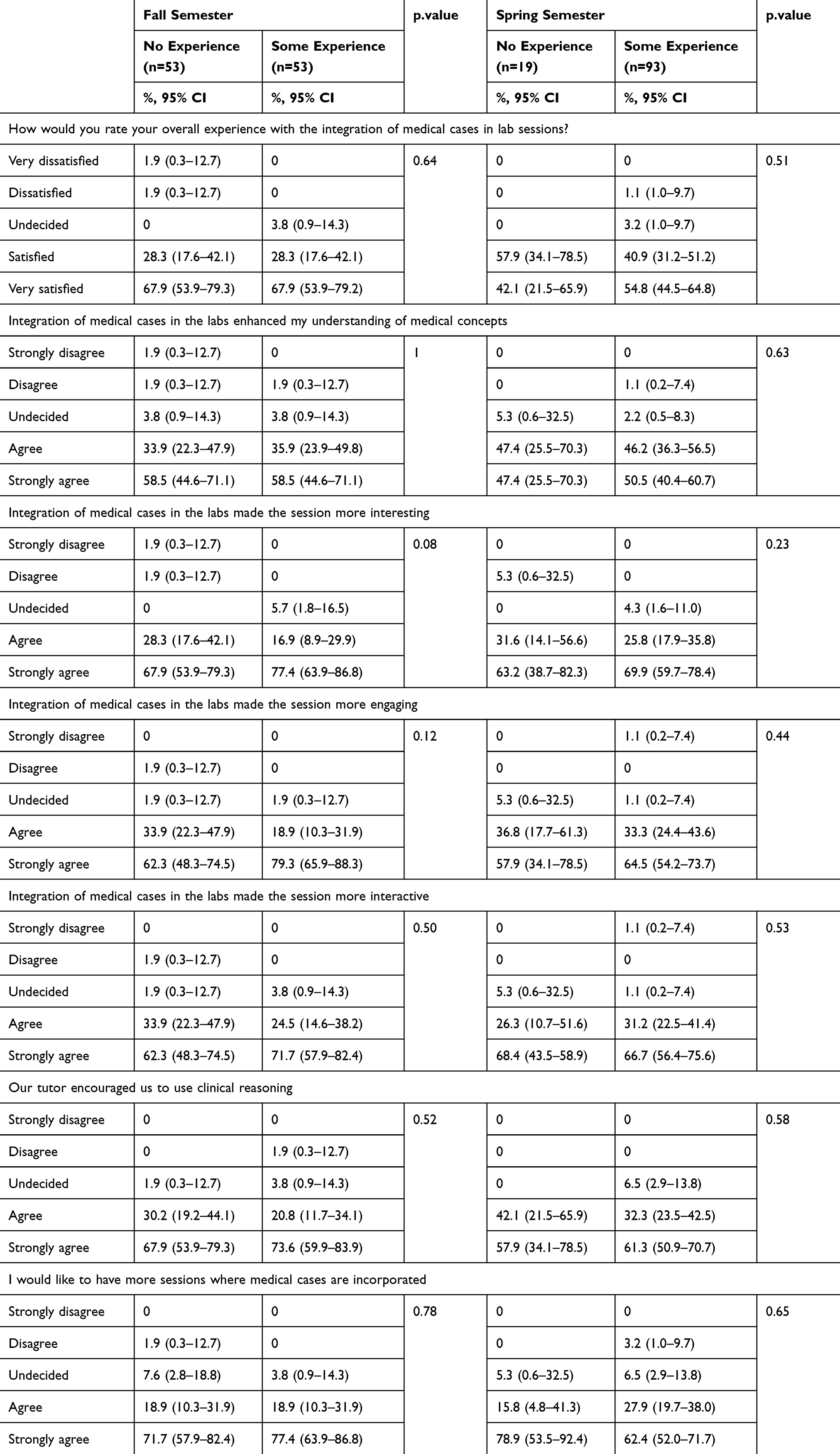 |
Table 1 Student Attitudes Toward Integration of Medical Cases in Laboratories, Stratified by Previous Experience. The Associations Were Examined Using the Fisher’s Exact Test |
NLP-Based Sentiment Analysis of Free-Text Responses
Free-text responses to the 3 open-ended questions were exported from SurveyMonkey (SurveyMonkey Inc, San Mateo, California) into Microsoft Excel (Microsoft Corp, Redmond, Washington) files. For each response, the dataset included the student serial number, the response text, the completion date and time, and the corresponding semester (fall or spring). Responses that were blank or that contained only “N/A” were removed.
Sentiment analysis was conducted in Python using the Natural Language Toolkit (NLTK), the Valence Aware Dictionary and sEntiment Reasoner (VADER).27,28 A minimal text normalisation was applied, in which comments were converted to string format and leading and trailing whitespace, as well as repeated internal whitespace, were removed.
For each comment, VADER returned a compound sentiment score, between −1 and 1, and a negative, neutral, or positive classification. The polarity classification used the standard VADER thresholds: positive for compound ≥ 0.05, negative for compound ≤ −0.05, and neutral for values between −0.05 and 0.05.28
Human Verification and Agreement Analysis
This component of the study was designed to empirically evaluate the reliability and limitations of NLP-based sentiment analysis when applied to authentic free-text responses in medical education.
To evaluate the performance of the NLP sentiment classification, a stratified random sample of comments was selected across both semesters and all three open-ended questions. The sampling strategy aimed to ensure representation of the three sentiment classes (positive, neutral, negative) within each question and semester. The full set of responses was divided into six strata defined by semester (two levels) and question (three levels). From each stratum, 10 comments were selected, yielding a total sample of 60 comments. Within each stratum, comments were first grouped by their VADER sentiment classification (positive, neutral, negative). Up to three comments were randomly selected from each sentiment class. The remaining positions required to reach ten comments per stratum were then filled by random selection from the remaining comments within that stratum. Five researchers, blinded to the NLP outputs, independently reviewed the text of each sampled comment and assigned a sentiment label (negative, neutral, or positive).
Inter-rater agreement among the five human coders for sentiment polarity was quantified using Krippendorff’s alpha.29 A majority-vote human sentiment category was derived for each comment (agreement of at least 3 of 5 raters) and compared with the NLP classification. Discrepancies were counted and examined qualitatively by reviewing the original text and summaries to identify potential patterns in misclassification.
Results
Participant Characteristics
In the fall semester, 106 of 218 eligible students completed the questionnaire, corresponding to a 49% response rate. Among respondents, 37% were male and 63% were female. In the spring semester, 112 of 215 students responded (52% response rate), with 41% male and 59% female. The mean age was 18.8 years (SD, 2.6) in the fall and 19.4 years (SD, 1.9) in the spring. Half of the fall respondents reported previous experience with integrated lab sessions, compared with 83% of the spring respondents.
Satisfaction and Perceived Educational Value
Overall satisfaction with the integrated medical cases was high in both semesters. In the fall, 28% of respondents (95% CI, 20% – 38%) reported being satisfied and 68% (95% CI, 58% – 76%) reported being very satisfied. Only 1% (95% CI, 0.1% – 6.5%) reported being dissatisfied and 1% (95% CI, 0.1% – 6.5%) very dissatisfied. In the spring, 43% (n = 49; 95% CI, 35% – 53%) reported being satisfied and 53% (95% CI, 43% – 62%) very satisfied, while 1% (95% CI, 0.1% – 6.2%) reported being dissatisfied.
Across both semesters, a substantial proportion of students strongly endorsed the educational value of the integrated cases. In the fall, 58% (95% CI, 49% – 68%) strongly agreed that the integration of medical cases enhanced their understanding of medical concepts, and in the spring 50% (95% CI, 49% – 68%) strongly agreed with this statement. Similarly, 73% of fall respondents (95% CI, 63% – 80%) and 69% of spring respondents (95% CI, 59% – 77%) strongly agreed that the sessions were more interesting with integrated cases. Seventy-one percent in the fall (95% CI, 61% – 79%) and 63% in the spring (95% CI, 54% – 72%) strongly agreed that sessions were more engaging, and 67% in the fall (95% CI, 57% – 75%) and 67% in the spring (95% CI, 58% – 75%) strongly agreed that sessions were more interactive.
Most students reported that tutor encouraged the use of clinical reasoning during the sessions: 71% in the fall (95% CI, 61% – 79%) and 61% in the spring (95% CI, 51% – 69%) strongly agreed that tutors encouraged them to use clinical reasoning. Desire for further integration was also strong. In the fall, 75% (95% CI, 65% – 82%) strongly agreed that they would like more sessions with integrated medical cases; in the spring, 65% (95% CI, 56% – 73%) strongly agreed with this statement. Detailed distributions of responses are presented in Figure 1.
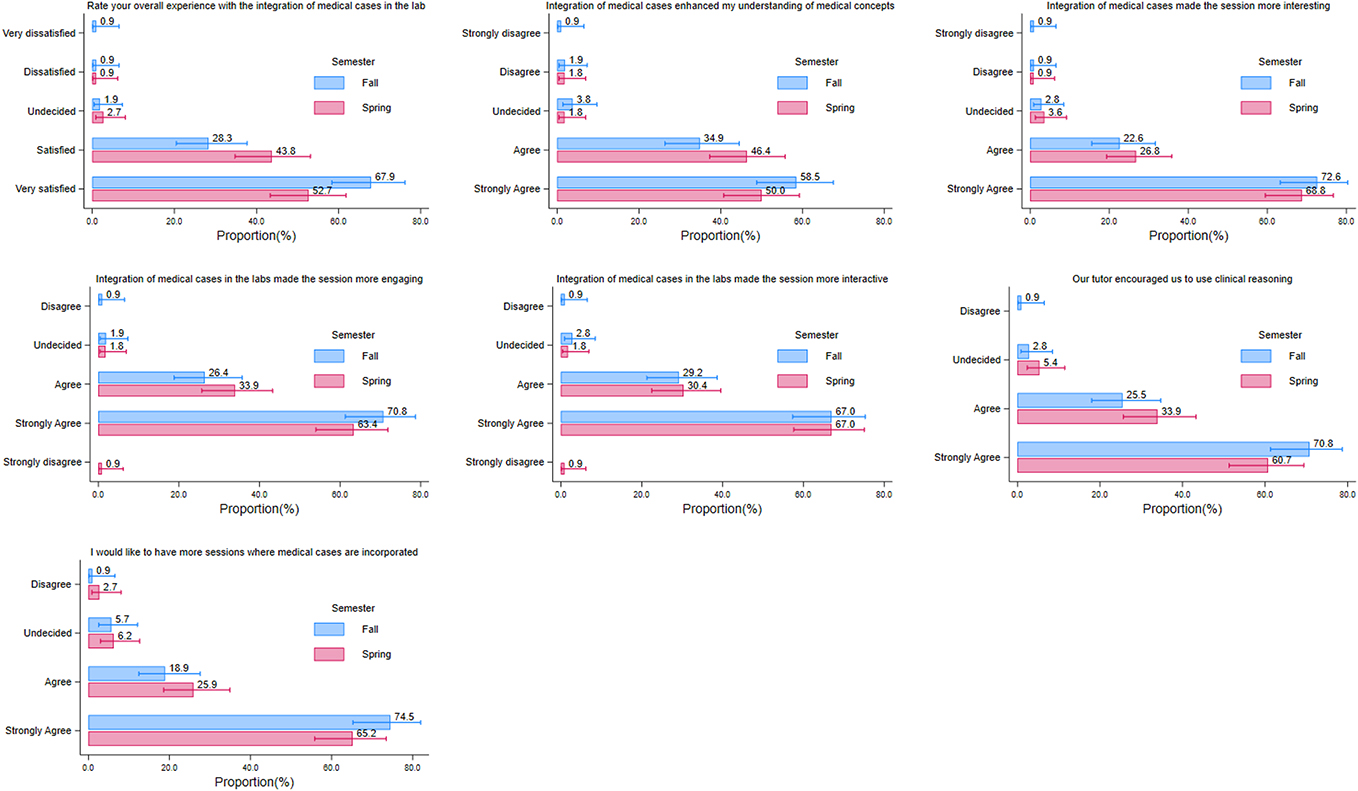 |
Figure 1 Distribution of student ratings for the integration of medical cases into Chemistry laboratory sessions across two semesters. Horizontal bar charts show the proportion of students selecting each Likert-scale response (vertical axis) for the questionnaires’ items. Results are presented separately for the fall and spring semesters. Error bars represent 95% confidence intervals for the proportion estimates. |
When responses were stratified by prior experience with integrated lab sessions, no statistically significant differences were observed in any of the attitudinal items for either semester, as summarized in Table 1. This suggests that earlier exposure to integrated labs did not materially influence perceptions of the current intervention.
NLP Sentiment Analysis and Human Verification
A stratified sample of 60 free-text comments underwent human sentiment coding by five independent raters. Krippendorff’s alpha for inter-rater agreement was 0.771, indicating strong but not perfect agreement. For 8 of the 60 comments, there was a discrepancy between the majority human sentiment decision and the NLP classification. Table 2 summarizes these discrepant cases and an additional 3 instances in which the majority decision aligned with the NLP output but two of the five raters disagreed with the algorithm.
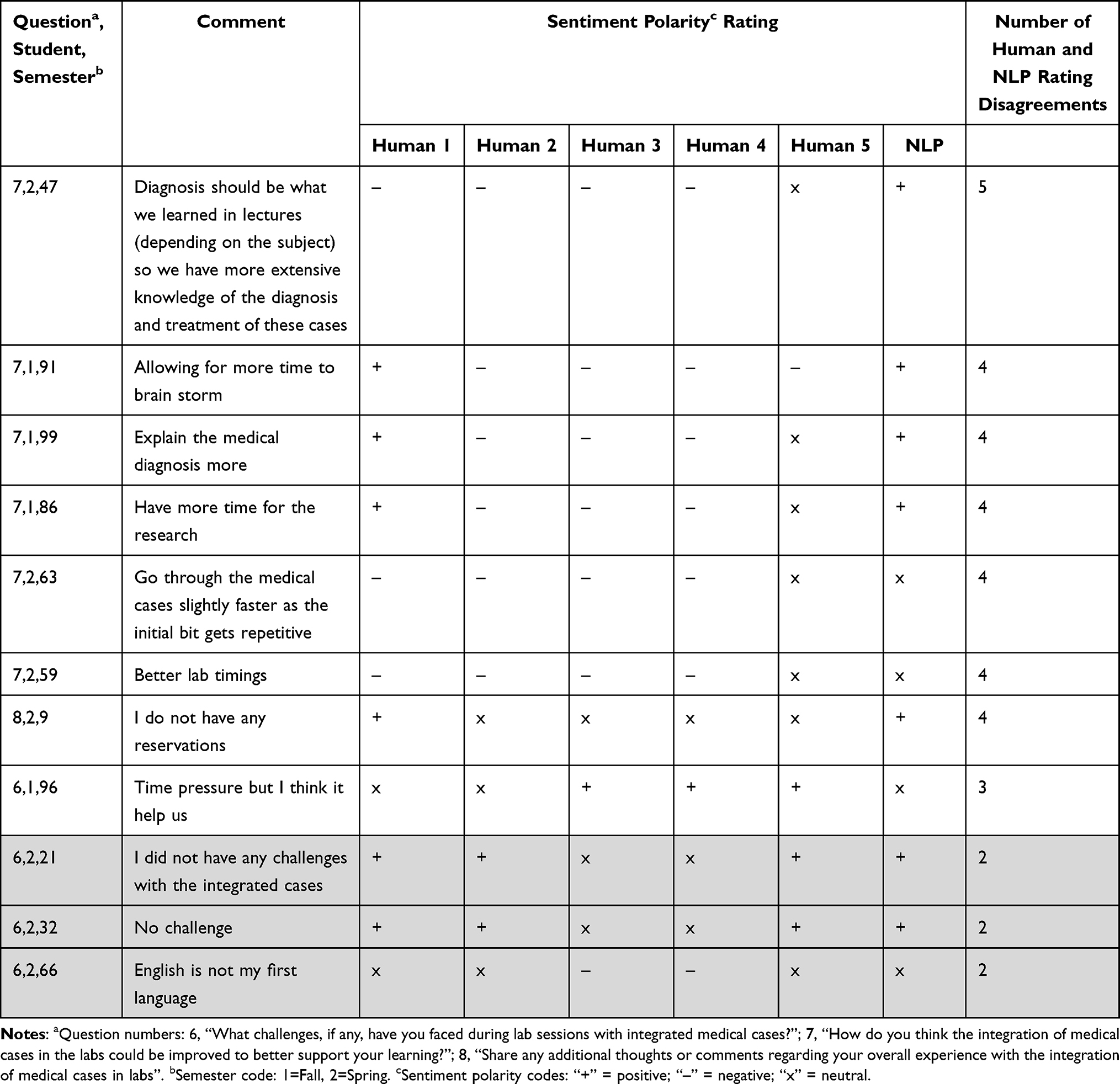 |
Table 2 Discrepancies Between Human Raters’ and NLP Sentiment Classifications in a Stratified Sample of Comments. Rows Highlighted in Grey Denote Cases Where the Majority Decision Aligned with the NLP Output, but Two of the Five Raters Disagreed with the Algorithm |
The first six discrepant cases represented comments in which students expressed a desire for change or suggested improvements, such as requesting more time for brainstorming or research, better alignment of diagnoses with lecture content, or adjustments to lab timing and pacing. In all 6, the majority of human raters interpreted the comments as negative, whereas the NLP algorithm labelled them as neutral or positive. These responses were all elicited by Question 7, which explicitly invited suggestions for improvement, a framing that may have influenced both students’ phrasing and the algorithm’s performance. Notably, human raters did not unanimously agree in these cases, and at least one rater in each instance classified the sentiment as neutral or positive.
The remaining two discrepant cases showed subtler differences. In one comment (“I do not have any reservations”), 4 of 5 human raters coded the sentiment as neutral, whereas the fifth rater and the NLP classifier coded it as positive. In another comment (“Time pressure but I think it helps us”), 3 of 5 human raters coded the sentiment as positive, and 2 raters along with the NLP classifier coded it as neutral.
Across the full dataset of 380 comments, 238 (62.6%) were classified by the NLP algorithm as positive, 96 (25.3%) as neutral, and 46 (12.1%) as negative. Negative sentiments were primarily linked to challenges such as time pressure, the difficulty of identifying medical diagnoses during lab sessions, and language barriers. These issues often co-existed with appreciation for the practical aspects of the sessions.
Descriptively the fall showed a slightly higher proportion of positive sentiments and fewer neutral sentiments than the spring, although both semesters reflected overall favorable perceptions.30 Taken together, the human verification showed that NLP sentiment analysis aligned with the majority of human judgments in 52 of 60 sampled comments (87% accuracy). Misclassifications mainly occurred when the algorithm interpreted suggestions for improvement as neutral or positive, and when comments were ambiguous regarding their evaluative tone.
Discussion
This study evaluated first-year medical students’ perceptions of integrating concise PBL-informed medical cases into General and Organic Chemistry laboratories within a traditional 6-year medical curriculum. Students reported high levels of satisfaction and perceived that the cases enhanced understanding, increased interest, and promoted engagement, interactivity, and clinical reasoning, supporting the feasibility of connecting foundational chemistry concepts with authentic clinical scenarios early in training.
Interpretation in Light of Existing Literature
Our results align with an extensive literature reporting favorable student perceptions of PBL in health professions education, including improvements in motivation, critical thinking, and self-directed learning.13,16–19,31 Students in our study highlighted the realism and complexity of the cases and the interactive nature of the sessions as key strengths, echoing prior reports that emphasize the importance of meaningful integration of basic science and clinical practice.32,33
The role of the tutor emerged as particularly salient. Amerstorfer and Münster-Kistner described how students’ engagement in PBL is shaped by perceptions of teacher caring, credibility, communication style, and feedback.34 In our study, several free-text comments explicitly expressed appreciation for instructors, and most students strongly agreed that tutors encouraged the use of clinical reasoning. This pattern suggests that well-prepared facilitators who can maintain a psychologically safe environment and invite exploratory reasoning may strongly influence the success of integrated sessions.
Consistent with the sentiment analysis results, only 12.1% of the 380 comments were classified as negative, and these primarily referred to logistical issues such as time constraints, diagnostic difficulties given the early stage of training, and language barriers rather than criticism of the pedagogical framework itself. Addressing these issues may involve allocating slightly more discussion time, improving alignment between laboratory cases and concurrent lectures, and providing clearer explanations of diagnostic reasoning during case debriefing.
Within a PBL framework, some of these challenges, particularly initial knowledge gaps, are expected and can be mitigated through structured self-directed learning, although they should still be considered when designing and scheduling PBL-style activities in foundational courses.14,26
The finding that no significant differences in attitudes were detected when stratifying by prior experience with integrated labs suggests that even students new to this format can derive perceived benefit from the intervention. This observation may suggest that integrated, case-based learning can be introduced early in medical training and serves as a hypothesis-generating finding that warrants further investigation in more rigorous study designs.
Use of NLP and Sentiment Analysis in Educational Evaluation
Free-text responses provide rich insights into student experience but are time-consuming to analyse manually, especially in large cohorts typical of medical schools.35,36 Our application of NLP sentiment analysis demonstrates a practical approach to summarising such qualitative feedback at scale. Previous studies have reported that NLP can identify sentiments in student evaluations, offering institutions timely information on courses and teaching.37–39 Our findings are consistent with these reports and extend them to the context of integrated PBL-style activities in basic science laboratories.
The combination of NLP sentiment analysis and human verification in this study highlights both the potential and the limitations of current tools. Overall agreement between the VADER algorithm and majority human sentiment coding was high (87%), and Krippendorff alpha among human raters indicated strong reliability. However, misclassifications frequently arose in comments framed as suggestions or wishes for improvement. In these cases, students’ wording conveyed a desire for change, which human raters typically interpreted as negative, while the algorithm coded them as neutral or positive.
This pattern is not unexpected, given that many lexicon-based sentiment tools rely on word-level valence without fully accounting for pragmatic context.37 The discrepancies we observed underscore that sentiment analysis should be interpreted as a screening or triage tool rather than a definitive classifier. Human review remains essential, particularly for borderline cases and when granular interpretation is required to improve quality.
From a practical perspective, the NLP-based method enabled rapid analysis of several hundred free-text responses with minimal computational resources, compared with the substantial time and personnel typically required for manual qualitative coding. While not intended to replace human interpretation, this efficiency supports the use of NLP as a first-pass screening tool in large medical programs, allowing educators to identify dominant trends and target subsets of feedback for deeper qualitative review.
At the same time, the ability of NLP methods to process hundreds or thousands of comments rapidly provides a substantial advantage over manual analysis alone. NLP can surface overarching trends, highlight areas of concern, and direct educators’ attention to subsets of comments that warrant closer reading. This hybrid approach balances efficiency with interpretive depth.
Strengths
This study has several strengths. It focuses on a clearly defined educational innovation: embedding concise medical cases within first-year chemistry laboratories in a traditional curriculum. The evaluation includes both quantitative and qualitative components, capturing satisfaction, perceived educational impact, and nuanced perceptions of the learning experience. The use of NLP and sentiment analysis to handle free-text responses addresses a practical barrier to analyzing open-ended feedback in large cohorts and is complemented by a structured human verification process. The stratification of attitudes by prior experience with integrated labs provides additional context for interpreting students’ responses.
Scientific Contribution
This study makes two primary contributions to the medical education literature. First, it provides initial, hypothesis-generating insight into students’ perceptions of integrating concise, PBL-informed clinical cases into foundational science laboratories, highlighting this approach as a potential area for further investigation. Second, and more importantly from a methodological perspective, it offers one of the few systematic validations of NLP-based sentiment analysis against multi-rater human coding in medical education. By identifying specific patterns of misclassification—particularly in comments framed as suggestions for improvement—the study advances understanding of how automated text analytics can be responsibly applied, interpreted, and refined in educational evaluation.
Limitations
Several limitations should be considered. First, the study did not include a comparator group, as the intervention was implemented across the entire cohort as part of routine teaching. This limits internal validity and precludes causal attribution of the observed outcomes to the intervention. In addition, the anonymous design precluded linking individual students’ responses across semesters, which prevented paired analyses and limited the ability to explore within-student changes over time. It is also possible that some students contributed responses in both semesters, introducing partial dependence between datasets. For these reasons, no formal comparisons between semesters were undertaken, and the findings should be interpreted as descriptive and hypothesis-generating.
Second, response rates were approximately 50% in both semesters. Voluntary participation raises the possibility of selection bias if students with stronger positive or negative views were more likely to respond. The high satisfaction levels observed may overestimate the perceptions of the full cohort.
Third, the study relied on self-reported perceptions and did not include objective measures of learning outcomes, such as examination performance, long-term knowledge retention, or observed clinical reasoning skills. Prior meta-analyses suggest that PBL is often associated with favorable student perceptions and skills related to problem-solving and self-directed learning, but the impact on short-term academic performance, especially in early preclinical years, is mixed.16,18,40–42 Our findings should therefore be interpreted as evidence of perceived, rather than demonstrated, learning benefits.
Fourth, although the NLP sentiment analysis performed well overall, its accuracy was imperfect, particularly for comments framed as suggestions. Human raters themselves disagreed in several cases, reflecting the inherent subjectivity of sentiment judgments. These limitations point to the need for cautious interpretation of automated sentiment outputs and continued refinement of analytic approaches.
Finally, the questionnaire was developed specifically for this study and did not undergo formal psychometric validation or reliability testing. Although the items were informed by prior literature and designed to capture relevant aspects of student perceptions, the absence of formal validation may limit the precision of the measured constructs. In addition, as the study was conducted within a single institution and specific curricular context, the findings should be interpreted in light of this setting.
Implications and Future Directions
The findings of this study suggest that integrating PBL-informed medical cases into foundational science laboratories can enhance first-year medical students’ engagement, satisfaction, and perceived understanding, regardless of prior exposure to similar pedagogies. Embedding clinical context into basic science teaching may help students develop early habits of clinical reasoning and see clearer connections between preclinical learning and future practice.
For educators and curriculum planners, the results highlight the importance of well-prepared facilitators who can scaffold clinical reasoning and create an interactive, supportive environment. Tutor development initiatives that focus on questioning strategies, feedback, and management of group dynamics may further enhance the impact of integrated sessions. Time allocation and scheduling should also be reviewed to address concerns about time pressure and lab timing. More broadly, structured case discussions embedded within basic science teaching may help learners connect biochemical and molecular mechanisms with patient presentations.15 Facilitator-guided activities that encourage hypothesis generation and discussion of underlying mechanisms may further support the development of integrative clinical reasoning during the preclinical years.34
From a methodological perspective, the study illustrates the value of NLP and sentiment analysis for handling extensive qualitative feedback. Because many sentiment algorithms operate through lexicon-based counts of positive and negative terms, their performance can be improved by tuning to domain-specific corpora and by explicitly accounting for patterns such as suggestions framed positively. Open-source tools are particularly amenable to such adaptation. In contrast, proprietary “black box” systems, including some large language models, may provide useful outputs but are more difficult to interpret, audit, or customize for local needs.
Future work could strengthen this analysis by using recent AI-based NLP approaches—from semantic and topic-modelling methods to more advanced language models—to better capture context and nuance in learner text for sentiment analysis.43 These approaches may cluster comments into thematic categories and complement our sentiment analysis by highlighting specific aspects of the learning environment that drive positive or negative experiences.
Further research should also integrate objective measures of learning with student perceptions. Potential avenues include linking exposure to integrated cases with performance on relevant exam questions, assessments of clinical reasoning, or longitudinal measures of basic science retention. Mixed-methods designs could provide richer insight into how and why early PBL-style integration in foundational courses influences learning trajectories.
Conclusions
Students reported high levels of satisfaction and positive perceptions of understanding, engagement, interactivity, and clinical reasoning following the integration of concise PBL-style medical cases into first-year chemistry laboratories in a traditional 6-year medical curriculum. These findings are descriptive and hypothesis-generating, suggesting that this approach may represent a useful direction for further investigation. The innovation appeared acceptable to students regardless of prior experience with integrated lab sessions, and negative perceptions were largely confined to logistical challenges rather than the pedagogical approach itself.
NLP-based sentiment analysis, supported by targeted human verification, offered an efficient means of summarizing extensive free-text feedback and capturing nuanced aspects of students’ experience. While current tools have limitations, particularly in interpreting suggestions and mixed sentiments, they provide a promising method for supporting ongoing curricular evaluation and refinement.
Future studies should evaluate this intervention using controlled or comparative study designs to assess its impact on objective indicators of learning, and to further develop analytic methods that integrate quantitative and qualitative data.
The methods and findings in this study are directly relevant to medical educators working within traditional curricula and large student cohorts. The study demonstrates that brief, clinically oriented case integration can enhance engagement and perceived relevance in foundational science laboratories without extensive curricular restructuring. In parallel, it shows that Natural Language Processing–based sentiment analysis, when complemented by targeted human review, can offer a scalable and timely approach to evaluating qualitative student feedback. Together, these insights support evidence-informed curriculum design and provide educators with pragmatic tools for monitoring and refining educational innovations. As medical education increasingly relies on large-scale learner feedback, scalable analytic approaches such as NLP-based sentiment analysis may become valuable tools for systematically evaluating and refining educational innovations.
Abbreviations
AI, Artificial Intelligence; ASDL, Active and Self-Directed Learning; BERT, Bidirectional Encoder Representations from Transformers; CI, Confidence Interval; GERD, Gastroesophageal Reflux Disease; LDA, Latent Dirichlet Allocation; LSA, Latent Semantic Analysis; ML, Machine Learning; MLP, Multilayer Perceptrons; NLP, Natural Language Processing; NLTK, Natural Language Toolkit; PBL, Problem-Based Learning; SD, Standard Deviation; VADER, Valence Aware Dictionary and sEntiment Reasoner.
Data Sharing Statement
The data that support the findings of this study are available from the corresponding author upon reasonable request.
Ethics and Consent Statements
Informed consent to participate was obtained from all participants. The study received ethical approval from the Cyprus National Bioethics Committee (CNBC), (Ethics Approval Number: EEBK EΠ 2024.01.178). The CNBC is an independent body and is not subject to the administrative control of any ministry. Further information is available from the committee website (https://www.bioethics.gov.cy/moh/cnbc/cnbc.nsf/page12_en/page12_en?OpenDocument).
Author Contributions
All authors made a contribution to the work reported, whether that is in the conception, study design, execution, acquisition of data, analysis and interpretation, or in all these areas; took part in drafting, revising or critically reviewing the article; gave final approval of the version to be published; have agreed on the journal to which the article has been submitted; and agree to be accountable for all aspects of the work.
Funding
There is no funding to report.
Disclosure
The authors report no conflicts of interest in this work.
References
1. Aljuhani FA, Alhejji AM, Aljaloud MS, et al. Principles and challenges of quality management in primary care. Int J Community Med Public Health. 2022;9(11):4296–15. doi:10.18203/2394-6040.ijcmph20222620
2. Reed S, Shell R, Kassis K, et al. Applying adult learning practices in medical education. Curr Probl Pediatr Adolesc Health Care. 2014;44(6):170–181. doi:10.1016/j.cppeds.2014.01.008
3. Johnson C, Keating J, Boud D, et al. Identifying educator behaviours for high quality verbal feedback in health professions education: literature review and expert refinement. BMC Med Educ. 2016;16(1):61–75. doi:10.1186/s12909-016-0613-5
4. Sandars J. The use of reflection in medical education: AMEE Guide No. 44. Med Teach. 2009;31(8):685–695. doi:10.1080/01421590903050374
5. Mussarat U, Zainub A, Hanif R, Ayub S, Naureen F, Inam T. Reflection: an effective strategy for outcome-based learning in basic medical sciences. J Pak Med Assoc. 2021;72(4):639–642.
6. Schei E, Johnsrud RE, Mildestvedt T, Pedersen R, Hjörleifsson S. Trustingly bewildered: how first-year medical students make sense of their learning experience in a traditional preclinical curriculum. Med Educ Online. 2018;23(1):1500344. doi:10.1080/10872981.2018.1500344
7. Blizard P, Carmody J, Holland R. Medical students’ retention of knowledge of physics and chemistry on entry to a course in physiology. Br J Med Educ. 1975;9(1):49–56. doi:10.1111/j.1365-2923.1975.tb01934.x
8. Ling Y, Swanson DB, Holtzman K, Bucak SD. Retention of basic science information by senior medical students. Acad Med. 2008;83(10):S82–S85. doi:10.1097/ACM.0b013e318183e2fc
9. Custers EJ. Long-term retention of basic science knowledge: a review study. Adv Health Sci Educ Theory Pract. 2010;15(1):109–128. doi:10.1007/s10459-008-9101-y
10. El-Belbasy R, Abo-Elmagd E, Abd Rabbo M. Medical students’ attitude and perception towards basic medical sciences in the faculty of medicine for girls, Al-Azhar University: a study prior to the integrated program. Egypt J Hosp Med. 2018;70(12):2043–2050. doi:10.12816/0045026
11. Teshome D, Tiruneh C, Berhanu L, Berihun G. Medical students’ attitude and perception towards basic medical science subjects at Wollo University, Northeast Ethiopia. Adv Med Educ Pract. 2021;12:431–438. doi:10.2147/AMEP.S309440
12. Yew EHJ, Goh K. Problem-based learning: an overview of its process and impact on learning. Health Professions Educ. 2016;2(2):75–79. doi:10.1016/j.hpe.2016.01.004
13. Weggemans MM, Custers EJ, ten Cate OT. Unprepared retesting of first-year knowledge: how much do second-year medical students remember? Med Sci Educ. 2017;27(4):597–605. doi:10.1007/s40670-017-0431-3
14. Servant VFC. Revolutions and re-iterations. 2016.
15. Stentoft D. Problem-based projects in medical education: extending PBL practices and broadening learning perspectives. Adv Health Sci Educ Theory Pract. 2019;24(5):959–969. doi:10.1007/s10459-019-09917-1
16. Manuaba IB, No Y, Wu -C-C. The effectiveness of problem-based learning in improving critical thinking, problem-solving and self-directed learning in first-year medical students: a meta-analysis. PLoS One. 2022;17(11):e0277339. doi:10.1371/journal.pone.0277339
17. Shin IS, Kim JH. The effect of problem-based learning in nursing education: a meta-analysis. Adv Health Sci Educ Theory Pract. 2013;18(5):1103–1120. doi:10.1007/s10459-012-9436-2
18. Trullàs JC, Blay C, Sarri E, Pujol R. Effectiveness of problem-based learning methodology in undergraduate medical education: a scoping review. BMC Med Educ. 2022;22(1):104. doi:10.1186/s12909-022-03154-8
19. Zhou J, Zhou S, Huang C, et al. Effectiveness of problem-based learning in Chinese pharmacy education: a meta-analysis. BMC Med Educ. 2016;16(1):23. doi:10.1186/s12909-016-0546-z
20. Okubo Y, Matsushita S, Takakuwa Y, Yoshioka T, Nitta K. Longitudinal PBL in undergraduate medical education develops lifelong-learning habits and clinical competencies in social aspects. Tohoku J Exp Med. 2016;238(1):65–74. doi:10.1620/tjem.238.65
21. Schmidt HG, Vermeulen L, Van Der Molen HT. Long-term effects of problem-based learning: a comparison of competencies acquired by graduates of a problem-based and a conventional medical school. Med Educ. 2006;40(6):562–567. doi:10.1111/j.1365-2929.2006.02483.x
22. Ocheretnyuk AO, Lysenko DA, Palamarchuk OV, Zakalata TR, Kernichnyi VV. The problem of adaptation of first-year medical students to the educational process. Rep Vinnytsia Natl Med Univ. 2018;22(3):543–547. doi:10.31393/reports-vnmedical-2018-22(3)-31
23. Picton A, Greenfield S, Parry J. Why do students struggle in their first year of medical school? A qualitative study of student voices. BMC Med Educ. 2022;22(1):100. doi:10.1186/s12909-022-03158-4
24. Mitchell RE, Matthews JR, Grandy TG, Lupo JV. The question of stress among first-year medical students. Acad Med. 1983;58(5):367–372. doi:10.1097/00001888-198305000-00001
25. Tlalajoe-Mokhatla N, Van der Merwe LJ, Jama MP. Social learning and integration factors that affect first-year medical students transitioning directly from high school: the views of students from a remedial programme. J Stud Aff Afr. 2023;11(1):65–76.
26. Czabanowska K, Moust J, Meijer A, Schröder-Bäck P, Roebertsen H. Problem-based learning revisited: introduction of active and self-directed learning to reduce fatigue among students. J Univ Teach Learn Pract. 2012;9(1):1–5.
27. Bird S, Klein E, Loper E. Natural Language Processing with Python: Analyzing Text with the Natural Language Toolkit. Sebastopol, CA: O’Reilly Media; 2009.
28. Hutto C, Gilbert E. VADER: a parsimonious rule-based model for sentiment analysis of social media text. Proceed Int AAAI Conference Web Soc Media. 2014;8(1):216–225. doi:10.1609/icwsm.v8i1.14550
29. Hayes AF, Krippendorff K. Answering the call for a standard reliability measure for coding data. Commun Methods Meas. 2007;1(1):77–89. doi:10.1080/19312450709336664
30. Loizou S, Pavlou A, Cory OA, Ireland DT. Introduction of PBL in the first year of traditional medical curriculum. Health Prof Educ. 2024;10(1):12.
31. Burgun-Parenthoine A, Darmoni S, Duff F, Wéber J. Problem-based learning in medical informatics for undergraduate medical students: an experiment in two medical schools. Int J Med Inform. 2006;75(5):396–402. doi:10.1016/j.ijmedinf.2005.07.014
32. Margolius S, Papp K, Altose M, Wilson-Delfosse A. Students perceive skills learned in pre-clerkship PBL valuable in core clinical rotations. Med Teach. 2020;42(8):902–908. doi:10.1080/0142159X.2020.1762031
33. Staun M, Bergström B, Wadensten B. Evaluation of a PBL strategy in clinical supervision of nursing students: patient-centred training in student-dedicated treatment rooms. Nurse Educ Today. 2010;30(7):631–637. doi:10.1016/j.nedt.2009.12.013
34. Amerstorfer C, Münster-Kistner C. Student perceptions of academic engagement and student-teacher relationships in problem-based learning. Front Psychol. 2021;12:713057. doi:10.3389/fpsyg.2021.713057
35. Artino AR, La Rochelle JS, Dezee KJ, Gehlbach H. Developing questionnaires for educational research: AMEE Guide No. 87. Med Teach. 2014;36(6):463–474. doi:10.3109/0142159X.2014.889814
36. Liu B. Sentiment analysis and subjectivity. In: Indurkhya N, Damerau FJ, editors. Handbook of Natural Language Processing.
37. Kim H, Qin G. Summarizing students’ free responses for an introductory algebra-based physics course survey using cluster and sentiment analysis. IEEE Access. 2023;11:89052–89066. doi:10.1109/ACCESS.2023.3305260
38. Shaik T, Tao X, Dann C, Xie H, Li Y, Galligan L. Sentiment analysis and opinion mining on educational data: a survey. Nat Lang Process J. 2023;2:100003. doi:10.1016/j.nlp.2022.100003
39. Shaik T, Tao X, Li Y, et al. A review of the trends and challenges in adopting natural language processing methods for education feedback analysis. IEEE Access. 2022;10:56720–56739. doi:10.1109/ACCESS.2022.3177752
40. Lin-Aung H, Masumoto D, Linn Z, et al. Students’ perception of problem-based learning at a Japanese medical school: an exploratory sequential mixed method. Int J Med Educ. 2022;13:322–334. doi:10.5116/ijme.6399.dee1
41. Chan S, Gondhalekar A, Choa G, Rashid M. Adoption of problem-based learning in medical schools in non-Western countries: a systematic review. Teach Learn Med. 2022;1–12.
42. Al-Naggar R, Bobryshev Y. Acceptance of problem-based learning among medical students. J Community Med Health Educ. 2012;2(5):146–152.
43. Rybinski K, Kopciuszewska E. Will artificial intelligence revolutionise the student evaluation of teaching? A big data study of 1.6 million student reviews. Assess Eval High Educ. 2020;46(7):1127–1139. doi:10.1080/02602938.2020.1844866
 © 2026 The Author(s). This work is published and licensed by Dove Medical Press Limited. The
full terms of this license are available at https://www.dovepress.com/terms
and incorporate the Creative Commons Attribution
- Non Commercial (unported, 4.0) License.
By accessing the work you hereby accept the Terms. Non-commercial uses of the work are permitted
without any further permission from Dove Medical Press Limited, provided the work is properly
attributed. For permission for commercial use of this work, please see paragraphs 4.2 and 5 of our Terms.
© 2026 The Author(s). This work is published and licensed by Dove Medical Press Limited. The
full terms of this license are available at https://www.dovepress.com/terms
and incorporate the Creative Commons Attribution
- Non Commercial (unported, 4.0) License.
By accessing the work you hereby accept the Terms. Non-commercial uses of the work are permitted
without any further permission from Dove Medical Press Limited, provided the work is properly
attributed. For permission for commercial use of this work, please see paragraphs 4.2 and 5 of our Terms.
Recommended articles

Assessment of Factors That Students Perceive to Affect Their Virtual Learning of Clinical Skills for OSCE
Peramuna Gamage M, Baskaran R, Mukhopadhyay S, Dalavaye N, Leveridge B, Ganesananthan S, Spencer R, Manivannan S, Zaben M
Advances in Medical Education and Practice 2023, 14:707-712
Published Date: 7 July 2023
Facilitating Active Collaborative Learning in Medical Education; a Literature Review of Peer Instruction Method
Fakoya AOJ, Ndrio M, McCarthy KJ
Advances in Medical Education and Practice 2023, 14:1087-1099
Published Date: 3 October 2023
A Comparison of the Academic Achievement at the End of the Medicine Undergraduate Degree Program Between Students Who Only Used the University Admission Test and Those Who Used the University Admission Test Plus Marks from the High School National Exam (ENEM) at a Single Brazilian Center
Bestetti RB, Durand MT, Couto LB, Faria-Jr M, Fumagalli HF, Silva VMR, Romão GS, Furlan-Daniel R, Garcia ME, Ferri SMN, Reis ACS, Jorge-Neto SD, Geleilete TJM
Advances in Medical Education and Practice 2023, 14:1185-1190
Published Date: 21 October 2023
Pathology as a Basic Medical Subject: Its Relevance and Application During Clinical Practice in Jordanian MD Programs, Interns’ and Residents’ Perspectives
Al-Saghbini MS, Fayyad MA, Gharaibeh L
Advances in Medical Education and Practice 2024, 15:627-635
Published Date: 4 July 2024
Problem-Based Learning and Case-Based Learning in Clinical Practical Teaching for Gynecology Residents: A Narrative Review
Zhu Y, Zhang J, Fei J, Fang H, Zhang Z
Advances in Medical Education and Practice 2025, 16:1269-1279
Published Date: 23 July 2025