
Back to Journals » Journal of Multidisciplinary Healthcare » Volume 18
Integrating Traditional Chinese Medicine into Maternity Care: Development and Evaluation of a Delphi-Based Training Course to Enhance Nurses’ Competency – A Quasi-Experimental Study
Authors Huang S, Chen Z, Cai S, Chen L  , Ren W , Cai W
Received 15 January 2025
Accepted for publication 3 July 2025
Published 16 September 2025 Volume 2025:18 Pages 5837—5847
DOI https://doi.org/10.2147/JMDH.S517695
Checked for plagiarism Yes
Review by Single anonymous peer review
Peer reviewer comments 3
Editor who approved publication: Dr David C. Mohr
Shijie Huang,1,2,* Zhaoying Chen,1,2,* Shiying Cai,3 Ling Chen,1,2 Wei Ren,1,2 Wenzhi Cai1
1Department of Nursing, Shenzhen Hospital, Southern Medical University, Shenzhen, People’s Republic of China; 2School of Nursing, Southern Medical University, Guangzhou, Guangdong, People’s Republic of China; 3School of Public Health and Management, Guangzhou University of Chinese Medicine, Guangzhou, Guangdong, People’s Republic of China
*These authors contributed equally to this work
Correspondence: Wenzhi Cai, Department of Nursing, Shenzhen Hospital, Southern Medical University, Shenzhen, 518101, People’s Republic of China, Email [email protected]
Purpose: Traditional Chinese medicine(TCM) has significant advantages in regulating the maternal constitution and promoting the healthy development of the fetus with its unique concept of health and fetal protection. However, there is no systematic training course for maternity nurses. Therefore, this study focused on designing a training course for maternity nurses on TCM health preservation during pregnancy and the perinatal period.
Methods: A two-round Delphi process with 18 multidisciplinary experts (clinicians, educators, TCM specialists) was employed to establish consensus on the training course through anonymous iterative feedback. From August 2024 to October 2024, a quasi-experimental design was utilized to conveniently recruit 84 maternity nurses from two hospitals for comparison. Among them, 42 nurses in the observation group received the training curriculum validated through the Delphi method, while 42 nurses in the control group received conventional education. The TCM knowledge, behavioral competence, and clinical competency of nurses in both groups were assessed using a standardized questionnaire before and after the training, to compare the intervention effects.
Results: The recovery rates of the two rounds of consultation were 100% and 88.8%, and the authority coefficients of experts were 0.771 and 0.822, respectively. The TCM health preservation during pregnancy and perinatal period training course for maternity nurses was formed, including 4 first-level indicators, 15 second-level indicators and 77 third-level indicators. The results of empirical research showed that the scores of knowledge, behavior ability and competency level of nurses in the observation group were significantly higher than those in the control group (P< 0.05).
Conclusion: The TCM health preservation during pregnancy and perinatal period training course for maternity nurses is scientific and reliable, which can provide a reference for maternity nurses to learn the knowledge and technology of TCM.
Keywords: maternity nurses, training course, traditional Chinese medicine, Delphi, empirical research
Introduction
In the continuous development and improvement of the global health system, maternal health has received increasing attention from the international community as an essential part of public health. The maternal mortality rate in China dropped from 1500 to 15.7 deaths per 100,000 live births from 1949 to 2022.1 At the same time, China, like many other countries, has undergone a period of obstetric transition, with gradual reductions in fertility and mortality rates.2 With the transformation of the medical model from single-disease treatment to comprehensive health management and promotion, more attention has been paid to the quality of pregnancy and postpartum care.3 As a medical system with thousands of years of history, traditional Chinese medicine (TCM) has significant advantages in regulating maternal constitution and promoting the healthy development of the fetus with its unique concept of health preservation and fetal care.
Pregnancy and childbirth are special periods in a woman’s life, during which the mother changes physiology, psychology and social roles. These changes not only affect the mother’s health status but also directly affect the growth and development of the fetus. TCM health care emphasizes “Preventing a disease before it arises”, that is, preventing diseases by regulating diet, living, emotion and other aspects before the occurrence of diseases, which coincides with the core concept of maternal health care. At present, there are studies on the implementation of whole-course TCM health management measures for pregnant women, and the results show that it can effectively reduce the occurrence of complications during pregnancy, puerperium and neonatal diseases, and greatly improve the health of pregnant women and perinatal infants.4–6 Therefore, strengthening the popularization and education of maternal health and fetal care knowledge is of great significance for improving the health of mothers and children and reducing the incidence of perinatal complications.
In recent years, although continuing education in clinical practice has gradually begun to carry out “Western Medicine Learning from Traditional Chinese Medicine”7 there is no systematic and focused maternal health care curriculum for maternity nurses.8,9 Studies have shown that TCM-educated healthcare workers help to improve patient’s quality of life and health outcomes, reduce readmission rates, and provide TCM treatments as appropriate healthcare professionals.10 However, the study found that the current maternity nurses lack the basic knowledge of TCM, the degree of mastery of TCM technology is not enough, and they can not fully play to the advantages of TCM in pregnancy and childbirth health and fetal care.11 This structural imbalance of knowledge and ability not only restricts the effectiveness of the collaborative diagnosis and treatment of TCM and Western medicine but also highlights the urgency of systematic training. Curriculum training plays a crucial role in talent training. Building a standardized training system has been proven to effectively improve the quality of training and accelerate the construction of professional talent teams.12
Based on this, this study introduces the competency theory as the theoretical basis for the construction of this study curriculum. The theory was originally proposed by the famous American psychologist David Mc Clelland.13 It should be noted that “competency” has different meanings in different fields. This study adopted the interpretation defined by the Johannesburg Competency Seminar:14 Competency is the relevant knowledge, skills and attitudes that affect the most critical responsibilities of a person, which can be optimized and improved through training and development. In recent years, scholars have tried to apply competency model to medical curriculum development and training system design, which provides an important basis for this study.15 Therefore, this study attempts to use the Delphi technique to construct the course of TCM health preservation and fetal care during pregnancy and childbirth from the three dimensions of professional knowledge, professional skills and professional development based on the competency theory. This course can provide a basis for better promoting TCM health care during pregnancy and childbirth, and help to improve the ability of maternity nurses to use TCM.
Methods
Construction of TCM Health Preservation During Pregnancy and Perinatal Period Training Course for Maternity Nurses
Study Design
Delphi method has been widely used in business, military, education, health care, and other fields, and it makes full use of the wisdom of experts to construct and improve new research content.16 Its strength lies in leveraging collective expert wisdom to build and refine research content. Through anonymous, iterative surveys, experts independently share and adjust their views based on feedback, gradually forming a consensus.17 This makes Delphi ideal for research with scarce empirical data or high uncertainty, especially in complex fields requiring multidisciplinary expertise. At present, there is no TCM training course for maternity nurses, and the establishment of TCM training courses for maternity nurses requires the combination of TCM theory, clinical practice and nursing education. Therefore, this study adopts Delphi method to construct the curriculum.
Setting up Research Group
The research group has 7 staff members, including 3 professors, 2 graduate students, and 2 clinical experts. The research group searched relevant literature on maternal health care of TCM, held a research group meeting, and determined the first draft of TCM health preservation during pregnancy and perinatal period training course. The group also developed an advisory questionnaire, selected experts, distributed and collected the questionnaire, and analyzed the experts’ opinions.
Delphi Process
Constructing Consultation Questionnaire
The consultation questionnaire consists of three aspects, as detailed in Supplementary Material 1: (1) the basic information of experts, including age, working unit, working year, educational background, and professional title, and (2) the consultation questionnaire of TCM health preservation during pregnancy and perinatal period training course, which is the central part of the evaluation in the expert questionnaire. The first draft of the questionnaire was formulated based on the competency theory. Professional basic knowledge and professional core knowledge correspond to the “knowledge” of competency theory, professional skills correspond to the “skills” of competency theory, and Professional development corresponds to the “attitude” of competency theory. The research team reviewed the domestic and foreign literature and finally formed the questionnaire based on literature such as Gynecology in Traditional Chinese, Medicine and Science of Health Preservation in Traditional Chinese Medicine.18–20 Experts will score and evaluate the importance of each item in the framework. (3) expert familiarity with content of the survey and judgement.
Selection of the Experts
The criteria for expert screening were determined according to the study by Saskia Junger et al.21 The study invited TCM, obstetrics and gynecology clinical experts, nursing experts, medical education personnel and administrators. The inclusion criteria were: (1) bachelor degree or above; (2) professional title qualification of intermediate or above; (3) clinicians, nurses, nursing managers and/or nursing educators engaged in obstetrics and gynecology or TCM and have sufficient knowledge of the research content; (4) work experience of more than 10 years, sign the informed consent form and voluntarily participate in this study.
Conducting Expert Consultation
From March to May 2024, the research group launched expert consultations with the selected experts. After the first round, the researchers organized each expert’s opinions, suggestions, and feedback, and anonymously presented them in the subsequent round of the expert questionnaire. This allowed the experts to be aware of one another’s viewpoints. We set the following selection criteria for each indicator before each round of expert consultation:22 (1) the average importance score >3.5, (2) the coefficient of variation (CV) of each indicator <0.25 and (3) the total score rate of each indicator >20%. Indicators that met all three criteria were included, whereas those that did not meet any criteria were excluded.
Implementing the Training Course of TCM Health Preservation During Pregnancy and Perinatal Period for Maternity Nurses
Participants
This study adopted a quasi-experimental study design, and the required sample size was calculated by software G*Power 3.1.23 The sample size was estimated by repeated measures analysis of variance statistical method. According to the study objective and design, the effect size was 0.8, the alpha was 0.05, the power was 0.95, the allocation ratio was 1, and the total sample size was 84.
From August 2024 to October 2024, a total of 84 maternity nurses from 2 hospitals were selected by the convenient sampling method. Nurses from one hospital were selected as the control group, and nurses from the other hospital were selected as the observation group, with 42 nurses in each group. The inclusion criteria for maternity nurses were having nursing qualifications, engaging in clinical nursing work, signing an informed consent form, and volunteering to participate in the study. The exclusion criteria were nursing staff in practice, off-duty due to illness, personal affairs, maternity leave or business trips, and those who may have gone out to study during the study period.
Research Implementation
The two hospitals selected for this study are affiliated with the same medical university, so their continuing education programs are similar in content. In the empirical study, the control group only participated in the “Western learning Chinese” course of continuing education. This course is a continuing education course of TCM for the whole hospital and all departments in the continuing education program. While the observation group was treated with training course on TCM health preservation during pregnancy and perinatal period for maternity nurses. The theoretical knowledge is mainly trained through online teaching, and the offline training is conducted as a workshop to learn skills. At the same time, case analysis, scene demonstration and other teaching methods are used to train the overall course. A training project group was established prior to the commencement of the training program, tasked with organizing and implementing the training activities. Based on the predefined training curriculum, the schedule for the training sessions and the invitations to teaching experts were finalized. Multidisciplinary experts specializing in obstetrics, gynecology, and TCM were invited to form teaching teams. Group lesson preparation sessions were organized before the training commenced. Instructors were required to submit their courseware and lesson plans for review one week prior to the start of the training. Workshop instructors delivered the training according to unified teaching standards and successfully completed the established teaching plan. To ensure the authenticity and reliability of the survey results, participants were informed that the survey outcomes would not influence their assessment results. The questionnaires were completed anonymously and collected immediately upon completion. Furthermore, the training evaluation survey was conducted in an anonymous manner, with designated personnel responsible for collating the data.
Evaluation Methodology
TCM Knowledge
The examination of TCM knowledge was carried out before and after the training. The questionnaire was designed by teachers according to the teaching objectives of knowledge and skills. The assessment covered the basic theory of TCM, nursing of TCM, gynecology of TCM and health preservation. The total score ranged from 0 to 100, and the higher the score, the higher the level of TCM knowledge. Experts reviewed the test items to ensure their reliability.
TCM Behavioral Ability
To evaluate whether maternity nurses can integrate what they have learned into their work. In the evaluation process, the research team used the self-made TCM behavior ability evaluation questions to evaluate the nurses’ behavior performance using the Likert 5-point scoring method. The higher the score, the better the behavior performance.
Competency Level
The competency level of maternity nurses was measured by the Nurse Practitioners’ Roles and Competencies Scale.24 Nurse Practitioners’ Roles and Competencies Scale has good reliability and validity in the Asian population. Nurses’ role and competency scale was used to investigate nurses in two groups before and after training. The six factors were named professionalism (20 items), direct care (12 items), clinical research (5 items), practical guidance (4 items), medical assistance (7 items), and leadership and reform (3 items). A 5-point scoring method, a set of Likert scale questions, was used. Scale scores ranged from “5” to “1” from “strongly agree with the item” to “strongly disagree with the item”. The higher the score of the questionnaire, the higher the competency level of nurses.
Ethical Considerations
Our study did not require further ethics committee approval as it did not involve animal or human clinical trials and was not unethical. To the ethical principles outlined in the Declaration of Helsinki, all participants provided informed consent before participating in the study. The anonymity and confidentiality of the participants were guaranteed, and participation was completely voluntary. This study was approved by the Ethics Committee of Shenzhen Hospital of Southern Medical University on December 13, 2023, and met the ethical review exemption standards (File number: AF/SC-09/01.0).
Data Analysis
We used Excel 2016 and IBM SPSS 25.0 for data entry, sorting and analysis. The effective questionnaire recovery rate represents the expert enthusiasm (RR), expert familiarity (Cs) and expert judgement basis (Ca) scores. The effective recovery rate represents the expert authority coefficient (Cr), CV for each index and Kendall’s W coefficient, reflecting the degree of concentration and coordination for the expert opinions. Shapiro–Wilk test was used to check the normality of the data and the Levene test was used to check homogeneity of variance. If data satisfied normality and homogeneity of variance, we used mean and standard deviation to describe. Other types of data were described as percentages. To analyze the differences pre-training and post-training, the independent samples t-test was used. All tests were two-tailed, a p value less than 0.05 was considered as statistically significant.
Results
Construction of TCM Health Preservation During Pregnancy and Perinatal Period Training Course for Maternity Nurses
Expert Sociodemographic Information
A panel of 18 experts from 5 provinces and cities (Guangdong, Beijing, Hebei, Hainan, and Shanxi) was initially recruited for this study, and 12 of them had master’s degree or above. The experts’ service length ranged from 10 to 40 years, and more than 72% of the experts had worked in the speciality for more than 15 years. The sociodemographic details of the experts are shown in Table 1.
 |
Table 1 The Socio-Demographic Information of the Experts (n=18) |
Enthusiasm and Authority of Experts
Eighteen questionnaires were sent out in each of the two rounds of consultation, and the recovery rates of the two rounds of consultation were 100% and 88.8%, respectively. In the two rounds of consultation, 11 and 3 experts put forward constructive modification suggestions, respectively, indicating a high degree of positivity of experts. Shows that the experts are very enthusiastic about this research. The expert authority coefficient (Cr) is the average of the expert familiarity index (Cs) and the index judgment criteria. In this study, in the first round of consultation, the Cr was 0.771; in the second round of consultation, the Cr was 0.822, indicating that experts’ authority was relatively high and the result of the research was reliable and authoritative.
Degree of Concentration and Coordination of Expert Opinions
The first round of consultation showed that the average score of the importance of all indicators was 3.89 to 4.89. The standard deviation was 0.32–0.96. In the second round, the mean importance score of all indicators ranged from 4.25 to 5.00. The standard deviation was 0.00–0.72, and the total score was 37.50–100.00%. Thus, the concentration of expert opinion has increased, as shown in Table 2. Table 2 presents the results of the Delphi consensus between core first-level and second-level indicators (see Supplementary Material 2 for full data).
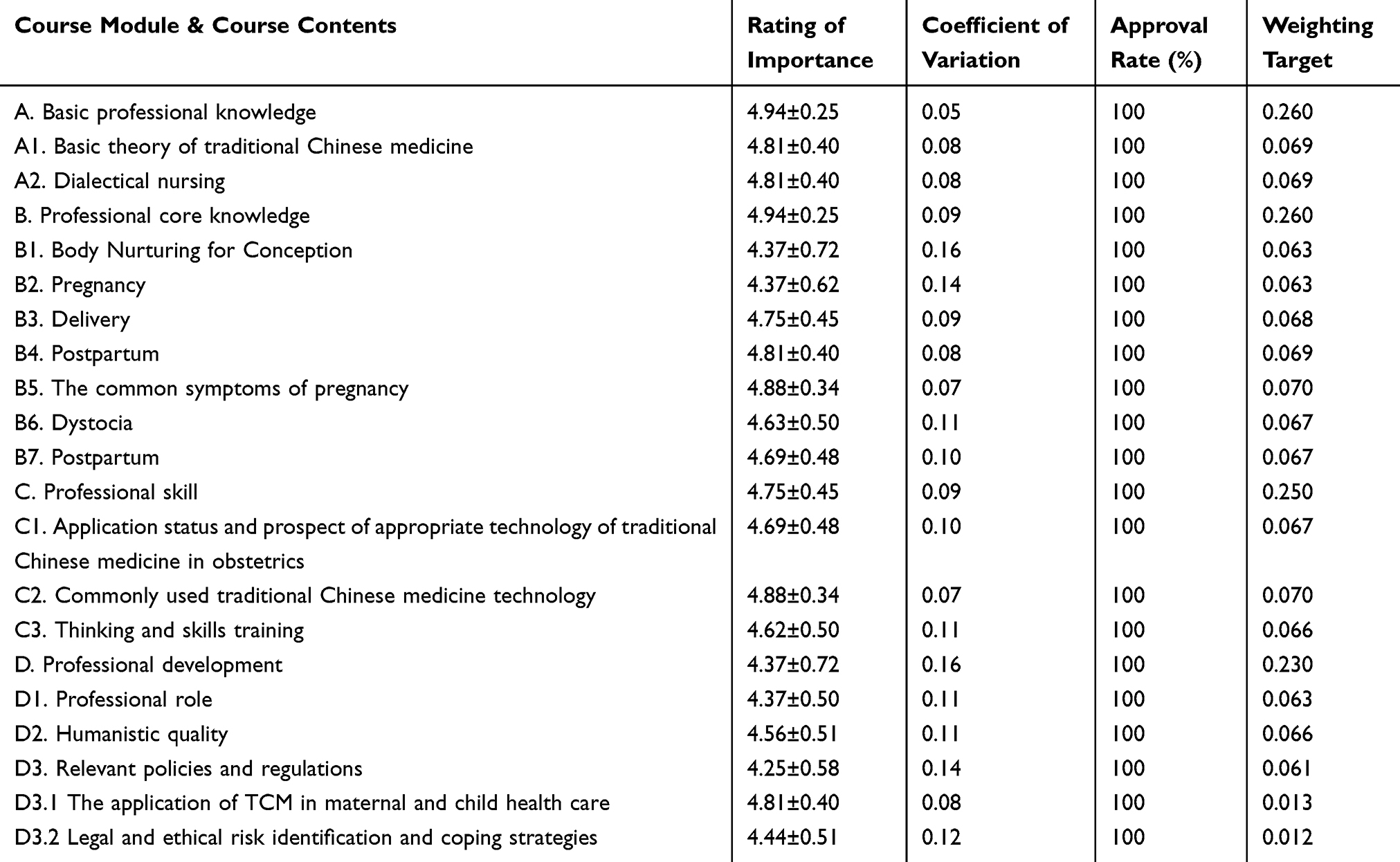 |
Table 2 Consultation Result of Traditional Chinese Medicine Health Preservation During Pregnancy and Perinatal Period Training Course for Maternity Nurses |
The coefficient of variation (CV) represents the fluctuation of expert opinion on the index. In the two rounds of consultation, the CV for all indicators was <0.3, and it indicated that the experts’ opinions were concentrated. Kendall’s harmony coefficient W and the significance test represent the consistency of expert scores on all indicators. The coordination coefficient was 0–1. The greater the coordination coefficient, the better the coordination of the experts. As shown in Table 3.
 |
Table 3 Coordination of Degree of Expert Opinions and Significant Test Results |
Experts’ Opinions on the Training Course
In the first round of the expert consultation questionnaire, 4 first-level indicators, 18 second-level indicators and 84 third-level indicators were set up. The importance score of the first-level indicators was 4.50–4.83, and the CV was 0.08–0.16, suggesting that the experts’ opinions were concentrated. According to the indicator screening criteria, expert opinions and group discussions, 3 secondary indicators and 16 third-level indicators were deleted. One second-level indicator was revised, and 5 third-level indicators were added.
The results of the two rounds of the consultation showed that the importance scores of the first-level and secondary level indicators were higher, ranging from 4.25 to 4.94, and the fluctuation range of CV was smaller, ranging from 0.05 to 0.16. The experts on the first-level indicators and the secondary level indicators did not put up opinions for modification. Combined with expert advice and clinical practice, the expression of two third-level indicators was modified. After two rounds of expert consultation, the final training course of TCM health preservation during pregnancy and perinatal period for maternity nurses included four first-level, 15 second- and 77 third-level indicators. See Supplementary Material 2 for specific course entries.
Implementing the Training Course of TCM Health Preservation During Pregnancy and Perinatal Period for Maternity Nurses
Hospitals in China have continuing education requirements for clinical nurses, and hospitals will organize nurses to carry out continuing education every year, ensuring ongoing learning for the nurses. The homogeneity of demographic characteristics of maternity nurses in the two groups is shown in Table 4. The general demographic baseline data of the two groups were balance and comparable. There was no significant difference in TCM knowledge, behavior ability and competency between the two groups before training. After training, the nurses in the observation group demonstrated higher levels of TCM knowledge, behavior ability, and competency than those in the control group (P < 0.05), as shown in Table 5.
 |
Table 4 General Information of Maternity Nurses in Two Groups (n=84) |
 |
Table 5 Comparison of Ability Difference Between Observation Group and Control Group |
Discussion
With the rapid development of modern society and the change in fertility concepts, the health status of women during pregnancy and the quality of fetal development have been widely concerns by all sectors of society.25 In this context, there is a growing demand for high-quality maternal health services, and maternity nurses, as clinical front-line workers, play an integral role in providing TCM care. As clinical frontline workers, maternity nurses play a key role in implementing interventions.26 However, there currently exists a notable gap between the development of maternity nurses and the required competencies for providing TCM health care during pregnancy and childbirth. Systematic and comprehensive training is essential for maternity nurses to fully acquire TCM knowledge and effectively integrate appropriate TCM technologies into clinical practice, thereby enhancing maternal health care services.27,28 Therefore, this study aims to construct a training course of TCM for maternity nurses during pregnancy and childbirth, so as to provide a reference for improving the TCM theory and practice level of maternity nurses.
Through literature analysis and two rounds of the Delphi method, this study constructed the training course on TCM health preservation during pregnancy and perinatal period for maternity nurses and obtained four first-level indicators of professional basic knowledge, professional core knowledge, professional skills and professional development. The experts selected by the Delphi method in this study covered clinicians and nurses related to obstetrics and gynecology and TCM, medical nursing education and management, and involved a wide range of related specialities. This study summarizes the advice of professionals on training TCM for pregnant and lying-in women from different perspectives to ensure the representativeness of the consultation results of the Delphi letter to the greatest extent.
The results showed that after the two rounds of consultation, the agreement rates of the two first-level indicators of “professional basic knowledge” and “professional core knowledge” were both 100.00%, and the importance scores were all more than 4.9 points, which reflected that the solid theoretical basis of TCM and the mastery of professional knowledge at all stages of pregnancy and childbirth were the core elements of TCM health care and fetal care services. The basic theory of TCM is the cornerstone to prevent TCM misunderstandings and guide TCM practice, and it is also an indispensable theoretical support to guide TCM practice and achieve accurate syndrome differentiation and treatment.29 The professional core knowledge focuses on the combination of TCM and obstetrics, focusing on the different stages of pregnancy and childbirth, covering the treatment of children, pregnancy, childbirth, postpartum care and the treatment of pregnancy and childbirth-related diseases, which are directly related to the clinical practice of obstetrics. For example, in the treatment of threatened abortion, hyperemesis gravidness and other diseases, TCM has shown significant effects with its rich treatment methods and characteristics of simplicity and safety.19
The professional skills section focuses on improving the operational ability of obstetric medical staff in the application of TCM technology and clinical practice. Among them, “Commonly used TCM technology” (0.070) ranked first in the second-level weight value. “Commonly used TCM technology” refers to TCM therapy under the guidance of TCM theory, which conforms to the Western health concept and the holistic concept of TCM and treatment based on syndrome differentiation. It has obvious advantages in health care, chronic disease management, and rehabilitation management.30 In this study, the “Acupoint massage Techniques”, “Acupoint application technique” and “Auriculotherapy” are given higher weight by experts in the third-level indicators. These TCM techniques are widely used in these operations in clinical practice, and they can play a good role in treating pregnancy resistance, postpartum lactation, and adverse urination.31–33 And for pregnant women, it is a non-invasive external operation, which is easier to be accepted.34 Unlike previous studies8 that focused solely on training healthcare providers in a single TCM technique, this study integrates multiple appropriate TCM techniques into the curriculum. This approach addresses the limitations of existing training programs, which predominantly emphasize a single TCM technique or focus exclusively on theoretical knowledge.35 This integration not only expands the knowledge and skills of maternity nurses but also facilitates the application of TCM in obstetrics.
Through two rounds of Delphi expert consultation, the research group constructed a systematic and comprehensive training course on TCM health preservation and fetal care for maternity nurses, and it carried out empirical research. From August to October 2024, a total of 84 clinical nurses from two hospitals were selected by convenience sampling method. Nurses from one hospital were selected as the control group, and nurses from the other hospital were selected as the observation group. The results of empirical research showed that the scores of TCM knowledge, TCM behavior ability and competency level of nurses in the observation group were significantly higher than those in the control group (P<0.05). This study focused on training course development of TCM in maternal and fetal health care. Results demonstrate that systematic TCM training significantly enhances clinical competencies among maternity nurses, particularly in maternal TCM health management.
The significant difference between the course and the previous Western learning Chinese courses is that the course focuses on the application of TCM in obstetrics, which helps maternity nurses understand the theory of TCM better, apply TCM nursing technology to clinical practice, make up the important gap of TCM nursing education in obstetrics, and provide innovative solutions to improve the quality of obstetric nursing. In addition, the course constructed in this study is highly consistent with the initiative of the World Health Organization (WHO). In recent years, the WHO has strongly advocated the integration of traditional medicine into the healthcare system of all countries, especially focusing on access to health in resource-limited areas.36 In this context, TCM has become the preferred mode of health management for residents in remote areas due to its easy availability, economy and cultural adaptability. This course not only optimizes maternal health management by improving the TCM practice ability of maternity nurses but also provides a feasible path for policymakers to integrate traditional medicine with the modern medical system, which not only responds to the needs of primary medical care but also provides a reference model for the standardized integration of traditional medicine worldwide.
Limitation
Despite the promising advancements of this study in the field of TCM obstetric nursing training, several limitations warrant acknowledgement. First, the relatively limited sample size, comprising only 84 clinical nurses from two hospitals, may compromise the external validity of the findings. Second, convenience sampling might have introduced selection bias, potentially affecting the generalizability of the results. Therefore, future studies should consider validating the effectiveness of the training programs by increasing the sample size and recruiting participants from diverse regions and institutions. This study mainly focused on descriptive consensus indicators. In the future, more stringent multiple correction methods can be used to control the false discovery rate in combination with subgroup analysis or multi-factor hypothesis investigation. Additionally, longitudinal research could provide valuable insights into the long-term impact of TCM training on maternity nurses’ performance and maternal health outcomes, thereby informing future educational initiatives and clinical practices. Furthermore, future investigations could explore the cost-benefit analysis of TCM training across various healthcare systems, particularly in resource-constrained settings, to offer meaningful recommendations for policymakers.
Conclusion
Based on the competency theory, this study develops a training course in TCM health preservation and fetal care during pregnancy and childbirth. The TCM health preservation during pregnancy and perinatal period training course for maternity nurses was formed, including 4 first-level indicators, 15 second-level indicators and 77 third-level indicators. The course aims to enhance participants’ theoretical knowledge of TCM health preservation and fetal care, improve their proficiency in TCM-appropriate technical operations, and preliminarily cultivate their awareness of TCM thinking. It also encourages the application of TCM’s holistic concept and syndrome differentiation for analyzing and addressing issues encountered in obstetric nursing. This provides maternity nurses with additional methods and options for problem-solving during pregnancy and childbirth care. The overall positive evaluation of the course further validates its feasibility and effectiveness, offering valuable insights for TCM training programs targeting maternity nurses. This study not only enriches educational resources for TCM training in obstetrics but also provides theoretical support for other researchers and professionals in the field, facilitating the integration of TCM into the modern medical system.
Acknowledgments
We thank all the experts involved in the consultation and all the faculty and nurses involved in the empirical study for their support and cooperation.
Disclosure
The authors report no conflicts of interest in this work.
References
1. Qiao J, Wang Y, Li X, et al. A Lancet Commission on 70 years of women’s reproductive, maternal, newborn, child, and adolescent health in China. Lancet. 2021;397(10293):2497–2536. doi:10.1016/S0140-6736(20)32708-2
2. Shi H, Chen L, Wei Y, Chen X, Zhao Y. Improving maternal healthcare further in China at a time of low maternal mortality. BMJ. 2024;386:e078640. doi:10.1136/bmj-2023-078640
3. Braithwaite J, Vincent C, Garcia-Elorrio E, et al. Transformational improvement in quality care and health systems: the next decade. BMC Med. 2020;18(1):340. doi:10.1186/s12916-020-01739-y
4. Tang P, Ding X. Effectiveness evaluation of traditional Chinese medicine in maternal health management. Maternal Child Health Care China. 2015;30(21):3558–3560. doi:10.7620/zgfybj.j.issn.1001-4411.2015.21.07
5. Lin M. Establishment and application of maternal health care model with traditional Chinese medicine characteristics. J Tradit Chin Med Manag. 2020;38(14):142–143. doi:10.16690/j.cnki.1007-9203.2020.14.066
6. Kuo SH, Wang HL, Lee TC, et al. Traditional Chinese medicine perspective on constitution transformations in perinatal women: a prospective longitudinal study. Women Birth. 2015;28(2):106–111. doi:10.1016/j.wombi.2015.01.002
7. Sun Q, Hu X. The first national whole-time training class for western physicians learning traditional Chinese medicine in China. Zhonghua Yi Shi Za Zhi. 2015;45(6):349–351.
8. Levett KM, Salomons E, Shenoy P, Kaur I, Fernandez E. Humanising childbirth - maternity acupressure training for healthcare providers at the Fernandez Foundation Hospitals, Hyderabad, India. Evaluation of program delivery in one region of India. Women Birth. 2024;37(6):101819. doi:10.1016/j.wombi.2024.101819
9. Adams J, Lui CW, Sibbritt D, Broom A, Wardle J, Homer C. Attitudes and referral practices of maternity care professionals with regard to complementary and alternative medicine: an integrative review. J Adv Nurs. 2011;67(3):472–483. doi:10.1111/j.1365-2648.2010.05510.x
10. Xie A, Soontornchai S, Bovornkitti S, Mao D, Shi Q, You J. Knowledge, attitude, and practice toward liver fibrosis/cirrhosis and traditional Chinese medicine treatment among medical staff. J Eval Clin Pract. 2025;31(1):e14261. doi:10.1111/jep.14261
11. Wada K, Charland LC, Bellingham G. Can women in labor give informed consent to epidural analgesia? Bioethics. 2019;33(4):475–486. doi:10.1111/bioe.12517
12. Ross DC, Farhat KF, Sayrafizadeh N, et al. A cross-sectional needs assessment for a trauma-informed care curriculum for multidisciplinary healthcare providers. BMC Health Serv Res. 2025;25(1):426. doi:10.1186/s12913-025-12568-1
13. McClelland DC. Testing for competence rather than for “intelligence”. Am Psychol. 1973;28(1):1. doi:10.1037/h0034092
14. Benner P. Issues in competency-based testing. Nurs Outlook. 1982;30(5):303–309.
15. Roberts ML, Sinacori B, Hassler LJ, Filippelli A. Elevating competency-based education in baccalaureate nursing: a simulation integration project. J Prof Nurs. 2024;54:45–49. doi:10.1016/j.profnurs.2024.06.014
16. Niederberger M, Spranger J. Delphi technique in health sciences: a map. Front Public Health. 2020;8:457. doi:10.3389/fpubh.2020.00457
17. Boulkedid R, Abdoul H, Loustau M, Sibony O, Alberti C. Using and reporting the Delphi method for selecting healthcare quality indicators: a systematic review. PLoS One. 2011;6(6):e20476. doi:10.1371/journal.pone.0020476
18. Ma L, Zhang D. Science of Health Preservation in Traditional Chinese Medicine (4th Edition, New Century Series). Beijing: China Press of Chinese Medicine; 2021:294.
19. Wang JS, Liu XW, Wang X, et al. Obstetric diseases responding specifically to traditional Chinese medicine. Chin J Exp Tradit Med Formulae. 2021;27(20):206–218. doi:10.13422/j.cnki.syfjx.20212091
20. Feng X, Zhang T. Gynecology in Traditional Chinese Medicine: Textbook for Higher Education in the Traditional Chinese Medicine Industry During the 14th Five-Year Plan Period. Beijing: China Press of Chinese Medicine; 2021.
21. Jünger S, Payne SA, Brine J, Radbruch L, Brearley SG. Guidance on Conducting and REporting DElphi Studies (CREDES) in palliative care: recommendations based on a methodological systematic review. Palliat Med. 2017;31(8):684–706. doi:10.1177/0269216317690685
22. Ye J, Tao W, Yang L, Xu Y, Zhou N, Wang J. Developing core competencies for clinical nurse educators: an e-Delphi-study. Nurse Educ Today. 2022;109:105217. doi:10.1016/j.nedt.2021.105217
23. Faul F, Erdfelder E, Lang AG, Buchner A. G*Power 3: a flexible statistical power analysis program for the social, behavioral, and biomedical sciences. Behav Res Methods. 2007;39(2):175–191. doi:10.3758/bf03193146
24. Lin LC, Lee S, Ueng SWN, Tang WR. Reliability and validity of the nurse practitioners’ roles and competencies scale. J Clin Nurs. 2016;25(1–2):99–108. doi:10.1111/jocn.13001
25. Alkema L, Chou D, Hogan D, et al. Global, regional, and national levels and trends in maternal mortality between 1990 and 2015, with scenario-based projections to 2030: a systematic analysis by the UN Maternal Mortality Estimation Inter-Agency Group. Lancet. 2016;387(10017):462–474. doi:10.1016/S0140-6736(15)00838-7
26. Nelson AM. The evolution of professional obstetric nursing in the United States (1880’s-present): qualitative content analysis of specialty nursing textbooks. Int J Nurs Stud Adv. 2020;2:100010. doi:10.1016/j.ijnsa.2020.100010
27. Yeh YC, Chung UL. An investigation into competence in TCM of BSN graduates from technological universities in Taiwan. J Nurs Res. 2007;15(4):310–318. doi:10.1097/01.jnr.0000387627.25801.12
28. de Camargo JC, Finkler M, Campagnoni JP, et al. Interprofessional education in traditional and complementary medicine: a scoping review. J Interprof Care. 2024;38(6):1127–1139. doi:10.1080/13561820.2024.2395978
29. Cai Y, Boyd DL. Effect of a traditional Chinese medicine course for undergraduate nursing students: a pre-/post-test study. Nurse Educ Today. 2018;70:87–93. doi:10.1016/j.nedt.2018.08.013
30. Chen L, Jiang WJ, Zhao RP. Application effect of Kolb’s experiential learning theory in clinical nursing teaching of traditional Chinese medicine. Digit Health. 2022;8:20552076221138313. doi:10.1177/20552076221138313
31. Fróes NBM, Aquino PDS, Soares PRAL, et al. Effects of auriculotherapy on nausea and vomiting in pregnant women: a randomized clinical trial. Complement Ther Clin Pract. 2024;55:101847. doi:10.1016/j.ctcp.2024.101847
32. Chen Q, HongMei M, Yi L. Acupoint application combined with acupressure as an adjunctive therapy for chemotherapy-induced nausea and vomiting. J Vis Exp. 2024;2024(208):e66865. doi:10.3791/66865
33. Zhu X, Shen Q. Effect of Low-Frequency Pulsed Electrotherapy Combined with Acupoint Nursing on Postpartum Urinary Retention in Patients with Vaginal Delivery. Int Urogynecol J. 2024;35(6):1227–1234. doi:10.1007/s00192-024-05804-5
34. Chen HT, Luo TZ, Jiang ZY, et al. Noninvasive external therapy of traditional Chinese medicine for preventing postpartum urinary retention in women with vaginal delivery: a network meta-analysis. Medicine. 2023;102(41):e35399. doi:10.1097/MD.0000000000035399
35. Williams H, Sweet L, Graham K. Acupuncture during pregnancy and the perinatal period: women’s attitudes, beliefs and practices. Women Birth. 2020;33(3):e286–e294. doi:10.1016/j.wombi.2019.04.010
36. World Health Organization. Traditional medicine. 2023. Available from: https://www.who.int/news-room/questions-and-answers/item/traditional-medicine.
 © 2025 The Author(s). This work is published and licensed by Dove Medical Press Limited. The
full terms of this license are available at https://www.dovepress.com/terms
and incorporate the Creative Commons Attribution
- Non Commercial (unported, 4.0) License.
By accessing the work you hereby accept the Terms. Non-commercial uses of the work are permitted
without any further permission from Dove Medical Press Limited, provided the work is properly
attributed. For permission for commercial use of this work, please see paragraphs 4.2 and 5 of our Terms.
© 2025 The Author(s). This work is published and licensed by Dove Medical Press Limited. The
full terms of this license are available at https://www.dovepress.com/terms
and incorporate the Creative Commons Attribution
- Non Commercial (unported, 4.0) License.
By accessing the work you hereby accept the Terms. Non-commercial uses of the work are permitted
without any further permission from Dove Medical Press Limited, provided the work is properly
attributed. For permission for commercial use of this work, please see paragraphs 4.2 and 5 of our Terms.