
Back to Journals » Advances in Medical Education and Practice » Volume 17
Implementation and Impact of Entrustable Professional Activities (EPAs) in Health Professions Education: A Global Bibliometric Analysis
Authors Zhang Y, Liang W, Hu Y, Sun B, Ding S, Xue J, Zheng C 
Received 11 November 2025
Accepted for publication 25 January 2026
Published 31 January 2026 Volume 2026:17 580770
DOI https://doi.org/10.2147/AMEP.S580770
Checked for plagiarism Yes
Review by Single anonymous peer review
Peer reviewer comments 2
Editor who approved publication: Prof. Dr. Balakrishnan Nair
Yikai Zhang,1,* Weiwei Liang,1,* Yue Hu,2 Bo Sun,1 Siying Ding,3 Jing Xue,4 Chao Zheng1
1Department of Endocrinology, The Second Affiliated Hospital, Zhejiang University School of Medicine, Hangzhou, 310009, People’s Republic of China; 2Key Laboratory of Respiratory Disease of Zhejiang Province, Department of Respiratory and Critical Care Medicine, The Second Affiliated Hospital of Zhejiang University School of Medicine, Hangzhou, Zhejiang, 310009, People’s Republic of China; 3Department of Cardiology, The Second Affiliated Hospital, Zhejiang University School of Medicine, Hangzhou, 310009, People’s Republic of China; 4Department of Rheumatology, The Second Affiliated Hospital, Zhejiang University School of Medicine, Hangzhou, 310009, People’s Republic of China
*These authors contributed equally to this work
Correspondence: Chao Zheng; Email [email protected] Jing Xue, Email [email protected]
Introduction: Entrustable Professional Activities (EPAs) have emerged as a key framework in health professions education, facilitating the development and assessment of competencies in healthcare professionals. Despite the rapid expansion of EPA-related research, the global distribution, thematic trends, and scholarly equity surrounding these studies remain underexplored. The existing literature, while growing, lacks a systematic and quantitative examination of the geographical and institutional origins of EPA research.
Methods: This bibliometric study analyzes a dataset of 966 publications sourced from the Web of Science Core Collection, spanning from 2005 to 2025. The analysis includes an examination of publication trends, collaborative networks, and thematic shifts over the two-decade period.
Results: The findings reveal a dominance of EPA research originating from North America and Europe, with significantly less representation from the Global South. Over time, there has been a shift in research focus from the development of EPA frameworks to the study of their implementation in clinical education settings. Collaboration patterns suggest a concentration of research activity within a few high-resource regions, with limited cross-regional partnerships.
Conclusion: This study provides a comprehensive overview of the global landscape of EPA research, uncovering knowledge disparities and underrepresented regions. It highlights the need for more inclusive and equitable contributions from the Global South and suggests that future research efforts should prioritize collaborative, international approaches to enhance the diversity and applicability of EPA scholarship.
Keywords: entrustable professional activities, EPAs, competency-based health professions education, bibliometric analysis, clinical competencies
Introduction
Entrustable Professional Activities (EPAs) epitomize a critical transformation in health professions education, bridging the divide between theoretical proficiencies and actual clinical duties. Originating in the Netherlands in 2005, EPAs have progressively become an essential part of competency-based medical education (CBME) globally, highlighting the crucial role of trust within the supervisory relationships between educators and trainees.1,2 By focusing on professional activities that can be entrusted to learners, this framework addresses the challenge of translating abstract competency domains into observing clinical practice.3 Furthermore, the entrustment process plays a pivotal role in shaping the professional identity of trainees. As learners progress through decreasing levels of supervision, the granting of trust fosters a sense of responsibility and belonging within the healthcare team, which is fundamental to their transition into autonomous practitioners.
EPAs are delineated as units of professional practice that are entrusted to learners once they have demonstrated adequate competence, thereby enabling a more thorough and comprehensive assessment of clinical skills and knowledge.3,4 They encapsulate the tasks or responsibilities that learners are anticipated to perform independently by the end of their training, integrating a variety of competencies across different fields.5 This concept is in line with the shift from traditional time-based educational models to competency-based education models, focusing on the attainment of specific competencies required for unsupervised practice.6
The foundation of EPAs is the principle that once medical interns exhibit sufficient competence, they are entrusted with specific professional activities that are indispensable parts of unsupervised practice. This approach not only aids in a more direct evaluation of clinical preparedness but also aligns educational outcomes with the demands of healthcare services.7 As the healthcare sector increasingly emphasizes outcome-based education, EPAs provide a structured framework to ensure that learners acquire the competencies necessary for safe and efficient patient care.1,3
While the body of literature on EPAs has grown exponentially, several systematic and scoping reviews have attempted to synthesize this knowledge to guide implementation. For instance, Shorey et al conducted a scoping review highlighting the use of EPAs across various health professions, emphasizing the need for consistent descriptions.8 Similarly, Meyer et al focused on the application of EPAs in undergraduate medical education,9 while Bramley and McKenna examined their utility in entry-level health professional education.10 Other reviews have synthesized evidence on specific specialties, such as surgery11 or pediatrics.12 These reviews have provided valuable qualitative insights into the definitions, implementation frameworks, and assessment challenges of EPAs. However, they primarily focus on content analysis and implementation strategies within specific contexts. To date, there is a paucity of research utilizing bibliometric methods to quantitatively map the global landscape of EPA scholarship. The existing reviews do not systematically capture the macro-level evolution of the field, the growth of collaborative networks, or the geographical distribution of research output over the past two decades.
Bibliometrics is the application of statistical and mathematical methods to analyze the quantitative characteristics and development patterns of scientific literature. Its goal is to measure and evaluate the impact of research outputs across various types of documents, such as books, journal articles, and patents. Through the examination of publication patterns, citation analysis, and content analysis, bibliometrics offers insights into the trends, impacts, and networks of scientific research. This methodology is extensively utilized in academia and research institutions to assess research performance, identify influential works and authors, and comprehend the evolution of scientific disciplines.
The swift adoption of EPAs across various medical specialties and regions worldwide underscores the necessity for a comprehensive bibliometric analysis to understand the trajectory, thematic evolution, and emerging collaboration networks of EPAs research. Such an analysis can provide valuable insights into the core themes propelling EPAs research, identify influential studies and authors, and elucidate the geographical distribution of EPAs scholarships. Moreover, it can clarify the methodologies employed in EPAs research, offering a meta-perspective on the field’s development.5
This study aims to conduct a comprehensive bibliometric analysis of EPA-related publications from 2005 to 2025, examining global trends, collaborations, thematic foci, and emerging directions in the field of health professions education. By bridging the gap between qualitative reviews and quantitative mapping, this study seeks to provide a holistic view of how the EPA framework has disseminated and evolved globally.
Materials and Methods
Data Source and Search Strategy
The Web of Science Core Collection (WOSCC) was selected for its comprehensive coverage of peer-reviewed literature in health professions education. The search strategy employed the “Topic” field (TS), which searches titles, abstracts, and author keywords. The specific query string was: TS = (“Entrustable Professional Activities” OR “EPA”) AND TS = (“Medical Education” OR “Health Professions Education”). The search included all publication types (articles, reviews, and conference papers) from January 2005 to November 2025. To ensure reproducibility, all records—including cited references—were downloaded as text files on November 1, 2025.
Inclusion and Exclusion Criteria
Inclusion criteria were: (1) Documents explicitly addressing the development, implementation, or assessment of EPAs within health professions education (including medicine, pharmacy, and dentistry). (2) peer-reviewed English-language articles, reviews, and conference proceedings papers and (3) accessible metadata including authorship, institution, country, and keywords. Exclusion criteria included non-academic commentaries, editorials without analytical content, and papers unrelated to education or training.
Two researchers (YK Zhang. and WW Liang.) independently screened the titles and abstracts of the retrieved records. Disagreements regarding inclusion were resolved through discussion or consultation with a third senior researcher (C Zheng).
Analytical Framework
The bibliometric analysis was conducted using a comprehensive suite of tools, with data standardization performed prior to visualization (eg, merging duplicate author names and unifying institution names such as “Harvard Univ” and “Harvard University”).
Following established bibliometric protocols, analyses were conducted using Bibliometrix package (version 4.2.0) for descriptive statistics, VOSviewer for co-authorship and co-citation visualization, and CiteSpace for temporal burst and trend analysis. The analysis focused on six key dimensions: (1) publication and citation trends, (2) country and regional distribution, (3) authorship and institutional networks, (4) journal impact, (5) keyword and thematic evolution, and (6) collaboration patterns. The counting method was set to “Full Counting.” To improve map readability, minimum thresholds were applied (eg, for keyword analysis, only keywords occurring at least 5 times were included).
Transparency and reproducibility were prioritized: all data processing steps were documented, and parameters were standardized across tools. Where appropriate, findings were cross-validated between software outputs. Figure 1 showed the flow chart of study design.
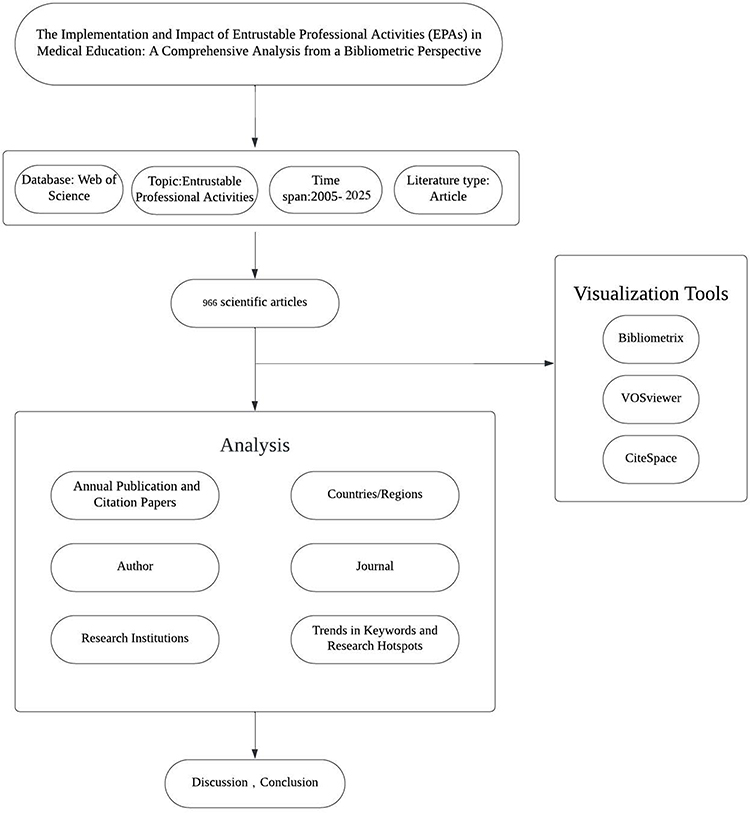 |
Figure 1 Flowchart of the bibliometric study design. This diagram illustrates the sequential process of the literature review and analysis. The study was conducted using the Web of Science database, focusing on publications related to EPAs between 2005 and 2025. |
Results
Annual Publication Numbers and Average Citations Per Year
A summary of the annual publication output is presented in Figure 2. The analysis of academic articles published between 2005 and 2025 indicates an overall upward trend in publication volume. In 2005, one article was published.2 Subsequently, the number of publications increased annually. The average citation count per year fluctuates, with earlier seminal papers accumulating higher citation counts over time.
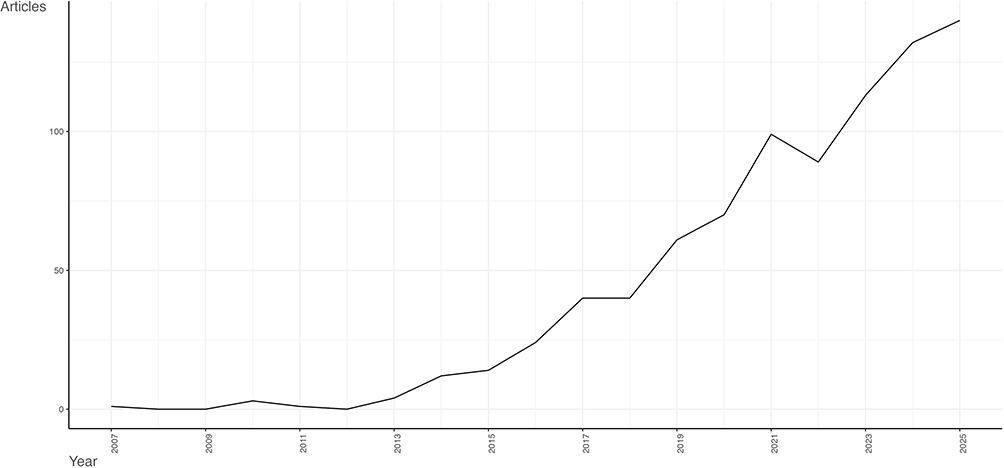 |
Figure 2 Annual scientific production of EPA-related research. The chart illustrates the steady annual growth in the number of publications related to Entrustable Professional Activities over the past two decades. |
Collaboration Analysis
Countries/Regions
Figure 3A and B illustrate the global distribution of EPA research. The United States produced the highest volume of research, with 559 articles and a total of 6,506 citations (average: ~11.6 citations per article). Canada followed with 91 articles and 1,093 total citations. The Netherlands published 65 papers but achieved a high total citation count of 3,526. Other contributing countries include Germany, Australia, and Switzerland. The collaboration network analysis indicates that cross-border partnerships are most frequent between researchers in the United States and the Netherlands.
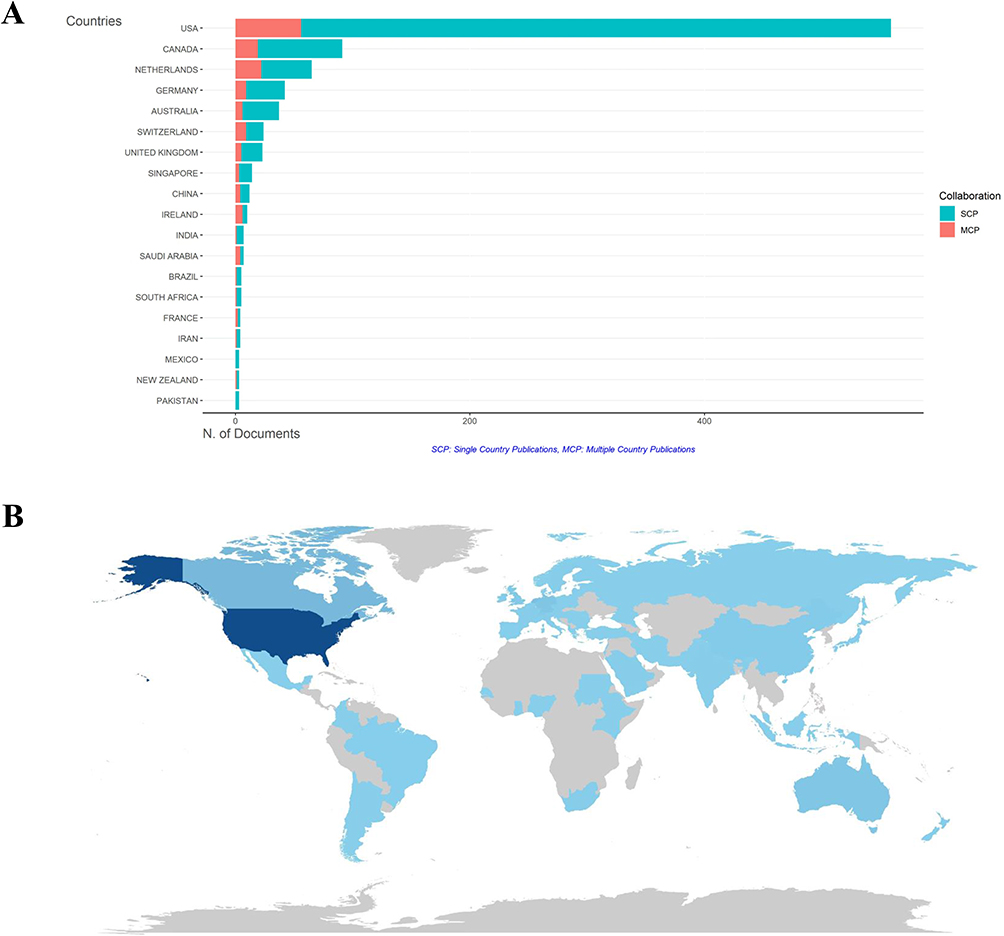 |
Figure 3 Geographical distribution and collaboration in EPA research. (A) Top 20 most productive countries. The bar chart distinguishes between Single Country Publications (SCP, blue bar) and Multiple Country Publications (MCP, Orange bar), highlighting the proportion of international collaboration for each nation. (B) Global scientific production map. The intensity of the blue color corresponds to the volume of publications, visualizing the concentration of research activity in North America, Western Europe, and Australia. Abbreviations: SCP, Single Country Production; MCP, Country Production. |
Author Analysis
Figure 4 present the most prolific and cited authors. Ten Cate O authored the highest number of publications (n=65), with a total citation count of 1,970 and an average of 20.56 citations per article. Carraccio C and Schumacher DJ followed with 30 and 25 articles, respectively. Regarding citation impact, Ten Cate O received the most citations, followed by Chen HC (616 citations) and Carraccio C (529 citations).
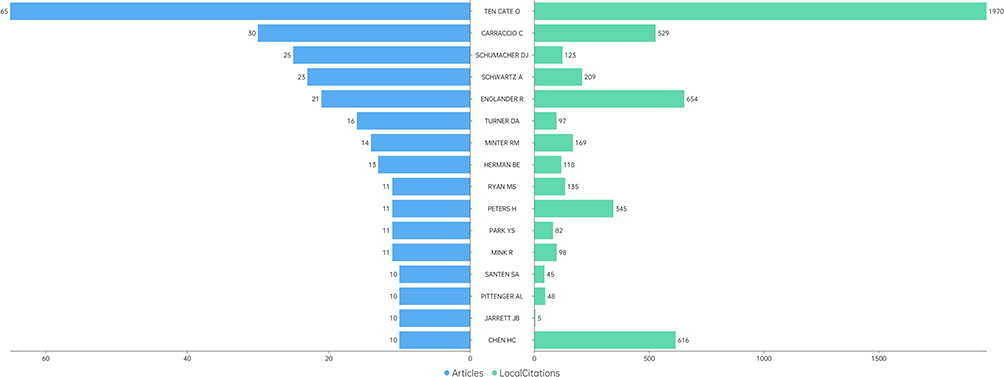 |
Figure 4 Most prolific and influential authors in the field of EPAs. The blue bars represent the top 10 most prolific authors, ranked by the number of publications. The green bars show the top 10 authors with the highest number of citations within the retrieved dataset. |
Journal Analysis
Figure 5 displays the publication sources. Academic Medicine published the most articles on EPAs (n=125) and received the highest total citations (4,082). The JOURNAL OF GRADUATE MEDICAL EDUCATION ranked second in output with 98 articles and 1,014 citations. BMC MEDICAL EDUCATION and MEDICAL TEACHER published 46 and 45 articles, respectively, with MEDICAL TEACHER accumulating 2,211 citations. Other active journals included the AMERICAN JOURNAL OF PHARMACEUTICAL EDUCATION, JOURNAL OF SURGICAL EDUCATION, and JOURNAL OF GENERAL INTERNAL MEDICINE.
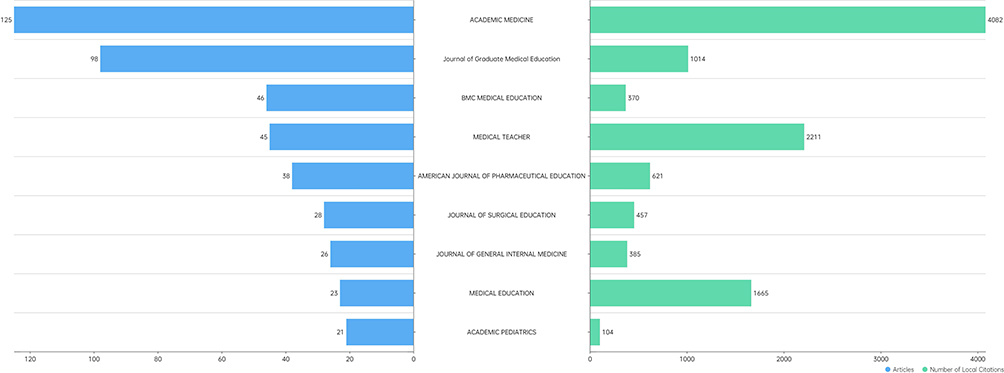 |
Figure 5 Most relevant and local cited publication sources in the field of EPAs. The blue bars represent the top 10 most relevant journals ranked by publication volume. The green bars show the top 10 journals ranked by local citation counts. |
Research Institution Analysis
Figure 6 outlines the institutional contributions. The University of California System had the highest output with 146 articles. The University of Toronto and Utrecht University Medical Center each published 103 articles. The University System of Ohio and the University of Minnesota Twin Cities followed with 96 and 91 articles, respectively.
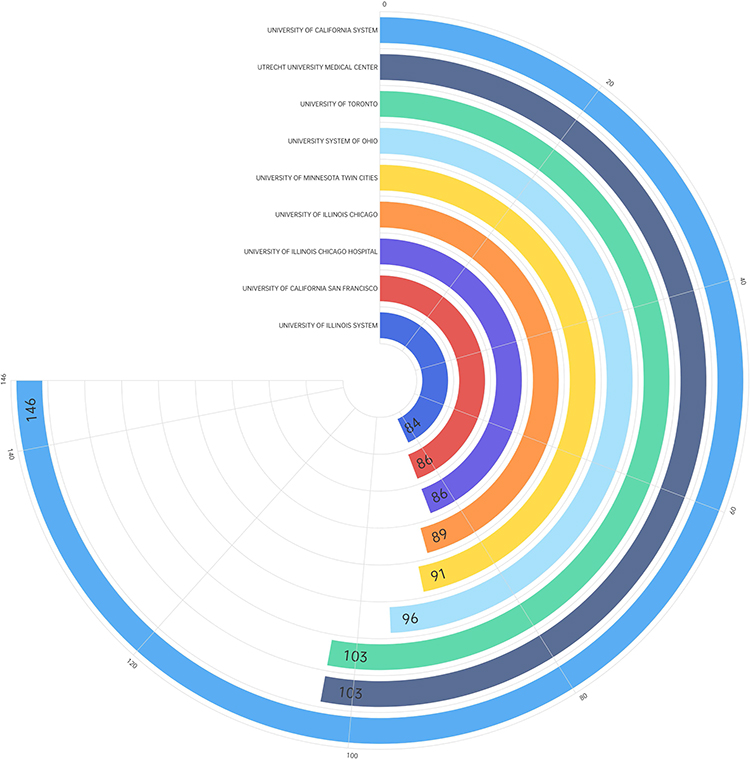 |
Figure 6 Most relevant affiliations in the field of EPAs. The bar chart displays the top 10 most relevant affiliations based on the number of published articles. |
Words Analysis
The frequency and evolution of keywords are shown in Figure 7. The term “Entrustable Professional Activities” (EPAs) showed a continuous increase in frequency from 2005 to 2025, with a notable rise in occurrences between 2015 and 2020. Co-occurring keywords with high frequency included “competency,” “performance,” and “assessment.” Figure 7B illustrates the temporal distribution of topics, showing the emergence of terms related to “curriculum” and “feedback” in recent years. The Words Frequency Over Time chart was displayed in Figure 7C.
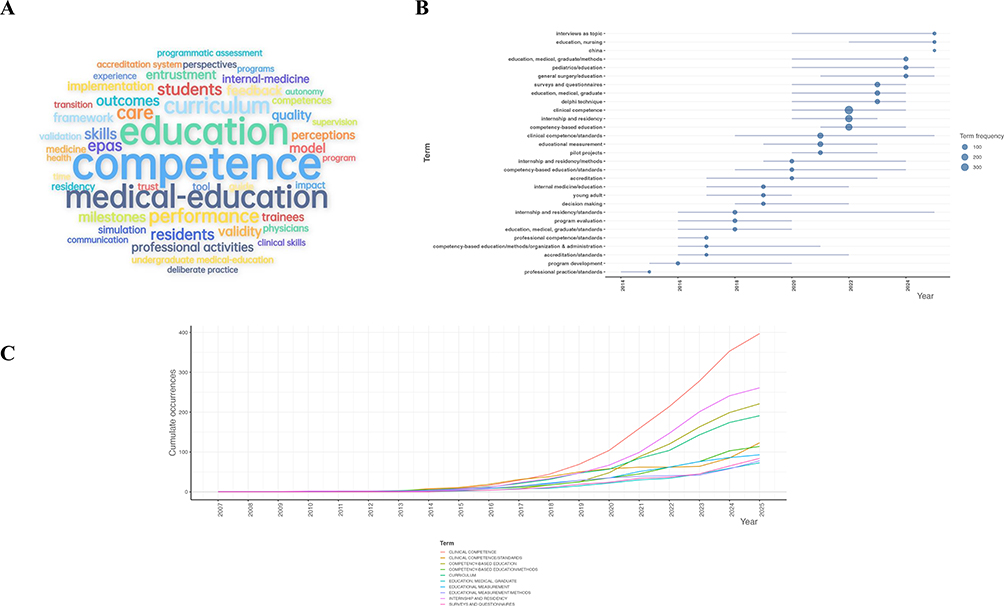 |
Figure 7 Thematic evolution and keyword analysis. (A) Word cloud visualization of the most frequent keywords, where font size is proportional to the frequency of occurrence. (B) Trend topics analysis. This chart illustrates the evolution of research hotspots over time, showing when specific topics became prominent. (C) Cumulative frequency of keywords over time. The line graph tracks the growth of core terms from 2005 to 2025, reflecting the maturation of the field. |
Discussion
This bibliometric analysis offers the first quantitative mapping of global EPA scholarship from 2005 to 2025. Unlike previous qualitative reviews that focused on implementation strategies within specific disciplines,8,9 our data reveal macro-level trends in the evolution, geographical distribution, and thematic shifts of the field.
The trajectory of annual publications indicates that EPA research has moved beyond its nascent phase into a period of exponential growth. This surge aligns with the global paradigm shift towards Competency-Based Medical Education.6 The initial slow growth from 2005 to 2010 reflects the conceptual incubation period following Ten Cate’s seminal introduction of the term.2 The rapid acceleration post-2015 likely corresponds to the operationalization of EPAs by major educational bodies, such as the AAMC’s “Core Entrustable Professional Activities for Entering Residency” in the United States.13 This quantitative trend corroborates Bramley and McKenna’s observation that EPAs have become the “currency” for translating abstract competencies into clinical practice.10
Our findings highlight a pronounced geographical imbalance, with the vast majority of research originating from North America (USA, Canada) and Western Europe (Netherlands, Germany). The prominence of the Netherlands is expected given the concept’s origins, while the high output from the USA reflects the systemic integration of EPAs into graduate medical education accreditation.10 However, the scarcity of contributions from the Global South (Africa, South America, Southeast Asia) is concerning. As noted in other bibliometric studies of medical education, this “western-centric” production may limit the cross-cultural validity of current EPA frameworks. Educational models developed in high-resource settings may not fully address the contextual challenges—such as higher patient loads and different supervisory structures—faced in low- and middle-income countries.14
The keyword analysis illustrates a clear maturation of the field. Early terms focused on defining “competency” and “entrustment.” In contrast, the emergence of recent high-frequency terms such as “feedback,” “curriculum,” and “e-portfolio”15 suggests a shift in research focus from conceptualization to implementation and assessment. This evolution indicates that the academic community is now grappling with the practicalities of entrustment decision-making in the workplace. The appearance of “interprofessional education” and “nursing”16,17 in recent years also signals the expansion of EPAs beyond medicine into allied health professions,18 validating the multidisciplinary applicability of the framework.19 Effective implementation also necessitates a shared mental model of supervision levels (eg, ranging from observation to independent practice). Standardizing these levels is essential for faculty to make consistent entrustment decisions that balance learner autonomy with patient safety.
This study has several limitations inherent to bibliometric analysis. First, the reliance on the Web of Science Core Collection may have excluded relevant articles published in journals not indexed in this database or in non-English languages, potentially exacerbating the apparent gap in the Global South. Second, bibliometric metrics such as citation counts are lagging indicators and may not fully capture the immediate impact of very recent publications. Finally, citation analysis does not evaluate the quality of the individual studies included.
Looking ahead, continued refinement of EPAs is expected to further advance medical and health education by fostering interdisciplinary research, strengthening the theory–practice connection, and maintaining relevance in a rapidly evolving healthcare landscape.20,21 Emerging assessment approaches, including virtual reality simulations and AI-driven analytics, will support more precise competency evaluation and enable highly targeted feedback and interventions.22–24 Integrating a global perspective remains essential, as examining EPA implementation across diverse healthcare systems can yield transferable insights, promote international collaboration, and enhance adaptability across cultural and clinical contexts.25–30 Technology will remain central to EPA-based assessment. The growing use of digital portfolios and online platforms has already transformed competency tracking, and future innovations are expected to provide more flexible and robust approaches to monitoring progress, delivering feedback, and certifying competencies.31–33 Another key direction is the specialization of EPAs for specific medical disciplines. Adapting EPAs to the distinct requirements of specialties such as anesthesiology34,35 and radiology36 can better align competency development with professional practice needs.37–39 Achieving this specialization requires close collaboration among educational institutions, professional bodies, and regulatory authorities to ensure alignment with professional standards and patient care priorities.12,39,40
Conclusion
This bibliometric analysis of 966 publications from 2005 to 2025 demonstrates that EPA research has undergone exponential growth, evolving from a theoretical concept to a widely implemented framework in health professions education. However, the findings reveal significant geographical disparities, with scholarly production heavily concentrated in North America and Western Europe, while the Global South remains underrepresented. Thematically, the field has matured, shifting focus from defining competencies to addressing practical implementation challenges such as curriculum integration, feedback, and assessment tools. To ensure the global applicability of EPAs, future scholarship must prioritize international collaboration and investigate the framework’s adaptation in diverse, resource-constrained educational contexts.
Data Sharing Statement
All data generated or analyzed in this study are available from published dataset.
Author Contributions
All authors made a significant contribution to the work reported, whether that is in the conception, study design, execution, acquisition of data, analysis and interpretation, or in all these areas; took part in drafting, revising or critically reviewing the article; gave final approval of the version to be published; have agreed on the journal to which the article has been submitted; and agree to be accountable for all aspects of the work.
Funding
We would like to express our thanks to the Natural Science Foundation of China (NO. 82402925, NO. 82370817) and “Noncommunicable Chronic Disease-National Science and Technology Major Project” (NO. 2024ZD0533500) for financial support.
Disclosure
Yikai Zhang and Weiwei Liang are co-first authors for this study. The authors certify that they have no conflicts of interest in this work.
References
1. Ten Cate O, Taylor DR. The recommended description of an entrustable professional activity: amee guide no. 140. Med Teach. 2021;43(10):1106–11. doi:10.1080/0142159X.2020.1838465
2. Ten Cate O. Entrustability of professional activities and competency-based training. Med Educ. 2005;39:1176–1177. doi:10.1111/j.1365-2929.2005.02341.x
3. Hennus MP, van Dam M, Gauthier S, Taylor DR, Ten Cate O. The logic behind entrustable professional activity frameworks: a scoping review of the literature. Med Educ. 2022;56:881–891. doi:10.1111/medu.14806
4. Schumacher DJ, West DC, Schwartz A, et al. Longitudinal assessment of resident performance using entrustable professional activities. JAMA Network Open. 2020;3:e1919316. doi:10.1001/jamanetworkopen.2019.19316
5. Sample S, Al Rimawi H, Bérczi B, Chorley A, Pardhan A, Chan TM. Seeing potential opportunities for teaching (spot): evaluating a bundle of interventions to augment entrustable professional activity acquisition. AEM Educ Train. 2021;5:e10631. doi:10.1002/aet2.10631
6. ten Cate O, Scheele F. Competency-based postgraduate training: can we bridge the gap between theory and clinical practice? Acad Med. 2007;82:542–547. doi:10.1097/ACM.0b013e31805559c7
7. Pagano MB, Treml A, Stephens LD, et al. Entrustable professional activities for apheresis medicine education. Transfusion. 2020;60:2432–2440. doi:10.1111/trf.15983
8. Shorey S, Lau TC, Lau ST, Ang E. Entrustable professional activities in health care education: a scoping review. Med Educ. 2019;53:766–777. doi:10.1111/medu.13879
9. Meyer EG, Chen HC, Uijtdehaage S, Durning SJ, Maggio LA. Scoping review of entrustable professional activities in undergraduate medical education. Acad Med. 2019;94:1040–1049. doi:10.1097/ACM.0000000000002735
10. Bramley AL, McKenna L. Entrustable professional activities in entry-level health professional education: a scoping review. Med Educ. 2021;55(9):1011–1032. doi:10.1111/medu.14539
11. Brasel KJ, Klingensmith ME, Englander R, et al. Entrustable professional activities in general surgery: development and implementation. J Surg Educ. 2019;76(5):1174–1186. doi:10.1016/j.jsurg.2019.04.003
12. Kerth JL, van Treel L, Bosse HM. The use of entrustable professional activities in pediatric postgraduate medical education: a systematic review. Acad Pediatr. 2022;22(1):21–28. doi:10.1016/j.acap.2021.07.007
13. Englander R, Flynn T, Call S, et al. Toward defining the foundation of the md degree: core entrustable professional activities for entering residency. Acad Med. 2016;91(10):1352–1358. doi:10.1097/ACM.0000000000001204
14. Steeb DR, Brock TP, Dascanio SA, et al. Entrustable professional activities (epas) for global health. Acad Med. 2021;96(3):402–408. doi:10.1097/ACM.0000000000003856
15. Lee CW, Chen GL, Lee YK. User experience evaluation of the epas-based e-portfolio system and an analysis of its impact. J Acute Med. 2020;10(3):115–125. doi:10.6705/j.jacme.202009_10(3).0003
16. Al-Moteri M. Entrustable professional activities in nursing: a concept analysis. Int J Nurs Sci. 2020;7(3):277–284. doi:10.1016/j.ijnss.2020.06.009
17. Pool IA, van Zundert H, Ten Cate O. Facilitating flexibility in postgraduate nursing education through entrustable professional activities to address nursing shortages and career prospects. Int Nurs Rev. 2024;71(3):419–423. doi:10.1111/inr.12892
18. Pittenger AL, Chapman SA, Frail CK, Moon JY, Undeberg MR, Orzoff JH. Entrustable professional activities for pharmacy practice. Am J Pharm Educ. 2016;80:57. doi:10.5688/ajpe80457
19. Pool I, Hofstra S, van der Horst M, Ten Cate O. Transdisciplinary entrustable professional activities. Med Teach. 2023;45:1019–1024. doi:10.1080/0142159X.2023.2170778
20. Bonnie LHA, Visser MRM, Bont J, Kramer AWM, van Dijk N. Trainers’ and trainees’ expectations of entrustable professional activities (epas) in a primary care training programme. Educ Prim Care. 2019;30:13–21. doi:10.1080/14739879.2018.1532773
21. Iqbal MZ, M MA-E. Using entrustable professional activities (epas) to assess teaching competence and transfer of training: a personal view. Med Teach. 2019;41:107–108. doi:10.1080/0142159X.2018.1440074
22. Czaja AS, Mink RB, Herman BE, et al. Exploring factors for implementation of epas in pediatric subspecialty fellowships: a qualitative study of program directors. J Med Educ Curric Dev. 2024;11:23821205231225011. doi:10.1177/23821205231225011
23. Marty A, Frick S, Bruderer Enzler H, Zundel S. An analysis of core epas reveals a gap between curricular expectations and medical school graduates’ self-perceived level of competence. BMC Med Educ. 2021;21:105. doi:10.1186/s12909-021-02534-w
24. Dewey CM, Jonker G, Ten Cate O, Turner TL. Entrustable professional activities (epas) for teachers in medical education: has the time come? Med Teach. 2017;39:894–896. doi:10.1080/0142159X.2016.1270447
25. Kinston R, Gay S, McKinley RK, Sam S, Yardley S, Lefroy J. How well do uk assistantships equip medical students for graduate practice? Think epas. Adv Health Sci Educ Theory Pract. 2024;29:173–198. doi:10.1007/s10459-023-10249-4
26. Scott DM, Kelsch M, Zhang A, Friesner DL. Evaluation of the entrustable professional activities (epas) of the population health promoter domain by north dakota pharmacists. Pharm Pract. 2020;18:1980. doi:10.18549/PharmPract.2020.3.1980
27. Iqbal MZ, Könings KD, Al-Eraky M, AlSheikh MH, van Merrienboer JJG. Development of an entrustable professional activities (epas) framework for small group facilitators through a participatory design approach. Med Educ Online. 2020;25:1694309. doi:10.1080/10872981.2019.1694309
28. van Bockel EAP, Walstock PA, van Mook W, et al. Entrustable professional activities (epas) for postgraduate competency based intensive care medicine training in the Netherlands: the next step towards excellence in intensive care medicine training. J Crit Care. 2019;54:261–267. doi:10.1016/j.jcrc.2019.09.012
29. Eliasz KL, Nick MW, Zabar S, et al. Viewing readiness-for-residency through binoculars: mapping competency-based assessments to the aamc’s 13 core entrustable professional activities (epas). Teach Learn Med. 2023;35:436–441. doi:10.1080/10401334.2022.2082432
30. Abeyaratne C, Galbraith K. A review of entrustable professional activities in pharmacy education. Am J Pharm Educ. 2023;87:ajpe8872.
31. von Streng Paats T, Masud T, Huwendiek S, Blundell A, Vassallo M, Stuck AE. Geriatric medicine learning objectives and entrustable professional activities in undergraduate medical curricula: a scoping review. Age Ageing. 2022;51.
32. Porter S, Prendiville E, Allen BFS, et al. Development of entrustable professional activities for regional anesthesia and pain medicine fellowship training. Reg Anesth Pain Med. 2022;47(11):672–677. doi:10.1136/rapm-2022-103854
33. Felicelli C, Gama A, Chornenkyy Y, Choy B, Blanco LZ Jr, Novo JE. From principles to practice: implementation of entrustable professional activities (epas) for surgical pathology residency education in a large academic hospital. Acad Pathol. 2023;10:100097. doi:10.1016/j.acpath.2023.100097
34. Weiss PG, Schwartz A, Carraccio CL, et al. Achieving entrustable professional activities during fellowship. Pediatrics. 2021;21(1):148. doi:10.1186/s12887-021-02624-0
35. Tu CY, Huang KM, Cheng CH, Lin WJ, Liu CH, Yang CW. Development, implementation, and evaluation of entrustable professional activities (epas) for medical radiation technologists in Taiwan: a nationwide experience. BMC Med Educ. 2024;24:95. doi:10.1186/s12909-024-05088-9
36. Medina MS, Farland MZ, Conry JM, et al. The aacp academic affairs committee’s final 2022 curricular outcomes and entrustable professional activities (coepa) for pharmacy graduates to replace 2013 cape and 2016 epas. Am J Pharm Educ. 2023;87:100558. doi:10.1016/j.ajpe.2023.100558
37. Peters H, Holzhausen Y, Maaz A, Driessen E, Czeskleba A. Introducing an assessment tool based on a full set of end-of-training epas to capture the workplace performance of final-year medical students. BMC Med Educ. 2019;19:207. doi:10.1186/s12909-019-1600-4
38. Curran VR, Deacon D, Schulz H, et al. Evaluation of the characteristics of a workplace assessment form to assess entrustable professional activities (epas) in an undergraduate surgery core clerkship. J Surg Educ. 2018;75:1211–1222. doi:10.1016/j.jsurg.2018.02.013
39. Ehlinger C, Fernandez N, Strub M. Entrustable professional activities in dental education: a scoping review. Br Dent J. 2023;234:171–176. doi:10.1038/s41415-023-5503-8
40. Ong AM, Hum C. Entrust me: embedding entrustable professional activities in a gastroenterology residency program. Dig Dis Sci. 2023;68:352–356. doi:10.1007/s10620-022-07815-y
 © 2026 The Author(s). This work is published and licensed by Dove Medical Press Limited. The
full terms of this license are available at https://www.dovepress.com/terms
and incorporate the Creative Commons Attribution
- Non Commercial (unported, 4.0) License.
By accessing the work you hereby accept the Terms. Non-commercial uses of the work are permitted
without any further permission from Dove Medical Press Limited, provided the work is properly
attributed. For permission for commercial use of this work, please see paragraphs 4.2 and 5 of our Terms.
© 2026 The Author(s). This work is published and licensed by Dove Medical Press Limited. The
full terms of this license are available at https://www.dovepress.com/terms
and incorporate the Creative Commons Attribution
- Non Commercial (unported, 4.0) License.
By accessing the work you hereby accept the Terms. Non-commercial uses of the work are permitted
without any further permission from Dove Medical Press Limited, provided the work is properly
attributed. For permission for commercial use of this work, please see paragraphs 4.2 and 5 of our Terms.