
Back to Journals » Advances in Medical Education and Practice » Volume 16


IMPASSIVE DICTATING: A Mnemonic Acronym for Systematically Generating Differential Diagnoses
Authors Ho M  , Coloma M, Ngo R, Santhakumar J
Received 13 September 2024
Accepted for publication 19 January 2025
Published 25 January 2025 Volume 2025:16 Pages 79—83
DOI https://doi.org/10.2147/AMEP.S460802
Checked for plagiarism Yes
Review by Single anonymous peer review
Peer reviewer comments 2
Editor who approved publication: Prof. Dr. Balakrishnan Nair
Video abstract presented by Ho.
Views: 98
Maxwell Ho, Melissa Coloma,* Richard Ngo,* Jessica Santhakumar*
School of Medicine, University of California, San Francisco (UCSF), San Francisco, CA, USA
*These authors contributed equally to this work
Correspondence: Maxwell Ho, University of California, San Francisco (UCSF), 513 Parnassus Ave, Suite S221, San Francisco, CA, 94143, USA, Tel +1 415 802 9984, Email [email protected]
Abstract: Systematically generating differential diagnoses facilitates a clinician’s history, physical exam, and clinical evaluation. IMPASSIVE DICTATING is an acronym for pathophysiologies to consider in a differential diagnosis: immune reactions and dysregulation, metabolic, psychiatric, allergic, structural, social, infectious, vascular, endocrine/exocrine, degenerative, iatrogenic, congenital, traumatic, autoimmune, toxic, idiopathic, neoplastic, and genetic. We suggest that this mnemonic includes several improvements on previous pathophysiology-based acronyms and have informally validated this new mnemonic with two lists of common diseases. By emphasizing mechanisms of disease rather than clinical experience, IMPASSIVE DICTATING may be particularly useful in preclinical education, other teaching contexts, and complex patient presentations. We demonstrate the use of IMPASSIVE DICTATING with several common syndromes and underscore its utility and application compared to other methods of creating differential diagnoses.
Plain Language Summary: To effectively evaluate patients, clinicians generate a list of potential diagnoses based on their patients’ presentations to rule in or out. A common approach is to use an acronym for disease mechanisms that may contribute to the patient’s condition. Due to the disadvantages of currently existing mnemonic acronyms, we propose a new acronym: IMPASSIVE DICTATING, standing for immune reactions and dysregulation, metabolic, psychiatric, allergic, structural, social, infectious, vascular, endocrine/exocrine, degenerative, iatrogenic, congenital, traumatic, autoimmune, toxic, idiopathic, neoplastic, and genetic. In this paper, we discuss the use and advantages of IMPASSIVE DICTATING in different contexts, such as medical education and complex patient presentations.
Keywords: differential diagnosis, medical education, pathophysiology
Introduction
Thorough differential diagnoses are fundamental to clinical practice and medical education. In preclinical curricula, medical students may encounter approaches to generate differential diagnoses such as pathophysiology-based acronyms like VINDICATE1 and VITAMINS ABCDEK.2 These mnemonics are accessible tools for formulating differential diagnoses that reinforce fundamental knowledge about disease mechanisms and promote a broad diagnostic approach to avoid anchoring bias. In both educational and clinical contexts, acronyms efficiently condense a complex set of diagnoses into a single phrase that can be quickly communicated and understood. However, current mnemonics are also limited, nesting unrelated mechanisms under a single letter and excluding several key pathophysiologies.
Building on previous acronyms, we propose IMPASSIVE DICTATING as a more granular and comprehensive acronym. In this paper, we discuss the utility of IMPASSIVE DICTATING, compare it to other approaches for generating differential diagnoses, and provide examples of differential diagnoses based on several common clinical presentations.
Methods
We constructed the mnemonic IMPASSIVE DICTATING by building on the existing pathophysiologies included in VINDICATE and VITAMNS ABCDEK. Based on our clinical experience, we expanded the mnemonic to include pathophysiologies not included in prior mnemonics. We then reviewed two reports on disease and disability, the Global Burden of Disease Study (371 conditions)3 and the US Centers for Disease Control and Prevention’s National Vital Statistics Reports (115 conditions),4 and validated that every listed condition corresponded to at least one pathophysiology in IMPASSIVE DICTATING.
Results
IMPASSIVE DICTATING is a pathophysiology-based, mnemonic acronym, abbreviating:
- Immune Reactions and Dysregulation: disorders involving the immune system, such as inflammatory disorders and immunodeficiencies (eg, multisystem inflammatory syndrome, sarcoidosis, common variable immunodeficiency, hemophagocytic lymphohistiocytosis).
- Metabolic: disorders involving compounds in metabolic pathways, including nutrients, vitamins, and metabolic products (eg, hereditary hemochromatosis, refeeding syndrome, scurvy, galactosemia).
- Psychiatric: psychiatric disorders or psychogenic conditions (eg, major depressive disorder, malingering, primary polydipsia).
- Allergic: shorthand for all hypersensitivity disorders. Subset of immune dysregulation (eg, anaphylaxis, contact dermatitis).
- Structural: disorders involving abnormal anatomical structures and physical mechanisms that affect the structural function of an organ or tissue (eg, constrictive pericarditis, duodenal atresia, foreign body aspiration, vascular ring).
- Social: social determinants of health and non-medical factors that influence an individual’s health outcome including socioeconomic status, cultural practices, interpersonal relationships, and healthcare access (eg, inability to afford medications, cultural dietary practices, elder neglect).
- Infectious: pathogen-mediated disorders (eg, bacterial pneumonia, hemolytic uremic syndrome, infective endocarditis).
- Vascular: vessel and circulatory disorders (eg, acute limb ischemia, chronic thromboembolic pulmonary hypertension, aortic aneurysm, cryoglobulinemia).
- Endocrine/Exocrine: endocrine and exocrine gland disorders (eg, diabetes mellitus, pheochromocytoma, cystic fibrosis).
- Degenerative: disorders caused by the progressive deterioration of tissue or organ function and/or structure over time (eg, osteoarthritis, age-related macular degeneration, Alzheimer’s disease).
- Iatrogenic: disorders resulting from medical and surgical interventions (eg, magnesium toxicity, ACE inhibitor cough, post-ERCP pancreatitis).
- Congenital: disorders present from birth prenatally or perinatally (eg, tetralogy of Fallot, congenital cytomegalovirus infection).
- Traumatic: disorders of physical trauma (eg, bone fracture, corneal abrasion, flail chest).
- Autoimmune: autoimmune disorders. Subset of immune reactions and dysregulation (eg, inflammatory bowel disease, immune thrombocytopenia).
- Toxic: disorders resulting from toxic exposures, including medication overdoses, pollutants, venoms/poisons, and illicit drugs (eg, opioid overdose, organophosphate poisoning, insect envenomation).
- Idiopathic: disorders with unclear etiologies (eg, idiopathic intracranial hypertension, idiopathic pulmonary fibrosis).
- Neoplastic: disorders of abnormal and uncontrolled cell proliferation (eg, thyroid adenoma, osteosarcoma).
- Genetic: genetic disorders (eg, Down syndrome, familial adenomatous polyposis).
Discussion
Below, we provide examples of IMPASSIVE DICTATING applied to three common presentations (fever, chest pain, and altered mental status) to demonstrate its application (Table 1).
 |
Table 1 Examples of Differential Diagnoses for Adult Patients Presenting With Chief Concerns of Fever, Chest Pain, and Altered Mental Status (AMS) Using IMPASSIVE DICTATING. For Simplicity, Only One Diagnosis Is Presented for Each Pathophysiology |
A previous study5 compared several mnemonics for generating a differential diagnosis: a pathophysiology-based acronym, an anatomical approach (“mental CT scan”), pattern recognition of characteristic findings (“constellations”), and identifying common, co-occurring diagnoses for clinical syndromes (“bundling”). Medical students rated the pathophysiology-related mnemonic as the least effective. However, we suggest that a mnemonic like IMPASSIVE DICTATING has unique advantages in certain applications.
In comparison to other mnemonics, IMPASSIVE DICTATING offers a comprehensive and broadly applicable method for generating differential diagnoses. Especially when approaching patients with multi-system involvement, rare diseases, or complex presentations, IMPASSIVE DICTATING allows the user to procedurally evaluate the full breadth of diagnostic possibilities for conditions without simple schemas (eg anatomical) or conditions that the user may not have previously encountered clinically. IMPASSIVE DICTATING can also be used iteratively to address the fundamental mechanism of a patient’s presentation. For example, one could use IMPASSIVE DICTATING to generate a differential diagnosis for a somnolent patient. If the patient is later diagnosed with diabetic ketoacidosis, then the provider can use IMPASSIVE DICTATING to address precipitating factors, such as infection or improper education around insulin usage. Finally, the focus on pathophysiology promotes a basic understanding of disease mechanisms, which is especially helpful in contexts where clinical evidence is limited. Given that preclinical curricula often focus on pathophysiology, this acronym may also be useful for preclinical students and reinforce basic knowledge about disorders without being contingent on clinical experience.
The length of IMPASSIVE DICTATING may limit efficient use in fast-paced clinical settings. In a clinical context, we suggest that the acronym can be written out to expedite use and may have more utility in exploring unusual disease manifestations or complex patient presentations. IMPASSIVE DICTATING can also be used to create shorter, clinically convenient mnemonics for disease presentations the user may encounter regularly. For example, MIST (ie, metabolic, infectious, structural, toxic) is an existing pathophysiology-based mnemonic for the differential diagnosis of altered mental status, which can be constructed from the letters of IMPASSIVE DICTATING. In addition, IMPASSIVE DICTATING may have utility in educational contexts, such as presenting a case report or teaching students the process of generating a differential diagnosis. Despite its length, we anticipate that learners can quickly uptake and apply the mnemonic given the ubiquity of acronym-based mnemonics and the intuitive use of pathophysiology for generating differential diagnoses. Therefore, IMPASSIVE DICTATING can be easily incorporated into existing teaching on diagnostic reasoning and presented alongside other diagnostic schemas. In general, IMPASSIVE DICTATING offers a comprehensive pathophysiology-based approach, which may make differential diagnoses more robust, especially when used in conjunction with other strategies.
In comparison to other pathophysiology-based acronyms like VINDICATE and VITAMINS ABCDEK (Table 2), IMPASSIVE DICTATING offers several improvements. Each letter in IMPASSIVE DICTATING abbreviates a unique pathophysiology, whereas multiple unrelated pathophysiologies are nested under a single letter in other mnemonics, such as the “D” in VITAMINS ABCDEK abbreviating “degenerative” as well as “drug-related”. In addition, IMPASSIVE DICTATING is much more comprehensive, including disease mechanisms that are only variably included in other acronyms, such as structural, social, genetic, and psychiatric causes. By validating the mnemonic with two extensive lists of diseases, we are confident that this broadened differential is more generally applicable to different clinical scenarios. Examples include considering malingering in a patient with an unusual presentation of pain or considering social contributions to delirium in an elderly patient to assess when you would need to engage a social worker or case manager. Finally, IMPASSIVE DICTATING carries semantic meaning with which medical students may be familiar, facilitating memorization of the mnemonic.
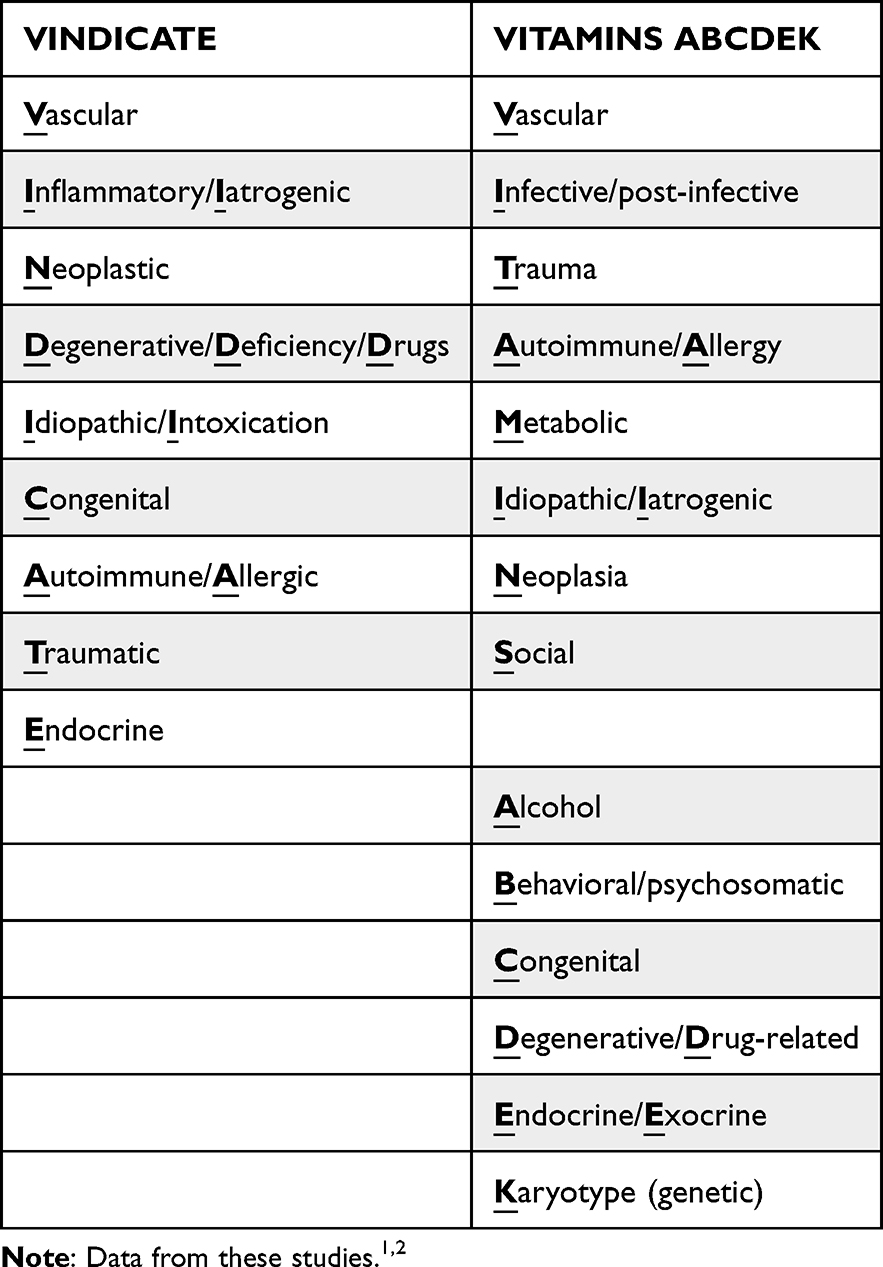 |
Table 2 Traditional Pathophysiology-Based Acronyms, VINDICATE1 and VITAMINS ABCDEK.2 |
Conclusion
IMPASSIVE DICTATING is a pathophysiology-based acronym that improves upon previous pathophysiology mnemonics and presents unique advantages in educational and clinical contexts. We hope that IMPASSIVE DICTATING will offer a systematic and inclusive approach for medical students, educators, and clinicians to generate comprehensive differential diagnoses.
Acknowledgments
The authors report no sources of funding for this work.
Author Contributions
All authors made a significant contribution to the work reported, whether that is in the conception, study design, execution, acquisition of data, analysis and interpretation, or in all these areas; took part in drafting, revising or critically reviewing the article; gave final approval of the version to be published; have agreed on the journal to which the article has been submitted; and agree to be accountable for all aspects of the work.
Disclosure
The authors report no conflicts of interest in this work.
References
1. Amey L, Donald KJ, Teodorczuk A. Teaching clinical reasoning to medical students. Br J Hosp Med. 2017;78(7):399–401. doi:10.12968/hmed.2017.78.7.399
2. Zabidi-Hussin ZA. Practical way of creating differential diagnoses through an expanded VITAMINSABCDEK mnemonic. Adv Med Educ Pract. 2016;7:247–248. doi:10.2147/AMEP.S106507
3. Ferrari AJ, Santomauro DF, Aali A, et al. Global incidence, prevalence, years lived with disability (YLDs), disability-adjusted life-years (DALYs), and healthy life expectancy (HALE) for 371 diseases and injuries in 204 countries and territories and 811 subnational locations, 1990–2021: a systematic analysis for the Global Burden of Disease Study 2021. Lancet. 2024;403(10440):2133–2161. doi:10.1016/S0140-6736(24)00757-8
4. Curtin SC, Tejada-Vera B, Bastian BA. Deaths: Leading Causes for 2021. Available from: https://stacks.cdc.gov/view/cdc/147882.
5. Leeds FS, Atwa KM, Cook AM, Conway KA, Crawford TN. Teaching heuristics and mnemonics to improve generation of differential diagnoses. Med Educ Online. 2020;25(1):1742967. doi:10.1080/10872981.2020.1742967
 © 2025 The Author(s). This work is published and licensed by Dove Medical Press Limited. The
full terms of this license are available at https://www.dovepress.com/terms
and incorporate the Creative Commons Attribution
- Non Commercial (unported, 3.0) License.
By accessing the work you hereby accept the Terms. Non-commercial uses of the work are permitted
without any further permission from Dove Medical Press Limited, provided the work is properly
attributed. For permission for commercial use of this work, please see paragraphs 4.2 and 5 of our Terms.
© 2025 The Author(s). This work is published and licensed by Dove Medical Press Limited. The
full terms of this license are available at https://www.dovepress.com/terms
and incorporate the Creative Commons Attribution
- Non Commercial (unported, 3.0) License.
By accessing the work you hereby accept the Terms. Non-commercial uses of the work are permitted
without any further permission from Dove Medical Press Limited, provided the work is properly
attributed. For permission for commercial use of this work, please see paragraphs 4.2 and 5 of our Terms.