
Back to Journals » Journal of Pain Research » Volume 19
Impact of Combined Epidural–General Anesthesia on Perioperative Recovery After Hepatectomy for Liver Cancer: A Prospective Observational Study
Authors Chen J, Yang D, Ying X 
Received 13 January 2026
Accepted for publication 23 April 2026
Published 23 May 2026 Volume 2026:19 595961
DOI https://doi.org/10.2147/JPR.S595961
Checked for plagiarism Yes
Review by Single anonymous peer review
Peer reviewer comments 2
Editor who approved publication: Dr Jinlei Li
Juhui Chen, Danfeng Yang, Xiaogang Ying
Department of Anesthesiology, Sir Run Run Shaw Hospital, Zhejiang University School of Medicine, Hangzhou, Zhejiang, 310016, People’s Republic of China
Correspondence: Juhui Chen, Sir Run Run Shaw Hospital, Zhejiang University School of Medicine, No. 3 East Qingchun Road, Hangzhou, Zhejiang, 310016, People’s Republic of China, Email [email protected]
Background: Optimizing anesthetic strategies may improve perioperative recovery and cognitive outcomes in patients undergoing hepatectomy. However, evidence comparing general anesthesia (GA) and combined epidural–general anesthesia (GEA) remains limited.
Methods: This prospective observational study included 106 patients undergoing elective hepatectomy, allocated to GA (n = 59) or GEA (n = 47) based on patient preference following standardized anesthetic consultation. Pain was assessed using the Visual Analog Scale (VAS), and cognitive function was evaluated using the Montreal Cognitive Assessment (MoCA) at baseline and postoperative days 1 and 3. Outcome assessors were blinded to group allocation. Intraoperative remifentanil dosage was normalized (μg/kg/min), and group comparisons were performed using appropriate parametric or non-parametric tests.
Results: Compared with the GEA group, the GA group had higher normalized remifentanil requirements (0.308 ± 0.040 vs. 0.294 ± 0.032 μg/kg/min, 95% CI 0.001– 0.028, P = 0.042) and higher postoperative VAS scores at 24 h (median 3 vs. 2, 95% CI 0.61– 0.79, P < 0.001). The GA group also showed lower MoCA scores on postoperative day 1 (median 24 vs. 26, P < 0.001) and longer hospital stay (20.24 ± 3.05 vs. 15.83 ± 1.92 days, P < 0.001). The incidence of adverse events was higher in the GA group (20.34% vs. 6.38%, P = 0.041).
Conclusion: In this prospective observational study, combined epidural–general anesthesia was associated with improved postoperative pain control and early cognitive outcomes. However, given the non-randomized design, causal relationships cannot be established, and further randomized studies are warranted.
Keywords: liver cancer, hepatectomy, anesthesia techniques, postoperative pain, cognitive dysfunction, epidural-general anesthesia
Introduction
Liver cancer remains a major cause of cancer-related morbidity and mortality worldwide, particularly in China.1–3 Surgical resection is the primary curative treatment for early-stage disease.4–6 However, hepatectomy is associated with substantial surgical stress and a high risk of postoperative complications, which may impair recovery and prolong hospitalization.7,8
Postoperative cognitive dysfunction (POCD) is a well-recognized complication after major surgery, characterized by impairments in memory, attention, and executive function.9,10 Previous studies have suggested that perioperative factors such as anesthetic exposure, inadequate analgesia, and systemic inflammatory responses may contribute to the development of POCD.11,12 In particular, accumulating evidence indicates that excessive surgical stress and opioid consumption may exacerbate neuroinflammation and adversely affect cognitive outcomes.13 Previous clinical studies comparing regional and general anesthesia in abdominal surgery have reported heterogeneous findings, with some suggesting improved analgesia and reduced inflammatory response, while others show limited effects on cognitive outcomes.14 Enhanced recovery after surgery (ERAS) pathways have increasingly emphasized the role of optimized analgesia and stress reduction in improving postoperative cognitive and functional outcomes, particularly in major hepatic surgery.
These effects may be mediated through attenuation of neuroinflammation and modulation of the hypothalamic–pituitary–adrenal axis, which are key pathways implicated in postoperative cognitive dysfunction. Anesthetic technique has therefore been proposed as a potentially modifiable factor influencing postoperative recovery. Several clinical and experimental studies have shown that combined epidural–general anesthesia (GEA) may attenuate the surgical stress response, reduce systemic anesthetic and opioid requirements,15 and improve postoperative analgesia compared with general anesthesia (GA) alone.16,17 Furthermore, randomized and observational studies in abdominal and oncologic surgery have suggested that neuraxial techniques may be associated with reduced inflammatory responses and improved early cognitive outcomes.18
However, despite these findings, evidence specifically focusing on hepatectomy remains limited. Existing studies are often heterogeneous in design, with variable outcome measures and insufficient integration of analgesic efficacy, cognitive function, and recovery indicators within a single clinical framework. Moreover, the extent to which improved analgesia translates into better cognitive and overall recovery outcomes in this population remains unclear.
However, existing studies remain heterogeneous in design and often focus on isolated outcomes, limiting a comprehensive understanding of how anesthetic techniques influence integrated perioperative recovery. This study adds prospective observational evidence by integrating perioperative analgesia, cognitive function, and recovery outcomes within a single clinical framework. The study aimed to evaluate the associations between anesthetic technique (GA vs. GEA) and perioperative outcomes, including intraoperative analgesic consumption, postoperative pain trajectory, cognitive function, and recovery indicators, in patients undergoing hepatectomy for liver cancer. We hypothesized that combined epidural–general anesthesia would be associated with improved postoperative pain control, better early cognitive outcomes, and enhanced overall recovery compared with general anesthesia alone.
Materials and Methods
Study Design
This was a single-center prospective observational study conducted at our institution between June and December 2025, including patients undergoing elective radical hepatectomy for liver cancer. Perioperative data, including intraoperative analgesic adequacy, postoperative pain assessed by the Visual Analog Scale (VAS), and cognitive function evaluated using the Montreal Cognitive Assessment (MoCA), were obtained from the electronic medical records system. Cognitive assessments were performed at baseline and on postoperative days 1 and 3 as part of the routine enhanced recovery pathway. Postoperative cognitive dysfunction (POCD) was defined as a ≥2-point decline from the baseline MoCA score, consistent with prior perioperative cognitive studies. Group allocation was based on patient preference following standardized anesthetic consultation, which may introduce selection bias. This definition has been used in prior perioperative cognitive studies but may not fully capture complex neurocognitive changes.
In this study, the common influencing factors for intraoperative pain control, postoperative pain recovery, and cognitive function were considered to be the anesthesia dosage. Based on the predefined study protocol, 106 patients undergoing elective hepatectomy were allocated into two groups according to anesthetic technique undergoing elective liver cancer radical surgery into two groups according to the anesthesia methods used during the surgery: GA Group and GEA Group. The GA Group received propofol + remifentanil + sevoflurane for general anesthesia, while the GEA Group had the same regimen with the addition of an epidural puncture at T7-T9 and continuous injection of 0.25% ropivacaine. The study evaluated the intraoperative remifentanil dose, postoperative VAS scores at various time points, the MoCA scores for cognitive function recovery on postoperative day 1 and day 3, extubation time, hospital stay duration, and the incidence of postoperative adverse events. An exploratory retrospective analysis was conducted solely to inform study design and outcome selection and was not used for inferential conclusions.
Anesthetic group allocation was determined by patient preference following standardized preoperative anesthetic consultation, rather than randomization. Of 128 eligible patients, 22 were excluded before allocation due to ineligibility, withdrawal of consent, or changes in surgical planning. The remaining 106 patients were included in the final analysis, comprising 59 patients in the general anesthesia (GA) group and 47 patients in the combined epidural–general anesthesia (GEA) group. All enrolled patients completed the planned follow-up assessments. Perioperative management, including fluid therapy, hemodynamic targets, and postoperative recovery protocols, followed standardized institutional pathways.
Before the prospective observational study, we conducted an exploratory retrospective analysis which included 80 patients undergoing hepatectomy during a defined period, and variables related to analgesic use, postoperative pain, and cognitive outcomes were descriptively explored. This preliminary analysis was intended solely for hypothesis generation and to inform the design and outcome selection of the subsequent prospective study. Therefore, results from the retrospective cohort are summarized descriptively and are not considered confirmatory evidence.
The sample size was estimated using PASS 15.0 software, based on the primary outcome (postoperative VAS score at 24 h). A clinically significant difference of 1.0 point (SD ≈ 1.5) between groups was assumed from pilot data. With α = 0.05 (two-sided) and 80% power, 48 patients per group were required. Considering a 10% dropout rate, a total of 106 patients were enrolled (59 in GA group, 47 in GEA group, Figure 1). The magnitude of observed differences in pain scores and cognitive outcomes suggests moderate effect sizes, supporting the adequacy of statistical power for primary and key secondary outcomes. Future studies with larger sample sizes are warranted to confirm these findings and to ensure adequate power for secondary endpoints. Given the observational design, multivariable analysis would be valuable. However, due to the limited sample size and event number, we intentionally avoided overfitting. Future studies with larger cohorts will incorporate adjusted models or propensity score methods.
 |
Figure 1 Study flowchart of patient enrollment, group allocation, and outcome assessment. A total of 128 patients scheduled for elective hepatectomy for liver cancer were screened. Twenty-two patients were excluded prior to anesthesia allocation due to declined participation, failure to meet inclusion criteria, or changes in surgical plan. The remaining 106 patients were included and allocated according to anesthetic technique into the general anesthesia (GA) group (n = 59) and the combined epidural–general anesthesia (GEA) group (n = 47). Outcomes assessed included intraoperative remifentanil consumption, postoperative pain evaluated using the Visual Analog Scale (VAS), postoperative cognitive function assessed by the Montreal Cognitive Assessment (MoCA), length of hospital stay, and incidence of postoperative adverse events. |
Participants
All patients were managed perioperatively by the same surgical and anesthetic teams, following a standardized intraoperative and postoperative care protocol to minimize variability. Patients were also evaluated for comorbidities and contraindications to epidural anesthesia, and all participants provided informed consent regarding anesthetic choices.
Inclusion Criteria: Patients aged 18 to 75 years scheduled for elective radical hepatectomy for liver cancer; American Society of Anesthesiologists (ASA) physical status classification I–III; no history of central nervous system disorders.
Exclusion Criteria: Patients were excluded if they experienced massive intraoperative hemorrhage, underwent a change in surgical plan during the operation, or had a prior history of cognitive impairment or psychiatric illness.
Anesthesia Protocol
In the GA group (n = 59), patients received combined intravenous-inhalation general anesthesia. Anesthesia induction consisted of intravenous propofol (1.5–2.0 mg/kg) and remifentanil (1–2 μg/kg administered over 30–60 seconds). Maintenance was achieved with sevoflurane at 0.8–1.2 MAC in a 50% oxygen/air mixture with a total gas flow of 2 L/min, supplemented with continuous remifentanil infusion (0.05–0.2 μg/kg/min) titrated to maintain hemodynamic stability; anesthetic depth was monitored with BIS (target 40–60).
In the GEA group, an epidural catheter was placed preoperatively at the T7–T9 interspace using a midline approach under strict aseptic conditions. Following catheter placement, sensory block was assessed every 5 minutes using cold sensation and pinprick tests. Adequate block was defined as loss of cold sensation and dull pinprick response covering the T6–T10 dermatomes bilaterally before surgical incision. A bolus of 0.25% ropivacaine (5–7 mL) was administered via the epidural catheter to establish initial block, followed by a continuous infusion of 0.25% ropivacaine at 4–6 mL/h throughout the surgery for segmental analgesia. This infusion rate was adjusted according to hemodynamic stability and surgical stimuli. All patients concurrently received the same general anesthesia protocol as the GA group, consisting of propofol (1.5–2.0 mg/kg) and remifentanil (1–2 μg/kg) for induction and sevoflurane maintenance at 0.8–1.2 MAC with 50% oxygen/air mixture. Remifentanil infusion during maintenance was titrated (0.05–0.3 μg/kg/min in our center, some cases required higher infusion rates due to surgical complexity.) to maintain hemodynamic stability and bispectral index (BIS) values between 40–60. Continuous monitoring of invasive arterial pressure, ECG, pulse oximetry, and BIS was performed. Adjustments in epidural infusion or general anesthetics were made in response to changes in heart rate, blood pressure, and autonomic signs to ensure adequate analgesia and anesthetic depth.
Postoperative Analgesia
According to international guidelines and ERAS (Enhanced Recovery After Surgery) recommendations, epidural analgesia (EA) remains the gold standard for open hepatectomy. In this study, all patients received postoperative thoracic epidural analgesia with a continuous infusion of 0.125–0.2% ropivacaine combined with sufentanil (0.5–1.0 µg/mL), initiated before emergence from anesthesia and continued for 48–72 hours. The basal infusion rate was 4–6 mL/h, with a patient-controlled bolus of 2 mL and a lockout interval of 20 minutes.
This regimen was designed to provide effective pain relief in the early postoperative period, aiming to maintain VAS scores ≤3 at rest and ≤4–5 during mobilization, in line with current ERAS protocols for liver surgery.
Outcome Measures
Demographic and clinical characteristics were collected for all participants, including age, sex, body mass index (BMI), and history of smoking and alcohol consumption. Intraoperative parameters included the type and total dosage of anesthetic agents administered, the duration of surgery measured in minutes, estimated intraoperative blood loss in milliliters, and the use of abdominal retractors.
Postoperative outcomes were assessed through multiple dimensions. VAS at 2, 6, 12, 24, and 48 hours after surgery to evaluate the effectiveness of analgesia. Cognitive function was assessed with the Montreal Cognitive Assessment (MoCA), which was recorded at baseline prior to surgery and then reassessed on the first and third postoperative days to monitor changes in cognitive status. Length of hospital stay was recorded as the number of days from the end of surgery to patient discharge, reflecting recovery speed.
Adverse Reactions
Postoperative adverse reactions were systematically recorded during the first 72 hours post-surgery, including: the incidence of postoperative adverse events, including nausea, vomiting, delirium, and other complications, was carefully monitored and documented.
Nausea and vomiting (PONV): any episode requiring antiemetic treatment;
Delirium: assessed using the Confusion Assessment Method (CAM);
Respiratory depression: respiratory rate < 8/min or SpO2 < 90% requiring intervention;
Hypotension: systolic blood pressure drop > 20% from baseline requiring vasopressors.
Monitoring was conducted by trained nursing staff blinded to anesthesia type, and all events were reviewed by the attending anesthesiologist for confirmation.
Pain and cognitive outcomes were evaluated by two trained anesthesiology residents blinded to group allocation and not involved in intraoperative care. This blinding minimized assessment bias.
Postoperative Pain Recovery Evaluation
Postoperative pain recovery was evaluated using the VAS on the third postoperative day. Based on the assessment results, patients were classified into two groups. Those with a VAS score of less than 3 and without the need for additional analgesic medication were considered to have good pain recovery. In contrast, patients with a VAS score equal to or greater than 3, or who required additional analgesia to achieve adequate pain relief, were categorized as having delayed pain recovery.
The VAS is a 10-centimeter horizontal line used to quantify subjective pain intensity. The left end represents “no pain” corresponding to 0 centimeters, while the right end indicates “worst imaginable pain” corresponding to 10 centimeters. Patients were asked to place a mark on the line that best reflected the intensity of their current pain. The final score was obtained by measuring the distance in centimeters from the left end of the line to the point marked by the patient.
Pain intensity was graded based on VAS scores, with lower scores indicating milder pain and higher scores reflecting more severe pain.19–21
Postoperative Cognitive Dysfunction (POCD)
Cognitive function was evaluated using the MoCA tool. A score of ≥26 was considered normal, while a score <26 indicated possible mild cognitive impairment, consistent with prior perioperative cognitive studies.22
Statistical Analysis
Statistical analysis was performed using SPSS version 26.0. The normality of continuous variables was tested using the Kolmogorov–Smirnov and Shapiro–Wilk tests. Continuous variables following a normal distribution were presented as mean ± standard deviation and compared using independent samples t-tests. Non-normally distributed data were expressed as median and interquartile range (IQR), and group comparisons were conducted using the Mann–Whitney U-test. Categorical variables were presented as percentages (%) and compared using the chi-square test. A P-value < 0.05 was considered statistically significant. Body weight was estimated from BMI using a standardized height (1.65 m), and intraoperative remifentanil dosage was normalized as μg/kg/min for analysis. Effect sizes were interpreted alongside P values where appropriate.
Ethical Approval and Consent
This study was approved by the Human Ethics Committee of Sir Run Run Shaw Hospital, Zhejiang University School of Medicine (Approval No. 2025–0355). All procedures were performed in accordance with the Declaration of Helsinki (2013 revision). Written informed consent was obtained from all participants prior to enrollment.
Results
Overview of Study Outcomes
A total of 106 patients undergoing elective hepatectomy were included and allocated into two groups according to anesthetic technique (GA group and GEA group). Key perioperative outcomes were evaluated, including intraoperative remifentanil consumption, postoperative pain scores (VAS), cognitive function (MoCA), hospital stay duration, and incidence of postoperative adverse events. No major adverse events occurred during the study period. (Figure 1).
Comparison of Baseline Data Between the Two Groups
A total of 106 patients were included in the study, with 59 in the GA group and 47 in the GEA group. Baseline demographic and clinical characteristics were comparable between the two groups, with no significant differences in age, BMI, sex distribution, smoking status, or alcohol consumption (all P > 0.05).
Similarly, surgical parameters, including operative duration, intraoperative blood loss, and the use of rib-spreader or auxiliary instruments, did not differ significantly between groups (all P > 0.05) (Table 1).
 |
Table 1 Analysis of Intraoperative Parameters in Patients Undergoing Different Anesthesia Techniques (Baseline Data) |
Impact of Different Anesthesia Techniques on Perioperative Outcomes
Intraoperative parameters, hospital stay, and adverse events are summarized in Table 2. The GA group had higher normalized intraoperative remifentanil requirements than the GEA group (95% CI 0.001–0.028 μg/kg/min, P = 0.042), As shown in Figure 2A, the intraoperative remifentanil dose was significantly lower in the GEA group compared with the GA group (P < 0.001). The length of hospital stay was also significantly longer in the GA group (95% CI 3.42–5.31 days, P < 0.001, Figure 2B).
 |
Table 2 Comparison of Perioperative Outcomes Between GA and GEA in Patients Undergoing Hepatectomy for Liver Cancer |
 |
Figure 2 Comparison of intraoperative remifentanil dosage and length of hospital stay between groups. (A) Intraoperative remifentanil dosage in patients receiving general anesthesia (GA, n = 59) and combined epidural–general anesthesia (GEA, n = 47). (B) Length of hospital stay in the GA and GEA groups. Data are presented as mean ± standard deviation (SD). Error bars indicate SD. Between-group comparisons were performed using independent samples t-tests. ***P < 0.001. |
Postoperative adverse events occurred more frequently in the GA group (20.34% vs. 6.38%, P = 0.041), with delirium, hypotension, and nausea/vomiting being the most commonly observed complications (Table 2). In the GA group, adverse events included delirium (n = 5), hypotension (n = 4), and nausea/vomiting (n = 3), whereas in the GEA group, each event type occurred in one patient (n = 1 for each).
Impact of Different Anesthesia Techniques on Postoperative VAS Scores
VAS scores at 2, 6, 12, 24, and 48 hours after surgery were significantly lower in the GEA group than in the GA group (all P < 0.05). Median VAS scores at rest were ≤3 in both groups within the first 48 hours (Table 3 and Figure 3). VAS scores at 24 hours were higher in the GA group (mean difference: 0.70, 95% CI 0.61–0.79, P < 0.001).
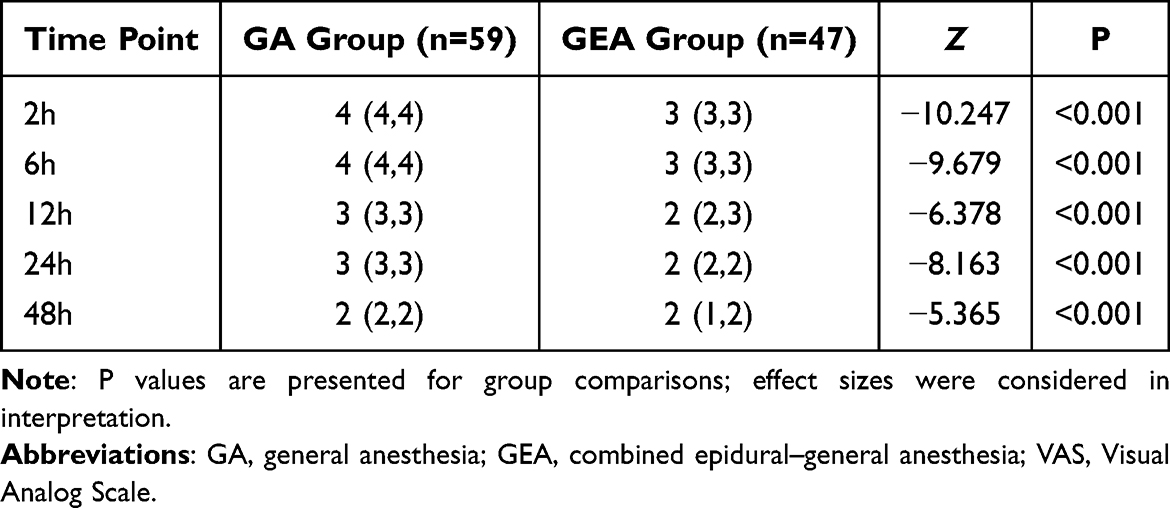 |
Table 3 Comparison of Postoperative VAS Scores at Different Time Points Between GA and GEA Groups |
 |
Figure 3 Postoperative Visual Analog Scale (VAS) scores over time. Scatter plots represent individual patient VAS scores at 2, 6, 12, 24, and 48 hours after surgery in the GA group (n = 59) and the GEA group (n = 47). Solid lines indicate group mean values, and error bars represent standard deviation. Between-group comparisons at each time point were performed using the Mann–Whitney U-test. |
Impact of Different Anesthesia Techniques on MoCA Scores
Preoperative MoCA scores were comparable between the two groups (P = 0.128). On postoperative day 1, MoCA scores were significantly lower in the GA group than in the GEA group (95% CI −2.12 to −1.16, P < 0.001). This difference persisted on postoperative day 3 (P = 0.021) (Table 4 and Figure 4).
 |
Table 4 Comparison of MoCA Scores Before and After Surgery Between GA and GEA Groups |
 |
Figure 4 Changes in Montreal Cognitive Assessment (MoCA) scores before and after surgery. Scatter plots show individual patient MoCA scores at baseline, postoperative day 1, and postoperative day 3 in the GA group (n = 59) and the GEA group (n = 47). Solid lines represent group mean values. Between-group comparisons were performed using the Mann–Whitney U-test. |
Correlation Analysis
Spearman correlation analysis demonstrated that intraoperative remifentanil dosage was negatively correlated with postoperative MoCA scores on postoperative day 1 (r = −0.247, P = 0.011). In addition, remifentanil dosage was positively correlated with postoperative VAS scores at 24 hours (r = 0.209, P = 0.032) (Figure 5).
 |
Figure 5 Correlation between intraoperative remifentanil dosage and postoperative outcomes. (A) Scatter plot showing the correlation between intraoperative remifentanil dosage and postoperative VAS scores at 24 hours. (B) Scatter plot showing the correlation between intraoperative remifentanil dosage and postoperative MoCA scores on postoperative day 1. Correlation analyses were performed using Spearman correlation coefficients. Lines represent fitted regression trends. |
Discussion
In this prospective observational study, combined epidural–general anesthesia (GEA) was associated with reduced intraoperative remifentanil requirements, improved postoperative pain control, better early postoperative cognitive function, shorter hospital stay, and a lower incidence of adverse events compared with general anesthesia (GA) alone. These findings suggest that anesthetic technique may influence perioperative recovery following hepatectomy.
The observed differences in postoperative pain are consistent with previous studies demonstrating that neuraxial techniques can enhance analgesia and reduce systemic opioid requirements. In the present study, VAS scores were consistently lower in the GEA group across multiple postoperative time points, although pain levels in both groups remained generally low.
Regarding cognitive outcomes, previous studies have indicated that postoperative cognitive dysfunction (POCD) may be closely related to intraoperative anesthetic exposure, inflammatory responses, and inadequate pain control.9,23–25 In the present study, MoCA scores on postoperative days 1 and 3 were lower in the GA group, supporting a potential association between anesthetic technique and early postoperative cognitive function.26–28 However, given the observational design, these findings should be interpreted as associative rather than causal.
The adverse events observed in this study, including delirium, hypotension, and nausea/vomiting, are commonly reported complications following major abdominal surgery. Although the types of adverse events were similar between groups, their incidence was lower in the GEA group, suggesting a potential benefit of combined anesthesia in perioperative safety.
The mechanisms underlying these observations remain unclear. Epidural anesthesia may reduce afferent nociceptive input and decrease systemic opioid exposure, thereby attenuating activation of the hypothalamic–pituitary–adrenal axis and inflammatory pathways. This may lead to reduced perioperative cortisol and catecholamine release and decreased production of pro-inflammatory cytokines such as IL-6 and TNF-α, which have been implicated in the pathogenesis of POCD.13,29 Previous studies in abdominal and cardiac surgery have similarly demonstrated that neuraxial techniques are associated with attenuated inflammatory responses and improved postoperative outcomes.30,31 However, as inflammatory or neurobiological markers were not measured in this study, these mechanisms remain speculative.
The observed correlations between remifentanil dosage and postoperative outcomes may reflect differences in surgical stimulation and analgesic requirements rather than a direct causal relationship. Higher intraoperative opioid requirements may indicate greater nociceptive stress, which could be associated with both increased postoperative pain and poorer early cognitive recovery.
From a clinical perspective, although the differences in VAS and MoCA scores were modest, they may still be meaningful. Improved early pain control and cognitive recovery may facilitate mobilization, enhance postoperative recovery pathways, and potentially shorten hospital stay, particularly in elderly or high-risk patients.
Our findings are consistent with recent evidence supporting the benefits of combined epidural–general anesthesia. A meta-analysis demonstrated that EA+GA significantly reduced perioperative inflammatory markers, including IL-6, TNF-α, CRP, and cortisol.15 A prospective clinical study in hepatectomy patients also showed improved analgesia and reduced opioid consumption with combined anesthesia.32 Additionally, randomized controlled trials in elderly liver cancer patients reported reduced POCD incidence and improved stress response profiles with GEA compared with GA alone.25 These findings support the hypothesis that optimizing perioperative analgesia may contribute to improved early recovery profiles.
Several limitations should be acknowledged. First, the non-randomized design and patient-preference–based allocation may introduce selection bias. All procedures were performed by the same surgical team following standardized protocols, which may partially mitigate variability related to surgical type. Second, this was a single-center study with a relatively limited sample size. Although statistically significant, the difference in remifentanil dosage was relatively small, and its clinical relevance should be interpreted with caution. Third, cognitive assessment relied on MoCA, which may not fully capture the complexity of postoperative cognitive dysfunction. Fourth, important perioperative variables, including fluid management and hemodynamic fluctuations, were not systematically recorded. Although these parameters were not quantitatively recorded, intraoperative hemodynamics were continuously monitored and maintained within clinically acceptable ranges according to institutional protocols. In addition, residual confounding cannot be excluded due to the lack of multivariate adjustment. The sample size was calculated based on pain outcomes and may be underpowered for secondary endpoints such as adverse events. Therefore, residual confounding and selection bias cannot be fully excluded.
Few studies have prospectively integrated analgesic efficacy, cognitive function, and recovery outcomes within a unified framework in hepatectomy patients. Future studies should include larger, multicenter cohorts and incorporate objective measures of intraoperative stress and inflammatory responses. Randomized controlled trials are required to further clarify the relationship between anesthetic technique and postoperative cognitive function and recovery outcomes.
Conclusion
In this prospective observational study of patients undergoing hepatectomy for liver cancer, combined epidural–general anesthesia (GEA) was associated with lower intraoperative opioid requirements, improved postoperative pain control, better early cognitive outcomes, shorter hospital stay, and a reduced incidence of adverse events compared with general anesthesia (GA) alone. These findings suggest that anesthetic technique may be an important factor influencing perioperative recovery and may have implications for optimizing perioperative analgesic strategies in major abdominal surgery.
However, given the non-randomized observational design, these findings should be interpreted as associative rather than causal. Several limitations should be considered, including potential selection bias, single-center design, and the use of simplified cognitive assessment tools. In addition, the generalizability of these findings to other surgical populations or minimally invasive procedures may be limited. Further randomized controlled studies are warranted to validate these associations and to clarify the underlying mechanisms.
Data Sharing Statement
The data used and/or analyzed during the current study are available from the corresponding author.
Human Ethics and Consent to Participate Declarations
This study was approved by the Human Ethics Committee of Sir Run Run Shaw Hospital, Zhejiang University School of Medicine (Ethics Approval Number: 2025-0355). All procedures performed in studies involving human participants were in accordance with the ethical standards of the institutional and/or national research committee and with the 1964 Helsinki declaration and its later amendments or comparable ethical standards. Informed consent was obtained from all individual participants included in the study.
Consent to Publish Declaration
All participants agreed to publish.
Author Contributions
All authors made a significant contribution to the work reported, whether that is in the conception, study design, execution, acquisition of data, analysis and interpretation, or in all these areas; took part in drafting, revising or critically reviewing the article; gave final approval of the version to be published; have agreed on the journal to which the article has been submitted; and agree to be accountable for all aspects of the work.
Funding
There is no fund support from any institution or individual for this research.
Disclosure
The authors declare no conflicts of interest in this work.
References
1. Joliat GR, Kobayashi K, Hasegawa K, et al. Guidelines for perioperative care for liver surgery: enhanced Recovery After Surgery (ERAS) society recommendations 2022. World J Surg. 2023;47(1):11–13. doi:10.1007/s00268-022-06732-5
2. Tan EY, Danpanichkul P, Yong JN, et al. Liver cancer in 2021: global burden of disease study. J Hepatol. 2025;82(5):851–860. doi:10.1016/j.jhep.2024.10.031
3. Cao MD, Wang H, Shi JF, et al. Disease burden of liver cancer in China: an updated and integrated analysis on multi-data source evidence. Zhonghua Liu Xing Bing Xue Za Zhi. 2020;41(11):1848–1858. doi:10.3760/cma.j.cn112338-20200306-00271
4. Maki H, Hasegawa K. Advances in the surgical treatment of liver cancer. Biosci Trends. 2022;16(3):178–188. doi:10.5582/bst.2022.01245
5. Wei J, Zhang H, Zhong J, et al. Fluorescent laparoscopic central hepatectomy for liver cancer using indocyanine green negative staining. J Vis Exp. 2023:e64869.
6. European Association For The Study Of The Liver. European association for the study of the L. EASL clinical practice guidelines on the management of hepatocellular carcinoma. J Hepatol. 2025;82(2):315–374. doi:10.1016/j.jhep.2024.08.028
7. Liu S, Wu Z, Wang C, et al. Prognosis predictors of hepatocellular carcinoma after hepatectomy following conversion therapy. Eur J Surg Oncol. 2025;51(1):109375. doi:10.1016/j.ejso.2024.109375
8. Zhang YJ, Chen J, Zhou Z, et al. Transarterial chemoembolization with radiofrequency ablation versus surgical resection for small late-recurrence hepatocellular carcinoma. Radiology. 2025;314(2):e241096. doi:10.1148/radiol.241096
9. Meng Z, Gao C, Li X, et al. Effects of combined epidural anesthesia and general anesthesia on cognitive function and stress responses of elderly patients undergoing liver cancer surgery. J Oncol. 2021;2021(8273722):1–5. doi:10.1155/2021/8273722
10. Suraarunsumrit P, Srinonprasert V, Kongmalai T, et al. Outcomes associated with postoperative cognitive dysfunction: a systematic review and meta-analysis. Age Ageing. 2024;53(7). doi:10.1093/ageing/afae160
11. Varpaei HA, Farhadi K, Mohammadi M, et al. Postoperative cognitive dysfunction: a concept analysis. Aging Clin Exp Res. 2024;36(1):133. doi:10.1007/s40520-024-02779-7
12. Travers R, Gagliardi G, Ramseyer M. Delirium management in perioperative geriatric services: a narrative review of non-pharmaceutical strategies. Front Psychiatry. 2024;15(1394583). doi:10.3389/fpsyt.2024.1394583
13. Wei X, Xing F, Xu Y, et al. Preoperative gut microbiota of POCD patients induces pre- and postoperative cognitive impairment and systemic inflammation in rats. J Neuroinflammation. 2024;21(1):221. doi:10.1186/s12974-024-03220-6
14. Suga M, Yasuhara J, Watanabe A, et al. Postoperative delirium under general anaesthesia by remimazolam versus propofol: a systematic review and meta-analysis of randomised controlled trials. J Clin Anesth. 2025;101(111735):111735. doi:10.1016/j.jclinane.2024.111735
15. Lin EJ, Prost S, Lin HJ, et al. Combined general/epidural anesthesia vs. general anesthesia on postoperative cytokines: a review and meta-analysis. Cancers. 2025;17(10):1667. doi:10.3390/cancers17101667
16. Monsel A, Sitbon A, Roux C, et al. Current insights into anaesthesia and critical care management of patients with hepatocellular carcinoma: multifaceted implications for the anaesthesiologist and intensive care physician. Eur J Anaesthesiol. 2025;42(5):435–448. doi:10.1097/EJA.0000000000002141
17. Lu H, Zhao X, Lu WJ, et al. Erector spinae plane block for pain management in hepatocellular carcinoma patients undergoing laparoscopic left hemihepatectomy: a retrospective propensity score-matched study. Surg Laparosc Endosc Percutan Tech. 2025;35(1). doi:10.1097/SLE.0000000000001344
18. Long Y, Li X, Tong C, et al. Combined epidural-general anesthesia is associated with increased postoperative complications in patients receiving neoadjuvant chemotherapy followed by gastrointestinal radical surgery: a propensity score weighting study. J Invest Surg. 2026;39(1):2611441. doi:10.1080/08941939.2025.2611441
19. Hjermstad MJ, Fayers PM, Haugen DF, et al. Studies comparing numerical rating scales, verbal rating scales, and visual analogue scales for assessment of pain intensity in adults: a systematic literature review. J Pain Symptom Manage. 2011;41(6):1073–1093. doi:10.1016/j.jpainsymman.2010.08.016
20. Heller GZ, Manuguerra M, Chow R. How to analyze the visual analogue scale: myths, truths and clinical relevance. Scand J Pain. 2016;13:67–75. doi:10.1016/j.sjpain.2016.06.012
21. Yang Y, Chen S, Yan Z, et al. Construction and validation of prediction model of severe abdominal pain post-transarterial chemoembolization in patients with HBV-associated primary liver cancer. Comput Math Methods Med. 2022;2022(5203166):1–6. doi:10.1155/2022/5203166
22. Jia X, Wang Z, Huang F, et al. A comparison of the Mini-Mental State Examination (MMSE) with the Montreal Cognitive Assessment (MoCA) for mild cognitive impairment screening in Chinese middle-aged and older population: a cross-sectional study. BMC Psychiatry. 2021;21(1):485. doi:10.1186/s12888-021-03495-6
23. Apisutimaitri K, Saeyup P, Suppipat K, et al. Effects of propofol-based total intravenous anesthesia versus desflurane anesthesia on natural killer cell cytotoxicity after hepatocellular carcinoma resection. J Anaesthesiol Clin Pharmacol. 2024;40(3):395–402. doi:10.4103/joacp.joacp_174_23
24. Kimura S, Sone M, Sugawara S, et al. Safety of propofol sedation administered by interventional radiologists for radiofrequency ablation in patients with hepatocellular carcinoma. Jpn J Radiol. 2024;42(11):1290–1297. doi:10.1007/s11604-024-01615-2
25. Su Y, Pu Y, Zhao Z, et al. Influence of combined epidural anesthesia on cognitive function, inflammation and stress response in elderly liver cancer patients undergoing surgery. Oncol Lett. 2020;19(4):2733–2738. doi:10.3892/ol.2020.11395
26. Kwon JH, Kim J, Yeo H, et al. Recurrence-free survival after hepatectomy using propofol-based total intravenous anaesthesia and sevoflurane-based inhalational anaesthesia: a randomised controlled study. Anaesthesia. 2025;80(4):366–377. doi:10.1111/anae.16488
27. Bell R, Pandanaboyana S, Prasad KR. Epidural versus local anaesthetic infiltration via wound catheters in open liver resection: a meta-analysis. ANZ J Surg. 2015;85(1–2):16–21. doi:10.1111/ans.12683
28. Xu Y, Sun Y, Chen H, et al. Effects of two different anesthetic methods on cellular immunity of patients after liver cancer resection. J Biol Regul Homeost Agents. 2016;30(4):1099–1106.
29. Singh N, Kanaujia SK, Singh MK, et al. Effect of virtual reality glasses and melody on cortisol and adrenocorticotropic hormone levels in patients with knee replacement surgery under combined spinal epidural anaesthesia. Cureus. 2024;16(6):e63017. doi:10.7759/cureus.63017
30. Wu Q, Jia XY, Zhang SH, et al. Metformin activates the PI3K/AKT/BDNF axis to attenuate postoperative cognitive dysfunction. Neuropharmacology. 2025;265(110262):110262. doi:10.1016/j.neuropharm.2024.110262
31. Gan L, Qian K, Yang J, et al. Intraoperative transcutaneous electrical acupoint stimulation combined with anesthesia to prevent postoperative cognitive dysfunction: a systematic review and meta-analysis. PLoS One. 2025;20(1):e0313622. doi:10.1371/journal.pone.0313622
32. Zhang Y, Lu J, Qin M, et al. Effects of different anesthesia methods on postoperative immune function in patients undergoing gastrointestinal tumor resection. Sci Rep. 2023;13(1):243. doi:10.1038/s41598-023-27499-2
 © 2026 The Author(s). This work is published and licensed by Dove Medical Press Limited. The
full terms of this license are available at https://www.dovepress.com/terms
and incorporate the Creative Commons Attribution
- Non Commercial (unported, 4.0) License.
By accessing the work you hereby accept the Terms. Non-commercial uses of the work are permitted
without any further permission from Dove Medical Press Limited, provided the work is properly
attributed. For permission for commercial use of this work, please see paragraphs 4.2 and 5 of our Terms.
© 2026 The Author(s). This work is published and licensed by Dove Medical Press Limited. The
full terms of this license are available at https://www.dovepress.com/terms
and incorporate the Creative Commons Attribution
- Non Commercial (unported, 4.0) License.
By accessing the work you hereby accept the Terms. Non-commercial uses of the work are permitted
without any further permission from Dove Medical Press Limited, provided the work is properly
attributed. For permission for commercial use of this work, please see paragraphs 4.2 and 5 of our Terms.
Recommended articles
Construction of Pain Management Strategies After Hepatectomy: Evidence Summary and Delphi Study
Wang Y, Song X, Wang S, Bai T, Li R, Liu H, Liu Y, Han Z
Journal of Pain Research 2024, 17:4541-4559
Published Date: 27 December 2024
Effect of the Evidence-Based and Multidisciplinary Pain Management Program in Patients After Laparoscopic Hepatectomy: A Quasi-Experimental Study
Song X, Liu Y, Zou J, Zhang D, Bai T, Han Z, Wang Y
Journal of Pain Research 2026, 19:582027
Published Date: 24 February 2026