
Back to Journals » Clinical Pharmacology: Advances and Applications » Volume 18
Hybrid Hydrogels in Pain Management Application: A Comprehensive Review
Authors Soorya Y, Abubakar BA, Karzoun Z, Brandt W, Viswanath O, Bernhardt BE, Shekoohi S  , Kaye AD
Received 25 November 2025
Accepted for publication 13 March 2026
Published 16 March 2026 Volume 2026:18 577931
DOI https://doi.org/10.2147/CPAA.S577931
Checked for plagiarism Yes
Review by Single anonymous peer review
Peer reviewer comments 3
Editor who approved publication: Dr Khaled Deeb
Yusra Soorya,1 Bushirat A Abubakar,1 Zack Karzoun,1 William Brandt,2 Omar Viswanath,3 Brian E Bernhardt,2 Sahar Shekoohi,2 Alan D Kaye2
1School of Medicine, Louisiana State University Health Sciences Center at Shreveport, Shreveport, LA, 71103, USA; 2Department of Anesthesiology, Louisiana State University Health Sciences Center at Shreveport, Shreveport, LA, 71103, USA; 3Department of Anesthesiology, Creighton University School of Medicine, Phoenix, AZ, USA
Correspondence: Sahar Shekoohi, Email [email protected]
Abstract: Hydrogels are widely used in clinical medicine for drug delivery and tissue repair; however, they exhibit limited mechanical strength, suboptimal degradation profiles, and variable biocompatibility. In order to address inherent shortcomings in conventional hydrogels, hybrid hydrogels were engineered by incorporating nanoparticles, bioactive materials, and polymer networks. This review explores the use of hybrid hydrogels in pain management, specifically emphasizing their localized and sustained drug delivery, their modulation of inflammation, and their regenerative effects on tissue. Hybrid hydrogels allow for targeted delivery of analgesics, NSAIDs, and biologics to localized tissues therefore reducing systemic exposure and toxicity. Their tunable release makes them responsive to physiological cues like body pH, temperature, and enzymatic activity which makes them tailored to the environment they are in. In addition to their multifunctional pharmacological application, hybrid hydrogels exhibit regenerative properties that can be used to repair tissues in a safe and effective manner. Despite the advantages of hybrid hydrogels, there are limitations in their biodegradation variability, potential cytotoxicity, and reproducibility for regulation into clinical use. Current and continued research is needed to optimize hybrid hydrogel formulations to address these limitations while maintaining the many benefits they provide. In conclusion, hybrid hydrogels are a promising medium for pain management by integrating advantageous aspects of conventional hydrogels while incorporating localized drug delivery, anti-inflammatory therapy, and regenerative capabilities, however, further research is needed to validate its adoption into clinical use.
Keywords: hybrid hydrogels, pain management, analgesics, regenerative medicine
Introduction
The efficacy of pain control in postoperative patient recovery is critical. Inadequate pain management can delay rehabilitation, prolong hospitalization, and increase the likelihood of patients developing chronic pain syndromes.1 Traditionally, pain management applications rely heavily on system analgesics, specifically opioids. This remains a clinical concern because opioid exposure in postoperative care has the risk of leading to persistent opioid use.2 Recent analyses indicate that roughly 5% to 58% of patients have chronic postsurgical pain that requires long term pain management, and that 2% to 65% of patients have persistent opioid use 3 to 12 months postoperatively.3 This underscores the clinical challenge of current pain management strategies and that there is a need for effective, localized, and sustained forms of analgesia while minimizing the risk for opioid dependence and toxicity.
Conventional approaches to pain management rely on oral, intravenous, and intramuscular routes, all of which deliver medication systemically. However, these methods of administration often achieve only suboptimal therapeutic concentrations of pain medication at the target site. Not to mention systemic side effects such as gastrointestinal irritation, renal dysfunction, and opioid dependence.4 In this regard, there is a growing interest in the development of alternative methods to deliver analgesics and anti-inflammatory agents that rely on localization and sustained release vehicles. Hydrogels are an example of one of these vehicles of administration, which have gained attention for their versatility, as biomaterials capable of improving safety and efficacy in pain management applications.
Hydrogels are hydrophilic, three-dimensional polymeric networks that are able to maintain their structural integrity while absorbing and releasing water and/or biological fluids.5 The unique characteristics of hydrogels, like their viscoelastic and porous structure, allow them to hold and gradually release therapeutic agents, which makes them highly desirable for localized drug delivery. In pain management, hydrogels can be tailored to specific therapeutic agents such as NSAIDs, corticosteroids, analgesics, and local anesthetics while minimizing adverse effects and repeated dosing. A major advantage hydrogels have is their biocompatibility and tunable degradation profiles, which make them temporary vehicles of drug administration that align with the healing timelines of postoperative tissues. However, conventional hydrogels have limitations in their mechanical stability, their responses to physiological stimuli, and their sometimes unpredictable degradation kinetics.6
As a result of limitations within hydrogels, hybrid hydrogels were developed, which integrate natural and synthetic polymers, and in some cases nanomaterials, to provide a more promising drug administration method. In this review, “hybrid” hydrogels are used to describe the multifunctional hydrogels that incorporate additional structural and bioactive components. Meanwhile, “nanocomposite” hydrogels refer to a subset of hybrid hydrogels that contain nanoscale fillers, therefore making these terms not interchangeable. Hybrid hydrogels are engineered to combine the biocompatibility of conventional hydrogels while also having enhanced structural strength, tunable drug release, and responsiveness to physiological stimuli.7 The incorporation of nanomaterials like silica nanoparticles, graphene oxide, or metallic ion enables the fine-tuning of mechanical and functional performance. Ultimately, this allows for precise and sustained analgesic delivery compared to conventional hydrogels. Additionally, it is worth noting that hybrid hydrogels respond to physiological triggers such as pH, temperature, and enzymatic activity, which traditional hydrogels lack.8
When comparing hybrid hydrogels to other emerging vehicles of drug delivery, like microspheres and liposomes, the hybrid hydrogels remain supreme. Microspheres and liposomes can reliably control drug release; however, they have limited loading capacity, rapid clearance, restricted localization, and risk of the burst release phenomena. In contrast, hybrid hydrogels are locally applied to the target site and form in situ depots, ensuring their targeted delivery while also providing structural integrity and modulating inflammation.9 Beyond drug delivery, hybrid hydrogels also promote tissue regeneration by providing structural support and encourage cell proliferation for healing, therefore providing long-term pain resolution.10
Hybrid hydrogels, therefore, present a promising frontier in alternative forms of drug delivery in pain management applications, given their ability to deliver therapeutics, modulate inflammation, and support tissue repair. The purpose of this narrative review will be to examine the current innovations in hydrogel-based systems, specifically focusing on hybrid hydrogels for postoperative and musculoskeletal pain applications. This review explores the structural and functional principles that dictate hydrogel design, follows the evolution from conventional to hybrid hydrogel systems, and evaluates their emerging application in drug delivery, anti-inflammatory therapy, and regenerative pain management. Ultimately, this review aims to investigate the potential of hybrid hydrogels as safe, effective, and sustained alternatives to conventional pain management strategies.
Section 1: Types of Hydrogels
Hydrogels are semi-solid compounds that are capable of self-repair if damaged through the fluidity of the compounds to break and reform, which revolves around their dynamic covalent bonds. One study explored five different synthesis reaction used five different synthesis reactions used to create hydrogels and delved into their bond dynamic efficacy their bond dynamics and effectiveness.11 These reactions were Schiff base, Borate ester, Diels-alder, disulfide, and dynamic noncovalent interactions (such as Hydrogen, ion, host-guest, and hydrophobic bonds). Furthermore, the stability and self-healing abilities of hydrogels are directly proportional to the number and strength of the chemical bonds used in the synthesis of the gel. This section summarizes and compares these dynamic bonding mechanisms.
Section 1.1 Schiff-Base Hydrogels
Schiff base hydrogels utilize the reaction of an Amino carbon (Amine, acyl hydrazine, Oxime, etc.) with an aldehyde to generate an imine (Schiff base) which is a double nitrogen-carbon compound double-bonded carbon–nitrogen structure (imine) (Schiff). This reaction under dynamic equilibria conditions can reverse back to amine and aldehyde through hydrolysis and vice versa. This reversibility allows Schiff-base hydrogels to supply a strong covalent bond making it excellent for retaining their shape. An ε-poly(L-lysine) carbon dot (PL-CD) is a long-chain carbon-nitrogen compound that is cross-linked using a Schiff base with an oxidized sugar (dextran-ODA) to generate a hydrogel that is not only excellent at self-repair but also contains antimicrobial properties. In a study, after 10 minutes of hydrogel contact with a bacterial dish coated with Staphylococcus aureus, 10% CFU/mL of 107 were killed. Additionally, when 1000% of shear stress is applied to the hydrogel, it was shown to regenerate fully within seconds. In another study, a different Schiff-based hydrogel was used and turned into an injectable form utilizing Tetramer-grafted-4-4formylbenzoic acid (Dex-AT-FA) and N-carboxyethyl chitosan (CECS).12 This was shown to provide enhanced electrical conductivity. Finally, the increased number of these interactions formed by Schiff-based bonding provides not only great force resistance and versatility but also allows cells to continue to thrive even if they are encapsulated by the gel. Clinically, the dynamic behavior of Schiff-base hydrogels supports their injectability and shape adaptability, which are essential for application within joints and irregular tissue sites.
Section 1.2 Borate Ester Bonds within Hydrogels
Boronic esters are compounds made from the combination of Boronic acid (electron acceptor) and an electron donor (Nitrogen, oxygen, etc). These compounds tend to exhibit dynamic equilibria in that they are sensitive to pH, temperature, aqueous media, and the properties of some biomolecules, making them ideal for controlled or targeted delivery, such as utilizing them for drug carrying and structural support. The combination of Phenylboronic acid with cis-diol polyethylene glycol and protein to cross-link.13 This generates a pH-sensitive compound that was able to carry the protein and release it at the desired location.
When drugs are administered, they must go through multiple barriers until they reach their target destination. Each barrier they go through reduces their effective concentration, thus requiring a larger dose of the drug to generate the desired effect. Larger doses can be problematic as some drugs are more toxic than others. Thus, by utilizing borate-ester hydrogels that are strong and sensitive to certain environments, this can generate a highly efficient way for drug delivery and efficacy. Furthermore, due to the bond’s flexibility, this can also provide a great way for self-healing, thus under stressors, the gel will be able to deform and reform accordingly while preserving the structural integrity of the tissue to which the gel is applied. Clinically, these characteristics of borate ester bonds make hydrogels stimuli-responsive in drug delivery causing analgesic or anti-inflammatory agents to release within inflamed or acidic microenvironments.
Section 1.3 Disulfide Bonds within Hydrogels
Disulfide (S–S) bonds are extremely common in the structural and dynamic integrity of proteins. Cystine is an amino acid with a sulfur group and is the main amino acid in disulfide bond generation. Disulfide bonds are highly dynamic in that they are highly sensitive to environmental changes such as temperature, mechanical stress, light, pH changes, and redox reactions. The alteration between the oxidized and reduced state of the disulfide bonds enables them to have self-healing properties. Thus, with the addition of carbon polymers with sulfur, hydrogels not only have self-healing properties but also exhibit rapid gel formation. Furthermore, related to the abundant nature of said bonds, this can act as a cheaper solution for generating high-quality hydrogels with greater availability and cheaper pricing.
In a previous experiment, the creation and injection of a rapid self-healing hydrogel was synthesized by combining a thiol with a Bovine Serum Albumin BSA solution.14 This caused the tertiary structure of the protein to unfold without affecting the secondary structure, which then led to the formation of disulfide bonds between the protein molecules into a non-toxic injectable self-healing gel. The integrity of the hydrogels was tested by the appliance of hydrogen peroxide, and the gel was shown to fully repair in 1–2 minutes with a repair efficacy of 100%fully repaired within 1–2 minutes. Additionally, in another study, a temperature-sensitive hydrogel was prepared utilizing sulfur compounds.15 The mixture of thiol-functionalized F127 with thiol-modified polyethylene glycol was mixed to generate a temperature-sensitive thiol hydrogel. The gel was able to undergo a sol-gel transition under temperature change. Finally, thiol hydrogels were shown to exhibit self-healing properties under mildly acidic to alkaline conditions due to disulfide exchange reactions, due to the cyclic tension of cyclic disulfide to increase reactivity of the disulfide bonds. Furthermore, the reversibility of disulfide bonds within hydrogels from a oxidized to reduced state causes redox-responsive self-healing that makes them exemplary in clinical use for settings of inflammation and oxidative stress.
Section 1.4 Diels-Alder Hydrogels
The Diels-Alder reaction is a widely used reaction for its stereoselectivity, atom economy, and high efficiency. The reaction revolves around the utilization of a diene and a dienophile, in which ultimately a 6-membered ring is formed. This reaction readily proceeds in water, can react at room temperature, and does not require toxic solvents for the reaction. Furthermore, Hydrogen bonding drastically accelerates the reaction kinetics by quickly allowing the carbon (hydrophobic) to quickly engage in the reaction due to the repulsion by water (hydrophilic). This is furthered by an increase in temperature, causing the reactants to react at a higher rate. Thus, due to the covalent bond strength, high selectivity, chemical yield, low byproducts, and thermal responsiveness, Diels-Alder (D.A.) hydrogels are widely manufactured. This reaction has also been shown to be biocompatible and can realize substrate bonding to certain biomolecules. Furthermore, there was a study in which a self-healing pectin/chitosan was prepared utilizing the Diels-Alder reaction.16 The Diels-Alder pectin/chitosan hydrogel was shown to have much greater density cross-linking capacity and had greater pH responsiveness with better self-healing capability compared to a pectin/chitosan hydrogel that did not undergo a Diels-Alder reaction. The Diels-Alder pectin/chitosan was shown to even have greater weight-bearing performance when subjected to 500g of weight, without obtaining any damage. Furthermore, a higher drug loading efficacy and drug release mechanism can be achieved with the adjustment of the cross-linking density. Clinically, the mechanical strength and thermal responsiveness of Diels-alder hydrogels makes them preferential for use within load-bearing tissues and for sustained drug release.
Section 1.5 Hydrogen Bonding within Hydrogels
Hydrogen bonds are one of the most essential chemical bonds, as they are found in almost every reaction; however, they play a major role in stabilizing the secondary and tertiary structures of proteins. Hydrogen bonds form when the Hydrogen of a polar molecule becomes bonded with a lone-pair electron from another atom. Preferred atoms are ones with high electronegativity and small atomic radius, such as nitrogen, oxygen, and fluoride. Hydrogen bond strength tends to be significantly different for different hydrogen-bonded molecules, but the overall strength is weak. Thus, enabling them to perform reversible interactions at a faster rate, making them another excellent choice for self-healing hydrogel synthesis. Furthermore, due to the spontaneity for hydrogen bond formation, different molecules with different concentrations of H-bonds can have different sensitivities to different stressors such as heat, pH, mechanical stress, etc. In an experiment, a polyvinyl alcohol hydrogel, which utilized hydrogen bonding, was synthesized and was shown to demonstrate excellent mechanical stress resistance, where it was able to endure 2.3kg of weight with an MPa tensile strength, and an elongation at break that can reach 450%.11 In pain management application, the elasticity provided by the hydrogen bonds within the hydrogels allows for application within articulating joints and target tissues where there is repeated motion.
Section 1.6 Ion Interactions
Ion bonds occur when two atoms with significantly different electronegativities interact, resulting in a bond that has a greater or complete stripping of a lone pair of electrons from an atom with a weak electronegativity. This interaction can occur between metals with empty orbits, atoms with lone-paired electrons, or different polymers with opposite charges, or the same polymers with opposite charges. Additionally, ionic interactions are reversible and stronger to break than others, allowing them to resist greater forces. When high concentrations of this reaction occur, the strength of a material increases drastically, as such with the mechanical properties of hydrogels. In a study, an alginate-based supramolecular polyurethane (ASPU) was generated from the combination of cationic alginate with an anionic alginate. The range of tensile strength generated was from 48MPa-93MPa, respectively. The gel was also shown to have exceptional healing properties.17 Ultimately, this mechanical resilience is critical for hydrogels when used for connective tissue support and sustaining drug release.
Section 1.7 Host-Guest Interaction
Interactions between two or more compounds are based on their attractive molecular properties. Assembly occurs when the bonding of a noncovalent complementary inclusion (guest), a compound, is inserted and contained in another part of a different compound (host). These compounds do not focus on a single bond form but rather multiple, such as H-bonding, Vander Wall interactions, ionic bonding, and hydrophobic interactions. The previously listed bonds tend to break and reform easily, making their combination an interesting choice for hydrogel healing, as it combines the power of different bonds to increase bond strength and gives hydrogels greater versatility, as it provides greater resistance to different environmental stressors. Clinically, this is advantageous because it sustains the hydrogel integrity through mechanical adaptability and self-repair. In a study, a double net hydrogel was prepared by dynamic cross-linking of O-carboxymethyl chitosan (O-CMCS) and Polyvinyl alcohol (PVA).18 This generated a hydrogel that had multiple different bond reactions, such as Schiff base, host-guest, borate-esters, and hydrogen bonding. The hydrogel was shown to have rapid healing properties with self-healing without an external source within 10 seconds, with the bonus of tissue adhesion, water absorption, and mechanical resilience.
Section 1.8 Hydrophobic Interactions
Hydrophobic interaction occurs when nonpolar compounds aggregate with each other due to the repellent forces of polar compounds. These interactions tend to be slightly stronger than hydrogen bonds. Nevertheless, they can be altered by the change in their size, surface area, and concentration. The creation of a hydrogel exploiting this phenomenon can be proven useful in an experiment in which complexed sulfonated urethane (SPU) was mixed with PAA and Zn2+ to generate SPU-PPA/Zn, a nonpolar hydrogel that was shown to have high mechanical strength, excellent elasticity, and a tensile strength and toughness of 7.1MPa and 30MJm −3. Furthermore, the hydrogel membrane was also shown to be able to be restored to its original shape after tensile stress release of 500%, and the fractured parts were reparable.17 The properties of hydrophobic-interaction based hydrogels cab be advantageous in high stress environments like load-bearing tissues when used in clinical application.
Section 2: Anti-Inflammatory Properties and Applications
Section 2.1 Limitations of Conventional Anti-Inflammatory Therapies
Inflammation is one of the body’s most important defense mechanisms, but when prolonged, it becomes destructive and interferes with normal healing. Standard pharmacologic treatments such as glucocorticoids, biologics, and nonsteroidal anti-inflammatory drugs (NSAIDs) have long served as the clinical backbone of anti-inflammatory therapy for decades. Glucocorticoids reduce cytokine release and leukocyte migration but at the expense of widespread immunosuppression, leaving patients susceptible to infection. NSAIDs inhibit prostaglandin synthesis, relieving pain and swelling but frequently causing gastrointestinal complications and, in chronic use, renal and cardiovascular effects. Biologic agents that block tumor-necrosis factor or interleukin signaling offer targeted control but are expensive and still carry systemic risk. These limitations have encouraged the development of biomaterial-based strategies capable of confining therapy to injured tissue while minimizing systemic exposure.
Section 2.2 Design and Mechanisms of Hybrid Hydrogels
Hybrid hydrogels have emerged as one of the most promising materials for this purpose. Unlike conventional hydrogels formed from a single polymer, hybrid systems combine synthetic and natural components such as poly(ethylene glycol), alginate, chitosan, and collagen to achieve both structural strength and biological activity.19 Their hydrated, three-dimensional networks mimic the extracellular matrix (ECM), creating a hospitable environment for cells while serving as a local reservoir for bioactive molecules. In inflammatory settings, hybrid hydrogels can be engineered to bind and neutralize cytokines, release anti-inflammatory drugs on demand, and even modulate immune-cell behavior.
One key mechanism is electrostatic cytokine sequestration. Many hybrid hydrogels incorporate glycosaminoglycans (GAGs) or heparin-like groups that carry negative charges, enabling them to bind the positively charged domains of pro-inflammatory cytokines such as IL-1β and TNF-α.20 This localized binding prevents cytokines from diffusing into surrounding tissue, thereby dampening the systemic inflammatory cascade. Hydrogels augmented with monoclonal antibodies further improve specificity by selectively capturing harmful cytokines while sparing those necessary for normal immune surveillance. In a different strategy, it was demonstrated that coating hydrogels with neutrophil-derived cell membranes camouflages them as “self”.21 This biomimetic surface reduces macrophage activation and foreign-body encapsulation, allowing the hydrogel to persist longer and function more effectively in inflamed environments.
Nanoparticle reinforcement adds additional functional control. Metallic or ceramic nanoparticles dispersed throughout the matrix increase surface area and introduce reactive sites for ligand attachment, improving cytokine capture and drug loading.22 Nanoparticles can also lend photothermal or catalytic activity; for example, iron oxide-based hybrids can respond to mild heating to enhance drug diffusion or promote antibacterial effects.23 Collectively, these design features transform the hydrogel from a passive carrier into an active participant in inflammation regulation.
Section 2.3 Bioenergetic, Antioxidative, and Stimuli-Responsive Properties
Beyond neutralizing cytokines, hybrid hydrogels contribute to bioenergetic support and antioxidative protection during wound healing. In a study, a glutaraldehyde-cross-linked GA-LPIA hydrogel was developed that restored mitochondrial activity in damaged tissue and promoted stronger cell adhesion.21 Wound repair is metabolically demanding, and mitochondrial dysfunction is common in chronic wounds. By improving mitochondrial respiration, the GA-LPIA hybrid enhanced cell proliferation and collagen synthesis. The same material exhibited antioxidative capacity by decomposing hydrogen peroxide (H2O2), one of the main reactive oxygen species (ROS) that prolong inflammation. Controlling ROS not only prevents further cellular injury but also encourages angiogenesis and granulation tissue formation, creating a more balanced healing environment.
Another major innovation is the development of inflammation-responsive hydrogels that regulate their own drug release. These systems remain stable under normal conditions but activate when inflammatory enzymes appear in the microenvironment. A study showed that a protease-triggered hybrid hydrogel that released encapsulated anti-inflammatory agents only when protease activity was elevated.24 Once inflammation subsided and enzyme levels dropped, drug diffusion slowed almost to baseline. Similarly, a study described a modular hybrid hydrogel that released its therapeutic load in response to protease activation, effectively controlling TNF-α production by pro-inflammatory macrophages.25 The matrix sensing inflammation and enhancing its drug delivery is a synergistic effect that reduces pro-inflammatory mediators, therefore diminishing sources of pain signaling linked to inflammatory cytokines and ROS. It is important to note, such self-adjusting behavior reduces dosing frequency and prevents the continuous systemic exposure typical of corticosteroids.
Section 2.4 Applications in Wound Healing and Drug Delivery
Hybrid hydrogels have also been applied successfully in infected wound models, where they address inflammation and bacterial burden simultaneously. In a study, a polysaccharide-based hybrid hydrogel was designed that incorporated iron nanoparticles and protocatechuic-aldehyde complexes that combine mild photothermal activity with cytokine regulation.23 Synergistically, the system killed bacteria while protecting adjacent tissue and lowering pro-inflammatory cytokine expression. In another study, it was demonstrated that a nanofiber-hydrogel composite system enhanced vascularization and accelerated wound closure through its dual ability to modulate inflammation and support angiogenesis.26 Another example of the synergistic effects was in a hybrid hydrogel that was loaded with betamethasone and ropivacaine and injected into lumbar disc herniations in rats. The delivery method through the hybrid hydrogels allowed for localized drug levels approximately 72-fold longer than free drugs while effectively inhibiting pro-inflammatory markers.27 Collectively, these findings show that hybrid hydrogels modulate inflammation through multiple complementary mechanisms: by sequestering cytokines, neutralizing ROS, releasing drugs only when needed, and providing physical scaffolds for cell regeneration. Compared with systemic anti-inflammatory drugs, their actions are localized, sustained, and self-limiting, which translates into better healing with fewer side effects. Although challenges such as biodegradation rate and scale-up manufacturing remain, the combination of bioactivity and controllable release makes hybrid hydrogels a realistic step toward safer post-surgical and chronic inflammation management.
The substantial progress made in engineering hybrid hydrogels for inflammation control naturally leads to their application in delivering therapeutic agents. For example, one study showed that an injectable polysaccharide hybrid hydrogel with mild photothermal effects could regulate the immune microenvironment and promote M2 macrophage polarization in infected wounds.23 Similarly, another study achieved synergistic anti-inflammatory and vascularization effects using a nanofiber-hydrogel system.26 Together, these studies highlight how the same biomaterial platforms that sequester cytokines and modulate immune responses can be adapted to release drugs in a controlled and responsive manner. Another study also illustrated this shift by developing a modular hybrid hydrogel that releases anti-inflammatory agents in response to elevated protease activity, thereby regulating TNF-α production by pro-inflammatory macrophages.25 This progression from inflammation modulation to drug delivery establishes the basis for how hybrid hydrogels are increasingly applied in pain management and sustained-release therapies.
Section 3: Drug Delivery in Pain Management
Section 3.1 Limitations of Conventional Pain Medications
Pain following orthopedic procedures or musculoskeletal injury presents a different but related challenge. Traditional pain medications such as opioids, local anesthetics, and NSAIDs provide temporary relief but are limited by their short duration of action and systemic toxicity. Rapid burst release from injections or oral dosing causes high plasma concentrations initially, followed by a rapid decline, leaving patients either over-sedated or in pain before the next dose. Hybrid hydrogels aim to solve this by controlling when and where pain medication is released.
Section 3.2 Mechanism of Controlled Release in Hybrid Hydrogels
Their cross-linked polymer network acts as a diffusion barrier that slows drug movement, extending therapeutic concentration at the target site. When nanoparticles are integrated into this network, they further modulate release kinetics and strengthen mechanical integrity.22 The result is a sustained and predictable drug-delivery profile that limits systemic absorption. Because the drug remains concentrated around nerves or surgical wounds, the total dosage can be reduced without sacrificing analgesic effect.
Hybrid hydrogels also introduce biological responsiveness into drug delivery. Many are designed to react to physiological cues such as temperature, pH, or enzyme activity. For instance, temperature-responsive hydrogels stay liquid during preparation and injection but solidify at body temperature, creating a localized depot that releases the drug gradually.28 This property makes them minimally invasive and ideal for peri-articular or subcutaneous applications. Certain systems respond to local acidosis, common in inflamed or ischemic tissue, by swelling or degrading faster, ensuring that more analgesic is released exactly where pain is most intense.29
Section 3.3 Clinical and Multifunctional Applications
A pivotal clinical demonstration of this concept was presented in a randomized controlled trial involving laparoscopic surgery patients.28 One group received standard ropivacaine injections, while another received a temperature-responsive hydrogel loaded with the same anesthetic. The hydrogel group reported approximately 30% less postoperative pain for up to 72 hours and required fewer rescue medications. No significant adverse events occurred, confirming that the polymer components were biocompatible and safe for injection. This trial provided clinical evidence that hybrid hydrogels could maintain local analgesia for days rather than hours, an improvement that could reduce both opioid use and hospital stay length.
Dual-drug and multifunctional delivery is another advantage of hybrid hydrogels. Their architecture can simultaneously host hydrophilic and hydrophobic compounds, allowing combined release of anti-inflammatory agents, antibiotics, and regenerative factors.19 By adjusting the ratio of polymer blocks or nanoparticle types, researchers can program sequential release, an initial burst to control acute pain followed by a slower, sustained phase for tissue repair. Such tunable platforms are particularly valuable for chronic or neuropathic pain, where long-term modulation is required without continuous dosing.
The biocompatibility of these materials adds to their value. The hydrogel matrix closely resembles ECM components such as collagen and glycosaminoglycans, enabling natural cell attachment and migration. Because of this similarity, the immune system generally recognizes the hydrogel as a familiar structure rather than a foreign invader. Macrophages, therefore, do not form giant cells or fibrotic capsules around the implant, minimizing chronic irritation. This is critical in pain management because inflammation and scarring near nerves often worsen pain. By reducing these reactions, hybrid hydrogels not only deliver medication but also promote a calmer local environment conducive to regeneration.19,30
Hybrid nanoparticle hydrogel composites expand the scope even further. These systems combine precise nanoparticle-based drug loading with the hydrogels’ ability to stay in place. A study showed that embedding drug-loaded nanoparticles inside a hydrogel creates a two-stage barrier: the drug must first exit the nanoparticle and then diffuse through the hydrogel mesh, allowing exceptional temporal control.22 Such composites are being explored for postoperative analgesia, antimicrobial prophylaxis, and localized chemotherapy, all using the same underlying principle of controlled, site-specific release.
Section 3.4 Tissue-Specific Design, Biocompatibility, and Future Challenges
Another promising direction is tissue-specific scaffolding that pairs pain relief with regeneration. For bone repair, the hydrogel can be integrated into a rigid scaffold that provides mechanical strength while slowly releasing analgesics and osteogenic factors. In contrast, for neural tissue where delicacy and conductivity are key, the matrix is kept softer and enriched with conductive polymers to encourage axon growth and reduce neuropathic pain.30 This flexibility allows clinicians to tailor the formulation to the type of tissue and the expected healing timeline.
Despite these advantages, several practical issues remain. The biodegradation rate must align with the duration of therapy: if the hydrogel breaks down too quickly, pain relief ends prematurely; if it persists too long, it may hinder tissue remodeling. In addition, regulatory pathways for combination products that include both polymers and active drugs are complex. Still, ongoing studies show consistent progress in optimizing polymer composition and cross-linking chemistry to balance durability with safe clearance.29
Therefore, hybrid hydrogels represent a transformative approach to pain management applications. They combine mechanical stability, responsiveness to biological cues, and compatibility with both traditional and biologic drugs. Clinical and experimental evidence shows that they can maintain analgesia for days, minimize systemic toxicity, and even support tissue repair. As formulations continue to evolve, hybrid hydrogels could redefine perioperative and chronic pain treatment by offering sustained, localized therapy that heals as it relieves.
Section 4: Tissue Regeneration and Repair
Section 4.1 Mechanism of Action for Regeneration
Tissue regeneration of bone, cartilage, neural, and soft tissue is often difficult, especially when conventional scaffolds are used, which fail to interact with the natural extracellular matrix (ECM) and physiological stimuli. However, given that hybrid hydrogels are composed of synthetic and natural elements, they provide advanced biomaterials capable of supporting tissue repair through multiple mechanisms.8
Conventionally, hydrogels are able to mimic the environment of the ECM because of their three-dimensional structure that supports cell adhesion, proliferation, and differentiation.31 However, in their hybrid form, the hydrogels can be adjusted to direct their cellular behaviors in characteristics like cross-linking density, porosity, and stiffness. For example, a hybrid hydrogel with a stiffer matrix can promote osteogenic differentiation; meanwhile, a softer, more elastic matrix favors neural or cartilage regeneration.8,31 Furthermore, the versatility of hybrid hydrogels allows them to exhibit advantageous properties like self-healing, which is promoted through highly engineered scaffolding. Self-healing hybrid hydrogels often feature covalent or noncovalent bonds that create an environment in which the scaffolds can repair micro-damage. This feature is possible while also maintaining structural continuity and preserving the bioactive molecules present in the hydrogel.11 In mechanically active tissues that can experience high stress, such as the myocardium and cartilage, self-healing hybrid hydrogels can be advantageous in maintaining scaffold integrity. The maintenance of scaffold integrity allows self-healing hydrogels to sustain regenerative activity and bioactivity.
Section 4.2 Applications Based on Designability
Multifunctional composites can further enhance hybrid hydrogels by incorporating nanoparticles, bioactive ceramics, or additional polymeric components that can improve the mechanical structure and biochemical properties. (Table 1) The integration of composites provides synergistic effects because maintenance of the mechanical structure helps to reinforce synergistic effects by reinforcing the mechanical structure while enhancing biochemical signaling, the biochemical response to physiological stimuli, which can guide local cellular behavior.32 For example, hybrid hydrogels that contain hydroxyapatite composites can promote osteogenesis while maintaining scaffold integrity, which makes them suitable for bone regeneration. In this regard, bioactive modulation within hybrid hydrogels further facilitates tissue regeneration. Cytokines, growth factors, and other therapeutic agents can be embedded within hydrogel networks to influence inflammation, stimulate proliferation, and promote angiogenesis, which mimics the natural healing process.11,32 The combination of multifunctional composites and bioactive modulation of hybrid hydrogel can increase tissue repair and regeneration.
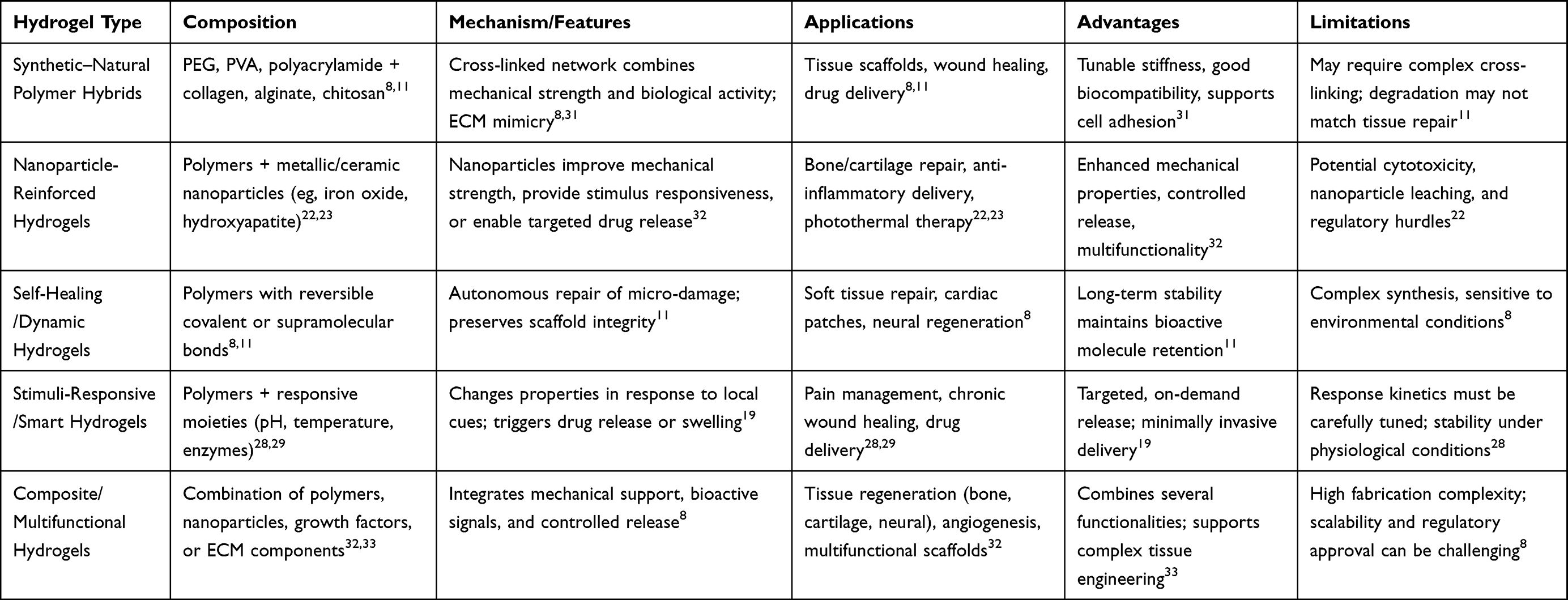 |
Table 1 Comparison of Hybrid Hydrogel Types |
As mentioned, hybrid hydrogels are versatile, making them practically applicable as both injectable materials and pre-formed scaffolds. Injectable hydrogels are delivered in a minimally invasive manner and solidify in situ, which conforms them to tissue defects while keeping their bioactivity.33 However, pre-formed scaffolds can be engineered with specific scaffolding using 3D bioprinting, which can be useful for tissues where mechanical integrity is of importance.34 The hydrated environment that the injectable scaffolds provide supports stem cell proliferation and differentiation, and nutrient and waste exchange. Additionally, the injectable scaffolds have controlled degradation rates that allow new tissue formation and later resorb without impeding the tissue remodeling process.33 As mentioned previously, given that hybrid hydrogels are highly customizable, they can target patient-specific needs. In tissue regeneration, the use of composites, bioactive modulation, and scaffolds enables tissue-specific applications that prevent the risks of immune rejection while optimizing healing outcomes.
Section 5: Challenges and Future Prospects
Section 5.1 Translational and Clinical Application Challenges
Although hybrid hydrogels provide almost an entire problem solution through their drug delivery mechanisms and tissue regeneration, their practical application is hindered by many factors. One major factor is reproducibility in manufacturing that follows Good Manufacturing Practice (GMP) conditions with consistency from sample to sample. Every hydrogel must meet the same standards in mechanical integrity, biocompatibility, degradation profiles, and sterility before its use in clinical trials.35 Furthermore, regulations for combination biomaterials, like the hybrid hydrogels used in integrating drugs, nanoparticles, and biologics, are very complex.36 The interactions between the polymer networks, nanomaterials, and bioactives can complicate approval of hybrid hydrogels, which can delay their introduction into clinical practice. Furthermore, approving individual hybrid hydrogels is difficult, but having to scale up production introduces additional challenges, given that quality control may not be guaranteed in fabrication (3D bioprinting, stimuli-responses, and cross-linking), as noted by reviews. The next generation of hybrid hydrogels will integrate different elements to deliver personalized therapy, but it cannot do so without regulation.37 As a result, further research is needed in the application of hydrogels within a clinical setting that addresses these shortcomings.
Section 5.2 Biodegradation, Mechanical Stability, and Long-Term Performance
A benefit in hybrid hydrogels that can sometimes be seen as a limitation is their degradation and mechanical profile in relation to the healing timeline of the target tissues. Although tunable, if a hybrid hydrogel degrades too rapidly, it will not have an ample enough effect on the target tissue, therefore being useless in providing structural and biochemical support. However, if the hybrid hydrogel persists for longer than necessary if the hydrogel persists beyond the intended therapeutic window, it may impede tissue remodeling and can cause inflammation.37 As mentioned, the composition of the hydrogels can be tuned so that the cross-linking, polymer structure, and nanomaterial incorporation can be optimal depending on the purpose of the hydrogel use. However, there is a fine balance that needs to be obtained to achieve this by optimizing the mechanical structure and biodegradability.38 For example, to ensure that a hybrid hydrogel degrades within the time of a treatment, it can offset the mechanical stability, causing issues. Furthermore, achieving the balance between mechanical resilience through structural integrity while also degrading at the perfect time can be difficult. There is already scarce data on this feature of hybrid hydrogels, and there should be further investigations before the integration of this material in clinical settings.
Section 5.3 Cytotoxicity, Nanomaterial Safety and Biocompatibility
Nanoparticles are often incorporated into hybrid hydrogels because of the benefits they bring to hydrogel design; however, they can raise concerns for cytotoxicity and affect the immune response. In this regard, it was found that a hybrid hydrogel that encountered certain tissue types and the circulatory system could cause a cytotoxic reaction because of the nanoparticle leaching.39 In another study, metal-based nanoparticle hybrid hydrogels, which are used for wound healing, were shown to create reactive oxygen species from reactions of the metal ions with surrounding tissues. Furthermore, reactive oxygen species trigger inflammatory responses when they disperse into tissues and are not cleared.40 As a result, it is essential to characterize the nanoparticles and to clear them as being safe before their incorporation into hydrogels. Biocompatibility extends to features of nanoparticles and scaffold degeneration. The fragments from nanoparticles, polymers, and cross-linking agents may cause adverse local effects in surrounding tissues when they accumulate.
Section 5.4 Solution Outlook for Safety and Degradation Control
As mentioned before, nanoparticle toxicity poses a problem for integration of hybrid hydrogels, but surface modification strategies offer a solution. The usage of hydrophilic polymers, like polyethylene glycol (PEG), conjugated with nanoparticle surfaces reduce protein adsorption, lower immune cell uptake, and decrease ROS-mediated stress. Ultimately, this would improve biocompatible without comprising drug delivery function. Other alternatives include zwitterionic or mixed-charge ligand surface coatings that reduce macrophage recognition and cellular uptake therefore lowering cytotoxic profiles.22 Another method of keeping nanoparticle concentrations below established cytotoxic thresholds is to optimize dosage. The therapeutic functionality of nanoparticles can be maintained while minimizing adverse effects by keeping nanoparticle concentrations below approximately 0.1 mg/mL.41 Furthermore, by carefully loading nanoparticles within hydrogels below cytotoxic threshold can prevent excessive ROS generation and immune activation while delivering its benefits in local drug delivery.
Additionally, to address degradation rates, recent advances in degradation regulation can be used to control the longevity of hybrid hydrogels. The use of polymer backbones with enzyme-sensitive and ROS-sensitive profiles can allow for preferential degradation of hybrid hydrogels in inflamed, healing tissues. Therefore, the degradation rates can be tuned in accordance with the therapeutic demand by engineering the hybrid hydrogels to include specific polymers to maintain stability or not.42 Prospectively, including cytotoxic concentration thresholds, immune responses, and degradation profiles into biocompatibility standards should be made essential to regulate the reproducibility. Furthermore, these targeted strategies to improve hybrid hydrogels can support their translation into clinical use by ensuring their safety and consistency across studies.
Conclusion
Hybrid hydrogels are a revolutionary advancement, given their biocompatibility, tunable features that assist in localized drug delivery, and tissue repair. In the realm of pain management, this innovation can personalize and specify therapeutic approaches to deliver localized relief.10,31 Beyond pain management, the integration of nanoparticles, polymers, and bioactive agents within hybrid hydrogels has demonstrated potential in regenerative and inflammatory applications.8,21 The purpose of this review was to show the various features of hybrid hydrogels and bridge the gap between pain management and regenerative medicine using this innovative vessel.22,29 Although hybrid hydrogels are a way to merge controlled drug delivery, tissue compatibility, tissue repair, while maintaining mechanical stability and tunable degradation, they lack consistency across development. The various editable features of hybrid hydrogels make them harder to replicate from sample to sample, leading to issues in integration within clinical medicine.32 Furthermore, there is need for pharmacokinetic and pharmacodynamic validation, including characterizing of local drug concentration, the duration of action, and dose-sparing effects for hybrid hydrogels. This requires further investigation, preferably in vivo studies and controlled clinical trials, on application and integration of hybrid hydrogels into clinical medicine addressing limitations. To conclude, hybrid hydrogels are an evolution in pain management given their versatile structures and ability to engineer them to cater to patient needs; however, further investigation is required in their applicability in a practical setting.
Data Sharing Statement
Data sharing is not applicable to this article as no datasets were generated or analyzed during the current study.
Ethics Approval
This article is based on previously conducted studies and does not contain any new studies with human participants or animals performed by any of the authors.
Author Contributions
All authors made a significant contribution to the work reported, whether that is in the conception, study design, execution, acquisition of data, analysis and interpretation, or in all these areas; took part in drafting, revising or critically reviewing the article; gave final approval of the version to be published; have agreed on the journal to which the article has been submitted; and agree to be accountable for all aspects of the work.
Disclosure
The authors report no conflicts of interest in this work.
References
1. Horn R, Hendrix JM, Kramer J. Postoperative pain control. In: StatPearls. Treasure Island (FL): StatPearls Publishing; 2025. Available from: http://www.ncbi.nlm.nih.gov/books/NBK544298/.
2. Bansal N, Ang S, Chen L-C. Prevalence and determinants of chronic pain and persistent opioid use after surgery: a review of systematic reviews. Br J Pain. 2024;18(1):95–13. doi:10.1177/20494637231204549
3. Brummett CM, Waljee JF, Goesling J, et al. New persistent opioid use after minor and major surgical procedures in US adults. JAMA Surg. 2017;152(6):e170504. doi:10.1001/jamasurg.2017.0504
4. Kim J, De Jesus O. Medication routes of administration. In: StatPearls. Treasure Island (FL): StatPearls Publishing; 2025. Available from: http://www.ncbi.nlm.nih.gov/books/NBK568677/.
5. Ho T-C, Chang -C-C, Chan H-P, et al. Hydrogels: properties and applications in biomedicine. Molecules. 2022;27(9):2902. doi:10.3390/molecules27092902
6. Li J, Mooney DJ. Designing hydrogels for controlled drug delivery. Nat Rev Mater. 2016;1(12):16071. doi:10.1038/natrevmats.2016.71
7. Gao W, Zhang Y, Zhang Q, Zhang L. Nanoparticle-hydrogel: a hybrid biomaterial system for localized drug delivery. Ann Biomed Eng. 2016;44(6):2049–2061. doi:10.1007/s10439-016-1583-9
8. Rana MM, De la hoz Siegler H. Evolution of hybrid hydrogels: next-generation biomaterials for drug delivery and tissue engineering. Gels. 2024;10(4):216. doi:10.3390/gels10040216
9. Abbasi H, Kouchak M, Mirveis Z, et al. What we need to know about liposomes as drug nanocarriers: an updated review. Adv Pharm Bull. 2023;13(1):7–23. doi:10.34172/apb.2023.009
10. Slaughter BV, Khurshid SS, Fisher OZ, Khademhosseini A, Peppas NA. Hydrogels in regenerative medicine. Adv Mater Deerfield Beach Fla. 2009;21(32–33):3307–3329. doi:10.1002/adma.200802106
11. Quan L, Xin Y, Wu X, Ao Q. Mechanism of self-healing hydrogels and application in tissue engineering. Polymers. 2022;14(11):2184. doi:10.3390/polym14112184
12. Guo B, Qu J, Zhao X, Zhang M. Degradable conductive self-healing hydrogels based on dextran-graft-tetraaniline and N-carboxyethyl chitosan as injectable carriers for myoblast cell therapy and muscle regeneration. Acta Biomater. 2019;84:180–193. doi:10.1016/j.actbio.2018.12.008
13. Terriac L, Helesbeux -J-J, Maugars Y, Guicheux J, Tibbitt MW, Delplace V. Boronate ester hydrogels for biomedical applications: challenges and opportunities. Chem Mater. 2024;36(14):6674–6695. doi:10.1021/acs.chemmater.4c00507
14. Zhang X, Jiang S, Yan T, et al. Injectable and fast self-healing protein hydrogels. Soft Matter. 2019;15(38):7583–7589. doi:10.1039/C9SM01543D
15. Yu H, Wang Y, Yang H, Peng K, Zhang X. Injectable self-healing hydrogels formed via thiol/disulfide exchange of thiol functionalized F127 and dithiolane modified PEG. J Mater Chem B. 2017;5(22):4121–4127. doi:10.1039/c7tb00746a
16. Li D-Q, Wang S-Y, Meng Y-J, Guo Z-W, Cheng -M-M, Li J. Fabrication of self-healing pectin/chitosan hybrid hydrogel via Diels-Alder reactions for drug delivery with high swelling property, pH-responsiveness, and cytocompatibility. Carbohydr Polym. 2021;268:118244. doi:10.1016/j.carbpol.2021.118244
17. Daemi H, Barikani M, Barmar M. Highly stretchable nanoalginate based polyurethane elastomers. Carbohydr Polym. 2013;95(2):630–636. doi:10.1016/j.carbpol.2013.03.039
18. Ren Z, Ke T, Ling Q, Zhao L, Gu H. Rapid self-healing and self-adhesive chitosan-based hydrogels by host-guest interaction and dynamic covalent bond as flexible sensor. Carbohydr Polym. 2021;273:118533. doi:10.1016/j.carbpol.2021.118533
19. Vasile C, Pamfil D, Stoleru E, Baican M. New developments in medical applications of hybrid hydrogels containing natural polymers. Mol. 2020;25(7):1539. doi:10.3390/molecules25071539
20. Qin H, Li Z, Li S, Huang J, Ren J, Wu X. Advances in hydrogels for capturing and neutralizing inflammatory cytokines. J Tissue Eng. 2025;16:20417314251342175. doi:10.1177/20417314251342175
21. Zhang X, Hu Z, Pörtner R, Zeng A-P. Hybrid biological hydrogel provides favorable bioenergetic, adhesive, and antioxidative effects on wound healing. ACS Biomater Sci Eng. 2025;11(6):3560–3572. doi:10.1021/acsbiomaterials.5c00072
22. Choi W, Kohane DS. Hybrid nanoparticle–hydrogel systems for drug delivery depots and other biomedical applications. ACS Nano. 2024;18(34):22780–22792. doi:10.1021/acsnano.4c06888
23. Zhou S, Zhang X, Ni W, et al. An immune-regulating polysaccharide hybrid hydrogel with mild photothermal effect and anti-inflammatory for accelerating infected wound healing. Adv Healthc Mater. 2024;13(20):e2400003. doi:10.1002/adhm.202400003
24. Helmecke T, Hahn D, Matzke N, et al. Inflammation‐controlled anti‐inflammatory hydrogels. Adv Sci. 2022;10(7):2206412. doi:10.1002/advs.202206412
25. Nguyen DT, Soeranaya BHT, Truong THA, Dang TT. Modular design of a hybrid hydrogel for protease-triggered enhancement of drug delivery to regulate TNF-α production by pro-inflammatory macrophages. Acta Biomater. 2020;117:167–179. doi:10.1016/j.actbio.2020.09.026
26. Jin L, Ma Y, Wang R, et al. Nanofibers and hydrogel hybrid system with synergistic effect of anti-inflammatory and vascularization for wound healing. Mater Today Adv. 2022;14:100224. doi:10.1016/j.mtadv.2022.100224
27. Deng W, Chen J, Wang X, et al. Paravertebrally-injected multifunctional hydrogel for sustained anti-inflammation and pain relief in lumbar disc herniation. Adv Healthc Mater. 2024;13(27):e2401227. doi:10.1002/adhm.202401227
28. Choi B-M, Hwang C-S, Yoon YS, Park IJ, Yoo M-W, Kim BS. Novel temperature-responsive hydrogel injected to the incision site for postoperative pain relief in laparoscopic abdominal surgery: a single-blind, randomized, pivotal clinical trial. Surg Endosc. 2022;36(8):5794–5802. doi:10.1007/s00464-022-09252-4
29. Moon YE, Jeong J-O, Choi H. Inflammation-responsive hydrogels in perioperative pain and wound management: design strategies and emerging potential. Gels. 2025;11(9):691. doi:10.3390/gels11090691
30. Liu Z, Ma X, Liu J, Zhang H, Fu D. Advances in the application of natural/synthetic hybrid hydrogels in tissue engineering and delivery systems: a comprehensive review. Int J Pharm. 2025;672:125323. doi:10.1016/j.ijpharm.2025.125323
31. Oyen M. Mechanical characterisation of hydrogel materials. Int Mater Rev. 2014;59(1):44–59. doi:10.1179/1743280413Y.0000000022
32. Hui Y, Zheng X, Zheng Z, Wu C, Hao Y, Zhou B. Progress in the application of multifunctional composite hydrogels in promoting tissue repair. ACS Omega. 2024;9(49):47964–47975. doi:10.1021/acsomega.4c08103
33. Amiryaghoubi N, Fathi M, Barar J, Omidi Y. Hydrogel-based scaffolds for bone and cartilage tissue engineering and regeneration. React Funct Polym. 2022;177:105313. doi:10.1016/j.reactfunctpolym.2022.105313
34. El-Sherbiny IM, Yacoub MH. Hydrogel scaffolds for tissue engineering: progress and challenges. Glob Cardiol Sci Pract. 2013;2013(3):316–342. doi:10.5339/gcsp.2013.38
35. Lu P, Ruan D, Huang M, et al. Harnessing the potential of hydrogels for advanced therapeutic applications: current achievements and future directions. Signal Transduct Target Ther. 2024;9(1):166. doi:10.1038/s41392-024-01852-x
36. Correa S, Grosskopf AK, Lopez Hernandez H, et al. Translational applications of hydrogels. Chem Rev. 2021;121(18):11385–11457. doi:10.1021/acs.chemrev.0c01177
37. Segneanu A-E, Bejenaru LE, Bejenaru C, et al. Advancements in hydrogels: a comprehensive review of natural and synthetic innovations for biomedical applications. Polymers. 2025;17(15):2026. doi:10.3390/polym17152026
38. Choudhary A, Sharma A, Singh A, Han SS, Sood A. Strategy and advancement in hybrid hydrogel and their applications: recent progress and trends. Adv Eng Mater. 2024;26(21):2400944. doi:10.1002/adem.202400944
39. Pradeepa P, Brabu B, Murugan SS, et al. Hydrogel based skin contacting medical devices and cytotoxicity: an overview of challenges and recommendations from a regulatory perspective. Indian J Sci Technol. 2023;16(30):2350–2357. doi:10.17485/IJST/v16i30.pradeepa
40. Wang Y, Zhang M, Yan Z, Ji S, Xiao S, Gao J. Metal nanoparticle hybrid hydrogels: the state-of-the-art of combining hard and soft materials to promote wound healing. Theranostics. 2024;14(4):1534–1560. doi:10.7150/thno.91829
41. Nunes D, Andrade S, Ramalho MJ, Loureiro JA, Pereira MC. Polymeric nanoparticles-loaded hydrogels for biomedical applications: a systematic review on in vivo findings. Polymers. 2022;14(5):1010. doi:10.3390/polym14051010
42. Martin JR, Patil P, Yu F, Gupta MK, Duvall CL. Enhanced stem cell retention and antioxidative protection with injectable, ROS-degradable PEG hydrogels. Biomaterials. 2020;263:120377. doi:10.1016/j.biomaterials.2020.120377
 © 2026 The Author(s). This work is published and licensed by Dove Medical Press Limited. The
full terms of this license are available at https://www.dovepress.com/terms
and incorporate the Creative Commons Attribution
- Non Commercial (unported, 4.0) License.
By accessing the work you hereby accept the Terms. Non-commercial uses of the work are permitted
without any further permission from Dove Medical Press Limited, provided the work is properly
attributed. For permission for commercial use of this work, please see paragraphs 4.2 and 5 of our Terms.
© 2026 The Author(s). This work is published and licensed by Dove Medical Press Limited. The
full terms of this license are available at https://www.dovepress.com/terms
and incorporate the Creative Commons Attribution
- Non Commercial (unported, 4.0) License.
By accessing the work you hereby accept the Terms. Non-commercial uses of the work are permitted
without any further permission from Dove Medical Press Limited, provided the work is properly
attributed. For permission for commercial use of this work, please see paragraphs 4.2 and 5 of our Terms.
Recommended articles

Interventional Pain Procedures: A Narrative Review Focusing on Safety and Complications. Part 1 Injections for Spinal Pain
Lo Bianco G, Tinnirello A, Papa A, Torrano V, Russo G, Stogicza A, Mercadante S, Cortegiani A, Mazzoleni S, Schatman ME
Journal of Pain Research 2023, 16:1637-1646
Published Date: 18 May 2023
Adherence to Opioids for Cancer-Related Pain Among Patients with Cancer in a Resource-Restricted Hospital in Palestine
Nashwan NY, Mohamed Shah N, Islahudin F, Wasfi III SM
Patient Preference and Adherence 2025, 19:2663-2671
Published Date: 30 August 2025