
Back to Journals » Clinical Interventions in Aging » Volume 21
Gut Microbiota in Constipation and Mild Cognitive Impairment: A Mendelian Randomization and Observational Study of Two Common Geriatric Syndromes
Authors Ren Q, Zhang J, Liu Y, Fang J, Yu J, Ma Q, Zhou T, Zhu H, Shang L
Received 2 February 2026
Accepted for publication 6 July 2026
Published 22 July 2026 Volume 2026:21 597117
DOI https://doi.org/10.2147/CIA.S597117
Checked for plagiarism Yes
Review by Single anonymous peer review
Peer reviewer comments 4
Editor who approved publication: Dr Zhi-Ying Wu
Qiaohui Ren,1,2,* Jiatong Zhang,3,* Yichao Liu,1,4 Jiawei Fang,1,2 Jianjiao Yu,1 Qing Ma,1 Ting Zhou,1 Huolan Zhu,1,5 Liang Shang1
1Department of Geriatrics, Shaanxi Provincial People’s Hospital, Xi’an, Shaanxi, People’s Republic of China; 2School of Medicine, Yan’an University, Yan’an, Shaanxi, People’s Republic of China; 3Department of Gastroenterology, Xi’an Chang’an District Hospital, Xi’an, Shaanxi, People’s Republic of China; 4Medical Department, Xizang Minzu University, Xianyang, Shaanxi, People’s Republic of China; 5Shaanxi Provincial Clinical Research Center for Geriatric Medicine, Shaanxi Provincial People’s Hospital, Xi’an, Shaanxi, People’s Republic of China
*These authors contributed equally to this work
Correspondence: Liang Shang, Email [email protected] Huolan Zhu, Email [email protected]
Background and Objectives: In geriatric syndrome (GS), conditions like cognitive impairment and constipation reduce quality of life. Gut microbiota may influence GS progression via the gut-brain axis. This exploratory study investigated potential causal associations and microbial characteristics between gut microbiota and constipation, including constipation with mild cognitive impairment.
Methods: Two-sample Mendelian randomization (MR) was performed to explore potential causality between gut microbiota and constipation. Inverse variance weighted (IVW) was the primary method, with sensitivity analyses using MR-Egger, weighted median, and MR-PRESSO. False discovery rate (FDR) correction was applied for multiple testing. Two-sample MR used summary statistics from MiBioGen (n=18,340) and FinnGen (51,956 cases). The observational study included 88 participants. Subsequently, fecal samples from 88 elderly participants (30 constipation+MCI, 28 constipation, 30 controls) were analyzed using 16S rDNA sequencing.Gut microbiota was profiled by 16S rDNA V3-V4 sequencing. Alpha diversity (Chao1, Shannon, Simpson) and beta diversity (Bray - Curtis PCoA with Adonis) were assessed. LEfSe (LDA > 4) identified differentially abundant taxa. Functional potential was predicted by Tax4Fun2.
Results: MR analysis indicated that the genus Oscillibacter may exert a protective effect against constipation, whereas the family Rikenellaceae, genus Enterorhabdus, and genus Victivallis were identified as risk factors. 16S sequencing showed significant structural differences among groups, though these findings are observational.LEfSe analysis identified Enterococcus-related taxa as characteristic features of the constipation+MCI group, whereas Bifidobacterium-related taxa were enriched in controls. Relative abundance analysis also suggested group-specific differences in Escherichia–Shigella, Prevotella_9, and Enterobacter.
Conclusion: The findings offer preliminary evidence that specific gut microbes may be associated with constipation. Distinct microbial features and functional changes are associated with constipation and constipation+MCI. Gut microbiota dysbiosis might link constipation and cognitive impairment, providing exploratory clues rather than definitive conclusions for future hypothesis-driven and microbiota-targeted studies.
Keywords: gut microbiota, geriatric syndrome, constipation, mild cognitive impairment, Mendelian randomization, 16S rDNA amplicon sequencing
Introduction
Geriatric syndromes refer to a collection of non-specific clinical conditions commonly observed in older adults, including constipation, falls, cognitive impairment, and others.1 Among these, constipation and mild cognitive impairment (MCI) frequently co-occur and significantly reduce quality of life.2,3 This study focuses specifically on these two conditions.
Constipation is highly prevalent among the elderly, affecting up to 22% of individuals aged 60 and above in China. It is characterized by difficult, infrequent, or hard bowel movements and can be categorized into organic and functional types.4 Recent studies suggest a strong association between gut microbiota dysbiosis and constipation. Gut microbes influence intestinal health by modulating motility, maintaining barrier function, and regulating metabolic homeostasis.5 Constipated patients often exhibit reduced beneficial bacteria, increased potential pathogens, and decreased microbial diversity.6
MCI represents an intermediate state between normal aging and dementia.7 Accumulating evidence indicates that gut microbiota may influence cognitive function via the gut–brain axis through mechanisms such as neurotransmitter synthesis, immune modulation, and the production of microbial metabolites including short-chain fatty acids (SCFAs).8 These metabolites can affect blood-brain barrier integrity and modulate neural connectivity and cognition.9
Constipation and mild cognitive impairment (MCI) often coexist and interact clinically. A cross-sectional survey reported a higher MCI prevalence in older Chinese adults with constipation.10 Ma et al found an inverse J-shaped relationship between bowel movement frequency and cognitive function, which correlated significantly with gut microbiota dysbiosis (eg, reduced butyrate-producing bacteria and enriched pro-inflammatory taxa).11 Another study showed that fecal short-chain fatty acids (SCFAs) were lower in MCI patients and negatively correlated with Aβ deposition in cognition-related brain regions.12 These findings suggest that gut microbiota may aggravate cognitive decline by modulating blood-brain barrier permeability via SCFAs—a mechanism similar to how gut microbiota improve constipation by raising intestinal SCFA concentrations to affect motility.13,14 Although the role of gut microbiota in the pathogenesis of constipation and MCI individually is increasingly recognized, the microbial characteristics of their comorbid state remain poorly understood.
Mendelian randomization (MR) provides an alternative approach for inferring potential causal relationships.15 It uses single-nucleotide polymorphisms from genome-wide association studies as genetic instruments to infer causality between an exposure and an outcome.16 Compared with traditional case-control studies, MR benefits from the random assortment of alleles, which reduces confounding by non-genetic factors. Moreover, because genetic variants are established before disease onset and are not influenced by disease or environmental factors, MR avoids reverse causation.17 This method is now widely used to investigate causal relationships between risk factors and diseases.18
Therefore, this study proposes the following hypothesis: specific gut microbiota have a causal relationship with constipation, and patients with constipation and mild cognitive impairment (MCI) exhibit distinct structural and functional alterations in their gut microbiome. To test this hypothesis, we employed Mendelian randomization to infer causality between gut microbiota and constipation, combined with 16S rDNA sequencing to characterize microbial composition and functional changes in patients with constipation alone and those with constipation plus MCI. The former leverages genetic variants to provide causal evidence, while the latter reveals actual microbial community structure and metabolic alterations in the target population. Together, these two approaches complement each other, aiming to provide a theoretical basis for future microbiota-targeted interventions.
Materials and Methods
Data Sources and Instrumental Variable Selection
In this study, genetic data for gut microbiota as the exposure variable were obtained from a large-scale genome-wide meta-analysis published by the MiBioGen consortium (https://mibiogen.gcc.rug.nl), which included 18,340 samples and 5,747,754 single nucleotide polymorphisms (SNPs). Genetic data for constipation, the outcome variable, were derived from the latest 2024 release of the FinnGen cohort genome-wide association study (GWAS) (https://r12.finngen.fi/), comprising 51,956 cases and 448,392 controls of European ancestry, with a total of 20,112,714 SNPs.
The instrumental variables (IVs) were selected according to the following criteria: First, SNPs significantly associated with gut microbial taxa at a suggestive significance threshold of P < 1×10⁻⁵ (a relatively lenient threshold for microbial GWAS) were identified.19,20 Second, to ensure independence among SNPs, those in linkage disequilibrium (LD) were pruned using a threshold of r2 < 0.01 within a clumping distance of 10,000kb.21 Finally, the F statistic was calculated for each SNP (F = β2 / SE2), and weak instrumental variables with F < 10 were excluded to minimize bias in causal estimation due to weak instruments.22
Causal Inference Analysis
The inverse variance weighted (IVW) method was employed as the primary analytical approach, supplemented by MR-Egger regression, weighted median estimator (WME), simple median estimator (SME), and weighted mode estimator (WME) for validation. The IVW method assumes the absence of pleiotropy for all instrumental variables and provides a robust estimate of the causal effect.23 To control for false positive results due to multiple testing, the false discovery rate (FDR) correction was applied, with a PFDR < 0.05 considered statistically significant.
Sensitivity Analysis
To evaluate the robustness of the results, multiple sensitivity analyses were carried out. Horizontal pleiotropy was assessed using the MR-Egger intercept test. The MR-PRESSO method was employed to detect and correct for outliers. Heterogeneity among instrumental variables was examined using Cochran’s Q test. Additionally, a leave-one-out analysis was performed to identify individual SNPs exerting excessive influence on the causal estimates. All analyses were conducted using R software (version 4.3.2) with the Two SampleMR package.
Gut Microbiota Analysis in Patients with Constipation and Mild Cognitive Impairment
Study Participants
A total of 88 elderly participants were consecutively enrolled from Shaanxi Provincial People’s Hospital community settings between February and September 2024. They were categorized into three groups: those with constipation and mild cognitive impairment (MCI) (Group A, n = 30), those with constipation only (Group B, n = 28), and healthy controls (Group C, n = 30). All participants were aged between 60 and 90 years, of Han Chinese ethnicity, and provided written informed consent. Participants in Group A met both the Rome IV diagnostic criteria for functional constipation and the National Institute on Aging–Alzheimer’s Association (NIA-AA) criteria for MCI. Those in Group B satisfied the Rome IV criteria for constipation but had normal cognitive function. Healthy controls (Group C) had no history of major organic diseases, psychiatric disorders, or chronic gastrointestinal conditions. Exclusion criteria encompassed severe cardiocerebrovascular diseases, hepatic or renal dysfunction, malignancy, history of gastrointestinal surgery within the preceding six months, and use of antibiotics, probiotics, or laxatives within the past three months. The study protocol was reviewed and approved by the Ethics Committee of Shaanxi Provincial People’s Hospital (Approval No.: SPPH-LLBG-06-3.1), and the study was conducted in accordance with the requirements of the Declaration of Helsinki. All participants and their families provided informed consent.
Sample Collection and Processing
Fresh morning stool samples (3–5 g) were collected from each participant, immediately placed in sterile cryotubes, and frozen at − 80 °C for subsequent analysis. Genomic DNA was extracted using the TIANamp Stool DNA Kit (DP328, TIANGEN BIOTECH, Beijing, China) (a commercial fecal DNA extraction kit), and its quality and integrity were evaluated by agarose gel electrophoresis and spectrophotometry. The V3–V4 hypervariable region of the bacterial 16S rRNA gene was amplified with the primers 341F and 806R. After library preparation using the NEBNext® Ultra™ II DNA Library Prep Kit (E7645B, NEB, USA), paired-end sequencing (2×250 bp) was carried out on the Illumina NovaSeq 6000 platform. During the experiment, blank extraction controls and PCR negative controls were set for each batch to monitor contamination; all samples were avoided repeated freezing and thawing, and reagents were pretreated according to kit instructions to ensure experimental reliability. Library quantification was performed using Qubit and qPCR to achieve equal concentration mixing and standardization before sequencing, with a sequencing depth threshold of ≥50,000 raw tags per sample and Q30 ≥ 80%.
Bioinformatics Analysis
Raw sequencing data were processed using QIIME 2 (via the DADA2 plugin) for quality filtering, denoising, chimera removal, and generation of an amplicon sequence variant (ASV) table Species taxonomic annotation was performed against the SILVA, RDP, and Greengenes databases. Alpha diversity was estimated using the Chao1, Ace, Shannon, Simpson, and Pielou’s evenness indices, and group differences were compared with the Kruskal–Wallis test. Beta diversity was analyzed through principal coordinate analysis (PCoA) and non-metric multidimensional scaling (NMDS) based on Bray–Curtis distances, and significant group differences were assessed with permutational multivariate analysis of variance (Adonis test). Linear discriminant analysis effect size (LEfSe) was applied to identify differentially abundant taxa (LDA score > 4). Functional profiling of microbial communities was predicted using Tax4Fun2. All statistical analyses were conducted in R (v4.3.2) or SPSS (v26.0), with a significance threshold of P < 0.05.
Results
Mendelian Randomization Analysis of Gut Microbiota and Constipation
Selection of Instrumental Variables and Causal Inference
A total of 2084 single-nucleotide polymorphisms (SNPs) associated with gut microbiota (p < 1×10⁻⁵) were initially identified. Following predefined criteria for instrumental variable (IV) selection, 86 SNPs were retained for Mendelian randomization analysis. All IVs exhibited F-statistics greater than 10, indicating the absence of weak instrument bias and supporting the robustness of the causal estimates. Using the inverse variance weighted (IVW) method as the primary analytical approach, eight gut microbial taxa showed potential causal associations with constipation. Consistency across complementary MR methods—including MR-Egger, weighted median, simple median, and weighted mode—supported a stable causal relationship for four of these taxa: Among them, the genus Oscillibacter showed a protective effect (OR < 1), whereas the other three—Rikenellaceae, Enterorhabdus, and Victivallis—were identified as risk factors (OR > 1).(See Table 1 and Figure 1).
 |
Table 1 Instrumental Variables and IVW Results for the Association Between Gut Microbial Taxa and Constipation |
 |
Figure 1 Scatterplot results of this MR study (A–D) demonstrate positive slopes, suggesting that Rikenellaceae, Enterorhabdus, and Victivallis are positively associated with constipation. In contrast, (C) shows a negative slope, indicating a protective effect of Oscillibacter against constipation. |
Sensitivity Analysis
Sensitivity analyses further supported the robustness of the Mendelian randomization results. The MR-Egger intercept test indicated no significant horizontal pleiotropy (all P > 0.05). MR-PRESSO analysis showed nominal significance for some taxa (eg, Rikenellaceae and Victivallis), but no outliers that would distort the causal estimates were detected. For Enterorhabdus and Oscillibacter, no significant outliers were found (P > 0.05). Cochran’s Q test indicated no significant heterogeneity across instrumental variables (all P > 0.05). Leave-one-out analysis confirmed that no single SNP dominated the overall results. Collectively, these findings support the robustness of the potential causal associations. (See Table 2 and Figure 2).
 |
Table 2 Sensitivity Analyses of the Mendelian Randomization Results |
 |
Figure 2 Leave- one-out sensitivity analysis. Notes: (A) Family Rikenellaceae, (B) Genus Enterorhabdus, (C) Genus Oscillibacter, (D) Genus Victivallis. All data points are distributed on the same side of the null line (zero), indicating that no single SNP disproportionately influenced the overall MR results. |
Gut Microbiota 16S rDNA Sequencing Analysis
Baseline Characteristics of the Study Groups
A total of 88 participants were included and categorized into three groups: constipation with MCI (Group A, n = 30), constipation alone (Group B, n = 28), and healthy controls (Group C, n = 30). No significant differences were observed among the groups in terms of gender, body mass index (BMI), smoking status, or educational level (all P > 0.05). However, participants in Group A were significantly older and had lower Montreal Cognitive Assessment (MoCA) scores compared to those in Groups B and C (all P < 0.05). Additionally, Group C exhibited significantly fewer comorbidities than Group A (P < 0.05). (See Table 3 for detailed results).
 |
Table 3 Comparison of Basic Information Among the Three Groups |
Alpha Diversity Analysis
Analysis of alpha diversity indices—including the Chao1, Shannon, Simpson, and Pielou’s evenness indices—revealed significant differences among the groups. The Kruskal–Wallis test showed that the Chao1 index was significantly higher in Group A (constipation with MCI) than in Group C (healthy controls) (P < 0.05), suggesting enhanced microbial richness in the constipation-MCI group. Additionally, Group A exhibited a significantly higher Pielou’s evenness index compared to Group B (constipation alone) (P < 0.05), indicating a more uniform species distribution. Tukey’s post hoc test found no significant differences in the other indices across groups (P > 0.05). The rarefaction curves reached stable plateaus, confirming that the sequencing depth was sufficient to capture the majority of microbial diversity. (See Table 4 and Table 5, Figures 3 and 4).
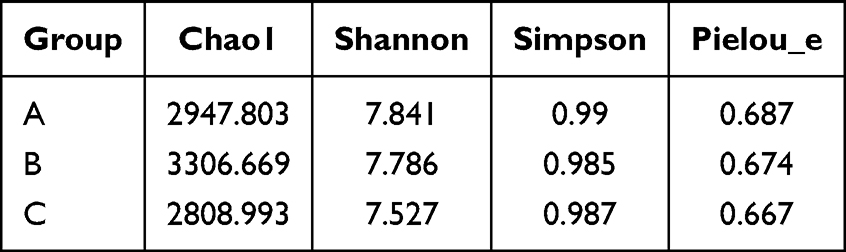 |
Table 4 Statistical Table of Alpha Diversity Index |
 |
Table 5 Analysis of Species Diversity Differences Among the Three Groups |
 |
Figure 3 Box chart of differences between groups of Alpha diversity index. Notes: (A) Family Rikenellaceae; (B) Genus Enterorhabdus; (C) Genus Oscillibacter; (D) Genus Victivallis. The horizontal axis of the box chart represents groupings, while the vertical axis represents the corresponding alpha diversity index values. |
 |
Figure 4 Dilution curves of different Alpha diversity contributions among the three groups. Notes: (A) Simpson index; (B) Shannon index; (C) Chao1 index; (D) Pielou’s evenness index (pielou_e). The horizontal axis of each boxplot represents experimental groups (A, B, C), while the vertical axes represent the corresponding Simpson, Shannon, Chao1, and Pielou_e alpha diversity index values for subplots A–D, respectively. Principal coordinate analysis (PCOA) based on Bray–Curtis distances revealed significant differences in microbial community structure among the three groups (Adonis, P < 0.05). Samples from Group C (healthy controls) were clearly separated from those of Groups A (constipation with MCI) and B (constipation alone) along the principal coordinates, suggesting distinct underlying factors driving microbial composition. Moreover, most samples from Group B clustered within the range of Group A, indicating structural similarities in microbiota between these two groups, though Group A exhibited greater variability in community composition. |
Beta Diversity Analysis
Principal coordinate analysis (PCoA) based on Bray–Curtis distances revealed significant differences in microbial community structure among the three groups (Adonis, P < 0.05). Pairwise Adonis tests showed statistically significant differences in all intergroup comparisons (P < 0.05), indicating that both constipation alone and constipation with MCI are associated with microbial compositions distinct from those of healthy controls, and that each condition influences the microbiota in unique ways (see Table 6). Samples from Group C (healthy controls) clearly separated from those in Groups A (constipation with MCI) and B (constipation alone), suggesting differing underlying drivers of microbial community structure. Furthermore, the structural variation in Group B largely fell within the range of Group A, The overlapping and distinct distribution patterns indicated partially shared and unique microbial community features between constipation alone and constipation with MCI (See Figure 5).
 |
Table 6 Pairwise PERMANOVA Analysis of Microbial Community Structure Among Groups |
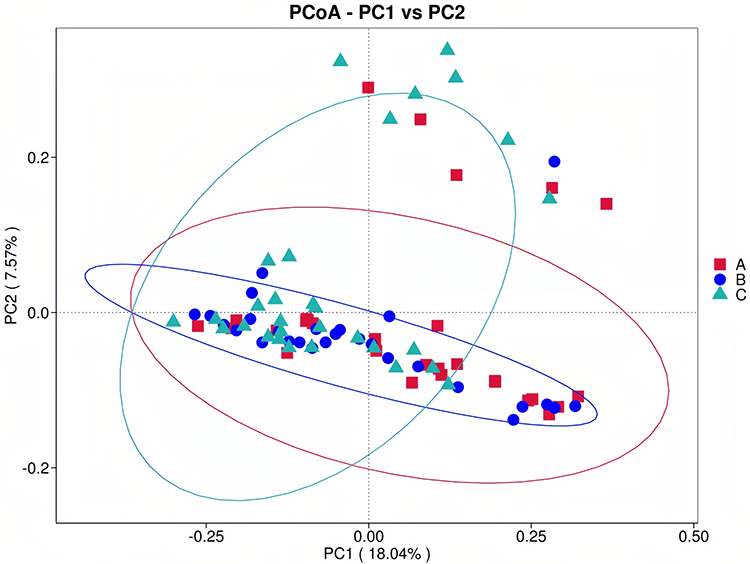 |
Figure 5 Two-dimensional PCoA diagram. Notes: The horizontal axis represents one principal component, the vertical axis represents another principal component, and percentages indicate the contribution of each principal component to sample variation. Each point represents a sample, with samples from the same group colored identically Principal coordinate analysis (PCoA) based on Bray-Curtis distances showing the separation of gut microbial communities among Group A, Group B, and Group C (healthy controls). Adonis test, P < 0.05. |
Microbial Composition Across the Three Groups
Analysis of amplicon sequence variants (ASVs) and taxonomic composition revealed distinct microbial diversity and structural profiles among the three groups. The Venn diagram indicated that Groups A, B, and C contained 2,712, 3,006, and 2,488 ASVs, respectively, with 686 ASVs shared among all groups (Figure 6). At the phylum level, Firmicutes, Bacteroidota, and Proteobacteria were the dominant phyla in all groups. The relative abundance of Proteobacteria was significantly higher in Group B (17.8%) compared to Group A (9.4%) and Group C (13.1%) (P < 0.05). Group C showed a significantly greater abundance of Bacteroidota (30.9%) than the other two groups. At the genus level, Enterococcus was most abundant in Group B (2.8%), while Group A was enriched with Escherichia–Shigella and Prevotella_9. Enterobacter was uniquely abundant in Group C and differed significantly from Group B (P < 0.05) (Figures 7 and 8).Phylogenetic analysis further revealed that Firmicutes contained the highest genus-level richness, with multiple genera showing group-specific distribution patterns (Figure 9).
 |
Figure 6 Venn graph of group population characteristics. Notes: (A–C) denote respective groups. Each circle in the diagram represents a group of samples. The numbers in the overlapping areas between circles indicate the number of ASVs shared between groups, while the numbers in the non-overlapping areas represent the number of unique ASVs specific to each group. |
 |
Figure 7 Histogram of relative species abundance at phylum level. |
 |
Figure 8 Histogram of relative species abundance at genus level. |
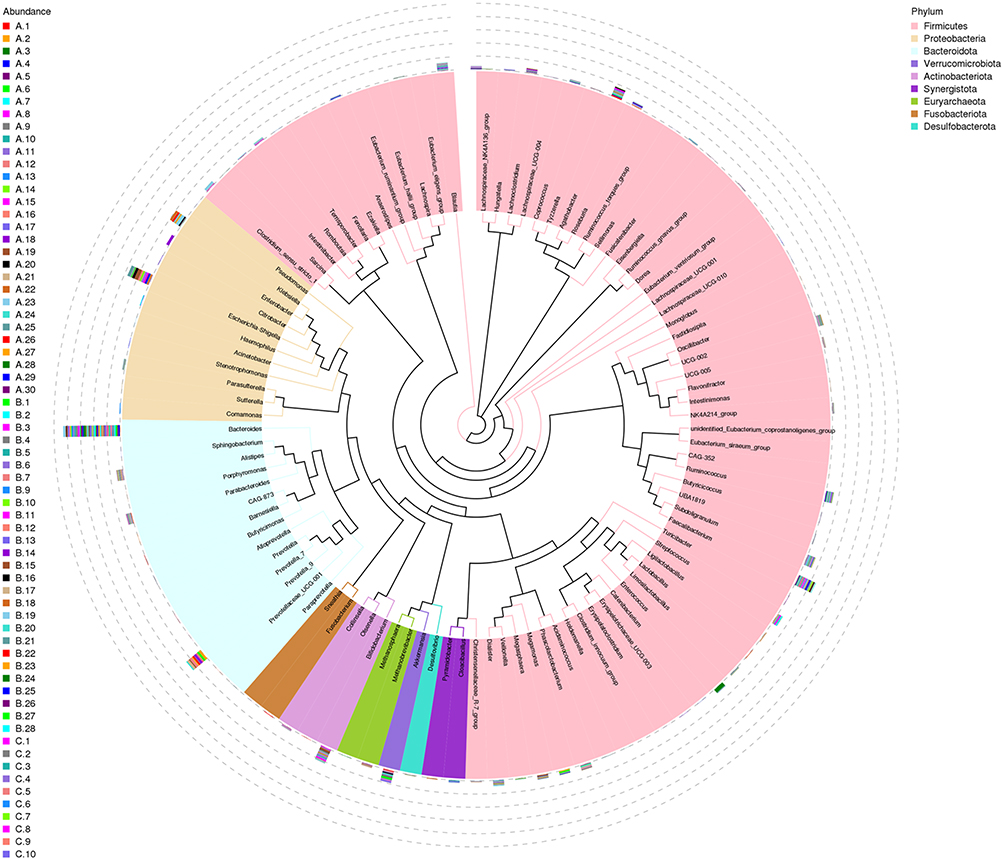 |
Figure 9 Horizontal species evolutionary tree of three groups. |
LEFse Analysis
Linear discriminant analysis effect size (LEfSe) analysis (LDA score > 4) identified significant enrichment of the following taxa in Group A: class Clostridia, family Oscillospiraceae, family Enterococcaceae, genus Enterococcus, and species Bacteroides coprocola. In Group C, enriched taxa included phylum Actinobacteriota, class Actinobacteria, order Bifidobacteriales, family Bifidobacteriaceae, family Veillonellaceae, genus Bifidobacterium, and species Bacteroides plebeius (see Figures 10 and 11). No significantly enriched biomarkers were detected in Group B at the selected LDA threshold (see Figures 12 and 13).
 |
Figure 10 Histogram of LDA value distribution in groups A and C. Notes: The length of the bars represents the effect size of the differentially abundant taxa (ie, LDA score). Red bars represent Group A, and green bars represent Group C. |
 |
Figure 11 Evolutionary cladism of groups A and C. Notes: The concentric circles radiating from the center represent taxonomic levels from phylum to genus (or species). Each small circle at different taxonomic levels represents a taxon at that level, and the diameter of the circle is proportional to its relative abundance. Taxa without significant differences are uniformly colored in yellow. Differential taxa (biomarkers) are colored according to their associated group: red nodes indicate microbial taxa that play significant roles in Group A, while green nodes represent those contributing importantly in Group C. |
 |
Figure 12 Histogram of LDA value distribution in groups A and B. |
 |
Figure 13 Evolutionary cladism of groups A and B. Note: Red nodes represent microbial taxa that play a significant role in Group A. |
Functional Prediction
Tax4Fun2-based functional prediction revealed that several metabolic pathways were significantly more active in Group A compared to Group C (P < 0.05). These included pyruvate metabolism, exosome function, glycolysis/gluconeogenesis, chromosome and associated proteins, prokaryotic carbon fixation pathways, and butyrate metabolism. These pathways are closely associated with energy metabolism, cellular communication, and inflammation regulation. These predicted pathways provide exploratory functional clues regarding potential metabolic alterations, but they require validation by metagenomic, metabolomic, or experimental studies (Figure 14).
 |
Figure 14 Analysis of functional differences between group A and C. |
Discussion
This study integrated Mendelian randomization (MR) and 16S rDNA sequencing to explore the association between specific gut microbiota and constipation and its co-occurrence with mild cognitive impairment (MCI) through both causal inference and observational approaches. MR analysis identified four microbial taxa associated with constipation: the genus Oscillibacter as a protective factor, and the family Rikenellaceae, genus Enterorhabdus, and genus Victivallis as risk factors. However, MR findings reflect genetic associations and do not independently establish causality. Further observational results revealed significant differences in microbial community structure, composition, and predicted functional pathways among constipated patients, those with constipation and MCI, and healthy controls. These findings provide novel insights into the role of gut microbiota in geriatric syndromes, particularly in the context of constipation and cognitive comorbidity. Given the cross-sectional design and exploratory nature of these analyses, these findings are more suitable for generating hypotheses than for drawing firm conclusions about causality or mechanism.
MR analysis suggests that gut microbiota may be associated with constipation risk. Our study revealed that a higher abundance of the genus Oscillibacter was associated with a reduced risk of constipation, which aligns with previous reports suggesting that this genus might enhance intestinal motility by modulating bile acid metabolism and influencing gut-brain axis signaling, such as through the production of GABA-like substances.24,25 However, these mechanistic interpretations remain speculative and were not directly tested in this study. In contrast, the family Rikenellaceae and the genera Enterorhabdus and Victivallis were found to be associated with higher constipation risk. Of note, certain species within Rikenellaceae (eg, Mucinivorans) exhibit mucin-degrading capacity, and previous studies have suggested may impair the intestinal mucosal barrier and trigger local inflammation and dysmotility.26 The genus Enterorhabdus has been previously linked to pro-inflammatory conditions in studies on inflammatory bowel disease,27 raising the hypothesis that it could contribute to constipation through analogous potential mechanisms. Research on the genus Victivallis remains limited, though it has been implicated in chronic inflammatory disorders;28 its role in constipation warrants further investigation. Collectively, these MR results suggest an association between gut microbial dysbiosis and constipation rather than a causal role, and should be considered hypothesis-generating. Any implications for microbiota-based interventions remain speculative and require validation in future studies. Recent experimental studies in aged mice demonstrated that gut microbial alterations could affect cognitive function via immune and vagal nerve pathways. Whether similar mechanisms mediate the association between constipation and MCI in humans remains to be clarified. A 2026 Nature study demonstrated that aging-associated gut dysbiosis, particularly enrichment of Parabacteroides goldsteinii, directly impairs vagus nerve signaling via the production of 3-hydroxyoctanoic acid, a medium-chain fatty acid that activates pro-inflammatory myeloid cells and suppresses hippocampal neuronal activity.29 This experimental evidence supports the biological plausibility that gut microbial alterations may influence cognitive function through microbial–metabolic–neural pathways, although whether similar mechanisms operate in constipation-associated MCI in humans remains uncertain.
Furthermore, 16S rDNA sequencing revealed significant microbial dysbiosis in both constipation and constipation-with-MCI groups. Beta diversity analysis showed clear separation among the three groups, with distinct clustering of healthy controls compared to the constipation groups along the major axes of variation, suggesting differing underlying ecological drivers. Notably, the majority of samples from the constipation-only group fell within the range of the constipation-MCI group, which itself exhibited greater dispersion. This pattern is consistent with the possibility that superimposed MCI may be associated with exacerbating microbial dysbiosis, possibly through the enrichment of pro-inflammatory taxa or depletion of neuroprotective bacteria. Constipation-related microbial shifts—such as reduced Akkermansia and increased Enterobacteriaceae—could contribute to intestinal inflammation via impaired barrier function or decreased production of short-chain fatty acids (SCFAs).5,30 The non-overlapping region in the PCoA plot between the constipation-only and constipation-MCI groups may represent microbiota associated with cognitive impairment. Chronic gut inflammation could influence brain function through gut–brain axis pathways, such as systemic endotoxin exposure potentially activating microglia,31 alongside accumulation of microbial metabolites like phenylacetylglutamine,32 collectively exacerbating neural dysfunction. These findings provide preliminary structural insights into microbial community dynamics that are consistent with the involvement of the gut–brain axis in the progression of comorbid conditions.
Complementing these observations, a 2026 Frontiers in Microbiol study delineated a microbiota–bile acid–receptor axis in functional constipation, showing that microbial dysbiosis reduces secondary bile acid synthesis and impairs FXR/TGR5 signaling, thereby slowing colonic transit. Importantly, this bile acid pathway also modulates blood–brain barrier permeability and neuroinflammation, creating a mechanistic bridge between constipation and MCI that our taxonomic and functional data further validate.33
In terms of taxonomic composition, the constipation-only and constipation-with-MCI groups differed in the total number of group-level ASVs. Of note, group-level cumulative ASV counts cannot represent individual microbial richness, which was primarily evaluated via alpha-diversity indices. The gut microbiota in all three groups was dominated by the phyla Firmicutes, Bacteroidota, and Proteobacteria, Which is consistent with previous reports, as these are core phyla in the mammalian gut microbiome.34 At the compositional level, the constipation-only group showed the highest relative abundance of Proteobacteria, a phylum often associated with microbial dysbiosis and ecosystem instability.35 Its characteristic lipopolysaccharides (LPS) may promote intestinal inflammation and dysmotility through pathways involving activation of the TLR4/NF-κB pathway.36,37 In contrast, the constipation-with-MCI group exhibited notable enrichment of the genus Enterococcus. Emerging evidence suggests that increased Enterococcus abundance may be linked to Aβ deposition and neuroinflammation, with changes potentially occurring prior to overt cognitive decline,38 suggesting a potential role as a microbial biomarker for MCI risk. On the other hand, the healthy control group was enriched with Enterobacter, Bifidobacterium, and Prevotella—genera known to promote intestinal motility and mucosal integrity.39 Their depletion may collectively contribute to the pathogenesis of constipation and cognitive dysfunction.
Functional profiling further suggested potential mechanisms at the metabolic level. The constipation-with-MCI group exhibited notable enrichment in pathways related to pyruvate metabolism, butyrate metabolism, carbon fixation, and exosome function. Pyruvate metabolism, a central node in energy homeostasis, has been frequently associated with neurodegenerative disorders when dysregulated.40 Butyrate, in addition to being a major energy substrate for colonic epithelial cells, exerts anti-inflammatory and neuroprotective effects; altered butyrate metabolism may thus directly interfere with gut–brain communication. The predicted alteration of the exosome complex (a molecular complex involved in RNA degradation in microorganisms) suggested potential changes in microbial RNA metabolism in patients with constipation combined with MCI.41 This finding may reflect predicted alterations in microbial RNA-processing pathways rather than extracellular vesicle-mediated communication. Moreover, enhanced glycolysis/gluconeogenesis was observed to align with the glucose metabolic disturbances commonly observed in Alzheimer’s disease,42,43 which is consistent with the hypothesis that gut microbiota influence brain function through metabolic alterations.
This study has several limitations. First, the single-center design and small sample size limit the generalizability of the results. It is a cross-sectional study, which cannot determine the temporal sequence of relevant variables and fails to infer causal relationships. In addition, significant imbalances in key clinical characteristics including age and comorbidity burden were observed across groups, and these confounding factors that greatly affect gut microbiota composition were not adequately adjusted in statistical analyses. Second, this research only focused on constipation and mild cognitive impairment (MCI) rather than a full spectrum of geriatric syndromes. Third, the Mendelian randomization analysis used a liberal instrumental variable threshold (P < 1×10⁻⁵), which may increase the risk of weak or pleiotropic variants despite acceptable F-statistics and no horizontal pleiotropy. Therefore, causal inferences should be interpreted cautiously. Moreover, the functional predictions generated by Tax4Fun2 are merely bioinformatic speculations and have not been verified by metagenomics or metabolomics experiments, so they cannot be regarded as definitive mechanistic conclusions. Overall, our findings are preliminary and hypothesis-generating, and require further validation in large, multicenter, prospective cohorts.
Conclusion
By integrating Mendelian randomization (MR) with 16S rDNA sequencing, this study provides hypothesis-generating evidence for the role of specific gut microbiota in constipation and its co-morbidity with mild cognitive impairment (MCI) in the elderly. The MR analysis suggests a potential causal involvement of several gut microbial taxa, including a protective effect of the genus Oscillibacter. The observational 16S data further reveal structural dysbiosis and functional metabolic alterations associated with constipation and constipation with MCI. However, these findings should be interpreted with caution due to the exploratory nature of the analyses and the limitations discussed above. MR analysis suggested that the genus Oscillibacter may be a protective factor against constipation, while the family Rikenellaceae and genera Enterorhabdus and Victivallis emerged as potential isk factors. These MR results suggest that certain gut microbial taxa may be involved in constipation risk, but they do not establish direct mechanistic links. The findings support an association rather than definitive causation, and should be interpreted with caution due to the cross-sectional design, modest sample size, potential confounding, and limitations of MR analysis. Observational analyses further revealed significant structural dysbiosis and functional metabolic alterations in the gut microbiota of both constipation and constipation-with-MCI patients. The phylum Proteobacteria and the genus Enterococcus may serve as candidate microbial biomarkers for constipation and MCI, respectively, although these associations warrant further replication. Enhanced activities in pathways related to butyrate metabolism, pyruvate metabolism, and exosomes suggest a potential link involving the microbiota–gut–brain axis in the constipation–cognition comorbidity.
Present/Permanent Address
Shaanxi Provincial People’s Hospital, 256 Youyi West Road, Xi’an 710061, China
Institutional Review Board Statement
The study protocol was reviewed and approved by the Ethics Committee of Shaanxi Provincial People’s Hospital (Approval No.: SPPH-LLBG-06-3.1), and the study was conducted in accordance with the requirements of the Declaration of Helsinki. Written informed consent was obtained from all participants or their legal guardians, where applicable, their family members.
Data Sharing Statement
Genetic data for gut microbiota were sourced from the MiBioGen consortium (https://mibiogen.gcc.rug.nl). Genetic data for constipation were obtained from the FinnGen cohort (https://r12.finngen.fi). The data that support the findings of this study are available upon request from either of the two Corresponding Authors. Readers may contact Dr. Zhu Huolan (Email:[email protected]) for data access.
Informed Consent Statement
All participants and their families provided informed consent.
Acknowledgments
We thank all the participants and the staff of Shaanxi Provincial People’s Hospital for their cooperation.
Author Contributions
All authors made a significant contribution to the work reported, whether that is in the conception, study design, execution, acquisition of data, analysis and interpretation, or in all these areas; took part in drafting, revising or critically reviewing the article; gave final approval of the version to be published; have agreed on the journal to which the article has been submitted; and agree to be accountable for all aspects of the work.
Funding
This research was funded by the Key Industrial Innovation Chain Project in Shaanxi Province of China (2023-ZDLSF-21), Shaanxi Provincial People’s Hospital Support Program (2021BJ-04), and Shaanxi province innovation ability support plan (2023-CX-TD-74). The funders had no role in the study design, data collection and analysis, decision to publish, or preparation of the manuscript.
Disclosure
The authors report no conflicts of interest in this work.
References
1. Cesari M, Marzetti E, Canevelli M, Guaraldi G. Geriatric syndromes: how to treat. Virulence. 2017;8(5):577–19. doi:10.1080/21505594.2016.1219445
2. Ironside PM, Tagliareni ME, McLaughlin B, King E, Mengel A. Fostering geriatrics in associate degree nursing education: an assessment of current curricula and clinical experiences. J Nurs Educ. 2010;49(5):246–252. doi:10.3928/01484834-20100217-01
3. Wang Q, Yi T, Jiang X. Constipation and risk of cognitive impairment and dementia in adults: a systematic review and meta-analysis. Front Neurol. 2025;16:1600952. doi:10.3389/fneur.2025.1600952
4. Emmanuel A, Mattace-Raso F, Neri MC, et al. Constipation in older people: a consensus statement. Int J Clin Pract. 2017;71(1):e12920. doi:10.1111/ijcp.12920
5. Ge X, Zhao W, Ding C, et al. Potential role of fecal microbiota from patients with slow transit constipation in the regulation of gastrointestinal motility. Sci Rep. 2017;7(1):441. doi:10.1038/s41598-017-00612-y
6. Huang J, Lin B, Zhang Y, et al. Bamboo shavings derived O-acetylated xylan alleviates loperamide-induced constipation in mice. Carbohydr Polym. 2022;276:118761. doi:10.1016/j.carbpol.2021.118761
7. Saunders S, Ritchie K, Russ TC, Muniz-Terrera G, Ritchie CW. Evolution and future directions for the concept of mild cognitive impairment. Int Psychogeriatr. 2018;30(10):1431–1434. doi:10.1017/S1041610217002812
8. Megur A, Baltriukiene D, Bukelskiene V, Burokas A. The microbiota-gut-brain axis and alzheimer’s disease: neuroinflammation is to blame? Nutrients. 2020;13(1):37. doi:10.3390/nu13010037
9. Parker A, Fonseca S, Carding SR. Gut microbes and metabolites as modulators of blood-brain barrier integrity and brain health. Gut Microbes. 2020;11(2):135–157. doi:10.1080/19490976.2019.1638722
10. Wang F, Fei M, Hu W, et al. Prevalence of constipation in elderly and its association with dementia and mild cognitive impairment: a cross-sectional study. Front Neurosci. 2022;15:821654. doi:10.3389/fnins.2021.821654
11. Ma C, Li Y, Mei Z, et al. Association between bowel movement pattern and cognitive function: prospective cohort study and a metagenomic analysis of the gut microbiome. Neurology. 2023;101(20):e2014–e2025. doi:10.1212/WNL.0000000000207849
12. Gao C, Li B, He Y, et al. Early changes of fecal short-chain fatty acid levels in patients with mild cognitive impairments. CNS Neurosci Ther. 2023;29(11):3657–3666. doi:10.1111/cns.14252
13. Zhang S, Wang R, Li D, Zhao L, Zhu L. Role of gut microbiota in functional constipation. Gastroentero report. 2021;9(5):392–401. doi:10.1093/gastro/goab035
14. Yang L, Wang Y, Zhang Y, et al. Gut microbiota: a new avenue to reveal pathological mechanisms of constipation. Appl Microbiol Biotechnol. 2022;106(21):6899–6913. doi:10.1007/s00253-022-12197-2
15. Boef AGC, Dekkers OM, le Cessie S. Mendelian randomization studies: a review of the approaches used and the quality of reporting. Int J Epidemiol. 2015;44(2):496–511. doi:10.1093/ije/dyv071
16. Davies NM, Holmes MV, Davey Smith G. Reading Mendelian randomisation studies: a guide, glossary, and checklist for clinicians. BMJ. 2018;362:k601. doi:10.1136/bmj.k601
17. Evans DM, Davey Smith GMR. New applications in the coming age of hypothesis-free causality. Annu Rev Genomics Hum Genet. 2015;16:327–350. doi:10.1146/annurev-genom-090314-050016
18. Emdin CA, Khera AV, Kathiresan S. Mendelian Randomization. JAMA. 2017;318(19):1925–1926. doi:10.1001/jama.2017.17219
19. Sanna S, van Zuydam NR, Mahajan A, et al. Causal relationships among the gut microbiome, short-chain fatty acids and metabolic diseases. Nat Genet. 2019;51(4):600–605. doi:10.1038/s41588-019-0350-x
20. Xiang M, Wang Y, Gao Z, et al. Exploring causal correlations between inflammatory cytokines and systemic lupus erythematosus: a Mendelian randomization. Front Immunol. 2022;13:985729. doi:10.3389/fimmu.2022.985729
21. Lv X, Hu Z, Liang F, et al. Causal relationship between ischemic stroke and its subtypes and frozen shoulder: a two-sample Mendelian randomization analysis. Front Neurol. 2023;14:1178051. doi:10.3389/fneur.2023.1178051
22. Liu X, Tong X, Zou Y, et al. Mendelian randomization analyses support causal relationships between blood metabolites and the gut microbiome. Nat Genet. 2022;54(1):52–61. doi:10.1038/s41588-021-00968-y
23. Hartwig FP, Davey Smith G, Bowden J. Robust inference in summary data Mendelian randomization via the zero modal pleiotropy assumption. Int J Epidemiol. 2017;46(6):1985–1998. doi:10.1093/ije/dyx102
24. Li C, Strazar M, Mohamed AMT, et al. Gut microbiome and metabolome profiling in Framingham heart study reveals cholesterol-metabolizing bacteria. Cell. 2024;187(8):1834–1852.e19. doi:10.1016/j.cell.2024.03.014
25. Sayin SI, Wahlstrom A, Felin J, et al. Gut microbiota regulates bile acid metabolism by reducing the levels of tauro-beta-muricholic acid, a naturally occurring FXR antagonist. Cell Metab. 2013;17(2):225–235. doi:10.1016/j.cmet.2013.01.003
26. Qiu B, Zhu L, Zhang S, et al. Prevention of loperamide-induced constipation in mice and alteration of 5-hydroxytryotamine signaling by ligilactobacillus salivarius li01. Nutrients. 2022;14(19):4083. doi:10.3390/nu14194083
27. Geesala R, Recharla N, Zhang K, et al. Exclusive enteral nutrition beneficially modulates gut microbiome in a preclinical model of crohn’s-like colitis. Nutrients. 2024;16(3):363. doi:10.3390/nu16030363
28. Ding W, Chen L, Xia J, et al. Causal relationships between gut microbrome and digestive system diseases: a two-sample Mendelian randomization study. Medicine. 2024;103(17):e37735. doi:10.1097/MD.0000000000037735
29. Cox TO, Devason AS, de Araujo A, et al. Intestinal interoceptive dysfunction drives age-associated cognitive decline. Nature. 2026;652(8109):442–450. doi:10.1038/s41586-026-10191-6
30. Mo C, Lou X, Xue J, et al. The influence of Akkermansia muciniphila on intestinal barrier function. Gut Pathog. 2024;16(1):41. doi:10.1186/s13099-024-00635-7
31. Zhao Z, Ning J, Bao X, et al. Fecal microbiota transplantation protects rotenone-induced Parkinson’s disease mice via suppressing inflammation mediated by the lipopolysaccharide-TLR4 signaling pathway through the microbiota-gut-brain axis. Microbiome. 2021;9(1):226. doi:10.1186/s40168-021-01107-9
32. Wen Y, Sun Z, Xie S, et al. Intestinal flora derived metabolites affect the occurrence and development of cardiovascular disease. J Multidiscip Healthc. 2022;15:2591–2603. doi:10.2147/JMDH.S367591
33. Wang J, Zhang Y, Wu Q, et al. Interactions of bile acids and gut microbiota modulate neurological health: a comprehensive review on mechanisms and therapeutic potential of dietary phytochemicals. Front Microbiol. 2026;17:1757551. doi:10.3389/fmicb.2026.1757551
34. Wu X, Wei Q, Wang X, Shang Y, Zhang H. Evolutionary and dietary relationships of wild mammals based on the gut microbiome. Gene. 2022;808:145999. doi:10.1016/j.gene.2021.145999
35. Shin N, Whon TW, Bae J. Proteobacteria: microbial signature of dysbiosis in gut microbiota. Trends Biotechnol. 2015;33(9):496–503. doi:10.1016/j.tibtech.2015.06.011
36. Li Q, Von ehrlich-treuenstatt V, Schardey J, et al. Gut barrier dysfunction and bacterial lipopolysaccharides in colorectal cancer. J Gastrointest Surg. 2023;27(7):1466–1472. doi:10.1007/s11605-023-05654-4
37. Zhan Z, Liu W, Pan L, et al. Overabundance of Veillonella parvula promotes intestinal inflammation by activating macrophages via LPS-TLR4 pathway. Cell Death Discov. 2022;8(1):251. doi:10.1038/s41420-022-01015-3
38. Jung JH, Kim G, Byun MS, et al. Gut microbiome alterations in preclinical Alzheimer’s disease. PLoS One. 2022;17(11):e0278276. doi:10.1371/journal.pone.0278276
39. Wang L, Chen C, Cui S, et al. Adhesive Bifidobacterium Induced Changes in Cecal Microbiome Alleviated Constipation in Mice. Front Microbiol. 2019;10:1721. doi:10.3389/fmicb.2019.01721
40. Kim M, Lee H, Chanda D, et al. The role of pyruvate metabolism in mitochondrial quality control and inflammation. Mol Cells. 2023;46(5):259–267. doi:10.14348/molcells.2023.2128
41. Li Z, Yi C, Katiraei S, et al. Butyrate reduces appetite and activates brown adipose tissue via the gut-brain neural circuit. Gut. 2018;67(7):1269–1279. doi:10.1136/gutjnl-2017-314050
42. Yan X, Hu Y, Wang B, Wang S, Zhang X. Metabolic dysregulation contributes to the progression of alzheimer’s disease. Front Neurosci. 2020;14:530219.
43. Tramutola A, Lanzillotta C, Perluigi M, Butterfield DA. Oxidative stress, protein modification and Alzheimer disease. Brain Res Bull. 2017;133:88–96. doi:10.1016/j.brainresbull.2016.06.005
 © 2026 The Author(s). This work is published and licensed by Dove Medical Press Limited. The
full terms of this license are available at https://www.dovepress.com/terms
and incorporate the Creative Commons Attribution
- Non Commercial (unported, 4.0) License.
By accessing the work you hereby accept the Terms. Non-commercial uses of the work are permitted
without any further permission from Dove Medical Press Limited, provided the work is properly
attributed. For permission for commercial use of this work, please see paragraphs 4.2 and 5 of our Terms.
© 2026 The Author(s). This work is published and licensed by Dove Medical Press Limited. The
full terms of this license are available at https://www.dovepress.com/terms
and incorporate the Creative Commons Attribution
- Non Commercial (unported, 4.0) License.
By accessing the work you hereby accept the Terms. Non-commercial uses of the work are permitted
without any further permission from Dove Medical Press Limited, provided the work is properly
attributed. For permission for commercial use of this work, please see paragraphs 4.2 and 5 of our Terms.
Recommended articles

Influence of Flax Seeds on the Gut Microbiota of Elderly Patients with Constipation
Ma J, Sun J, Bai H, Ma H, Wang K, Wang J, Yu X, Pan Y, Yao J
Journal of Multidisciplinary Healthcare 2022, 15:2407-2418
Published Date: 20 October 2022
Revealing the Impact of Gut Microbiota on Acne Through Mendelian Randomization Analysis

Ji X, Wu S, Zhao D, Bai Q, Wang Y, Gong K, Zheng H, Zhu M
Clinical, Cosmetic and Investigational Dermatology 2024, 17:383-393
Published Date: 8 February 2024
Genomics-Microbiome Based Assessment of Bidirectional Causality Between Gut Microbiota and Psoriasis
Gao Q, Liu JH, Ma WY, Cheng ZL, Hao PS, Luo NN
Clinical, Cosmetic and Investigational Dermatology 2024, 17:435-445
Published Date: 13 February 2024
Associations of Schizophrenia and Major Depressive Disorder with Constipation: A Mendelian Randomization Study
Liu J, Huang Y, Fu X, Wei J, Wei P
Clinical and Experimental Gastroenterology 2024, 17:349-357
Published Date: 26 November 2024
Causal Relationships Between Gut Microbiota, Metabolites, and Diabetic Nephropathy: Insights from a Two-Sample Mendelian Randomization Analysis
Song X, Cui J, Li S, Huang B
International Journal of Nephrology and Renovascular Disease 2024, 17:319-332
Published Date: 10 December 2024