
Back to Journals » International Journal of General Medicine » Volume 18
Fear of Disease Progression in Patients with Type 2 Diabetes Construction and Validation of a Nomogram Prediction Model
Authors Liu X, Wang J, Dong H  , Zhao Y, Liu L
Received 7 May 2025
Accepted for publication 10 July 2025
Published 29 July 2025 Volume 2025:18 Pages 4091—4102
DOI https://doi.org/10.2147/IJGM.S531784
Checked for plagiarism Yes
Review by Single anonymous peer review
Peer reviewer comments 2
Editor who approved publication: Dr Jacopo Manso
Xiaoxiao Liu,1,2 Junjun Wang,3 Haili Dong,2 Yanmin Zhao,4 Li Liu1
1Medical Insurance Department, Binzhou Medical University Hospital, Binzhou, Shandong, 256600, People’s Republic of China; 2College of Nursing, Binzhou Medical University, Binzhou, Shandong, 256600, People’s Republic of China; 3Blood Donation Service Department, Binzhou Central Blood Station, Binzhou, Shandong, 256600, People’s Republic of China; 4Endocrinology Department, Binzhou Medical University Hospital, Binzhou, Shandong, 256600, People’s Republic of China
Correspondence: Li Liu, Medical Insurance Department, Binzhou Medical University Hospital, No. 661, Huanghe 2nd Road, Bincheng District, Binzhou, Shandong, 256600, People’s Republic of China, Tel +86 13854336002, Email [email protected]
Objective: This study aimed to understand the current situation of phobia regarding disease progression in patients with type 2 diabetes mellitus (T2DM) and identify its influencing factors.
Methods: A convenient sampling method was used to select patients with T2DM who were hospitalized in a tertiary A hospital in Binzhou City, Shandong Province, from September 2024 to February 2025 as the research objects. The evaluation tools included a general information questionnaire, a simple disease perception questionnaire, a chronic disease health literacy scale, a diabetes self-management behavior scale, a family resilience scale, and a simplified scale for fear of disease progression. Factors influencing the fear of disease progression in patients with T2DM were analyzed through single-factor and binary logistic regression analyses.
Results: Among 346 patients with T2DM, 124 patients exhibited fear of disease progression, with an incidence of 35.80%. Multifactor logistic regression analysis indicated that gender, place of residence, number of complications, scores on the Brief Illness Perception Questionnaire, and Family Resilience Assessment Scale were independent risk factors for fear of disease progression. Using these risk factors, a nomogram prediction model was constructed that achieved an area under the receiver operating characteristic curve of 0.814 (0.767– 0.862), with a sensitivity and specificity of 76.6%. The maximum Youden index and the optimal cutoff value were determined to be 0.532 and 0.361, respectively. Internal validation results using the Bootstrap self-sampling method indicated that the calibration curve of the nomogram closely approximated the ideal curve.
Conclusion: The incidence of fear of disease progression (FOP) is higher in patients with T2DM. The constructed risk prediction model has good predictive performance and can provide a reference for assessing the risk of FOP in patients with T2DM. Simultaneously, it is conducive to the formulation of intervention strategies targeting risk factors.
Keywords: type 2 diabetes, fear of disease progression, influencing factors, psychological resilience
Introduction
The incidence rate of diabetes continues to rise globally, becoming a significant global public health issue.1 According to global statistics, the number of adult patients with diabetes was 366 million in 2011 and is projected to increase to 537 million by 2021, resulting in a prevalence rate of 9.8%.2 China has the highest number of adult patients with diabetes, totaling up to 141 million.3 Since the 1980s, the number of patients with type 2 diabetes mellitus (T2DM) has increased rapidly in many countries. 4 T2DM is an endocrine, metabolic disease caused by insulin resistance or relative secretion insufficiency. Patients with T2DM experience a long disease cycle, a poor prognosis, rapid progression, increased disease risk and economic burden, and considerable fear regarding disease progression.5 The concept of fear of disease progression (FOP) was first introduced by German scholar Dankert in 2003.6,7 It refers to the fear individuals experience due to the progression of their existing diseases, leading to adverse physiological, psychological, and social effects or disease recurrence. Research indicates that about 40% of patients with diabetes experience significant FOP, manifesting as discomfort related to their health status and fear of complications such as amputation, blindness, progressive tissue necrosis, and organ failure.8 High levels of FOP negatively impact blood glucose control in diabetes patients, affect treatment compliance, and threaten their physical function and mental health, ultimately accelerating adverse disease outcomes.8 There has been limited research on FOP in patients with T2DM, domestically and internationally, regarding the influencing factors. Currently, existing studies on FOP risk assessment are limited to populations with cancer, hemodialysis, heart failure, and other conditions. This study aimed to develop a specific risk assessment model for patients with T2DM to quickly identify their fear emotions, providing a theoretical foundation for enhancing the effectiveness of disease management and prognosis.
Materials and Methods
Research Object
Using convenience sampling, about 346 patients with T2DM were selected from a tertiary A hospital in Binzhou City, Shandong Province, between September 2024 and February 2025. The inclusion criteria were as follows: (1) Meet the diagnostic criteria of the Chinese Guidelines for the Prevention and Treatment of Type 2 Diabetes (2020 Edition);9 (2) age ≥ 18 years old; (3) normal consciousness and thinking, unobstructed communication, and explicit language expression; and (4) informed consent and voluntary participation in this study. Conversely, the exclusion criteria were as follows: (1) Patients with acute diabetic complications (hypoglycemic coma, diabetic ketoacidosis, and hyperglycemic hyperosmolar state) and (2) patients with severe cardiovascular disease and malignant tumors.
All participants in this study provided informed consent forms. This research was conducted by the principles of the Helsinki Declaration and has been approved by the Ethics Committee of Binzhou Medical University Hospital (approval number 2024KYLL-364).
This study employed the Event Per Variable (EPV) method to determine the sample size.10 The class with fewer dependent variables was selected, and the values from this class were divided by the EPV value to identify the analyzable independent variables in the prediction model. An EPV value of ≥ 5 is required to ensure stability. Therefore, this study aimed to incorporate 15 significant risk factors based on previous research, with an EPV of 5. Moreover, at least 75 patients with T2DM with FOP psychological dysfunction were required for this study. The expected incidence of FOP in patients with T2DM was 40%, with a dropout rate of 20%. Therefore, the required sample size for the modeling set was at least 75 ÷ 40% ÷ 0.8 = 234 cases.
Investigation Tools
General Information Survey Form
This study was designed by researchers based on an extensive literature review. This review included (1) demographic data: Age, gender, marital status, work status, educational level, place of residence, mode of residence, and payment method; and (2) disease-related information: Disease course, glycated hemoglobin, treatment methods, number of complications, and other factors.
Fear of Progression Questionnaire Short Form
The scale developed by Mehnert et al in 2006 is based on the Fear of Disease Progression Scale.11 It is a simplified questionnaire with 12 items, including two dimensions: Physiological health and social family. The scale employs a Likert 5-point scoring method, with a total score of 12–60 points. Each dimension contains six items, with a score range of 6–30 points. A higher score indicates a greater fear of disease progression. A score of 12 to < 23 indicates mild fear, 23 to < 37 indicates moderate fear, and 37–60 signifies severe fear. A total score of ≥ 34 suggests that the patient has experienced psychological dysfunction, exceeding the range of moderate fear. Domestic scholars, including Wu Qiyun et al, have translated this scale into Chinese, with a reported Cronbach’s alpha coefficient of 0.883.12
Brief Illness Perception Questionnaire (BIPQ)
According to a compilation by Broadbent et al, based on prior research, there are nine items divided into three dimensions: Cognition, emotion, and comprehension ability. Items 1–8 utilize the Likert 11 (0–10) scoring method, while item 9 requires an open-ended response.13 Furthermore, items 3, 4, and 7 use reverse scoring, while the remaining are scored positively. The total score is obtained by adding the scores of each item, ranging from 0 to 80 points. A higher score indicates a greater threat posed by the disease to the physical health of patients. The scale has a Cronbach’s alpha coefficient of 0.84, demonstrating good reliability and validity.14
Diabetes Self-Care Activities
This scale was compiled by international scholar Toobert and translated into Chinese by scholars Wan Qiaoqin et al.15 The scale consists of six dimensions: Regular diet (2 items), special diet (2 items), exercise (2 items), blood glucose monitoring (2 items), foot care (2 items), and medication (1 item), totaling 11 items. Among them, 10 items scored positively, while 1 item scored negatively. Each item is scored on an 8-point scale ranging from 0 to 7. The total and dimension scores are calculated by adding each item and dividing by the number of items. A score of ≤ 4.1 indicates a difference of 4.2–5.5 points, while a score of ≥ 5.6 points indicates a good score. The Cronbach’s alpha coefficient for the scale is 0.62, and the test-retest reliability is 0.83, demonstrating good reliability and validity.16
Simplified Chinese Edition of the Family Resilience Assessment Scale (FRAS-C)
This scale, developed by Sixbey, is based on the Walsh family resilience process model. It assesses the overall adaptability of families to traumatic events from a family systems perspective.17 The scale was introduced to China by domestic scholar Li Yuli.18 The scale consists of 3 dimensions and 32 items: Family communication and problem-solving dimension (23 items), social resource utilization dimension (3 items), and holding positive views dimension (6 items). The questionnaire uses a Likert 4 rating scale, with scores ranging from 1 to 4, representing “strongly disagree” to “strongly agree”. The total score ranges from 32 to 128, with higher scores indicating higher levels of family resilience. The Cronbach’s alpha coefficient for the scale is 0.95, indicating strong reliability and validity.19
Health Literacy Management Scale (HeLMS) for Patients with Chronic Disease
This scale was developed and compiled by Professor Jordan and translated and revised by Sun Haolin.20,21 It is the first tool in China to conduct specific health literacy assessments for patients with chronic diseases. The scale consists of 4 dimensions and 24 items: Information acquisition ability dimension (9 items), communication and interaction ability dimension (9 items), willingness to improve health dimension (4 items), and willingness to provide economic support dimension (2 items). The questionnaire rating standard is Likert 5, with a score of 5–1 representing a range from “no difficulty” to “completely impossible”. The total score can range from 24 to 120 points, with higher scores indicating a higher level of health literacy. A score greater than 96 points signifies chronic disease health literacy. The Cronbach’s alpha coefficient of the scale is 0.894, with a test-retest reliability of 0.683, indicating promising reliability and validity.19
Data Collection Methods and Quality Control
Before conducting formal data collection, researchers clarified their research objectives and communicated with the head nurses of the hospital and relevant departments to obtain their recognition and support. Data were collected through face-to-face interactions, on-site distribution, and questionnaire collection methods to fill out questionnaires for eligible research subjects. Surveys were conducted after obtaining informed consent. All data were stored electronically in a database. If a patient was unable to fill out the questionnaire, the researcher interpreted the questions for the patient and confirmed the answer in reverse based on specific responses. Once data collection was complete, researchers thoroughly reviewed the questionnaires to check for quality. Any identified errors or omissions were promptly corrected to ensure the completeness and accuracy of the questionnaire. If key variables were missing, the questionnaire was deemed invalid and removed.
Statistical Methods
The Statistical Package for the Social Sciences (version 26.0) and R (version 4.3.2) software were employed for statistical analyses. The measurement data of normal distribution is expressed as mean ± standard deviation. An independent sample t-test was used for inter-group comparison. Econometric data following a non-normal distribution were measured using the median.
The Mann–Whitney U-test was utilized for inter-group comparisons, and results are presented using quartiles. Count data are expressed in frequency and percentage, with the chi-square test employed for inter-group comparisons. A significance level of P < 0.05 was set for this study. Variables with P < 0.05 in univariate analysis were included in a logistic regression analysis, employing a stepwise backward method to screen these variables, construct a risk assessment model, and draw a nomogram. The Bootstrap method was employed to resample the modeling group database 1000 times for internal validation. The discriminative power of the prediction model was evaluated by calculating the area under the receiver operating characteristic (ROC) curve. Additionally, decision curve analysis (DCA) was used to assess the clinical utility of the model. A P < 0.05 indicated statistically significant differences.
Results
Current Status of FOP in Patients with T2DM
A total of 346 patients were included in the modeling group, with 200 males (57.80%) and 146 females (42.20%). About 124 patients (35.80%) developed FOP psychological dysfunction. Among them, 305 cases (88.15%) were married, and 193 cases (55.8%) acquired a junior high school education or lower. The primary payment method for medical expenses was basic medical insurance for urban residents, covering 181 cases (52.31%).
Univariate Analysis of Factors Influencing FOP in Patients with T2DM
Patients in the modeling group were categorized into the occurrence and the non-occurrence groups based on whether they experienced FOP-related psychological dysfunction. A univariate analysis was performed for each predictive factor. The results revealed that there was a statistically significant difference (P < 0.05) between the two groups in terms of patient gender, average monthly household income, place of residence, work status, medical expense payment method, disease duration, number of complications, number of comorbidities, and BIPQ, HeLMS, and FRAS-C scores. These findings are presented in Table 1.
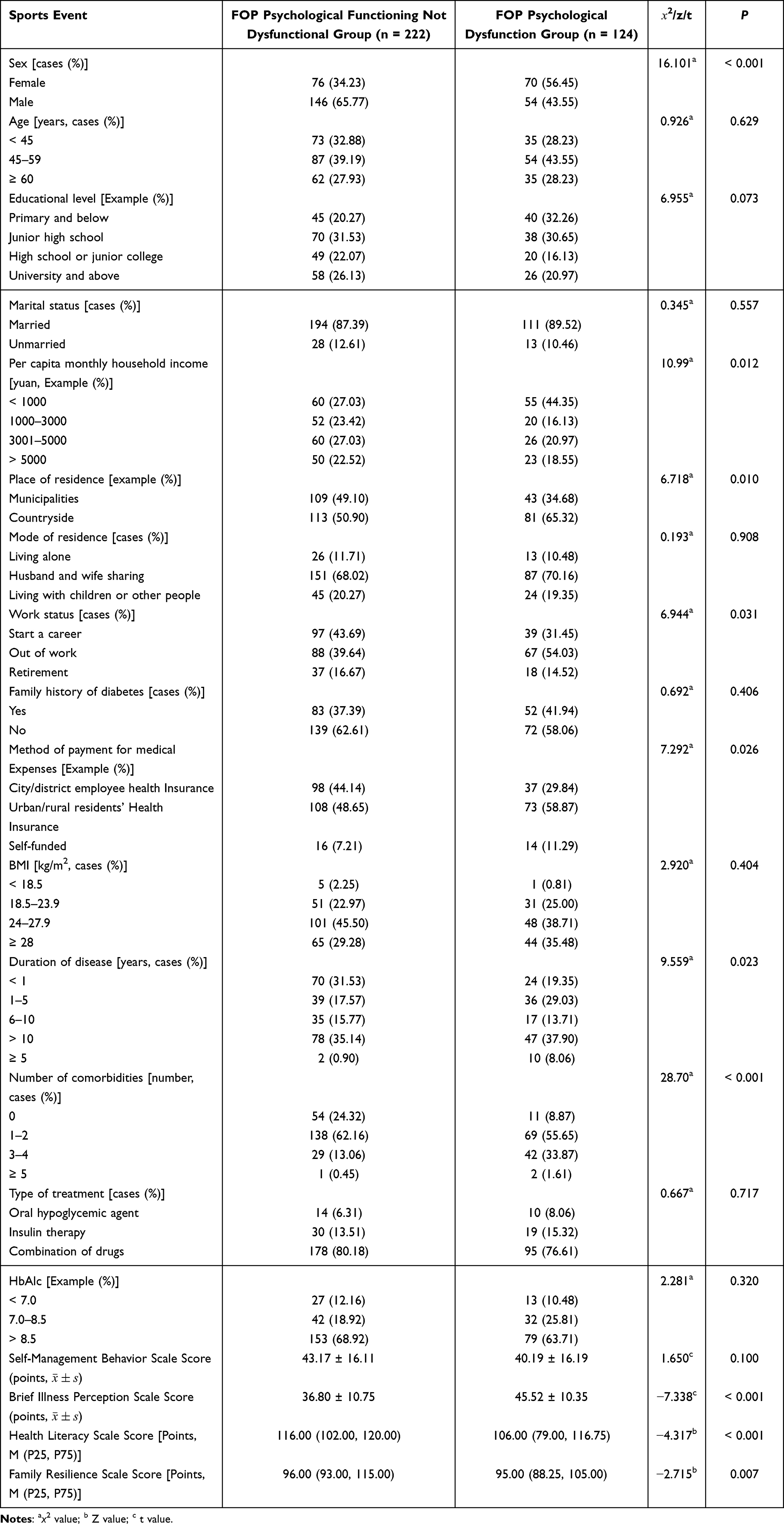 |
Table 1 Univariate Analysis of FOP in Patients with T2DM (n = 346) |
Multivariate Analysis of Factors Affecting FOP in Patients with T2DM
Using FOP psychological dysfunction in patients as the dependent variable, a bidirectional stepwise logistic regression analysis was conducted, incorporating variables with P < 0.05 from the univariate analysis. The independent variables were assigned as follows: Gender (male = 0, female = 1); per capita monthly household income (< 1000 yuan/month = 1, 1000–3000 yuan/month = 2, 3001–5000 yuan/month = 3, and > 5000 yuan/month = 4); residential area (rural = 0 and urban = 1); work status (employment = 1, unemployment = 2, and retirement = 3), and payment method for medical expenses (city/district employee medical insurance = 1, urban/township resident medical insurance = 2, and self-payment = 3). Moreover, the disease duration was classified as follows: < 1/year = 1, 1–5/year = 2, 6–10/year = 3, and > 10/year = 4. The number of complications was classified as 0/1 = 1, 1–2/2 = 2, 3–4/3 = 3, and ≥ 5/4 = 4, while the number of comorbidities followed the same classification. The original scores of BIPQ, HeLMS, and FRAS-C were recorded. The results revealed that gender, place of residence, number of complications, comorbidities, BIPQ, and FRAS-C scores were the influencing factors for FOP psychological dysfunction in patients, as outlined in Table 2.
 |
Table 2 Logistic Regression Analysis Results of Factors Influencing FOP in Patients with T2DM |
Drawing of FOP Nomogram Prediction Model for Patients with T2DM
Based on the results of the logistic analysis, a nomogram prediction model was constructed for FOP in patients with T2DM using R software, as depicted in Figure 1. The different values of the six variables are based on gender, place of residence, number of complications, number of comorbidities, BIPQ, and FRAS-C scores. The corresponding scores were determined using the scoring scale at the top of the nomogram, indicated by vertical lines (default range: 0–100 points). Subsequently, the scores of all variables were summed to obtain a total score. The corresponding predicted risk value was obtained on the prediction line at the bottom of the nomogram using the total score. Clinical nursing staff can calculate the scores of six predictive factors by comparing the nomogram to obtain the risk prediction value of FOP psychological dysfunction in patients with T2DM.
 |
Figure 1 Nomogram for FOP in patients with T2DM. |
Validation of the FOP Risk Prediction Model for Patients with T2DM and Evaluation of the Value of Clinical Application
Internal Validation: An ROC curve was constructed using the predicted probabilities from the nomogram model, as displayed in Figure 2. This curve helps evaluate the discriminative ability of the model. The area under the ROC curve was 0.814 (95% confidence interval [CI]: 0.767–0.862), with sensitivity and specificity recorded at 76.6%. The maximum Youden index was 0.532, and the optimal cutoff value for risk prediction was 0.361. The calibration curve of the nomogram model was drawn to assess its accuracy, as illustrated in Figure 3. The calibration curve closely coincided with the ideal curve, indicating strong consistency between the predicted risk of FOP in patients with T2DM and the actual risk. Additionally, the net benefit of varying threshold probabilities was quantified using DCA curves to evaluate the clinical utility value of the predictive model. The results revealed that the overall net benefit rate of the DCA curve within the threshold range of 0–1 was higher than the two extreme cases of no intervention and full intervention, as illustrated in Figure 4. This finding suggests that the clinical utility of the predictive model is relatively high.
 |
Figure 2 ROC curve of the FOP prediction model for patients with T2DM. |
 |
Figure 3 Risk prediction model calibration curve diagram. |
 |
Figure 4 DCA diagram of the FOP risk prediction model for patients with T2DM. |
Discussions
Current Status of FOP in Patients with T2DM
The results of this study revealed that the incidence of FOP among patients with T2DM was 35.8%. This finding is similar to the results of Arend et al, who reported a 36.3% incidence of fear regarding long-term complications in patients with T2DM.22 However, it is significantly higher than the survey results of FOP incidence in elderly patients with T2DM in China (15.0%).23 This may be due to the fact that participants of this study were patients with T2DM, including individuals from all age groups—youth, middle-aged, and elderly. Additionally, data indicates that the number of young and middle-aged patients with T2DM in China is 1.6 times that of elderly patients.24 These younger individuals are at the peak of their productivity and tend to experience a greater psychological burden when they become ill. Therefore, healthcare professionals must focus on assessing the fear of disease progression in patients with T2DM. Early identification of those experiencing FOP, along with active interventions, can improve their psychological dysfunction.
Factors Affecting FOP in Patients with T2DM
Gender
This research revealed that female patients with T2DM exhibited higher levels of FOP compared to male patients, an independent risk factor for FOP. These findings are consistent with the results of Yang Han et al.25 Compared with male patients, female patients pay more attention to personal appearance and physical details. Therefore, when they experience disease progressions, such as diabetic foot, retinopathy, or other complications, they are more likely to develop negative thoughts, emotional responses, and behaviors associated with their bodies. This can lead to negative psychological outcomes such as feelings of inferiority, shame, and fear.26 Additionally, this may be linked to the psychological resilience of the patient. Women have delicate and sensitive minds and may exhibit relatively lower psychological resilience when facing adverse events such as disease progression.27 They are prone to negative emotions such as anxiety and depression, which can lead to pronounced fear. This suggests that medical staff should timely provide adequate psychological support based on the gender characteristics of patients. This may help prevent FOP development in patients with diabetes and reduce levels of fear.
Residence
This study found that the living environment is a significant risk factor for FOP in patients with T2DM. The reason may be that patients with diabetes living in villages and towns often experience poor economic conditions due to limited development in their areas and a lack of stable employment. Besides, patients with self-funded or basic medical insurance for urban and rural residents bear higher expenses, which increases their concern about the disease and heightens feelings of FOP. A study examining the FOP levels of 100 patients with nasopharyngeal carcinoma who were discharged for five years found no correlation between the patient’s place of residence and their FOP levels. This result contrasts with the findings of our study.28 This may be due to the fact that 57% of the participants in this study were urban residents, while only 37% of the participants in the study by Qiu Liyan et al lived in urban areas.28 Varying proportions of survey subjects may cause differences in the results. Consequently, medical staff should emphasize strengthening the psychological counseling of urban patients with diabetes and not overlook the impact of living environment differences on their levels of FOP.
Complications
The results indicated that the increase in complications in patients with T2DM may lead to higher FOP scores, reflecting a heightened fear of the adverse effects of diabetes. This finding aligns with the results of Yang Han et al.25 Conversely, elderly patients with complications of diabetes experience a long-term course of disease, excessive fluctuations in blood sugar range, and poor control, ultimately affecting the physical physiology of the patients. As the number of complications increases, patients may suffer greater physical damage. Additionally, a higher number of complications and medications leads to an enhanced economic burden. Furthermore, it increases the family pressure on patients due to stringent disease management.29 These superimposed effects can enhance fear of the progression of diabetes in patients.30 Therefore, medical professionals must pay close attention to the psychological and emotional status of patients with various complications and symptoms. Providing accurate guidance and education is essential to help patients understand the progression of their disease and to enhance their treatment compliance and confidence.
Comorbidities
The results of this study indicate that the presence of other chronic comorbidities is an independent predictor of FOP psychological dysfunction in patients with T2DM. This finding aligns with those of Liu Jinwen.31 The reason for these results may be that patients perceive all physical symptoms related to comorbidities as signs of disease progression. This can lead them to believe that their symptoms signal disease recurrence, resulting in excessive tension, sensitivity, and increased suspicion. Additionally, seeking related information online can exacerbate these feelings of suspicion and fear. Furthermore, Todd et al pointed out that when patients experience symptoms and treatment experiences of all existing physical diseases, they tend to develop cognitive barriers to the progression of the disease. This can lead to harmful and avoidant invasive rumination, ultimately inducing psychological distress of excessive fear of disease progression.32 Comorbidities exacerbate the complexity of disease management and increase the medication burden for patients. Patients with multiple comorbidities are more likely to have concerns about adverse drug reactions and associate the manifestation of symptoms with poor disease prognosis, increasing their fear. Therefore, medical professionals should evaluate a patient’s health history during the diagnostic process.
BIPQ Score
The results of this study indicate that disease perception can predict FOP psychological dysfunction in patients with T2DM. This is consistent with the findings of Cessna et al, which suggest that negative perceptions about the disease—such as overestimating risks or excessively focusing on symptoms—tend to increase patients’ fear levels.33 A study on 110 survivors of breast cancer in the UK found that patients who lack knowledge of the disease and have misperceptions are more likely to experience intense fear of disease progression.34 Individual differences in disease understanding also play a role; patients who perceive their condition as a severe threat are more susceptible to developing avoidance behaviors. Consequently, the nursing staff should focus on correcting patients’ negative cognition and encourage them to confront challenges rather than resort to avoidance.
FRAS-C Score
The results indicate that individuals with FOP-related psychological dysfunction exhibited lower family resilience scores than those who did not experience these issues. High family resilience can significantly reduce the occurrence of FOP in patients with T2DM, supporting the findings of Liu et al.35 Developing a plan to enhance family communication can help reduce patients’ fears of progression, strengthen family resilience, and improve patients’ quality of life. This underscores the importance of medical staff being attentive to the family resilience of patients with T2DM. By providing active and positive guidance, they can encourage families to recognize their strengths and resources. This approach allows families to fully utilize the compensatory and regulatory role of family resilience, ensuring the smooth functioning of family dynamics.
The FOP Prediction Model for Patients with T2DM Has Strong Predictive Ability, Having Specific Scientific and Practical Significance
This study established a binary logistic regression model based on R software, including six predictive factors: Gender, place of residence, number of complications, number of comorbidities, BIPQ, and FRAS-C scores. The predictive model was visualized with a nomogram. The model validation results revealed an AUC of 0.814, with the calibration curve overlapping significantly with the ideal curve. This confirms that the predictive model demonstrated strong stability and clinical predictive performance.
Conclusion
The risk prediction model developed in this study has demonstrated strong predictive performance, enabling the proactive identification of high-risk populations. Its application in clinical practice can enhance the personalized level of nursing for patients with diabetes and promote their physical and mental health. This model allows nursing staff to accurately identify high-risk groups for FOP in patients with T2DM. Additionally, it can enable early interventions based on high-risk factors, the implementation of personalized nursing measures, and effective health education. However, due to time constraints, the nomogram prediction model from this study has not yet undergone external validation, which will be a key focus for future research.
Disclosure
The authors report no conflicts of interest in this work.
References
1. Florêncio RB, de Araújo Fonseca LG, da Silva VFD, et al. Diabetes mellitus hospitalization and mortality rate according to a national database in Brazil: a longitudinal study. BMC Public Health. 2021;21(1):1–7. doi:10.1186/s12889-021-10438-z
2. Lee H, Um M, Nam K, et al. Development of a prediction model to estimate the glycemic load of ready-to-eat meals. Foods. 2021;10(11):2626. doi:10.3390/foods10112626
3. Liu T, Sun P, Zou J, et al. Increased frequency of β cells with abnormal NKX6. 1 expression in type 2 diabetes but not in subjects with higher risk for type 2 diabetes. BMC Endocr Disord. 2021;21(1):1–7. doi:10.1186/s12902-021-00708-7
4. Wang Y, Zeng Z, Ding J, et al. Fear of hypoglycemia among patients with type 2 diabetes mellitus: a cross-sectional study. Sci Rep. 2021;11(1):7971. doi:10.1038/s41598-021-86954-0
5. Paudel S, Khanal SP, Gautam S, et al. Anxiety and depression among people with type diabetes vi siting the diabetes clinics of Pokhara metropolitan, Nepal: a cross-sectional study. BMJ open. 2023;13(1):e064490. doi:10.1136/bmjopen-2022-064490
6. Dankert A, Duran G, Engst-Hastreiter U, et al. Fear of progression in patients with cancer, diabetes mellitus, and chronic arthritis. Die Rehabilitation. 2003;42(3):155–163. doi:10.1055/s-2003-40094
7. Jinwen L, Yan Q, Qin S, et al. Application progress of fear disease progression-related scales in evaluating chronic disease patients. Nursing Res. 2020;34(18):3272–3276.
8. Research on the relationship between fear of disease progression and coping style, and family function in Niurui type 2 diabetes patients. Guangxi University of Traditional Chinese Medicine, 2021.
9. Chinese MA. Guidelines for the prevention and treatment of type 2 diabetes (2020 edition) (I). Chin J Pract Internal Med. 2021;41(08):668–695.
10. Chunfeng X. Analysis of risk factors and construction of risk prediction model for breast swelling and pain in postpartum women. Southern Medical University; 2024.
11. Cold S, Cold F, Jensen MB, et al. Systemic or vaginal hormone therapy after early breast cancer: a Danish observational cohort study. J National Cancer Inst. 2022;114(10):1347–1354. doi:10.1093/jnci/djac112
12. Qiyun W, Zhixia Y, Li L, Peiyu L. Sinicization and reliability validity analysis of a simplified scale for fear of disease progression in cancer patients. Chin J Nurs. 2015;50(12):1515–1519.
13. Broadbent E, Petrie KJ, Main J, et al. The brief illness perception questionnaire. J Psychosomatic Res. 2006;60(6):631–637. doi:10.1016/j.jpsychores.2005.10.020
14. Zhang Y, Yongxia M, Zhiwei L, et al. Analysis of the subject-object interdependence model of resilience in stroke patients and their spouses to fear disease progression. J Nurs. 2024;39(06):78–81.
15. Qiaoqin W, Shaomei S, Xiaobin L, et al. Study on the reliability and validity of the self-management behavior scale for patients with type 2 diabetes. Chinese J Pract Nurs. 2008;(7):26–27.
16. Qu L. Research on the status quo and influencing factors of disease pain and self-management behavior of elderly patients with type 2 diabetes. Henan University, 2022.
17. Sixbey MT. Development of the Family Resilience Assessment Scale to Identify Family Resilience Constructs. Gainesville: University of Florida; 2005.
18. Li Y, Zhao Y, Zhang J, et al. Psychometric properties of the shortened Chinese family resilience assessment scale. J Child Family Stud. 2016;25(9):2710–2717. doi:10.1007/s10826-016-0432-7
19. Lirong W. A correlation study on health literacy, family resilience, disease perception, and fear of disease progression in stroke patients. Tianjin University of Traditional Chinese Medicine; 2023.
20. Jordan JE, Buchbinder R, Briggs AM, et al. The health literacy management scale(HeLMS) measures an individual’s capacity to seek, understand, and use health information in healthcare. Patient Educ Couns. 2013;91(2):228–235. doi:10.1016/j.pec.2013.01.013
21. Haolin S, Hui P, Hua F. Dimension structure analysis of the chronic disease patient health literacy survey scale. Environm Occupational Med. 2013;30(03):171–175.
22. Arend F, Müller UA, Schmitt A, et al. Overestimation of risk and increased fear of long-term complications of diabetes in people with type 1 and type 2 diabetes. Exp Clin Endocrinol Diabetes. 2019;127(10):645–652. doi:10.1055/a-0977-2667
23. Jiana F. Correlation analysis of cognitive weakness, disease perception, and fear of disease progression in elderly patients with type 2 diabetes. Dalian Medical University; 2023.
24. Saeedi P, Petersohn I, Salpea P, et al. Global and regional diabetes prevalence estimates for 2019 and projections for 2030 and 2045: results from the international diabetes federation diabetes atlas. Diabetes Res Clin Pract. 2019;157:107843. doi:10.1016/j.diabres.2019.107843
25. Han Y, Qiyuan S, Shiyu X, et al. Analysis of the current situation and influencing factors of fear disease progression in young and middle-aged patients with type 2 diabetes. Chongqing Med J. 2023;52(21):3349–3354.
26. Bingjie W. Research on the influencing factors and action paths of diabetes foot patients’ fear of disease progression. Tianjin University of Traditional Chinese Medicine; 2024.
27. Yang C, Congshan P, Jing Y, et al. A survey on fear of disease progression, social support, and psychological resilience in liver cancer patients after TACE. Chongqing Med J. 2020;49(11):
28. Liyan Q, Yang L. Analysis of the current status and influencing factors of fear of disease progression in nasopharyngeal carcinoma patients discharged for 5 years. Nursing Res. 2020;34(02):183–187.
29. Wang Y, Yu Q, Zeng Z, et al. Predictors of fear of diabetes progression: a multi-center cross-sectional study for patients’ self-management and healthcare professionals’ education. Front Public Health. 2022;10:910145. doi:10.3389/fpubh.2022.910145
30. Jiao T, Shan H. The mediating effect of self-efficacy between fear of disease progression and quality of life in patients with type 2 diabetes. Chinese and Foreign Med Res. 2021;19(07):160–162.
31. Jinwen L. Exploratory study on risk factors for fear of disease progression in patients with coronary heart disease. Yanbian University; 2021.
32. Todd J, Pickup B, Coutts-Bain D. Fear of progression, imagery, interpretation bias, and their relationship with endometriosis pain. Pain. 2023;164(12):2839–2844. doi:10.1097/j.pain.0000000000003003
33. Cessna Palas JM, Hyland KA, Nelson AM, et al. An examination of the relationship of patient modifiable and non-modifiable characteristics with fear of cancer recurrence among colorectal cancer survivors. Support Care Cancer. 2021;29(2):869–876. doi:10.1007/s00520-020-05552-4
34. Millan IDMH, Cameron J, Yang Y, et al. An observational mixed-methods approach to investigate the fear of cancer recurrence cognitive and emotional model by Lee-Jones et al. with women with breast cancer during radiotherapy treatment. ecancermedicalscience. 2019;13:984. doi:10.3332/ecancer.2019.984
35. Liu SH, Hsiao FH, Chen SC, Shiau SJ, Hsieh MH. The experiences of family resilience from the view of the adult children of parents with bipolar disorder in Chinese society. J Adv Nurs. 2022;78(1):176–186. doi:10.1111/jan.15008
 © 2025 The Author(s). This work is published and licensed by Dove Medical Press Limited. The
full terms of this license are available at https://www.dovepress.com/terms
and incorporate the Creative Commons Attribution
- Non Commercial (unported, 4.0) License.
By accessing the work you hereby accept the Terms. Non-commercial uses of the work are permitted
without any further permission from Dove Medical Press Limited, provided the work is properly
attributed. For permission for commercial use of this work, please see paragraphs 4.2 and 5 of our Terms.
© 2025 The Author(s). This work is published and licensed by Dove Medical Press Limited. The
full terms of this license are available at https://www.dovepress.com/terms
and incorporate the Creative Commons Attribution
- Non Commercial (unported, 4.0) License.
By accessing the work you hereby accept the Terms. Non-commercial uses of the work are permitted
without any further permission from Dove Medical Press Limited, provided the work is properly
attributed. For permission for commercial use of this work, please see paragraphs 4.2 and 5 of our Terms.
Recommended articles
Health Behavior Protection Motivation and eHealth Literacy in Type 2 Diabetes Patients: A Cross-Sectional Study
Chen F, Gao J
Journal of Multidisciplinary Healthcare 2026, 19:576440
Published Date: 21 January 2026