
Back to Journals » Patient Preference and Adherence » Volume 20
Factors Influencing the Implementation of Unaccompanied Care for Older Inpatients in Chinese Tertiary Hospitals: A Qualitative Study
Authors He Y  , Li R, Jiao T, Liu C, Chen Y, Li L
Received 2 September 2025
Accepted for publication 30 December 2025
Published 6 January 2026 Volume 2026:20 564683
DOI https://doi.org/10.2147/PPA.S564683
Checked for plagiarism Yes
Review by Single anonymous peer review
Peer reviewer comments 4
Editor who approved publication: Professor Qizhi (Cathy) Yao
Yaping He,1,* Ruilian Li,1,* Taofang Jiao,1 Chunyu Liu,1 Ying Chen,1 Li Li2
1School of Nursing, Southwest Medical University, Luzhou, Sichuan, 646000, People’s Republic of China; 2Department of Nursing, the Affiliated Hospital of Southwest Medical University, Luzhou, Sichuan, 646000, People’s Republic of China
*These authors contributed equally to this work
Correspondence: Li Li, Department of Nursing, the Affiliated Hospital of Southwest Medical University, Luzhou, Sichuan, 646000, People’s Republic of China, Email [email protected]
Background: In China, tertiary hospitals are piloting an “unaccompanied care” model in which trained care attendants, instead of constantly present family caregivers, provide 24-hour bedside and daily living care for older inpatients under nurses’ supervision. This hospital-based service aims to relieve family caregiving shortages and advance integrated care but remains non-standardised and faces major implementation challenges.
Objective: Guided by a social-ecological framework, this study examined the multilevel factors influencing the implementation of unaccompanied care and generated evidence to inform the optimization of service design, risk communication with family members, and the allocation of staffing and financial resources.
Methods: We used a qualitative descriptive design with a phenomenological orientation. Using purposive sampling with maximum variation, we recruited 36 participants: 21 older inpatients and family caregivers and 15 healthcare professionals (administrators, clinicians, nurses) and staff from companion-care companies. Data were collected through semi-structured interviews conducted between November 2024 and January 2025 and analysed using Colaizzi’s seven-step method.
Results: A total of five main themes and 15 sub-themes were identified: personal cognition, economy, and triple constraints; interpersonal support and interaction; organization resource integration and driving; social environment constraints and demands; public policy support and promotion.
Conclusion: The implementation of unaccompanied care in Chinese tertiary hospitals faces challenges such as economic burden, cultural expectations of family caregiving, and insurance policy gaps. Through targeted communication, joint development of infrastructure and staff capabilities, along with supportive payment and regulatory policies, this pilot model can be integrated into sustainable, high-quality care for elderly inpatients.
Keywords: “unaccompanied care” services, social ecosystem theory, stakeholders, barrier, facilitator, qualitative research
A Letter to the Editor has been published for this article.
A Response to Letter by Prof. Dr. Zhao has been published for this article.
Introduction
Population ageing and the rising prevalence of chronic conditions have made the organisation of hospital and long-term care a policy priority worldwide.1,2 Many high-income countries have expanded formal long-term care3 and integrated care4 programmes to complement, and in part replace, traditional family-based caregiving. For example, under Japan’s long-term care insurance system,5 frail older adults can access institutional and home-based services delivered mainly by professional staff, and “unaccompanied” institutional stays are largely financed through public insurance rather than direct family caregiving. In many European countries and North America, routine inpatient daily care is primarily delivered by professional nursing staff, with family members providing intermittent emotional and social support rather than continuous bedside care.6 These institutional arrangements reflect different cultural expectations regarding family responsibility, professional care and the role of the state in supporting older adults. In contrast to these models, China’s newly piloted “unaccompanied care” services enables hospitalized patients to forgo the need for family accompaniment or the hiring of private caregivers. Instead, the inpatient care is delivered by standardized professionally trained nursing assistants in coordination with medical staff.7
In China, similar demographic and epidemiological transitions are occurring. According to the Seventh National Population Census, 264 million people are aged 60 years or above, accounting for 18.7% of the total population, which has led to a growing demand for professional long-term care services.8 To relieve this pressure, the National Healthcare Security Administration issued the nursing fee can better reflect the value of technical labor and support hospitals in providing “Unaccompanied care” services in 2024, encouraging local governments to explore localised and diversified care models within a unified policy framework.9 Within this policy context, Fujian, Tianjin, Zhejiang and Sichuan tertiary hospitals have begun piloting what is locally termed the “unaccompanied care” services or “unaccompanied care wards”. This model involves standardized professionally trained nursing assistants providing 24-hour continuous daily living assistance and other services to hospitalized patients. Under the guidance and management of registered nurses, these nursing assistants deliver companionship and daily care based on patients’ clinical conditions and individual needs, while also assisting nurses in health education and patient safety protection. Currently, two operational models are being implemented in China: (1) all basic care and daily living tasks, including eating, personal hygiene and mobility, are undertaken by nurses or full-time care workers; and (2) patients are generally admitted without self-brought attendants, or a family member may stay only for emotional support (“accompany but not care”), while professional staff deliver the full range of nursing and daily care services.7
Integrated care seeks to provide coordinated, continuous and person-centred services across providers and sectors, integrating medical and social support.10 From an integrated care perspective, unaccompanied care is expected to promote safer, more coordinated and more professional inpatient care by lowering the risk of hospital-acquired infections, improving nursing quality and enhancing patients’ experiences.11 Nevertheless, this model remains in an early pilot phase, mainly in tertiary hospitals, and has not yet evolved into a standardised national service. Its wider implementation is hindered by several structural barriers, including low public awareness, shortages of nursing staff, the lack of unified service specifications and an underdeveloped health insurance payment mechanism.
Against this backdrop, empirical evidence on unaccompanied care remains limited despite growing policy interest and local experimentation. Existing studies largely focus on programme design, service processes or the experiences of a single stakeholder group. Few adopt a multi-level perspective that explicitly examines how individual, interpersonal, organisational and policy-level factors jointly shape the uptake and delivery of unaccompanied care within an integrated care framework.12 The social ecology theory provides a useful theoretical foundation for this analysis. It views the utilization of health-related behaviors and services as the outcome of dynamic interactions between different levels.13 Based on this theory and adopting a stakeholder perspective12, this study aims to identify the factors influencing the choice of individual care services for elderly inpatients in tertiary hospitals, providing information for formulating strategies that are adapted to local conditions and involve multiple stakeholders, in order to promote the development of comprehensive hospital care services for the elderly in China. Therefore, we conducted a qualitative study with older inpatients, family caregivers and healthcare providers in tertiary hospitals in China, using social ecological theory to guide data collection and analysis.
Method
We adopted a descriptive qualitative design to obtain a rich and straightforward account of participants’ experiences and perceptions of the “unaccompanied care” service model in routine clinical practice. This design is particularly suitable for practice-oriented inquiries that aim to stay close to participants’ own language and meanings while informing service development and improvement. The study is reported in accordance with the (Consolidated Criteria for Reporting Qualitative Research, COREQ).14 Guided by the social ecological framework, we explored the influencing factors in the implementation process of unaccompanied care services from three dimensions: the micro level (individual level), the meso level (interpersonal and organizational level), and the macro level (policy and social-cultural level). Interview data were analyzed using Colaizzi’s phenomenological method, which provided a systematic structure for extracting significant statements, formulating meanings, and organizing themes.15
Participants
The study was conducted in a Grade A tertiary hospital in Luzhou, China, between November 2024 and January 2025. We used purposive sampling to recruit inpatients, their family caregivers, and healthcare staff involved in the organization and delivery of this unaccompanied care model. Recruitment focused on adult inpatients with high care needs, most of whom were older adults affected by population aging and limited family caregiving capacity.
The inclusion criteria for patients were as follows: admitted to the hospital with a documented nursing level of special care or level-I care; Barthel Index ≤ 60;16 age ≥ 60 years;17 clear consciousness, intact orientation, and ability to communicate verbally or in writing; and provision of written informed consent. Patients were excluded if they had impaired consciousness or severe communication difficulties; were judged by the clinical team to be excessively dependent on continuous family care (ie unable to participate in self-care or in-depth interviews without constant assistance from family members); refused personal care from non-family caregivers due to religious or cultural beliefs; declined to participate even after a full explanation of the study; or had severe comorbidities that precluded participation in the interview.
The inclusion criteria for caregivers were as follows: age ≥ 18 years; clear mental status and intact cognitive function; participation in the unaccompanied care service model during the index hospitalization; and provision of written informed consent.
The inclusion criteria for stakeholders were as follows: at least 5 years of professional experience in clinical nursing, nursing management, or hospital administration; direct involvement in planning, delivery, or management of unaccompanied care services; and voluntary participation.
Sampling and Sample Size
We combined maximum-variation purposive sampling with the principle of information saturation. Participants were selected to ensure diversity in patient characteristics (eg, gender, age, educational level, marital status, number of children) and professional roles and years of experience among staff. Recruitment and interviewing proceeded iteratively. Data saturation was considered to have been reached when three consecutive interviews yielded no new codes or themes, at which point enrolment was discontinued.
Data Collection
Data were collected through in-depth, face-to-face semi-structured interviews, guided by an interview schedule developed from the social ecological model. Drawing on a review of the literature, relevant policies on unaccompanied or extended nursing care, and expert consultation within the research team, we drafted an initial interview guide that covered: (1) perceptions and needs at the micro level, (2) family and professional support at the meso level, and (3) institutional and policy factors at the macro level. One representative from each stakeholder group reviewed the draft guide for clarity and relevance.
We then piloted the guide with two patient–family dyads; feedback from these interviews was used to refine wording, sequencing, and probing questions, and the pilot data were not included in the formal analysis. The final version of the interview guide, including core questions and prompts, is presented in Figure 1.
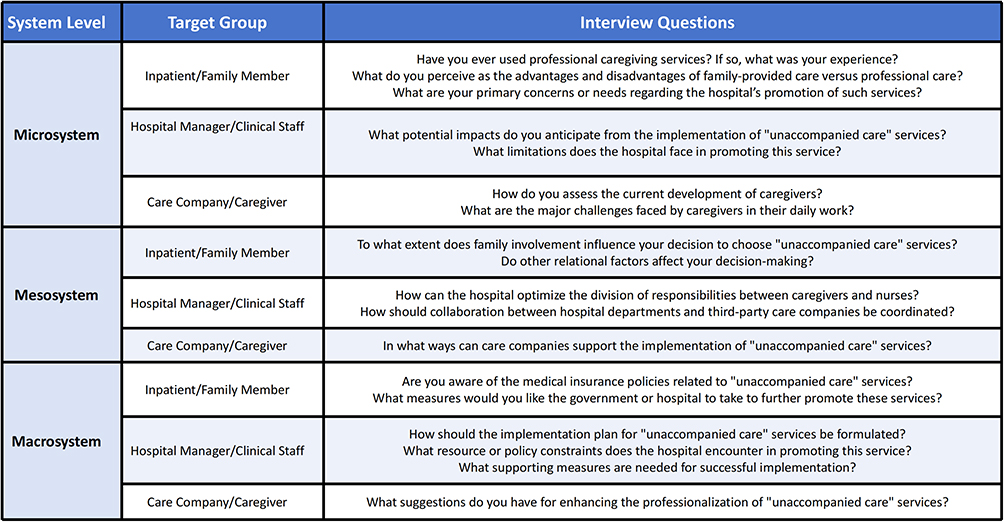 |
Figure 1 Semi-structured interview guide for stakeholder interviews on “unaccompanied care”. |
All formal interviews were conducted by the first author, who had received formal training in qualitative interviewing and phenomenological analysis and had extensive inpatient nursing experience. Before each interview, the researcher explained the study aims, procedures, and data management plan to potential participants and obtained written informed consent from those who agreed to take part. Interviews were conducted in quiet, private rooms on the inpatient wards at times that did not interfere with clinical care, meals, or scheduled rest. With participants’ permission, all interviews were audio-recorded. In addition to the audio data, the interviewer documented non-verbal cues (eg facial expressions, affect, tone of voice) and contextual information in field notes and reflective journals. Each interview lasted approximately 30–60 minutes.
Data Analysis
Within 24 hours of each interview, two researchers who were not involved in data collection transcribed the audio recordings verbatim and cross-checked the transcripts against the field notes and reflective journals. When gaps or ambiguities were identified, the researchers contacted participants to clarify meanings. Transcripts were then returned to participants for member checking when clarification or confirmation was needed.
We used NVivo 11.0 (QSR International) to manage, store, and code the data. Data analysis followed Colaizzi’s seven-step phenomenological method: (1) all transcripts were read repeatedly to obtain an overall understanding; (2) significant statements related to experiences of unaccompanied care were extracted and imported into NVivo as initial codes; (3) formulated meanings were derived by comparing codes within and across participants; (4) these meanings were grouped into categories, themes, and subthemes, with attention to convergence and divergence across patient, caregiver, and staff perspectives; (5) a rich narrative description was written for each theme; (6) the essential structure of the phenomenon was refined by comparing themes across the micro, meso, and macro levels of the social-ecological framework; and (7) preliminary findings were presented to a subset of participants and to the wider research team to confirm resonance with their experiences and refine the wording of themes.
Two researchers coded the transcripts and developed preliminary coding frameworks. They then compared their coding, discussed discrepancies, and refined the codebook iteratively. A third senior researcher, who had extensive experience in qualitative analysis and was not involved in data collection, independently reviewed a subset of transcripts, the evolving codebook, and the thematic structure. This researcher helped resolve any remaining disagreements, checked the fit between raw data and coded themes, and provided feedback on the clarity and distinctiveness of themes. This three-analyst process enhanced the credibility, dependability, and confirmability of the findings.
Results
Characteristics of Participants
We conducted one-to-one, semi-structured interviews with hospitalized older patients, their family caregivers, and key stakeholders involved in the organization, delivery, and management of “unaccompanied care” services. In total, 21 older patients and family caregivers participated and were assigned the codes P1–P15 and C1–C15, respectively, and 15 stakeholders (nurses, nurse managers, physicians, and administrative staff) were assigned the codes N1–N15. The interviews lasted for approximately 10 hours in total and generated more than 65,000 words of verbatim transcripts. No repeat interviews were conducted. The demographic characteristics of patients and family caregivers are summarized in Table 1, and the demographic profiles of stakeholders are presented in Table 2.
 |
Table 1 General Information of Patients |
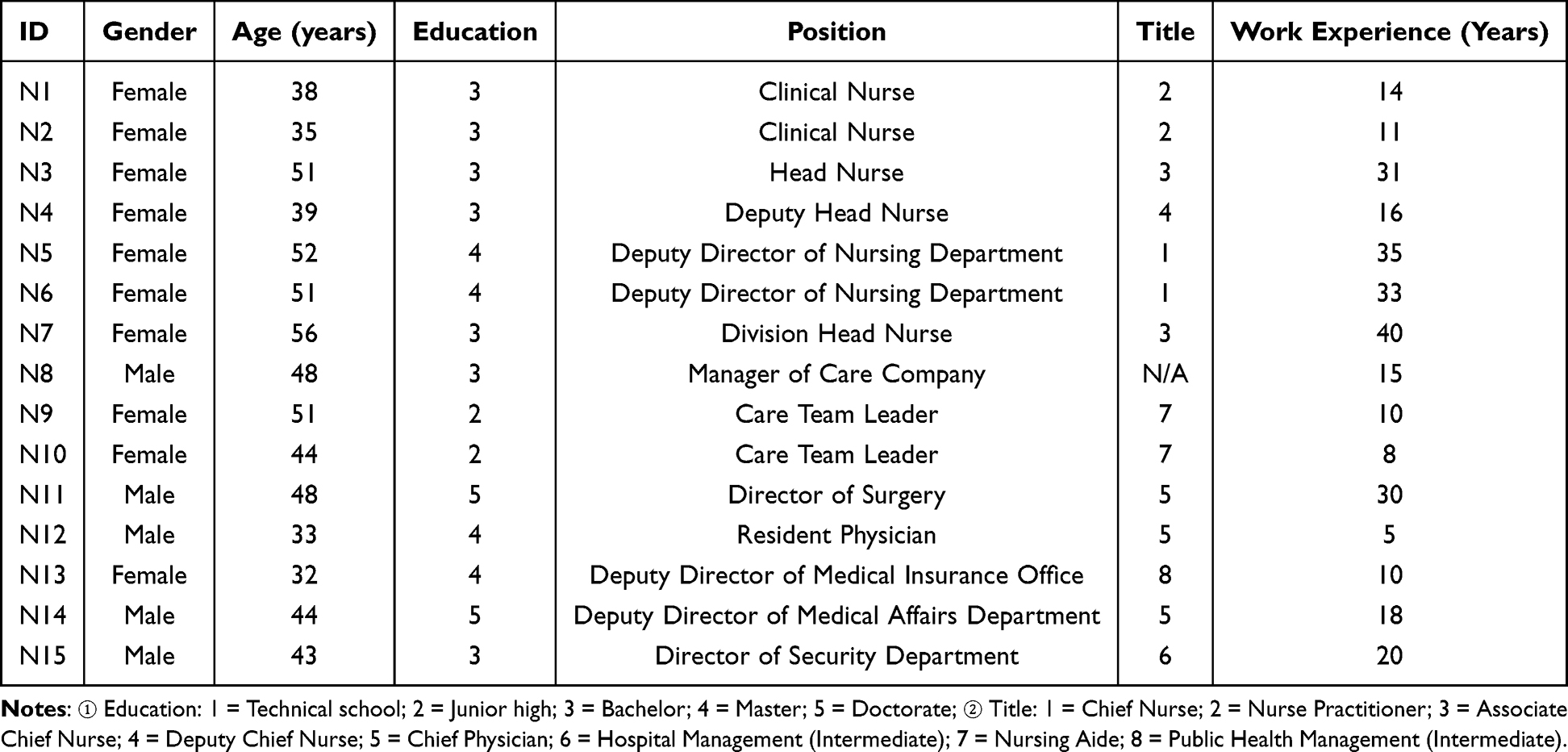 |
Table 2 Basic Information of Stakeholders |
Theme 1: Personal Cognition, Economy, and Triple Constraints
Sub-Theme 1.1 Insufficient Awareness of Unaccompanied Care Services
At the individual level, many patients and family caregivers had limited or fragmented awareness of unaccompanied care services. Few had received systematic information from hospitals; instead, most learned about the service informally through short videos or advertisements on platforms such as WeChat and TikTok. Some family members misinterpreted “unaccompanied care” as meaning that patients would be left alone with minimal supervision or assistance. Perceived safety was a central concern shaping their willingness to use these services, as they questioned whether caregivers could respond promptly to urgent needs, provide individualized attention, and maintain adequate nurse–patient ratios. Their informational needs therefore extended beyond basic service descriptions to concrete assurances regarding staffing, response times, and safety mechanisms.
C05: Patients need assistance when using the restroom at night. How long would it take for a caregiver or nurse to arrive?
P03: With so many patients, can nurses really take better care of us than our own family members?
Sub-Theme 1.2 Economic Constraints
Economic considerations were another key factor shaping participants’ decisions about whether to use unaccompanied care services. Many patients and family caregivers perceived the service as costly and were uncertain whether the expenses were proportional to the benefits, particularly in low-income families. One patient described the cumulative financial strain of long-term illness and treatment, while another caregiver emphasized that tuition fees and daily expenses for their children left little capacity to pay for additional caregiving services. These narratives illustrate that willingness to use unaccompanied care is closely tied to perceived affordability, and that high out-of-pocket costs may discourage uptake even when participants recognize the potential benefits of professional caregiving. Participants also expressed a clear need for transparent pricing and financial protection mechanisms to reduce the perceived economic risk of choosing this service model.
P07: I worked in Guangzhou for many years, but all the money I earned has now been spent on medical treatment. Continuing treatment has become a heavy burden for my family.
C03: I have already paid for my children’s education through college, and now my savings are completely depleted.
Sub-Theme 1.3 Dual Service Requirements
Participants described dual expectations for unaccompanied care services, encompassing both professional clinical care and non-professional daily-living and emotional support. On the professional side, nursing managers and clinical staff expected caregivers to have sufficient competence to conduct basic health monitoring, recognize early warning signs of deterioration, and collaborate effectively with nurses, with a clear division of labor between caregivers and registered nurses. These expectations underscored the perceived need for standardized training, explicit role definitions, and coordinated team-based care to ensure safety and quality. At the same time, patients and family caregivers placed considerable emphasis on non-professional aspects, including assistance with daily activities, dietary arrangements, visiting policies, and emotional support. Divergent views emerged regarding hospital meals and visitation rules: while some stakeholders felt that structured visitation could reduce disruption and improve ward order, family members often experienced such restrictions as inconvenient or even distressing. Across accounts, participants repeatedly highlighted the importance of empathy, communication, and psychological comfort, indicating that daily comfort, connection with family, and emotional reassurance are as crucial as professional competencies in shaping their attitudes toward unaccompanied care.
N03: Professional caregivers should be able to assist with basic assessments, monitor changes in patients’ conditions, and handle simple emergencies before informing nurses.
N04: Caregivers should take responsibility for basic activities of daily living, while nurses focus on professional tasks such as treatment, patient education, and complex care.
P10: I like the hospital meals; they are convenient.
P12: The food does not always meet my taste or dietary restrictions.
N12: Implementing a structured visitation management system can reduce redundant communication with families and help us focus on patient care.
C14: Restricting visitation hours significantly inconveniences us as family members.
C10: If I can only see my relative at fixed times, how is that different from being imprisoned?
P08: I hope the caregivers can be more considerate and not so cold.
C01: Communication with patients is very important. Caregivers should provide psychological guidance and emotional support.
Theme 2: Family Support and Caregiving Dilemmas
Sub-Theme 2.1 Family Role Conflict
At the interpersonal level, family support emerged as both a crucial resource and a source of strain. Many family caregivers expressed a strong desire to fulfill filial obligations while simultaneously experiencing considerable physical, emotional, and occupational pressure. They described feeling torn between staying at the bedside and maintaining their own work and health. Stakeholders also acknowledged that, in the Chinese cultural context, family companionship is deeply valued and separation can trigger anxiety for both patients and relatives. As a result, family motivations toward unaccompanied care were often ambivalent: on the one hand, families hoped that professional services could help relieve the caregiving burden; on the other hand, they worried that relying on such services might be perceived as “replacing” weakening their filial responsibilities, thereby generating guilt and anxiety.
C11: My parents are getting older, and providing long-term care is taking a toll on my own health. My work commitments prevent me from being at the hospital all the time.
N06: For many Chinese people, nothing compares to the comfort of family companionship, but being separated from loved ones can trigger separation anxiety for both sides.
Sub-Theme 2.2 Professional Support from Nurses and Caregivers
Participants emphasized that effective professional support from nurses and trained caregivers was pivotal for building trust in unaccompanied care services. Nursing assistants were regarded as essential for taking over basic activities of daily living and routine care tasks, thereby allowing nurses to concentrate on more specialized clinical duties. At the same time, some family members initially felt reluctant to rely on non-family caregivers because of concerns about trust and safety. However, when they perceived the system as clearly regulated, with explicit standards and professional supervision, their attitudes became more accepting. These findings suggest that confidence in institutional regulations and professional safeguards is a key interpersonal mechanism linking families’ caregiving dilemmas to their eventual willingness to adopt unaccompanied care.
N02: Caregivers can take over basic daily-living tasks, which allows nurses to focus on more specialized clinical duties.
C06: We have always taken care of everything ourselves because we do not fully trust others.
C06: If there are clear regulations and professional safeguards in place, we can all accept unaccompanied care.
Theme 3 Organization Resource Integration and Driving
Sub-Theme 3.1 Opportunities for Hospital Development
At the organizational level, unaccompanied care services were viewed as an opportunity to enhance both service quality and hospital development. Stakeholders suggested that structured caregiving could improve ward order, reduce safety incidents, shorten patients’ length of stay, and increase satisfaction, even though it imposes additional attendant costs on families. Unaccompanied care was also perceived as a way to expand the hospital’s service portfolio and strengthen its reputation. Overall, organizations tended to regard unaccompanied care not only as a clinical service, but also as a strategic initiative to support sustainable development and competitiveness.
N06: Although the service imposes additional attendant costs on families, it significantly reduces patients’ length of stay and enhances satisfaction.
N15: Implementing attendant-free care expands the scope of medical services and improves the hospital’s image.
Sub-Theme 3.2 Multi-Department Coordination and Collaboration
Effective implementation of unaccompanied care was described as highly dependent on cross-departmental coordination, information sharing, and clearly defined institutional procedures. Participants emphasized that nursing, medical affairs, finance, logistics, and other units all needed to be involved, and that collaboration should be embedded in departmental performance indicators. They also highlighted the importance of robust information systems to ensure timely responses to patients’ and families’ needs. These accounts underscore that unaccompanied care cannot be sustained by the nursing department alone; instead, it requires a system-level organizational response, including standardized workflows, staff training, and integrated information platforms.
N06: This service requires coordination across nursing, medical affairs, finance, logistics, and other units. Collaboration should be incorporated into departmental performance indicators.
N08: Hospitals need robust information systems to promptly respond to the needs of patients and their families.
Theme 4 Social Environment Constraints and Demands
Sub-Theme 4.1 Constraints of Traditional Concepts
At the social environment level, Confucian philosophy and traditional filial piety norms were described as powerful influences on attitudes toward unaccompanied care. Many participants expressed a strong moral obligation for adult children to provide direct, hands-on care for their older parents, and some framed hospital accompaniment as a core expression of filial duty. These deeply rooted expectations shaped caregivers’ sense of self-worth and, in some cases, led family members to reduce working hours or even resign from their jobs to remain at the bedside. As a result, cultural norms could limit families’ willingness to accept unaccompanied care, even when they acknowledged its practical advantages.
P11: I believe family members should make time to stay with their elders in the hospital.
N05: Children feel they must be by their parents’ side to feel a sense of self-worth.
Sub-Theme 4.2 Increasing Demands of an Aging Population
Participants also noted that rapid population aging was intensifying the tension between traditional expectations and contemporary caregiving realities. Long-term care responsibilities for older parents placed substantial physical, emotional, and financial burdens on middle-aged caregivers, making it increasingly difficult to balance employment and caregiving roles. Some older patients, aware of these pressures, expressed support for unaccompanied care as a way to avoid overburdening their children, provided that the service was reliable and affordable. Taken together, these accounts depict a social transition in which enduring filial norms coexist with demographic and economic pressures, creating both obstacles and opportunities for the wider adoption of unaccompanied care models.
C01: The long-term care of aging parents takes a huge toll on caregivers’ health. It is very hard to balance work and caregiving.
P09: I would support a service like this if it were both affordable and reliable. My children have jobs, and I do not want to burden them. This initiative is essential.
Theme 5 Public Policy Support and Promotion
Sub-Theme 5.1 Strengthening Publicity and Promotion
At the policy level, participants emphasized the need for comprehensive and trustworthy publicity to build public awareness and acceptance of unaccompanied care. Stakeholders suggested that hospitals should position unaccompanied care as a specialized program and actively promote it through multiple media channels, rather than treating it as an auxiliary service. Family caregivers also noted that visible public and institutional endorsement would strongly influence their own decisions. Together, these perspectives point to the importance of transparent communication strategies and policy-supported health education campaigns to reduce misconceptions and encourage informed uptake of unaccompanied care services.
N04: Widespread publicity is fundamental to building public awareness.
N06: Hospitals should treat companion-free care as a specialized program and intensify promotion through various media channels.
C07: If a service gains public approval, we as family members are more likely to approve of it as well.
Sub-Theme 5.2 Phased Pilot Exploration
Stakeholders widely endorsed a phased pilot approach to implementing unaccompanied care services. They emphasized that scientific planning, a clearly defined pilot scope, and stepwise implementation are essential for managing risks and uncertainties during the rollout phase. Participants also stressed the importance of continuous training and iterative improvement, arguing that caregiver training should follow a cycle of ongoing refinement. In addition, they highlighted the need for close coordination between hospitals and community institutions to progressively improve both formal regulations and informal practices. These views suggest that policymakers should prioritize small-scale pilot projects, systematic evaluation, and feedback-driven adjustment of standards to support the responsible scaling up of unaccompanied care services.
N03: A well-defined scope for pilot programs is essential to control risks during the implementation phase.
N03: The training of caregivers must be grounded in the principle of continuous improvement.
N08: Hospitals must coordinate closely with community institutions and gradually refine both formal and informal regulations.
Sub-Theme 5.3 Medical Insurance System Protection
Participants identified limitations in the medical insurance system as a major barrier to the wider adoption of unaccompanied care. In many regions, attendant-related services have not yet been incorporated into basic medical insurance, resulting in substantial out-of-pocket expenses and leading some families to provide care themselves instead of using unaccompanied care. Caregivers reported taking unpaid leave or even resigning from their jobs to care for older relatives, which further intensified their financial burden. Others pointed to inequities between different insurance schemes, such as gaps between urban resident insurance and employee medical insurance, which result in unequal coverage for these services. These accounts underscore that insurance coverage and financial protection policies are critical determinants of the feasibility and equity of unaccompanied care, and that targeted policy reforms are needed to support its sustainable implementation.
C07: Because the service is not covered by insurance, many families still choose to provide care on their own.
C14: There is a significant gap between urban resident insurance and employee medical insurance, which leads to unequal coverage for these services.
Discussion
Individual Level: Limited Awareness of the “Unaccompanied Care” Service and Safety Concerns Among Patients and Their Families Serve as the Primary Barriers to Its Acceptance
Consistent with previous studies, participants described a tendency to overestimate potential risks while underestimating possible benefits when faced with an unfamiliar model of care, leading to hesitation and resistance at the point of admission.18 In line with the rationale outlined in the Introduction, these findings underscore the need for sustained, multi-channel health education and public communication. Governments and hospitals can use television public service announcements, science popularization videos, live streams on short-video platforms (eg TikTok/Douyin), and official WeChat accounts to provide clear, accessible information. Visually demonstrating routine care processes, safety measures, and complaint or feedback mechanisms within unaccompanied care may help correct misconceptions, gradually build public understanding and trust, and ultimately increase older inpatients’ willingness to choose this model.
With the advancement of internet technologies,19 artificial intelligence,20 and remote monitoring systems,21 hospitals can digital tools to reduce patients’ rigid dependence on constant bedside presence of family members. For instance, combining online video with scheduled in-person visits, hospitals can establish real-time video visiting systems at ward level and allow families to book visit times and durations online platforms. Visit quotas can be set based on patients’ clinical conditions and ward capacity to ensure safety and order. Such digital solutions enable family members to participate in clinical communication and major decision-making even when they cannot remain at the bedside for extended periods. In doing so, they help maintain emotional bonds and respond to the filial ideals of “being present” and “showing care,” without substantially increasing ward crowding or the risk of cross-infection.
In addition, nutritional care represents a concrete domain in which unaccompanied care can add value. Hospitals may leverage multidisciplinary collaboration by integrating resources from nutrition departments and clinical units to establish a structured and continuous nutritional management system. Based on comprehensive assessment of patients’ clinical conditions, laboratory indicators and dietary habits, individualized nutritional plans can be developed, dynamically monitored and regularly adjusted by specialist nutrition nurses.22,23 Digital platforms can also be used to create patient social-support communities, enabling real-time collection of feedback and questions, and thereby enhancing the accessibility, interactivity and perceived responsiveness of the service.24
Interpersonal Level: The Tension Between Traditional Family Culture and Contemporary Social Reality Is Particularly Salient
In Chinese cultural norms, having family members at the bedside during hospitalization is regarded as an important way of fulfilling moral responsibility and filial piety.25 Continuous family presence not only symbolizes affection and obligation, but is also believed to enhance patients’ sense of security and adherence to treatment. This cultural expectation leads many patients and family members to prefer conventional arrangements in which relatives provide direct bedside care.26,27 To respond to these cultural expectations while accommodating practical constraints, “unaccompanied care”can offer a feasible pathway for family–care worker collaboration: family members primarily provide emotional support and participate in major medical decisions, while professional nurses and care workers deliver continuous, standardized clinical care. To ensure both safety and person-centredness within this model, it is necessary to strengthen care workers’ “hard skills” and “soft skills” in tandem.28 On the one hand, standardized training should enhance basic caregiving skills and clinical observation capabilities; on the other hand, curricula should systematically include psychological communication, emotional support, and functional exercise, thereby improving care workers’ ability to address patients’ emotional and rehabilitation needs.29 Building a tiered competence-based training system with job competency at its core may help integrate formal services with informal family care under the value framework of filial piety, and better alleviate the family burden encapsulated by the saying “when one person is hospitalized, the whole family is exhausted”.
Organizational Level: The Successful Implementation of “Unaccompanied Care” Depends on Robust Operational Mechanisms and Staffing Structures
During the initial phase, hospitals inevitably need to invest in large-scale recruitment and training, information systems, and other technical infrastructure, which can be particularly challenging for resource-limited primary and secondary facilities. Nonetheless, if the model is carefully designed and properly managed, standardizing care processes and clarifying role responsibilities have the potential to substantially improve efficiency.30 Clearly delineating task boundaries between nurses and care assistants can reduce duplicate work and procedural redundancies, allowing registered nurses to focus more on complex and high-risk clinical decision-making and interventions.31 Effective coordination and communication among hospital managers, clinical teams, patients, and families are equally critical. For example, integrating joint ward rounds involving physicians, nurses and care workers; implementing staggered rounding schedules; and adopting parallel workflows between nurses and care workers can all contribute to more precise allocation of resources.31,32 A unit-based geographic assignment system, in which nurses and care assistants jointly responsibility for a defined group of patients, may help maintain continuity of information exchange and improve responsiveness to changes in patients’ conditions. In turn, this can enhance continuity and safety of care while reducing frontline staff workload and fatigue.33,34
Social Environment Level: Prevailing Social Values Strongly Shape Acceptance of “Unaccompanied Care”
Within the framework of traditional filial culture, “serving one’s parents at the bedside” is regarded as a central expression of both emotion and responsibility. Continuous bedside by family members is seen not only as a symbol of affection and obligation but also as a key way to patients’ anxiety and convey care, which has long entrenched a family-based of elder care in China.35 At the same time, rapid population ageing, shrinking household size and rising female labour force participation are collectively increasing the demand for formal elder care services,36 reshaping the time and that families can devote to care, and prompting some households to view “unaccompanied care” as a realistic strategy for balancing work obligations and caregiving responsibilities. In contrast, in many Western settings, formal long-term care and home care services have been more widely accepted, and adult children’s duties toward ageing parents are more substantially shared by welfare states and community service systems.37 In high-income countries, long-term care insurance schemes and community-based care systems have developed over several decades, providing policy instruments and financial for professional care models.38 However, differences in cultural values and environments limit the direct transferability of these international experiences to the Chinese context. This suggests that the development of “unaccompanied care” in China is likely to follow a distinct, path-dependent trajectory that must both respond to deeply rooted filial norms and adapt to demographic shifts and labour-market changes.
Public Policy Level: Scaling Up Unaccompanied Care Requires Coordinated Efforts Across Multiple System Levels
Hospitals can embed concise information on the nature of the service, eligible patient groups and application procedures into outpatient halls, inpatient wards, bulletin boards, electronic displays and admission education materials, thereby lowering the informational threshold for patients and families. When explaining diagnoses and care plans, healthcare professionals can include unaccompanied care as a routine option in their discussions and proactively introduce it to suitable patients.39 Importantly, the model should be framed as an optional, complementary form of support rather than a replacement for family care, and staff should avoid exerting pressure or devaluing the contribution of family caregivers. In terms of roll-out strategy, pilot programmes should preferably start in departments or disease areas with high care needs, sound management foundations and relatively controllable risk, so that experience can be accumulated within a limited scope before gradual expansion to other wards. Policy support is crucial for the sustainable development of this service model. Fiscal subsidies, tax incentives and the formulation of service specifications and quality standards can all encourage hospitals to actively promote unaccompanied care and provide institutional support for its stable operation over time.39,40
Unaccompanied care should therefore be developed as a complementary, family–professional collaboration model rather than a replacement for family involvement. Multilevel strategies are needed: multi-channel health education to build trust and correct misconceptions; competency-based training and structured supervision for care workers; unit-based team models and tiered staffing to optimize resource use; and the integration of remote communication technologies to maintain emotional connection and shared decision-making.41 At the system level, carefully designed pilot programmes, together with financial incentives, regulatory standards, and alignment with emerging long-term care and insurance reforms, are recommended to support the sustainable scaling-up of unaccompanied care in China.
Limitations
Although this study offers multi-level practice and policy implications for unaccompanied care, several limitations should be acknowledged. First, the sample primarily comprised rural patients from economically less developed regions, which may limit the generalisability of the findings to other areas or types of healthcare facilities. Future studies should be conducted in more diverse geographic settings and across different levels of hospitals to test and extend the present results. Moreover, this study used a qualitative design and focused on the subjective experiences of patients and other stakeholders; it therefore lacks quantitative data to test and compare the mechanisms identified. Subsequent research could build on these findings using quantitative or mixed-methods approaches to more systematically examine acceptance, motivations and specific needs regarding unaccompanied care among different population groups.
Second, potential researcher bias represents another limitation. The researchers’ educational backgrounds and personal experiences may have influenced the framing of the research questions, interpretation of data and identification of themes. To mitigate this risk, the research team emphasised reflexivity throughout data collection and analysis, and used triangulation and repeated team discussions to enhance the credibility and dependability of the findings. In addition, we sought external perspectives through peer debriefing and review of the analytical framework and key themes, which likely strengthened the transparency and trustworthiness of the study’s conclusions.
Conclusion
Based on the social-ecological model, this study identified key challenges in implementing “unaccompanied care” services from the perspectives of multiple stakeholders, including limited public awareness, entrenched filial expectations, and insufficient policy and institutional support. Our findings suggest several concrete strategies for hospital administrators and policymakers. At the hospital level, managers can integrate “hardware” (such as dedicated unaccompanied care wards, appropriate nurse–patient ratios, and basic monitoring equipment) with “software” (including standardised information leaflets, admission counselling, staff training, supervision, and clear standard operating procedures) to clarify responsibilities and address families’ safety and trust concerns. Pilot programmes or phased rollouts of unaccompanied care models could be evaluated using indicators such as patient satisfaction, adverse event and complication rates, complaint records, and staff workload to inform ongoing refinement and scale-up. At the health-system level, refining medical insurance reimbursement policies and issuing clear operational guidelines, combined with cross-sector collaboration with community health services and social organisations, may further support the sustainable provision of unaccompanied care.
Data Sharing Statement
All data supporting the findings of this study are included in the article. The interview transcripts are not publicly available in order to protect participant privacy.
Ethics Approval and Consent to Participate
The study protocol was reviewed and approved by the Ethics Committee of the Affiliated Hospital of Southwest Medical University, Luzhou, China (Approval No. KY2024529). All procedures involving human participants complied with the principles of the Declaration of Helsinki. Before data collection, all participants received a full explanation of the study aims and procedures and provided written informed consent. All participants provided written consent for the use of their anonymized responses and direct quotations in publications.
Acknowledgments
We are deeply grateful to all participants for generously sharing their experiences. We also sincerely thank the medical staff of the Affiliated Hospital of Southwest Medical University for their valuable support in coordinating and facilitating the interviews.
Author Contributions
All authors made a substantial contribution to this work, including at least one of the following: study conception or design, execution, data acquisition, analysis, or interpretation. All authors participated in drafting the article and/or revising it critically, approved the final version for publication, jointly agreed on the journal to which the work was submitted, and accept accountability for all aspects of the article.
Funding
This study was supported by the 2024 Strategic Science and Technology Cooperation Fund of the Luzhou MunicipalPeople’s Government and Southwest Medical University (Grant No. 2024LZXNYDJ067) and the Southwest Medical University Specialised Research Project in Clinical Medicine 2024 (Grant No. 2024LCYXZX65).
Disclosure
The authors declare no conflicts of interest in this work.
References
1. GBD 2023 Disease and Injury and Risk Factor Collaborators. Burden of 375 diseases and injuries, risk-attributable burden of 88 risk factors, and healthy life expectancy in 204 countries and territories, including 660 subnational locations, 1990-2023: a systematic analysis for the Global Burden of Disease Study 2023. Lancet. 2025;406(10513):1873–15. doi:10.1016/S0140-6736(25)01637-X
2. Chen X, Giles J, Yao Y, et al. The path to healthy ageing in China: a Peking University-Lancet Commission. Lancet. 2022;400(10367):1967–2006. doi:10.1016/S0140-6736(22)01546-X
3. Villalobos Dintrans P. Long-term care needs assessment: from frameworks to practice. J Am Med Dir Assoc. 2025;26(2):105409. doi:10.1016/j.jamda.2024.105409
4. Lin J, Islam K, Leeder S, et al. Integrated care for multimorbidity population in Asian countries: a scoping review. Int J Integr Care. 2022;22(1):22. doi:10.5334/ijic.6009
5. Yamada M, Arai H. Long-term care system in Japan. Ann Geriatr Med Res. 2020;24(3):174–180. doi:10.4235/agmr.20.0037
6. Min L, Huilan X. Comparative analysis of long-term care quality for older adults in China and Western countries. J Int Med Res. 2020;48(2):300060519865631. doi:10.1177/0300060519865631
7. Weiying F, Yuan C, Yuanyuan L. Construction and application of a management scheme for nursing assistants in unaccompanied hospitals. Chin J Nurs. 2024;59(01):85–92. doi:10.3761/j.issn.0254-1769.2024.01.012
8. National Bureau of Statistics. Communiqué on the Seventh National Population Census; 2022. Available from: https://www.gov.cn/guoqing/2021-05/13/content_5606149.htm/.
9. National Healthcare Security Administration. The nursing fee can better reflect the value of technical labor and support hospitals in providing “Unaccompanied care” services; 2024. Available from: https://www.nhsa.gov.cn/art/2024/10/26/art_14_14409.html.
10. Yan Wang N, Liu X, Kong X, et al. Implementation and impact of the World Health Organization integrated care for older people (ICOPE) program in China: a randomised controlled trial. Age Ageing. 2024;53(1):afad249. doi:10.1093/ageing/afad249
11. Liu X, Lai C, Ye M, Xie J. Determinants of inpatient satisfaction and hospital recommendation: experiences from a cross-sectional study of a tertiary general hospital in China. BMJ Open. 2024;14(11):e086331. doi:10.1136/bmjopen-2024-086331
12. Yu G, Yuan T, Bu S, Zeng Y. Psychological distress and cultural role conflict among dementia family caregivers in China: a phenomenological study. BMC Nurs. 2025;24(1):1352. doi:10.1186/s12912-025-03996-9
13. McLeroy KR, Bibeau D, Steckler A, et al. An ecological perspective on health promotion programs. Health Educ Q. 1988;15(4):351–377. doi:10.1177/109019818801500401
14. Tong A, Sainsbury P, Craig J. Consolidated criteria for reporting qualitative research (COREQ): a 32-item checklist for interviews and focus groups. Int J Qual Health Care. 2007;19(6):349–357. doi:10.1093/intqhc/mzm042
15. Northall T, Chang E, Hatcher D, Nicholls D. The application and tailoring of Colaizzi’s phenomenological approach in a hospital setting. Nurse Res. 2020;28(2):20–25. doi:10.7748/nr.2020.e1700
16. Zhao J, Liu X, Wan L, et al. A novel Longshi scale measured activity of daily living disability in elderly patients affected by neurological diseases: a multi-center cross-sectional study in China. BMC Geriatr. 2021;21(1):348. doi:10.1186/s12877-021-02296-6
17. Yu P, Wang J, Hu J, et al. The standard for healthy Chinese older adults (2022). Aging Med. 2022;5(4):244–245. doi:10.1002/agm2.12233
18. Thompson AE, Shaw T, Nott S, Wilson A, Saurman E. Patient and carer experiences of hospital-based hybrid virtual medical care: a qualitative study. Med J Aust. 2024;221(Suppl 11):S22–S27. doi:10.5694/mja2.52520
19. Aghdam ZN, Rahmani AM, Hosseinzadeh M. The role of the internet of things in healthcare: future trends and challenges. Comput Methods Programs Biomed. 2021;199:105903. doi:10.1016/j.cmpb.2020.105903
20. Yu KH, Beam AL, Kohane IS. Artificial intelligence in healthcare. Nat Biomed Eng. 2018;2(10):719–731. doi:10.1038/s41551-018-0305-z
21. Sasangohar F, Davis E, Kash BA, et al. Remote patient monitoring and telemedicine in neonatal and pediatric settings: scoping literature review. J Med Internet Res. 2018;20(12):e295. doi:10.2196/jmir.9403
22. Berkowitz SA, Terranova J, Hill C, et al. Meal delivery programs reduce the use of costly health care in dually eligible medicare and medicaid beneficiaries. Health Aff. 2018;37(4):535–542. doi:10.1377/hlthaff.2017.0999
23. Downer S, Berkowitz SA, Harlan TS, Olstad DL, Mozaffarian D. Food is medicine: actions to integrate food and nutrition into healthcare. BMJ. 2020;369:m2482. doi:10.1136/bmj.m2482
24. Petkovic J, Duench S, Trawin J, et al. Behavioural interventions delivered through interactive social media for health behaviour change, health outcomes, and health equity in the adult population. Cochrane Database Syst Rev. 2021;5(5):CD012932. doi:10.1002/14651858.CD012932.pub2
25. Sumpton D, Kelly A, Tunnicliffe DJ, et al. Patients’ perspectives and experience of psoriasis and psoriatic arthritis: a systematic review and thematic synthesis of qualitative studies. Arthritis Care Res. 2020;72(5):711–722. doi:10.1002/acr.23896
26. Board M, McCormack B. Exploring the meaning of home and its implications for the care of older people. J Clin Nurs. 2018;27(15–16):3070–3080. doi:10.1111/jocn.14495
27. Zhao R, Zhou H, Zhu J. Factors associated with willingness to choose the way for old-age care: a population-based cross-sectional study in Chongqing, China. Inquiry. 2021;58:469580211020196. doi:10.1177/00469580211020196
28. Stoop A, Lette M, Ambugo EA, et al. Improving person-centredness in integrated care for older people: experiences from thirteen integrated care sites in Europe. Int J Integr Care. 2020;20(2):16. doi:10.5334/ijic.5427
29. Yu S, Wang J, Xia Y, et al. The status quo and influencing factors of intrinsic capacity among community-dwelling older adults from the perspective of Ecological Systems Theory: a cross-sectional study. BMC Geriatr. 2024;24(1):934. doi:10.1186/s12877-024-05499-9
30. Roberts ET, Duggan C, Stein R, et al. Quality, spending, utilization, and outcomes among dual-eligible medicare-medicaid beneficiaries in integrated care programs: a systematic review. JAMA Health Forum. 2024;5(7):e242187. doi:10.1001/jamahealthforum.2024.2187
31. Creapeau LJG, Johs-Artisensi JL, Lauver KJ. Leadership and staff perceptions on long-term care staffing challenges related to certified nursing assistant retention. J Nurs Adm. 2022;52(3):146–153. doi:10.1097/NNA.0000000000001122
32. Kee K, van Wieringen M, Nies H, et al. The relationships between certified nursing assistants’ voice behaviour and job satisfaction, work engagement and turnover intentions: a two-wave survey study. J Adv Nurs. 2025;81(2):798–808. doi:10.1111/jan.16238
33. Campbell AR, Layne D, Scott E, et al. Interventions to promote teamwork, delegation and communication among registered nurses and nursing assistants: an integrative review. J Nurs Manag. 2020;28(7):1465–1472. doi:10.1111/jonm.13083
34. Goh PQL, Ser TF, Cooper S, et al. Nursing teamwork in general ward settings: a mixed-methods exploratory study among enrolled and registered nurses. J Clin Nurs. 2020;29(19–20):3802–3811. doi:10.1111/jocn.15410
35. Pan Y, Chen R, Yang D. The relationship between filial piety and caregiver burden among adult children: a systematic review and meta-analysis. Geriatr Nurs. 2022;43:113–123. doi:10.1016/j.gerinurse.2021.10.024
36. Feng Z, Glinskaya E, Chen H, et al. Long-term care system for older adults in China: policy landscape, challenges, and future prospects. Lancet. 2020;396(10259):1362–1372. doi:10.1016/S0140-6736(20)32136-X
37. Chen L, Zhang L, Xu X. Review of evolution of the public long-term care insurance (LTCI) system in different countries: influence and challenge. BMC Health Serv Res. 2020;20(1):1057. doi:10.1186/s12913-020-05878-z
38. Petracca F, Ardito V, Sala F, et al. Harnessing financial incentives for health promotion: a scoping review of prevention programs implemented in upper-middle and high-income countries. Soc Sci Med. 2025;383:118499. doi:10.1016/j.socscimed.2025.118499
39. Determeijer JJ, van Waard JD, Leopold SJ, et al. The barriers and facilitators family caregivers experience when participating in resource-limited hospital care: a qualitative systematic review. BMJ Glob Health. 2024;9(11):e015956. doi:10.1136/bmjgh-2024-015956
40. Jiang N, Wu B, Li Y. Caregiving in Asia: priority areas for research, policy, and practice to support family caregivers. Health Care Sci. 2024;3(6):374–382. doi:10.1002/hcs2.124
41. Duan Y, Yang M, Wang Y, et al. Effects of a blended face-to-face and eHealth lifestyle intervention on physical activity, diet, and health outcomes in Hong Kong community-dwelling older adults: a randomized controlled trial. BMC Public Health. 2025;25(1):2145. doi:10.1186/s12889-025-23311-0
 © 2026 The Author(s). This work is published and licensed by Dove Medical Press Limited. The
full terms of this license are available at https://www.dovepress.com/terms
and incorporate the Creative Commons Attribution
- Non Commercial (unported, 4.0) License.
By accessing the work you hereby accept the Terms. Non-commercial uses of the work are permitted
without any further permission from Dove Medical Press Limited, provided the work is properly
attributed. For permission for commercial use of this work, please see paragraphs 4.2 and 5 of our Terms.
© 2026 The Author(s). This work is published and licensed by Dove Medical Press Limited. The
full terms of this license are available at https://www.dovepress.com/terms
and incorporate the Creative Commons Attribution
- Non Commercial (unported, 4.0) License.
By accessing the work you hereby accept the Terms. Non-commercial uses of the work are permitted
without any further permission from Dove Medical Press Limited, provided the work is properly
attributed. For permission for commercial use of this work, please see paragraphs 4.2 and 5 of our Terms.
Recommended articles

Facilitators and Barriers of Integrated Care for Older Adults with Multimorbidity: A Descriptive Qualitative Study
Wu J, Xue E, Huang S, Fu Y, Chen D, Shao J, Zhang H, Tang L, Ye Z
Clinical Interventions in Aging 2023, 18:1973-1983
Published Date: 29 November 2023
Barriers and Facilitators of Early Palliative Care in the Trajectory of People Living with Chronic Condition: A Mini Review Using Socio-ecological Framework to Inform Public Health Strategy
Haroen H, Maulana S, Harlasgunawan AR, Rahmawati S, Riansyah A, Musthofa F, Pardosi JF
Journal of Multidisciplinary Healthcare 2024, 17:4189-4197
Published Date: 29 August 2024
Perspectives of People with Type 2 Diabetes Mellitus Towards a Decision Aid Assessing Preferences of Glucose-Lowering Drugs: The Dilemma of Choosing
Roldan Munoz S, Mol PGM, de Vries F, van Dijk PR, Hillege H, Postmus D, de Vries ST
Patient Preference and Adherence 2025, 19:215-234
Published Date: 25 January 2025
Facilitator and Barrier to Health Information System Use from Health Professionals Perspective: A Scoping Review
Yuliasih N, Khoiry QA, Alfian SD, Suwantika AA, Abdulah R
Journal of Multidisciplinary Healthcare 2025, 18:3901-3920
Published Date: 7 July 2025