
Back to Journals » Journal of Multidisciplinary Healthcare » Volume 19
Factors Influencing Physical Activity Participation Among Older Adults: A Social Ecological Analysis of Sports-Medical Integration
Authors Chen Y, Bin Abdullah MF, Li F, Zainal Abidin NE, Sha S, Wang H, Yang C 
Received 20 February 2026
Accepted for publication 6 May 2026
Published 15 May 2026 Volume 2026:19 600190
DOI https://doi.org/10.2147/JMDH.S600190
Checked for plagiarism Yes
Review by Single anonymous peer review
Peer reviewer comments 2
Editor who approved publication: Dr Pavani Rangachari
Yuanli Chen,1,2 Mohd Firdaus Bin Abdullah,2 Fanghui Li,3 Nor Eeza Zainal Abidin,2 Sha Sha,4 Huilin Wang,4 Chengwei Yang2
1School of Physical Education and Health, Chengdu University of Traditional Chinese Medicine, Chengdu, Sichuan, People’s Republic of China; 2Faculty of Sports and Exercise Science, Universiti Malaya, Kuala Lumpur, Malaysia; 3School of Sports Science and Physical Education, Nanjing Normal University, Nanjing, Jiangsu, People’s Republic of China; 4School of Wellness and Rehabilitation, Chengdu University of Traditional Chinese Medicine, Chengdu, Sichuan, People’s Republic of China
Correspondence: Yuanli Chen, Email [email protected] Mohd Firdaus Bin Abdullah, Email [email protected]
Introduction: This study applies the Social Ecological Model to examine multilevel determinants of physical activity among community-dwelling older adults within the context of China’s sports-medical integration strategy.
Methods: A cross-sectional field survey was conducted among 252 older adults in Xianyang. Hierarchical multiple linear regression was employed to evaluate the predictive effects of variables across four ecological levels on physical activity.
Results: The model explained 67.3% variance in older adults’ physical activity (R2=0.673; p< 0.01). At the microsystem level, self-efficacy was the dominant predictor (β=0.365) and physical deterioration was the major inhibiting factor. At the mesosystem level, peer support positively predicted physical activity, whereas family burdens hindered regular exercise engagement. At the exosystem level, 66.1% of participants lacked accessible indoor sports venues. At the macrosystem level, an obvious disconnect existed between policy perception and real-world exercise practices.
Discussion: Older adults’ physical activity was jointly constrained by interactive individual, social and environmental barriers, accompanied by a prominent cognition-behavior gap. Under sports-medical integration, public health interventions should transform from passive medical treatment to targeted proactive health promotion by enhancing self-efficacy, optimizing peer social support networks, and improving the practical accessibility of sports facilities.
Keywords: social ecological model, proactive health, sports-medical integration, older adults, physical activity
Introduction
Population aging has become a critical global public health challenge.1 As one of the fastest-aging countries, China faces dual pressures from a rapidly changing demographic structure and an underdeveloped support system.2,3 This transition demands a shift from a treatment-centered medical model to a proactive active health paradigm,4,5 where regular physical activity is one of the most cost-effective and scalable strategies for healthy aging.6,7 However, a key research gap persists: older adults in China still exhibit low exercise adherence and participation rates,8,9 which transcends mere physiological limitations but rather reflects a state of efficacy deprivation—constraints on their ability to sustain health behaviors due to interlocking cognitive limitations, weakened social support, and restrictive environmental conditions.10–12 This study directly addresses this gap, representing a critical intervention node for sustainable healthy aging.
In response, China’s national Healthy China strategy has promoted sports-medical integration as a key policy initiative to tackle population aging.13 Nevertheless, persistent fragmentation across the sports and healthcare sectors continues to undermine policy effectiveness. This fragmentation is manifested in disciplinary compartmentalization, fragmented community-based service provision, and insufficient standardized intervention pathways,14,15 which hinders the translation of institutional advantages into long-term sustainable physical activity behaviours among older adults. To address this systemic challenge, this study employs the Social Ecological Model, which conceptualises health behaviours as outcomes of dynamic, reciprocal interactions across intrapersonal, interpersonal, organisational, community, and national policy levels.16 By systematically identifying barriers and facilitators across these interconnected layers, this study advances a reconceptualization of older adults’ participation, shifting from a focus on efficacy deprivation toward the cultivation of proactive health. Consequently, this approach establishes a rigorous theoretical foundation for designing multidisciplinary national strategies that advance healthy aging through the synergistic Sports-Medical Integration.
Literature Review
Physical exercise, recognized as an effective non-pharmaceutical intervention for population aging, has been widely validated for its scientific value.17 The World Health Organization has explicitly stated in its guidelines that physical activity is essential for achieving optimal health outcomes,18 particularly as a low-cost, high-impact and therapeutic tool comparable to pharmacological interventions for chronic disease management, with its positive impact on the health of older adults being widely recognized.19 As early as 1953, Morris revealed the protective effect of physical activity on cardiovascular health through an investigation of heart disease incidence among London transport workers.20 Subsequently, extensive evidence has confirmed that regular exercise significantly and sustainably reduces the risk of chronic diseases, delays sarcopenia, and lowers the incidence of Alzheimer’s disease in older adults.21–23 Research indicates that the benefits of physical activity extend beyond physiological improvement,24,25 offering empirically supported psychological and social advantages, such as alleviating anxiety and depression and slowing cognitive decline.26,27
This evidence initially spurred the global Exercise is Medicine (EIM) initiative, which advocates for embedding exercise assessment and prescription directly into clinical care pathways.28 However, the EIM often overemphasizes individual-level vital signs, while neglecting the social, environmental and policy determinants of health behavior. So, adherence rates among older adults remain modest due to persistent motivational barriers and accessibility challenges.29
Empirical evidence from the UK’s Exercise Referral Schemes and Japan’s community rehabilitation programs indicates that integrated service delivery between sports and medicine can improve healthcare, sports organizations, and community systems, thereby enhancing health outcomes and reducing costs in aging populations.30,31 Despite this evidence, the consistently high dropout rates observed in China suggest that the gap between knowledge and behavior reflects not merely individual noncompliance, but a systemic issue rooted in the interaction between individuals and their environments.25,32
Previous studies note that older adults’ health is influenced by factors such as personal motivation,33 health education,34 social participation,35 and maintaining physical function.36 To systematically understand how these factors interact, researchers have adopted multilevel theoretical frameworks. At the individual level, models such as the Health Belief Model37 and the Theory of Planned Behavior38 identify cognitive predictors of behavior; at the interpersonal level, Social Cognitive Theory highlights the role of self-efficacy and social learning.39,40 Furthermore, the PRECEDE-PROCEED model emphasizes that environmental support and empowerment are essential for sustaining behavior change.41,42
Building on these foundations, the Social Ecological Model provides a comprehensive analysis framework.43 It transcends traditional paradigms that treat health behavior as an isolated individual choice, positing instead that outcomes emerge from dynamic interactions across micro (individual), meso (interpersonal), exo (environmental/organizational), and macro (policy/societal) systems44,45. Applying this socio-ecological lens enables a more accurate characterization of synergistic interactions and cumulative effects across these levels.46,47 This systemic analysis facilitates a paradigm shift from passive medical care to proactive health promotion,48 enabling multidisciplinary teams to bridge the gap between clinical advice and sustained individual action.
The Sports-Medical Integration (SMI) reflects a profound paradigm shift in health promotion,49 defined as a multidimensional service model that synergistically utilizes physical activity and medical interventions to restore, maintain, and promote health in aging populations. However, interventions targeting only a single level often struggle to address the complex, multilevel barriers present in geriatric health promotion. This fragmentation frequently stems from a lack of functional synergy between clinical and sports professionals,49 which creates and reinforces structural barriers across individual, social, and environmental levels.50 Therefore, an integrated, multi-level analytical perspective is essential for evaluating and designing effective health promotion services.51
Theoretical Framework: The Social Ecological Model
This study adopts the Social Ecological Model as its overall framework to integrate multilevel factors influencing older adults’ sports participation systematically. This model follows a hierarchical nested logic of cognitive drive, relationship reinforcement, environmental support, and institutional guidance, with each level interacting through information transmission and resource flow (Figure 1).
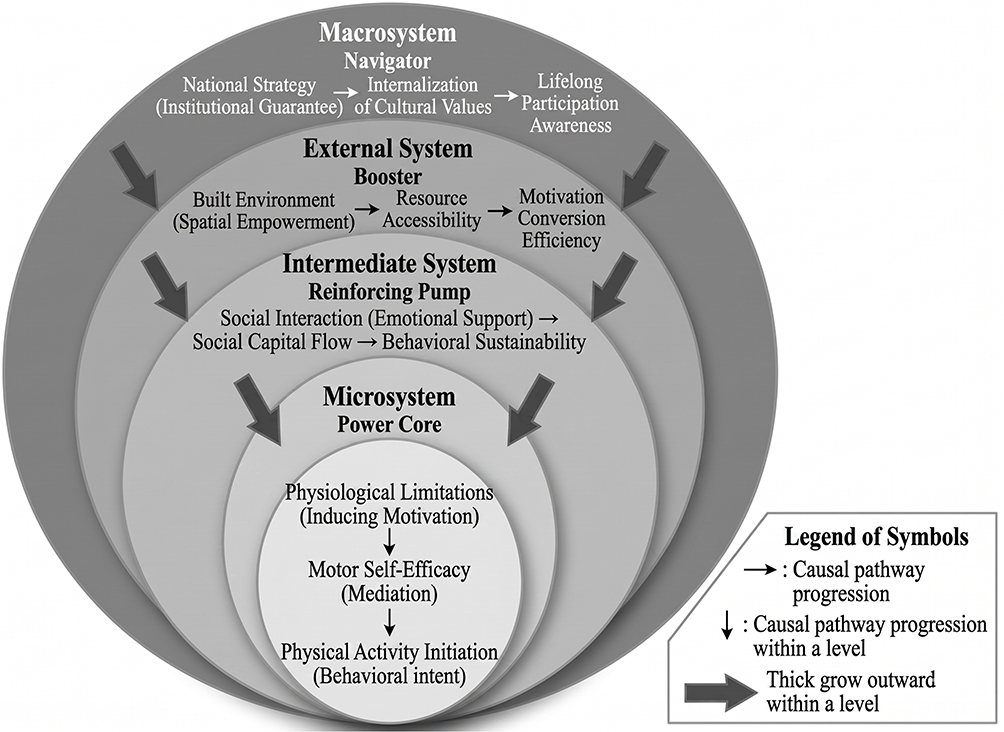 |
Figure 1 The Social Ecological Model of older adults based on the Sports-Medical Integration. |
Microsystem: Individual Self-Efficacy Perception and Mediation
The microsystem represents the fundamental unit of analysis for understanding the generation of physical activity motivation among older adults. Its operational mechanism is anchored in the reciprocal interaction between physiological status and psychological constructs. With increasing age, progressive physiological attrition and the burden of chronic diseases emerge as primary motivators for health-seeking behaviors. As a widely validated non-pharmacological intervention, physical exercise serves as a critical modality for preserving cardiopulmonary function and attenuating degenerative musculoskeletal changes, thereby facilitating a paradigm shift from medical care to prevention. Simultaneously, exercise self-efficacy functions as a pivotal psychological determinant for the initiation and maintenance of physical activity. Higher levels of self-efficacy enhance an individual’s resilience against physical discomfort and environmental barriers. Conversely, when physiological limitations are internalized as stable negative expectations, they may precipitate efficacy deprivation, systematically eroding the individual’s behavioral intent.
Mesosystem: Social Capital Interaction and Relational Support
The mesosystem encompasses the interconnections between social networks, which provide emotional support and behavioral reinforcement via the mobilization of social capital. To counteract efficacy deprivation, peer groups, through emotional resonance, behavioral modeling, and shared participation, constitute a consistent source of motivation. However, family role binding can act as a paradoxical constraint. While encouragement and companionship facilitate engagement, domestic responsibilities often impose significant temporal and energetic constraints, acting as a structural barrier to sports participation. Furthermore, the digital transformation of social interaction has positioned virtual platforms as a vital extension of the mesosystem. These digital conduits mitigate social isolation and sustain exercise motivation by lowering information barriers and fostering remote connectivity.
Exosystem: Spatial Empowerment and Environmental Affordances
The exosystem refers to the spatial and environmental parameters that, although not involving the individual as an active participant, exert a profound influence on behavioral choices via structural parameters. A classic theoretical foundation for this perspective comes from Kurt Lewin’s52 behavior formula, B=f(P,E), which posits that behavior (B) is a function of the person (P) and the environment (E). This formulation reinforces the rationale that environmental factors are not merely static backgrounds but active determinants that shape behavioral outcomes, making it theoretically central to the exosystem level. This level addresses spatial mismatch by optimizing environmental affordances. Factors such as mixed land use, road connectivity, environmental safety, and aesthetic quality exert a significant moderating effect on exercise behavior, particularly for populations with high mobility dependence. The degree of age-friendliness within a neighborhood determines the opportunity cost and feasibility of physical engagement. Furthermore, the density and spatial accessibility of community sports facilities, exemplified by the 15-minute fitness circle, serve as the material infrastructure necessary for transforming psychological motivation into actual behavior. When community sports resources achieve functional synergy with primary healthcare services, the exosystem effectively minimizes participation barriers and bolsters the sustainability of exercise behavior.
Macrosystem: Institutional Governance and Technology
The macrosystem, the most distal layer of the social ecosystem, encompasses public policies, legislative frameworks, cultural traditions, and mainstream values. It serves as the foundation for paradigm reconstruction by bridging the gap between institutional design and individual health beliefs. With the Sports-Medical Integration into national strategies, macro-level health promotion policies are increasingly optimizing resource allocation. Concomitantly, leveraging digital dividends is essential to alleviating the downstream bottlenecks of policy implementation. At the cultural level, concepts such as active aging and proactive health are gradually reshaping social norms, driving sports participation from a passive rehabilitative measure to an active pursuit of quality of life.
To bridge the gap between theoretical constructs and empirical observation, this study follows the hierarchical nesting logic of identifying structural obstructions and proposing reconstruction paths. Through bibliometric analysis and expert interviews, a four-dimensional evaluation indicator system has been constructed. This system comprises 48 items, aiming to systematically deconstruct the complex dynamic system of community elderly sports participation (Table 1).
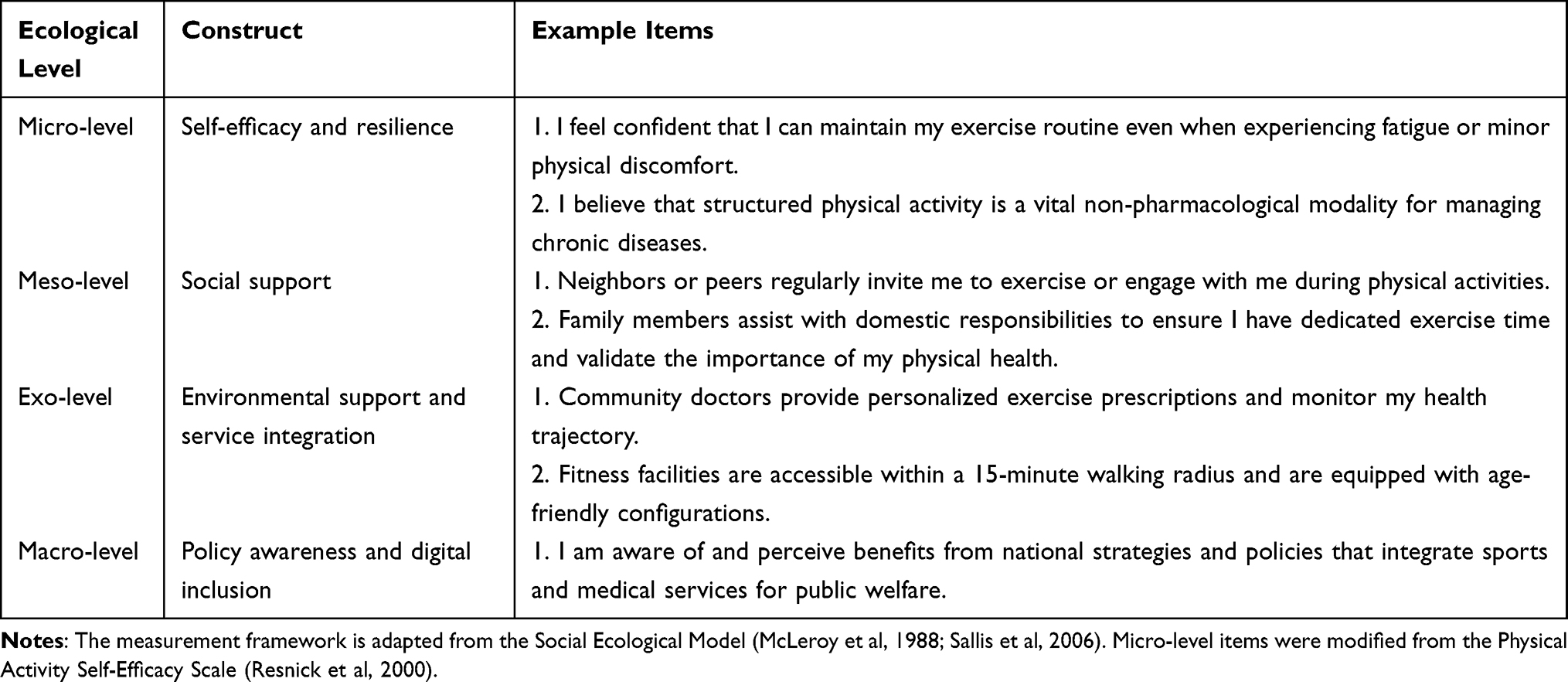 |
Table 1 Measurement Framework and Representative Items for Factors Influencing Older Adults’ Sports Participation |
Instruments and Methods
Instruments and Validity Testing
Physical activity (PA) levels were measured using the International Physical Activity Questionnaire Short Form (IPAQ-SF). To identify influencing factors, a multi-layered evaluation index system was developed based on the Social Ecological Model. The development involved two phases: first, an item pool was adapted from Resnick’s Exercise Self-Efficacy Scale and Sallis’ Social Support Scale; second, semi-structured expert interviews (n=10) were conducted to refine the items for the local Chinese context. Reliability and validity testing demonstrated robust psychometric properties (Cronbach’s α = 0.934; KMO = 0.881; Table 2).
 |
Table 2 Reliability Test Results for Scale Dimensions |
Data Collection and Quality Control
This study recruited participants and gathered relevant data from October to December 2025 at the Central Hospital and three residential communities in Xianyang City, namely Jincheng, Wenlin and Baoquan Communities. Using stratified convenience sampling, 300 questionnaires were distributed, yielding 252 valid responses (84.0% recovery). The participants were aged between 60 and 75 years (mean age = 67.5 years, SD=3.5). The sample included 119 males (47.2%) and 133 females (52.8%). To accommodate participants with varying literacy levels, investigators administered the survey through structured face-to-face interviews, reading items verbatim without interpretation to ensure data consistency and mitigate social desirability bias.
Data Analysis Strategy
Data processing was performed using SPSS 25.0. To address the multilevel design, we employed a sequential analysis logic:
Preliminary Analysis: Descriptive statistics summarized demographic profiles. Independent samples t-tests, ANOVA, and Pearson correlation were used to identify significant demographic differences and associations between variables.
Hierarchical Regression: A hierarchical multiple linear regression model was constructed to quantify the predictive power of each ecological level on PA levels.
Qualitative Triangulation: The statistical predictors identified in the regression were cross-validated against the findings from the expert interviews. This approach ensured that the statistical results were interpreted alongside the practical obstacles identified by experts.
Result
Based on empirical data from 252 community-dwelling older adults, the multiple linear regression model revealed that multidimensional factors derived from the socioecological framework collectively explained 67.3% of the variance in physical activity levels (R=0.673, F=37.739, p< 0.001) indicating the model’s robust explanatory power. The corresponding statistical associations between multi-level factors and physical activity are presented in Table 3.
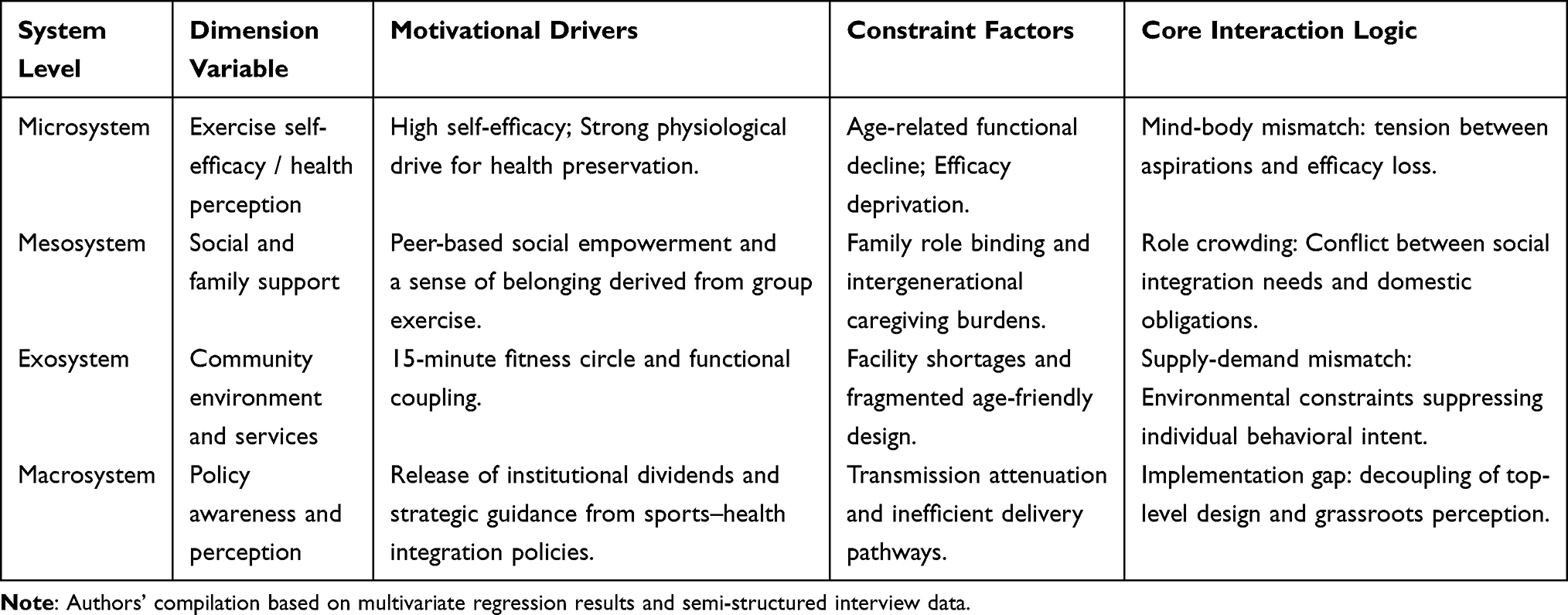 |
Table 3 Social-Ecological Mapping of Multi-Level Factors Influencing Sports Participation Among Older Adults |
Cognitive Mismatch and Physiological Decline
Empirical results indicate that exercise self-efficacy constitutes the primary micro-level statistical predictor of sports participation among older adults. Correlation analysis revealed a strong positive association (r= 0.684, p< 0.01) and the standardized regression coefficient (β=0.356, p< 0.01) underscoring the significant predictive relationship between individuals’ confidence and their ability to persist in exercise. Compared with mere health awareness, self-efficacy emerges as the proximal predictor enabling the translation of intention into behavior.
Although the mean score for perceived exercise-related health benefits among respondents was relatively high (M=3.34), this variable failed to reach statistical significance in the regression model (p> 0.05), demonstrating a lack of significant association between health knowledge and actual activity levels. In addition, age was significantly and negatively associated with physical activity levels (β=- 0.110, p< 0.05), suggesting that physiological decline negatively predicts activity frequency. This results in an observed negative correlation, whereby physical deterioration is statistically linked to reduced activity intentions and behavioral enactment.
Social Networks and Family Binding
Analysis at the meso-level demonstrates a clear statistical preference for peer-based support. Regression results confirm that support from friends exerts a significant positive effect on participation (B=0.241, p< 0.01), whereas the effect of family support was non-significant. This finding highlights a “peer-over-family” support gap, where older adults’ activity levels are more closely associated with interest-based affiliations than kinship-based networks.
Within peer groups, collective exercise provides stronger statistical incentives for participation than family settings. However, the culturally embedded practice of intergenerational caregiving in China produces detectable time and role constraints. Survey evidence indicates that many older adults are statistically more likely to be isolated from exercise networks due to heavy domestic responsibilities, remaining marginalized despite the presence of supportive peers.
Spatial Mismatch and Environmental Barriers
The exosystem-level analysis indicated that service-related factors exert a stronger predictive influence than the mere presence of infrastructure. Regression analysis shows that the availability of medical services (β=0.187), organized sports activities (β=0.173), and fitness venues (β=0.171) all have significant positive associations with physical activity levels. Field investigations reveal that although the 15-minute fitness circle has achieved broad spatial coverage, 66.1% of respondents reported unmet demand for indoor facilities. This indicates that participation is predicted less by the quantity of equipment than by specific environmental affordances through Sports-Medical coupling. Integrating medical monitoring with physical space is associated with a reduction in participation opportunity costs.
Obstacles to Policy and Institutional Implementation
At the macrosystem level, policy perception demonstrated no significant association with physical activity (PA) behavior. Survey data revealed that the average awareness score for Sports-Medical Integration policies was only 1.25. Hierarchical regression confirmed that policy awareness failed to significantly predict PA levels (p>0.05). These findings suggest that the top-down strategy has yet to demonstrate a measurable impact on individual behavioral consciousness. The existence of implementation gaps within grassroots organizations, combined with a shortage of specialized instructors, has resulted in observable bottlenecks. To effectively facilitate proactive health, it is essential to bridge the informational divide and ensure that institutional assets are converted into measurable individual motivation.
Discussion
Exercise Self-Efficacy as the Primary Predictor of Participation
The regression analysis identifies exercise self-efficacy as the most salient micro-level predictor of physical activity (β=0.356, p<0.01), underscoring the central role of perceived capability in shaping actual participation. A critical observation here is the cognition-behavior gap: although respondents reported relatively high perceived health benefits (M=3.34), this variable failed to reach statistical significance in the regression model (p>0.05). This discrepancy confirms that awareness and positive attitudes alone cannot catalyze behavioral change; instead, the primary bottleneck lies in an individual’s confidence to overcome situational and functional barriers.
To bridge this gap, interventions should prioritize efficacy-building through structured mastery experiences rather than relying on general informational outreach. In practice, this requires transitioning from passive health education to active trial models—such as professionally supervised introductory sessions and peer-led feedback loops—that allow older adults to accumulate “small wins.” These successes reinforce situational confidence and ease the transition from intention to sustained engagement. Future research should integrate psychological moderators like self-regulation and habit strength to further explain the variance between awareness and action. Methodologically, adopting Ecological Momentary Assessment (EMA) would better capture the within-person dynamics through which cognitive appraisal translates into stable behavioral adherence. Additionally, the negative association between age and participation (β=−0.110, p <0.05) suggests that physical decline remains a persistent barrier. Consequently, personalized exercise prescriptions—integrated within primary care—are essential to help older adults overcome the functional limitations identified in this study.
The Contrast Between Peer Support and Family Constraints
The regression results indicate a significant positive effect of peer support (B=0.241, p<0.01), whereas the influence of family support was statistically negligible. This divergence highlights a differentiated structure of social capital among urban older adults. While cultural expectations in China suggest strong family-based support, our data indicate that the translation of awareness into action depends more heavily on context-specific reinforcement from peers.
This finding reflects a broader sociocultural reconfiguration in contemporary urban China. As urbanization and reduced household sizes physically separate older adults from their adult children, the traditional reliance on kinship-based support is being supplemented—or even partially replaced—by interest-based peer networks. Rather than a decline in collectivist values, this likely signifies a shift toward “reconfigured collectivism,” where social belonging is relocated from the family unit to the community level. Furthermore, in the Chinese context, family support often manifests as “protective caregiving” or risk aversion (eg, discouraging strenuous activity to prevent injury), which can inadvertently constrain active exercise. In contrast, peer circles provide the synchronization and mutual encouragement necessary to activate the self-efficacy mechanisms discussed previously. Consequently, community interventions should prioritize context-specific, peer-led models—such as organized walking groups, Tai Chi groups, or Square Dance collectives—to leverage the group dynamics that our model identifies as a key facilitator.
Addressing the Mismatch Between Facility Access and Usability
Our community-level analysis confirms that both service availability (β=0.187) and venue access (β=0.171) are key predictors of physical activity. However, the 66.1% deficit in indoor facility accessibility reveals a structural bottleneck: a mismatch between the quantity of hardware and its actual usability. This suggests that the “15-minute fitness circle” policy, while successful in spatial mapping, has not yet accounted for the “temporal accessibility” required by seniors. Older adults are more sensitive to extreme weather, air pollution, and seasonal variations common in urban China, which significantly limit the utility of outdoor equipment.
Beyond proximity, participation is also influenced by perceived safety. The absence of indoor, age-friendly environments—featuring non-slip flooring, adequate lighting, and emergency support—constitutes a practical barrier for many. Efforts should therefore shift from mere infrastructure expansion to improving functional quality. Upgrading existing facilities by integrating basic health-monitoring services and on-site assistance could reduce perceived risks and help nearly two-thirds of the respondents overcome the environmental hurdles that currently limit their participation.
Addressing the Implementation Gap in Policy Awareness
The absence of a statistically significant association between policy perception and physical activity (p>0.05), combined with a low average awareness score (M=1.25), points to a clear decoupling between policy formulation and individual-level engagement. Despite initiatives like “Healthy China 2030,” national strategies have limited visibility at the grassroots level. This gap may stem from digital access barriers and the top-down format of communication, which often bypasses the channels most accessible to older adults.
To resolve this, policy implementation must be integrated into routine health services through the Family Doctor system. By authorizing doctors to issue personalized exercise prescriptions, abstract policy objectives can be translated into actionable daily behaviors with medical authority. Furthermore, aligning policy with individual motivation through tangible incentive mechanisms—such as linking participation to health service benefits or insurance discounts—may enhance behavioral uptake. This approach connects macro-level policy more directly to the individual-level psychological and social mechanisms that drive behavioral adherence.
Conclusion
Based on the social ecological framework, this study analyzed the structural obstacles encountered by integrated sports and medicine health services in promoting older adults’ participation. The research substantiates that limited participation is not the result of a single factor, but a synergistic effect of multi-level barriers: a pronounced cognition-behavior gap driven by impaired exercise self-efficacy at the micro-level, the preeminence of peer support over traditional family influence at the meso-level, a mismatch between facility quantity and functional usability at the environmental level, and a decoupling between macro-level policy formulation and individual awareness. The negative coupling between these levels weakens the transition from health awareness into actual exercise behavior, confirming that high health perception (M=3.34) alone is insufficient to catalyze activity without robust self-efficacy and supportive socio-environmental conditions.
Theoretically, this study reveals a shifting structure of social capital in urban China, where interest-based peer networks are increasingly supplementing traditional kinship-based support. This suggests a “reconfigured collectivism” that demands a move from passive medical intervention toward proactive, efficacy-based health promotion. At the practical level, interventions should shift from general informational outreach to mastery-experience strategies and peer-led coaching. Furthermore, integrating personalized exercise prescriptions into primary care and upgrading outdoor facilities to meet temporal and safety needs provides a direct mechanism to bridge the identified self-efficacy and usability gaps, thereby enhancing the precision of health service delivery.
While this study clarifies the structural associations within the social ecological system, it is limited by its cross-sectional nature and regional sample. Future research should employ longitudinal cohort designs or Ecological Momentary Assessment (EMA) to dynamically track the temporal evolution from cognitive appraisal to stable behavioral adherence. Further investigation into the causal mechanisms of the cognition–behavior gap will provide a more replicable paradigm for active aging strategies, contributing to the broader global goal of healthy aging.
Ethics and Consent Statements
This study was conducted in accordance with the Declaration of Helsinki and was approved by the Medical Ethics Committee of Xianyang Central Hospital (Approval No. 2025-IRB-136). Written informed consent was obtained from all participants prior to their enrollment in the study.
Acknowledgments
The authors thank Yanbin Lin for securing ethical approval from the Medical Ethics Committee of Xianyang Central Hospital and for assisting with data collection. We also thank the participants and staff at the collaborating site for their cooperation.
Funding
This work was supported by the Ministry of Education of the People’s Republic of China Humanities and Social Sciences Research Project (Grant No. 24XJC890001).
Disclosure
The authors report no conflicts of interest in this work.
References
1. Khan HT, Addo KM, Findlay H. Public health challenges and responses to the growing ageing populations. Public Health Chall. 2024;3(3):e213. doi:10.1002/puh2.213
2. Han Y, He Y, Lyu J, Yu C, Bian M, Lee L. Aging in China: perspectives on public health. Glob Health J. 2020;4(1):11–11. doi:10.1016/j.glohj.2020.01.002
3. Chen F, Liu G. Population aging in China. In: Uhlenberg P, editor. International Handbook of Population Aging. Dordrecht: Springer Netherlands; 2009:157–172.
4. Huang R, Zhu Z, He M, et al. The curative-to-preventive perspective shift of medical students through community dementia programs: a qualitative study based on transformative learning theory. Front Public Health. 2025;13:1708455. doi:10.3389/fpubh.2025.1708455
5. Zhou X, Xu X, Li J, et al. Oral health in China: from vision to action. Int J Oral Sci. 2018;10(1):1. doi:10.1038/s41368-017-0006-6
6. Wang H, Qin D, Fang L, et al. Addressing healthy aging in China: practices and prospects. Biosci Trends. 2024;18(3):212–218. doi:10.5582/bst.2024.01180
7. Fang EF, Fang Y, Chen G, et al. Adapting health, economic and social policies to address population aging in China. Nature Aging. 2025;31:1–2.
8. Zhou Z, Hou Y, Lin J, Wang K, Liu Q. Patients’ views toward knee osteoarthritis exercise therapy and factors influencing adherence-a survey in China. Physician Sports Med. 2018;46(2):221–227. doi:10.1080/00913847.2018.1425595
9. Gjestvang C, Abrahamsen F, Stensrud T, Haakstad LA. Motives and barriers to initiation and sustained exercise adherence in a fitness club setting-A one-year follow-up study. Scand J Med Sci Sports. 2020;30(9):1796–1805. doi:10.1111/sms.13736
10. Hertzog C, Kramer AF, Wilson RS, Lindenberger U. Enrichment effects on adult cognitive development: can the functional capacity of older adults be preserved and enhanced? Psychol Sci Public Interes. 2008;9(1):1–65. doi:10.1111/j.1539-6053.2009.01034.x
11. Horgan S, Prorok J, Ellis K, et al. Optimizing older adult mental health in support of healthy ageing: a pluralistic framework to inform transformative change across community and healthcare domains. Int J Environ Res Public Health. 2024;21(6):664. doi:10.3390/ijerph21060664
12. McAuley E, Szabo A, Gothe N, Olson EA. Self-efficacy: implications for physical activity, function, and functional limitations in older adults. Am J Lifestyle Med. 2011;5(4):361–369. doi:10.1177/1559827610392704
13. Wang B, Lin Q, Wang Y, Tang S. Policy analysis of the integration of sports and medicine against the backdrop of “healthy China”: a qualitative study using NVivo. Int J Environ Res Public Health. 2023;20(3):2079. doi:10.3390/ijerph20032079
14. Zhu S, Zhang Q. Research on the development and optimization of a lifelong health promotion system integrating physical. In:
15. Dawes J, Rogans-Watson R, Broderick J. ‘You can change your life through sports’—physical activity interventions to improve the health and well-being of adults experiencing homelessness: a mixed-methods systematic review. Br J Sports Med. 2024;58(8):444–458. doi:10.1136/bjsports-2023-107562
16. Stokols D. Translating social ecological theory into guidelines for community health promotion. Am J Health Promotion. 1996;10(4):282–298. doi:10.4278/0890-1171-10.4.282
17. Liebich A, Zheng S, Schachner T, et al. Non-pharmaceutical interventions and epigenetic aging in adults: protocol for a scoping review. PLoS One. 2024;19(8):e0301763. doi:10.1371/journal.pone.0301763
18. Bull FC, Al-Ansari SS, Biddle S, et al. World Health Organization 2020 guidelines on physical activity and sedentary behaviour. Br J Sports Med. 2020;54(24):1451–1462. doi:10.1136/bjsports-2020-102955
19. Taylor AH, Cable NT, Faulkner G, et al. Physical activity and older adults: a review of health benefits and the effectiveness of interventions. J Sports Sci. 2004;22(8):703–725. doi:10.1080/02640410410001712421
20. Morris JN, Heady JA, Raffle PA, Roberts CG, Parks JW. Coronary heart-disease and physical activity of work. Lancet. 1953;262(6796):1111–1120. doi:10.1016/S0140-6736(53)91495-0
21. Matthews CE, Moore SC, Arem H, et al. Amount and intensity of leisure-time physical activity and lower cancer risk. J clin oncol. 2020;38(7):686–697. doi:10.1200/JCO.19.02407
22. Dunsky A, Netz Y. Physical activity and sport in advanced age: is it risky? A summary of data from articles published between 2000–2009. Curr Aging Sci. 2012;5(1):66–71. doi:10.2174/1874609811205010066
23. Valenzuela PL, Castillo-García A, Morales JS, et al. Exercise benefits on Alzheimer’s disease: state-of-the-science. Ageing Res Rev. 2020;62:101108. doi:10.1016/j.arr.2020.101108
24. Blake H, Mo P, Malik S, Thomas S. How effective are physical activity interventions for alleviating depressive symptoms in older people? A systematic review. Clin Rehabil. 2009;23(10):873–887. doi:10.1177/0269215509337449
25. Carter I. Human Behavior in the Social Environment: A Social Systems Approach. Routledge; 2017.
26. Botto R, Callai N, Cermelli A, Causarano L, Rainero I. Anxiety and depression in Alzheimer’s disease: a systematic review of pathogenetic mechanisms and relation to cognitive decline. Neurol Sci. 2022;43(7):4107–4124. doi:10.1007/s10072-022-06068-x
27. Gulpers B, Ramakers I, Hamel R, Köhler S, Oude Voshaar R, Verhey F. Anxiety as a predictor for cognitive decline and dementia: a systematic review and meta-analysis. Am J Geriatric Psychiatry. 2016;24(10):823–842. doi:10.1016/j.jagp.2016.05.015
28. Pedersen BK, Saltin B. Exercise as medicine–evidence for prescribing exercise as therapy in 26 different chronic diseases. Scand J Med Sci Sports. 2015;25:1–72. doi:10.1111/sms.12581
29. A’Naja MN. Exercise Prescription Practices in University Counseling Centers: Testing the Information-Motivation-Behavioral Skills Model. University of South Florida; 2021.
30. Dugdill L, Graham RC, McNair F. Exercise referral: the public health panacea for physical activity promotion? A critical perspective of exercise referral schemes; their development and evaluation. Ergonomics. 2005;48(11–14):1390–1410. doi:10.1080/00140130500101544
31. Yamaguchi K, Makihara Y, Kono M. Rehabilitation professionals for the aging society in Japan Their scopes of work and related health policies and systems. J Natl Instit Public Health. 2022;71(1):35–44.
32. Green D, McDermott F. Social work from inside and between complex systems: perspectives on person-in-environment for today’s social work. Br J Soc Work. 2010;40(8):2414–2430. doi:10.1093/bjsw/bcq056
33. Schutzer KA, Graves BS. Barriers and motivations to exercise in older adults. Preventive Med. 2004;39(5):1056–1061. doi:10.1016/j.ypmed.2004.04.003
34. Miller AM, Iris M. Health promotion attitudes and strategies in older adults. Health Educ Behav. 2002;29(2):249–267. doi:10.1177/1090198102029002009
35. Aroogh MD, Shahboulaghi FM. Social participation of older adults: a concept analysis. Int J Commun Based Nurs Midwifery. 2020;8(1):55. doi:10.30476/IJCBNM.2019.82222.1055
36. Manini TM, Pahor M. Physical activity and maintaining physical function in older adults. Br J Sports Med. 2009;43(1):28–31. doi:10.1136/bjsm.2008.053736
37. Janz NK, Becker MH. The health belief model: a decade later. Health Educ Q. 1984;11(1):1–47. doi:10.1177/109019818401100101
38. Ajzen I. The theory of planned behavior. Organ Behav Hum Decis Process. 1991;50(2):179–211.
39. Luszczynska A, Schwarzer R. Social cognitive theory. Fac Health Sci Publ. 2015;2015:225–251.
40. Schunk DH, DiBenedetto MK. Motivation and social cognitive theory. Contemp Educ Psychol. 2020;60:101832. doi:10.1016/j.cedpsych.2019.101832
41. Crosby R, Noar SM. What is a planning model? An introduction to PRECEDE-PROCEED. J Public Health Dent. 2011;71(s1):S7–S15. doi:10.1111/j.1752-7325.2011.00235.x
42. Green L, Kreuter M. The precede-proceed model. Health promotion planning: an educational approach. In: Mountain View (CA). Mayfield Publishing Company; 1999:32–43.
43. McLeroy KR, Bibeau D, Steckler A, Glanz K. An ecological perspective on health promotion programs. Health Educ Q. 1988;15(4):351–377. doi:10.1177/109019818801500401
44. Yi X, Pope Z, Gao Z, et al. Associations between individual and environmental factors and habitual physical activity among older Chinese adults: a social–ecological perspective. J Sport Health Sci. 2016;5(3):315–321. doi:10.1016/j.jshs.2016.06.010
45. Lusmägi P, Aavik K. Developing a social-ecological model for promoting physical activity among older adults based on the experiences of 50+ adults. SAGE Open. 2021;11(3):1–15. doi:10.1177/21582440211032943
46. Sirven N, Debrand T. Social participation and healthy ageing: an international comparison using SHARE data. Soc Sci Med. 2008;67(12):2017–2026. doi:10.1016/j.socscimed.2008.09.056
47. Leung KM, Ou KL, Chung PK, et al. Older adults’ perceptions toward walking: a qualitative study using a social-ecological model. Int J Environ Res Public Health. 2021;18(14):7686. doi:10.3390/ijerph18147686
48. Paterson DH, Jones GR, Rice CL. Ageing and physical activity: evidence to develop exercise recommendations for older adults. Appl Physiol Nutr Metab. 2007;32(Suppl 2E):S69–S108. doi:10.1139/H07-111
49. World Health Organization. Global Action Plan on Physical Activity 2018–2030: More Active People for a Healthier World. World Health Organization; 2019.
50. Golden SD, Earp JAL. Social ecological approaches to individuals and their contexts: twenty years of health education & behavior health promotion interventions. Health Educ Behav. 2012;39(3):364–372. doi:10.1177/1090198111418634
51. Derakhshanrad SA, Piven E, Ghoochani BZ. A cross-sectional study to investigate motivation for physical activity in a sample of Iranian community-dwelling older adults. Health Promotion Perspect. 2020;10(2):135. doi:10.34172/hpp.2020.22
52. Lewin K. Principles of Topological Psychology. New York: McGraw-Hill; 1936.
 © 2026 The Author(s). This work is published and licensed by Dove Medical Press Limited. The
full terms of this license are available at https://www.dovepress.com/terms
and incorporate the Creative Commons Attribution
- Non Commercial (unported, 4.0) License.
By accessing the work you hereby accept the Terms. Non-commercial uses of the work are permitted
without any further permission from Dove Medical Press Limited, provided the work is properly
attributed. For permission for commercial use of this work, please see paragraphs 4.2 and 5 of our Terms.
© 2026 The Author(s). This work is published and licensed by Dove Medical Press Limited. The
full terms of this license are available at https://www.dovepress.com/terms
and incorporate the Creative Commons Attribution
- Non Commercial (unported, 4.0) License.
By accessing the work you hereby accept the Terms. Non-commercial uses of the work are permitted
without any further permission from Dove Medical Press Limited, provided the work is properly
attributed. For permission for commercial use of this work, please see paragraphs 4.2 and 5 of our Terms.
Recommended articles
Physical Exercise, Sports Spectating, and Subjective Life Expectancy in Older Chinese Adults: A Chain Mediation Analysis
Chen L, Guo J, Han X
Risk Management and Healthcare Policy 2025, 18:3675-3688
Published Date: 18 November 2025