
Back to Journals » Journal of Multidisciplinary Healthcare » Volume 19
Factors Influencing Functional Recovery in People After Chronic Critical Illness During Early Neurological Rehabilitation
Authors Plechinger O, Bauer P  , Schunk M, Schlutt M, Jahn K, Bergmann J, Egger M
Received 19 March 2026
Accepted for publication 8 June 2026
Published 25 June 2026 Volume 2026:19 609776
DOI https://doi.org/10.2147/JMDH.S609776
Checked for plagiarism Yes
Review by Single anonymous peer review
Peer reviewer comments 2
Editor who approved publication: Professor Tilakavati Karupaiah
Oliver Plechinger,1,2 Petra Bauer,1,3 Michaela Schunk,1,3 Maria Schlutt,2 Klaus Jahn,2,4 Jeannine Bergmann,2,4 Marion Egger2
1Faculty of Applied Health and Social Sciences, Rosenheim Technical University of Applied Sciences, Rosenheim, Germany; 2Department of Neurology and Intensive Care Medicine, Schoen Clinic Bad Aibling, Bad Aibling, Germany; 3Centre for Research, Development and Technology Transfer, Rosenheim Technical University of Applied Sciences, Rosenheim, Germany; 4German Center for Vertigo and Balance Disorders, LMU University Hospital, Munich, Germany
Correspondence: Oliver Plechinger, Faculty of Applied Health and Social Sciences, Rosenheim Technical University of Applied Sciences, Rosenheim, Germany, Email [email protected]
Background: Advances in intensive care have increased survival after critical illness, often accompanied by prolonged mechanical ventilation and the development of chronic critical illness (CCI) with persistent physical impairments. Physiotherapy in early rehabilitation is central to restoring function, though recovery is influenced by various (pre-)clinical factors. This study provides a systematic description of physiotherapy during early rehabilitation and explores how (pre-)clinical factors affect functional outcomes.
Methods: This secondary analysis of the prospective cohort study CINAMOPS included participants after CCI with ≥ 5 days of invasive ventilation. Physiotherapeutic goals, interventions, and mobility milestones were recorded and analyzed descriptively. To quantify functional recovery, a study-specific, non-validated cumulative milestone score based on weighted physiotherapeutic mobility milestones was developed to capture nonlinear recovery trajectories. Multiple linear regression with backward elimination assessed the impact of age, sex, CIP/CIM, sepsis, ventilation duration, COVID-19, cerebral lesion, frailty, physical activity, comorbidities, and weekly physiotherapy sessions on milestone achievement.
Results: A total of 237 participants after CCI (mean age 62 ± 14 years, 34% female, median ICU stay 57 days, median rehabilitation 67 days) were included. Severe mobility limitations were present at admission. High functional goals, such as walking (85%) and stair climbing (57%), were frequently defined. Mainly active, functionally oriented interventions were applied, particularly gait training (81%) and balance training (65%). All mobility milestones improved significantly until discharge (p < 0.001), though limitations persisted. Cerebral lesion (p = 0.018), CIP/CIM (p = 0.022), and sepsis (p = 0.046) were associated with lower milestone scores.
Conclusion: This study provides a systematic overview of physiotherapeutic goals, interventions, and mobility milestones after CCI. Cerebral lesion, CIP/CIM, and sepsis were associated with lower functional recovery and may represent relevant factors for rehabilitation approaches. However, further research is needed to validate the cumulative milestone score and to further investigate rehabilitation trajectories after CCI.
Keywords: chronic critical illness, early neurological rehabilitation, physiotherapy, mobility milestones, functional recovery, CIP/CIM, cerebral lesion, sepsis
Introduction
Advances in intensive care medicine and the development of novel treatment approaches have led to increasing survival rates after Intensive Care Unit (ICU) stays.1 However, some patients develop persistent organ dysfunction requiring prolonged ICU treatment and extended mechanical ventilation. This syndrome is referred to as chronic critical illness (CCI).2 In addition, new or persistent physical, psychological, and cognitive impairments may occur after an ICU stay, commonly described in the literature as Post-Intensive Care Syndrome (PICS).3–5 Physical impairments are the most common manifestations associated with PICS.6 One example of a physical health impairment following intensive care treatment is the development of generalized muscle weakness, known as ICU-acquired weakness (ICUAW).7 ICUAW manifests as diffuse, symmetric weakness of the limbs and respiratory muscles that can persist for months or even years after ICU discharge8,9 and is typically caused by critical illness polyneuropathy (CIP), critical illness myopathy (CIM), or a combination of both conditions.7 CIP is a distal axonal sensorimotor polyneuropathy that affects the innervation of both respiratory and limb muscles, typically presenting with greater severity in distal compared to proximal muscles. CIM is a primary myopathy that predominantly affects the proximal respiratory and limb muscles.10 Electrophysiological examination is considered the gold standard for confirming the diagnosis of CIP and CIM.11
For most patients after CCI, a subsequent inpatient rehabilitation phase follows intensive care rehabilitation to continue therapeutic measures, aiming for discharge either to home or a nursing facility.12,13 Physiotherapy plays a central role in restoring physical function after an ICU stay, as well as in the treatment of ICUAW.14,15 However, there is still a lack of studies describing specific physiotherapeutic goals and interventions, especially during the post-acute inpatient rehabilitation phase after CCI.16–18 To assess functional recovery, mobility milestones (MobMS) and mobility-related activities are among the most frequently reported approaches for evaluating physical functioning in critically ill patients.19 Despite this, a wide range of outcome measures has been used, and no consensus has yet been reached regarding the most appropriate assessment tools for patients after CCI.20 Moreover, the factors influencing functional rehabilitation are not fully understood. To date, only a few longitudinal studies have investigated the association between (pre-)clinical health status and functional impairments after ICU treatment.21
This study aimed to describe physiotherapeutic goals, interventions, and mobility-related functional recovery during inpatient rehabilitation in patients after CCI and to explore associations between sociodemographic, health-related, and (pre-)clinical factors and functional recovery. It was hypothesized that sociodemographic, health-related, and (pre-)clinical factors are associated with functional recovery in patients after CCI. To reflect rehabilitation trajectories, an exploratory cumulative milestone score based on achieved MobMS was applied.
Methods
Study Setting and Population
This study is a secondary data analysis of the monocentric prospective cohort study CINAMOPS (Critical Illness Polyneuropathy and Myopathy: Outcome, Predictors and Longitudinal Trajectories), which examined the clinical course and long-term outcomes of individuals after critical illness. The present analyses were conducted exploratorily within the CINAMOPS cohort.22 Data were collected in an inpatient neurorehabilitation setting specialized in the treatment of patients with severe functional impairments, including those requiring intensive care and early neurological rehabilitation.
Patients were recruited at admission to neurorehabilitation, after discharge from the ICU. Eligibility required that they had been invasively ventilated in the ICU for at least five days and were 18 years or older. Exclusion criteria were palliative treatment; preexisting neuromuscular or neurological diseases associated with severe muscle weakness (eg., Guillain-Barré syndrome, myasthenia gravis, amyotrophic lateral sclerosis, cervical myelopathy, porphyria, Lambert-Eaton syndrome, severe preexisting vasculitic neuropathy, and botulism); insufficient communicative ability (due to language barriers or cognitive impairment) that would prevent completion of the assessments, with no available relative or legal guardian to assist; full motor strength (MRC 5/5, no paresis); and enrollment only during a late stage of rehabilitation, as these patients were excluded to ensure comparability in baseline rehabilitation status. During neurological rehabilitation, patients received standard care, which typically consisted of approximately 100 minutes of multidisciplinary therapy per day, including physiotherapy, occupational therapy, dysphagia therapy, and neuropsychology. The selection and content of therapeutic interventions were individualized and based on the patients’ respective ICF-based functional limitations and impairments during rehabilitation.
Electrophysiological testing was used to confirm a potential diagnosis of CIP/CIM and was carried out shortly after study enrolment. The testing included motor and sensory nerve conduction velocities, compound muscle action potential after nerve stimulation (neCMAP) and after direct muscle stimulation (dmCMAP), and electromyography. Details and criteria used to diagnose CIP/CIM can be found in the study protocol.20
Standard Protocol Approval, Registration, and Patient Consent
The study received approval from the relevant institutional ethics committee (project no. 20166, 08.05.2020) and was conducted in accordance with the Declaration of Helsinki. Written informed consent was obtained from all participants (or their legal guardians). The study was registered in a clinical trials registry (No. DRKS00025606).
Study Design
The analysis included two study visits: V1 marked inclusion into the CINAMOPS study after admission to inpatient neurorehabilitation, while V2 was conducted shortly before discharge from inpatient neurorehabilitation (Figure 1). As the study visits were part of the CINAMOPS study, they included a variety of questionnaires and functional assessments. For the present analysis, sociodemographic, health-related, and (pre-)clinical data collected at V1 were used for subsequent analyses.
 |
Figure 1 Study design. |
Between V1 and V2, physiotherapy-related data were collected throughout inpatient rehabilitation, including physiotherapy frequency, physiotherapeutic goals, interventions, and achieved MobMS. These data were documented for each patient by physiotherapists during weekly team meetings using standardized clinical procedures and transferred into the hospital database system. For study purposes, a research associate transferred the data from the digital hospital information system into an Access database every two weeks.
Furthermore, at admission to neurorehabilitation, the MobMS already achieved were recorded from the documented physiotherapy-related data. At discharge from inpatient neurorehabilitation or at the end of rehabilitation in case of death, MobMS achieved or no longer achieved during the course of rehabilitation were reassessed using the continuously documented physiotherapy-related data. Based on these two assessment time points, a cumulative milestone score was calculated to reflect functional recovery during inpatient neurorehabilitation.
Physiotherapeutic Data and Milestone Score
From the physiotherapy documentation in the hospital database system, numbered physiotherapeutic goals, interventions, and MobMS were assigned (Supplementary Table 1).
The frequency of physiotherapy interventions was calculated by summing the total number of physiotherapy sessions (30 minutes per session) during early neurorehabilitation for each participant and dividing this value by the total weeks spent in early neurorehabilitation. This resulted in the average frequency of physiotherapy interventions per week.

In critically ill patients, mobilization follows a hierarchical progression from basic in-bed mobility to more complex functional activities such as standing and walking.23 Accordingly, the sequence and grading of the MobMS were based on the ICU Mobility Scale24 as well as the milestones of the clinic’s mobilization concept, both of which follow a hierarchical approach to mobility tasks within the rehabilitation process. Initially, fifteen MobMS were defined by the study team according to a stepwise concept representing progressive levels of mobility and weighted according to their functional relevance (weighting factor 1–15). In contrast to the 11-level ICU Mobility Scale, the present study used a 15-level milestone hierarchy to additionally capture higher functional mobility levels during inpatient neurorehabilitation and to reduce potential ceiling effects during rehabilitation.
Based on these continuously documented physiotherapy-related data, the MobMS achieved at admission to early rehabilitation and at discharge from inpatient rehabilitation were determined according to the predefined 15-level milestone hierarchy. To calculate the milestone score, a baseline total score (M1) was calculated by summing the weights of milestones already achieved at admission. Similarly, a total score at discharge (M2) was obtained by summing the weights of milestones achieved by that time. The milestone score was then determined as the difference between M2 and M1, reflecting the functional progress during rehabilitation. The milestone score assessed functional recovery in relation to the individual baseline status at admission to rehabilitation. Positive values indicated functional improvement compared with the mobility status at admission, whereas negative values indicated deterioration in mobility performance during rehabilitation compared with admission status. In contrast to the ICU Mobility Scale, which is based on the highest achieved mobility level, the present approach used a cumulative scoring system with an individual baseline score at admission, incorporating multiple achieved as well as no longer achieved MobMS throughout rehabilitation. Patients who died during rehabilitation were therefore not excluded from the analyses, as their inclusion allowed a more comprehensive representation of clinical courses, with death representing the end point of the rehabilitation trajectory. However, the cumulative milestone score has not yet undergone formal psychometric evaluation and was therefore applied in an exploratory manner in the present study.

Statistical Analysis
Clinical characteristics are presented as absolute values and percentages, as mean values and standard deviations or as median and interquartile range, as appropriate.
A descriptive analysis was performed to assess the frequencies of physiotherapeutic interventions conducted, physiotherapeutic goals defined, and the MobMS achieved.
To analyze differences in the achievement of MobMS at the beginning of early rehabilitation and at discharge from inpatient rehabilitation, the McNemar test for paired dichotomous data was applied for each MobMS.25 Effect sizes were calculated using Cohen’s g for paired dichotomous data. Values of Cohen’s g range from 0 (no positive change) to 1 (maximum positive change). According to Ellis, values between 0.1 and 0.3 are considered small, between 0.3 and 0.5 moderate, and greater than 0.5 large effect sizes.26
To investigate the association between potential predictors and the milestone score, a multiple linear regression analysis was carried out. The independent variables included age, sex, diabetes status, duration of mechanical ventilation, preclinical frailty (measured with the Clinical Frailty Scale (CFS)),27–29 preclinical physical activity (measured with the International Physical Activity Questionnaire (IPAQ)),30,31 comorbidities (measured with the Elixhauser Comorbidity Scale (ECS)),32,33 sepsis, frequency of physiotherapy interventions per week, as well as the main diagnoses cerebral lesion, COVID-19, and CIP/CIM. Variable selection was done according to the recommendations given by Heinze et al34 Backward elimination was performed using the Akaike Information Criterion (AIC) as the stopping rule. At each step, the variable whose removal yielded the largest decrease in AIC was eliminated, and the procedure was stopped when no further removal improved the AIC. Model fit was assessed using the adjusted R2. Stability investigations of the selected model were performed according to Heinze et al34 Bootstrap resampling with replacement (1000 replicates) was done for the calculation of inclusion frequencies, sampling distributions of regression coefficients, and model selection frequencies. Furthermore, the relative conditional bias (which measures the anticipated level of bias introduced by variable selection when a particular independent variable is chosen) was calculated as suggested in Heinze et al34 Postestimation shrinkage factors were calculated using the R package “shrink”35 to reduce potential overfitting of the regression model. Model assumptions (linearity of residuals, homoscedasticity, normal distribution, autocorrelation) were graphically assessed. Normality of the milestone score was additionally assessed visually using histograms and Q-Q plots and statistically using the Shapiro–Wilk test. For homoscedasticity, the Score Test for Non-Constant Error Variance (ncv test) was additionally computed. Multicollinearity was assessed by calculating variance inflation factors (VIF).
All analyses were performed with R (version 4.3.2). Statistical significance was set at p ≤ 0.05.
Results
Study Population
A total of 1064 patients were screened between August 2020 and July 2023. A total of 250 patients were enrolled in the study and study visits V1 and V2 were conducted between September 2020 and December 2023. Reasons for exclusion are shown in Figure 2. Eleven patients died before visit 2. A total of 237 participants were included in the analysis.
 |
Figure 2 Study flow chart. |
Patient and clinical characteristics are displayed in Table 1. The main reasons for ICU admission were cardiac and pulmonary diseases (37.6%) and COVID-19 (26.2%), as the study was conducted at the peak of the pandemic in 2020–2021. Patients frequently presented with sepsis (59.6%), acute kidney injury (54.9%), delirium (42.6%), and acute respiratory distress syndrome (37.1%). Preclinical frailty was observed in 9.3% of patients. Nerve conduction studies were performed in 204 participants for the diagnosis of CIP/CIM, which was confirmed in 164 cases (80.4%).
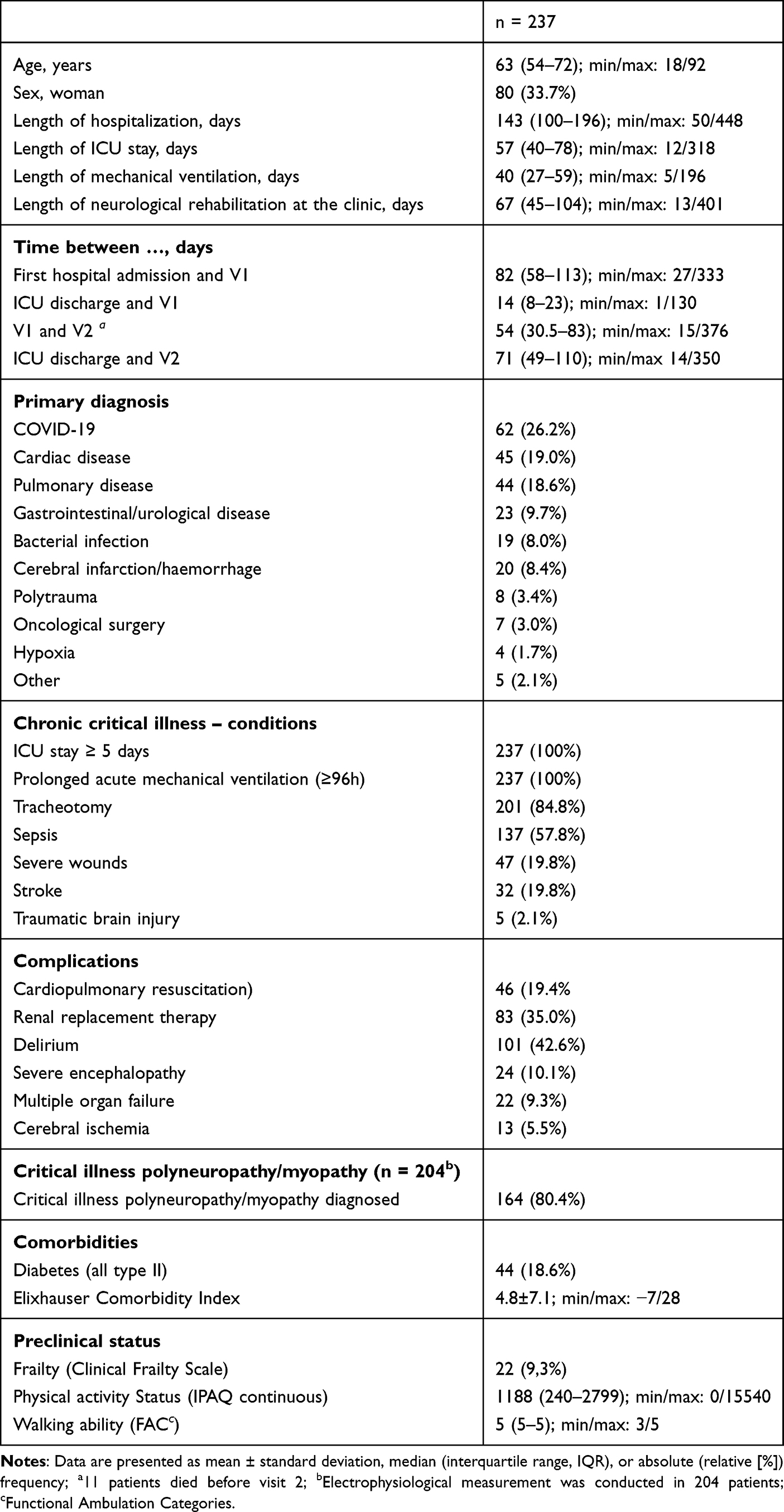 |
Table 1 Patient and Clinical Characteristics |
Physiotherapeutic Goals, Interventions and MobMS
The most frequently therapist-defined physiotherapeutic goal was the restoration of walking ability, which was set for 85% of the patients. The ability to climb stairs was defined as a goal for just over half of the patients (57%), making it the second most common objective. An analysis of the goal hierarchy shows that objectives requiring more complex coordinative and strength-related abilities (eg., walking, stair climbing) were set more frequently than goals requiring fewer of these abilities, such as sitting, passive mobility, or wheelchair locomotion. This may be explained by the fact that patients were already admitted to early neurological rehabilitation following ICU treatment. Therefore, basic mobility goals such as sitting or turning in bed had often already been achieved at admission, whereas more advanced goals were more frequently defined during rehabilitation. Figure 3 provides an overview of the physiotherapeutic goals established by the therapists.
 |
Figure 3 Physiotherapeutic goals. Notes: The chart shows which goals were set at least once during the patient’s rehabilitation. |
Patients received a median of 4.6 physiotherapy interventions per week (IQR 4–5.7; min/max 2/18). The descriptive analysis revealed that physiotherapeutic interventions were predominantly active in nature, with walking training (81%) being the most frequently applied, followed by balance training (65%) and strengthening exercises (61%). In contrast, interventions such as pain management (3%), relaxation (2%), contracture prophylaxis (1%), and functional electrical stimulation (1%) were rarely utilized. This distribution suggests that rehabilitation primarily focused on active, task-oriented interventions aimed at restoring mobility and functional independence. An overview of the physiotherapeutic interventions is provided in Figure 4.
 |
Figure 4 Physiotherapeutic interventions. Notes: The chart shows which interventions were applied at least once during the patient’s rehabilitation. |
The median milestone score at discharge was 55 (IQR 29–78; min/max −32/116). The achieved physiotherapeutic MobMS, including p-values and effect sizes, are presented in Table 2. The MobMS show significant differences between the measurement time points, indicating that mobility status improved significantly during early rehabilitation. Nevertheless, some patients continued to exhibit mobility limitations at discharge from inpatient rehabilitation. This was particularly reflected by the limited achievement of higher-level MobMS, such as independent stair climbing and longer walking distances. Independent walking without external assistance or assistive devices was possible for approximately one quarter of patients at the end of inpatient rehabilitation. Similarly, fewer than half of the patients were able to climb stairs independently at discharge, and only 6% were able to walk distances greater than one kilometer. Most MobMS demonstrated moderate to large effect sizes, ranging from g = 0.321 to g = 0.734. Exceptions were the MobMS “walking distance > 1 km” (g = 0.051) and “independent walking possible” (g = 0.224), which showed small effect sizes. Figure 5 illustrates the differences in achieved MobMS between admission to early rehabilitation and discharge from inpatient rehabilitation.
 |
Table 2 Physiotherapeutic Mobility Milestones |
 |
Figure 5 Physiotherapeutic MobMS. Note: Percentage distribution of patients who achieved the respective MobMS at admission (Orange) and at discharge (blue). Example: 9% in “Standing up independently” indicates that 9% of patients had already reached this mobility level at admission to early rehabilitation. |
Multiple Linear Regression Analysis
After excluding missing data (CIP/CIM data in 33 participants, IPAQ data in 2 participants, and frailty data in 1 participant), 201 cases remained for analysis. The milestone score showed slight deviations from normal distribution (W = 0.967, p < 0.001). However, inspection of the regression diagnostic plots indicated that the assumptions of the linear regression model were adequately met (Supplementary Figure 1). Using backward elimination with AIC, a significant model was identified (p < 0.001, Table 3), including eight predictors: cerebral lesion, CIP/CIM, sepsis, IPAQ, duration of mechanical ventilation, comorbidities, frailty, and sex (adjusted R2=10.4%). Three variables showed significant negative associations with the milestone score: cerebral lesion (β = –17.19; 95% CI: –31.36 to –3.02; p = 0.018), CIP/CIM (β = –12.02; 95% CI: –22.26 to –1.79; p = 0.022), and sepsis (β = –8.48; 95% CI: –16.79 to –0.17; p = 0.046).
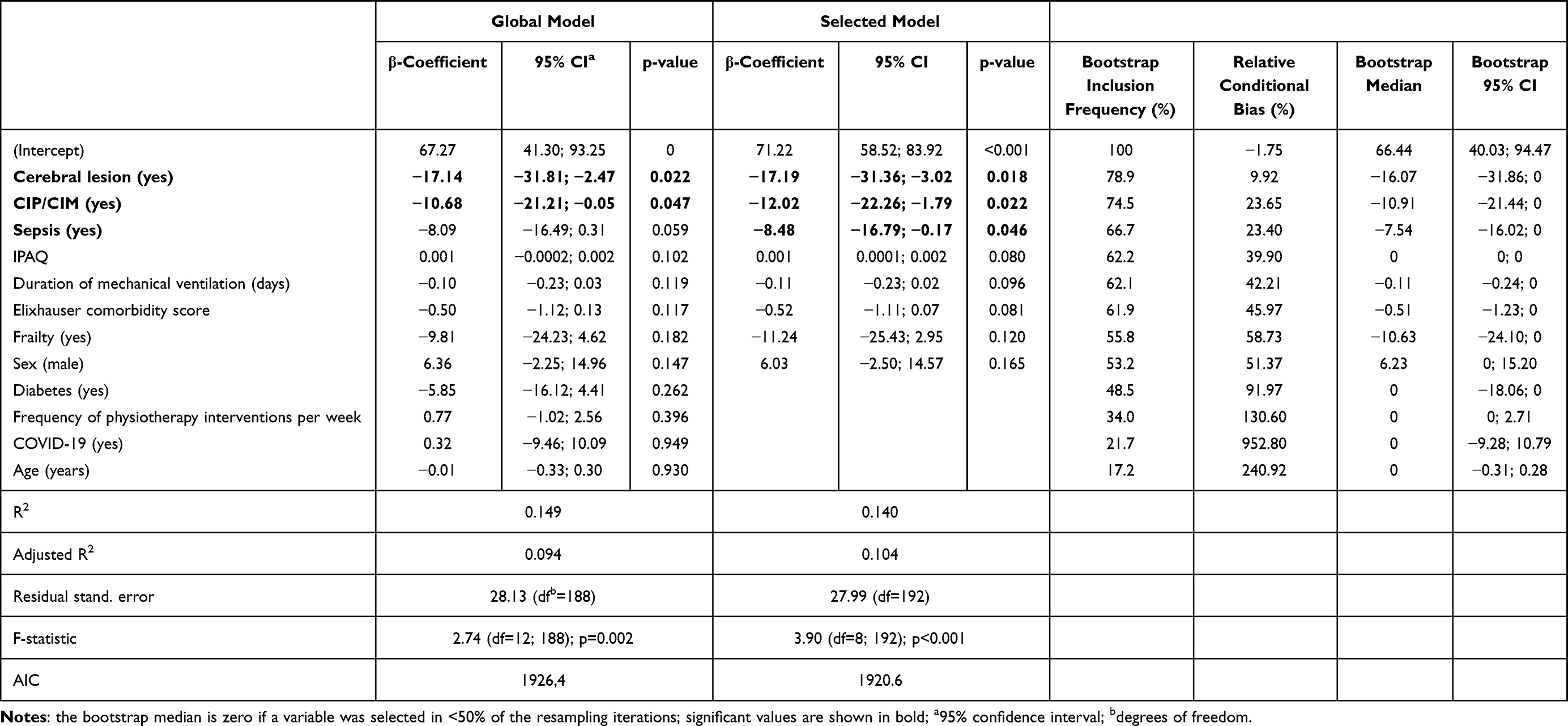 |
Table 3 Regression Analysis with Bootstrap Inclusion Frequencies and Relative Conditional Bias Values |
Model stability analyses revealed varying robustness among predictors. Bootstrap inclusion frequencies, reflecting how consistently predictors were selected across bootstrap samples, showed that cerebral lesion (78.9%) and CIP/CIM (74.5%) were most consistently selected, indicating relatively high stability. The remaining variables had moderate inclusion frequencies (53.2% to 66.7%). Relative conditional bias values, representing the potential overestimation and instability of regression coefficients, further supported the stability of cerebral lesion (9.9%), while CIP/CIM showed moderate bias (23.7%). Other predictors particularly sex (50.4%) and frailty (58.7%) demonstrated higher bias values, suggesting less stable associations.
Cerebral lesion, CIP/CIM, and sepsis consistently appeared in the ten most frequently selected models in the bootstrap analyses, supporting the relevance of these associations (Supplementary Table 2). The variables comorbidities, frailty, and sex appeared in six models each, further increasing the uncertainty associated with these variables. After applying shrinkage factors (global shrinkage = 0.733, Parameterwise shrinkage factors in Supplementary Table 3), the associations remained: cerebral lesion (shrunk β = –12.03), CIP/CIM (shrunk β = –10.22), as well as sepsis (shrunk β = –5.77). Multicollinearity was not a concern (VIF: 1.04 to 1.16), and homoscedasticity assumptions were met (ncv test: p = 0.708).
These findings suggest that cerebral lesion, CIP/CIM, and sepsis were the most consistent factors associated with lower milestone scores. The associations of IPAQ and duration of mechanical ventilation were of moderate strength. In contrast, frailty, sex, and comorbidities showed weaker and inconsistent associations with mobility outcomes.
Discussion
In this study, we described physiotherapeutic interventions and goals as well as the achievement of MobMS in a population of survivors of CCI. The descriptive analysis revealed that most physiotherapeutic interventions focused on active approaches. While all MobMS improved significantly during the course of rehabilitation, relevant limitations persisted at discharge, emphasizing the ongoing rehabilitation needs of this patient population. Furthermore, as trajectories of functional recovery and milestone attainment varied considerably between patients, we explored the impact of sociodemographic, health-related, and (pre-)clinical factors on functional recovery. The regression analysis revealed that lower milestone scores were significantly associated with cerebral lesion, CIP/CIM, and sepsis; however, these associations should be interpreted within the exploratory context of the analyses. The predominance of early and active physiotherapeutic approaches in our cohort aligns with previous research, which recommend active rather than passive therapy, with task-specific and function-oriented elements as key components in early neurorehabilitation.16,18,36 However, further research is needed to evaluate the comparative effectiveness of specific physiotherapeutic interventions on functional outcomes. To date, no studies have systematically characterized specific physiotherapeutic goals in the context of CCI.
The significant factors associated with lower milestone scores in our analysis are consistent with findings from previous studies. Cerebral lesions are a leading cause of physical disability and often result in long-term mobility limitations.37,38 Alongside sensorimotor deficits, approximately one third of stroke patients exhibit additional cognitive impairments at the onset of rehabilitation, which can adversely affect functional recovery.39 It has been shown that intensive, high-repetition, task-oriented, and task-specific training can stimulate neuroplastic processes and facilitate motor learning across all phases of post-stroke rehabilitation.40,41 Similarly, patients with ICUAW show persistently reduced mobility and lower physical functioning after ICU discharge.42,43 In our previous study investigating balance function in critical illness survivors, the presence of CIP/CIM as well as cerebral disease was likewise associated with poorer balance performance reflected by lower Mini-BESTest scores.44 These findings are in line with the present results demonstrating lower milestone scores in patients with CIP/CIM and cerebral lesions. Early ICU mobilization tailored to the individual patient’s needs, when implemented through structured and progressively intensified mobilization protocols represents a key therapeutic approach in CIP/CIM and can effectively improve muscle strength.45,46 Sepsis has likewise been linked to a decline in physical function and muscle strength47,48 and is considered one of the major risk factors for the development of CIP/CIM.8,49 Previous studies suggest that sepsis-related microcirculatory disturbances and tissue hypoxia may contribute to the development of neuromuscular complications such as CIP/CIM.50–52 In the present study, both sepsis and CIP/CIM were significantly associated with lower milestone scores, indicating a possible pathophysiological overlap between these variables. However, the statistical analyses showed no indication of relevant multicollinearity, suggesting that sepsis and CIP/CIM reflect partly distinct mechanisms contributing to impaired functional recovery. Early physiotherapy in patients with sepsis is safe to implement and supports the preservation of muscle mass and function.53 Following sepsis, interdisciplinary early rehabilitation leads to significant improvements in mobility and self-care ability and is therefore a key prerequisite for successful further rehabilitation.54 Other factors such as lower preclinical physical activity, multiple comorbidities, longer duration of mechanical ventilation, preclinical frailty, and female sex also showed associations with lower milestone scores. However, model stability analyses indicated uncertainties regarding the strength of these associations. Future studies should further investigate these influencing factors. To our knowledge, no studies have examined the impact of preclinical activity status on functional rehabilitation in patients with or after CCI. Regarding preclinical comorbidities and sex, previous studies have reported inconsistent findings concerning the disease and rehabilitation course.55–60 In the literature, prolonged mechanical ventilation has been associated with skeletal muscle atrophy, muscle weakness, and poorer functional status at hospital discharge.61,62 Several studies have also shown that a lower preclinical frailty severity is associated with better functional mobility during and after hospitalization.63,64 Interestingly, the frequency of physiotherapy interventions per week was not significantly associated with the milestone score. However, this variable reflected only the frequency of physiotherapy sessions and did not capture specific therapeutic content or actual therapeutic intensity, which may have limited its explanatory value.
Strengths and Limitations
One strength of this study is the cumulative approach of the MobMS and the derived milestone score. This approach allows for the depiction of non-linear trajectories of functional recovery, capturing both progression and regression in mobility performance. By considering all achieved and non-achieved milestones rather than only the highest one, it was intended to provide a more comprehensive and realistic representation of the rehabilitation process, which often deviates from a strictly linear course. Furthermore, backward elimination with AIC as the stopping rule was applied instead of predefined significance levels, following the recommendations of Heinze et al34 This procedure was implemented to support data-driven model selection and to reduce the risk of overfitting. In addition, post-estimation shrinkage methods and model stability analyses were performed to assess potential bias and model stability. These approaches were intended to address common limitations of traditional variable selection methods, such as biased regression coefficients and overly narrow confidence intervals.65,66 Nevertheless, these approaches cannot fully compensate for limitations related to the exploratory cumulative milestone score and the use of backward elimination for variable selection. A major strength is the application of electrophysiological testing for the diagnosis of CIP/CIM, representing the current gold standard.11 This is particularly noteworthy, as national survey data from German ICUs indicate that standardized diagnostic approaches for CIP/CIM are still rarely implemented. Only a small proportion of ICUs routinely perform electrophysiological testing, despite its recognition as the diagnostic gold standard.67 Finally, the sample size of 237 patients after CCI represents an additional strength, providing a robust data basis and enhancing the generalizability of the findings.
As this study was a secondary data analysis based on routine clinical physiotherapy documentation collected during physiotherapeutic team meetings, no formal assessment of inter-rater reliability was performed. Although documentation followed structured clinical procedures within the rehabilitation setting, variability between therapists in the assessment and documentation of physiotherapeutic goals, interventions, and MobMS cannot be excluded. In addition, the manual transfer of physiotherapy-related data from the hospital information system to the Access database may have represented a potential source of data entry errors. Moreover, the monocentric study design may limit the generalizability of the findings, particularly with regard to physiotherapeutic interventions that may reflect center-specific rehabilitation concepts and clinical routines. Generalizability may be further limited by the high severity of illness within the study population. Compared with other studies investigating CCI,68 our patients had longer ICU stays and ventilation durations, which may limit transferability to less severely affected CCI populations. The exclusion of patients with impaired communication or cognitive deficits may also have introduced selection bias and further limited the representativeness of the cohort in relation to the broader CCI population. A further limitation of this study is that both the applied milestone hierarchy and the calculation of the cumulative milestone score have an exploratory character and were applied in this form for the first time in a study. To date, no formal psychometric validation has been performed, and the psychometric properties of the score have therefore not been systematically investigated. In addition, the cumulative milestone score represents an ordinal rather than a truly interval-scaled variable. However, the relatively high number of MobMS categories (15 levels) may support a metric approximation of the score, and no major violations of the regression model assumptions were observed. This may support the application of multiple linear regression. Furthermore, the model explained only a limited proportion of the variance in the milestone score (adjusted R2 = 10.4 %), indicating that additional, yet unconsidered, cognitive, psychosocial, nutritional and motivational factors may contribute to functional recovery. However, high R2 values are often not realistic in clinical medicine due to the multitude of genetic, environmental, and behavioral factors influencing patient outcomes.69 Consequently, due to the exploratory nature of the cumulative milestone score, the ordinal structure of the outcome variable, and the limited explanatory power of the model, the results of the regression analyses should be interpreted with caution. In addition, the exclusion of cases due to missing data may have affected the robustness of the regression analyses and introduced additional selection bias. Finally, the observational design precludes causal inferences regarding the effectiveness of specific physiotherapeutic interventions. Future randomized controlled trials should evaluate the effectiveness of the most frequently applied therapeutic approaches identified in this cohort.
Conclusions
The descriptive analyses showed that physiotherapeutic rehabilitation after CCI was predominantly based on active, task-oriented interventions and that mobility-related functional improvements occurred during rehabilitation. Nevertheless, substantial mobility limitations persisted in many patients at discharge from inpatient rehabilitation. Furthermore, cerebral lesion, CIP/CIM, and sepsis were associated with lower milestone scores in this exploratory analysis. However, further research is needed to validate the cumulative milestone score and to further investigate rehabilitation trajectories and influencing factors in this patient population Given the rising incidence of CCI and the associated strain on healthcare systems, this study contributes to a better understanding of functional recovery, influencing factors, and physiotherapeutic interventions after CCI.
Data-Sharing Statement
The authors intend to share individual deidentified participant data underlying the results reported in this article, including demographic, clinical, and rehabilitation-related data. The study protocol and statistical analysis plan will also be made available. Data will be available from the corresponding author upon reasonable request beginning after publication and ending five years following article publication. Requests for data access can be directed to the corresponding author via email.
Ethics/Registration
The study protocol and the template informed consent forms are reviewed and approved by the Ethics Committee of the Ludwig-Maximilians-Universität München (project number 20-166). The study was registered at the German Clinical Trials Register (No. DRKS00025606).
Funding
This research was supported in part by the Else Kröner-Fresenius-Stiftung (Grant No. 2020_EKEA.94).
Disclosure
The authors report no competing interests in this work.
References
1. Needham DM, Davidson J, Cohen H, et al. Improving long-term outcomes after discharge from intensive care unit: report from a stakeholders’ conference. Crit Care Med. 2012;40(2):S.502–15. doi:10.1097/CCM.0b013e318232da75
2. Rosenthal MD, Kamel AY, Rosenthal CM, Brakenridge S, Croft CA, Moore FA. Chronic critical illness: application of what we know. Nut Clin Prac. 2018;33(1):S.39–45. doi:10.1002/ncp.10024
3. Yuan C, Timmins F, Thompson DR. Post-intensive care syndrome: a concept analysis. Int J Nurs Studies. 2021;114:
4. Nakanishi N, Liu K, Kawakami D, et al. Post-intensive care syndrome and its new challenges in coronavirus disease 2019 (COVID-19) pandemic: a review of recent advances and perspectives. J Clin Med. 2021;10(17):
5. Wiegele M, Hermann M, Kimberger O, Schaden E, Tiboldi A. Langzeitfolgen einer Intensivtherapie. Anästhesie Nachr. 2024;6(3):S.152–156. doi:10.1007/s44179-024-00242-6
6. Geense WW, Zegers M, Peters MAA, et al. New physical, mental, and cognitive problems 1 year after icu admission: a prospective multicenter study. Am J Respir Crit Care Med. 2021;203(12):S.1512–1521. doi:10.1164/rccm.202009-3381OC
7. Kramer CL. Intensive care unit-acquired weakness. Neurol Clin. 2017;35(4):S.723–736. doi:10.1016/j.ncl.2017.06.008
8. Hermans G, van den Berghe G. Clinical review: intensive care unit acquired weakness. Critical Care. 2015;19(1):
9. Meyer-Frießem CH, Malewicz NM, Rath S, et al. Incidence, time course and influence on quality of life of intensive care unit acquired weakness symptoms in long-term intensive care survivors. J Intensive Care Med. 2021;36(11):S.1313–1322. doi:10.1177/0885066620949178
10. Latronico N, Bolton CF. Critical illness polyneuropathy and myopathy: a major cause of muscle weakness and paralysis. Lancet Neurol. 2011;10(10):S.931–941. doi:10.1016/S1474-4422(11)70178-8
11. Senger D, Erbguth F. Critical-illness-Myopathie und -polyneuropathie. Medizinische Klinik Intensivmedizin Und Notfallmedizin. 2017;112(7):S.589–596. doi:10.1007/s00063-017-0339-0
12. Kwakman RCH, Major ME, Dettling-Ihnenfeldt DS, Nollet F, Engelbert RHH, Van der Schaaf M. Physiotherapy treatment approaches for survivors of critical illness: a proposal from a Delphi study. Physiother Theory Pract. 2020;36(12):S.1421–1431. doi:10.1080/09593985.2019.1579283
13. Nydahl P, Boehnke D, Denke C, et al. Die Zeit nach der Intensivstation. Intensiv. 2024;32(06):S.309–323. doi:10.1055/a2385-4496
14. Gupta H. Restoring physical function in post-intensive care syndrome (PICS): a review of literature. Int J Physiol Health Phys Educ. 2022;4(1):S.9–12. doi:10.33545/26647265.2022.v4.i1a.31
15. Anekwe DE, Biswas S, Bussières A, Spahija J. Early rehabilitation reduces the likelihood of developing intensive care unit-acquired weakness: a systematic review and meta-analysis. Physiotherapy. 2020;107:S.1–10. doi:10.1016/j.physio.2019.12.004
16. Mehrholz J, Mückel S, Mehrholz K, Pohl M. Behandlungsansätze bei Patienten mit auf der Intensivstation erworbenen Schwächesyndrom. Neuroreha. 2013;5(01):S.40–43. doi:10.1055/s-0033-1337349
17. Connolly B, Salisbury L, O’Neill B, et al. Exercise rehabilitation following intensive care unit discharge for recovery from critical illness. Cochrane Database Syst Rev. 2015;6:CD008632. doi:10.1002/14651858.CD008632.pub2
18. Thomas S, Mehrholz J, Bodechtel U, Elsner B. Effect of physiotherapy on regaining independent walking in patients with intensive-care-unit-acquired muscle weakness: a cohort study. J Rehabilit Med. 2019;51(10):S.797–804. doi:10.2340/16501977-2606
19. Tipping CJ, Young PJ, Romero L, Saxena MK, Dulhunty J, Hodgson CL. A systematic review of measurements of physical function in critically ill adults. Critical Care Resuscitat. 2012;14(4):S.302–311.
20. Du Plessis I, Hanekom SD, Lupton-Smith AR. Physical function measures in ICU survivors, where to now? A scoping review. S Afr J Crit Care. 2024;40(2):e1742. doi:10.7196/SAJCC.2024.v40i2.1742
21. Latronico N, Herridge M, Hopkins RO, et al. The ICM research agenda on intensive care unit-acquired weakness. Intensive Care Med. 2017;43(9):S.1270–1281. doi:10.1007/s00134-017-4757-5
22. Bergmann J, Egger M, Müller F, Jahn K. Outcome, predictors and longitudinal trajectories of subjects with critical illness polyneuropathy and myopathy (CINAMOPS): study protocol of an observational cohort study in a clinical and post-clinical setting. BMJ open. 2024;14(4):e083553. doi:10.1136/bmjopen-2023-083553
23. Stiller K, Phillips A. Safety aspects of mobilising acutely ill inpatients. Physiother Theory Pract. 2003;19(4):S.239–257. doi:10.1080/716100582
24. Hodgson C, Needham D, Haines K, et al. Feasibility and inter-rater reliability of the ICU mobility scale. Heart Lung. 2014;43(1):S.19–24. doi:10.1016/j.hrtlng.2013.11.003
25. Pembury Smith MQR, Ruxton GD. Effective use of the McNemar test. Behav Ecol Sociobiol. 2020;74(11). doi:10.1007/s00265-020-02916-y
26. Ellis P. The Essential Guide to Effect Sizes. Statistical Power, Meta-Analysis, and the Interpretation of Research Results.
27. Gordon JI, Brummel NE. Implications of frailty before and after intensive care unit admission. Curr Opinion Critical Care. 2024;30(5):S.472–478. doi:10.1097/MCC.0000000000001197
28. Shears M, Takaoka A, Rochwerg B, et al. Beurteilung von Gebrechlichkeit auf der Intensivstation: eine Reliabilitäts- und Validitätsstudie. J Crit Care. 2018;45:197–203. doi:10.1016/j.jcrc.2018.02.004
29. Rockwood K, Theou O. Verwendung der klinischen Gebrechlichkeitsskala bei der Zuteilung knapper Gesundheitsressourcen. Can Geriatr J. 2020;23:210–215. doi:10.5770/cgj.23.46
30. Van Poppel MNM, Chinapaw MJM, Mokkink LB, van Mechelen W, Terwee CB. Physical activity questionnaires for adults: a systematic review of measurement properties. Sports Med. 2010;40(7):S.565–600. doi:10.2165/11531930-000000000-00000
31. Craig CL, Marshall AL, Sjöström M, et al. International physical activity questionnaire: 12-country reliability and validity. Med Sci Sports Exercise. 2003;35(8):S.1381–1395. doi:10.1249/01.MSS.0000078924.61453.FB
32. Gasparini A. comorbidity: an R package for computing comorbidity scores. JOSS. 2018;3(23):
33. Van Walraven C, Austin PC, Jennings A, Quan H, Forster AJ. A modification of the Elixhauser comorbidity measures into a point system for hospital death using administrative data. Med Care. 2009;47(6):S.626–633. doi:10.1097/MLR.0b013e31819432e5
34. Heinze G, Wallisch C, Dunkler D. Variable selection – a review and recommendations for the practicing statistician. Biometrical J Biometrische Zeitschrift. 2018;60(3):S.431–449. doi:10.1002/bimj.201700067
35. Dunkler D, Sauerbrei W, Heinze G. Global, parameterwise and joint shrinkage factor estimation. J Stat Soft. 2016;69(8):S.1–19. doi:10.18637/jss.v069.i08
36. Renner C, Jeitziner -M-M, Albert M, et al. Guideline on multimodal rehabilitation for patients with post-intensive care syndrome. Critical Care. 2023;27(1):
37. Bouvet P, Murgier M, Pons B, Darmon M. Long-term outcomes of critically ill patients with stroke requiring mechanical ventilation. Am J Crit Care. 2019;28(6):S.477–480. doi:10.4037/ajcc2019310
38. Intiso D, Centra AM, Bartolo M, Gatta MT, Gravina M, Di Rienzo F. Recovery and long term functional outcome in people with critical illness polyneuropathy and myopathy: a scoping review. BMC Neurol. 2022;22(1):
39. Froß M, Sailer M, Lamprecht J. Einfluss kognitiver Dysfunktionen auf die Mobilität im Verlauf der neurologischen Rehabilitation nach Schlaganfall. NR. 2020;26(4):S.207–213. doi:10.14624/NR2010001
40. Veerbeek JM, Van Wegen, Erwin VP, et al. What is the evidence for physical therapy poststroke? A systematic review and meta-analysis. PLoS One. 2014;9(2):e87987. doi:10.1371/journal.pone.0087987
41. Harvey, Richard L. Improving poststroke recovery: neuroplasticity and task oriented training. Curr Treat Options Cardiovasc Med. 2009;11(3):S.251–259. doi:10.1007/s11936-009-0026-4
42. Tipping CJ, Bailey MJ, Bellomo R, et al. The ICU mobility scale has construct and predictive validity and is responsive. a multicenter observational study. Ann Am Thoracic Soc. 2016;13(6):S.887–893. doi:10.1513/AnnalsATS.201510-717OC
43. Wieske L, Dettling-Ihnenfeldt DS, Verhamme C, et al. Impact of ICU-acquired weakness on post-ICU physical functioning: a follow-up study. Critical Care. 2015;19(1):
44. Egger M, Finsterhölzl M, Buetikofer A, et al. Balance function in critical illness survivors and evaluation of psychometric properties of the Mini-BESTest. Sci Rep. 14(1):12089. doi:10.1038/s41598-024-61745-5
45. Latronico N, Rasulo FA, Eikermann M, Piva S. Illness weakness, polyneuropathy and myopathy: diagnosis, treatment, and long-term outcomes. Critical Care. 2023;27(1):
46. Nydahl P, Günther U, Diers A, et al. PROtocol-based mobilization on intensive care units: stepped-wedge, cluster-randomized pilot study (Pro-Motion). Nurs Critical Care. 2020;25(6):S.368–375. doi:10.1111/nicc.12438
47. Takahashi Y, Morisawa T, Okamoto H, et al. Prevalence and predictors of hospital-acquired functional decline in patients with sepsis admitted to the intensive care unit. Int J Rehabil Res. 2021;44(4):S.307–313. doi:10.1097/MRR.000000000000049
48. Borges RC, Carvalho CRF, Colombo AS, da Silva Borges MP, Soriano FG. Physical activity, muscle strength, and exercise capacity 3 months after severe sepsis and septic shock. Intensive Care Med. 2015;41(8):S.1433–1444. doi:10.1007/s00134-015-3914-y
49. Bednarík J, Vondracek P, Dusek L, Moravcova E, Cundrle I. Risk factors for critical illness polyneuromyopathy. J Neurol. 2005;252(3):S.343–351. doi:10.1007/s00415-005-0654-x
50. Ertmer C, Rehberg S. Pathophysiologie der Sepsis. Dtsch Med Wochenschr. 2016;141(15):S.1067–1073. doi:10.1055/s-0042-110742
51. Neu C, Lange AI, Wissuwa B, Coldewey SM. Mikrozirkulationsstörungen in der Sepsis. DIVI Mitgliederzeitschrift der Deutschen Interdisziplinären Vereinigung für Intensiv-und Notfallmedizin. 2020;11(2):S.66–73. doi:10.3238/DIVI.2019.0066-0073
52. Witt NJ, Zochodne DW, Bolton CF, et al. Peripheral nerve function in sepsis and multiple organ failure. Chest. 1991;99(1):S.176–184. doi:10.1378/chest.99.1.176
53. Hickmann CE, Castanares-Zapatero D, Deldicque L, et al. Impact of very early physical therapy during septic shock on skeletal muscle: a randomized controlled trial. Crit Care Med. 2018;46(9):S.1436–1443. doi:10.1097/CCM.0000000000003263
54. Liebl M, Elmer N, Schwedtke C, Schröder I, Reißhauer A. Fachübergreifende Frührehabilitation nach Sepsis – eine retrospektive Analyse. Physikalische und Rehabilitative Medizin – Evidenzbasierte Praxis und Qualitätsmanagement. 122. Jahreskongress der Deutschen Gesellschaft für Physikalische Medizin und Rehabilitation. Dresden, 9/15/2017 - 9/16/2017: Georg Thieme Verlag KG (Physikalische Medizin, Rehabilitationsmedizin, Kurortmedizin). 2017.
55. Yang J, Zheng Y, Gou X, et al. Prevalence of comorbidities and its effects in patients infected with SARS-CoV-2: a systematic review and meta-analysis. Inter J Infect Dis. 2020:S.91–95. doi:10.1016/j.ijid.2020.03.017
56. Kobara S, Yamamoto R, Rad MG, et al. Association between comorbidities at ICU admission and post-Sepsis physical impairment: a retrospective cohort study. J Crit Care. 2024;83:
57. Bartoszewicz K, Bartoszewicz M, Stróż S, Stasiak-Barmuta A, Kosiorek P. Predictors of the severity of the course of COVID-19: demographic factors, clinical signs and laboratory markers. J Med Microbiol. 2024;73(10). doi:10.1099/jmm.0.001911
58. Elijah IM, Amsalu E, Jian X, et al. Characterization and determinant factors of critical illness and in-hospital mortality of COVID-19 patients: a retrospective cohort of 1,792 patients in Kenya. Biosaf Health. 2022;4(5):S.330–338. doi:10.1016/j.bsheal.2022.06.002
59. Kang J, Lee MH. Incidence rate and risk factors for post-intensive care syndrome subtypes among critical care survivors three months after discharge: a prospective cohort study. Intensive Critical Care Nurs. 2024;81:
60. Engelhardt LJ, Grunow JJ, Wollersheim T, et al. Sex-Specific aspects of skeletal muscle metabolism in the clinical context of intensive care unit-acquired weakness. J Clin Med. 2022;11:3. doi:10.3390/jcm11030846
61. Zhou Y, Sun Y, Pan Y, Dai Y, Xiao Y, Yu Y. Risk prediction models for intensive care unit-acquired weakness in critically ill patients: a systematic review. Aust Crit Care. 2024. doi:10.1016/j.aucc.2024.05.003
62. Wang L, Long D-Y. Significant risk factors for intensive care unit-acquired weakness: a processing strategy based on repeated machine learning. World J Clin Cases. 2024;12(7):S.1235–1242. doi:10.12998/wjcc.v12.i7.1235
63. Hatheway OL, Mitnitski A, Rockwood K. Frailty beeinflusst den initialen Behandlungserfolg und die Zeit bis zur Wiederherstellung der Mobilität bei älteren Erwachsenen mit akuten Erkrankungen im Krankenhaus. Physioscience. 2018;14(02):
64. Hongo T, Yumoto T, Inaba M, et al. Long term, patient-centered, frailty-based outcomes of older critical illness survivors from the emergency department: a post hoc analysis of the LIFE Study. BMC Geriatr. 2024;24(1):
65. Austin PC. Using the bootstrap to improve estimation and confidence intervals for regression coefficients selected using backwards variable elimination. Stat Med. 2008;27(17):S.3286–3300. doi:10.1002/sim.3104
66. Talbot D, Massamba VK. A descriptive review of variable selection methods in four epidemiologic journals: there is still room for improvement. Eur J Epidemiol. 2019;34(8):725–730.
67. Klawitter F, Schaller SJ, Söhle M, Reuter DA, Ehler J. Intensive care unit-acquired weakness”: Eine bundesweite umfrage zu diagnostik, monitoring und therapiestrategien auf deutschen intensivstationen. Die Anaesthesiologie. 2022;71(8):S.618–625. doi:10.1007/s00101-022-01089-9
68. Ohbe H, Satoh K, Totoki T, et al. Definitions, epidemiology, and outcomes of persistent/chronic critical illness: a scoping review for translation to clinical practice. Critical Care. 2024;28(1):
69. Gupta A, Stead TS, Ganti L. Determining a meaningful R-squared value in clinical medicine. Academic Med Surg. 2024. doi:10.62186/001c.125154
 © 2026 The Author(s). This work is published and licensed by Dove Medical Press Limited. The
full terms of this license are available at https://www.dovepress.com/terms
and incorporate the Creative Commons Attribution
- Non Commercial (unported, 4.0) License.
By accessing the work you hereby accept the Terms. Non-commercial uses of the work are permitted
without any further permission from Dove Medical Press Limited, provided the work is properly
attributed. For permission for commercial use of this work, please see paragraphs 4.2 and 5 of our Terms.
© 2026 The Author(s). This work is published and licensed by Dove Medical Press Limited. The
full terms of this license are available at https://www.dovepress.com/terms
and incorporate the Creative Commons Attribution
- Non Commercial (unported, 4.0) License.
By accessing the work you hereby accept the Terms. Non-commercial uses of the work are permitted
without any further permission from Dove Medical Press Limited, provided the work is properly
attributed. For permission for commercial use of this work, please see paragraphs 4.2 and 5 of our Terms.