
Back to Journals » Advances in Medical Education and Practice » Volume 16
Enhancing Student Learning Through the Application of First Principles of Instruction in a Blended E-Learning Approach
Authors Amare EM, Jimma TT, Abdelrahman HAF, Zerihun AB
Received 6 August 2025
Accepted for publication 9 November 2025
Published 4 December 2025 Volume 2025:16 Pages 2249—2257
DOI https://doi.org/10.2147/AMEP.S554861
Checked for plagiarism Yes
Review by Single anonymous peer review
Peer reviewer comments 2
Editor who approved publication: Prof. Dr. Balakrishnan Nair
Equlinet Misganaw Amare,1 Tefera Tadesse Jimma,1 Hiba Abuelgasim Fadlelmoula Abdelrahman,1 Abebe Bekele Zerihun2
1Education Development and Quality Center, University of Global Health Equity, Kigali, Rwanda; 2School of Medicine and Health Science, University of Global Health Equity, Kigali, Rwanda
Correspondence: Equlinet Misganaw Amare, Education Development and Quality Center, University of Global Health Equity, P.O. Box 6955, Kigali, Rwanda, Email [email protected]
Introduction: Blended e-learning guided by the First Principles of Instruction (FPI) can enhance learning outcomes while reducing costs, performing comparably to face-to-face training. However, in low- and middle-income countries, its application in health professions education remains limited, with little empirical evidence and minimal evaluation from learners’ perspectives. This study was designed, implemented, and evaluated an FPI-based blended course to generate evidence and insights for future course design and to assess the teaching and learning quality (TALQ) from learners’ viewpoints.
Methods: A descriptive, correlational design was employed at the Health Professional Education training program at the University of Global Health Equity in Rwanda between February and April 2025, and data were collected using the reliable Teaching and Learning Quality survey instrument. A descriptive statistic, a one-way multivariate analysis of variance and correlation analysis were conducted to analyse the collected data.
Results: This study, involving 38 postgraduate certificate-level learners (79.1% response rate) from four types of institutions, found strong support for the integration of FPI elements in a blended e-learning module. Learners frequently engaged in problem-solving activities, reported significant learning progress, and rated the course quality as outstanding with high satisfaction. Furthermore, strong correlations were observed among teaching and learning quality measures, while no significant associations were found between demographic variables and teaching and learning quality scores.
Conclusion: The blended eLearning lesson design—structured around a central problem, activation of prior knowledge, multimedia-based explanations, collaborative discussions, and opportunities for reflection and application—demonstrated effective integration of the first principles of instruction. This integration of FPI within a blended e-learning framework was a key factor in promoting student engagement, learning progress, and satisfaction, thereby contributing to the overall enhancement of teaching and learning quality.
Keywords: blended e-learning, first principles of instruction, teaching and learning quality, University of Global Health Equity, Rwanda
Introduction
E-learning has experienced significant growth over the past decade as a method for educating health professionals in areas with limited resources, mainly due to its adaptability and accessibility.1–4 The global COVID-19 pandemic further accelerated this trend, leading to a substantial increase in the adoption of blended e-learning approaches within these nations.5,6 The pandemic fundamentally altered educational landscapes, prompting learning institutions to transition from traditional face-to-face instruction to blended e-learning models.7–10
A blended learning approach integrates conventional face-to-face education with e-learning. This combination offers several advantages, including: Supporting workplace-based practical training, reducing the amount of time required for in-person instruction, facilitating social peer learning, and enabling programmes to reach a greater number of learners.11,12
Evidence suggests13,14 that a well-designed blended e-learning approach should be guided by Merrill’s First Principles of Instruction (FPIs), which are identified as essential for promoting enhanced student learning. First Principles of Instruction is a prescriptive theory of instructional design(ID) developed by David Merrill in 2002,15 aimed at promoting effective, efficient, and engaging instruction. Models. As a common strategy for many ID models, the FPI, which was strongly influenced by constructivism, compiles the five requirements necessary to realize an effective learning environment. Specifically, it is organized as follows: “(a) Problem-centred: Learning is promoted when learners are working to solve real-world problems. (b) Activation: Existing knowledge learning is promoted when activated as a basis for new knowledge. (c) Demonstration: Learning is promoted when new knowledge is presented to the learner. (d) Application: Learning is promoted when the learner applies new knowledge. (e) Integration: Learning is promoted when new knowledge is integrated into the learner’s world15 These principles define increasingly effective levels of instructional strategy, with performance enhancement being most evident in complex problem-solving tasks15–18 Merrill posits that learning will be negatively impacted if any of these fundamental principles are not applied.15 Consequently, these design principles are crucial for delivering effective and efficient instruction, and educational modules, courses, or programs should be evaluated to ascertain their adherence to these principles.
Despite the growing adoption, providing digital learning for healthcare professionals in low- and middle-income countries (LMICs) remains a relatively developing practice.1 This has resulted in a shortage of empirical evidence regarding the specific impact of FPIs on student learning within a blended e-learning framework, particularly in resource-constrained environments. Furthermore, the overall teaching and learning quality (TALQ) of such blended e-learning often lacks evaluation from the learner’s perspective. This includes assessing learners’ engagement in problem-solving tasks, their progress in learning, their satisfaction with the course, and the general quality of the courses.
This lack of learner perspective means that instructional designers, teachers, and programme coordinators are often without crucial feedback needed to confirm teaching and learning quality and identify areas for improvement. Therefore, the study aimed to design, implement, and evaluate an FPI-based health professional education course using a blended approach, aiming to offer empirical evidence and practical insights for designing future courses that enhance teaching and learning. It also sought to evaluate the TALQ of blended e-learning from the learner’s viewpoint.
Materials and Methods
Study Design and Setting
A descriptive, correlational study was conducted at the Health Professional Education (HPE) training program at the University of Global Health Equity (UGHE) in Rwanda. UGHE is a pioneering institution in Rwanda dedicated to nurturing the next generation of global health professionals. The HPE training program is structured in three sequential levels: Postgraduate Certificate (Level 1), Postgraduate Diploma (Level 2), and MSc (Level 3). Each level builds upon the preceding one, with completion of the earlier qualification serving as a prerequisite for progression. The program was launched in 2025 with its first cohort of 48 students drawn from four institutions—higher education institutions (HEIs), professional councils, the Ministry of Health, and teaching hospitals—enrolled at the Postgraduate Certificate level. All learners enrolled at the Postgraduate Certificate level of the program were invited to participate in the study.
Instructional Design
The HPE postgraduate certificate program at UGHE was delivered via a blended e-learning approach that combines traditional face-to-face instruction with online learning to leverage the strengths of both methods. The design, development, and delivery of the blended e-learning modules were guided by Merrill’s first principles of instruction, which offer a framework for creating effective, efficient, and engaging learning experiences across diverse educational settings.15–18.
Every lesson was designed according to the five elements of FPI: Problem-centered, Activation, Demonstration, Application, and Integration. Lessons included essential interactive content, self-assessment quizzes, practice exercises, and timely feedback to help learners recall or build upon prior knowledge before introducing new concepts, thereby connecting new information to existing mental schemas (activation). To foster a sense of community and collaborative learning, each session featured a discussion forum where students could support one another, connect new knowledge to their own experiences, and reflect on its broader implications. At the beginning of each lesson, students encountered a problem to solve(problem-centred), followed by an opportunity to recall or describe their prior experiences related to the content(activation). Using text, images, videos, and other multimedia tools to provide concrete examples(demonstration), new knowledge was introduced and explained. Students were given opportunities to work in groups to discuss solutions to the problems posed by the teacher during both in-person and weekly virtual sessions (Application), and to reflect on, present, and consider how to apply and transfer this knowledge to their real-world work settings(integration).
Data Collection Methods and Tools
We used the Teaching and Learning Quality (TALQ) survey instrument developed by Frick et al13 to collect data at the end of the learning module. The TALQ survey instrument was constructed with items targeting academic learning time (ALT), Merrill’s first principles, and Kirkpatrick’s levels of evaluation.13 In addition, global items are similar to those reported in Cohen,19 indicating overall course and instructor ratings. The tool consisted of a total of 36 items across nine TALQ constructs, with each construct measured by a specific number of items: ALT Scale (3 items), Learning Progress (5 items), Student Satisfaction (3 items), BEST Scale (Global IU course evaluation; 3 items), Merrill’s First Principles of instruction which included Authentic Problem (4 items), Activation Scale (5 items), Demonstration Scale (4 items), Application Scale (4 items), and Integration Scale (5 items). All 36 items within the nine constructs were assessed using a five-point Likert scale, ranging from 1 (strongly disagree) to 5 (strongly agree). Reliability tests were performed on the instrument, and all nine constructs were found to be reliable, with reliability scores above 0.8.13 Data were collected between February and April 2025.
The items on the TALQ were randomly ordered to prevent learners from identifying which items belonged to which scale. Additionally, some items were negatively worded to assess whether learners read the TALQ items carefully. Furthermore, the instrument included items regarding the demographic characteristics of the learners. Faculty members collected data via the Open Data Kit (ODK) Collect open-source Android app, freely available for survey-based data gathering purposes.20 The study was approved by the Human Research Ethics Committee of the University of Global Health Equity Institutional Review Board with approval number: UGHE-IRB/2025/473
Data Analysis
The ODK CSV data were imported into SPSS for thorough cleaning and analysis. All the items in the Likert scale for each construct were aggregated into a single average score for analysis. Furthermore, all the 22 items (ie Authentic Problem (4 items), Activation Scale (5 items), Demonstration Scale (4 items), Application Scale (4 items), and Integration Scale (5 items) were aggregated into a single score as Merrill’s First Principles of instruction. Descriptive statistics, including frequency, percentage, and mean score, were used to describe participant characteristics and summarize the perceived quality of teaching and learning. A one-way between-groups multivariate analysis of variance was performed to investigate participants’ demographic differences in their agreement on the combined TALQ of the blended e-learning module they had completed. In addition, correlation analyses were conducted to examine whether there are relationships among the TALQ scale scores and various background variables.
Results
This study included 38 post-graduate certificate-level learners (a 79.1% response rate) drawn from four types of institutions: HEIs, teaching hospitals, the Ministry of Health (MoH), and professional councils. Most respondents were male (55.3%) and worked primarily in HEIs (76.4%). Nearly one-third of the learners were in the nursing profession. Most held an academic qualification of a second degree (68.5%), and half reported 5–10 years of work experience. (Table 1).
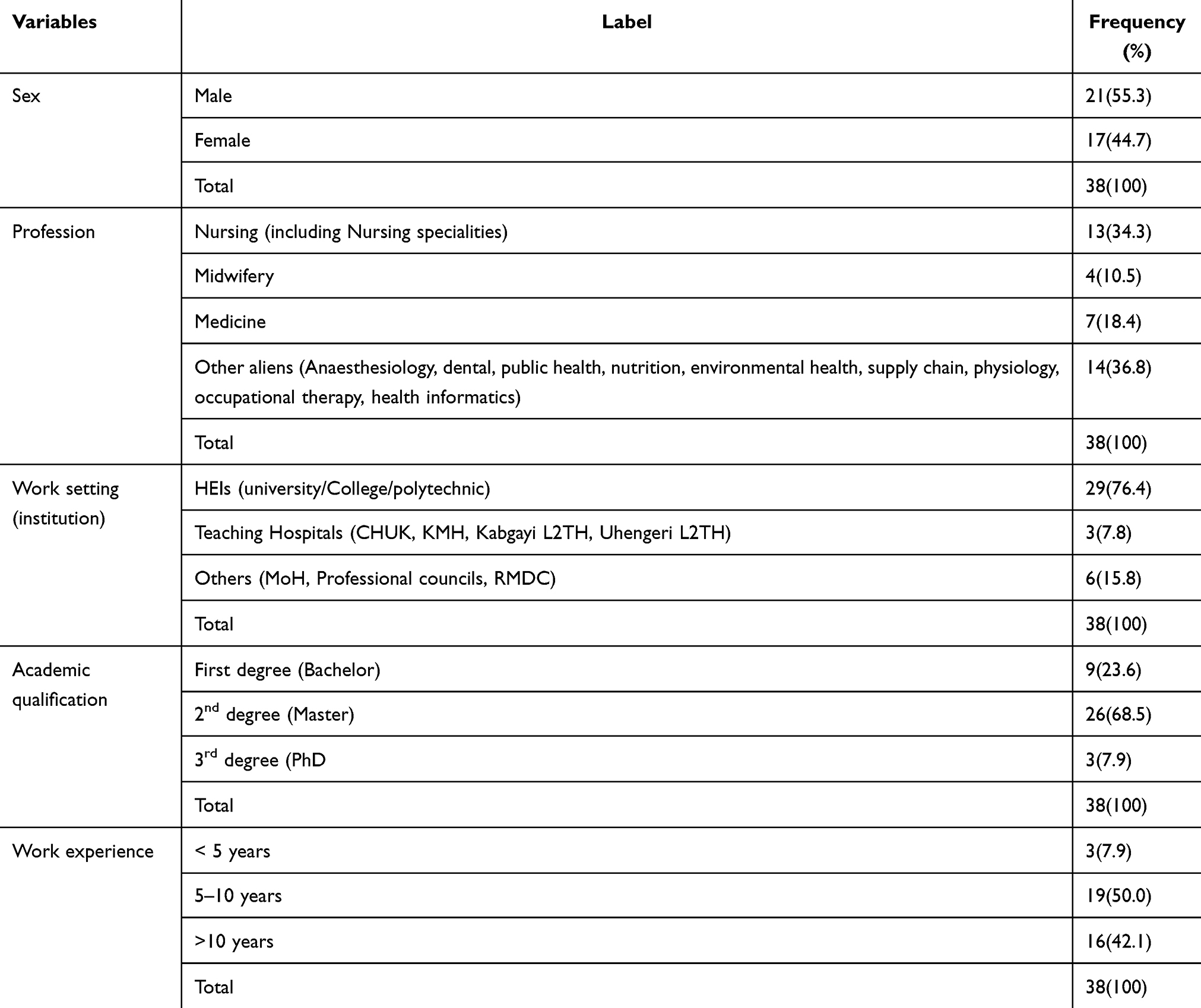 |
Table 1 Demographic Characteristics of the Study Participants (n=38) |
Teaching and Learning Quality (TALQ)
There was a high level of agreement that the blended lesson design—which was problem-based, elicited prior experiences, explained concepts using multimedia, involved collaborative in-person discussions, and provided opportunities for reflection and practical application (integration of FPI) within the blended e-learning module they had completed, with a mean score of 4.60, CI= [4.46--4.74]. They also reported frequently engaging in problem-solving tasks and activities (academic learning time (ALT), with a mean score = 4.47, CI= [4.30--4.64]. Additionally, the learners reported significant learning progress (learning a lot), with a mean score of 4.53, CI= [4.38--4.68]. Furthermore, the course quality was rated as outstanding, with a score of 4.73, CI= [4.62.4.85], and the learners expressed high levels of satisfaction, with a mean score of 4.80, CI= [4.68, 4.91] (Table 2).
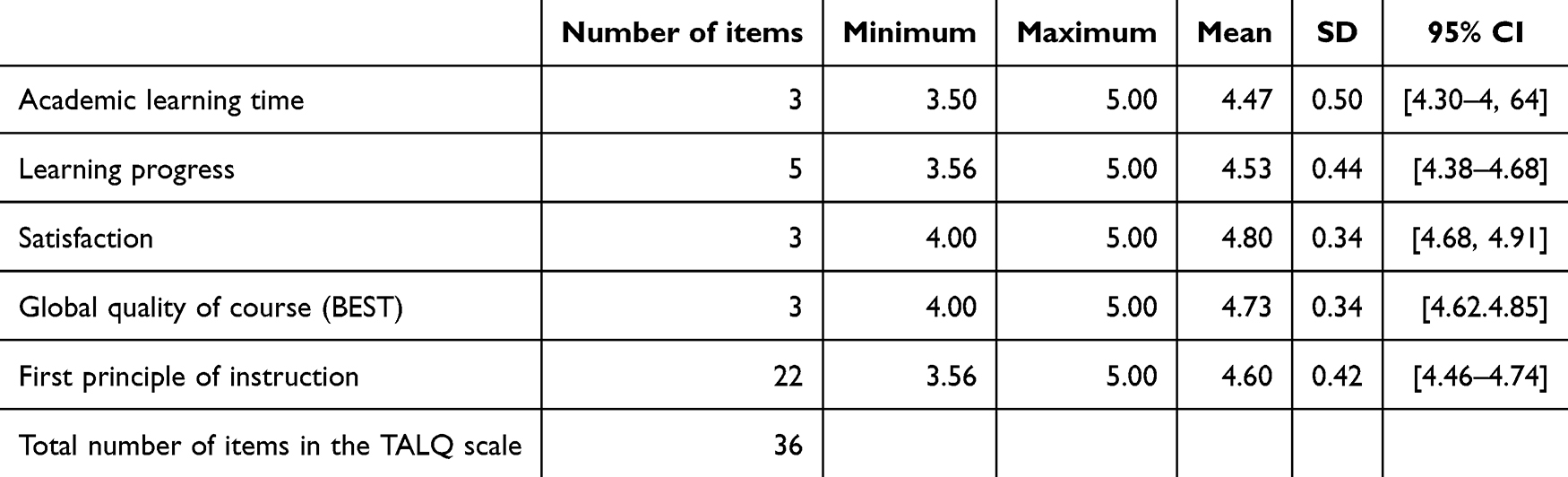 |
Table 2 Learners’ Mean Agreement on the Application of FPIs, Engagement, Instruction Quality, Satisfaction, and Learning Progress (TALQ Scale) in the Blended E-Learning Module (N=38) |
A one-way between-groups multivariate analysis of variance (MANOVA) was conducted to examine whether participants’ demographic characteristics influenced their agreement on the combined TALQ scores of the blended e-learning module. The five dependent variables were FPI, ALT, learning progress, satisfaction, and Global Quality of Course (BEST). Independent variables included sex, profession, academic qualification, work setting, and years of teaching and learning experience. Preliminary assumption testing confirmed normality, homogeneity of variance (p >0.05), equality of covariance matrices (p >0.001), and absence of multicollinearity, with no serious violations detected. The MANOVA revealed no statistically significant differences across demographic groups on the combined TALQ scale (Table 3).
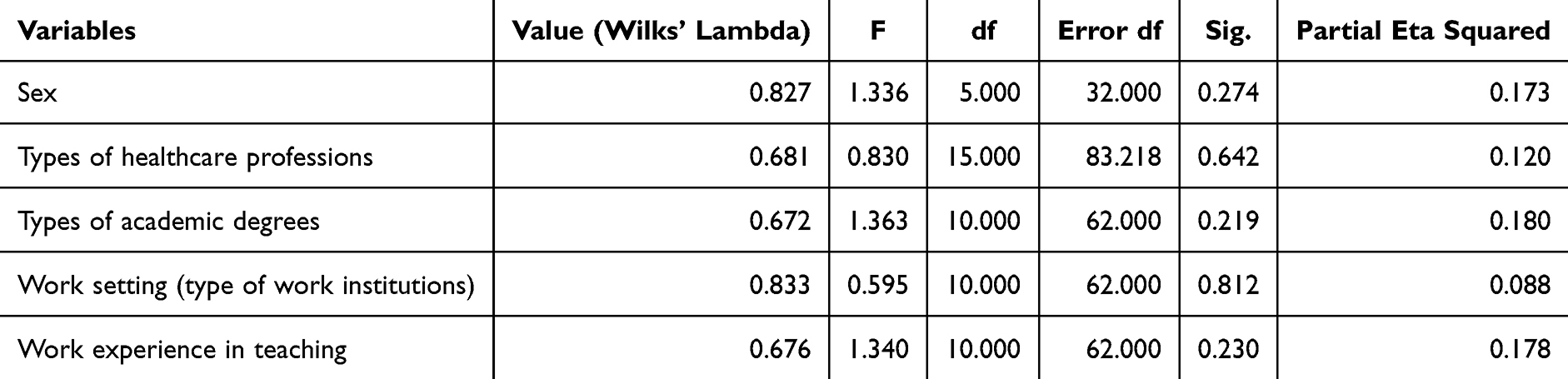 |
Table 3 Multivariate Analysis of Variance (MANOVA) Results for Demographic Variables on Combined TALQ Scores |
A strong positive correlation was observed between ALT and learners’ self-reported learning progress (r = 0.516). Furthermore, the findings indicate a strong positive relationship between ALT and FPI (r = 0.73). Learners who acknowledged the application of these principles in the modules also reported higher levels of engagement in solving problems and completing learning tasks. The ALT scale also demonstrated a significant positive correlation with the BEST Rating, which assesses the overall quality of the module and instructors (r = 0.624). Additionally, a moderate positive correlation was found between ALT and learner satisfaction (r = 0.46) (Table 4).
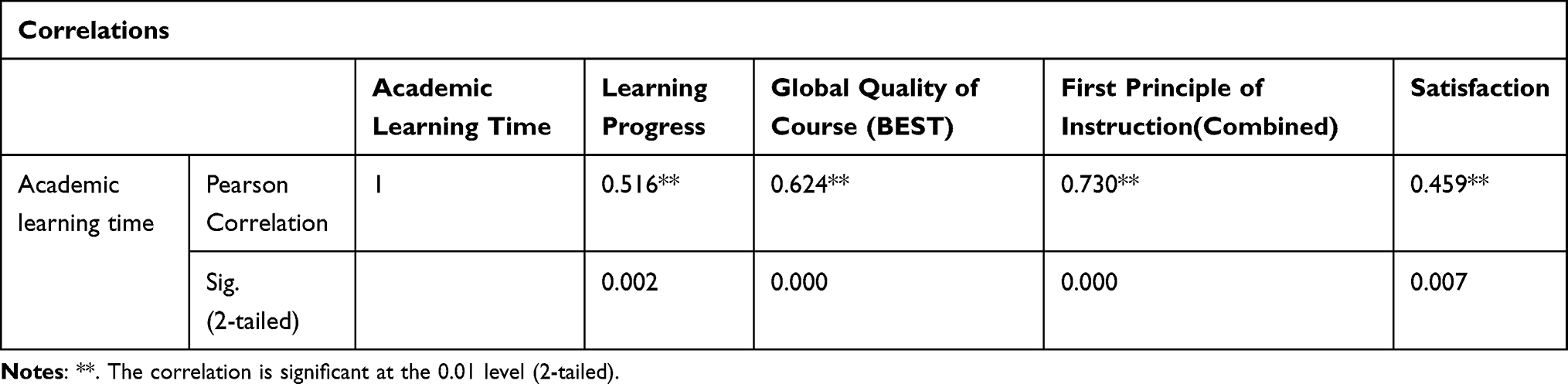 |
Table 4 Correlations Between ALT and Other TALQ Measures (n = 38) |
The application of FPIs within a module is positively and strongly correlated with other TALQ measures. These include the overall quality of the course and instructors (r=0.714), student satisfaction (r=0.711), and learning progress (r=0.633) (Table 5).
 |
Table 5 Correlations Between the First Principle of Instruction and the Other TALQ Measures (n=38) |
Discussion
This study is the first to design, implement, and evaluate an FPI-based health professional education course using a blended approach, aiming to offer empirical evidence and practical insights for designing future courses that enhance teaching and learning.
There was a high level of agreement that the blended lesson design—which was problem-based, elicited prior experiences, explained concepts using multimedia, involved collaborative in-person discussions, and provided opportunities for reflection and practical application—demonstrated the successful integration of FPI elements. The FPI, one ID theory, is an integrated one, and it is an effective solution as a principle necessary for the course.15 The widely endorsed FPI, developed under the influence of constructivism, outlines the requirements needed for achieving five effective learning environment goals.21 Research demonstrates significant benefits of integrating Merrill’s First Principles of Instruction into course design across various educational contexts. The five principles—engaging learners in real-world problem solving, activating existing knowledge, demonstrating new knowledge, applying new knowledge, and integrating knowledge into learners’ worlds—provide a structured, task-centred approach that effectively combines subject knowledge with practical skills.22,23 Empirical studies show positive outcomes when these principles guide course development.22 Choi22 found that students positively evaluated teaching effectiveness in a professional course designed using these principles. Similarly, Cheung & Hew reported that their blended learning course based on Merrill’s principles was well-organized with meaningful activities and created a positive, engaging learning environment for students.24
Similarly, a high level of agreement among learners regarding academic ALT implies that students perceive the time spent on learning tasks to be compelling, engaging, and conducive to their success. A high student agreement on academic learning time signifies that the instructional environment is effectively designed and managed to maximize productive learning. A high level of ALT also indicates the acquisition and retention of essential content in the course. Studies have shown that when learners experience high levels of ALT and FPI, they are more likely to achieve mastery of course objectives.25–27
Consistent with other evidence, this finding of this study revealed that the application of FPIs in the modules was significantly correlated with frequent student engagement in problem-solving tasks and activities (ALT), high-quality instruction, student satisfaction, and their perception of significant learning progress. Studies have consistently shown strong correlations between students’ perceptions of FPI application and their overall evaluations of the course and instructor quality. For example, research often reports correlations (eg, Spearman ρ) in the range of 0.714--0.748 (Frick et al, as cited in various reviews of FPI effectiveness),27 indicating that learners perceive courses designed with FPIs as being of superior quality. High student agreement on FPI implementation directly supports their perception of significant learning progress (eg, “learning a lot”). Empirical studies have demonstrated strong correlations here, often ranging from 0.633 to 0.720, suggesting that when FPIs are in play, students genuinely feel they are acquiring knowledge and skills more effectively.21 FPIs encourage active and authentic engagement (problem-centered, application, integration), leading to deeper understanding, better retention, and transfer of knowledge beyond rote memorization. Students who perceive FPIs are likely to engage in these deeper cognitive processes. FPIs foster intrinsic motivation by making learning relevant (problem-centred) and providing opportunities for active participation and success (application).21,28 High agreement indicates that these elements successfully make the learning experience more engaging and less passive for students. These principles form the basis of prescriptive instructional design theory and offer a structured, task-centred approach to course design to create effective, efficient, and engaging instruction.
In this study, consistent with existing evidence, we observed a strong relationship between ALT and the overall quality of the course, student satisfaction, and learning progress. For example, subsequent meta-analyses and reviews, such as those summarized by John Hattie’s Visible Learning,29 consistently show that the effective use of academic learning time, characterized by high engagement and success rates, has a significant positive effect on student learning progress and achievement. Furthermore, when students are effectively engaged and experience a high success rate (key components of ALT), they naturally feel a sense of accomplishment and mastery. This direct link between perceived competence and positive emotion contributes significantly to student satisfaction.30 Students also perceive the quality of their education as higher when they feel that their time is being utilized effectively for meaningful learning.31,32
While acknowledging that learners’ self-reported ratings of engagement and perceived learning progress differ from objective measures of learning achievement, it is essential to note that past research has consistently shown a strong and significant correlation between ALT and student academic achievement, as measured by standardized tests.13 For example, a meta-analysis conducted by Cohen in 198119 revealed an average correlation of 0.47 between learners’ self-ratings of their learning progress and their objectively measured learning achievements.
Notably, none of the demographic variables were associated with the learners’ perceptions of teaching and learning quality reported in this study. This finding aligns with broader research indicating that students’ perceptions of their educational experience and teaching-learning processes do not correlate with demographic variables or educational background.33 This suggests that learners from diverse backgrounds—regardless of profession, academic qualification, or work setting—tend to perceive the quality of their educational experience similarly. Ultimately, these findings indicate that perceptions of teaching-learning quality are shaped more by the ID and practices than by learners’ backgrounds.
Strengths and Limitations
The consistency of the results of this study with empirical findings from numerous studies conducted over the past 40 years—when measuring the same variable—strongly supports the validity of our findings. If the rating scales used had not been highly reliable, relying on a single student rating per course would have posed significant concerns. However, this was not the case. The inclusion of a wide range of courses introduced greater variability in between-course ratings, which in turn allowed for the observation of strong intercorrelations among the scales.
Importantly, this study did not objectively measure student learning achievement, nor did it conclude that FPIs increase student ALT, learning progress, satisfaction, or overall course quality. However, these promising results strongly suggest that further research in this area is warranted, particularly studies that objectively measure student achievement and specifically examine the effectiveness of first principles in leading to better learning outcomes. This study is limited by the relatively small sample size and the use of quantitative data only. Future research employing a longitudinal design and a mixed-methods approach may provide more comprehensive insights.
Conclusion
The blended eLearning lesson design—structured around a central problem, activation of prior knowledge, multimedia-based explanations, collaborative discussions, and opportunities for reflection and application—demonstrated effective integration of the first principles of instruction. This integration of FPI within a blended e-learning framework was a key factor in promoting student engagement, learning progress, and satisfaction, thereby contributing to the overall enhancement of teaching and learning quality.
Abbreviations
FPI, First principle of Instructions; TALQ, Teaching and learning quality; HPE, health professions education; UGHE, University of Global Health Equity; ALT, Academic learning time.
Data Sharing Statement
The article contains data that is supported by additional materials and referenced within the article.
Ethical Considerations and Approval
We adhered to all ethical guidelines for research involving human participants. Prior to data collection, an information sheet (provided below) was used to obtain informed written consent from participants. The consent form clearly explained the purpose, procedures, potential risks, and benefits of the study, ensuring that participants read and fully understood the information before agreeing to take part in the research.
Acknowledgments
We are very grateful to UGHE for the ethical clearance. We would also like to thank all educational development and quality assurance teams and students who participated in this study for their commitment to completing our survey.
Author Contributions
All authors made a significant contribution to the work reported, whether that is in the conception, study design, execution, acquisition of data, analysis and interpretation, or in all these areas; took part in drafting, revising or critically reviewing the article; gave final approval of the version to be published; have agreed on the journal to which the article has been submitted; and agree to be accountable for all aspects of the work.
Funding
This research received no funding.
Disclosure
The authors declare that they have no competing interests in this work.
References
1. Guillaume D, Troncoso E, Duroseau B, Bluestone J, Fullerton J. Mobile-social learning for continuing professional development in low-and middle-income countries: integrative review. JMIR Med Educ. 2022;8(2):e32614. doi:10.2196/32614
2. Delungahawatta T, Dunne SS, Hyde S, et al. Advances in e-learning in undergraduate clinical medicine: a systematic review. BMC Med Educ. 2022;22(1):711. doi:10.1186/s12909-022-03773-1
3. Gay GH. An assessment of online instructor e-learning readiness before, during, and after course delivery. J Comput High Educ. 2016;28(2):199–220. doi:10.1007/s12528-016-9115-z
4. Motaghian H, Hassanzadeh A, Moghadam DK. Factors affecting university instructors’ adoption of web-based learning systems: case study of Iran. Comput Educ. 2013;61:158–167. doi:10.1016/j.compedu.2012.09.016
5. Gachanja F, Mwangi N, Gicheru W. E-learning in medical education during the COVID-19 pandemic: experiences of a research course at Kenya Medical Training College. BMC Med Educ. 2021;21(1):612. doi:10.1186/s12909-021-03050-7
6. Batucan GB, Gonzales GG, Balbuena MG, Pasaol KRB, Seno DN, Gonzales RR. An extended UTAUT model to explain factors affecting online learning system amidst COVID-19 pandemic: the case of a developing economy. Front Artif Intell. 2022;5:768831. doi:10.3389/frai.2022.768831
7. Costan E, Gonzales G, Gonzales R, et al. Education 4.0 in developing economies: a systematic literature review of implementation barriers and future research agenda. Sustainability. 2021;13(22):12763. doi:10.3390/su132212763
8. Drueke B, Mainz V, Lemos M, Wirtz MA, Boecker M. An evaluation of forced distance learning and teaching under pandemic conditions using the technology acceptance model. Front Psychol. 2021;12:701347. doi:10.3389/fpsyg.2021.701347
9. Szopiński T, Bachnik K. Student evaluation of online learning during the COVID-19 pandemic. Technol Forecast Soc Change. 2022;174:121203. doi:10.1016/j.techfore.2021.121203
10. Guideline W. Recommendations on digital interventions for health system strengthening. World Health Organ. 2019:2020.
11. Tarus JK, Gichoya D, Muumbo A. Challenges of implementing e-learning in Kenya: a case of Kenyan public universities. Int Rev Res Open Distrib Learn. 2015;16(1):120–141.
12. Stark CM, Garner CD, Garg A, Bégin F. Building capacity of health professionals in low-and middle-income countries through online continuing professional development in nutrition. J Contin Educ Health Prof. 2021;41(1):63–69. doi:10.1097/CEH.0000000000000334
13. Frick TW, Chadha R, Watson C, Wang Y, Green P. College student perceptions of teaching and learning quality. Educ Technol Res Dev. 2009;57:705–720. doi:10.1007/s11423-007-9079-9
14. Yushun L, Qun L, Chunlan Q, Shuxia Z, Pan L. Research on evaluation model for interactive classroom enabled with mobile terminals. In: 2017 International Conference of Educational Innovation Through Technology (EITT). IEEE; 2017:136–141.
15. Merrill MD. A pebble‐in‐the‐pond model for instructional design. Perform Improv. 2002;41(7):41–46. doi:10.1002/pfi.4140410709
16. Merrill MD. First Principles of Instruction. John Wiley & Sons; 2012.
17. Merrill MD. Using the first principles of instruction to make instruction effective, efficient, and engaging. Found Learn Instr Des Technol. 2017.
18. Merrill MD. First principles of instruction revisited. In: International Handbook of Psychology Learning and Teaching. Springer; 2021:1–33.
19. Cohen PA. Student ratings of instruction and student achievement: a meta-analysis of multisection validity studies. Rev Educ Res. 1981;51(3):281–309. doi:10.3102/00346543051003281
20. JeffreyCoker F, Basinger M, Modi V. Open data kit: implications for the use of smartphone software technology for questionnaire studies in international development. Modi Mech Columbia Eduwp-Contentuploads201004Open-Data-Kit-Rev-Artic Pdf. 2010;12.
21. Hao H, Susono H, Geng X, Chen L, Yamada M. Effects of using the first principles of instruction in a content and language integrated learning class. Asian-Pac J Second Foreign Lang Educ. 2023;8(1):2. doi:10.1186/s40862-022-00173-2
22. Choi J. Instructional design and application of a professional English course. J Teach Engl Specif Acad Purp. 2014;2(3):445–458.
23. Becker K. First principles of CS instruction. 2006.
24. Cheung WS, Hew KF. Applying “first principles of instruction” in a blended learning course. In: Technology in Education. Transforming Educational Practices with Technology: First International Conference, ICTE 2014, Hong Kong, China, July 2–4, 2014. Revised Selected Papers. Springer; 2015:127–135.
25. Fisher CW, Berliner DC, Filby NN, Marliave R, Cahen LS, Dishaw MM. Teaching behaviours, academic learning time, and student achievement: an overview. J Classr Interact. 1981;17(1):2–15.
26. Derri V, Emmanouilidou K, Vassiliadou O, Tzetzis G, Kioumourtzoglou E. Relationship between academic learning time in physical education (ALT-PE) and skill concepts acquisition and retention. Phys Educ. 2008;65(3):134.
27. Frick TW, Chadha R, Watson C, Zlatkovska E. Improving course evaluations to improve instruction and complex learning in higher education. Educ Technol Res Dev. 2010;58:115–136. doi:10.1007/s11423-009-9131-z
28. Zhao JH, Shangguan ST, Long G, Yang QF. First principles of instruction approach to developing a collaborative knowledge organizer-based digital game of biology learning. J Sci Educ Technol. 2025;1–15.
29. Hattie J. Visible Learning: A Synthesis of Over 800 Meta-Analyses Relating to Achievement. Routledge; 2008.
30. Heydari M, Jafari H, Azadian F, Mohammadi F, Moghaddam SFM, Shakiba Z. The relationship between the quality of education and students’ satisfaction with the quality of the E-learning system and its effect on education to reduce complications of diabetes. Rev Latinoam Hipertens. 2023;18(1):10–19.
31. Bash KL, Kreiner DS. Student perceptions of study time. Psi Chi J Psychol Res. 2014;19(1):3–9. doi:10.24839/2164-8204.JN19.1.3
32. Liu M. The relationship between students’ study time and academic performance, and its practical significance. BCP Educ Psychol. 2022;7:412–415. doi:10.54691/bcpep.v7i.2696
33. Shah V, Shah A. Relationship between student perception of school worthiness and demographic factors. In: Frontiers in Education. Vol. 3. Frontiers Media SA; 2018:45.
 © 2025 The Author(s). This work is published and licensed by Dove Medical Press Limited. The
full terms of this license are available at https://www.dovepress.com/terms
and incorporate the Creative Commons Attribution
- Non Commercial (unported, 4.0) License.
By accessing the work you hereby accept the Terms. Non-commercial uses of the work are permitted
without any further permission from Dove Medical Press Limited, provided the work is properly
attributed. For permission for commercial use of this work, please see paragraphs 4.2 and 5 of our Terms.
© 2025 The Author(s). This work is published and licensed by Dove Medical Press Limited. The
full terms of this license are available at https://www.dovepress.com/terms
and incorporate the Creative Commons Attribution
- Non Commercial (unported, 4.0) License.
By accessing the work you hereby accept the Terms. Non-commercial uses of the work are permitted
without any further permission from Dove Medical Press Limited, provided the work is properly
attributed. For permission for commercial use of this work, please see paragraphs 4.2 and 5 of our Terms.