
Back to Journals » Advances in Medical Education and Practice » Volume 16
Enhancing Pediatric Residency Training Through Peer-Education Based Gamified Simulation
Authors Scaglione M  , Calandrino A , Puzone L, Bottino G, Conte A, Striano P , Maghnie M
Received 31 January 2025
Accepted for publication 20 April 2025
Published 3 September 2025 Volume 2025:16 Pages 1621—1626
DOI https://doi.org/10.2147/AMEP.S518814
Checked for plagiarism Yes
Review by Single anonymous peer review
Peer reviewer comments 2
Editor who approved publication: Dr Md Anwarul Azim Majumder
Marco Scaglione,1 Andrea Calandrino,1,2 Laura Puzone,1 Giovanni Bottino,1,3 Alessio Conte,1 Pasquale Striano,1,4 Mohamad Maghnie1,5
1Department of Neuroscience, Rehabilitation, Ophtalmology, Genetics, Maternal and Child Health, University of Genoa, Genoa, 16132, Italy; 2Department of Maternal and Neonatal Health, Neonatal Intensive Care Unit, IRCCS Giannina Gaslini Institute, Genoa, 16147, Italy; 3Department of Maternal and Neonatal Health, Pediatric and Neonatology Spoke Unit of Savona, IRCCS Giannina Gaslini Institute, San Paolo Hospital, Savona, 17100, Italy; 4Department of Pediatrics, Pediatric Neurology and Muscular Diseases Unit, IRCCS Giannina Gaslini Institute, Genoa, 16147, Italy; 5Department of Pediatrics, Pediatric Endocrinology Unit, IRCCS Giannina Gaslini Institute, Genoa, 16147, Italy
Correspondence: Andrea Calandrino, Department of Neuroscience, Rehabilitation, Ophtalmology, Genetics, Maternal and Child Health University of Genoa, Via Gerolamo Gaslini 5, Genoa, 16147, Italy, Tel +39 010 56362218, Fax +39 010 3075271, Email [email protected]
Abstract: The reduction in clinical rotation hours, particularly in high-demand pediatric subspecialties such as Neonatal Intensive Care Units (NICU) and Pediatric Emergency Rooms (ER), has highlighted the need for innovative approaches to enhance pediatric residency education. A 2019 survey of Italian pediatric residency programs revealed that most residents receive fewer than five hours of simulation-based training annually, with 66% participating in no simulation activities. Additionally, pediatric ER rotation hours have seen significant reductions—daytime rotations decreased by 29%, while nighttime rotations were reduced by 60% over the past four years at the University of Genoa. These challenges emphasize the importance of simulation-based curricula to address gaps in clinical exposure.This study presents a gamified simulation-based curriculum developed at the University of Genoa, designed to improve both technical and non-technical competencies among pediatric residents while compensating for reduced clinical exposure. The curriculum spans five years, with Year 1 focusing on foundational skills such as airway management, vascular access, and diagnostic techniques. Year 2 introduces more advanced scenarios like neonatal resuscitation, shock management, and cardiac arrest, while Years 3– 5 culminate in high-fidelity simulations involving complex trauma and crisis resource management.Throughout the program, gamification elements such as badges, leaderboards, and team-based rewards enhance engagement, motivation, and participation. These elements provide feedback and foster progression, reinforcing residents’ commitment to mastering technical skills and non-technical competencies like teamwork, leadership, and decision-making. By combining simulation-based training with gamification, this curriculum offers an innovative approach to residency education, preparing pediatric residents for real-world challenges and developing essential skills for high-stakes pediatric care.
Keywords: Simulation, residents, gamification, peer-education, training, technical skills, non-technical skills
The increasing number of Italian pediatric residency contracts over the past five years has raised concerns about its impact on clinical training opportunities, particularly in high-demand subspecialties such as Emergency Rooms (ER) and NICU/PICU departments.1 These rotations are fundamental for equipping future healthcare professionals with a comprehensive clinical foundation,1,2
Recent changes in how residents are anticipatedly integrated into primary and secondary hospitals, with recruitments within the public healthcare system before the regular completion of the 5-year residency course, have further highlighted the pressing need for a standardized system to assess residents’ autonomy,3.4 Similar trends have been observed at the University of Genoa, a tertiary-level academic children’s hospital in northern Italy. Despite ranking in the top quartile for annual residency contracts, our program has experienced a notable decline in pediatric ER rotations over the past four years. Specifically, daytime rotation hours have decreased by 29%, while nighttime rotations have been reduced by 60%, reflecting significant adjustments in clinical training exposure (Figure 1).
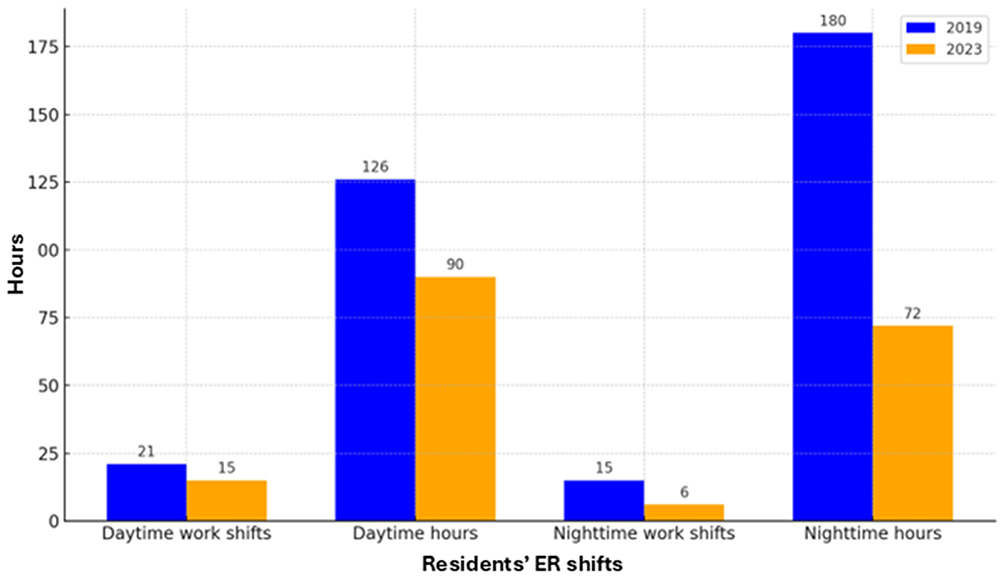 |
Figure 1 Changes in Pediatric ER Rotation Hours at the University of Genoa (2019 vs 2023). Notes: Significant reduction in daytime and nighttime work shifts and hours for pediatric residents over the four-year period, reflecting the adjustments in clinical training exposure reported at the University of Genoa Pediatric Residency Program. |
Simulation-based curricula offer a promising strategy to maximize residents’ exposure to high-stakes situations requiring significant technical, cognitive, and emotional skills. Such curricula could help bridge the gaps identified above. Engaging residents in simulation programs through competitions supports their progression toward greater autonomy in the final stages of training.5
Simulation is pivotal in modern medical education, focusing on cognitive knowledge, critical thinking, psychomotor skills, and clinical performance.6 In pediatric training, simulation-based education is particularly valuable, enhancing learners’ confidence and performance, especially in emergency and neonatal care. These areas benefit from simulation because it allows for deliberate practice in rare but high-stakes scenarios.7 As simulation becomes increasingly integrated into pediatric education, it is essential to develop structured curricula and train instructors to ensure the effectiveness and transferability of the skills and knowledge.8
A 2019 nationwide survey covering 71% of Italian pediatric residency programs revealed that 88% of respondents had received fewer than five hours of simulation-based training in the previous year, with 66% having participated in no simulation activities. Consequently, 93% expressed interest in participating in simulation-based training to enhance their decision-making abilities in complex medical situations and improve both technical and non-technical skills.9
Simulation-based competitions, such as the “Pediatric Simulation Games” and the “Neonatal Simulation Competition” held annually in Italy, are excellent examples of gamified training methods that develop both technical and non-technical skills among pediatric residents.10 Gamification, defined as the integration of game-design elements into non-game contexts, has emerged as a powerful tool in healthcare education. By incorporating interactive elements such as points, badges, and leaderboards, gamification increases engagement, promotes active participation, and provides immediate feedback, thus supporting skill acquisition and self-directed learning.11
Gamified training transforms the learning environment, making it more dynamic and interactive. It helps residents acquire complex skills, such as managing pediatric emergencies, in a more effective and enjoyable manner. Participants are more emotionally and mentally invested, retaining information better, improving teamwork and communication, and performing more effectively under pressure. The combination of increased engagement, motivation, and practical application leads to superior learning outcomes, making the training more impactful if correctly applied by educators.12
Studies examining the first American simulation-based gamified protocol designed for ER in-training doctors, “SimWars” have shown a statistically significant improvement in In-Training Examination (ITE) scores for scenarios involving Abdominal/Gastrointestinal, Thoracic, OBGyn, and Trauma.13 A similar positive effect has been observed in the Italian initiative “SIMCUP Italia”, where residents’ self-confidence was significantly improved immediately following the competition.14 These initiatives also emphasize non-technical skills, such as communication, teamwork, and decision-making, which have become increasingly important in recent years for reducing human errors in healthcare settings, particularly in the management of emergency and complex situations.15
To prepare residents for such competitions, we developed a pilot peer-education training program for our institution’s fourth- and fifth-year residents. This program focused on specific Pediatric Advanced Life Support (PALS) and Neonatal Life Support (NLS) scenarios. It included supplementary non-formal education activities to enhance team building, leadership, cooperation, and communication skills. The training sessions were led by residents who had previously participated in these competitions under the guidance of expert tutors.
Building on this pilot experience, following the standards required by the Italian Ministry of University on the residency program standards16 we have developed a comprehensive training curriculum for residents that begins in their first year. This curriculum gradually builds both technical and non-technical competencies through a structured progression of simulation-based learning activities. The proposed program, outlined in Table 1, follows a structured progression from foundational skill labs in the first year (practical workshops, relational simulations, and flipped activities focused on non-technical skills such as teamwork, communication, and decision-making), to advanced, high-fidelity simulations in the later years. To enhance motivation and engagement, gamification elements are also integrated throughout the curriculum, including the use of open badge systems for progressive tracking and recognition of achievements.17 Residents earn badges for mastering specific skills, completing scenarios, and demonstrating leadership in complex simulations. These badges serve as verifiable credentials and can be shared on professional platforms. Additionally, rewards such as access to advanced workshops, competitive event participation, and milestone recognition encourage active participation and progression. In order to provide a future standardization of the evaluation progress, we propose the integration of validated international assessments systems together with the informal ones.18
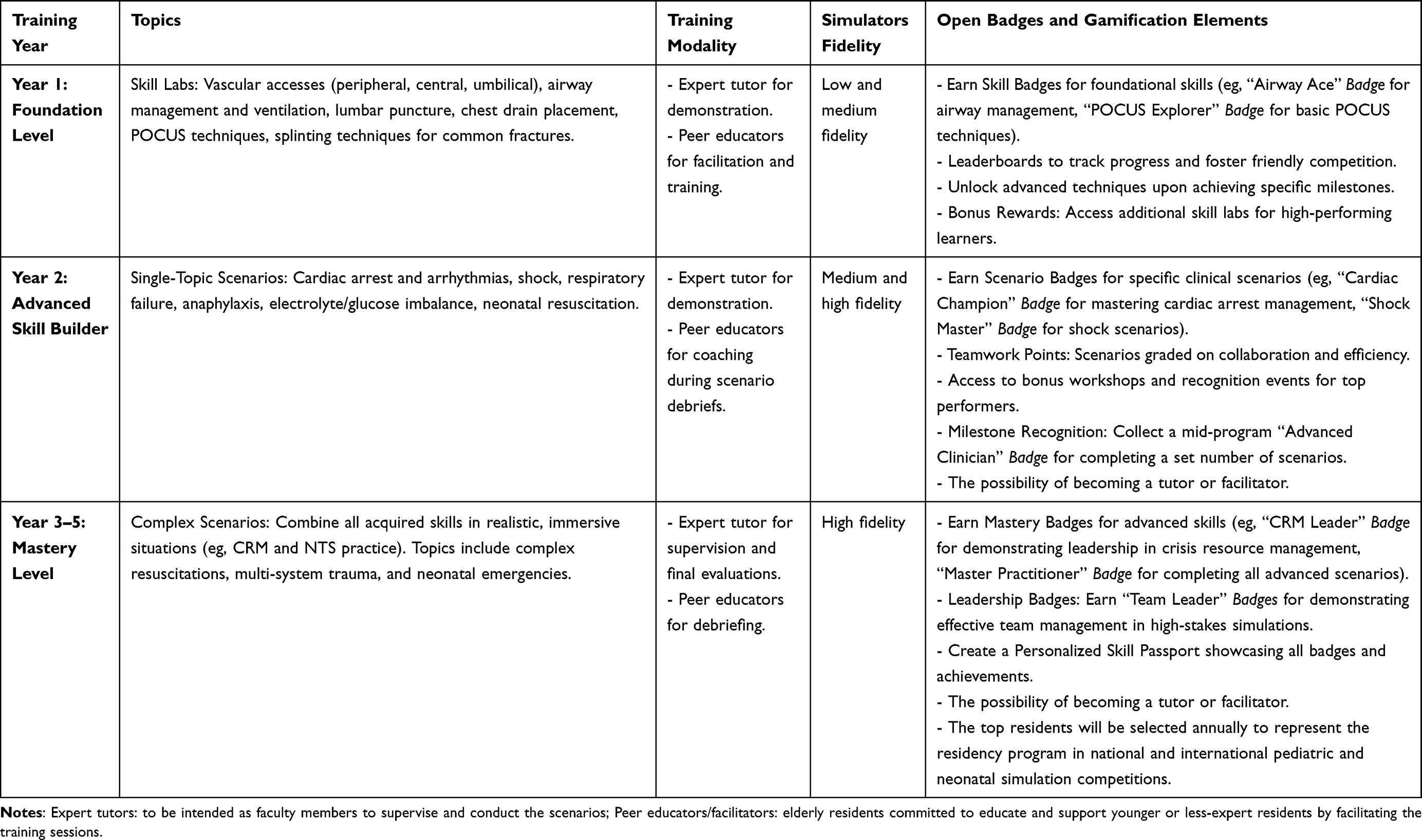 |
Table 1 Comprehensive Training Program with Gamification System |
The gamified curriculum is structured to align with the residents’ academic progression, with each year introducing more complex scenarios that match their skill level. Faculty members oversee the program, ensuring the training meets educational standards and providing feedback during debriefing sessions.
A key feature of this curriculum is the use of experienced residents as peer tutors under faculty supervision, which not only makes learning more relatable and accessible but also enhances training efficiency. Since residents have more flexible schedules than senior faculty, we can increase the frequency and adaptability of training sessions, ensuring that learning opportunities are more widely available.19 The peer-led model thus enriches the learning experience while optimizing training time, fostering well-rounded development of essential pediatric competencies. Moreover, simulators with progressively increasing levels of fidelity allow learners to gradually build their clinical competence.20 This approach starts with mastering basic procedures and algorithms applied in increasing complexity scenarios. This progression reinforces technical skills and provides the opportunity to develop and refine non-technical skills and crisis resource management, ensuring a comprehensive and integrated approach to clinical training.15
To further explore the advantages and challenges of integrating gamification into pediatric residency training, we highlight the need for adequate resources, faculty training, and alignment with curricular goals. While extending case study learning hours is essential, faculty and staff involvement is crucial to ensure the curriculum’s integration with the overall educational framework.
In the end, this manuscript is aimed to present the educational framework of our proposal. We acknowledge that future studies incorporating pre-post assessments would be valuable in evaluating the effectiveness of this gamified simulation approach and its impact on residents’ skills. In this direction, researchers should also consider incorporating students’ perspectives on the effectiveness of this approach, gathering feedback on their experiences and accomplishments.
Abbreviations
ER, Emergency Room; NICU, Neonatal Intensive Care Unit; ITE, In-Training Examination; OBGyn, Obstetrics and Gynecology; PALS, Pediatric Advanced Life Support; NLS, Neonatal Life Support; POCUS, Ponit-of-Care Ultrasonography; CRM, Crisis Resource Management; NTD, Non-technical skills.
Author Contributions
All authors made a significant contribution to the work reported, whether that is in the conception, study design, execution, acquisition of data, analysis and interpretation, or in all these areas; took part in drafting, revising or critically reviewing the article; gave final approval of the version to be published; have agreed on the journal to which the article has been submitted; and agree to be accountable for all aspects of the work.
Funding
This study was supported by the IRCCS Istituto Giannina Gaslini Pediatric Clinic research funds [COMM_UA (2022_260_0)].
Disclosure
The authors have no competing interest to declare for this work.
References
1. Corsello A, Rotulo S, Santangelo A, et al. Challenges and opportunities in pediatric residency: an analysis of the increasing number of residents in Italy. Ital J Pediatr. 2024;50(1):1–7. doi:10.1186/S13052-024-01778-8/TABLES/2
2. Huang YB, Lin YR, Hung SK, Chang YC, Ng CJ, Chen SY. Pediatric training crisis of emergency medicine residency during the COVID-19 pandemic. Children. 2022;9(1):32. doi:10.3390/CHILDREN9010032
3. Meric R, Stone RG, Lupu VV, et al. The diversity of pediatric residency programs across Europe: quality assurance of training, night shifts, and wages. J Pediatr. 2020;226:319–320.e2. doi:10.1016/J.JPEDS.2020.08.001
4. Goldshore MA, Solomon BS, Downs SM, Pan R, Minkovitz CS. Residency exposures and anticipated future involvement in community settings. Acad Pediatr. 2014;14(4):341–347. doi:10.1016/J.ACAP.2014.02.011
5. Salerno N, et al. Challenging hazards amidst observational simulation in the emergency department: advancing gamification in simulation education through a novel resident-led skills competition. Cureus. 2018;10(11). doi:10.7759/CUREUS.3563
6. Issenberg SB. The scope of simulation-based healthcare education. Simul Healthc. 2006;1(4):203–208. doi:10.1097/01.SIH.0000246607.36504.5A
7. Cheng A, Duff J, Grant E, Kissoon N, Grant VJ. Simulation in paediatrics: an educational revolution. Paediatr Child Health. 2007;12(6):465–468. doi:10.1093/PCH/12.6.465
8. Mills DM, Williams DC, Dobson JV. Simulation training as a mechanism for procedural and resuscitation education for pediatric residents: a systematic review. Hosp Pediatr. 2013;3(2):167–176. doi:10.1542/HPEDS.2012-0041
9. Binotti M, et al. Simulation-based medical training for paediatric residents in Italy: a nationwide survey. BMC Med Educ. 2019;19(1). doi:10.1186/S12909-019-1581-3
10. Zanetto L, et al. A simulation competition on neonatal resuscitation as a new educational tool for pediatric residents. Children. 2023;10(10):203–208. doi:10.3390/CHILDREN10101621
11. Xu M, Luo Y, Zhang Y, Xia R, Qian H, Zou X. Game-based learning in medical education. Front Public Health. 2023;11. doi:10.3389/FPUBH.2023.1113682.
12. Van Gaalen AEJ, Brouwer J, Schönrock-Adema J, Bouwkamp-Timmer T, Jaarsma ADC, Georgiadis JR. Gamification of health professions education: a systematic review. Adv Health Sci Educ Theory Pract. 2021;26(2):683–711. doi:10.1007/S10459-020-10000-3
13. Mendez D, Takenaka K, Cardenas-Turanzas M, Suarez G. The effect of simulation wars on em residents’ global rating scales and in-training examination scores. Open Access Emerg Med. 2020;12:35–42. doi:10.2147/OAEM.S223257
14. Ingrassia PL, Franc JM, Carenzo L. A novel simulation competition format as an effective instructional tool in post-graduate medical education. Adv Simul. 2018;3(1). doi:10.1186/S41077-018-0075-4
15. Elendu C, Amaechi DC, Okatta AU, et al. The impact of simulation-based training in medical education: a review. Medicine. 2024;103(27):e38813. doi:10.1097/MD.0000000000038813
16. Decreto interministeriale recante gli standard, i requisiti e gli indicatori di attività formativa e assistenziale delle Scuole di specializzazione di area sanitaria - Miur. Available from: https://www.mim.gov.it/web/guest/-/decreto-interministeriale-recante-gli-standard-i-requisiti-e-gli-indicatori-di-attivita-formativa-e-assistenziale-delle-scuole-di-specializzazione-di-.
17. Edwards EA, Lumsden J, Rivas C, et al. Gamification for health promotion: systematic review of behaviour change techniques in smartphone apps. BMJ Open. 2016;6(10):e012447. doi:10.1136/BMJOPEN-2016-012447
18. Perkins SQ, Dabaja A, Atiemo H. Best approaches to evaluation and feedback in post-graduate medical education. Curr Urol Rep. 2020;21(10). doi:10.1097/MD.0000000000038813
19. Pethrick H, et al. Peer mentoring in medical residency education: a systematic review. Can Med Educ J. 2020;11(6). doi:10.36834/CMEJ.68751
20. Lefor AK, Harada K, Kawahira H, Mitsuishi M. The effect of simulator fidelity on procedure skill training: a literature review. Int J Med Educ. 2020;11:97–106. doi:10.5116/IJME.5EA6.AE73
 © 2025 The Author(s). This work is published and licensed by Dove Medical Press Limited. The
full terms of this license are available at https://www.dovepress.com/terms
and incorporate the Creative Commons Attribution
- Non Commercial (unported, 4.0) License.
By accessing the work you hereby accept the Terms. Non-commercial uses of the work are permitted
without any further permission from Dove Medical Press Limited, provided the work is properly
attributed. For permission for commercial use of this work, please see paragraphs 4.2 and 5 of our Terms.
© 2025 The Author(s). This work is published and licensed by Dove Medical Press Limited. The
full terms of this license are available at https://www.dovepress.com/terms
and incorporate the Creative Commons Attribution
- Non Commercial (unported, 4.0) License.
By accessing the work you hereby accept the Terms. Non-commercial uses of the work are permitted
without any further permission from Dove Medical Press Limited, provided the work is properly
attributed. For permission for commercial use of this work, please see paragraphs 4.2 and 5 of our Terms.
Recommended articles

Just-in-Time, Just-in-Place Virtual Training in the Pediatric Emergency Department: A Novel Approach to Impact the Perfusion Exam


Shah AS, Sobolewski B, Chon S, Cruse B, Glisson MD, Zackoff MW, Davis D, Zhang Y, Schumacher DJ, Geis GL
Advances in Medical Education and Practice 2023, 14:901-911
Published Date: 18 August 2023
Exploring Endoscopic Competence in Gastroenterology Training: A Simulation-Based Comparative Analysis of GAGES, DOPS, and ACE Assessment Tools
Ismail FW, Afzal A, Durrani R, Qureshi R, Awan S, Brown MR
Advances in Medical Education and Practice 2024, 15:75-84
Published Date: 31 January 2024
Paramedics Satisfaction with Simulation Experience for Career Development and Skills Maintenance
Alshibani A, Alburaidi AS, Alsukait MA, Albadr R, Alsubaie BK, Almutairi A, Almutairi S, AlHussaini Z
Advances in Medical Education and Practice 2025, 16:245-253
Published Date: 19 February 2025
Transfer of Laparoscopic Skills From Box Trainer Simulation to Real Life: A Bi-Center Study in Pakistan
Aftab R, Ali SM, Ali A, Shahid N, Arja SB, Ahmed M, Nafees R, Shahid M
Advances in Medical Education and Practice 2025, 16:2003-2012
Published Date: 30 October 2025