
Back to Journals » Journal of Pain Research » Volume 19
Effects of Transverse Abdominis Plane Block with Ropivacaine-Hydromorphone versus. Ropivacaine in Cesarean Section: A Randomized Controlled Trial
Authors Zhang J, Zhang D, Wang Y, Li W, Tu H 
Received 29 December 2025
Accepted for publication 5 March 2026
Published 13 March 2026 Volume 2026:19 592353
DOI https://doi.org/10.2147/JPR.S592353
Checked for plagiarism Yes
Review by Single anonymous peer review
Peer reviewer comments 2
Editor who approved publication: Dr Jinlei Li
Jie Zhang,1,* Dan Zhang,1,* Yi Wang,1 Wei Li,1 Hongtao Tu2
1Department of Anesthesiology, Dazhou Integrated TCM& Western Medicine Hospital, Dazhou, 635000, People’s Republic of China; 2Department of Urology, Dazhou Central Hospital, Dazhou, 635000, People’s Republic of China
*These authors contributed equally to this work
Correspondence: Hongtao Tu, Department of Urology, Dazhou Central Hospital, No. 56, Nan Yue Miao Street, Tongchuan District, Dazhou City, Sichuan Province, 635000, People’s Republic of China, Email [email protected]
Objective: To compare the efficacy and safety of ultrasound-guided transverse abdominis plane block (TAPB) with ropivacaine combined with hydromorphone versus ropivacaine alone for postoperative analgesia in parturients undergoing cesarean section.
Methods: A randomized controlled trial was conducted with 90 eligible parturients scheduled for elective cesarean section. They were randomly assigned to the experimental group (Group R+H, n=45) receiving TAPB with 0.25% ropivacaine plus 0.2 mg hydromorphone (20 mL per side), and the control group (Group R, n=45) receiving TAPB with 0.25% ropivacaine. The primary outcome was the time to first rescue analgesia. Secondary outcomes included serum prolactin (PRL) levels, pain intensity, patient-controlled analgesia (PCA) usage, postoperative recovery indicators, adverse reactions, and patient satisfaction.
Results: The time to first PCA use was significantly longer in Group R+H than in Group R (7.32± 4.80 h vs. 3.49± 1.74 h, p< 0.001). Group R+H showed lower PCA consumption at 4, 12, 24, and 48 hours post-TAPB (all p< 0.05). Numerical rating scale (NRS) scores at rest and during movement were significantly lower in Group R+H at 4 and 12 hours post-TAPB (all p< 0.05), but no significant differences were observed at 24 and 48 hours. There were no significant differences in serum PRL levels, postoperative recovery indicators (time to first ambulation, flatus, and spontaneous urination), or the incidence of adverse reactions between the two groups (all p> 0.05). Patient satisfaction with analgesia was significantly higher in Group R+H (9 (9, 10) vs. 8 (8, 9), p=0.004).
Conclusion: Ultrasound-guided TAPB with ropivacaine combined with hydromorphone provides superior early postoperative analgesia, reduces rescue analgesic requirements, and improves patient satisfaction in parturients undergoing cesarean section. It does not affect perioperative PRL levels or postoperative recovery, nor does it increase adverse events, making it a safe and effective analgesic strategy.
Keywords: postoperative pain, ultrasound-guided TAPB, hydromorphone, cesarean section
Introduction
As a core surgical procedure in the field of obstetrics for managing critical conditions such as high-risk pregnancies, dystocia, and fetal distress, cesarean section plays an irreplaceable role in ensuring maternal and infant safety. With the development of perinatal medical technology, the adoption of cesarean section has remained at a relatively high level in clinical practice.1 However, postoperative pain management has always been a key link requiring optimization in the field of obstetric anesthesia. Studies have shown that the incidence of acute severe pain in parturients after cesarean section is as high as over 60%.2 This severe postoperative pain not only triggers negative emotions such as anxiety and depression in parturients but also activates the body’s stress response system, leading to the massive release of stress hormones such as catecholamines and cortisol.3 This further induces physiological complications including nausea, vomiting, and delayed intestinal function recovery. In severe cases, it may even develop into chronic postsurgical pain syndrome, exerting a significant negative impact on the long-term physical and mental health of parturients and their postnatal rehabilitation process.4,5 Therefore, exploring a safe, effective, and long-acting postoperative analgesic regimen for cesarean section has become an important issue in current clinical practice and scientific research in the field of obstetric anesthesia.
In current clinical practice, patient-controlled intravenous analgesia (PCIA) is one of the conventional regimens for postoperative analgesia after cesarean section. By allowing parturients to independently control the infusion of analgesic drugs, this regimen can meet the individual analgesic needs to a certain extent and has a rapid onset of analgesia. However, the PCIA regimen relies on the continuous intravenous infusion of opioid drugs, which has obvious limitations in clinical application. On one hand, excessive use of opioids is prone to cause adverse reactions such as respiratory depression, pruritus, and urinary retention, increasing the risk of postoperative complications in parturients.6,7 On the other hand, the intravenous administration method cannot accurately target the pain conduction pathway in the surgical incision area. Some parturients still experience insufficient analgesic effect or short duration of analgesia,8 which further affects their postoperative early ambulation, breastfeeding, and other rehabilitation behaviors. Therefore, the search for regional block techniques that can reduce the dosage of opioids and improve analgesic specificity has become a research focus in postoperative pain management after cesarean section.
As a new type of trunk regional block technique, ultrasound-guided transverse abdominis plane block (TAPB) has gradually demonstrated its application value in postoperative analgesia for abdominal surgery in recent years.9,10 By injecting local anesthetics into the fascial plane between the internal oblique muscle and transverse abdominis muscle, this technique can effectively block the sensory branches of the T7-L1 spinal nerves that innervate the anterior abdominal wall, thereby achieving accurate blocking of pain conduction in the surgical incision area.11 Compared with traditional intravenous analgesia regimens, TAPB has the advantages of clear analgesic targets and fewer systemic adverse reactions. Moreover, the application of ultrasound guidance significantly improves the accuracy and safety of the block operation, reducing the risk of complications such as vascular and visceral injuries. At present, ropivacaine, as a long-acting amide local anesthetic, has become a preferential local anesthetic for TAPB due to its high degree of separation between sensory and motor nerve blocks and low cardiac toxicity.
However, clinical practice has found that when ropivacaine is used alone for TAPB, the duration of analgesia is difficult to meet the key analgesic needs of 24–48 hours after abdominal surgery.12,13 This leads to frequent additional administration of analgesic drugs or the initiation of rescue analgesic measures for parturients, which not only increases the burden of medical operations but also affects the postoperative rehabilitation experience of parturients. Therefore, how to extend the analgesic duration of ropivacaine in TAPB through combined drug application has become a core breakthrough point for further improving the analgesic effect of TAPB after cesarean section. In recent years, a number of clinical studies have shown that adding opioids to local anesthetics can enhance the analgesic effect and prolong the analgesic duration in spinal anesthesia.14,15
Hydromorphone, as a semi-synthetic opioid analgesic, has the characteristics of high analgesic potency, rapid onset, long duration of action, and inactive metabolites, showing good application prospects in postoperative pain management.16 However, up to now, studies on peripheral nerve block with hydromorphone combined with ropivacaine in postoperative analgesia are still relatively scarce, and its safety and effectiveness have not been fully verified. In erector spinae plane block after breast surgery, no significant differences were detected between hydromorphone combined with ropivacaine and ropivacaine alone in terms of the analgesic effect, but hydromorphone was associated with lower IL-6.17 Similarly, hydromorphone combined with ropivacaine did not improve the analgesic effect in comparison with ropivacaine alone in serratus anterior plane block.18 However, hydromorphone was reported to exhibit a synergistic effect with ropivacaine in brachial plexus block.19
Our pilot observation found that hydromorphone as an adjuvant to ropivacaine prolonged the analgesic duration of TAPB after cesarean section. Therefore, this study intends to compare the effects of ultrasound-guided TAPB with hydromorphone combined with ropivacaine and ropivacaine alone in postoperative analgesia after cesarean section through a randomized controlled trial. The use of hydromorphone is supposed to improve the analgesia effects of TAPB.
Methods
Study Design and Setting
This was a double-blinded, prospective, single-center, randomized controlled trial conducted at Dazhou Integrated TCM& Western Medicine Hospital. The study protocol was reviewed and approved by the Ethics Committee of Dazhou Integrated TCM& Western Medicine Hospital (Approval No.: 2025-09) and registered in the Chinese Clinical Trial Registry (ChiCTR2500110705) prior to participant enrollment. The trial was carried out in accordance with the principles of the Declaration of Helsinki and the Consolidated Standards of Reporting Trials (CONSORT) statement. All participants or their legal representatives provided written informed consent before enrollment.
Participants
Inclusion and Exclusion Criteria
Eligible participants were parturients scheduled for elective cesarean section at Dazhou Integrated TCM& Western Medicine Hospital, meeting the following criteria: Singleton pregnancy with full-term gestation (≥37 weeks of gestation); Age ranging from 20 to 39 years; Body Mass Index (BMI) between 18 and 30 kg/m2; American Society of Anesthesiologists (ASA) physical status classification II or III; Ability to communicate effectively and comply with the study procedures (eg, complete pain assessments and record daily activities).
Parturients were excluded if they had: Severe cardiopulmonary diseases (eg, heart failure, severe chronic obstructive pulmonary disease) or pregnancy complications (eg, preeclampsia with severe features, gestational diabetes with ketoacidosis); Contraindications to neuraxial anesthesia (eg, coagulation disorders, spinal stenosis, infection at the puncture site); A history of chronic pain disorders or long-term use of analgesic drugs; Mental disorders (eg, schizophrenia, major depressive disorder) or language communication barriers that prevented accurate expression of pain; A known allergy to study-related drugs; Infection, ulceration, or other pathological changes in the abdominal wall skin that might interfere with TAPB operation.
Participants were withdrawn from the study if: They or their family members requested to terminate participation voluntarily; Severe adverse reactions occurred during the study (eg, excessively high anesthetic level); The anesthesia plan was modified intraoperatively (eg, conversion from spinal anesthesia to general anesthesia due to failed spinal puncture; additional epidural anesthesia due to insufficient anesthetic level); The ultrasound image for TAPB was unsatisfactory (eg, unclear visualization of the abdominal muscle layers, inability to confirm the target fascial plane); Severe surgical complications occurred that required a change in the surgical approach (eg, massive postpartum hemorrhage requiring hysterectomy).
Sample Size Calculation
The sample size was determined based on the results of a preliminary pilot study conducted by our research team. In the pilot study, 10 participants were included in each group, and the median time to first rescue analgesia was 8.7 (IQR: 4.32) hours in the experimental group (hydromorphone combined with ropivacaine) and 4.0 (IQR: 2.03) hours in the control group (ropivacaine alone). Using G*Power 3.1 software for sample size estimation, with a type I error rate (α) set at 0.05 (two-tailed), a power (1-β) of 0.90, and an anticipated dropout rate of 10%, the minimum sample size required for each group was calculated to be 45. Therefore, a total of 90 participants were enrolled and randomly assigned to the two groups.
Randomization and Allocation Concealment
After confirming eligibility, participants were randomly assigned to either the experimental group (Group R+H) or the control group (Group R) at a 1:1 ratio using a random number table generated by a statistician who was not involved in participant recruitment, data collection, or final analyses. The random number was generated using the SPSS software and no block randomization was applied. The random number table was pre-prepared and sealed in opaque, sequentially numbered envelopes. After obtaining informed consent, the research coordinator opened the envelope corresponding to the participant’s enrollment order to determine the group allocation. Outcome assessors, the anesthesiologists performing TAPB, the patients, and statisticians performing final analyses were strictly blinded to group allocation.
Anesthesia and Analgesia Protocols
All participants were instructed to fast for 8 hours and abstain from clear liquids for 4 hours before surgery to prevent aspiration. Upon arrival at the operating room, standard monitoring was initiated, including electrocardiography (ECG), non-invasive blood pressure (NIBP), and pulse oxygen saturation (SpO2). A peripheral venous access was established in the upper limb, and 5 mL/kg of compound sodium chloride injection (Ringer’s lactate solution) was infused intravenously as preload to maintain hemodynamic stability.
Spinal anesthesia was performed by an experienced anesthesiologist. The participant was placed in the lateral decubitus position, and the L3-L4 intervertebral space was identified as the puncture site. After routine disinfection of the skin and local infiltration anesthesia with 1% lidocaine, a 25G spinal needle was inserted into the subarachnoid space. Once clear cerebrospinal fluid (CSF) was observed to flow out of the needle, and no blood was aspirated, 2.5 mL of 0.6% isobaric ropivacaine hydrochloride injection was slowly injected into the subarachnoid space. Immediately after the injection, the participant was turned to the supine position, and the abdomen was gently tilted to the left to avoid aortocaval compression syndrome. Oxygen was administered via a face mask at a flow rate of 4 L/min throughout the surgery. The level of sensory block was assessed using a pinprick test, and the anesthetic level was adjusted to be between T5 and T8 to ensure adequate surgical anesthesia.
Intraoperative blood pressure and heart rate were monitored continuously. If systolic blood pressure (SBP) decreased by >20% from baseline or fell below 90 mmHg, intravenous vasopressors were given as follows: 0.3 mg metaraminol bitartrate for HR ≥100 bpm, and 3–6 mg ephedrine hydrochloride for HR <100 bpm. Repeat administration was allowed if necessary to maintain hemodynamic stability. Immediately after fetal delivery, 100 ug of carbetocin injection was administered slowly intravenously to prevent postpartum hemorrhage.
TAPB was performed by the same experienced anesthesiologist immediately after surgery completion. The participant remained in the supine position. The puncture site was located on the abdominal wall between the costal margin and the iliac spine, near the midaxillary line. The skin around the puncture site was disinfected with 2% chlorhexidine gluconate alcohol solution, and a sterile drape was applied. A high-frequency linear ultrasound probe was coated with ultrasound gel and covered with a sterile sheath. The probe was placed horizontally at the level of the umbilicus and moved laterally to the midaxillary line to identify the three layers of abdominal muscles (external oblique muscle, internal oblique muscle, and transverse abdominis muscle) and the fascial plane between the internal oblique muscle and transverse abdominis muscle (the target plane for TAPB).
A 22G blunt-tip regional block needle was inserted in-plane with the ultrasound probe. After confirming that the needle tip was located in the target fascial plane using real-time ultrasound guidance, 3 mL of normal saline was injected to confirm the correct position (observation of fascial separation). Consequently, 20 mL of a mixture containing 0.25% ropivacaine hydrochloride and 0.2 mg of hydromorphone hydrochloride was injected in Group R+H, while 20 mL of 0.25% ropivacaine hydrochloride was injected in Group R. During the injection, real-time ultrasound was used to monitor the spread of the drug solution, which typically appeared as a fusiform or strip-shaped hypoechoic area expanding bilaterally in the target fascial plane. The same procedure was repeated on the contralateral side to complete bilateral TAPB.
After TAPB, all participants were connected to a PCIA pump. The PCIA solution was prepared as follows: 10 mg of hydromorphone hydrochloride, 8 mg of ondansetron hydrochloride, and 100 ug of dexmedetomidine hydrochloride were mixed and diluted with normal saline to a total volume of 100 mL. The PCIA pump was set with the following parameters: Loading dose: 3 mL; Bolus dose: 1.5 mL; Background infusion rate: 2 mL/h; Lockout time: 15 minutes. Participants were instructed on how to use the PCIA pump to self-administer a bolus dose when experiencing pain.
After getting back to the wards, diclofenac sodium suppository 50 mg was applied per rectum twice daily.
Outcome Measures
Primary Outcome
The primary outcome of this study was the time to first rescue analgesia, defined as the time interval from the completion of TAPB to the first time the participant requested PCIA due to uncontrolled pain.
Secondary Outcomes
Serum Prolactin (PRL) Level
Venous blood samples (3 mL) were collected from each participant at three time points: 10 minutes before surgery, 24 hours after surgery, and 48 hours after surgery. The blood samples were centrifuged at 5000 rpm for 10 minutes with a centrifugal radius of 12 cm. The supernatant (serum) was separated and stored at −20°C until analysis. The serum PRL concentration was measured using a commercially available enzyme-linked immunosorbent assay (ELISA) kit (Cat. No.: KE00172, R&D Systems, Minneapolis, USA) according to the manufacturer’s instructions. The detection range of the kit was 31.25–2000 pg/mL, and the intra-assay and inter-assay coefficients of variation were <5% and <10%, respectively.
Pain Intensity Assessment
The numerical rating scale (NRS) was used to assess the intensity of incisional pain at rest and during movement (defined as slow turning in bed or sitting up from the supine position) at four time points after surgery: 4 hours, 12 hours, 24 hours, and 48 hours. All pain assessments were performed by a trained research nurse who was blinded to the group allocation.
PCIA Usage
The PCIA pump data were recorded at 4 hours, 12 hours, 24 hours, and 48 hours after surgery, including: The number of PCIA bolus presses; The total amount of PCIA drug solution used (in mL). These data were extracted directly from the PCIA pump’s built-in memory and verified by the research nurse.
Postoperative Recovery Indicators
Time to first ambulation: The time interval from the end of surgery to the first time the participant walked independently with assistance (for a distance of at least 5 meters);
Time to first flatus: The time interval from the end of surgery to the first time the participant reported passing flatus;
Time to first spontaneous urination: All participants had an indwelling urinary catheter inserted during surgery, which was removed 24 hours after surgery. The time to first spontaneous urination was defined as the time interval from the removal of the urinary catheter to the first time the participant urinated spontaneously (within 8 hours after catheter removal).
Adverse Reactions
Nausea and vomiting; Urinary retention: Defined as the inability to urinate spontaneously within 8 hours after the removal of the indwelling urinary catheter, requiring catheterization again; Pruritus; Dizziness; Drowsiness; Respiratory depression: Defined as a respiratory rate <10 breaths per minute or SpO2 <90% (with oxygen supplementation discontinued for 5 minutes), requiring clinical intervention (eg, oxygen supplementation, naloxone administration). All adverse reactions were recorded by the research nurse and confirmed by the attending physician, and the corresponding treatment measures were documented.
Patient Satisfaction Assessment
At 48 hours after surgery, patient satisfaction with postoperative analgesia was evaluated using a 10-point numerical rating scale. The higher points refer to more satisfaction regarding the analgesic effects and adverse events.
Statistical Analysis
All statistical analyses were performed using SPSS 23.0 software (IBM Corp., Armonk, NY, USA). The normality of continuous data was tested using the Shapiro–Wilk test, and the homogeneity of variances was tested using Levene’s test. Continuous data that conformed to a normal distribution were expressed as mean ± standard deviation ( ), and between-group comparisons were performed using independent-sample t-test. Continuous data that did not conform to a normal distribution were expressed as median and interquartile range [M (Q1, Q3)], and between-group comparisons were performed using the Mann–Whitney U-test. Categorical data were expressed as counts and percentages (n, %), and between-group comparisons were performed using the chi-square (χ2) test or Fisher’s exact test (when the expected frequency in any cell was <5). A P value <0.05 was considered statistically significant.
Results
Demographic and Baseline Characteristics
From October 20 to December 20, 2025, 128 patients undergoing elective cesarean section were assessed for eligibility. Among them, 90 parturients were enrolled in this study and randomly assigned to Group R (n=45) and Group R+H (n=45). No participants were withdrawn due to severe adverse reactions, protocol violations, or voluntary withdrawal, resulting in a 100% completion rate for the study. The study flowchart was displayed in Figure 1.
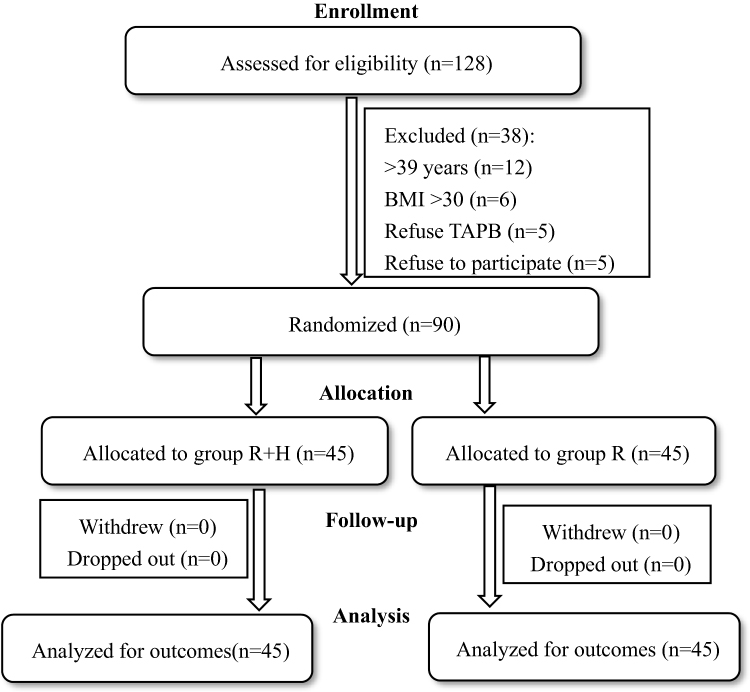 |
Figure 1 Study flowchart. Group R+H: 0.25% ropivacaine plus 0.2 mg hydromorphone; Group R: 0.25% ropivacaine. |
As presented in Table 1, there were no statistically significant differences in baseline demographic characteristics between the two groups. All 90 parturients achieved the targeted sensory block height of T5–T8 within 5 minutes of spinal anesthesia administration, with no between-group differences in block height distribution (Group R: 28/45 [62.22%] T5–T6, 17/45 [37.78%] T7–T8; Group R+H: 27/45 [60.00%] T5–T6, 18/45 [40.00%] T8; p = 0.924). The duration of surgery was 49.1 ± 5.8 minutes for Group R and 47.9 ± 6.5 minutes for Group R+H (p = 0.891), and all participants maintained the targeted sensory block height throughout the procedure. No additional intraoperative analgesia, anesthetics, or supplemental nerve blocks were required in either group, and no participant reported intraoperative pain or exhibited hemodynamic/behavioral responses to surgical stimulation.
 |
Table 1 Demographic Data of the Patients |
PCA Outcomes
Significant differences in PCA-related outcomes were observed between Group R and Group R+H, as shown in Table 2. The time to first PCA use was substantially prolonged in Group R+H compared with Group R (7.32±4.80 h vs. 3.49±1.74 h, p<0.001). In terms of analgesic consumption, Group R+H consistently exhibited lower consumption at all time points compared with Group R. Specifically: At 4 hours post-TAPB: 8.10±0.38 mL vs. 9.03±1.86 mL, p=0.001; At 12 hours post-TAPB: 26.70±2.69 mL vs. 29.20±5.64 mL, p=0.009; At 24 hours post-TAPB: 52.67±4.12 mL vs. 57.60±8.96 mL, p=0.001; At 48 hours post-TAPB: 101.83±5.62 mL vs. 105.67±8.91 mL, p=0.017.
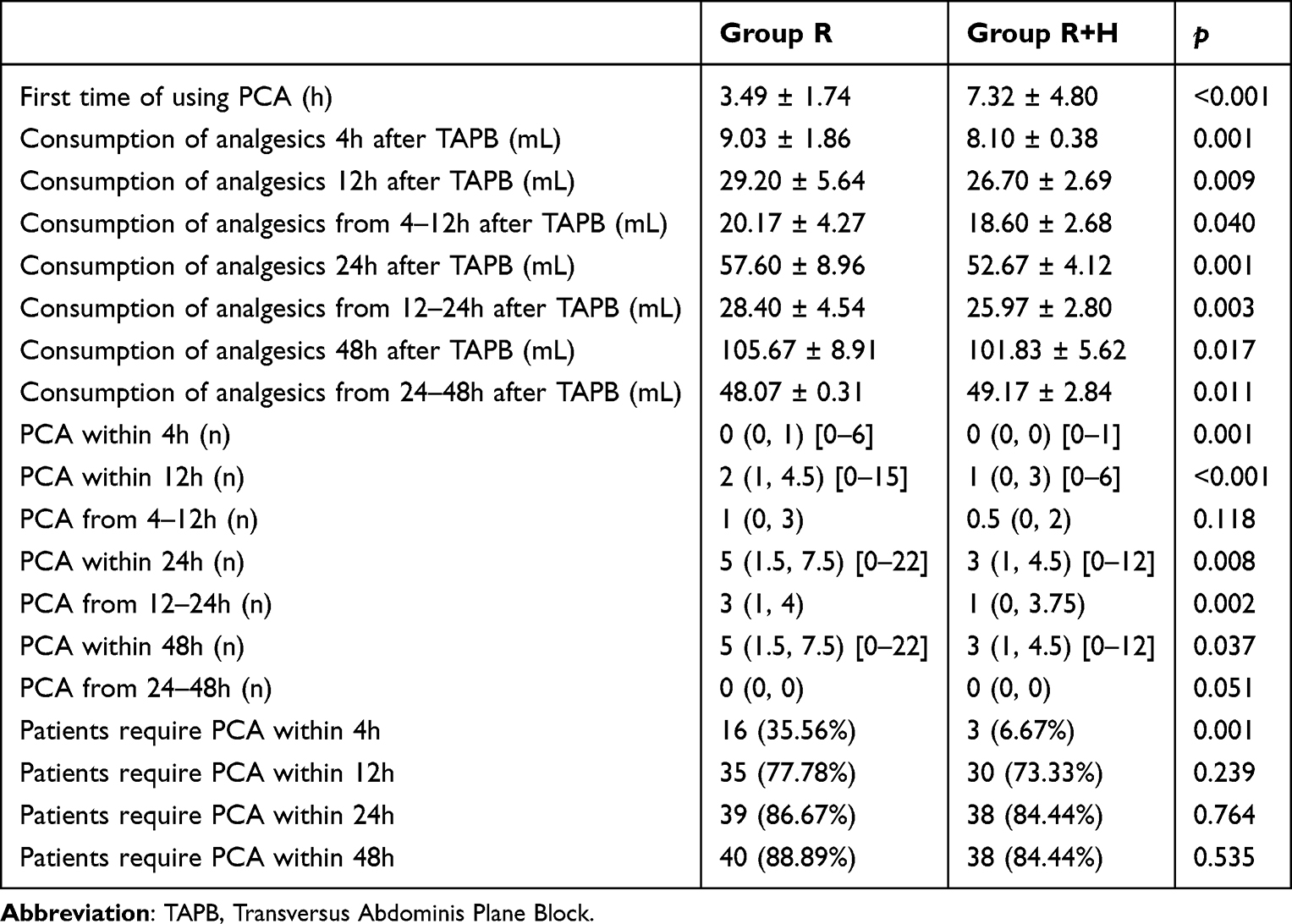 |
Table 2 Comparison of Patient-Controlled Analgesia (PCA) Outcomes. The Data are Presented as Mean ± SD, Median (25th IQR, 75th IQR) [Range] or n (%) |
When analyzing the hourly intervals, the difference in analgesic consumption remained significant during the 4–12 h (18.60±2.68 mL vs. 20.17±4.27 mL, p=0.040) and 12–24 h (25.97±2.80 mL vs. 28.40±4.54 mL, p=0.003) periods. However, no statistical difference was found in the 24–48 h interval (49.17±2.84 mL vs. 48.07±0.31 mL, p=0.051).
In addition, the number of PCA presses within specific time frames was significantly lower in Group R+H (All p<0.05, Table 2). Consistently, the proportion of patients requiring PCA within 4 hours was markedly lower in Group R+H (6.67%, 3/45) than in Group R (35.56%, 16/45) (p=0.001, Table 2). However, no significant differences were observed in the proportion of patients requiring PCA within 12 hours (73.33% vs. 77.78%, p=0.239), 24 hours (84.44% vs. 86.67%, p=0.764), or 48 hours (84.44% vs. 88.89%, p=0.535) between the two groups (Table 2).
Pain Intensity Assessment
At 4 and 12 hours post-TAPB, Group R+H demonstrated significantly lower NRS scores than Group R in both resting and exercise states (All p<0.05, Table 3). In contrast, at 24 and 48 hours post-TAPB, the NRS scores (both resting and exercise) were similar between the two groups, with no statistically significant differences (All p>0.05, Table 3).
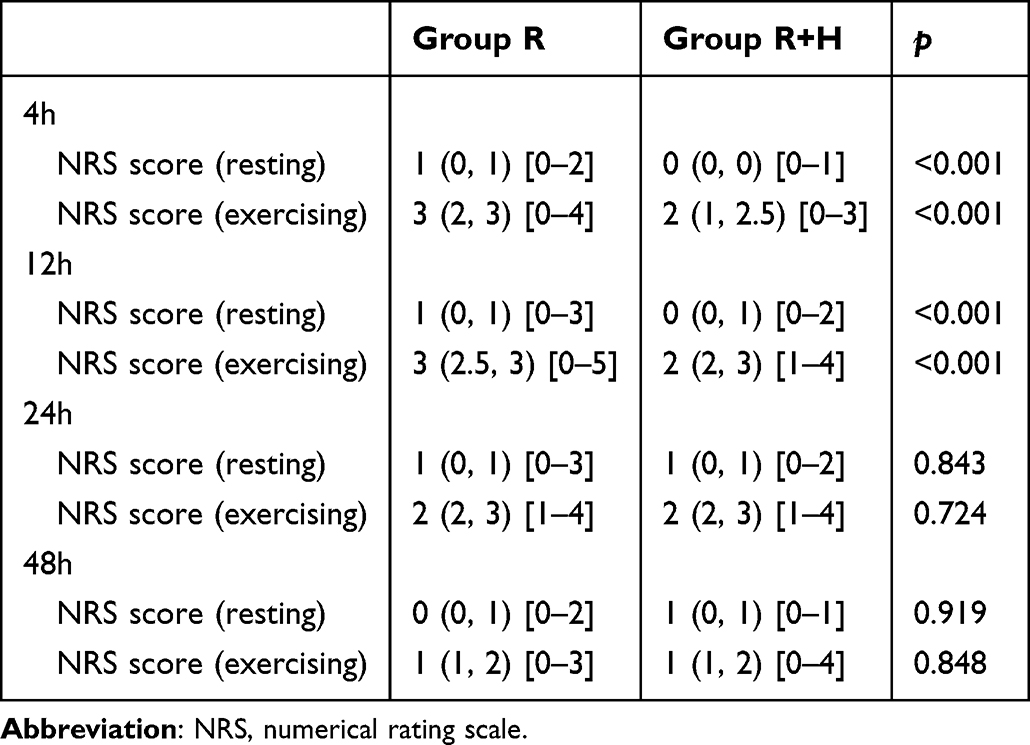 |
Table 3 Comparison of Pain Scores at Different Post-Block Hours. The Data are Presented as Median (25th IQR, 75th IQR) [Range] |
Perioperative Serum Prolactin (PRL) Levels
As shown in Table 4, there were no significant differences in serum PRL concentrations between Group R and Group R+H at any of the three time points measured (All p>0.05).
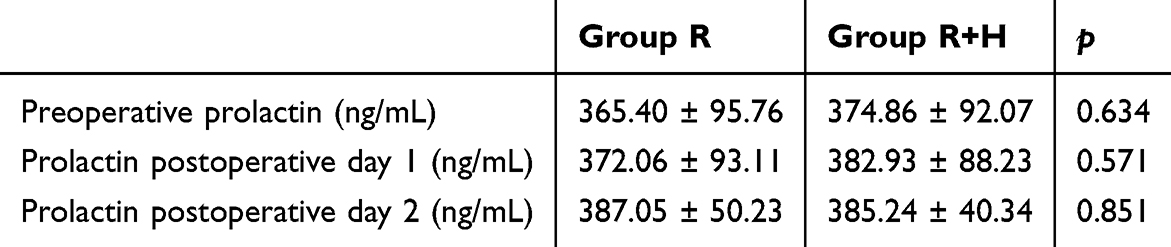 |
Table 4 Perioperative Changes of Prolactin in the Groups. The Data are Presented as Mean ± SD |
Postoperative Recovery Indicators, Adverse Events, and Patient Satisfaction
Table 5 shows that the key postoperative recovery indicators were comparable between the two groups: Time to first ambulation: 26.64±2.08 h (Group R+H) vs. 27.29±1.85 h (Group R), p=0.119; Time to first flatus (a marker of gastrointestinal function recovery): 32.30±10.70 h (Group R+H) vs. 31.30±12.02 h (Group R), p=0.677; Time to spontaneous voiding: 3.01±0.55 h (Group R+H) vs. 3.05±0.56 h (Group R), p=0.732.
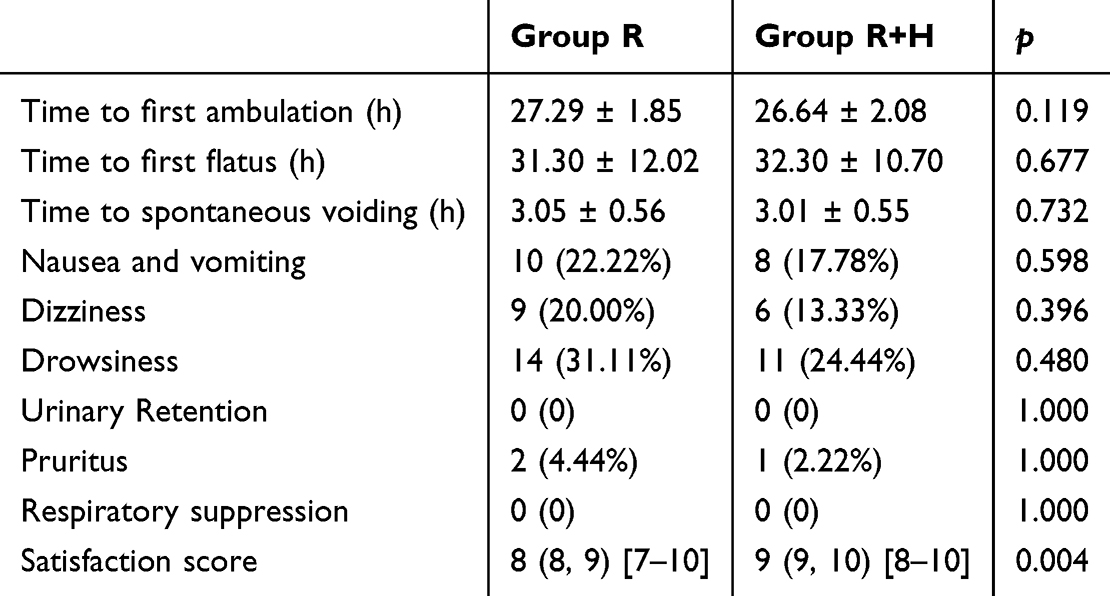 |
Table 5 Adverse Events and Satisfaction Scores of the Groups. The Data are Presented as Mean ± SD, n (%) or Median (25th IQR, 75th IQR) [Range] |
No severe adverse events (eg, respiratory depression, urinary retention) were reported in either group (Table 5). The incidence of mild-to-moderate adverse events was similar between the two groups (All p>0.05, Table 5).
Patient satisfaction with the analgesic regimen was significantly higher in Group R+H than in Group R (9 (9, 10) vs. 8 (8, 9), p=0.004, Table 5).
Discussion
This study evaluated the efficacy and safety of ultrasound-guided TAPB using ropivacaine combined with hydromorphone versus ropivacaine alone for postoperative analgesia in parturients undergoing cesarean section. The key findings indicate that adding hydromorphone to ropivacaine significantly enhances the early analgesic effect of TAPB, reduces rescue analgesic requirements, improves patient satisfaction, and does not compromise perioperative prolactin levels, postoperative recovery, or safety.
The primary outcome of this study, time to first PCA use, was substantially prolonged in Group R+H (7.32±4.80 h) compared with Group R (3.49±1.74 h), and this advantage was accompanied by lower analgesic consumption at 4, 12, 24, and 48 h post-TAPB. Consistent with this, Group R+H exhibited significantly lower numerical rating scale (NRS) scores at rest and during exercise at 4 and 12 h post-TAPB. These results collectively confirm that hydromorphone extends the analgesic duration of ropivacaine-based TAPB and strengthens early pain control. The synergistic mechanism underlying this effect may attribute to pharmacodynamic principles. Ropivacaine, a long-acting amide local anesthetic, blocks voltage-gated sodium channels in spinal sensory nerves to inhibit pain signal conduction,20 while hydromorphone—an opioid agonist with high affinity for μ-receptors—suppresses pain signal transmission at the spine level.21 This dual action of the two analgesics prolongs the time to first rescue analgesia and reduces early pain intensity. Similar findings have been reported in previous studies. Yang et al22 reported that epidural co-administration of a higher dose (0.6 mg) of hydromorphone and ropivacaine yields adequate postoperative analgesia in cesarean section. 5 μg/kg hydromorphone exhibits a synergistic effect with ropivacaine in brachial plexus block, strengthening the block efficacy in children.19 Chen et al18 observed that additional hydromorphone (1 mg) for peripheral nerve block was related to significantly better pain control in thoracic surgery. Nevertheless, Cao et al17 failed to reach similar conclusion in breast surgery. The potential reason may be the inadequate sample size, as they did not provide the calculations for it.
Serum PRL, a hormone essential for lactogenesis and milk secretion, is sensitive to physiological stress and opioid exposure.23,24 However, our data showed no significant differences in PRL levels between Group R and Group R+H at baseline (preoperative), postoperative day 1, or postoperative day 2. This finding suggests that the low-dose hydromorphone used in TAPB does not interfere with PRL homeostasis. In addition, postoperative pain control by TAPB or PCIA limits the influence of pain on PRL.
This study has several limitations that should be considered when interpreting the results. First, the sample size was calculated based on a preliminary pilot study, and the relatively small cohort (n=45 per group) may limit the generalizability of results to parturients with extreme BMI (eg, >30 kg/m2) or comorbidities (eg, chronic pain), who were excluded from this study. Second, we only assessed short-term outcomes and did not evaluate long-term outcomes such as chronic postsurgical pain or lactation duration—important endpoints for cesarean section research. Third, due to the influence of spinal anesthesia, we cannot assess the success of TAPB and the blockage range. Alternatively, the TAPB was performed under ultrasound guidance by a skillful anesthesiologist, which minimizes this bias. Finally, we did not measure plasma concentrations of ropivacaine or hydromorphone, so the extent of systemic absorption and systemic redistribution following TAPB administration cannot be quantified. Moreover, it remains difficult to confirm whether the analgesic effect of perineurally administered hydromorphone is derived solely from peripheral opioid receptor activation or from a central analgesic effect subsequent to systemic redistribution. Nevertheless, our results demonstrate the safety and efficacy of hydromorphone as an adjuvant in TAPB, adding to the evidence for the use of opioids in peripheral nerve blocks.25
Conclusion
In parturients undergoing cesarean section, ultrasound-guided TAPB with ropivacaine combined with hydromorphone significantly improves early postoperative analgesia compared with ropivacaine alone. Importantly, this regimen preserves perioperative PRL levels, does not increase adverse events, and enhances patient satisfaction. These findings support the use of hydromorphone-combined TAPB as a safe and effective analgesic strategy for cesarean section, particularly for parturients prioritizing early pain control and lactation preservation.
Trial Registration
Chinese Clinical Trial Registry (ChiCTR2500110705).
Data Sharing Statement
The data can be accessed from the first author and corresponding author on reasonable request.
Funding
This study is supported by Dazhou Municipal Health Commission (DYC202405), Sichuan Provincial Administration of Traditional Chinese Medicine (2024MS598), and Scientific Research Fund of Technology Bureau in Dazhou (21ZDYF0028).
Disclosure
The authors report no conflicts of interest in this work.
References
1. Boerma T, Ronsmans C, Melesse DY, et al. Global epidemiology of use of and disparities in caesarean sections. Lancet. 2018;392(10155):1341–11. doi:10.1016/S0140-6736(18)31928-7
2. Duch P, Jørgensen CC, Nedergaard HK. Text message questionnaires for patient-reported outcome measures after cesarean section-a feasibility study. Acta Anaesthesiol Scand. 2024;68(9):1254–1260. doi:10.1111/aas.14477
3. Shen D, Hasegawa-Moriyama M, Ishida K, et al. Acute postoperative pain is correlated with the early onset of postpartum depression after cesarean section: a retrospective cohort study. J Anesth. 2020;34(4):607–612. doi:10.1007/s00540-020-02789-5
4. Sun KW, Pan PH. Persistent pain after cesarean delivery. Int J Obstet Anesth. 2019;40:78–90. doi:10.1016/j.ijoa.2019.06.003
5. Fregoso G, Wang A, Tseng K, et al. Transition from acute to chronic pain: evaluating risk for chronic postsurgical pain. Pain Physician. 2019;22(5):479–488.
6. Cheng J, Wan M, Yu X, et al. Pharmacologic analgesia for cesarean section: an update in 2024. Curr Pain Headache Rep. 2024;28(10):985–998. doi:10.1007/s11916-024-01278-8
7. Jun MR, Lee MO, Shim HS, et al. Intravenous patient-controlled analgesia regimen in postoperative pain management following elective cesarean section: a single-center retrospective evaluation. Medicine. 2023;102(15):e33474. doi:10.1097/MD.0000000000033474
8. Yang Y, Zhang YN. Effects of adding transversus abdominis plane block on intravenous nalbuphine and dexmedetomidine for severely pre-eclamptic parturients after cesarean delivery. Kaohsiung J Med Sci. 2025;41(7):e70027. doi:10.1002/kjm2.70027
9. Zhang Y, Guo Y, Gong C, et al. Influence of transverse abdominis plane block on intraoperative diaphragmatic and respiratory functions in patients receiving laparoscopic colorectal surgery. Ther Clin Risk Manag. 2024;20:413–426. doi:10.2147/TCRM.S462688
10. He J, Qin S, Wang Y, et al. Rescue analgesia with a transversus abdominis plane block alleviates moderate-to-severe pain and improves oxygenation after abdominal surgery: a randomized controlled trial. Front Pain Res. 2024;5:1454665. doi:10.3389/fpain.2024.1454665
11. Soliz JM, Lipski I, Hancher-Hodges S, et al. Subcostal transverse abdominis plane block for acute pain management: a review. Anesth Pain Med. 2017;7(5):e12923. doi:10.5812/aapm.12923
12. Imani F, Rahimzadeh P, Faiz H-R, et al. An evaluation of the adding magnesium sulfate to ropivacaine on ultrasound-guided transverse abdominis plane block after abdominal hysterectomy. Anesth Pain Med. 2018;8(4):e74124. doi:10.5812/aapm.74124
13. Kakade A, Wagh G. Evaluate the feasibility of surgical transversus abdominis plane block for postoperative analgesia after cesarean section. J Obstet Gynaecol India. 2019;69(4):330–333. doi:10.1007/s13224-019-01241-3
14. Pöpping DM, Elia N, Marret E, et al. Opioids added to local anesthetics for single-shot intrathecal anesthesia in patients undergoing minor surgery: a meta-analysis of randomized trials. Pain. 2012;153(4):784–793. doi:10.1016/j.pain.2011.11.028
15. Uppal V, Retter S, Casey M, et al. Efficacy of intrathecal fentanyl for cesarean delivery: a systematic review and meta-analysis of randomized controlled trials with trial sequential analysis. Anesth Analg. 2020;130(1):111–125. doi:10.1213/ANE.0000000000003975
16. Liu L, Xu M, Wang J, et al. Research progress of hydromorphone in clinical application. Physiol Res. 2025;74(1):41–48. doi:10.33549/physiolres.935354
17. Cao X, Bao M, Ma Y, et al. Hydromorphone combined with ropivacaine for erector spinae plane block in patients undergoing modified radical mastectomy: a prospective randomized controlled trial. Medicine. 2024;103(26):e38758. doi:10.1097/MD.0000000000038758
18. Chen X, Zhang W, Wang L, et al. The impact of hydromorphone combined with ropivacaine in serratus anterior plane block on postoperative pain in patients undergoing video-assisted thoracoscopic pulmonary lobectomy: a randomized, double-blind clinical trial. BMC Anesthesiol. 2025;25(1):237. doi:10.1186/s12871-025-03101-2
19. Lin H, Nie L. Application of hydromorphone and ropivacaine in ultrasound-guided brachial plexus block of children. J Perianesth Nurs. 2022;37(5):662–668. doi:10.1016/j.jopan.2021.11.013
20. Ruetsch YA, Böni T, Borgeat A. From cocaine to ropivacaine: the history of local anesthetic drugs. Curr Top Med Chem. 2001;1(3):175–182. doi:10.2174/1568026013395335
21. Herman TF, Cascella M, Muzio MR. Mu receptors. In: StatPearls. Treasure Island (FL): StatPearls Publishing Copyright © 2025, StatPearls Publishing LLC.; 2025.
22. Yang M, Wang L, Chen H, et al. Postoperative analgesic effects of different doses of epidural hydromorphone coadministered with ropivacaine after cesarean section: a randomized controlled trial. Pain Res Manag. 2019;2019:9054538. doi:10.1155/2019/9054538
23. Demarest SP, Gill RS, Adler RA. Opioid endocrinopathy. Endocr Pract. 2015;21(2):190–198. doi:10.4158/EP14339.RA
24. Egli M, Leeners B, Kruger TH. Prolactin secretion patterns: basic mechanisms and clinical implications for reproduction. Reproduction. 2010;140(5):643–654. doi:10.1530/REP-10-0033
25. Gola W, Zając M, Cugowski A. Adjuvants in peripheral nerve blocks - the current state of knowledge. Anaesthesiol Intensive Ther. 2020;52(4):323–329. doi:10.5114/ait.2020.98213
 © 2026 The Author(s). This work is published and licensed by Dove Medical Press Limited. The
full terms of this license are available at https://www.dovepress.com/terms
and incorporate the Creative Commons Attribution
- Non Commercial (unported, 4.0) License.
By accessing the work you hereby accept the Terms. Non-commercial uses of the work are permitted
without any further permission from Dove Medical Press Limited, provided the work is properly
attributed. For permission for commercial use of this work, please see paragraphs 4.2 and 5 of our Terms.
© 2026 The Author(s). This work is published and licensed by Dove Medical Press Limited. The
full terms of this license are available at https://www.dovepress.com/terms
and incorporate the Creative Commons Attribution
- Non Commercial (unported, 4.0) License.
By accessing the work you hereby accept the Terms. Non-commercial uses of the work are permitted
without any further permission from Dove Medical Press Limited, provided the work is properly
attributed. For permission for commercial use of this work, please see paragraphs 4.2 and 5 of our Terms.
Recommended articles


Analgesic Effect of Esketamine Combined with Tramadol for Patient-Controlled Intravenous Analgesia After Cesarean Section: A Randomized Controlled Trial
Guo Y, Ding X, Wang S, Wang F, Zheng Z, Zou L
Journal of Pain Research 2023, 16:3519-3528
Published Date: 20 October 2023

Effect of Personality and Pain Catastrophizing on Postoperative Analgesia Following Cesarean Section: A Prospective Cohort Study
Ren Y, Guo Y, Tang J, He L, Li M, Huang X, Lu Q, Sun B, Feng H, Liu H, Du J, Li J
Journal of Pain Research 2024, 17:11-19
Published Date: 3 January 2024