
Back to Journals » Infection and Drug Resistance » Volume 19
Early Tacrolimus C0/D Ratio and Subsequent Proven Invasive Fungal Disease After Liver Transplantation with Routine Early Echinocandin Prophylaxis
Authors Hou W, Liang Z, Luo X, Guo H  , Zhang Y, Li H, Guo J
Received 10 May 2026
Accepted for publication 8 July 2026
Published 13 July 2026 Volume 2026:19 623612
DOI https://doi.org/10.2147/IDR.S623612
Checked for plagiarism Yes
Review by Single anonymous peer review
Peer reviewer comments 2
Editor who approved publication: Prof. Dr. Héctor Mora-Montes
Wenjing Hou,1,* Zhizhong Liang,2,* Xiao Luo,1 Heng Guo,1 Yuhong Zhang,3 Hongwei Li,3 Jinlin Guo4,5
1Department of Pharmacy, Beijing Friendship Hospital, Capital Medical University, Beijing, People’s Republic of China; 2Department of Bone and Soft Tissue Oncology, Shanxi Province Cancer Hospital (Shanxi Hospital Affiliated to Cancer Hospital, Chinese Academy of Medical Sciences; Cancer Hospital Affiliated to Shanxi Medical University), Taiyuan, Shanxi, People’s Republic of China; 3Hepatobiliary and Pancreatic Surgery Ward, Shanxi Provincial People’s Hospital, Taiyuan, Shanxi, People’s Republic of China; 4Department of Pharmacy, Shanxi Provincial People’s Hospital, Taiyuan, Shanxi, People’s Republic of China; 5School of Pharmacy, Shanxi Medical University, Taiyuan, Shanxi, People’s Republic of China
*These authors contributed equally to this work
Correspondence: Jinlin Guo, Department of Pharmacy, Shanxi Provincial People’s Hospital, Taiyuan, Shanxi, People’s Republic of China, Email [email protected]
Background: Invasive fungal disease (IFD) may occur despite routine early echinocandin prophylaxis after liver transplantation, but the relationship between early tacrolimus exposure metrics and subsequent proven IFD remains uncertain. We evaluated whether early tacrolimus trough concentration and the concentration-to-dose (C0/D) ratio were associated with subsequent proven IFD in this prophylaxis-treated cohort.
Methods: In a two-center retrospective cohort of adult liver transplant recipients receiving routine postoperative caspofungin for 5 days, tacrolimus exposure was summarized as the patient-level median trough concentration and C0/D ratio during postoperative days (PODs) 3– 10. Inpatient fungal outcomes were classified as no fungal infection, probable/possible IFD, or proven IFD according to consensus criteria. Multinomial logistic regression adjusted for prespecified demographics, illness severity, immunosuppression, and center; exposure quartiles and restricted cubic splines assessed dose-response and nonlinearity. Exploratory sensitivity analyses examined severity-adjusted associations, apparent discrimination, and incremental area under the receiver operating characteristic curve (AUC).
Results: Among 164 recipients, 25 (15.2%) developed proven IFD and 18 (11.0%) probable/possible IFD; proven cases were predominantly mould infections, including Aspergillus spp. and Mucorales. Higher tacrolimus trough concentrations were associated with proven IFD (per 5 ng/mL: adjusted odds ratio [aOR], 4.84; 95% confidence interval [CI], 2.20– 10.66) but not with probable/possible IFD. The C0/D ratio showed a stronger and more consistent association with proven IFD than trough concentration alone. In exploratory analyses, the apparent AUC of C0/D was 0.802 (95% CI, 0.682– 0.903); adding log(C0/D) to a clinical severity panel increased the apparent AUC from 0.902 to 0.928 (ΔAUC, 0.026; 95% bootstrap CI, − 0.034 to 0.087).
Conclusion: A higher tacrolimus C0/D ratio was associated with subsequent proven IFD in recipients receiving routine early echinocandin prophylaxis. These hypothesis-generating findings do not establish causality, an actionable C0/D threshold, or a management strategy, and require prospective external validation before clinical implementation.
Keywords: antifungal prophylaxis, echinocandin, invasive fungal disease, liver transplantation, tacrolimus, concentration-to-dose ratio
Introduction
Invasive fungal disease (IFD) remains a major cause of morbidity and mortality after solid organ transplantation despite advances in surgery, immunosuppression, and antifungal strategies.1 Liver transplant recipients constitute a high-risk category for invasive candidiasis and aspergillosis.2
International guidelines generally support targeted systemic antifungal prophylaxis for liver transplant recipients with established risk factors, and practice varies substantially across regions and centers.3–11 Both participating centers used a local protocol of routine caspofungin for the first 5 postoperative days to provide standardized early Candida-active coverage during the clinically unstable period in which oral absorption and bedside risk stratification may be difficult. Echinocandins do not reliably prevent mould disease, and fungal disease can occur after completion of a short prophylactic course.9–13 This setting allowed us to evaluate early tacrolimus exposure metrics among recipients managed under a shared prophylaxis protocol.
Susceptibility to opportunistic infection after liver transplantation reflects net immunosuppression and perioperative illness. Relevant contributors include induction therapy, corticosteroid burden, concomitant antimetabolites, graft dysfunction, renal replacement therapy, reoperation, prolonged critical illness, inflammation, and transplant-specific surgical factors.2 Tacrolimus-based regimens are foundational, yet tacrolimus exposure is particularly variable early after transplantation because of fluctuating hepatic function, drug-drug interactions, and changing critical illness physiology.14 Therapeutic drug monitoring relies largely on pre-dose trough concentrations, but trough-based monitoring may incompletely reflect disposition and the host state relevant to infection risk.15,16 The tacrolimus trough concentration-to-dose (C0/D) ratio is an easily derived index of dose-normalized exposure that has been linked to outcomes in other transplant settings.16–18 In this context, C0/D may represent a composite correlate of metabolism, organ function, inflammation, and treatment intensity.
Despite strong biological plausibility, evidence linking early tacrolimus exposure metrics to post-transplant IFD risk after liver transplantation remains limited, particularly in settings where routine early echinocandin use is common. Moreover, rigorous outcome classification is essential; current consensus definitions for IFD (including probable/possible vs proven disease) provide a standardized framework for epidemiologic research and comparative studies.19
We therefore evaluated whether tacrolimus trough concentration and the C0/D ratio during PODs 3–10 were associated with subsequent in-hospital fungal outcome categories among adult liver transplant recipients receiving a shared 5-day postoperative caspofungin protocol. We also explored the apparent discrimination of these tacrolimus exposure metrics relative to clinical severity markers.
Materials and Methods
Study Design and Setting
We performed a retrospective, two-center cohort study of adult liver transplant recipients treated at two tertiary transplant centers (Beijing Friendship Hospital and Shanxi Provincial People’s Hospital) between Jan, 1, 2019 and Nov, 30, 2025. Data were extracted from electronic health records, the TDM platform, laboratory databases, and inpatient infectious diseases/microbiology documentation.
In both centers, postoperative management followed the same local anti-infective protocol, detailed below under Antifungal prophylaxis strategy. Fungal outcomes were therefore interpreted within a routine early echinocandin prophylaxis-treated cohort.
The study was approved by the institutional review boards of both centers (No. 2024–510 and YYXSSC-2024-K169-02) and was conducted in accordance with the Declaration of Helsinki. Informed consent for participation was waived because of the retrospective design and use of de-identified data. All donor organs were obtained through voluntary donation with written informed consent from the donors or their legally authorized representatives; no organs from executed prisoners were used. Organ donation and transplantation procedures were conducted in accordance with the Declaration of Istanbul.
Participants
Eligible recipients were adults undergoing liver transplantation who had at least one tacrolimus trough concentration measured between POD 3–10 and sufficient inpatient documentation to ascertain fungal infection status. We excluded recipients with death or graft loss before POD 3 and those with insufficient identifiers to link TDM, laboratory, and clinical infection records.
Induction Immunosuppression
All recipients received basiliximab induction, administered as two intravenous doses of 20 mg each: the first dose within 2 hours before reperfusion (or within 6 hours after graft reperfusion), and the second dose on postoperative day (POD) 4. Basiliximab was used universally in both centers regardless of immunologic risk stratification, consistent with contemporary Chinese liver transplantation practice guidelines.
Perioperative Corticosteroid Protocol
Intraoperative methylprednisolone (500 mg intravenously) was administered at graft reperfusion. Postoperative corticosteroids were tapered according to a standardized institutional protocol: methylprednisolone 240 mg on POD 1, reduced by 40 mg/day to 80 mg, then converted to oral prednisone 20 mg/day, and subsequently tapered by 5 mg every 1–2 weeks to a maintenance dose of 5–10 mg/day (or oral methylprednisolone 4–8 mg/day). Because this scheduled perioperative regimen was protocolized, between-patient variation in planned cumulative exposure was limited. The available covariate was the patient-level median daily prednisone-equivalent maintenance dose during PODs 3–10; cumulative administered corticosteroid exposure could not be reconstructed reliably for all recipients. Steroid pulse therapy was captured separately when available. Complete steroid withdrawal was attempted in selected stable recipients by POD 90–180.
Tacrolimus Exposure Assessment
Tacrolimus trough concentration (C0) was defined as the whole-blood concentration measured 0.5 hours before the next scheduled dose. The POD 3–10 window was selected a priori to exclude the highly unstable first 48 postoperative hours, begin after tacrolimus initiation in most recipients, and provide sufficient repeated measurements for a robust patient-level summary before the median proven IFD diagnosis (POD 12). The primary exposure was the patient-level median tacrolimus C0 during PODs 3–10; when only one value was available, that value was used. We additionally examined the corresponding patient-level median C0/D ratio (trough concentration divided by daily tacrolimus dose) and quartiles of both metrics. Day-specific prediction was not assessed in this window-based analysis. Because subclinical infection or evolving organ dysfunction may have affected tacrolimus pharmacokinetics before formal diagnosis, reverse causation remains possible.
Antifungal Prophylaxis Strategy
Both centers used the same local protocol of caspofungin for 5 days after liver transplantation. The protocol was adopted to provide standardized early systemic Candida-active coverage during an unstable perioperative period. Antifungal therapy beyond day 5 was not classified as extended prophylaxis; continuation reflected suspected or documented infection and was considered treatment. In practice, continued caspofungin was mainly reserved for candidemia or Candida intra-abdominal infection, with duration determined by infection site and clinical response.
Outcomes and Adjudication
Outcomes
The primary outcome was inpatient fungal infection status during the index hospitalization, categorized as no evidence of fungal infection, probable/possible IFD adjudicated using EORTC/MSG criteria, or proven IFD based on microbiologic confirmation. Formal diagnostic confirmation occurred after the tacrolimus measurements used to derive the POD 3–10 metrics; however, the biological onset of IFD could not be dated reliably. The analysis was therefore prespecified as an exposure-before-diagnosis association framework.
Covariates
Covariates were selected to represent demographics, postoperative illness severity, immunosuppression, and center. APACHE II was the score recorded at the initial postoperative ICU assessment. For CRP, total bilirubin, serum creatinine, albumin, WBC, and INR, the value used in descriptive and sensitivity analyses was the earliest postoperative measurement available after transplantation and before fungal diagnosis; the retrospective dataset did not support a more uniform clock-time definition. RRT was coded as any prediagnostic RRT. Re-operation/take-back and steroid pulse therapy were captured when available and only if they preceded fungal diagnosis. MMF dose was the patient-level median daily dose during PODs 3–10, with 0 mg/day assigned when MMF was not used. Basiliximab induction was universal by protocol and was therefore not modeled. Immediate postoperative regimen composition was categorized by inclusion of MMF. MMF dose was not included in primary models because reduction often occurred concurrent with or after fungal diagnostic evaluation, creating reverse-time bias.
Statistical Analysis
Continuous variables were summarized as median (interquartile range) and categorical variables as counts (percentages); group differences used Kruskal–Wallis, χ2, or Fisher exact tests, as appropriate. Multinomial logistic regression used no fungal infection as the reference and reported aORs with 95% CIs for probable/possible and proven IFD. The primary adjustment set (age, sex, APACHE II score, POD 3–10 corticosteroid dose, immediate postoperative regimen composition, and center) was chosen a priori and kept fixed without data-driven selection. Exposure quartiles and restricted cubic splines were used to assess dose-response and nonlinearity. Complete-case binary sensitivity models for proven IFD versus no fungal infection incorporated (1) APACHE II, log(CRP + 1), log(total bilirubin), and log(serum creatinine), or (2) INR and prediagnostic RRT. Apparent discrimination was summarized by AUC with bootstrap 95% CIs. Exploratory Youden cutoffs, sensitivity, and specificity were calculated for descriptive purposes only. A clinical severity panel consisting of APACHE II, log(CRP + 1), log(total bilirubin), and log(serum creatinine) was compared with the same panel plus log(C0/D) or tacrolimus trough; paired bootstrap CIs quantified ΔAUC. No cutoff or model was externally validated. Analyses were two-sided with P<0.05 and were performed in Python.
Results
Study Cohort and Inpatient Fungal Outcome Classification
A total of 164 liver transplant recipients were included (Figure 1). During the index hospitalization, outcomes were classified into 3 mutually exclusive categories: no fungal infection (n=121, 73.8%), probable/possible IFD (n=18, 11.0%), and proven IFD (n=25, 15.2%) (Table 1). Overall, fungal events (probable/possible IFD plus proven IFD) occurred in 43/164 (26.2%).
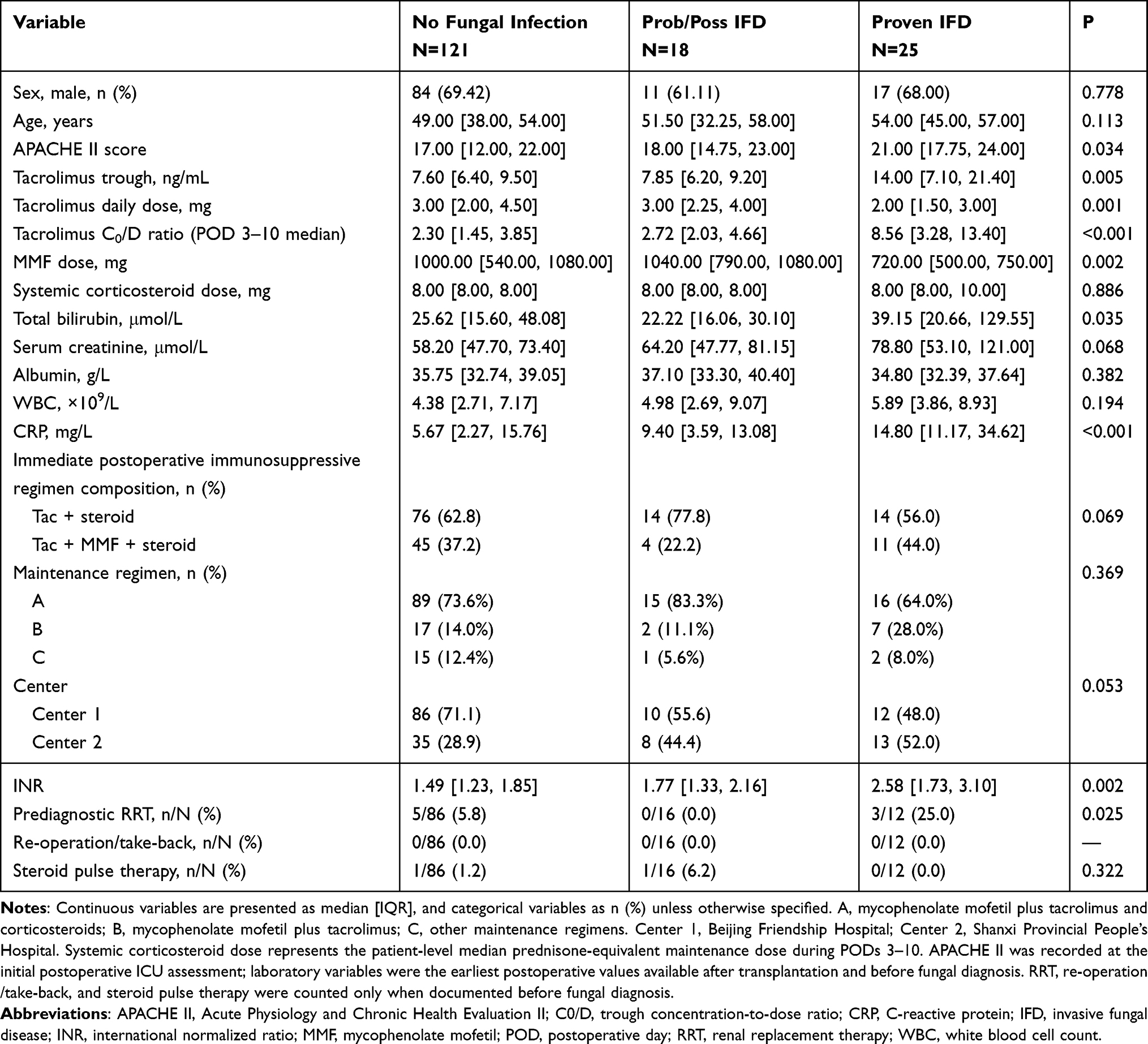 |
Table 1 Baseline Characteristics of Liver Transplant Recipients by Inpatient Fungal Outcome Category |
 |
Figure 1 Flowchart of the study. |
Recipients were enrolled from two centers (Center 1, n=108; Center 2, n=56). Outcome distributions differed modestly by center (P=0.053; Table 1). Because all recipients were managed under the same routine early caspofungin protocol, outcomes describe a prophylaxis-treated cohort rather than untreated fungal risk. Among 25 proven IFD cases, pathogens were predominantly Mucorales and Aspergillus spp. (Supplementary Table S1). This mould-heavy distribution and substantial proven IFD incidence may reflect local referral case-mix, diagnostic practices, and center epidemiology, and may limit generalizability.
Baseline Characteristics
Median age did not differ significantly across outcome categories (no fungal infection: 49.0 [38.0–54.0] years; probable/possible IFD: 51.5 [32.3–58.0] years; proven IFD: 54.0 [45.0–57.0] years; overall P=0.113) (Table 1). Postoperative illness severity and inflammatory markers differed across the three outcome categories. APACHE II score was highest in the proven IFD group, followed by probable/possible IFD and no fungal infection: 21.0 [17.8–24.0], 18.0 [14.8–23.0], and 17.0 [12.0–22.0], respectively (overall P=0.034). CRP showed a similar pattern, with values of 14.80 [11.17–34.62], 9.40 [3.59–13.08], and 5.67 [2.27–15.76] mg/L, respectively (overall P<0.001). Total bilirubin differed across groups (overall P=0.035), while creatinine showed a borderline difference (overall P=0.068). Denominators varied because of missing postoperative measurements.
Tacrolimus exposure metrics also differed across categories. The proven group had higher POD 3–10 tacrolimus trough concentrations (14.00 [7.10–21.40] vs 7.60 [6.40–9.50] ng/mL; P=0.005), lower tacrolimus daily dose (2.00 [1.50–3.00] vs 3.00 [2.00–4.50] mg/day; P=0.001), and markedly higher tacrolimus concentration-to-dose ratios (C0/D) (8.56 [3.28–13.40] vs 2.30 [1.45–3.85] ng/mL per mg; P<0.001) (Figure 2). MMF dose was lower in the proven group (720 [500–750] vs 1000 [540–1080] mg/day; P=0.002). Sex, immediate postoperative immunosuppressive regimen composition, maintenance regimen category, and steroid dose did not differ significantly across groups (all P>0.05).
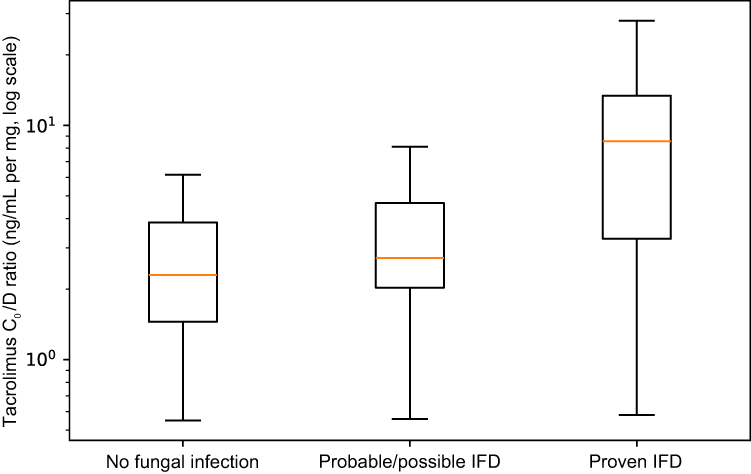 |
Figure 2 Distribution of POD 3–10 tacrolimus concentration-to-dose (C0/D) ratio by inpatient fungal outcome category. Box plots show the distribution of patient-level POD 3–10 median tacrolimus C0/D ratios (ng/mL per mg) on a logarithmic y-axis. Boxes indicate the interquartile range (IQR), center lines indicate medians, and whiskers extend to the most extreme values within 1.5×IQR. |
Lower MMF dose in the proven IFD group largely reflected post-diagnostic immunosuppression minimization: MMF reduction preceded clinical suspicion or sampling in 2/25 (8.0%) and occurred concurrently with or after diagnostic evaluation in 23/25 (92.0%). No biopsy-proven acute rejection occurred during PODs 3–10. Among 114 recipients with available records for these perioperative events, steroid pulse therapy occurred in 2 recipients (both in the non-proven group), and no re-operation/take-back was documented; 50 recipients lacked complete data for these variables.
Additional Clinical Characteristics of Proven IFD
There was no extended-prophylaxis cohort because antifungal use beyond the standard 5-day caspofungin course represented treatment. Proven IFD was predominantly pulmonary, diagnosed at a median of 12 days after transplantation, and managed mainly with voriconazole or posaconazole (Supplementary Table S2). Most diagnoses therefore occurred after completion of the routine 5-day course, although subclinical disease may have preceded formal diagnosis.
Association Between Early Tacrolimus Exposure and Fungal Outcomes
We evaluated associations between early tacrolimus exposure and the three-category inpatient fungal outcome using the prespecified multinomial model (Table 2). Because the adjustment set was large relative to the number of events, the estimates and confidence intervals are interpreted as exploratory associations.
 |
Table 2 Associations Between Early Tacrolimus Exposure Metrics and Inpatient Fungal Outcomes (Multinomial Logistic Regression) |
Tacrolimus Trough Concentration (POD 3–10 Median)
Per 5 ng/mL higher tacrolimus trough concentration, the odds of proven IFD were significantly higher compared with no fungal infection (adjusted odds ratio [aOR], 4.84; 95% confidence interval [CI], 2.20–10.66; P<0.001). The corresponding association for probable/possible IFD was directionally positive but not statistically significant (aOR, 1.84; 95% CI, 0.69–4.93; P=0.225) (Table 2).
Tacrolimus C0/D Ratio
C0/D-based metrics showed stronger associations with proven IFD. Each 1-unit increase in log(C0/D) was associated with higher odds of proven IFD versus no fungal infection (aOR, 6.03; 95% CI, 2.37–15.32; P<0.001). The association with probable/possible IFD was not statistically significant (aOR, 1.73; 95% CI, 0.78–3.85; P=0.176) (Table 2).
Dose-Response Analyses
In quartile analyses of C0/D (reference: Q1), the highest quartile (Q4) was associated with increased odds of both fungal outcomes: for probable/possible IFD, Q4 vs Q1 aOR 8.17 (95% CI, 1.22–54.53; P=0.030); for proven IFD, Q4 vs Q1 aOR 14.86 (95% CI, 1.94–114.17; P=0.009) (Figure 3 and Table 2). Q2 and Q3 were not consistently different from Q1 (Table 2).
 |
Figure 3 Adjusted odds ratios for inpatient fungal outcomes by tacrolimus C0/D quartiles (reference: Q1). Forest plot of adjusted odds ratios (aORs) and 95% confidence intervals (CIs) from multinomial logistic regression comparing C0/D quartiles Q2–Q4 with Q1, shown separately for probable/possible IFD vs no fungal infection and proven IFD vs no fungal infection. The x-axis is logarithmic; the vertical dashed line indicates aOR=1. Models were adjusted as specified in Table 2. |
Trend tests were consistent with an overall increasing trend in the odds of proven IFD across C0/D quartiles (per quartile increase aOR, 2.92; 95% CI, 1.44–5.89; P=0.003), although intermediate quartiles were not consistently different from Q1.
A restricted cubic spline model in a binary framework (proven IFD vs no fungal infection) showed a nonlinear increase in the adjusted predicted probability of proven IFD with higher C0/D ratio, with the increase concentrated at higher C0/D values (Figure 4).
 |
Figure 4 Restricted cubic spline of tacrolimus C0/D ratio and adjusted predicted probability of proven IFD. Restricted cubic spline model (binary framework: proven IFD vs no fungal infection) depicting the association between tacrolimus C0/D ratio (logarithmic x-axis) and the adjusted predicted probability of proven IFD. Predictions are shown holding covariates at reference (categorical) or median (continuous) values, with covariate adjustment consistent with Table 2. |
Exploratory Analysis Incorporating Additional Perioperative Severity Variables
In complete-case sensitivity analyses, log(C0/D) remained associated with proven IFD versus no fungal infection after adjustment for APACHE II, log(CRP + 1), log(total bilirubin), and log(serum creatinine) (OR, 4.89; 95% CI, 1.67–14.33; P=0.004; n=96; 14 events) and after adjustment for INR and prediagnostic RRT (OR, 3.67; 95% CI, 1.58–8.52; P=0.003; n=98; 12 events) (Supplementary Table S3). Additional exploratory binary models using proven IFD versus all non-proven outcomes are shown in Supplementary Table S4.
For proven IFD versus no fungal infection, apparent AUCs were 0.802 (95% CI, 0.682–0.903) for C0/D and 0.703 (0.551–0.836) for tacrolimus trough. The exploratory C0/D Youden cutoff was 6.56, with 64.0% sensitivity and 90.9% specificity. A clinical severity panel had an apparent AUC of 0.902 (0.832–0.966); adding log(C0/D) increased the AUC to 0.928 (0.858–0.985), but ΔAUC was 0.026 (95% paired-bootstrap CI, −0.034 to 0.087) (Supplementary Tables S5 and S6).
Discussion
In this two-center prophylaxis-treated cohort, the principal finding was an association between higher early tacrolimus C0/D ratio and subsequent proven IFD. The C0/D association was more consistent than the trough association across the main and sensitivity analyses, but should be interpreted as an exploratory risk-association signal. The signal is better interpreted as a composite correlate of tacrolimus disposition, graft function, inflammation, and perioperative illness. Associations with probable/possible IFD were weaker and less stable, likely reflecting outcome heterogeneity and limited events.
The 15.2% incidence of proven IFD and predominance of Mucorales and Aspergillus spp. were notable in this cohort. Echinocandins do not provide reliable mould prophylaxis, but the present study cannot determine whether the local 5-day protocol altered pathogen distribution because there was no alternative-prophylaxis or untreated comparator. This pattern may also reflect high-acuity referral case-mix, local ecology, diagnostic intensity, or unmeasured transplant-specific risk factors. Generalizability to centers with different epidemiology or prophylaxis strategies may therefore be limited.3,20–22
The C0/D signal should be considered alongside established fungal risk factors. Basiliximab and scheduled perioperative corticosteroids were nearly uniform, while APACHE II, CRP, bilirubin, creatinine, INR, and RRT varied and were associated with outcome to differing degrees. Systemic inflammation and allograft dysfunction can reduce tacrolimus clearance through downregulation of hepatic CYP3A activity, which may raise C0/D without indicating greater administered immunosuppression.17,23–25 The persistence of the C0/D association after severity adjustment is hypothesis-generating, but residual confounding by operative complexity, transfusion burden, preoperative critical illness, underlying liver disease, biliary interventions, and other unavailable factors remains likely.
Exploratory discrimination analyses provide context. C0/D had an apparent AUC of 0.802 (95% CI, 0.682–0.903) for proven IFD versus no fungal infection, compared with 0.703 for tacrolimus trough. An exploratory C0/D cutoff of 6.56 yielded 64.0% sensitivity and 90.9% specificity, but was selected and evaluated in the same small cohort. More importantly, adding log(C0/D) to a clinical severity panel increased apparent AUC only from 0.902 to 0.928 (ΔAUC, 0.026; 95% bootstrap CI, −0.034 to 0.087). Thus, incremental clinical value was not demonstrated, and no threshold is proposed for care decisions.
The current data are insufficient to support C0/D-guided antifungal therapy, immunosuppressive adjustment, or surveillance as standard care. Future prospective studies should use serial, time-stamped tacrolimus and biomarker measurements, define infection onset independently of exposure, compare C0/D with validated clinical risk models, and perform external validation and decision-curve assessment before considering implementation.
This study has several limitations. Its retrospective design precludes causal inference, and evolving subclinical infection or organ dysfunction may have altered tacrolimus pharmacokinetics before formal diagnosis. The POD 3–10 median summarizes a broad interval and cannot determine the best measurement day. Cumulative corticosteroid exposure and several transplant-specific factors—including transfusion requirements, preoperative ICU stay, ALF/ACLF, biliary interventions, and therapeutic plasma exchange—were unavailable or insufficiently coded. APACHE II and several laboratory variables had missing data, and re-operation and steroid-pulse variables were available for only 114 recipients. Limited events relative to model complexity produced wide CIs and risks overfitting; all ROC estimates and cutoffs were apparent, internally derived, and not externally validated. In-hospital categorical outcomes may be affected by length of stay and diagnostic opportunity. The high mould incidence and local universal 5-day caspofungin protocol further limit generalizability.
Conclusions
Among hospitalized liver transplant recipients receiving routine early echinocandin prophylaxis, a higher POD 3–10 tacrolimus C0/D ratio was associated with subsequent proven IFD. This exploratory association may reflect altered drug disposition and overall illness severity rather than a tacrolimus-specific causal effect. Prospective validation is needed before using C0/D for clinical decision-making.
Abbreviations
aORs, adjusted odds ratios; APACHE II, acute physiology and chronic health evaluation II; C0/D, trough concentration-to-dose; CRP, C-reactive protein; IFD, invasive fungal disease; MMF, mycophenolate mofetil; POD, postoperative days; TDM, therapeutic drug monitoring; WBC, white blood cell count.
Data Sharing Statement
The data that support the findings of this study are available from the corresponding author upon reasonable request.
Ethics Approval and Informed Consent
The study was approved by the institutional review boards of both centers (No. 2024-510 and YYXSSC-2024-K169-02). Informed consent for study participation was waived because of the retrospective design and use of de-identified data. All donor organs were obtained through voluntary donation with written informed consent from the donors or their legally authorized representatives; no organs from executed prisoners were used. Organ donation and transplantation procedures were conducted in accordance with the Declaration of Istanbul.
Author Contributions
Wenjing Hou: Conceptualization, methodology, data curation, formal analysis, visualization, writing—original draft, and writing—review and editing. Zhizhong Liang: Methodology, formal analysis, interpretation of data, visualization, and writing—review and editing. Xiao Luo: Data curation, investigation, therapeutic drug-monitoring data verification, and writing—review and editing. Heng Guo: Data curation, investigation, laboratory data verification, and writing—review and editing. Yuhong Zhang: Clinical data acquisition, interpretation of transplant-related clinical variables, outcome verification, and writing—review and editing. Hongwei Li: Clinical data acquisition, interpretation of surgical and inpatient clinical characteristics, outcome verification, and writing—review and editing. Jinlin Guo: Conceptualization, supervision, funding acquisition, project administration, interpretation of data, and writing—review and editing. All authors made a significant contribution to the work reported, whether that is in the conception, study design, execution, acquisition of data, analysis and interpretation, or in all these areas; took part in drafting, revising or critically reviewing the article; gave final approval of the version to be published; have agreed on the journal to which the article has been submitted; and agree to be accountable for all aspects of the work.
Funding
This work was funded by the Shanxi Province Basic Research Program (Jinlin Guo, ID: 202403021221274). The funder had no role in the design and conduct of the study; collection, management, analysis, and interpretation of the data; preparation, review, or approval of the manuscript; and decision to submit the manuscript for publication.
Disclosure
The authors declare that they have no known competing financial interests or personal relationships that could have appeared to influence the work reported in this paper.
References
1. Meyer L, Frossard J, Schreiber PW, et al. Invasive Candida infections in solid organ transplant recipients between 2008 and 2020. Am J Transplant. 2025;25(12):2634–11. doi:10.1016/j.ajt.2025.07.2480
2. Senoner T, Breitkopf R, Treml B, Rajsic S. Invasive fungal infections after liver transplantation. J Clin Med. 2023;12(9):3238. doi:10.3390/jcm12093238
3. Saliba F, Pascher A, Cointault O, et al. Randomized trial of micafungin for the prevention of invasive fungal infection in high-risk liver transplant recipients. Clin Infect Dis. 2015;60(7):997–1006. doi:10.1093/cid/ciu1128
4. Kang WH, Song GW, Lee SG, et al. A multicenter, randomized, open-label study to compare micafungin with fluconazole in the prophylaxis of invasive fungal infections in living-donor liver transplant recipients. J Gastrointest Surg. 2020;24(4):832–840. doi:10.1007/s11605-019-04241-w
5. Winston DJ, Limaye AP, Pelletier S, et al. Randomized, double-blind trial of anidulafungin versus fluconazole for prophylaxis of invasive fungal infections in high-risk liver transplant recipients. Am J Transplant. 2014;14(12):2758–2764. doi:10.1111/ajt.12963
6. Fortun J, Muriel A, Martin-Davila P, et al. Caspofungin versus fluconazole as prophylaxis of invasive fungal infection in high-risk liver transplantation recipients: a propensity score analysis. Liver Transpl. 2016;22(4):427–435. doi:10.1002/lt.24391
7. Rinaldi M, Bartoletti M, Ferrarese A, et al. Breakthrough invasive fungal infection after liver transplantation in patients on targeted antifungal prophylaxis: a prospective multicentre study. Transpl Infect Dis. 2021;23(4):e13608. doi:10.1111/tid.13608
8. Salmanton-Garcia J, Giacinta A, Giannella M, et al. Current trends on antifungal prophylaxis in solid organ transplantation: a study from ESCMID-EFISG, ESCMID-ESGICH, SITA, and SEIMC-GESITRA-IC. Infection. 2025;53(6):2411–2420. doi:10.1007/s15010-025-02575-z
9. Aslam S, Rotstein C. AST infectious disease community of practice. candida infections in solid organ transplantation: guidelines from the american society of transplantation infectious diseases community of practice. Clin Transplant. 2019;33(9):e13623. doi:10.1111/ctr.13623
10. Husain S, Camargo JF. Invasive aspergillosis in solid-organ transplant recipients: guidelines from the American society of transplantation infectious diseases community of practice. Clin Transplant. 2019;33(9):e13544. doi:10.1111/ctr.13544
11. Branch of Organ Transplantation of Chinese Medical Association. Diagnosis and treatment guideline of invasive fungal infections in solid organ transplant recipients. Chin J Organ Transpl. 2019;10(3):227–236. doi:10.3969/j.issn.1674-7445.2019.03.002
12. Gatti M, Rinaldi M, Ferraro G, et al. Breakthrough invasive fungal infections in liver transplant recipients exposed to prophylaxis with echinocandins vs other antifungal agents: a systematic review and meta-analysis. Mycoses. 2021;64(11):1317–1327. doi:10.1111/myc.13362
13. Cornely OA, Hoenigl M, Lass-Florl C, et al. Defining breakthrough invasive fungal infection-position paper of the mycoses study group education and research consortium and the European confederation of medical mycology. Mycoses. 2019;62(9):716–729. doi:10.1111/myc.12960
14. Barriga-Rodriguez P, Falcon-Cubillo M, Mejias-Trueba M, et al. Pharmacokinetics of different tacrolimus formulations in the early post-liver transplant period: a scoping review. Pharmaceutics. 2025;17(5):619. doi:10.3390/pharmaceutics17050619
15. Brunet M, van Gelder T, Asberg A, et al. Therapeutic drug monitoring of tacrolimus-personalized therapy: second consensus report. Ther Drug Monit. 2019;41(3):261–307. doi:10.1097/FTD.0000000000000640
16. Wenqian C, Lei Z, Zhang Y, et al. Expert consensus on individual treatment of tacrolimus in solid organ transplantation. Eval Analy Drug-Use Hosp China. 2021;21(12):1409–1424. doi:10.14009/j.issn.1672-2124.2021.12.001
17. Van Gelder T, Meziyerh S, Swen JJ, de Vries APJ, Moes D. The clinical impact of the C(0)/D ratio and the CYP3A5 genotype on outcome in tacrolimus treated kidney transplant recipients. Front Pharmacol. 2020;11:1142. doi:10.3389/fphar.2020.01142
18. Tholking G, Schutte-Nutgen K, Schmitz J, et al. A low tacrolimus concentration/dose ratio increases the risk for the development of acute calcineurin inhibitor-induced nephrotoxicity. J Clin Med. 2019;8(10):1586. doi:10.3390/jcm8101586
19. Donnelly JP, Chen SC, Kauffman CA, et al. Revision and update of the consensus definitions of invasive fungal disease from the European organization for research and treatment of cancer and the mycoses study group education and research consortium. Clin Infect Dis. 2020;71(6):1367–1376. doi:10.1093/cid/ciz1008
20. Breitkopf R, Treml B, Senoner T, Bukumiric Z, Rajsic S. Invasive fungal breakthrough infections under targeted echinocandin prophylaxis in high-risk liver transplant recipients. J Fungi. 2023;9(2):272. doi:10.3390/jof9020272
21. Breitkopf R, Treml B, Simmet K, et al. Incidence of invasive fungal infections in liver transplant recipients under targeted echinocandin prophylaxis. J Clin Med. 2023;12(4):1520. doi:10.3390/jcm12041520
22. Andes DR, Safdar N, Baddley JW, et al. The epidemiology and outcomes of invasive Candida infections among organ transplant recipients in the United States: results of the transplant-associated infection surveillance network (TRANSNET). Transpl Infect Dis. 2016;18(6):921–931. doi:10.1111/tid.12613
23. Brunet M, Pastor-Anglada M. Insights into the pharmacogenetics of tacrolimus pharmacokinetics and pharmacodynamics. Pharmaceutics. 2022;14(9):1755. doi:10.3390/pharmaceutics14091755
24. Thongprayoon C, Hansrivijit P, Kovvuru K, et al. Impacts of high intra- and inter-individual variability in tacrolimus pharmacokinetics and fast tacrolimus metabolism on outcomes of solid organ transplant recipients. J Clin Med. 2020;9(7):2193. doi:10.3390/jcm9072193
25. Chavant A, Fonrose X, Gautier-Veyret E, Hilleret MN, Roustit M, Stanke-Labesque F. Variability of tacrolimus trough concentration in liver transplant patients: which role of inflammation? Pharmaceutics. 2021;13(11):1960. doi:10.3390/pharmaceutics13111960
 © 2026 The Author(s). This work is published and licensed by Dove Medical Press Limited. The
full terms of this license are available at https://www.dovepress.com/terms
and incorporate the Creative Commons Attribution
- Non Commercial (unported, 4.0) License.
By accessing the work you hereby accept the Terms. Non-commercial uses of the work are permitted
without any further permission from Dove Medical Press Limited, provided the work is properly
attributed. For permission for commercial use of this work, please see paragraphs 4.2 and 5 of our Terms.
© 2026 The Author(s). This work is published and licensed by Dove Medical Press Limited. The
full terms of this license are available at https://www.dovepress.com/terms
and incorporate the Creative Commons Attribution
- Non Commercial (unported, 4.0) License.
By accessing the work you hereby accept the Terms. Non-commercial uses of the work are permitted
without any further permission from Dove Medical Press Limited, provided the work is properly
attributed. For permission for commercial use of this work, please see paragraphs 4.2 and 5 of our Terms.