
Back to Journals » Clinical Pharmacology: Advances and Applications » Volume 17
Dose Optimization of Tyrosine Kinase Inhibitors for Chronic Myeloid Leukemia
Authors Chen J, Zhu Y, Zhao Y, Guo N, Yao Y, Luo X, Huang L 
Received 15 April 2025
Accepted for publication 19 July 2025
Published 30 July 2025 Volume 2025:17 Pages 211—225
DOI https://doi.org/10.2147/CPAA.S532263
Checked for plagiarism Yes
Review by Single anonymous peer review
Peer reviewer comments 2
Editor who approved publication: Dr Khaled Deeb
Jiali Chen,1,2 Yidan Zhu,1,3 Yinyu Zhao,1,3 Nan Guo,1,2 Yuxuan Yao,1,2 Xingxian Luo,1 Lin Huang1
1Department of Pharmacy, Peking University People’s Hospital, Beijing, People’s Republic of China; 2School of Life Science and Biopharmaceutics, Shenyang Pharmaceutical University, Shenyang, People’s Republic of China; 3School of Pharmaceutical Sciences, Peking University, Beijing, People’s Republic of China
Correspondence: Lin Huang, Department of Pharmacy, Peking University People’s Hospital, No. 11, Xizhimen South Street, Xicheng District, Beijing, 100044, People’s Republic of China, Email [email protected]
Abstract: With the advent of newer treatments such as new molecular targeted agents and immunotherapies, the model that selects therapeutic doses on the basis of the maximum tolerated dose is no longer relevant. The emergence of tyrosine kinase inhibitor (TKI) therapy has changed the treatment prospects for chronic myeloid leukemia (CML) and prolonged the long-term survival of CML patients. However, long-term exposure to TKIs is accompanied by adverse events, which may lead to disease progression and even death. It can also increase economic pressure on patients and affect their health-related quality of life. In general, dose reduction is feasible and safe for most patients and can reduce the incidence of adverse events while ensuring efficacy, reduce the financial burden on patients and society, improve the quality of life of patients, and also as a prelude to an attempt at treatment-free remission (TFR). This review will classify the dose optimization of all approved TKIs (imatinib, dasatinib, nilotinib, bosutinib, ponatinib, asciminib, radotinib) at different stages of treatment based on clinical trials and real-life studies, including dose optimization prior to attempting TFR. In addition, we briefly describe the application of therapeutic drug monitoring in dose optimization and the potential benefits of dose optimization on health-related quality of life.
Keywords: tyrosine kinase inhibitor, dose optimization, chronic myeloid leukemia, therapeutic drug monitoring
Introduction
For over 70 years, cytotoxic drug development in oncology has emphasized that higher doses yield greater antitumor effects. With the advent of newer treatments like new molecular targeted agents (MTAs) and immunotherapies, the model that selects therapeutic doses on the basis of the maximum tolerated dose (MTD) is no longer relevant.1–3 Compared to traditional chemotherapy agents, MTAs and immunotherapies exhibit novel mechanisms of action, enhanced efficacy, and distinct safety profiles. Their target saturation limits are often below the MTD, indicating that administration at lower doses can achieve comparable efficacy while minimizing adverse effects.1–3
Chronic myeloid leukemia (CML) is a malignancy affecting the blood and bone marrow and is defined by the presence of the Philadelphia chromosome as a result of a reciprocal translocation between chromosomes 9 and 22 [t9;22], resulting in the BCR::ABL1 fusion gene.4 Tyrosine kinase inhibitor (TKI) therapy is a highly effective treatment option for patients with chronic phase–CML (CP-CML). The National Comprehensive Cancer Network Clinical Practice Guidelines in Oncology (NCCN Guidelines) for CML (version 2.2024) recommended imatinib and second generation (2G) TKIs (dasatinib, nilotinib, or bosutinib) as first-line therapy. Besides, ponatinib and asciminib (specifically targeting the ABL myristoyl pocket inhibitor) are active against most of the resistant BCR::ABL1 kinase domain mutants including T315I,4 and Radotinib has so far received marketing authorization exclusively in South Korea.5
However, long-term exposure to TKIs is accompanied by adverse events (AEs) that may lead to disease progression and even death.6,7 Especially 2G TKIs may increase cardiovascular risks, such as arterial ischemic events (coronary heart disease, stroke) and pulmonary hypertension.8–10 A prediction model for the failure of TKI treatment was found that 20–30% of patients failed the treatment due to drug resistance or toxicity. Among them, the cumulative failure rate of the high-risk group in 8 years reached 69%, and it was significantly correlated with the risk of disease progression.11 After long-term TKI treatment in elderly patients (>75 years old), the proportion of non-CML-related deaths (such as infections and cardiovascular events) was as high as 40%, suggesting that age and the cumulative effect of toxicity synergically increase the risk of death.12 Long-term exposure to TKIs can also increase economic pressure on patients and affect their health-related quality of life (HRQOL). Many AEs occur early in treatment and are dose-dependent, and thus they can be managed by dose modifications.13 Optimally responsive patients may be overtreated with standard doses of TKIs. In addition, TKI significantly improved the outcomes of patients with CML. Treatment-free remission (TFR) is now the new goal of CML therapy. Prior to achieving TFR, dose optimization is implemented to balance efficacy and safety, thereby creating conditions for subsequent treatment discontinuation.
In this review, we classified the dose optimization of all approved TKIs (imatinib, dasatinib, nilotinib, bosutinib, ponatinib, asciminib, radotinib) at different stages of treatment according to the results of clinical trials and real-life studies, including pre-TFR dose optimization (Figure 1). We also discussed TKI dose optimization on the basis of therapeutic drug monitoring (TDM) and the HRQOL of patients after dose optimization, aiming to offer critical references for individualized clinical treatment for patients with CML.
 |
Figure 1 Dose optimization in the course of disease treatment. |
Dose Optimization of Imatinib
Imatinib (Glivec; Novartis), the first TKI, was approved in 2001 in the United States and Europe for the treatment of all CML stages. Although the standard dose of 400 mg is usually well tolerated by most patients, studies have shown that AEs and overtreatment still exist. There have been several studies on post-marketing dose optimization of imatinib, including in elderly individuals (Table 1).
 |
Table 1 Studies of Imatinib Dose Optimization |
Dose Optimization in Patients with Newly Diagnosed CP-CML
After a large number of clinical trials and studies, 400mg daily was finally determined as the initial dose of adult CML in the chronic phase rather than 800mg daily, although 800mg daily induced a quicker and deeper molecular response.14–20 There are limited data regarding starting imatinib at doses less than 400 mg daily, with the exception of elderly patients with serious comorbidities and polypharmacy. However, the results revealed that imatinib plays an important role in first-line treatment of elderly patients with CML without increased toxicity, and every effort should be made to use standard-dose therapy in these patients to obtain the same response as in younger subjects.21,22
Dose Optimization Due to AEs
Although the safety profile of imatinib is superior to that of other TKIs, some patients still have intolerance to imatinib. AEs to imatinib are generally grade 1 (mild) or 2 (moderate), with the most common being superficial oedema, nausea, muscle cramps and rash.36 According to previous studies, serious adverse events associated with imatinib are infrequent (9.3%), most often occurring in the first year of treatment and decreasing in incidence over time, with abdominal pain being the most common.37 A previous study reported that four patients reported a reduction in the imatinib dose from 400 mg to 200 mg daily due to intolerance after achieving molecular remission, side effects subsided and BCR::ABL negativity persisted for a median of 17 months.23 Another Korean study reported nine CML patients whose imatinib dose was reduced to 300 or 200 mg daily mainly because of severe neutropenia or thrombocytopenia (grade 3 or 4). The dose reduction resulted in a significant reduction in toxicity from Grade 3 or 4 to Grade 1 or 2, while maintaining treatment responses.24 Therefore, reducing the dose of imatinib may help reduce the incidence of AEs.
Dose Optimization After Achieving a Stable Molecular Response
Optimally responsive patients may be overtreated with standard doses of TKIs. Therefore, TKI dose reduction should be considered for the management and prevention of AEs to improve HRQOL. In 43 patients who achieved a sustained deep molecular response (DMR) (Supplement Table 1). Over a median time of 4 years, the imatinib dose was reduced to 300 mg daily; none lost the major molecular response (MMR), and 62.2% of patients experienced improvement in toxicity.25 Moreover, dose-halving may become a new treatment paradigm for CML patients with DMR receiving ongoing maintenance TKI therapy.26,28,38 In particular, de-escalation treatment has shown clinical benefits over discontinuation in terms of molecular recurrence-free survival.28
In addition, intermittent treatment with TKIs is an option for CML patients who have an optimal response to TKIs but do not meet the current discontinuation requirements, especially elderly patients.29,30 Although the intensification of the intermittent TKI schedule in the PROGRESSIVE arm of the OPTkIMA trial was associated with a higher incidence of MMR loss, this did not translate into an increased incidence of disease progression.31 The progressive intermittent schedule can be regarded as a “patient selection tool” for discontinuing TKIs, as patients who maintain an MMR at the end of the study are frequently considered eligible for TFR.31
Dose Optimization Before TFR
Given the promising results in the treatment of CML patients with TKIs, the life expectancy of CML patients is close to that of non-CML population. TFR has become the main therapeutic target in CML to improve the quality of life of patients and reduce their financial burden.39 Recently, Italian hematologists noted that the use of low-dose TKIs does not seem to affect the probability of achieving DMR, so attempting to discontinue treatment may even increase the TFR rate.40,41 Compared with the EURO-SKI trial, in which full-dose treatment was discontinued after stable DMR was achieved, DESTINY had a higher recurrence-free survival rate (72% vs 50%) at 24 months, in which patients were treated with a half-dose for 1 year before discontinuation.27,32 Most studies typically report a recurrence-free survival of 50–60% in CP-CML patients with stable DMR who have been treated with TKIs for several years.42 Although another study also revealed a slightly higher TFR rate in the low-dose group than in the full-dose group, prospective randomized clinical trials must be undertaken to answer the controversial issue that improvement in the TFR is associated with the TKI de-escalation strategy prior to discontinuation of TKI therapy.33 In addition, it is an attempt to achieve TFR by gradually escalating TKI treatment, and although a subgroup of patients were unsuccessful in complete discontinuation, the molecular response was maintained at a lower TKI dose.34
Dose Optimization of Dasatinib
Dasatinib, a 2G TKI, was approved in 2006 in the United States. Preclinical studies have shown that, compared with imatinib, dasatinib has 325-fold greater in vitro activity against native BCR::ABL and can overcome primary (intrinsic) and secondary (acquired) imatinib resistance.43,44 The final long-term results of the DASISION study clearly revealed that 100 mg of dasatinib QD had a faster and deeper molecular response than 400 mg of imatinib QD in newly diagnosed CP-CML patients.45 As with imatinib, dose optimization studies of dasatinib have been ongoing, taking into account the quality of patient survival and safety issues (Table 2).
 |
Table 2 Studies of Dasatinib Dose Optimization |
Dose Optimization in Patients with Newly Diagnosed CP-CML
With respect to the dose optimization of dasatinib, one success has been achieved by switching from 70 mg BID to 100 mg QD.47 Recently, initial treatment with 50 mg of dasatinib QD was shown to be effective and well tolerated in newly diagnosed CP-CML patients, and it may be a new alternative choice in CP-CML.48–51 Dasatinib 50 mg daily was at least as effective as 100 mg daily with a better safety profile and drug exposure, and the incidence rate of grade 3 to 4 pleural effusion (PE) was only 2% with a median follow-up time of 5 years.50 In addition, early molecular response (EMR) rates were comparable between low-dose dasatinib and standard-dose imatinib, but DMR rates were significantly higher with low-dose dasatinib.52 Similarly, reducing the dose of dasatinib below 100 mg daily (even to ≤ 20 mg daily) in elderly CML patients induced rapid and deep molecular responses without causing severe AEs.53–55
Dose Optimization Due to AEs
PE is one of the most frequently reported drug-related, nonhematologic AEs associated with dasatinib, and its incidence is the highest in the first year.45 In 2013, a study reported that on/off treatment with a weekend drug holiday significantly reduced PE and hematologic toxicity without impairing the efficacy of dasatinib in imatinib-resistant and imatinib-intolerant CP-CML patients.56 Additionally, for patients who experienced AEs, reducing the dose of dasatinib to 80 mg or 50 mg was a safe and effective treatment option.46 Interestingly, Italian scholars Iurlo et al found through research that reducing the dose of dasatinib after the first PE event had no preventive effect on the recurrence of this AE. For patients who have already achieved MMR or DMR, reducing the dose as soon as possible before PE occurs may help to reduce the incidence of PE.60
Dose Optimization After Achieving a Stable Molecular Response
Multiple studies have shown that it is feasible to reduce the TKI dose (or even halve it) after a stable molecular response is achieved without affecting the TFR rate.27,40,41 However, few studies have explored dose optimization in patients receiving first-line 2G TKIs after achieving a stable molecular response and before TFR. The DESTINY trial (n=174) included only a small number of patients receiving first-line 2G TKIs (10 patients with dasatinib and 16 patients with nilotinib).26,27 Patients with newly diagnosed CP-CML, who received at least 24 months of dasatinib treatment and had a sustained DMR for at least 1 year, were asked to discontinue dasatinib directly in the DADI trial and DASFREE study.57,58 These studies demonstrate that dasatinib discontinuation is a viable and potentially long-term option in patients with CML-CP. However, it is necessary to further confirm in larger-scale trials how to choose after achieving a sustained DMR: discontinue the drug or reduce the dosage.
Dose Optimization of Nilotinib
Nilotinib was approved for marketing in 2007 in the United States and was the first and only TKI approved to be discontinued.61 Nilotinib may be preferred in patients who have a history of lung disease or are considered to be at risk for developing PE.4 Compared with studies exploring imatinib, fewer studies have explored the dose optimization of nilotinib (Table 3).
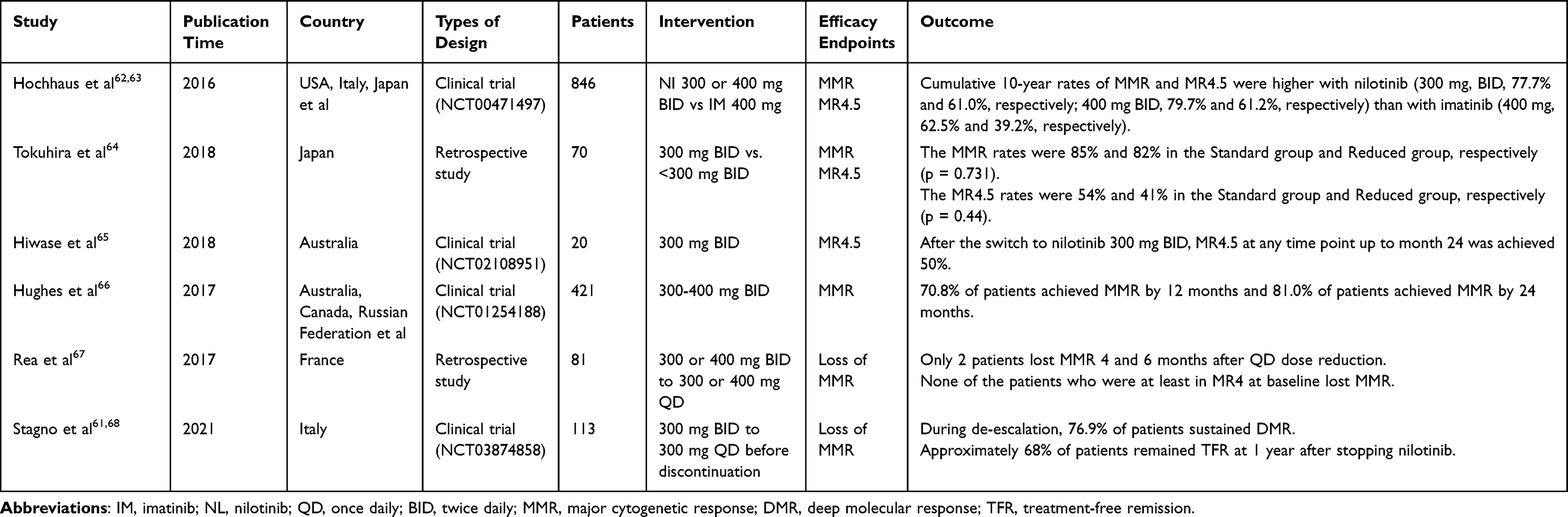 |
Table 3 Studies of Nilotinib Dose Optimization |
Dose Optimization in Patients with Newly Diagnosed CP-CML
The recommended starting dose of nilotinib is 300 mg BID for patients with newly diagnosed CP-CML and 400 mg BID for those with resistant or intolerant CP-CML.4 However, AEs were more common in the nilotinib 400 mg BID group than in the nilotinib 300 mg BID group.62 In a retrospective study evaluating the efficacy of early dose modification in patients with newly diagnosed CP-CML, patients in the reduced group experienced better therapeutic efficacy and a lower rate of AEs than did those in the standard group.64 In addition, in CP-CML patients intolerant to imatinib or dasatinib, switching to nilotinib 300 mg BID was effective and well tolerated, below the recommended dose of 400 mg BID.65
Dose Optimization Due to AEs
The most common non-hematological AEs of nilotinib are headache, rash, and nausea.66 Patients treated with nilotinib had more cardiovascular events and more frequent increases in blood cholesterol and glucose levels than did those treated with imatinib.62 A total of 48.7% of patients had AEs leading to dose adjustments or interruptions and 20.9% of patients had their nilotinib dose escalated to 400 mg BID due to lack of efficacy in the ENESTxtnd.66 Compared with ENESTnd, ENESTxtnd allows patients with insufficient response and those with drug-related AEs to have their nilotinib dose actively escalated or reduced and re-escalated, and then continue therapy, and ENESTxtnd has a higher MMR rate.66 Therefore, it is necessary to optimize the dose individually according to the specific conditions of the patients.
Dose Optimization After Achieving a Stable Molecular Response
The NILO-RED study provided preliminary evidence that it is feasible and safe to switch to a nilotinib QD regimen at reduced doses as maintenance therapy after achieving an MMR on a standard-dose nilotinib BID schedule in CP-CML patients, regardless of prior treatment history.67 Only 2 patients treated with first-line nilotinib lost their MMR at 4 and 6 months after the QD regimen of nilotinib, but they spontaneously recovered 4 and 6 months later.
Dose Optimization Before TFR
Although nilotinib is the first and only TKI approved for stopping therapy, a nilotinib-based TFR optimization strategy has not been formally studied. The DANTE study is the first to evaluate the safety and feasibility of nilotinib de-escalation before TFR in CP-CML patients.61,68 A total of 107 CP-CML patients who achieved DMR for ≥1 year were enrolled, and then treated with nilotinib 300 mg QD in this study for 48 weeks. Finally, 52 patients completed de-escalation treatment, and 40 patients entered the TFR stage. De-escalation of nilotinib before a TFR attempt in CP-CML patients with a sustained DMR may be a successful dose optimization strategy.
Dose Optimization of Bosutinib
Bosutinib was approved for marketing in 2012 for patients with intolerant or resistant CP-CML, and it was approved in 2017 for the treatment of patients with newly diagnosed CP-CML. Owing to the late marketing of bosutinib, few studies on dose optimization have been conducted (Table 4), especially after a stable molecular response was reached and bosutinib was discontinued, and further attention should be given to this topic in the future.
 |
Table 4 Studies of Bosutinib Dose Optimization |
Dose Optimization in Patients with Newly Diagnosed CP-CML
Bosutinib 400 mg daily is recommended for patients with newly diagnosed CP-CML and 500 mg daily is recommended for patients with intolerant or resistant CP-CML as second- or subsequent-line (≥ 2 L) therapy.4 The BELA and BFORE studies are pivotal Phase III trials of bosutinib in the first-line (1 L) setting and have emphasized its improved efficacy over imatinib and the better tolerability of the 400 mg daily dose.69,70 However, in elderly patients intolerant to or failing 1 L TKIs, bosutinib may be highly effective and better tolerated at a dose lower than 500 mg daily, even at 300 mg daily.71
Dose Optimization Due to AEs
In both 1 L and ≥ 2 L treatment, given that gastrointestinal (GI) toxicity often occurs early after treatment initiation, physicians often prefer to start treatment at a lower dose (200 to 300 mg) and gradually increase the dose until the patients reach either the standard 400 mg daily dose or their maximum tolerated dose.75 The BODO study investigated the tolerability and efficacy of a step-in dosing concept of bosutinib (starting at 300 mg daily) in CP-CML patients in the ≥2 L line who were intolerant to or failed previous TKI treatment.72 However, their data could not show that bosutinib, in which the dosing started at 300 mg daily, and toxicity-related dose adaptation led to significant improvement in early GI toxicity. On the other hand, using a strategy to manage AEs with bosutinib through dose reduction from 500 mg to 400 mg or 300 mg daily can lead to improved/ maintained efficacy and better tolerability.73
Dose Optimization of Other TKIs
Ponatinib
Ponatinib is a potent oral bioavailable pan BCR::ABL inhibitor that is 520-fold more potent than imatinib and inhibits both wild-type and mutant BCR::ABL 1 kinases, including the “gatekeeper” T315 I mutation, with resistance to all other currently available TKIs.76 Based on the OPTIC trial, the recommended starting dose of ponatinib is 45 mg once daily, and when patients once ≤1% BCR::ABL, the dose is reduced to 15 mg once daily to reduce the risk of cardiovascular side effects.77,78 Indeed, anecdotal evidence suggests that clinicians start ponatinib at 45 once daily only in a few cases and most patients start treatment at 30 mg once daily.79 The German consensus also states that some patients may consider starting ponatinib at a lower dose, and the initial dose should be determined by evaluating each individual case, considering CML disease state and patient characteristics, prior treatment, mutation status, CV risk, and therapy goals80,81 (Table 5).
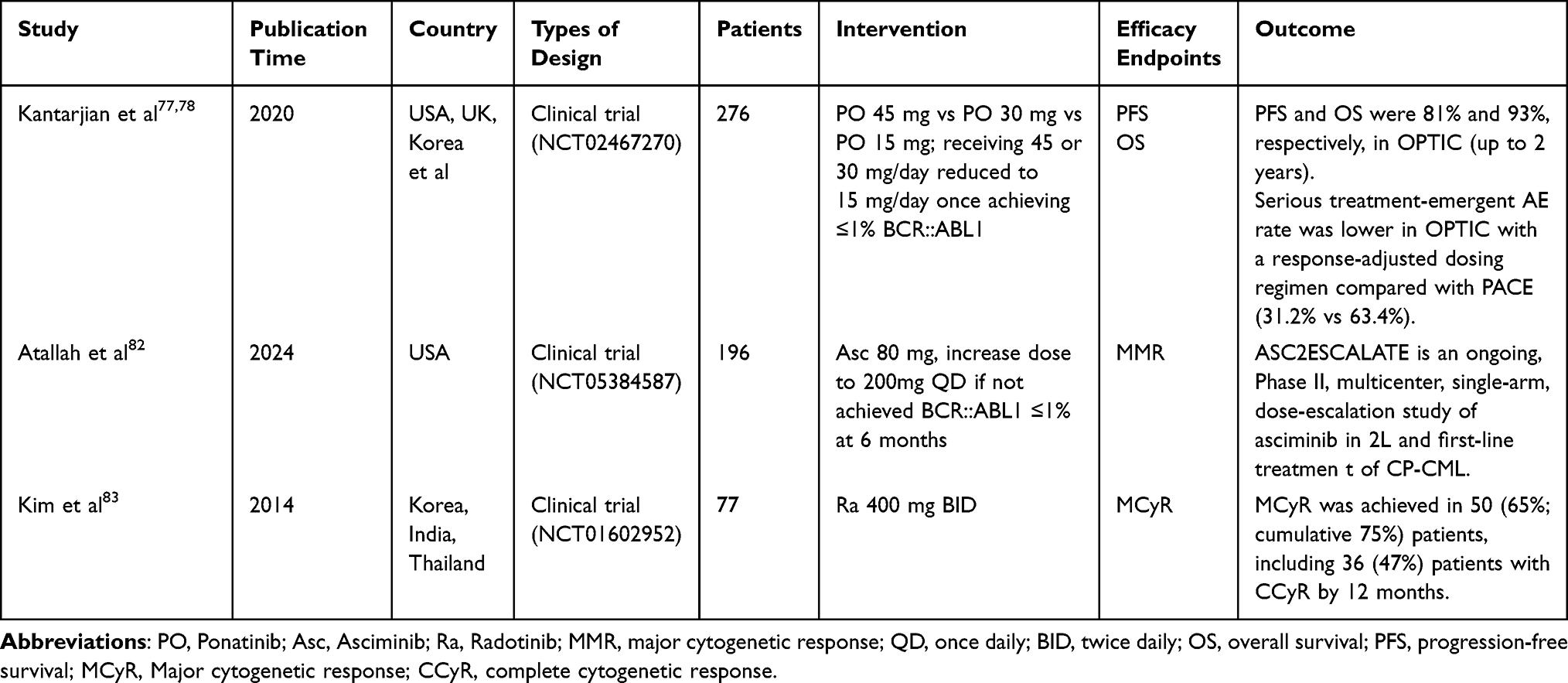 |
Table 5 Studies of Other TKIs (Ponatinib, Asciminib, Radotinib) Dose Optimization |
Asciminib
Asciminib is the first BCR::ABL1 inhibitor that works by Specifically Targeting the ABL1 Myristoyl Pocket (STAMP), which received accelerated approval by the US FDA for patients with CP-CML treated with≥2 prior TKIs and full approval for patients with CP-CML with the T315I mutation based on results of the Phase I study in October 2021.84 A study showed that 40 mg BID and 80 mg QD regimens demonstrated similar and substantial efficacy with well-tolerated safety in patients without T315I mutation.85 And the 200 mg BID dose was deemed safe and effective for patients with T315I mutation.85 However, the ongoing ASC2ESCALATE trial pointed out dose escalation is an option for patients who do not reach response milestones in 1L and 2L82 (Table 5).
Radotinib
Radotinib is a selective 2G BCR::ABL1 TKI that was approved by the Korean Ministry of Food and Drug Safety in 2012.83 The approved starting dose is 400 mg BID for the treatment of patients with CP-CML resistant and/ or intolerant to imatinib, and 300 mg BID for the treatment of patients with newly diagnosed CP-CML.83 However, a study have shown that the starting dose of radotinib adjusted for individual patients’BW (Dose/BW) at baseline was positively associated with the occurrence of dose-limiting toxicity (DLT) by 12 months of radotinib therapy, and the probability of achieving MMR at 12 months was associated with the Dose/BW of radotinib in an inverse manner.86,87 Therefore, they suggest 400 mg once daily be tested to patients as the 1L treatment of CP-CML, and the dose may be titrated up later as needed based on a careful monitoring of efficacy and safety responses87 (Table 5).
TDM-Guided Dose Optimization
TKIs have shown exposure‒response and exposure‒safety correlations. Pharmacokinetic exposure, such as the area under the plasma concentration time curve (AUC) or the plasma trough level (Cmin), varies highly between CML patients.88,89 Some patients may experience treatment-related toxicity due to high exposure, whereas others may experience suboptimal reactions due to insufficient exposure.88 Patients receiving imatinib concentrations >1685 ng/mL were more likely to develop diarrhea, whereas those receiving concentrations >1575 ng/mL were more likely to develop periorbital and limb edema.90 Consequently, TDM is a new strategy for dose optimization to achieve faster and more effective clinical response and reduce the incidence of AEs during TKI therapy in CML patients.91
The implementation of TDM for TKIs requires consideration of analytical methodologies with adequate sensitivity to capture the narrow therapeutic windows of these agents. Currently, the main methods used for TDM of TKIs include liquid chromatography-tandem mass spectrometry (LC-MS/MS), high performance liquid chromatography coupled to ultraviolet detection (HPLC-UV) and enzyme-linked immunosorbent assay (ELISA).92,93 The LC-MS/MS method enables simultaneous quantification of these TKIs and their metabolites, demonstrating high sensitivity and selectivity even at low plasma concentrations below 1 ng/mL.92 But LC-MS/MS equipment is expensive. As clinical monitoring requires a simpler and more cost-effective method, the plasma concentrations of imatinib and nilotinib can be determined by the HPLC-UV method after comparison with the results obtained by the standard LC-MS/MS method.92 And the cost of each sample for this HPLC-UV method used to determine imatinib and nilotinib is approximately $4, including running costs.92 However, in the quantification of dasatinib, the highly sensitive LC-MS/MS method is superior to the HPLC-UV method. Because the quantification limit of dasatinib plasma concentration is less than 1.0 ng/mL (approximately 0.1ng/mL).92 The application of immunoassay in TKI-TDM is relatively limited. At present, only a few TKIs (such as imatinib) have commercially available immunoassay kits, which use the principles of chemiluminescence immunoassay (CLIA) or ELISA.
Rousselot et al conducted studies of imatinib and dasatinib to evaluate the value of dose optimization on the basis of monitoring Cmin levels in patients with newly diagnosed CP-CML.35,59 They divided patients into TDM arms, control arms, and observation arms on the basis of the Cmin level and treated them with different dosing strategies. The results showed that TDM served as a valuable “PE prediction tool” for dasatinib. A similar study was conducted with bosutinib: the daily dose of bosutinib might be adjusted on the basis of the target C0 to avoid AEs in general clinical practice.74 These results provide initial indications of the clinical benefits of TDM in individualized medication to optimize outcomes for each patient.
Effect of Dose Optimization on HRQOL
HRQOL is an important therapeutic goal of molecular targeted therapy for patients with CML. Fatigue, gastrointestinal reactions, edema, rash, and skeletal muscle soreness are frequent symptoms among CML patients.94 Previous studies have shown that chronic fatigue is a major factor limiting HRQOL in CML patients treated with imatinib.95 A study in a Chinese population analyzed the effect of TKI treatment on HRQOL via online questionnaires, 45.0% reported a slight effect, 28.8% reported a moderate impact, 13.1% reported slight impact, 2.4% reported a severe impact, and only 10.6% reported no impact.94 In addition, they concluded that full-dose TKI therapy and a history of TKI intolerance were significantly associated with poor HRQOL.94
Luo et al reported that there was no significant difference in overall health status scores (P = 0.889) between de-escalation group and discontinuation group, but emotional functioning tended to be worse in the discontinuation group (P = 0.038).28 Among the four items related to emotional function, tension and trepidation of disease are the most common emotional responses in CML patients, especially people in the discontinuation cohort had a higher prevalence and more moderate or severe tension and trepidation of disease than did those in the de-escalation cohort.28 Compared with TKI discontinuation, TKI dose reduction significantly improved patients’ HRQOL and mental health.28,94 Most patients indicate that they prefer dose reduction before stopping TKI therapy because they fear disease relapse.28,94 Similarly, HRQOL gradually improved with intermittent schedules in elderly CML patients.30,31
Conclusions
The primary goal of dose optimization is to maintain the proven efficacy of TKIs at the lowest possible dose and reduce AEs. Most studies have shown that dose optimization can indeed reduce the incidence of AEs and improve quality of life.
Dose optimization may be considered at all stages of the patients’ treatment journey. For newly diagnosed patients, the standard or low dose of initial treatment can be considered according to the patient’s age and physical function. In the course of treatment, if there are serious AEs, the dose should be reduced or discontinued according to the specific circumstances. When patients achieve a stable molecular response, they may choose to maintain therapy with a low dose of TKI or discontinue the drug after qualifying for discontinuation. Molecular responses should be closely monitored during dose optimization, and the original treatment regimen should be immediately restored if molecular relapse occurs.
Dose optimization on the basis of TDM may help improve patient effectiveness and reduce AEs, so the inclusion of TDM as an important part of TKI therapy is suggested. Furthermore, the HRQOL of CML patients after dose optimization is another area that needs to be focused on. Novel prospective clinical trials and real-life clinical practices are still needed to explore dose optimization of CP-CML as a new promising treatment strategy, which will lead to further improvements in quality of life and outcomes for CP-CML patients.
Data Sharing Statement
Data sharing is not applicable to this article because no new data were created or analyzed in this study.
Acknowledgments
The authors would like to thank Professor Qian Jiang for her help with this paper.
Funding
This work was supported by Beijing Natural Science Foundation [grant number 7242210].
Disclosure
No conflicts of interest declared.
References
1. Blumenthal G. Optimizing dosing in oncology drug development. 2021.
2. Minasian L, Rosen O, Auclair D, et al. Optimizing Dosing of Oncology Drugs. Clin Pharmacol Ther. 2014;96(5):572–579. doi:10.1038/clpt.2014.153
3. Shah M, Rahman A, Theoret MR, et al. The drug-dosing conundrum in oncology — when less is more. N Engl J Med. 2021;385(16):1445–1447. doi:10.1056/NEJMp2109826
4. Shah NP, Bhatia R, Altman JK, et al. Chronic myeloid leukemia, version 2.2024, NCCN clinical practice guidelines in oncology. J National Compr Cancer Netw. 2024;22(1):43–69. doi:10.6004/jnccn.2024.0007
5. Kwak J-Y, Kim S-H, Oh SJ, et al. Phase III Clinical Trial (RERISE study) results of efficacy and safety of radotinib compared with imatinib in newly diagnosed chronic phase chronic myeloid leukemia. Clin Cancer Res. 2017;23(23):7180–7188. doi:10.1158/1078-0432.CCR-17-0957
6. Williams LA, Gonzalez AGG, Ault P, et al. Measuring the symptom burden associated with the treatment of chronic myeloid leukemia. Blood. 2013;122(5):641–647. doi:10.1182/blood-2013-01-477687
7. Steegmann JL, Baccarani M, Breccia M, et al. European leukemianet recommendations for the management and avoidance of adverse events of treatment in chronic myeloid leukaemia. Leukemia. 2016;30(8):1648–1671. doi:10.1038/leu.2016.104
8. Wong S-F. New dosing schedules of dasatinib for CML and adverse event management. J Hematol Oncol. 2009;2:10. doi:10.1186/1756-8722-2-10
9. Emir H, Albrecht-Schgoer K, Huber K, et al. Nilotinib exerts direct pro-atherogenic and anti-angiogenic effects on vascular endothelial cells: a potential explanation for drug-induced vasculopathy In CML. Blood. 2013;122(21):257. doi:10.1182/blood.V122.21.257.257
10. Hiwase DK, Yeung DT, Carne L, et al. Hypercholesterolemia in imatinib intolerant/Resistant CML-CP PATIENTS TREATED WITH NILOTINIB: A RETROSPECTIVE ANALysis. Blood. 2013;122(21):1503. doi:10.1182/blood.V122.21.1503.1503
11. Zhang X, Liu B, Huang J, et al. A predictive model for therapy failure in patients with chronic myeloid leukemia receiving tyrosine kinase inhibitor therapy. Blood. 2024;144(18):1951–1961. doi:10.1182/blood.2024024761
12. Gugliotta G, Castagnetti F, Breccia M, et al. Treatment-free remission in chronic myeloid leukemia patients treated front-line with nilotinib: 10-year followup of the GIMEMA CML 0307 study. Haematologica. 2022;107(10):2356–2364. doi:10.3324/haematol.2021.280175
13. Lipton JH, Brümmendorf TH, Gambacorti-Passerini C, et al. Long-term safety review of tyrosine kinase inhibitors in chronic myeloid leukemia - What to look for when treatment-free remission is not an option [J]. Blood Rev. 2022;56.
14. Deininger MW, Kopecky KJ, Radich JP, et al. Imatinib 800 mg daily induces deeper molecular responses than imatinib 400 mg daily: results of SWOG S0325, an intergroup randomized PHASE II trial in newly diagnosed chronic phase chronic myeloid leukaemia. Br J Haematol. 2014;164(2):223–232. doi:10.1111/bjh.12618
15. Cortes JE, Kantarjian HM, Goldberg SL, et al. High-dose imatinib in newly diagnosed chronic-phase chronic myeloid leukemia: high rates of rapid cytogenetic and molecular responses. J Clin Oncol. 2009;27(28):4754–4759. doi:10.1200/JCO.2008.20.3869
16. Cortes JE, Baccarani M, Guilhot F, et al. Phase III, randomized, open-label study of daily imatinib mesylate 400 mg versus 800 mg in patients with newly diagnosed, previously untreated chronic myeloid leukemia in chronic phase using molecular end points: tyrosine kinase inhibitor optimization and selectivity study. J Clin Oncol. 2010.
17. Hughes TP, Kaeda J, Branford S, et al. Frequency of major molecular responses to imatinib or interferon alfa plus cytarabine in newly diagnosed chronic myeloid leukemia [J]. New Engl J Med. 2003;349(15):1423–1432. doi:10.1056/NEJMoa030513
18. Hehlmann R, Lauseker M, SAUßELE S, et al. Assessment of imatinib as first-line treatment of chronic myeloid leukemia: 10-year survival results of the randomized CML study IV and impact of non-CML determinants [J]. Leukemia. 2017;31(11):2398–2406. doi:10.1038/leu.2017.253
19. Hehlmann R, Müller MC, Lauseker M, et al. Deep molecular response is reached by the majority of patients treated with imatinib, predicts survival, and is achieved more quickly by optimized high-dose imatinib: results from the randomized CML-study IV. J Clin Oncol. 2014;32(5):415–423. doi:10.1200/JCO.2013.49.9020
20. Baccarani M, Rosti G, Castagnetti F, et al. Comparison of imatinib 400 mg and 800 mg daily in the front-line treatment of high-risk, Philadelphia-positive chronic myeloid leukemia: a European LeukemiaNet Study. Blood. 2009;113(19):4497–4504. doi:10.1182/blood-2008-12-191254
21. Crugnola M, Castagnetti F, Breccia M, et al. Outcome of very elderly chronic myeloid leukaemia patients treated with imatinib frontline. Ann Hematol.
22. Latagliata R, Ferrero D, Iurlo A, et al. Imatinib in very elderly patients with chronic myeloid leukemia in chronic phase: a retrospective study. Drugs Aging. 2013;30(8):629–637. doi:10.1007/s40266-013-0088-6
23. Carella AM, Lerma E. Durable responses in chronic myeloid leukemia patients maintained with lower doses of imatinib mesylate after achieving molecular remission. Ann Hematol. 2007;86(10):749–752. doi:10.1007/s00277-007-0326-2
24. Park SJ, Choi IK, Seo HY, et al. Reduced dose of imatinib for patients with chronic myeloid leukemia and low body surface area. Acta Haematologica. 2007;118(4):219–221. doi:10.1159/000111777
25. Cervantes F, Correa J-G, Pérez I, et al. Imatinib dose reduction in patients with chronic myeloid leukemia in sustained deep molecular response [J]. Ann Hematol. 2017;96(1):81–85. doi:10.1007/s00277-016-2839-z
26. Clark RE, Polydoros F, Apperley JF, et al. De-escalation of tyrosine kinase inhibitor dose in patients with chronic myeloid leukaemia with stable major molecular response (DESTINY): an interim analysis of a non-randomised, Phase 2 trial. Lancet Haematol. 2017;4(7):e310–e6. doi:10.1016/S2352-3026(17)30066-2
27. Clark RE, Polydoros F, Apperley JF, et al. De-escalation of tyrosine kinase inhibitor therapy before complete treatment discontinuation in patients with chronic myeloid leukaemia (DESTINY): a non-randomised, phase 2 trial. Lancet Haematol. 2019;6(7):e375–e83. doi:10.1016/S2352-3026(19)30094-8
28. Luo J, Du X, Lou J, et al. De‐escalation or discontinuation of tyrosine kinase inhibitor in patients with chronic myeloid leukemia: a multicentral, open‐label, prospective trial in China. eJHaem. 2022;3(4):1220–1230. doi:10.1002/jha2.550
29. Russo D, Martinelli G, Malagola M, et al. Effects and outcome of a policy of intermittent imatinib treatment in elderly patients with chronic myeloid leukemia. Blood. 2013;121(26):5138–5144. doi:10.1182/blood-2013-01-480194
30. Malagola M, Iurlo A, Abruzzese E, et al. Molecular response and quality of life in chronic myeloid leukemia patients treated with intermittent TKIs: first interim analysis of OPTkIMA study. Cancer Med. 2021;10(5):1726–1737. doi:10.1002/cam4.3778
31. Malagola M, Iurlo A, Bucelli C, et al. The Italian multicentric randomized OPTkIMA trial on fixed vs progressive intermittent tki therapy in cml elderly patients: 3-years of molecular response and quality of life monitoring after completing the treatment Plan. Clin Lymphoma Myeloma Leukemia. 2024;24(5):323–331. doi:10.1016/j.clml.2024.01.008
32. Saussele S, Richter J, Guilhot J, et al. Discontinuation of tyrosine kinase inhibitor therapy in chronic myeloid leukaemia (EURO-SKI): a prespecified interim analysis of a prospective, multicentre, non-randomised, trial [J]. Lancet Oncol. 2018;19(6):747–757. doi:10.1016/S1470-2045(18)30192-X
33. Cayssials E, Torregrosa‐Diaz J, Gallego‐Hernanz P, et al. Low‐dose tyrosine kinase inhibitors before treatment discontinuation do not impair treatment‐free remission in chronic myeloid leukemia patients: results of a retrospective study. Cancer. 2020;126(15):3438–3447. doi:10.1002/cncr.32940
34. Verma M, Halder R, Singh R, et al. retrospective study of treatment free remission in patients with Chronic Myeloid Leukaemia(CML) treated at tertiary care oncology centre from India. Blood. 2022;140(Supplement 1):12222. doi:10.1182/blood-2022-168574
35. Rousselot P, Johnson-Ansah H, Huguet F, et al. Personalized daily doses of imatinib by therapeutic drug monitoring increase the rates of molecular responses in patients with chronic myeloid leukemia. final results of the randomized OPTIM imatinib study. Blood. 2015;126(23):133. doi:10.1182/blood.V126.23.133.133
36. O’brien SG, Guilhot F, Larson RA, et al. Imatinib compared with interferon and low-dose cytarabine for newly diagnosed chronic-phase chronic myeloid leukemia. New Engl J Med. 2003;348(11):994–1004. doi:10.1056/NEJMoa022457
37. Hochhaus A, Larson RA, Guilhot F, et al. Long-Term outcomes of imatinib treatment for chronic myeloid leukemia. New Engl J Med. 2017;376(10):917–927. doi:10.1056/NEJMoa1609324
38. Fassoni AC, Baldow C, Roeder I, et al. Reduced tyrosine kinase inhibitor dose is predicted to be as effective as standard dose in chronic myeloid leukemia: a simulation study based on phase III trial data. Haematologica. 2018;103(11):1825–1834. doi:10.3324/haematol.2018.194522
39. Mahon F-X. Treatment-free remission in CML: who, how, and why? 2017.
40. Iurlo A, Cattaneo D, Artuso S, et al. Treatment-free remission in chronic myeloid leukemia patients treated with low-dose tkis: a feasible option also in the real-life. a campus cml study. Front Oncol. 2022;12:839915. doi:10.3389/fonc.2022.839915
41. Iurlo A, Cattaneo D, Consonni D, et al. Treatment discontinuation following low-dose TKIs in 248 chronic myeloid leukemia patients: updated results from a campus CML real-life study. Front Pharmacol. 2023;14:1154377. doi:10.3389/fphar.2023.1154377
42. SAUßELE S, Richter J, Hochhaus A, et al. The concept of treatment-free remission in chronic myeloid leukemia [J]. Leukemia. 2016;30(8):1638–1647. doi:10.1038/leu.2016.115
43. O’hare T, Walters DK, Stoffregen EP, et al. In vitro activity of Bcr-Abl inhibitors AMN107 and BMS-354825 against clinically relevant imatinib-resistant Abl kinase domain mutants. Cancer Res. 2005;65(11):4500–4505. doi:10.1158/0008-5472.CAN-05-0259
44. Shah NP, Tran C, Lee FY, et al. Overriding imatinib resistance with a novel ABL kinase inhibitor. Science. 2004;305(5682):399–401. doi:10.1126/science.1099480
45. Cortes. Final 5-Year Study Results of DASISION: The Dasatinib Versus Imatinib Study in Treatment-Na¨ıve Chronic Myeloid Leukemia Patients Trial; 2016.
46. Cortes JE, Hochhaus A, Kantarjian HM, et al. Impact of dose reductions on 5-year efficacy in newly diagnosed patients with chronic myeloid leukemia in chronic phase (CML-CP) from DASISION. J Clin Oncol. 2017;35:7051. doi:10.1200/JCO.2017.35.15_suppl.7051
47. Shah NP, Rousselot P, Schiffer C, et al. Dasatinib in imatinib‐resistant or ‐intolerant chronic‐phase, chronic myeloid leukemia patients: 7‐year follow‐up of study CA180‐034. Am J Hematol. 2016;91(9):869–874. doi:10.1002/ajh.24423
48. Naqvi K, Jabbour E, Skinner J, et al. Early results of lower dose dasatinib (50 mg daily) as frontline therapy for newly diagnosed chronic‐phase chronic myeloid leukemia. Cancer. 2018;124(13):2740–2747. doi:10.1002/cncr.31357
49. Naqvi K, Jabbour E, Skinner J, et al. Long‐term follow‐up of lower dose dasatinib (50 mg daily) as frontline therapy in newly diagnosed chronic‐phase chronic myeloid leukemia. Cancer. 2020;126(1):67–75. doi:10.1002/cncr.32504
50. Gener-Ricos G, Haddad F, Sasaki K, et al. Long-term follow-up of low-dose dasatinib (50mg Daily) as frontline therapy in newly diagnosed chronic myeloid leukemia. Blood. 2022;140(Supplement 1):1493–1494. doi:10.1182/blood-2022-167764
51. Jabbour E, Sasaki K, Haddad FG, et al. Low‐dose dasatinib 50 mg/day versus standard‐dose dasatinib 100 mg/day as frontline therapy in chronic myeloid leukemia in chronic phase: a propensity score analysis [J]. Am J Hematol. 2022;97(11):1413–1418. doi:10.1002/ajh.26689
52. Ahmed R, Singh R, Kapoor J, et al. attenuated dose dasatinib in newly diagnosed chronic myeloid leukemia chronic phase patients in India. Clin Lymphoma Myeloma Leukemia. 2023;23(2):e71–e7. doi:10.1016/j.clml.2022.11.006
53. Itamura H, Kubota Y, Shindo T, et al. elderly patients with chronic myeloid leukemia benefit from a dasatinib dose as low as 20 mg. Clin Lymphoma Myeloma Leukemia. 2017;17(6):370–374. doi:10.1016/j.clml.2017.02.023
54. Stagno F, Breccia M, Annunziata M, et al. Long term follow-up of frontline Dasatinib in older patients with chronic myeloid leukemia in chronic phase treated outside clinical trials: a real-life cohort observational study. Acta Oncologica. 2021;60(11):1527–1533. doi:10.1080/0284186X.2021.1971292
55. Murai K, Ureshino H, Kumagai T, et al. Low-dose dasatinib in older patients with chronic myeloid leukaemia in chronic phase (DAVLEC): a single-arm, multicentre, phase 2 trial. Lancet Haematol. 2021;8(12):e902–e11. doi:10.1016/S2352-3026(21)00333-1
56. La Rosée P, Martiat P, Leitner A, et al. Improved tolerability by a modified intermittent treatment schedule of dasatinib for patients with chronic myeloid leukemia resistant or intolerant to imatinib. Ann Hematol. 2013;92(10):1345–1350. doi:10.1007/s00277-013-1769-2
57. Kimura S, Imagawa J, Murai K, et al. Treatment-free remission after first-line dasatinib discontinuation in patients with chronic myeloid leukaemia (first-line DADI trial): a single-arm, multicentre, phase 2 trial. Lancet Haematol. 2020;7(3):e218–e25. doi:10.1016/S2352-3026(19)30235-2
58. Shah NP, García-Gutiérrez V, Jiménez-Velasco A, et al. Dasatinib discontinuation in patients with chronic-phase chronic myeloid leukemia and stable deep molecular response: the DASFREE study. Leukemia Lymphoma. 2020;61(3):650–659. doi:10.1080/10428194.2019.1675879
59. Rousselot P, Mollica L, Guilhot J, et al. Dasatinib dose optimisation based on therapeutic drug monitoring reduces pleural effusion rates in chronic myeloid leukaemia patients. Br J Haematol. 2021;194(2):393–402. doi:10.1111/bjh.17654
60. Iurlo A, Galimberti S, Abruzzese E, et al. Pleural effusion and molecular response in dasatinib-treated chronic myeloid leukemia patients in a real-life Italian multicenter series [J]. Ann Hematol. 2018;97(1):95–100. doi:10.1007/s00277-017-3144-1
61. Stagno F, Abruzzese E, Iurlo A, et al. Treatment-free remission outcome in patients with chronic myeloid leukemia in chronic phase following one year of nilotinib de-escalation: 96-week update of Dante study. Blood. 2022;140(Supplement 1):9614–9616. doi:10.1182/blood-2022-157700
62. Hochhaus A, Saglio G, Hughes TP, et al. Long-term benefits and risks of frontline nilotinib vs imatinib for chronic myeloid leukemia in chronic phase: 5-year update of the randomized ENESTnd trial. Leukemia. 2016;30(5):1044–1054. doi:10.1038/leu.2016.5
63. Kantarjian HM, Hughes TP, Larson RA, et al. Long-term outcomes with frontline nilotinib versus imatinib in newly diagnosed chronic myeloid leukemia in chronic phase: eNESTnd 10-year analysis. Leukemia. 2021;35(2):440–453. doi:10.1038/s41375-020-01111-2
64. Tokuhira M, Kimura Y, Sugimoto K, et al. Efficacy and safety of nilotinib therapy in patients with newly diagnosed chronic myeloid leukemia in the chronic phase. Med Oncol. 2018;35(3):38. doi:10.1007/s12032-018-1093-8
65. Hiwase D, Tan P, D’rozario J, et al. Efficacy and safety of nilotinib 300 mg twice daily in patients with chronic myeloid leukemia in chronic phase who are intolerant to prior tyrosine kinase inhibitors: results from the Phase IIIb ENESTswift study. Leukemia Res. 2018;67:109–115. doi:10.1016/j.leukres.2018.02.013
66. Hughes TP, Munhoz E, Aurelio Salvino M, et al. Nilotinib dose-optimization in newly diagnosed chronic myeloid leukaemia in chronic phase: final results from ENESTxtnd. Br J Haematol. 2017;179(2):219–228. doi:10.1111/bjh.14829
67. D REA, Nicolini FE, Tulliez M. Molecular responses after switching from a standard-dose twice-daily nilotinib regimen to a reduced-dose once-daily schedule in patients with chronic myeloid leukemia: a real life observational study (NILO-RED). Blood. 2017;129:846–854. doi:10.1182/blood-2016-09-742205
68. Breccia M, Abruzzese E, Stagno F, et al. First Interim analysis of the Italian Dante study: de-escalation before treatment-free remission in patients with chronic myeloid leukemia treated with first-line nilotinib. Blood. 2021;138(Supplement 1):1474. doi:10.1182/blood-2021-145411
69. Cortes JE, Gambacorti-Passerini C, Deininger MW, et al. Bosutinib versus imatinib for newly diagnosed chronic myeloid leukemia: results from the randomized BFORE trial. J Clin Oncol off J Am Soc Clin Oncol. 2018;36(3):231–237. doi:10.1200/JCO.2017.74.7162
70. Cortes JE, Kim D-W, Kantarjian HM, et al. Bosutinib versus imatinib in newly diagnosed chronic-phase chronic myeloid leukemia: results from the BELA trial. J Clin Oncol off J Am Soc Clin Oncol. 2012;30(28):3486–3492. doi:10.1200/JCO.2011.38.7522
71. Castagnetti F, Gugliotta G, Bocchia M, et al. Dose optimization in elderly Cml patients treated with bosutinib after intolerance or failure of first-line tyrosine kinase inhibitors. Blood. 2019;134(Supplement_1):496. doi:10.1182/blood-2019-127514
72. Isfort S, Manz K, Teichmann LL, et al. Step-in dosing of bosutinib in pts with chronic phase chronic myeloid leukemia (CML) after second-generation tyrosine kinase inhibitor (TKI) therapy: results of the Bosutinib Dose Optimization (BODO) Study. Ann Hematol. 2023;102(10):2741–2752. doi:10.1007/s00277-023-05394-0
73. Kota V, Brümmendorf TH, Gambacorti-Passerini C, et al. Efficacy and safety following bosutinib dose reduction in patients with Philadelphia chromosome‒positive leukemias. Leukemia Res. 2021;111:106690. doi:10.1016/j.leukres.2021.106690
74. Mita A, Abumiya M, Miura M, et al. Correlation of plasma concentration and adverse effects of bosutinib: standard dose or dose-escalation regimens of bosutinib treatment for patients with chronic myeloid leukemia. Exp Hematol Oncol. 2018;7:9. doi:10.1186/s40164-018-0101-1
75. Cortes JE, Apperley JF, Deangelo DJ, et al. Management of adverse events associated with bosutinib treatment of chronic-phase chronic myeloid leukemia: expert panel review. J Hematol Oncol. 2018;11(1):143. doi:10.1186/s13045-018-0685-2
76. O’hare T, Shakespeare WC, Zhu X, et al. AP24534, a Pan-BCR-ABL inhibitor for chronic myeloid leukemia, potently inhibits the T315I mutant and overcomes mutation-based resistance. Cancer Cell. 2009;16(5):401–412. doi:10.1016/j.ccr.2009.09.028
77. Kantarjian HM, Deininger MW, Abruzzese E, et al. Efficacy and safety of ponatinib (PON) in Patients with Chronic-Phase Chronic Myeloid Leukemia (CP-CML) who failed one or more second-generation (2g) tyrosine kinase inhibitors (Tkis): analyses based on pace and optic. Blood. 2020;136(Supplement 1):43–44. doi:10.1182/blood-2020-133922
78. Cortes JE, Apperley J, Hochhaus A, et al. Outcome by mutation status and line of treatment in optic, a dose-ranging study of 3 starting doses of ponatinib in patients with CP-CML. Blood. 2020;136(Supplement 1):44–45. doi:10.1182/blood-2020-135883
79. Castagnetti F, Pane F, Rosti G, et al. Dosing Strategies for Improving the Risk-Benefit Profile of Ponatinib in Patients With Chronic Myeloid Leukemia in Chronic Phase. Front Oncol. 2021;11.
80. Saussele S, LA Rosée P, Kiani A, et al. Addendum to the German consensus recommendations on ponatinib in the treatment of chronic myeloid leukemia. Acta Haematologica. 2024;147(3):344–351. doi:10.1159/000533666
81. Saussele S, Haverkamp W, Lang F, et al. Ponatinib in the treatment of chronic myeloid leukemia and Philadelphia chromosome-positive acute leukemia: recommendations of a German expert consensus panel with focus on cardiovascular management. Acta Haematologica. 2020;143(3):217–231. doi:10.1159/000501927
82. Atallah EL, Mauro MJ, Sasaki K, et al. Dose-escalation of second-line and first-line asciminib in chronic myeloid leukemia in chronic phase: the ASC2ESCALATE Phase II trial. Future Oncol. 2024;20(38):3065–3075. doi:10.1080/14796694.2024.2402680
83. Kim SH, Menon H, Jootar S, et al. Efficacy and safety of radotinib in chronic phase chronic myeloid leukemia patients with resistance or intolerance to BCR-ABL1 tyrosine kinase inhibitors. Haematologica. 2014;99(7):1191–1196. doi:10.3324/haematol.2013.096776
84. Deeks ED. Asciminib: first Approval. Drugs. 2022;82(2):219–226. doi:10.1007/s40265-021-01662-3
85. Combes FP, SY S k B, Li YF, et al. Dose Justification for asciminib in patients with Philadelphia chromosome-positive chronic myeloid leukemia with and without the T315I mutation. Clin Pharmacokinet. 2024;63(9):1301–1312. doi:10.1007/s40262-024-01411-1
86. Noh H, Park MS, Kim S-H, et al. Optimization of radotinib doses for the treatment of Asian patients with chronic myelogenous leukemia based on dose-response relationship analyses. Leukemia Lymphoma. 2015;57(8):1856–1864. doi:10.3109/10428194.2015.1113278
87. Noh H, Jung SY, Kwak JY, et al. Determination of a radotinib dosage regimen based on dose–response relationships for the treatment of newly diagnosed patients with chronic myeloid leukemia. Cancer Med. 2018;7(5):1766–1773. doi:10.1002/cam4.1436
88. Verheijen RB, Yu H, Schellens JHM, et al. Practical recommendations for therapeutic drug monitoring of kinase inhibitors in oncology. Clin Pharmacol Ther. 2017;102(5):765–776. doi:10.1002/cpt.787
89. He S, Bian J, Shao Q, et al. Therapeutic drug monitoring and individualized medicine of dasatinib: focus on clinical pharmacokinetics and pharmacodynamics. Front Pharmacol. 2021;12:797881. doi:10.3389/fphar.2021.797881
90. Cheng F, Zeng F, Li Q, et al. Imatinib dose optimization based on therapeutic drug monitoring in Chinese patients with chronic‐phase chronic myeloid leukemia. Cancer. 2022;128(22):3951–3958. doi:10.1002/cncr.34478
91. Miura M. Therapeutic Drug Monitoring of Imatinib, Nilotinib, and Dasatinib for Patients with Chronic Myeloid Leukemia. Biol Pharm Bull. 2015;38(5):645–654. doi:10.1248/bpb.b15-00103
92. Miura M, Takahashi N. Routine therapeutic drug monitoring of tyrosine kinase inhibitors by HPLC–UV or LC–MS/MS methods. Drug Metab Pharmacokinet. 2016;31(1):12–20. doi:10.1016/j.dmpk.2015.09.002
93. Merienne C, Rousset M, Ducint D, et al. High throughput routine determination of 17 tyrosine kinase inhibitors by LC–MS/MS. J Pharmaceutical Biomed Analysis. 2018;150:112–120. doi:10.1016/j.jpba.2017.11.060
94. Chen Y, Xu N, Yang Y, et al. Quality-of-life, mental health, and perspective on TKI dose reduction as a prelude to discontinuation in chronic phase chronic myeloid leukemia. Cancer Med. 2023;12(16):17239–17252. doi:10.1002/cam4.6296
95. Efficace F, Baccarani M, Breccia M, et al. Chronic fatigue is the most important factor limiting health-related quality of life of chronic myeloid leukemia patients treated with imatinib [J]. Leukemia. 2013;27(7):1511–1519. doi:10.1038/leu.2013.51
 © 2025 The Author(s). This work is published and licensed by Dove Medical Press Limited. The
full terms of this license are available at https://www.dovepress.com/terms
and incorporate the Creative Commons Attribution
- Non Commercial (unported, 4.0) License.
By accessing the work you hereby accept the Terms. Non-commercial uses of the work are permitted
without any further permission from Dove Medical Press Limited, provided the work is properly
attributed. For permission for commercial use of this work, please see paragraphs 4.2 and 5 of our Terms.
© 2025 The Author(s). This work is published and licensed by Dove Medical Press Limited. The
full terms of this license are available at https://www.dovepress.com/terms
and incorporate the Creative Commons Attribution
- Non Commercial (unported, 4.0) License.
By accessing the work you hereby accept the Terms. Non-commercial uses of the work are permitted
without any further permission from Dove Medical Press Limited, provided the work is properly
attributed. For permission for commercial use of this work, please see paragraphs 4.2 and 5 of our Terms.
Recommended articles
Dasatinib Dose Optimization Based on Therapeutic Drug Monitoring in Patients with Chronic-Phase Chronic Myeloid Leukemia
Cheng F, Cui Z, Li Q, Wang L, Zhang Y, Li W
Drug Design, Development and Therapy 2025, 19:4311-4320
Published Date: 23 May 2025
Optimizing Flumatinib Therapy in Chinese Chronic-Phase Chronic Myeloid Leukemia Based on Therapeutic Drug Monitoring
Cheng F, Wang F, Cui Z, Li Q, Liu X, Li W
Drug Design, Development and Therapy 2026, 20:612207
Published Date: 18 June 2026