
Back to Journals » Psychology Research and Behavior Management » Volume 19
Different Social Media Use Types, Psychological Needs, and Adolescents’ Mental Health: A Panel Study
Authors Chen S  , Zou X, Gao Q, Bian R
Received 22 July 2025
Accepted for publication 23 February 2026
Published 10 March 2026 Volume 2026:19 555515
DOI https://doi.org/10.2147/PRBM.S555515
Checked for plagiarism Yes
Review by Single anonymous peer review
Peer reviewer comments 4
Editor who approved publication: Professor Einar Thorsteinsson
Shuang Chen,1 Xiqian Zou,1 Qin Gao,2 Ran Bian3
1School of Journalism and Communication, Tsinghua University, Beijing, People’s Republic of China; 2School of Sociology, China University of Political Science and Law, Beijing, People’s Republic of China; 3Beijing Key Laboratory of Applied Experimental Psychology, National Demonstration Center for Experimental Psychology Education, National Virtual Simulation Center for Experimental Psychology Education, Faculty of Psychology, Beijing Normal University, Beijing, People’s Republic of China
Correspondence: Qin Gao, School of Sociology, China University of Political Science and Law, 25 Xitucheng Lu, Haidian District, Beijing, 100088, People’s Republic of China, Email [email protected] Ran Bian, Beijing Key Laboratory of Applied Experimental Psychology, National Demonstration Center for Experimental Psychology Education, National Virtual Simulation Center for Experimental Psychology Education, Faculty of Psychology, Beijing Normal University, No. 19 Xinjiekouwai St., Haidian District, Beijing, 100875, People’s Republic of China, Email [email protected]
Background: Despite prior studies have shown the impacts of different types of social media use on adolescent’s mental health can vary, little is known about why and when these differences occur. Thus, this study investigated the effects of different types of social media use—public active use, private active use, and passive use—on adolescent mental health through Self-Determination Theory’s three basic psychological needs (autonomy, relatedness, and competence), and how these effects are shaped by the quality of offline relationships.
Methods: A two-wave panel study with five-month interval was conducted among 343 randomly selected Chinese adolescents aged 11 to 17 (from grade 7 to grade 11).
Results: Findings showed that no direct effects of any type of social media use on mental health outcomes over time, while private active social media use significantly predicted the fulfillment of relatedness needs and positively contributed to subsequent life satisfaction. The “poor get richer” and “rich get richer” of social media use hypotheses were supported. Specifically, for adolescents with low-quality offline relationships, public active social media use promoted the satisfaction of competence needs and thus decreased depression, and promoted competence and autonomy satisfaction and thus increased life satisfaction. For adolescents with high-quality offline relationships, private active social media use facilitated relatedness satisfaction, subsequently enhancing life satisfaction.
Conclusion: This study introduces an explanatory boundary condition for the diversity of psychological reactions stemming from different types of social media use, and underscores the significance of personalized guidance for adolescents’ social media use.
Keywords: adolescents, different types of social media use, self-determination theory, offline relationship quality, mental health
Introduction
Cross-culturally, adolescents have been shown to be the most enthusiastic users of social media today.1,2 China reports 193 million minor Internet users; 61.3% of them report spending an average of half an hour on Internet on weekdays, while 34.2% use social media.3 In China, the social media landscape is dominated by integrated platforms such as “WeChat”, “QQ”, and “Douyin”. These platforms differ from their Western counterparts by often combining social networking with a wider array of services, including messaging, payment, news consumption, and ecommerce services.4 A survey results indicated that “WeChat” and “Douyin” were the most widely used social media platforms among Chinese adolescents, with utilization rates of 81.75% and 42.7%, respectively.5 With an increasing number of adolescents immersing themselves in cyberspace, and their time focused on their immediate surroundings or company being replaced primarily by social media,6 concerns have been raised about the potential impact of social media use on adolescent mental health.7 For example, 33% of Chinese adolescents reported having less than one hour of daily outdoor activity, and nearly 40% experienced sleep quality issues.5
Empirical research has often categorized social media use into “active” and “passive” forms.8–10 Active social media use involves building connections with other social media users, either publicly (eg, posting statuses, images, or videos) or privately (eg, one-on-one interactions with specific friends). In contrast, passive social media use refers to passively monitoring others’ content without interaction.11 However, findings regarding their psychological consequences remain mixed. On the one hand, Taylor et al12 for example, found that passive social media use was linked to higher levels of anxiety, depression, and stress. In contrast, active social media use has been associated with improved online support, well-being, and positive affect.13 On the other hand, some scholars indicated that active social media use is linked to a decrease in well-being,14 whereas passive social media use has been found to have negative impacts on anxiety and depression.15 These inconsistencies reveal a critical gap: simple direct-effect models are not sufficient to explain the complex relationship between social media use and adolescent mental health. It is essential to uncover why (the mediating mechanisms) and when (the boundary conditions) these effects occur—yet few studies have tested the psychological processes underlying these inconsistent associations.
To address the “why”, this study integrates insights from Uses and Gratifications Theory (U & G) with the explanatory framework of Self-Determination Theory (SDT). U & G theory posits that users actively and deliberately select media to fulfill specific needs and desires.16,17 This theoretical perspective provides a principled foundation for conceptualizing social media use not as a unitary activity, but as a set of distinct, goal-directed behaviors. Accordingly, we adopt the tripartite framework advanced by Frison and Eggermont,10 which distinguishes between public active use (eg, posting status updates), private active use (eg, one-on-one chats), and passive use. Through a U & G lens, they represent goal-directed channels for pursuing distinct classes of gratification: public active use facilitates self-presentation and recognition, private active use supports intimate social connection, and passive use serves surveillance or entertainment needs.18–20 This classification is particularly relevant in the Chinese context, where adolescents typically use integrated platforms like WeChat for private communication and platforms like Douyin for public broadcasting and passive consumption—making it an ideal setting in which to examine these distinctions.
However, while U & G effectively categorizes gratifications sought, it offers limited insight into how these gratifications ultimately influence well-being.21 To address this explanatory gap, we turn to Self-Determination Theory (SDT),22 which is recognized as a crucial framework for understanding the mechanisms through which social media use influences adolescents’ mental health.23 SDT posits that sustained mental health depends on the satisfaction of three innate psychological needs: autonomy (feeling volitional), competence (feeling effective), and relatedness (feeling connected). We propose that the gratifications identified by U&G are proximate goals that serve the deeper function of fulfilling these universal psychological needs. Therefore, U&G outlines the landscape of goal-directed behaviors, whereas SDT explains the fundamental psychological mechanisms through which those behaviors influence mental health.
Although a small number of studies have applied SDT to understand social media effects on mental health,24 the current study advances this line of inquiry in several important ways. First, by leveraging the distinction between passive, public, and private active social media use, we formulate and test finer-grained hypotheses regarding their differential relationships with psychological needs. Second, drawing on the co-construction model25—and considering the emphasis on interpersonal harmony within China’s collectivist cultural context26—we introduce offline relationship quality as a pivotal boundary condition. This allows us to test the classic “poor get richer” and “rich get richer” hypotheses within our integrated framework, helping explain mixed prior findings by showing how the same type of social media use may lead to divergent outcomes for different adolescents. Finally, by employing a two-wave panel design, we examine how different social media use types predict subsequent changes in psychological need satisfaction and mental health, advancing beyond the cross-sectional designs that dominate existing integrative work,8,27 and providing more robust evidence for the proposed causal pathways.
In summary, this research aims to resolve mixed findings between social media use and adolescents’ mental health in the literature by proposing a nuanced U & G-SDT integrated model that specifies how differential social media use predicts adolescents’ depression and life satisfaction—key indicators of negative and positive mental health, respectively28,29—through the mediation of psychological need satisfaction, and the moderation of offline relationship quality. We focus on a wide adolescent age range (11–17 years) in China to capture social media use patterns across early to late adolescence, a developmental period marked by significant changes in identity formation and social relationship management, which are central to our theoretical framework. The conceptual framework of this study is shown in Figure 1.
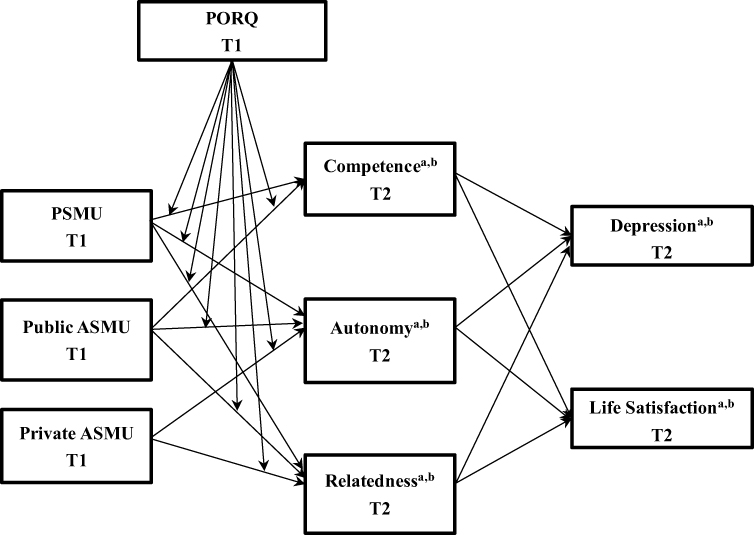 |
Figure 1 Research model. Abbreviations: PORQ, perceived offline relationship quality; PSUM, passive social media use; ASMU, active social media use. Notes: T1 = time 1, T2 = time 2. a Controlling for gender, age, and family income. b Controlling for baseline level of the same variable. |
The Mediating Roles of Psychological Needs Satisfaction
Satisfaction of Need for Autonomy
According to SDT, the need for autonomy is satisfied when individuals experience their behavior as self-endorsed and volitional.22 When using social media passively, however, individuals are in an “automatic”, “hypnotic” state where “you’re on autopilot”, and “whatever’s being thrown at you, you’re taking it”.30 Therefore, we expected that passive use would hinder autonomy satisfaction.
In contrast, active use offers individuals ample opportunity to engage in self-determined behaviors.31 The lack of social cues online can result in less of a perceived hierarchy and fewer indications of power balances,32 leading to a more equitable atmosphere. Active social media users feel free to share their personal views and present their true selves, leading to a stronger sense of control in interactions.33 Besides, empirical studies have demonstrated the positive association between active (either private or public) social media use and autonomy need satisfaction.34,35
Satisfaction of Need for Competence
The need for competence is satisfied when individuals feel capable and effective in their interactions with the social environment, successfully mastering challenges and achieving desired outcomes.22 However, positivity bias,36 the bias towards posting positive rather than negative aspects of oneself,37 exposed passive users to extensive upward comparison and decreased self-evaluation.38 Therefore, we expected passive use to be negatively associated with competence satisfaction.
Public active use, in contrast, is believed to help fulfill specific ego needs39 and increase feelings of self-worth40 by providing individuals with opportunities to engage in self-affirmation. Self-affirmation theory41 posits that individuals have an innate desire to maintain a positive self-image by seeking out positive self-relevant information. Self-affirmation processes in public active use consist of not only presenting a positive depiction of themselves,42 but also eliciting positive feedbacks.43 Plus, studies showed that both editing and viewing one’s Facebook page leads to a boosted self-esteem.44,45 Therefore, a positive association between public active use and competence satisfaction is expected.
Satisfaction of Need for Relatedness
The need for relatedness is satisfied when people experience a sense of connection, care, and belonging with significant others or their community.22 We expected a negative link between passive use and relatedness satisfaction for the following reasons. First, passive use lacks direct interpersonal communication and limits individuals in creating and managing relationships, lowering their sense of belonging and social capital.46 Second, the upward comparisons in passive use may refrain individuals from seeking social support, as we tend not to request support from those who are better off than us.10 Moreover, studies have linked passive use to relatedness frustration.47
Private active use is believed to satisfy the need for relatedness through the reinforcement of existing offline relationships and the making of new friends in online worlds.48 Empirical evidence has shown that online chatting helped fulfill individuals’ needs for social interaction49 and relatedness.47
However, existing studies yield inconsistent results regarding the relationship between public active use and relatedness satisfaction. On one hand, self-presentation and commenting on social media have been found to reduce individuals’ loneliness,10 and individuals posting more frequent status updates than usual reported a significant increase in their sense of connectedness.50 On the other hand, studies have also linked public active use to decreased perceived online social support51 and increased loneliness.52 In consideration of the mixed results, we proposed a non-directional hypothesis on the relationship between public active use and relatedness satisfaction.
Given that extensive empirical evidence has supported the relationship between basic psychological needs satisfaction and mental health across educational,53 recreational,54 work,55,56 and online communication34 contexts. We propose the following mediation hypotheses:
Hypothesis 1 (H1): Passive social media use affect adolescent mental health though frustration of autonomy (H1a), competence (H1c), and relatedness (H1r) needs. Hypothesis 2 (H2): Public active social media use affect adolescent mental health though satisfaction of autonomy (H2a), competence (H2c), and relatedness (H2r) needs. Hypothesis 3 (H3): Private active social media use affect adolescent mental health though satisfaction of autonomy (H3a) and relatedness (H3r) needs.
The Moderating Role of Offline Relationship Quality
During the adolescence period, adolescents’ interpersonal relationships gradually expand beyond their family, and the quality of these relationships is critical to their personal development.57 The co-construction model highlights that adolescents’ online and offline contexts are closely interconnected.25 As a result, Yau and Reich58 have advocated that adolescents’ online activities and its influence on psychological development should be explored with the consideration of adolescents’ offline connections. Recent research also supported that the quality of adolescents’ offline relationships significantly impacts the relationship between social media use behaviors and their psychological needs.59
To illustrate the impact of offline relationship quality on the relationship between different types of social media use and psychological needs, this study adopts the Use and Gratifications theory (U & G) perspective.16 According to U&G, as individuals’ diverse situational contexts lead to differing socio-psychological needs, they are able to selectively use various media, including social media, to fulfill those needs. From this perspective, the offline relationship quality of adolescents will shape different motivational states, which subsequently affect the relationship between adolescents’ social media use and their psychological needs. The moderating role of offline relationship quality can be understood through two key motivational mechanisms: compensation or enhancement.60 For adolescents with lower offline relationship quality (eg, social isolation or lack of support), the primary gratification sought from social media is typically a compensatory motivation.61 However, passive social media use, with its low interaction and high comparison characteristics, amplifies the negative psychological consequences of passive use among adolescents with low offline quality relationships.62 In contrast, for adolescents with high-quality offline relationships, the sought gratification is typically an enhancement motivation. Positive offline relationships signify stronger communication and conflict management skills, and their active social media behaviors (eg, commenting, self-disclosure) are more likely to receive positive responses, significantly enhancing their psychological well-being.8,13
Accordingly, this study reasonably speculates that the quality of adolescents’ offline relationships may influence the relationship between different types of social media use and psychological need fulfillment. Specifically, three hypotheses regarding the moderating role of offline relationship quality in the relationship between different types of social media use and mental health have been proposed, including the “poor get poorer”, “poor get richer”, and “rich get richer” hypotheses.
Passive Social Media Use: “Poor Get Poorer”
Significant associations between passive social media use and various adverse psychological outcomes have been widely demonstrated.13,63 However, the strength of these connections may vary depending on the quality of individuals’ offline relationships. For adolescents with a high level of offline relationship quality, such relationships may serve as a buffer in the relationship between online behaviors and negative consequences (eg, problematic Internet use).64 Conversely, for adolescents with low-quality offline relationships, the “poor get poorer” hypothesis65,66 may explain the stronger association between passive social media use and negative psychological consequences. Specifically, when adolescents have lower levels of offline relationship quality (eg, lack of sufficient offline social support), the association between passive social media use and lower levels of friendship connections,67 increased loneliness,68 and weaker social competence69 may be strengthened, thereby undermining the satisfaction of basic psychological needs. Therefore, we proposed the following hypotheses:
Hypothesis 4 (H4): Offline interpersonal relationship quality moderates the relationship between passive social media use and autonomy (H4a), competence (H4c), and relatedness (H4r), such that their negative associations will be stronger for adolescents having low-quality offline interpersonal relationships than for those having high-quality offline interpersonal relationships.
Public Active Social Media Use: “Poor Get Richer”
This study speculated that, for adolescents with low-quality offline relationships, the “poor-get-richer” hypothesis70,71 illustrates how their psychological needs are satisfied through public active social media use. For socially anxious adolescents who experience poor offline relationships quality, the anonymous publicly online interacting with others can minimize their anxiety and increase their sense of social control.72 Public active social media use, engaging in broadcasting and status updates, linked to increased sense of belonging and relatedness73 for socially anxious adolescents. Importantly, receiving more online feedback is thought to enhance sense of control,74 especially for adolescents with low-quality offline relationships. We therefore proposed:
Hypothesis 5 (H5): Offline interpersonal relationship quality moderates the relationship between public active social media use and autonomy (H5a), competence (H5c), and relatedness (H5r), such that their associations will be stronger for adolescents having low-quality offline interpersonal relationships than for those having high-quality offline interpersonal relationships.
Private Active Social Media Use: “Rich Get Richer”
For adolescents with high-quality offline relationships, we proposed that the “rich get richer” hypothesis70 may explains the effects of private active social media use on psychological needs. Prior research indicated that only direct person-to-person communication has been associated with increased social capital.75 For adolescents with low-quality offline relationships, however, as the sociability issues they encounter in the real world (eg, embarrassment, coldness) may transfer to private online communication contexts. Therefore, adolescents with low-quality offline relationship may receive relatively less psychological satisfaction through one-to-one direct online communication or chatting compared to those with high-quality offline relationship. Conversely, adolescents with high-quality offline relationships will encounter fewer barriers in private active social media use, which may allow them to gain more autonomy through it. Additionally, given the collectivistic nature of Chinese society, the need for relatedness and its fulfillment through private social media use might be particularly pronounced. Indeed, adolescents with high-quality offline relationships are more likely to experience more social connection during one-on-one online interactions with friends,76 fulfilling their needs for maintaining and expanding interpersonal connections.77 Thus, we hypothesized that:
Hypothesis 6 (H6): Offline interpersonal relationship quality moderates the relationship between private active use and autonomy (H6a), and relatedness (H6r) satisfaction, such that their positive associations will be stronger for adolescents with higher-quality offline interpersonal relationships than for those with lower-quality offline relationships.
Methods
Participants and Procedure
In total, five randomly selected schools located in Haidian District, Beijing, China were contacted of whom one school (20%) agreed to participate. Using G*Power, we estimated that we would need at least 103 participants to detect a small- to medium-sized effect. Given concerns that power analyses calculated in G*Power may underestimate the power needed to detect interaction effects,78 we targeted around 350 participants at Time 1 to achieve a final sample of 200. A two-wave panel study with a five-month interval was conducted from 11- to 17-year-old adolescents (grade 7–grade 11) from one public secondary school. At Time 1 (T1), 343 participants completed a survey assessing their social media use, perceived offline relationship quality, psychological needs, depression, and life satisfaction. After a five-month interval, the same group of participants completed follow-up measures at Time 2 (T2), during which we reassessed their psychological needs, depression, and life satisfaction. The procedures of surveys at T1 and T2 were identical. Informed consent was provided by participants and their parent(s) or legal guardian. Being guaranteed of the confidentiality of the study, all participants completed a battery of self-reporting paper-and-pencil survey during regular school hours, with one research assistant there to assist with individual student comprehension if necessary and to respond to any questions. All procedures were approved by the Ethics Committee at School of Journalism and Communication at Tsinghua University (No. TSJC 202401120004).
Of the 343 initial participants, 227 (66%) completed both surveys (T1 and T2). As the remaining samples still contained a sizeable amount of data, we used listwise deletion in our analysis. Following the recommendations of Goodman and Blum,79 the results from multiple logistic regression revealed that whether participants completed both surveys versus just survey 1 was not significantly predicted by demographics (gender, age, family income) or by T1 measures (ps > 0.18 for all). Thus, the data appear to be missing at random with respect to the focal variables, and the results are unlikely to be biased by participant attrition. Of the final sample (N = 227), 104 (45.9%) of the participants were female. The average age was 13.2 years (SD = 1.24).
Measures
Following the translation/back-translation procedure,80 we translated the English-language scales into Chinese scales. Specifically, the items were first translated from English to Chinese by the third and fourth authors of the article. Then, a trained bilingual research assistant back-translated the scales. Discrepancies were discussed and resolved within the author team.
Types of Social Media Use
Frison and Eggermont’s Multidimensional Scale of Facebook Use (MSFU)10 was adapted to measure the three types of social media use: passive, private active, and public active social media use. The original scale was designed specifically for Facebook; however, WeChat and QQ dominate the Chinese social media landscape and possess distinct features from Facebook. Our adaptation involved: (1) replacing “Facebook” with “WeChat” or “QQ” throughout all items, (2) adjusting platform-specific terminology (eg, “Facebook wall” became “WeChat Moments” or “QQ Space”). Using a nine-point Likert scale which ranged from 1 (“never”) to 9 (“several times per day”), participants rate eight items assessing three different types of social media activities. Passive social media use is measured by three items (eg, “How often do you look at your friends’ WeChat moments [or QQ space] status updates?”), and the α for this subscale in the current study was 0.79. Private active social media use is assessed using two items (eg, “How often do you chat with your friends on WeChat [or QQ]?”), and the α for the subscale in the current study was 0.91. Public active social media use is assessed by three items (eg, “How often do you post a text message on your own WeChat moments [or QQ space]?”), and the Cronbach’s α for the subscale in the current study was 0.89.
Psychological Needs
The Balanced Measure of Psychological Needs (BMPN) Scale was used to evaluate participants’ psychological needs.81 Participants are asked to self-report their level of satisfaction with regards to relatedness, competence, and autonomy using a five-point Likert scale ranging from 1 (“no agreement”) to 5 (“much agreement”). The relatedness subscale consists of three items (eg, “I felt a sense of contact with people who care for me, and whom I care for”.), and the αs at T1 and T2 in the current study were 0.76 and 0.74, respectively. Competence is measured using three items (eg, “I experienced some kind of failure, or was unable to do well at something”.), and the αs at T1 and T2 in the current study were 0.84 and 0.87, respectively. Autonomy is also measured using three items (eg, “I was free to do things my own way”.), and the αs at T1 and T2 in the current study were 0.67 and 0.72, respectively.
Depression
Nine items from the Patient Health Questionnaire (PHQ-9) were used to evaluate participants’ level of depression.82 Participants report the extent to which they have been bothered by each item during the previous two weeks using a four-point scale ranging from 0 (“not at all”) to 3 (“nearly every day”). An example item is, “Little interest or pleasure in doing things”. The αs at T1 and T2 in the current study were 0.85 and 0.91, respectively.
Life Satisfaction
The Satisfaction with Life Scale was used to measure participants’ life satisfaction.83 Participants are asked to rate five items asking about their current perceptions of their own life using a seven-point Likert scale ranging from 1 (“strongly disagree”) to 7 (“strongly agree”). An example item is, “In most ways my life is close to my ideal”. The αs at T1 and T2 in the current study were 0.82 and 0.89, respectively.
Perceived Offline Relationship Quality (PORQ)
Nine items derived from the positive subscale (seeking safe haven, seeking secure base, and companionship) of the Network of Relationships Inventory84 were used to measure perceived offline relationship quality. We adapted the relationship targets to focus on parents, peers, and teachers based on evidence these are the most influential relationships for Chinese adolescents.85 Participants are asked to rate how much each feature occurs in each relationship using a five-point Likert scale ranging from 1 (“very little or not at all”) to 5 (“a great deal”). Examples of items are, “How much do you turn to this person (Teachers/Peers/Parents) when you’re worried about something?” The α for the scale in the current study was 0.94.
Analytic Strategy
In a first step, we followed Little’s recommendations to examine measurement invariance.86 To examine longitudinal measurement invariance of the measure of psychological needs, depression, and life satisfaction across two measurement occasions, we compared three models with increasingly severe restrictions.86,87 We started with an unconstrained measurement model in which the factor loadings are freely estimated over time (ie, configural invariance). Second, we constrained the respective factor loadings to be equal over time (ie, metric invariance). Third, we constrained the respective factor loadings and intercepts to be equal over time (ie, scalar invariance). We compared these three models using changes in comparative fit index (CFI) no more than 0.01 as the main criterion for model equivalency.86,88
In a second step, we conducted confirmatory factor analysis (CFA) to test the measurement model of the focal predictors (ie, T1 passive, public active, private active social media use), moderator (ie, T1 perceived offline relationship quality), mediators (ie, T2 competence, autonomy, and relatedness), and outcomes (ie, T2 depression, life satisfaction) to determine whether the measured variables were distinguishable from each other. Prior to this, we created parcels for the perceived offline relationship quality scale. Parcels in SEM help to maintain a manageable indicator-to-sample size ratio when the sample size is relatively small and provide more reliable factor solutions compared with item-level data, especially with the factor structure of lengthy scale that we had.89,90 Previous studies have used item parceling to overcome such issues.91,92 Specifically, we created three parcels related to the twenty-seven items of perceived offline relationship quality with the participants’ teachers, peers, and parents (each parcel had nine items).
In a final step, we tested the hypothesized relationships with two path models using the composite scores of our research variables. In the first model, where only mediating effects were considered, the indirect effects of social media use at T1 via three forms of psychological needs (competence, autonomy, and relatedness) at T2 on depression and life satisfaction at T2 were specified. In addition to the hypothesized relations, we controlled for the baseline key variables by including paths from each baseline variable to its counterpart (eg, a path from baseline competence to Time 2 competence), and the direct effects of social media use on depression and life satisfaction. We also controlled for gender, age, and family income by including paths from these variables to the mediators and outcome variables. To test the indirect effects, we employed the bootstrapping method to construct the 95% confidence intervals (CIs) based on 5000 resamples.93 In the second model, we additionally included perceived offline relationship quality as a moderator and introduced an interaction effect between three kinds of social media use and perceived offline relationship quality to predict different forms of psychological needs. The rest of specification in the model is exactly the same as that in the first model. We then conducted simple slope test following Aiken and West.94 The interactive effects were plotted at high and low (ie, one standard deviation above and below the mean) levels of moderator. Next, we calculated the conditional indirect effects of the mediators at the different levels of moderator.
All data analyses were performed using SPSS Statistics 26.0 and Mplus 8.3.95 Standard fit indices were used to evaluate the model fit, including the comparative fit index (CFI), root-mean-square error of approximation (RMSEA) and standardized root mean square residual (SRMR). Acceptable fit is indicated with values >0.90 for CFI, <0.08 for RMSEA, and <0.08 for SRMR.96
Results
Preliminary Analyses
Descriptive statistics and correlations for study variables and controls are presented in Table 1.
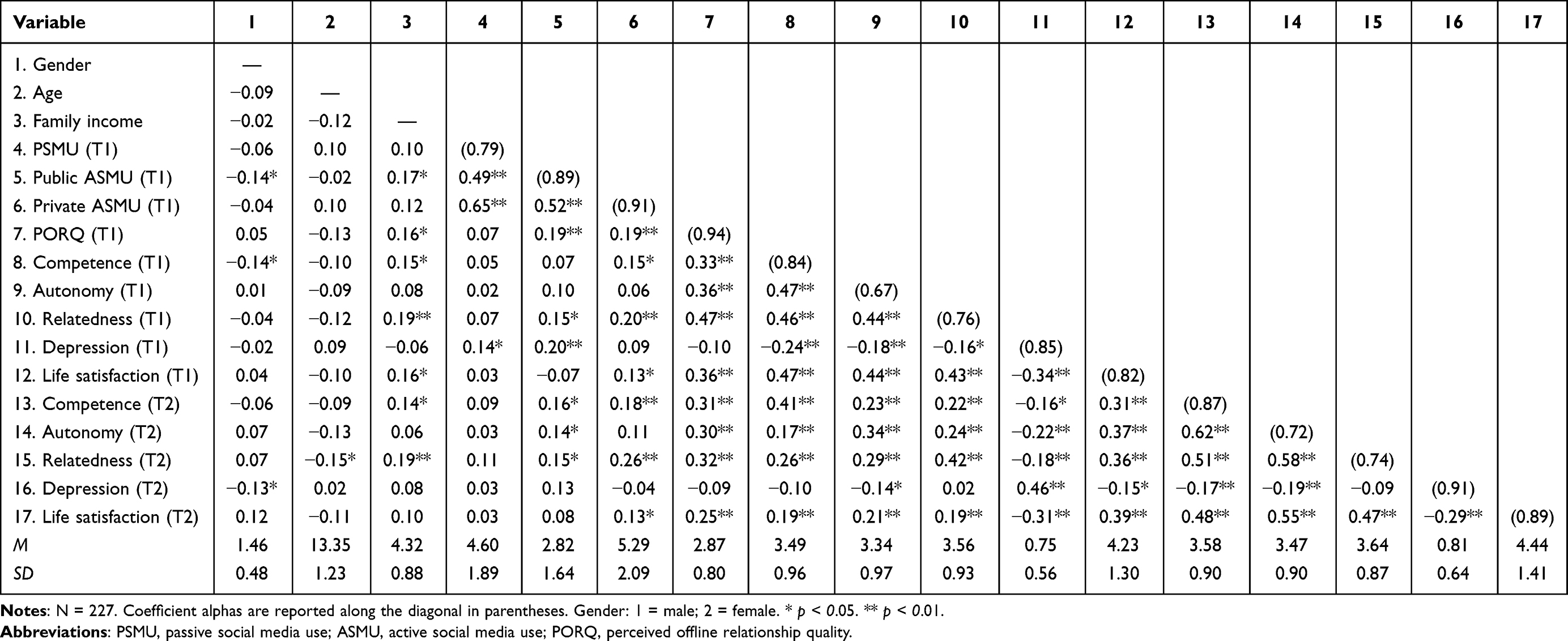 |
Table 1 Descriptive Statistics and Correlations Among the Key Variables |
In the first step, we tested longitudinal measurement invariance of the measure of psychological needs, depression, and life satisfaction. The results are shown in Table 2. Inspection of the modification indices of the configural invariance model of life satisfaction indicated a large residual covariance between items 2 (“The conditions of my life are excellent”.) and 3 (“I am satisfied with life”). Thus, freely estimating the residual variance between the two items at both measurement occasions improved the model fit considerably (see Table 2). This modified model represented the baseline model of the measure of life satisfaction. Comparison of the nested models of all five measures showed that no change in model fit was greater than the cutoff of ΔCFI = 0.01. Therefore, we concluded that scalar invariance holds over time for the measure of psychological needs, depression, and life satisfaction.
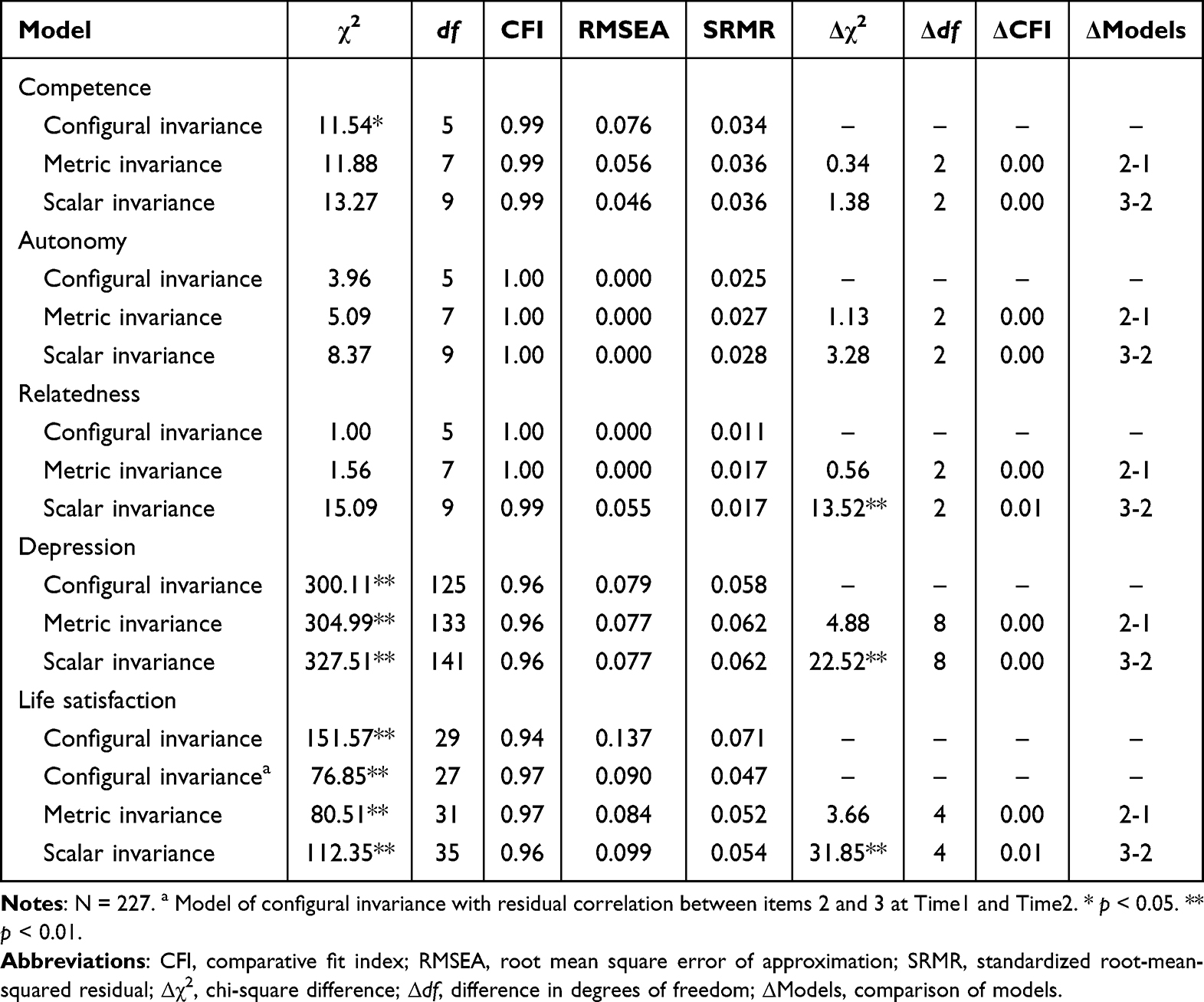 |
Table 2 Measurement Invariance Results for Psychological Needs, Depression, and Life Satisfaction |
In the next step, CFA results showed that, the hypothesized nine-factor model demonstrated a good fit to the data, χ2(491) = 948.89, p < 0.01, CFI = 0.94, RMSEA = 0.07, and SRMR = 0.06. All standardized item loadings were statistically significant (p < 0.01), ranging from 0.48 to 0.94. Average variance extracted estimates ranged from 0.39 to 0.80. None of the confidence intervals for the correlations (phi estimates) among the factors contained a value of 1, indicating discriminant validity.97
Test of the Hypothesized Model
Testing Mediation (Indirect) Effects of Psychological Needs
The first path model which considered only the mediating effects had a good fit, χ2(21) = 41.06, p < 0.01, CFI = 0.95, RMSEA = 0.07, and SRMR = 0.05. The results (see Table 3) showed that passive use, public, and private active use were non-significantly associated with either depression or life satisfaction. In addition, passive use and public active use were non-significantly related to competence, which was negatively related to depression (β = −0.32, p < 0.01) and positively related to life satisfaction (β = 0.29, p < 0.01). Public active use and private active use was non-significantly related to autonomy, which was positively related to depression (β = 0.24, p < 0.01) and life satisfaction (β = 0.19, p < 0.01). Private active use was positively related to relatedness (β = 0.19, p < 0.01), which was positively related to life satisfaction (β = 0.19, p < 0.01) but not depression.
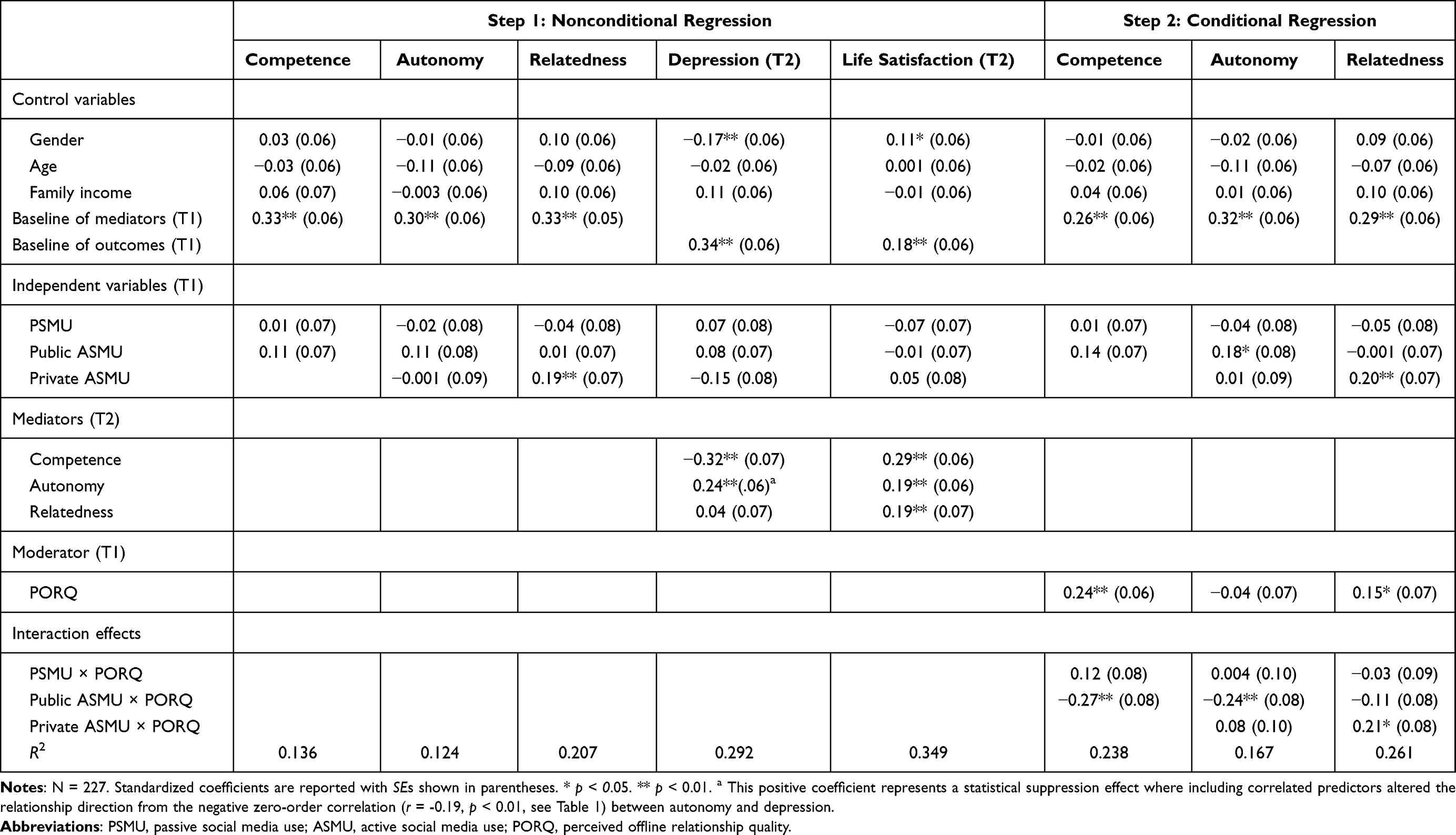 |
Table 3 Path Analyses Results |
For the indirect effects, results showed that only relatedness had significant mediation effects on the relationship between private active use and life satisfaction (indirect effect = 0.02, SE = 0.01, 95% CI [0.003, 0.070]), but not depression. No other significant indirect effects were founded.
Testing Moderating Effect of PORQ
The second path model which included PORQ as a moderator demonstrated an accepted fit (χ2(30) = 57.81, p < 0.01, CFI = 0.93, RMSEA = 0.06, and SRMR = 0.05). This model showed negative interaction effects between public active use and PORQ on both competence (β = −0.27, p < 0.01) and autonomy (β = −0.24, p < 0.01), and a positive interaction effect between private active use and PORQ on relatedness (β = 0.21, p < 0.05). No other significant interaction effects were found (see Table 3). Simple slope test results showed that, for the relationship between public active use and competence, the slope was significantly positive for adolescents with low PORQ (b = 0.24, p < 0.01), but it was not significant for adolescents with high PORQ (b = −0.05, p > 0.05; see Figure 2). For the relationship between public active use and autonomy, the slope was also significantly positive for adolescents with low PORQ (b = 0.20, p < 0.01), but not significant for adolescents with high PORQ (b = −0.02, p > 0.05; see Figure 3). For the relationship between private active use and relatedness, the slope was non-significant for adolescents with low PORQ (b = 0.03, p > 0.05), but significantly positive for adolescents with high PORQ (b = 0.18, p < 0.01; see Figure 4). Such evidence partially supports the moderating role of PORQ.
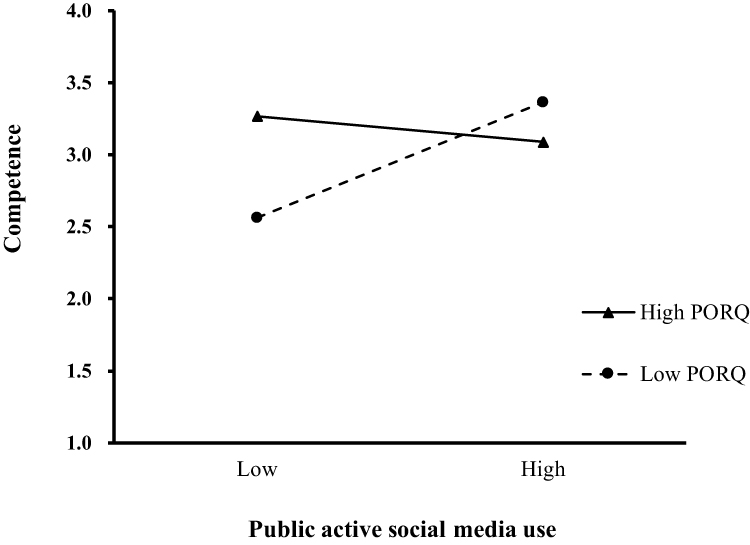 |
Figure 2 Moderating effect of PORQ on the relationship between public active social media use and competence. Abbreviation: PORQ, perceived offline relationship quality. |
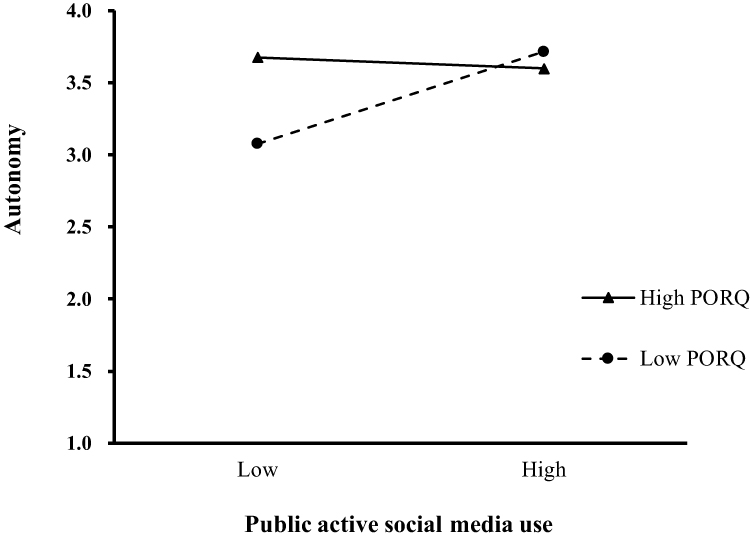 |
Figure 3 Moderating effect of PORQ on the relationship between public active social media use and autonomy. Abbreviation: PORQ, perceived offline relationship quality. |
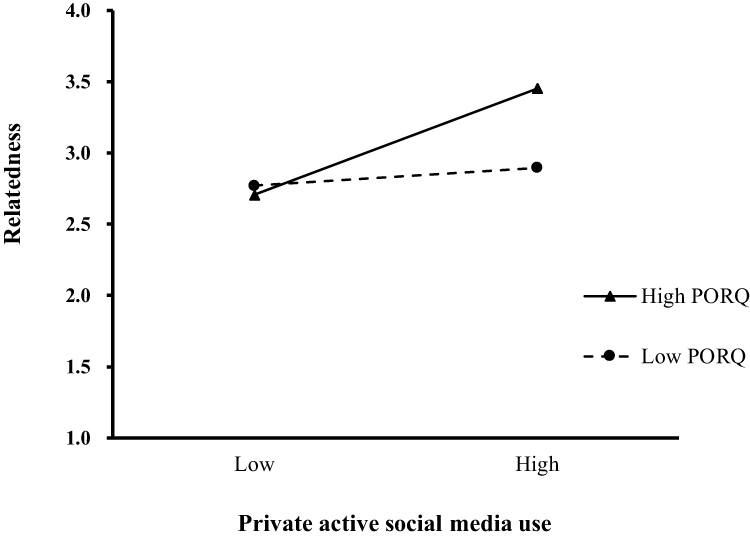 |
Figure 4 Moderating effect of PORQ on the relationship between private active social media use and relatedness. Abbreviation: PORQ, perceived offline relationship quality. |
Testing Moderated Mediation Effects
Bootstrapping results showed that the indirect effects of public active use on life satisfaction (b = 0.09, SE = 0.04, 95% CI [0.035, 0.193]) and depression (b = −0.05, SE = 0.03, 95% CI [−0.123, −0.015]) through competence were significant when PORQ was low, but they were not significant when PORQ was high (b = −0.02, SE = 0.03, 95% CI [−0.095, 0.019] for life satisfaction; b = 0.01, SE = 0.02, 95% CI [−0.008, 0.055] for depression). The indirect effect of public active use on life satisfaction through autonomy was also significant when PORQ was low (b = 0.06, SE = 0.03, 95% CI [0.020, 0.139]), but not when PORQ was high (b = −0.01, SE = 0.02, 95% CI [−0.042, 0.022]). The indirect effect of private active use on life satisfaction through relatedness was not significant when PORQ was low (b = 0.003, SE = 0.01, 95% CI [−0.016, 0.036]), but it was significant when PORQ was high (b = 0.05, SE = 0.03, 95% CI [0.008, 0.124]). No other pathways had significant conditional indirect effects. The results of all research hypotheses are shown in Table 4.
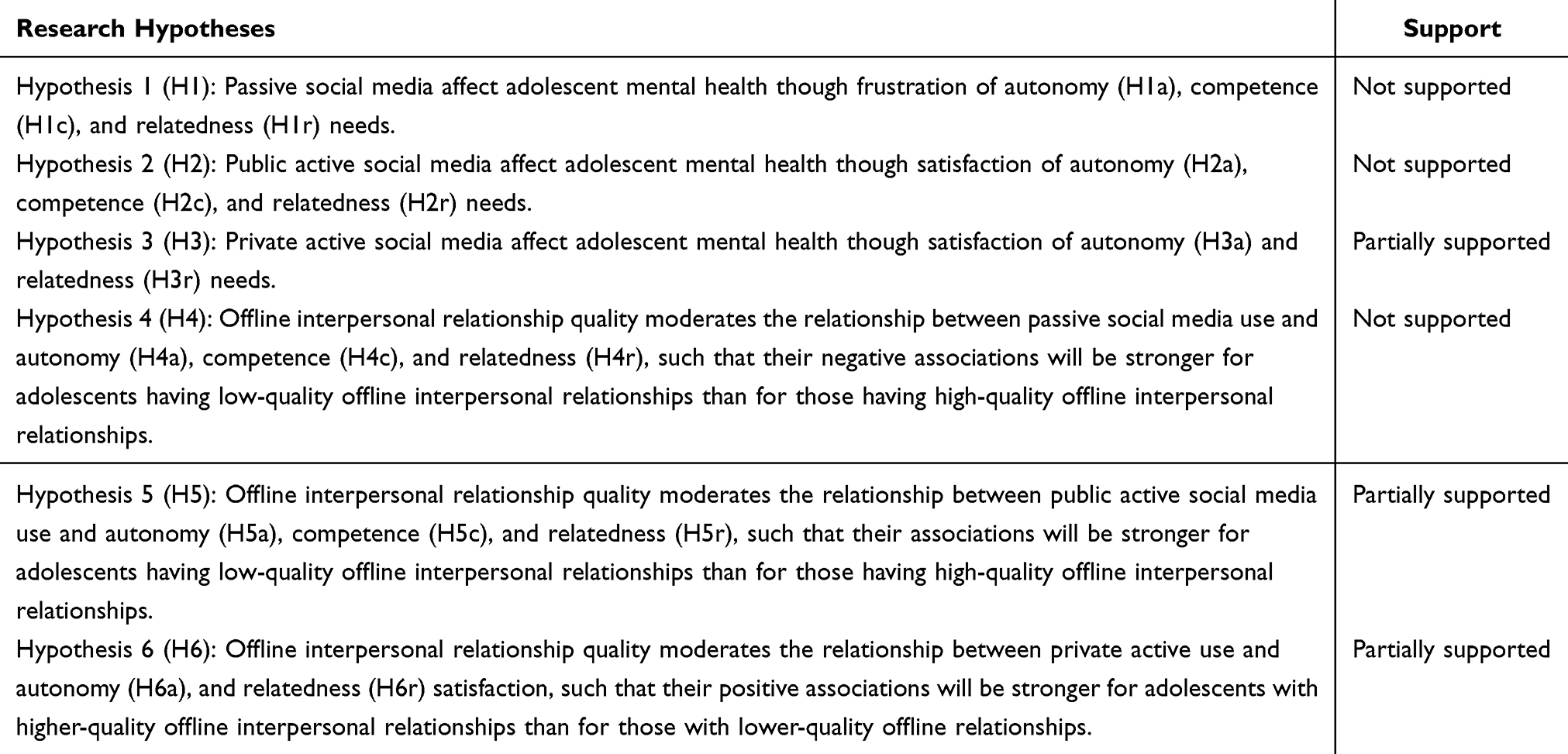 |
Table 4 Research Hypotheses Testing Results |
Discussion
This study aimed to resolve inconsistent findings in the literature by examining the nuanced mechanisms and boundary conditions linking different types of social media use to adolescents’ mental health. Grounded in an integrated framework of U & G and SDT, we proposed and tested a model in which psychological need satisfaction mediates the relationship between social media use and mental health, with offline relationship quality serving as a critical contextual moderator. Methodologically, our two-wave panel design advances beyond the cross-sectional approaches prevalent in existing SDT-informed social media research, offering more robust evidence for the proposed temporal pathways.
Our results strongly support the necessity of a conditional mediation model for understanding these complex relationships. First, and most fundamentally, we found no direct effects of any type of social media use (passive, public active, or private active) on mental health outcomes over time. This absence of direct effects is not an anomaly; it aligns with a growing body of longitudinal research that similarly reports null direct links,98,99 challenging simplistic “good versus bad” narratives. This finding underscores the limitation of simple direct-effect models and reinforces our core premise: the relationship is not straightforward but operates through underlying psychological processes that are sensitive to individual context. Second, we identified highly specific pathways that clarify how and for whom these effects occur. Private active social media use enhanced life satisfaction specifically through relatedness satisfaction, but only among adolescents with high-quality offline relationships (“rich get richer”). Conversely, public active use promoted mental health by fulfilling competence and autonomy needs, yet exclusively among those with low-quality offline relationships (“poor get richer”). No significant indirect effects emerged for passive social media use in our model.
Our most significant contribution lies in refining and validating the integrative U & G-SDT model. While U & G theory provided the rationale for distinguishing goal-directed use types, SDT supplied the fundamental mechanism—psychological need satisfaction—linking these behaviors to mental health. By differentiating public from private active use, we move beyond the active–passive dichotomy and provide robust empirical evidence for their functional specificity. Our results demonstrate that these are not interchangeable “active” behaviors; they serve distinct psychological functions: public use is oriented toward self-focused, ego-enhancing gratifications (satisfying competence and autonomy), whereas private use serves relational, connection-oriented functions (satisfying relatedness).
The most compelling evidence for this functional specificity comes not only from the pathways we found but, equally importantly, from those we did not. The dissociation in our results is theoretically instructive: public active use was not linked to mental health through relatedness satisfaction, just as private active use was not linked through autonomy or competence satisfaction. These targeted null findings validate the conceptual purity of our model. They demonstrate that the primary gratification of public broadcasting is self-oriented rather than interpersonally connective, while the core function of private messaging is relational bonding rather than self-evaluation. This pattern of results provides powerful empirical support for the U & G premise that distinct media behaviors are pursued for distinct gratifications and may explain why prior studies treating “active use” as a unitary construct have yielded inconsistent findings.14
The moderating role of offline relationship reveals that the effectiveness of active use as a need-satisfying strategy is not universal but critically context-dependent. Our findings provide clear support for the “rich get richer” hypothesis in private communication contexts. For adolescents with high-quality offline relationships, private active use fulfills relatedness need, thereby enhancing life satisfaction. This aligns neatly with theoretical expectations: the goal-directed behavior of one-on-one chatting (U & G) serves the deeper function of fulfilling the need for connection (SDT). This result suggests that private social media use functions best as an extension of a healthy offline social life, enabling adolescents to maintain and deepen existing bonds76,100 and illustrating the co-construction of online and offline worlds.25
Conversely, the pattern for public active use among adolescents with low-quality offline relationships illustrates a “poor get richer” dynamic via a compensation mechanism. For these youth, the controlled environment of public broadcasting—characterized by the reduced social cues and asynchronous communication, as outlined in hyperpersonal theory101—provides a less threatening arena for self-expression. Indeed, adolescents who are more isolated49 or introverted102 are more likely to engage in online communication. Furthermore, social media offers opportunities for curated self-presentation and receiving affirming feedback from a broader network, thereby compensating for the autonomy and competence frustrations experienced offline and resulting in improved mental health. For adolescents with strong offline networks, however, public use conferred no additional benefit, suggesting their psychological needs may already be adequately met through offline channels.
Our overall pattern of results—where direct effects are absent, simple mediation is limited, but moderated mediation is robust—invites a deeper theoretical synthesis. It appears that the psychological “space” in which social media operates is not a vacuum but is preconditioned by the quality of the adolescent’s offline social world. SDT provides the foundational needs, but the access points to these needs in the digital realm are regulated by offline social capital. Adolescents with low offline social capital find a compensatory pathway to need satisfaction through the relatively safer, more controllable arena of public broadcasting. In contrast, those with high offline social capital find a complementary pathway to further enhance their relatedness through the intimate channel of private messaging. This study thus extends SDT by demonstrating that the need-satisfying potential of a digital environment is not intrinsic to the activity itself but is co-constructed by the individual’s offline social context.
The non-significant findings for passive use (H1, H4) warrant theoretical consideration. The lack of negative effects aligns with emerging research suggesting passive use’s impact may be more nuanced and less uniformly negative than previously assumed.9,13 Its potential harm might not be inherent but could depend on unmeasured moderators,8,103 such as the nature of the content consumed (eg, inspirational vs envy-inducing) or individual susceptibility (eg, tendency for upward social comparison). Our study’s focus on overall use frequency, without capturing these subtleties, may account for the null results. Nevertheless, these findings are instructive, highlighting the need for future research to employ more granular measures of passive consumption.
The practical implications of our study are substantial. For parents, educators, and clinicians, the key insight is the need to replace monolithic “social media is bad/good” narratives with personalized guidance. Encouraging adolescents with strong offline social skills to use social media for private, meaningful interactions can be beneficial. For those who are socially isolated or struggling offline, constructive public active use (eg, sharing creative work, participating in interest-based communities) may serve as a valuable springboard for building confidence and agency, while concurrently working to improve their offline social competence. Mental health assessments could usefully incorporate evaluations of social media use patterns and offline relationship quality to identify specific sources of need frustration or satisfaction.
Limitations
Several limitations of this study must be noted. First, there was a relatively high attrition rate at T2 in our study. Sample attrition is nearly inevitable in panel survey research.104 While attrition analyses suggested random dropout, it may still influenced the results of the current study to some extent. Future studies should consider increasing the sample size, providing more incentives, or adopting a planned missingness design105 to improve their overall response rates. Second, to maintain the parsimony of the research model, this study integrated adolescents’ relationships with peers, parents, and teachers into a comprehensive indicator of offline relationship quality. While this approach provides a holistic view of adolescents’ offline relationship, we acknowledge that these distinct relationships may exert unique and nuanced influences on the interplay between social media use and psychological outcomes. Therefore, future research that disaggregates this composite construct to separately examine the specific roles of parental monitoring, peer support, and teacher–student relationships would be of significant value. Third, this study focused only on two types of social media platforms, QQ and WeChat. While these platforms remain the predominant social networking sites among Chinese adolescents, future researchers should be aware of the growing prevalence of other short-video social media platforms (eg, “Douyin”). Therefore, testing our research findings on short-video social media platforms should be an important direction for future research. Fourth, while this study is innovative in its use of SDT to explore the relationships between various types of social media use and adolescents’ mental health, as well as its consideration of offline relationship quality as a moderator. Other mediators and moderators, such as adolescents’ self-regulation,106 personality traits,2 or positive and negative social media content exposure,24 should be explored in the future research. Finally, data in the current study was collected at only two waves, five months apart. Future research should incorporate more measurement waves over an extended period and employ more refined analytical methods, such as cross-lagged panel models or latent growth curve models, to better explore the dynamic relationship between social media use and mental health. Future research may examine the reliability and validity for the Chinese version Autonomy subscale as the Cronbach’s α was below 0.7 (α = 0.67 at T1).
Conclusion
The current study is the first that we know of to systematically evaluate the relationships between different types of social media use and both positive and negative aspects of mental health outcomes in adolescents. It also investigated the psychological mechanisms underlying these associations while considering the mediator role of satisfaction of psychological needs, and the moderating role of offline relationship quality. Results indicate that different types of social media use were not significantly associated with adolescents’ depression or life satisfaction. Mediation analysis results indicate private active social media use significantly predicts the fulfillment of relatedness needs and further contributes to adolescents’ subsequent life satisfaction. Importantly, moderation analysis reveals the potential mechanisms of the “poor get richer” and “rich get richer” hypotheses depending on the type of social media use and mental health outcomes. Specifically, for adolescents with low-quality offline relationships, public active social media use promoted the satisfaction of competence needs and thus decreased depression, and promoted competence and autonomy satisfaction and thus increased life satisfaction. For adolescents with high-quality offline relationships, private active social media use facilitated relatedness satisfaction, subsequently enhancing life satisfaction. Through the integrated perspective of the U & G theory and SDT, this study provides insights into the differential psychological outcomes of social media use among adolescents with different levels of offline relationship quality. This extends the existing literature by expanding the understanding of the mechanisms and boundary conditions of how adolescent social media use impacts mental health in the Chinese context.
The Disclosure of AI Usage
The authors declare they have used AI services, specifically introduction and discussion, for grammar correction and minor edit refinements. They carefully reviewed all suggestions from these services to ensure the original meaning and factual accuracy were preserved.
Ethical Consideration
All procedures for the study were in accordance with the ethical standards of the institutional review board of the School of Journalism and Communication at Tsinghua University, and the ethical review approval number is: No. TSJC 202401120004, which follows the principles of the Declaration of Helsinki for research involving human subjects.
Acknowledgments
The authors would also like to express their gratitude to each of the adolescents who participated in this survey and their parents.
Author Contributions
All authors made a significant contribution to the work reported, whether that is in the conception, study design, execution, acquisition of data, analysis and interpretation, or in all these areas; took part in drafting, revising, or critically reviewing the article; gave final approval of the version to be published; have agreed on the journal to which the article has been submitted; and agree to be accountable for all aspects of the work.
Funding
This study was funded by the Humanities and Social Sciences Youth Foundation, Ministry of Education of China (No. 20YJCZH010) awarded to Shuang Chen; Tsinghua University Initiative Scientific Research Program (No. 2024THZWWH02) awarded to Shuang Chen; Tsinghua Lab Research Program on Computational Communication and Intelligent Media (No. 2026TSJCLAB001) awarded to Shuang Chen; Tsinghua University Undergraduate Education Innovation Grants (No. DX08_06) awarded to Shuang Chen; the Program for Qianduansheng Young Researcher in China University of Political Science and Law awarded to Qin Gao; the Key Project of the National Social Science Foundation of China (No. 23ASH016).
Disclosure
The authors declared no potential conflicts of interest with respect to the research, authorship, publication, and/or financial relationships of this article.
References
1. Abraham BK. Attitude of adolescents towards use of social media. Int J Adv Res. 2020;8(02):443–20. doi:10.21474/IJAR01/10480
2. Maheux AJ, Burnell K, Maza MT, Fox KA, Telzer EH, Prinstein MJ. Annual research review: adolescent social media use is not a monolith: toward the study of specific social media components and individual differences. J Child Psychol Psychiatr. 2025;66(4):440–459. doi:10.1111/jcpp.14085
3. The 5th National Survey Report on Minors’ Internet Usage [homepage on the Internet]. Beijing: China Internet Network Information Center (CNNIC); 2023. Available from: https://www.cnnic.cn/NMediaFile/2023/1225/MAIN1703484375296SPBHV29S0V.pdf.
4. Fitzgerald R, Sandel T, Wu X. Chinese social media: technology, culture and creativity. Discourse Context Media. 2022;48:100610. doi:10.1016/j.dcm.2022.100610
5. The report indicates that online consumption among minors in China is showing a trend toward younger age groups [homepage on the Internet]. Beijing: People’s Daily Online; 2025. Available from: http://finance.people.com.cn/BIG5/n1/2025/0331/c1004-40450641.html.
6. Firth J, Torous J, López-Gil JF, et al. From “online brains” to “online lives”: understanding the individualized impacts of Internet use across psychological, cognitive and social dimensions. World Psychiatry. 2024;23(2):176–190. doi:10.1002/wps.21188
7. Fassi L, Ferguson AM, Przybylski AK, Ford TJ, Orben A. Social media use in adolescents with and without mental health conditions. Nat Hum Behav. 2025;9:1283–1299. doi:10.1038/s41562-025-02134-4
8. Nguyen ND, Truong NA, Dao PQ, Nguyen HH. Can online behaviors be linked to mental health? Active versus passive social network usage on depression via envy and self-esteem. Comput Hum Behav. 2025;162:108455. doi:10.1016/j.chb.2024.108455
9. Valkenburg PM, van Driel II, Beyens I. The associations of active and passive social media use with well-being: a critical scoping review. New Media Soc. 2022;24(2):530–549. doi:10.1177/14614448211065425
10. Frison E, Eggermont S. Toward an integrated and differential approach to the relationships between loneliness, different types of Facebook use, and adolescents’ depressed mood. Commun Res. 2020;47(5):701–728. doi:10.1177/0093650215617506
11. Blackwell CK, Mansolf M, Rose T, et al. Adolescent social media use and mental health in the environmental influences on child health outcomes study. J Adolesc Health. 2025;76(4):647–656.
12. Taylor Z, Yankouskaya A, Panourgia C. Social media use, loneliness and psychological distress in emerging adults. Behav Inf Technol. 2024;43(7):1312–1325. doi:10.1080/0144929X.2023.2209797
13. Godard R, Holtzman S. Are active and passive social media use related to mental health, wellbeing, and social support outcomes? A meta-analysis of 141 studies. J Comput Mediat Commun. 2023;29(1). doi:10.1093/jcmc/zmad055
14. Kross E, Verduyn P, Sheppes G, Costello CK, Jonides J, Ybarra O. Social media and well-being: pitfalls, progress, and next steps. Trends Cognit Sci. 2021;25(1):55–66. doi:10.1016/j.tics.2020.10.005
15. Ryding FC, Harkin LJ, Kuss DJ. Instagram engagement and well-being: the mediating role of appearance anxiety. Behav Inf Technol. 2025;44(3):446–462. doi:10.1080/0144929X.2024.2323078
16. Katz E, Haas H, Gurevitch M. On the use of the mass media for important things. Am Sociol Rev. 1973;38:164–181. doi:10.2307/2094393
17. Hoang HQ, Tran KT, Le TD. Engaging users on university Facebook pages: insights from the uses and gratifications theory and post characteristics. Cogent Soc Sci. 2024;10(1):2402086. doi:10.1080/23311886.2024.2402086
18. Niu X, Verduyn P, Gaskin J, Scherr S, McDonnell D, Wang J-L. The development and validation of the extended active-passive social media use scale. Cyberpsychology. 2025;19(3):Article1. doi:10.5817/CP2025-3-1
19. Whiting A, Williams D. Why people use social media: a uses and gratifications approach. Qual Mark Res Int J. 2013;16(4):362–369. doi:10.1108/QMR-06-2013-0041
20. Khan ML. Social media engagement: what motivates user participation and consumption on YouTube? Comput Hum Behav. 2017;66:236–247. doi:10.1016/j.chb.2016.09.024
21. Reinecke L, Oliver MB. The Routledge Handbook of Media Use and Well-Being. New York: Routledge; 2016.
22. Ryan RM, Deci EL. Self-determination theory and the facilitation of intrinsic motivation, social development, and well-being. Am Psychol. 2000;55(1):68–78. doi:10.1037/0003-066X.55.1.68
23. West M, Rice S, Vella-Brodrick D. Adolescent social media use through a Self-Determination theory lens: a systematic scoping review. Int J Environ Res Public Health. 2024;21(7):862. doi:10.3390/ijerph21070862
24. Sheldon KM, Titova L. Social media use and well-being: testing an integrated self-determination theory model. Media Psychol. 2023;26(6):637–659. doi:10.1080/15213269.2023.2185259
25. Subrahmanyam K, Smahel D, Greenfield P. Connecting developmental constructions to the internet: identity presentation and sexual exploration in online teen chat rooms. Dev Psychol. 2006;42(3):395–406. doi:10.1037/0012-1649.42.3.395
26. Feng H, Xuan C, Yi S. The more popular, the happier? Exploring curvilinear relationships between popularity and subjective well-being in the social networking context of China. Asian J Soc Psychol. 2025;28(3):e70047. doi:10.1111/ajsp.70047
27. Flamant N, Ponnet K, Soenens B, Hees VV, Vansteenkiste M. Adolescents’ mental health in the social-media era: the role of offline and online need-based experiences. J Adolesc. 2024;96(3):612–631. doi:10.1002/jad.12286
28. Antaramian SP, Huebner ES, Valois RF. Adolescent life satisfaction. Appl Psychol. 2008;57:112–126. doi:10.1111/j.1464-0597.2008.00357.x
29. Headey B, Kelley J, Wearing A. Dimensions of mental health: life satisfaction, positive affect, anxiety and depression. Soc Indic Res. 1993;29:63–82. doi:10.1007/BF01136197
30. Jammal D. The Experience of the Self in Cyberspace: An Experiential Perspective on Social Networking Sites [dissertation]. London: University of London; 2020.
31. Reinecke L, Vorderer P, Knop K. Entertainment 2.0? The role of intrinsic and extrinsic need satisfaction for the enjoyment of Facebook use. J Commun. 2014;64(3):417–438. doi:10.1111/jcom.12099
32. Walther JB. Interpersonal effects in computer-mediated interaction: a relational perspective. Commun Res. 1992;19(1):52–90. doi:10.1177/009365092019001003
33. Chen A. From attachment to addiction: the mediating role of need satisfaction on social networking sites. Comput Hum Behav. 2019;98:80–92. doi:10.1016/j.chb.2019.03.034
34. Ang CS, Talib MA, Tan KA, Tan JP, Yaacob SN. Understanding computer-mediated communication attributes and life satisfaction from the perspectives of uses and gratifications and self-determination. Comput Hum Behav. 2015;49:20–29. doi:10.1016/j.chb.2015.02.037
35. Yang T, Ying Q. Online self-presentation strategies and fulfillment of psychological needs of Chinese sojourners in the United States. Front Psychol. 2021;11:586204. doi:10.3389/fpsyg.2020.586204
36. Burnell K, George MJ, Vollet JW, Ehrenreich SE, Underwood MK. Passive social networking site use and well-being: the mediating roles of social comparison and the fear of missing out. Cyberpsychology. 2019;13(3):article5. doi:10.5817/CP2019-3-5
37. Dorethy MD, Fiebert MS, Warren CR. Examining social networking site behaviors: photo sharing and impression management on Facebook. Int Rev Soc Sci Humanit. 2014;6(2):111–116.
38. Midgley C, Thai S, Lockwood P, Kovacheff C, Page-Gould E. When every day is a high school Reunion: social media comparisons and self-esteem. J Pers Soc Psychol. 2021;121(2):285–307. doi:10.1037/pspi0000336
39. Toma CL, Hancock JT. Self-affirmation underlies Facebook use. Pers Soc Psychol Bull. 2013;39(3):321–331. doi:10.1177/0146167212474694
40. Toma CL. Feeling better but doing worse: effects of Facebook self-presentation on implicit self-esteem and cognitive task performance. Media Psychol. 2013;16(2):199–220. doi:10.1080/15213269.2012.762189
41. Sherman DK, Cohen GL. The psychology of self-defense: self-affirmation theory. Adv Exp Soc Psychol. 2006;38:183–242. doi:10.1016/S0065-2601(06)38004-5
42. Kleemans M, Daalmans S, Carbaat I, Anschütz D. Picture perfect: the direct effect of manipulated Instagram photos on body image in adolescent girls. Media Psychol. 2018;21:93–110. doi:10.1080/15213269.2016.1257392
43. Wenninger H, Krasnova H, Buxmann P. Understanding the role of social networking sites in the subjective well-being of users: a diary study. Eur J Inf Syst. 2019;28:126–148. doi:10.1080/0960085X.2018.1496883
44. Gentile B, Twenge JM, Freeman EC, Campbell WK. The effect of social networking websites on positive self-views: an experimental investigation. Comput Hum Behav. 2012;28:1929–1933. doi:10.1016/j.chb.2012.05.012
45. Gonzales AL, Hancock JT. Mirror, mirror on my Facebook wall: effects of Facebook exposure on self-esteem. Cyberpsychol Behav Soc Netw. 2011;14:79–83. doi:10.1089/cyber.2009.0411
46. Matook S, Cummings J, Bala H. Are you feeling lonely? The impact of relationship characteristics and online social network features on loneliness. J Manag Inf Syst. 2015;31(4):278–310. doi:10.1080/07421222.2014.1001282
47. Chen W, Fan CY, Liu QX, Zhou ZK, Xie XC. Passive social network site use and subjective well-being: a moderated mediation model. Comput Hum Behav. 2016;64:507–514. doi:10.1016/j.chb.2016.04.038
48. Subrahmanyam K, Smahel D. Digital Youth: The Role of Media in Development. New York: Springer; 2011.
49. Bonetti L, Campbell MA, Gilmore L. The relationship of loneliness and social anxiety with children’s and adolescents’ online communication. Cyberpsychol Behav Soc Netw. 2010;13(3):279–285. doi:10.1089/cyber.2009.0215
50. Deters FG, Mehl MR. Does posting Facebook status updates increase or decrease loneliness? An online social networking experiment. Soc Psychol Personal Sci. 2013;4(5):579–586. doi:10.1177/1948550612469233
51. Frison E, Eggermont S. Gender and Facebook motives as predictors of specific types of Facebook use: a latent growth curve analysis in adolescence. J Adolesc. 2016;52:182–190. doi:10.1016/j.adolescence.2016.08.008
52. Yang C. Instagram use, loneliness, and social comparison orientation: interact and browse on social media, but don’t compare. Cyberpsychol Behav Soc Netw. 2016;19(12):703–708. doi:10.1089/cyber.2016.0201
53. Tian L, Chen H, Huebner ES. The longitudinal relationships between basic psychological needs satisfaction at school and school-related subjective well-being in adolescents. Soc Indic Res. 2014;119(1):353–372. doi:10.1007/s11205-013-0495-4
54. Leversen I, Danielsen AG, Birkeland MS, Samdal O. Basic psychological need satisfaction in leisure activities and adolescents’ life satisfaction. J Youth Adolesc. 2012;41(12):1588–1599. doi:10.1007/s10964-012-9776-5
55. Walker GJ, Kono S. The effects of basic psychological need satisfaction during leisure and paid work on global life satisfaction. J Posit Psychol. 2018;13(1):36–47. doi:10.1080/17439760.2017.1374439
56. Meng Q. Chinese university teachers’ job and life satisfaction: examining the roles of basic psychological needs satisfaction and self-efficacy. J Gen Psychol. 2022;149(3):327–348. doi:10.1080/00221309.2020.1853503
57. Roehlkepartain EC, Ross KM, Seward MD, Hirano KA. Developmental relationships: the roots of effective youth development practice. In: Arnold ME, Ferrari TM, editors. Positive Youth Development: Integrating Research and Practice. Cham: Springer Nature Switzerland; 2025:185–208. doi:10.1007/978-3-031-85110-0_11
58. Yau JC, Reich SM. Are the qualities of adolescents’ offline friendships present in digital interactions? Adolesc Res Rev. 2018;3:339–355. doi:10.1007/s40894-017-0059-y
59. Dredge R, Schreurs L. Social media use and offline interpersonal outcomes during youth: a systematic literature review. Mass Commun Soc. 2020;23(6):885–911. doi:10.1080/15205436.2020.1810277
60. Gingras MP, Brendgen M, Beauchamp MH, et al. Adolescents and social media: longitudinal links between motivations for using social media and subsequent internalizing symptoms. J Youth Adolesc. 2025;54(3):807–820. doi:10.1007/s10964-024-02097-1
61. Ruppel EK, McKinley CJ. Social support and social anxiety in use and perceptions of online mental health resources: exploring social compensation and enhancement. Cyberpsychol Behav Soc Netw. 2015;18(8):462–467. doi:10.1089/cyber.2014.0652
62. Thorisdottir IE, Sigurvinsdottir R, Asgeirsdottir BB, Allegrante JP, Sigfusdottir ID. Active and passive social media use and symptoms of anxiety and depressed mood among Icelandic adolescents. Cyberpsychol Behav Soc Netw. 2019;22(8):535–542. doi:10.1089/cyber.2019.0079
63. Agyapong-Opoku N, Agyapong-Opoku F, Greenshaw AJ. Effects of social media use on youth and adolescent mental health: a scoping review of reviews. Behav Sci. 2025;15(5):574. doi:10.3390/bs1505
64. Mazzoni E, Baiocco L, Cannata D, Dimas I. Is internet the cherry on top or a crutch? Offline social support as moderator of the outcomes of online social support on Problematic Internet Use. Comput Hum Behav. 2016;56:369–374. doi:10.1016/j.chb.2015.11.032
65. Steinsbekk S, Bjørklund O, Valkenburg P, Nesi J, Wichstrøm L. The new social landscape: relationships among social media use, social skills, and offline friendships from age 10-18 years. Comput Hum Behav. 2024;156:108235. doi:10.1016/j.chb.2024.108235
66. Reich SM. Connecting offline social competence to online peer interactions. Psychol Pop Media Cult. 2017;6(4):291–310. doi:10.1037/ppm0000111
67. Shaw AM, Timpano KR, Tran TB, Joormann J. Correlates of Facebook usage patterns: the relationship between passive Facebook use, social anxiety symptoms, and brooding. Comput Hum Behav. 2015;48:575–580. doi:10.1016/j.chb.2015.02.003
68. Burke M, Marlow C, Lento T. Social network activity and social well-being.
69. Cheng C, Wang HY, Sigerson L, Chau CL. Do the socially rich get richer? A nuanced perspective on social network site use and online social capital accrual. Psychol Bull. 2019;145(7):734–764. doi:10.1037/bul0000198
70. Raeymaecker KD, Baetens I, Heel MV. Who fits the glass slipper? Adolescent dispositional profiles and their link with instant messaging social support and mental health. J Res Adolesc. 2025;35(3):e70052. doi:10.1111/jora.70052
71. Zywica J, Danowski J. The faces of Facebookers: investigating social enhancement and social compensation hypotheses; Predicting Facebook™ and offline popularity from sociability and self-Esteem, and mapping the meanings of popularity with semantic networks. J Comput Mediat Commun. 2008;14(1):1–34. doi:10.1111/j.1083-6101.2008.01429.x
72. Shepherd R, Edelmann RJ. Reasons for internet use and social anxiety. Personal Individ Differ. 2005;39(5):949–958. doi:10.1016/j.paid.2005.04.001
73. Etgar S. Not all selfies took alike: distinct selfie motivations are related to different personality characteristics. Front Psychol. 2017;8:233719. doi:10.3389/fpsyg.2017.00842
74. Tobin SJ, Vanman EJ, Verreynne M, Saeri AK. Threats to belonging on Facebook: lurking and ostracism. Soc Influ. 2015;10(1):31–42. doi:10.1080/15534510.2014.893924
75. Burke M, Kraut R, Marlow C. Social capital on Facebook: differentiating uses and users.
76. Abbas R, Mesch G. Do rich teens get richer? Facebook use and the link between offline and online social capital among Palestinian youth in Israel. Inf Commun Soc. 2018;21(1):63–79. doi:10.1080/1369118X.2016.1261168
77. Wang JL, Jackson LA, Zhang DJ, Su ZQ. The relationships among the Big Five Personality factors, self-esteem, narcissism, and sensation-seeking to Chinese University students’ uses of social networking sites (SNSs). Comput Hum Behav. 2012;28(6):2313–2319. doi:10.1016/j.chb.2012.07.001
78. Giner-Sorolla R. Powering your interaction [homepage on the Internet]; 2018. Available from: https://approachingblog.wordpress.com/2018/01/24/powering-your-interaction-2/.Accessed.
79. Goodman JS, Blum TC. Assessing the non-random sampling effects of subject attrition in longitudinal research. J Manage. 1996;22(4):627–652. doi:10.1177/014920639602200405
80. Brislin RW. Translation and content analysis of oral and written material. In: Triandis HC, Berry JW, editors. Handbook of Cross-Cultural Psychology. Boston: Allyn & Bacon; 1980:389–444.
81. Sheldon KM, Hilpert JC. The balanced measure of psychological needs (bmpn) scale: an alternative domain general measure of need satisfaction. Motiv Emot. 2012;36(4):439–451. doi:10.1007/s11031-012-9279-4
82. Kroenke K, Spitzer RL, Williams JB. The PHQ‐9: validity of a brief depression severity measure. J Gen Intern Med. 2001;16(9):606–613. doi:10.1046/j.1525-1497.2001.016009606.x
83. Diener E, Emmons RA, Larsen RJ, Griffin S. The satisfaction with life scale. J Pers Assess. 1985;49:71–75. doi:10.1207/s15327752jpa4901_13
84. Furman W, Buhrmester D. Methods and measures: the network of relationships inventory: behavioral systems version. Int J Behav Dev. 2009;33(5):470–478. doi:10.1177/0165025409342634
85. Huang C, Li C, Zhao F, et al. Teacher and peer effects on the social behaviors of chinese adolescents: a structural equation modeling analysis. Brain Sci. 2023;13(2):191. doi:10.3390/brainsci13020191
86. Little TD. Longitudinal Structural Equation Modeling. New York: Guilford Press; 2013.
87. Widaman KF, Ferrer E, Conger RD. Factorial invariance within longitudinal structural equation models: measuring the same construct across time. Child Dev Perspect. 2010;4(1):10–18. doi:10.1111/j.1750-8606.2009.00110.x
88. Cheung GW, Rensvold RB. Evaluating goodness-of-fit indexes for testing measurement invariance. Struct Equation Model. 2002;9(2):233–255. doi:10.1207/S15328007SEM0902_5
89. Floyd FJ, Widaman KF. Factor analysis in the development and refinement of clinical assessment instruments. Psychol Assess. 1995;7:286–299. doi:10.1037/1040-3590.7.3.286
90. Little TD, Cunningham WA, Shahar G, Widaman KF. To parcel or not to parcel: exploring the question, weighing the merits. Struct Equation Model. 2002;9:151–173. doi:10.1207/S15328007SEM0902_1
91. Stump KN, Biggs J, Hawley PH. A dyadic analysis of power and friendship functioning. J Relatsh Res. 2015;6:e5. doi:10.1017/jrr.2015.1
92. Takeuchi R, Bolino MC, Lin CC. Too many motives? The interactive effects of multiple motives on organizational citizenship behavior. J Appl Psychol. 2015;100:1239–1248. doi:10.1037/apl0000001
93. Preacher KJ, Hayes AF. Asymptotic and resampling strategies for assessing and comparing indirect effects in multiple mediator models. Behav Res Methods. 2008;40(3):879–891. doi:10.3758/BRM.40.3.879
94. Aiken LS, West SG. Multiple Regression: Testing and Interpreting Interactions. Newbury Park, CA: Sage Publications; 1991.
95. Muthén LK, Muthén BO. Mplus User’s Guide: Statistical Analysis with Latent Variables. Los Angeles: Muthén & Muthén; 2015.
96. Kenny DA. Measuring model fit [homepage on the Internet]; 2020. Available from: http://davidakenny.net/cm/fit.htm.
97. Anderson JC, Gerbing DW. Structural equation modeling in practice: a review and recommended two-step approach. Psychol Bull. 1988;103(3):411. doi:10.1037/0033-2909.103.3.411
98. Valkenburg PM, Koutamanis M, Vossen HG. The concurrent and longitudinal relationships between adolescents’ use of social network sites and their social self-esteem. Comput Hum Behav. 2017;76:35–41. doi:10.1016/j.chb.2017.07.008
99. Coyne SM, Rogers AA, Zurcher JD, Stockdale L, Booth M. Does time spent using social media impact mental health?: an eight year longitudinal study. Comput Hum Behav. 2020;104:106160. doi:10.1016/j.chb.2019.106160
100. Reich SM, Subrahmanyam K, Friending EG. IMing, and hanging out face-to-face: overlap in adolescents’ online and offline social networks. Dev Psychol. 2012;48(2):356–368. doi:10.1037/a0026980
101. Walther JB. Computer-mediated communication: impersonal, interpersonal, and hyperpersonal interaction. Commun Res. 1996;23(1):3–43. doi:10.1177/009365096023001001
102. Peter J, Valkenburg PM, Schouten AP. Developing a model of adolescent friendship formation on the Internet. Cyberpsychol Behav. 2005;8(5):423–430. doi:10.1089/cpb.2005.8.423
103. Kaye LK, Egan IM, Rowe B, Taylor J. A qualitative study exploring behaviors which underpin different types of social media use. Psychol Pop Media. 2025;14(2):264–275. doi:10.1037/ppm0000533
104. Ribisl KM, Walton MA, Mowbray CT, Luke DA, Davidson IIWS, Bootsmiller BJ. Minimizing participant attrition in panel studies through the use of effective retention and tracking strategies: review and recommendations. Eval Program Plann. 1996;19(1):1–25. doi:10.1016/0149-7189(95)00037-2
105. Silvia PJ, Kwapil TR, Walsh MA, Myin-Germeys I. Planned missing-data designs in experience-sampling research: monte Carlo simulations of efficient designs for assessing within-person constructs. Behav Res Methods. 2014;46:41–54. doi:10.3758/s13428-013-0353-y
106. Xiao B, Zhao H, Hein-Salvi C, Parent N, Shapka JD. Examining self-regulation and problematic smartphone use in Canadian adolescents: a parallel latent growth modeling approach. J Youth Adolesc. 2025;54(2):468–479. doi:10.1007/s10964-024-02071-x
 © 2026 The Author(s). This work is published and licensed by Dove Medical Press Limited. The
full terms of this license are available at https://www.dovepress.com/terms
and incorporate the Creative Commons Attribution
- Non Commercial (unported, 4.0) License.
By accessing the work you hereby accept the Terms. Non-commercial uses of the work are permitted
without any further permission from Dove Medical Press Limited, provided the work is properly
attributed. For permission for commercial use of this work, please see paragraphs 4.2 and 5 of our Terms.
© 2026 The Author(s). This work is published and licensed by Dove Medical Press Limited. The
full terms of this license are available at https://www.dovepress.com/terms
and incorporate the Creative Commons Attribution
- Non Commercial (unported, 4.0) License.
By accessing the work you hereby accept the Terms. Non-commercial uses of the work are permitted
without any further permission from Dove Medical Press Limited, provided the work is properly
attributed. For permission for commercial use of this work, please see paragraphs 4.2 and 5 of our Terms.
Recommended articles

Adaptation of the Mental Health Inventory (MHI-38) for Adolescents - Indonesian Version
Parombean AC, Abidin FA, Qodariah L, Novita S
Psychology Research and Behavior Management 2023, 16:2655-2665
Published Date: 13 July 2023
Short Video-Based Mental Health Intervention for Depressive Symptoms in Junior High School Students: A Cluster Randomized Controlled Trial
Yang Y, Wang H, Sha W, Guo X, Deng W, Wang J, Fu C
Psychology Research and Behavior Management 2023, 16:4169-4181
Published Date: 16 October 2023
Differential Impact of Emotional and Contextual Factors Associated with COVID-19 on Adolescent Mental Health
Sánchez-López MT, Llamas-Díaz D, Megías-Robles A, Gómez-Leal R, Gutiérrez-Cobo MJ, Fernández-Berrocal P, Cabello R
Psychology Research and Behavior Management 2024, 17:147-156
Published Date: 10 January 2024
AI Technology panic—is AI Dependence Bad for Mental Health? A Cross-Lagged Panel Model and the Mediating Roles of Motivations for AI Use Among Adolescents
Huang S, Lai X, Ke L, Li Y, Wang H, Zhao X, Dai X, Wang Y
Psychology Research and Behavior Management 2024, 17:1087-1102
Published Date: 12 March 2024
The Mediating Role of School Adaptation in the Impact of Adolescent Victimization from Bullying on Mental Health: A Gender Differences Perspective
Zhang L, Zhang Y, Zhou J, Zhang X, Gao L
Psychology Research and Behavior Management 2024, 17:3515-3531
Published Date: 14 October 2024