
Back to Journals » Neuropsychiatric Disease and Treatment » Volume 22

Current Evidence of Acetyl-L-Carnitine Use in Mood Disorders-: A Systematic Review and Meta-Analysis
Authors Kumar R  , Hashempour Z, Shahriarirad S, Shahriarirad R, Hassett LC, Singh B , Croarkin PE , Veldic M, Frye MA, Pagali SR
Received 6 January 2026
Accepted for publication 12 March 2026
Published 3 June 2026 Volume 2026:22 586506
DOI https://doi.org/10.2147/NDT.S586506
Checked for plagiarism Yes
Review by Single anonymous peer review
Peer reviewer comments 3
Editor who approved publication: Dr Roger Pinder
Evidence of Acetyl-L-Carnitine use in Mood Disorders – Video abstract [586506]
Views: 50
Rakesh Kumar,1 Zahra Hashempour,2 Sara Shahriarirad,2 Reza Shahriarirad,3 Leslie C Hassett,4 Balwinder Singh,1 Paul E Croarkin,1 Marin Veldic,1 Mark A Frye,1 Sandeep R Pagali5
1Department of Psychiatry & Psychology, Mayo Clinic, Rochester, MN, USA; 2School of Medicine, Shiraz University of Medical Sciences, Shiraz, Iran; 3Department of Surgery Innovation Center, Mayo Clinic, Rochester, MN, USA; 4Mayo Clinic Libraries, Mayo Clinic, Rochester, MN, USA; 5Division of Hospital Internal Medicine, Department of Medicine, Mayo Clinic, Rochester, MN, USA
Correspondence: Rakesh Kumar, Department of Psychiatry and Psychology, Mayo Clinic, 200 First Street SW, Rochester, MN, USA, 55905, Email [email protected]
Abstract: Acetyl-l-carnitine (ALC) is increasingly recognized for its potential psychopharmacological mechanism and role in the treatment of mood disorders, particularly major depressive disorder (MDD) and bipolar disorder (BD). Emerging evidence suggests that ALC levels are reduced in individuals with MDD, and this deficiency may contribute to depressive symptoms through disruptions in mitochondrial fatty acid transport, neuroplasticity, and neurotransmission. This review synthesizes findings from randomized controlled trials, open-label studies, and observational research examining ALC use and clinical outcomes in adults treated with ALC in MDD and BD. A systematic review (n=15) and meta-analysis (n=10) studies (14 randomized controlled trials [RCTs] and 1 open label) involving 809 participants (treatment group: 392; comparator group: 417) revealed that ALC significantly reduces depressive symptoms compared to placebo, with comparable efficacy to standard antidepressants and fewer adverse effects. Subgroup analyses suggest enhanced benefits in older adults and those with treatment-resistant depression. These findings support the potential of ALC as both a biomarker and a therapeutic agent in mood disorders. Further large-scale, longitudinal studies are needed to clarify its clinical utility and mechanistic pathways in mood disorders.
Keywords-: acetyl-L-carnitine, ALC, mood disorders, major depressive disorders, bipolar depression, personalized medicine
Introduction
Major depressive disorder (MDD) is the most prevalent psychiatric disorders globally and leading cause of disability, affecting >280 million people worldwide.1 Despite the availability of multiple treatments, a substantial proportion of patients either fail to achieve remission, particularly in cases of treatment-resistant depression (TRD) and late-life depression.2 While the monoamine hypothesis has dominated MDD treatment and research arena, however it has significant limitations too.3 Typical antidepressants affects neurotransmitters, with delayed clinical benefits.4
Despite the availability of multiple antidepressant classes, TRD remains common, and many patients experience incomplete remission or intolerable side effects.2,5 These limitations underscore the urgent need for newer approaches to broaden MDD/TRD treatment options. This highlights the critical need for novel, well-tolerated, and with alternative mechanisms to broaden MDD treatment options, especially Acetyl-L-Carnitine (ALC). This potential of ALC has emerged as a promising candidate due to its neuroplasticity-enhancing, mitochondrial, and epigenetic effects.6–9
ALC a naturally occurring endogenous short-chain acetylated derivative of L-carnitine which plays a critical role in mitochondrial energy metabolism by facilitating the transport of long-chain fatty acids across the mitochondrial membrane.10 ALC has pivotal role beyond its metabolic functions in neuroprotection, antioxidant, and have neurotrophic properties.6 Past literature provides substantial evidence for its potential role as an antidepressant, especially in older adults and individuals with treatment-resistant mood disorders. A recent meta-analysis study reviewed twelve randomized controlled trials (RCTs) (n = 791) and found that ALC supplementation significantly reduced depressive symptoms in MDD as monotherapy and augmentation compared to placebo, with effect sizes comparable to standard antidepressants and a superior safety profile.11 Interestingly, the antidepressant effects of ALC appeared most robust in older adults, suggesting age-related differences in mitochondrial or neurochemical pathways might mediate its psychotherapeutic actions.
Mechanistically, ALC exerts its antidepressant effects via multiple pathways, including enhancement of mitochondrial function, upregulation of brain-derived neurotrophic factor (BDNF), modulation of glutamatergic neurotransmission, and epigenetic regulation of gene expression involved in mood regulation.12 Preclinical data also have shown that it rapidly increases mGlu2 receptor expression via histone acetylation, leading to sustained antidepressant-like effects.9 Furthermore, ALC was shown to be as effective as the antidepressant amisulpride, with fewer side effects and better tolerability in older adults too.13 Another study found that patients with MDD had significantly lower plasma levels of ALC compared to healthy controls, and these levels were inversely correlated with depression severity and duration.6 ALC has been used as an adjunct treatment for bipolar depression (BD), however no significant benefits noted in improvement in depressive symptoms.14 ALC also crosses blood-brain barrier (BBB) more efficiently than its free carnitine molecule, which has potentially stronger antidepressant effects compared to non-acetylated forms.10 Interestingly, ALC may help alleviate depression in older adults, potentially by restoring phosphomonoester levels in the prefrontal cortex to normal.15 Overall, it favors that ALC could serve as a potential treatment and plays role as a potential biomarker for MDD.
In summary, current clinical and preclinical evidence supports the antidepressant properties of acetyl-L-carnitine, particularly in populations with treatment-resistant depression, and cognitive impairment in mood disturbances. Its multimodal mechanisms of action and excellent tolerability make it a promising candidate for adjunctive or standalone treatment in mood disorders. Further large-scale, longitudinal studies are warranted to clarify its efficacy, optimal dosing, and patient selection criteria. There is a lack of consistent data and evidence regarding an optimal use of ALC in treatment of depression. Thus, we aimed to conduct this systematic review to appraise the current evidence for ALC use in the treatment of depression in mood disorders.
Methods
A protocol was developed for this systematic review following the Preferred Reporting Items for Systematic Reviews and Meta-Analyses guidelines.16 The protocol was registered with PROSPERO17,18 (CRD420250391405).
Data Sources and Search Strategies
A comprehensive search of several databases was performed on October 24, 2022, and updated December 10, 2024. No date limits were applied to the search. Animal studies were excluded. Databases searched (and their content coverage dates) were Ovid MEDLINE(R) (1946+ including epub ahead of print, in-process, and other nonindexed citations), Ovid Embase (1974+), Ovid APA PsycInfo (1967+), Ovid Cochrane Central Register of Controlled Trials (1991+), Ovid Cochrane Database of Systematic Reviews (2005+), Web of Science Core Collection via Clarivate Analytics (1975+), and Scopus via Elsevier (1974+). These articles were reviewed through Covidence platform as provided by Mayo Clinic Libraries.19
The search strategy was designed and conducted by a medical librarian (L.C.H.) with input from the study’s principal investigator. Controlled vocabulary supplemented with keywords was used to search for studies on evaluating ALC use in patients with mood disorders. The search strategy listing all search terms used is available in the Appendix 1.
Study Selection
Two reviewers (R.K. and Z.H.) working independently and in pairs identified and screened the titles and abstracts of potentially eligible articles. Subsequently, the full texts were reviewed separately by two different reviewers (R.K, Z.H, R.S and S.S). Any disagreement was resolved by consensus with other coauthors. Inter-reviewer agreement during study selection was assessed using percent agreement. In cases where multiple studies originated from the same cohort, the study with the larger sample size was selected. Eligible studies included those involving adult patients diagnosed with a mood disorder ie., MDD or BD and receiving pharmacological treatment with ALC, either as monotherapy or as an adjunctive treatment. Studies were included if they reported outcomes related to remission or response rates, all-cause discontinuation, or changes in symptom severity using standardized behavioral scales. Eligible study designs included RCTs, open-label studies, non-randomized studies, and observational studies. Preclinical studies, case series, case reports, and review articles were excluded. Inclusion/Exclusion Criteria and Adverse Events were listed in Table S1a.
Data Collection
Data were extracted from the included studies using a standardized data extraction form by 2 reviewers. We extracted data on the following variables: study characteristics (author, year, country, study design, sample size, demographic characteristics of study participants, inclusion and exclusion criteria), intervention types, outcome measures, and duration of treatment (weeks). To standardize the ALC values across the studies, we converted all the data values to grams per day (g/day).
Methodological Quality and Risk of Bias Assessment
We used the Cochrane Risk of Bias 2 (RoB 2) tool (crossover extension where applicable) for assessing the risk of bias to evaluate the methodological quality of RCTs.20 We assessed the risk of bias for randomization process, deviations from intended interventions, missing outcome data, measurement of outcome, selection of reported results, and other biases. For the non-randomized/observational studies, the methodological quality was assessed using Risk Of Bias In Non-randomized Studies of Interventions (ROBINS-I).21 The certainty of evidence for key outcomes was assessed using GRADE (risk of bias, inconsistency, indirectness, imprecision, and publication bias).22
Data Analysis
Quantitative synthesis was conducted using randomized controlled trials with extractable outcome data. We pooled continuous depressive-symptom outcomes based on standard scales used by studies ie. Hamilton Depression Rating Scale (HDRS),23 Beck Depression Inventory (BDI),24 and Montgomery–Åsberg Depression Rating Scale (MADRS)25 as standardized mean differences (SMDs) and their corresponding 95% CI at end-of-treatment (negative values favor ALC) using random-effects (REML) models. The outcome was the change in depressive symptom severity from baseline to end-of-treatment. We extracted outcomes for all reported standard scales; however, where a study assessed depression on multiple scales, we prioritized the HDRS for the primary meta-analysis, using one effect per study. Heterogeneity was quantified with Cochran’s Q-test, I2, and τ2 statistics. Small-study effects were examined via funnel plots, Egger’s regression, and Begg’s rank test, with trim-and-fill used as sensitivity analysis when indicated. Subgroup analysis was done by stratifying studies by comparator groups (1) ALC monotherapy vs placebo; (2) ALC + add-on vs the same add-on; (3) ALC vs another drug; and (4) ALC + add-on vs placebo, and by age (studies primarily enrolling ≥60 vs <60 years), with random-effects models within strata and Q_between to compare subgroups. Also, a meta-regression analysis was conducted to evaluate the treatment duration and ALC daily dose as moderators in the HDRS and BDI datasets. Also, since depressive outcomes were assessed with different rating scales, we grouped them based on the scales most frequently used and performed a secondary meta-analysis within the HDRS (n=9), BDI (n=4), and MADRS (n=3) groups. Each of these scales was analyzed separately using one effect per study at the end-of-treatment time point. Safety outcomes (adverse events) were synthesized descriptively because AE reporting was incomplete and not sufficiently consistent across trials to support quantitative synthesis. All analyses were conducted in Stata software version 17, and p-values below 0.05 were considered statistically significant.
Results
Study Selection
A total of 195 records were initially identified through database searches. After removing duplicates and screening titles and abstracts, 27 full-text articles were assessed for eligibility. Ultimately, 14 RCTs10,11,15–26 and one open-label clinical trial12 met the inclusion criteria. Ten trials13,14,26–32 had sufficient data for the meta-analysis (n=366 treatment, n=359 control), and five trials15,26,33–35 were excluded from quantitative synthesis due to incomplete or non-extractable data. Only randomized trials contributed to quantitative synthesis. The selection process is summarized in the flow diagram (Figure 1).
 |
Figure 1 PRISMA flow diagram. |
Study Characteristics
The 15 included trials were conducted across Italy (n=9), the United States (n=3), Russia (n=1), Iran (n=1), and India (n=1), and were published between 1983 and 2024. Fourteen were RCTs, including one crossover trial,21 and one trial was open label.12
All except one were published in English and we used translated version for data verification.19 Across the included studies, sample sizes ranged from 8 to 193 participants, and participants’ ages ranged from 18 to 93 years. The total number randomized, and gender distribution were not consistently reported; however, among trials that reported gender, females comprised the majority. Depressive outcomes were evaluated using various assessment tools, among which HDRS, BDI, and MADRS were most frequently used. The treatment duration ranged from 40 days to 12 weeks, and daily doses of ALC varied from 1–3 g/day.
Diagnostic criteria applied across the included studies varied by disorder. Five studies enrolled participants with MDD,16,17,19,20,25 and four focused on dysthymic disorder (DSM-IV criteria).10,15,18,23 One trial specifically investigated BD,11 while another19 included a small subgroup of nine patients with bipolar depression alongside its primary MDD population. One study enrolled older adult inpatients with depression without an explicitly stated diagnostic framework.21 The characteristics of each study and the patients included in each study (country, design, sample size, age, dose, treatment, intervention, and outcomes) are provided in Table 1.
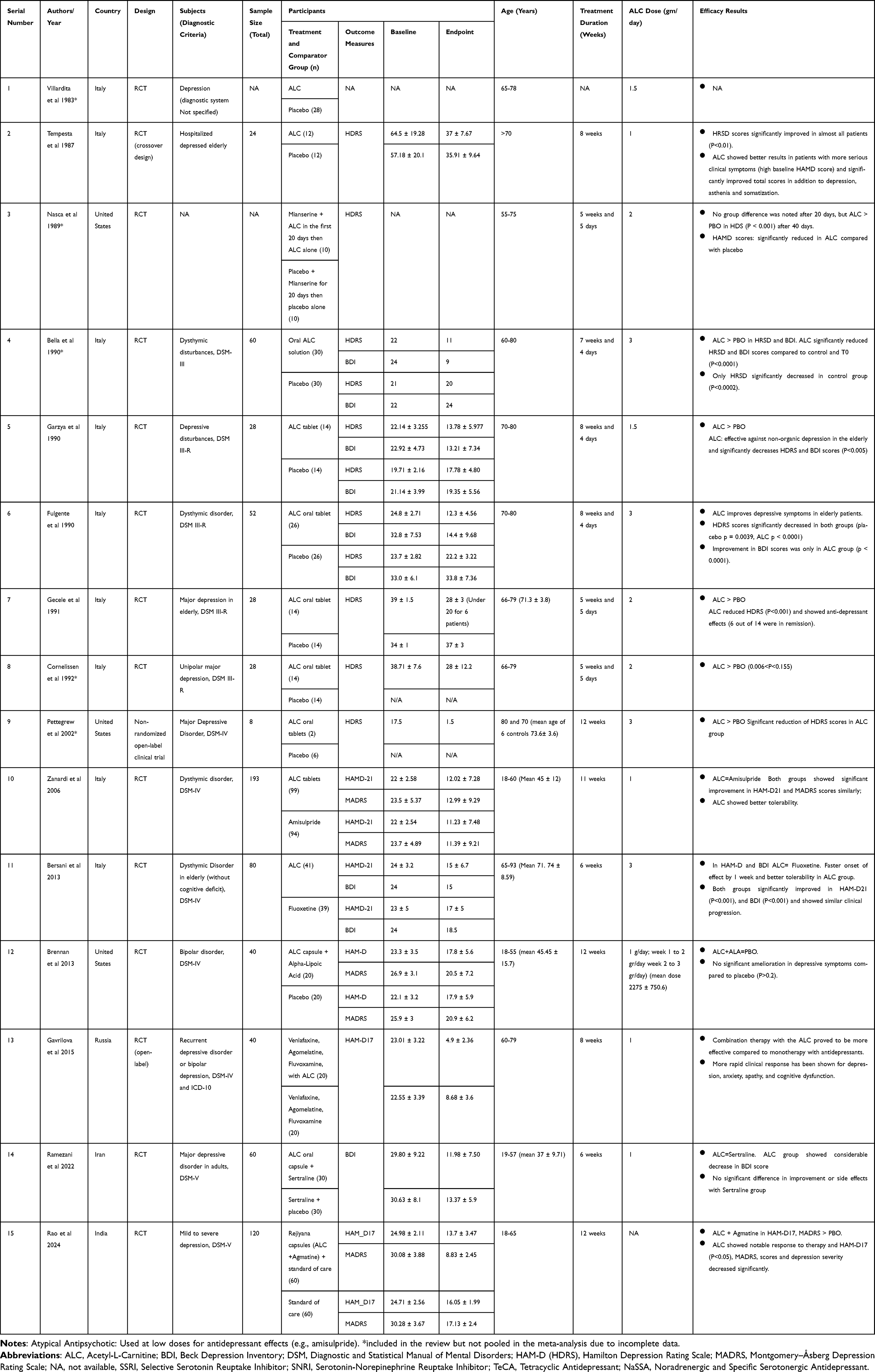 |
Table 1 Characteristics of the Included Studies and Patient Populations |
We grouped the included trials into four subgroups based on the type of comparison to provide comparator-specific synthesis and subgroup analysis. The first subgroup encompassed studies in which ALC was administered as monotherapy and evaluated against placebo (n=8).12,15–17,21,23,24,26 Of these, only four studies provided sufficient data for quantitative synthesis. The second subgroup comprised trials where ALC was given in combination with another antidepressant, compared with the same concomitant therapy, either with or without placebo (n=3).19,20,22 A third subgroup consisted of head-to-head studies that compared ALC with another active pharmacological agent (n=2).10,18 Finally, the fourth prespecified subgroup included trials in which ALC, when administered in combination with another active agent, was compared with placebo (n=2).11,25 Subsequent results are presented within these comparator groups. These comparator categories were prespecified to keep comparisons clinically meaningful and to avoid pooling different control types that could blur ALC’s added effect.
Risk of Bias Assessment
Risk of bias was assessed for all included studies. (Figure S1) Risk of bias was evaluated separately for efficacy and safety outcomes. Most randomized trials were rated as low risk or with some concerns, with very few domains rated as high risk. Among the RCTs, most domains were low risk, and concerns were mainly related to the randomization process and outcome measurement. One trial14 had a high risk of bias for efficacy outcomes due to missing outcome data. We therefore conducted a sensitivity analysis excluding this trial from the primary meta-analysis. The crossover trial by Tempesta et al21 was evaluated using the RoB 2 crossover tool, and judgments were consistent with other RCTs, showing some concerns in the randomization and measurement domains. The non-randomized trial by Pettegrew et al12 assessed with ROBINS-I, showed a critical risk of bias from confounding and serious risk from participant selection, although other domains were low risk. Overall, this study was considered at serious to critical risk of bias, consistent with its open-label design.
Synthesis of Results
The primary meta-analysis pooled all RCTs across depression rating scales using standardized mean difference (SMD) random effects (REML). Secondary analyses were conducted by instrument (HDRS, BDI, MADRS).
Primary Meta-Analysis
Across 10 RCTs (n= 366 ALC; n= 359 control), the pooled estimate favored ALC (SMD −1.20, 95% CI −2.12 to −0.29; p = 0.01; Figure 2). While heterogeneity was high (I2=96.86%), the direction of effect consistently favored ALC across robustness checks. In leave-one-out analyses, the pooled estimate remained in the same direction when omitting each study in turn (SMD range −1.36 to −0.82; all p≤0.03). Excluding the trial judged at high risk of bias for efficacy outcomes likewise did not materially change the estimate (SMD −1.32, 95% CI −2.33 to −0.31; p=0.01). Small-study effects were suggested by Egger’s (p<0.001) and Begg’s test (p=0.049); however, trim-and-fill imputed no missing studies, and the pooled estimate was unchanged (SMD −1.201, 95% CI −2.115 to −0.287). Taken together, these findings support a beneficial effect of ALC, although the magnitude of benefit likely varies across study settings and comparator types. In a sensitivity analysis restricted to placebo-controlled ALC monotherapy trials (4 studies), the pooled estimate also favored ALC (SMD −2.41, 95% CI −4.43 to −0.39; p=0.02) (Figure S3).
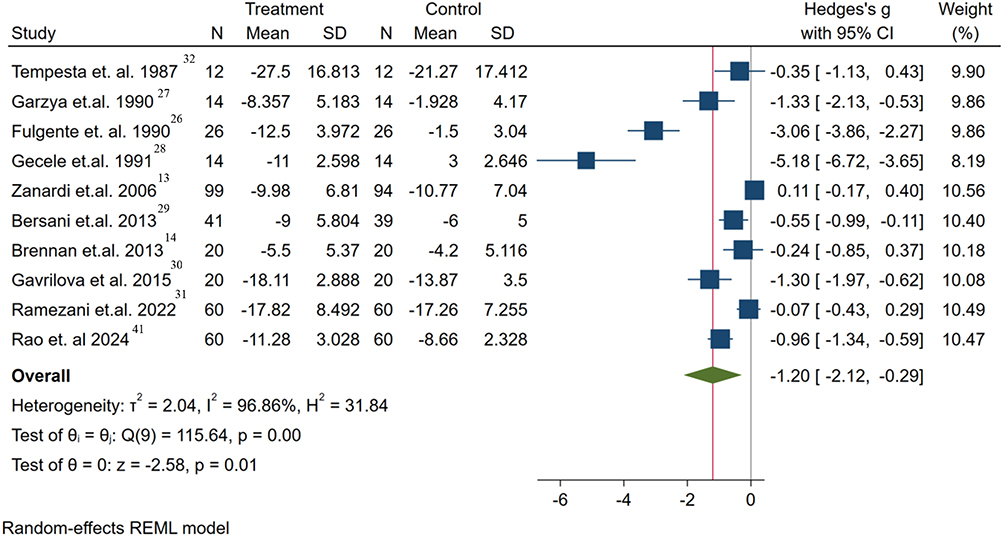 |
Figure 2 Forest plots showing the effects of acetyl-L-carnitine on depression severity scores measure. |
Subgroup Analysis
To explore potential sources of heterogeneity, we conducted prespecified subgroup analyses in the primary meta-analysis. Effects were stratified by comparator group using the four predefined categories, and by age groups: studies enrolling older samples ≥ 60 years vs primarily < 60 years. Because the number of trials within several strata was limited, these subgroup estimates and between-group comparisons should be interpreted cautiously.
In prespecified subgroup analyses of the pooled evidence, effects appeared more favorable in trials enrolling older adults (≥60 years; SMD −1.88, 95% CI −3.26 to −0.50) than in trials enrolling primarily younger adults (<60 years; SMD −0.28, 95% CI −0.77 to 0.20), with evidence of a between-group difference (p=0.03). When stratified by comparator groups, the pooled estimate was most favorable in monotherapy trials versus placebo (SMD −2.41, 95% CI −4.43 to −0.39), whereas the add-on designs versus the same background treatment (SMD −0.65, 95% CI −1.85 to 0.55), head-to-head comparisons versus another drug (SMD −0.19, 95% CI −0.84 to 0.45), and add-on designs versus placebo (SMD −0.65, 95% CI −1.35 to 0.06) showed more modest estimates and did not provide clear evidence of a between-group difference overall (p=0.21). Full estimates are demonstrated in Figure 3.
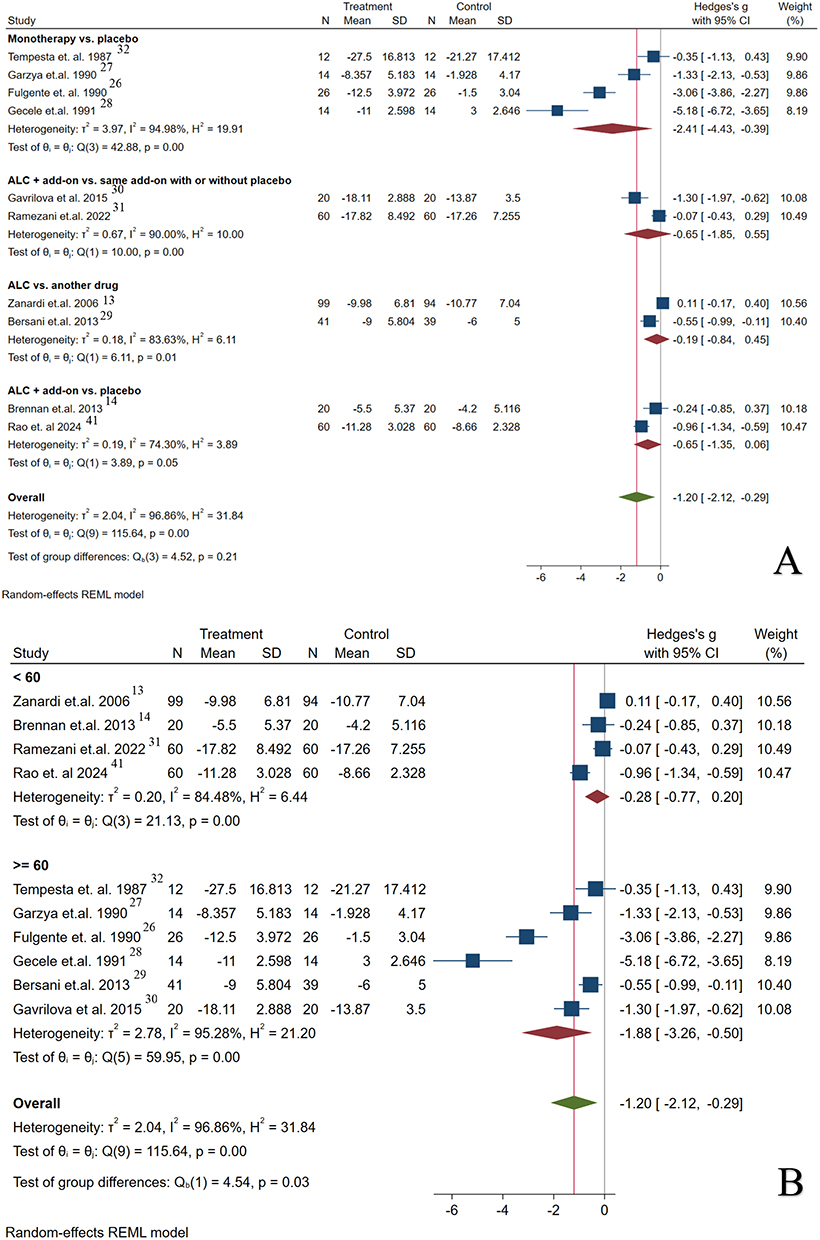 |
Figure 3 Subgroup analyses of the effects of acetyl-L-carnitine on depression severity scores, stratified by comparator type (A), and age group (B). |
Meta-Regression
In exploratory random-effects (REML) meta-regression based on the primary pooled dataset, neither treatment duration nor ALC daily dose showed a clear association with the standardized treatment effect. For ALC daily dose, the coefficient was −0.72 SMD units per 1 g/day (95% CI −2.00 to 0.55; p=0.267). For treatment duration, the coefficient was 0.23 SMD units per additional week (95% CI −0.15 to 0.61; p=0.242). Full estimates are reported in Table 2.
 |
Table 2 Meta-Regression of Standardized Effect Sizes by Treatment Duration and Daily ALC Dose (Primary Pooled Analysis) |
Secondary Meta-Analysis
As secondary analyses stratified by depression rating scale, we synthesized depressive-symptom severity separately for the most frequently reported scales. On HDRS (9 trials; n=306 ALC, n=299 control), the pooled estimate favored ALC (SMD −1.38, 95% CI −2.41 to −0.34; I2=96.9%; Figure S2A). On BDI (4 trials; n=141 ALC, n=139 control), the pooled estimate also favored ALC, though the confidence interval included the possibility of no effect (SMD −1.33, 95% CI −2.80 to 0.14; I2=96.5%; Figure S2B). On MADRS (3 trials; n=179 ALC, n=174 control), the pooled estimate was similarly in the direction favoring ALC (SMD −0.81, 95% CI −2.42 to 0.81; I2=97.5%; Figure S2C). Additional rating scale–specific diagnostics (eg., leave-one-out analyses and small-study effect assessments) are provided in the Supplement.
Five studies could not be included in the quantitative synthesis because they did not report depressive-symptom outcomes with the summary statistics needed to calculate the effect size. One trial33 studied older adults over 40 days; during the first 20 days, participants received ALC plus Mianserine versus placebo plus Mianserine, followed by ALC alone versus placebo alone for the remaining 20 days, with no between-group difference at day 20 but greater improvement by day 40, favoring ALC on the Hamilton scale (p<0.001). A placebo-controlled trial34 reported that ALC (3 g/day for 53 days) produced greater improvement than placebo on both the Hamilton scale and BDI (p<0.0001). Another placebo-controlled study35 reported clinical improvement alongside circadian biomarker assessment, noting that seven participants had more than a 10-point decrease in DSM-III-R depression score after ALC treatment. Also, a small non-randomized study15 in two older adults treated with ALC (2 g/day for 12 weeks), reported a decrease in HDRS scores from 15 to 0 and from 20 to 3 by week 12 and compared outcomes with six non-depressed controls. Finally, Villardita et al36 evaluated ALC versus placebo, but did not report depressive-symptom efficacy results in a way that could be summarized quantitatively.
Adverse Events
Of the 15 trials, four did not report adverse event (AE) data.17,19,22,26 Given incomplete and inconsistent reporting, AE findings were summarized descriptively. Where patient-level incidence was available, the proportion with ≥1 AE ranged from 0–35% in treatment arms and 10–46% in controls. In studies reporting event counts, ALC arm events were mainly categorized as gastrointestinal (GI) and central nervous system (CNS), with other systems (skin/subcutaneous, urinary, cardiovascular, endocrine/metabolic, reproductive) reported infrequently.
In the first subgroup (ALC vs placebo), three studies15,21,23 reported no AEs in either arm, and one16 found no between-group difference. Also, one study12 reported only mild AEs with ALC (dry mouth, n=1; increased perspiration, n=1). In the second subgroup (ALC add-on vs the same background drug), Gavrilova et al19 observed AEs in 35% with ALC add-on versus 45% with antidepressant alone, and Ramezani et al20 reported AEs in three patients (1 in ALC + sertraline, 2 in sertraline + placebo). Both trials mainly reported CNS events, with no serious AEs. In direct comparisons of ALC with active drugs, ALC had fewer reported AEs, mostly CNS or GI, while comparator events reflected drug-specific profiles (eg., endocrine events with amisulpride). Finally, in the fourth subgroup (ALC combination vs placebo), GI events were most frequent in both arms, followed by CNS.11,25
Across the studies that reported serious/severe AEs, serious events were rare (2 in the treatment arm and 1 in the control) and, when adjudicated, not attributed to ALC.10,11 Notably, no serious AEs occurred in add-on trial.19 Severe AEs were reported in 1 ALC recipient and 3 controls on amisulpride.10 Also, Bersani et al reported moderate-severe AEs in 3 fluoxetine-treated patients.18 Overall, ALC was generally well tolerated, with predominantly mild GI and CNS events, and no evidence of excess serious AEs compared with controls. Full per-study counts, arm-level percentages, and system distributions are provided in S1.
Discussion
To the best of our knowledge, this is a latest systematic review and meta-analysis to examine the current evidence of ALC use in mood disorders especially MDD across RCTs and non-randomized trials as well.
Our study synthesized evidence based on 15 clinical trials of ALC for depressive disorders. By incorporating more recent trials and stratifying results by rating scales, comparator groups, age, and dose, the present study provides a more granular, clinically interpretable synthesis. Across rating scales, estimates generally favored ALC, with the clearest statistically significant effect on HDRS; on BDI and MADRS, effects favored ALC but varied among studies. Largest effects were observed in monotherapy vs placebo/no treatment, while head-to-head comparisons did not demonstrate superiority of ALC over antidepressant drugs. ALC was generally well tolerated, with predominantly mild gastrointestinal or central nervous system adverse events and no excess of serious harms compared with controls. These findings align with and extend earlier reviews suggesting antidepressant potential for ALC.11
Our findings indicate that, when used as a standalone treatment, ALC significantly reduced depressive symptoms compared to placebo or no treatment. Additionally, In the limited head-to-head trials available, ALC demonstrated comparable effectiveness to commonly used antidepressants, especially, Selective Serotonin Reuptake Inhibitor (SSRI), Serotonin-Norepinephrine Reuptake Inhibitor (SNRI), Tetracyclic Antidepressant (TeCA), Noradrenergic and Specific Serotonergic Antidepressant (NaSSA), Atypical Antipsychotics like Amisulpride used at low doses for antidepressant effects in this meta-analysis. Importantly, while the incidence of adverse effects was similar between ALC and placebo/no intervention, ALC was associated with a lower incidence of adverse effects compared to antidepressant medications.
ALC may exert antidepressant effects through several mechanisms. It promotes neuroplasticity in brain regions like the hippocampus by increasing BDNF levels, glutamate release, and upregulating mGLU2 receptors, particularly in the hippocampus and prefrontal cortex.37 It may also correct metabolic imbalances, such as myo-inositol deficiency, which is linked to depression.38 Additionally, ALC modulates neurotransmitters by increasing serotonin levels and enhancing dopamine and serotonin output in meso-cortico-limbic areas, potentially protecting against stress.39 Meta-analyses also suggest ALC reduces pain—a common, often overlooked contributor to depression.40
Clinical Efficacy
Clinically, the pooled effect sizes suggest that ALC can provide meaningful benefits in reducing depressive symptoms. Stronger effects observed in older adult populations may reflect unique pathophysiological mechanisms of late-life depression, including mitochondrial dysfunction and neurodegenerative processes, which ALC could plausibly target.
Treatment effects of ALC appear context-dependent: the strongest benefit emerged in monotherapy vs placebo; effects were relatively similar in head-to-head comparisons, and small variations were noted in studies using ALC in combination and comparing it to the same drug. Larger effects in studies enrolling older samples (≥ 60 years) were observed, but the remaining between-study findings warrant prospective confirmation.
In exploratory random-effects (REML) meta-regression based on the primary pooled dataset, neither treatment duration nor ALC daily dose showed a clear association with the standardized treatment effect. Therefore, the available data do not allow firm conclusions about dose-response or duration-response relationships. Given the number of trials, we want to highlight that this meta-regression had limited power; therefore, these findings should not infer the absence of a dose–response or duration effect.
These findings suggest potential clinical roles for ALC in patient groups underserved by current antidepressant options, including those with poor tolerability to standard antidepressants or with late-onset depressive syndromes. Prior meta-analyses were limited by smaller evidence bases and less granular analyses of outcome measures. Unlike a prior meta-analysis,11 we modeled with HDRS, BDI, and MADRS separately rather than prioritizing a single scale. While the later emphasized a dose-response effect and found no role for follow-up, however, we observed no consistent dose gradient but did find that longer follow-up linked to greater improvement on self-reported symptoms (BDI only). Despite methodological differences, both reviews found ALC associated with greater improvement in depressive symptoms versus control.
Safety & Tolerability of ALC
Beyond efficacy, safety is a major consideration in the management of depression, particularly among older adults and those with comorbid conditions. Across included trials, ALC was well tolerated, with adverse events primarily mild and limited to gastrointestinal or central nervous system complaints. Serious adverse events were rare, and when occurred, they were not attributed to ALC. Compared with active comparators, ALC was associated with a more favorable adverse event profile, further supporting its potential role as a safer therapeutic option, especially for vulnerable populations.41
Our review has several methodological strengths. It represents the most comprehensive synthesis of randomized and controlled evidence for ALC to date, covering more than four decades of research. By analyzing results separately by rating scale, conducting prespecified subgroup and meta-regression analyses, and assessing robustness through sensitivity tests, this study provides a comprehensive evaluation of the evidence. Risk of bias was also systematically assessed using standard tools, adding further transparency to the interpretation of findings.
Nevertheless, the underlying evidence base has important limitations. In the current review, five eligible studies were excluded from quantitative synthesis due to incomplete/non-extractable data. Also, the previous literature dominated by older trials from specific regions (mostly Europe), which may limit generalizability to other settings. Additionally, high heterogeneity among studies was observed, reflecting the variability in study designs, populations, and assessment tools. Funnel plot asymmetry and Egger’s tests suggested potential small-study effects in some datasets (HDRS, BDI), raising concerns about publication bias. Many studies had small sample sizes, and trial quality varied. Additional limitations were minimal BD data. Older literature with high risk of bias. Overall GRADE would probably be low with high risk of publication bias. Some studies have missing MDD diagnostic criteria. To enhance interpretability despite this variability, we pooled outcomes within instruments (HDRS, BDI, MADRS), conducted prespecified subgroup analyses by comparator group and age, used random-effects models, performed leave-one-out sensitivity analyses and publication-bias diagnostics, and applied meta-regression to examine treatment duration and daily dose.
Proposed Mechanistic Model of ALC in Depression and Stress-Related Modulation
ALC may exert antidepressant effects through converging mechanisms including mitochondrial bioenergetic enhancement, epigenetic upregulation of mGlu2 expression, and reduction of neuroinflammation. These processes enhance synaptic plasticity within corticolimbic circuits (hippocampus, medial amygdala, prefrontal cortex). Stress exposure, particularly early-life adversity, may dysregulate endogenous ALC signaling and moderate treatment response (Figure 4).
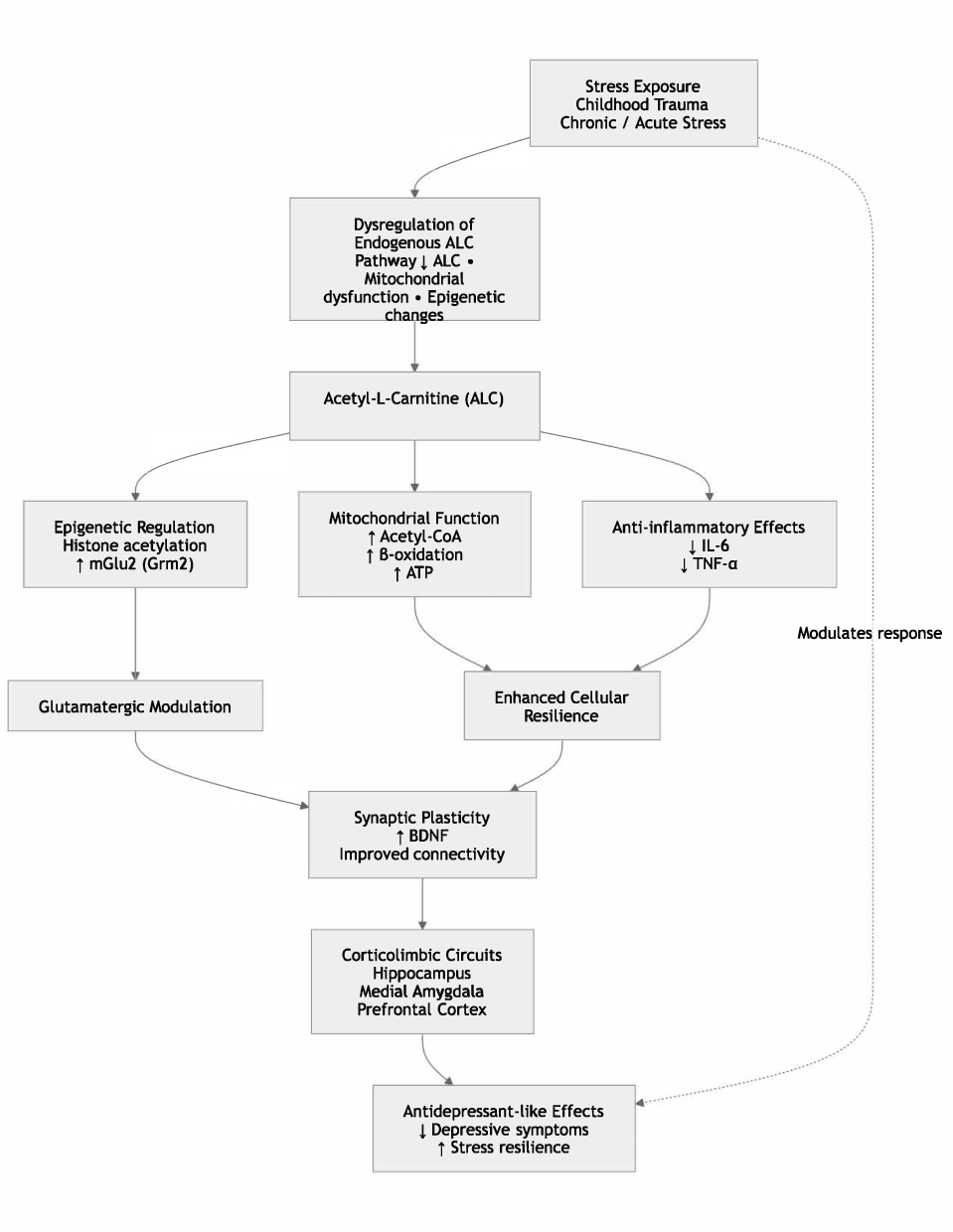 |
Figure 4 Proposed mechanistic model of acetyl-L-carnitine (ALC) in depression and stress-related modulation. |
Conclusions
ALC shows promise as a novel treatment avenue for mood disorders, especially for depression in older adults, and for individuals with treatment resistance depression. Its diverse actions on neuroplasticity, neurotransmission, and mitochondrial function reinforce its therapeutic potential. Future research studies should prioritize large multicenter RCTs that apply standardized diagnostic criteria and validated depression rating scales. Further investigation of dose–response effects and long-term outcomes is needed to clarify the durability and clinical significance of ALC’s benefits.
Author Contributions
Study concept and design: Kumar, Pagali, Singh. Acquisition, analysis, or interpretation of data: All authors. Drafting of the manuscript: Kumar and All authors. Statistical analysis: Pagali and Hasset. Obtained funding: NA.Critical revision of the manuscript for important intellectual content: All authors. Administrative, technical, or material support: Kumar. Study supervision: Pagali. All authors made a significant contribution to the work reported, whether that is in the conception, study design, execution, acquisition of data, analysis and interpretation, or in all these areas; took part in drafting, revising or critically reviewing the article; gave final approval of the version to be published; have agreed on the journal to which the article has been submitted; and agree to be accountable for all aspects of the work.
Disclosure
Dr. Pagali has received the Mayo Clinic CTSA (Mayo Clinic Small grants) through grant number UL1TR002377 from the National Center for Advancing Translational Sciences (NCATS), a component of the National Institutes of Health (NIH). Dr. Croarkin reported serving on the advisory board for MindMed; receiving equipment support grant in kind for federally funded study from MagVenture Inc and Neuronetics Inc; receiving grants from Innosphere Inc; and receiving payment for editorial work from Journal of Child and Adolescent Psychopharmacology outside the submitted work. Dr. Singh has received research grant support from Mayo Clinic, the National Network of Depression Centers (NNDC), and Breakthrough Discoveries for Thriving with Bipolar Disorder (BD2). He is a KL2 Mentored Career Development Program scholar, supported by CTSA Grant Number KL2TR002379 from the National Center for Advancing Translational Science (NCATS). Dr. Singh has received honoraria (to Mayo Clinic) from Elsevier for editing a Clinical Overview on Treatment-Resistant Depression. Dr. Frye received grant support from Assurex Health, Baszucki Group, Myriad, Mayo Foundation and BD2, received CME travel and honoraria from Carnot Laboratories and American Physician Institute and has Financial Interest/Stock ownership/Royalties from Chymia LLC. The funding sources had no influence on the study results, data interpretation, or decision to submit for publication. The remaining authors report no potential competing interests in this work.
References
1. Wu Y, Ning P, Rao Z, et al. Burden of disease in the belt and road countries from 1990 to 2021: analysis of estimates from the global burden of disease 2021. Global Health Res Policy. 2025;10(1):20. doi:10.1186/s41256-025-00403-3
2. Rush AJ, Trivedi MH, Wisniewski SR, et al. Acute and longer-term outcomes in depressed outpatients requiring one or several treatment steps: a STAR*D report. Am J Psychiatry. 2006;163(11):1905–16. doi:10.1176/ajp.2006.163.11.1905
3. Massart R, Mongeau R, Lanfumey L. Beyond the monoaminergic hypothesis: neuroplasticity and epigenetic changes in a transgenic mouse model of depression. Philos Trans R Soc B. 2012;367(1601):2485–2494. doi:10.1098/rstb.2012.0212
4. Machado-Vieira R, Salvadore G, Luckenbaugh DA, Manji HK, Zarate JCA. Rapid onset of antidepressant action: a new paradigm in the research and treatment of major depressive disorder. J Clin Psychiatry. 2008;69(6):946–958. doi:10.4088/JCP.v69n0610
5. Nunez NA, Joseph B, Pahwa M, et al. Augmentation strategies for treatment resistant major depression: a systematic review and network meta-analysis. J Affective Disord. 2022;302:385–400. doi:10.1016/j.jad.2021.12.134
6. Nasca C, Bigio B, Lee FS, et al. Acetyl- l -carnitine deficiency in patients with major depressive disorder. Proc Natl Acad Sci. 2018;115(34):8627–8632. doi:10.1073/pnas.1801609115
7. Giménez-Palomo A, Dodd S, Anmella G, et al. The role of mitochondria in mood disorders: from physiology to pathophysiology and to treatment. Front Psychiatry. 2021;12:546801. doi:10.3389/fpsyt.2021.546801
8. Chiechio S, Canonico PL, Grilli M. l-Acetylcarnitine: a mechanistically distinctive and potentially rapid-acting antidepressant drug. Int J Mol Sci. 2017;19(1):11. doi:10.3390/ijms19010011
9. Nasca C, Xenos D, Barone Y, et al. L -acetylcarnitine causes rapid antidepressant effects through the epigenetic induction of mGlu2 receptors. Proc Natl Acad Sci. 2013;110(12):4804–4809. doi:10.1073/pnas.1216100110
10. Pettegrew J, Levine J, McClure R. Acetyl-L-carnitine physical-chemical, metabolic, and therapeutic properties: relevance for its mode of action in Alzheimer’s disease and geriatric depression. Mol Psychiatry. 2000;5(6):616–632. doi:10.1038/sj.mp.4000805
11. Veronese NStubbs B, Solmi M, Ajnakina O, Carvalho AF, Maggi S. Acetyl-L-carnitine supplementation and the treatment of depressive symptoms: a systematic review and meta-analysis. Psychosom Med. 2018;80(2):154–159.
12. Nie L-J, Liang J, Shan F, et al. L-carnitine and acetyl-L-carnitine: potential novel biomarkers for major depressive disorder. Front Psychiatry. 2021;12:671151. doi:10.3389/fpsyt.2021.671151
13. Zanardi R, Smeraldi E. A double-blind, randomised, controlled clinical trial of acetyl-L-carnitine vs. amisulpride in the treatment of dysthymia. Eur Neuropsychopharmacol. 2006;16(4):281–287. doi:10.1016/j.euroneuro.2005.10.005
14. Brennan BP, Jensen JE, Hudson JI, et al. A placebo-controlled trial of acetyl-L-carnitine and α-lipoic acid in the treatment of bipolar depression. J Clin Psychopharmacol. 2013;33(5):627–635. doi:10.1097/JCP.0b013e31829a83f5
15. Pettegrew JW, Levine J, Gershon S, et al. 31 P-MRS study of acetyl- L -carnitine treatment in geriatric depression: preliminary results. Bipolar Disord. 2002;4(1):61–66. doi:10.1034/j.1399-5618.2002.01180.x
16. Moher D, Liberati A, Tetzlaff J, Altman DG. Preferred reporting items for systematic reviews and meta-analyses: the PRISMA statement. BMJ. 2009;339.
17. Schiavo JH. PROSPERO: an international register of systematic review protocols. Med Reference Services Quarterly. 2019;38(2):171–180. doi:10.1080/02763869.2019.1588072
18. Page MJ, McKenzie JE, Bossuyt PM, et al. The PRISMA 2020 statement: an updated guideline for reporting systematic reviews. BMJ. 2021;372.
19. Babineau J. Product review: covidence (systematic review software). J Canadian Health Libraries Assoc. 2014;35(2):68–71. doi: 10.5596/c14-016
20. Jørgensen L, Paludan-Müller AS, Laursen DRT, et al. Evaluation of the Cochrane tool for assessing risk of bias in randomized clinical trials: overview of published comments and analysis of user practice in Cochrane and non-Cochrane reviews. Syst Rev. 2016;5(1):80. doi:10.1186/s13643-016-0259-8
21. Chipponi J. Sterne JA, Hernán MA, Reeves BC, Savović J, Berkman ND, Viswanathan M, Henry D, Altman DG, Ansari MT, Boutron I, Carpenter JR. ROBINS-I: a tool for assessing risk of bias in non-randomised studies of interventions. bmj. 2016 Oct 12;355. bmj355(2016). 2016;355():. doi: 10.1136/bmj.i4919
22. Guyatt GH, Oxman AD, Vist G, et al. GRADE guidelines: 4. Rating the quality of evidence—study limitations (risk of bias). J Clin Epidemiol. 2011;64(4):407–415. doi:10.1016/j.jclinepi.2010.07.017
23. Williams JBW. A structured interview guide for the Hamilton depression rating scale. Arch Gen Psychiatry. 1988;45(8):742–747. doi:10.1001/archpsyc.1988.01800320058007
24. Kung S, Alarcon RD, Williams MD, Poppe KA, Jo Moore M, Frye MA. Comparing the beck depression inventory-II (BDI-II) and patient health questionnaire (PHQ-9) depression measures in an integrated mood disorders practice. J Affect Disord. 2013;145(3):341–343. doi:10.1016/j.jad.2012.08.017
25. Gonzalez JM, Bowden CL, Katz MM, et al. Development of the Bipolar inventory of symptoms scale: concurrent validity, discriminant validity and retest reliability. Int J Methods Psychiatr Res. 2008;17(4):198–209. doi:10.1002/mpr.262
26. Fulgente T, Onofrj M, Delre M, et al. Levoacetylcarnitine (nicetile) treatment of senile depression. Clin Trials J. 1990;27(3):155–163.
27. Garzya G, Corallo D, Fiore A, Lecciso G, Petrelli G, Zotti C. Evaluation of the effects of L-acetylcarnitine on senile patients suffering from depression. Drugs Under Experim Clin Res. 1990;16(2):101–106.
28. Gecele M, Francesetti G, Meluzzi A. Acetyl-L-carnitine in aged subjects with major depression: clinical efficacy and effects on the circadian rhythm of cortisol. Dementia Geriatric Cognit Disord. 1991;2(6):333–337. doi:10.1159/000107224
29. Bersani G, Meco G, Denaro A, et al. L-acetylcarnitine in dysthymic disorder in elderly patients: a double-blind, multicenter, controlled randomized study vs. fluoxetine. Eur Neuropsychopharmacol. 2013;23(10):1219–1225. doi:10.1016/j.euroneuro.2012.11.013
30. Gavrilova S, Kalyn YB, Safarova T, et al. Optimization of antidepressant therapy in conditions of the gerontology psychiatric out-patient clinic. Neurosci Behav Physiol. 2017;47(2):138–147. doi:10.1007/s11055-016-0377-8
31. Ramezani A, Kheirkhah F, Zabihi E, Shirafkan H, Moudi S. Effectiveness of L-carnitine supplementation to sertraline for treatment of major depressive disorder: a double-blind randomized placebo-controlled trial. Global J Med Pharmaceu Biomed Update. 2022;17:10. doi:10.25259/GJMPBU_16_2022
32. Tempesta E, Casella L, Pirrongelli C, Janiri L, Calvani M, Ancona L. L-acetylcarnitine in depressed elderly subjects. A cross-over study vs placebo. Drugs Under Experim Clin Res. 1987;13(7):417–423.
33. Nasca D, Zurria G, Aguglia E. Action of acetyl-L-carnitine in association with mianserine on depressed old people. New Trends Clin Neuropharmacol. 1989;3(4):225–230.
34. Bella R, Biondi R, Raffaele R, Pennisi G. Effect of acetyl-L-carnitine on geriatric patients suffering from dysthymic disorders. Int J Clin Pharmacol Res. 1990;10(6):355–360.
35. Cornélissen G, Francesetti G, Gecele M, Meluzzi A. Metachronanalysis: acetyl-L-carnitine advances circadian aspect of circulating cortisol chronome of elderly depressed patients. New Trends Experim Clin Psychiatry. 1992.
36. Villardita C, Smirni P, Vecchio I. Acetyl-L-carnitine in depressed geriatric patients. Eur Rev Med Pharmacol Sci. 1983;6:1–12.
37. Wang S-M, Han C, Lee S-J, Patkar AA, Masand PS, Pae C-U. A review of current evidence for acetyl-l-carnitine in the treatment of depression. J Psychiatr Res. 2014;53:30–37. doi:10.1016/j.jpsychires.2014.02.005
38. Zanelli SA, Solenski NJ, Rosenthal RE, Fiskum G. Mechanisms of ischemic neuroprotection by acetyl-L-carnitine. Ann NY Acad Sci. 2005;1053(1):153–161. doi:10.1196/annals.1344.013
39. Tolu P, Masi F, Leggio B, et al. Effects of long-term acetyl-L-carnitine administration in rats i. increased dopamine output in mesocorticolimbic areas and protection toward acute stress exposure. Neuropsychopharmacology. 2002;27(3):410–420. doi:10.1016/S0893-133X(02)00306-8
40. Li S, Li Q, Li Y, Li L, Tian H, Sun X. Acetyl-L-carnitine in the treatment of peripheral neuropathic pain: a systematic review and meta-analysis of randomized controlled trials. PLoS One. 2015;10(3):e0119479. doi:10.1371/journal.pone.0119479
41. Rao GP, Kariya S, Chaudhari P, Bhondave M. A study to assess efficacy and safety of add-on acetyl-l-carnitine and agmatine (rejiyana) with standard of care (soc) to validate visible changes in major depressive disorder a randomized controlled trial: revive trial. Int J Med Public Health. 2024;14(2):597–604. doi:10.5530/ijmedph.2024.2.115
 © 2026 The Author(s). This work is published and licensed by Dove Medical Press Limited. The
full terms of this license are available at https://www.dovepress.com/terms
and incorporate the Creative Commons Attribution
- Non Commercial (unported, 4.0) License.
By accessing the work you hereby accept the Terms. Non-commercial uses of the work are permitted
without any further permission from Dove Medical Press Limited, provided the work is properly
attributed. For permission for commercial use of this work, please see paragraphs 4.2 and 5 of our Terms.
© 2026 The Author(s). This work is published and licensed by Dove Medical Press Limited. The
full terms of this license are available at https://www.dovepress.com/terms
and incorporate the Creative Commons Attribution
- Non Commercial (unported, 4.0) License.
By accessing the work you hereby accept the Terms. Non-commercial uses of the work are permitted
without any further permission from Dove Medical Press Limited, provided the work is properly
attributed. For permission for commercial use of this work, please see paragraphs 4.2 and 5 of our Terms.