
Back to Journals » Patient Preference and Adherence » Volume 19
Cross-Cultural Adaptation and Validation of the Pediatric Eye Questionnaire in Chinese Children with Uveitis: A Rasch Analysis
Authors Linghu W, Sun X, Zhang M, Zhang H, Yu X, Zhang X 
Received 26 July 2025
Accepted for publication 5 December 2025
Published 18 December 2025 Volume 2025:19 Pages 4167—4177
DOI https://doi.org/10.2147/PPA.S556321
Checked for plagiarism Yes
Review by Single anonymous peer review
Peer reviewer comments 3
Editor who approved publication: Dr Ramón Morillo-Verdugo
Wenrui Linghu,1,2,* Xiaona Sun,1,* Mi Zhang,1,2 Hui Zhang,1 Xinyue Yu,1 Xiaomin Zhang1,2
1Tianjin Key Laboratory of Retinal Functions and Diseases, Tianjin Branch of National Clinical Research Center for Ocular Disease, Eye Institute and School of Optometry, Tianjin Medical University Eye Hospital, Tianjin, People’s Republic of China; 2Tianjin Eye Hospital, Tianjin Key Laboratory of Ophthalmology and Visual Science, Tianjin Eye Institute, Nankai University Affiliated Eye Hospital; Clinical College of Ophthalmology, Tianjin Medical University, Tianjin, People’s Republic of China
*These authors contributed equally to this work
Correspondence: Xiaomin Zhang, Tianjin Eye Hospital, Tianjin Key Laboratory of Ophthalmology and Visual Science, Tianjin Eye Institute, Nankai University Affiliated Eye Hospital; Clinical College of Ophthalmology, Tianjin Medical University, Tianjin, People’s Republic of China, Email [email protected]
Background: Pediatric uveitis often results in severe visual impairment, significantly impairing the quality of life for affected children and their families. The Pediatric Eye Questionnaire (PedEyeQ) was originally developed and validated in English to assess vision-related quality of life (VR-QOL) in children. However, the psychometric properties of its Chinese adaptation (PedEyeQ-CN) remain unexplored in pediatric uveitis patients. To fill this gap, we conducted the first study to translate the PedEyeQ into Chinese and evaluate its psychometric properties using Rasch analysis in children with uveitis.
Methods: The PedEyeQ (12– 17 years) was translated from English into Chinese, building upon the previously adapted PedEyeQ-CN (5– 11 years). Patients with pediatric uveitis were recruited to complete the Child section, while their parents completed the Proxy and Parent sections. Rasch analysis was conducted to assess the psychometric properties of both age-specific versions (5– 11 and 12– 17 years), including unidimensionality, measurement precision, fit statistics, differential item functioning (DIF), category threshold ordering, and targeting.
Results: The study included 154 children aged 5– 11 years and 193 children aged 12– 17 years, each accompanied by a parent. Unidimensionality was confirmed for every domain in both age-specific versions of the PedEyeQ-CN. Additionally, Rasch analysis showed evidence of ordered category thresholds, adequate measurement precision, and satisfactory person-item targeting for all questionnaires. Both the Child and Proxy PedEyeQ-CN (12– 17 years) each had one item with an outfit value greater than 1.5. A few items displayed minimal differential item functioning (DIF) by gender in each section of the PedEyeQ-CN.
Conclusion: The PedEyeQ-CN demonstrates acceptable psychometric properties and is a valid tool for assessing VR-QOL in Chinese pediatric patients with uveitis and their families. This instrument is available for use in clinical and research settings, providing a standardized method to quantify the impact of uveitis and its treatments on daily life, and facilitating patient-centered care and outcome evaluation.
Keywords: pediatric uveitis, Eye-Related Quality of life, pediatric eye questionnaire, Rasch analysis
Introduction
Pediatric uveitis is a vision-threatening ocular disease that can lead to various complications, including band keratopathy, synechiae, cataracts, secondary glaucoma, and macular edema.1,2 Long-term treatment for uveitis in children could lead to side effects such as growth retardation, hepatic and renal damage, and an increased infection risk induced by systemic corticosteroids, immunosuppressants, and biologics. Disease management often has a substantial impact on the quality of life of patients and their families, who must face the emotional sequelae of living with a burdensome disease. Ophthalmologists should focus not only on treating disease but also on the quality of life. Thus, a child- and parent-reported questionnaire is needed to understand how pediatric uveitis affects the vision-related quality of life (VR-QOL) of children and their parents.
At present, while several studies have investigated quality of life in pediatric uveitis patients, most used generic or limited vision-specific instruments.3–8 For instance, generic tools such as the Pediatric Quality of Life Inventory (PedsQL) assess overall health-related quality of life but lack vision-specific domains. Meanwhile, vision-specific questionnaires also exhibit limitations: the Cardiff Visual Ability Questionnaire for Children (CVAQC) focuses exclusively on visual ability and functional vision, and the Effects of Youngsters’ Eyesight on Quality of Life (EYE-Q) questionnaire is designed only for adolescents aged 8–18 years. Moreover, none of these instruments provide differentiated question sets tailored to distinct developmental stages, potentially limiting their sensitivity in capturing the evolving challenges faced by children as they grow.
The Pediatric Eye Questionnaire (PedEyeQ) was developed to assess the impact of children’s eye conditions on functional vision and VR-QOL from both child and parent perspectives across different age groups (0–4, 5–11, and 12–17 years).9 This makes it particularly suitable for capturing the comprehensive impact of uveitis and its treatment on daily life. The PedEyeQ questionnaire was originally developed and validated in English. At present, a single study has translated and validated the Chinese version (PedEyeQ-CN) for children aged 5–11 years with refractive errors or strabismus/amblyopia.10 Notably, the psychometric properties of PedEyeQ-CN have not yet been examined in Chinese pediatric uveitis populations. Therefore, in the current study, we translated the PedEyeQ for children aged 12–17 years and used Rasch analysis to evaluate whether the PedEyeQ-CN for both age groups (5–11 and 12–17 years) demonstrates appropriate psychometric properties for assessing VR-QOL in Chinese pediatric uveitis patients.
Methods
This translation and validation study was approved by the Institutional Review Board of Tianjin Medical University Eye Hospital (Ethics ID: 2024KY-63). All research procedures adhered to the tenets of the Declaration of Helsinki. Consent was obtained from the parent or legal guardian, and assent was obtained from participating children.
Subjects
Participants were recruited from a tertiary uveitis clinic at Tianjin Medical University Eye Hospital, Tianjin, China, between October 2024 and May 2025. Inclusion criteria were: (1) age 5–18 years; (2) a clinical diagnosis of uveitis according to the International Uveitis Study Group criteria;11 (3) presence or absence of uveitis-related ocular complications such as band-shaped keratopathy, complicated cataract, or secondary glaucoma; and (4) normal cognitive ability, as determined by a senior pediatric ophthalmologist through a brief introductory interaction to confirm the child’s ability to understand and respond the questionnaire items. Patients with other ocular disorders that could affect their quality of life (eg, strabismus, amblyopia, or various congenital diseases), as well as those with other major physical, neurological, or psychiatric illnesses, were excluded. Following the recommendations of Linacre (1994) and other methodological guidelines for Rasch analysis, a sample size of over 100 participants is generally considered stable for precise parameter estimation.12 Our target enrollment aligns with this recommendation and is consistent with sample sizes employed in similar questionnaire validation studies.
This clinic serves as a major referral center, thus providing access to a diverse and clinically complex patient population. While this recruitment strategy enhances the clinical relevance of our sample for the target condition, it is acknowledged that it may limit the generalizability of the results to community-based settings. Furthermore, to minimize selection bias within this setting, all eligible patients attending the clinic during the recruitment period were invited to participate consecutively.
Translation and Cultural Adaptation of the PedEyeQ
The Pediatric Eye Questionnaire (PedEyeQ) is designed to evaluate vision-related quality of life (VR-QOL) in children.9 It comprises child, proxy, and parent sections. The child PedEyeQ is available in two age-specific modules (5–11 and 12–17 years), each comprising four independently scored domains: functional vision, discomfort with eyes/vision, social aspects, and frustration/worry, with minor item variations across age groups. The proxy PedEyeQ contains three age-specific modules: 0–4 years (covering functional vision, bothered by eyes/ vision, and social domains), 5–11 years and 12–17 years (each adding frustration/worry and eye care domains), with minor age-related item differences. The parent PedEyeQ evaluates the impact of a child’s eye condition on the parent across four domains: impact on parent and family, worry about child’s eye condition, worry about child’s self-perception and interactions, and worry about child’s functional vision. Earlier research has translated and validated the PedEyeQ-CN for Chinese children aged 5–11 years.10 Building on this work, we translated the PedEyeQ for children aged 12–17 years.
In this study, the 12–17- year PedEyeQ modules were translated from English into Chinese by two bilingual medical doctors working independently. An expert panel reconciled the two forward translations to produce a second draft, which was then back-translated into English and compared with the original to identify and resolve discrepancies. A comprehension test was administered to ten participants utilizing the PedEyeQ-CN to identify potentially ambiguous items. Based on their feedback, further adjustments were made to enhance item comprehensibility.
Rasch Analysis
We conducted Rasch analysis using the Andrich rating scale model with Winsteps software (version 3.72.3). Rasch analysis is a probabilistic mathematical model that estimates item difficulty, person ability, and thresholds for each response category on a single continuum logit scale (log-odds units).13 Rasch analysis was used to evaluate psychometric parameters of the PedEyeQ-CN, including:
(1) Unidimensionality of a (sub)scale indicates that all the items measure the same aspect.14 In the principal component analysis, a level of 40% of the variance explained by the raw data is considered an indication of unidimensionality.15 Similarly, an eigenvalue > 2.0 as evidence of a second construct being measured by the instrument, indicating a multidimensional instrument.16
(2) Measurement precision is a critical parameter for an instrument, indicative of its ability to function as an independent measuring scale. Measurement precision could be estimated by person separation index (PSI), item separation index (ISI), person reliability index (PRI), and item reliability index (IRI). A PSI and ISI of at least 2.0, and a PRI and IRI of at least 0.8, indicate that the instrument can distinguish different levels of person ability.17
(3) The fit statistics, infit and outfit, are used to measure item fit to the construct and are calculated as the mean square of standardized residuals (MnSq). Both infit and outfit MnSq have an expected value of 1, with an acceptable fit criterion of 0.7 to 1.3.18 Infit and Outfit MnSq values less than 0.7 indicate an overfit item, while values greater than 1.3 indicate an underfit item.
(4) The response category was assessed by observing whether the probability curves showed an orderly increase in category calibration.19 The category threshold is the crossover point between two response categories where either response is equally probable. Threshold disordering may occur when there are an excessive number of categories or when the category labels are unclear.
(5) Differential item functioning (DIF) evaluates whether there are significant differences in how demographic subgroups within a population respond to items. For this study, we assessed DIF of each item by gender. DIF was considered small or absent if the item measure difference was below 0.50 logits, minimal if it was between 0.50 and 1.0 logits, and notable if it exceeded 1.0 logits.20
(6) The targeting of scale items is evaluated using a person-item map, which displays both person and item measures on the same calibration scale. An accurately targeted instrument has evenly spaced, well-fitting items, with persons positioned at the same level in the person-item map.21
Results
Study Participants
A total of 370 Chinese-speaking children with pediatric uveitis were administered the PedEyeQ-CN at a clinic visit. Of these, 21 participants were excluded due to incomplete data or unreliable responses, resulting in 347 eligible for analysis (Figure S1). The final sample included 154 children (5–11 years, median 9 years) and 193 adolescents (12–17 years, median 14 years). The demographic and clinical characteristics of the patients, categorized by age group, are presented in Table 1.
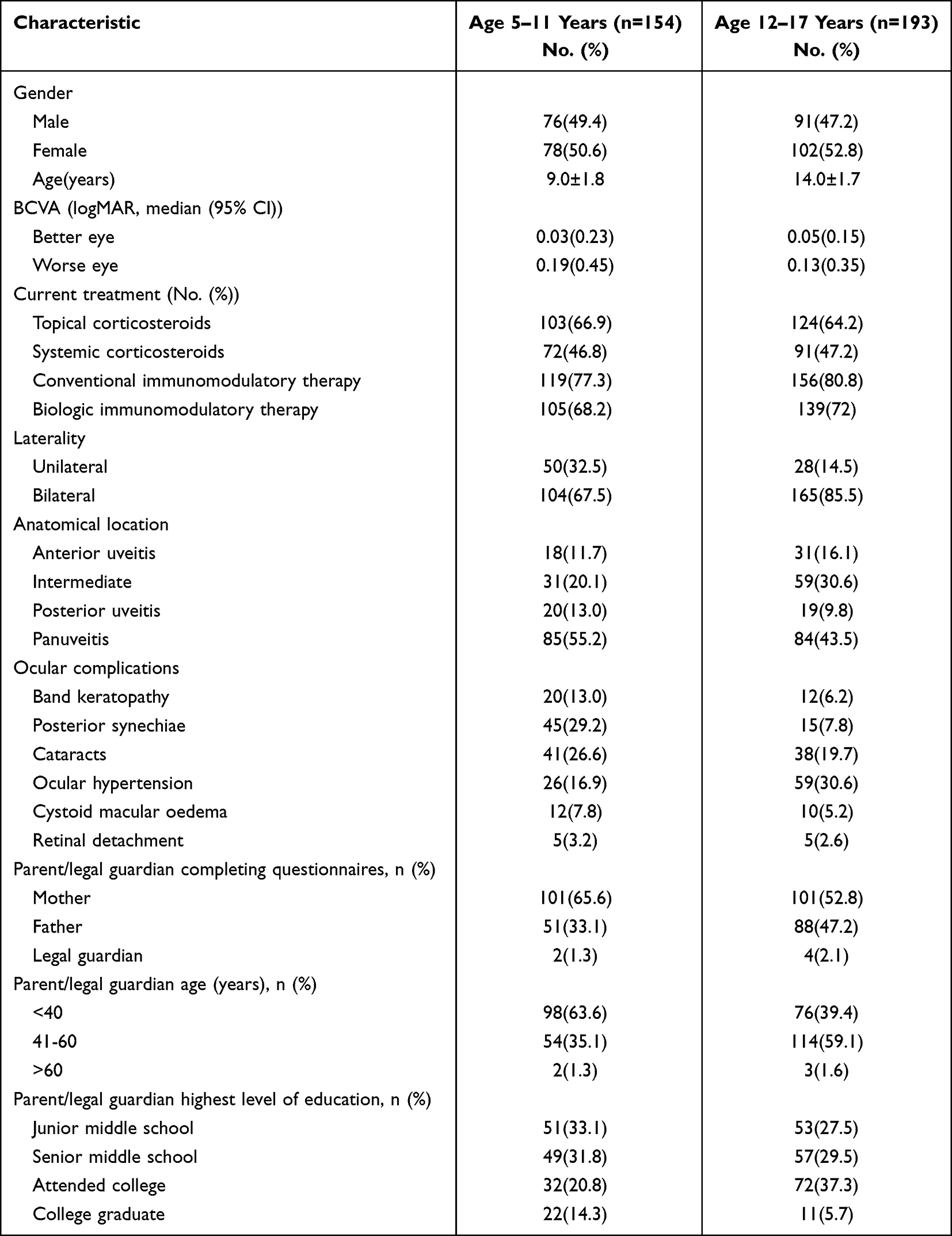 |
Table 1 Demographic Characteristics |
Validating the PedEyeQ-CN in Pediatric Uveitis Patients Unidimensionality
Unidimensionality by PCA of the residuals for the Child, Proxy, and Parent PedEyeQ-CN showed that the raw variance explained for the first contrast exceeded 40% for all subscales, except for the Frustration/worry subscale of the Child PedEyeQ-CN (5–11 years). Meanwhile, the unexplained variance in the first contrast was less than 2.0 eigenvalue units across all subscales of the PedEyeQ - CN, satisfying the assumption of the Rasch model (Table 2).
 |
Table 2 Rasch Indices for Each Unidimensional Domain Within Each Questionnaire, By Age Group |
Measurement Precision
For the Chinese-translated questionnaires, the Child PedEyeQ-CN had PSI of 2.01–2.88 (PRI 0.80–0.89) and ISI of 2.07–5.96 (IRI 0.81–0.97). The Proxy PedEyeQ-CN had PSI of 2.01–2.90 (PRI 0.80–0.89) and ISI of 2.04–5.14 (IRI 0.81–0.96). The Parent questionnaires showed PSI of 2.18–3.37 (PRI 0.83–0.92) and ISI of 2.86–5.55 (IRI 0.89–0.97). All these questionnaires demonstrated acceptable ISI and PSI with high reliability (Table 2).
Fit Statistics
For the Child PedEyeQ-CN, infit MnSq values ranged from 0.72 to 1.27 and outfit MnSq values ranged from 0.58 to 1.54. For the Proxy PedEyeQ-CN, infit MnSq values ranged from 0.67 to 1.39 and outfit MnSq values ranged from 0.53 to 1.59. For the Parent PedEyeQ-CN, infit MnSq values ranged from 0.56 to 1.16 and outfit MnSq values ranged from 0.63 to 1.24. Both the Child and Proxy PedEyeQ-CN (12–17 years) each had one item with an outfit MnSq value greater than 1.5, indicating excessive variance in the observed responses to the item (Tables 3–5).
 |
Table 3 Rasch Analysis of the Chinese Version of Child Pediatric Eye Questionnaires (PedEyeQ) |
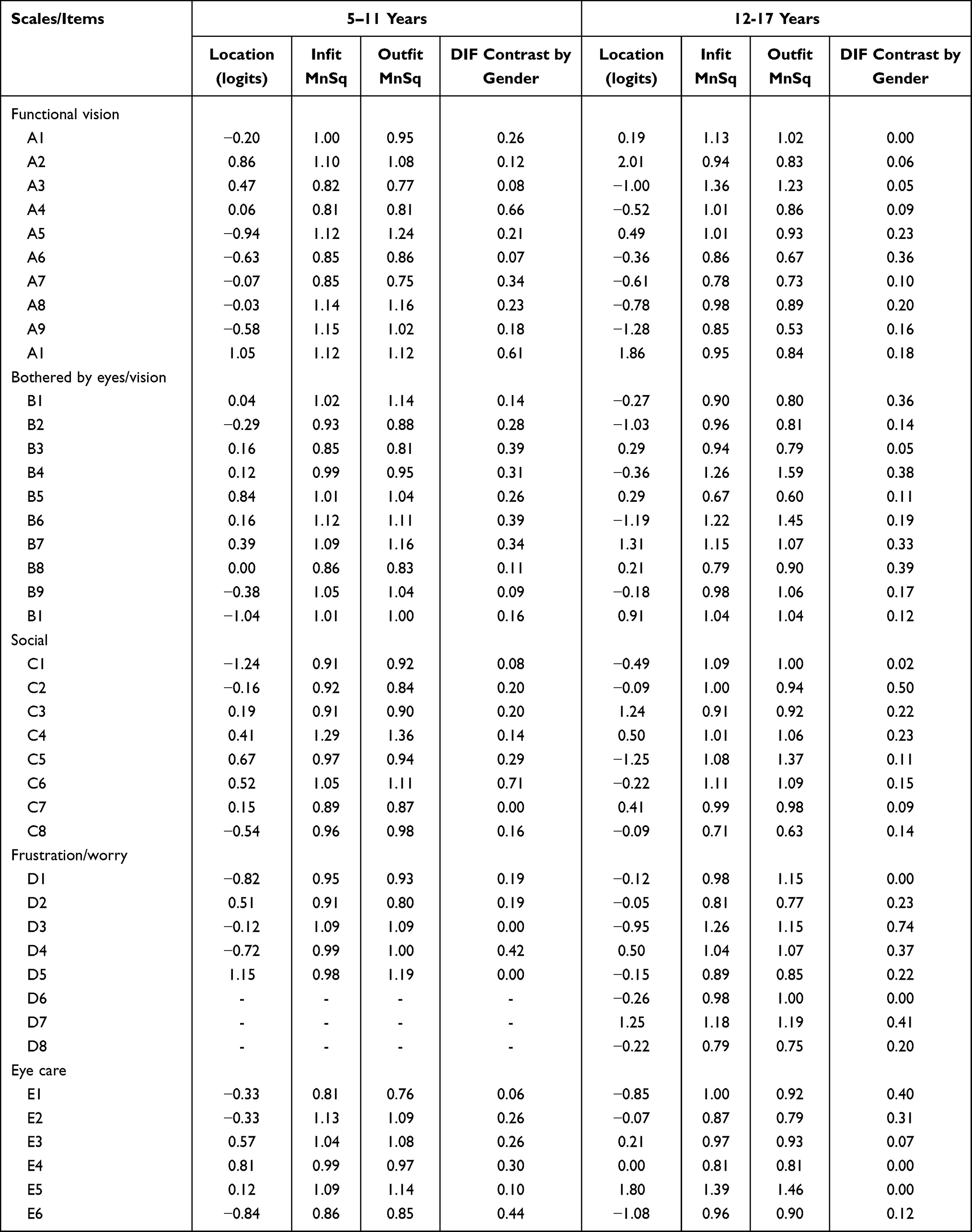 |
Table 4 Rasch Analysis of the Chinese Version of Proxy Pediatric Eye Questionnaires (PedEyeQ) |
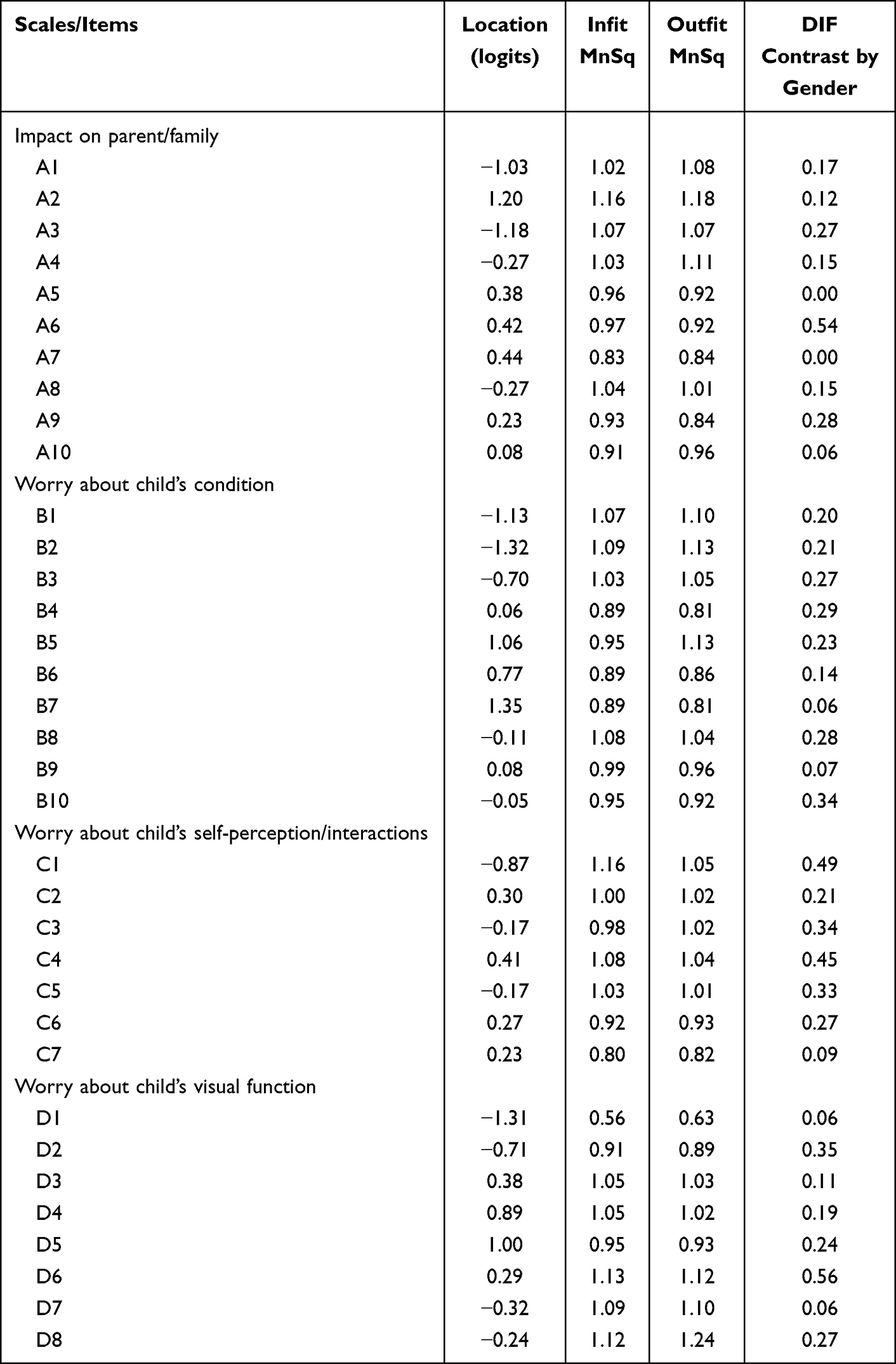 |
Table 5 Rasch Analysis of the Chinese Version of Parent Pediatric Eye Questionnaires (PedEyeQ) |
Category Threshold Order
No disordering of response categories was observed for the PedEyeQ-CN. This demonstrated that the respondents in this study utilized the categories as intended (Figure S2).
Differential Item Functioning
The Child PedEyeQ-CN (5–11 and 12–17 years) each contained five items with minimal differential item functioning by gender. In the Proxy PedEyeQ-CN (5–11 years), three items displayed minimal DIF by gender, while one item did so in the 12–17 years version. Additionally, the Parent PedEyeQ-CN had two items with minimal DIF by gender (Tables 3–5).
Targeting Person-Item Map
The person-item maps shown in Figures S3 illustrate the relationship between item difficulty and person ability. The targeting of the Child, Proxy, and Parent PedEyeQ-CN was satisfactory. However, the mean person ability measure was slightly higher than the mean item measure, indicating that the average item difficulty is lower than the average ability of the sample.
Discussion
In the present study, we translated the PedEyeQ for children aged 12–17 years, building on a prior study that translated the Chinese version for children aged 5–11 years. We employed the Rasch rating scale model to assess whether the PedEyeQ-CN for both age groups could effectively evaluate the impact of pediatric uveitis on children’s functional vision and VR-QOL, as well as its effect on parents, in the Chinese setting.
The Rasch model is an advanced measurement theory that addresses limitations of traditional Likert scale measures derived from classical test theory. Rasch analysis allows for in-depth validation of items and may provide optimal quality criteria for the measurement.22 In the present sample, all subscales of the Child, Proxy, and Parent PedEyeQ-CN satisfied the unidimensionality assumption, except for the Frustration/worry subscale of the Child PedEyeQ-CN (5–11 years). This may be attributable to notable differences in disease severity within the sample, resulting in significantly varied responses from children to the Frustration/worry subscale, which mainly affected the results of the unidimensionality tests. Good reliability and separation were observed for all items and persons. In addition, the category probability curves demonstrated that the three response categories (“Never”, “Sometimes”, “All of the time”) were ordered in all subscales, indicating that participants could distinguish between the response options. The Rasch analysis revealed one misfitting item in each of the Child and Proxy PedEyeQ-CN (12–17 years). The misfitting items suggest that their responses were more unpredictable, possibly due to ambiguous wording or external factors. Therefore, we recommend relying on the total or subscale scores for clinical interpretation. These items present a target for refinement in future studies. A few items showed minimal DIF in the PedEyeQ-CN when comparing the ability levels of male and female participants. The observed minimal DIF by gender indicates that while there are minor differences in how male and female participants respond to a few items, these differences are not substantial enough to compromise the fairness of the measurement. In short, the aforementioned items should continue to be investigated in order to determine whether bias truly exists. Furthermore, while the targeting of the PedEyeQ-CN was satisfactory, the mean person ability measure was slightly higher than the mean item measure in each questionnaire. This can be interpreted as the patients in this study having relatively good visual recovery and higher VR-QOL after receiving effective and reasonable treatment. This finding indicates that the instrument is well-targeted for the study population but might be less sensitive to detecting difficulties in individuals with exceptionally high VR-QOL, which should be considered when interpreting scores in clinical settings.
To our knowledge, no ophthalmic instrument has been originally designed for Chinese children with eye conditions. Most instruments used in China are translated from English-language versions. However, due to cultural differences between countries, these original versions need to be cross-culturally revised and evaluated before being applied in Chinese settings, as demonstrated in this study. Unlike other pediatric quality of life questionnaires used for pediatric uveitis patients,3,4,6,23 the PedEyeQ stands out for its comprehensive design, comprising child, proxy, and parent components. This design enables age-appropriate assessment of the impact of the eye condition on the VR-QOL of children and their parents. Therefore, we conducted a cross-cultural adaptation and validated the psychometric properties of the PedEyeQ-CN to assess its applicability in Chinese pediatric uveitis patients. The strong measurement properties of the PedEyeQ-CN confirm its clinical utility. It allows clinicians to systematically identify patient issues beyond clinical exams, guide communication, and monitor treatment outcomes. As such, it provides a valuable patient-reported measure that complements objective clinical assessments. Additionally, the PedEyeQ-CN can be easily and quickly completed by participants, minimizing respondent burden, with an average completion time of 10–15 minutes. Meanwhile, Rasch-scoring look-up tables and the PedEyeQ-CN questionnaire have been provided as supplementary materials (Tables S1–S5, Figures S4 and S5) to enable other researchers to use the PedEyeQ-CN without needing to perform Rasch analysis.
There are several limitations to this study. Firstly, the single-center design may limit the generalizability of our findings to other clinical settings or patient populations. Although we recruited a large and diverse cohort of children and parents to complete the questionnaires, certain socioeconomic groups may have been under- or overrepresented. Secondly, our study was cross-sectional, and the instrument’s responsiveness to clinical change over time (longitudinal sensitivity) remains unconfirmed. Further longitudinal studies are needed to evaluate the sensitivity of the PedEyeQ-CN in measuring outcomes of visual functional recovery and EQOL after treatment. A key psychometric limitation is the lack of evidence for the PedEyeQ-CN’s discriminative ability across varying levels of disease severity, which is critical for its utility in clinical evaluation and decision-making. Furthermore, as this study focused on the psychometric validation of the PedEyeQ-CN, we did not evaluate the association between quality of life and clinical ocular manifestations, such as floating cells in the anterior chamber or vitreous, retinal vasculitis and macular edema.24,25 Future research will focus on further exploring the psychometric properties of the PedEyeQ-CN using clinical data.
In conclusion, this study demonstrates that the PedEyeQ-CN is a reliable and valid instrument for cross-sectionally assessing functional vision and VR-QOL in Chinese pediatric uveitis patients and their families. These findings support its clinical application in routine practice to help clinicians better understand the impact of the disease on affected children and their families, although longitudinal responsiveness remains to be established in future studies.
Data Sharing Statement
The datasets used and/or analysed during the current study are available from the corresponding author on reasonable request.
Ethics Approval and Consent to Participate
The study was approved by the Institutional Review Board of Tianjin Medical University Eye Hospital (Ethics ID: 2024KY-63). All participants gave their consents and voluntarily participated in the study. The parents and children were fully informed about the purpose of the research.
Author Contributions
All authors made a significant contribution to the work reported, whether that is in the conception, study design, execution, acquisition of data, analysis and interpretation, or in all these areas; took part in drafting, revising or critically reviewing the article; gave final approval of the version to be published; have agreed on the journal to which the article has been submitted; and agree to be accountable for all aspects of the work.
Funding
This work was supported by the National Natural Science Foundation of China under Grants [82171042 and 81870651] and Tianjin Key Medical Discipline Construction Project (TJYXZDXK-3-004A-2).
Disclosure
The authors declare no competing interests.
References
1. Blum-Hareuveni T, Seguin-Greenstein S, Kramer M, et al. Risk factors for the development of cataract in children with uveitis. Am J Ophthalmol. 2017;177:139–143. doi:10.1016/j.ajo.2017.02.023
2. Holland GN, Denove CS, Yu F. Chronic anterior uveitis in children: clinical characteristics and complications. Am J Ophthalmol. 2009;147:667–678e665. doi:10.1016/j.ajo.2008.11.009
3. Guerriero S, Palmieri R, Craig F, et al. Psychological effects and quality of life in parents and children with jia-associated uveitis. Children. 2022;10:9. doi:10.3390/children10010009
4. Wan W, Chen Z, Xun Y, et al. Comprehensive evaluation of functional vision, quality of life, and cognitive ability in pediatric uveitis. BMC Ophthalmol. 2023;23:381. doi:10.1186/s12886-023-03117-7
5. Cassedy A, Altaye M, Andringa J, et al. Assessing the validity and reliability of the effects of youngsters’ eyesight on quality of life questionnaire among children with uveitis. Arthritis Care Res. 2022;74:355–363. doi:10.1002/acr.24491
6. McDonald J, Cassedy A, Altaye M, et al. Comprehensive assessment of quality of life, functioning, and mental health in children with juvenile idiopathic arthritis and noninfectious uveitis. Arthritis Care Res. 2022;74:1311–1320. doi:10.1002/acr.24551
7. Ezzahri M, Amine B, Rostom S, et al. The uveitis and its relationship with disease activity and quality of life in Moroccan children with juvenile idiopathic arthritis. Clin Rheumatol. 2013;32:1387–1391. doi:10.1007/s10067-013-2262-y
8. Lu A, Liu Z, Su G, et al. Global research status regarding uveitis in the last decade. Ocul Immunol Inflamm. 2024;32:326–335. doi:10.1080/09273948.2023.2170251
9. Hatt SR, Leske DA, Castaneda YS, et al. Development of pediatric eye questionnaires for children with eye conditions. Am J Ophthalmol. 2019;200:201–217. doi:10.1016/j.ajo.2019.01.001
10. Gong L, Yu X, Wei L, et al. Translating and evaluating the Chinese version of Pediatric Eye Questionnaire (PedEyeQ-CN) for children. Eye. 2023;37:1397–1404. doi:10.1038/s41433-022-02157-5
11. Bloch-Michel E, Nussenblatt RB. International uveitis study group recommendations for the evaluation of intraocular inflammatory disease. Am J Ophthalmol. 1987;103:234–235. doi:10.1016/S0002-9394(14)74235-7
12. Linacre JM. Sample size and item calibration stability. Rasch Meas Trans. 1994;7:328.
13. Hirasawa H, Murata H, Mayama C, et al. Validating the sumi quality of life questionnaire with Rasch analysis. Invest Ophthalmol Vis Sci. 2014;55:5776–5782. doi:10.1167/iovs.14-14390
14. Thorborg K, Holmich P, Christensen R, et al. The copenhagen Hip and Groin Outcome Score (HAGOS): development and validation according to the COSMIN checklist. Br J Sports Med. 2011;45:478–491. doi:10.1136/bjsm.2010.080937
15. Fournier CN, Bedlack R, Quinn C, et al. Development and validation of the rasch-built overall amyotrophic lateral sclerosis disability scale (ROADS). JAMA Neurol. 2020;77:480–488. doi:10.1001/jamaneurol.2019.4490
16. Balparda K, Herrera-Chalarca T, Cano-Bustamante M. Standardizing the measurement and classification of quality of life using the Keratoconus End-Points Assessment Questionnaire (KEPAQ): the ABCDEF keratoconus classification. Eye Vis. 2022;9:17. doi:10.1186/s40662-022-00288-0
17. Lamoureux EL, Chong E, Wang JJ, et al. Visual impairment, causes of vision loss, and falls: the Singapore Malay Eye Study. Invest Ophthalmol Vis Sci. 2008;49:528–533. doi:10.1167/iovs.07-1036
18. Adnan TH, Mohamed Apandi M, Kamaruddin H, et al. Catquest-9SF questionnaire: validation of Malay and Chinese-language versions using Rasch analysis. Health Qual Life Outcomes. 2018;16:5. doi:10.1186/s12955-017-0833-3
19. McAlinden C, Pesudovs K, Moore JE. The development of an instrument to measure quality of vision: the Quality of Vision (QoV) questionnaire. Invest Ophthalmol Vis Sci. 2010;51:5537–5545. doi:10.1167/iovs.10-5341
20. Khadka J, Pesudovs K, McAlinden C, et al. Reengineering the glaucoma quality of life-15 questionnaire with Rasch analysis. Invest Ophthalmol Vis Sci. 2011;52(9):6971–6977. doi:10.1167/iovs.11-7423
21. Mallinson T, Stelmack J, Velozo C. A comparison of the separation ratio and coefficient alpha in the creation of minimum item sets. Med Care. 2004;42:I17–24. doi:10.1097/01.mlr.0000103522.78233.c3
22. Riklikiene O, Blackman I, Bendinskaite I, et al. Measuring the validity and reliability of the Lithuanian missed nursing care in infection prevention and control scales using Rasch analysis. J Nurs Manag. 2020;28:2025–2035. doi:10.1111/jonm.12918
23. Li Y, Yang L. Clinical manifestations and vision-related quality of life in pediatric uveitis. Indian J Ophthalmol. 2023;71:2162–2167. doi:10.4103/IJO.IJO_2648_22
24. Abraham A, Saboo US, Ducca BL, et al. The detection of occult retinal vasculitis on fluorescein angiography in pediatric uveitis. Ophthalmol Retina. 2020;4:198–203. doi:10.1016/j.oret.2019.09.007
25. Yang P, Zhong Z, Su G, et al. Retinal vasculitis, a common manifestation of idiopathic pediatric uveitis? Retina. 2021;41:610–619. doi:10.1097/IAE.0000000000002885
 © 2025 The Author(s). This work is published and licensed by Dove Medical Press Limited. The
full terms of this license are available at https://www.dovepress.com/terms
and incorporate the Creative Commons Attribution
- Non Commercial (unported, 4.0) License.
By accessing the work you hereby accept the Terms. Non-commercial uses of the work are permitted
without any further permission from Dove Medical Press Limited, provided the work is properly
attributed. For permission for commercial use of this work, please see paragraphs 4.2 and 5 of our Terms.
© 2025 The Author(s). This work is published and licensed by Dove Medical Press Limited. The
full terms of this license are available at https://www.dovepress.com/terms
and incorporate the Creative Commons Attribution
- Non Commercial (unported, 4.0) License.
By accessing the work you hereby accept the Terms. Non-commercial uses of the work are permitted
without any further permission from Dove Medical Press Limited, provided the work is properly
attributed. For permission for commercial use of this work, please see paragraphs 4.2 and 5 of our Terms.