
Back to Journals » Risk Management and Healthcare Policy » Volume 18
Cost-Effectiveness of First-Line Zuberitamab-CHOP versus Rituximab-CHOP Regimens in Untreated CD20+ Diffuse Large B-Cell Lymphoma in China
Authors Gao L, Zhu H, Wang J, Lin Y  , Ding B, Sun Y , Tao T, Li X
Received 14 July 2025
Accepted for publication 2 November 2025
Published 14 November 2025 Volume 2025:18 Pages 3621—3632
DOI https://doi.org/10.2147/RMHP.S553720
Checked for plagiarism Yes
Review by Single anonymous peer review
Peer reviewer comments 2
Editor who approved publication: Dr Keon-Hyung Lee
Lihong Gao,1,2 Haomin Zhu,1 Jia Wang,3 Yingtao Lin,1,4,5 Baolong Ding,1 Yuyang Sun,1 Tiantian Tao,1 Xin Li2,3,5
1Department of Pharmaceutical Regulatory Science and Pharmacoeconomics, School of Pharmacy, Nanjing Medical University, Nanjing, Jiangsu, People’s Republic of China; 2Department of Pharmacy, The Second People’s Hospital of Changzhou, Changzhou, Jiangsu, People’s Republic of China; 3Department of Health Policy, School of Health Policy and Management, Nanjing Medical University, Nanjing, Jiangsu, People’s Republic of China; 4Clinical Medical Research Center, Fujian Cancer Hospital, Fuzhou, Fujian, People’s Republic of China; 5Center for Global Health, School of Public Health, Nanjing Medical University, Nanjing, Jiangsu, People’s Republic of China
Correspondence: Xin Li, Department of Pharmaceutical Regulatory Science and Pharmacoeconomics, School of Pharmacy, Nanjing Medical University, Nanjing, Jiangsu, People’s Republic of China, Email [email protected] Tiantian Tao, Department of Pharmaceutical Regulatory Science and Pharmacoeconomics, School of Pharmacy, Nanjing Medical University, Nanjing, Jiangsu, People’s Republic of China, Email [email protected]
Purpose: To conduct a cost-effectiveness analysis comparing zuberitamab combined with CHOP (cyclophosphamide, doxorubicin, vincristine, and prednisone; Hi-CHOP) versus rituximab combined with CHOP (R-CHOP) as first-line therapy for previously untreated CD20-positive diffuse large B-cell lymphoma (DLBCL) patients in China.
Patients and Methods: A partitioned survival model (PSM) was developed to conduct a cost-effectiveness analysis of Hi-CHOP versus R-CHOP regimens in newly diagnosed CD20-positive DLBCL patients. The study utilized a 20-year time frame. Evaluated outcomes included overall survival (OS), quality-adjusted life-years (QALYs), total treatment costs, and incremental cost-effectiveness ratios (ICERs). The willingness-to-pay (WTP) threshold was defined as $40,334.05 per QALY, equivalent to triple China’s 2024 per capita GDP.
Results: The base-case analysis indicated that Hi-CHOP provided an additional 1.49 life-years and 1.57 QALYs compared to R-CHOP. The total treatment cost of Hi-CHOP was $238,164.77 higher than that of R-CHOP over 20 years, resulting in ICERs of $151,373.19 per QALY and $160,273.99 per life-year. One-way sensitivity analysis (OSA) identified progression-free survival (PFS) utility as the most significant parameter impacting model outcomes. Probabilistic sensitivity analysis (PSA) demonstrated that almost all simulated outcomes surpassed the WTP threshold. The cost-effectiveness acceptability curve (CEAC) demonstrated R-CHOP’s superior cost-effectiveness probability relative to Hi-CHOP across a WTP range from $0 to $150,000.
Conclusion: Given that Hi-CHOP is not cost-effective at conventional WTP thresholds, a substantial price reduction or unnecessary procedures, and optimizing clinical workflows for Hi-CHOP would be necessary to make it an economically viable first-line option for DLBCL compared to R-CHOP.
Keywords: cost-effectiveness, diffuse large b-cell lymphoma, quality-adjusted life years, zuberitamab, rituximab
Introduction
Lymphoma has two main types: Hodgkin lymphoma (HL)and Non-Hodgkin lymphoma (NHL).1 Diffuse large B-cell lymphoma (DLBCL) represents the most prevalent NHL subtype, accounting for over 40% of adult lymphoma diagnoses globally. DLBCL constitutes approximately 25% of all NHL cases in the United States. In China, DLBCL accounts for 54% of all B-cell lymphomas and 35.75% of all lymphoma cases.2 DLBCL exhibits significant clinical and molecular heterogeneity, accompanied by aggressive disease progression. The natural survival duration is notably limited, with a 5-year survival rate of 63.9%.3
The first-line therapeutic regimen for DLBCL combines rituximab with CHOP chemotherapy (cyclophosphamide, doxorubicin, vincristine, and prednisone; R-CHOP). Compared to conventional CHOP chemotherapy, the R-CHOP regimen demonstrates superior clinical efficacy. Specifically, it elevates the 10-year progression-free survival (PFS) rate from 20.0% to 36.5%, while the 10-year overall survival (OS) rate increases from 27.6% to 43.5%.4 Despite the therapeutic efficacy of R-CHOP, a significant proportion of patients experience relapse or develop resistance, thereby restricting subsequent therapeutic options.5,6 Over the past two decades, extensive research has explored strategies to improve outcomes, including dose intensification, maintenance protocols, and incorporation of novel agents; however, these approaches have demonstrated limited clinical benefit.7–9 Moreover, the cost-effectiveness findings were unsatisfactory. The substantial treatment costs associated with R-CHOP impose a critical economic burden, particularly in developing countries, creating a significant barrier to its global implementation.10 Therefore, identifying a cost-effective alternative to rituximab or an alternative to the R-CHOP regimen overall would represent a beacon of hope for DLBCL patients worldwide.
Zuberitamab, produced in China by Zhejiang BioRay Biopharmaceutical, is a Class I me-too drug designed to emulate the structure and function of rituximab. Me-too drug refers to a pharmaceutical product that is developed to be structurally or functionally similar to an existing, already approved drug (often referred to as a “first-in-class” or “pioneer” drug). These drugs typically target the same disease or biological pathway as the original drug. Preclinical investigations11 demonstrated non-inferiority between zuberitamab and rituximab in pharmacodynamics profiles, safety parameters, and pharmacokinetic characteristics at equimolar doses. A Phase II trial (NCT03485118) further compared R-CHOP and Hi-CHOP’s objective response rate (ORR, >90%), incidence of adverse events (AEs), and infusion-related reactions (IRRs). Moreover, the result showed that the two regimens had no significant differences. A Phase III trial12 demonstrated that the Hi-CHOP regimen exhibited non-inferiority to R-CHOP regarding ORR. Furthermore, the Hi-CHOP regimen showed a higher complete response (CR) rate and improved tolerability than R-CHOP. These findings confirm Hi-CHOP’s clinical efficacy and safety in this patient population. Hi-CHOP seems to be a potentially cost-effective alternative that could alleviate financial burdens, improve patient accessibility, and promote pharmaceutical innovation in China. However, its economic value remains unclear. Given these considerations, a comprehensive pharmacoeconomic evaluation is required to establish the clinical value and cost-effectiveness profile of incorporating Hi-CHOP into standard DLBCL treatment algorithms within China’s healthcare system. This study employs a partitioned survival model (PSM) to conduct a comparative cost-effectiveness analysis of R-CHOP versus Hi-CHOP. PSM is an economic model used to calculate a medical treatment’s long-term costs and health benefits. Its core principle is simple: it divides a patient’s future into distinct health states and estimates how much time they will spend in each one. We hope the results will provide critical evidence to guide reimbursement policy formulation, healthcare resource optimization, and strategic domestic drug substitution initiatives.
Materials and Methods
Patients and Interventions
This study’s patient data and treatment interventions were obtained from a phase III clinical trial.12 The study population consisted of newly diagnosed patients with CD20-positive DLBCL, aged between 18 and 75 years, with an expected survival of more than 6 months. All cases underwent histopathological verification. The intervention group received Hi-CHOP therapy, whereas the control group received standard R-CHOP treatment. All therapeutic agents were administered according to standardized clinical practice guidelines and approved pharmaceutical labeling requirements. The detailed treatment protocols for each study cohort are documented in Tables 1 and 2. Antihistamine premedication was administered within 60 minutes before zuberitamab and rituximab infusion.
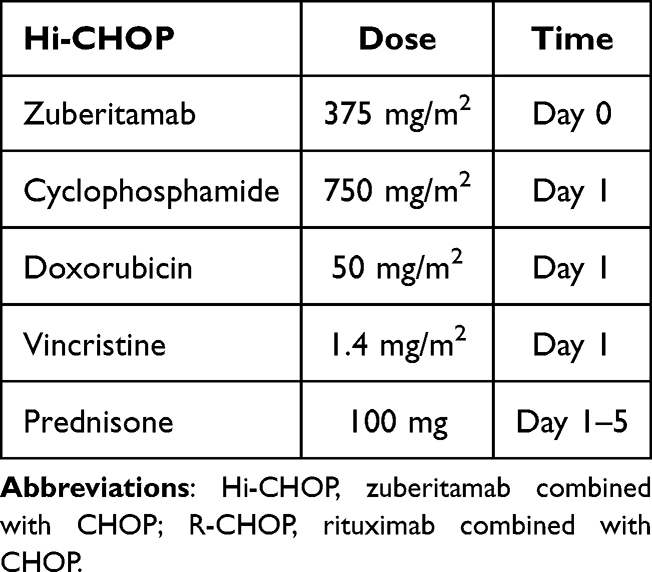 |
Table 1 Intervention Group (Hi-CHOP Regimen) |
 |
Table 2 Control Group (R-CHOP Regimen) |
Model Construction
This economic evaluation was conducted and reported following the Consolidated Health Economic Evaluation Reporting Standards (CHEERS) checklist,13 ensuring methodological transparency and compliance with international reporting guidelines. It utilized a PSM to evaluate the long-term cost-effectiveness of Hi-CHOP versus R-CHOP as first-line treatment for DLBCL (Figure 1). Our analytical framework consisted of three health states, corresponding to distinct disease stages: progression-free survival (PFS), progressed disease (PD), and death. The patients who responded to treatment entered the model in the PFS state, while patients with no response or disease progression transitioned to the PD state to receive second-line or supportive care. We chose the PSM because it provides the most direct and transparent approach to modeling the cost-effectiveness of DLBCL treatment based on the available clinical trial data.
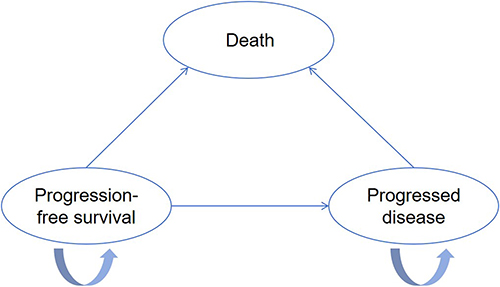 |
Figure 1 Model structure of the partitioned survival model with the 3 health states. |
Considering the average patient age is 56 years,12 and the mean life expectancy at birth among the Chinese population has attained 78.6 years,14 the time horizon was set at 20 years. Each treatment cycle was 21 days, which aligns with the clinical treatment schedule. Both cost and outcome data were subject to an annual discount rate of 5%, following Chinese pharmacoeconomic guidelines15 and supporting literature. Primary economic outcomes included total costs, quality-adjusted life-years (QALYs), and incremental cost-effectiveness ratios (ICERs). A willingness-to-pay (WTP) threshold of $40,334.05 per QALY was adopted, equivalent to three times China’s per capita GDP in 2024.16 All costs were expressed in US dollars (USD), using the average 2024 exchange rate of 1 USD = 7.1217 RMB.17
Clinical Data Input
Data analysis for this study was primarily conducted using GetData Graph Digitizer, R Studio, and Microsoft Excel. PFS and OS data were digitally extracted from the Kaplan-Meier (K-M) survival curves from the phase III trial12 using GetData Graph Digitizer. The K-M survival curves were then reconstructed in R Studio (Figure S1 and Figure S2). Using R Studio, we fitted five parametric survival distributions, including Exponential, Gamma, Weibull (proportional hazards, PH), Loglogistic, and Lognormal, to the reconstructed PFS and OS curves. The best-fitting distributions were chosen based on the Akaike Information Criterion (AIC), the Bayesian Information Criterion (BIC), and visual inspection against the original patient-level survival data reported in a phase III trial.18 The specific values of the AIC and the BIC for each model are documented in Table S1. Results of the selection of the distributions and related data are shown in Table S2. The reconstructed survival curves closely resembled those published in the trial. These optimal models were then used to extrapolate the patients’ long-term survival situations. Furthermore, we validated the long-term projections of R-CHOP by comparing them with survival outcomes reported in published studies.4,9,10 This validation, together with clinical experts’ evaluation of their plausibility in real-world practice, demonstrated strong concordance between our modelled estimates and external evidence.
Cost and Utility Input
This analysis paid more attention to direct medical costs within the framework of China’s healthcare system. These included the costs of primary medications (rituximab, zuberitamab, and CHOP), secondary supportive drugs (antihistamines, second-line therapies, and maintenance treatments), laboratory tests and radiological examinations, hospitalization and inpatient care, routine nursing care, management and medication for AEs, and follow-up examinations. The analysis focused on grade 3–4 AEs with an incidence of ≥5% as reported in the phase III trial, and included associated management and treatment costs. Cost data were sourced from local tertiary hospitals and government documents.19 Additional information was obtained from official Chinese governmental sources, such as the China National Health Commission,20 the National Comprehensive Cancer Network (NCCN) Clinical Practice Guidelines,21 and published expert consensus, supplemented by clinical expert consultation. Zuberitamab and rituximab are both drugs included in the national price negotiation program. The National Healthcare Security Administration has established uniform reimbursement standards, and their prices are standardized nationwide. The prices of other drugs were mainly based on the average winning bid price from the national volume-based procurement program. In light of China’s current policies on nationally negotiated medicines and the national volume-based procurement program, the drug cost information used in our study is highly representative. All costs were converted to USD using the 2024 average exchange rate of 1 USD = 7.1217 RMB.17 QALYs served as the primary outcome measure, integrating survival duration and health-related quality of life. The QALY calculation applied time-weighted utility scores, where each health state’s duration was multiplied by its corresponding preference weight (scale: 0=death to 1=optimal health). Due to the lack of utility data for Chinese DLBCL patients, utility inputs were derived from published self-reported quality-of-life data using the EuroQol-5D (EQ-5D) instrument in adult non-Hodgkin lymphoma populations.22–24 Treatment-related disutilities, particularly those resulting from AEs, were incorporated, as these events could negatively impact patients’ health-related quality of life during treatment. The AEs analysis focused on grade 3–4 events with an incidence of ≥5%, as reported in the phase III trial.
For more information about variable parameters,12,19,22–29 see Table 3.
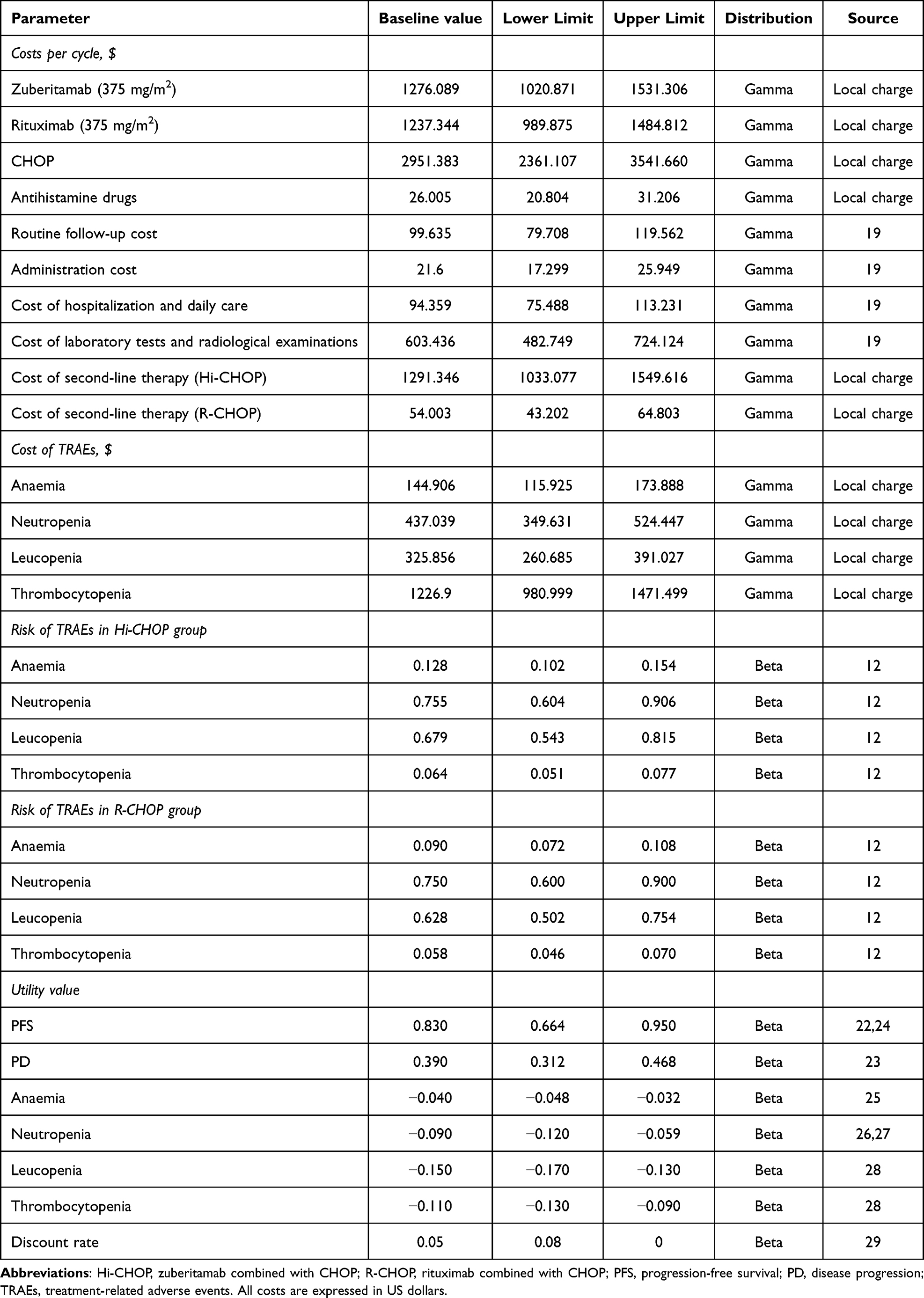 |
Table 3 Baseline Values, Range, and Reference of Model Parameters |
Base-Case Analysis
We modeled the 20-year treatment outcomes of patients receiving either the Hi-CHOP or R-CHOP regimen, estimating survival years, QALYs, and treatment-related costs. We also employed comparative effectiveness research methods to quantify the economic value of competing interventions, with outcomes expressed as ICER for each therapeutic regimen and subsequent comparison against the WTP threshold to determine financial viability. Based on relevant pharmacoeconomic guidelines and expert recommendations, the WTP threshold was three times China’s per capita GDP in 2024. With a 2024 per capita GDP of $13,444.68,16 the resulting WTP threshold was $40,334.05 per QALY. Both cost and outcome data were subject to an annual discount rate of 5%, following Chinese pharmacoeconomic guidelines15 and published literature.
Sensitivity Analyses
Following the base-case analysis, one-way sensitivity analysis (OSA) and probabilistic sensitivity analysis (PSA) were performed to evaluate the model’s robustness. The OSA aimed to examine the impact of individual parameters on the outcomes. Parameter bounds were determined based on confidence intervals, relevant literature, or ±10% to ±20% of the base-case value. The discount rate was varied from 0% to 8%. OSA results were visually presented using a tornado diagram. The PSA was designed to account for uncertainty across all model parameters. All variables with defined upper and lower bounds were simultaneously varied, and 1,000 Monte Carlo simulations were conducted. The results produced a scatter plot of ICERs and a cost-effectiveness acceptability curve (CEAC), visually summarizing the uncertainty in the cost-effectiveness analysis.
Scenario Analysis
In drug pricing and health economic evaluations, variations in drug cost can significantly influence model outcomes and the ICERs. To assess the potential economic value of zuberitamab under different pricing scenarios, we conducted a scenario analysis in which the price of zuberitamab was systematically reduced by 25%, 50%, and 75%.
Results
Base-Case Analysis
Table 4 summarizes the findings of the base-case analysis. Regarding clinical outcomes, the estimated life expectancy for Hi-CHOP patients was 9.05 life-years, compared with 7.56 life-years for those receiving the R-CHOP regimen, representing an incremental gain of 1.49 life-years for Hi-CHOP. After adjusting for quality of life, accounting for health states and adverse events, the total QALYs were slightly reduced for both regimens. Patients treated with Hi-CHOP were estimated to gain 6.45 QALYs, while those treated with R-CHOP gained 4.88 QALYs, resulting in an incremental gain of 1.57 QALYs for Hi-CHOP. From the cost perspective, the total 20-year treatment cost for patients receiving Hi-CHOP was $724,369.70, compared to $486,204.93 for R-CHOP. This represents an incremental cost of $238,164.77 for the Hi-CHOP regimen. Consequently, the ICER was $151,373.19 per QALY gained and $160,273.99 per life-year gained.
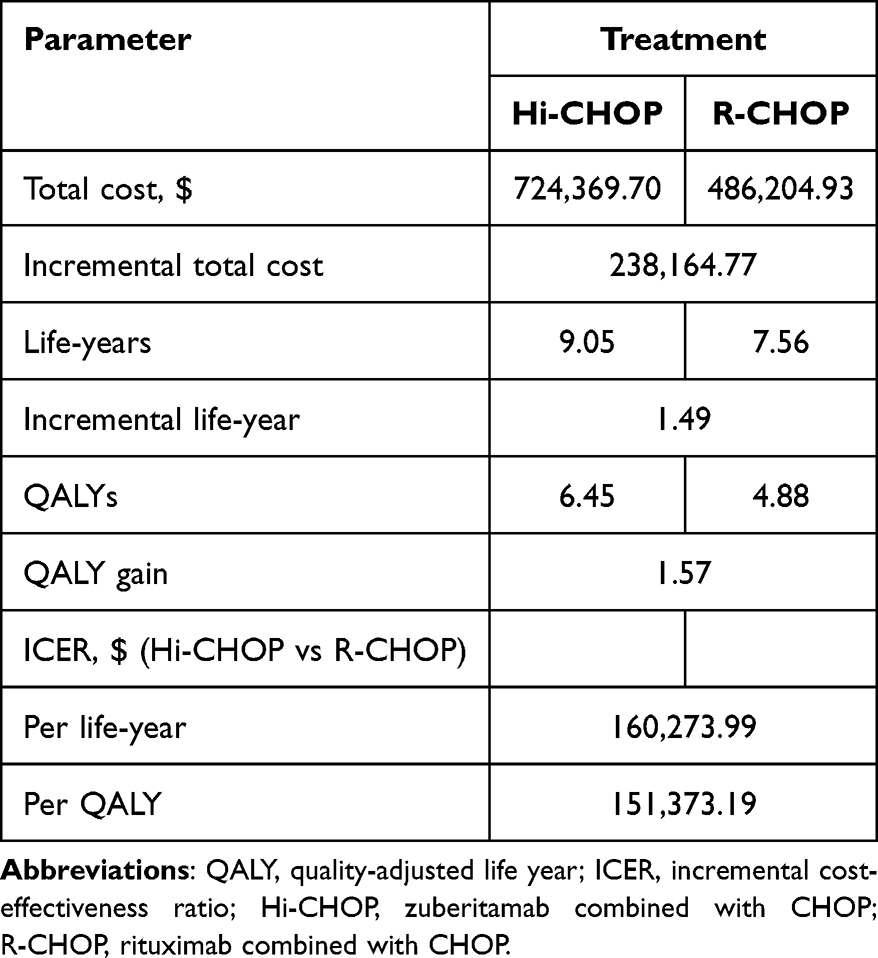 |
Table 4 Summary of Base-Case Results |
Sensitivity Analysis
OSA’s results are shown in Figure 2. All model parameters influenced the ICER, with the utility value for PFS demonstrating the most substantial effect. Subsequent influential parameters included the costs of zuberitamab, CHOP, rituximab, and the utility value for PD. ICER values remained above the WTP threshold across all parameter ranges tested, demonstrating the model’s robustness. Figure 3 displays the PSA scatter plot derived from 1,000 Monte Carlo simulations. Nearly all simulated ICERs exceeded the WTP threshold. As shown in Figure 4, the CEAC reveals that R-CHOP maintained a higher probability of cost-effectiveness than Hi-CHOP across WTP thresholds ranging from $0 to $150,000. At a WTP of $150,000, both treatment regimens had an equal 50% probability of being cost-effective. However, this threshold is nearly four times the assumed WTP value of $40,334.05. It was not until the WTP reached $372,000 that Hi-CHOP had an 80% probability of being more cost-effective than R-CHOP.
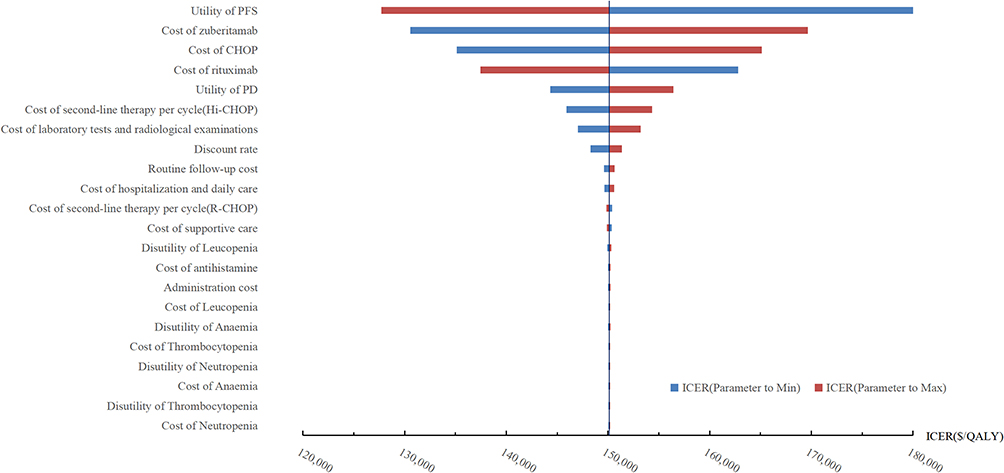 |
Figure 2 Tornado Diagram of One-Way Sensitivity Analyses of Hi-CHOP Versus R-CHOP. |
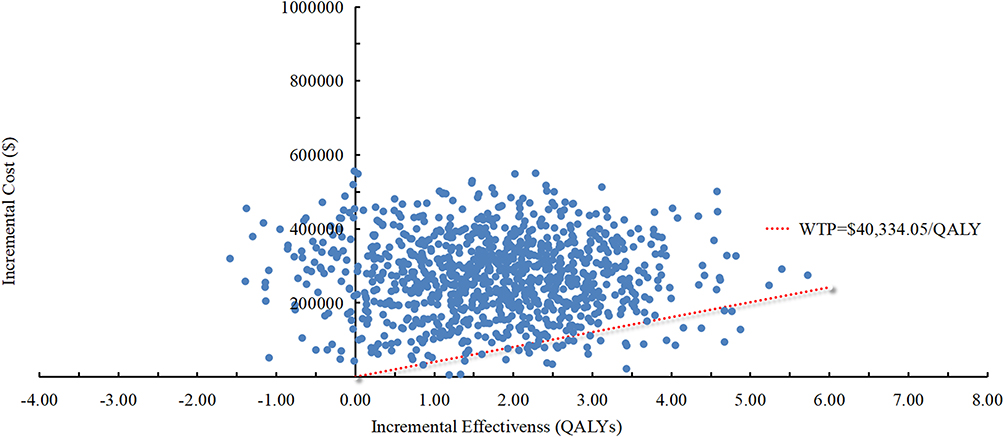 |
Figure 3 ICER scatter plot of Hi-CHOP vs R-CHOP in China. |
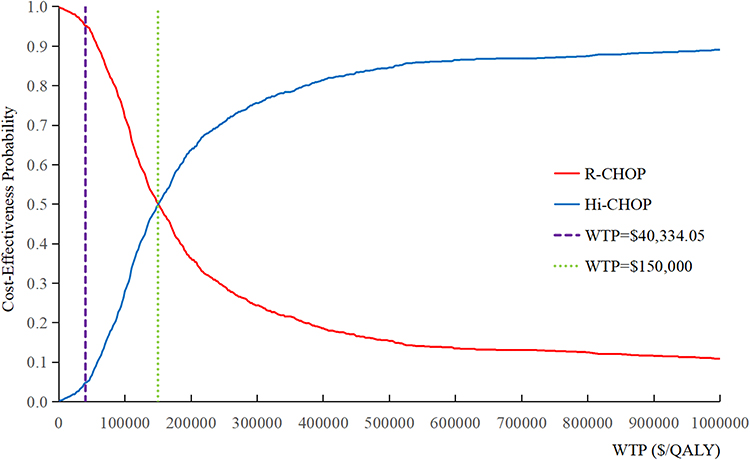 |
Figure 4 Cost-effectiveness Acceptability Curves. |
Scenario Analysis
The results of the scenario analysis are presented in Tables S3a–S3c. After reducing the price of zuberitamab by 25%, 50%, and 75%, the incremental costs of the Hi-CHOP regimen become $196,497.02, $154,827.81, and $113,159.89, respectively. The corresponding ICERs are $124,889.93, $98,405.73, and $71,922.37 per QALY gained. These ICER values still substantially exceed the WTP threshold established in this study.
Discussion
R-CHOP remains the most effective first-line therapy for adult DLBCL patients. However, after years of treatment, the high cost brings a heavy economic burden to the patients. Zuberitamab, a me-too drug developed as an alternative to rituximab (the cornerstone of R-CHOP), has garnered significant clinical interest since its commercialization. Amid escalating healthcare costs, value optimization through cost-effective therapeutic selection has emerged as a crucial consideration in cancer management. This study conducted a cost-effectiveness analysis comparing the zuberitamab-based Hi-CHOP regimen with standard R-CHOP therapy. The base-case analysis revealed that Hi-CHOP conferred 1.49 additional life-years and 1.57 QALYs versus R-CHOP. However, the 20-year total treatment cost of Hi-CHOP exceeded R-CHOP by $238,164.77, yielding an ICER of $151,373.19 per QALY and $160,273.99 per life-year gained. These ICER values substantially surpassed the WTP threshold ($40,334.05, equivalent to triple China’s 2024 per capita GDP), demonstrating Hi-CHOP’s lack of cost-effectiveness. OSA identified PFS utility values as the most influential parameter, followed sequentially by zuberitamab costs, CHOP regimen expenses, rituximab pricing, and PD utility values. While these variables significantly influenced outcomes, the ICER persistently exceeded the WTP threshold throughout parameter ranges, confirming model robustness. PSA incorporating 1,000 Monte Carlo simulations showed that nearly all ICER estimates surpass the WTP threshold, reinforcing the stability conclusion. The CEAC revealed R-CHOP maintained superior cost-effectiveness probabilities versus Hi-CHOP across WTP thresholds from $0 to $150,000. Treatment equivalence (50% probability) occurred at $150,000 WTP, while Hi-CHOP required $372,000 WTP to attain 80% cost-effectiveness likelihood. Despite three simulated price reductions for zuberitamab in the scenario analysis, the corresponding ICER values substantially exceeded the WTP threshold defined in this study. These analyses collectively indicate Hi-CHOP’s cost-ineffectiveness within China’s current economic framework.
Based on a systematic literature review, we identified no prior studies evaluating the cost-effectiveness of Hi-CHOP versus R-CHOP for this indication. Given zuberitamab’s recent market approval and exclusive availability in China, investigations into both the drug and Hi-CHOP regimen remain limited. Existing research has predominantly examined clinical efficacy and safety profiles, leaving economic evaluations underexplored. Reviewing similar literature, we found that nearly all existing studies strongly support using R-CHOP. Whether in resource-limited settings30 or among special patient populations,31 R-CHOP has become the global standard-of-care regimen for treating DLBCL. However, whether substituting rituximab, which is the most essential component of R-CHOP, with another agent can maintain both clinical efficacy and economic value remains uncertain. At least in this study, replacing rituximab with zuberitamab resulted in less cost-effectiveness, with the ICER far exceeding the WTP threshold. To better understand this result, we identified several possible contributing factors and proposed potential strategies for improvement. Regarding drug prices, the price differential between zuberitamab and rituximab significantly influences the model outcomes. Although both drugs have been included in China’s national health insurance catalogue,32 their prices are still very high. The current pricing strategy for zuberitamab lacks robust pharmacoeconomic validation due to insufficient real-world clinical data. More real-world health data should be incorporated to inform rational drug pricing, value-based assessments, and reasonable real-world price negotiations. In the sensitivity analyses, we found that PFS utility dominates outcome shifts more than drug cost. This may be due to the fact that those treated with Hi-CHOP experienced a longer duration of PFS compared with patients receiving R-CHOP. Consequently, even small changes in health-related quality of life during this extended PFS period are amplified. We believe this further reflects the value of Hi-CHOP in providing greater survival benefits for patients. If the pricing strategy is highly reasonable, its economic value should not be underestimated. From the perspective of treatment design, non-drug medical costs contributed significantly to the total price, emphasizing the need for medical institutions to refine treatment protocols. Reducing unnecessary procedures and optimizing clinical workflows may help lower overall treatment costs. In addition, the development of combination therapies may justify higher ICERs. Taken together, a dual approach-adjusting both pricing and treatment regimens-is required to offer policymakers a more comprehensive evidence base.
After obtaining the results, we implemented a three-phase validation framework to verify model robustness. First, domain experts comprehensively assessed the model architecture, data sources, analytical methodology, and outputs; second, an internal code audit verified programming logic and input-output relationships; finally, a goodness-of-fit assessment compared model-generated survival curves with empirical survival data from the original trial. Although the validation process enhanced model credibility, this study still has some limitations. For one thing, the exclusive reliance on data from a single randomized controlled trial introduces potential publication bias and constrains the external validity of the results. Consequently, the cost-effectiveness analysis depends on the trial’s original clinical endpoints. Another thing is that, as we lacked access to individual patient-level clinical data, survival inputs such as OS and PFS were reconstructed using digitization and modeling software. These methodological constraints propagate through survival curve extrapolations, introducing unavoidable errors. Furthermore, significant uncertainties exist in the sensitivity analysis parameters. In the OSA, we implemented a uniform ±20% variation from baseline values for parameters lacking well-defined uncertainty ranges. While this methodology is widely used in pharmacoeconomic research, it introduces residual uncertainty. Additionally, long-term evidence supporting zuberitamab remains limited. Since zuberitamab’s recent approval in China and current unavailability elsewhere, high-quality, long-term clinical data remain scarce. The drug’s long-term efficacy and safety profiles warrant additional investigation, potentially affecting the reliability of existing economic assessments. These limitations must be carefully considered when interpreting the study findings and their policy implications.
Our cost-effectiveness analysis indicates that the Hi-CHOP regimen is not economically viable at its current price level. This result carries important policy implications. First, healthcare payers should consider adopting value-based price negotiations with the manufacturer to bring the price of zuberitamab into a range that aligns with cost-effectiveness criteria. Notably, even under a hypothetical 75% price reduction, the ICER remains well above the willingness-to-pay threshold, suggesting that a substantial price adjustment would be required to improve the economic profile of this regimen. Considering that the ICERs reported in pharmacoeconomic evaluations of most cancer therapies successfully included in the National Reimbursement Drug List (NRDL) are well below the conventional WTP threshold of 1–3 times the per capita GDP in China,15,33,34 whereas the ICER of Hi-CHOP in this study is nearly four times the WTP threshold, policymakers should give immediate consideration to policy adjustments regarding its inclusion. Although policymakers may at times accept higher ICERs for innovative biologics with substantial clinical benefit (particularly in oncology), such acceptance generally occurs only when accompanied by significant price concessions during NRDL negotiations or when novel payment mechanisms are implemented. Second, policymakers may also explore innovative payment mechanisms, such as outcome-based risk-sharing agreements, which could mitigate financial risks for payers while supporting efficient resource allocation. In addition, promoting biosimilars’ development and market entry represents an important pathway to improve affordability by enhancing market competition. Over the longer term, dynamic pricing mechanisms linked to real-world outcomes could help align drug costs more closely with the value delivered in clinical practice. Finally, our findings suggest that price reduction alone may not be sufficient to make the Hi-CHOP regimen cost-effective. A more comprehensive approach should also include optimizing patient selection, treatment duration, and dosing strategies. Future studies should continue to monitor drug price dynamics and assess the impact of alternative policy scenarios on the economic feasibility of this regimen. Considering the large target population, treatment duration, and drug acquisition costs, supplementing the analysis with a budget impact assessment (BIA) could provide additional evidence by projecting the potential nationwide budgetary burden of adoption, which may represent a valuable direction for future research.
Conclusion
This study provides a comprehensive pharmacoeconomic evaluation comparing zuberitamab-based Hi-CHOP with standard R-CHOP therapy for DLBCL patients in China. Our analysis demonstrates that Hi-CHOP is not cost-effective within China’s healthcare economic framework. Although Hi-CHOP provided modest additional survival benefits, these were achieved at a substantially increased cost. The resulting ICER values exceeded our predefined WTP threshold (three times China’s per capita GDP). PFS utility values were identified as the most influential parameter. Notably, the ICER remained above the WTP threshold across all parameter variations. Furthermore, R-CHOP maintained a higher probability of being cost-effective across a wide range of reasonable WTP thresholds. The scenario analysis revealed that even a 75% price cut for zuberitamab was insufficient to bring the ICER below the study’s WTP threshold.
Based on these robust findings, we cannot recommend Hi-CHOP as a cost-effective alternative to R-CHOP. Therefore, R-CHOP remains the dominant choice, representing both the clinical and economic standard of care for DLBCL treatment in China.
Data Sharing Statement
The data supporting this study’s findings are available from Xin Li upon reasonable request.
Ethics Approval
This study was a pharmacoeconomic study that did not involve patient participation. Therefore, it did not require ethics approval.
Acknowledgments
All authors who contributed to this publication were listed.
Author Contributions
All authors made a significant contribution to the work reported, whether that is in the conception, study design, execution, acquisition of data, analysis and interpretation, or in all these areas; took part in drafting, revising or critically reviewing the article; gave final approval of the version to be published; have agreed on the journal to which the article has been submitted; and agree to be accountable for all aspects of the work.
Funding
This work was supported by the National Natural Science Foundation of China (72074123, 72204118). The funders had no role in the study design, collection, analysis, and interpretation of data, in the report’s writing, or in submitting the article for publication.
Disclosure
The authors have no competing interests or relevant affiliations with any organization or entity related to the subject matter or materials discussed in the manuscript.
References
1. Sanam L, Jeffrey L. Noncutaneous cytotoxic T-cell lymphomas: recent advances and emerging concepts: a report of the 2023 Society of Hematopathology/European Association for Haematopathology T-cell lymphoma workshop. Am J Clin Pathol. 2025;164(1):36–45. doi:10.1093/ajcp/aqaf016
2. Lauren RT, Carol ED, James RC, Lindsay MM, Ahmedin J, Christopher RF. US lymphoid malignancy statistics by world health organization subtypes. CA Cancer J Clin. 2016;66(6):443–459. doi:10.3322/caac.21357
3. Peng-Peng X, Rong S, Zi-Yang S, et al. The Prognostic Significance of CD79B mutation in diffuse large b-cell lymphoma: a meta-analysis and systematic literature review. Clin Lymphoma Myeloma Leuk. 2022;22(12):e1051–e1058. doi:10.1016/j.clml.2022.08.006
4. Bertrand C, Catherine T, Eric VDN, et al. Long-term outcome of patients in the LNH-98.5 trial, the first randomized study comparing rituximab-CHOP to standard CHOP chemotherapy in DLBCL patients: a study by the Groupe d’Etudes des Lymphomes de l’Adulte. Blood. 2010;116(12):2040–2045. doi:10.1182/blood-2010-03-276246
5. Michael C, N SS, Umar F, et al. Outcomes in refractory diffuse large B-cell lymphoma: results from the international SCHOLAR-1 study. Blood. 2017;130(16):1800–1808. doi:10.1182/blood-2017-03-769620
6. Sara H, Sandra E, Sara E, et al. Incidence of relapsed/refractory diffuse large B-cell lymphoma (DLBCL) including CNS relapse in a population-based cohort of 4243 patients in Sweden. Blood Cancer J. 2021;11(1):9. doi:10.1038/s41408-020-00403-1
7. Jennifer KL, OC OA. A perspective on improving the R-CHOP regimen: from Mega-CHOP to ROBUST R-CHOP, the Phoenix is yet to rise. Lancet Haematol. 2020;7(11):e838–e850. doi:10.1016/S2352-3026(20)30222-2
8. S PJ, U JM, C JR, et al. Autologous transplantation as consolidation for aggressive non-Hodgkin’s lymphoma. N Engl J Med. 2013;369(18):1681–1690. doi:10.1056/NEJMoa1301077
9. Thierry L, Gandhi D, Pierre S, et al. R-CHOP 14 with or without radiotherapy in nonbulky limited-stage diffuse large B-cell lymphoma. Blood. 2017;131(2):174–181. doi:10.1182/blood-2017-07-793984
10. Sara K, Jaclyn B, Murray K, et al. Real world costs and cost-effectiveness of Rituximab for diffuse large B-cell lymphoma patients: a population-based analysis. BMC Cancer. 2014;14:586. doi:10.1186/1471-2407-14-586
11. Lin G, Xiaohong H, Xiaohui H, et al. Phase I study of chimeric anti-CD20 monoclonal antibody in Chinese patients with CD20-positive non-Hodgkin’s lymphoma. Chin J Cancer Res. 2016;28(2):197–208. doi:10.21147/j.issn.1000-9604.2016.02.07
12. Zhiming L, Wenqi J, Hui Z, et al. Comparison of zuberitamab plus CHOP versus rituximab plus CHOP for the treatment of drug-naïve patients diagnosed with CD20-positive diffuse large B-cell lymphoma: a Phase 3 trial. J Immunother Cancer. 2024;12(10):e008895. doi:10.1136/jitc-2024-008895
13. Don H, Michael D, Federico A, et al. Consolidated health economic evaluation reporting standards 2022 (CHEERS 2022) statement: updated reporting guidance for health economic evaluations. BMJ. 2022;376:e067975. doi:10.1136/bmj-2021-067975
14. National Health Commission of the People’s Republic of China. Statistical Bulletin of China ‘s Health Development in 2023; 2023. Available from: https://www.nhc.gov.cn/cms-search/downFiles/58c5d1e9876344e5b1aa5aa2b083a51a.pdf.
15. Chinese Pharmaceutical Association. Chinese Pharmacoeconomic Evaluation Guidelines. 2020. Available from: https://www.cpa.org.cn/cpadmn/attached/fle/20201203/1606977380634185.pdf.
16. National Bureau of Statistics of China. 2024 Statistical bulletin of the people’s republic of china on national economic and social development; 2025. Available from: https://www.gov.cn/lianbo/bumen/202502/content_7008605.htm.
17. Exchange-Rates.org. World currency exchange rates and historical rates; 2025. Available from: https://www.exchange-rates.org/exchange-rate-history/.
18. Nicholas RL. Survival analysis for economic evaluations alongside clinical trials--extrapolation with patient-level data: inconsistencies, limitations, and a practical guide. Med Decis Making. 2013;33(6):743–754. doi:10.1177/0272989X12472398
19. Jiangsu Provincial Medical Insurance Administration. Catalogue of medical service price items in Jiangsu Province; 2023. Available from: https://ybj.jiangsu.gov.cn/col/col85491/index.html.
20. National Health Commission of the People’s Republic of China. Interpretation of the statistical bulletin on the development of health care in China in 2023. Available from: https://www.nhc.gov.cn/wjw/c100178/202408/90e39fe93f0b48019d3ac34036f64b81.shtml.
21. National Comprehensive Cancer Network. Guidelines-Treatment by Cancer Type; 2025. Available from: https://www.nccn.org/guidelines/category_1.
22. Michael JK, Stephen GP, Susan KP. Using nonrandomized studies to inform complex clinical decisions: the thorny issue of cranial radiation therapy for T-cell acute lymphoblastic leukemia. Pediatr Blood Cancer. 2015;62(5):790–797. doi:10.1002/pbc.25451
23. Qiushi C, Ashley DS, Turgay A, Daniel AG, Jean LK, Christopher RF. Exploring the potential cost-effectiveness of precision medicine treatment strategies for diffuse large B-cell lymphoma. Leuk Lymphoma. 59(7):1700–1709. doi:10.1080/10428194.2017.1390230
24. Robert H, Mark C, Sebastian H, et al. The assessment and appraisal of regenerative medicines and cell therapy products: an exploration of methods for review, economic evaluation and appraisal. Health Technol Assess. 2017;21(7):1–204. doi:10.3310/hta21070.
25. Dominik G, Katarzyna J, Alicja W, et al. EQ-5D-derived health state utility values in hematologic malignancies: a catalog of 796 utilities based on a systematic review. Value Health. 2020;23(7):953–968. doi:10.1016/j.jval.2020.04.1825
26. Xiaohua G, Qiang Z, Yun-Bo C, et al. Cost-effectiveness of Afatinib, gefitinib, erlotinib and pemetrexed-based chemotherapy as first-line treatments for advanced non-small cell lung cancer in China. Lung Cancer. 2019;127:84–89. doi:10.1016/j.lungcan.2018.11.029
27. Zhiwei Z, Huide Z, Ling F, Hongfu C. Cost-effectiveness analysis of sugemalimab vs. chemotherapy as first-line treatment of metastatic nonsquamous non-small cell lung cancer. Front Pharmacol. 2022;13:996914. doi:10.3389/fphar.2022.996914
28. Christopher H, Colin V, Graeme B. The cost effectiveness of axicabtagene ciloleucel versus best supportive care in the treatment of adult patients with relapsed or refractory Large B-Cell Lymphoma (LBCL) after two or more lines of systemic therapy in Canada. Pharmacoeconomics. 2022;40(9):917–928. doi:10.1007/s40273-022-01169-z
29. XiaoMin W, YuCong Z, ChongQing T, XiaoHui Z, LiuBao P. First-line nivolumab plus ipilimumab vs sunitinib for metastatic renal cell carcinoma: a cost-effectiveness analysis. JAMA Oncol. 2019;5(4):491–496. doi:10.1001/jamaoncol.2018.7086
30. P MS, Racquel K, Stephen K, et al. Comparison of best supportive care, CHOP, or R-CHOP for treatment of diffuse large B-cell lymphoma in Malawi: a cost-effectiveness analysis. Lancet Glob Health. 2021;9(9):e1305–e1313. doi:10.1016/S2214-109X(21)00261-8
31. Felicetto F, Roberto R. Cost-effectiveness analysis of the addition of rituximab to CHOP in young patients with good-prognosis diffuse large-B-cell lymphoma. Clin Drug Investig. 2008;28(1):55–65. doi:10.2165/00044011-200828010-00007
32. The Central People’s Government of the People’s Republic of China. The ministry of human resources and social security of the national medical insurance bureau issued a document on printing and distributing the notice of “ National Basic Medical Insurance, Industrial Injury Insurance and Maternity Insurance Drug List “; 2023. Available from: https://www.gov.cn/zhengce/zhengceku/2023-01/18/content_5737840.htm.
33. Juan P, Huiling X, Qiao L. Sintilimab plus chemotherapy with or without bevacizumab biosimilar IBI305 in EGFR-mutated non-ssquamous NSCLC patients who progressed on EGFR TKI therapy: a China-based cost-effectiveness analysis. PLoS One. 2024;19(10):e0312133. doi:10.1371/journal.pone.0312133
34. Shitong X, Yanan S, Ling-Hsiang C, et al. Cost-effectiveness of brentuximab vedotin compared with conventional chemotherapy for relapsed or refractory classic Hodgkin lymphoma in China. Health Econ Rev. 2024;14(1):38. doi:10.1186/s13561-024-00514-6
 © 2025 The Author(s). This work is published and licensed by Dove Medical Press Limited. The
full terms of this license are available at https://www.dovepress.com/terms
and incorporate the Creative Commons Attribution
- Non Commercial (unported, 4.0) License.
By accessing the work you hereby accept the Terms. Non-commercial uses of the work are permitted
without any further permission from Dove Medical Press Limited, provided the work is properly
attributed. For permission for commercial use of this work, please see paragraphs 4.2 and 5 of our Terms.
© 2025 The Author(s). This work is published and licensed by Dove Medical Press Limited. The
full terms of this license are available at https://www.dovepress.com/terms
and incorporate the Creative Commons Attribution
- Non Commercial (unported, 4.0) License.
By accessing the work you hereby accept the Terms. Non-commercial uses of the work are permitted
without any further permission from Dove Medical Press Limited, provided the work is properly
attributed. For permission for commercial use of this work, please see paragraphs 4.2 and 5 of our Terms.