
Back to Journals » Journal of Pain Research » Volume 18
Compare the Effects of Transversalis Fascia Plane Block versus Intravenous Lidocaine Infusion on the Quality of Early Postoperative Recovery in Patients Undergoing Gynecologic Laparoscopic Surgery
Authors Zhang P, Zhao Y  , Mu H, Zhang J , Zhang F, Wang S
Received 31 May 2025
Accepted for publication 8 December 2025
Published 23 December 2025 Volume 2025:18 Pages 7019—7027
DOI https://doi.org/10.2147/JPR.S537190
Checked for plagiarism Yes
Review by Single anonymous peer review
Peer reviewer comments 3
Editor who approved publication: Dr Karina Gritsenko
Peng Zhang,* Ying Zhao,* Hailing Mu, Jin Zhang, Fan Zhang, Shaolin Wang
Department of Anesthesiology, The Second People’s Hospital of Wuhu, Wuhu, Anhui, People’s Republic of China
*These authors contributed equally to this work
Correspondence: Shaolin Wang, Department of Anesthesiology, The Second People’s Hospital of Wuhu, No. 259 Jiuhua Middle Road, Wuhu, Anhui, People’s Republic of China, Email [email protected]
Objective: To compare the effects of transversalis fascia plane (TFP) block versus intravenous lidocaine infusion on early recovery after gynecologic laparoscopic surgery.
Methods: In this randomized trial, 59 patients were assigned to: Group L (n = 30): Intravenous lidocaine (bolus 1.5 mg/kg followed by 25 μg/kg/min infusion); Group T (n = 29): Bilateral ultrasound-guided TFP block with 40 mL of 0.33% ropivacaine. Both groups underwent standardized general anesthesia and patient-controlled intravenous analgesia (PCIA). The primary outcome was quality of recovery-15 (QoR-15) scores on postoperative day 1 (POD1). Secondary outcomes included numerical rating scale (NRS), PCIA demand, inflammatory markers (IL-6, TNF-α), time to first flatus, and adverse events.
Results: No significant differences were observed in QoR-15 scores, intraoperative drug consumption, pain scores, PCIA demand, inflammatory markers, or adverse events (P > 0.05). However, Group L exhibited a shorter time to first flatus (P < 0.05).
Conclusion: TFP block and lidocaine infusion provided comparable recovery quality, though lidocaine may accelerate gastrointestinal recovery.
Keywords: lidocaine, transversalis fascia plane block, gynecologic surgery, laparoscopy, early postoperative recovery quality
A Letter to the Editor has been published for this article.
Introduction
Laparoscopic surgery has gradually emerged as the mainstream approach in gynecologic procedures due to its advantages such as minimal invasiveness and faster postoperative recovery. However, the use of pneumoperitoneum during laparoscopy—while essential for visualization and operative space—leads to increased intra-abdominal pressure and mechanical traction on adjacent organs. These factors inevitably trigger ischemia-hypoxia in visceral tissues and systemic inflammatory responses, which may exacerbate postoperative pain, increase complication risks, and ultimately hinder enhanced recovery pathways. Multimodal analgesia has become an integral component of Enhanced Recovery After Surgery (ERAS) protocols. Regional nerve blocks and intravenous lidocaine infusion have assumed increasingly vital roles within these multimodal strategies,1,2 however, due to concerns about local anesthetic toxicity, international consensus guidelines recommend against initiating intravenous lidocaine within 4 hours of administering any nerve or fascial plane block. Consequently, these two methods cannot be concurrently utilized as components of multimodal analgesia for the same surgical case. Intravenous lidocaine infusion exerts systemic effects—including analgesia, anti-inflammatory, and antiarrhythmic actions—that theoretically promote faster postoperative recovery compared to other analgesic modalities. However, there is currently a lack of clinical studies directly comparing the impact of these two approaches on postoperative patient outcomes. The 15-item Quality of Recovery scale (QoR-15), derived from the QoR-40, is one of the most comprehensive tools for assessing postoperative overall health status. In this study, we adopt QoR-15 as the primary outcome measure. By applying transversalis fascia plane (TFP) blocks and intravenous lidocaine infusion in gynecological laparoscopic surgery, we aim to compare their respective impacts on early postoperative recovery quality. This rigorous comparative analysis seeks to inform the optimization of multimodal analgesia protocols in clinical practice.
Materials and Methods
Study Design and Patients Enrollment
This study was approved by the Ethics Committee of Wuhu Second People’s Hospital. (Approval No.: 2024-KY-013) and registered with the Chinese Clinical Trial Registry (Registration ID: ChiCTR2400087779). Written informed consent was obtained from all participants prior to enrollment. Research adhered to the principles outlined in the Declaration of Helsinki. A total of 64 patients undergoing elective gynecological laparoscopic surgery at our hospital between October 2024 and February 2025 were enrolled.
Aged 18–64 years; American Society of Anesthesiologists (ASA) physical status class I–II; Body mass index (BMI) 18–30 kg/m2; Normal hepatic and renal function. Exclusion criteria were Severe psychiatric disorders; Severe hepatic or renal dysfunction; Allergy to amide local anesthetics or history of seizure; Adams-Stokes syndrome, Wolff-Parkinson-White (WPW) syndrome, or severe cardiac conduction block (including sinoatrial, atrioventricular, or intraventricular block); History of chronic pain or opioid dependence. Withdrawal criteria are Intraoperative conversion to laparotomy; Postoperative admission to the intensive care unit (ICU); Severe adverse reactions occurring intraoperatively or postoperatively; Voluntary withdrawal from the study by the patient or family during the trial.
Patient Grouping, Randomization and Blinding Methods
Patients were randomly assigned to two groups using a random number table method: the Lidocaine group (Group L) and the transversalis fascia plane (TFP) Block group (Group T). Group L: Before induction, lidocaine was administered intravenously at 1.5 mg/kg (based on ideal body weight, calculated as height [cm] – 105) over 10 minutes, followed by a continuous infusion of 25 µg/kg/min until the end of surgery. The administration of lidocaine will be discontinued immediately if participants experience any related adverse events, such as abnormal ECG findings, drowsiness, dizziness, metallic taste, perioral numbness, or tinnitus. Group T: After endotracheal intubation, the transversalis fascia plane (TFP) block was performed under ultrasound guidance using TFP block2 described in reference. Here is the detailed procedure: The patient is placed in the supine position. After sterilization and draping, a 6–13 MHz ultrasound probe is placed on the anterior abdominal wall to identify the external oblique, internal oblique, and transversus abdominis muscles. The probe is then slid toward the midaxillary line until the transversus abdominis muscle disappears and transitions into the thoracolumbar fascia. Using an in-plane technique, the needle is advanced until its tip reaches the junction where the transversus abdominis muscle merges with the thoracolumbar fascia. Once the needle tip is confirmed to be positioned between the transversalis fascia and thoracolumbar fascia (with negative blood aspiration), 20 mL of 0.33% ropivacaine is injected. The same procedure is repeated on the contralateral side. All nerve blocks were performed by experienced anesthesiologists. The anesthesiologists performing the blocks and the surgeons were aware of the group allocation, while all anesthesiologists responsible for pre- and postoperative assessments, as well as the patients and their families, remained blinded to the group assignment.
Anesthesia Management
Upon entering the operating room, an intravenous line was established in the forearm. Standard monitoring included electrocardiography (ECG), heart rate (HR), pulse oximetry (SpO2), and bispectral index (BIS). Following intravenous administration of 50 mg flurbiprofen axetil, radial artery catheterization was performed under local anesthesia for continuous invasive blood pressure monitoring. Induction of anesthesia: Sufentanil (0.3 μg/kg), etomidate (0.3 mg/kg), and rocuronium (0.6 mg/kg) were administered sequentially. Tracheal intubation was performed 90 seconds later, followed by mechanical ventilation via an anesthesia machine with the following parameters: respiratory rate (RR) 12–16 breaths/min, tidal volume (VT) 6 mL/kg, fraction of inspired oxygen (FiO2) 40–70%, and end-tidal carbon dioxide pressure (PETCO2) maintained at 35–45 cmH2O. Prior to surgical incision, both groups received an additional 10 μg of sufentanil for enhanced analgesia. Anesthesia was maintained with 1% sevoflurane inhalation, combined with continuous intravenous infusions of propofol (2–4 mg/kg/h) and remifentanil (0.1–0.2 μg/kg/min) via syringe pumps. Intermittent boluses of rocuronium were administered to maintain neuromuscular blockade. The BIS was titrated to 40–60. Intraoperative hemodynamic stability was achieved by maintaining heart rate and blood pressure fluctuations within 20% of baseline values. Nalbuphine hydrochloride (10 mg) was administered intravenously 30 minutes before the end of surgery. Sevoflurane inhalation was discontinued 10 minutes prior to surgical closure, while propofol and remifentanil infusions were ceased immediately upon completion of surgery. PCIA was initiated postoperatively, with the solution prepared as follows: sufentanil (100 μg) + ondansetron (8 mg) + normal saline, diluted to a total volume of 100 mL, here are Parameter settings: Background infusion rate: 2 mL/h; Bolus dose: 0.5 mL; Lockout interval: 15 minutes. Patient-controlled analgesia is required. If the NRS were ≥4, dezocine (0.1 mg/kg) was administered intravenously as rescue analgesia.
Outcome Measures
The intraoperative consumption of propofol, remifentanil, and sufentanil was recorded in both patient groups. NRS were also recorded immediately after surgery and at 6, 12, 24, and 48 hours postoperatively. Additionally, the number of effective patient-controlled analgesia activations and the frequency of rescue analgesia administrations were documented. QoR-15 cores were recorded on preoperative day 1 and postoperative day 1, QoR-15 questionnaire comprises 15 items across five dimensions: emotional status (4 items), physical comfort (5 items), ability to perform self-care (2 items), psychological support (2 items), and pain symptoms (2 items). It assesses patients’ postoperative recovery quality on a total score ranging from 0 to 150 points. Venous blood samples (4 mL) were collected via peripheral venipuncture preoperatively and at 24 hours postoperatively. After being allowed to clot for 1 hour at room temperature, the samples were centrifuged at 3000 r/min for 5 minutes. Serum aliquots were cryopreserved at −70°C until analysis. Serum concentrations of interleukin-6 (IL-6) and tumor necrosis factor-alpha (TNF-α) were quantitatively determined using enzyme-linked immunosorbent assay (ELISA). The time to first postoperative flatus, time to ambulation, and the incidence of adverse reactions (including nausea and vomiting, pruritus, and delirium) were documented and compared between the two groups.
Sample Size Calculation
The required sample size was determined using PASS software (version 15.0). Based on preliminary trial data showing mean QoR-15 scores at 24 hours postoperatively of 105.7 ± 3.6 (Group L, n=5) and 102.2 ± 4.4 (Group T, n=5), with α=0.05 and power (1-β)=0.90, a calculated sample size of 29 patients per group was obtained. Accounting for a 10% dropout rate, the final study protocol planned to enroll 64 patients (32 per group).
Statistical Analysis
Data were analyzed using SPSS 26.0 software. Normally distributed continuous variables are expressed as mean ± standard deviation (mean ± SD), and between-group comparisons were performed using the independent samples t-test. Non-normally distributed continuous variables are presented as median (P25, P75), with between-group differences assessed by the Mann–Whitney U-test. Categorical variables are described as frequency (%), and group comparisons were made using the χ2-test or Fisher’s exact test, as appropriate. A two-tailed P < 0.05 was considered statistically significant.
Results
Initially, 64 patients were enrolled in this study. In Group L, one patient was excluded due to intraoperative conversion to open surgery and another declined postoperative follow-up. In Group T, one patient required ICU admission postoperatively and two refused follow-up. Consequently, 59 patients were ultimately included in the final analysis (Figure 1). No statistically significant differences were observed between the two groups in age, ASA classification, BMI, types of surgery, operative duration, anesthesia duration, intraoperative propofol consumption, remifentanil consumption, sufentanil consumption, fluid infusion volume, blood loss, or urine output (Table 1).
 |
Table 1 Comparison of Demographics and Intraoperative Characteristics Between the Two Groups |
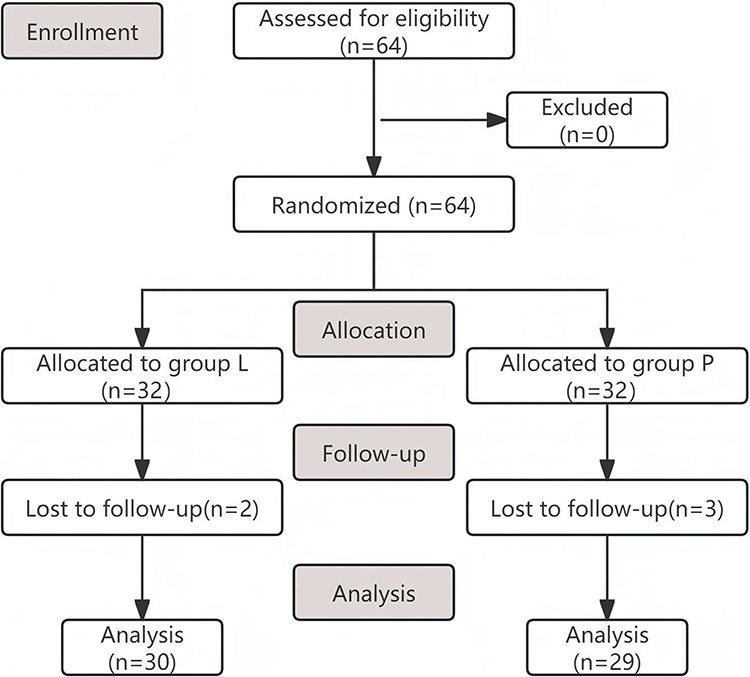 |
Figure 1 Flow diagram of the present study. |
No statistically significant differences were observed between the two groups in postoperative NRS pain scores at various time points, number of effective PCIA boluses, or remedial analgesia rate (Table 2).
 |
Table 2 Comparison of Postoperative NRS Scores and Analgesia Outcomes Between the Two Groups at Different Time Points |
The L group demonstrated significantly higher scores in the physical comfort domain and total QoR-15 scores compared to the T group postoperatively (P < 0.05) (Table 3).
 |
Table 3 Comparison of QoR-15 Scores Between the Two Groups at Different Time Points |
No statistically significant differences were observed in the levels of inflammatory factors IL-6 and TNF-α between the two groups at different time points (Table 4).
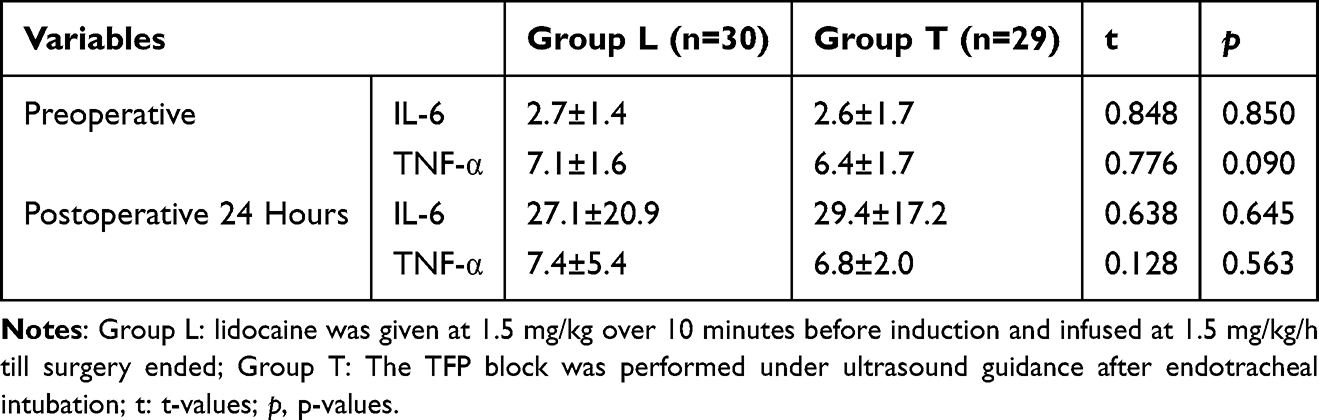 |
Table 4 Comparison of Inflammatory Factor Levels Between the Two Groups at Different Time Points |
Patients in Group L exhibited a significantly shorter time to first postoperative flatus compared to Group T (P < 0.05). No statistically significant differences were observed between the two groups in postoperative ambulation time or the incidence of adverse reactions, including nausea/vomiting, pruritus, and delirium (Table 5).
 |
Table 5 Comparison of Postoperative Outcomes Between the Two Groups |
Discussion
Multimodal analgesia based on regional nerve blocks has become an essential component of Enhanced Recovery After Surgery (ERAS) protocols. Multiple abdominal nerve block techniques exist, including quadratus lumborum block (QLB), rectus sheath block (RSB) and transversus abdominis plane block (TAPB). QLB primarily blocks the anterior rami of T10-L2 spinal nerves, making it more suitable for pain management in lumbar or retroperitoneal surgeries. RSB targets the anterior rami of T7-L1 spinal nerves, with analgesic effects concentrated along the midline abdominal region (eg, periumbilical area to pubic symphysis). RSB provides precise analgesia for midline incisions (eg, vertical incisions in open hysterectomies) but offers limited lateral abdominal wall coverage. TAP mainly acts on the anterior branches of the thoracic nerves T7-T12 in the anterior abdominal wall, which innervate the of the abdominal wall of the lower abdomen. TAPB can effectively relieve pain caused by abdominal wall incisions in gynecological laparoscopy and discomfort caused by traction of pelvic organs.
The transversalis fascia plane (TFP) block was first described by Hebbard in 2009.3 By injecting local anesthetic between the transversalis fascia and thoracolumbar fascia, the agent spreads to the inner surface of the quadratus lumborum muscle and blocks the proximal branches of the T12 and L1 nerves. Compared to the transversalis fascia plane (TFP) block, the TFP block provides a more complete blockade of the T12-L1 nerves. The transversalis fascia plane (TFP) block was initially applied in iliac bone graft harvesting and inguinal hernia repair. Recent studies have demonstrated that the TFP block provides superior postoperative analgesia and reduces opioid requirements compared to the transversalis fascia plane (TFP) block in cesarean sections and gynecological surgeries.2,4,5 Lidocaine exerts its analgesic effects by targeting voltage-gated sodium channels in the dorsal root ganglia of nociceptive nerves. This action reduces sodium ion peak currents, thereby decreasing neuronal excitability and blocking the transmission of peripheral nociceptive signals to the central nervous system.6 Intravenous lidocaine has been used to treat acute pain, cancer-related pain, neuropathic pain, complex regional pain syndrome (CRPS), and diabetic neuropathy. Numerous recent studies have demonstrated its efficacy in improving postoperative pain management in surgical patients. A study by Fabian et al demonstrated that intravenous lidocaine provides analgesic efficacy comparable to thoracic epidural analgesia within the first 24 hours following open abdominal surgery.7 Additionally, research by Wu et al revealed that perioperative lidocaine infusion enhances postoperative recovery quality, improves analgesia, and reduces opioid consumption in patients undergoing surgery for lumbar spinal stenosis.8 This study found that no significant differences were observed in NRS scores at postoperative time points, PCIA bolus attempts, or rescue analgesia rates between patients receiving intravenous lidocaine infusion and those undergoing TFP block. These results indicate that intravenous lidocaine infusion achieves analgesic efficacy comparable to the TFP block.
QoR-15 derived from the QoR-40, serving as one of the most comprehensive assessment tools for evaluating patients’ overall postoperative health status. This validated instrument has been widely adopted to measure postoperative recovery quality, with higher scores correlating with improved recovery outcomes.9 In this study, postoperative recovery quality was assessed using the QoR-15 scale (referencing relevant literature10) at 1 day preoperatively and 1 day postoperatively. The evaluation covered five domains: Emotional status (4 items), Physical comfort (5 items), Physical independence (2 items), Psychological support (2 items), Pain (2 items). Each item was scored on a 0–10 scale, yielding a total score ranging from 0 to 150 points, with higher values indicating better recovery outcomes. On postoperative day 1, the QoR-15 scores for the L-group and T-group were 103 (101–104) and 102 (99.5–104), respectively, with no statistically significant difference observed. The study adopted a minimal clinically important difference (MCID) of 6 points for QoR-15 scores,11 indicating that intravenous lidocaine infusion did not demonstrate superiority over TFP block in enhancing postoperative recovery quality. The superiority of intravenous lidocaine infusion over traditional analgesic modalities in terms of pain relief efficacy and postoperative recovery remains inconsistent across studies. For example, in patients undergoing septoplasty, both intravenous lidocaine and fentanyl improved postoperative recovery quality as measured by the QoR-15 scale.12 However, the lidocaine group demonstrated higher QoR-15 scores postoperatively compared to the fentanyl group, indicating superior analgesia and enhanced recovery outcomes. However, in a separate study,13 comparing the effects of ultrasound-guided bilateral superficial cervical plexus blocks and perioperative lidocaine infusion on postoperative recovery quality in patients undergoing thyroidectomy, the results demonstrated no significant difference between the two interventions. The discrepancies observed across these studies may be attributable to variations in lidocaine dosing regimens and infusion durations. A meta-analysis demonstrated14 that the analgesic effects of perioperative lidocaine infusion persist for ≤8.5 hours. If lidocaine administration is discontinued at the end of surgery or within hours postoperatively, its analgesic benefits fail to extend beyond 24 hours post-surgery. Studies indicate that patients receiving a lidocaine maintenance infusion rate of 1 mg/kg/h postoperatively exhibit significantly higher QoR-15 scores compared to those without lidocaine use, though the difference does not meet the minimal clinically important difference (MID) threshold of 6 points. In contrast, a higher maintenance dose of 3 mg/kg/h not only results in superior QoR-15 scores compared to the 1 mg/kg/h regimen but also achieves the predefined MID of 6 points.15 This study enrolled ASA I–II patients undergoing gynecological laparoscopic surgeries and implemented a multimodal analgesia protocol that, in addition to intravenous lidocaine (or TFP blocks), included: preemptive flurbiprofen axetil 50 mg (administered preoperatively), nalbuphine 10 mg administered 30 minutes before surgical closure, a postoperative PCIA pump (delivering sufentanil 100 μg). This study followed a consensus guideline,1 administering an initial lidocaine bolus of 1.5 mg/kg (based on ideal body weight) followed by a continuous infusion of 25 µg/kg/min until the end of surgery, with a total infusion duration of ~160 minutes. However, due to patient-specific factors (eg, comorbidities, pain thresholds), surgical complexity, and analgesic modality interactions, the selected lidocaine dosing regimen and duration failed to demonstrate clinically superior outcomes compared to thoracic fascial plane (TFP) blocks. These findings underscore that lidocaine infusion protocols should not be standardized across diverse populations or surgical procedures but instead require personalized dose optimization to balance efficacy and safety.
Lidocaine exhibits potent anti-inflammatory properties by modulating the release of pro-inflammatory cytokines (eg, IL-1β, IL-6, TNF-α) that drive both inflammatory cascades and pathological pain. Specifically, it suppresses the activation of peripheral polymorphonuclear leukocytes (PMNs) and neutrophils, thereby reducing the secretion of cytokines such as IL-4, IL-6, and TNF-α through mechanisms involving membrane stabilization and inhibition of neutrophil adhesion/aggregation.16 The study observed no statistically significant differences in postoperative IL-6 and TNF-α levels between the L-group (lidocaine) and T-group (TFP block). This equivalence may stem from: Comparable anti-inflammatory potency of the two amide-linked local anesthetics (lidocaine vs TFP block agents) despite differing administration routes (systemic vs regional), suggesting similar efficacy in suppressing cytokine release intensity; Limited surgical stress inherent to gynecological laparoscopic procedures, which generate minimal tissue trauma and systemic inflammation; Patient selection bias: The inclusion of ASA I–II patients with robust physiological reserves likely attenuated intergroup inflammatory response variability. In this study, patients in the L-group exhibited a shorter time to first postoperative flatus compared to the T-group (p<0.05). While the exact mechanisms underlying lidocaine’s acceleration of gastrointestinal recovery remain unclear, prior studies suggest it may involve: Anti-inflammatory effects: Lidocaine suppresses systemic inflammation and protects intestinal epithelial cells by inhibiting neutrophil infiltration and cytokine-mediated damage.17,18 Smooth muscle modulation: It stimulates contraction of circular and longitudinal smooth muscles, enhancing intestinal motility via sodium channel blockade and calcium signaling regulation.17,18 Barrier restoration: Lidocaine reduces intestinal hyperpermeability caused by post-ischemic jejunal lipopolysaccharide elevation, thereby accelerating mucosal barrier recovery.17,18
TFP block reduced the use of opioids after surgery through analgesia and reduced the patient’s stress response, thus improving the patient’s postoperative recovery quality. In addition to inhibiting nociception, intravenous lidocaine can also inhibit excessive inflammatory response, improve gastrointestinal function, and lidocaine has cardiovascular protective and improve postoperative cognitive function. In theory, intravenous lidocaine is more conducive to the early recovery of patients after surgery than a single nerve block The primary outcome of this study was negative, probably because this study selected healthy patients, the surgical trauma was relatively small and the duration was relatively short. Therefore, the choice of intraous lidocaine dose and duration cannot be subject to a uniform standard in different populations and different surgeries, and the issue of “personalization” should be considered.
The impact of different analgesic modalities on postoperative outcomes varies. Previous studies5,8,19 have demonstrated that both TFP blocks and intravenous lidocaine infusion are valid components of multimodal analgesia for gynecological laparoscopic surgery, both modalities enhance postoperative recovery through their analgesic and anti-inflammatory effects. This study demonstrates that TFP block and lidocaine infusion provided comparable recovery quality, though lidocaine may accelerate gastrointestinal recovery. Both modalities show comparable efficacy in enhancing early postoperative recovery quality.
Conclusion
TFP block and lidocaine infusion provided comparable recovery quality, though lidocaine may accelerate gastrointestinal recovery.
Abbreviations
ASA, American Society of Anesthesiologists; BIS, bispectral index; BMI, Body mass index; CRPS, complex regional pain syndrome; ECG, electrocardiography; ERAS, Enhanced Recovery After Surgery; FiO2, fraction of inspired oxygen; HR, heart rate; ICU, intensive care unit; MID, the minimal clinically important difference; NRS, numerical rating scale; PCIA, patient-controlled intravenous analgesia; PETCO2, end-tidal carbon dioxide pressure; PMNs, polymorphonuclear leukocytes; POD1, postoperative day 1; QLB, quadratus lumborum block; QoR-15, quality of recovery-15; RR, respiratory rate; RSB, rectus sheath block; SpO2, pulse oximetry; TAPB, transversus abdominis plane block; TFP, transversalis fascia plane; VT, tidal volume; WPW, Wolff-Parkinson-White.
Data Sharing Statement
The raw data supporting the conclusions of this article will be made available. Further inquiries can be directly to the corresponding author.
Funding
Research project of Wuhu Health Commission (WHWJ2023y031).
Disclosure
The authors declare that they have no conflicts of interest with regard to this work.
References
1. Foo I, Macfarlane AJR, Srivastava D, et al. The use of intravenous lidocaine for postoperative pain and recovery: international consensus statement on efficacy and safety. Anaesthesia. 2021;76(2):238–250. doi:10.1111/anae.15270
2. Shan T, Yin J, Meng QS, Shi L, Han L, Bao HG. Comparison of ultrasound-guided transversalis fascia plane block versus transversus abdominis plane block for postoperative analgesia in cesarean section [In Chinese with English abstract]. J Clin Anesthesiol. 2020;36(10):988–991.
3. Hebbard PD. Transversalis fascia plane block, a novel ultrasound-guided abdominal wall nerve block. Can J Anaesth. 2009;56(8):618–620. doi:10.1007/s12630-009-9110-1
4. Pinarbaşi A, Altiparmak B, Korkmaz Toker M, Pirinççi F, Uğur B. Ultrasound-guided transversalis fascia plane block or transversus abdominis plane block for recovery after caesarean section: a randomised clinical trial. Eur J Anaesthesiol. 2024;41(10):769–778. doi:10.1097/EJA.0000000000002041
5. Zhu YL, Deng WX, Qiu DL, et al. Comparison of transversalis fascia plane block versus transversus abdominis plane block on postoperative analgesia, inflammatory response, and recovery in patients undergoing gynecological laparoscopic surgery [In Chinese with English abstract]. Med J Wuhan Univ. 2023;44(6):750–754.
6. Yang X, Wei X, Mu Y, Li Q, Liu J. A review of the mechanism of the central analgesic effect of lidocaine. Medicine. 2020;99(17):e19898. doi:10.1097/MD.0000000000019898
7. Casas-Arroyave FD, Osorno-Upegui SC, Zamudio-Burbano MA. Therapeutic efficacy of intravenous lidocaine infusion compared with thoracic epidural analgesia in major abdominal surgery: a noninferiority randomised clinical trial. Br J Anaesth. 2023;131(5):947–954. doi:10.1016/j.bja.2023.07.032
8. Wu Y, Chen Z, Yao C, et al. Author Correction: effect of systemic lidocaine on postoperative quality of recovery, the gastrointestinal function, inflammatory cytokines of lumbar spinal stenosis surgery: a randomized trial. Sci Rep. 2024;14(1):8480. doi:10.1038/s41598-024-59219-9
9. Lv X, Li X, Guo K, et al. Effects of systemic lidocaine on postoperative recovery quality and immune function in patients undergoing laparoscopic radical gastrectomy. Drug Des Devel Ther. 2021;15:1861–1872. doi:10.2147/DDDT.S299486
10. Jiang BW, Ma FD, Huang J, et al. Effect of ultrasound-guided iliopsoas plane block on postoperative recovery quality in patients undergoing total Hip arthroplasty [In Chinese with English abstract]. J Clin Anesthesiol. 2024;40(2):133–138.
11. Myles PS, Myles DB. An updated minimal clinically important difference for the QoR-15 scale. Anesthesiology. 2021;135(5):934–935. doi:10.1097/ALN.0000000000003977
12. Chhabra A, Dave M, Jeenger L, Meena R, Aggarwal I, Partani S. Comparison of Quality of Recovery (QoR-15) following the administration of intravenous lignocaine and fentanyl in patients undergoing septoplasty under general anaesthesia: a double-blinded, randomised, controlled trial. Indian J Anaesth. 2023;67(4):388–393. doi:10.4103/ija.ija_479_22
13. Yang X, Yang H, Li M, Zhu K, Shen L, Xie C. Effect of ultrasound-guided bilateral superficial cervical plexus block versus perioperative intravenous lidocaine infusion on postoperative quality of recovery in patients undergoing thyroidectomy: a randomised double-blind comparative trial. Indian J Anaesth. 2024;68(3):238–245. doi:10.4103/ija.ija_852_23
14. Yang W, Yan S, Yu F, Jiang C. Appropriate duration of perioperative intravenous administration of lidocaine to provide satisfactory analgesia for adult patients undergoing colorectal surgery: a meta-analysis of randomized controlled trials. Anesth Analg. 2023;136(3):494–506. doi:10.1213/ANE.0000000000006347
15. Li YX, Gao XN, Sun YB. Effect of different doses of lidocaine on early postoperative quality of recovery in elderly patients undergoing laparoscopic radical colectomy [In Chinese with English abstract]. J Clin Anesthesiol. 2023;39(8):811–815.
16. Hermanns H, Hollmann MW, Stevens MF, et al. Molecular mechanisms of action of systemic lidocaine in acute and chronic pain: a narrative review. Br J Anaesth. 2019;123(3):335–349. doi:10.1016/j.bja.2019.06.014
17. Lang A, Ben Horin S, Picard O, Fudim E, Amariglio N, Chowers Y. Lidocaine inhibits epithelial chemokine secretion via inhibition of nuclear factor kappa B activation. Immunobiology. 2010;215(4):304–313. doi:10.1016/j.imbio.2009.05.006
18. Tappenbeck K, Hoppe S, Reichert C, Feige K, Huber K. In vitro effects of lidocaine on contractility of circular and longitudinal equine intestinal smooth muscle. Vet J. 2013;198(1):170–175. doi:10.1016/j.tvjl.2013.07.027
19. Tang P, Sun Q, Li Z, Tong X, Chen F. Perioperative intravenous lidocaine infusion improves postoperative analgesia after hysterectomy: a systematic review and meta-analysis of randomized controlled trials. Int J Surg. 2025;111(1):1265–1274. doi:10.1097/JS9.0000000000001942
 © 2025 The Author(s). This work is published and licensed by Dove Medical Press Limited. The
full terms of this license are available at https://www.dovepress.com/terms
and incorporate the Creative Commons Attribution
- Non Commercial (unported, 4.0) License.
By accessing the work you hereby accept the Terms. Non-commercial uses of the work are permitted
without any further permission from Dove Medical Press Limited, provided the work is properly
attributed. For permission for commercial use of this work, please see paragraphs 4.2 and 5 of our Terms.
© 2025 The Author(s). This work is published and licensed by Dove Medical Press Limited. The
full terms of this license are available at https://www.dovepress.com/terms
and incorporate the Creative Commons Attribution
- Non Commercial (unported, 4.0) License.
By accessing the work you hereby accept the Terms. Non-commercial uses of the work are permitted
without any further permission from Dove Medical Press Limited, provided the work is properly
attributed. For permission for commercial use of this work, please see paragraphs 4.2 and 5 of our Terms.
Recommended articles
Oliceridine versus Sufentanil on Postoperative Nausea and Vomiting in Women Undergoing Gynecological Laparoscopic Surgery: A Randomized Double‑Blind Controlled Trial
Liu F, Liu N, Wang X, Liu Z, Tao Z, Yuan Q, Zhang Y, Guan Z, Shen W, Tang B, Liu Z, Yang L
Drug Design, Development and Therapy 2026, 20:621409
Published Date: 14 July 2026