
Back to Journals » Journal of Pain Research » Volume 18
Comment on “Acupuncture Modalities Differentially Modulate Pain and Joint Damage in a Rat Model of Knee Osteoarthritis” [Letter]

Received 5 November 2025
Accepted for publication 8 November 2025
Published 20 November 2025 Volume 2025:18 Pages 6197—6200
DOI https://doi.org/10.2147/JPR.S579178
Checked for plagiarism Yes
Editor who approved publication: Dr Houman Danesh
Minzhe Wang, Xiangming Ye
The Second School of Clinical Medicine, Zhejiang Chinese Medical University, Hangzhou, Zhejiang Province, 310000, People’s Republic of China
Correspondence: Xiangming Ye, The Second School of Clinical Medicine, Zhejiang Chinese Medical University, Hangzhou, Zhejiang Province, 310000, People’s Republic of China, Email [email protected]
View the original paper by Miss Kamau and colleagues
A Response to Letter has been published for this article.
Dear editor
The recent article in your journal, “Acupuncture Modalities Differentially Modulate Pain and Joint Damage in a Rat Model of Knee Osteoarthritis” (Journal of Pain Research 2025:18 5377–5384), impressed us with its academic value in comparative acupuncture research. This study is the first to systematically compare the therapeutic effects of manual acupuncture (MA), laseracupuncture (LA), bee venom acupuncture (BVA), and electroacupuncture (EA) for knee osteoarthritis (KOA) in an animal model. Beyond providing experimental support for clinical acupuncture treatment choices, it sets a solid framework for further mechanistic studies. We also note that the authors used multidimensional evaluation metrics, such as imaging, behavioral, and histological studies, which strengthen the validity of the study’s conclusions. To further enhance scientific rigor and clinical relevance, we would like to highlight an oversight that might affect the interpretation and application of the results.
The Lack of a “Comparative Benchmark” May Stem From Fundamental Differences in Acupuncture Treatments
Controlling variables is essential in scientific research, especially in comparative studies. Ideally, comparisons should rely on the same mechanistic framework. However, the four modalities examined in this study differ fundamentally in their mechanisms, as they fall into distinct categories: mechanical stimulation (MA), chemical drug stimulation (BVA), and physical energy stimulation (EA, LA).
The Nature of the Stimuli Differs Fundamentally
“Sterile acupuncture needles (0.25 mm diameter, 13 mm length) were inserted bilaterally at GB34 to a depth of approximately 5 mm. Needles were manually stimulated with gentle twirling for 30 seconds every minute during a 3-minute session”.1 This was how the MA technique was performed in this study. The amplitude, frequency, and intensity of the twirling motion, along with the practitioner’s manual skill, all significantly affect its therapeutic effectiveness.2 These parameters are quite challenging to measure and standardize. The LA procedure was described as: “The laser was set at 50 Hz, 20 mW, and applied for 3 minutes per session at GB34 on both legs to a depth of 5 mm.1,3,4“Sterile stainless-steel acupuncture needles (0.25 mm in diameter and 13 mm in length) were inserted bilaterally at GB34 to a depth of approximately 5 mm in the EA operating mode. Electrical stimulation was applied using a constant current EA device, delivering alternating frequencies of 2/10 Hz at an intensity of 1 mA for 3 minutes per session”.1 Among the four modalities, this one offers the best variable control. It is the easiest to standardize since its current, voltage, frequency, waveform, and timing can all be accurately measured and reproduced by the device with minimal operator subjectivity. “A0.1mL injection of bee venom solution (1.0 mg/mL) was administered subcutaneously at GB34 using a 30-gauge insulin syringe to a depth of approximately 5 mm”1 is the BVA operating mode. Essentially, BVA is a medication injection therapy whose effectiveness relies less on physical stimulation and more on the pharmacological effects of complex bioactive components in bee venom, such as venom peptides.5 Its therapeutic effects are closely linked to metabolic rate, potential local inflammation (also noted in this study), and the individual’s immune response to bee venom.6 This therapy introduces unique, hard-to-control factors related to pharmacokinetics and immunology, making it entirely incomparable with physical modalities like EA and LA. These key points are summarized in the table below (Table 1).
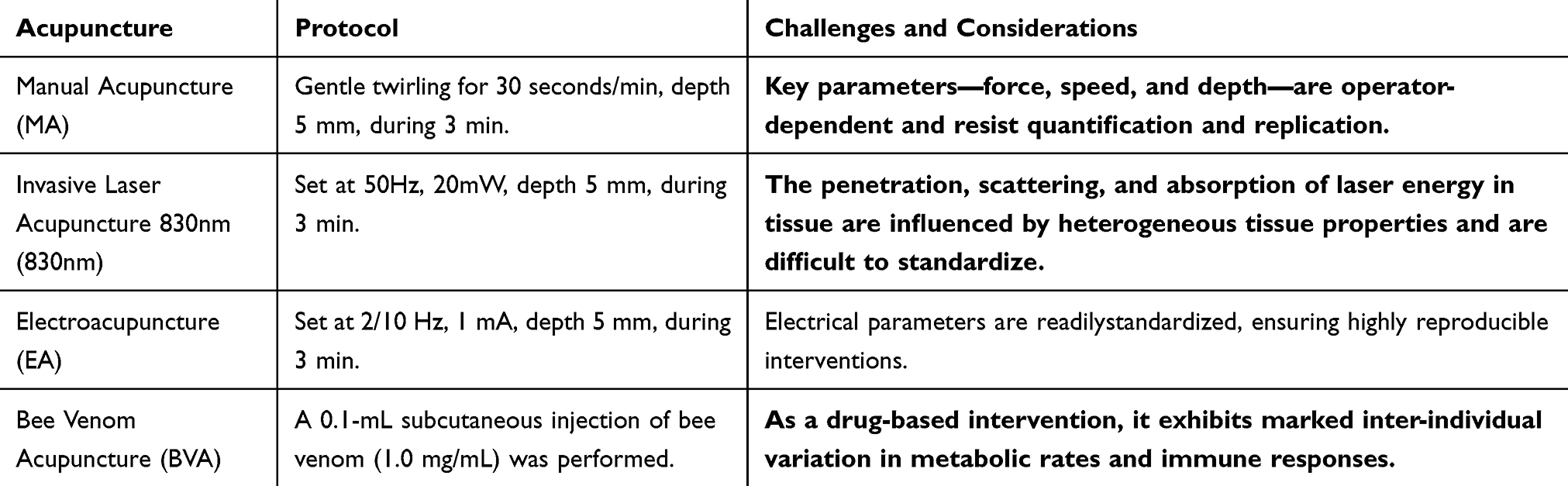 |
Table 1 Variable Control: Key Challenges for Four Acupuncture Methods |
The Challenge of Achieving “Equivalent Stimulation”
When different acupuncture techniques cause similar or the same levels of physiological response in the body, this is called “equivalent stimulation”. While this study finds LA and EA work better for reducing pain and improving joint structure, it does not provide ways to compare energy or stimulation intensity. So are their stimulation levels actually similar? For example, is a 1 mA electrical stimulus “equivalent” to a 20mW laser stimulus? If a bee venom injection causes local inflammation, is its “stimulus” even comparable to other techniques? Like, is the bee venom dose (1 mg/mL) biologically similar to a 1 mA electrical stimulus? These comparisons are clearly difficult. Also, MA had the smallest therapeutic effect. This might be because its stimulation intensity was lowest, but it could also come from different mechanisms of action.
We think these comparison studies work better as screening research rather than mechanism-based studies. If the goal of this study is to find “which acupuncture method is more effective”, it overlooks the fact that the optimal settings for each method may not have been properly set. This could make it harder to see the unique benefits of each of the four treatments, making clinical recommendations less accurate. To allow fair comparison, we have considered using an “intermediate conversion method” as a bridge to convert different stimulus types into a single, comparable biological or physical measure. For example:
Biological Indicator-Based Standardization
For example, certain serum biomarkers (including β-endorphin, IL-6, and TNF-α),7 skin temperature,8 electromyography, or changes in local blood flow9 could serve as “intermediate conversion indicators” to measure the “biological effect intensity” of different treatment approaches.
Determining the Marker’s Corresponding Endpoint
One “standard biological effect unit” could be “a 50% increase in paw withdrawal thresholds (PWT)”,10 “a 20% increase in local blood flow9 30 minutes post-treatment”, or “a 20% reduction in serum inflammatory mediators”. The parameters of each therapy would then be adjusted to produce this effect. This phase allows us to choose a stimulus intensity for each therapy that has a biological impact that is roughly equal.
Using a “Minimal Effective Stimulus” or “Sham Stimulus” as a Control
For example, to control for psychological effects, “sham laser” and “sham electroacupuncture” treatments are designed so no group experiences perceptual changes.11
Thus, we argue the value of this study lies in screening the effectiveness trends of different acupuncture modalities as a first step. However, since the stimulation methods and dosages are not directly comparable, the results should be viewed as exploratory rather than definitive conclusions. In short, using a “bioeffect-based intermediate conversion method” is a viable and necessary way to address the study’s limitations and boost its scientific rigor.
Conclusion
In conclusion, this work makes a valuable contribution to comparative acupuncture research designs. Extending it to include a range of treatment parameters and adding molecular biology tests to link macro-level efficacy with micro-level processes would enable a more balanced assessment of therapeutic methods. These improvements will significantly increase the study’s scholarly impact and therapeutic translation potential by reducing overinterpretation of trend data suggesting one therapy is superior to another.
We appreciate the learning and sharing opportunities your publication has provided, and we look forward to the publication of more excellent comparative efficacy research.
Author Contributions
Minzhe Wang analyzed and interpreted the data as well as wrote the manuscript.
Ye Xiangming and Minzhe Wang designed the study and edited the manuscript.
All authors made a significant contribution to the work reported, whether that is in the conception, study design, execution, acquisition of data, analysis and interpretation, or in all these areas; took part in drafting, revising or critically reviewing the article; gave final approval of the version to be published; have agreed on the journal to which the article has been submitted; and agree to be accountable for all aspects of the work.
Disclosure
The authors report no potential conflicts of interest in this letter.
References
1. Kamau VN, Yang S, Lee G, Kim J-H. Acupuncture modalities differentially modulate pain and joint damage in a rat model of knee osteoarthritis. J Pain Res. 2025;18:5377–5384. doi:10.2147/JPR.S555223
2. Song Y, Chen Y, Li J, Sun W, Jin F. Manual acupuncture enhanced therapeutic efficacy in vascular dementia rat model: systematic review and network meta-analysis. Syst Rev. 2025;14(1):80. doi:10.1186/s13643-025-02821-3
3. Jeon H, Oh J-Y, Ahn S, et al. Invasive laser acupuncture targeting muscle: a novel approach to protect dopaminergic neurons and reduce neuroinflammation in a brain of Parkinson’s disease model. Chin Med. 2025;20(1):59. doi:10.1186/s13020-025-01104-2
4. Bao R, Wang S, Liu X, et al. Neuromorphic electro-stimulation based on atomically thin semiconductor for damage-free inflammation inhibition. Nat Commun. 2024;15(1):1327. doi:10.1038/s41467-024-45590-8
5. Sriwidodo S, Suhandi C, Wilar G, Wathoni N. Bee venom in pharmacology: mechanistic insights from pro-inflammatory trigger to anti-inflammatory therapeutic agent. Biomed Pharmacother. 2025;192:118636. doi:10.1016/j.biopha.2025.118636
6. Schmidle P, Blank S, Altrichter S, et al. Basophil activation test in double-sensitized patients with hymenoptera venom allergy: additional benefit of component-resolved diagnostics. J Allergy Clin Immunol Pract. 2023;11:2890–2899.e2. doi:10.1016/j.jaip.2023.06.007
7. Chen W, Zhang X-N, Su Y-S, et al. Electroacupuncture activated local sympathetic noradrenergic signaling to relieve synovitis and referred pain behaviors in knee osteoarthritis rats. Front Mol Neurosci. 2023;16:1069965. doi:10.3389/fnmol.2023.1069965
8. Yang C, Peng X, Shi Y, et al. Umbilical therapy for promoting transdermal delivery of topical formulations: enhanced effect and underlying mechanism. Int J Pharm. 2024;652:123834. doi:10.1016/j.ijpharm.2024.123834
9. Yang R, Liu M, Tang C, Wang S. Effect of acupuncture combined with Western medicine on vertebrobasilar artery hemodynamics and efficacy in patients with CV: a systematic review and meta-analysis. Syst Rev. 2025;14:87. doi:10.1186/s13643-025-02810-6
10. Zhang Y, Wang Y, Zhao W, et al. Role of spinal RIP3 in inflammatory pain and electroacupuncture-mediated analgesic effect in mice. Life Sci. 2022;306:120839. doi:10.1016/j.lfs.2022.120839
11. Alexander JW, Karjalainen P, Ow LL, et al. CO2 surgical laser for treatment of stress urinary incontinence in women: a randomized controlled trial. Am J Obstet Gynecol. 2022;227:473.e1–473.e12. doi:10.1016/j.ajog.2022.05.054
 © 2025 The Author(s). This work is published and licensed by Dove Medical Press Limited. The
full terms of this license are available at https://www.dovepress.com/terms
and incorporate the Creative Commons Attribution
- Non Commercial (unported, 4.0) License.
By accessing the work you hereby accept the Terms. Non-commercial uses of the work are permitted
without any further permission from Dove Medical Press Limited, provided the work is properly
attributed. For permission for commercial use of this work, please see paragraphs 4.2 and 5 of our Terms.
© 2025 The Author(s). This work is published and licensed by Dove Medical Press Limited. The
full terms of this license are available at https://www.dovepress.com/terms
and incorporate the Creative Commons Attribution
- Non Commercial (unported, 4.0) License.
By accessing the work you hereby accept the Terms. Non-commercial uses of the work are permitted
without any further permission from Dove Medical Press Limited, provided the work is properly
attributed. For permission for commercial use of this work, please see paragraphs 4.2 and 5 of our Terms.