
Back to Journals » Advances in Medical Education and Practice » Volume 17

Attendance in a First-year Educational Support Program and Academic Performance Among Allied Health Students in Japan: A Retrospective Observational Study
Authors Ishihara R  , Murakami Y, Ono Y, Kunii M, Murakami K, Handa T, Kurachi M, Abe Y, Murakami H
Received 10 January 2026
Accepted for publication 16 April 2026
Published 22 April 2026 Volume 2026:17 595068
DOI https://doi.org/10.2147/AMEP.S595068
Checked for plagiarism Yes
Review by Single anonymous peer review
Peer reviewer comments 2
Editor who approved publication: Prof. Dr. Balakrishnan Nair
Rei Ishihara, Yuki Murakami, Yusuke Ono, Masataka Kunii, Kaya Murakami, Tadashi Handa, Masashi Kurachi, Yumiko Abe, Hirokazu Murakami
Department of Medical Technology and Clinical Engineering, Gunma University of Health and Welfare, Maebashi, Gunma, Japan
Correspondence: Rei Ishihara, Department of Medical Technology and Clinical Engineering, Gunma University of Health and Welfare, Maebashi, Gunma, Japan, Tel +81 27 253 0294, Fax +81 27 254 0294, Email [email protected]
Purpose: This study examined the association between attendance in a first-year educational support program and academic performance among students in allied health education.
Patients and Methods: This retrospective observational study was conducted at a single university and included 67 first-year students enrolled in clinical laboratory technology and clinical engineering programs during the first semester of 2025. Attendance was recorded across 11 sessions of the Introduction to Self-Learning Management program. The program was conceptually informed by self-regulated learning theory and included goal setting, individual learning activities, self-reflection, and instructor feedback. Academic performance was assessed using grade point average (GPA) at the end of the semester. Attendance was analyzed using multiple linear regression and independent-samples t-tests. In multiple linear regression analysis, attendance, academic foundation test score, and mathematics placement test score were included as explanatory variables.
Results: Multiple linear regression showed that attendance remained significantly associated with GPA after adjustment for baseline academic performance variables (β = 0.20, 95% confidence interval [CI] 0.06– 0.34, P = 0.005), whereas academic foundation test score and mathematics placement test score were not significantly associated with GPA. For descriptive comparison, students with one or fewer absences showed a significantly higher mean GPA than those with two or more absences (mean difference 0.89, 95% CI 0.43– 1.34, P = 0.0007, Cohen’s d = 1.02).
Conclusion: Attendance was positively associated with GPA in this sample. Because of the retrospective observational design and absence of direct self-regulated learning measures, causal interpretation is limited. Prospective studies with controlled designs are needed to determine whether attendance can serve as an indicator for identifying students requiring additional educational support.
Plain Language Summary: Many students in allied health programs, such as clinical laboratory technology and clinical engineering, experience difficulties during their first year at university. Developing effective study habits early is important, but educators often struggle to identify students who may need additional support.
This study was conducted to explore whether attendance in a first-year learning support program could be related to students’ academic performance. The program, called Introduction to Self-Learning Management, was designed to help students plan their learning, carry out study activities, reflect on their progress, and receive feedback. The researchers examined attendance records from 11 program sessions and compared them with students’ grade point averages (GPA) at the end of the semester.
The study included 67 first-year students at a Japanese university. The results showed that students who attended more sessions tended to achieve higher GPAs. In particular, students with few or no absences performed better academically than those who missed multiple sessions. Because this was an observational study, the results do not prove that attendance directly caused better academic performance.
These findings suggest that attendance may be associated with academic performance during the early stage of allied health education. Further studies are needed to determine whether attendance monitoring can help educators identify students who may benefit from additional academic support.
Keywords: attendance, academic performance, allied health education, first-year students, educational support
Introduction
Recently, first-year education has received increased attention as a foundation for improving students’ learning outcomes in health professions education.1 The initial period after university admission is a critical transition during which students experience substantial changes in learning environments, daily routines, and assessment standards. Students who fail to establish effective learning habits and self-efficacy during this stage are at increased risk of poor academic performance or early withdrawal. In contrast, early educational support has been associated with higher engagement, self-efficacy, and persistence, which may positively influence later academic and clinical performance.2,3 Early educational interventions are therefore considered essential for the long-term development of students in medical and allied health professions.
Multiple factors including learning habits, personality traits, motivation, and learning environments influence academic achievement.4 Among these factors, class attendance has been widely recognized as a key behavioral indicator of learning engagement, and previous studies have demonstrated its association with academic performance. Levshankova et al reported positive relationships between attendance and examination scores in nursing education,5 while Al Shenawi et al observed similar associations in a surgical clerkship setting.6 These findings suggest that attendance may reflect not only formal participation, but also students’ engagement in learning activities. Although attendance–performance associations have been reported in medical and nursing education, evidence remains scarce in clinical laboratory technology and clinical engineering education, where students are expected to develop autonomous learning habits, safety-oriented decision making, and readiness for interprofessional collaboration from an early stage of professional training.
Self-regulated learning (SRL) has been proposed as a theoretical framework for enhancing learning effectiveness. Panadero, drawing on the models of Zimmerman and Pintrich, described SRL as a cyclical process consisting of forethought (planning), performance (monitoring and strategy use), and self-reflection (evaluation and improvement).7 Through repeated engagement in this cycle, learners develop greater self-efficacy, sustained motivation, and adaptive learning strategies.8,9 Empirical studies have shown that SRL-related strategies, such as peer learning and help seeking, are positively associated with academic outcomes, including in flipped classroom environments.8 Moreover, SRL is not an innate ability but a skill that can be fostered through structured educational interventions.9
In Japan, as in many other countries, some students may enter higher education without sufficient experience in independent learning. A national report from the Ministry of Education, Culture, Sports, Science and Technology indicates that while study time outside school has increased among academically higher-performing secondary school students, it remains low among lower-performing students, and learning time among university students has shown limited improvement compared with past surveys.10 In addition, OECD data indicate that Japanese students spend less time on homework than the OECD average, suggesting relatively limited engagement in out-of-class learning activities.11 As a result, strengthening first-year education has been recognized internationally as a priority in higher education.2,3 Despite this need, relatively few studies have examined early-year educational programs specifically targeting students training to become clinical laboratory technologists and clinical engineers; professions that require autonomous, safety-oriented learning and readiness for interprofessional collaboration.
Against this background, at our institution, a first-year educational program entitled Introduction to Self-Learning Management was implemented and conceptually informed by self-regulated learning theory. The program was designed to support self-directed learning by guiding students through repeated cycles of goal setting, individual learning activity, reflection, and improvement. In each session, students set short-term learning goals using Google Forms, engaged in individual learning activities, reflected on their progress, and received aggregated instructor feedback in the following session. These components correspond to forethought, performance monitoring, and reflection processes described in self-regulated learning models. Accordingly, this study examined the association between attendance in a first-year educational support program and academic performance, measured by grade point average (GPA), during the first semester. By analyzing attendance patterns, this study sought to provide empirical evidence regarding early educational engagement in allied health education, with particular attention to the training of clinical laboratory technologists and clinical engineers. Because attendance and academic performance may both be influenced by pre-existing student characteristics such as prior academic achievement, motivation, and study habits, the observed association should be interpreted cautiously.
Materials and Methods
Study Design and Participants
This retrospective observational study included all first-year students enrolled in the clinical laboratory technology and clinical engineering programs during the first semester at a single university. The study population comprised all first-year students targeted by a first-year educational program conducted during scheduled free periods within the first-semester academic timetable. Attendance was expected for all students because the program was offered to the full first-year cohort; however, participation in each session was not mandatory because the program was conducted outside formal class hours. No formal a priori sample size calculation was performed, and all eligible students during the study period were included; therefore, the statistical power to detect smaller associations may have been limited. Baseline demographic and academic data were obtained from anonymized institutional records, including age (defined as age on April 1, 2025), gender, major, academic foundation test scores, and mathematics placement test scores.
Educational Program: Introduction to Self-Learning Management
Introduction to Self-Learning Management is a first-year educational program conceptually informed by self-regulated learning (SRL) theory. The program supports students in designing and managing their own learning through an experiential cycle consisting of goal setting, execution, reflection, and improvement. The program was conducted once a week for a total of 11 sessions during the first semester.
Each session followed a standardized structure. At the beginning of the session, students set learning goals by entering their plans (“what,” “how much,” and “how”) into a Google Form. This was followed by an individual learning period lasting 30–60 minutes, with the duration gradually extended from 30 minutes in the first session to 60 minutes by the fourth session and maintained thereafter. After the learning period, students conducted self-evaluation and reflection by recording their progress and challenges. At the beginning of the subsequent session, the instructor provided aggregated feedback based on the previous week’s reflections, highlighting common challenges such as time allocation, concentration, and adjustment of learning goals, together with practical examples for improvement. Individualized feedback was not provided.
Google Forms enabled standardized data collection, visualization of learning progress, and prompt reflection for subsequent instructional planning. The program aimed to foster four key skills: planning, execution, concentration, and self-improvement. Prior to program implementation, a survey of senior students was conducted to collect information on study strategies and reflections, and the summarized results were shared with first-year students to provide realistic examples of diverse learning approaches. The same instructor conducted all sessions using the same procedure throughout the program to ensure consistency across sessions.
Measures
Attendance
Attendance was recorded for all 11 sessions. Total attendance was analyzed as a continuous variable. For descriptive analyses, students were also categorized into two groups based on the number of absences: one or fewer absences (≤1 absence) and two or more absences (≥2 absences). This grouping was used to distinguish students with near-complete attendance from those with repeated absences and was intended for descriptive comparison only. Because the number of students with repeated absences was limited, this categorical comparison was interpreted descriptively.
Academic Performance
Academic performance was assessed using GPA at the end of the first semester. In the institutional grading system, grades were converted to numerical values as follows: S = 4, A = 3, B = 2, C = 1, and D = 0, and GPA was calculated by dividing the total weighted grade points by the number of registered credits.
Potential Sources of Bias
Because attendance was used as a behavioral indicator of engagement, unmeasured factors such as students’ motivation, study habits, or personal circumstances may have influenced both attendance and academic performance. Although baseline academic performance variables were included in multivariable analysis, residual confounding may remain.
Statistical Analysis
Attendance was analyzed as both a continuous and a categorical variable. To examine the association between attendance and GPA while accounting for baseline academic performance, multiple linear regression analysis was performed with GPA as the dependent variable and attendance, academic foundation test score, and mathematics placement test score as independent variables. Regression coefficients (β), 95% confidence intervals (CIs), and p values were reported. GPA was also compared descriptively between attendance groups using Welch’s two-sample t-test because of unequal group sizes between groups. Effect size was calculated using Cohen’s d and interpreted as small (0.2), medium (0.5), and large (0.8). As a sensitivity analysis, students were additionally recategorized using an alternative cutpoint (0 absences vs. ≥1 absence), and GPA was compared between groups using Welch’s two-sample t-test.
All statistical analyses were conducted using EZR (Saitama Medical Center, Jichi Medical University, Saitama, Japan), a graphical user interface for R (The R Foundation for Statistical Computing, Vienna, Austria), and Microsoft Excel (Microsoft Corp., Redmond, WA, USA). Variance inflation factors (VIFs) were examined to assess multicollinearity among explanatory variables, with values below 10 considered acceptable. A two-tailed p value of <0.05 was considered statistically significant.
Ethics Approval and Informed Consent
All attendance and academic data were anonymized before analysis. Questionnaire responses had originally been collected for educational reflection purposes but were excluded from research analysis in accordance with institutional ethical restrictions. This study was approved by the Research Ethics Committee of Gunma University of Health and Welfare (approval number: RS25-20). Written informed consent was obtained from all participants prior to the study. Participants were informed that participation was voluntary, that non-participation would not result in any disadvantage, and that they could withdraw at any time.
Results
Participants
A total of 68 first-year students were initially enrolled in the program. One student was excluded because of insufficient attendance data, resulting in a final analytic sample of 67 participants. The demographic and baseline academic characteristics of the participants are summarized in Table 1. Participants were enrolled in either the Clinical Laboratory Science or Clinical Engineering major. The mean age at baseline was 18.01 ± 0.12 years (range, 18–19). The mean academic foundation test score was 51.0 ± 9.5, and the mean mathematics placement test score was 41.3 ± 24.9.
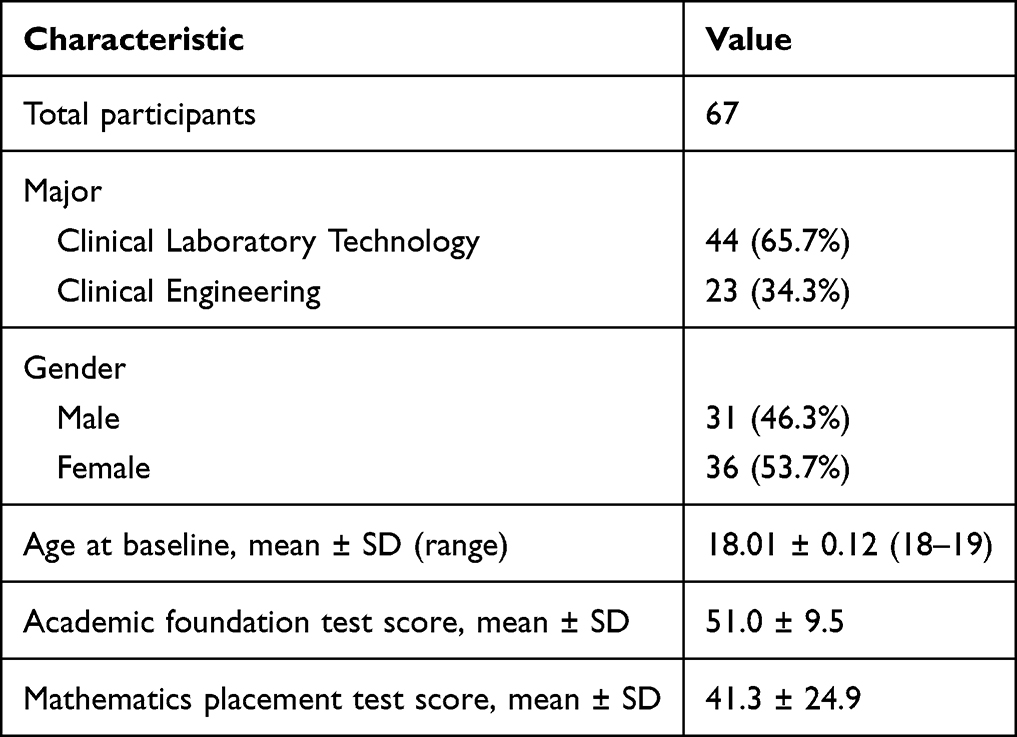 |
Table 1 Participant Characteristics of First-Year Students (n = 67) |
Association Between Attendance and Academic Performance
Multiple linear regression analysis showed that attendance remained significantly associated with GPA at the end of the first semester after adjustment for academic foundation test score and mathematics placement test score (β = 0.20, 95% confidence interval [CI] 0.06–0.34, P = 0.005; Table 2). In contrast, neither academic foundation test score nor mathematics placement test score showed a statistically significant association with GPA. The overall model explained 16% of the variance in GPA (adjusted R2 = 0.12). VIFs for all explanatory variables were below 2 (Attendance: 1.08; academic foundation test score: 1.46; mathematics placement test score: 1.39), indicating no substantial multicollinearity.
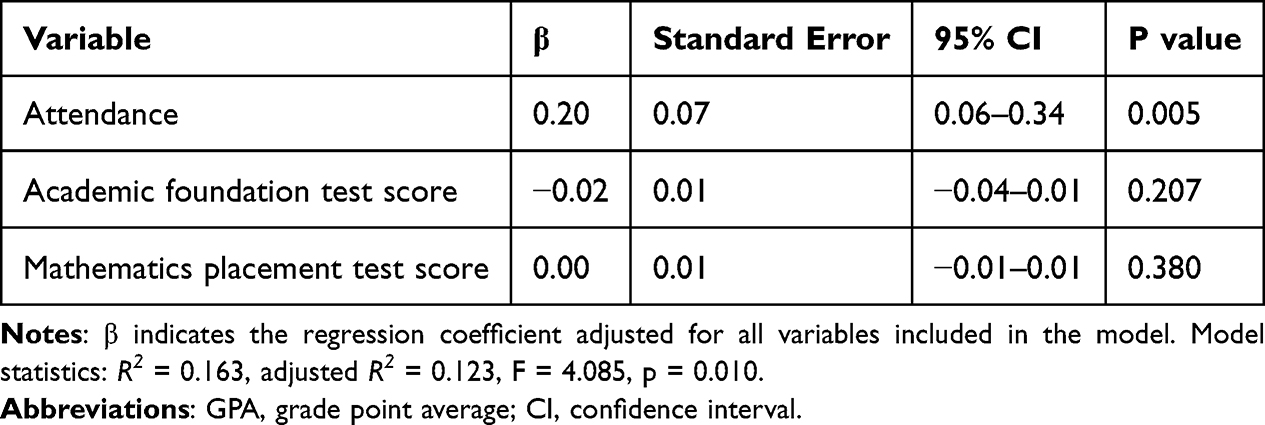 |
Table 2 Multiple Linear Regression Analysis of Attendance and Baseline Academic Factors Associated with GPA |
Comparison of GPA by Attendance Category
For descriptive analysis, students were categorized into two groups based on the number of absences. The mean GPA was 1.99 ± 0.85 (95% CI, 1.75–2.22) among students with one or fewer absences and 1.10 ± 0.59 (95% CI, 0.64–1.57) among students with two or more absences (Table 3). The mean difference in GPA between the two groups was 0.89 (95% CI 0.43–1.34).
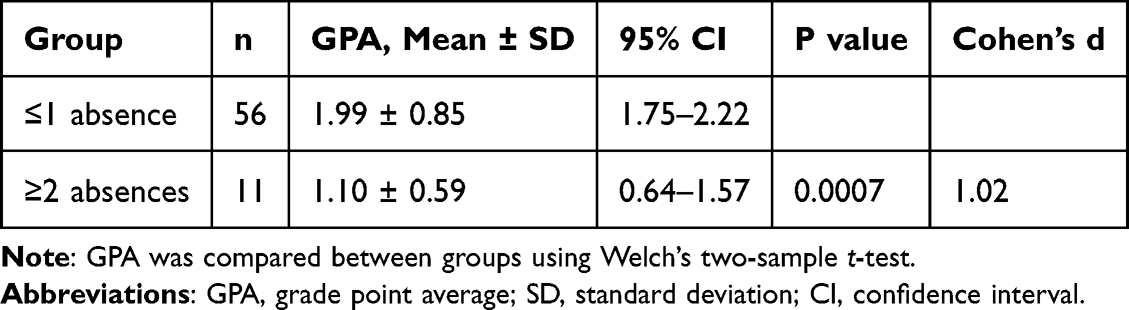 |
Table 3 Comparison of GPA by Overall Attendance Status Across 11 Sessions |
Welch’s two-sample t-test showed a statistically significant difference in GPA between the two groups (p = 0.0007; Figure 1). The effect size was large, with a Cohen’s d of 1.02. Because the higher-absence group was small, this categorical comparison was interpreted descriptively.
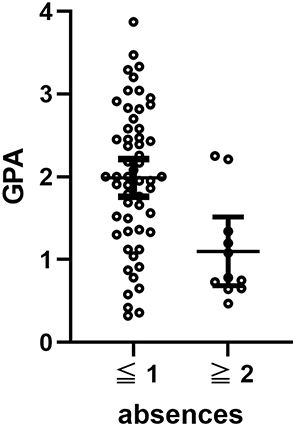 |
Figure 1 Comparison of grade point average by overall attendance status across 11 sessions. Students were categorized into two groups based on the number of absences across 11 sessions: one or fewer absences (≤1 absence) and two or more absences (≥2 absences). GPA was measured at the end of the first semester. The group with one or fewer absences showed a significantly higher GPA than the group with two or more absences (P = 0.0007, Welch’s two-sample t-test). Error bars represent 95% confidence intervals. |
As a sensitivity analysis, students were recategorized using an alternative cutpoint: no absences (0 absences) versus one or more absences (≥1 absence). The mean GPA was 2.06 ± 0.93 (95% CI, 1.77–2.35) among students with no absences (n = 42) and 1.48 ± 0.66 (95% CI, 1.20–1.75) among students with one or more absences (n = 25) (Table 4). Welch’s two-sample t-test showed a statistically significant difference between the two groups (mean difference 0.58, 95% CI 0.19–0.97, P = 0.004, Cohen’s d = 0.67), consistent with the primary analysis.
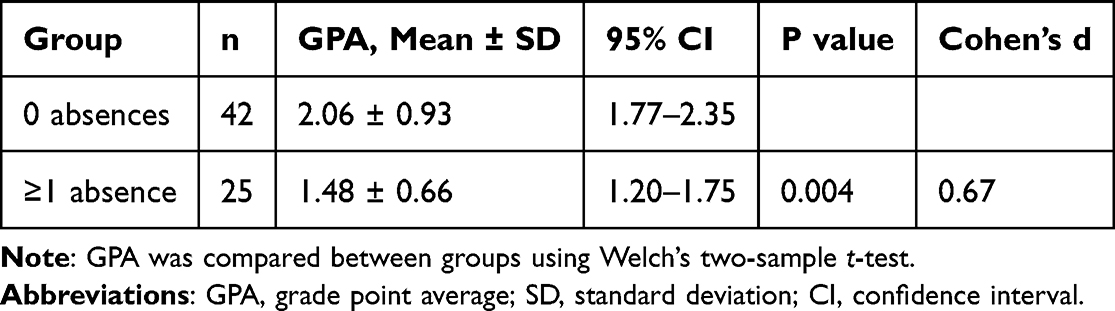 |
Table 4 Sensitivity Analysis: Comparison of GPA by Alternative Attendance Cutpoint |
Discussion
This study examined the association between attendance and academic performance, measured by GPA, in a first-year educational program conceptually informed by self-regulated learning (SRL) theory for students training to become clinical laboratory technologists and clinical engineers. Higher attendance was associated with higher GPA at the end of the first semester, both when attendance was analyzed as a continuous variable and when students were grouped by absence frequency. These findings are consistent with previous studies in medical and nursing education reporting positive associations between attendance and academic performance.5,6
Attendance has been widely discussed as a behavioral indicator of learner engagement rather than merely an administrative requirement. Regular participation in educational activities has been linked to academic outcomes in prior studies.5,6 In the present study, the observed association may reflect multiple overlapping factors, including study habits, motivation, time management, and other stable student characteristics during the early stage of university education. Recent work has also highlighted that habitual learning behaviors play an important role in students’ self-regulated learning processes during university adaptation.12
The educational program examined in this study was conceptually grounded in SRL theory. SRL models proposed by Zimmerman and Pintrich emphasize cyclical processes of planning, performance, and reflection, which are associated with effective learning behaviors across educational settings.8,9 In addition, SRL has been recognized as an important framework for learning adaptation in clinical and professional training environments.13 However, because SRL-related constructs were not directly measured in the present study, SRL theory should be regarded as a conceptual background rather than a direct explanatory mechanism for the observed association.
Previous research has shown that early educational support may facilitate students’ adaptation to university learning environments by enhancing engagement, self-efficacy, and persistence.2,3 Although attendance in a structured first-year program was associated with GPA in this study, the retrospective observational design and absence of a comparison group do not allow conclusions regarding whether the program itself improved academic performance.
From an educational perspective, the present findings suggest that attendance, as a simple behavioral indicator, may be associated with academic performance in a first-year professional healthcare training context. Attendance should be interpreted cautiously, as absences may occur for legitimate reasons and do not always reflect students’ motivation or learning behaviors. In addition, although the between-group comparison showed a large effect size (Cohen’s d = 1.02), this estimate should be interpreted cautiously because of the small size of the higher-absence group and the possibility of residual confounding.
Recent educational literature emphasizes a shift from traditional knowledge-transmission approaches toward learner-centered and coaching-oriented models that support students’ autonomous learning and reflective processes.14,15 Although instructional strategies were not directly evaluated in this study, the structure of the program included elements such as goal setting, reflection, and aggregated feedback that are conceptually consistent with these educational principles.
Compared with existing research that has primarily focused on medical schools and nursing education,5,6 this study provides empirical data from allied health education, specifically in the training of clinical laboratory technologists and clinical engineers, where evidence has remained scarce regarding attendance and academic performance during the first semester. Because these professions require systematic, autonomous, and safety-oriented learning, early engagement in structured educational activities may be particularly relevant for students’ adaptation to this educational context.
Several limitations should be acknowledged. First, this study was conducted at a single institution with a relatively small sample size, which may limit transferability to other educational settings. Second, academic performance was assessed solely using GPA without incorporating other relevant factors such as learning motivation, metacognitive skills, or direct measures of SRL behaviors. Third, although attendance remained significantly associated with GPA after adjustment for baseline academic scores, much of the variance in GPA remained unexplained, suggesting that other unmeasured factors may contribute substantially to academic performance. Fourth, the retrospective observational design precludes causal inference. Future prospective studies should examine whether attendance remains associated with academic outcomes after incorporating direct measures of SRL, motivational factors, and indicators of early academic adaptation.
Conclusion
This retrospective observational study demonstrated an association between attendance in a first-year educational program conceptually informed by self-regulated learning theory and academic performance, measured by GPA, among students training to become clinical laboratory technologists and clinical engineers. Students with higher attendance tended to achieve higher GPAs at the end of the first semester, even after adjustment for baseline academic scores.
Because this study was conducted at a single institution with a relatively small sample size, used GPA as the sole indicator of academic performance, and did not directly measure self-regulated learning or motivational factors, causal inference cannot be made regarding whether the program itself influenced academic performance or whether attendance reflected pre-existing student characteristics.
Future prospective multi-institutional studies should incorporate direct measures of self-regulated learning, motivation, and early academic adaptation to further clarify factors associated with academic performance in early allied health education.
Data Sharing Statement
The datasets used and/or analyzed during the current study are available from the corresponding author upon reasonable request.
Acknowledgments
The authors would like to sincerely thank the students who participated in the Introduction to Self-Learning Management program and Yasumasa Totsuka, Head Director of the Support Center for Higher Education at Gunma University of Health and Welfare, for their valuable educational support during the implementation of the program.
Author Contributions
All authors made a significant contribution to the work reported, whether that is in the conception, study design, execution, acquisition of data, analysis and interpretation, or in all these areas; took part in drafting, revising or critically reviewing the article; gave final approval of the version to be published; have agreed on the journal to which the article has been submitted; and agree to be accountable for all aspects of the work.
Funding
This research received no specific grant from any funding agency in the public, commercial, or not-for-profit sectors.
Disclosure
The authors report no conflicts of interest in this work.
References
1. Picton A, Greenfield S, Parry J. Why do students struggle in their first year of medical school? A qualitative study of student voices. BMC Med Educ. 2022;22(1):100. doi:10.1186/s12909-022-03158-4
2. van Rooij ECM, Jansen EPWA, van de Grift WJCM. First-year university students’ academic success: the importance of academic adjustment. Eur J Psychol Educ. 2018;33(4):749–9. doi:10.1007/s10212-017-0347-8
3. van Lamoen PM, Meeuwisse M, Hiemstra AMF, Arends LR, Severiens SE. Supporting students’ transition to higher education: the effects of a pre-academic programme on sense of belonging, academic self-efficacy, and academic achievement. Eur J High Educ. 2024;43:340–361. doi:10.1080/21568235.2024.2331122
4. Aljaffer MA, Almadani AH, AlDughaither A, et al. The impact of study habits and personal factors on the academic achievement performances of medical students. BMC Med Educ. 2024;24(1):888. doi:10.1186/s12909-024-05889-y
5. Levshankova C, Hirons D, Kirton JA, Knighting K, Jinks AM. Student nurse non-attendance in relation to academic performance and progression. Nurse Educ Today. 2018;60:151–156. doi:10.1016/j.nedt.2017.10.006
6. Al Shenawi H, Yaghan R, Almarabheh A, Al Shenawi N. The relationship between attendance and academic performance of undergraduate medical students during surgical clerkship. BMC Med Educ. 2021;21(1):396. doi:10.1186/s12909-021-02833-2
7. Panadero E. A review of self-regulated learning: six models and four research directions. Front Psychol. 2017;8:422. doi:10.3389/fpsyg.2017.00422
8. Zheng B, Zhang Y. Self-regulated learning: the effect on medical student learning outcomes in a flipped classroom environment. BMC Med Educ. 2020;20(1):100. doi:10.1186/s12909-020-02023-6
9. Higgins NL, Rathner JA, Frankland S. Development of self-regulated learning: a longitudinal study on academic performance in undergraduate science. Res Sci Technol Educ. 2023;41(4):1242–1266. doi:10.1080/02635143.2021.1997978
10. Ministry of Education, Culture, Sports, Science and Technology. Current Status and Issues Related to Education. Available from: https://www.mext.go.jp/en/policy/education/lawandplan/title01/detail01/sdetail01/1373818.html.
11. Organisation for Economic Co-operation and Development. How Is Learning Time Organised in Primary and Secondary Education? Paris: OECD Publishing; 2016. doi:10.1787/5jm3tqsm1kq5-en
12. David L, Biwer F, Crutzen R, de Bruin A. The challenge of change: understanding the role of habits in university students’ self-regulated learning. High Educ. 2024;88(5):2037–2055. doi:10.1007/s10734-024-01199-w
13. van Houten-Schat MA, Berkhout JJ, van Dijk N, et al. Self-regulated learning in the clinical context: a systematic review. Med Educ. 2018;52(10):1008–1015. doi:10.1111/medu.13615
14. King SM, Carnicer Hijazo R, Anas S, Low-Beer N. Academic coaching as a pedagogy to facilitate the navigation of complexity across the health professions education continuum. Front Med. 2025;12:1523741. doi:10.3389/fmed.2025.1523741
15. Bettinger EP, Baker RB. Effects of student coaching: an evaluation of a randomized experiment on student advice. Educ Eval Policy Anal. 2014;36(1):3–19. doi:10.3102/0162373713500523
 © 2026 The Author(s). This work is published and licensed by Dove Medical Press Limited. The
full terms of this license are available at https://www.dovepress.com/terms
and incorporate the Creative Commons Attribution
- Non Commercial (unported, 4.0) License.
By accessing the work you hereby accept the Terms. Non-commercial uses of the work are permitted
without any further permission from Dove Medical Press Limited, provided the work is properly
attributed. For permission for commercial use of this work, please see paragraphs 4.2 and 5 of our Terms.
© 2026 The Author(s). This work is published and licensed by Dove Medical Press Limited. The
full terms of this license are available at https://www.dovepress.com/terms
and incorporate the Creative Commons Attribution
- Non Commercial (unported, 4.0) License.
By accessing the work you hereby accept the Terms. Non-commercial uses of the work are permitted
without any further permission from Dove Medical Press Limited, provided the work is properly
attributed. For permission for commercial use of this work, please see paragraphs 4.2 and 5 of our Terms.