
Back to Journals » Advances in Medical Education and Practice » Volume 17
Association of the Transition to Online Examination with Grading Patterns in Medical Basic Sciences: A Single-Center Retrospective Study Before, During, and After the COVID-19 Pandemic
Authors Abed M, Rashidi F  , Zare S , Adabi K, Rajaei S, Meysamie A
Received 24 March 2026
Accepted for publication 4 July 2026
Published 9 July 2026 Volume 2026:17 610755
DOI https://doi.org/10.2147/AMEP.S610755
Checked for plagiarism Yes
Review by Single anonymous peer review
Peer reviewer comments 2
Editor who approved publication: Dr Md Anwarul Azim Majumder
Mohammad Abed,1,* Farhang Rashidi,1,2,* Sarina Zare,1 Khadijeh Adabi,3 Samira Rajaei,4 Alipasha Meysamie5
1School of Medicine, Tehran University of Medical Sciences, Tehran, Iran; 2Iranian Center of Neurological Research, Neuroscience Institute, Tehran University of Medical Sciences, Tehran, Iran; 3Department of Obstetrics and Gynecology, School of Medicine, Tehran University of Medical Sciences, Tehran, Iran; 4Department of Immunology, School of Medicine, Tehran University of Medical Sciences, Tehran, Iran; 5Department of Preventive and Community Medicine, School of Medicine, Tehran University of Medical Sciences, Tehran, Iran
*These authors contributed equally to this work
Correspondence: Alipasha Meysamie, Department of Preventive and Community Medicine, School of Medicine, Tehran University of Medical Sciences, Tehran, Iran, Email [email protected]
Background: The COVID-19 pandemic led to a sudden shift from in-person to online teaching and evaluation, prompting concerns about academic integrity, changes in grading practices, and potential grade inflation. This study examines temporal trends in grade distributions in medical Basic Science courses at Tehran University of Medical Sciences (TUMS) across three phases: pre-pandemic, during-pandemic, and post-pandemic.
Methods: This retrospective study examined the academic results of Doctor of Medicine students admitted to TUMS from the summer semester of 2019 to the winter semester of 2022. Grades were categorized by the timing of the Comprehensive Basic Science Examination (CBSE) as pre-pandemic (through March 2020), during-pandemic (April 2020 to March 2022), and post-pandemic (April 2022 to March 2024), depending on whether TUMS conducted in-person or online activities. Outcome metrics were course-specific grades, cumulative Basic Science courses grade point average (GPA), and CBSE scores.
Results: The GPA was available for 1510 students, and CBSE scores were available for 1,310 students. The mean GPA of Basic Science courses significantly decreased from 16.97 ± 1.38 pre-pandemic to 16.24 ± 1.49 post-pandemic (P < 0.001), indicating an overall post-pandemic decline in cumulative Basic Science performance. In contrast, CBSE scores showed a non-significant decline (129.30 ± 23.81 vs. 122.00 ± 28.95; P = 0.09). Course-level patterns were heterogeneous: several courses (Epidemiology, Medical English, Physiology, Virology) showed transient increases in top grades during the pandemic, whereas other courses (Mycology and Anatomy) showed ceiling effects, and still others (Parasitology and Microbiology) showed net declines (all P < 0.001).
Conclusion: The transition to virtual assessments at Tehran University of Medical Sciences was not associated with sustained, system-wide grade inflation; instead, observed grading patterns were heterogeneous and course-specific. While several lecture-style courses showed transient increases during remote assessment, other courses showed ceiling effects or net declines, and overall Basic Science GPA decreased post-pandemic. These findings support the design of targeted assessments or security improvements. However, interpretation is limited by the single-center design, missing course-level data, and small pre-pandemic subgroups in several course-specific analyses.
Keywords: COVID-19, medical education, grade inflation, virtual assessment
Introduction
The global outbreak of COVID-19 profoundly disrupted numerous aspects of daily life, particularly activities that depend on human gatherings, which faced substantial modifications or outright cancellation.1 The education sector, encompassing schools, universities, and academic institutions, underwent substantial transformations.2 Prominent among these was the shift from traditional in-person classrooms to virtual learning environments, as well as the transition of examinations to an online format.3 The novelty of this educational and assessment method, combined with the recently developed online examination platforms, created numerous challenges for students, university administrators, and instructors.4,5 These challenges included concerns about a potential increase in academic dishonesty, changes in grading patterns, and variations in students’ academic performance.6,7 In this context, grade inflation refers to an increase in awarded grades or the proportion of top grades that is not accompanied by clear evidence of a corresponding increase in student achievement or competence.
Research on virtual examinations highlighted that the anxiety of achieving higher grades led some students to engage in academic dishonesty during online tests.8,9 In response, universities adopted strategies to reduce students’ stress and address their concerns.10 Given the various methods available for academic dishonesty in online examinations, various strategies have been implemented to enhance their security and integrity. These measures include limiting the overall exam duration or timing individual sections, displaying one question at a time, randomizing the order of questions, and restricting the ability to revisit previous questions.11 During the pandemic, TUMS shifted most teaching activities and course-based assessments in the Basic Science phase to online formats. At the same time, high-stakes comprehensive examinations, such as the Comprehensive Basic Science Examination (CBSE), continued to be administered in person due to their role in medical student progression.
TUMS is one of the major medical education centers in Iran and follows the national structure of Iranian medical education, which is organized into four sequential phases. It begins with a Basic Sciences program, covering subjects such as anatomy, biochemistry, and physiology, which concludes with a CBSE. Students who pass then proceed to the Pathophysiology phase, where they delve deeper into disease mechanisms and clinical theory. Next comes the Externship, during which students rotate through hospital departments under supervision to develop practical skills. Upon successful completion of a second comprehensive exam, they advance to the internship, assuming graduated responsibilities in patient care across various specialties before full licensure.12–14 Evaluating the quality and accuracy of this method is necessary to ensure fairness and to determine how these grades impact students’ overall grade point averages (GPAs). This would help understand the effectiveness of online exams, identify potential instances of dishonesty, and find a fair way to include these grades in students’ final records. GPA and CBSE may respond differently to educational disruption because GPA is institution-based and course-specific, whereas CBSE is a national standardized examination. Moreover, other studies have reported significant grade inflation during COVID-19 compared to the pre-pandemic era.15,16
While several studies have suggested widespread grade inflation during the pandemic, results have been inconsistent across institutions and academic disciplines, and fewer studies have distinguished course-level grading changes from system-wide changes in medical Basic Science performance. Variations in grading outcomes may stem from differences in assessment design, student preparedness, and institutional policy adaptations during remote learning. Understanding these dynamics is particularly relevant in medical education, where evaluation standards critically influence student progression and professional readiness. A recent nationwide study by Rashidi et al demonstrated a moderate correlation between pre-clinical GPAs and CBSE scores among Iranian medical students, identifying Anatomy, Physiology, Epidemiology, and Virology as the strongest predictors.17 This highlights the predictive value of basic science performance on subsequent licensing examinations and underscores the importance of maintaining rigorous assessment standards during educational disruptions.
The transition to online teaching and examinations during the pandemic was mandated for universities, but no comprehensive study or assessment of its implications was conducted beforehand. Consequently, the return to in-person examinations following the end of the pandemic has limited the benefits that can be achieved through online and blended courses and online examinations. Therefore, it seems necessary to assess temporal changes in students’ academic performance during the shift to virtual teaching and examinations due to COVID-19 to better understand the advantages and disadvantages of online education and assessments for the future. This evaluation can also help identify strategies to address the challenges of this educational approach and improve its overall quality. Thus, in this study, we investigated temporal trends in Basic Science course grades, cumulative GPA, and CBSE scores among medical students at the Faculty of Medicine, Tehran University of Medical Sciences, before, during, and after the COVID-19 pandemic.
Material and Methods
The current retrospective cohort study aimed to evaluate the differences in outcomes of Basic Science courses before, during, and after the COVID-19 pandemic among Doctor of Medicine students at Tehran University of Medical Sciences (TUMS). The study protocol received approval from the Ethics Committee of TUMS (ethics code: IR.TUMS.REC.1401.1234), and the ethics committee waived the requirement for individual informed consent due to the use of anonymized educational records. The overall methodology is the same as that of a recently published paper on this database;18 however, the necessary details are presented again.
Definitions and Clarifications
The CBSE is a national standardized evaluation of medical students’ integrated understanding of foundational sciences before they commence clinical training, and it usually takes place two and sometimes up to four times a year. It consists of 200 multiple-choice questions (MCQs), with 1 point per correct answer and no penalty for incorrect ones. Students need to pass the exam to proceed to the further stages of the medical curriculum. The minimum passing score (cut score) set by CBSE is independently determined for each exam administration, in accordance with the scoring process and national guidelines. The cut score is set to 70% of the mean score of the top 5% of examinees for a specific administration; therefore, it is not intended for comparison across exam dates.19 Examinees who achieved scores below the designated cut score for this administration were categorized as not meeting the passing criteria for that attempt.
The GPA, on the other hand, serves as a cumulative quantitative measure of academic performance, determined by the weighted mean of grades earned in all completed courses throughout all semesters. The contribution of each course to the GPA is proportional to its assigned credit value, whereby courses with higher credit hours exert a greater influence on the overall average. The pass/fail thresholds for each semester’s GPA to proceed to higher levels in the curriculum were set at 12, the median score range due to traditional faculty regulations. However, the threshold was 10 per course during the basic science phase of the medical curriculum. Notably, almost all formative assessments during the basic science phase of the medical curriculum are MCQs, similar to CBSE. The GPA serves as an indicator of students’ academic performance in specific courses and of their overall consistency and advancement within the curriculum.
Study Setting and Data Collection
After obtaining ethical approval and necessary authorizations, data were requested from the Office of General Practitioner Medical Education at TUMS. The raw data were presented in seven Excel files, each representing a distinct student cohort admitted from the summer semester of 2019 to the winter semester of 2022. The files included demographic data, course grades, GPAs, and CBSE scores, and were merged into a single final datasheet despite structural differences and challenges. The primary outcome variables included the raw and categorized scores for each Basic Science course, classified as follows: A (≥17), B (≥14 and <17), C (<14), and the CBSE score. Variables related to pandemic exposure include the timing of the CBSE attempt in relation to the COVID-19 pandemic, categorized as pre-pandemic (up to March 2020), during-pandemic (up to March 2022), and post-pandemic (up to March 2024). In other words, students were admitted between the summer semester of 2019 and the winter semester of 2022, while academic outcomes were followed through March 2024 because completion of the Basic Science phase and participation in the CBSE occurred after admission and therefore extended beyond the enrollment period for some cohorts.
Inclusion and Exclusion Criteria
This study encompassed all students enrolled in the Basic Science phase of the Doctor of Medicine program at Tehran University of Medical Sciences from the summer semester of 2019 (Iranian solar calendar: 1397) to the winter semester of 2022 (Iranian solar calendar: 1400). To be eligible for inclusion, students must have (1) a valid university student identifier, (2) attempted CBSE at least once, and (3) had complete records for each of the core Basic Science course grades (Physiology, Biochemistry, Microbiology, Parasitology, Mycology, Virology, Anatomy, Health Service Principles, Epidemiology, Medical English, and Islamic Studies), the official cumulative Basic Science’s GPA, and the CBSE score. Students were excluded if their academic files did not contain a valid identifier or if their CBSE timing during the pandemic (pre-, during-, or post-) could not be determined. Records lacking demographic information (date of birth or gender) or containing multiple missing core course grades were excluded from the primary temporal analyses. Students who withdrew from the program prior to CBSE or were marked as “absent” on the day of their CBSE attempt were excluded from analyses.
Data Processing and Standardization
Data cleaning and standardization were performed to achieve structural uniformity across cohorts. The completed dataset consisted of two primary files:
- The initial file contained the student ID, admission semester, and grades for the essential Basic Science courses, including Physiology, Biochemistry, Microbiology, Parasitology, Mycology, Virology, Anatomy, Health Service Principles, Epidemiology, Medical English, and Islamic Studies. A GPA was calculated for each student using the available course grades; however, this computed GPA was excluded from analyses because the official cumulative GPA was available in the second file.
- The second file included student ID, date of birth (in the Solar Hijri calendar for Iranian students and Gregorian for international students), gender, nationality, CBSE attempt number, year and semester of admission, examination date, CBSE result (pass, fail, or absent), CBSE score, and official cumulative GPA for the Basic Science phase.
The two files were imported into SPSS version 26 and merged utilizing the student ID as the key variable.
Statistical Analysis
One-way ANOVA was employed to analyze continuous outcome variables, such as course grades, GPA, and CBSE scores, across different admission years and semesters. Independent-samples t-tests evaluated differences by gender, and ANOVA evaluated differences by pandemic period classification. Chi-square tests were employed to assess the relationships between categorized grades (A, B, C) and independent categorical variables. A binary logistic regression analysis was conducted to investigate the relationship between the time period and GPA, controlling for gender. A significance level of P < 0.05 was utilized for all statistical analyses. All statistical analyses were performed using SPSS version 26. Missing data were handled using an available-case approach; therefore, students with available data for a given outcome were included in the corresponding analysis, while records with missing values for that variable were excluded. No multiple imputation was performed. Because missingness may not have been completely random, particularly for course-specific grades, the results of course-level analyses should be interpreted cautiously.
Results
Descriptive Statistics
Of 1,727 records, complete cumulative GPA data were available for 1,679 students (97.22%), while course-specific grades ranged from 726 to 1,004 records per course (42.03% to 58.13%). The timing of the CBSE in relation to the pandemic was established for 1,510 students (87.5%) and utilized for temporal analyses. Eventually, 1,510 (87.43%) records provided GPA data, and 1,310 (75.85%) provided CBSE score data regarding timing during the COVID-19 pandemic, forming the sample for our pre-, during-, and post-pandemic analyses. Some records lacked student IDs or course grades, especially for international students, and were therefore excluded from the analyses.
The Basic Science GPA declined significantly across the three periods, as indicated by a one-way ANOVA (P < 0.001). The mean GPAs were 16.97 ± 1.38 pre-pandemic, 16.89 ± 1.39 during the pandemic, and 16.24 ± 1.49 post-pandemic reopening, resulting in an overall mean of 16.60 ± 1.47. In contrast, CBSE scores exhibited a non-significant downward trend (129.30 ± 23.81 vs. 124.11 ± 25.69 vs. 122.00 ± 28.95; P = 0.09), and the age at examination did not vary by period (20.94 ± 2.38 vs. 21.05 ± 2.11 vs. 20.94 ± 1.84 years; P = 0.58) (Table 1).
 |
Table 1 GPA and CBSE Scores by Pandemic Phase (N = 1,510) |
Grade Distributions and Trend Analyses
Different temporal patterns were identified. Some courses that previously had low “A” rates prior to the pandemic experienced significant, temporary increases during the pandemic. These courses subsequently reverted to or dropped below baseline levels, indicative of transient grade inflation (Physiology, Medical English, Epidemiology, Virology; all P < 0.001). Some other courses that exhibited high “A” grade rates prior to the pandemic experienced only modest increases or stability during the pandemic, followed by a decline post-pandemic. This pattern aligns more closely with ceiling effects or cohort or exam differences rather than a significant inflationary surge (Mycology and Anatomy; both P < 0.001).
Additionally, some courses showed net decreases over the analyzed periods (Parasitology and Microbiology; both P < 0.001). Finally, Biochemistry, Health Service Principles, and Islamic Studies exhibited no significant temporal changes. The pandemic’s impact on A-grade rates varied by course, suggesting distinct underlying mechanisms, such as transient inflation, ceiling effects, or variability across cohorts and exams (Table 2).
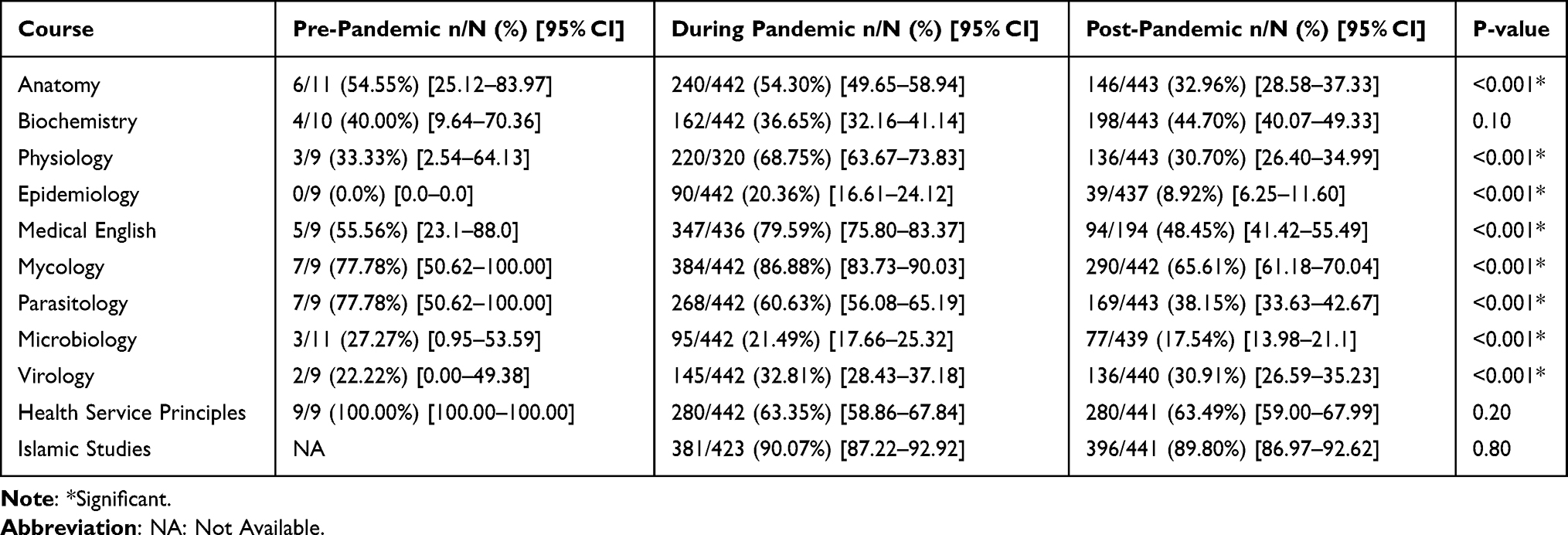 |
Table 2 Grade A Distributions |
Grade Inflation Assessment
Before the pandemic, 56.86% of students achieved a GPA of 17 or higher; during the pandemic, this figure decreased to 53.51%, and it further declined to 35.62% following the post-pandemic reopening. Additionally, the percentage of students with GPAs below 14 increased from 3.53% to 8.84% across these timeframes. This pattern reflects a slight decrease in mean GPA and indicates no overall inflation in cumulative performance after the transition to virtual assessments; conversely, a different trend was observed following the pandemic (Table 3).
 |
Table 3 Distribution of GPA Categories Across Pandemic Periods (N = 1,510) |
According to the binary logistic regression analysis, the pandemic period was significantly associated with the likelihood of achieving a GPA of “A” (P < 0.001). Compared with the pre-pandemic period, the during-pandemic period was not significantly associated with an “A” grade GPA (P = 0.34). In contrast, the post-pandemic period was associated with significantly lower odds of achieving a GPA of “A” (OR = 0.42, 95% CI: 0.31–0.56; P < 0.001). Gender was not significantly associated with GPA of “A” after adjustment for the pandemic period (P = 0.48). These findings suggest that differences in “A” grade GPA were mainly associated with the pandemic period rather than gender.
Discussion
Trends in Specific Courses
This study indicates that the shift to virtual assessment was not associated with enduring, system-wide grade inflation at TUMS; however, observed course-level grading patterns were heterogeneous. We observed transient spikes in A-rate proportions in several courses, notably Epidemiology and Medical English, as well as in Physiology and Virology. Upon the resumption of in-person exams, many of these transient increases declined, suggesting that the observed patterns were temporary rather than sustained. These temporary, reversible results are consistent with those of previous studies.7,20
The pedagogical characteristics of each course may help explain differences in observed grading patterns. Courses characterized by objective, multiple-choice formats (such as Epidemiology, Physiology, and Virology) or language-based components (such as Medical English) showed increases in top-grade proportions during the pandemic. However, this study did not directly measure access to unauthorized resources or academic dishonesty. In contrast, some lab-oriented subjects exhibited net decreases (Parasitology, Microbiology) or ceiling-effect patterns (Mycology) rather than pandemic-driven inflation; these findings may reflect course-specific differences, cohort variability, or exam differences, although the present data cannot determine the underlying causes. Additionally, the course format may have contributed to differences in grading patterns across subjects. As in the present study, the pre-clinical courses assessed are almost all lecture-based and can be easily delivered virtually, unlike clinical courses, which pose greater challenges. The lack of in-person labs or practicums in courses like Microbiology and Mycology may have influenced performance in these subjects, although this explanation was not directly assessed in the present study. Moving lab-based disciplines online may be associated with different grading patterns than moving lecture-based courses online.
The observed course-specific grading patterns suggest that institutions may consider robust proctoring and assessment security, particularly in subjects that lend themselves to open-book formats. Institutions may implement online proctored platforms that use AI-based anomaly detection, enforce mandatory proctoring protocols, or employ randomized question banks to reduce unauthorized collaboration.21 Furthermore, transitioning from traditional MCQs to alternative assessment formats, such as short-answer questions, matching questions, or other methods that require higher cognitive engagement and knowledge, may yield advantages. It is worth noting that short-answer questions in examinations were omitted from online exams during the pandemic due to technical difficulties.
Trends in GPA
Our analyses show a statistically significant decline in cumulative Basic Science GPA across phases (mean 16.97 ± 1.38 pre-pandemic and 16.24 ± 1.49 post-pandemic; P < 0.001). Our cohort’s lack of widespread grade inflation contrasts with specific higher education reports indicating modest increases in GPA related to the pandemic.15
A hierarchical mixed-effects analysis conducted across various U.S. universities indicated minimal grade increases during emergency remote teaching, which predominantly returned to normal following the pandemic.15 A comprehensive study conducted across multiple Turkish universities identified a modest increase in top grades during the COVID-19 pandemic, which was considered context-specific.10,20
The decline in GPA during the pandemic compared to pre-pandemic levels may reflect disruptions to traditional learning, reduced engagement, exam variability, or mental health challenges that affect motivation.22 However, these factors were not directly measured in the present study. The absence of direct instructor supervision may also have impacted comprehension in subjects that require hands-on experience. Additionally, changes in exam administration played a crucial role. Changes in exam administration may also have contributed to grading patterns, but the present study did not directly measure exam difficulty or changes in testing format. While intended to maintain integrity, these adjustments may have unintentionally increased the academic burden, negatively affecting students’ scores.
Some studies have shown that online exams have no significant impact on students’ experience, and the quality of their exam experience remains unchanged. Additionally, students have reported feeling less anxious when preparing for online exams, which could be a benefit of this exam format.23,24
Numerous studies conducted in various contexts have indicated temporary, drastic grade improvements during remote instruction, which subsequently diminished or declined following the pandemic. A large-scale study in Canada, examining more than 47,000 undergraduate students across various academic disciplines, revealed notable shifts in student GPA trends following the COVID-19 pandemic. During the pandemic, higher education institutions worldwide experienced a sharp increase in grades, a phenomenon widely attributed to grade inflation rather than a rise in student achievements. After the pandemic, some faculties, such as Business, Engineering, and Health Sciences, successfully returned to pre-pandemic grading patterns, restoring academic standards. However, other faculties, including Humanities and Social Sciences, continue to exhibit inflated GPAs compared to pre-pandemic levels, suggesting that the effects of pandemic-era grading practices persist in specific academic fields. Notably, the faculties that have managed to curb grade inflation more effectively tend to be more selective, likely because of their stronger incentives to maintain rigorous educational benchmarks.25 Some studies also mentioned that weaker students experienced higher grade inflation than stronger students.26
The post-pandemic decline in overall GPA may be consistent with changes in grading or assessment conditions after the reintroduction of in-person assessments. Less flexibility in exams and difficulties adjusting to in-person evaluations may have contributed to this trend. These findings highlight the possible association between assessment modalities and academic performance, as well as the need for balanced evaluation strategies. This trend may be consistent with changes in evaluation criteria during and after the virtual assessment period. As institutions reinstated traditional assessment methods, students may have faced increased academic demands, which could have contributed to the observed decline in cumulative performance.
The decline in GPA post-pandemic indicates that targeted interventions, particularly those with lower GPAs, may be essential to achieve equitable outcomes.27 Novel assessment approaches, such as certainty-based marking rather than number-right scoring,28 can also benefit virtual examination by better distinguishing examinees when the exam consistency remains challenging.
Trends in CBSE
Interestingly, CBSE scores trended downward but did not reach statistical significance, suggesting that standardized examination performance remained relatively stable despite fluctuations in GPA. This consistency may stem from the objective nature of CBSE assessments, which are less susceptible to environmental and instructional modifications. However, CBSE analyses were based on fewer students (CBSE n = 1,310) and had a particularly small pre-pandemic sample (n = 60), which limits confidence in concluding that standardized performance was fully stable. Additionally, it should be noted that comprehensive exams such as CBSEs were held in person, even during the pandemic (due to their critical and essential nature in the medical curriculum), which might explain the insignificant change in the trend of CBSE scores.
Some studies have found that students taking online exams often encounter technical issues, such as internet disconnection and sudden logouts. Additionally, they encounter other challenges, including difficulty staying motivated during online exams, limited time, and insufficient feedback.29 Although online exams, due to positive features such as ease of use, compatibility, and trialability, can be used more widely if necessary conditions are met.30
It is worth noting that the shift from in-person to online teaching and examinations during the COVID-19 pandemic was implemented under critical circumstances, and no prior comprehensive study or assessment had evaluated its limitations or benefits. This sudden transition, over time, led to a perceived decline in student grades, knowledge, and skills. Therefore, conducting studies of this nature seems necessary to ensure that, in the event of future circumstances similar to COVID-19, the education system is better prepared to adapt its teaching and examination methods, thereby minimizing the negative impact of such changes on students’ academic performance.
Study Limitations and Future Directions
Several methodological limitations should be considered when interpreting these findings. First, this was a single-center retrospective study, which may limit the generalizability of the results. Second, some course-level analyses, particularly those involving pre-pandemic cohorts, were based on relatively small subgroup sizes, reducing statistical power and increasing the uncertainty of course-specific estimates. Third, missing data were handled using an available-case approach, and no multiple imputation was performed; therefore, the possibility of bias due to nonrandom missingness cannot be excluded. Fourth, although an adjusted logistic regression analysis was performed to evaluate the association between pandemic period and “A” grade GPA while accounting for gender, other potentially important confounders, including instructor-related factors, examination difficulty, curriculum modifications, and assessment design changes, were not consistently available in the administrative dataset and could not be incorporated into the models. Finally, grade inflation was assessed indirectly through temporal changes in grade distributions and GPA rather than through direct measures of academic dishonesty, examination difficulty, or independent assessments of student competence. Therefore, the findings should be interpreted as evidence of changes in grading patterns associated with the pandemic period rather than definitive proof of grade inflation or its absence.
Future research should examine grade distributions in clinical and skill-based assessments (such as OSCEs), use multicenter, prospective designs, ensure full capture of standardized exam data, and incorporate robust missing-data strategies (such as multiple imputation and sensitivity analyses) to test the impact of nonrandom missingness. These specific courses and assessments may have been adversely affected by the suspension of in-person educational activities during the COVID-19 pandemic. In particular, mixed-methods studies combining quantitative performance metrics with qualitative insights (such as interviews or surveys of students and faculty) could help capture perceptions of fairness, preparedness, and instructional quality. Randomized controlled comparisons between online and in-person exam formats for similar content could further clarify the causal effects of modality on performance. Furthermore, studies should assess the long-term effects of continuous hybrid learning models on academic performance and professional competency outcomes among graduate physicians, particularly during the pandemic. Examining students’ and faculty perceptions of assessment fairness and learning analytics, particularly regarding time-on-task and resource utilization, may help clarify the factors influencing course-specific grade trends. In addition, randomized trials comparing online and in-person exam formats for the same content would provide stronger evidence on the effects of assessment modalities. Finally, future multicenter studies should incorporate qualitative insights and institutional-level policy data to better contextualize quantitative trends.
Conclusion
The transition to virtual assessments at TUMS was not associated with sustained, system-wide grade inflation; instead, observed grading patterns were heterogeneous and course-specific. Performance fluctuations were transient in some lecture-type courses (such as Epidemiology, Medical English, Physiology, Virology), whereas other subjects showed ceiling effects or net declines (Mycology, Anatomy, Parasitology, Microbiology). However, several course-specific comparisons were based on very small pre-pandemic subgroups and should be interpreted cautiously. Overall GPAs tended to decrease upon the return to traditional examination formats. Because this study evaluated grading patterns rather than directly measured causes of grade changes, statements about grade inflation should be interpreted as associations rather than causal effects. These findings suggest that targeted assessment design and security improvements may be considered as practical strategies to maintain rigor and equity in medical education during future educational disruptions.
Abbreviations
Grade point average (GPA); Comprehensive Basic Science Examination (CBSE); Multiple-choice question (MCQ); Tehran University of Medical Sciences (TUMS).
Data Sharing Statement
All data supporting the current study are provided within the manuscript.
Ethics Approval and Consent to Participate
The study protocol received approval from the Ethics Committee of Tehran University of Medical Sciences (TUMS) under ethics code IR.TUMS.REC.1401.1234. The requirement for individual informed consent was waived due to the use of anonymized educational records. All protocols were carried out in compliance with the Helsinki Declaration.
Acknowledgments
Authors shall acknowledge the Health Professions Education Research Center, Tehran University of Medical Sciences, Tehran, Iran, for supporting this study.
Author Contributions
F.R. conceptualized the study. F.R. and A.M. designed the methodology. K.A. and S.R. obtained the data requirements and permissions. S.Z. and M.A. collected and cleaned the data. A.M. analyzed the data, and F.R. drafted the first version of the manuscript. All authors made a significant contribution to the work reported, whether that is in the conception, study design, execution, acquisition of data, analysis and interpretation, or in all these areas; took part in drafting, revising or critically reviewing the article; gave final approval of the version to be published; have agreed on the journal to which the article has been submitted; and agree to be accountable for all aspects of the work.
Funding
The Health Professions Education Research Center, Tehran University of Medical Sciences, Tehran, Iran, for supporting this study with grant number 1402-4-255-69421.
Disclosure
All authors declare that they have no competing interests in this study.
References
1. Chakraborty I, Maity P. COVID-19 outbreak: migration, effects on society, global environment and prevention. Sci Total Environ. 2020;728:138882. doi:10.1016/j.scitotenv.2020.138882
2. Daniel SJ. Education and the COVID-19 pandemic. Prospects. 2020;49(1–2):91–10.
3. Salta K, Paschalidou K, Tsetseri M, et al. Shift from a traditional to a distance learning environment during the COVID-19 pandemic: university students’ engagement and interactions. Sci Educ. 2022;31(1):93–122. doi:10.1007/s11191-021-00234-x
4. Clemmons A, Lebovitz L, Fulford M, et al. impact of the COVID-19 pandemic on faculty at research-intensive United States schools/colleges of pharmacy. Curr Pharm Teach Learn. 2022;14(2):145–152. doi:10.1016/j.cptl.2021.11.018
5. Mohammadimehr M. e-Learning as an educational response to COVID-19 epidemic in Iran: the role of the learner support system. 2021.
6. Fluck A. An International Review of eExam Technologies and Impact. Computers & Education; 2018:132.
7. Watson G, Sottile J. Cheating in the digital age: do students cheat more in online courses? Online J Distance Learning Administrat. 2010.
8. Al-Jarf R. Grade inflation at saudi universities before, during and after the pandemic: a Comparative Study. J Humanities Soc Sci Studies. 2022;4:111–125. doi:10.32996/jhsss.2022.4.4.15
9. Newton P, Essex K. How common is cheating in online exams and did it increase during the COVID-19 pandemic? A systematic review. J Acad Ethics. 2023;22.
10. Karadag E. Effect of COVID-19 pandemic on grade inflation in higher education in Turkey. PLoS One. 2021;16(8):e0256688. doi:10.1371/journal.pone.0256688
11. Henderson M, Chung J, Awdry R, et al. Factors associated with online examination cheating. Assess Eval Higher Educ. 2022;48:1–15.
12. Mirzazadeh A, Bavarian B, Labaf A, et al. Curriculum gaps in teaching clinical skills to Iranian undergraduate medical students. Arch Med Sci. 2013;9(2):309–313. doi:10.5114/aoms.2013.33073
13. Sekandari S, Akbari M. Evaluation of the predictive validity of comprehensive basic science examination for the adequacy of dentistry students’ clinical competence. J Mashhad Dental School. 2016;40:113–122.
14. Rasouli MAR. Quality of education in community medicine externship and internship: perspective of medical students of Kurdistan University of Medical Sciences. Iran J Med Educ. 2017;17:516–521.
15. Tillinghast J, Mjelde D, Yeritsyan A. COVID-19 and Grade Inflation: Analysis of Undergraduate GPAs During the Pandemic. SAGE Open; 2023:13.
16. Kostal J, Kuncel N, Sackett P. Grade inflation marches on: grade increases from the 1990s to 2000s. Educat Measure. 2015;35.
17. Rashidi F, Sattarpour R, Meysamie A. Predictive validity of pre-clinical academic achievements in comprehensive basic science examination: a nationwide cohort of iranian medical students. Adv Med Educ Pract. 2025;16:1747–1759. doi:10.2147/AMEP.S552380
18. Abed M, Rashidi F, Adabi K, et al. Admission routes and demographics as predictors of academic performance in medical students: a retrospective cohort of Grade Point Averages (GPAs) and comprehensive exam scores. Adv Med Educ Pract. 2026;17:574930. doi:10.2147/AMEP.S574930
19. Council SOTGM Method of calculating the positive impact of GPA and the minimum passing score in the comprehensive basic sciences and pre-internship exams. 2025 [Cited November 20, 2025]; Available from: https://B2n.ir/mg2927.
20. Karadag E, Ciftci SK. Contributions from Türkiye on Grade Inflation in Higher Education: Educational Landscapes Before, During, and After COVID-19. Higher Education; 2025.
21. Rehman J, Ali R, Afzal A, et al. Assessment during COVID-19: quality assurance of an online open book formative examination for undergraduate medical students. BMC Med Educ. 2022;22(1):792. doi:10.1186/s12909-022-03849-y
22. Kharbat FF, Daabes ASA. E-proctored exams during the COVID-19 pandemic: a close understanding. Educ Inf Technol. 2021;26(6):6589–6605. doi:10.1007/s10639-021-10458-7
23. Cross S, Aristeidou M, Rossade K-D, et al. The impact of online exams on the quality of distance learners’ exam and exam revision experience: perspectives from The Open University UK. Online Learning. 2023;27(2):27–45. doi:10.24059/olj.v27i2.3761
24. Eltahir ME, Alsalhi NR, Al-Qatawneh SS. Implementation of E-exams during the COVID-19 pandemic: a quantitative study in higher education. PLoS One. 2022;17(5):e0266940. doi:10.1371/journal.pone.0266940
25. Kuperman V, Franco-Ortiz M, Tremblay RL, et al. Recovery from university grade inflation after the COVID-19 pandemic varies by faculty. Stud Higher Educ. 2025;50(3):439–463. doi:10.1080/03075079.2024.2341118
26. François M, De Witte K. A decade of grade inflation boosted by the COVID‐19 pandemic—An empirical analysis of a top European university. British Educat Res J. 2025.
27. Gorgani HH, Shabani S. Online exams and the COVID-19 pandemic: a hybrid modified FMEA, QFD, and k-means approach to enhance fairness. SN Appl Sci. 2021;3(10):818. doi:10.1007/s42452-021-04805-z
28. Rashidi F, Rezaei MS, Meysamie A. Comparison of Certainty-Based Marking (CBM) and Number Right Scoring (NRS) in Multiple-Choice Question (MCQ) assessments: a prospective cohort study of second-year medical students. Adv Med Educ Pract. 2025;16:2133–2145. doi:10.2147/AMEP.S564289
29. Ocak G, Karakus G. Undergraduate students’ views of and difficulties in online exams during the COVID-19 Pandemic. Themes eLearning. 2021;14:13–30.
30. Raman R, B S, G V, et al. Adoption of online proctored examinations by university students during COVID-19: innovation diffusion study. Educ Inf Technol. 2021;26(6):7339–7358. doi:10.1007/s10639-021-10581-5
 © 2026 The Author(s). This work is published and licensed by Dove Medical Press Limited. The
full terms of this license are available at https://www.dovepress.com/terms
and incorporate the Creative Commons Attribution
- Non Commercial (unported, 4.0) License.
By accessing the work you hereby accept the Terms. Non-commercial uses of the work are permitted
without any further permission from Dove Medical Press Limited, provided the work is properly
attributed. For permission for commercial use of this work, please see paragraphs 4.2 and 5 of our Terms.
© 2026 The Author(s). This work is published and licensed by Dove Medical Press Limited. The
full terms of this license are available at https://www.dovepress.com/terms
and incorporate the Creative Commons Attribution
- Non Commercial (unported, 4.0) License.
By accessing the work you hereby accept the Terms. Non-commercial uses of the work are permitted
without any further permission from Dove Medical Press Limited, provided the work is properly
attributed. For permission for commercial use of this work, please see paragraphs 4.2 and 5 of our Terms.
Recommended articles

Medical Students’ Perceptions Towards Online Teaching During the Covid-19 Pandemic: A Cross-Sectional Study from Saudi Arabia
Dergham P, Saudagar FNI, Jones-Nazar CC, Hashim SA, Saleh K, Mohammedhussain AA, Wafai SA, Madadin M
Advances in Medical Education and Practice 2023, 14:407-419
Published Date: 23 April 2023

Assessment of Factors That Students Perceive to Affect Their Virtual Learning of Clinical Skills for OSCE
Peramuna Gamage M, Baskaran R, Mukhopadhyay S, Dalavaye N, Leveridge B, Ganesananthan S, Spencer R, Manivannan S, Zaben M
Advances in Medical Education and Practice 2023, 14:707-712
Published Date: 7 July 2023
Physician-Patient Communication Course: When the Inauguration of a New Israeli Medical School Coincided with COVID-19 Pandemic
Kushnir T, Sandhaus Y, Castel H, Golik A, Salai M, Tzabari A, Yahav Y, Grossman Z, Mazuz H, Ashkenazi S
Advances in Medical Education and Practice 2023, 14:1013-1024
Published Date: 19 September 2023