
Back to Journals » International Journal of Women's Health » Volume 18
Association of Maternal Hyperlipidemia Combined with Gestational Diabetes Mellitus with Adverse Maternal and Neonatal Outcomes: A Retrospective Cohort Study
Authors Wang J, Chen M, Wu H, Zhou M, Chen D, Gao Y 
Received 9 April 2026
Accepted for publication 25 June 2026
Published 8 July 2026 Volume 2026:18 615707
DOI https://doi.org/10.2147/IJWH.S615707
Checked for plagiarism Yes
Review by Single anonymous peer review
Peer reviewer comments 2
Editor who approved publication: Dr Matteo Frigerio
Jing Wang,1 Mengfan Chen,2 Hanglin Wu,1 Menglin Zhou,2 Danqing Chen,2 Yajuan Gao1
1Department of Gynecology and Obstetrics, Hangzhou Women’s Hospital (Hangzhou Maternity and Child Health Care Hospital), Hangzhou, Zhejiang, People’s Republic of China; 2Department of Obstetrics, Women’s Hospital, School of Medicine, Zhejiang University, Hangzhou, Zhejiang, People’s Republic of China
Correspondence: Yajuan Gao, Department of Gynecology and Obstetrics, Hangzhou Women’s Hospital (Hangzhou Maternity and Child Health Care Hospital), Hangzhou, Zhejiang, People’s Republic of China, Email [email protected]
Background: Hyperlipidemia and gestational diabetes mellitus (GDM) are common metabolic disorders during pregnancy and have each been associated with adverse maternal and neonatal outcomes. However, evidence regarding the combined association of maternal hyperlipidemia and GDM with pregnancy outcomes remains limited.
Objective: To evaluate the association between maternal hyperlipidemia combined with GDM and adverse pregnancy outcomes in a retrospective cohort of pregnant women with hyperlipidemia.
Methods: This retrospective observational cohort study included 3,526 singleton pregnant women diagnosed with hyperlipidemia during late pregnancy. Participants were categorized into a non-GDM group (n=2,684) and a GDM group (n=842) according to the results of the oral glucose tolerance test performed at 24– 28 weeks of gestation. Multivariable logistic regression analyses were conducted to assess the associations between hyperlipidemia combined with GDM and adverse pregnancy outcomes after adjustment for maternal age, gravidity, parity, gestational weight gain, pre-pregnancy body mass index (BMI), educational level, mode of conception, and mode of delivery.
Results: Compared with women with hyperlipidemia alone, women with hyperlipidemia combined with GDM were more likely to experience preterm birth (PTB) at 34– 36+6 weeks (adjusted odds ratio [aOR] 1.986, 95% confidence interval [CI] 1.384– 2.849; P< 0.001) and intrahepatic cholestasis of pregnancy (ICP) (aOR 1.716, 95% CI 1.184– 2.489; P=0.004). Hyperlipidemia combined with GDM was also associated with increased odds of large for gestational age infants (LGA) (aOR 1.213, 95% CI 1.028– 1.433; P=0.023), macrosomia (aOR 1.445, 95% CI 1.116– 1.872; P=0.005), and admission to the general neonatal ward (aOR 1.229, 95% CI 1.017– 1.487; P=0.033). In contrast, inverse associations were observed for oligohydramnios (aOR 0.410, 95% CI 0.206– 0.816; P=0.011) and congenital anomalies (aOR 0.326, 95% CI 0.114– 0.929, P=0.036). Sensitivity analyses demonstrated that the associations with PTB, ICP, LGA, and macrosomia remained robust after exclusion of pregnancies conceived through assisted reproductive technology.
Conclusion: Among pregnant women with hyperlipidemia, coexisting GDM was associated with higher odds of PTB at 34– 36+6 weeks, ICP, LGA, macrosomia, and neonatal ward admission. These findings may contribute to risk stratification among women with combined glucose–lipid metabolic abnormalities during pregnancy; however, prospective studies are required to confirm these associations.
Keywords: hyperlipidemia, gestational diabetes mellitus, GDM, retrospective cohort study, pregnancy outcomes
Introduction
Maternal lipid metabolism undergoes profound physiological adaptations throughout pregnancy to support the increasing metabolic demands of fetal growth and placental development. Circulating lipid levels, particularly triglycerides, progressively increase during gestation and may reach two- to four-fold above pre-pregnancy concentrations by late pregnancy.1 While this gestational hyperlipidemic state is generally considered a normal physiological adaptation, excessive lipid accumulation can result in pathological dyslipidemia, which has been increasingly implicated in adverse maternal and perinatal outcomes, including hypertensive disorders of pregnancy (HDP), gestational diabetes mellitus (GDM), preterm birth (PTB), and aberrant fetal growth.2 Beyond its immediate obstetric consequences, accumulating evidence suggests that dysregulated lipid metabolism in late pregnancy may have lasting cardiometabolic implications, serving as a significant risk factor for the development of cardiovascular disease in both mothers and their offspring during the first decade after delivery.3
GDM represents another prevalent metabolic disorder during pregnancy and has become a growing public health challenge worldwide.4 According to the International Diabetes Federation (IDF), hyperglycemia in pregnancy affects approximately 23 million live births annually, with nearly one in six live births experiencing related complications. Recent epidemiological studies estimate that the global prevalence of GDM is approximately 14.0%, although considerable heterogeneity exists across populations and geographic regions.5 As a major contributor to maternal and neonatal morbidity, GDM has been linked to an increased risk of adverse pregnancy outcomes, including HDP, preterm delivery, and fetal overgrowth. In addition to its immediate obstetric consequences, GDM may exert long-lasting effects on maternal and offspring health through metabolic programming mechanisms, predisposing both mothers and their children to obesity, type 2 diabetes mellitus, and cardiovascular disease later in life.6
Hyperlipidemia and GDM are closely related metabolic disorders characterized by shared pathophysiological pathways, including insulin resistance,7 metabolic dysregulation,8 endothelial dysfunction,9 and oxidative stress.10 The coexistence of these conditions may therefore amplify metabolic derangements through additive or synergistic mechanisms, potentially conferring a substantially greater risk of adverse pregnancy outcomes than either disorder alone.11 While extensive evidence has linked maternal hyperlipidemia and GDM individually to adverse maternal and neonatal outcomes, data evaluating their combined effects remain scarce. Most previous studies have examined disturbances in glucose or lipid metabolism in isolation, with limited investigation into the clinical implications of their coexistence. As a result, whether concomitant GDM further increases the risk of adverse maternal and perinatal outcomes among women with hyperlipidemia has not been fully elucidated.
Understanding the combined effects of hyperlipidemia and GDM is clinically relevant because the management of glucose–lipid metabolic abnormalities during pregnancy remains complex. Current strategies primarily focus on lifestyle interventions, including dietary modification, physical activity, metabolic surveillance, and glycemic control, whereas pharmacological treatment of dyslipidemia during pregnancy is limited owing to concerns regarding fetal safety. Consequently, improved identification of women at elevated metabolic risk and a better understanding of the cumulative effects of multiple metabolic disorders may enhance risk stratification and guide future preventive and therapeutic approaches. Therefore, we conducted a large retrospective cohort study of singleton pregnancies to investigate the associations between maternal hyperlipidemia complicated by GDM and adverse maternal and perinatal outcomes. By evaluating the coexistence of these metabolic disorders, this study seeks to provide a more comprehensive understanding of the clinical consequences of glucose–lipid metabolic dysregulation during pregnancy and to generate evidence that may support earlier risk identification and more individualized obstetric care.
Materials and Methods
Study Subjects
This study selected single pregnant women with hyperlipidemia who underwent routine prenatal examination and delivered at the Women’s Hospital, School of Medicine, Zhejiang University from January 1, 2018, to December 31, 2019, as the study object. A total of 4255 pregnant women were eligible. All subjects participated in data collection based on informed consent, and the study was approved by the Ethics Committee of Women’s Hospital, School of Medicine, Zhejiang University (Approval No. IRB-20210269-R). No written informed consent was gathered because this investigation was retrospective.
Inclusion criteria: 1) Patients diagnosed with hyperlipidemia in the third trimester; 2) Patients with singleton pregnancy who received prenatal checkup and delivered in this hospital; 3) Pregnant women aged 19 to 44 years; 4) OGTT screening during 24–28 weeks of pregnancy; 5) No history of drinking or smoking during pregnancy; 6) Complete medical records.
Exclusion criteria: 1) Those under 18 or over 45 years old; 2) Multiple pregnancy; 3) Malformation induced abortion or stillbirth; 4) Pre-pregnancy hypertension, diabetes, thyroid dysfunction, immune system disease, tumor and other internal and external diseases; 5) Pregnant women with familial hyperlipidemia; 6) Pregnant women treated with hypolipidemic or hypoglycemic drugs; 7) Those with abnormal blood sugar/lipidemia and poor control; 8) Those with a history of coagulopathy or thromboembolic disease; 9) Those with incomplete medical records.
Methods of Blood Glucose and Lipid Testing
Pregnant women need to eat normally for 3 days before taking the 75g OGTT and blood lipid test, and the carbohydrate intake should be no less than 150g. Fasting should be performed for at least 8 hours before the test and should start before 9:00 the next day at the latest. On the test day, 6mL venous blood was collected and evenly divided into 2 3.5mL disposable vacuum collection vessels. Orally take 300mL of liquid containing 75g of glucose within 5 minutes and draw venous blood for blood glucose measurement 1 hour and 2 hours after drinking the sugar water (time is calculated from the start of drinking the sugar water).
Relevant Criteria
In this study, hyperlipidemia in late pregnancy was defined according to the diagnostic criteria of Williams Obstetrics, 24th edition: triglyceride level >5.11 mmol/L or cholesterol level >9.03 mmol/L. GDM was diagnosed as fasting blood glucose(FBG) ≥5.1 mmol/L, 1-hour blood glucose ≥10.0 mmol/L, or 2-hour blood glucose ≥8.5 mmol/L. Diagnostic criteria for pregnancy outcome and perinatal outcome were defined in the 10th edition of Obstetrics and Gynecology (People’s Medical Publishing House).
Grouping and Treatment Methods
According to the OGTT results at 24–28 weeks of gestation and the reference range of blood lipids in the third trimester, the pregnant women with hyperlipidemia were divided into two groups: the non-GDM group (2684 cases) and the GDM group (842 cases). According to the Gestational Diabetes Evidence-Based Nutrition Practice Guideline published by the Academy of Nutrition and Dietetics in 2018, women diagnosed with GDM generally received medical nutrition therapy,12 whereas women with abnormal lipid metabolism were managed with non-pharmacological interventions according to the National Lipid Association Recommendations for Patient-Centered Management of Dyslipidemia by the National Lipid Association in 2015.13
Statistical Analysis
Data were collected using Excel 2016 software, and SPSS 25.0 software was used for statistical analysis. The median and quartile were used to describe measurement data that did not conform to a normal distribution, and the Mann–Whitney U-test was used to compare groups. The count data was expressed as n (%), and the χ2-test was used for comparison between groups. The effect of combined dysglycemia in hyperlipidemic pregnant women on pregnancy complications and perinatal outcomes was analyzed using univariate logistic regression. In Logistic regression models, odds ratios (OR) and their 95% confidence intervals (CI) were calculated to assess the effect of abnormal blood glucose on pregnancy outcomes in hyperlipidemia after controlling for potential confounders such as age, parity, gravidity, gestational weight gain, pre-pregnancy BMI, highest level of education, mode of conception and delivery. P value < 0.05 indicated that the difference was statistically significant.
Multicollinearity among covariates was assessed using the variance inflation factor (VIF). A VIF value <5 was considered indicative of no significant multicollinearity. Model calibration was evaluated using the Hosmer–Lemeshow goodness-of-fit test. A P-value >0.05 indicated good model fit. To assess the robustness of the study model, given the imbalance in assisted reproductive technology (ART) conception rates across study groups, a sensitivity analysis was conducted by excluding pregnancies resulting from ART. Multivariate logistic regression analysis was repeated using the same adjustment strategy. A two-sided P-value < 0.05 was considered statistically significant.
Results
General Characteristics of the Study Population
Figure 1 illustrates the participant screening process for the entire trial. 3,526 women participated in the study, including 2,684 with hyperlipidemia and no gestational diabetes comorbidities (non-GDM group) and 842 with hyperlipidemia and gestational diabetes comorbidities (GDM group).
 |
Figure 1 Flowchart of participants included in this study. |
The baseline maternal characteristics of the two groups are summarized in Table 1. The GDM group had considerably higher triglyceride (TG) levels than the non-GDM group (median: 6.00 mmol/L vs 5.82 mmol/L, p<0.001), while total cholesterol (TC) levels were not significantly different (p=0.067) (Figure 2a). The GDM group had a higher median age (32 versus 30 years, P<0.001) and a higher proportion of women ≥35 years (34.9% versus 19.5%) (Figure 2b). Furthermore, the GDM group had higher proportions of multigravid and multiparous women (69.4% vs 60.4%, 49.9% vs 42%, p<0.001).
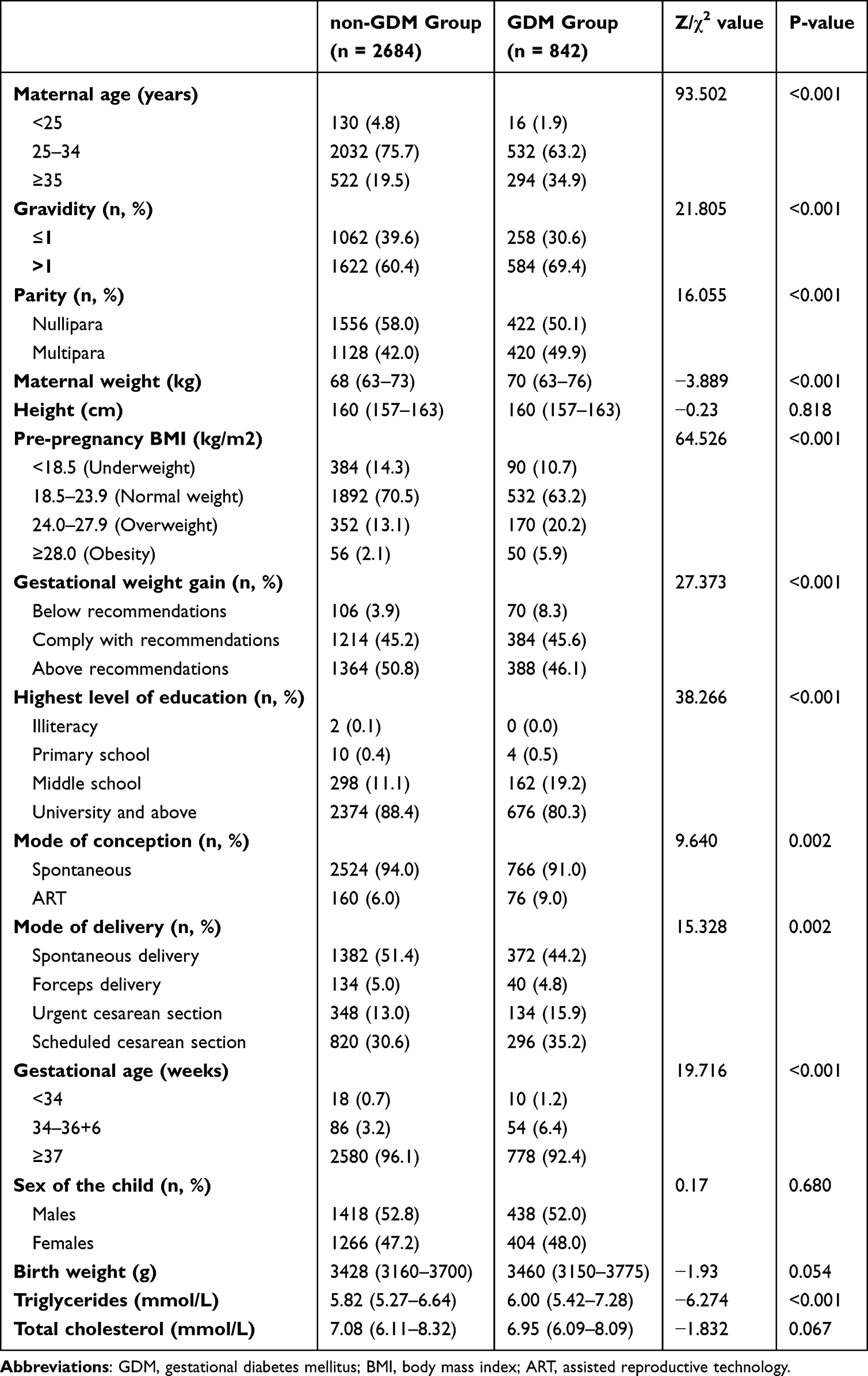 |
Table 1 Baseline Characteristics of Study Cohort |
 |
Figure 2 Two-group comparison of triglycerides (a), total cholesterol (a), maternal age (b), pre-delivery weight (b), BMI (b), and neonatal birth weight (b) in hyperlipidemic patients. Black lines represent median, lower quartile, and upper quartile. The percentage of adverse maternal and fetal outcomes in both groups (c). **, p<0.01. Abbreviations: HDP, hypertensive disorders of pregnancy; PTB, preterm birth; PPH, postpartum hemorrhage; ICP, intrahepatic cholestasis of pregnancy; SGA, small for gestational age infant; LGA, large for gestational age infant; FGR, fetal growth restriction. |
Compared to the non-GDM group, the GDM group had a substantially higher pre-pregnancy body mass index (BMI) (median: 21.94 vs 20.96 kg/m2, p<0.001), and a more significant proportion of overweight people (20.2% vs 13.1%) and obese people (5.9% vs 2.1%) (p<0.001) (Figure 2b). Analysis of weight gain during pregnancy showed a higher percentage of weight gain below the recommended amount (8.3% vs 3.9%) and a lower percentage of weight gain above the recommended amount (46.1% vs 50.8%, p<0.001) in the GDM group. The distribution of maternal height in the two groups did not differ significantly (p=0.818).
Regarding education level, the proportion of women with college and higher education in the GDM group was lower than that in the non-GDM group (80.3% vs 88.4%, P<0.001). In addition, a higher percentage of the GDM group used ART (9.0% vs 6.0%, p=0.002). Regarding delivery mode, the cesarean section rate was higher in the GDM group (48.4% vs 38.0%, P=0.002), and the spontaneous delivery rate was lower (44.2% vs 51.4%).
The rate of PTB was substantially greater (p<0.001), and the mean gestational week was marginally lower in the GDM group compared to the non-GDM group (p<0.001). The newborns’ sex distribution did not differ significantly between the two groups (p=0.680). Despite a modest increase in neonatal weight between the GDM and non-GDM groups, the difference was not statistically significant (p=0.054) (Figure 2b).
Figure 2c displays the percentage of women in both groups for each unfavorable pregnancy outcome.
Adverse Maternal Outcomes
Logistic regression analysis of the influence of blood glucose and lipids on maternal pregnancy complications is shown in Figure 3. There were statistically significant differences in the incidence of gestational hypertension, preeclampsia, PTB (34–36+6 weeks), cesarean section, intrahepatic cholestasis of pregnancy (ICP), and oligohydramnios between the two groups (p<0.05). The incidence of PTB (<34 weeks), PPH, placental abruption, placenta previa, chorioamnionitis, and polyhydramnios were not statistically significantly different (p>0.05). Maternal hyperlipidemia combined with GDM was associated with higher odds of gestational hypertension, preeclampsia, PTB (34–36+6 weeks), cesarean section, and ICP (OR 1.508, 95% CI 1.029–2.211, p=0.035; OR 1.883, 95% CI 1.279 −2.774, p=0.001; OR 2.082, 95% CI 1.468–2.954, p<0.001; OR 1.376, 95% CI 1.179–1.608, p<0.001; OR 1.779, 95% CI 1.249–2.533, p=0.001) and was associated with lower odds of oligohydramnios (OR 0.449, 95% CI 0.230–0.875, p=0.019).
 |
Figure 3 Obstetrical outcomes of study cohort. #Adjusted for maternal age, gravidity, parity, pre-pregnancy BMI, gestational weight gain, highest level of education, mode of conception and delivery. Abbreviations: HDP, hypertensive disorders of pregnancy; ICP, intrahepatic cholestasis of pregnancy; PTB, preterm birth; PPH, postpartum hemorrhage. |
Post-correction analyses were performed for age, BMI subgroups, gravidity, parity, gestational weight gain, education, mode of delivery, and mode of conception. In the adjusted model (Figure 3), hyperlipidemia combined with GDM remained independently associated with higher odds of PTB (34–36+6 weeks), ICP (aOR 1.986, 95% CI 1.384–2.849, p<0.001; aOR 1.716, 95% CI 1.184 −2.489, p=0.004) and was independently associated with lower odds of oligohydramnios and placenta previa (aOR 0.410, 95% CI 0.206–0.816, p=0.011; aOR 0.441, 95% CI 0.216–0.898, p=0.024). Hyperlipidemia combined with GDM was not significantly associated with HDP, PTB (<34 weeks), PPH, placental abruption, chorioamnionitis, cesarean section, and polyhydramnios (adjusted p>0.05).
Adverse Neonatal Outcomes
Figure 4 shows the comparison of fetal outcomes between two groups in the study cohort. The difference in the incidence of LGA, macrosomia, congenital anomalies, neonatal asphyxia, 1-minute Apgar score ≤7, and admission to the neonatology general ward between the two groups was statistically significant (p<0.05). There was no significant difference in the incidence of SGA, FGR, 5-minute Apgar score ≤7, and admission to NICU between the two groups (p>0.05). Hyperlipidemia combined with GDM was associated with higher odds of LGA, macrosomia, neonatal asphyxia, 1-minute Apgar score ≤7, and admission to the neonatology general ward (OR 1.351, 95% CI 1.154–1.581, p<0.001; OR 1.448, 95% CI 1.134–1.850, p=0.003; OR 1.946, 95% CI 1.229–3.081, p=0.004; OR 2.029, 95% CI 1.277–3.223, p=0.003; OR 1.310, 95% CI 1.090–1.574, p=0.004) and was associated with lower odds of congenital anomalies (OR 0.300, 95% CI 0.107–0.840, p=0.022).
 |
Figure 4 Fetal outcomes of study cohort. #Adjusted for maternal age, gravidity, parity, pre-pregnancy BMI, gestational weight gain, highest level of education, mode of conception and delivery. Abbreviations: SGA, small for gestational age infant; FGR, fetal growth restriction; LGA, large for gestational age infant. |
After adjusting for confounders such as age, parity, gravidity, gestational weight gain, BMI subgroups, education, mode of conception, and mode of delivery, hyperlipidemia combined with GDM remained independently associated with higher odds of LGA, macrosomia, and admission to the neonatology general ward (aOR 1.213, 95% CI 1.028–1.433, p= 0.023; aOR 1.445, 95% CI 1.116–1.872, p=0.005; aOR 1.229, 95% CI 1.017–1.487, p=0.033) and was independently associated with lower odds of congenital anomalies (aOR 0.326, 95% CI 0.114–0.929, P=0.036) (Figure 4). Hyperlipidemia combined with GDM was not significantly associated with SGA, FGR, neonatal asphyxia, Apgar score ≤7 and admission to the NICU (adjusted p>0.05).
Model Diagnostics and Sensitivity Analyses
The results of the multicollinearity test showed that no evidence of significant multicollinearity was observed among the covariates included in the multivariate logistic regression model, and the VIF for all variables was less than 5.0. According to the Hosmer–Lemeshow goodness-of-fit test, the multivariable logistic regression models demonstrated acceptable calibration (P > 0.05), indicating that the models adequately reflected the consistency between the observed data and the predicted results.
To further validate the robustness of the study findings, a sensitivity analysis was conducted after excluding pregnancies conceived through ART. The results showed that the association between maternal hyperlipidemia combined with gestational diabetes mellitus and preterm birth at 34–36+6 weeks, ICP, LGA infants, and macrosomia remained statistically significant, and the effect estimates were largely consistent with those from the main analysis. In contrast, the associations between hyperlipidemia combined with GDM and oligohydramnios, congenital anomalies, and admission to the neonatal general ward were no longer statistically significant after excluding ART pregnancies (Supplementary Table S1).
Discussion
Abnormal glucose and lipid metabolism during pregnancy is associated with adverse pregnancy outcomes. Against the backdrop of accelerated urbanization and changes in dietary structure worldwide, the prevalence of this condition is showing a significant upward trend.14 Compensatory hyperinsulinemia plays an important role in the regulation of both glucose and lipid metabolism during pregnancy. It leads to abnormal lipid metabolism by inhibiting lipolysis (inhibiting lipase activity) and promoting lipid synthesis (promoting fatty acid and TG uptake). Reactive oxygen radicals produced in adipose tissue can trigger oxidative stress and inflammation. This reaction leads to premature aging of the placenta, leading to pancreatic β-cell dysfunction and increased insulin resistance. Patients with GDM and hyperlipidemia may experience greater metabolic and vascular dysfunction, which could contribute to adverse pregnancy outcomes.7 In this retrospective cohort study of 3,526 singleton pregnancies with hyperlipidemia, coexisting GDM was independently associated with increased odds of PTB at 34–36+6 weeks of gestation, ICP, LGA, and macrosomia after adjustment for multiple maternal characteristics. Importantly, these associations remained consistent in sensitivity analyses excluding pregnancies conceived through assisted reproductive technology, underscoring the robustness of the observed findings. However, the association with neonatal ward admission was no longer statistically significant in the sensitivity analysis and therefore warrants cautious interpretation.
In the present study, pregnant women with hyperlipidemia and coexisting GDM exhibited significantly higher odds of PTB at 34–36+6 weeks of gestation after adjustment for potential confounding factors. Importantly, this association remained statistically significant in sensitivity analyses after excluding pregnancies conceived through assisted reproductive technology. Our findings are consistent with previous evidence demonstrating that both lipid and glucose metabolic abnormalities are associated with PTB. Cai et al15 reported that pregnant women with lipid metabolism disorders had a 1.42-fold higher risk of preterm birth, while several other studies similarly identified dyslipidemia as an independent factor associated with PTB.16,17 More recently, Smith et al18 reported that maternal dyslipidemia was associated with increased odds of PTB (aOR 1.49, 95% CI 1.39–1.59), and a cohort study involving 6,963 pregnant women further confirmed a significant association between abnormal maternal lipid profiles and PTB. Consistent with these findings, Sharami et al19 also reported a strong association between late-pregnancy hyperlipidemia and PTB. In addition, a systematic review and meta-analysis by Ye et al20 demonstrated that GDM was independently associated with PTB (aOR 1.51, 95% CI 1.26–1.80). PTB may be closely associated with pregnancy comorbidities such as GDM.21 Notably, our study extends previous evidence by simultaneously evaluating the associations of both glucose and lipid metabolic abnormalities with PTB. We observed that women with late-pregnancy hyperlipidemia complicated by GDM had nearly two-fold higher odds of late PTB (aOR 1.986), suggesting that concurrent disturbances in glucose and lipid metabolism may impose a greater metabolic burden than either condition alone.
Our study demonstrated that, among women with hyperlipidemia, coexisting GDM was independently associated with higher odds of ICP. This finding was further supported by the sensitivity analysis, in which the association remained statistically significant after exclusion of pregnancies conceived through assisted reproductive technology. Growing evidence suggests a close interplay among lipid metabolism, glucose homeostasis, and bile acid regulation during pregnancy.22,23 Previous studies have demonstrated that maternal lipid abnormalities are associated with ICP. Dann et al24 observed that women with ICP exhibited an abnormal lipid profile characterized by elevated concentrations of total cholesterol, low-density lipoprotein cholesterol (LDL-C), and apolipoprotein B-100. Similarly, Jin et al reported that each 1 mmol/L increase in third-trimester triglyceride concentration was associated with a higher likelihood of ICP. Furthermore, Zhang et al17 demonstrated in a prospective population-based study that elevated total cholesterol and LDL-C levels during late pregnancy were associated with a 1.39- to 1.56-fold increase in the odds of ICP.25 Although direct evidence demonstrating that GDM increases the likelihood of ICP remains limited, several studies have reported a close metabolic relationship between ICP and GDM. This association may be explained by shared pathophysiological pathways, including insulin resistance, bile acid signaling dysregulation, hepatic lipid metabolism, and impaired glucose–lipid homeostasis.23 Therefore, our findings extend previous evidence by suggesting that, among women already complicated by hyperlipidemia, those with coexisting GDM may represent a subgroup with a greater likelihood of developing ICP. Nevertheless, given the retrospective observational design of the present study, these findings should be interpreted cautiously and warrant further confirmation in prospective studies.
Our study further demonstrated that, after adjustment for multiple potential confounders, the coexistence of GDM among women with hyperlipidemia was significantly associated with an increased risk of macrosomia and LGA infants. These associations remained robust in sensitivity analyses, supporting the stability of our findings. Our results are consistent with previous evidence indicating that disturbances in both glucose and lipid metabolism contribute to excessive fetal growth. The landmark Hyperglycemia and Adverse Pregnancy Outcome (HAPO) study, which included more than 23,000 pregnant women, demonstrated a continuous positive association between maternal glycemia and fetal overgrowth, showing that each one-standard-deviation increase in maternal glucose concentration was associated with a 38–46% increase in the likelihood of birth weight above the 90th percentile.26 Catalano et al27 reported that maternal metabolic abnormalities, including hyperglycemia, obesity, and dyslipidemia, collectively contribute to excessive fetal growth and increased neonatal adiposity. Schaefer-Graf et al28 found that maternal triglyceride concentrations were an important determinant of fetal growth among women with GDM, independent of maternal body mass index, insulin resistance, and glycemic status, highlighting the critical role of maternal lipid metabolism in fetal development. Compared with previous studies, our investigation specifically evaluated the coexistence of hyperlipidemia and GDM and demonstrated that women with both conditions had 1.45-fold higher odds of macrosomia and 1.21-fold higher odds of LGA compared with women with hyperlipidemia alone. Several biological mechanisms may account for these observations. Maternal hyperglycemia increases placental glucose transfer, leading to fetal hyperinsulinemia, which in turn promotes adipose tissue deposition and somatic growth.29 Simultaneously, elevated maternal triglyceride and free fatty acid concentrations may enhance placental lipid transport, thereby increasing fetal fat accretion.30 The coexistence of hyperglycemia and dyslipidemia may therefore exert synergistic effects on nutrient transfer and fetal metabolic programming, ultimately contributing to excessive fetal growth.31 Further prospective studies are warranted to elucidate the underlying mechanisms linking concurrent glucose–lipid metabolic disturbances to fetal overgrowth and to determine whether targeted metabolic interventions during pregnancy can reduce the risk of LGA infants and macrosomia.
We also observed inverse associations between coexisting GDM and several pregnancy outcomes, including oligohydramnios and congenital anomalies. However, these findings should be interpreted with caution. In sensitivity analyses excluding pregnancies conceived through ART, the associations with oligohydramnios, congenital anomalies, and neonatal hospitalization were attenuated and no longer reached statistical significance. Although the direction of these associations remained unchanged, the loss of statistical significance suggests that these findings may not be robust. Several factors may account for these observations. Given the retrospective observational nature of this study, residual confounding cannot be completely excluded despite adjustment for multiple maternal characteristics. Differences in clinical surveillance, obstetric management, and other unmeasured maternal factors may have influenced the observed associations. Prospective studies incorporating more comprehensive assessments of maternal metabolic status, clinical management strategies, and potential confounding factors are warranted to clarify these associations.
This study has several strengths. Few previous studies have specifically evaluated adverse pregnancy outcomes among women with hyperlipidemia complicated by GDM.32–34 By focusing on this high-risk population, our study provides a more integrated assessment of concurrent glucose–lipid metabolic abnormalities during pregnancy. In addition, the relatively large sample size, homogeneous study population, standardized clinical management, and comprehensive medical records enabled adjustment for multiple measured confounding factors and enhanced the reliability of the findings. Nevertheless, several limitations should be acknowledged. Owing to the retrospective observational design, causal relationships cannot be established, and residual confounding cannot be completely excluded. Although multiple maternal characteristics were adjusted for in the multivariable analyses, information on dietary patterns, physical activity, glycemic control, lipid control, and intensity of clinical surveillance was unavailable and may have influenced the observed associations. Furthermore, a more comprehensive lipid profile, including apolipoprotein A-1, apolipoprotein B, high-density lipoprotein cholesterol, and low-density lipoprotein cholesterol, was not available in the database. Therefore, the potential contribution of specific lipid fractions to adverse pregnancy outcomes could not be evaluated. Finally, because pregnancies complicated by stillbirth and pregnancy termination were excluded, the potential association between hyperlipidemia combined with GDM and pregnancy loss could not be assessed. Future prospective studies incorporating detailed metabolic biomarkers, comprehensive lifestyle information, and longitudinal follow-up are warranted to validate our findings and further elucidate the mechanisms linking concurrent glucose–lipid metabolic abnormalities with adverse maternal and neonatal outcomes.
Conclusion
Among pregnant women with hyperlipidemia, coexisting gestational diabetes mellitus was significantly associated with higher odds of PTB at 34–36+6 weeks (aOR 1.986, 95% CI 1.384–2.849), ICP (aOR 1.716, 95% CI 1.184–2.489), LGA (aOR 1.213, 95% CI 1.028–1.433), and macrosomia (aOR 1.445, 95% CI 1.116–1.872). These findings may support the potential value of metabolic monitoring and risk stratification during pregnancy. However, given the retrospective observational design of this study, the observed associations should not be interpreted as causal relationships. Future prospective multicenter studies with detailed assessment of metabolic control and clinical management are warranted to validate these findings and further elucidate the underlying mechanisms.
Data Sharing Statement
The datasets generated/analyzed during the current study are available from the corresponding author upon reasonable request.
Ethics Approval and Consent to Participate
All procedures performed in studies involving human participants were in accordance with the ethical standards of the institutional and national research committee and with the 1964 Helsinki Declaration and its later amendments. This study was approved by the Ethics Committee of Women’s Hospital, School of Medicine, Zhejiang University (date of approval: September 13, 2021; Approval No. IRB-20210269-R; Hangzhou, China). The Ethics Committee of Women’s Hospital, School of Medicine, Zhejiang University granted a patient consent exemption because this retrospective study was harmless to the patients and contained no personal data.
Acknowledgments
We thank the subjects who participated in the current study.
Author Contributions
All authors made a significant contribution to the work reported, whether that is in the conception, study design, execution, acquisition of data, analysis and interpretation, or in all these areas; took part in drafting, revising or critically reviewing the article; gave final approval of the version to be published; have agreed on the journal to which the article has been submitted; and agree to be accountable for all aspects of the work.
Funding
This study was supported by the Basic Public Welfare Research Program of Zhejiang Province (Grant No. BY24H040038) and the Hangzhou Medical and Health Science and Technology Project (Grant No. A20231007).
Disclosure
The authors declare no competing interests in this work.
References
1. Schatoff D, Jung IY, Goldberg IJ. Lipid Disorders and Pregnancy. Endocrinol Metabol Clin North Am. 2024;53(3):483–12. doi:10.1016/j.ecl.2024.05.009
2. Mulder J, Kusters DM, Roeters van Lennep JE, Hutten BA. Lipid metabolism during pregnancy: consequences for mother and child. Curr Opin Lipidol. 2024;35(3):133–140. doi:10.1097/MOL.0000000000000927
3. Briana DD, Malamitsi-Puchner A. Effect of gestational diabetes mellitus and hypercholesterolemia on fetal cardiovascular disease risk: the role of epigenetics. Curr Vasc Pharmacol. 2022;20(4):379–380. doi:10.2174/1570161120666220804090725
4. Sweeting A, Wong J, Murphy HR, Ross GP. A clinical update on gestational diabetes mellitus. Endocr Rev. 2022;43(5):763–793. doi:10.1210/endrev/bnac003
5. Wang H, Li N, Chivese T, et al. IDF Diabetes Atlas: estimation of global and regional gestational diabetes mellitus prevalence for 2021 by International Association of Diabetes in Pregnancy Study Group’s Criteria. Diabetes Res Clin Pract. 2022;183:109050. doi:10.1016/j.diabres.2021.109050
6. Lee SM, Shivakumar M, Park JW, et al. Long-term cardiovascular outcomes of gestational diabetes mellitus: a prospective UK Biobank study. Cardiovasc Diabetol. 2022;21(1):221. doi:10.1186/s12933-022-01663-w
7. Eppel D, Feichtinger M, Lindner T, et al. Association between maternal triglycerides and disturbed glucose metabolism in pregnancy. Acta Diabetologica. 2021;58(4):459–465. doi:10.1007/s00592-020-01644-z
8. Furse S, Fernandez-Twinn DS, Chiarugi D, Koulman A, Ozanne SE. Lipid metabolism is dysregulated before, during and after pregnancy in a mouse model of gestational diabetes. Int J Mol Sci. 2021;22(14):7452. doi:10.3390/ijms22147452
9. Echeverria C, Eltit F, Santibanez JF, Gatica S, Cabello-Verrugio C, Simon F. Endothelial dysfunction in pregnancy metabolic disorders. Biochimica Et Biophysica Acta Molecular Basis of Disease. 2020;1866(2):165414. doi:10.1016/j.bbadis.2019.02.009
10. Wang Y, Pan XF, Pan A. Lipidomics in gestational diabetes mellitus. Curr Opin Lipidol. 2023;34(1):1–11. doi:10.1097/MOL.0000000000000858
11. Gorban de Lapertosa S, Alvariñas J, Elgart JF, Salzberg S, Gagliardino JJ. The triad macrosomia, obesity, and hypertriglyceridemia in gestational diabetes. Diabetes/Metabolism Res Rev. 2020;36(5):e3302. doi:10.1002/dmrr.3302
12. Duarte-Gardea MO, Gonzales-Pacheco DM, Reader DM, et al. Academy of nutrition and dietetics gestational diabetes evidence-based nutrition practice guideline. J Acad Nutri Dietetics. 2018;118(9):1719–1742. doi:10.1016/j.jand.2018.03.014
13. Jacobson TA, Maki KC, Orringer CE, et al. National lipid association recommendations for patient-centered management of dyslipidemia: part 2. J Clin Lipidol. 2015;9(6 Suppl):S1–122.e121. doi:10.1016/j.jacl.2015.09.002
14. GBD 2019 Diseases and Injuries Collaborators. Global burden of 369 diseases and injuries in 204 countries and territories, 1990-2019: a systematic analysis for the Global Burden of Disease Study 2019. Lancet. 2020;396(10258):1204–1222. doi:10.1016/S0140-6736(20)30925-9
15. Cai E, Czuzoj-Shulman N, Malhamé I, Abenhaim HA. Maternal and neonatal outcomes in women with disorders of lipid metabolism. J Perinatal Med. 2021;49(9):1129–1134. doi:10.1515/jpm-2021-0028
16. Maymunah AO, Kehinde O, Abidoye G, Oluwatosin A. Hypercholesterolaemia in pregnancy as a predictor of adverse pregnancy outcome. African Health Sci. 2014;14(4):967–973. doi:10.4314/ahs.v14i4.28
17. Jin WY, Lin SL, Hou RL, et al. Associations between maternal lipid profile and pregnancy complications and perinatal outcomes: a population-based study from China. BMC Pregnancy Childbirth. 2016;16:60. doi:10.1186/s12884-016-0852-9
18. Smith CJ, Baer RJ, Oltman SP, et al. Maternal dyslipidemia and risk for preterm birth. PLoS One. 2018;13(12):e0209579. doi:10.1371/journal.pone.0209579
19. Sharami SH, Gholipour M, Milani F, Kazemnejad E, Heirati SFD, Ranjbar ZA. The association between dyslipidemia and preterm birth: a prospective cohort study in The North of Iran. Endocrin Metabol Immun Disord Drug Targets. 2020;20(2):227–233. doi:10.2174/1871530319666190529090517
20. Ye W, Luo C, Huang J, Li C, Liu Z, Liu F. Gestational diabetes mellitus and adverse pregnancy outcomes: systematic review and meta-analysis. BMJ. 2022;377:e067946.
21. Ghodke B, Pusukuru R, Mehta V. Association of lipid profile in pregnancy with preeclampsia, gestational diabetes mellitus, and preterm delivery. Cureus. 2017;9(7):e1420. doi:10.7759/cureus.1420
22. Huang H, Li J, Chen T, et al. The correlation between blood lipids and intrahepatic cholestasis syndrome during pregnancy. J Obstet Gynaecol. 2024;44(1):2369929. doi:10.1080/01443615.2024.2369929
23. Fan HM, Mitchell AL, Williamson C. ENDOCRINOLOGY IN PREGNANCY: metabolic impact of bile acids in gestation. Eur J Endocrinol. 2021;184(3):R69–r83. doi:10.1530/EJE-20-1101
24. Dann AT, Kenyon AP, Wierzbicki AS, Seed PT, Shennan AH, Tribe RM. Plasma lipid profiles of women with intrahepatic cholestasis of pregnancy. Obstet Gynecol. 2006;107(1):106–114. doi:10.1097/01.AOG.0000189096.94874.9c
25. Zhang Y, Lan X, Cai C, et al. Associations between maternal lipid profiles and pregnancy complications: a prospective population-based study. Am J Perinatol. 2021;38(8):834–840. doi:10.1055/s-0039-3402724
26. Metzger BE, Lowe LP, Dyer AR, et al. Hyperglycemia and adverse pregnancy outcomes. N Engl J Med. 2008;358(19):1991–2002.
27. Catalano PM, McIntyre HD, Cruickshank JK, et al. The hyperglycemia and adverse pregnancy outcome study: associations of GDM and obesity with pregnancy outcomes. Diabetes Care. 2012;35(4):780–786. doi:10.2337/dc11-1790
28. Schaefer-Graf UM, Graf K, Kulbacka I, et al. Maternal lipids as strong determinants of fetal environment and growth in pregnancies with gestational diabetes mellitus. Diabetes Care. 2008;31(9):1858–1863. doi:10.2337/dc08-0039
29. Bao W, Dar S, Zhu Y, et al. Plasma concentrations of lipids during pregnancy and the risk of gestational diabetes mellitus: a longitudinal study. J Diabetes. 2018;10(6):487–495. doi:10.1111/1753-0407.12563
30. Rojas-Rodriguez R, Price LL, Somogie J, Hauguel-de Mouzon S, Kalhan SC, Catalano PM. Maternal lipid metabolism is associated with neonatal adiposity: a longitudinal study. J Clin Endocrinol Metabolism. 2022;107(9):e3759–e3768. doi:10.1210/clinem/dgac360
31. Wang J, Moore D, Subramanian A, et al. Gestational dyslipidaemia and adverse birthweight outcomes: a systematic review and meta-analysis. Obesity Rev. 2018;19(9):1256–1268. doi:10.1111/obr.12693
32. Zhou Y, Zhao R, Lyu Y, et al. Serum and amniotic fluid metabolic profile changes in response to gestational diabetes mellitus and the association with maternal-fetal outcomes. Nutrients. 2021;13(10):3644. doi:10.3390/nu13103644
33. Li D, Du H, Wu N. Association between serum free fatty acids and gestational diabetes mellitus. Front Endocrinol. 2024;15:1451769. doi:10.3389/fendo.2024.1451769
34. Shi P, Tang J, Yin X. Association between second- and third-trimester maternal lipid profiles and adverse perinatal outcomes among women with GDM and non-GDM: a retrospective cohort study. BMC Pregnancy Childbirth. 2023;23(1):318. doi:10.1186/s12884-023-05630-5
 © 2026 The Author(s). This work is published and licensed by Dove Medical Press Limited. The
full terms of this license are available at https://www.dovepress.com/terms
and incorporate the Creative Commons Attribution
- Non Commercial (unported, 4.0) License.
By accessing the work you hereby accept the Terms. Non-commercial uses of the work are permitted
without any further permission from Dove Medical Press Limited, provided the work is properly
attributed. For permission for commercial use of this work, please see paragraphs 4.2 and 5 of our Terms.
© 2026 The Author(s). This work is published and licensed by Dove Medical Press Limited. The
full terms of this license are available at https://www.dovepress.com/terms
and incorporate the Creative Commons Attribution
- Non Commercial (unported, 4.0) License.
By accessing the work you hereby accept the Terms. Non-commercial uses of the work are permitted
without any further permission from Dove Medical Press Limited, provided the work is properly
attributed. For permission for commercial use of this work, please see paragraphs 4.2 and 5 of our Terms.
Recommended articles

Gestational Diabetes Mellitus Risk Factors in Pregnant Women Attending Public Health Institutions in Ethiopia’s Sidama Region: An Unmatched Case-Control Study
Bune GT
Diabetes, Metabolic Syndrome and Obesity 2024, 17:2303-2316
Published Date: 7 June 2024